• Trade
  • Markets
  • Copy
  • Contests
  • News
  • 24/7
  • Calendar
  • Q&A
  • Chats
Trending
Screeners
SYMBOL
LAST
BID
ASK
HIGH
LOW
NET CHG.
%CHG.
SPREAD
SPX
S&P 500 Index
6827.42
6827.42
6827.42
6899.86
6801.80
-73.58
-1.07%
--
DJI
Dow Jones Industrial Average
48458.04
48458.04
48458.04
48886.86
48334.10
-245.98
-0.51%
--
IXIC
NASDAQ Composite Index
23195.16
23195.16
23195.16
23554.89
23094.51
-398.69
-1.69%
--
USDX
US Dollar Index
97.950
98.030
97.950
98.500
97.950
-0.370
-0.38%
--
EURUSD
Euro / US Dollar
1.17394
1.17409
1.17394
1.17496
1.17192
+0.00011
+ 0.01%
--
GBPUSD
Pound Sterling / US Dollar
1.33707
1.33732
1.33707
1.33997
1.33419
-0.00148
-0.11%
--
XAUUSD
Gold / US Dollar
4299.39
4299.39
4299.39
4353.41
4257.10
+20.10
+ 0.47%
--
WTI
Light Sweet Crude Oil
57.233
57.485
57.233
58.011
56.969
-0.408
-0.71%
--

Community Accounts

Signal Accounts
--
Profit Accounts
--
Loss Accounts
--
View More

Become a signal provider

Sell trading signals to earn additional income

View More

Guide to Copy Trading

Get started with ease and confidence

View More

Signal Accounts for Members

All Signal Accounts

Best Return
  • Best Return
  • Best P/L
  • Best MDD
Past 1W
  • Past 1W
  • Past 1M
  • Past 1Y

All Contests

  • All
  • Trump Updates
  • Recommend
  • Stocks
  • Cryptocurrencies
  • Central Banks
  • Featured News
Top News Only
Share

Iranian Media Says 18 Crew Members Of Foreign Tanker Seized In Gulf Of Oman Over Carrying 'Smuggled Fuel' Detained

Share

Regional Governor: Two Killed In Ukrainian Drone Strike On Russia's Saratov

Share

Chinese Foreign Ministry - China Foreign Minister Met With United Arab Emirates Counterpart On Dec 12

Share

China's Central Financial And Economic Affairs Commission Deputy Director: Will Expand Export And Increase Import In 2026

Share

Thai Leader Anutin: Landmine Blast That Killed Thai Soldiers 'Not A Roadside Accident'

Share

Thai Leader Anutin: Thailand To Continue Military Action Until 'We Feel No More Harm'

Share

Cambodian Prime Minister Hun Manet Says He Had Phone Calls With Trump And Malaysian Leader Anwar About Ceasefire

Share

Cambodia's Hun Manet Says USA, Malaysia Should Verify 'Which Side Fired First' In Latest Conflict

Share

Cambodia's Hun Manet: Cambodia Maintains Its Stance In Seeking Peaceful Resolution Of Disputes

Share

Nasdaq Companies: Allergan, Ferrovia, Insmed, Monolithic Power Systems, Seagate Technology, And Western Digital Will Be Added To The NASDAQ 100 Index. Biogen, CdW, GlobalFoundries, Lululemon, ON Semiconductor, And Tradedesk Will Be Removed From The NASDAQ 100 Index

Share

Witkoff Headed To Berlin This Weekend To Meet With Zelenskiy, European Leaders -Wsj Reporter On X

Share

Russia Attacks Two Ukrainian Ports, Damaging Three Turkish-Owned Vessels

Share

[Historic Flooding Occurs In At Least Four Rivers In Washington State Due To Days Of Torrential Rains] Multiple Areas In Washington State Have Been Hit By Severe Flooding Due To Days Of Torrential Rains, With At Least Four Rivers Experiencing Historic Flooding. Reporters Learned On The 12th That The Floods Caused By The Torrential Rains In Washington State Have Destroyed Homes And Closed Several Highways. Experts Warn That Even More Severe Flooding May Occur In The Future. A State Of Emergency Has Been Declared In Washington State

Share

Trump Says Proposed Free Economic Zone In Donbas Would Work

Share

Trump: I Think My Voice Should Be Heard

Share

Trump Says Will Be Choosing New Fed Chair In Near Future

Share

Trump Says Proposed Free Economic Zone In Donbas Complex But Would Work

Share

Trump Says Land Strikes In Venezuela Will Start Happening

Share

US President Trump: Thailand And Cambodia Are In A Good Situation

Share

State Media: North Korean Leader Kim Hails Troops Returning From Russia Mission

TIME
ACT
FCST
PREV
U.K. Trade Balance Non-EU (SA) (Oct)

A:--

F: --

P: --

U.K. Trade Balance (Oct)

A:--

F: --

P: --

U.K. Services Index MoM

A:--

F: --

P: --

U.K. Construction Output MoM (SA) (Oct)

A:--

F: --

P: --

U.K. Industrial Output YoY (Oct)

A:--

F: --

P: --

U.K. Trade Balance (SA) (Oct)

A:--

F: --

P: --

U.K. Trade Balance EU (SA) (Oct)

A:--

F: --

P: --

U.K. Manufacturing Output YoY (Oct)

A:--

F: --

P: --

U.K. GDP MoM (Oct)

A:--

F: --

P: --

U.K. GDP YoY (SA) (Oct)

A:--

F: --

P: --

U.K. Industrial Output MoM (Oct)

A:--

F: --

P: --

U.K. Construction Output YoY (Oct)

A:--

F: --

P: --

France HICP Final MoM (Nov)

A:--

F: --

P: --

China, Mainland Outstanding Loans Growth YoY (Nov)

A:--

F: --

P: --

China, Mainland M2 Money Supply YoY (Nov)

A:--

F: --

P: --

China, Mainland M0 Money Supply YoY (Nov)

A:--

F: --

P: --

China, Mainland M1 Money Supply YoY (Nov)

A:--

F: --

P: --

India CPI YoY (Nov)

A:--

F: --

P: --

India Deposit Gowth YoY

A:--

F: --

P: --

Brazil Services Growth YoY (Oct)

A:--

F: --

P: --

Mexico Industrial Output YoY (Oct)

A:--

F: --

P: --

Russia Trade Balance (Oct)

A:--

F: --

P: --

Philadelphia Fed President Henry Paulson delivers a speech
Canada Building Permits MoM (SA) (Oct)

A:--

F: --

P: --

Canada Wholesale Sales YoY (Oct)

A:--

F: --

P: --

Canada Wholesale Inventory MoM (Oct)

A:--

F: --

P: --

Canada Wholesale Inventory YoY (Oct)

A:--

F: --

P: --

Canada Wholesale Sales MoM (SA) (Oct)

A:--

F: --

P: --

Germany Current Account (Not SA) (Oct)

A:--

F: --

P: --

U.S. Weekly Total Rig Count

A:--

F: --

P: --

U.S. Weekly Total Oil Rig Count

A:--

F: --

P: --

Japan Tankan Large Non-Manufacturing Diffusion Index (Q4)

--

F: --

P: --

Japan Tankan Small Manufacturing Outlook Index (Q4)

--

F: --

P: --

Japan Tankan Large Non-Manufacturing Outlook Index (Q4)

--

F: --

P: --

Japan Tankan Large Manufacturing Outlook Index (Q4)

--

F: --

P: --

Japan Tankan Small Manufacturing Diffusion Index (Q4)

--

F: --

P: --

Japan Tankan Large Manufacturing Diffusion Index (Q4)

--

F: --

P: --

Japan Tankan Large-Enterprise Capital Expenditure YoY (Q4)

--

F: --

P: --

U.K. Rightmove House Price Index YoY (Dec)

--

F: --

P: --

China, Mainland Industrial Output YoY (YTD) (Nov)

--

F: --

P: --

China, Mainland Urban Area Unemployment Rate (Nov)

--

F: --

P: --

Saudi Arabia CPI YoY (Nov)

--

F: --

P: --

Euro Zone Industrial Output YoY (Oct)

--

F: --

P: --

Euro Zone Industrial Output MoM (Oct)

--

F: --

P: --

Canada Existing Home Sales MoM (Nov)

--

F: --

P: --

Euro Zone Total Reserve Assets (Nov)

--

F: --

P: --

U.K. Inflation Rate Expectations

--

F: --

P: --

Canada National Economic Confidence Index

--

F: --

P: --

Canada New Housing Starts (Nov)

--

F: --

P: --

U.S. NY Fed Manufacturing Employment Index (Dec)

--

F: --

P: --

U.S. NY Fed Manufacturing Index (Dec)

--

F: --

P: --

Canada Core CPI YoY (Nov)

--

F: --

P: --

Canada Manufacturing Unfilled Orders MoM (Oct)

--

F: --

P: --

Canada Manufacturing New Orders MoM (Oct)

--

F: --

P: --

Canada Core CPI MoM (Nov)

--

F: --

P: --

Canada Manufacturing Inventory MoM (Oct)

--

F: --

P: --

Canada CPI YoY (Nov)

--

F: --

P: --

Canada CPI MoM (Nov)

--

F: --

P: --

Canada CPI YoY (SA) (Nov)

--

F: --

P: --

Canada Core CPI MoM (SA) (Nov)

--

F: --

P: --

Q&A with Experts
    • All
    • Chatrooms
    • Groups
    • Friends
    Connecting
    .
    .
    .
    Type here...
    Add Symbol or Code

      No matching data

      All
      Trump Updates
      Recommend
      Stocks
      Cryptocurrencies
      Central Banks
      Featured News
      • All
      • Russia-Ukraine Conflict
      • Middle East Flashpoint
      • All
      • Russia-Ukraine Conflict
      • Middle East Flashpoint
      Search
      Products

      Charts Free Forever

      Chats Q&A with Experts
      Screeners Economic Calendar Data Tools
      Membership Features
      Data Warehouse Market Trends Institutional Data Policy Rates Macro

      Market Trends

      Market Sentiment Order Book Forex Correlations

      Top Indicators

      Charts Free Forever
      Markets

      News

      News Analysis 24/7 Columns Education
      From Institutions From Analysts
      Topics Columnists

      Latest Views

      Latest Views

      Trending Topics

      Top Columnists

      Latest Update

      Signals

      Copy Rankings Latest Signals Become a signal provider AI Rating
      Contests
      Brokers

      Overview Brokers Assessment Rankings Regulators News Claims
      Broker listing Forex Brokers Comparison Tool Live Spread Comparison Scam
      Q&A Complaint Scam Alert Videos Tips to Detect Scam
      More

      Business
      Events
      Careers About Us Advertising Help Center

      White Label

      Data API

      Web Plug-ins

      Affiliate Program

      Awards Institution Evaluation IB Seminar Salon Event Exhibition
      Vietnam Thailand Singapore Dubai
      Fans Party Investment Sharing Session
      FastBull Summit BrokersView Expo
      Recent Searches
        Top Searches
          Markets
          News
          Analysis
          User
          24/7
          Economic Calendar
          Education
          Data
          • Names
          • Latest
          • Prev

          View All

          No data

          Scan to Download

          Faster Charts, Chat Faster!

          Download App
          English
          • English
          • Español
          • العربية
          • Bahasa Indonesia
          • Bahasa Melayu
          • Tiếng Việt
          • ภาษาไทย
          • Français
          • Italiano
          • Türkçe
          • Русский язык
          • 简中
          • 繁中
          Open Account
          Search
          Products
          Charts Free Forever
          Markets
          News
          Signals

          Copy Rankings Latest Signals Become a signal provider AI Rating
          Contests
          Brokers

          Overview Brokers Assessment Rankings Regulators News Claims
          Broker listing Forex Brokers Comparison Tool Live Spread Comparison Scam
          Q&A Complaint Scam Alert Videos Tips to Detect Scam
          More

          Business
          Events
          Careers About Us Advertising Help Center

          White Label

          Data API

          Web Plug-ins

          Affiliate Program

          Awards Institution Evaluation IB Seminar Salon Event Exhibition
          Vietnam Thailand Singapore Dubai
          Fans Party Investment Sharing Session
          FastBull Summit BrokersView Expo

          Britain's Bold Leap: Unveiling a Vision for a Competitive Carbon Capture Revolution by 2035!

          Ukadike Micheal

          Energy

          Political

          Economic

          Summary:

          UK Unveils Bold 2035 Vision: Shifting from Subsidies to a Competitive Carbon Capture Market, Accelerating Innovation and Driving Down Costs for a Greener Future.

          In a historic move announced on Wednesday, the British government is steering its environmental strategy toward a future dominated by a competitive market for carbon capture, usage, and storage (CCUS) by 2035. This visionary plan marks a decisive departure from conventional subsidies, injecting vitality into the dynamic landscape of sustainable technologies.
          The UK's commitment to this green transition is underscored by a substantial £20 billion ($25.33 billion) investment pledge made earlier this year, primarily directed towards carbon capture and storage technology, with a strategic focus on fostering clusters in Scotland and northern England. This financial backing lays the foundation for groundbreaking advancements in the realm of carbon capture.
          Under the newly unveiled plans, specific conditions will be established to welcome projects into the market that are unable to transport CO2 via pipelines. This inclusivity, set to commence by 2025, opens avenues for alternative transportation modes, including ship, road, and rail. These measures reflect the government's proactive approach to adapting and diversifying CCUS strategies to ensure broader participation and impact.
          At the heart of the UK's environmental aspirations is the ambitious goal to capture 20-30 million tonnes of CO2 annually by 2030. This target aligns with the nation's broader commitment to achieving a net-zero economy by 2050. The government underscores the significance of capturing carbon dioxide before it reaches the atmosphere as a pivotal strategy in realizing this overarching environmental objective.
          Beneath the North Sea lies a vast expanse of potential, offering storage space for an astounding 78 billion tonnes of CO2. This untapped reservoir emphasizes the UK's strategic advantage and capacity for sustainable carbon storage, positioning the nation as a leader in the global fight against climate change.
          Commercial terms have been successfully negotiated to expand the Northern Endurance Partnership (NEP) in northern England. This strategic move paves the way for the expansion of critical clusters, solidifying the UK's commitment to fostering collaborative efforts and creating regional hubs for sustainable innovation.
          the British government's bold initiative sets a global precedent, showcasing a commitment to environmental stewardship that extends beyond rhetoric. The transformative shift away from subsidies towards a competitive CCUS market by 2035 not only accelerates innovation but also propels the UK into a leadership role in sustainable practices. As the world watches, the UK's journey toward a greener, more sustainable future serves as a beacon of hope and inspiration for nations worldwide, signaling a paradigm shift in the fight against climate change.

          Source: Reuters

          To stay updated on all economic events of today, please check out our Economic calendar
          Risk Warnings and Disclaimers
          You understand and acknowledge that there is a high degree of risk involved in trading. Following any strategies or investment methods may lead to potential losses. The content on the site is provided by our contributors and analysts for information purposes only. You are solely responsible for determining whether any trading assets, securities, strategy, or any other product is suitable for investing based on your own investment objectives and financial situation.
          Comments
          Add to Favorites
          Share

          Japan's Central Bank Keeps Its Negative Interest Rate Unchanged, Says It's Watching Wage Trends

          Zi Cheng

          Central Bank

          The Bank of Japan kept its longstanding easy credit policy unchanged on Tuesday, saying it will watch price and wage trends before raising its negative benchmark interest rate.
          The BOJ policy decision was widely expected. But investors and analysts believe the central bank is tip-toeing toward a shift due to price increases that have left inflation above its 2% target.
          The U.S. dollar gained against the Japanese yen and stock prices surged after Tuesday’s decision.
          The benchmark rate of negative 0.1% is meant to encourage banks to lend more and businesses and consumers to borrow more to spur the economy, the world's third-largest. The central bank also has purchased trillions of dollars worth of government bonds and other assets as part of its strategy of injecting more cash to spur growth as the Japanese population shrinks and grows older.
          Inflation has risen in Japan but at a much slower pace than in the U.S. and other major economies, most recently at about 3%. At the same time, the U.S. dollar has risen against the Japanese yen as rates were raised to counter inflation that peaked at 9.1% in the U.S. That has undercut the purchasing power of the yen, raising costs for energy and other commodities.
          BOJ Gov. Kazuo Ueda has remained cautious about raising rates, saying that wage increases have lagged behind rising prices and that the target level of inflation may not be sustained.
          The central bank's policy statement said that housing investment remained weak and government spending was flat.
          “With extremely high uncertainties surrounding economies and financial markets at home and abroad, the bank will patiently continue with monetary easing,” the BOJ said in a statement.
          The central bank is reviewing its strategy, but “will not rush to exit” its current stance of “quantitative easing,” Oxford Economics said in a research note. “The exit will be delicate, requiring many years and comprehensive policy measures in conjunction with the government to ensure a smooth and stable process,” it said.

          Source: ABC News

          Risk Warnings and Disclaimers
          You understand and acknowledge that there is a high degree of risk involved in trading. Following any strategies or investment methods may lead to potential losses. The content on the site is provided by our contributors and analysts for information purposes only. You are solely responsible for determining whether any trading assets, securities, strategy, or any other product is suitable for investing based on your own investment objectives and financial situation.
          Comments
          Add to Favorites
          Share

          Bank of England Rate Cut Bets Surge As Inflation Could Hit 2.0% Target Within Months

          Warren Takunda

          Economic

          Bank of England rate cut bets have surged in the wake of December's inflation release that showed price pressures were easing rapidly in the UK and could fall to the 2.0% target in a matter of months.
          The fall in headline CPI inflation to 3.9% year-on-year in October was met with a frenzy of bets on money markets that showed investors now see the first Bank of England rate cut falling in May of 2024.
          "We continue to expect the MPC to reduce Bank Rate by 25bp initially in May, and then at alternate meetings thereafter," says Samuel Tombs, Chief UK Economist at Pantheon Macroeconomics.
          The scale of the undershoot in all elements of the inflation data caught markets and economists off guard, with the all-important core CPI rate printing at -0.3% month-on-month, which was well below October's 0.3% and the expected 0.2%.
          Reacting to the inflation surprise, the overnight index swaps (OIS) market showed investors added to rate cut bets for 2024 and 2025:
          Bank of England Rate Cut Bets Surge As Inflation Could Hit 2.0% Target Within Months_1

          Above: Rate cut expectations have increased significantly today. Chart updated 09:14 GMT, 20/12/23. Source: Refinitiv. Courtesy of @Capital Edge

          The OIS market implies investors are now looking for roughly five cuts in 2024, with the bank rate falling from 5.25% to around 4.0%, followed by four more cuts in 2025 to a year-end rate of c3.0%.
          As the chart above shows, this is materially more than was expected just days ago.
          The repricing lower in interest rate expectations has boosted UK bond prices, which has corresponded with falling bond yields, which has weighed on the Pound. "With more rate cuts priced in, GBP, to no surprise, is falling," says Thanim Islam, Head of FX Analysis at Equals Money.
          Looking ahead, CPI inflation looks set to continue to fall more quickly than the Bank of England predicted in November. Pantheon Macroeconomics says the headline rate of CPI inflation will drop to about 3.8% in Q1 and then to 2.0% in Q2, substantially below the MPC’s forecasts of 4.4% and 3.6%, respectively.
          "This will support a sooner and swifter reduction in Bank Rate than the MPC has countenanced to date, though we still think uncertainty over the scope of fiscal loosening in the Budget and the impact of next April’s increase in the National Living Wage on overall wages will mean that the MPC will not cut Bank Rate at its next meeting in early February," says Pantheon's Tombs.
          Despite the fall in inflation, some economists warn market expectations for the timing of the first rate cut in May, as well as the total for 2024, are excessive.
          "We expect the Bank of England to face more intensive debate about when it can cut interest rates, but to try and push against this whilst it waits for reassurance that the inflation battle really has been won," says Victoria Clarke, UK Chief Economist at Santander CIB.
          Santander says the Bank of England will only gain the comfort it needs to start cutting interest rates in summer 2024, implying rate cut expectations must reverse at some point.
          Clarke says although inflation is set to trend lower from here, "the trickier problem for the Bank of England is that services inflation is still elevated, and pay growth too, making it difficult for the BoE to conclude inflation will stay at low rates."

          Source: PoundSterlingLive

          To stay updated on all economic events of today, please check out our Economic calendar
          Risk Warnings and Disclaimers
          You understand and acknowledge that there is a high degree of risk involved in trading. Following any strategies or investment methods may lead to potential losses. The content on the site is provided by our contributors and analysts for information purposes only. You are solely responsible for determining whether any trading assets, securities, strategy, or any other product is suitable for investing based on your own investment objectives and financial situation.
          Comments
          Add to Favorites
          Share

          Central Banks, King Canute and Rate Tide

          Zi Cheng

          Economic

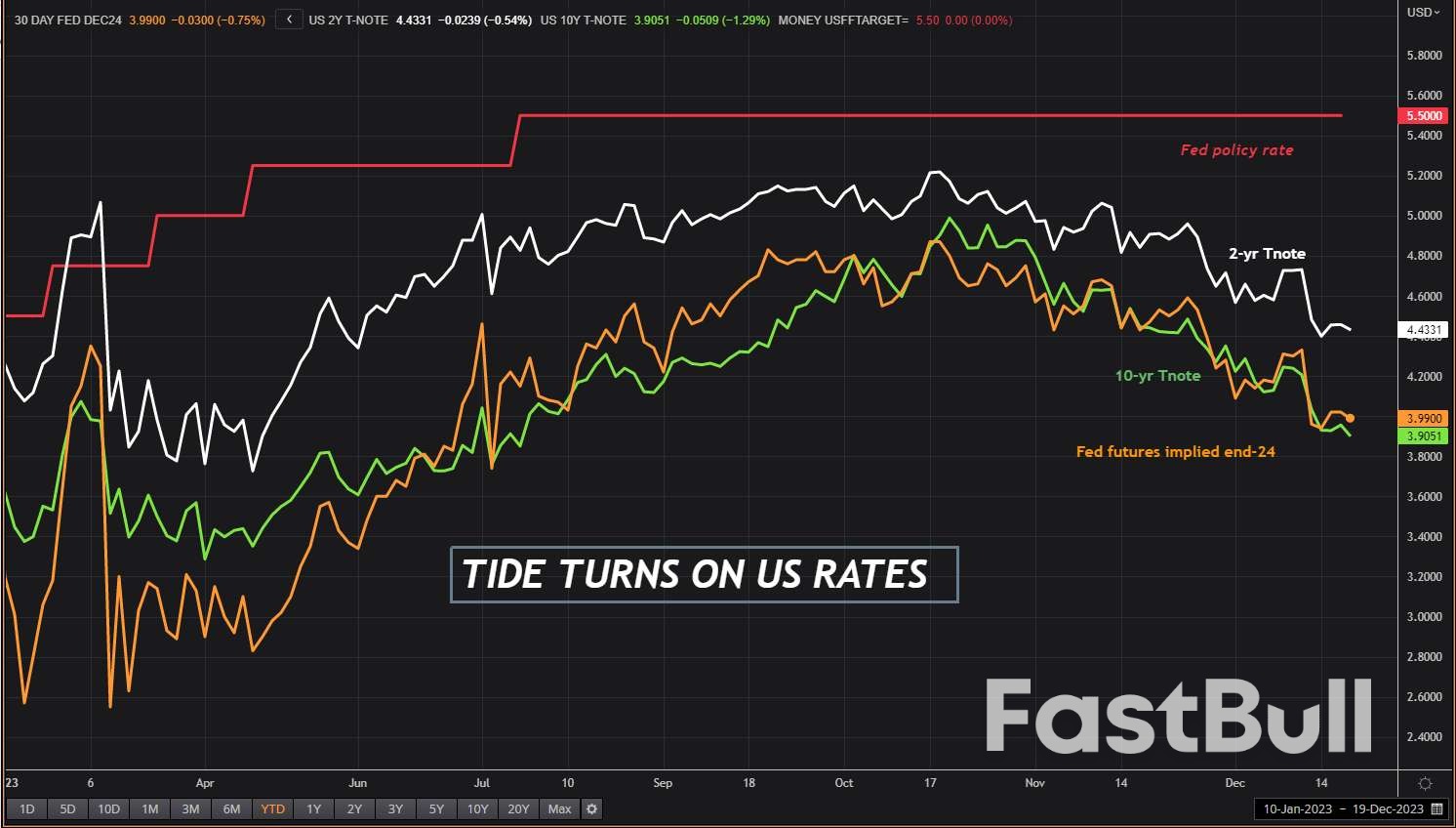
          Like medieval King Canute's unsuccessful attempt to command the incoming tide to stop, central banks' attempts to push back against swelling interest rate cut bets seem forlorn.
          But like the story of the old Anglo-Norse monarch, there's more to these old yarns than meets the eye.
          For many, the apocryphal tale of Canute ordering the tide to stop just illustrates foolish overconfidence in regal power. Yet chroniclers insist the wily king was in fact just showing his courtiers the limits of his earthly majesty in the face of overarching forces of god and nature.
          Stretching the analogy at bit, a similar nuance for central banks is important looking ahead to 2024.
          After acknowledging the interest rate cycle had turned, many Federal Reserve and other central bank officials now feel compelled to stop the tide from coming in too fast - scrambling to warn markets not to overstep the mark.
          On the face of it, that seems a bit futile - at least trying to frustrate long-maturity bond yields from pricing what many will reasonably see as a full cyclical downswing in rates over the years ahead.
          The Fed and others officials could prod and poke futures and short rates pricing by protesting against the now-assumed rate cut timings - but stopping a dash for 10-or 30-year coupons is a different matter altogether and largely outside its control as it hinges more on how the economy unfolds.
          Yet, the Fed will surely have known last Wednesday exactly what changed projections for next year would unleash. And with armies of researchers and market liaison staff - it will also know that rhetorical pushback on economically sensitive long rates won't cut it once an easing cycle is started.
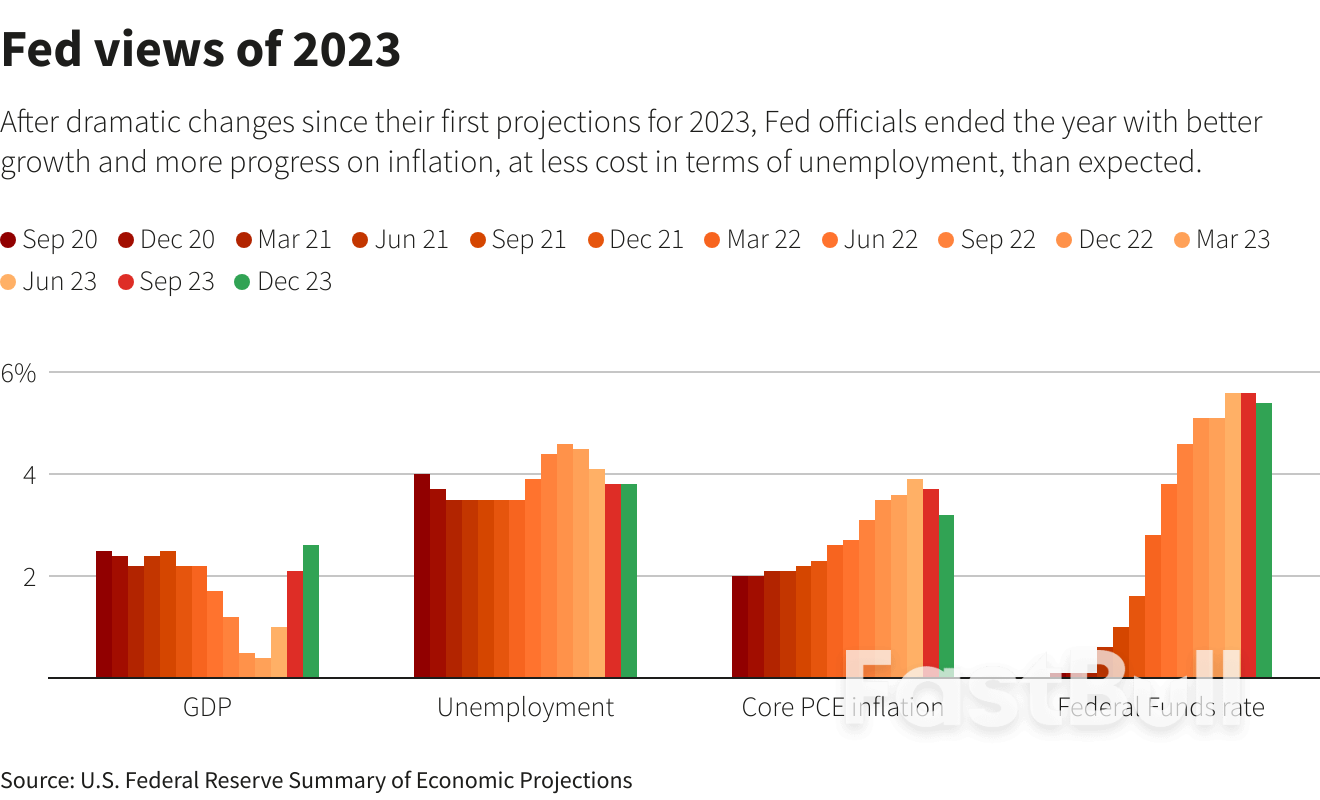
          After all, markets were already priced for 100 basis points of cuts when the standing Fed forecasts still had a median 'dot' pointing to one more hike this year. The fact they're now pricing up to 150bps of cuts next year when the Fed policymaker average has shifted to cuts of 75bps is not greatly surprising.
          So, much like Canute, the Fed - and its counterparts in continental Europe where inflation is already back near target - may just be playing a game of optics while acknowledging the direction of travel in markets is both a little beyond their control now and possibly what they wanted anyway.
          Perhaps.
          ECB board member Isabel Schnabel's dramatic switch from hawk to dove earlier this month is case in point - and any attempt at stanching the market flow after that switch may just seem mischievous.
          Publicly at least, central bankers often want to distance themselves from markets altogether - preferring to see price shifts as a force of nature as changeable as the wind, or indeed the tide.
          "One of the things I've learned is I don't control markets and so they're going to do what they're going to do," Richmond Fed President Thomas Barkin opined on Tuesday.
          And even though the Fed will insist it's "data dependent" from here, Barkin seemed pretty comfortable with the state of play and what the Fed was indicating.

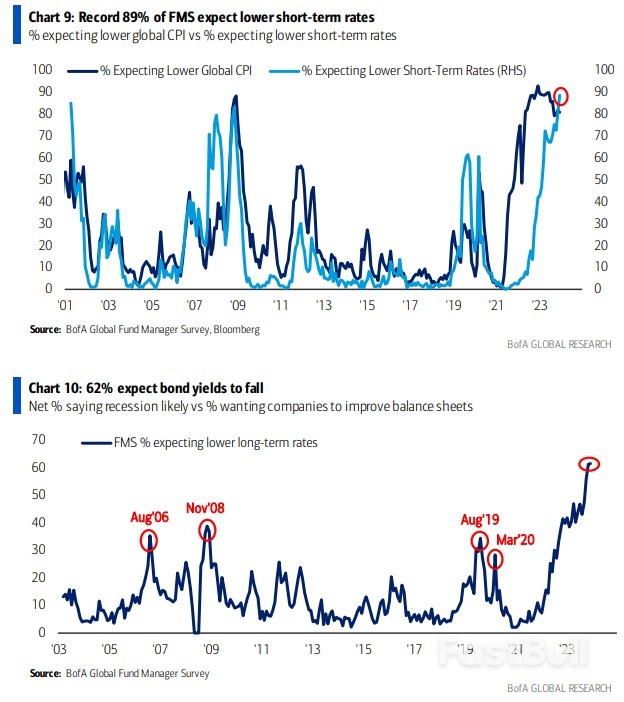
          Central Banks, King Canute and Rate Tide_1Central Banks, King Canute and Rate Tide_2Bank of America chart on fund mangers' rates view

          Central Banks, King Canute and Rate Tide_3Reuters Graphics Reuters Graphics

          NEW 'RESTRICTIVE' MANTRA

          What's more, the 'higher for longer' mantra prevalent at most top central banks for so long has shifted subtly too - to "more restrictive for longer".
          "It will be important for monetary policy to be restrictive for an extended period," Bank of England Deputy Governor Sarah Breeden said on Wednesday.
          But of course "restrictive" is not strictly where rates are now.
          If rates above the Fed's unchanged long-term neutral rate of 2.5% are technically bearing down on the economy, then that leaves a lot of potential easing while remaining 'restrictive'. Even matching the markets' slightly caffeinated 150bps would leave policy rates at a historically bruising 4.0%.
          What's more, further disinflation only lifts the real policy rate from here as the economy slows, requiring some offset just to keep real rates where they are.
          And in the end, the Fed has no interest in triggering recession if inflation is contained - its dual mandate actually dictates otherwise.
          San Francisco Fed chief Mary Daly made that point crystal clear this week in an interview with the Wall Street Journal, pithily dismissing any suggestion of some scorched earth monetary policy.
          "We don't give people price stability but take away jobs," she said.
          So what then of the market thinking that Chicago Fed boss Austan Goolsbee this week claimed to be "confused" by - the relentless tide itself?
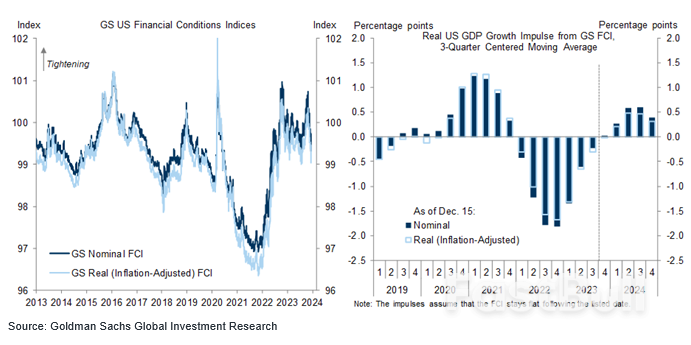
          In some respects, central banks allowing markets to ease credit conditions into the coming slowdown, while appearing to talk tough, could be seen as an impressive attempt at fine tuning the fabled 'soft landing'. With the full force of past policy rate hikes yet to hit with its traditional lag, bond market easing now could balance the ship.
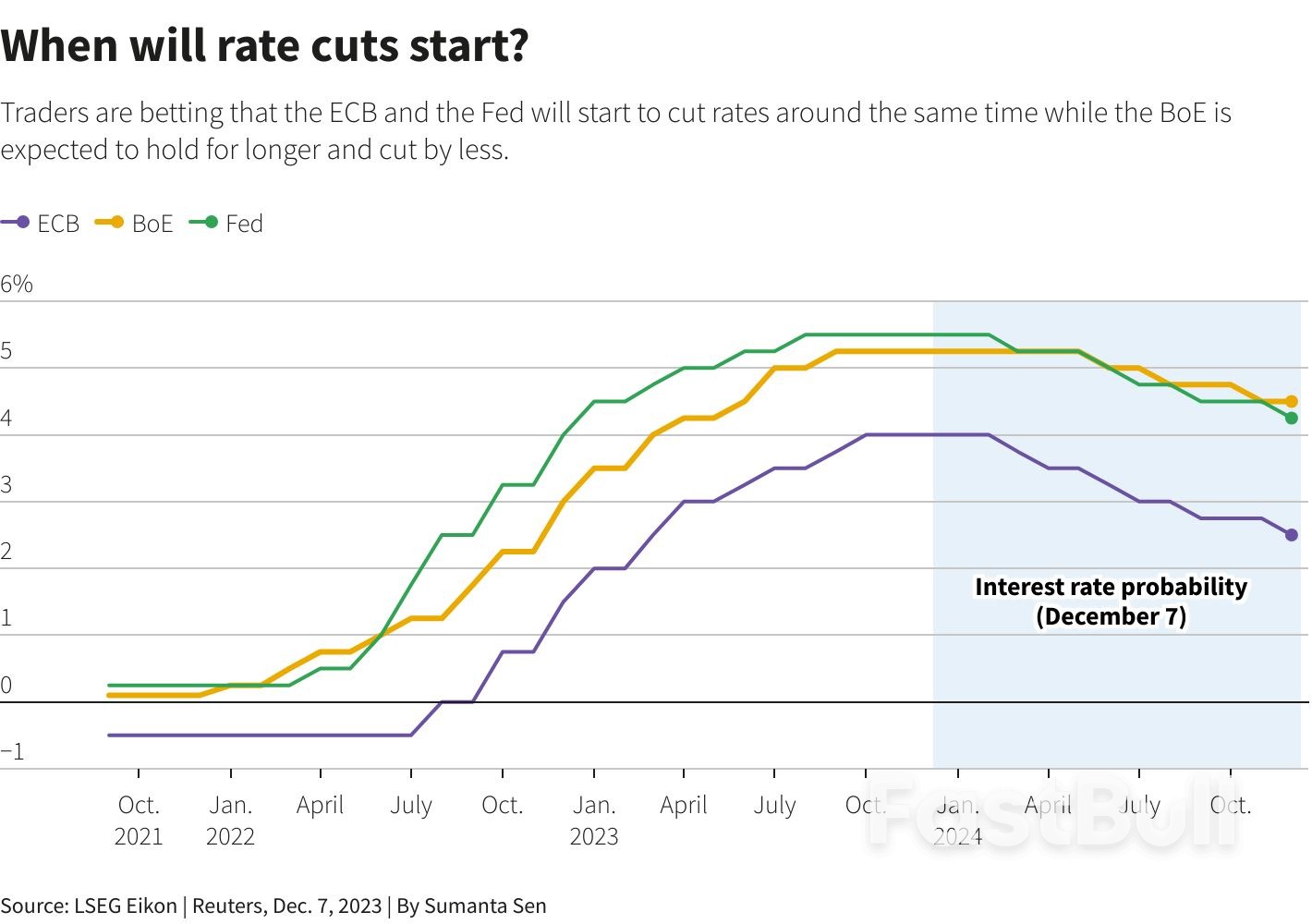
          For all the official comments attempting to halt the rush, money markets still imply - give or take 10bps or so - some 150bps of easing from the Fed and ECB next year and about 120bps from the BoE.
          Bank of America's final global fund manager survey of the year perhaps gave a better picture of the cresting waves.
          Almost 90% of asset managers expect rates to be lower this time next year, 80% expect inflation will be lower and a record 62% see bond yields lower. And just as significantly, more funds saw global recession as the biggest tail risk to the year's benign 'soft landing' consensus than saw sticky inflation or hawkish central banks as a threat.
          In less than two months, benchmark 10-year Treasury yields have dropped 113bps, British gilt yields have dropped 112bps and German bund equivalents have lost 95bps.
          And yet, all three borrowing rates are only roughly where they were 12 months ago - and at least twice where they were 12 months before that.
          There may be some way to go yet before high tide is reached and not a great deal that will stand in its way.

          Central Banks, King Canute and Rate Tide_4Goldman Sachs chart on financial conditions

          Central Banks, King Canute and Rate Tide_5Reuters Graphics

          The opinions expressed here are those of the author, a columnist for Reuters

          Source: Reuters

          To stay updated on all economic events of today, please check out our Economic calendar
          Risk Warnings and Disclaimers
          You understand and acknowledge that there is a high degree of risk involved in trading. Following any strategies or investment methods may lead to potential losses. The content on the site is provided by our contributors and analysts for information purposes only. You are solely responsible for determining whether any trading assets, securities, strategy, or any other product is suitable for investing based on your own investment objectives and financial situation.
          Comments
          Add to Favorites
          Share

          Sanctions on Russian Oil have Failed. Were They Ever Meant to Succeed?

          Saif

          Political

          The Kyiv School of Economics (KSE), which monitors Russian oil sales, estimates that Moscow will make $178bn from oil sales this year, rising to a potential $200bn next year.
          These amounts are lower than the record $218 bn Russia earned in oil revenues during the first year of the war when Europe was still buying about half its oil exports, but they show that Russia has replaced that lost revenue remarkably quickly.
          “Russia now has to ship its oil over much larger distances. You basically have only China and India left, so it reduces competition and reduces prices,” said Jan Stockbruegger, a researcher with the Ocean Infrastructure Research Group at the University of Copenhagen.
          But not by much. The KSE says Russia’s benchmark Urals crude traded at $84 a barrel in October, not too far below the $90.78 average price commanded by Brent crude in the same month.

          Sanction-proof tankers

          Anticipating this, the EU, along with the G7, last year placed a $60-per-barrel price cap on Russian oil sold to third parties. This was an ambitious and unprecedented bid by the EU to enforce its will beyond its borders when most Russian oil was still being shipped by Western-owned and Western-insured tankers.
          But Russian entities have since bought much of the ageing portion of the fleet from Western companies at prices attractively higher than scrap metal, cobbling together a shadow fleet outside Western control.
          A shadow tanker is “usually a tanker that does not have Western or G7 involvement, in terms of ownership, insurance, finance or any other services”, Stockbruegger told Al Jazeera. “It’s basically a sanction-proof tanker.”
          Western protection-and-indemnity-insured tankers dropped two-thirds of their trade in Russian crude between April and October, trading places with a shadow fleet that tripled that trade to 2.6 million barrels a day over the same period.
          The KSE estimates there are at least 187 shadow tankers carrying Russian crude and refined petroleum products.
          Ukraine’s Western allies could still reduce Russia’s oil revenue by a quarter if they did more to enforce the embargo and price cap, and by more than half if they lowered the price cap to $50 a barrel, says the KSE.
          But Moscow is banking that they will not.
          On November 27, Russian President Vladimir Putin signed off on a 70 % increase in defence and security spending for next year, to $157.5bn. The entire Russian budget of $412bn is itself 13 % higher than last year, based on higher expected earnings from oil.
          Economist Maria Demertzis, a senior fellow at the Bruegel think tank in Brussels, told Al Jazeera a price cap was always going to be difficult to enforce.
          “How do you prevent a country in the Gulf [from] buying and selling energy to third countries? It’s very difficult to monitor,” she said.
          Political will was an added obstacle.
          “At the beginning of the invasion, 50% of the world in population terms either sided with Russia or were neutral,” Demertzis said.
          “This was an indication that countries were not prepared to cut their economic ties to Russia, and therefore any help that the [EU or] G7 would need to try to enforce sanctions just wasn’t there,”

          ‘Token’ measures

          There are signs that the EU and the G7 are getting more serious about enforcing the price cap.
          In October, Washington may have single-handedly shaved $3 off the price of Russian crude by sanctioning two tankers for using US-based services – the price cap’s first enforcement.
          Last month, Washington slapped sanctions on three more Liberian-flagged tankers after discovering they regularly shipped Sokol crude from Russia’s far east to Indian Oil Corp.
          The EU reportedly floated measures last month to allow Denmark to inspect and block Russian oil tankers travelling through the Danish straits – a chokepoint that ships leaving Russian Baltic ports must pass to reach the Atlantic.
          Stockbruegger believes such gestures will remain token, however.
          “The simple reality is we need Russian oil on the market,” he told Al Jazeera.
          “If it is cut out, oil prices globally will rise and inflation will skyrocket. [Joe] Biden will not win the [2024] election if the price of gasoline in the US rises significantly. So the sanctions are set up to ensure Russian oil reaches global markets,” he said.
          Figures from the Institute of International Finance (IIF) last month show that China, India and Turkey have massively increased Russian crude imports during the Ukraine war, and could be transshipping crude or refined products to Western markets.
          The use of go-betweens has been documented elsewhere in sanctions evasion. Robin Brooks, the IIF chief economist, also demonstrated that German carmakers had increased their exports of vehicles and spare parts 55-fold to Kyrgyzstan, sevenfold to Kazakhstan and fourfold to Armenia over two years.
          “This export surge started after Russia invaded Ukraine, so it’s obvious this stuff is going to Moscow. This has to stop,” Brooks wrote on X, formerly Twitter.

          Can renewables fill the gap?

          There is one way in which Moscow’s sales to Europe are genuinely falling, and irreversibly.
          In the first 10 months of this year, wind and solar power generated a record 28 % of Europe’s electricity, a six-point increase on last year’s performance, according to Ember, a London-based think tank. They have long overtaken natural gas and coal in electricity generation, for which consumption fell by 15 % and 30 %, respectively, this year.
          “It remains profoundly cheaper to produce electricity by solar or wind [power] rather than fossil fuels or nuclear [power]. That is why they are taking market share,” Beatrice Petrovich, a senior energy and climate analyst at Ember, told Al Jazeera.
          This is good news for a continent that paid between $1 trillion and $2 trillion more for its energy imports during the first year of the Ukraine war than it did in 2021.
          “Europe is better prepared than last winter,” Petrovich said. “This is the best insurance policy against price hikes and volatility.”
          It is also good news for Europe’s goal to cut greenhouse gas emissions by 55 % in 2030, relative to 1990.
          But it does not cut Russia’s revenue.
          “If India and China don’t see the argument that we are trying to make … this is very worrying,” said Demertzis. “The centre of gravity now has gone east, and if they feel one way about things, they have the power to pursue it.”
          “We always talk about how we support Ukraine in terms of how many weapons we give them and how much ammunition,” said Stockbruegger. “But we never talk about it in terms of how much we are enforcing these sanctions. And by that measure, our support in Europe is actually quite limited.”

          SOURCE: AL JAZEERA

          Risk Warnings and Disclaimers
          You understand and acknowledge that there is a high degree of risk involved in trading. Following any strategies or investment methods may lead to potential losses. The content on the site is provided by our contributors and analysts for information purposes only. You are solely responsible for determining whether any trading assets, securities, strategy, or any other product is suitable for investing based on your own investment objectives and financial situation.
          Comments
          Add to Favorites
          Share

          Pound Sterling: Significant Drop In Inflation Prompts Falls Against Euro and Dollar

          Warren Takunda

          Economic

          Central Bank

          Forex

          The British pound fell as an initial reaction to news inflation in the UK slowed by a far greater rate in November than had been expected.
          The Pound to Euro exchange rate dropped 0.40% to 1.1545 after the ONS said inflation fell by 0.2% month-on-month in November, down from 0% in October and lower than the 0.2% increase the market expected.
          CPI inflation printed at 3.9% year-on-year in November, down from 4.6% in October, whereas the market anticipated a reading of 4.3%.
          The Pound to Dollar exchange rate fell 0.38% to 1.2660 (below chart) as investors bet there was now enough progress in inflation to allow the Bank of England to become more comfortable with the idea of cutting interest rates in 2024. "This really pushes back on the idea that UK inflation is stickier than elsewhere (it really isn't). BoE cuts in May 2024 live," says Viraj Patel, a strategist at Vanda Research.
          Pound Sterling: Significant Drop In Inflation Prompts Falls Against Euro and Dollar_1
          Indeed, the services inflation level, which the Bank of England is particularly watchful of, eased from 6.6% y/y to 6.3% in November.
          Core inflation, another area of interest for the Bank as it strips out energy and food and gives a better reflection of domestic inflation pressures, rose 5.1 y/y, down from 5.7% and below the expectation of 5.5%. To put this downside surprise into context, the lowest estimate out of 28 economists surveyed by Bloomberg was 5.2%.
          The outcome resulted from an unexpected -0.3% m/m reading in November, down from 0.3% in October and below the consensus for 0.2%.
          While the Pound has taken a near-term hit, the fall in inflation is all the better for UK consumers and bolsters the UK's economic outlook. In the medium term, this should be a supportive development for Pound Sterling.
          Pound Sterling: Significant Drop In Inflation Prompts Falls Against Euro and Dollar_2
          Jake Finney, economist at PwC, says the decline in inflation provides strong evidence that disinflationary pressures are building in the UK.
          "Headline, core and services inflation are all now materially below the Bank of England’s expectations in their last November Monetary Policy Report. Next month's inflation data is likely to follow a similar trend," he says. Economists still expect headline inflation to increase slightly early in the new year as the CPI basket is re-weighted and the household energy price cap is increased by 5%.
          Reacting to the positive inflation surprise, the overnight index swaps (OIS) market showed investors added to rate cut bets for 2024 and 2025.
          The OIS market implies investors are now looking for roughly five cuts in 2024, with the bank rate falling from 5.25% to around 4.0%, followed by four more cuts in 2025 to a year-end rate of c3.0%.
          "Following the big downward shift in BoE rate expectations in recent months, the OIS market is now roughly in line with our own year-end calls for 2024 and 2025 which we have held since June," says Kallum Pickering, Senior Economist at Berenberg.
          "Although Bank of England (BoE) policymakers are at pains to push back against growing rate cut bets for 2024 while inflation is still well above target, the direction of travel for prices now seems clear," he adds.

          Source: PoundSterlingLive

          To stay updated on all economic events of today, please check out our Economic calendar
          Risk Warnings and Disclaimers
          You understand and acknowledge that there is a high degree of risk involved in trading. Following any strategies or investment methods may lead to potential losses. The content on the site is provided by our contributors and analysts for information purposes only. You are solely responsible for determining whether any trading assets, securities, strategy, or any other product is suitable for investing based on your own investment objectives and financial situation.
          Comments
          Add to Favorites
          Share

          Asset Managers Face Tougher Rules on Investor Cash Calls

          Zi Cheng

          Economic

          Regulators have been scrutinising the ability of open ended funds, a sector worth over $40 trillion globally, after central banks had to intervene to stop money market and other types of funds freezing in the face of a "dash for cash" when economies went into COVID-19 lockdowns in March 2020.
          Funds could not raise cash fast enough, though the industry has argued that many parts of the market came under severe stress at that time.
          The reforms from the G20's Financial Stability Board and IOSCO, a global umbrella group for securities watchdogs, aim to end so-called first mover advantage or investors leaving a fund being less worse off than those who remain.
          The rules, which had been put out to public consultation, with some tweaks in the final recommendations, say that redemption terms must reflect how long it would take to sell assets in a fund to avoid a liquidity "mismatch".
          Property funds, for example, were offering daily redemptions and some had to suspend them given the difficulty of selling property quickly.
          The FSB sets out "buckets" to categorise whether funds can offer daily redemptions.
          "In response to the public consultation, the FSB sought to clarify the categorisation approach and provide more flexibility to authorities in implementing the framework in their respective jurisdictions," the FSB said in a statement.
          The FSB said the liquidity management tools (LMTs) that asset managers must have would be increasingly used by funds mainly invested in less liquid assets that typically take more time to sell.
          IOSCO said it has provided more flexibility in using LMTs, and has specified that the aim is to impose "fair and reasonable transaction costs" that are deducted from redemptions.
          The FSB and IOSCO, whose members commit to applying agreed rules in national handbooks, said they will assess by 2028 whether the changes have sufficiently addressed financial stability risks.

          Source: Reuters

          To stay updated on all economic events of today, please check out our Economic calendar
          Risk Warnings and Disclaimers
          You understand and acknowledge that there is a high degree of risk involved in trading. Following any strategies or investment methods may lead to potential losses. The content on the site is provided by our contributors and analysts for information purposes only. You are solely responsible for determining whether any trading assets, securities, strategy, or any other product is suitable for investing based on your own investment objectives and financial situation.
          Comments
          Add to Favorites
          Share
          FastBull
          Copyright © 2025 FastBull Ltd

          728 RM B 7/F GEE LOK IND BLDG NO 34 HUNG TO RD KWUN TONG KLN HONG KONG

          TelegramInstagramTwitterfacebooklinkedin
          App Store Google Play Google Play
          Products
          Charts

          Chats

          Q&A with Experts
          Screeners
          Economic Calendar
          Data
          Tools
          Membership
          Features
          Function
          Markets
          Copy Trading
          Latest Signals
          Contests
          News
          Analysis
          24/7
          Columns
          Education
          Company
          Careers
          About Us
          Contact Us
          Advertising
          Help Center
          Feedback
          User Agreement
          Privacy Policy
          Business

          White Label

          Data API

          Web Plug-ins

          Poster Maker

          Affiliate Program

          Risk Disclosure

          The risk of loss in trading financial instruments such as stocks, FX, commodities, futures, bonds, ETFs and crypto can be substantial. You may sustain a total loss of the funds that you deposit with your broker. Therefore, you should carefully consider whether such trading is suitable for you in light of your circumstances and financial resources.

          No decision to invest should be made without thoroughly conducting due diligence by yourself or consulting with your financial advisors. Our web content might not suit you since we don't know your financial conditions and investment needs. Our financial information might have latency or contain inaccuracy, so you should be fully responsible for any of your trading and investment decisions. The company will not be responsible for your capital loss.

          Without getting permission from the website, you are not allowed to copy the website's graphics, texts, or trademarks. Intellectual property rights in the content or data incorporated into this website belong to its providers and exchange merchants.

          Not Logged In

          Log in to access more features

          FastBull Membership

          Not yet

          Purchase

          Become a signal provider
          Help Center
          Customer Service
          Dark Mode
          Price Up/Down Colors

          Log In

          Sign Up

          Position
          Layout
          Fullscreen
          Default to Chart
          The chart page opens by default when you visit fastbull.com