Markets
News
Analysis
User
24/7
Economic Calendar
Education
Data
- Names
- Latest
- Prev




Signal Accounts for Members
All Signal Accounts
All Contests


U.S. API Weekly Cushing Crude Oil StocksA:--
F: --
P: --
U.S. API Weekly Refined Oil StocksA:--
F: --
P: --
U.S. API Weekly Gasoline StocksA:--
F: --
P: --
Mexico Unemployment Rate (Not SA) (Nov)A:--
F: --
P: --
U.S. MBA Mortgage Application Activity Index WoWA:--
F: --
P: --
U.S. Weekly Continued Jobless Claims (SA)A:--
F: --
U.S. Weekly Initial Jobless Claims (SA)A:--
F: --
P: --
U.S. Initial Jobless Claims 4-Week Avg. (SA)A:--
F: --
P: --
Japan Construction Orders YoY (Nov)A:--
F: --
P: --
Japan New Housing Starts YoY (Nov)A:--
F: --
P: --
Turkey Capacity Utilization (Dec)A:--
F: --
P: --
Japan Tokyo CPI YoY (Excl. Food & Energy) (Dec)A:--
F: --
P: --
Japan Unemployment Rate (Nov)A:--
F: --
P: --
Japan Tokyo Core CPI YoY (Dec)A:--
F: --
P: --
Japan Tokyo CPI YoY (Dec)A:--
F: --
P: --
Japan Jobs to Applicants Ratio (Nov)A:--
F: --
P: --
Japan Tokyo CPI MoM (Dec)A:--
F: --
P: --
Japan Tokyo CPI MoM (Excl. Food & Energy) (Dec)A:--
F: --
P: --
Japan Industrial Inventory MoM (Nov)A:--
F: --
P: --
Japan Retail Sales (Nov)A:--
F: --
P: --
Japan Industrial Output Prelim MoM (Nov)A:--
F: --
P: --
Japan Large-Scale Retail Sales YoY (Nov)A:--
F: --
P: --
Japan Industrial Output Prelim YoY (Nov)A:--
F: --
P: --
Japan Retail Sales MoM (SA) (Nov)A:--
F: --
P: --
Japan Retail Sales YoY (Nov)A:--
F: --
P: --
Russia Retail Sales YoY (Nov)A:--
F: --
P: --
Russia Unemployment Rate (Nov)A:--
F: --
P: --
Argentina Retail Sales YoY (Oct)A:--
F: --
P: --
U.S. Weekly Treasuries Held by Foreign Central Banks--
F: --
P: --
China, Mainland Industrial Profit YoY (YTD) (Nov)A:--
F: --
P: --
Russia IHS Markit Manufacturing PMI (Dec)--
F: --
P: --
India Manufacturing Output MoM (Nov)--
F: --
P: --
India Industrial Production Index YoY (Nov)--
F: --
P: --
France Unemployment Class-A (Nov)--
F: --
P: --
Euro Zone Total Reserve Assets (Nov)--
F: --
P: --
Canada National Economic Confidence Index--
F: --
P: --
U.S. Pending Home Sales Index (Nov)--
F: --
P: --
U.S. Pending Home Sales Index MoM (SA) (Nov)--
F: --
P: --
U.S. Pending Home Sales Index YoY (Nov)--
F: --
P: --
U.S. EIA Weekly Crude Oil Imports Changes--
F: --
P: --
U.S. EIA Weekly Cushing, Oklahoma Crude Oil Stocks Change--
F: --
P: --
U.S. EIA Weekly Crude Demand Projected by Production--
F: --
P: --
U.S. EIA Weekly Gasoline Stocks Change--
F: --
P: --
U.S. Dallas Fed General Business Activity Index (Dec)--
F: --
P: --
U.S. EIA Weekly Heating Oil Stock Changes--
F: --
P: --
U.S. EIA Weekly Crude Stocks Change--
F: --
P: --
U.S. Dallas Fed New Orders Index (Dec)--
F: --
P: --
Russia CPI YoY (Dec)--
F: --
P: --
U.S. EIA Weekly Natural Gas Stocks Change--
F: --
P: --
Brazil CAGED Net Payroll Jobs (Nov)--
F: --
P: --
South Korea Industrial Output MoM (SA) (Nov)--
F: --
P: --
South Korea Retail Sales MoM (Nov)--
F: --
P: --
South Korea Services Output MoM (Nov)--
F: --
P: --
Russia IHS Markit Services PMI (Dec)--
F: --
P: --
Turkey Economic Sentiment Indicator (Dec)--
F: --
P: --
Brazil Unemployment Rate (Nov)--
F: --
P: --
U.S. Weekly Redbook Index YoY--
F: --
P: --
U.S. S&P/CS 20-City Home Price Index YoY (Not SA) (Oct)--
F: --
P: --
U.S. S&P/CS 20-City Home Price Index MoM (SA) (Oct)--
F: --
P: --
U.S. FHFA House Price Index MoM (Oct)--
F: --
P: --


No matching data
Latest Views
Latest Views
Trending Topics
Top Columnists
Latest Update
White Label
Data API
Web Plug-ins
Affiliate Program
View All

No data
Bitcoin’s price stayed subdued on December 25 as renewed activity from large holders, including whale transfers to exchanges, combined with continued outflows from US spot Bitcoin ETFs, unset
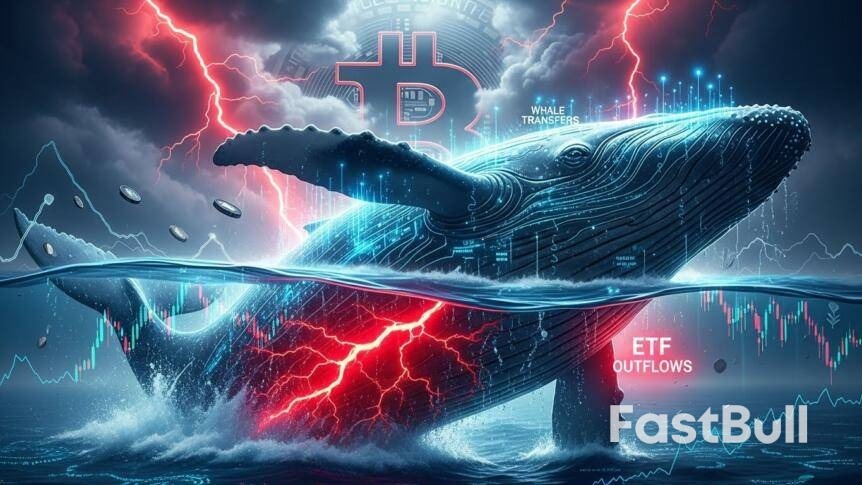
Bitcoin's price stayed subdued on December 25 as renewed activity from large holders, including whale transfers to exchanges, combined with continued outflows from US spot Bitcoin ETFs, unsettled market sentiment, raised concerns about potential sell pressure, and left traders cautious despite BTC holding above key technical support levels overall market.
A long-inactive Bitcoin whale and asset manager BlackRock moved large sums of BTC to centralized exchanges on the day according to blockchain analytics firm Onchain Lens.
BlackRock had invested 2,292 BTC that had a value of about 199.8 million dollars in Coinbase. In another transaction, a whale wallet that was dormant in eight years transferred 400 BTC, worth about 34.92 million, to the OKX exchange.
Traders keep a close eye on such transfers, which massive deposits to exchanges would typically suggest to them that there is sell-side pressure.
No direct spot selling was established, but the flows were sufficiently sufficing to place market participants on their toes.
The warning sound was supported by the ongoing weak institutional flows. According to the data provided by SoSoValue, U.S. spot Bitcoin ETFs experienced their fifth day in a row of net outflows. The continual withdrawals were an indication that the institutional demand was still weak despite the fact that Bitcoin was trading above key technical support levels.

Meanwhile, there was an overall fall in leverage in the derivatives market. BTC was trading around $87,700 at press time, falling about 0.35% on the day. According to CoinGlass, open interest was dropped at 0.99% to $57.42 billion, which means that traders were not taking on risk as they were not aggressively positioning themselves to expect a price breakout.
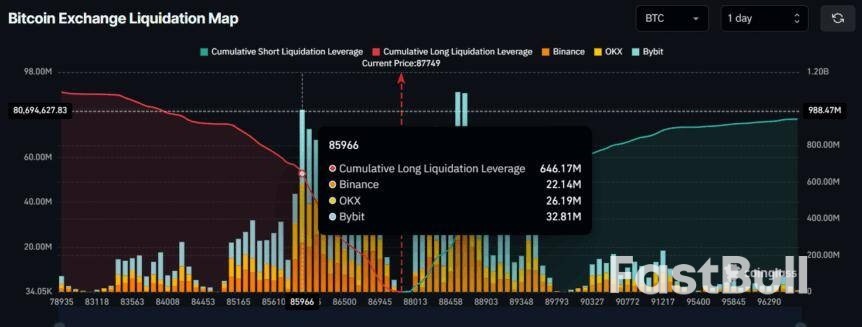
Positioning information suggested areas of bullish conviction in spite of the leverage pullback. The Liquidation Map of CoinGlass indicated that its largest concentration of leverage was on the downside and on the upside to $85,966 and 88,636 respectively.
The long leveraged positions (of a total of around 646.17 million) were concentrated nearer to the bottom whereas the short leveraged positions (of the total of around 422.42 million) were concentrated above the Bitcoin price, indicating that the traders were generally confident that BTC would be above the zone of support of 85,966.
In a larger technical context, BTC is stuck in a range of consolidation. The weekly chart analysis indicates that BTC has been trading at an average bottom of about $86,000 to a top of about $93,500 since mid-November. Such long periods of steady consolidation are, in the past, usually followed by sharp swings in one way or the other.
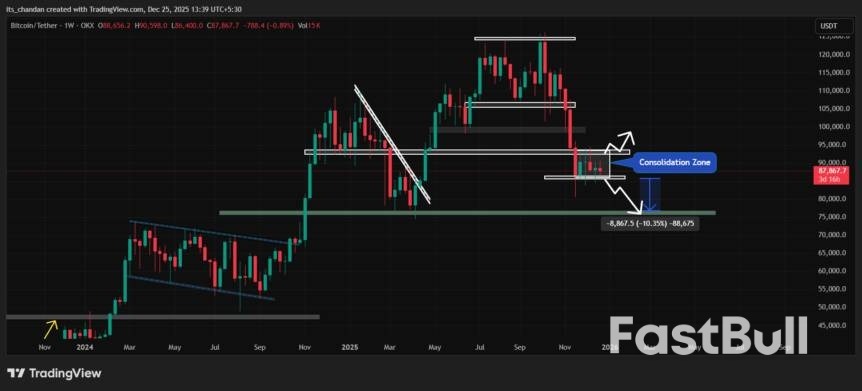
Since Bitcoin has been fluctuating around the lower part of this range, there has been an increased fear of a possible breakdown. Technical analysts believe that a daily close below the support of the $86,000 may open up to further decline.
On the contrary, the bearish view would be nullified in case BTC were to advance beyond the upper resistance at about 93,500 mark and herald another bullish breakout.
Whale action, ETF outflows, and to a certain extent, thinning leverage have so far joined hands to hold the Bitcoin traders squarely on the defensive side.
Investors are looking for the US stock market to end 2025 on a high note next week, with equities at record peaks and nearing further bullish milestones to close out another strong year.
Major US indexes were on course to end December higher after stocks shook off turbulence earlier in the month driven by weakness in technology shares over worries tied to spending on artificial intelligence.
The S&P 500 posted a record close on Wednesday, ahead of the Christmas holiday on Thursday, and was about 1% from reaching the 7,000 level for the first time. The benchmark index was on track for its eighth straight month of gains, which would be its longest monthly winning streak since 2017-2018.
"Momentum is certainly on the side of the bulls," said Paul Nolte, senior wealth adviser and market strategist at Murphy & Sylvest Wealth Management. "Barring any exogenous event, the path of least resistance for stocks, I think, is higher."
Minutes from the Federal Reserve's most recent meeting highlight the market events in the holiday-shortened week ahead, while year-end portfolio adjustments could cause some volatility at a time when light trading volumes can exaggerate asset price moves.
Heading into the new year, investors are highly focused on when the Fed might further cut interest rates. The US central bank, which balances goals of contained inflation and full employment, lowered its benchmark rate by 75 basis points over its last three meetings of 2025 to the current level of 3.5%-3.75%.
But the Fed's most recent vote at its December 9-10 meeting to lower rates by a quarter percentage point was divided, while policymakers also gave widely different projections about rates in the coming year. The minutes for that meeting, due to be released on Tuesday of next week, may be "illuminating to hear what some of the arguments were around the table," said Michael Reynolds, vice president of investment strategy at Glenmede.
"Handicapping how many rate cuts we're going to get next year is a big thing markets are focused on right now," Reynolds said. "We'll just get a little bit more information on that next week."
Investors are also waiting for President Donald Trump to nominate a Fed chair to replace Jerome Powell, whose term ends in May, and any inkling of Trump's decision could sway markets in the coming week.
With just a handful of trading sessions left in 2025, the S&P 500 was up nearly 18% for the year, with the technology-heavy Nasdaq Composite up 22%.
However, the tech sector, which has been the main driver of the more than three-year-old bull market, has struggled in recent weeks, while other areas of the market have shined. Despite rebounding this week, the S&P 500 tech sector has declined more than 3% since the start of November. Over that time, areas such as financials, transports, healthcare and small caps have posted solid gains.
The market moves indicate some rotation into areas where valuations are more moderate, said Anthony Saglimbene, chief market strategist at Ameriprise Financial.
"There are more investors that are buying in to the narrative that the economy is on pretty solid footing right now," Saglimbene said. "And it has weathered a lot of potential roadblocks this year that might not be such roadblocks next year."
President Donald Trump has the chance to begin the reconstruction of the Gaza Strip. Delay will only destabilize the situation.
President Donald Trump's peace plan for Gaza, and his best hope for a Nobel Peace Prize, needs a big push when he meets with Israeli prime minister Benjamin Netanyahu on December 29. As of Christmas, the plan appears to have stalled, but that is only partly true. Hamas's refusal to surrender its weapons is the big problem—but the solution is far more in President Trump's hands than most realize.
I led postwar planning for Iraq at the US State Department and worked on post-conflict operations in Bosnia, Kosovo, Iraq, East Timor, Libya, and Afghanistan. After Hamas' terrorist attack on October 7, 2023, along with many others, I warned of the dangers of failing to plan for postwar Gaza and joined a group of former senior officials to develop a plan for postwar Gaza. President Trump and his team, working with Israel and Arab allies, deserve the credit for Trump's twenty-point peace plan, codified in United Nations Security Council Resolution 2803.
Our plan got closer to Trump's final plan than anyone else: international governance for a transitional period, an international oversight board, working with Palestinians from Gaza, backed up by an international stabilization force, authorized by a United Nations Security Council resolution, with a non-American in charge of the civilian effort and a US general heading up the International Stabilization Force (ISF).
All living and all but one deceased Israeli hostages have been returned, but Hamas has neither disarmed nor given up governance of the west of a "Yellow Line" that divides Gaza in half. Apart from a Civil-Military Coordination Center in Kiryat Gat, Israel, no country has sent forces for the ISF that will provide security, oversee Hamas's disarmament, and allow the Israeli army to withdraw to Gaza's borders.
The Board of Peace, which Trump will chair, will not be announced until January. The Palestinian technocratic committee tasked with rebuilding Gaza's infrastructure has not yet been named. An executive committee that will handle vital day-to-day coordination among internationals, Palestinians, Israelis, Egyptians, and donor states has only four known names: highly respected Bulgarian diplomat Nikolay Mladenov, US envoy Steve Witkoff, Trump's son-in-law Jared Kushner, and former British prime minister Tony Blair.
While visionary plans exist, nobody has put up the money needed to start anything. Arab governments will not finance Gaza's reconstruction as long as Hamas retains its weapons, the use of which would invite Israeli retaliation, destroying whatever was rebuilt. Some think both Hamas and Israel are slow-rolling Trump's plan, increasing the suffering of the two million Gazans living in desperate circumstances and putting the security of both Israelis and Palestinians at risk while Hamas increases its chokehold over half of Gaza's territory and most of Gaza's people.
Despite this, much has been going on behind the scenes, but Trump now has to make a key choice among three clashing visions.
One, which Prime Minister Netanyahu will likely push, is Trump's approval for Israeli military action against Hamas fighters. The strategic logic is that a further weakened Hamas would eventually be unable to interfere with Trump's peace plan. However, this would result in Israeli and many Gazan casualties and disruption of humanitarian aid. How long this would take is unclear. Also, Netanyahu reportedly wants US support for an attack on Iran's missile program, which Iran is actively rebuilding. He may also ask for Trump's authorization to attack Hezbollah if it refuses to turn over its weapons to the Lebanese armed forces. Trump may agree to one of these ideas, but he will not agree to all of them.
The second is the plan that the Tony Blair Institute developed last summer. A leaked draft from September in Haaretz has a small international "executive secretariat" with five "commissioners" overseeing a Palestinian Executive Authority (PEA) that actually runs Gaza. This plan puts substantial responsibilities on the local Palestinians, who would not be affiliated with Hamas. Still, the leaked draft is weak on how Hamas would be disarmed and how to keep Hamas from extorting or coercing Gazans, including those in the PEA, into obeying its will.
It calls for partial deployment in the first two years, with full operations only in Year Three, which is too late. Audit mechanisms appear significantly understaffed. Corruption is a major reason many Palestinians mistrust the Palestinian Authority in Ramallah, and support for Gaza's reconstruction will evaporate if it replicates this failure.
With a total budget of only $90 million in the first year, the plan appears too small to oversee the amount of work required to start Gaza's physical and social reconstruction. This plan has almost certainly been improved since September, but Trump will want to know whether these problems have been addressed.
The third option is the Gaza Supply System, developed by Americans reporting to Witkoff and Kushner, which would use private capital to jump-start Gaza's physical and social reconstruction east of the Yellow Line, while employing private security contractors in roles the International Stabilization Force is unwilling to undertake. This would get around two roadblocks: first, no Arab governments have actually contributed billions of dollars to Gaza's reconstruction, and second, private security contractors are willing to work in Gaza even while the United States insists on no US boots on the ground, and other countries are unwilling to have their troops confront Hamas.
According to an article from The Guardian, private investors would be repaid for jump-starting Gaza's reconstruction through tariffs or tolls on aid and commercial trucks entering Gaza. The United States government similarly relied on customs duties and tariffs to fund public services and security until the advent of the income tax.
Historically, Hamas also charged tolls on aid trucks and taxed Gazans bringing in cash from jobs in Israel. And charging tolls on incoming trucks provides private investors with a positive incentive to increase the number of trucks entering Gaza, aligning their interests with those of the Gazan people while ensuring robust but not excessive security inspections.
Trump will have to decide soon which of these three competing proposals he will support. Waiting on Hamas to voluntarily disarm is unlikely to succeed, prolonging both the misery of 2 million Gazans and the security risk to both Israelis and Palestinians. Arab governments have not embraced Blair's plan.
The people of Gaza and Israel need to see progress, and waiting for an enlarged version of a postwar governance plan to be funded and staffed in mid-2026 is dangerously late. President Trump should approve a plan that starts, urgently, Gaza's physical and social reconstruction. The Gaza Supply System model, for all its limitations, is currently the best available approach to jump-start some level of security and reconstruction in at least half of Gaza. We have to start somewhere—and we need to start now.
China announced largely symbolic sanctions against 20 US defense companies and 10 executives, signaling its anger over Washington's latest arms sales to Taiwan while stopping short of a broader escalation.
The Chinese Foreign Ministry said on Friday it would sanction companies including Northrop Grumman Systems Corp., L3Harris Maritime Services, Boeing's operations in St. Louis, as well as Vantor, formerly known as Maxar Intelligence. The measures include freezing any assets the companies hold in China and banning them from doing business with Chinese entities.
China is also targeting executives at defense companies, including Palmer Luckey, founder of Anduril Industries Inc., and Vantor Chief Executive Officer Dan Smoot, freezing their assets in China and barring dealings and entry to the mainland, Hong Kong and Macau.
The sanctions follow what Beijing described as "large-scale" US arms sales to Taiwan. The State Department said last week that Washington has approved a package worth up to $11 billion — one of its largest ever for the island — covering equipment including missiles, drones and artillery systems.
"Any provocative actions that cross the line on the Taiwan issue will be met with a forceful response from China," a Foreign Ministry spokesperson said in an accompanying statement on Friday. "Any enterprise or individual involved in arms sales to Taiwan will pay the price for their misguided actions."
In reality the impact of the measures is likely to be limited. Most of the companies and executives targeted have little or no presence in China, and some were already placed on the Commerce Ministry's unreliable entity list.
China views Taiwan as a breakaway province that must ultimately be brought under its control, by force if necessary — a position Taipei firmly rejects. Since President Lai Ching-te took office in May 2024, Beijing has stepped up military pressure on the self-governing island of 23 million people.
The issue continues to loom large in US-China relations. In a phone call last month, Chinese leader Xi Jinping told President Donald Trump that Taiwan's return to China was an "integral part of the postwar international order."
Nevertheless, Beijing and Washington have sought to steady ties. They agreed to a one-year truce in their trade dispute, under which China ensures US access to rare earths vital to industries ranging from smartphones to missile systems, while the US lowers tariffs on Chinese goods.
White Label
Data API
Web Plug-ins
Poster Maker
Affiliate Program
The risk of loss in trading financial instruments such as stocks, FX, commodities, futures, bonds, ETFs and crypto can be substantial. You may sustain a total loss of the funds that you deposit with your broker. Therefore, you should carefully consider whether such trading is suitable for you in light of your circumstances and financial resources.
No decision to invest should be made without thoroughly conducting due diligence by yourself or consulting with your financial advisors. Our web content might not suit you since we don't know your financial conditions and investment needs. Our financial information might have latency or contain inaccuracy, so you should be fully responsible for any of your trading and investment decisions. The company will not be responsible for your capital loss.
Without getting permission from the website, you are not allowed to copy the website's graphics, texts, or trademarks. Intellectual property rights in the content or data incorporated into this website belong to its providers and exchange merchants.
Not Logged In
Log in to access more features

FastBull Membership
Not yet
Purchase
Log In
Sign Up