• Trade
  • Markets
  • Copy
  • Contests
  • News
  • 24/7
  • Calendar
  • Q&A
  • Chats
Trending
Screeners
SYMBOL
LAST
BID
ASK
HIGH
LOW
NET CHG.
%CHG.
SPREAD
SPX
S&P 500 Index
6920.92
6920.92
6920.92
6965.70
6919.18
-23.90
-0.34%
--
DJI
Dow Jones Industrial Average
48996.07
48996.07
48996.07
49621.43
48951.99
-466.00
-0.94%
--
IXIC
NASDAQ Composite Index
23584.26
23584.26
23584.26
23723.37
23504.22
+37.10
+ 0.16%
--
USDX
US Dollar Index
98.800
98.880
98.800
98.990
98.740
-0.120
-0.12%
--
EURUSD
Euro / US Dollar
1.16504
1.16511
1.16504
1.16598
1.16359
+0.00085
+ 0.07%
--
GBPUSD
Pound Sterling / US Dollar
1.34445
1.34452
1.34445
1.34586
1.34190
+0.00238
+ 0.18%
--
XAUUSD
Gold / US Dollar
4635.53
4635.94
4635.53
4641.84
4588.51
+49.43
+ 1.08%
--
WTI
Light Sweet Crude Oil
61.411
61.441
61.411
61.804
60.145
+0.555
+ 0.91%
--

Community Accounts

Signal Accounts
--
Profit Accounts
--
Loss Accounts
--
View More

Become a signal provider

Sell trading signals to earn additional income

View More

Guide to Copy Trading

Get started with ease and confidence

View More

Signal Accounts for Members

All Signal Accounts

Best Return
  • Best Return
  • Best P/L
  • Best MDD
Past 1W
  • Past 1W
  • Past 1M
  • Past 1Y

All Contests

  • All
  • Trump Updates
  • Recommend
  • Stocks
  • Cryptocurrencies
  • Central Banks
  • Featured News
Top News Only
Share

LME Nickel Surged 4.00% Intraday, Currently Trading At $18,301.20 Per Ton. SHFE Nickel Futures Also Saw A Short-term Rally, Rising Nearly 4% Intraday To 146,360 Yuan Per Ton

Share

Bank Of America CFO Says Sees Continued Stability In Total Net Charge Offs

Share

Citigroup CFO Mason Says Bank Cannot Support Interest Rate Cap, Would Affect Availability

Share

Bank Of America CFO Says We Expect Good Core Nii Performance From Loan And Deposit Growth That Will Additionally Benefit From Sizable Fixed Asset Repricing

Share

London Metal Exchange Three Month Tin Jumps Over 10% To Record $54760 A Metric Ton

Share

OPEC: Secondary Data Shows That Iraq's Crude Oil Production Increased By 55,000 Barrels Per Day In December To 4.119 Million Barrels Per Day

Share

US Natural Gas Flows To Freeport LNG's Export Plant In Texas Were On Track To Decline On Wednesday, According To Data From Lseg

Share

OPEC: Secondary Data Shows That Saudi Arabia's Crude Oil Production Increased By 27,000 Barrels Per Day In December To 10.078 Million Barrels Per Day

Share

Poland's Central Bank Says Keeps Main Interest Rate Steady At 4.00%

Share

Germany's 10-Year Government Bond Yield Little Changed After US Data, Last Down 0.5 Bps At 2.81%

Share

USA Treasury Yields Slightly Pare Declines After PPI, Retail Sales Data, Yield On 10-Year Treasury Notes Last Down 0.8 Basis Points At 4.164%

Share

New York Fed Accepts $0 Billion Of $0 Billion Submitted To Standing Repo Facility On Jan 14

Share

US Nov Retail Sales Ex-Autos/Gasoline +0.4% Versus Oct +0.4% (Previous +0.5%)

Share

The US Core PPI Rose 0% Month-on-month In November, Compared To An Expected 0.2%

Share

US November PPI Rose 3% Year-on-Year, Below The Expected 2.7%

Share

USA Nov Month-Over-Month PPI Final Demand +0.2%

Share

US Nov Cars/Parts Sales +1.0% Versus Oct -1.6%

Share

US Nov Gasoline Sales +1.4% Versus Oct -1.2%

Share

USA Q3 Current Account Balance -226.4 Billion Dlrs (Cons -238.4 Billion) Versus Q2 Balance -249.2 Billion (Previous -251.3 Billion)

Share

US Nov Retail Sales +0.6% (Consensus +0.4%)

TIME
ACT
FCST
PREV
U.S. API Weekly Cushing Crude Oil Stocks

A:--

F: --

P: --

U.S. API Weekly Refined Oil Stocks

A:--

F: --

P: --

U.S. API Weekly Gasoline Stocks

A:--

F: --

P: --

South Korea Unemployment Rate (SA) (Dec)

A:--

F: --

P: --

Japan Reuters Tankan Non-Manufacturers Index (Jan)

A:--

F: --

P: --

Japan Reuters Tankan Manufacturers Index (Jan)

A:--

F: --

P: --

China, Mainland Exports YoY (CNH) (Dec)

A:--

F: --

P: --

China, Mainland Trade Balance (USD) (Dec)

A:--

F: --

P: --

China, Mainland Trade Balance (CNH) (Dec)

A:--

F: --

P: --

China, Mainland Exports (Dec)

A:--

F: --

P: --

China, Mainland Imports YoY (CNH) (Dec)

A:--

F: --

P: --

China, Mainland Imports (CNH) (Dec)

A:--

F: --

P: --

China, Mainland Imports YoY (USD) (Dec)

A:--

F: --

P: --

China, Mainland Exports YoY (USD) (Dec)

A:--

F: --

P: --

U.K. 10-Year Note Auction Yield

A:--

F: --

P: --

U.S. MBA Mortgage Application Activity Index WoW

A:--

F: --

P: --

U.S. Core PPI YoY (Nov)

A:--

F: --

P: --
U.S. PPI MoM (SA) (Nov)

A:--

F: --

P: --
U.S. PPI YoY (Nov)

A:--

F: --

P: --
U.S. Current Account (Q3)

A:--

F: --

P: --
U.S. Retail Sales YoY (Nov)

A:--

F: --

P: --

U.S. Retail Sales (Nov)

A:--

F: --

P: --

U.S. Core Retail Sales MoM (Nov)

A:--

F: --

P: --
U.S. PPI YoY (Excl. Food, Energy & Trade) (Nov)

A:--

F: --

P: --

U.S. PPI MoM Final (Excl. Food, Energy and Trade) (SA) (Nov)

A:--

F: --

P: --

U.S. Retail Sales MoM (Excl. Automobile) (SA) (Nov)

A:--

F: --

P: --

U.S. Core Retail Sales (Nov)

A:--

F: --

P: --

U.S. Retail Sales MoM (Excl. Gas Stations & Vehicle Dealers) (SA) (Nov)

A:--

F: --

P: --

U.S. Retail Sales MoM (Nov)

A:--

F: --

P: --
U.S. Core PPI MoM (SA) (Nov)

A:--

F: --

P: --
Philadelphia Fed President Henry Paulson delivers a speech
U.S. Commercial Inventory MoM (Oct)

--

F: --

P: --

U.S. Existing Home Sales Annualized Total (Dec)

--

F: --

P: --

U.S. Existing Home Sales Annualized MoM (Dec)

--

F: --

P: --

U.S. EIA Weekly Cushing, Oklahoma Crude Oil Stocks Change

--

F: --

P: --

U.S. EIA Weekly Crude Stocks Change

--

F: --

P: --

U.S. EIA Weekly Gasoline Stocks Change

--

F: --

P: --

U.S. EIA Weekly Crude Demand Projected by Production

--

F: --

P: --

U.S. EIA Weekly Crude Oil Imports Changes

--

F: --

P: --

U.S. EIA Weekly Heating Oil Stock Changes

--

F: --

P: --

U.S. Refinitiv/Ipsos Primary Consumer Sentiment Index (PCSI) (Jan)

--

F: --

P: --

Japan Domestic Enterprise Commodity Price Index YoY (Dec)

--

F: --

P: --

Japan Domestic Enterprise Commodity Price Index MoM (Dec)

--

F: --

P: --

Japan PPI MoM (Dec)

--

F: --

P: --

Australia Consumer Inflation Expectations (Jan)

--

F: --

P: --

U.K. 3-Month RICS House Price Balance (Dec)

--

F: --

P: --

South Korea Benchmark Interest Rate

--

F: --

P: --

Q&A with Experts
    • All
    • Chatrooms
    • Groups
    • Friends
    3220737 flag
    okay thank you vẻry much
    EuroTrader flag
    3220737
    with the gold
    @3220737did you trade the ppi news driver that was released ealier on
    miki maka flag
    EuroTrader
    @EuroTraderthey manipulate market when all trader give up..they pump it up
    Size flag
    3220737
    with the gold
    @Visitor3220737I’m still looking for buys, overall bias remains bullish as long as key support zones hold.
    69X35EMWYG flag
    sell xauusd @4635 tp 4610 sl 4645
    3362312 flag
    Are there any brothers or sisters in South Korea?
    Size flag
    Waiting for a clean reaction or rejection to confirm the move.@Visitor3220737
    Gad flag
    3362312
    Are there any brothers or sisters in South Korea?
    @Visitor3362312yh am in
    Size flag
    69X35EMWYG
    sell xauusd @4635 tp 4610 sl 4645
    @69X35EMWYGI wouldn’t agree with that one for now.
    3362312 flag
    Gad
    Where in South Korea are you?
    69X35EMWYG flag
    Size
    @Sizealready reached to 4630
    Size flag
    Gold is still showing bullish bias, and selling around 4635 feels risky unless we see a clear rejection or break of structure.@69X35EMWYG
    Size flag
    69X35EMWYG
    @69X35EMWYGGold is still ranging, so we need a breakout or clear rejection to confirm the next move..
    C.E.O flag
    profit $100 on gold.waiting for another entry.buy entry 4625 tp hit 4636 lot 0.1


    ifan afian flag
    consolidation be carefull
    ifan afian flag
    so many buy stop above 4541 and sell limit
    EuroTrader flag
    3362312
    Are there any brothers or sisters in South Korea?
    @3362312ive not really seen traders from south korea here in the chatroom but am sure they are here but not many of them
    ifan afian flag
    fabove 4641
    ifan afian flag
    sorry
    Size flag
    C.E.O
    profit $100 on gold.waiting for another entry.buy entry 4625 tp hit 4636 lot 0.1
    @C.E.OGood patience and taking a clean entry that’s how small setups add up..
    Type here...
    Add Symbol or Code

      No matching data

      All
      Trump Updates
      Recommend
      Stocks
      Cryptocurrencies
      Central Banks
      Featured News
      • All
      • Russia-Ukraine Conflict
      • Middle East Flashpoint
      • All
      • Russia-Ukraine Conflict
      • Middle East Flashpoint
      Search
      Products

      Charts Free Forever

      Chats Q&A with Experts
      Screeners Economic Calendar Data Tools
      Membership Features
      Data Warehouse Market Trends Institutional Data Policy Rates Macro

      Market Trends

      Market Sentiment Order Book Forex Correlations

      Top Indicators

      Charts Free Forever
      Markets

      News

      News Analysis 24/7 Columns Education
      From Institutions From Analysts
      Topics Columnists

      Latest Views

      Latest Views

      Trending Topics

      Top Columnists

      Latest Update

      Signals

      Copy Rankings Latest Signals Become a signal provider AI Rating
      Contests
      Brokers

      Overview Brokers Assessment Rankings Regulators News Claims
      Broker listing Forex Brokers Comparison Tool Live Spread Comparison Scam
      Q&A Complaint Scam Alert Videos Tips to Detect Scam
      More

      Business
      Events
      Careers About Us Advertising Help Center

      White Label

      Data API

      Web Plug-ins

      Affiliate Program

      Awards Institution Evaluation IB Seminar Salon Event Exhibition
      Vietnam Thailand Singapore Dubai
      Fans Party Investment Sharing Session
      FastBull Summit BrokersView Expo
      Recent Searches
        Top Searches
          Markets
          News
          Analysis
          User
          24/7
          Economic Calendar
          Education
          Data
          • Names
          • Latest
          • Prev

          View All

          No data

          Scan to Download

          Faster Charts, Chat Faster!

          Download App
          English
          • English
          • Español
          • العربية
          • Bahasa Indonesia
          • Bahasa Melayu
          • Tiếng Việt
          • ภาษาไทย
          • Français
          • Italiano
          • Türkçe
          • Русский язык
          • 简中
          • 繁中
          Open Account
          Search
          Products
          Charts Free Forever
          Markets
          News
          Signals

          Copy Rankings Latest Signals Become a signal provider AI Rating
          Contests
          Brokers

          Overview Brokers Assessment Rankings Regulators News Claims
          Broker listing Forex Brokers Comparison Tool Live Spread Comparison Scam
          Q&A Complaint Scam Alert Videos Tips to Detect Scam
          More

          Business
          Events
          Careers About Us Advertising Help Center

          White Label

          Data API

          Web Plug-ins

          Affiliate Program

          Awards Institution Evaluation IB Seminar Salon Event Exhibition
          Vietnam Thailand Singapore Dubai
          Fans Party Investment Sharing Session
          FastBull Summit BrokersView Expo

          Bitcoin Price at Generational Bottom With Institutions Buying en Masse

          Owen Li
          Summary:

          Crypto analyst Cred opines that bitcoin may have hit a generational bottom, presenting a good buying opportunity for long-term holders.

          Crypto analyst Cred opines that bitcoin may have hit a generational bottom, presenting a good buying opportunity for long-term holders.
          On Oct. 5, 2022, Fidelity Investments purchased over $5 million worth of ETH for their institutional investors, not long after the New York Digital Currency Group raised $720 million for a bitcoin fund.

          Could institutions be eyeing the long game?

          Crypto analyst Cred opines that while it is a toss-up whether bitcoin has reached a so-called generational bottom, a long time horizon will mean you won't regret buying at $20,000. However, Cred points out that the confluence of macro events like the Covid-19 pandemic, a strong dollar, and increasingly hawkish tightening by the Federal Reserve are influencing bitcoin's price beyond traditional multi-year price cycles.
          "Like how many times will these incredibly unique conditions repeat themselves where we get completely shut down and new economics from COVID, super-inflationary crazy fiscal and monetary policy post-COVID? I mean, that sequence of events is on its own just so unfathomable that, realistically speaking, we may only get one in our lifetime. And therefore, it also presents an opportunity, especially if you can stomach some drawdown." he declared.
          According to Fidelity, investors indeed see an opportunity, albeit within the ambit of their risk appetites.
          "We have continued to see client demand for exposure to digital assets beyond bitcoin," said a Fidelity spokesperson following the announcement.
          The $5 million ETH purchase follows a $62 million fundraiser for the company's Wise Origin Bitcoin Index Fund. But it all started when quantitative digital asset trading firm Cambrian Asset Management bought $20 million worth of Bitcoin and Ethereum for investors on Sep. 22, 2022. These investments, along with NYDIG's fundraising, mark the first time in two years that institutional investors bought almost $1 billion in crypto in a fortnight.

          Do institutional investors have inside information?

          The current spate of investments could lead the broader market to believe that institutional investors have additional insights on how to survive a bear market.
          While charts mainly remained flat between 2020 and the 2021 bull market and still are relatively stable, investment companies may now be observing interest from institutional players that typically look to crypto as a long-term part of their investment portfolios. These purchases don't move the price needle much, except in the cases of "whales" purchasing large amounts of crypto, which generally doesn't include the demographic catered to by investment companies.
          But, as in previous bear markets, where others see mostly flat price behavior in the second year of the bear market, the reality could likely be a prolonged rise in price that culminates in a bull market.

          Source: beincrypto

          Risk Warnings and Disclaimers
          You understand and acknowledge that there is a high degree of risk involved in trading. Following any strategies or investment methods may lead to potential losses. The content on the site is provided by our contributors and analysts for information purposes only. You are solely responsible for determining whether any trading assets, securities, strategy, or any other product is suitable for investing based on your own investment objectives and financial situation.
          Comments
          Add to Favorites
          Share

          OPEC+ Cuts Ahead of Winter Fan Global Inflation Concerns

          Winkelmann
          Concerns over tight oil supplies and soaring inflation have intensified after the OPEC+ group of nations announced its largest supply cut since 2020 ahead of European Union embargoes on Russian energy.
          The move has widened a diplomatic rift between the Saudi-backed bloc and Western nations, which worry higher energy prices will hurt the fragile global economy and hinder efforts to deprive Moscow of oil revenue following Russia's invasion of Ukraine.
          Global crude futures, jumped this week, returning to three-week highs, after the Organization of the Petroleum Exporting Countries and their allies, including Russia, agreed to slash output by 2 million barrels per day just ahead of peak winter season.
          This is likely to drive spot prices higher, particularly for Middle East oil, which meets about two-third of Asia's demand, industry participants said, adding to inflation concerns as governments from Japan to India fight rising cost of living while Europe is expected to burn more oil to replace Russian gas this winter.
          "We are concerned about a resurgence in international oil prices, which have shown some signs of calming down since the second quarter," a spokesperson at South Korea's largest refiner SK Energy told Reuters.
          Another South Korean refining source said the supply cut could drive prices back to levels seen in the second quarter.
          South Korea, Asia's fourth-largest economy and a manufacturing powerhouse, has seen costs skyrocket due to the surging commodity prices.
          Brent hit $139.13 a barrel in March, the highest since 2008, after the Ukraine war sparked fears of Russian oil supply loss.

          Actual Cuts

          Saudi Energy Minister Abdulaziz bin Salman said the real supply cut would be about 1 million to 1.1 million bpd, a response to rising global interest rates and a weakening world economy.
          That move triggered a sharp response from Washington, which criticised the OPEC+ deal as shortsighted. The White House said President Joe Biden would continue to assess whether to release further strategic oil stocks to lower prices.
          "Saudi, UAE (the United Arab Emirates) and Kuwait are likely to take up most of the burden of cuts," said Tilak Doshi, managing director of Doshi Consulting, who was previously with Saudi Aramco.
          "It's a slap on Biden's face by OPEC+," he said, adding that ties between Russia and Saudi seem increasingly tight.
          While the SK Energy spokesperson expects U.S. reserves release to accelerate ahead of the U.S. midterm elections in November, RBC Capital analysts said follow-on sales would likely be more incremental.
          "We are unlikely to see another blockbuster release in the near term," the bank added.
          The OPEC+ cuts compound supply concerns as European Union sanctions on Russian crude and oil products take effect in December and February, respectively.
          Industry participants estimate the loss of Russian crude at between 1 and 2 million bpd, depending on how Moscow reacts to the G7's price cap on Russian oil. That policy is aimed at ensuring Russian oil continues flowing to emerging economies but at lower prices to reduce Moscow's revenues.
          "The market is still underpricing the actual loss," said a Singapore-based crude oil trader who declined to be named due to company policy.

          Source: Reuters

          Risk Warnings and Disclaimers
          You understand and acknowledge that there is a high degree of risk involved in trading. Following any strategies or investment methods may lead to potential losses. The content on the site is provided by our contributors and analysts for information purposes only. You are solely responsible for determining whether any trading assets, securities, strategy, or any other product is suitable for investing based on your own investment objectives and financial situation.
          Comments
          Add to Favorites
          Share

          Turmoil Turns Tide on Europe's Banks After Long Recovery

          Devin
          Turmoil in markets has triggered alarm over how banks will cope, with regulators warning they could repeat some of the mistakes that led to the financial crisis more than a decade ago.
          Watchdogs are concerned that recent big swings in asset prices could compound the pressure on banks in the region resulting from Russia's invasion of Ukraine, a deepening energy crisis, rising inflation and a worsening economic outlook.
          That nervousness has been clear too across markets.
          Some investors panicked last Friday, sending sterling and British government bonds into freefall after the government announced plans to slash taxes and pay with heavy borrowing.
          And this week, Credit Suisse saw its stock tumble and the cost of insuring against default jump amid concerns over the turnaround of Switzerland's second-largest bank as it prepares a restructuring plan after a series of setbacks and losses.
          Credit Suisse said this week it remains close to its clients as it conducts its strategic review.
          Top European Central Bank (ECB) supervisor Andrea Enria pointed to financial market volatility and the impact of rising prices and interest rates on heavily indebted companies and consumers, warning banks of the perils.
          He even rebuked some for misplaced optimism, saying that the "Russian invasion of Ukraine is developing into a persistent and fully fledged macroeconomic shock".
          Enria singled out the risk that loans could go unpaid and that a repeat of the government support that prevented this happening in the pandemic was now less likely, urging banks to take him seriously.
          Overly optimistic?
          Enria's remarks follow a rare official warning by the European Systemic Risk Board, a risk-monitoring body, of threats to financial stability, or the functioning of the money system that ran aground in the crash more than a decade ago.
          It highlighted risks including higher energy prices hurting borrowers' ability to repay, volatile energy markets putting "strain" on traders and a fall in property prices - mortgage lending is central to many banks' business.
          Many regulators are worried, however, that their warnings are going unheeded.
          ECB vice-president Luis de Guindos recently highlighted risks in the property market and growing debts, urging tighter controls on bank capital before loans go unpaid.
          Earlier, he cautioned that investors were being overly optimistic, pointing to some who believed that companies would still be able to repay even risky loans despite the downturn.
          These threats have also been underscored in talks between European regulators and banks under their watch.
          Earlier this year, the ECB wrote to banks, telling them to cut lending to the most indebted borrowers.
          Leveraged transactions have grown to roughly 500 billion euros on the books of the euro zone's 28 largest lenders from 300 billion euros in 2018 as banks sought riskier returns.
          Banks have now responded, outlining how they were keeping risk from that business in check.
          But Enria's comments suggest that not all banks have learnt from past mistakes.
          He pointed to "an increasingly optimistic attitude ... which generates a certain reluctance on the part of banks to seriously engage in supervisory discussions on ... risks".
          Market jitters seem set to continue.
          U.S. stock market volatility as measured by the VIX (.VIX) "fear index", is well above a 30-year average, although far below the pandemic and financial crisis highs.
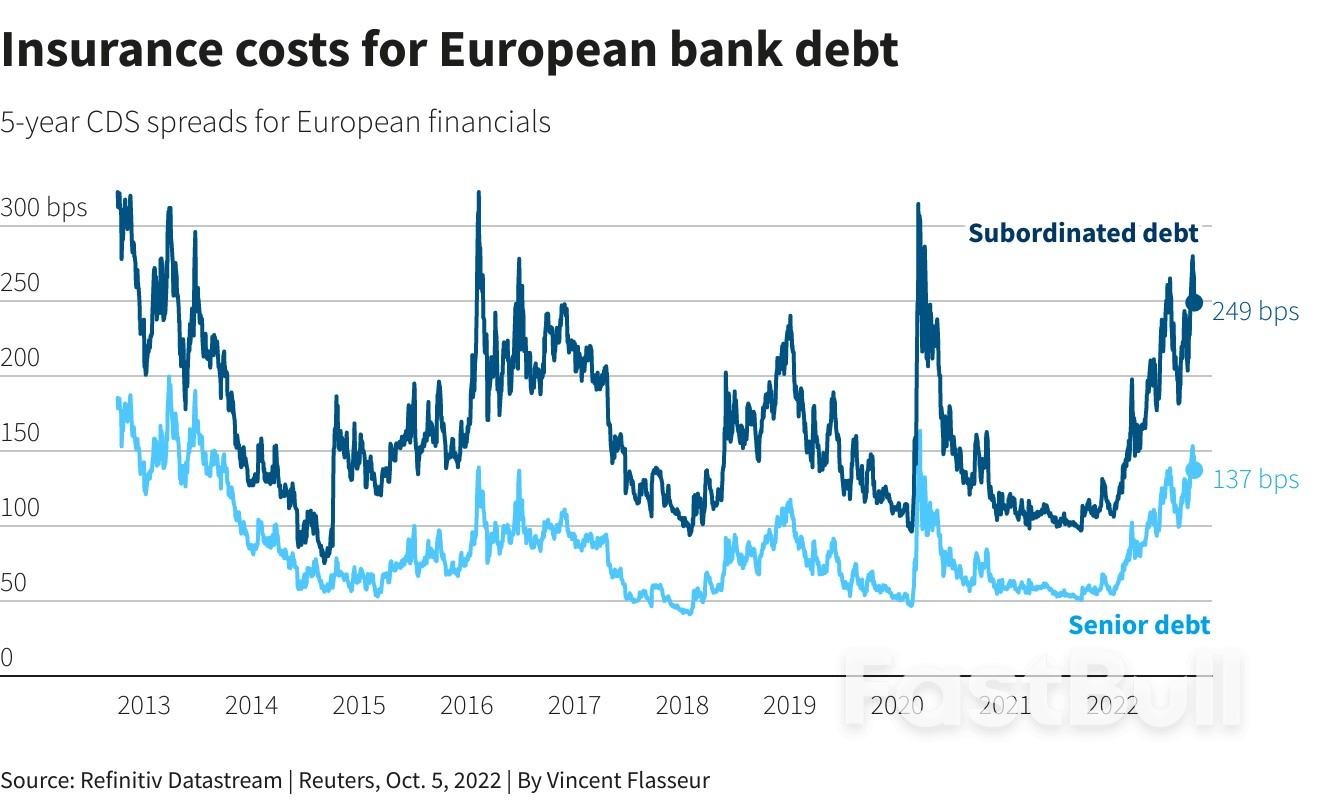
          The cost of insuring against a Credit Suisse debt default rose as high as 355 bps on Monday and was at 308 bps on Wednesday, up from 57 bps at the start of the year, according to S&P Global data.
          Santander's Chief Executive Jose Antonio Alvarez said on Tuesday that liquidity in the banking sector was "extraordinarily high" and he did not see contagion risks when asked about Credit Suisse.
          Turmoil Turns Tide on Europe's Banks After Long Recovery_1As concerns grow, investors have voted with their feet.
          An index of European banks shares has fallen by 22% since the start of the year, leaving it trading at a 40% discount to the value of the banks' assets.
          But Karel Lannoo of Brussels-based think tank the Centre for European Policy Studies said banks are far safer now than they were in the past.
          "With the banks' share valuation where it is, the bad news is already priced in," Lannoo said.

          Source: Reuters

          Risk Warnings and Disclaimers
          You understand and acknowledge that there is a high degree of risk involved in trading. Following any strategies or investment methods may lead to potential losses. The content on the site is provided by our contributors and analysts for information purposes only. You are solely responsible for determining whether any trading assets, securities, strategy, or any other product is suitable for investing based on your own investment objectives and financial situation.
          Comments
          Add to Favorites
          Share

          Plenty of 'Fire' But Less 'Fury' As North Korea Tensions Rise Again

          Thomas
          Between long-range missile launches and the looming prospect of new nuclear tests, this year has seen North Korea return to weapons activities not seen since the days of "fire and fury" in 2017.
          A key difference: despite the "fire" from North Korea this time around, there has been far less concerted international "fury."
          Analysts say the international response comes down to a number of factors, including U.S. President Joe Biden's low-key approach, a fracturing in cooperation between the United States and China and Russia, and a lack of agreement on the thorny question of how to change Pyongyang's behaviour.
          "While there's still pretty broad political condemnation of North Korea's continued testing, there is neither agreement about how to respond to it nor the political will among the big powers to work together," said Jenny Town, director of the U.S.-based 38 North project.
          North Korea paused its long-range missile launches and nuclear testing during its engagement with then-U.S. President Donald Trump, but those talks fell apart. This year, Pyongyang resumed firing its largest missiles and appears poised to detonate a nuclear device for the first time in five years.
          Last month leader Kim Jong Un said an updated nuclear policy law means that denuclearisation talks will never be an option.
          That means more sanctions are unlikely to dissuade North Korea from pursuing its banned weapons programmes, Town said.
          "They have imposed costs on North Korea for their continued WMD development – but it seems a cost North Korea is willing to pay and can find partners who will work with them," she said.

          Few Simple Options

          In May, China and Russia vetoed a U.S.-led push to impose more United Nations sanctions on North Korea over its renewed missile launches, publicly splitting the U.N. Security Council (UNSC) for the first time since it started punishing Pyongyang in 2006.
          This week Beijing and Moscow opposed a U.S. effort to even hold a public UNSC meeting on the latest launches, with Russia's envoy calling more sanctions "a dead end." The United States accused those countries of providing North Korea with "blanket protection."
          That has left the United States and its partners to impose new unilateral sanctions, and resume major displays of military force, including deploying an aircraft carrier and staging missile drills.
          Biden's aides have condemned the launches, but the president rarely raises the issue publicly.
          Much of what Washington was doing in 2017 bears a close resemblance to the steps it is taking now: assurances to allies, displays of military capability, and warnings to North Korea, among other measures, said Evans Revere, a former U.S. diplomat.
          "The problem, of course, is that the threat is now growing," he said. "This tells me that it is now necessary for the U.S. and its allies to lift their game."
          Stephen Biegun, a top North Korea negotiator under Trump, said Pyongyang is unlikely to respond to the Biden administration's call for negotiations without preconditions, and in fact "hate" that kind of open-ended offer.
          "They want an offer sheet. They don't want a negotiation," he said. "They want to know what the Biden administration is going to give them."
          Analysts say Biden's muted responses may lower the chances of an inadvertent war, but some worry that North Korea feels emboldened.
          "The situation is better and worse than 2017: better because we don't have a president who might want to try a limited preventive strike that could escalate quickly; worse because Kim Jong Un clearly thinks he has wide latitude to test and build up his diverse and increasingly capable nuclear weapons and missiles," said Patrick Cronin of the Hudson Institute.

          Source: Reuters

          Risk Warnings and Disclaimers
          You understand and acknowledge that there is a high degree of risk involved in trading. Following any strategies or investment methods may lead to potential losses. The content on the site is provided by our contributors and analysts for information purposes only. You are solely responsible for determining whether any trading assets, securities, strategy, or any other product is suitable for investing based on your own investment objectives and financial situation.
          Comments
          Add to Favorites
          Share

          Opec+ Agrees to Cut Output By 2 Million BPD as Oil Demand Concerns Take Centre Stage

          Kevin Du
          The 23-member Opec+ alliance agreed to slash its November output by 2 million barrels per day on Wednesday, its biggest production cut since the start of the pandemic in 2020.
          The group will reduce its overall production by 2 million bpd from the August 2022 required production levels starting November 2022, Opec+ said in a statement after the group's first in-person meeting in Vienna since March 2020.
          The decision was made in "light of the uncertainty that surrounds the global economic and oil market outlooks, and the need to enhance the long-term guidance for the oil market, and in line with the successful approach of being proactive and pre-emptive", Opec+ said.
          The move is the latest effort by the oil producers' alliance to support prices as a potential economic slowdown weighs heavily on the outlook for fuel demand.
          Brent, the benchmark for two thirds of the world's oil, was up 1.64 per cent at $93.31 per barrel at 10.08pm UAE time on Wednesday. s, the gauge that tracks US crude, was trading 1.44 per cent higher at $87.77 a barrel.
          Opec and non-Opec members also decided to extend their alliance until December 31, 2023, the statement said.
          The group announced that the monthly Opec joint ministerial monitoring committee meetings will now be held once every two months, and that the Opec and non-Opec ministerial meeting will take place every six months, with the next one scheduled for December 4.
          However, meetings can be called "at any time to address market developments if necessary", the statement said.
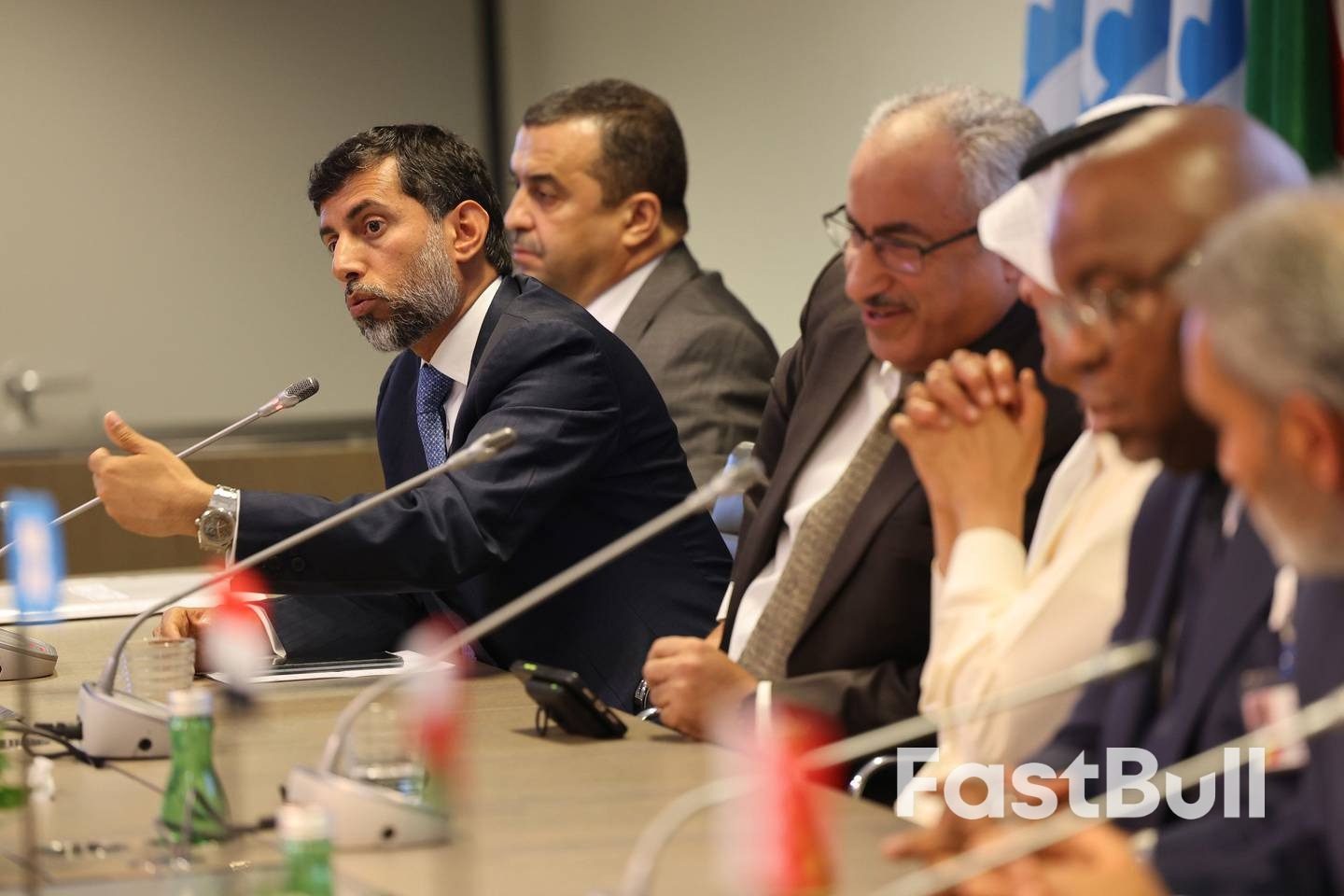
          "We will make sure that we have a balanced market and if we have to do more, we will do more ... We are looking at long-term," Suhail Al Mazrouei, Minister of Energy and Infrastructure, said at the post-meeting press conference.
          "What is important to us is bringing the investment [and] the sustainability of this market," he said.Opec+ Agrees to Cut Output By 2 Million BPD as Oil Demand Concerns Take Centre Stage_1
          Opec+ is "here to stay as a moderating force to bring about stability", Saudi Arabia's Energy Minister Prince Abdulaziz bin Salman said at the conference.
          "Energy is something that can never be attended to in short-term tweaks and moves … the world energy markets need attendance, careful planning and investments."
          Oil prices, which posted their worst quarter in two years last month, rallied strongly earlier this week on expectations of the production cuts.
          Since peaking close to $140 a barrel in March, prices have retreated to about $90 a barrel this October as markets grow anxious over demand conditions going into 2023.
          The group's ability to make a large production cut is "entrenched in the lack of any supply elasticity", said Ehsan Khoman, director of emerging markets research for Europe, the Middle East and Africa at MUFG Bank.
          There is "negligible" spare capacity outside the core Opec producers and US shale activity is showing signs of slowing, Mr Khoman said.
          A shale resurgence, centred on the Permian Basin in Texas, made the US the world's biggest producer of oil and gas in 2018.
          However, a lack of capital and pressure mounted by investors seeking higher returns have prevented further output increases, despite the price surge.
          "While exceptional, this cut is also logical as it maximises the group's revenue today with minimal sacrifice of future profitability," Mr Khoman said.
          Last month, Opec and its allies agreed to modestly cut oil production by 100,000 bpd, reverting to August production levels to support prices, a move that analysts said showed the group's willingness to take action amid rising volatility.
          "The challenge in cutting output will be to avoid pushing prices up too much that it exacerbates the pending slowdown in demand growth," Edward Bell, senior director of market economics at Emirates NBD, said in a research note.
          Emirates NBD, which expects a more "interventionist" stance from the oil super group in the near term, expects Brent crude to average $105 a barrel in 2023.
          It expects WTI to average $95 a barrel next year.
          The Opec+ alliance agreed in the spring of 2020 to cumulatively cut crude output by a record 9.7 million bpd as it faced a coronavirus-induced crash in oil prices. The alliance then gradually unwound the cuts over the past two years.
          Growing fears of a global recession, a strong US dollar, surging inflation and monetary tightening by central banks around the world have continued to weigh on the market since June.
          The International Monetary Fund, the World Bank, the Institute of International Finance and the Organisation for Economic Co-operation and Development have all slashed their global economic growth forecasts for this year.
          "Global rate hikes will inevitably impact aggregate demand and therefore oil consumption, too, especially in developing countries but its impact will not as severe as during the pandemic," said Tamas Varga, oil analyst at London broker PVM Oil.
          Sudharsan Sarathy, a London Stock Exchange Group analyst, said oil demand in the short term could be affected by winter heating demand in Europe and North Asia, China's lockdowns and sanctions on Russian energy exports.

          Source: thenationalnews

          Risk Warnings and Disclaimers
          You understand and acknowledge that there is a high degree of risk involved in trading. Following any strategies or investment methods may lead to potential losses. The content on the site is provided by our contributors and analysts for information purposes only. You are solely responsible for determining whether any trading assets, securities, strategy, or any other product is suitable for investing based on your own investment objectives and financial situation.
          Comments
          Add to Favorites
          Share

          Dollar's Blistering Rally to Extend into Next Year

          Devin
          The unstoppable dollar, which is already having a banner year, is likely to extend its dominance beyond 2022, according to a Reuters poll of foreign exchange strategists who said the currency was still some distance from an inflection point.
          Up over 16% so far in 2022, the dollar index has already had its best year in at least five decades, with the currency exhibiting few signs of slowing anytime soon.
          Underpinning the greenback's ascendancy were the U.S. economy's superior performance, the Federal Reserve hiking interest rates by 300 basis points this year - with more expected - and the role it plays as a safe-haven currency.
          With those broad narratives supporting the dollar well into next year the greenback was likely to be well bid over the short-to-medium term.
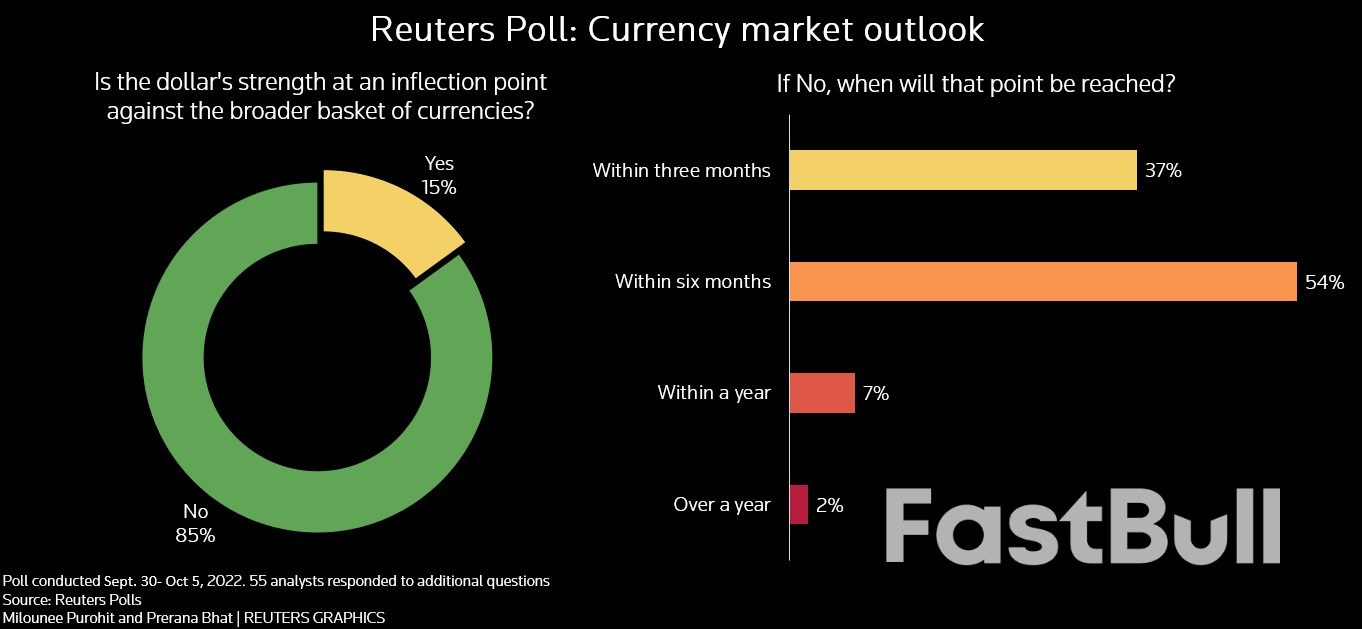
          An overwhelming majority of 85% of analysts, 47 of 55, in the Sept. 30-Oct. 5 Reuters poll who answered an additional question said the dollar's broad strength against a basket of currencies hasn't yet reached an inflection point.
          When asked when it would be reached, 25 of 46 who responded said within six months and 17 said within three months. Among the remaining four analysts three said within a year and one said over a year.
          Dollar's Blistering Rally to Extend into Next Year_1"It's definitely too early to start calling the pivot points in the dollar...in the short term we still see more dollar upside," said Simon Harvey, head of FX analysis at Monex Europe.
          "We don't necessarily see a bigger turning point for the greenback until at least Q2 of next year when we think we will start to see potentially U.S. fundamentals turn against the Fed's stance of restrictive policies."
          The dollar's extended rally is bad news for most major currencies which have not only accumulated heavy losses so far this year but have also surprisingly underperformed their emerging market counterparts.
          Nearly all major currencies - eight among the G10 - which were down in double digits for the year were not expected to recoup their year-to-date losses over the next 12 months, the poll showed.
          The euro which was down 12% for the year against the dollar and has largely traded below parity since August was expected to stay there for at least another six months.
          This is the first time in over two decades median forecasts in Reuters polls have predicted the common currency to trade below parity over a six-month horizon.
          It was then expected to gain around 4% to reach $1.03 in a year from $0.991 it was trading around on Wednesday.
          Japan's yen, which hit a 24-year low of 146/dollar recently, was expected to recover some of its losses in a year.
          The safe-haven currency was forecast to trade around 144.0, 140.5 and 135.0 per dollar over the next three, six and 12 months, respectively.
          If realised that would amount to only about a 7% gain against the dollar in 12 months for a currency already down more than 20% for the year and the worst performer among majors.
          Much of the weakness was down to the Bank of Japan sticking to its ultra-easy monetary policy when nearly every other central bank is moving in the opposite direction.
          "The Bank of Japan is still not signalling any change to its ultra-accommodative monetary policy. Adopting a less-dovish monetary policy would probably have a greater, more lasting effect on the yen's exchange rate," noted Jimmy Jean, vice-president, chief economist and strategist at Desjardins.
          Trading around $1.12 on Wednesday the latest poll showed sterling would fall to $1.09 in a month and be at $1.10 in six months. It was predicted to be around 3.6% stronger at $1.16 in a year.

          Source: Reuters

          Risk Warnings and Disclaimers
          You understand and acknowledge that there is a high degree of risk involved in trading. Following any strategies or investment methods may lead to potential losses. The content on the site is provided by our contributors and analysts for information purposes only. You are solely responsible for determining whether any trading assets, securities, strategy, or any other product is suitable for investing based on your own investment objectives and financial situation.
          Comments
          Add to Favorites
          Share

          What is NOPEC, the U.S. Bill to Pressure the OPEC+ Oil Group?

          Damon
          U.S. legislation that could open members of oil producing group OPEC+ to antitrust lawsuits has emerged as a possible tool to tackle high fuel prices, after the body said it would slash production despite lobbying by the Biden administration.
          The No Oil Producing and Exporting Cartels (NOPEC) bill, which passed a Senate committee 17-4 on May 5, is intended to protect U.S. consumers and businesses from engineered oil spikes.
          But some analysts warn that implementing it could also have some dangerous unintended consequences.
          OPEC+, which groups the Organization of the Petroleum Exporting Countries (OPEC) and allies including Russia, on Wednesday agreed steep production cuts, curbing supply in an already tight market.
          After the decision, the White House said it would consult with Congress on "additional tools and authorities" to reduce the group's control over energy prices, an apparent reference to possible support for NOPEC. The White House had previously raised concerns about the bill.
          Here are some details about the legislation.

          What is the NOPEC bill?

          The bipartisan NOPEC bill would tweak U.S. antitrust law to revoke the sovereign immunity that has protected OPEC+ members and their national oil companies from lawsuits.
          If signed into law, the U.S. attorney general would gain the option to sue the oil cartel or its members, such as Saudi Arabia, in federal court.
          It is unclear exactly how a federal court could enforce judicial antitrust decisions against a foreign nation. The United States could also face criticism for its attempts to manipulate markets by, for example, its planned release of 165 million barrels of oil from the emergency oil reserve between May and November.
          But several attempts to pass NOPEC over more than two decades have long worried OPEC's de facto leader Saudi Arabia, leading Riyadh to lobby hard every time a version of the bill has come up.
          With the Senate Judiciary Committee passing the bill in May, it needs to pass the full Senate and House and be signed by the president to become law. ClearView Energy Partners, a nonpartisan research group, said NOPEC, if introduced to the Senate floor, would likely get the 60 votes needed to pass the 100-member chamber.

          What's changed now?

          Previous versions of the NOPEC bill have failed amid resistance by oil industry groups, including top U.S. oil lobby group, the American Petroleum Institute (API).
          But anger has risen in Congress about gasoline prices that earlier this year helped fuel inflation to the highest level in decades.
          Saudi Arabia has rebuffed repeated lobbying during visits by Biden officials not to cut production. Instead, OPEC+ on Wednesday agreed to cut output by the most since the start of the COVID-19 pandemic.

          U.S. Oil industry opposed

          Lobby group API has long opposed NOPEC, saying it could hurt U.S. oil and gas producers. Mike Sommers, API's president and chief executive, said NOPEC "would create further instability in the marketplace and exacerbate existing challenges in international commerce. Such legislation would be unhelpful in any market condition past, present or future."
          One industry concern is that NOPEC legislation could ultimately lead to overproduction by OPEC, bringing prices so low that U.S. energy companies have difficulty boosting output. Saudi Arabia and other OPEC countries have some of the world's cheapest and easiest reserves to produce.
          A wave of oil from OPEC producers, even at a time of concerns about Russian supply could chill U.S. drillers, some of which are already reluctant to boost output despite the cut.

          Potential Blowback

          Some analysts have said that NOPEC could lead to unintended blowback, including the possibility that other countries could take similar action on the United States for withholding agricultural output to support domestic farming, for example.
          "It's always a bad idea to make policy when you are angry," Mark Finley, a fellow in energy and global oil at Rice University's Baker Institute and former analyst and manager at the Central Intelligence Agency, said in May when the bill advanced.
          OPEC nations could also strike back in other ways.
          In 2019, for example, Saudi Arabia threatened to sell its oil in currencies other than the dollar if Washington passed a version of the NOPEC bill. Doing so would undermine the dollar's status as the world's main reserve currency, reduce Washington's clout in global trade, and weaken its ability to enforce sanctions on nation states.
          The kingdom could also decide to buy at least some weapons from countries other than the United States, hitting a lucrative business for U.S. defense contractors.
          In addition, the kingdom and other oil producers could limit U.S. investments in their countries or simply raise their prices for oil sold into the United States - undermining the basic aim of the bill.
          The United States and its allies are already facing big challenges securing imports of reliable energy supplies, especially as sanctions ramp up on Russia, one of the world's largest oil and gas suppliers, for its invasion of Ukraine.

          Source: Reuters

          Risk Warnings and Disclaimers
          You understand and acknowledge that there is a high degree of risk involved in trading. Following any strategies or investment methods may lead to potential losses. The content on the site is provided by our contributors and analysts for information purposes only. You are solely responsible for determining whether any trading assets, securities, strategy, or any other product is suitable for investing based on your own investment objectives and financial situation.
          Comments
          Add to Favorites
          Share
          FastBull
          Copyright © 2026 FastBull Ltd

          728 RM B 7/F GEE LOK IND BLDG NO 34 HUNG TO RD KWUN TONG KLN HONG KONG

          TelegramInstagramTwitterfacebooklinkedin
          App Store Google Play Google Play
          Products
          Charts

          Chats

          Q&A with Experts
          Screeners
          Economic Calendar
          Data
          Tools
          Membership
          Features
          Function
          Markets
          Copy Trading
          Latest Signals
          Contests
          News
          Analysis
          24/7
          Columns
          Education
          Company
          Careers
          About Us
          Contact Us
          Advertising
          Help Center
          Feedback
          User Agreement
          Privacy Policy
          Personal Information Protection Statement
          Business

          White Label

          Data API

          Web Plug-ins

          Poster Maker

          Affiliate Program

          Risk Disclosure

          The risk of loss in trading financial instruments such as stocks, FX, commodities, futures, bonds, ETFs and crypto can be substantial. You may sustain a total loss of the funds that you deposit with your broker. Therefore, you should carefully consider whether such trading is suitable for you in light of your circumstances and financial resources.

          No decision to invest should be made without thoroughly conducting due diligence by yourself or consulting with your financial advisors. Our web content might not suit you since we don't know your financial conditions and investment needs. Our financial information might have latency or contain inaccuracy, so you should be fully responsible for any of your trading and investment decisions. The company will not be responsible for your capital loss.

          Without getting permission from the website, you are not allowed to copy the website's graphics, texts, or trademarks. Intellectual property rights in the content or data incorporated into this website belong to its providers and exchange merchants.

          Not Logged In

          Log in to access more features

          FastBull Membership

          Not yet

          Purchase

          Become a signal provider
          Help Center
          Customer Service
          Dark Mode
          Price Up/Down Colors

          Log In

          Sign Up

          Position
          Layout
          Fullscreen
          Default to Chart
          The chart page opens by default when you visit fastbull.com