• Trade
  • Markets
  • Copy
  • Contests
  • News
  • 24/7
  • Calendar
  • Q&A
  • Chats
Trending
Screeners
SYMBOL
LAST
BID
ASK
HIGH
LOW
NET CHG.
%CHG.
SPREAD
SPX
S&P 500 Index
6827.42
6827.42
6827.42
6899.86
6801.80
-73.58
-1.07%
--
DJI
Dow Jones Industrial Average
48458.04
48458.04
48458.04
48886.86
48334.10
-245.98
-0.51%
--
IXIC
NASDAQ Composite Index
23195.16
23195.16
23195.16
23554.89
23094.51
-398.69
-1.69%
--
USDX
US Dollar Index
97.950
98.030
97.950
98.500
97.950
-0.370
-0.38%
--
EURUSD
Euro / US Dollar
1.17394
1.17409
1.17394
1.17496
1.17192
+0.00011
+ 0.01%
--
GBPUSD
Pound Sterling / US Dollar
1.33707
1.33732
1.33707
1.33997
1.33419
-0.00148
-0.11%
--
XAUUSD
Gold / US Dollar
4299.39
4299.39
4299.39
4353.41
4257.10
+20.10
+ 0.47%
--
WTI
Light Sweet Crude Oil
57.233
57.485
57.233
58.011
56.969
-0.408
-0.71%
--

Community Accounts

Signal Accounts
--
Profit Accounts
--
Loss Accounts
--
View More

Become a signal provider

Sell trading signals to earn additional income

View More

Guide to Copy Trading

Get started with ease and confidence

View More

Signal Accounts for Members

All Signal Accounts

Best Return
  • Best Return
  • Best P/L
  • Best MDD
Past 1W
  • Past 1W
  • Past 1M
  • Past 1Y

All Contests

  • All
  • Trump Updates
  • Recommend
  • Stocks
  • Cryptocurrencies
  • Central Banks
  • Featured News
Top News Only
Share

Iranian Media Says 18 Crew Members Of Foreign Tanker Seized In Gulf Of Oman Over Carrying 'Smuggled Fuel' Detained

Share

Regional Governor: Two Killed In Ukrainian Drone Strike On Russia's Saratov

Share

Chinese Foreign Ministry - China Foreign Minister Met With United Arab Emirates Counterpart On Dec 12

Share

China's Central Financial And Economic Affairs Commission Deputy Director: Will Expand Export And Increase Import In 2026

Share

Thai Leader Anutin: Landmine Blast That Killed Thai Soldiers 'Not A Roadside Accident'

Share

Thai Leader Anutin: Thailand To Continue Military Action Until 'We Feel No More Harm'

Share

Cambodian Prime Minister Hun Manet Says He Had Phone Calls With Trump And Malaysian Leader Anwar About Ceasefire

Share

Cambodia's Hun Manet Says USA, Malaysia Should Verify 'Which Side Fired First' In Latest Conflict

Share

Cambodia's Hun Manet: Cambodia Maintains Its Stance In Seeking Peaceful Resolution Of Disputes

Share

Nasdaq Companies: Allergan, Ferrovia, Insmed, Monolithic Power Systems, Seagate Technology, And Western Digital Will Be Added To The NASDAQ 100 Index. Biogen, CdW, GlobalFoundries, Lululemon, ON Semiconductor, And Tradedesk Will Be Removed From The NASDAQ 100 Index

Share

Witkoff Headed To Berlin This Weekend To Meet With Zelenskiy, European Leaders -Wsj Reporter On X

Share

Russia Attacks Two Ukrainian Ports, Damaging Three Turkish-Owned Vessels

Share

[Historic Flooding Occurs In At Least Four Rivers In Washington State Due To Days Of Torrential Rains] Multiple Areas In Washington State Have Been Hit By Severe Flooding Due To Days Of Torrential Rains, With At Least Four Rivers Experiencing Historic Flooding. Reporters Learned On The 12th That The Floods Caused By The Torrential Rains In Washington State Have Destroyed Homes And Closed Several Highways. Experts Warn That Even More Severe Flooding May Occur In The Future. A State Of Emergency Has Been Declared In Washington State

Share

Trump Says Proposed Free Economic Zone In Donbas Would Work

Share

Trump: I Think My Voice Should Be Heard

Share

Trump Says Will Be Choosing New Fed Chair In Near Future

Share

Trump Says Proposed Free Economic Zone In Donbas Complex But Would Work

Share

Trump Says Land Strikes In Venezuela Will Start Happening

Share

US President Trump: Thailand And Cambodia Are In A Good Situation

Share

State Media: North Korean Leader Kim Hails Troops Returning From Russia Mission

TIME
ACT
FCST
PREV
U.K. Trade Balance Non-EU (SA) (Oct)

A:--

F: --

P: --

U.K. Trade Balance (Oct)

A:--

F: --

P: --

U.K. Services Index MoM

A:--

F: --

P: --

U.K. Construction Output MoM (SA) (Oct)

A:--

F: --

P: --

U.K. Industrial Output YoY (Oct)

A:--

F: --

P: --

U.K. Trade Balance (SA) (Oct)

A:--

F: --

P: --

U.K. Trade Balance EU (SA) (Oct)

A:--

F: --

P: --

U.K. Manufacturing Output YoY (Oct)

A:--

F: --

P: --

U.K. GDP MoM (Oct)

A:--

F: --

P: --

U.K. GDP YoY (SA) (Oct)

A:--

F: --

P: --

U.K. Industrial Output MoM (Oct)

A:--

F: --

P: --

U.K. Construction Output YoY (Oct)

A:--

F: --

P: --

France HICP Final MoM (Nov)

A:--

F: --

P: --

China, Mainland Outstanding Loans Growth YoY (Nov)

A:--

F: --

P: --

China, Mainland M2 Money Supply YoY (Nov)

A:--

F: --

P: --

China, Mainland M0 Money Supply YoY (Nov)

A:--

F: --

P: --

China, Mainland M1 Money Supply YoY (Nov)

A:--

F: --

P: --

India CPI YoY (Nov)

A:--

F: --

P: --

India Deposit Gowth YoY

A:--

F: --

P: --

Brazil Services Growth YoY (Oct)

A:--

F: --

P: --

Mexico Industrial Output YoY (Oct)

A:--

F: --

P: --

Russia Trade Balance (Oct)

A:--

F: --

P: --

Philadelphia Fed President Henry Paulson delivers a speech
Canada Building Permits MoM (SA) (Oct)

A:--

F: --

P: --

Canada Wholesale Sales YoY (Oct)

A:--

F: --

P: --

Canada Wholesale Inventory MoM (Oct)

A:--

F: --

P: --

Canada Wholesale Inventory YoY (Oct)

A:--

F: --

P: --

Canada Wholesale Sales MoM (SA) (Oct)

A:--

F: --

P: --

Germany Current Account (Not SA) (Oct)

A:--

F: --

P: --

U.S. Weekly Total Rig Count

A:--

F: --

P: --

U.S. Weekly Total Oil Rig Count

A:--

F: --

P: --

Japan Tankan Large Non-Manufacturing Diffusion Index (Q4)

--

F: --

P: --

Japan Tankan Small Manufacturing Outlook Index (Q4)

--

F: --

P: --

Japan Tankan Large Non-Manufacturing Outlook Index (Q4)

--

F: --

P: --

Japan Tankan Large Manufacturing Outlook Index (Q4)

--

F: --

P: --

Japan Tankan Small Manufacturing Diffusion Index (Q4)

--

F: --

P: --

Japan Tankan Large Manufacturing Diffusion Index (Q4)

--

F: --

P: --

Japan Tankan Large-Enterprise Capital Expenditure YoY (Q4)

--

F: --

P: --

U.K. Rightmove House Price Index YoY (Dec)

--

F: --

P: --

China, Mainland Industrial Output YoY (YTD) (Nov)

--

F: --

P: --

China, Mainland Urban Area Unemployment Rate (Nov)

--

F: --

P: --

Saudi Arabia CPI YoY (Nov)

--

F: --

P: --

Euro Zone Industrial Output YoY (Oct)

--

F: --

P: --

Euro Zone Industrial Output MoM (Oct)

--

F: --

P: --

Canada Existing Home Sales MoM (Nov)

--

F: --

P: --

Euro Zone Total Reserve Assets (Nov)

--

F: --

P: --

U.K. Inflation Rate Expectations

--

F: --

P: --

Canada National Economic Confidence Index

--

F: --

P: --

Canada New Housing Starts (Nov)

--

F: --

P: --

U.S. NY Fed Manufacturing Employment Index (Dec)

--

F: --

P: --

U.S. NY Fed Manufacturing Index (Dec)

--

F: --

P: --

Canada Core CPI YoY (Nov)

--

F: --

P: --

Canada Manufacturing Unfilled Orders MoM (Oct)

--

F: --

P: --

Canada Manufacturing New Orders MoM (Oct)

--

F: --

P: --

Canada Core CPI MoM (Nov)

--

F: --

P: --

Canada Manufacturing Inventory MoM (Oct)

--

F: --

P: --

Canada CPI YoY (Nov)

--

F: --

P: --

Canada CPI MoM (Nov)

--

F: --

P: --

Canada CPI YoY (SA) (Nov)

--

F: --

P: --

Canada Core CPI MoM (SA) (Nov)

--

F: --

P: --

Q&A with Experts
    • All
    • Chatrooms
    • Groups
    • Friends
    Connecting
    .
    .
    .
    Type here...
    Add Symbol or Code

      No matching data

      All
      Trump Updates
      Recommend
      Stocks
      Cryptocurrencies
      Central Banks
      Featured News
      • All
      • Russia-Ukraine Conflict
      • Middle East Flashpoint
      • All
      • Russia-Ukraine Conflict
      • Middle East Flashpoint
      Search
      Products

      Charts Free Forever

      Chats Q&A with Experts
      Screeners Economic Calendar Data Tools
      Membership Features
      Data Warehouse Market Trends Institutional Data Policy Rates Macro

      Market Trends

      Market Sentiment Order Book Forex Correlations

      Top Indicators

      Charts Free Forever
      Markets

      News

      News Analysis 24/7 Columns Education
      From Institutions From Analysts
      Topics Columnists

      Latest Views

      Latest Views

      Trending Topics

      Top Columnists

      Latest Update

      Signals

      Copy Rankings Latest Signals Become a signal provider AI Rating
      Contests
      Brokers

      Overview Brokers Assessment Rankings Regulators News Claims
      Broker listing Forex Brokers Comparison Tool Live Spread Comparison Scam
      Q&A Complaint Scam Alert Videos Tips to Detect Scam
      More

      Business
      Events
      Careers About Us Advertising Help Center

      White Label

      Data API

      Web Plug-ins

      Affiliate Program

      Awards Institution Evaluation IB Seminar Salon Event Exhibition
      Vietnam Thailand Singapore Dubai
      Fans Party Investment Sharing Session
      FastBull Summit BrokersView Expo
      Recent Searches
        Top Searches
          Markets
          News
          Analysis
          User
          24/7
          Economic Calendar
          Education
          Data
          • Names
          • Latest
          • Prev

          View All

          No data

          Scan to Download

          Faster Charts, Chat Faster!

          Download App
          English
          • English
          • Español
          • العربية
          • Bahasa Indonesia
          • Bahasa Melayu
          • Tiếng Việt
          • ภาษาไทย
          • Français
          • Italiano
          • Türkçe
          • Русский язык
          • 简中
          • 繁中
          Open Account
          Search
          Products
          Charts Free Forever
          Markets
          News
          Signals

          Copy Rankings Latest Signals Become a signal provider AI Rating
          Contests
          Brokers

          Overview Brokers Assessment Rankings Regulators News Claims
          Broker listing Forex Brokers Comparison Tool Live Spread Comparison Scam
          Q&A Complaint Scam Alert Videos Tips to Detect Scam
          More

          Business
          Events
          Careers About Us Advertising Help Center

          White Label

          Data API

          Web Plug-ins

          Affiliate Program

          Awards Institution Evaluation IB Seminar Salon Event Exhibition
          Vietnam Thailand Singapore Dubai
          Fans Party Investment Sharing Session
          FastBull Summit BrokersView Expo

          Bitcoin Holds Ground as Fed Leaves Interest Rates Unchanged

          Manuel

          Cryptocurrency

          Summary:

          The total value of digital assets globally edged up to $3.23 trillion, reflecting cautious optimism among crypto traders who have kept a close watch on U.S. monetary policy.

          The Federal Reserve left its key interest rate steady on June 18, choosing caution as it monitors persistent inflation and global uncertainties.
          Bitcoin (BTC) remained largely stable, continuing to hold recent gains despite broader market jitters. The flagship crypto was trading at $104,110 as of press time, down 0.66% over the past 24 hours.

          Rates maintained

          The central bank’s Federal Open Market Committee announced it would maintain its policy rate within the current 4.25% to 4.5% target range, matching market expectations.
          Policymakers emphasized that any future rate changes would depend on incoming economic data, citing healthy job growth and moderate progress on inflation as reasons to pause.
          The total value of digital assets globally edged up to $3.23 trillion, reflecting cautious optimism among crypto traders who have kept a close watch on U.S. monetary policy.
          Financial markets widely anticipated the Fed’s decision, especially with recent oil price increases adding new risks to inflation forecasts. Tensions in the Middle East, particularly between Israel and Iran, have also contributed to a more cautious economic outlook.
          A survey from CME Group showed traders were almost certain, with a 99.9% probability, that the Fed would hold rates steady, despite repeated calls from the White House to push for a rate cut.

          Trump calls for cuts

          President Donald Trump intensified criticism of Fed Chair Jerome Powell on June 18, accusing him of damaging economic momentum by keeping borrowing costs too high.
          Trump claimed that lowering rates by two percentage points would spur investment and support markets, contrasting U.S. policy with recent rate cuts by European central banks.
          Even so, the Fed has signaled it intends to stay the course in its effort to bring inflation back in line with its 2% target, resisting political pressure amid a complex economic backdrop.
          Bitcoin’s steady performance highlights how some investors continue to treat the token as a potential buffer against traditional market and policy shifts. However, geopolitical flashpoints and volatile commodity prices could test the crypto market’s relative calm in the months ahead.

          Source: Cryptoslate

          Risk Warnings and Disclaimers
          You understand and acknowledge that there is a high degree of risk involved in trading. Following any strategies or investment methods may lead to potential losses. The content on the site is provided by our contributors and analysts for information purposes only. You are solely responsible for determining whether any trading assets, securities, strategy, or any other product is suitable for investing based on your own investment objectives and financial situation.
          Add to Favorites
          Share

          US Plans to Ease Capital Rule Limiting Banks Treasury Trades

          Manuel

          Political

          Middle East Situation

          President Donald Trump said Iran squandered the chance to make a deal over its nuclear enrichment, but declined to say whether the US plans to join Israel’s offensive aimed at destroying the program.
          “I may do it. I may not do it,” Trump told reporters Wednesday at the White House when asked if he is moving closer to bombing Iran. “I mean, nobody knows what I’m going to do.”
          Iran had been in negotiations with the US over its nuclear program for weeks, and had a further meeting scheduled, when Israel attacked Friday. The two Mideast nations have since traded missile strikes and escalating rhetoric — Israeli leaders threatening to topple the Islamic Republic, and their Iranian counterparts vowing defiance and retaliation — while the Trump administration weighs how deeply to get involved in its ally’s war.
          Trump’s ambiguous comments add a new layer of tension to the deepening Israel-Iran clash. The president, who has campaigned for a decade in opposition to American wars in the Middle East, also faces a tense divide among his supporters over whether the US should enter the fray. America has so far limited its participation to helping Israel defend itself against Iranian missile and drone launches.
          Trump said he encouraged Benjamin Netanyahu in a call Tuesday to “keep going” with his offensive operations, adding that he gave the Israeli premier no indication that US forces would participate in the attacks.
          But the US is seen as being able to provide military firepower necessary to destroy Iran’s underground enrichment facility at Fordow, which analysts say Israel is unable to do alone. Iran has warned it can hit American bases across the region, where tens of thousands of troops are stationed, if the US joins the Israeli attack.
          Trump didn’t close the door to a resumption of nuclear talks — he said Iran had sought a meeting, a claim Tehran disputed — but downplayed the likelihood they would bear fruit. “I said it’s very late to be talking,” the president said. “There’s a big difference between now and a week ago.”
          The comments were Trump’s first substantive remarks since meeting Tuesday with his National Security Council, where the US’s options were discussed. He spoke to reporters on the South Lawn of the White House, where workers were installing a giant flagpole outside the executive mansion’s diplomatic entrance. Hours earlier he’d demanded “UNCONDITIONAL SURRENDER” from Iran in a social media post.
          Since Israel’s strikes started, Iran has fired 400 ballistic missiles and hundreds of drones at Israel, killing 24 people and injuring more than 800, according to the Israeli government. At least 224 Iranians have been killed by Israel’s attacks. Iran has hit targets including a key oil refinery in the port of Haifa that was forced to shut down.
          “The Americans should know that the Iranian nation is not one to surrender,” Iran’s Supreme Leader Ayatollah Ali Khamenei said in a statement published on his official website Wednesday. “Any military incursion by the United States will undoubtedly result in irreparable damage.”

          Out of Patience

          “Good luck,” Trump said when asked for his response. “We cannot let Iran get a nuclear weapon. I’ve been saying it for a long time. I mean it more now than I ever mentioned.”
          Dennis Ross, who served as President Bill Clinton’s Middle East envoy and just returned from a trip to the region, said the Iranian regime is likely looking for an off-ramp from the current conflict despite the bellicose comments from Khamenei.
          Its top priority is survival, followed by avoiding a direct conflict with the US, said Ross, who’s now a fellow at the Washington Institute for Near East Policy. “When they feel profoundly threatened, they will make concessions. They certainly feel vulnerable and threatened right now.”
          Iran’s missile and drone launches against Israel appeared to be subsiding Wednesday evening, although the reason wasn’t immediately clear. While the Israeli army earlier said it had destroyed around one-third of Iran’s missile launchers, Tehran still possesses thousands of ballistic missiles that can reach Israel, National Security Adviser Tzachi Hanegbi said Monday.
          US Ambassador to Israel Mike Huckabee announced Wednesday that the embassy is organizing evacuations of Americans in Israel who want to leave. Embassy personnel have already begun to depart the country, a spokesperson said. The announcements came a day after the US embassy in Jerusalem said it would be closed Wednesday through Friday.
          Trump said the Iranian government had contacted the US about the conflict and even proposed a White House meeting to settle the matter, yet he said his patience with the Islamic Republic had “already run out.” Iran’s mission to the United Nations denied that claim in an X post Wednesday, saying “No Iranian official has ever asked to grovel at the gates of the White House.”
          The question of whether to strike Iran has the potential to cause domestic political headaches for Trump, whose base is split between isolationists and traditional conservative interventionists. Supporters of both political parties oppose the US joining Israel’s attack on Iran by clear majorities, a YouGov survey found.
          Trump said his bottom line remains that “Iran cannot have a nuclear weapon” and “it’s not a question of anything else.” During his first term, Trump withdrew from an agreement aimed at curtailing Iran’s atomic program, which the US and other world powers had spent years negotiating.
          Republican hawks have been supportive of military action against Iran, but Trump has faced pressure from some of his isolationist supporters to take a more measured approach. “We have all been very vocal for days now urging, ‘Let’s be America First. Let’s stay out,” Representative Marjorie Taylor Greene said Tuesday on CNN.
          During a breakfast Wednesday hosted by the Christian Science Monitor, longtime Trump ally Steve Bannon said Trump’s supporters want him to focus on issues most important to his base, like cracking down on immigration. But Bannon said that if the president has more information that backs the case for intervention “and makes that case to the American people, the MAGA movement will support President Trump.”
          Defense Secretary Pete Hegseth, appearing before the Senate Armed Services Committee on Wednesday, declined to answer directly whether Trump had asked the Pentagon to provide options for striking Iran.
          Hegseth said that “maximum force protection at all times is being maintained” for US troops stationed in the region, and said that “the president has options and is informed of what those options might be, and what the ramifications of those options might be.”
          The US has continued building its military presence in the region. The USS Ford carrier strike group is set to depart next week on a regularly scheduled deployment, initially in the European theater, according to a US official.
          Meanwhile, the head of the International Atomic Energy Agency said the location of Iran’s near-bomb-grade stockpile of enriched uranium cannot currently be verified.
          IAEA Director General Rafael Mariano Grossi said Wednesday the whereabouts of the material are now unclear, given Tehran warned him the stockpile could be moved in the event of an Israeli attack. The agency continues to see no indication of significant damage to Iran’s Fordow nuclear site, he added.

          Source: Bloomberg

          Risk Warnings and Disclaimers
          You understand and acknowledge that there is a high degree of risk involved in trading. Following any strategies or investment methods may lead to potential losses. The content on the site is provided by our contributors and analysts for information purposes only. You are solely responsible for determining whether any trading assets, securities, strategy, or any other product is suitable for investing based on your own investment objectives and financial situation.
          Add to Favorites
          Share

          Fed Dot Plot Reveals More Divided Central Bank, but Still Points to two Rate Cuts in 2025

          Manuel

          Central Bank

          Economic

          The Federal Reserve's latest "dot plot" outlining future interest rate moves suggests the central bank will still cut rates twice this year, unchanged from its March outlook, though June's forecast shows a more divided Fed weighing its next move on interest rates.
          The Fed announced Wednesday that it held its benchmark interest rate in a range of 4.25%-4.5%, as expected. This marked the fourth straight meeting the Fed kept rates unchanged since cutting rates by 0.25% back in December.
          Along with its policy announcement, the Fed released updated economic forecasts in its Summary of Economic Projections (SEP), including its "dot plot," which maps out policymakers' expectations for where interest rates could be headed in the future.
          The central bank raised its projections for inflation and unemployment at the end of this year while lowering its forecast for economic growth.
          Fed officials see the fed funds rate falling to 3.9% this year, on par with its previous March projection. Coming into the decision, markets had priced in one to two additional rate cuts this year, according to Bloomberg data. The central bank slashed interest rates by a total of 100 basis points in 2024. It has yet to deliver rate cuts so far this year.
          In 2026, officials see one additional cut; in March, the Fed expected to cut rates twice next year.
          Twelve officials predict a rate cut this year, with two officials seeing a decrease of more than 0.5%.
          Most notable in Wednesday's dot plot were forecasts that showed seven FOMC members see no change in rates this year, signaling a more hawkish stance compared to March when four officials saw no change. Two FOMC members expect only one interest rate cut this year.
          The updated forecasts suggest the Federal Reserve will continue to take a cautious approach as officials attempt to understand the Trump administration's shifting trade narrativeand other policy unknowns, such as the implications of the president's tax proposal.
          Meanwhile, fears over stagflation, a bleak economic scenario in which growth stalls, inflation persists, and unemployment rises, have escalated since the start of the year — and Wednesday's projections continued to underscore that sentiment.
          The SEP indicated the Federal Reserve sees core inflation hitting 3.1% this year, higher than March's projection of 2.8%, before cooling to 2.4% in 2026 and 2.1% in 2027.
          The Fed also sees the unemployment rate rising to 4.5% this year, higher than its previous forecast of 4.4%. As of May, the unemployment rate stood at 4.2%. Unemployment is expected to remain at that level — 4.5% — through 2026 before ticking down to 4.4% in 2027.
          The Fed also downgraded its previous forecast for US economic growth, with GDP expected to grow at an annualized pace of 1.4% this year before reaching 1.6% growth in 2026 and 1.8% in 2027.
          In March, officials saw GDP growth at 1.7% this year before reaching 1.8% in 2026 and 2027.
          Source: Yahoo Finance
          To stay updated on all economic events of today, please check out our Economic calendar
          Risk Warnings and Disclaimers
          You understand and acknowledge that there is a high degree of risk involved in trading. Following any strategies or investment methods may lead to potential losses. The content on the site is provided by our contributors and analysts for information purposes only. You are solely responsible for determining whether any trading assets, securities, strategy, or any other product is suitable for investing based on your own investment objectives and financial situation.
          Add to Favorites
          Share

          Fed Keeps Rates Unchanged, Sees Two Cuts In 2025 But Less Easing In Later Years

          Thomas

          Central Bank

          The Federal Reserve held interest rates steady on Wednesday and policymakers signaled borrowing costs are still likely to fall this year, but slowed the overall pace of expected future rate cuts in the face of estimated higher inflation flowing from the Trump administration's tariff plans.

          In new economic projections, policymakers sketched a modestly stagflationary picture of the U.S. economy, with economic growth slowing to 1.4% this year, unemployment rising to 4.5% by the end of this year, and inflation finishing 2025 at 3%, well above the current level.

          While policymakers still anticipate cutting rates by half a percentage point this year, as they projected in March and December, they slightly slowed the pace from there to a single quarter-percentage-point cut in each of 2026 and 2027 in a protracted fight to return inflation to the central bank's 2% target.

          Under the new projections, inflation remains elevated at 2.4% through 2026 before falling to 2.1% in 2027 amid largely stable unemployment.

          "Uncertainty about the economic outlook has diminished but remains elevated," the Fed said in its latest policy statement, a modification of language used in May, at a more turbulent moment in the trade debate, when it said that the risk of both higher inflation and higher unemployment had risen.

          Those outcomes were both embedded in the new projections, the Fed's latest thinking about how President Donald Trump's suite of economic policies is expected to shape the economy this year.

          The 1.4% growth in output this year compares to the 1.7% rate seen in the last round of projections in March, and the 4.5% unemployment rate expected at the end of the year is up from the 4.4% projected in March. The rate as of May was 4.2%

          So far, however, "the unemployment rate remains low, and labor market conditions remain solid," the Fed said in its policy statement, which was approved unanimously.

          It did not mention the sudden outbreak of hostilities between Israel and Iran and the risk that conflict posed to global oil or other markets.

          Fed Chair Jerome Powell is scheduled to hold a press conference at 2:30 pm EDT (1830 GMT) and is likely to speak on the issue, as well as elaborate on the central bank's latest statement and economic projections.

          The rate projections from Fed officials for this year at least are in line with recent market expectations for a quarter-percentage-point rate reduction as soon as the Fed's September 16-17 meeting. The central bank continues to ignore Trump's call for immediate rate cuts, a move Fed officials feel would be counter to their effort to ensure inflation returns to their 2% target until key tariff changes are finalized and their effects are better understood.

          As Fed officials were meeting on Wednesday, Trump called Powell "stupid" and said the policy rate should be slashed in half, the type of move usually reserved for severe economic emergencies.

          The Fed's current policy rate was set in the current 4.25%-4.50% range in December, and policymakers have been reluctant to commit to a timeline for further cuts given the volatility of U.S. trade policy, and the difficulty of estimating how the burden of higher import taxes will be spread among consumers, importers, and producing nations.
          Source: Reuters

          Risk Warnings and Disclaimers
          You understand and acknowledge that there is a high degree of risk involved in trading. Following any strategies or investment methods may lead to potential losses. The content on the site is provided by our contributors and analysts for information purposes only. You are solely responsible for determining whether any trading assets, securities, strategy, or any other product is suitable for investing based on your own investment objectives and financial situation.
          Add to Favorites
          Share

          If the Fed lowers interest rates this year, it’ll likely be because of bad news. Here’s why

          Adam

          Economic

          Rising unemployment will likely be what pulls the trigger for the Federal Reserve to finally begin lowering interest rates again, economists say.
          Since January, the Fed has stood on the sidelines, keeping its benchmark lending rate unchanged at about 4.4%. Officials have said in recent speeches that they want to see how President Donald Trump’s significant policy changes, including on tariffs, affect the US economy first before considering further rate cuts.
          Renewed tensions in the Middle East add even more to the uncertainty that has paralyzed the central bank. Officials are expected to continue with their strategy of staying on hold at the conclusion of their two-day policy meeting on Wednesday, with an announcement at 2 p.m. ET.
          But the economy could soon buckle as Trump’s tariffs begin to force shoppers to pull back on their spending, eventually sending unemployment higher as company profits take a hit. That would give the Fed, which is responsible for preserving the labor market’s strength, the signal to start lowering rates.
          New economic projections from Fed policymakers could show they expect to lower rates at least once this year — and it will likely be because of bad news, economists say.
          “The Fed will probably start to cut rates in the second half of the year as the tariffs start to weigh on growth and you see the unemployment rate coming up,” Jay Bryson, chief economist at Wells Fargo, told CNN.
          While the Fed will likely lower rates eventually, the Fed’s expected decision on Wednesday might not sit well with Trump, who has torn into Fed Chair Jerome Powell for not lowering borrowing costs already, describing the Fed leader as a “fool” and a “numbskull.”

          The bigger worry

          In April after Trump unveiled a massive tariff hike on dozens of countries, Powell predicted the Fed could be in a situation in which both of the US central bank’s goals — stable prices and maximum employment — are “in tension.”
          A stagnant economy combined with rising inflation is referred to as “stagflation,” which isn’t happening outright, but forecasts from most economists, in addition to Fed officials themselves, show the US economy is trending in that direction. Officials’ new projections, to be released Wednesday, will likely show they still expect stagflation to slowly take shape this year.
          Such a situation puts the Fed in a difficult situation, and Powell has said how the Fed responds depends on which variable is in a worse state. The bigger worry for the Fed may end up being with the labor market.
          “The steady unemployment rate notwithstanding, cracks are becoming more evident in the labor market,” Jim Baird, chief investment officer at Plante Moran Financial Advisors, wrote in a recent analyst note. “Job openings are down, job creation has slowed, and unemployment claims continue to edge higher.”
          Fed officials have signaled that they will step in by lowering rates if the labor market shows concerning signs of strain.

          Trump ramps up the pressure on the Fed

          For months, Trump has lambasted the Fed and Powell himself for not lowering borrowing costs quickly enough.
          Trump has said the Fed is lagging behind its European counterpart and has claimed, without evidence, that the reason Powell is not lowering rates is to help Democrats. (The Fed is an independent agency whose decisions on monetary policy are free of political interference.) Trump has also said the Fed ought to lower rates to reduce the federal government’s interest payments on its massive budget deficits, which are expected to grow even larger if Congress passes the president’s tax and spending bill.
          “We’re going to spend $600 billion a year, $600 billion because of one numbskull that sits here (and says), ‘I don’t see enough reason to cut the rates now,’” Trump said at the White House last week.
          However, Fed officials don’t consider the government’s finances when setting rates. They focus on achieving their so-called dual mandate of stable prices and maximum employment.
          Other administration officials have piled on to the criticism of the Fed recently.
          “It’s unbelievable how much we would save if [Powell] did his job and he cut interest rates,” Commerce Secretary Howard Lutnick told Fox News last week. “Come on. He’s got to do his job soon.”
          Last week, Vice President JD Vance accused the Fed of deliberate misconduct for not lowering borrowing costs, writing in a post on X that the Fed is engaged in “monetary malpractice.”

          Source: cnn

          To stay updated on all economic events of today, please check out our Economic calendar
          Risk Warnings and Disclaimers
          You understand and acknowledge that there is a high degree of risk involved in trading. Following any strategies or investment methods may lead to potential losses. The content on the site is provided by our contributors and analysts for information purposes only. You are solely responsible for determining whether any trading assets, securities, strategy, or any other product is suitable for investing based on your own investment objectives and financial situation.
          Add to Favorites
          Share

          What Are Inflation Surprises Telling Us About Tariffs?

          Adam

          Economic

          The Fed will remain on hold today, and the main justification is the risk of persistently higher inflation due to tariffs. However, the inflation data through May have been weaker than expected, with limited signs of a tariff pass-through to consumer prices.
          The most likely explanation is that it’s too early to see the price effects of tariffs, but it could also be a sign of weaker demand limiting the pass-through to consumer prices. The smaller the boost to consumer inflation from tariffs, the more likely the Fed is to cut rates this year.
          Today’s post digs into one of the surprises in the recent inflation data: apparel prices have fallen in the past two months despite being one of the most import-intensive consumer goods. The post attempts to trace tariffs through economic data and offers some industry-specific context. Spending on apparel accounts for only 2.5% of the CPI, so it won’t settle the debate about tariff-related inflation risks. However, it provides some counter to the worst-case scenarios.

          Consumers Have Yet to See Prices Increase in Apparel

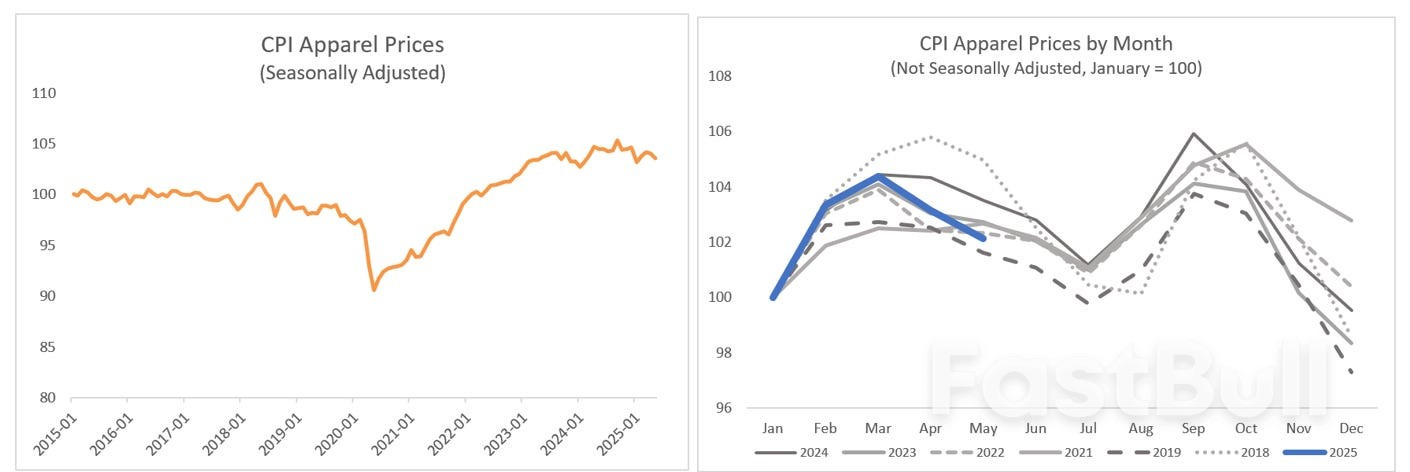
          Apparel prices in the CPI declined 0.4% in April, marking the second consecutive monthly decline, and are down 1% since the end of last year (orange line in left chart). The recent moves do not stand out when compared to the usual monthly volatility. Still, they are somewhat surprising given the tariff increases this year and the sector’s high import intensity.
          What Are Inflation Surprises Telling Us About Tariffs?_1
          The most recent declines are also apparent in the non-seasonally adjusted data (blue line in the right chart). The non-seasonally adjusted data show two clear peaks in prices during the year. Additionally, due to the industry’s import-intensive nature, production and delivery of goods often occur several months later. The tariffs are likely to be more relevant for the pricing of apparel later in the year. The Beige Book included a reference in the Boston District on repricing:
          A clothing retailer, which typically tags items with prices months in advance, took the rare step to retag items with higher prices to cover the cost of tariffs, and those items will hit store shelves this summer.
          Some delay in passing costs to customers is possible, but there are alternative ways to absorb the tariffs and other factors that influence pricing decisions.

          Import Prices for Apparel Have Declined.

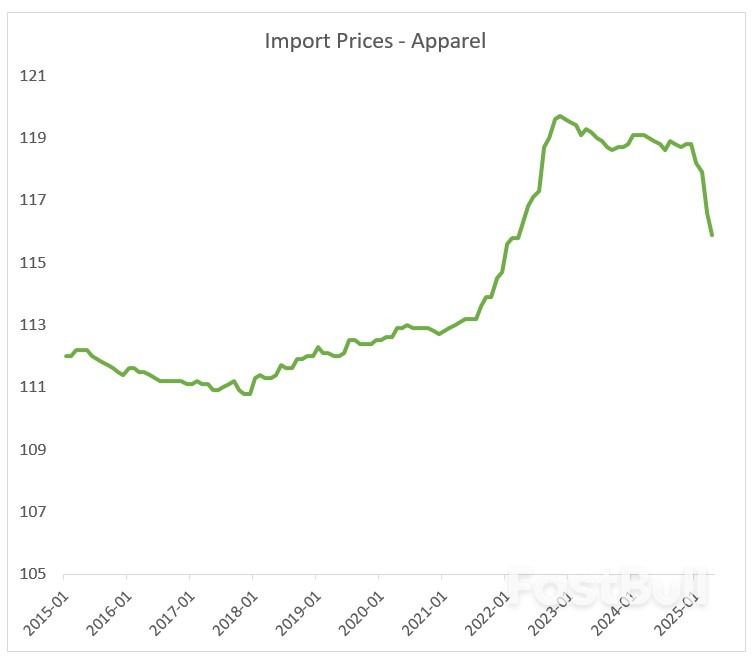
          While the domestic importer pays the tariff to the US government, the foreign producer can bear some of the tariff burden if it reduces the prices it charges to US importers. The import price refers to the transaction price between businesses upon entry and does not include tariff duties, insurance, or shipping costs.
          Overall import prices for end-use goods have remained little changed this year, but import prices for apparel have declined by nearly 3% through May. That is consistent with foreign producers bearing some of the burden of tariffs, though it is insufficient to fully offset the increased tariff duties that the domestic importers must pay.
          What Are Inflation Surprises Telling Us About Tariffs?_2
          The longer production cycles may have given US apparel importers more leverage than importers in other industries. In a Bloomberg interview, Sarah LaFleur, the owner of a women’s clothing brand, M.M.LaFleur, explained that the clothes had already been produced when the tariffs were announced.
          Reducing the import price could be a better alternative than losing the entire order payment for the foreign apparel manufacturers. That particular form of leverage may diminish over time. Still, it does suggest less cost pressure on US apparel importers due to tariffs so far, and could partly explain why consumer prices have not risen.

          Tariff Collections Have Risen, but Are Likely Still in the Process of Adjustment.

          Another reason why the effects of tariffs on apparel consumer prices may be muted is that the ramp-up in tariff collections has been more gradual than the announced changes in tariff rates. Businesses have less cost to pass on than the policy announcements might have suggested.
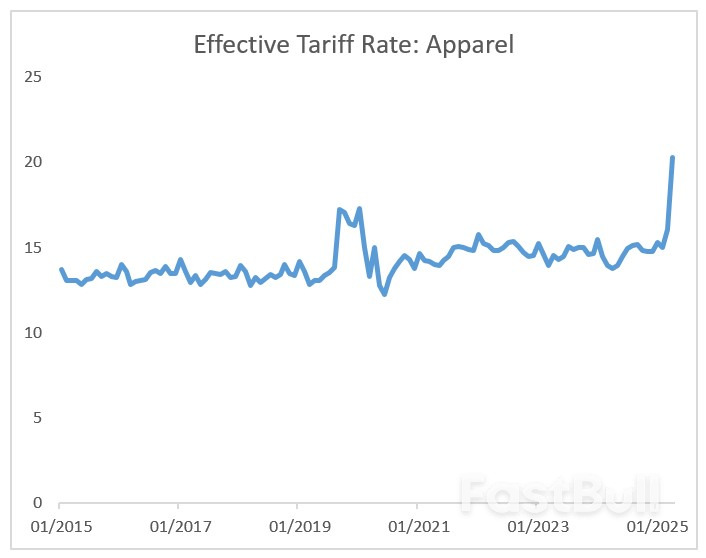
          The effective tariff rate on apparel manufacturing—total value of duties divided by total customs value of imports—from all countries has risen 5.5 percentage points through April. For Chinese apparel imports, it was 34 percentage points higher.
          What Are Inflation Surprises Telling Us About Tariffs?_3
          Those are notable increases, but by April, the tariff rate on apparel had increased by at least 10 percentage points for most countries and by more than 145 percentage points for China. Exemptions from the reciprocal tariffs for goods shipped before April 5 (for the 10% baseline tariffs) and April 9 (for the country-specific tariffs) are likely the primary reason for the gap. That was a one-time way to avoid the tariff increases.
          Given the breadth of the 10% baseline tariffs, the effective tariff rate is likely to rise further, even though the tariff policy rates have declined since April. The tariffs for most countries on apparel were reset to 10% in mid-April, and for China, to 30% in mid-May. June will be the first full month at the current level. The timing of shipping is a good example of how businesses will make an effort to minimize the extra costs of tariffs. Lower costs incurred are lower costs to pass on.

          Gross Margins Are Little Changed, but Could Offer a Buffer.

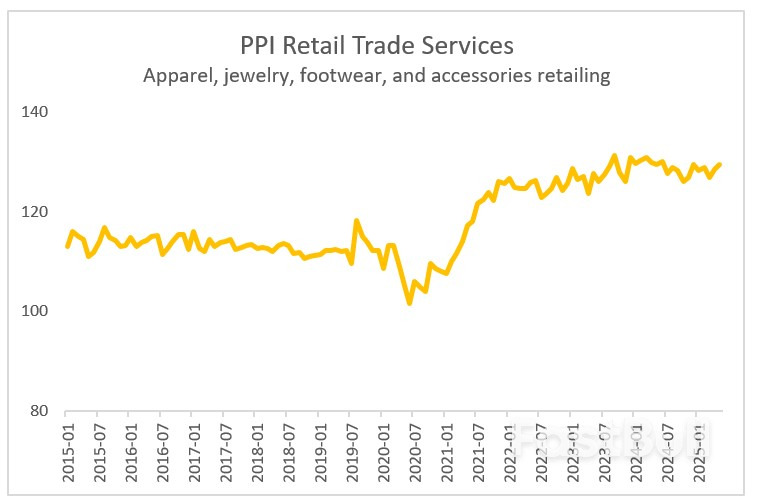
          Businesses that import tariffed goods can also absorb some of the cost by operating with narrower profit margins or by reducing other expenses. One measure of margins is trade services indexes in the Producer Price Index report, which capture the difference between the selling price and the acquisition price of a good.
          Note that the acquisition price (like the import price) does not include tariffs; therefore, a constant trade services margin would suggest that the business is bearing any additional costs associated with the tariff. Trade services for apparel retailers were unchanged in May compared to the end of last year. Steady margins also correspond roughly to declines in apparel import prices and consumer prices in recent months.
          What Are Inflation Surprises Telling Us About Tariffs?_4
          For now, any extra costs of tariffs (not offset by the lower import prices) appear to be absorbed by businesses. Those costs could be passed on later via higher consumer prices, but the apparel gross margins are elevated relative to pre-pandemic levels, which could provide some cushion.
          In his analysis of tariffs and pricing of apparel from 2015 to 2024, Professor Sheng Lu argued:
          … about 50% to 80% of the variation in U.S. retail prices is explained by its past values, underscoring the persistence of retailers’ pricing practices. Meanwhile, U.S. apparel retail sales account for about 27% of the changes in U.S. apparel retail prices. In comparison, apparel tariff changes explained only about 5% of the retail price fluctuations. In other words, market factors, particularly consumer demand, play a more significant role in shaping fashion companies’ pricing decisions than tariffs.
          The declines in consumer prices for apparel could also be a sign of weakening consumer demand. Apparel need not be representative of other consumer goods. Its trade services margins rose less than half as much as retailers overall. However, the lack of price increases in apparel consumer prices may indicate the restraints on passing tariffs on to consumers.

          In Closing

          In 2021, the Fed told us not to worry when inflation rose, saying it would be transitory. Now the Fed is telling us to worry even as inflation has slowed, saying more inflation is coming and it might be persistent.
          The most logical explanation for the modest signs of tariffs on consumer inflation is that it’s too soon to see the effects. But that’s not the only possible explanation. The declines in apparel consumer prices in recent months also suggest greater demand sensitivity and some tariff cost sharing by foreign producers. That would imply a smaller boost to inflation from tariffs, as opposed to simply a delay in the boost.
          It’s too soon to know the effects of the tariffs, but it will be important to hear how the Fed is sifting through the data and assessing the risks.

          source :investing

          To stay updated on all economic events of today, please check out our Economic calendar
          Risk Warnings and Disclaimers
          You understand and acknowledge that there is a high degree of risk involved in trading. Following any strategies or investment methods may lead to potential losses. The content on the site is provided by our contributors and analysts for information purposes only. You are solely responsible for determining whether any trading assets, securities, strategy, or any other product is suitable for investing based on your own investment objectives and financial situation.
          Add to Favorites
          Share

          Shares Of Coinbase, Circle Surge After Stablecoin Bill Passes Senate

          Devin

          Cryptocurrency

          Jeremy Allaire, CEO of Circle Internet Group, the issuer of one of the world's biggest stablecoins, and Circle co-founder Sean Neville pose outside the New York Stock Exchange (NYSE), on the day of the company's IPO in New York City, U.S., June 5, 2025.

          NYSE

          Shares of Circle and Coinbase rallied on Wednesday, as Wall Street cheered the Senate's passage of the GENIUS Act, which would establish a federal framework for U.S. dollar-pegged stablecoins.

          Circle, the issuer of the USDC stablecoin, rose 22% following the passing of the bill late Tuesday. It's the continuation of a remarkable run for Circle's stock since the company held its stock market debut on June 5. The shares are trading at about $180, up almost sixfold from their $31 IPO price.

          Coinbase, which co-founded USDC and shares in 50% of its revenue with Circle, gained more than 10%. Stablecoins have become Coinbase's biggest revenue driver after trading, with stablecoin-related income surging 50% year-over-year in the first quarter.

          The GENIUS Act, short for the Guiding and Establishing National Innovation for U.S. Stablecoins Act, allows private companies to issue stablecoins under strict guardrails, including full reserve backing and monthly audits.

          It represents the crypto industry's first major legislative win, but still has to get signed into law. The bill now heads to the House, which has its own version of a stablecoin bill dubbed STABLE. Both prohibit yield-bearing consumer stablecoins, but diverge on who regulates what.

          The Senate version centralizes oversight with Treasury, while the House splits authority between the Federal Reserve, the Comptroller of the Currency, and others. Reconciling the two could take a while, especially as House Republicans weigh attaching a broader market structure package, according to congressional aides.

          If the GENIUS Act becomes law, it could pave the way for explosive growth in the nearly $260 billion stablecoin market, and drive more revenue to key infrastructure players like Circle and Coinbase.

          Coinbase earns 100% of the interest on USDC held directly on its platform. CEO Brian Armstrong has said he wants USDC to overtake Tether as the world's top stablecoin.

          "If you can get shared economics, I don't see why we wouldn't see more of these banks partnering with USDC," Armstrong said last month, calling stablecoins a major pillar of Coinbase's long-term growth.

          Source: CNBC

          Risk Warnings and Disclaimers
          You understand and acknowledge that there is a high degree of risk involved in trading. Following any strategies or investment methods may lead to potential losses. The content on the site is provided by our contributors and analysts for information purposes only. You are solely responsible for determining whether any trading assets, securities, strategy, or any other product is suitable for investing based on your own investment objectives and financial situation.
          Add to Favorites
          Share
          FastBull
          Copyright © 2025 FastBull Ltd

          728 RM B 7/F GEE LOK IND BLDG NO 34 HUNG TO RD KWUN TONG KLN HONG KONG

          TelegramInstagramTwitterfacebooklinkedin
          App Store Google Play Google Play
          Products
          Charts

          Chats

          Q&A with Experts
          Screeners
          Economic Calendar
          Data
          Tools
          Membership
          Features
          Function
          Markets
          Copy Trading
          Latest Signals
          Contests
          News
          Analysis
          24/7
          Columns
          Education
          Company
          Careers
          About Us
          Contact Us
          Advertising
          Help Center
          Feedback
          User Agreement
          Privacy Policy
          Business

          White Label

          Data API

          Web Plug-ins

          Poster Maker

          Affiliate Program

          Risk Disclosure

          The risk of loss in trading financial instruments such as stocks, FX, commodities, futures, bonds, ETFs and crypto can be substantial. You may sustain a total loss of the funds that you deposit with your broker. Therefore, you should carefully consider whether such trading is suitable for you in light of your circumstances and financial resources.

          No decision to invest should be made without thoroughly conducting due diligence by yourself or consulting with your financial advisors. Our web content might not suit you since we don't know your financial conditions and investment needs. Our financial information might have latency or contain inaccuracy, so you should be fully responsible for any of your trading and investment decisions. The company will not be responsible for your capital loss.

          Without getting permission from the website, you are not allowed to copy the website's graphics, texts, or trademarks. Intellectual property rights in the content or data incorporated into this website belong to its providers and exchange merchants.

          Not Logged In

          Log in to access more features

          FastBull Membership

          Not yet

          Purchase

          Become a signal provider
          Help Center
          Customer Service
          Dark Mode
          Price Up/Down Colors

          Log In

          Sign Up

          Position
          Layout
          Fullscreen
          Default to Chart
          The chart page opens by default when you visit fastbull.com