• Trade
  • Markets
  • Copy
  • Contests
  • News
  • 24/7
  • Calendar
  • Q&A
  • Chats
Trending
Screeners
SYMBOL
LAST
BID
ASK
HIGH
LOW
NET CHG.
%CHG.
SPREAD
SPX
S&P 500 Index
6870.39
6870.39
6870.39
6895.79
6858.28
+13.27
+ 0.19%
--
DJI
Dow Jones Industrial Average
47954.98
47954.98
47954.98
48133.54
47871.51
+104.05
+ 0.22%
--
IXIC
NASDAQ Composite Index
23578.12
23578.12
23578.12
23680.03
23506.00
+72.99
+ 0.31%
--
USDX
US Dollar Index
98.930
99.010
98.930
98.960
98.730
-0.020
-0.02%
--
EURUSD
Euro / US Dollar
1.16483
1.16491
1.16483
1.16717
1.16341
+0.00057
+ 0.05%
--
GBPUSD
Pound Sterling / US Dollar
1.33174
1.33182
1.33174
1.33462
1.33136
-0.00138
-0.10%
--
XAUUSD
Gold / US Dollar
4208.85
4209.26
4208.85
4218.85
4190.61
+10.94
+ 0.26%
--
WTI
Light Sweet Crude Oil
59.272
59.302
59.272
60.084
59.181
-0.537
-0.90%
--

Community Accounts

Signal Accounts
--
Profit Accounts
--
Loss Accounts
--
View More

Become a signal provider

Sell trading signals to earn additional income

View More

Guide to Copy Trading

Get started with ease and confidence

View More

Signal Accounts for Members

All Signal Accounts

Best Return
  • Best Return
  • Best P/L
  • Best MDD
Past 1W
  • Past 1W
  • Past 1M
  • Past 1Y

All Contests

  • All
  • Trump Updates
  • Recommend
  • Stocks
  • Cryptocurrencies
  • Central Banks
  • Featured News
Top News Only
Share

Brazil Economists See Brazilian Real At 5.40 Per Dollar By Year-End 2025 Versus 5.40 In Previous Estimate - Central Bank Poll

Share

Brazil Economists See Year-End 2026 Interest Rate Selic At 12.25% Versus 12.00% In Previous Estimate - Central Bank Poll

Share

Brazil Economists See Year-End 2025 Interest Rate Selic At 15.00% Versus 15.00% In Previous Estimate - Central Bank Poll

Share

EU Commission Says Meta Has Committed To Give EU Users Choice On Personalised Ads

Share

Sources Revealed That The Bank Of England Has Invited Employees To Voluntarily Apply For Layoffs

Share

The Bank Of England Plans To Cut Staff Due To Budget Pressures

Share

Traders Believe There Is Less Than A 10% Chance That The European Central Bank Will Cut Interest Rates By 25 Basis Points In 2026

Share

Egypt, European Bank For Reconstruction And Development Sign $100 Million Financing Agreement

Share

Israel Budget Deficit 4.5% Of GDP In November Over Past 12 Months Versus 4.9% Deficit In October

Share

JPMorgan - Council Chaired By Jamie Dimon Includes Jeff Bezos

Share

UK Government: UK Health Security Agency Identified New Recombinant Mpox Virus In England In Individual Who Had Recently Travelled To Asia

Share

European Central Bank Governing Council Member Kazimir: I See No Reason To Change Rates In The Coming Months, Definitely No In December

Share

European Central Bank Governing Council Member Kazimir: Overengineering Policy Around Small Inflation Deviations Would Introduce Unnecessary Policy Uncertainty

Share

European Central Bank Governing Council Member Kazimir: European Central Bank Must Be Vigilant About Some Upside Risks To Inflation

Share

European Central Bank Governing Council Member Kazimir: Forex Pass Through To Prices May Not Be As Strong As Expected

Share

Document: EU Looking At Options For Boosting Lebanon's Internal Security Forces

Share

Thai Foreign Ministry: Military Action Will Continue Until Thai Sovereignty, Territorial Integrity Secure

Share

Ukraine President Zelenskiy: No Accord So Far On Eastern Ukraine In US Talks

Share

NATO: Ukrainian President Zelenskiy Will Meet NATO's Rutte And EU Commission Chief Von Der Leyen And Costa In Brussels On Monday

Share

China Finance Ministry: To Reopen 119 Billion Yuan 10-Year Bonds On Dec 12

TIME
ACT
FCST
PREV
France Industrial Output MoM (SA) (Oct)

A:--

F: --

P: --
France Trade Balance (SA) (Oct)

A:--

F: --

P: --
Euro Zone Employment YoY (SA) (Q3)

A:--

F: --

P: --
Canada Part-Time Employment (SA) (Nov)

A:--

F: --

P: --

Canada Unemployment Rate (SA) (Nov)

A:--

F: --

P: --

Canada Full-time Employment (SA) (Nov)

A:--

F: --

P: --

Canada Labor Force Participation Rate (SA) (Nov)

A:--

F: --

P: --

Canada Employment (SA) (Nov)

A:--

F: --

P: --

U.S. PCE Price Index MoM (Sept)

A:--

F: --

P: --

U.S. Personal Income MoM (Sept)

A:--

F: --

P: --

U.S. Core PCE Price Index MoM (Sept)

A:--

F: --

P: --

U.S. PCE Price Index YoY (SA) (Sept)

A:--

F: --

P: --

U.S. Core PCE Price Index YoY (Sept)

A:--

F: --

P: --

U.S. Personal Outlays MoM (SA) (Sept)

A:--

F: --

P: --
U.S. 5-10 Year-Ahead Inflation Expectations (Dec)

A:--

F: --

P: --

U.S. Real Personal Consumption Expenditures MoM (Sept)

A:--

F: --

P: --
U.S. Weekly Total Rig Count

A:--

F: --

P: --

U.S. Weekly Total Oil Rig Count

A:--

F: --

P: --

U.S. Consumer Credit (SA) (Oct)

A:--

F: --

P: --
China, Mainland Foreign Exchange Reserves (Nov)

A:--

F: --

P: --

Japan Trade Balance (Oct)

A:--

F: --

P: --

Japan Nominal GDP Revised QoQ (Q3)

A:--

F: --

P: --

China, Mainland Imports YoY (CNH) (Nov)

A:--

F: --

P: --

China, Mainland Exports (Nov)

A:--

F: --

P: --

China, Mainland Imports (CNH) (Nov)

A:--

F: --

P: --

China, Mainland Trade Balance (CNH) (Nov)

A:--

F: --

P: --

China, Mainland Exports YoY (USD) (Nov)

A:--

F: --

P: --

China, Mainland Imports YoY (USD) (Nov)

A:--

F: --

P: --

Germany Industrial Output MoM (SA) (Oct)

A:--

F: --

P: --
Euro Zone Sentix Investor Confidence Index (Dec)

A:--

F: --

P: --

Canada National Economic Confidence Index

--

F: --

P: --

U.K. BRC Like-For-Like Retail Sales YoY (Nov)

--

F: --

P: --

U.K. BRC Overall Retail Sales YoY (Nov)

--

F: --

P: --

Australia Overnight (Borrowing) Key Rate

--

F: --

P: --

RBA Rate Statement
RBA Press Conference
Germany Exports MoM (SA) (Oct)

--

F: --

P: --

U.S. NFIB Small Business Optimism Index (SA) (Nov)

--

F: --

P: --

Mexico 12-Month Inflation (CPI) (Nov)

--

F: --

P: --

Mexico Core CPI YoY (Nov)

--

F: --

P: --

Mexico PPI YoY (Nov)

--

F: --

P: --

U.S. Weekly Redbook Index YoY

--

F: --

P: --

U.S. JOLTS Job Openings (SA) (Oct)

--

F: --

P: --

China, Mainland M1 Money Supply YoY (Nov)

--

F: --

P: --

China, Mainland M0 Money Supply YoY (Nov)

--

F: --

P: --

China, Mainland M2 Money Supply YoY (Nov)

--

F: --

P: --

U.S. EIA Short-Term Crude Production Forecast For The Year (Dec)

--

F: --

P: --

U.S. EIA Natural Gas Production Forecast For The Next Year (Dec)

--

F: --

P: --

U.S. EIA Short-Term Crude Production Forecast For The Next Year (Dec)

--

F: --

P: --

EIA Monthly Short-Term Energy Outlook
U.S. API Weekly Gasoline Stocks

--

F: --

P: --

U.S. API Weekly Cushing Crude Oil Stocks

--

F: --

P: --

U.S. API Weekly Crude Oil Stocks

--

F: --

P: --

U.S. API Weekly Refined Oil Stocks

--

F: --

P: --

South Korea Unemployment Rate (SA) (Nov)

--

F: --

P: --

Japan Reuters Tankan Non-Manufacturers Index (Dec)

--

F: --

P: --

Japan Reuters Tankan Manufacturers Index (Dec)

--

F: --

P: --

Japan Domestic Enterprise Commodity Price Index MoM (Nov)

--

F: --

P: --

Japan Domestic Enterprise Commodity Price Index YoY (Nov)

--

F: --

P: --

China, Mainland PPI YoY (Nov)

--

F: --

P: --

China, Mainland CPI MoM (Nov)

--

F: --

P: --

Q&A with Experts
    • All
    • Chatrooms
    • Groups
    • Friends
    Connecting
    .
    .
    .
    Type here...
    Add Symbol or Code

      No matching data

      All
      Trump Updates
      Recommend
      Stocks
      Cryptocurrencies
      Central Banks
      Featured News
      • All
      • Russia-Ukraine Conflict
      • Middle East Flashpoint
      • All
      • Russia-Ukraine Conflict
      • Middle East Flashpoint
      Search
      Products

      Charts Free Forever

      Chats Q&A with Experts
      Screeners Economic Calendar Data Tools
      Membership Features
      Data Warehouse Market Trends Institutional Data Policy Rates Macro

      Market Trends

      Market Sentiment Order Book Forex Correlations

      Top Indicators

      Charts Free Forever
      Markets

      News

      News Analysis 24/7 Columns Education
      From Institutions From Analysts
      Topics Columnists

      Latest Views

      Latest Views

      Trending Topics

      Top Columnists

      Latest Update

      Signals

      Copy Rankings Latest Signals Become a signal provider AI Rating
      Contests
      Brokers

      Overview Brokers Assessment Rankings Regulators News Claims
      Broker listing Forex Brokers Comparison Tool Live Spread Comparison Scam
      Q&A Complaint Scam Alert Videos Tips to Detect Scam
      More

      Business
      Events
      Careers About Us Advertising Help Center

      White Label

      Data API

      Web Plug-ins

      Affiliate Program

      Awards Institution Evaluation IB Seminar Salon Event Exhibition
      Vietnam Thailand Singapore Dubai
      Fans Party Investment Sharing Session
      FastBull Summit BrokersView Expo
      Recent Searches
        Top Searches
          Markets
          News
          Analysis
          User
          24/7
          Economic Calendar
          Education
          Data
          • Names
          • Latest
          • Prev

          View All

          No data

          Scan to Download

          Faster Charts, Chat Faster!

          Download App
          English
          • English
          • Español
          • العربية
          • Bahasa Indonesia
          • Bahasa Melayu
          • Tiếng Việt
          • ภาษาไทย
          • Français
          • Italiano
          • Türkçe
          • Русский язык
          • 简中
          • 繁中
          Open Account
          Search
          Products
          Charts Free Forever
          Markets
          News
          Signals

          Copy Rankings Latest Signals Become a signal provider AI Rating
          Contests
          Brokers

          Overview Brokers Assessment Rankings Regulators News Claims
          Broker listing Forex Brokers Comparison Tool Live Spread Comparison Scam
          Q&A Complaint Scam Alert Videos Tips to Detect Scam
          More

          Business
          Events
          Careers About Us Advertising Help Center

          White Label

          Data API

          Web Plug-ins

          Affiliate Program

          Awards Institution Evaluation IB Seminar Salon Event Exhibition
          Vietnam Thailand Singapore Dubai
          Fans Party Investment Sharing Session
          FastBull Summit BrokersView Expo

          Bitcoin Dips to $105k on Q3 Open Despite Record Monthly Close

          Manuel

          Cryptocurrency

          Summary:

          Bitcoin (BTC) managed to maintain its footing above the $105,000, but altcoins experienced drastic declines, with some posting double-digit percentage losses for the day.
          The crypto market saw significant declines on July 1 despite Bitcoin’s record monthly close the day prior amid continued institutional and corporate accumulation.
          Bitcoin (BTC) managed to maintain its footing above the $105,000, but altcoins experienced drastic declines, with some posting double-digit percentage losses for the day.
          Bitcoin fell nearly 2% to a low of $105,182, while its daily trading volume rose 5.2% to $44.96 billion, indicating continued activity even as prices dipped. The flagship crypto was trading at $105,700 but remains in danger of further downside if the recovery loses steam.
          Ethereum (ETH) also fared better than the average, sliding 3.8% for the day to a low of $2,393, while other major tokens such as Solana (SOL) and Cardano (ADA) posted losses exceeding 7%, reflecting wider market weakness. The overall crypto market value dropped 2.5% to $3.25 trillion.
          Over the past 24 hours, approximately 99,016 traders were liquidated, with total liquidations reaching $243.49 million. Long positions accounted for $207.14 million, while shorts represented $36.36 million, based on Coinglass data.
          Bitcoin saw the highest liquidations at $57.93 million, followed by Ethereum at $33.04 million.
          Broader economic uncertainty continues to weigh on market sentiment. Persistent inflation pressures remain despite prior rate increases, fueling concerns that the Federal Reserve may maintain elevated borrowing costs for longer than previously expected.
          Meanwhile, geopolitical tensions, especially the upcoming July 9 tariff deadline, have added to investor caution, with worries about global supply chain disruptions and energy security impacting broader market confidence.
          The US Senate also passed President Donald Trump’s “Big Beautiful Bill,” but it dropped the crypto tax amendments from the final draft, further exacerbating the negative sentiment in the market.
          Traditional markets showed mixed results, with the Nasdaq and S&P 500 edging down while the Dow Jones Industrial Average rose 1%.
          Bitcoin’s relative stability in the face of these declines emphasizes its position as the dominant digital asset, though its failure to break above key resistance levels has prompted some traders to lock in profits, adding to market pressure.
          Investors are now awaiting upcoming US labor market data later this week, which could influence the Federal Reserve’s policy path and set the tone for risk assets in the days ahead.

          Source: CryptoSlate

          Risk Warnings and Disclaimers
          You understand and acknowledge that there is a high degree of risk involved in trading. Following any strategies or investment methods may lead to potential losses. The content on the site is provided by our contributors and analysts for information purposes only. You are solely responsible for determining whether any trading assets, securities, strategy, or any other product is suitable for investing based on your own investment objectives and financial situation.
          Add to Favorites
          Share

          Treasury Yields Drop to Lowest Level in Two Months Before Powell Speaks

          Manuel

          Central Bank

          Bond

          Treasuries fell on Tuesday after a report on US job openings failed to provide justification for a Federal Reserve interest-rate cut as soon as next month.
          Bonds slipped across maturities with yields trading close to session highs late in New York. Shorter-dated tenors, those more sensitive to Fed policy shifts, rose the most. The two-year note’s yield was up about six basis points to 3.78% — rebounding from below 3.70% earlier in the session — following JOLTS data that showed a steep increase in openings, a sign of strength in the labor market.
          The market had been rallying in anticipation that three reports on the employment picture would spur Fed rate cuts. Traders saw a remote chance of the first of those coming in July if the reports showed weakness in the labor market. Fed Chair Jerome Powell, speaking at a global monetary policy event in Sintra, Portugal, declined to rule out a July cut.
          “It seems as if the market has bypassed the data-dependency” of Powell “and focused more on the much stronger May JOLTs data,” said John Brady, managing director at RJ O’Brien.
          Momentum has been building in favor of earlier Fed rate cuts despite expectations that tariffs introduced by the US administration this year will contribute to faster inflation. President Donald Trump on Tuesday said he’s not considering delaying the July 9 deadline for those levies.
          A July rate cut is viewed as a long shot, but swap contracts linked to Fed policy shifts assign it about 15% odds versus near zero last month, and in the past week, interest-rate options trades looking for lower yields and a faster pace of Fed easing have been popular. A quarter-point cut is fully priced in for September.
          Economists at Goldman Sachs Group Inc. on Monday predicted Fed rate cuts in September, October and December. They previously expected one, in December.
          Against the backdrop of record highs for US stocks and other favorable financial conditions, Fed policymakers may insist on evidence of a faltering job market before cutting rates. Two other reports this week — the ADP report on private-sector job creation and the US Labor Department’s employment report, both for June — could still provide it.
          “If the jobs data finally confirm the concerns on the labor front, it gets the Fed off the fence, to at least start to signal that July is a possibility,” said George Goncalves, head of US macro strategy at MUFG Securities Americas Inc. “You’ll get more Fed speakers leaning toward a cut in July. Investors don’t want to miss that pivot. But it’s all predicated on a weak NFP,” he said, referring to the employment report’s nonfarm payrolls component.
          The Treasury market delivered its best performance since February last month as softer-than-expected inflation data and growth in jobless claims drove expectations for an earlier start to Fed rate cuts. Traders are pricing in around 65 basis points of cuts by year-end, compared with around 50 basis points at the end of May.
          Speaking in Sintra, Powell — who has said that widespread expectations for tariff-induced inflation to emerge later this year mean that the Fed should be cautious — reiterated that message in part.
          He said Fed officials would “expect to see over the summer some higher [inflation] readings, but we’re prepared to learn that it can be higher or lower or later or sooner than we’d expected.”
          Policy will evolve “meeting by meeting,” he said, “but I wouldn’t take any meeting off the table or put it directly on the table. It’s going to depend on how the how the data evolve.”
          Powell’s comments came as the US administration steps up its criticism of the Fed as being too slow to reduce borrowing costs.
          Trump sent a note to Powell on Monday with a list of interest rates in other countries, calling for cuts in the US, White House Press Secretary Karoline Leavitt said. Meanwhile, Treasury Secretary Scott Bessent told Bloomberg TV that policymakers “seem a little frozen at the wheel” with regard to deciding on rates right now.
          “Powell has been fairly balanced, but I think he just announced what is coming down the road, and that is a rate cut and possibly more than expected,” Tom di Galoma, managing director at Mischler Financial Group, said.
          Trump’s announced intention to replace Powell when his term ends in May 2026 with a Fed chair who’ll cut rates has helped drive short-term Treasury yields lower.
          Also in focus is the latest US budget deal that may alter expectations for deficits and borrowing. On Tuesday, the US Senate passed a $3.3 trillion tax and spending cut bill and the package, which now goes to the House, combines $4.5 trillion in tax cuts with $1.2 trillion in spending cuts.

          Source: Bloomberg

          Risk Warnings and Disclaimers
          You understand and acknowledge that there is a high degree of risk involved in trading. Following any strategies or investment methods may lead to potential losses. The content on the site is provided by our contributors and analysts for information purposes only. You are solely responsible for determining whether any trading assets, securities, strategy, or any other product is suitable for investing based on your own investment objectives and financial situation.
          Add to Favorites
          Share

          US stock market: Key questions as second half of 2025 kicks off

          Adam

          Stocks

          The U.S. stock market completed a roller-coaster first half of the year at record-high levels but a host of factors could knock equities off their perch over the rest of 2025.
          The benchmark S&P 500 (.SPX), is up over 5% on the year so far, rebounding from an April plunge after an economic scare stemming from President Donald Trump's "Liberation Day" tariff plan. Here are some of the key questions facing U.S. stock investors at the start of the second half.

          WILL TARIFFS BITE, OR JUST BARK?

          While worst-case fears about Trump's tariffs have eased, more near-term volatility could be in store as the U.S. seeks to hammer out trade agreements in the coming weeks. A July 9 deadline on many tariffs, if it holds, could be an early second-half test for stocks.
          Even if some of the harshest levies are rolled back, higher effective tariffs this year still could drive up inflation and cut into company profits and consumer spending. The effective U.S. tariff rate based on announced policies has climbed to 13% from 3% at the start of the year, Goldman Sachs analysts said last week.
          After strong first-quarter profits, U.S. corporate earnings will be a critical gauge to assess whether Wall Street has properly factored in the fallout from tariffs. Second-quarter reports begin later this month, with S&P 500 earnings in the period expected to have increased 5.9%, according to LSEG IBES.

          WHEN WILL THE FED CUT RATES?

          Fed Chair Jerome Powell has pointed to concerns that tariffs will push up inflation as a reason for the central bank to hold off on interest rate cuts. Still, fed fund futures indicate nearly three cuts expected by the end of this year, with the first likely in September, LSEG data showed.
          The Fed and Powell have endured a barrage of pressure from Trump to cut rates and the president has mused about picking a replacement for Powell soon, well ahead of the expiration of the chair's term in May 2026. That move could increase expectations for more cuts but also bring turbulence to markets concerned about the Fed remaining independent.
          A weakening U.S. economy could also prompt the central bank to ease rates, and some signs of softening in the labor market mean that incoming data poses a test for asset prices. The latest monthly employment report is due on Thursday.

          IS BIG TECH BACK IN CHARGE?

          After a rough start to the year, technology and growth shares have retaken the reins of the market. Tech (.SPLRCT), was the best-performing S&P 500 sector in the second quarter, while the "Magnificent Seven" megacap stocks overall (MAGS.Z), have surged since the market's April lows.
          The performance has revived concerns about a relatively small number of large stocks propelling the market, including that the advance may not be as strong beneath the surface. Many investors still expect more stocks to support market gains as the year goes on.
          The equal-weight version of the S&P 500 - which better captures performance of the average stock in the index - is up nearly 4% in 2025.
          "I would suspect that if the market is going to continue pushing higher, you're going to need to see broadening," said Brent Schutte, chief investment officer at Northwestern Mutual Wealth Management.

          HOW EXPENSIVE CAN EQUITIES GET?

          With the market's rebound, stock valuations have also ascended. On Friday, when the S&P 500 hit its first record high in over four months, the index's forward price-to-earnings ratio reached 22.2. That was the highest level since February and well above its long-term average of 15.8.
          As investors seek to value equities, they are increasingly looking to future earnings prospects, including whether 2026 profits significantly improve. S&P 500 earnings are expected to rise 8.5% this year and 14% next year.
          Another factor is Treasury yields, which tend to pressure equity valuations when they rise. While benchmark yields have subsided since earlier this year, any spike in the 10-year yield could rattle stock investors, such as if the U.S. fiscal bill moving through Congress prompts concerns about the widening deficit.

          WILL 'U.S. EXCEPTIONALISM' DOUBTS DENT EQUITIES?

          Questions about the allure of U.S. assets have been a global theme in 2025, triggered by Trump's stunning tariffs announcement in April that sparked uncertainty over American policy. The U.S. dollar recently hit its lowest level in three years against a basket of major currencies.
          After a long period of dominance over other regions, U.S. equities have also trailed their international counterparts so far this year. Non-U.S. equities are still relatively cheap in general, creating questions about which group will win out over the rest of 2025.

          WILL GEOPOLITICS RE-EMERGE AS A RISK?

          Stocks pulled back briefly during the recent Israel-Iran conflict before tensions calmed, but analysts are wary that resumption of Middle East hostilities could cause fresh volatility. That would particularly be the case if constraints on oil supply led crude prices to soar above $100 a barrel.
          Spikes in geopolitical unrest over the past 30 years have rarely been a headwind for U.S. equity returns, Barclays strategists said in a recent note. But they added that "geopolitical risk flare-ups do motivate bouts of elevated volatility, and risk assets in general would be vulnerable should the current conflict escalate."

          Source: Reuters

          Risk Warnings and Disclaimers
          You understand and acknowledge that there is a high degree of risk involved in trading. Following any strategies or investment methods may lead to potential losses. The content on the site is provided by our contributors and analysts for information purposes only. You are solely responsible for determining whether any trading assets, securities, strategy, or any other product is suitable for investing based on your own investment objectives and financial situation.
          Add to Favorites
          Share

          Benchmark Diesel Falls Back With no Further Mideast Conflict

          Manuel

          Commodity

          Middle East Situation

          With futures markets having first fallen and then stabilized after the worst-case scenarios coming out of the Iran-Israel conflict did not occur, retail prices are starting to reflect that retreat.
          The weekly Department of Energy/Energy Information Administration average weekly retail diesel price fell 4.8 cents/gallon effective Monday, announced Tuesday, to $3.727/g.
          The decline follows three weeks of gains which added 32.4 cts/g to the benchmark used for most fuel surcharges, rising to last week’s price of $3.727/g, up from $3.451/g prior to the three-week surge.
          Futures prices for ultra low sulfur diesel (ULSD) on the CME commodity exchange fell 17.87 cts/g on June 23, the first day after it appeared the Israel-Iran conflict was not going to lead to the worst case supply scenario of a closure of the Strait of Hormuz, the gateway to the Persian Gulf and its exports of about 20% of the world’s crude supply. The settlement that day was $2.2851/g.
          But prices have since bounced back, helped in part by the weak U.S. dollar. Oil prices, denominated in dollars, tend to move in the opposite direction of strength in the dollar. That helped a rebound that resulted in ULSD settling Tuesday at $2.3269/g.
          Beyond the movement in outright oil prices, ULSD continues to strengthen relative to crude.
          On a straight comparison of first-month Brent on CME versus first-month ULSD, that spread at the close of May was about 50 cts/g. But by the last trading day of June on Monday, the spread had widened to either side of 70 cts/g for several days.
          That sort of gain shows up at the pump in price increases that outpace those of crude, and decreases that lag those in the crude market.
          Diesel has been increasingly burdened with tight inventories worldwide. Inventories show up in the spread between first month and second month diesel or crude, and tight stocks widen the spread between higher-priced first month ULSD and lower-priced second month.
          In a perfectly balanced market, the front month price is lower than the second month price, with the higher price in the later month reflecting the time value of money and the cost of inventory. That market structure is called contango.
          But when inventories are tight, the barrel to be delivered the fastest becomes the most valuable. The market then flips into a structure called backwardation, with the front month the most expensive, the second month less expensive and the third month lower still.
          The backwardation has blown out in recent days. It closed May at 1.18 cts/g–meaning the front month was that much higher-priced than the second month–but by the final day of June on Monday had widened to 5.95 cts/g. Much of that increase in the spread came in the last days of the month, rising from just under 4 cts/g Wednesday to more than 7 cts/g Thursday before dropping back slightly.

          Source: FreightWaves

          Risk Warnings and Disclaimers
          You understand and acknowledge that there is a high degree of risk involved in trading. Following any strategies or investment methods may lead to potential losses. The content on the site is provided by our contributors and analysts for information purposes only. You are solely responsible for determining whether any trading assets, securities, strategy, or any other product is suitable for investing based on your own investment objectives and financial situation.
          Add to Favorites
          Share

          Euro´s Persistent Rise Undercut by Dollar Bounce on Data, Bill

          Manuel

          Forex

          Central Bank

          The euro’s relentless rally stalled on Tuesday as US data failed to support an imminent interest-rate cut by the Federal Reserve, prompting traders to buy the dollar.
          The greenback’s recovery pressured the common currency, leading it to trade slightly weaker on the day after it touched the highest level since September 2011 earlier in the session. If it were to close higher on Tuesday, it would have been the longest streak since 2004 and eclipsed only twice since the currency’s inception in 1999.
          The Bloomberg Dollar Spot Index advanced to a session high after Donald Trump’s $3.3 trillion tax and spending cut bill passed the Senate. It was also gaining after the first of this week’s three reports on US labor market conditions failed to provide justification for a Fed cut as soon as next month.
          “I think the knee-jerk reaction was to buy the dollar on lower fiscal policy uncertainty,” said Win Thin, global head of markets strategy at Brown Brothers Harriman & Co. “To me, pushing through a massive tax cut will eventually widen the budget deficit, which is ultimately dollar-negative.”
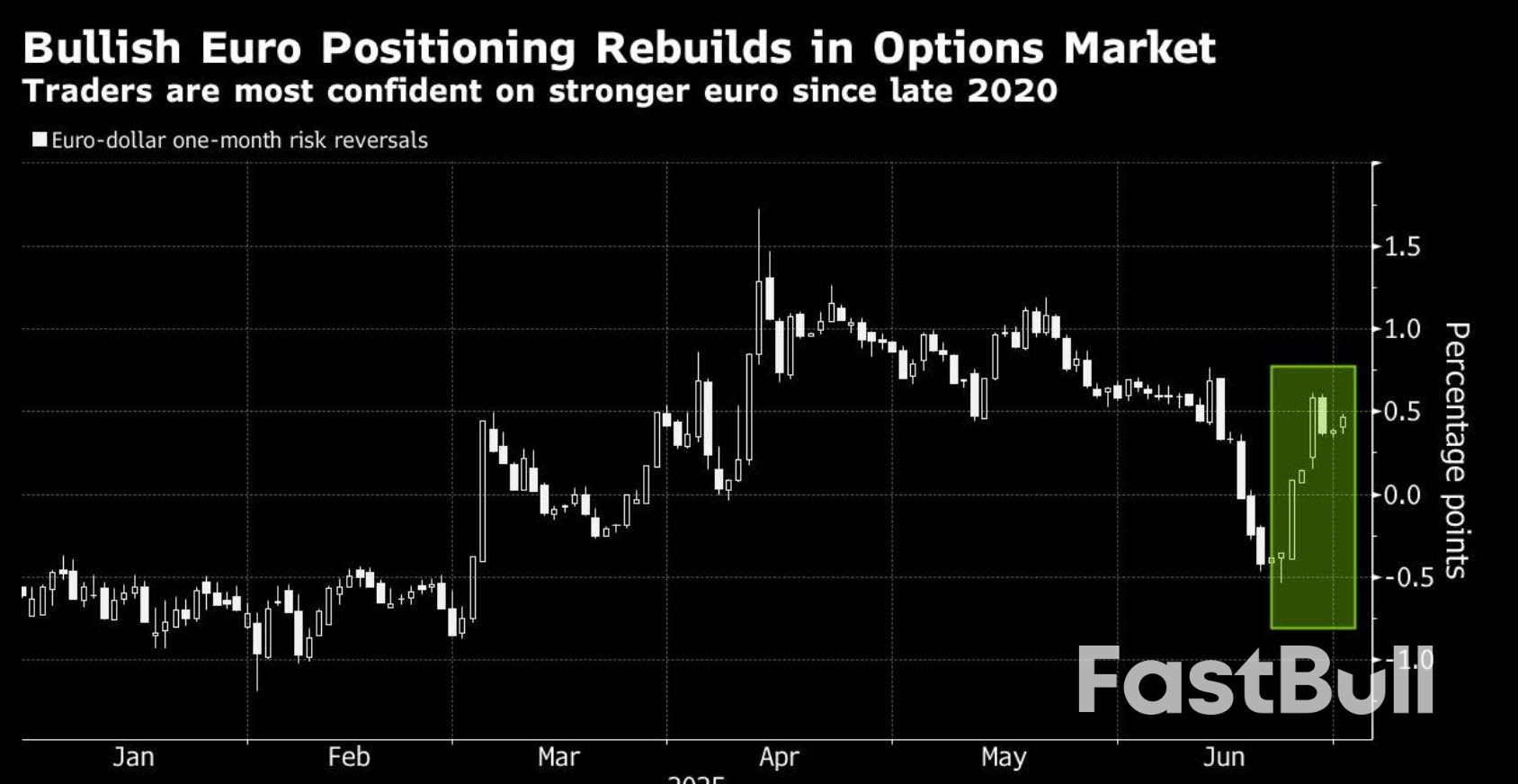
          The common currency declined 0.1% to $1.1777 on Tuesday, after eight days of advances pushed options traders to ramp up bullish positioning. So-called risk reversals — a closely watched measure of market sentiment — posted the third-strongest bullish repricing of the year last week. Data from the Depository Trust & Clearing Corporation show that nearly two out of three options in the past week targeted a stronger euro.Euro´s Persistent Rise Undercut by Dollar Bounce on Data, Bill_1
          The euro’s rally has been underpinned by a long-running slide for the dollar, with fresh momentum from weaker US data and growing conviction that the Fed is preparing to ease policy more aggressively than the European Central Bank. According to Danske Bank AS strategists led by Jens Naervig Pedersen, the dollar’s structural decline has resumed as geopolitical risks fade and focus returns to the US economy and political backdrop.
          “We see many reasons to be short USD right now, including the possibility of a new Fed Chair being appointed earlier than expected, the Big Beautiful Bill on 4 July, and the tariff deadline on 9 July,” he said.
          The euro has risen nearly 14% against the greenback this year so far, while a dollar index has fallen more than 9%.
          Analysts increasingly see the euro rallying toward $1.20 in the coming months. Strategists at Societe Generale SA, including Kit Juckes, expect the common currency to peak at around $1.25 over the medium term, even if it lags the yen and some Asian peers in the second half of the year.
          European Central Bank Vice President Luis de Guindos said Tuesday that while a move to $1.20 is “acceptable,” further gains would make policy makers’ task more complicated.

          What Bloomberg Strategists Say

          “While a mild strengthening of the currency doesn’t pose a particular concern for the ECB, gains that are too rapid tend to tighten financial conditions and may threaten to crimp economic growth.” — Ven Ram, Macro Strategist, Dubai. Click here for the full piece.
          For Nicholas Wall, head of Global FX Strategy at J.P. Morgan Asset Management, the ECB is doing the right thing by embracing a euro that’s attracting more demand as a reserve currency. “A stronger euro is good for Europe partly in the context of rising oil prices,” he said.
          The latest euro-area inflation data offered little reason for the ECB to alter its stance. Consumer prices rose in France and Spain but held steady in Italy and unexpectedly eased in Germany, reinforcing the central bank’s view that inflation will converge sustainably toward its 2% target.

          Source: Bloomberg

          Risk Warnings and Disclaimers
          You understand and acknowledge that there is a high degree of risk involved in trading. Following any strategies or investment methods may lead to potential losses. The content on the site is provided by our contributors and analysts for information purposes only. You are solely responsible for determining whether any trading assets, securities, strategy, or any other product is suitable for investing based on your own investment objectives and financial situation.
          Add to Favorites
          Share

          3 Altcoins That Stand to Gain If Capital Rotates Away From Bitcoin

          Adam

          Cryptocurrency

          Although the cryptocurrency market has seen a slight decline in recent days, Bitcoin continues to dominate. This has resulted in altcoins recording their weakest performance against BTC in years.
          The total market capitalization excluding Bitcoin recovered by nearly 10% last week. Sitting at a critical support level of $1 trillion, the new week has started calmly for altcoins. If this support zone holds across the altcoin market, it could indicate that the capital flowing into crypto—currently dominated by Bitcoin—may begin to shift towards altcoins. In particular, expectations around ETFs, the possibility of early Fed rate cuts, and the launch of new altcoin-based products could support this transition.
          Several developments within the internal dynamics of the crypto market may also gradually shift investor sentiment in favor of altcoins. The ongoing ETF progress for Ethereum, the launch of a staking-integrated ETF for Solana, and rising institutional interest in Bitcoin Cash are just some examples of this growing momentum toward altcoins.
          While ETF Uncertainty Persists in Ethereum, Medium-to-Long-Term Potential Remains
          Ethereum, which leads the altcoin market, continues to face pressure—most recently from the SEC’s decision to delay the Ethereum staking ETF proposed by Bitwise.
          The SEC’s approval of the spot Ethereum ETF last year was a major milestone. Now, the potential inclusion of staking could mark another turning point for ETH. The possible returns from introducing staking into ETFs, along with broader spot ETF approvals, remain powerful catalysts for Ethereum over the medium to long term.
          At the same time, increased activity on the Ethereum network and recent upgrades are contributing to its stability. The expansion of institutional Ethereum products in the second half of the year could also bring ETH back into focus. In the short term, however, ETH remains under technical pressure.
          3 Altcoins That Stand to Gain If Capital Rotates Away From Bitcoin_1
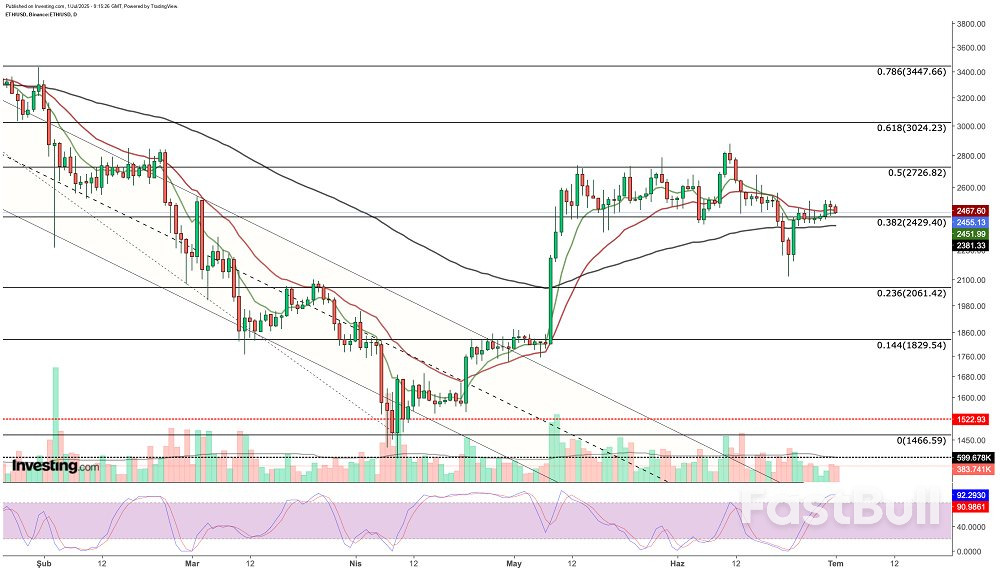
          Ethereum recently rebounded alongside the broader market following a ceasefire between Israel and Iran. As a result, ETH recovered the support level we’ve been monitoring at $2,430, driven by renewed buying interest.
          Currently, ETH is trading sideways above the $2,430 support, but ongoing pressure is making it difficult to break into the $2,500 region. If ETH manages to secure daily closes above $2,500, this could open the door for a move towards $2,700. The resistance at $2,730 has remained unbroken since May. A high-volume breakout above this level could trigger a rally towards the $3,000–3,400 range.
          However, if ETH—already under pressure—falls below the $2,430 support without any shock developments, we could see an increase in selling pressure. If that happens, and ETH dips below the 3-month EMA at $2,380, the likelihood of a move towards $2,000 increases significantly.
          ETF Movement in Solana Creates Excitement
          Solana’s REX-Osprey SOL+Staking ETF is the first spot ETF to integrate staking rewards. Launching on July 2, 2025, this product offers investors exposure to both SOL price action and passive staking income. This first-of-its-kind ETF has been met with short-term positive sentiment.
          However, this ETF development coincides with a weakening of Solana’s network fundamentals. Stablecoin value on the network has declined since the start of the year, and revenues have also fallen. This suggests waning interest in Solana, which is also making it technically difficult for SOL to break out of its short-term downtrend. At this stage, sustained interest in the ETF could boost demand for SOL again. For stronger price action, we’ll need to see a recovery in network usage and an increase in institutional fund flows.
          3 Altcoins That Stand to Gain If Capital Rotates Away From Bitcoin_2
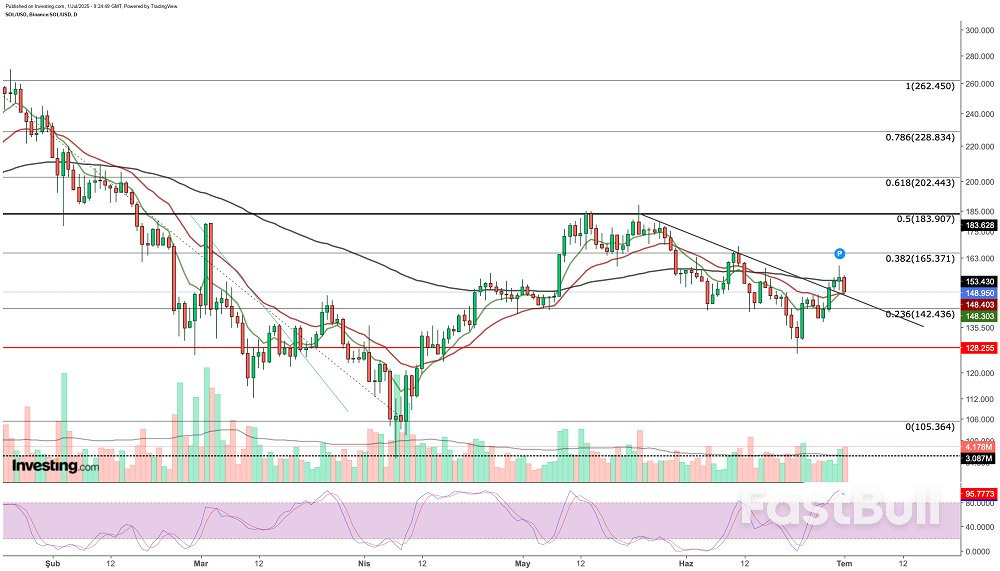
          Recent buying activity in Solana helped break the short-term downtrend. However, following the ETF news, the typical “sell the news” reaction in crypto kicked in, and the SOL price now appears to be retesting the trendline.
          Accordingly, $148 is a key support level for SOL. If buyers can defend this level, it would confirm the continuation of the uptrend. In this case, we could see Solana advancing toward price targets of $165, $183, and $202, respectively.
          Conversely, if daily closes fall below the $148 support, a pullback toward the $130 level becomes likely.
          Bitcoin Cash Maintains Strong Outlook With the Support of Institutional Buying
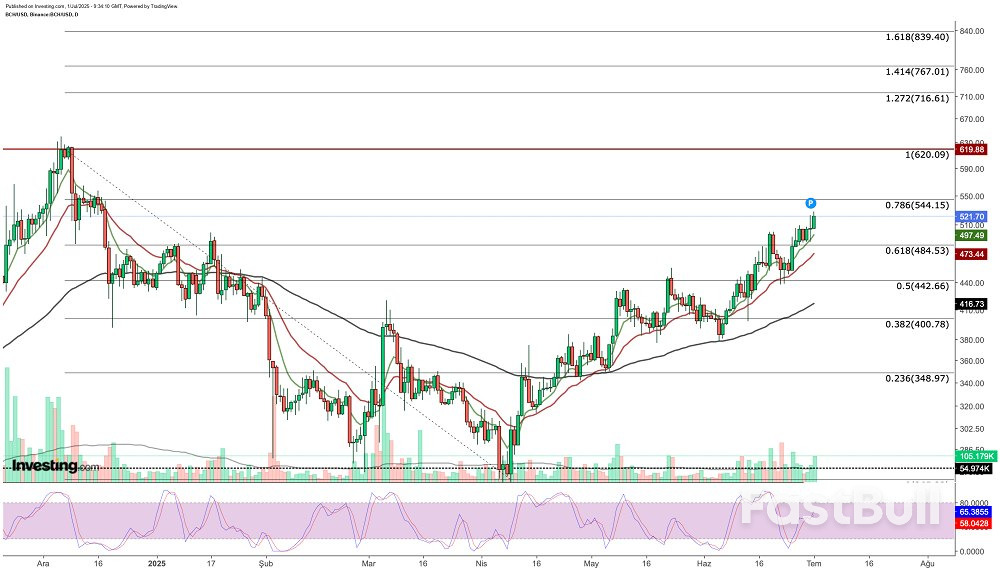
          Bitcoin Cash has recently emerged as one of the market’s standout assets. BCH, currently trading at $523, is revisiting levels not seen since December 2024.
          After beginning its uptrend in April, BCH was only marginally affected by the May correction and managed to maintain its positive momentum through June. The recent divergence in BCH—both technically and in terms of investor interest—positions it as a notable option for short-term speculative trading. That said, the sustainability of this uptrend will depend on broader market conditions and macroeconomic developments.
          3 Altcoins That Stand to Gain If Capital Rotates Away From Bitcoin_3
          Technically, the Stochastic RSI on the daily chart indicates that BCH may continue its upward move. Based on the last bearish wave (from December 2024 to April 2025), the nearest resistance lies at $544 (Fib 0.786). If BCH can close above this level on a weekly basis, it could continue its momentum toward the $620 resistance, followed by a medium-term target range of $720–840.
          If BCH fails to break above $544, profit-taking may accelerate. In that case, a retreat to the $485 support (Fib 0.618) would be the likely first stop.

          Source: investing

          Risk Warnings and Disclaimers
          You understand and acknowledge that there is a high degree of risk involved in trading. Following any strategies or investment methods may lead to potential losses. The content on the site is provided by our contributors and analysts for information purposes only. You are solely responsible for determining whether any trading assets, securities, strategy, or any other product is suitable for investing based on your own investment objectives and financial situation.
          Add to Favorites
          Share

          Taxes, energy, and healthcare: 3 ways Senate's Trump megabill impacts the business world

          Adam

          Economic

          Senate leaders advanced President Trump's "One Big Beautiful Bill" on Tuesday in a vote that moved the megabill one step closer to becoming law despite three Republican defections, leading to a 50-50 tally that required Vice President JD Vance to break the tie in Trump's favor.
          The process proved exceptionally contentious in recent days, largely over healthcare provisions and trims to the Medicaid program that are set to extract hundreds of billions in government savings but cause millions to lose coverage.
          This portion of the bill fueled two of the Republican no votes — Thom Tillis of North Carolina and Susan Collins of Maine — and led to last-minute concessions to Lisa Murkowski of Alaska as a way of securing her yes vote.
          The third Republican no vote was Rand Paul of Kentucky, who objected to the inclusion of a $5 trillion debt ceiling increase in the package.
          Medicaid and that debt ceiling increase were just two pieces of a complex, nearly 900-page bill that is set to reshape whole swathes of the US economy, especially in the areas of tax rates, energy, and healthcare.
          Clean energy companies — especially electric-vehicle maker Tesla (TSLA) — were perhaps paying the closest attention in recent days.
          Tesla CEO Elon Musk emerged during final negotiations as the top business-world critic of the bill, attacking the price and how it treats clean energy. He said earlier Tuesday that the $3.3 increase in debt expected from the bill makes a "mockery" of his work at the Department of Government Efficiency (DOGE).
          Musk and others are also set to see impacts on their bottom line, with government support in the form of tax credits set to go away. But a last-minute change appeared to remove what could have been a new headwind in the form of an excise tax, which had raised particular ire.
          Economists have likewise noted that the final price tag, which could top $4 trillion, and critiqued an accounting gimmick Republicans employed to hide much of that red ink.
          Silicon Valley has growing questions after a last-minute change stripped a closely watched artificial intelligence provision from the bill.
          But a range of GOP priorities that are included — from increased funding for border enforcement to the military to money for America's 250th anniversary celebration next year — pushed the bill over the line, with many in corporate America in favor and focused on the tax-cuts piece.
          The Business Roundtable, which represents CEOs in Washington, D.C., urged passage in recent days and called it "critical legislation [to] protect and enhance the transformative economic benefits that President Trump's historic 2017 tax reform delivered for American businesses, workers and families."
          President Trump on Tuesday morning expressed confidence it would reach his desk soon, calling it the "greatest bill ever passed," focusing on the border provisions and dismissing concerns that Americans would love their healthcare coverage.
          The legislation now moves back to the US House of Representatives, which, after passing a previous version in May, is set to move quickly ahead, perhaps within hours, but with passage far from assured as criticisms from fiscal conservatives pile up in recent days (and Musk focused on flipping votes there).
          For now, here is a closer look at three ways the current version of the bill, as blessed by the Senate, would impact the business world.
          Changes for both the individual and corporate tax structure
          A centerpiece of the bill — and far and away the most expensive provisions — surrounds taxes.
          The bill's main impetus has long been to permanently extend tax cuts for individuals contained in the 2017 Tax Cuts and Jobs Act, which Trump signed into law on a temporary basis during his first term as president.
          The bill would represent a continuation of the status quo for taxpayers. As one example, if the bill is enacted, America's highest earners will see a continued top rate of 37%.
          The bill also provides new tax credits for individuals by fulfilling signature Trump campaign promises — albeit slightly less fulsomely than in the House version — to eliminate taxes on tips, overtime, and car loan interest. It also offers an expanded standard deduction for seniors after Trump promised to eliminate taxes on Social Security benefits.
          Employees would be able to deduct up to $25,000 annually for tips and overtime in the Senate version, in contrast to the House's approach of 100% deductibility under certain income limits.
          Business owners, meanwhile, are keenly focused on a series of tax deductions that will reinstate credits for corporations for things like property depreciation, capital investments, new factory construction, interest expenses, and research and development costs.
          Many of these provisions were present in the House version, but only temporarily. Permanency was a key Senate priority and is now included in the bill, even as it increased the price tag.
          The bill also makes permanent the pass-through deduction at a rate of 20%. That deduction — formally known as the 199A deduction — is focused on often smaller businesses organized as S corporations or partnerships.
          The Senate version also includes an array of other tax changes, including a $40,000 annual deduction for state and local taxes (SALT) for some taxpayers in the coming years, enhanced credits for "opportunity zones," and so-called MAGA accounts.

          A focus on energy and healthcare

          The effect on the energy sector could be profound, especially after a last-minute series of changes turned the bill even further against the clean energy industry while offering new support for fossil fuels.
          The bill has long been expected to phase out Biden-era clean energy tax credits, but the final Senate bill now aims to shut them down faster than expected.
          A late addition to the bill also raised particular pique in the form of a new tax on wind and solar projects completed after 2027 if a certain amount of supplies came from China. But those objections appear to have led to a moderation, with CNN first noticing Tuesday morning that a final draft quietly removed that excise tax.
          It gave clean energy advocates some solace, with Democratic Sen. Ed Markey of Massachusetts posting only that "We just forced them to take it out."
          At the same time, new last-minute inducements were unveiled for fossil fuels, including one classifying coal as a critical mineral for a government manufacturing credit.
          "We're doing coal," Trump said in an interview released over the weekend on Fox News' "Sunday Morning Futures," where he also called solar energy projects "ugly as hell."
          It was a mix that led Musk and others to predict that it would cut off clean energy, hurt the overall energy grid, and perhaps lead to higher utility bills. A statement from the American Clean Power Association said the effect would be to "undermine growth in domestic manufacturing and land hardest on rural communities who would have been the greatest beneficiaries of clean energy investment."
          The bill is also set to implement major changes to the healthcare system, which Democrats say will hurt the social safety net and the healthcare sector.
          Healthcare negotiations went until nearly the literal last minute, but the overall package is set to trim the government's Medicaid spending by around $900 billion in the years ahead.
          Corners of the sector, like rural hospitals, are set to be most directly impacted. A $25 billion fund was included to cushion the blow for these providers from 2028 to 2032.
          But the bottom line for patients — according to an accounting from the Congressional Budget Office that came in over the weekend — is that 11.8 million additional residents would become uninsured by 2034 because of the healthcare provisions.
          Some would be illegal immigrants, as Republicans often point out, but millions are expected to be US citizens put off by a raft of additional requirements to qualify for coverage.
          Capitol Hill has yet to offer its final verdict on the package, with House deliberations still in the offing, but the healthcare provisions in particular appear to have led Americans to grow increasingly skeptical.
          A series of polls has shown a decline in support for the bill as the focus has turned to healthcare. Even a recent Fox News national poll found a 21-point gap between those who say they are opposed (59%) and those who say they are in favor (38%).

          source :finance.yahoo

          To stay updated on all economic events of today, please check out our Economic calendar
          Risk Warnings and Disclaimers
          You understand and acknowledge that there is a high degree of risk involved in trading. Following any strategies or investment methods may lead to potential losses. The content on the site is provided by our contributors and analysts for information purposes only. You are solely responsible for determining whether any trading assets, securities, strategy, or any other product is suitable for investing based on your own investment objectives and financial situation.
          Add to Favorites
          Share
          FastBull
          Copyright © 2025 FastBull Ltd

          728 RM B 7/F GEE LOK IND BLDG NO 34 HUNG TO RD KWUN TONG KLN HONG KONG

          TelegramInstagramTwitterfacebooklinkedin
          App Store Google Play Google Play
          Products
          Charts

          Chats

          Q&A with Experts
          Screeners
          Economic Calendar
          Data
          Tools
          Membership
          Features
          Function
          Markets
          Copy Trading
          Latest Signals
          Contests
          News
          Analysis
          24/7
          Columns
          Education
          Company
          Careers
          About Us
          Contact Us
          Advertising
          Help Center
          Feedback
          User Agreement
          Privacy Policy
          Business

          White Label

          Data API

          Web Plug-ins

          Poster Maker

          Affiliate Program

          Risk Disclosure

          The risk of loss in trading financial instruments such as stocks, FX, commodities, futures, bonds, ETFs and crypto can be substantial. You may sustain a total loss of the funds that you deposit with your broker. Therefore, you should carefully consider whether such trading is suitable for you in light of your circumstances and financial resources.

          No decision to invest should be made without thoroughly conducting due diligence by yourself or consulting with your financial advisors. Our web content might not suit you since we don't know your financial conditions and investment needs. Our financial information might have latency or contain inaccuracy, so you should be fully responsible for any of your trading and investment decisions. The company will not be responsible for your capital loss.

          Without getting permission from the website, you are not allowed to copy the website's graphics, texts, or trademarks. Intellectual property rights in the content or data incorporated into this website belong to its providers and exchange merchants.

          Not Logged In

          Log in to access more features

          FastBull Membership

          Not yet

          Purchase

          Become a signal provider
          Help Center
          Customer Service
          Dark Mode
          Price Up/Down Colors

          Log In

          Sign Up

          Position
          Layout
          Fullscreen
          Default to Chart
          The chart page opens by default when you visit fastbull.com