• Trade
  • Markets
  • Copy
  • Contests
  • News
  • 24/7
  • Calendar
  • Q&A
  • Chats
Trending
Screeners
SYMBOL
LAST
BID
ASK
HIGH
LOW
NET CHG.
%CHG.
SPREAD
SPX
S&P 500 Index
6870.39
6870.39
6870.39
6895.79
6858.28
+13.27
+ 0.19%
--
DJI
Dow Jones Industrial Average
47954.98
47954.98
47954.98
48133.54
47871.51
+104.05
+ 0.22%
--
IXIC
NASDAQ Composite Index
23578.12
23578.12
23578.12
23680.03
23506.00
+72.99
+ 0.31%
--
USDX
US Dollar Index
98.800
98.880
98.800
98.960
98.730
-0.150
-0.15%
--
EURUSD
Euro / US Dollar
1.16618
1.16625
1.16618
1.16717
1.16341
+0.00192
+ 0.16%
--
GBPUSD
Pound Sterling / US Dollar
1.33316
1.33325
1.33316
1.33462
1.33151
+0.00004
0.00%
--
XAUUSD
Gold / US Dollar
4216.57
4216.98
4216.57
4218.85
4190.61
+18.66
+ 0.44%
--
WTI
Light Sweet Crude Oil
59.975
60.012
59.975
60.063
59.752
+0.166
+ 0.28%
--

Community Accounts

Signal Accounts
--
Profit Accounts
--
Loss Accounts
--
View More

Become a signal provider

Sell trading signals to earn additional income

View More

Guide to Copy Trading

Get started with ease and confidence

View More

Signal Accounts for Members

All Signal Accounts

Best Return
  • Best Return
  • Best P/L
  • Best MDD
Past 1W
  • Past 1W
  • Past 1M
  • Past 1Y

All Contests

  • All
  • Trump Updates
  • Recommend
  • Stocks
  • Cryptocurrencies
  • Central Banks
  • Featured News
Top News Only
Share

Most Active China Coking Coal Contract Falls 7.1% To 1082.5 Yuan/Metric Ton

Share

German Foreign Minister Says A Lot Of Work Is Still Needed To Persuade China To Issue General Export Licences For Rare Earths

Share

European Central Bank's Schnabel 'Rather Comfortable' On Investor Bets Next Move To Be Interest Rate Hike

Share

Agriculture Ministry: Uganda October Coffee Shipments Up 38% From Last Year

Share

Russia's Nornickel: Cobalt Production Capacity To Be At Up To 3000 Tons Per Year

Share

Russia's Nornickel: Fully Restarts Cobalt Production In Murmansk Region

Share

India's Nifty Realty Index Down 2.7%

Share

China Vice President, In Meeting With German Foreign Minister: China Willing To Enhance Communication With Germany - Xinhua

Share

Japan Finance Minister Katayama: Will Take Appropriate Action If Necessary

Share

Japan Finance Minister Katayama: Concerned About Forex Moves

Share

Japan Finance Minister Katayama: Recently Seeing One-Sided, Rapid Moves

Share

LME Three-month Copper Rose To $11,771 Per Tonne, Setting A New Record High

Share

Shanghai's Most Active Copper Contract Sets Peak At 93300 Yuan Per Metric Ton

Share

Thai Prime Minister: Thailand Does Not Want Violence

Share

Thai Prime Minister: Ready To Take Necessary Measures To Maintain Security, Sovereignty Of Country

Share

China Politburo: Will Better Coordinate Between China's Economic Work And International Economic And Trade Battle Next Year

Share

China Politburo: Moderately Loose Monetary Policy

Share

China Politburo:Continue To Implement More Active Fiscal Policies

Share

India's SEBI Chair: If Any Entity Wants To Advertise Any Past Return They Can Do Only Via The Platform

Share

Vietnam's Plans To Have Nuclear Power Plant Ready By 2035 Are Too Tight - Ambassador

TIME
ACT
FCST
PREV
U.S. Personal Income MoM (Sept)

A:--

F: --

P: --

U.S. PCE Price Index YoY (SA) (Sept)

A:--

F: --

P: --

U.S. PCE Price Index MoM (Sept)

A:--

F: --

P: --

U.S. Personal Outlays MoM (SA) (Sept)

A:--

F: --

P: --

U.S. Core PCE Price Index MoM (Sept)

A:--

F: --

P: --

U.S. Core PCE Price Index YoY (Sept)

A:--

F: --

P: --

U.S. UMich 5-Year-Ahead Inflation Expectations Prelim YoY (Dec)

A:--

F: --

P: --

U.S. Real Personal Consumption Expenditures MoM (Sept)

A:--

F: --

P: --

U.S. UMich Current Economic Conditions Index Prelim (Dec)

A:--

F: --

P: --

U.S. UMich Consumer Sentiment Index Prelim (Dec)

A:--

F: --

P: --

U.S. UMich 1-Year-Ahead Inflation Expectations Prelim (Dec)

A:--

F: --

P: --

U.S. UMich Consumer Expectations Index Prelim (Dec)

A:--

F: --

P: --

U.S. Weekly Total Rig Count

A:--

F: --

P: --

U.S. Weekly Total Oil Rig Count

A:--

F: --

P: --

U.S. Unit Labor Cost Prelim (SA) (Q3)

--

F: --

P: --

U.S. Consumer Credit (SA) (Oct)

A:--

F: --

P: --

China, Mainland Foreign Exchange Reserves (Nov)

A:--

F: --

P: --

Japan Wages MoM (Oct)

A:--

F: --

P: --

Japan Trade Balance (Oct)

A:--

F: --

P: --

Japan Nominal GDP Revised QoQ (Q3)

A:--

F: --

P: --

Japan Trade Balance (Customs Data) (SA) (Oct)

A:--

F: --

P: --

Japan GDP Annualized QoQ Revised (Q3)

A:--

F: --

P: --
China, Mainland Exports YoY (CNH) (Nov)

A:--

F: --

P: --

China, Mainland Trade Balance (USD) (Nov)

A:--

F: --

P: --

China, Mainland Imports YoY (CNH) (Nov)

A:--

F: --

P: --

China, Mainland Exports (Nov)

A:--

F: --

P: --

China, Mainland Imports (CNH) (Nov)

A:--

F: --

P: --

China, Mainland Trade Balance (CNH) (Nov)

A:--

F: --

P: --

China, Mainland Imports YoY (USD) (Nov)

A:--

F: --

P: --

China, Mainland Exports YoY (USD) (Nov)

A:--

F: --

P: --

Germany Industrial Output MoM (SA) (Oct)

--

F: --

P: --

Euro Zone Sentix Investor Confidence Index (Dec)

--

F: --

P: --

Canada Leading Index MoM (Nov)

--

F: --

P: --

Canada National Economic Confidence Index

--

F: --

P: --

U.S. Dallas Fed PCE Price Index YoY (Sept)

--

F: --

P: --

China, Mainland Trade Balance (USD) (Nov)

--

F: --

P: --

U.S. 3-Year Note Auction Yield

--

F: --

P: --

U.K. BRC Overall Retail Sales YoY (Nov)

--

F: --

P: --

U.K. BRC Like-For-Like Retail Sales YoY (Nov)

--

F: --

P: --

Australia Overnight (Borrowing) Key Rate

--

F: --

P: --

RBA Rate Statement
RBA Press Conference
Germany Exports MoM (SA) (Oct)

--

F: --

P: --

U.S. NFIB Small Business Optimism Index (SA) (Nov)

--

F: --

P: --

Mexico Core CPI YoY (Nov)

--

F: --

P: --

Mexico 12-Month Inflation (CPI) (Nov)

--

F: --

P: --

Mexico PPI YoY (Nov)

--

F: --

P: --

Mexico CPI YoY (Nov)

--

F: --

P: --

U.S. Weekly Redbook Index YoY

--

F: --

P: --

U.S. JOLTS Job Openings (SA) (Oct)

--

F: --

P: --

China, Mainland M2 Money Supply YoY (Nov)

--

F: --

P: --

China, Mainland M0 Money Supply YoY (Nov)

--

F: --

P: --

China, Mainland M1 Money Supply YoY (Nov)

--

F: --

P: --

U.S. EIA Short-Term Crude Production Forecast For The Next Year (Dec)

--

F: --

P: --

U.S. EIA Short-Term Crude Production Forecast For The Year (Dec)

--

F: --

P: --

U.S. EIA Natural Gas Production Forecast For The Next Year (Dec)

--

F: --

P: --

EIA Monthly Short-Term Energy Outlook
U.S. 10-Year Note Auction Avg. Yield

--

F: --

P: --

U.S. API Weekly Cushing Crude Oil Stocks

--

F: --

P: --

U.S. API Weekly Crude Oil Stocks

--

F: --

P: --

U.S. API Weekly Refined Oil Stocks

--

F: --

P: --

Q&A with Experts
    • All
    • Chatrooms
    • Groups
    • Friends
    Connecting
    .
    .
    .
    Type here...
    Add Symbol or Code

      No matching data

      All
      Trump Updates
      Recommend
      Stocks
      Cryptocurrencies
      Central Banks
      Featured News
      • All
      • Russia-Ukraine Conflict
      • Middle East Flashpoint
      • All
      • Russia-Ukraine Conflict
      • Middle East Flashpoint
      Search
      Products

      Charts Free Forever

      Chats Q&A with Experts
      Screeners Economic Calendar Data Tools
      Membership Features
      Data Warehouse Market Trends Institutional Data Policy Rates Macro

      Market Trends

      Market Sentiment Order Book Forex Correlations

      Top Indicators

      Charts Free Forever
      Markets

      News

      News Analysis 24/7 Columns Education
      From Institutions From Analysts
      Topics Columnists

      Latest Views

      Latest Views

      Trending Topics

      Top Columnists

      Latest Update

      Signals

      Copy Rankings Latest Signals Become a signal provider AI Rating
      Contests
      Brokers

      Overview Brokers Assessment Rankings Regulators News Claims
      Broker listing Forex Brokers Comparison Tool Live Spread Comparison Scam
      Q&A Complaint Scam Alert Videos Tips to Detect Scam
      More

      Business
      Events
      Careers About Us Advertising Help Center

      White Label

      Data API

      Web Plug-ins

      Affiliate Program

      Awards Institution Evaluation IB Seminar Salon Event Exhibition
      Vietnam Thailand Singapore Dubai
      Fans Party Investment Sharing Session
      FastBull Summit BrokersView Expo
      Recent Searches
        Top Searches
          Markets
          News
          Analysis
          User
          24/7
          Economic Calendar
          Education
          Data
          • Names
          • Latest
          • Prev

          View All

          No data

          Scan to Download

          Faster Charts, Chat Faster!

          Download App
          English
          • English
          • Español
          • العربية
          • Bahasa Indonesia
          • Bahasa Melayu
          • Tiếng Việt
          • ภาษาไทย
          • Français
          • Italiano
          • Türkçe
          • Русский язык
          • 简中
          • 繁中
          Open Account
          Search
          Products
          Charts Free Forever
          Markets
          News
          Signals

          Copy Rankings Latest Signals Become a signal provider AI Rating
          Contests
          Brokers

          Overview Brokers Assessment Rankings Regulators News Claims
          Broker listing Forex Brokers Comparison Tool Live Spread Comparison Scam
          Q&A Complaint Scam Alert Videos Tips to Detect Scam
          More

          Business
          Events
          Careers About Us Advertising Help Center

          White Label

          Data API

          Web Plug-ins

          Affiliate Program

          Awards Institution Evaluation IB Seminar Salon Event Exhibition
          Vietnam Thailand Singapore Dubai
          Fans Party Investment Sharing Session
          FastBull Summit BrokersView Expo

          Bitcoin Crosses $100,000 To Overtake Amazon As The World's Fifth-largest Asset

          Fiona Harper

          Cryptocurrency

          Economic

          Summary:

          Bitcoin has crossed the $100,000 price mark, propelling its market capitalisation to new heights and surpassing Amazon to become the fifth-largest asset globally. The digital gold achieved the new feat on Thursday, May 8, 2025, when it surged to over $10,400, with a market cap of about $2.01 trillion.
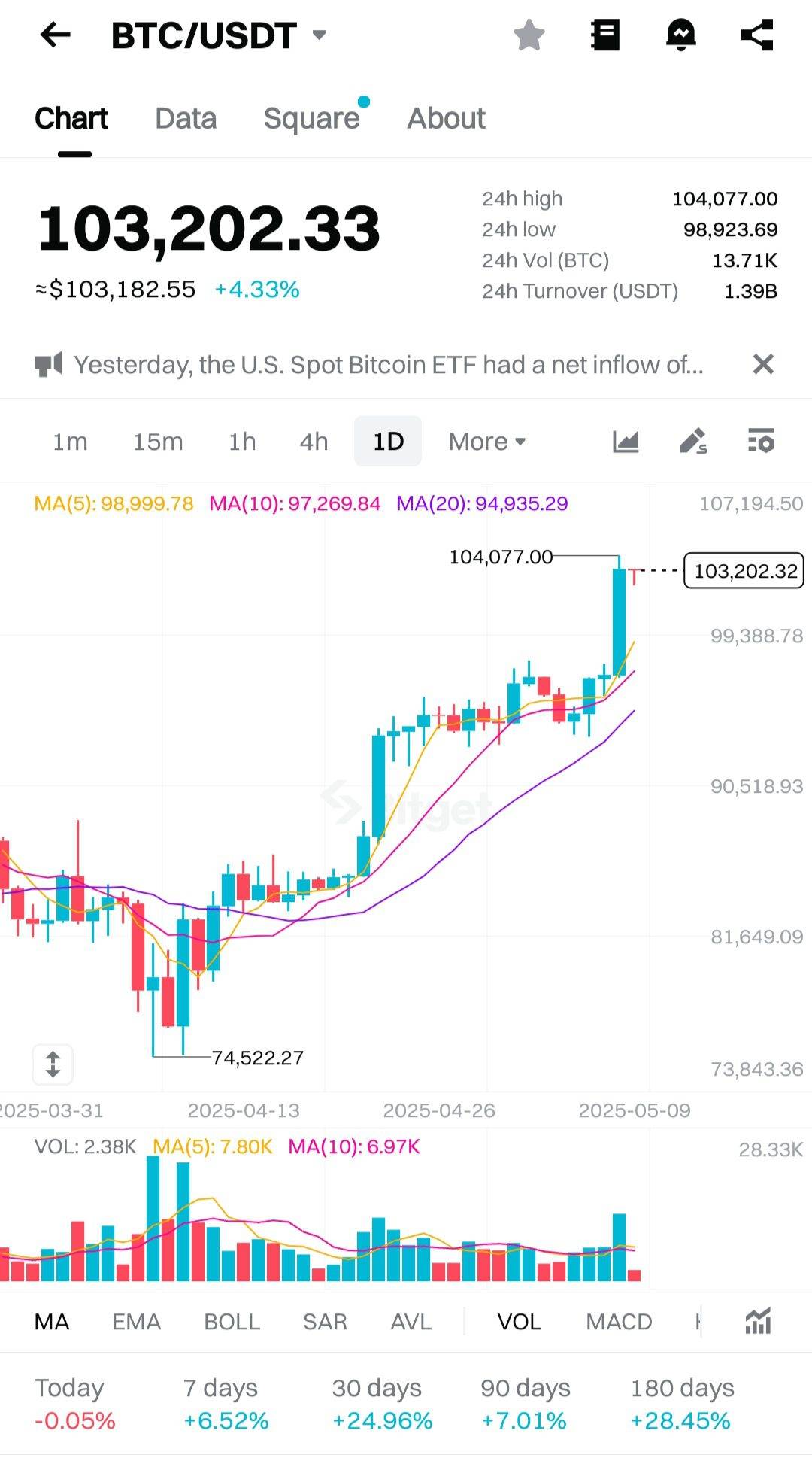
          Bitcoin has crossed the $100,000 price mark, propelling its market capitalisation to new heights and surpassing Amazon to become the fifth-largest asset globally. The digital gold achieved the new feat on Thursday, May 8, 2025, when it surged to over $10,400, with a market cap of about $2.01 trillion.
          As it stands, the digital asset has edged past Amazon's valuation of $1.837 trillion and trailing only gold, Apple, Microsoft, and Nvidia. This achievement underscores its growing legitimacy as a global asset class and its increasing adoption by institutional and retail investors alike.
          The rally, which saw the coin climb over 6% in the past 24 hours to break the $100,000 barrier, has been fuelled by a combination of macroeconomic factors, institutional interest, and renewed market optimism. Posts on X captured the excitement, with user noting:“Bitcoin just surpassed Amazon to become the 5th largest asset in the world. No CEO, no headquarters, no marketing team. Just code, conviction, and global demand.” Another user announced, “Bitcoin officially surpasses Amazon to become the 5th largest asset in the world by market cap.”

          Bitcoin surpasses $100,000

          This milestone follows Bitcoin's earlier ascent in April 2025, when it briefly overtook Amazon and Google with a market cap of $1.86 trillion, reaching $94,000 per coin. At that time, CoinDesk reported that its rise was driven by easing U.S.–China trade tensions and a broader tech rally, with the crypto outperforming the Nasdaq. However, the recent surge past $100,000 marks a more sustained breakthrough, with its market cap now exceeding $2 trillion, a level it briefly touched in January 2025 when prices hit an all-time high of $109,000 during President Donald Trump's re-inauguration.

          Main reasons for the Bitcoin rally

          Analysts attribute its latest rally to several key factors. First, institutional adoption has surged, with U.S. Bitcoin exchange-traded funds (ETFs) recording significant inflows.
          On April 22, 2025, CryptoNinjas reported that Bitcoin ETFs saw $936 million in net inflows, the highest daily figure since January, with no ETFs recording outflows. Major players like ARKB (Ark Invest and 21Shares) and FBTC (Fidelity) led the charge, signalling robust institutional confidence. Additionally, corporate accumulation has played a role, with Strategy₿, led by Michael Saylor, announcing a $555 million Bitcoin acquisition on April 21, bringing its holdings to over 538,200 BTC, valued at more than $50 billion.
          Macroeconomic shifts have also bolstered its appeal. CoinTelegraph highlighted a “decoupling” from U.S. tech stocks in April, with Bitcoin rallying 15% while the Nasdaq 100 gained only 4.5%. Macro analyst Fejau noted that Bitcoin's immunity to tariffs, unlike U.S. assets, positions it as a high-beta asset without the tail risks associated with tech stocks. “This market regime is what Bitcoin was built for,” Fejau wrote, emphasising its role as a hedge against economic uncertainty. The Economic Times further noted that sustained ETF inflows, institutional buying, and improving global macroeconomic sentiment have supported Bitcoin's climb, with technical support at $88,000 paving the way for a test of $100,000.
          Bitcoin's rise has not been without challenges. After peaking at $109,000 in January, its price fell to a low of $76,000 in early 2025 amid geopolitical tensions and economic uncertainties. However, the crypto's resilience has been evident, with a year-to-date gain of over 100% and a 40% increase over the past 12 months, significantly outperforming Amazon's negative 3.5% return over the same period. Amazon's stock, closing at $173.18 on April 23, has declined more than 21% year-to-date, highlighting Bitcoin's superior performance.
          The broader crypto market has also benefitted from Bitcoin's rally, with the total crypto market cap reaching $3.27 trillion, a 37.51% increase from a year ago, according to CoinGecko. Ethereum (ETH), Dogecoin (DOGE), XRP, and Solana (SOL) recorded gains of 7–11% in April, reflecting a rising tide across digital assets. Its dominance, at 61.63% of the crypto market, underscores its leadership in the space.
          As Bitcoin cements its place among the world's top assets, its journey from a niche experiment to a financial powerhouse continues to captivate markets. With no central authority or traditional corporate structure, Its rise challenges conventional financial paradigms, signalling a new era for digital assets.

          Source: CryptoSlate

          To stay updated on all economic events of today, please check out our Economic calendar
          Risk Warnings and Disclaimers
          You understand and acknowledge that there is a high degree of risk involved in trading. Following any strategies or investment methods may lead to potential losses. The content on the site is provided by our contributors and analysts for information purposes only. You are solely responsible for determining whether any trading assets, securities, strategy, or any other product is suitable for investing based on your own investment objectives and financial situation.
          Add to Favorites
          Share

          Russia Pushes for Gas Pipeline Deal with China Amid Strategic Energy Shift

          Gerik

          Economic

          Commodity

          Pipeline Diplomacy in Focus During Xi’s Moscow Visit

          In a symbolic and strategically charged moment, Chinese President Xi Jinping’s state visit to Moscow has coincided with intensified talks between Russia and China over the ambitious Power of Siberia 2 gas pipeline. The project, designed to transport Russian natural gas from Siberia’s vast western fields to northern China via Mongolia, has been a long-standing Russian priority—especially since the rupture of its energy ties with Europe following the Ukraine conflict.
          Russian Energy Minister Sergei Tsivilev confirmed that while negotiations are progressing actively, a formal contract is unlikely to be finalized before May 9. His comments, reported by state-run TASS, underscore the complexity and urgency of the deal as Moscow looks to re-anchor its energy exports toward the East.

          China Holds the Advantage in Energy Talks

          Beijing's leverage in the talks is clear. Now Russia’s largest gas customer and a key trade partner across multiple sectors, China is in no rush to close the deal. The collapse of Russia’s gas exports to Europe—once its primary energy customer—has put Moscow in a position of relative dependency. While eager to redirect supply, Russia faces mounting challenges convincing China to commit to pricing and volume terms that justify the scale of the Power of Siberia 2 investment.
          Despite Russian reassurances, Beijing has not yet committed to specific purchase volumes or pricing, maintaining a cautious stance amid broader concerns over demand fluctuation, energy diversification, and market competition from LNG sources.

          Technical and Strategic Hurdles Remain

          The proposed 2,600 km pipeline would run from Russia’s Yamal gas fields through Mongolia into China’s industrial heartland. It is envisioned as a complementary project to the existing Power of Siberia 1 line, which became operational in 2019 but sources gas from eastern Russia. The second pipeline would open new export routes from western deposits, reshaping Russia’s export geography.
          However, the ambitious scale of the project comes with technical, financial, and geopolitical complexities. Tsivilev noted that companies on both sides are working to draft contract frameworks, particularly around the Mongolian transit route, but these efforts require time and negotiation finesse, particularly as both sides weigh long-term strategic implications.

          Geopolitical Backdrop: A Calculated Partnership

          Xi’s visit to Moscow—during which he will meet President Vladimir Putin and attend Russia’s 80th anniversary Victory Day parade—marks a continuation of the deepening Sino-Russian political alignment. Xi is accompanied by leaders from nations maintaining ties with Russia post-Ukraine, signaling diplomatic solidarity.
          Nevertheless, while the optics are strong, energy agreements remain transactional. China’s careful maneuvering reflects a broader pattern: strategic alignment without unconditional commitment. The gas pipeline talks exemplify this—China remains open to cooperation but insists on favorable terms.
          The Power of Siberia 2 pipeline stands at the crossroads of geopolitical realignment and economic pragmatism. For Russia, it represents both an escape from European dependence and a lifeline for its gas sector. For China, it offers energy diversification and leverage. But the path to agreement remains obstructed by unresolved pricing issues and cautious diplomacy. As May 9 approaches, both sides may reaffirm strategic intent, but a binding deal appears still out of reach—pending further concessions or a shift in negotiation dynamics.

          Source: OilPrice

          To stay updated on all economic events of today, please check out our Economic calendar
          Risk Warnings and Disclaimers
          You understand and acknowledge that there is a high degree of risk involved in trading. Following any strategies or investment methods may lead to potential losses. The content on the site is provided by our contributors and analysts for information purposes only. You are solely responsible for determining whether any trading assets, securities, strategy, or any other product is suitable for investing based on your own investment objectives and financial situation.
          Add to Favorites
          Share

          India, Pakistan Accuse Each Other of Attacks As Hostilities Rise

          Glendon

          Political

          India and Pakistan accused each other of launching new military attacks on Friday, using drones and artillery for the third day in the worst fighting between the nuclear-armed South Asian neighbours in nearly three decades.

          The old enemies have been clashing since India struck multiple locations in Pakistan on Wednesday that it said were "terrorist camps", in retaliation for a deadly attack on Hindu tourists in Indian Kashmir last month.

          Pakistan denied it was involved in the attack but both countries have exchanged cross-border fire and shelling and sent drones and missiles into each other's airspace since then, with about four dozen people dying in the violence.

          Villagers have fled border areas in both countries and many cities have been hit with blackouts, air raid warnings and panic buying of essentials. India has suspended its prestigious Indian Premier League T20 cricket tournament after one match was stopped midway on Thursday and the floodlights switched off.

          The fighting is the deadliest since a limited conflict between the two countries in Kashmir's Kargil region in 1999. India has targeted cities in Pakistan's mainland provinces outside Pakistani Kashmir for the first since their full-scale war in 1971.

          The Indian army said on Friday that Pakistani troops had resorted to "numerous cease fire violations" along the countries' de-facto border in Kashmir, a region that is divided between them but claimed in full by both.

          "The drone attacks were effectively repulsed and befitting reply was given to the CFVs (ceasefire violations)," the army said, adding all "nefarious designs" would be responded to with "force".

          Pakistan Information Minister Attaullah Tarar said the Indian army statement was "baseless and misleading", and that Pakistan had not undertaken any "offensive actions" targeting areas within Indian Kashmir or beyond the country's border.

          In Pakistani Kashmir, officials said heavy shelling from across the border killed five civilians, including an infant, and injured 29 in the early hours of Friday.

          India's defence ministry did not immediately respond to a request for comment.

          SIRENS IN AMRITSAR

          A "major infiltration bid" was "foiled" in Kashmir's Samba region on Thursday night, India's Border Security Force said, and heavy artillery shelling persisted in the Uri area on Friday, according to a security official who did not want to be named.

          "Several houses caught fire and were damaged in the shelling in the Uri sector...one woman was killed and three people were injured in overnight shelling," the official said.

          Sirens blared for more than two hours on Friday in India's border city of Amritsar, which houses the Golden Temple revered by Sikhs, and residents were asked to remain indoors.

          Hotels reported a sharp fall in occupancy as tourists fled the city by road since the airport was closed.

          "We really wanted to stay but the loud sounds, sirens, and blackouts are giving us sleepless nights. Our families back home are worried for us so we have booked a cab and are leaving," said a British national who did not want to be named.

          Other border areas also took precautionary measures on Friday, including Bhuj in Gujarat, where authorities said tourist buses had been kept on standby to evacuate residents near the Pakistan border.

          Schools and coaching centres were closed in the Bikaner region of India's desert state of Rajasthan, and residents near the Pakistan border said they were asked to move further away and consider moving in with relatives or using accommodation arranged by the government.

          India's Directorate General of Shipping directed all ports, terminals and shipyards to increase security, amid "growing concerns regarding potential threats".

          Ansab, a student at the Sher-e-Kashmir University of Agriculture, Science and Technology in India's Jammu city, which was among the places where blasts were heard overnight, said the explosions were "more violent and louder" around 4 a.m. (2230 GMT Thursday).

          "For two to three minutes it became very loud, windows started shaking as if they will break," she said, adding the air was "smoggy" later - a mixture of smoke and fog.

          World powers from the U.S. to China have urged the two countries to calm tensions, and U.S. Vice President JD Vance on Thursday reiterated the call for de-escalation.

          "We want this thing to de-escalate as quickly as possible. We can't control these countries, though," he said in an interview on Fox News show "The Story with Martha MacCallum."

          The Saudi minister of state for foreign affairs Adel Al-Jubeir is also scheduled to visit Pakistan on Friday, a senior Pakistani official said.

          Al-Jubeir was in India on Thursday and met Indian Foreign Minister Subrahmanyam Jaishankar, who said he "shared India’s perspectives on firmly countering terrorism" with him.

          Pakistani Defence Minister Khawaja Muhammad Asif told parliament that Islamabad is "speaking daily" to Saudi Arabia, Qatar and China about de-escalating the crisis.

          The relationship between Hindu-majority India and Islamic Pakistan has been fraught with tension since they became separate countries after attaining independence from colonial British rule in 1947.

          Kashmir, a Muslim-majority region, has been at the heart of the hostility and they have fought two of their three wars over the region.

          Source: Reuters

          Risk Warnings and Disclaimers
          You understand and acknowledge that there is a high degree of risk involved in trading. Following any strategies or investment methods may lead to potential losses. The content on the site is provided by our contributors and analysts for information purposes only. You are solely responsible for determining whether any trading assets, securities, strategy, or any other product is suitable for investing based on your own investment objectives and financial situation.
          Add to Favorites
          Share

          China’s Export Engine Finds Lifeline in Southeast Asia Amid U.S. Trade Collapse

          Gerik

          Economic

          China–U.S. Trade War

          Export Growth Defies Expectations Despite U.S. Collapse

          In a surprising reversal of expectations, China’s exports in April soared 8.1% year-on-year in U.S. dollar terms, sharply beating Reuters’ forecast of just 1.9%. This impressive growth occurred in the face of an escalating trade war with the U.S., where outbound shipments plunged more than 21%, and imports from America fell nearly 14%.
          The divergence between overall export growth and the sharp decline in U.S.-bound trade highlights a new dynamic: China is increasingly leaning on regional partners—particularly in Southeast Asia—to cushion the blow of lost access to the American market.

          Southeast Asia Becomes Key Buffer Zone

          China’s exports to ASEAN countries surged 20.8% year-on-year in April, up from 11.6% in March. Within the bloc, Indonesia and Thailand posted standout gains of 37% and 28%, respectively, in imports of Chinese goods. Vietnam and Malaysia continued to be major trade partners, suggesting a deepening of intra-Asian trade integration amid geopolitical tensions.
          This rapid redirection reflects both proactive trade policy shifts and possible transshipment strategies. Analysts, such as Zhiwei Zhang of Pinpoint Asset Management, noted that some of the export gains may stem from contracts signed before tariff escalation or goods being rerouted through third-party countries to bypass trade restrictions.

          Tariffs Bite as Trade with U.S. Recedes Sharply

          The collapse in U.S.-China trade volumes was driven by the Trump administration’s imposition of 145% tariffs on Chinese imports, matched by Beijing’s 125% retaliation. These historically high levies effectively froze direct trade lanes, with container traffic between the two countries dropping significantly by late April, according to ANZ’s chief economist Raymond Yeung.
          In March, Chinese exporters had briefly frontloaded shipments ahead of the tariff spike, pushing U.S.-bound exports up 9.1% temporarily. But that surge proved short-lived, with April marking the steepest year-on-year drop since the trade war began. Imports followed suit, reflecting diminished bilateral demand and the chilling effect of policy uncertainty.

          Domestic Pain Surfaces as Economic Risks Deepen

          Despite headline export growth, underlying indicators signal mounting distress in China’s export-driven economy. Factory activity sank to a 16-month low in April, with new export orders hitting their weakest level since December 2022. The broader purchasing managers’ index also indicated falling employment, as manufacturers began suspending operations and placing workers on leave.
          Goldman Sachs now estimates that as many as 16 million Chinese jobs—roughly 2% of the national labor force—are at risk, primarily in sectors reliant on U.S. demand. Local governments and businesses are being urged to redirect unsold goods into the domestic market, a move that could exacerbate deflationary pressures.

          Macroeconomic Indicators Point Toward Deflation

          China is expected to post further evidence of deflation when consumer and wholesale price data are released. The CPI is forecast to fall 0.1% and the PPI by 2.8%, continuing a trend of declining prices driven by weakening demand and excess supply.
          To counteract these pressures, Chinese authorities have introduced new monetary easing and support packages for affected exporters. Still, investor confidence remains fragile. The CSI 300 fell 0.23% on Friday, and the offshore yuan stayed largely flat at 7.2483 per U.S. dollar, indicating limited optimism despite the strong export figures.

          U.S.-China Talks: A Chance for De-escalation or Just Optics?

          Markets are now watching closely as U.S. and Chinese officials prepare for high-level talks in Switzerland—the first since the latest tariff round. While analysts expect no immediate breakthrough, even a partial rollback of tariffs could provide relief.
          Morgan Stanley forecasts that U.S. tariffs on Chinese goods could ease from the current 145% average to around 45% by the end of 2025, though it warns that the path will be turbulent and politically fraught. Laura Wang, the firm’s equity strategist, described the potential for tariff de-escalation as a “major positive” for Chinese equities but cautioned that no durable agreement is yet in sight.
          April’s strong export figures offered a glimmer of resilience in China’s trade position, driven largely by increased integration with Southeast Asia and the EU. However, the sharp decline in trade with the U.S., coupled with rising domestic stress and looming deflation, underscores the fragility of this recovery. As negotiations resume, the potential for policy relief remains—but without structural shifts in global supply chains or a clear diplomatic thaw, China’s export engine remains on uneven ground.

          Source: CNBC

          To stay updated on all economic events of today, please check out our Economic calendar
          Risk Warnings and Disclaimers
          You understand and acknowledge that there is a high degree of risk involved in trading. Following any strategies or investment methods may lead to potential losses. The content on the site is provided by our contributors and analysts for information purposes only. You are solely responsible for determining whether any trading assets, securities, strategy, or any other product is suitable for investing based on your own investment objectives and financial situation.
          Add to Favorites
          Share

          Vietnam's Banking M&A Wave Set to Ignite as Foreign Ownership Cap Lifts

          Gerik

          Economic

          Stocks

          Legal Reforms Trigger a Strategic Inflection Point

          Beginning May 19, 2025, Vietnam's Decree 69/2025/NĐ-CP officially takes effect, alongside the recently activated Circular 18/2025/TT-BTC. These regulatory changes redefine the landscape for foreign capital in the banking sector, unlocking mechanisms for equity inflows previously constrained by strict ownership limits and technical hurdles. The reforms signal a transition from incremental adjustments to structural transformation, as Vietnam moves to align with global investment norms.
          As of April 2025, data from the Vietnam Securities Depository and Clearing Corporation (VSDC) shows that 13 out of 27 publicly listed banks have foreign ownership above 15%, with several nearing the previous 30% ceiling—ACB at 29.97%, MSB at 27.28%, and VietinBank at 26.76%. These banks typically offer high profitability, transparent governance, and expansive customer bases—features that appeal to long-term institutional investors.
          The planned lift to a 49% foreign ownership cap at strategic institutions—especially those undergoing forced transfers—has the potential to reshape capital flows. While some banks like VIB and Eximbank have proactively capped foreign room to reserve space for future strategic investors, others are now reevaluating their shareholder structures following the withdrawal of players such as Commonwealth Bank of Australia and Dragon Capital. The shift signals not a retreat but a repositioning ahead of a selective M&A wave.

          Forced Transfers Reshape Ownership and Investment Strategy

          Decree 69 introduces a critical clause (6a to Article 7), permitting foreign investors to own up to 49% of banks undergoing mandatory restructuring—provided they are not majority state-owned. MBBank (MBV), VPBank (GPBank), and HDBank (Vikki Bank) are the first to utilize this channel.
          MBV’s transformation into a single-member LLC structure opens the door to full foreign ownership. VPBank’s ambitious turnaround plan for GPBank—once a chronic loss-maker—targets VND 500 billion in profit this year alone. Meanwhile, HDBank’s Vikki Bank is focused on SMEs and retail clients using an integrated tech ecosystem to achieve early profitability. These cases show how the restructuring mechanism has become a gateway for foreign entry into previously closed institutions.

          Digital Banking Emerges as a Golden Pathway to Full Ownership

          Vietnam’s regulatory framework does not cap foreign ownership in digital banks established under a single-member LLC model. This loophole effectively allows 100% foreign ownership without new licensing. Since no fully foreign-owned bank licenses have been granted since 2017, this provides a rare and legal workaround. New-generation digital banks like MBV, Vikki Bank, and VCBNeo are the vanguard of this trend.
          These banks benefit from lean operational models, minimal legacy debt, and the ability to use behavioral data and AI to drive credit decision-making. Their appeal lies in offering strategic foreign investors immediate market access, reduced regulatory friction, and scalable digital platforms tailored for rapid growth.

          KRX Clearing System: Technical Reform Unlocks Capital Efficiency

          Circular 18/2025 also introduces the KRX clearing mechanism, allowing institutional investors to execute trades without pre-funding orders, provided settlement is completed by 10:15 a.m. on T+2. Under this framework, foreign investors retain ownership until T+3, even in case of temporary payment shortfalls, assuming settlement confirmation is provided. Previously, unsettled trades would revert to proprietary accounts, risking ownership loss due to room limits.
          With the integration of CCP (Central Counterparty Clearing), Vietnam now aligns its post-trade infrastructure with global standards. This is particularly impactful for high-capitalization sectors like banking, where foreign investor appetite is strongest. According to SSI and VDSC, full utilization of foreign room in the three banks under restructuring could attract USD 1–1.5 billion in net foreign capital in H2 2025 alone.

          Strategic Shareholder Restructuring Marks a New Capital Cycle

          Recent divestments by major funds—such as CBA’s exit from VIB and Norges Bank’s trimming of Sacombank—signal not a withdrawal, but a recalibration toward more focused, longer-term holdings. Banks like Techcombank and MB are now selectively courting partners with financial muscle and alignment on governance and digital transformation.
          Chairman Ho Hung Anh of Techcombank stated that equity issuance will proceed only with “truly high-quality” partners. This signals a shift toward a new M&A phase where foreign ownership becomes not just a funding tool, but a mechanism for corporate governance enhancement, operational synergy, and resilience building in a volatile global environment.
          Vietnam’s banking sector is on the cusp of a transformative M&A wave, fueled by synchronized regulatory reform, institutional capital readiness, and strategic digital banking models. The convergence of expanded foreign room, streamlined trading infrastructure, and targeted restructuring has laid the groundwork for a deep revaluation of bank equities. Institutions that manage their foreign room strategically, embrace digital innovation, and cultivate strong, aligned partners will be best positioned to lead in Vietnam’s next financial growth cycle.
          To stay updated on all economic events of today, please check out our Economic calendar
          Risk Warnings and Disclaimers
          You understand and acknowledge that there is a high degree of risk involved in trading. Following any strategies or investment methods may lead to potential losses. The content on the site is provided by our contributors and analysts for information purposes only. You are solely responsible for determining whether any trading assets, securities, strategy, or any other product is suitable for investing based on your own investment objectives and financial situation.
          Add to Favorites
          Share

          ECB's Rehn Favors A Rate Cut In June If Justified By Forecasts

          Catherine Richards

          Central Bank

          The European Central Bank should cut its interest rate next month if its new forecasts confirm an outlook of disinflation and waning growth momentum, according to Governing Council member Olli Rehn.
          Speaking in Helsinki on Friday, the Finnish central bank governor signaled his openness to an eighth reduction at a time when US tariffs are presenting policymakers with “exceptional uncertainty.”
          “Against this background of disinflation on track and growth having weakened, in case this is going to be confirmed in our June forecast, then in my view in order to achieve our 2% symmetric inflation target over the medium term, the right reaction in monetary policy is to cut rates,” Rehn said.
          While markets are betting on two to three additional reductions in borrowing costs this year, policymakers have been more hesitant to commit. Before specifying his view on the outlook, Rehn reiterated the ECB's stance that the “Governing Council is maintaining full freedom of action in monetary policy,” and he went on to insist that nothing is set in stone.
          “We are data dependent and we take decisions at each meeting,” he said. “I don't say anything more at this stage because I want to see the data and the roadmap economic projection exercise of June first before taking any decisions.”
          In March, the ECB projected 0.9% growth this year, followed by 1.2% and 1.3% in 2026 and 2027. In April, Chief Economist Philip Lane told Bloomberg that trade tensions had darkened the outlook, but that it's “important to say it is a markdown to a little bit less” as the economy is still growing.
          Since then, the economy showed unexpected resilience with a first quarter growth outcome of 0.4% — double the previous period's gain. A revised estimate will be released next week.
          Earlier on Friday, Rehn described the difficulty for ECB officials in forecasting and setting policy during testing times.
          “Recent data has shown signs of recovery in the euro area, but the outlook remains clouded by exceptional uncertainty due to President Trump's trade war,” he said. “We will adjust our rates to bring inflation to 2% in the medium term — just as our strategy tells us to do.”

          Source: Bloomberg Europe

          Risk Warnings and Disclaimers
          You understand and acknowledge that there is a high degree of risk involved in trading. Following any strategies or investment methods may lead to potential losses. The content on the site is provided by our contributors and analysts for information purposes only. You are solely responsible for determining whether any trading assets, securities, strategy, or any other product is suitable for investing based on your own investment objectives and financial situation.
          Add to Favorites
          Share

          Uneasy Gains: Why London Markets Shrugged Off the U.S.-U.K. Trade Deal

          Gerik

          Economic

          Stocks

          Wall Street Cheers, But London Stays Cautious

          While U.S. markets surged on news of a preliminary trade deal between the United States and the United Kingdom, the response in London was notably cooler. The FTSE 100, the benchmark index for British equities, closed lower, diverging from gains across the S&P 500, Dow Jones, and Nasdaq. This divergence highlights a fundamental split in how the deal was interpreted on each side of the Atlantic.
          In the U.S., investors celebrated the political symbolism of the first finalized trade deal under President Trump’s new round of tariff policies. However, in London, market participants appeared less convinced that the agreement would translate into tangible economic benefits for Britain.

          The Substance Behind the Announcement: More Flash Than Function?

          According to preliminary details released by the White House, the U.S. will maintain a blanket 10% tariff on U.K. imports. Although the U.K. secured concessions such as reduced tariffs on its first 100,000 exported vehicles and a discussion on Trump's 25% levies on steel and aluminum, the overall structure heavily favors American interests. Crucially, the 10% rate announced on April 2 remains unchanged, offering little relief to most British exporters.
          The deal, so far, appears more symbolic than economically transformative. As Andy Abbott, CEO of Atlantic Container Line, put it: “What we heard today is just noise for most U.K. imports. It doesn’t affect the majority of products.” In other words, the deal lacks the breadth and depth needed to meaningfully boost British trade.

          Trade Asymmetries Undermine Investor Confidence

          One key reason for the market’s lukewarm reaction is the trade imbalance between the two nations. The U.S. already runs a surplus with the U.K., exporting more than it imports. The retention of U.S. tariffs only cements this asymmetry. Without reciprocal benefits or significant tariff reductions, U.K. firms remain exposed to U.S. protectionism with limited upside.
          From an investor’s standpoint, that means continued pressure on key export industries, especially in manufacturing, autos, and metals. It also raises questions about Prime Minister Keir Starmer’s leverage in global trade negotiations and the broader economic outlook amid stagnant growth and persistent inflation risks.

          Structural Concerns and Geopolitical Risks Weigh Heavily

          Another factor dragging down U.K. market sentiment is the broader uncertainty tied to Trump’s global trade policy. The new U.S. tariff regime—framed as "reciprocal import duties" on all trading partners—was initially rolled out at high rates, then paused and revised to a baseline 10% for most countries. Though temporarily softened, these measures reflect a return to aggressive protectionism.
          Major European retailers, including Puma, Pandora, and Hugo Boss, have already begun reevaluating pricing strategies and supply chains in anticipation of potential disruptions. Such uncertainty filters through to export-heavy economies like the U.K., which must now navigate an increasingly transactional and unpredictable U.S. trade environment.

          A Temporary Lift or a Strategic Win? Diverging Outlooks

          While U.S. equity markets responded positively to the announcement, some analysts, including CNBC Pro contributor Josh Brown, warned the boost might be temporary. Without signed documentation or a clear timeline, the agreement remains a policy outline rather than a binding commitment. As a result, investors are pricing in a short-term diplomatic thaw, not a structural shift in trade dynamics.
          Meanwhile, the ongoing strength in Chinese exports—up 8.1% year-on-year in April despite a 21% drop in shipments to the U.S.—indicates that Washington’s trade policy may be failing to isolate Beijing while simultaneously alienating traditional allies like the U.K. That adds a layer of geopolitical friction to the already fragile global trade outlook.
          The U.S.-U.K. trade deal, while politically significant, appears skewed in favor of Washington and lacking in material benefits for British industries. London’s cautious market reaction reflects deeper skepticism about the durability and fairness of the agreement, especially amid broader concerns about Trump’s tariff strategy and global economic uncertainty. Unless future negotiations yield more balanced terms, Britain may find that symbolism alone cannot offset structural disadvantages in its trade relationship with the U.S.

          Source: CNBC

          To stay updated on all economic events of today, please check out our Economic calendar
          Risk Warnings and Disclaimers
          You understand and acknowledge that there is a high degree of risk involved in trading. Following any strategies or investment methods may lead to potential losses. The content on the site is provided by our contributors and analysts for information purposes only. You are solely responsible for determining whether any trading assets, securities, strategy, or any other product is suitable for investing based on your own investment objectives and financial situation.
          Add to Favorites
          Share
          FastBull
          Copyright © 2025 FastBull Ltd

          728 RM B 7/F GEE LOK IND BLDG NO 34 HUNG TO RD KWUN TONG KLN HONG KONG

          TelegramInstagramTwitterfacebooklinkedin
          App Store Google Play Google Play
          Products
          Charts

          Chats

          Q&A with Experts
          Screeners
          Economic Calendar
          Data
          Tools
          Membership
          Features
          Function
          Markets
          Copy Trading
          Latest Signals
          Contests
          News
          Analysis
          24/7
          Columns
          Education
          Company
          Careers
          About Us
          Contact Us
          Advertising
          Help Center
          Feedback
          User Agreement
          Privacy Policy
          Business

          White Label

          Data API

          Web Plug-ins

          Poster Maker

          Affiliate Program

          Risk Disclosure

          The risk of loss in trading financial instruments such as stocks, FX, commodities, futures, bonds, ETFs and crypto can be substantial. You may sustain a total loss of the funds that you deposit with your broker. Therefore, you should carefully consider whether such trading is suitable for you in light of your circumstances and financial resources.

          No decision to invest should be made without thoroughly conducting due diligence by yourself or consulting with your financial advisors. Our web content might not suit you since we don't know your financial conditions and investment needs. Our financial information might have latency or contain inaccuracy, so you should be fully responsible for any of your trading and investment decisions. The company will not be responsible for your capital loss.

          Without getting permission from the website, you are not allowed to copy the website's graphics, texts, or trademarks. Intellectual property rights in the content or data incorporated into this website belong to its providers and exchange merchants.

          Not Logged In

          Log in to access more features

          FastBull Membership

          Not yet

          Purchase

          Become a signal provider
          Help Center
          Customer Service
          Dark Mode
          Price Up/Down Colors

          Log In

          Sign Up

          Position
          Layout
          Fullscreen
          Default to Chart
          The chart page opens by default when you visit fastbull.com