• Trade
  • Markets
  • Copy
  • Contests
  • News
  • 24/7
  • Calendar
  • Q&A
  • Chats
Trending
Screeners
SYMBOL
LAST
BID
ASK
HIGH
LOW
NET CHG.
%CHG.
SPREAD
SPX
S&P 500 Index
6827.42
6827.42
6827.42
6899.86
6801.80
-73.58
-1.07%
--
DJI
Dow Jones Industrial Average
48458.04
48458.04
48458.04
48886.86
48334.10
-245.98
-0.51%
--
IXIC
NASDAQ Composite Index
23195.16
23195.16
23195.16
23554.89
23094.51
-398.69
-1.69%
--
USDX
US Dollar Index
97.950
98.030
97.950
98.500
97.950
-0.370
-0.38%
--
EURUSD
Euro / US Dollar
1.17394
1.17409
1.17394
1.17496
1.17192
+0.00011
+ 0.01%
--
GBPUSD
Pound Sterling / US Dollar
1.33707
1.33732
1.33707
1.33997
1.33419
-0.00148
-0.11%
--
XAUUSD
Gold / US Dollar
4299.39
4299.39
4299.39
4353.41
4257.10
+20.10
+ 0.47%
--
WTI
Light Sweet Crude Oil
57.233
57.485
57.233
58.011
56.969
-0.408
-0.71%
--

Community Accounts

Signal Accounts
--
Profit Accounts
--
Loss Accounts
--
View More

Become a signal provider

Sell trading signals to earn additional income

View More

Guide to Copy Trading

Get started with ease and confidence

View More

Signal Accounts for Members

All Signal Accounts

Best Return
  • Best Return
  • Best P/L
  • Best MDD
Past 1W
  • Past 1W
  • Past 1M
  • Past 1Y

All Contests

  • All
  • Trump Updates
  • Recommend
  • Stocks
  • Cryptocurrencies
  • Central Banks
  • Featured News
Top News Only
Share

China's Central Financial And Economic Affairs Commission Deputy Director: Will Expand Export And Increase Import In 2026

Share

Thai Leader Anutin: Landmine Blast That Killed Thai Soldiers 'Not A Roadside Accident'

Share

Thai Leader Anutin: Thailand To Continue Military Action Until 'We Feel No More Harm'

Share

Cambodian Prime Minister Hun Manet Says He Had Phone Calls With Trump And Malaysian Leader Anwar About Ceasefire

Share

Cambodia's Hun Manet Says USA, Malaysia Should Verify 'Which Side Fired First' In Latest Conflict

Share

Cambodia's Hun Manet: Cambodia Maintains Its Stance In Seeking Peaceful Resolution Of Disputes

Share

Nasdaq Companies: Allergan, Ferrovia, Insmed, Monolithic Power Systems, Seagate Technology, And Western Digital Will Be Added To The NASDAQ 100 Index. Biogen, CdW, GlobalFoundries, Lululemon, ON Semiconductor, And Tradedesk Will Be Removed From The NASDAQ 100 Index

Share

Witkoff Headed To Berlin This Weekend To Meet With Zelenskiy, European Leaders -Wsj Reporter On X

Share

Russia Attacks Two Ukrainian Ports, Damaging Three Turkish-Owned Vessels

Share

[Historic Flooding Occurs In At Least Four Rivers In Washington State Due To Days Of Torrential Rains] Multiple Areas In Washington State Have Been Hit By Severe Flooding Due To Days Of Torrential Rains, With At Least Four Rivers Experiencing Historic Flooding. Reporters Learned On The 12th That The Floods Caused By The Torrential Rains In Washington State Have Destroyed Homes And Closed Several Highways. Experts Warn That Even More Severe Flooding May Occur In The Future. A State Of Emergency Has Been Declared In Washington State

Share

Trump Says Proposed Free Economic Zone In Donbas Would Work

Share

Trump: I Think My Voice Should Be Heard

Share

Trump Says Will Be Choosing New Fed Chair In Near Future

Share

Trump Says Proposed Free Economic Zone In Donbas Complex But Would Work

Share

Trump Says Land Strikes In Venezuela Will Start Happening

Share

US President Trump: Thailand And Cambodia Are In A Good Situation

Share

State Media: North Korean Leader Kim Hails Troops Returning From Russia Mission

Share

The 10-year Treasury Yield Rose About 5 Basis Points During The "Fed Rate Cut Week," And The 2/10-year Yield Spread Widened By About 9 Basis Points. On Friday (December 12), In Late New York Trading, The Yield On The Benchmark 10-year US Treasury Note Rose 2.75 Basis Points To 4.1841%, A Cumulative Increase Of 4.90 Basis Points For The Week, Trading Within A Range Of 4.1002%-4.2074%. It Rose Steadily From Monday To Wednesday (before The Fed Announced Its Rate Cut And Treasury Bill Purchase Program), Subsequently Exhibiting A V-shaped Recovery. The 2-year Treasury Yield Fell 1.82 Basis Points To 3.5222%, A Cumulative Decrease Of 3.81 Basis Points For The Week, Trading Within A Range Of 3.6253%-3.4989%

Share

Trump: Lots Of Progress Being Made On Russia-Ukraine

Share

NOPA November US Soybean Crush Estimated At 220.285 Million Bushels

TIME
ACT
FCST
PREV
U.K. Trade Balance Non-EU (SA) (Oct)

A:--

F: --

P: --

U.K. Trade Balance (Oct)

A:--

F: --

P: --

U.K. Services Index MoM

A:--

F: --

P: --

U.K. Construction Output MoM (SA) (Oct)

A:--

F: --

P: --

U.K. Industrial Output YoY (Oct)

A:--

F: --

P: --

U.K. Trade Balance (SA) (Oct)

A:--

F: --

P: --

U.K. Trade Balance EU (SA) (Oct)

A:--

F: --

P: --

U.K. Manufacturing Output YoY (Oct)

A:--

F: --

P: --

U.K. GDP MoM (Oct)

A:--

F: --

P: --

U.K. GDP YoY (SA) (Oct)

A:--

F: --

P: --

U.K. Industrial Output MoM (Oct)

A:--

F: --

P: --

U.K. Construction Output YoY (Oct)

A:--

F: --

P: --

France HICP Final MoM (Nov)

A:--

F: --

P: --

China, Mainland Outstanding Loans Growth YoY (Nov)

A:--

F: --

P: --

China, Mainland M2 Money Supply YoY (Nov)

A:--

F: --

P: --

China, Mainland M0 Money Supply YoY (Nov)

A:--

F: --

P: --

China, Mainland M1 Money Supply YoY (Nov)

A:--

F: --

P: --

India CPI YoY (Nov)

A:--

F: --

P: --

India Deposit Gowth YoY

A:--

F: --

P: --

Brazil Services Growth YoY (Oct)

A:--

F: --

P: --

Mexico Industrial Output YoY (Oct)

A:--

F: --

P: --

Russia Trade Balance (Oct)

A:--

F: --

P: --

Philadelphia Fed President Henry Paulson delivers a speech
Canada Building Permits MoM (SA) (Oct)

A:--

F: --

P: --

Canada Wholesale Sales YoY (Oct)

A:--

F: --

P: --

Canada Wholesale Inventory MoM (Oct)

A:--

F: --

P: --

Canada Wholesale Inventory YoY (Oct)

A:--

F: --

P: --

Canada Wholesale Sales MoM (SA) (Oct)

A:--

F: --

P: --

Germany Current Account (Not SA) (Oct)

A:--

F: --

P: --

U.S. Weekly Total Rig Count

A:--

F: --

P: --

U.S. Weekly Total Oil Rig Count

A:--

F: --

P: --

Japan Tankan Large Non-Manufacturing Diffusion Index (Q4)

--

F: --

P: --

Japan Tankan Small Manufacturing Outlook Index (Q4)

--

F: --

P: --

Japan Tankan Large Non-Manufacturing Outlook Index (Q4)

--

F: --

P: --

Japan Tankan Large Manufacturing Outlook Index (Q4)

--

F: --

P: --

Japan Tankan Small Manufacturing Diffusion Index (Q4)

--

F: --

P: --

Japan Tankan Large Manufacturing Diffusion Index (Q4)

--

F: --

P: --

Japan Tankan Large-Enterprise Capital Expenditure YoY (Q4)

--

F: --

P: --

U.K. Rightmove House Price Index YoY (Dec)

--

F: --

P: --

China, Mainland Industrial Output YoY (YTD) (Nov)

--

F: --

P: --

China, Mainland Urban Area Unemployment Rate (Nov)

--

F: --

P: --

Saudi Arabia CPI YoY (Nov)

--

F: --

P: --

Euro Zone Industrial Output YoY (Oct)

--

F: --

P: --

Euro Zone Industrial Output MoM (Oct)

--

F: --

P: --

Canada Existing Home Sales MoM (Nov)

--

F: --

P: --

Euro Zone Total Reserve Assets (Nov)

--

F: --

P: --

U.K. Inflation Rate Expectations

--

F: --

P: --

Canada National Economic Confidence Index

--

F: --

P: --

Canada New Housing Starts (Nov)

--

F: --

P: --

U.S. NY Fed Manufacturing Employment Index (Dec)

--

F: --

P: --

U.S. NY Fed Manufacturing Index (Dec)

--

F: --

P: --

Canada Core CPI YoY (Nov)

--

F: --

P: --

Canada Manufacturing Unfilled Orders MoM (Oct)

--

F: --

P: --

Canada Manufacturing New Orders MoM (Oct)

--

F: --

P: --

Canada Core CPI MoM (Nov)

--

F: --

P: --

Canada Manufacturing Inventory MoM (Oct)

--

F: --

P: --

Canada CPI YoY (Nov)

--

F: --

P: --

Canada CPI MoM (Nov)

--

F: --

P: --

Canada CPI YoY (SA) (Nov)

--

F: --

P: --

Canada Core CPI MoM (SA) (Nov)

--

F: --

P: --

Q&A with Experts
    • All
    • Chatrooms
    • Groups
    • Friends
    Connecting
    .
    .
    .
    Type here...
    Add Symbol or Code

      No matching data

      All
      Trump Updates
      Recommend
      Stocks
      Cryptocurrencies
      Central Banks
      Featured News
      • All
      • Russia-Ukraine Conflict
      • Middle East Flashpoint
      • All
      • Russia-Ukraine Conflict
      • Middle East Flashpoint
      Search
      Products

      Charts Free Forever

      Chats Q&A with Experts
      Screeners Economic Calendar Data Tools
      Membership Features
      Data Warehouse Market Trends Institutional Data Policy Rates Macro

      Market Trends

      Market Sentiment Order Book Forex Correlations

      Top Indicators

      Charts Free Forever
      Markets

      News

      News Analysis 24/7 Columns Education
      From Institutions From Analysts
      Topics Columnists

      Latest Views

      Latest Views

      Trending Topics

      Top Columnists

      Latest Update

      Signals

      Copy Rankings Latest Signals Become a signal provider AI Rating
      Contests
      Brokers

      Overview Brokers Assessment Rankings Regulators News Claims
      Broker listing Forex Brokers Comparison Tool Live Spread Comparison Scam
      Q&A Complaint Scam Alert Videos Tips to Detect Scam
      More

      Business
      Events
      Careers About Us Advertising Help Center

      White Label

      Data API

      Web Plug-ins

      Affiliate Program

      Awards Institution Evaluation IB Seminar Salon Event Exhibition
      Vietnam Thailand Singapore Dubai
      Fans Party Investment Sharing Session
      FastBull Summit BrokersView Expo
      Recent Searches
        Top Searches
          Markets
          News
          Analysis
          User
          24/7
          Economic Calendar
          Education
          Data
          • Names
          • Latest
          • Prev

          View All

          No data

          Scan to Download

          Faster Charts, Chat Faster!

          Download App
          English
          • English
          • Español
          • العربية
          • Bahasa Indonesia
          • Bahasa Melayu
          • Tiếng Việt
          • ภาษาไทย
          • Français
          • Italiano
          • Türkçe
          • Русский язык
          • 简中
          • 繁中
          Open Account
          Search
          Products
          Charts Free Forever
          Markets
          News
          Signals

          Copy Rankings Latest Signals Become a signal provider AI Rating
          Contests
          Brokers

          Overview Brokers Assessment Rankings Regulators News Claims
          Broker listing Forex Brokers Comparison Tool Live Spread Comparison Scam
          Q&A Complaint Scam Alert Videos Tips to Detect Scam
          More

          Business
          Events
          Careers About Us Advertising Help Center

          White Label

          Data API

          Web Plug-ins

          Affiliate Program

          Awards Institution Evaluation IB Seminar Salon Event Exhibition
          Vietnam Thailand Singapore Dubai
          Fans Party Investment Sharing Session
          FastBull Summit BrokersView Expo

          Beneath China's Resilient Economy, aLlife of Pay Cuts and Side Hustles

          Manuel

          Economic

          China–U.S. Trade War

          Summary:

          China's economy posted robust 5.2% growth in the second quarter, showing its export-heavy model has so far withstood U.S. tariffs.

          Chinese state firm employee Zhang Jinming makes up for a 24% cut to his salary by delivering food for three hours every night after work and on weekends - and hopes he can avoid awkward encounters with colleagues.
          "Being a part-time delivery person while working for a state-owned enterprise isn't exactly considered respectable," said Zhang, whose real estate firm pays him 4,200 yuan ($585) per month, down from 5,500 yuan.
          While China has supported economic growth by keeping its ports and factories humming, the lack of real demand has hit profits, in turn squeezing workers like Zhang through wage cuts and forcing them to moonlight.
          "There's just no other way," added the 30-year-old, who rides his scooter until 11.30 pm, making 60-70 yuan per evening. "The pay cut has put me under huge pressure. Many colleagues have resigned and I took over their workload."
          China's economy posted robust 5.2% growth in the second quarter, showing its export-heavy model has so far withstood U.S. tariffs. But beneath the headline resilience, cracks are widening.
          Contract and bill payment delays are rising, including among export champions like the autos and electronics industries and at utilities, whose owners, indebted local governments, have to run a tight shop while shoring up tariff-hit factories.
          Ferocious competition for a slice of external demand, hit by global trade tensions, is crimping industrial profits, fuelling factory-gate deflation even as export volumes climb. Workers bear the brunt of companies cutting costs.
          Falling profits and wages shrank tax revenues, pressuring state employers like Zhang's to cut costs as well. In pockets of the financial system, non-performing loans are surging as authorities push banks to lend more.
          For the most part, the lopsided nature of growth in the world's second-largest economy is a product of policies that favour exporters over consumers.
          Economists have long urged Beijing to redirect support to domestically focused sectors, such as education and healthcare, or boost household consumption - for instance, by bolstering welfare - or risk a slowdown in the second half of the year.
          Max Zenglein, Asia-Pacific senior economist at the Conference Board of Asia, describes China as a "dual-speed economy" with strong industry and weak consumption, noting the two are related.
          "Some of the economic challenges including low profitability and deflationary pressure are largely driven by continued capacity expansion in the manufacturing and technology sectors," said Zenglein.
          "What's unfolding now" in the trade war with the U.S. is "coming back home as a domestic issue."

          HIT TO INCOMES

          Frank Huang, a 28-year-old teacher in Chongzuo, a city of more than 2 million people near the Vietnam border, in the indebted Guangxi region, says his school has not paid him in two-to-three months, waiting for authorities to provide the funds.
          "I can only endure, I don't dare to quit," said Huang, who relies on parents when his 5,000 yuan paycheck doesn't arrive. "If I were married with a mortgage, car loan and child, the pressure would be unimaginable."
          Another teacher from Linquan, a rural county of 1.5 million in eastern China, said she is only receiving her basic 3,000 yuan monthly salary. The performance-based part of her pay, usually about 16%, "has been consistently delayed."
          "After I pay for gas, parking and property management fees, what's left isn't enough for groceries," said the teacher, who only gave her surname Yun for privacy reasons.
          "I feel like begging," added Yun. "If it weren't for my parents, I would starve."
          There is no data on payment delays in the government sector. But among industrial firms, arrears have grown quickly in sectors with a strong state presence, either through industrial policy or - like in utilities - through direct ownership.
          Arrears in the computer, communication and electronic equipment sector and in autos manufacturing - two priorities for China's economic planners - rose by 16.6% and 11.2%, respectively, in the year through May, faster than the 9% average across industries. Overdue payments were up 17.1% and 11.1% in the water and gas sectors.
          These figures suggest liquidity stress and are a side-effect of authorities prioritising output over demand, said Minxiong Liao, senior economist at GlobalData.TS Lombard APAC.
          "The result should be slower growth for these champion sectors," in the future, he said.

          SPENDING DEFERRED

          With incomes under pressure, Beijing is struggling to meet its pledge to lift household consumption and worries are growing that persistent deflation will further damage the economy as consumers defer spending.
          Huang Tingting quit her waitress job last month after business at her restaurant - and most shops nearby - plummeted in April, at the height of U.S.-China trade tensions. Responding to plunging revenues, the restaurant owner asked staff to take four unpaid leave days every month.
          "I still have to pay rent and live my life," said the 20-year-old from the eastern Jiangsu province, an export powerhouse that's outpacing national growth, explaining why she quit.
          In the past, though, she could find another restaurant job in a day or two. This time, she's been unemployed since June. One recruiter told her a job she applied for had more than 10 other candidates.
          "The job market this year is worse than last year," said Huang.

          Source: Reuters

          To stay updated on all economic events of today, please check out our Economic calendar
          Risk Warnings and Disclaimers
          You understand and acknowledge that there is a high degree of risk involved in trading. Following any strategies or investment methods may lead to potential losses. The content on the site is provided by our contributors and analysts for information purposes only. You are solely responsible for determining whether any trading assets, securities, strategy, or any other product is suitable for investing based on your own investment objectives and financial situation.
          Add to Favorites
          Share

          Cantor Fitzgerald SPAC Nears $4B Deal With Blockstream´s Adam Back to Amass 30,000 Bitcoin

          Manuel

          Cryptocurrency

          Stocks

          Cantor Fitzgerald’s blank‑cheque affiliate is in late‑stage talks to acquire more than $3 billion in Bitcoin (BTC) from Adam Back’s Blockstream Capital through a transaction that could exceed $4 billion, the Financial Times reported on July 15.
          Cantor Equity Partners 1, a special‑purpose acquisition company that raised $200 million in a January IPO, would issue new shares to Back in exchange for as much as 30,000 BTC. The amount represents approximately $3 billion at current prices.
          Furthermore, the firm intends to seek up to $800 million in additional outside capital for further Bitcoin purchases. Upon completion of the transaction, the vehicle will be renamed BSTR Holdings.

          Deal details

          If completed, the deal would mirror a $3.6 billion Bitcoin buying venture, Twenty One Capital, that Cantor Fitzgerald’s Brandon Lutnick set up with SoftBank and Tether in April.
          Combined, the two SPACs could accumulate nearly $10 billion in Bitcoin this year, positioning Cantor as one of the most active institutional buyers of the asset.
          Back is best known for inventing Hashcash and co-founding Blockstream in 2014. As part of the deal, Back will swap the contributed Bitcoin for equity in the public firm.
          Blockstream Capital’s stake would rise alongside any subsequent purchases the SPAC finances with newly raised capital. Brandon Lutnick was named chair of Cantor Fitzgerald in February after his father, Howard Lutnick, became US Commerce Secretary.
          Cantor’s move follows a playbook popularized by Strategy, whose Bitcoin treasury approach has prompted a wave of corporations and SPACs to raise equity or issue convertible bonds to buy BTC outright.

          Timing and regulatory backdrop

          Negotiators aim to finalize terms as early as this week, placing the announcement in the midst of what Republican lawmakers have branded “Crypto Week,” during which the House is debating multiple digital asset bills.
          Cantor’s push also aligns with President Donald Trump’s deregulatory stance toward crypto markets, a shift that executives describe as conducive to large balance sheet allocations.
          The transaction would require shareholder approval and review by the Securities and Exchange Commission of updated disclosures detailing the Bitcoin contribution and capital raise.
          Should the SPAC complete its acquisition and subsequent fundraising, BSTR Holdings would emerge as one of the world’s largest listed holders of Bitcoin, trailing only Strategy and a handful of spot ETF trusts.

          Source: Cryptoslate

          Risk Warnings and Disclaimers
          You understand and acknowledge that there is a high degree of risk involved in trading. Following any strategies or investment methods may lead to potential losses. The content on the site is provided by our contributors and analysts for information purposes only. You are solely responsible for determining whether any trading assets, securities, strategy, or any other product is suitable for investing based on your own investment objectives and financial situation.
          Add to Favorites
          Share

          JPMorgan's Dimon Warns Against Playing Around With the Fed' as Powell Pressure Mounts

          Manuel

          Central Bank

          Political

          JPMorgan Chase (JPM) CEO Jamie Dimon said Tuesday that the independence of the Federal Reserve is "absolutely critical" for Jerome Powell and whoever succeeds him as chairman of the central bank.
          "Playing around with the Fed can often have adverse consequences," Dimon told reporters after JPMorgan reported its first quarter earnings, adding that it can produce "the absolute opposite of what may be hoping for."
          Wall Street is paying close attention to the drama unfolding in Washington, D.C., as President Trump and other White House officials intensify their pressure on Powell to lower interest rates and conduct a search for his replacement. Powell's term as chair ends in May.
          rump has hammered Powell for months over what Trump views as a refusal to ease monetary policy for political and personal reasons. At one point, he mused publicly about removing Powell, before assuring that he wouldn't do so.
          Trump's allies in recent weeks have also used another tactic to turn up the pressure on Powell: They have invoked a $2.5 billion renovation of the Fed's headquarters as a way to question the chair's management of the institution and whether he told Congress the truth about the project.
          Different administration officials are sending mixed messages about how far they may be willing to go with Powell.
          National Economic Council Director Kevin Hassett said Sunday on ABC News's "This Week" that whether the president has the legal authority to fire Powell before his term is up next May "is being looked into" and that "certainly, if there's cause, he does."
          But Treasury Secretary Scott Bessent told Bloomberg Tuesday that the president "said numerous times he's not going to fire Jay Powell" and compared Trump's public pressure to former college basketball coach Bobby Knight "working the refs."
          "President Trump seems to prefer the Bobby Knight school," he said.
          Bessent also said Tuesday that central bank independence is important and noted that "there's a formal process that's already starting" to find Powell's replacement. He also hopes Powell decides to leave the Fed board when his term as chair is up.
          "Traditionally, the Fed chair also steps down as a governor," Bessent said, "and there's been a lot of talk of a shadow Fed chair causing confusion in advance of his or her nomination, and I can tell you I think it would be very confusing for the market for a former Fed chair to stay on also."
          Bessent is considered among the possible successors to Powell, along with Hassett, former Fed governor Kevin Warsh, and Fed governor Christopher Waller.
          "There are a lot of great candidates, and we'll see how rapidly it progresses," Bessent said, without confirming if he was in fact under consideration. "It's President Trump's decision, and it will move at his speed."
          As far as who the next pick will be, Dimon said, "Let's just see who the president picks, and you'll be the judge of that when you see the choice ... But I would say it is important they be independent."
          Dimon went out of his way to note that the president has said he "is not going to remove Jay Powell."
          Another big bank executive, Wells Fargo (WFC) CFO Mike Santomassimo, was also asked Tuesday about the market risk of recent Fed pressure.
          He rebuffed concerns. "I think you haven't really seen that'd be a major factor at this point relative to what we're seeing from a risk perspective," Santomassimo told reporters.

          Source: Yahoo Finance

          Risk Warnings and Disclaimers
          You understand and acknowledge that there is a high degree of risk involved in trading. Following any strategies or investment methods may lead to potential losses. The content on the site is provided by our contributors and analysts for information purposes only. You are solely responsible for determining whether any trading assets, securities, strategy, or any other product is suitable for investing based on your own investment objectives and financial situation.
          Add to Favorites
          Share

          House Rejects Crypto Rule Package Despite Trump´s Call, Push for Second Vote Later Today

          Manuel

          Cryptocurrency

          Political

          President Donald Trump urged House Republicans on July 15 to support a procedural motion that would advance three crypto bills during the chamber’s “Crypto Week,” but lawmakers resisted the bill in today’s voting session.
          Trump wrote on Truth Social that “all Republicans should vote yes,” arguing that the GENIUS Act will keep the US “lightyears ahead” of China and Europe in digital asset regulation.
          Leadership counts showed some libertarian‑leaning members swung against the rule after it merged the crypto bills with defense spending, despite Trump’s appeal.
          Journalist Jake Sherman described the defeat as “a huge blow to crypto’s sway in D.C.” At the same time, seed investor Ryan Wallace said most dissenting votes came from House Freedom Caucus members who opposed bundling the bills with the defense‑spending measure and demanded separate debates.
          Representative Chip Roy confirmed that stance, telling reporter Laura Weiss he wants “a hard ban” on a US central bank digital currency (CBDC) and sees the CLARITY Act as equally important. He added that opponents “need to be dealing with this all at once” and will seek future commitments before the GENIUS Act advances.
          According to a Fox News report, Trump is “pissed” and is directly pressuring lawmakers who voted against the crypto rule package.

          Rule vote stalls the combined package

          The failed motion would have combined the GENIUS Act, the CLARITY Act, and the Anti-CBDC Surveillance Act with the fiscal year defense appropriation.
          Speaker Mike Johnson said Republicans blocked the rule because “some members really want to emphasize the House’s product.”
          Wallace rumored a revised rule for a second vote, and it might happen at about 5 P.M. ET.
          The new proposal could decouple the defense bill or split the crypto measures, allowing each to receive individual debate time.
          Should it pass, floor debate on the crypto measures could begin on July 16, with final votes aimed for later in the week.

          Source: Cryptoslate

          Risk Warnings and Disclaimers
          You understand and acknowledge that there is a high degree of risk involved in trading. Following any strategies or investment methods may lead to potential losses. The content on the site is provided by our contributors and analysts for information purposes only. You are solely responsible for determining whether any trading assets, securities, strategy, or any other product is suitable for investing based on your own investment objectives and financial situation.
          Add to Favorites
          Share

          Traders rush to land Brazilian coffee in the US before Trump's 50% tariff

          Manuel

          Economic

          Commodity

          Commodities traders are racing against time to unload as much Brazilian coffee as possible in the United States before Trump's new 50% tariff on Brazilian products is implemented on August 1, they said on Tuesday.
          Newly released data showed U.S. consumer prices rose in June as the cost of the Trump administration's tariffs began to be passed on, including to cups of coffee.
          Some traders are diverting vessels mid-journey, canceling stops in other ports so that containers filled with Brazilian coffee can enter U.S. ports without paying the 50% tariff.
          Others are sending some Brazil-origin coffee they have in stock in neighboring countries such as Canada or Mexico, meant for use there, to the U.S. market instead. Meanwhile, U.S.-based importers are already posting wholesale listing prices that include the 50% additional charge for any shipment arriving after August 1.
          "We redirected some freight to land in the U.S. earlier, something that was headed to a longer journey," said Jeff Bernstein, managing director at coffee trader RGC Coffee. "But for some other cargos, we could not speed up."
          No workarounds are available for coffee yet to leave Brazil.
          Brazil produces a third of all the coffee used in the U.S., both as a single origin and as the base of most blends sold in the world's largest coffee-consuming country. The U.S. produces only around 1% of the coffee it uses.
          Prices for coffee in the U.S. have already risen sharply after a 70% spike in the market last year triggered by production shortages.
          If implemented, the new 50% tariff on imports from Brazil announced last week will cause a wave of price increases, market players say.
          "It is a form of taxation which is hurting American businesses. No one else. Not Brazil. Not Brazilian President Lula. This new 50% tariff is an existential threat to importers like me," said Steve Walter Thomas, chief executive of U.S.-based importer Lucatelli Coffee.
          Brazilian coffee co-op Expocacer, which increased its sales to the U.S. by 15% last year, said no renegotiation is possible for deals with delivery after August 1.
          "It is a tax imposed internally, in the importing country, so the importer is responsible to pay it and then pass it on to consumers," said Expocacer President Simao Pedro de Lima, adding that no export deals have been closed with U.S. buyers after the Trump announcement.
          Traders said if the tariff stands, coffee flows in the global market will be reordered, with Brazilian beans going to Europe and Asia, and the U.S. buying more from Africa, South and Central America.
          This change is not easy and will cost importers more, they said.
          One trader, who asked not to be named, said Brazilian coffee makes up a third of the blends sold by coffee chains Dunkin Donuts and Tim Hortons. He said it is also widely used by Starbucks.
          The three companies did not return requests for comment.
          The U.S. National Coffee Association declined to comment on the tariff, but said "coffee is a fixture in Americans' daily lives and the U.S. economy," noting that two-thirds of American adults drink coffee each day.
          The association has asked the Trump administration to exempt coffee from the tariffs on Brazil.

          Source: Reuters

          To stay updated on all economic events of today, please check out our Economic calendar
          Risk Warnings and Disclaimers
          You understand and acknowledge that there is a high degree of risk involved in trading. Following any strategies or investment methods may lead to potential losses. The content on the site is provided by our contributors and analysts for information purposes only. You are solely responsible for determining whether any trading assets, securities, strategy, or any other product is suitable for investing based on your own investment objectives and financial situation.
          Add to Favorites
          Share

          Oil Falls on Doubts Trump´s Russia Plan Will Reduce Supplies

          Manuel

          Commodity

          Russia-Ukraine Conflict

          Oil fell as the dollar strengthened and traders doubted US President Donald Trump’s plan to pressure Moscow would disrupt Russian exports.
          West Texas Intermediate slid 0.7% to settle above $66, extending Monday’s losses. Trump told reporters the US will impose a 19% tariff on goods from Indonesia after teasing the deal earlier in the day. The dollar strengthened, making commodities priced in the currency less attractive.
          Trump’s plan to pressure Russia into a ceasefire with Ukraine that was released Monday didn’t directly target energy infrastructure, a decision that brought some bears off of the sidelines. The administration intends to impose 100% tariffs on Russia only if the hostilities don’t end with a deal in 50 days, allaying fears of near-term supply tightness.
          “Since the start of the Ukraine war, it has become evident that halting Russian oil trade by targeting Russian sellers or the numerous shippers and payment intermediaries is nearly impossible,” JPMorgan Chase & Co. analysts led by Natasha Kaneva wrote in a note.
          Prices briefly popped on comments by US Energy Secretary Chris Wright that the US is considering creative ways to refill the Strategic Petroleum Reserve, before resuming their decline.
          Futures also came under pressure as investors liquidated their positions in WTI’s so-called prompt spread ahead of the contract expiry. US crude’s prompt spread — the difference between its two nearest contracts — held steady at around $1.16 a barrel in backwardation. While that’s still a bullish pattern, with nearer-term prices above those further out, it’s notably lower than Monday’s peak of $1.49.
          The gauge is set to be closely followed as the market’s focus shifts back to supply. The Organization of the Petroleum Exporting Countries partly pushed back against an International Energy Agency report that Saudi Arabia’ crude production surged in June. The cartel’s figures show Riyadh complied with its quota. The kingdom last week said excess production was put in storage and wasn’t delivered to the market.
          US crude has lost about 7% this year, hurt by the fallout from Trump’s trade war and a drive by OPEC+ to restore curbed supplies. These headwinds have fanned concern output may run ahead of consumption, creating a glut, although current market metrics point to underlying support.
          In Asia, traders assessed a relatively strong showing from crude processors in China, the world’s largest oil importer. Refining throughput rose to more than 15.2 million barrels a day in June, the strongest pace since September 2023, according to Bloomberg calculations based on government figures. A gauge of apparent demand also improved.
          Still, “investors appear to be discounting China-related strength, viewing it as front-end loading ahead of potential tariffs rather than a sustainable demand signal,” said Rebecca Babin, a senior energy trader at CIBC Private Wealth Group. “The overriding focus for crude remains the expected oversupply in the second half of the year.”

          Source: Bloomberg

          Risk Warnings and Disclaimers
          You understand and acknowledge that there is a high degree of risk involved in trading. Following any strategies or investment methods may lead to potential losses. The content on the site is provided by our contributors and analysts for information purposes only. You are solely responsible for determining whether any trading assets, securities, strategy, or any other product is suitable for investing based on your own investment objectives and financial situation.
          Add to Favorites
          Share

          June Inflation Data Reaffirms Fed Pause as Tariff Uncertainty Grows

          Manuel

          Economic

          Central Bank

          June's Consumer Price Index (CPI) report likely gives the Federal Reserve room to continue its wait-and-see approach to cutting rates amid uncertainty over how President Trump's tariffs will impact inflation.
          On a "core" basis, which excludes volatile food and energy costs, CPI increased 0.2% from the previous month, slightly lower than economists' expectations but ahead of May's 0.1% gain.
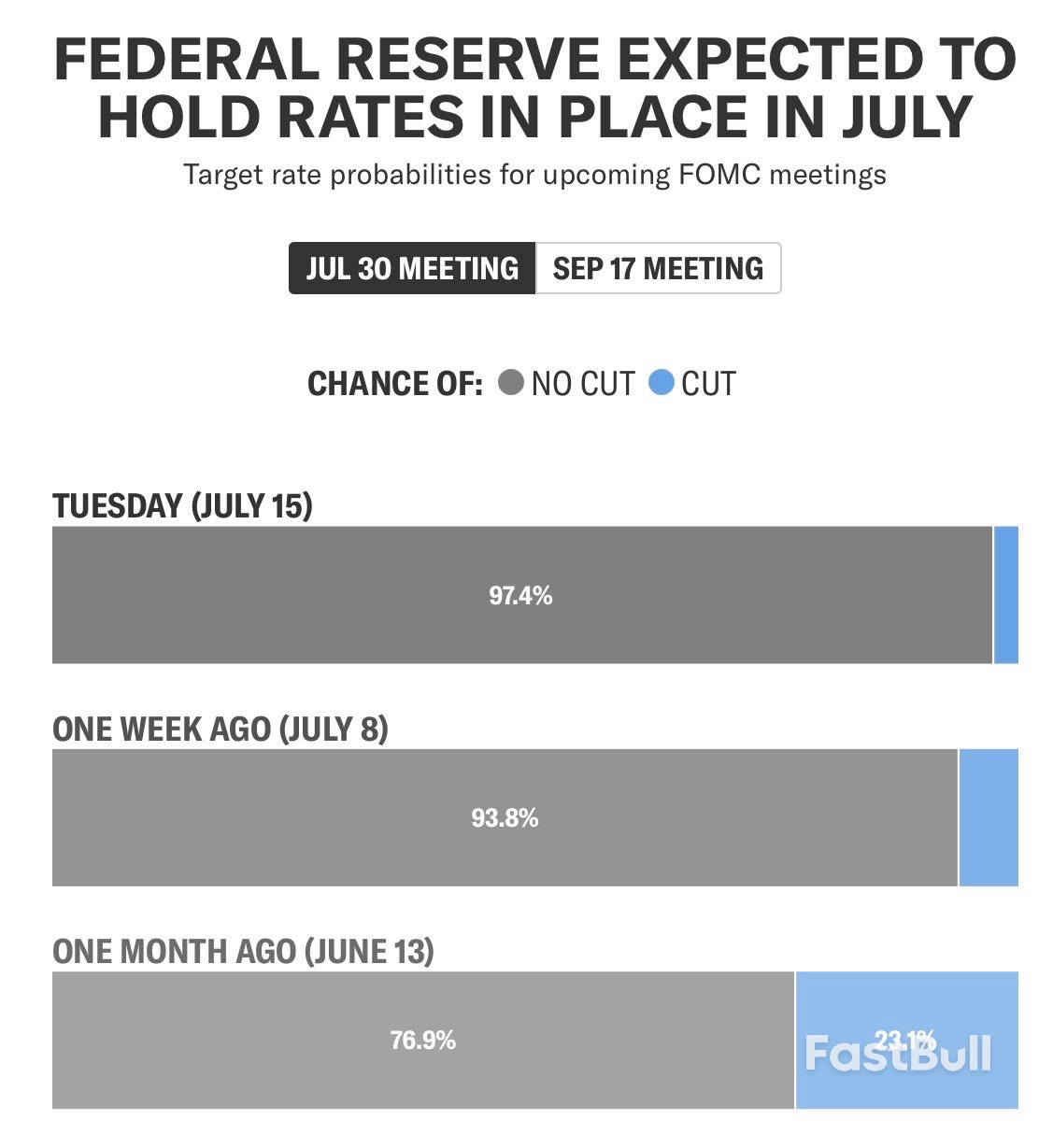
          Following the report, investors were placing a 97% probability on the Fed holding rates steady at its July meeting, up from 93% on Monday, according to the CME FedWatch Tool. Meanwhile, the chance of a September rate cut dropped sharply after the release, falling below 60% initially and inching closer to 50% as markets digested the data.June Inflation Data Reaffirms Fed Pause as Tariff Uncertainty Grows_1
          "The Fed’s ability to cut rates was resting heavily on today’s inflation print," Seema Shah, chief global strategist at Principal Asset Management, wrote following Tuesday's release.
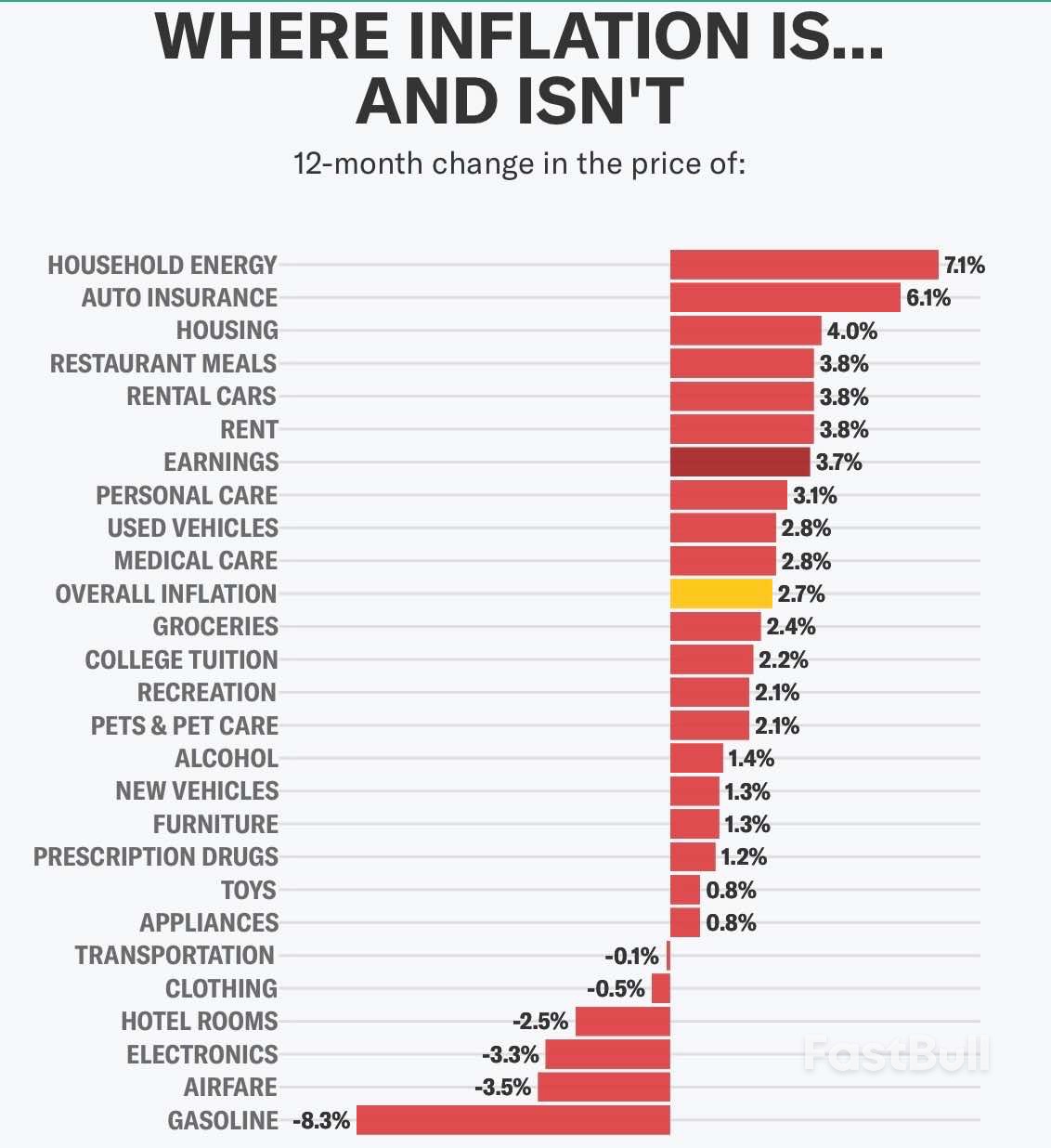
          "With inflation coming in softer than expected for the fifth month in a row, it may initially seem like there is still little sign of the tariff-induced boost to inflation that the Fed has been expecting," she continued, referring to the slower-than-expected monthly gain in core prices. "However, with increases in categories like household furnishings, recreation, and apparel, import levies are slowly filtering through to core goods prices."
          Indeed, apparel prices rose 0.4% in June, and footwear jumped 0.7% after several months of declines. Furniture and bedding prices also climbed 0.4%, reversing the 0.8% drop recorded in May, a potential indication that tariff-related cost pressures are beginning to reach consumers.
          Shah noted that the full inflationary impact of tariffs will take time to materialize, particularly as many goods were front-loaded ahead of the latest rollouts.
          "With higher tariffs being announced, it would be wise for the Fed to remain on the sidelines for a few more months at least," she added.June Inflation Data Reaffirms Fed Pause as Tariff Uncertainty Grows_2
          Greg Daco, chief economist at EY, echoed that view, noting that the full effects of tariffs have yet to unveil themselves. He believes any resulting price increases will likely be short-lived.
          "A lot of businesses are talking about rapidly passing on the higher tariff shock from these higher duties. So we're anticipating a rather swift pass-through," he told Yahoo Finance. "But if we are in an environment where there are staggered tariffs over the next year, then there is a risk of more inflation persistence. And I think that's the key risk for the US economy right now."
          The Fed itself has appeared divided on when to lower interest rates. Minutes from its June policy meeting revealed a split committee, with "most" officials supporting at least one rate cut this year while "a couple" signaled they'd be open to moving as early as July. Others preferred to hold rates steady through year-end.
          Meanwhile, President Trump has continued his public campaign for significantly lower rates, writing on Truth Social: "Fed should cut Rates by 3 Points. Very Low Inflation. One Trillion Dollars a year would be saved!!!"
          The next major inflation test for the Fed comes Wednesday, with the release of the Producer Price Index (PPI), a measure of how much prices are changing for what businesses sell. Later this month, investors will shift focus to the Fed's preferred inflation gauge, the Personal Consumption Expenditures (PCE) index.
          But as Wall Street has consistently been reminded, the Fed’s cautious stance is being driven not just by recent inflation data but also by lingering uncertainty around President Trump's evolving tariff policy.
          Ryan Sweet, chief US economist at Oxford Economics, said that if Trump's proposed Aug. 1 tariffs go into effect, the inflationary impact on goods prices could take several months to appear.
          Sweet, who is currently forecasting the next rate cut in December, said this would likely keep the Fed on hold unless the labor market weakens significantly.
          "The new tariffs, if implemented, could tilt the risks toward the next rate cut occurring later than in the baseline," the economist said. "The Fed could be comfortable waiting a little too long and then trying to catch up with more aggressive cuts because of the uncertainty around tariffs."

          Source: Yahoo Finance

          To stay updated on all economic events of today, please check out our Economic calendar
          Risk Warnings and Disclaimers
          You understand and acknowledge that there is a high degree of risk involved in trading. Following any strategies or investment methods may lead to potential losses. The content on the site is provided by our contributors and analysts for information purposes only. You are solely responsible for determining whether any trading assets, securities, strategy, or any other product is suitable for investing based on your own investment objectives and financial situation.
          Add to Favorites
          Share
          FastBull
          Copyright © 2025 FastBull Ltd

          728 RM B 7/F GEE LOK IND BLDG NO 34 HUNG TO RD KWUN TONG KLN HONG KONG

          TelegramInstagramTwitterfacebooklinkedin
          App Store Google Play Google Play
          Products
          Charts

          Chats

          Q&A with Experts
          Screeners
          Economic Calendar
          Data
          Tools
          Membership
          Features
          Function
          Markets
          Copy Trading
          Latest Signals
          Contests
          News
          Analysis
          24/7
          Columns
          Education
          Company
          Careers
          About Us
          Contact Us
          Advertising
          Help Center
          Feedback
          User Agreement
          Privacy Policy
          Business

          White Label

          Data API

          Web Plug-ins

          Poster Maker

          Affiliate Program

          Risk Disclosure

          The risk of loss in trading financial instruments such as stocks, FX, commodities, futures, bonds, ETFs and crypto can be substantial. You may sustain a total loss of the funds that you deposit with your broker. Therefore, you should carefully consider whether such trading is suitable for you in light of your circumstances and financial resources.

          No decision to invest should be made without thoroughly conducting due diligence by yourself or consulting with your financial advisors. Our web content might not suit you since we don't know your financial conditions and investment needs. Our financial information might have latency or contain inaccuracy, so you should be fully responsible for any of your trading and investment decisions. The company will not be responsible for your capital loss.

          Without getting permission from the website, you are not allowed to copy the website's graphics, texts, or trademarks. Intellectual property rights in the content or data incorporated into this website belong to its providers and exchange merchants.

          Not Logged In

          Log in to access more features

          FastBull Membership

          Not yet

          Purchase

          Become a signal provider
          Help Center
          Customer Service
          Dark Mode
          Price Up/Down Colors

          Log In

          Sign Up

          Position
          Layout
          Fullscreen
          Default to Chart
          The chart page opens by default when you visit fastbull.com