• Trade
  • Markets
  • Copy
  • Contests
  • News
  • 24/7
  • Calendar
  • Q&A
  • Chats
Trending
Screeners
SYMBOL
LAST
BID
ASK
HIGH
LOW
NET CHG.
%CHG.
SPREAD
SPX
S&P 500 Index
6796.87
6796.87
6796.87
6871.16
6789.06
-143.14
-2.06%
--
DJI
Dow Jones Industrial Average
48488.58
48488.58
48488.58
48918.89
48428.13
-870.76
-1.76%
--
IXIC
NASDAQ Composite Index
22954.31
22954.31
22954.31
23236.05
22916.83
-561.08
-2.39%
--
USDX
US Dollar Index
98.210
98.290
98.210
98.470
98.170
-0.120
-0.12%
--
EURUSD
Euro / US Dollar
1.17328
1.17335
1.17328
1.17395
1.17009
+0.00068
+ 0.06%
--
GBPUSD
Pound Sterling / US Dollar
1.34281
1.34288
1.34281
1.34565
1.34011
-0.00131
-0.10%
--
XAUUSD
Gold / US Dollar
4873.76
4874.17
4873.76
4888.31
4757.73
+110.60
+ 2.32%
--
WTI
Light Sweet Crude Oil
60.398
60.428
60.398
60.805
59.170
+0.934
+ 1.57%
--

Community Accounts

Signal Accounts
--
Profit Accounts
--
Loss Accounts
--
View More

Become a signal provider

Sell trading signals to earn additional income

View More

Guide to Copy Trading

Get started with ease and confidence

View More

Signal Accounts for Members

All Signal Accounts

Best Return
  • Best Return
  • Best P/L
  • Best MDD
Past 1W
  • Past 1W
  • Past 1M
  • Past 1Y

All Contests

  • All
  • Trump Updates
  • Recommend
  • Stocks
  • Cryptocurrencies
  • Central Banks
  • Featured News
Top News Only
Share

US President Trump Has Been Advocating For Firing Government Employees And Cutting Federal Spending

Share

US President Trump: We Have Cut $100 Billion In Federal Spending

Share

US President Trump: Many Countries Have Enormous Potential

Share

US President Trump: Focus On Green Energy; Mass Immigration Has Devastated Europe

Share

US President Trump: Europe Is Not Heading In The Right Direction

Share

US President Trump: Some Parts Of Europe Have Been Completely Transformed

Share

US President Trump: The United States Is The Hottest Country In The World

Share

US President Trump: I Intend To Raise The Standard Of Living

Share

Trump To Davos Audience: You All Follow US Down And You'Ll Follow US Up

Share

US President Trump: I Believe My Policies Will Lead To Higher Economic Growth

Share

US President Trump: The US Economy Is Growing At Twice The Rate Predicted By The International Monetary Fund

Share

US President Trump: Core Inflation Is 1.5%, And The Economy Is Projected To Grow By 5.4% In The Fourth Quarter Of 2025

Share

US President Trump: Speaks To “friends And A Few Enemies” In Davos

Share

US President Trump: US Inflation Has Been Defeated

Share

Brazil Labor Ministry Says Government Will Appeal Court Decision Suspending Changes To Meal Voucher System

Share

New York Fed Accepts $0 Billion Of $0 Billion Submitted To Standing Repo Operation On Jan 21

Share

Canada December Raw Materials Prices +0.5% From November, +6.4% On Year

Share

Canada December Industrial Prices -0.6% From November, +4.9% On Year

Share

UK's Reeves Favours De-Escalation On US Tariffs, Won't Rule Out Options

Share

Poll-Fed To Hold Rates Through March, And Possibly Through Powell's Tenure, On Strong Growth

TIME
ACT
FCST
PREV
Euro Zone ZEW Economic Sentiment Index (Jan)

A:--

F: --

P: --

Euro Zone Construction Output YoY (Nov)

A:--

F: --

P: --

Euro Zone Construction Output MoM (SA) (Nov)

A:--

F: --

P: --
Argentina Trade Balance (Dec)

A:--

F: --

P: --

U.K. CPI MoM (Dec)

A:--

F: --

P: --

U.K. Input PPI MoM (Not SA) (Dec)

A:--

F: --

P: --
U.K. Core CPI MoM (Dec)

A:--

F: --

P: --

U.K. Retail Prices Index MoM (Dec)

A:--

F: --

P: --

U.K. Input PPI YoY (Not SA) (Dec)

A:--

F: --

P: --

U.K. CPI YoY (Dec)

A:--

F: --

P: --

U.K. Output PPI MoM (Not SA) (Dec)

A:--

F: --

P: --

U.K. Output PPI YoY (Not SA) (Dec)

A:--

F: --

P: --

U.K. Core Retail Prices Index YoY (Dec)

A:--

F: --

P: --

U.K. Core CPI YoY (Dec)

A:--

F: --

P: --

U.K. Retail Prices Index YoY (Dec)

A:--

F: --

P: --

Indonesia 7-Day Reverse Repo Rate

A:--

F: --

P: --

Indonesia Loan Growth YoY (Dec)

A:--

F: --

P: --

Indonesia Deposit Facility Rate (Jan)

A:--

F: --

P: --

Indonesia Lending Facility Rate (Jan)

A:--

F: --

P: --

South Africa Core CPI YoY (Dec)

A:--

F: --

P: --

South Africa CPI YoY (Dec)

A:--

F: --

P: --

IEA Oil Market Report
U.K. CBI Industrial Output Expectations (Jan)

A:--

F: --

P: --
U.K. CBI Industrial Prices Expectations (Jan)

A:--

F: --

P: --

South Africa Retail Sales YoY (Nov)

A:--

F: --

P: --

U.K. CBI Industrial Trends - Orders (Jan)

A:--

F: --

P: --

Mexico Retail Sales MoM (Nov)

A:--

F: --

P: --

U.S. MBA Mortgage Application Activity Index WoW

A:--

F: --

P: --

Canada Industrial Product Price Index YoY (Dec)

A:--

F: --

P: --
Canada Industrial Product Price Index MoM (Dec)

A:--

F: --

P: --
U.S. Weekly Redbook Index YoY

--

F: --

P: --

U.S. Pending Home Sales Index YoY (Dec)

--

F: --

P: --

U.S. Pending Home Sales Index MoM (SA) (Dec)

--

F: --

P: --

U.S. Construction Spending MoM (Oct)

--

F: --

P: --

U.S. Pending Home Sales Index (Dec)

--

F: --

P: --

Japan Imports YoY (Dec)

--

F: --

P: --

Japan Exports YoY (Dec)

--

F: --

P: --

Japan Goods Trade Balance (SA) (Dec)

--

F: --

P: --

Japan Trade Balance (Not SA) (Dec)

--

F: --

P: --
Australia Employment (Dec)

--

F: --

P: --

Australia Labor Force Participation Rate (SA) (Dec)

--

F: --

P: --

Australia Unemployment Rate (SA) (Dec)

--

F: --

P: --

Australia Full-time Employment (SA) (Dec)

--

F: --

P: --

Turkey Capacity Utilization (Jan)

--

F: --

P: --

Turkey Late Liquidity Window Rate (LON) (Jan)

--

F: --

P: --

Turkey Overnight Lending Rate (O/N) (Jan)

--

F: --

P: --

Turkey 1-Week Repo Rate

--

F: --

P: --

U.S. Weekly Continued Jobless Claims (SA)

--

F: --

P: --

U.S. Initial Jobless Claims 4-Week Avg. (SA)

--

F: --

P: --

U.S. Real Personal Consumption Expenditures Final QoQ (Q3)

--

F: --

P: --

U.S. Real Personal Consumption Expenditures Prelim QoQ (Q3)

--

F: --

P: --

U.S. Weekly Initial Jobless Claims (SA)

--

F: --

P: --

U.S. Real GDP Annualized QoQ Final (Q3)

--

F: --

P: --

U.S. PCE Price Index Final QoQ (AR) (Q3)

--

F: --

P: --

U.S. EIA Weekly Natural Gas Stocks Change

--

F: --

P: --

U.S. Kansas Fed Manufacturing Composite Index (Jan)

--

F: --

P: --

U.S. Kansas Fed Manufacturing Production Index (Jan)

--

F: --

P: --

U.S. EIA Weekly Crude Stocks Change

--

F: --

P: --

U.S. EIA Weekly Crude Demand Projected by Production

--

F: --

P: --

U.S. EIA Weekly Cushing, Oklahoma Crude Oil Stocks Change

--

F: --

P: --

Q&A with Experts
    • All
    • Chatrooms
    • Groups
    • Friends
    Khawatir_ flag
    rawa ronte
    Don't trust Trump's words too much. He's cunning.
    [100]haha ya
    Ronnie flag
    let's go
    Ronnie flag
    Kung Fu flag
    rawa ronte
    Don't trust Trump's words too much. He's cunning.
    @rawa ronteyeah, I know. I'm not gonna go in yet
    rawa ronte flag
    Look at investors continuing to attack gold buyers.. they don't believe Trump's words.
    Kung Fu flag
    3405122
    can iIbuy gold now
    @Visitor3405122don't do that
    john flag
    Sean
    @Sean It's largely driven by headlines rather than fundamental shifts. Those geopolitical tensions around Japan and Greenland have spurred this short-term volatility.
    Size flag
    rawa ronte
    Don't trust Trump's words too much. He's cunning.
    @rawa ronteTrue, headlines alone can be misleading.
    Sean flag
    john
    Gold hitting new highs suggests investors are seeking safe havens. I see
    Size flag
    The key is to trade the market’s reaction, not the speech itself.@rawa ronte
    Vibhav Rai flag
    trumps plans would have worked to make america great if he would have born in 1945 i born to late for all this
    rawa ronte flag
    Size
    @SizeYes, Trump is a bastard in the business world. If inflation improves, investors will definitely not continue to buy gold. But now they are still buying it.
    Size flag
    Often, initial moves are exaggerated, and real opportunity comes after the dust settles and price confirms direction.@rawa ronte
    Kung Fu flag
    Sean
    @Seanyou'd better watch the charts in a lower time frame to figure real reaction
    Size flag
    Vibhav Rai
    trumps plans would have worked to make america great if he would have born in 1945 i born to late for all this
    True, timing is everything@Vibhav Rai
    rawa ronte flag
    Kung Fu
    @Kung Futrump's reaction to peeing his pants🤣🤣
    Size flag
    Politically driven moves impact markets differently depending on the economic and global context@Vibhav Rai
    M91O9NOL5X flag
    p bang coffee
    Size flag
    rawa ronte
    @rawa ronteExactly it’s all about market drivers, not personalities.
    M91O9NOL5X flag
    rawa ronte
    Don't trust Trump's words too much. He's cunning.
    @rawa rontebener cok
    Type here...
    Add Symbol or Code

      No matching data

      All
      Trump Updates
      Recommend
      Stocks
      Cryptocurrencies
      Central Banks
      Featured News
      • All
      • Russia-Ukraine Conflict
      • Middle East Flashpoint
      • All
      • Russia-Ukraine Conflict
      • Middle East Flashpoint
      Search
      Products

      Charts Free Forever

      Chats Q&A with Experts
      Screeners Economic Calendar Data Tools
      Membership Features
      Data Warehouse Market Trends Institutional Data Policy Rates Macro

      Market Trends

      Market Sentiment Order Book Forex Correlations

      Top Indicators

      Charts Free Forever
      Markets

      News

      News Analysis 24/7 Columns Education
      From Institutions From Analysts
      Topics Columnists

      Latest Views

      Latest Views

      Trending Topics

      Top Columnists

      Latest Update

      Signals

      Copy Rankings Latest Signals Become a signal provider AI Rating
      Contests
      Brokers

      Overview Brokers Assessment Rankings Regulators News Claims
      Broker listing Forex Brokers Comparison Tool Live Spread Comparison Scam
      Q&A Complaint Scam Alert Videos Tips to Detect Scam
      More

      Business
      Events
      Careers About Us Advertising Help Center

      White Label

      Data API

      Web Plug-ins

      Affiliate Program

      Awards Institution Evaluation IB Seminar Salon Event Exhibition
      Vietnam Thailand Singapore Dubai
      Fans Party Investment Sharing Session
      FastBull Summit BrokersView Expo
      Recent Searches
        Top Searches
          Markets
          News
          Analysis
          User
          24/7
          Economic Calendar
          Education
          Data
          • Names
          • Latest
          • Prev

          View All

          No data

          Scan to Download

          Faster Charts, Chat Faster!

          Download App
          English
          • English
          • Español
          • العربية
          • Bahasa Indonesia
          • Bahasa Melayu
          • Tiếng Việt
          • ภาษาไทย
          • Français
          • Italiano
          • Türkçe
          • Русский язык
          • 简中
          • 繁中
          Open Account
          Search
          Products
          Charts Free Forever
          Markets
          News
          Signals

          Copy Rankings Latest Signals Become a signal provider AI Rating
          Contests
          Brokers

          Overview Brokers Assessment Rankings Regulators News Claims
          Broker listing Forex Brokers Comparison Tool Live Spread Comparison Scam
          Q&A Complaint Scam Alert Videos Tips to Detect Scam
          More

          Business
          Events
          Careers About Us Advertising Help Center

          White Label

          Data API

          Web Plug-ins

          Affiliate Program

          Awards Institution Evaluation IB Seminar Salon Event Exhibition
          Vietnam Thailand Singapore Dubai
          Fans Party Investment Sharing Session
          FastBull Summit BrokersView Expo

          Beijing Warns U.S.–Taiwan Trade Pact Risks Hollowing Out Taiwan’s Economy

          Gerik

          Economic

          Political

          Summary:

          China said the recent U.S.–Taiwan trade deal primarily serves American interests while weakening Taiwan’s industrial base, arguing that deeper economic integration with Washington will erode the island’s long-term competitiveness...

          China’s Criticism And Strategic Framing

          Beijing intensified its criticism of the trade agreement reached last week between the United States and Taiwan, warning that the pact would drain Taiwan’s economic strength for the benefit of Washington. Peng Qingen, a spokesperson for China’s Taiwan Affairs Office, said the agreement would “only drain Taiwan’s economic interests,” accusing Taiwan’s ruling Democratic Progressive Party of allowing the United States to hollow out the island’s key industries. This framing reflects Beijing’s broader position that economic cooperation between Taiwan and countries maintaining diplomatic relations with China violates the one-China principle and undermines regional stability.
          China considers Taiwan part of its territory, a stance repeatedly emphasized by Xi Jinping, who has described reunification with the mainland as a historical inevitability. Taiwan rejects these claims and continues to pursue closer economic and security ties with Washington, a dynamic that has become increasingly contentious as geopolitical rivalry between China and the United States deepens.

          Structure Of The Trade Deal And Economic Trade-Offs

          Under the agreement, U.S. tariffs on most Taiwanese exports were reduced to 15 percent from 20 percent, while tariffs were waived on generic drugs and ingredients, aircraft components, and certain natural resources not available domestically in the U.S. In exchange, Taipei committed to significant investment flows into the American economy. Taiwanese firms are set to invest around $250 billion directly in the United States to build and expand technology operations, including semiconductor and artificial intelligence facilities. The Taiwanese government also pledged to guarantee an additional $250 billion in credit to support its chip and technology companies as they scale up production in the U.S.
          Taiwanese chipmakers will also receive higher quotas for tariff-free chip exports to the United States, reinforcing supply chain integration. U.S. Commerce Secretary Howard Lutnick said the goal is to relocate about 40 percent of Taiwan’s semiconductor supply chain to the United States. This target highlights a strategic objective rather than an immediate outcome, as it depends on sustained investment, workforce development, and technological alignment over time.

          Semiconductors At The Center Of The Dispute

          At the heart of Beijing’s criticism lies Taiwan’s dominant position in global semiconductor manufacturing. Taiwan Semiconductor Manufacturing Company, the world’s largest contract chipmaker, has already pledged $165 billion to build fabrication plants and a research and development facility in the United States. Reports suggest the company may construct four to six additional plants, potentially bringing the total number of U.S. facilities to more than ten.
          China argues that such investments weaken Taiwan’s industrial foundations. Beijing has pointed to significantly higher labor costs at TSMC’s U.S. factories compared with those in Taiwan, implying that shifting production abroad could reduce efficiency and profitability. From China’s perspective, this supports its claim that Washington is “using Taiwan to contain China,” turning the island into a strategic asset rather than an independent economic actor.

          Taiwan’s Response And Limits Of Industrial Migration

          Taiwanese officials and experts have pushed back against the notion that the deal will hollow out the island’s economy. Analysts note that Taiwan continues to keep its most advanced semiconductor technologies at home, limiting the extent to which production relocation can undermine domestic capabilities. When asked about the U.S. ambition to achieve 40 percent chip self-sufficiency, Taiwan’s vice premier Cheng Li-chiun said the goal does not rest solely on Taiwan, emphasizing that U.S. chipmakers and other countries are also central to that strategy.
          This highlights a relationship of correlation rather than direct causation between overseas investment and domestic industrial decline. While increased U.S. production may gradually diversify global supply chains, it does not automatically translate into an immediate loss of Taiwan’s technological edge, particularly as the island retains control over its most advanced processes.

          Geopolitical Stakes And Economic Signaling

          Taiwan’s central role in the global semiconductor supply chain gives the trade deal broader geopolitical significance. Nearly a third of global demand for new computing power is estimated to be met by Taiwan, making its de facto autonomy a strategic priority for the United States and its allies. The agreement therefore serves both economic and security objectives, deepening U.S.–Taiwan ties at a time when China has stepped up military and political pressure on the island.
          From Beijing’s standpoint, the pact signals a tightening alignment between Washington and Taipei that threatens China’s regional influence. From Washington’s perspective, it represents a step toward supply chain resilience and reduced dependence on a single geographic hub. The tension between these interpretations underscores why the deal has become a focal point for broader U.S.–China rivalry, extending well beyond trade balances into questions of technology leadership, security, and long-term economic sovereignty.

          Source: CNBC

          To stay updated on all economic events of today, please check out our Economic calendar
          Risk Warnings and Disclaimers
          You understand and acknowledge that there is a high degree of risk involved in trading. Following any strategies or investment methods may lead to potential losses. The content on the site is provided by our contributors and analysts for information purposes only. You are solely responsible for determining whether any trading assets, securities, strategy, or any other product is suitable for investing based on your own investment objectives and financial situation.
          Add to Favorites
          Share

          Ukraine's New Defense Chief Pivots to AI and Drones

          Isaac Bennett

          Data Interpretation

          Political

          Russia-Ukraine Conflict

          Remarks of Officials

          Ukraine has appointed a new defence minister with a clear mandate: overhaul Europe's largest military with a data-driven strategy designed to give its forces a decisive edge against Russia's larger army. Mykhailo Fedorov, formerly the country's digitalisation minister, was appointed last week by President Volodymyr Zelenskiy to drive innovation and fortify Ukraine's defenses.

          Fedorov's plan centers on rewarding battlefield results and implementing advanced technology to counter Russia's superior equipment.

          Ukraine's new Defence Minister, Mykhailo Fedorov, is tasked with driving a data-centric overhaul of the nation's military.

          A Mandate for Measurable Results

          In his first remarks to reporters, Fedorov promised a sweeping reform of the defence ministry's management, emphasizing that performance will be the sole criterion for success. "If people don't demonstrate measurable results, they can't remain in the system," he stated.

          His team has already compiled "high-quality data" to analyze ministry spending, identify potential savings, and address a significant budget gap. Fedorov stressed the importance of what he calls "the mathematics of war," underscoring that his approach will be built on systematic calculation and efficiency.

          Boosting Battlefield Efficiency with Data

          To translate this vision into action, the ministry will soon launch a mission control system for its drone operations. This platform will provide detailed data on the performance and effectiveness of drone crews, enabling better strategic decisions. A similar system is planned for artillery units.

          "We need to see the full picture to simplify and speed up management decision-making," Fedorov explained. The ultimate goal is to increase Russian losses to an unsustainable level.

          Leveraging Combat Data to Train Allied AI

          Ukraine plans to establish a system that allows its allies to use its vast repository of combat data to train their military artificial intelligence models. Since Russia's full-scale invasion in February 2022, Ukraine has accumulated an invaluable trove of battlefield information, including:

          • Systematically logged combat statistics

          • Millions of hours of drone footage

          This real-world data is critical for training AI to recognize patterns and predict outcomes. Fedorov has previously described this data collection as one of Ukraine's key negotiating assets. Ukraine is already using AI technology from the U.S. data analytics firm Palantir.

          Fedorov also noted that his team is receiving strategic advice from prominent think tanks, including the Center for Strategic and International Studies (CSIS) and RAND in the United States, as well as the Royal United Services Institute (RUSI) in the UK, as he seeks to more actively integrate allies into defense projects.

          Developing a Homegrown Mavic Drone Replacement

          This month, Ukraine will begin testing a domestically produced replacement for China's widely used DJI Mavic drone, which serves as a primary reconnaissance tool for both sides of the conflict. The manufacturer's name was not disclosed.

          This move addresses concerns about over-reliance on Chinese technology, especially given Beijing's close ties with Moscow. "We will have our own Mavic analogue: the same camera, but with a longer flight range," Fedorov confirmed.

          Risk Warnings and Disclaimers
          You understand and acknowledge that there is a high degree of risk involved in trading. Following any strategies or investment methods may lead to potential losses. The content on the site is provided by our contributors and analysts for information purposes only. You are solely responsible for determining whether any trading assets, securities, strategy, or any other product is suitable for investing based on your own investment objectives and financial situation.
          Add to Favorites
          Share

          “Sell America” Trade Re-Emerges as Greenland Tensions Rattle Global Investors

          Gerik

          Greenland Dispute Triggers Flight From U.S. Assets

          Financial markets on Tuesday reflected a decisive shift away from U.S. risk as geopolitical uncertainty intensified around President Donald Trump’s renewed push to take control of Greenland. Investor anxiety rose after Greenland Prime Minister Jens-Frederik Nielsen warned that the possibility of U.S. military force had not been fully ruled out, even if it remained unlikely. This statement acted as a catalyst for market repricing rather than a standalone trigger, reinforcing an already fragile risk environment shaped by trade threats and diplomatic strain.
          The immediate market response followed a familiar “sell America” pattern. U.S. equities sold off aggressively, bond yields climbed as prices fell, the dollar weakened, and capital rotated into traditional safe havens such as gold. These moves suggest a correlation between geopolitical uncertainty and capital allocation decisions, as investors reassessed U.S. political risk rather than reacting to any direct economic shock.

          Wall Street Suffers Worst Session Since October

          Major U.S. equity indices posted their sharpest losses in months. The S&P 500 fell 2.06 percent, the Dow Jones Industrial Average declined 1.76 percent, and the Nasdaq Composite slid 2.39 percent, pushing both the S&P 500 and Nasdaq into negative territory for 2026. Market volatility spiked during the session, with the VIX index briefly touching 20.99, underscoring the sudden deterioration in investor confidence.
          Technology and growth stocks led the decline, with Netflix falling sharply even after posting a narrow earnings beat, while losses also spread across financials, industrials, and consumer-facing sectors. These broad-based declines point to systemic risk aversion rather than sector-specific concerns.

          Gold Surges as Dollar And Treasuries Lose Appeal

          As U.S. assets came under pressure, gold prices surged to fresh all-time highs, rising more than 2.2 percent on the day. The move marked gold’s strongest one-day gain since 2020, reinforcing its role as a hedge during periods of geopolitical stress. At the same time, the U.S. Dollar Index slipped, reflecting reduced demand for dollar-denominated assets amid growing uncertainty over U.S. foreign policy direction.
          U.S. Treasury prices also fell, pushing yields higher, a sign that even traditional safe-haven bonds were not immune. One notable early signal came from Denmark, where pension fund AkademikerPension announced plans to sell roughly $100 million in U.S. Treasurys. While the fund cited concerns over U.S. government finances as the primary reason, its investment chief acknowledged that recent U.S.–Europe tensions made the decision easier to justify. This illustrates a reinforcing relationship where political risk amplifies existing structural concerns rather than acting as the sole cause.

          Warnings Of Capital Conflict Gain Attention

          Concerns about longer-term capital flows were amplified by comments from Ray Dalio, founder of Bridgewater Associates. Speaking at the World Economic Forum in Davos, Dalio warned that trade conflicts can evolve into capital conflicts, prompting foreign governments and investors to reassess their exposure to U.S. assets. His remarks framed the Greenland dispute as part of a broader pattern in which trade weaponization risks spilling over into global capital markets.
          U.S. officials struck a more defiant tone. Treasury Secretary Scott Bessent defended the administration’s stance, describing it as an expression of renewed U.S. leadership. However, international reactions have been notably cooler, with European leaders and Greenland officials expressing alarm, and France’s Emmanuel Macron condemning what he described as bullying behavior while calling for the removal of U.S. tariffs on Europe.

          Markets Question Who Benefits From Escalation

          Despite mounting criticism, Trump signaled no intention to retreat, expressing confidence ahead of his departure for Davos that discussions on Greenland would “work out pretty well.” For markets, the unresolved question is not whether talks will continue, but whose interests will ultimately be served. In the near term, the evidence suggests that uncertainty itself is the dominant force driving asset prices, with investors choosing caution as long as geopolitical risks remain elevated.
          While some Wall Street analysts argue that tensions could cool and that the sell-off may prove temporary, current price action reflects a market increasingly sensitive to political risk. The Greenland dispute has therefore become less about the island itself and more about what it signals regarding the future stability of U.S. trade relations, alliances, and capital flows.

          Source: CNBC

          Risk Warnings and Disclaimers
          You understand and acknowledge that there is a high degree of risk involved in trading. Following any strategies or investment methods may lead to potential losses. The content on the site is provided by our contributors and analysts for information purposes only. You are solely responsible for determining whether any trading assets, securities, strategy, or any other product is suitable for investing based on your own investment objectives and financial situation.
          Add to Favorites
          Share

          UK Inflation Rises to 3.4%, But Rate Cut Bets Hold Firm

          George Anderson

          Data Interpretation

          Central Bank

          Economic

          Remarks of Officials

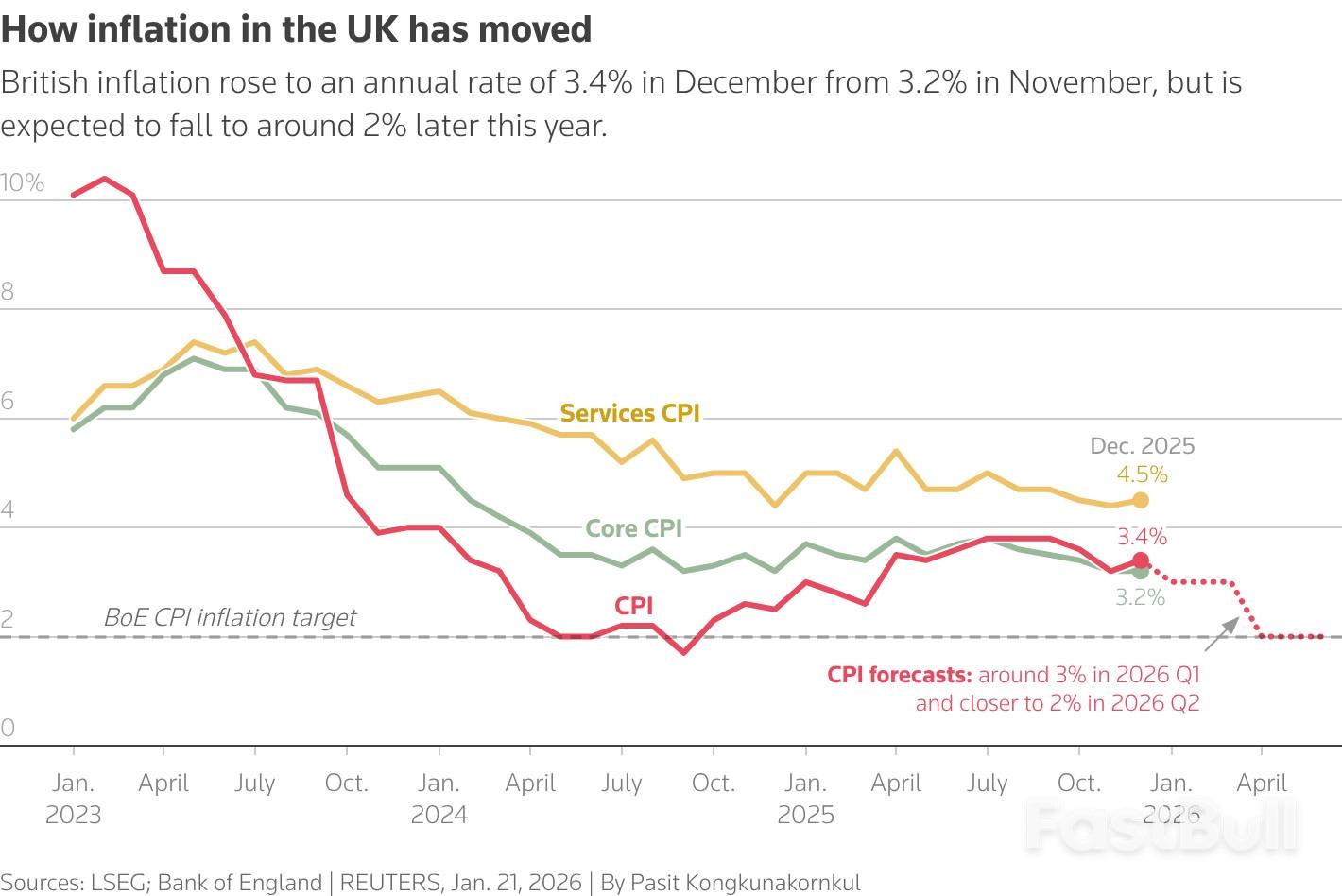
          UK inflation unexpectedly climbed for the first time since July, hitting 3.4% in December and complicating the path toward price stability. Despite the increase, investors and economists largely believe the upward blip won't derail the Bank of England's plan to cut interest rates later this year.

          Official data shows the Consumer Price Index (CPI) rose from 3.2% in November, surpassing the 3.3% that economists had forecasted.

          Key takeaways from the latest report include:

          • Headline Inflation: Reached 3.4% in December.

          • Primary Drivers: Price hikes were mainly caused by increased tobacco duties and seasonal airfare costs.

          • Market Reaction: Financial markets remained steady, with expectations for 2026 rate cuts unchanged.

          • Services Inflation: A crucial metric for the central bank, services price inflation edged up to 4.5% from 4.4%, aligning perfectly with forecasts.

          Figure 1: UK inflation data shows the headline CPI rate rose in December 2025 but remains on a clear downward trajectory toward the Bank of England's 2% target.

          What Drove the December Price Spike?

          The primary forces behind the December inflation increase were higher prices for tobacco products, following a rise in duties, and the typical surge in airfares around the Christmas holiday period.

          While the headline number was higher than expected, Adam Deasy, an economist at PwC, described the event as a "speed-bump, rather than an indication we are veering off course on the road to price stability."

          This sentiment is shared across the market, as the underlying drivers are seen as temporary rather than a sign of persistent inflationary pressure.

          Bank of England Stays the Course for 2026

          Despite the uptick, the Bank of England (BoE) is widely expected to proceed with interest rate cuts in 2026. The central bank is focused on the broader trend, which still points toward a significant slowdown in price growth over the coming months.

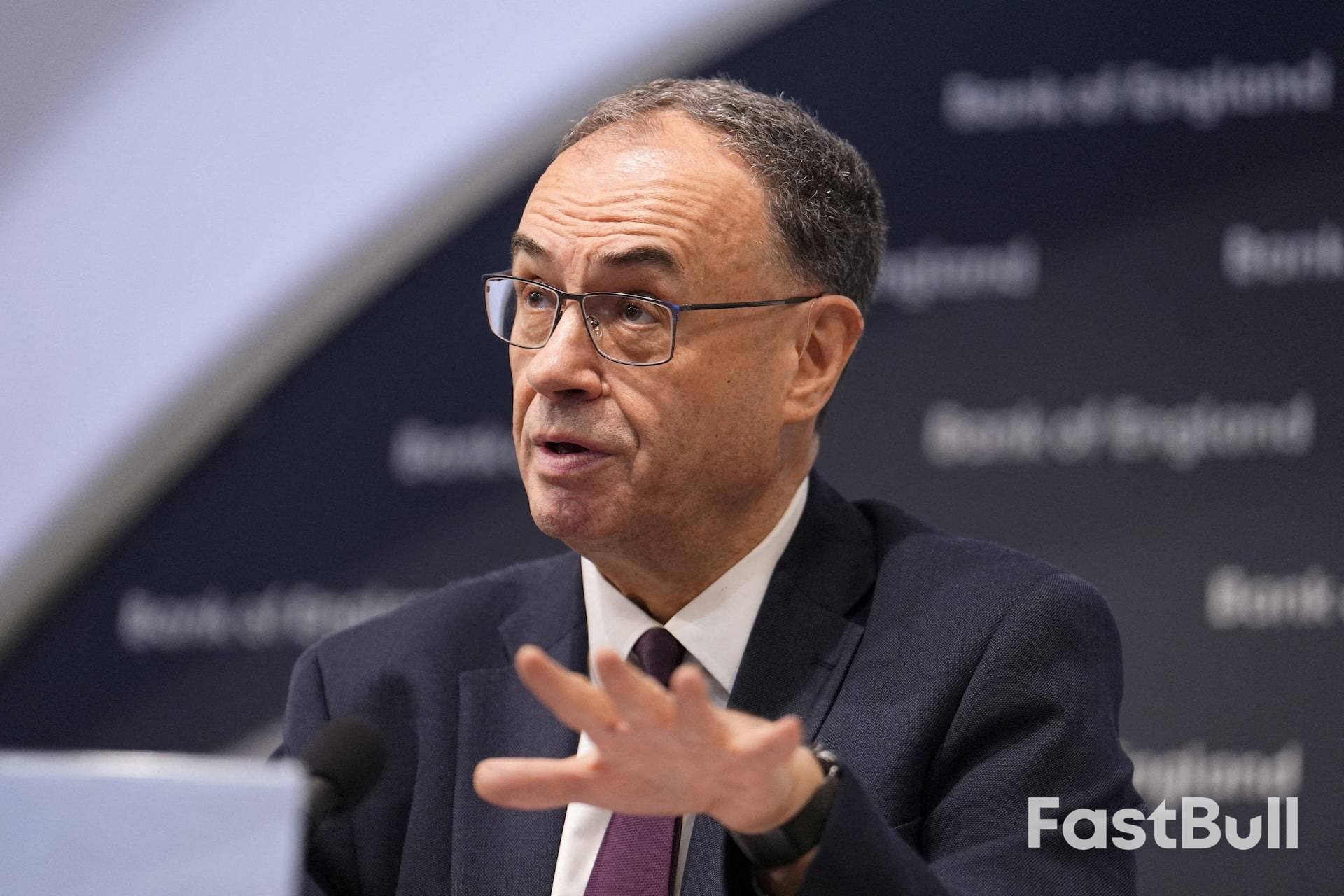
          BoE Governor Andrew Bailey has previously stated that he expects inflation to fall close to the bank's 2% target by April or May. Consequently, the latest data did little to move the pound or alter market bets on future monetary policy.

          Figure 2: Bank of England Governor Andrew Bailey has voiced concerns over geopolitical risks but maintains that inflation should return to its target in the coming months.

          "The Bank of England will... not be worried by these numbers," noted Nicholas Crittenden, an economist from the National Institute of Economic and Social Research. He added, "We still predict one cut in Bank Rate in the first half of this year."

          Financial markets are currently pricing in one or possibly two quarter-point rate cuts by the BoE in 2026. This reflects confidence that the disinflationary trend will overcome short-term volatility.

          Geopolitical Risks and Energy Prices Loom

          While the domestic inflation picture appears manageable, external factors pose a significant risk. Governor Bailey recently highlighted that the BoE is worried about how markets are reacting to geopolitical developments.

          These concerns are materializing in energy markets. British natural gas futures have surged by approximately 25% in the last two weeks, partly due to deteriorating relations with the United States, a key supplier of liquefied natural gas. The tensions stem from President Donald Trump's threats of tariffs on European allies who oppose his Greenland takeover plan. An escalation could disrupt supply chains and push energy costs higher, complicating the BoE's inflation fight.

          The Broader Economic Outlook

          Even with the December surprise, Britain's consumer price and services inflation rates are running slightly below the BoE's own projections from its November forecasts. However, the UK continues to have the highest inflation rate in the Group of Seven, paired with sluggish economic growth.

          Data on producer prices, which can be a leading indicator for consumer inflation, showed a sharp increase in the services sector during the fourth quarter, rising to 2.9% from 2.0%. Meanwhile, output price inflation for manufacturers remained stable.

          The BoE's Monetary Policy Committee last cut the Bank Rate to 3.75% in December, but the decision was not unanimous. Nearly half of its members voted to hold rates steady, citing concerns about persistent inflation, a signal that the debate over policy easing is far from over.

          To stay updated on all economic events of today, please check out our Economic calendar
          Risk Warnings and Disclaimers
          You understand and acknowledge that there is a high degree of risk involved in trading. Following any strategies or investment methods may lead to potential losses. The content on the site is provided by our contributors and analysts for information purposes only. You are solely responsible for determining whether any trading assets, securities, strategy, or any other product is suitable for investing based on your own investment objectives and financial situation.
          Add to Favorites
          Share

          Markets Catch Their Breath, Trumps Speech In Davos Now Key

          Justin

          Forex

          Stocks

          Global markets appeared to stabilize somewhat today after the sharp U.S. selloff overnight, which saw the DOW suffer its worst one-day loss since October. That said, the underlying source of stress has not faded. Greenland-related tensions remain unresolved, with no visible path toward de-escalation. The current stabilization looks more like position-squaring, rather than renewed confidence.

          For now, markets are simply catching their breath, awaiting the next catalyst. Attention has shifted to World Economic Forum, where US President Donald Trump is due to deliver a closely watched address later today. Trump's speech comes amid soaring tensions between the U.S. and Europe over Danish territory Greenland, which Trump wants the U.S. to acquire. Markets are watching closely for any signal of escalation, moderation, or strategic ambiguity.

          On Tuesday, Trump declined to specify how far he is prepared to go to achieve that objective, telling reporters bluntly, "You'll find out." He has previously refused to rule out military action and has threatened new tariffs on multiple European countries if they block the takeover bid.

          Those threats have already left their mark on markets this week. The renewed risk of a transatlantic trade war pushed U.S. Treasuries sharply lower, while Gold surged to new record highs.

          U.S. 10-year yield briefly breached 4.3% overnight, before settling around 4.295%. Speaking in Davos, Scott Bessent sought to play down concerns about the bond selloff. He said he was not worried about Treasuries, dismissing speculation that European investors were pulling back.

          Asked specifically about Denmark, Bessent said its holdings were "irrelevant," noting they amounted to less than USD 100 million, and added that Denmark has been selling Treasuries for years. He emphasized that the U.S. has seen record foreign investment in Treasuries overall.

          Instead, Bessent pointed to Japan, arguing that the recent Japanese bond selloff following a snap election announcement had spilled over into global markets. He dismissed talk of European liquidation as originating from a single analyst at Deutsche Bank. Bessent added that Deutsche Bank's CEO had personally contacted him to say the bank did not stand by the analyst report, accusing "fake news media" of amplifying unfounded fears.

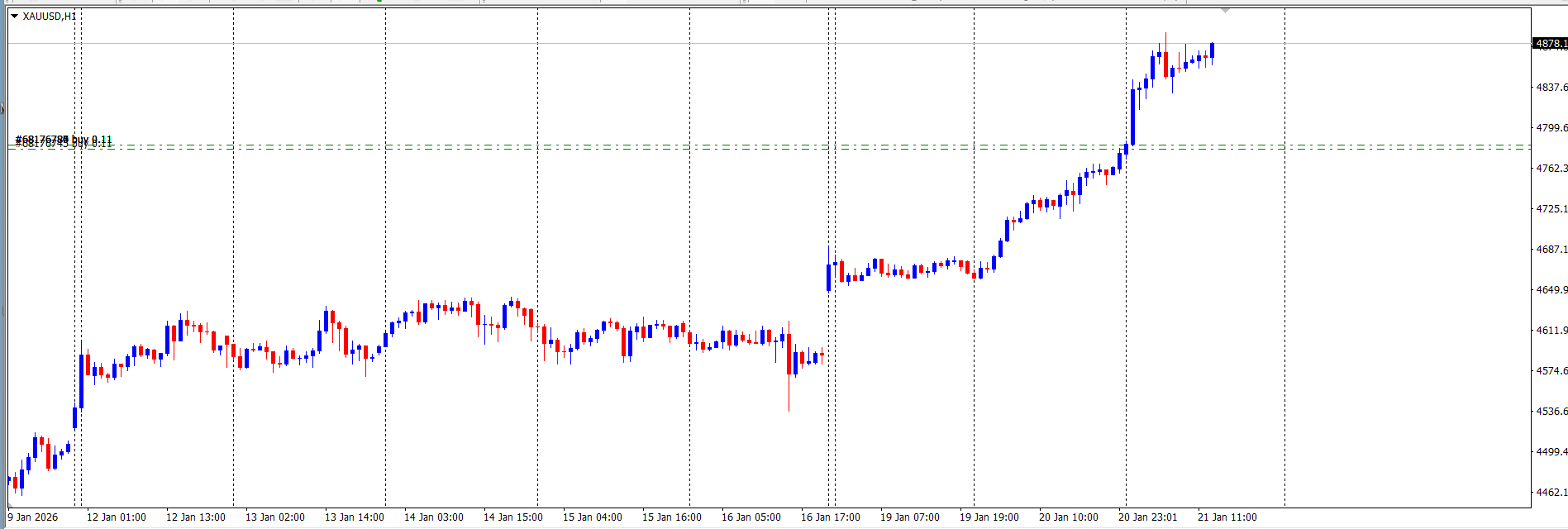
          Meanwhile, Gold climbed above 4,800, extending a powerful rally driven by tariff threats, geopolitical instability, falling real rates, and ongoing diversification away from the dollar. After a record 2025, Gold has entered 2026 with momentum firmly intact. According to analysts surveyed by the London Bullion Market Association, prices are increasingly expected to rise above 5,000 this year, citing lower U.S. real yields, continued Fed easing, and sustained central-bank diversification.

          In FX performance terms this week so far, Dollar sits at the bottom, followed by Yen and Sterling, while Kiwi leads, followed by Swiss Franc and Aussie, with Euro and Loonie in the middle.

          In Asia, Nikkei fell -0.41%. Hong Kong HSI rose 0.37%. China Shanghai SSE rose 0.08%. Singapore Strait Times is down -0.46%. Japan 10-year JGB yield stabilized and fell -0.056 to 2.288. Overnight, DOW fell -1.76%. S&P 500 fell -2.06%. NADSAQ fell -2.39%. 10-year yield rose 0.064 to 4.295.

          ECB's Lagarde: Tariffs manageable, Trump's constant reversals more damaging

          ECB President Christine Lagarde said she expects only a "minimal" inflationary impact from additional U.S. tariffs, arguing that Eurozone price pressures remain firmly under control. Speaking to RTL, Lagarde noted that inflation is currently around 1.9%, leaving little scope for tariffs to materially disrupt the ECB's inflation outlook.

          Though, she acknowledged that the impact would not be evenly distributed, with Germany likely more exposed than France given its export-heavy manufacturing base. However, Lagarde argued that Europe would be far more resilient if it focused on removing non-tariff trade barriers within the EU, strengthening internal trade and competitiveness rather than reacting defensively to external shocks.

          Lagarde's sharper warning was reserved for uncertainty, not tariffs themselves. Referring to renewed threats from US President Donald Trump, who has vowed to impose escalating tariffs on several European countries over Greenland, she said the "constant reversals" and unpredictability pose a more serious risk. Trump, she added, often takes a transactional approach, setting demands at "sometimes completely unrealistic" levels.

          UK CPI rises to 3.4%, core holds at cycle low of 3.2%

          UK inflation firmed at the end of 2025, with headline pressure coming in slightly hotter than expected. CPI rose to 3.4% yoy in December, up from 3.2% and above expectations of 3.3%, while prices increased 0.4% mom, pointing to ongoing near-term inflation momentum.

          The upside in headline inflation, however, masked relative stability in underlying pressures. Core CPI—excluding energy, food, alcohol and tobacco—was unchanged at 3.2% yoy, undershooting expectations of 3.3%, and marking the joint-lowest reading since December 2024. Core inflation was last lower in September 2021, reinforcing the view that underlying disinflation progress, while slow, remains intact.

          By component, services inflation edged up to 4.5% yoy from 4.4%, keeping the sector firmly in focus for the BoE, while goods inflation rose to 2.2% from 2.1%.

          NZD/USD presses resistance Q4 CPI awaited on RBNZ hike guidance

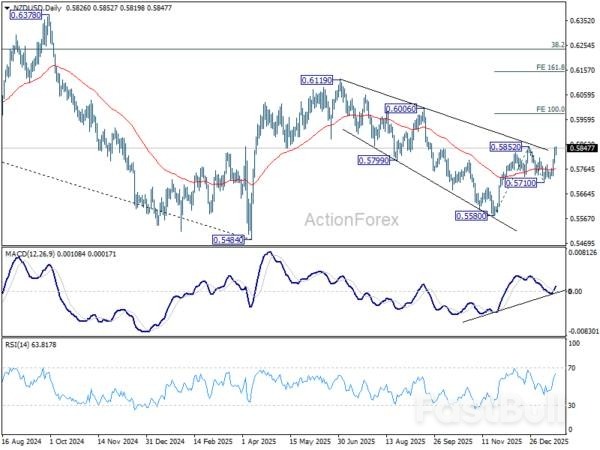
          NZD/USD has surged sharply this week and is now pressing key near-term resistance at 0.5852, as shifting global risk dynamics unexpectedly favor the Kiwi. With Dollar and Euro under pressure from Greenland-related geopolitical tensions, both New Zealand dollar and Australian Dollar have surprisingly emerged as relative safe havens, benefiting from stable domestic backdrops and distance from the dispute.

          At the same, Yen remains under pressure, weighed down by an aggressive selloff in Japanese government bonds as markets price in post-election fiscal expansion. That divergence has left antipodean currencies unusually well-bid, along with Swiss Franc.

          For Kiwi, attention now turns to New Zealand Q4 CPI, due Friday in Asia. The annual rate is expected to hold at 3.0%, right at the top of the RBNZ's 2–3% target band. With the Official Cash Rate at 2.25%, markets broadly agree the RBNZ has completed its easing cycle. The open question is timing of the next hike, not whether one eventually comes. CPI overshoot would sharply pull forward expectations and offer fresh support to NZD.

          That focus will intensify at the February 18 OCR review, the first major policy decision under new Governor Anna Breman. Markets will be listening closely to the tone of the post-meeting press conference for clues on whether Breman leans hawkish, dovish, or neither.

          Technically, NZD/USD's dip to 0.5710 earlier this month was a little deeper than expected. But that didn't alter the overall structure. The corrective down trend from 0.6119 (2025 high) should have completed with three waves down to 0.5580.

          Firm break of 0.5852 will resume the whole rally from 0.5580 and target 100% projection of 0.5580 to 0.5852 from 0.5710 at 0.6015. Decisive break of 0.6015 will solidify that NZD/USD is in an impulsive move that should be resuming whole rise from 0.5484 (2025 low) through 0.6119. In any case, outlook will now stay bullish as long as 0.5710 support holds.

          EUR/JPY Daily Outlook

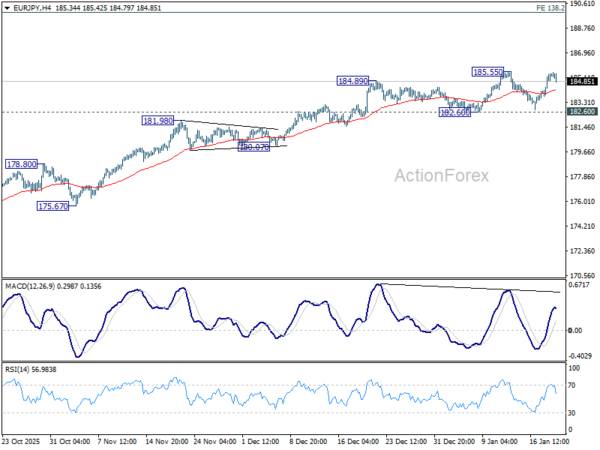
          Daily Pivots: (S1) 184.33; (P) 184.90; (R1) 186.02;

          EUR/JPY retreated ahead of 185.55 resistance as range trading continues. Intraday bias remains neutral for the moment. With 182.60 support intact, further rally is expected. On the upside, break of 185.55 will resume larger up trend to 186.31 projection level. Firm break there will target 138.2% projection of 151.06 to 173.87 from 172.24 at 189.94. However, sustained break of 182.60 will confirm short term topping, and turn bias back to the downside for 55 D EMA (now at 181.83) and below.

          In the bigger picture, up trend from 114.42 (2020 low) is in progress and should target 61.8% projection of 124.37 to 175.41 from 154.77 at 186.31. Considering bearish divergence condition in D MACD, upside could be capped by 186.31 on first attempt. Still, outlook will stay bullish as long as 55 W EMA (now at 172.58) holds, even in case of deep pullback. Sustained break of 186.31 will pave the way to 78.6% projection at 194.88 next.

          Economic Indicators Update

          GMTCCYEVENTSActConsPrevRev
          07:00GBPCPI M/M Dec0.40%0.40%-0.20%
          07:00GBPCPI Y/Y Dec3.40%3.30%3.20%
          07:00GBPCore CPI Y/Y Dec3.20%3.30%3.20%
          07:00GBPRPI M/M Dec0.70%0.50%-0.40%
          07:00GBPRPI Y/Y Dec4.20%4.10%3.80%
          07:00GBPPPI Input M/M Dec-0.20%-0.10%0.30%0.50%
          07:00GBPPPI Input Y/Y Dec0.80%
          1.10%
          07:00GBPPPI Output M/M Dec0.00%0.10%0.10%
          07:00GBPPPI Output Y/Y Dec3.40%
          3.40%
          07:00GBPPPI Core Output M/M Dec-0.10%
          0.00%0.10%
          07:00GBPPPI Core Output Y/Y Dec3.20%
          3.50%3.60%
          13:30CADRaw Material Price Index Dec

          0.30%
          13:30CADIndustrial Product Price M/M Dec

          0.90%
          15:00USDPending Homeles M/M Dec

          3.30%

          Source: ACTIONFOREX

          Risk Warnings and Disclaimers
          You understand and acknowledge that there is a high degree of risk involved in trading. Following any strategies or investment methods may lead to potential losses. The content on the site is provided by our contributors and analysts for information purposes only. You are solely responsible for determining whether any trading assets, securities, strategy, or any other product is suitable for investing based on your own investment objectives and financial situation.
          Add to Favorites
          Share

          Bessent Slams Powell Over SCOTUS Visit Amid Fed Feud

          Alexander

          Central Bank

          Remarks of Officials

          Daily News

          Political

          Economic

          The conflict over the U.S. Federal Reserve's independence has intensified, with Treasury Secretary Scott Bessent openly criticizing Fed Chair Jerome Powell's decision to attend a high-stakes Supreme Court hearing. The case centers on President Donald Trump's attempt to fire a sitting central bank governor, a move that could reshape the Fed's political autonomy.

          Bessent argued that Powell's presence at the court proceedings would be a "real mistake" that could further politicize the central bank. The controversy is escalating just as the Trump administration prepares to announce its nominee to lead the Fed, with a decision expected as early as next week.

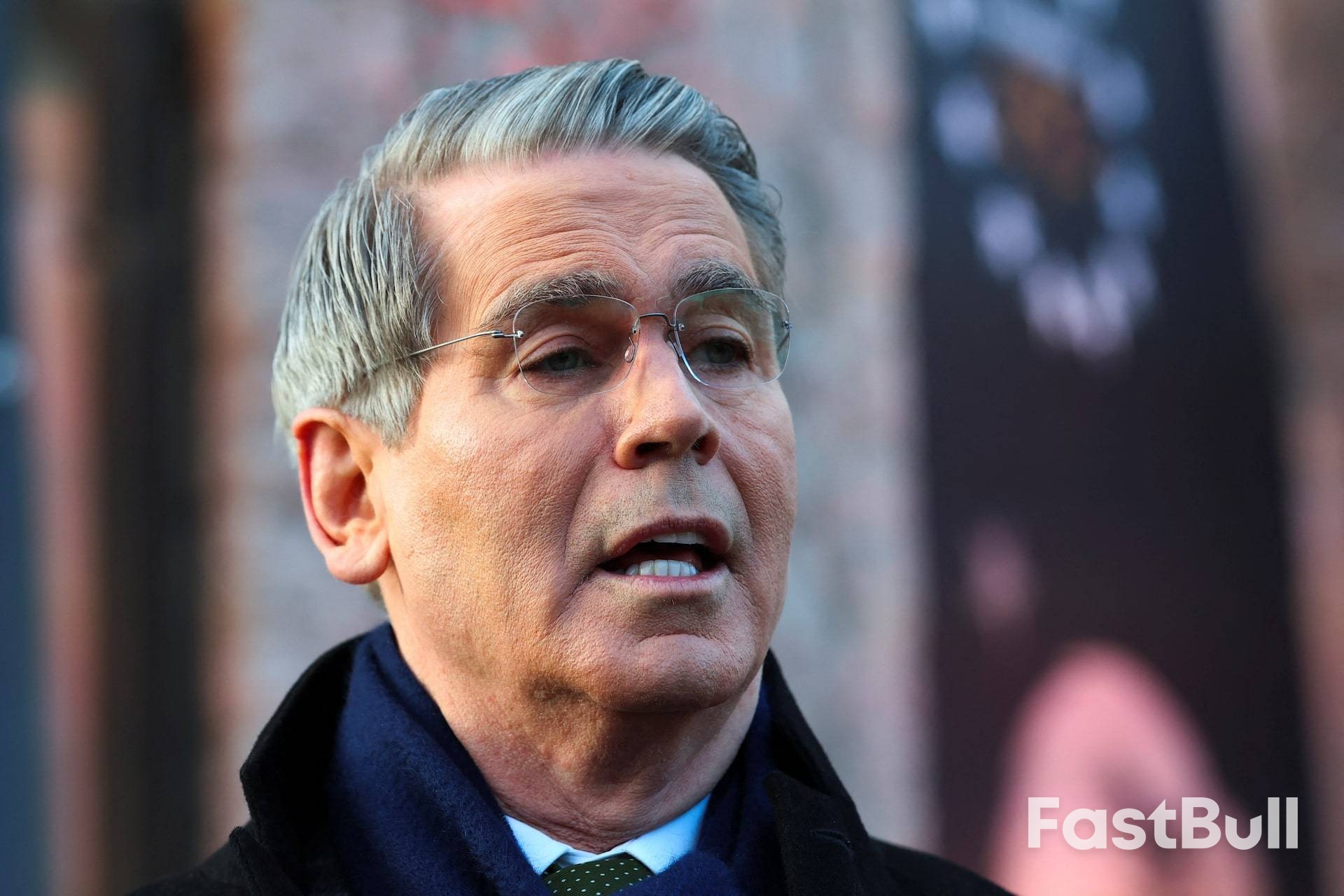
          Figure 1: U.S. Treasury Secretary Scott Bessent, who called Fed Chair Powell's plan to attend a Supreme Court hearing a "mistake."

          Powell's Controversial Court Appearance

          In an interview with CNBC, Bessent was direct in his assessment of Powell's plan to attend the Supreme Court's oral arguments.

          "If you're trying not to politicize the Fed, for the Fed chair to be sitting there, trying to put his thumb on the scale, is a real mistake," Bessent said.

          Powell’s planned attendance is widely seen as a symbolic gesture amid an ongoing clash with the administration. The U.S. Department of Justice has previously threatened a criminal investigation against him, which Powell labeled a "pretext" to influence monetary policy.

          The Supreme Court Case: Firing a Fed Governor

          The Supreme Court is set to hear arguments on Wednesday regarding the legality of President Trump's effort to remove Federal Reserve Governor Lisa Cook. While the case proceeds, lower courts have allowed Cook to remain in her position.

          The attempt to fire Cook, based on alleged misstatements on mortgage documents from before her time at the Fed, has been criticized as a thinly veiled effort to pressure the central bank into lowering interest rates or to open up board seats for Trump to fill. Cook has not been charged with any violations related to the mortgages.

          This case tests the legal standard for removing a Fed governor, who serves a 14-year term and can only be dismissed "for cause." This protection is designed to shield the central bank from short-term political influence, and the "for cause" standard has never been tested in court.

          Democrats Demand Investigation Records

          The situation has also drawn scrutiny from Congress. Democratic senators Elizabeth Warren and Dick Durbin have called on the Trump administration to release all records related to the probe into the Fed. Their request includes any communications between the Justice Department, the Treasury, and the White House concerning Powell, Cook, and the Fed's interest-rate decisions.

          Critics of the president worry that the administration's actions and rhetoric are a direct threat to the U.S. central bank's long-held independence. The ongoing tension is particularly significant as President Trump's choice to succeed Powell, whose term ends in May, is imminent.

          To stay updated on all economic events of today, please check out our Economic calendar
          Risk Warnings and Disclaimers
          You understand and acknowledge that there is a high degree of risk involved in trading. Following any strategies or investment methods may lead to potential losses. The content on the site is provided by our contributors and analysts for information purposes only. You are solely responsible for determining whether any trading assets, securities, strategy, or any other product is suitable for investing based on your own investment objectives and financial situation.
          Add to Favorites
          Share

          Trump's Fed Probe Sparks Political Firestorm

          James Riley

          Political

          Central Bank

          Economic

          Remarks of Officials

          Democratic senators Elizabeth Warren and Dick Durbin are demanding the Trump administration release all records connected to a criminal investigation into Federal Reserve Chair Jerome Powell. The lawmakers allege the probe is a politically motivated attack on the central bank's independence.

          In letters addressed to Attorney General Pam Bondi and Federal Housing Finance Agency Director Bill Pulte, the senators described the investigation as a "serious misuse of power." They claim it is part of a broader campaign by President Trump to "seize control of the Federal Reserve by any means necessary."

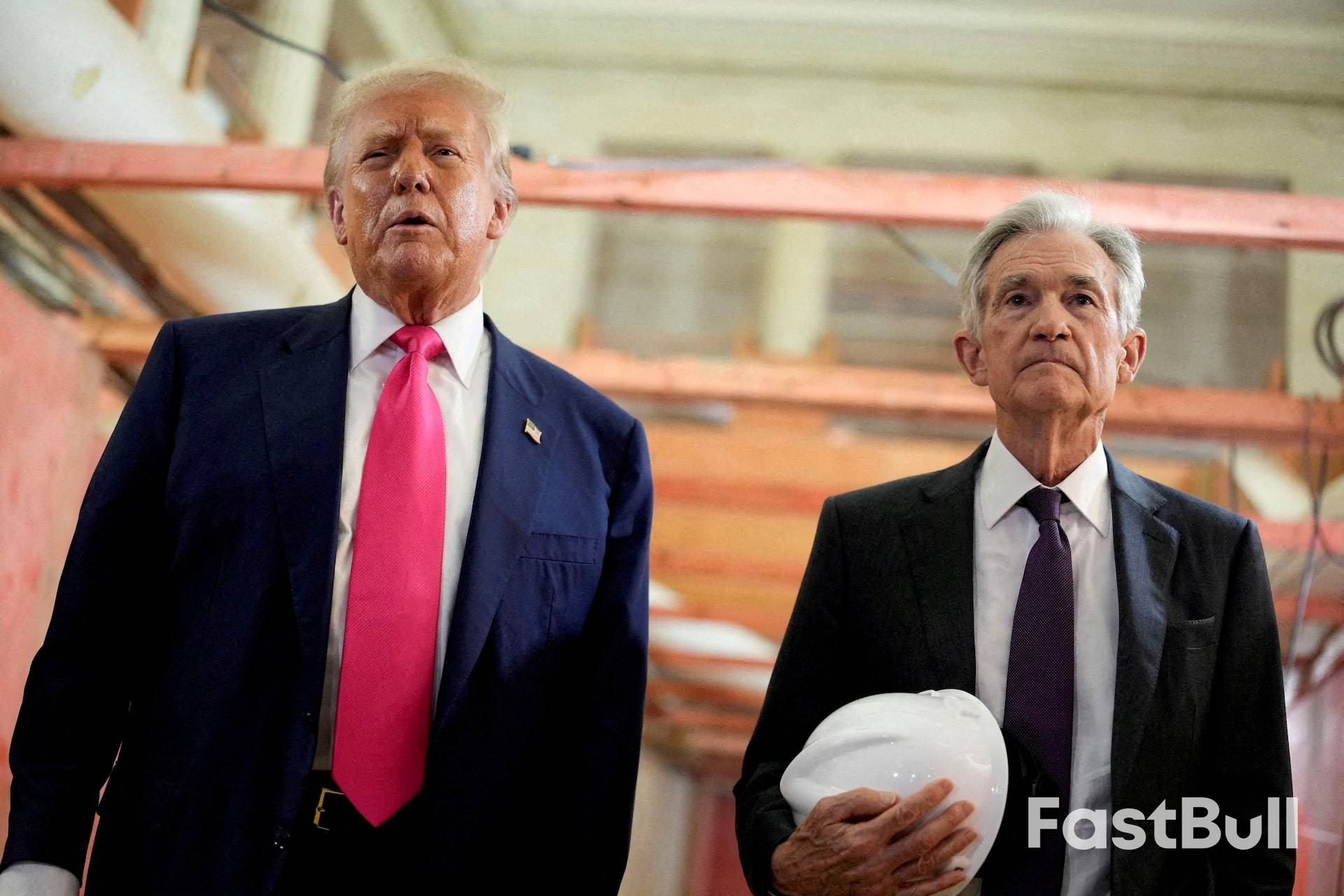
          Figure 1: President Donald Trump and Federal Reserve Chair Jerome Powell tour a Federal Reserve building. Powell's comments on renovations later became the subject of a Justice Department criminal probe.

          The Probe into Powell's Remarks

          The Justice Department's investigation centers on comments Powell made to Congress last summer regarding renovations at two Federal Reserve buildings in Washington. Earlier this month, Powell confirmed he had received subpoenas related to those remarks.

          Powell has characterized the probe as a pretext designed to pressure the Federal Reserve into cutting interest rates—a move President Trump has repeatedly demanded. In contrast, White House adviser Kevin Hassett recently attempted to play down the significance of the federal criminal investigation.

          Broader Concerns Over Fed Independence

          The senators' demands extend beyond the Powell probe. Their letters also request all administration communications related to Fed Governor Lisa Cook "and any other Fed official," signaling deep concern about political interference.

          This development comes as the Supreme Court prepares to hear arguments on President Trump's attempt to fire Governor Cook, an unprecedented move for a U.S. president.

          Warren and Durbin framed these events as part of a dangerous pattern. "The Trump Administration's apparent efforts to seize control of the Fed by criminally prosecuting its Chair and its board members when they fail to acquiesce to the President are dangerous, authoritarian, and unprecedented," they wrote.

          To stay updated on all economic events of today, please check out our Economic calendar
          Risk Warnings and Disclaimers
          You understand and acknowledge that there is a high degree of risk involved in trading. Following any strategies or investment methods may lead to potential losses. The content on the site is provided by our contributors and analysts for information purposes only. You are solely responsible for determining whether any trading assets, securities, strategy, or any other product is suitable for investing based on your own investment objectives and financial situation.
          Add to Favorites
          Share
          FastBull
          Copyright © 2026 FastBull Ltd

          728 RM B 7/F GEE LOK IND BLDG NO 34 HUNG TO RD KWUN TONG KLN HONG KONG

          TelegramInstagramTwitterfacebooklinkedin
          App Store Google Play Google Play
          Products
          Charts

          Chats

          Q&A with Experts
          Screeners
          Economic Calendar
          Data
          Tools
          Membership
          Features
          Function
          Markets
          Copy Trading
          Latest Signals
          Contests
          News
          Analysis
          24/7
          Columns
          Education
          Company
          Careers
          About Us
          Contact Us
          Advertising
          Help Center
          Feedback
          User Agreement
          Privacy Policy
          Personal Information Protection Statement
          Business

          White Label

          Data API

          Web Plug-ins

          Poster Maker

          Affiliate Program

          Risk Disclosure

          The risk of loss in trading financial instruments such as stocks, FX, commodities, futures, bonds, ETFs and crypto can be substantial. You may sustain a total loss of the funds that you deposit with your broker. Therefore, you should carefully consider whether such trading is suitable for you in light of your circumstances and financial resources.

          No decision to invest should be made without thoroughly conducting due diligence by yourself or consulting with your financial advisors. Our web content might not suit you since we don't know your financial conditions and investment needs. Our financial information might have latency or contain inaccuracy, so you should be fully responsible for any of your trading and investment decisions. The company will not be responsible for your capital loss.

          Without getting permission from the website, you are not allowed to copy the website's graphics, texts, or trademarks. Intellectual property rights in the content or data incorporated into this website belong to its providers and exchange merchants.

          Not Logged In

          Log in to access more features

          FastBull Membership

          Not yet

          Purchase

          Become a signal provider
          Help Center
          Customer Service
          Dark Mode
          Price Up/Down Colors

          Log In

          Sign Up

          Position
          Layout
          Fullscreen
          Default to Chart
          The chart page opens by default when you visit fastbull.com