

Markets
News
Analysis
User
24/7
Economic Calendar
Education
Data
- Names
- Latest
- Prev



Signal Accounts for Members
All Signal Accounts
All Contests
 France Trade Balance (SA) (Oct)
A:--
F: --
 Euro Zone Employment YoY (SA) (Q3)
A:--
F: --
 Canada Part-Time Employment (SA) (Nov)
A:--
F: --
P: --
Canada Unemployment Rate (SA) (Nov)A:--
F: --
P: --
Canada Full-time Employment (SA) (Nov)A:--
F: --
P: --
Canada Labor Force Participation Rate (SA) (Nov)A:--
F: --
P: --
Canada Employment (SA) (Nov)A:--
F: --
P: --
 U.S. PCE Price Index MoM (Sept)
A:--
F: --
P: --
U.S. Personal Income MoM (Sept)A:--
F: --
P: --
U.S. Core PCE Price Index MoM (Sept)A:--
F: --
P: --
U.S. PCE Price Index YoY (SA) (Sept)A:--
F: --
P: --
U.S. Core PCE Price Index YoY (Sept)A:--
F: --
P: --
U.S. Personal Outlays MoM (SA) (Sept)A:--
F: --
U.S. 5-10 Year-Ahead Inflation Expectations (Dec)A:--
F: --
P: --
U.S. Real Personal Consumption Expenditures MoM (Sept)A:--
F: --
U.S. Weekly Total Rig CountA:--
F: --
P: --
U.S. Weekly Total Oil Rig CountA:--
F: --
P: --
U.S. Consumer Credit (SA) (Oct)A:--
F: --
 China, Mainland Foreign Exchange Reserves (Nov)
A:--
F: --
P: --
 Japan Trade Balance (Oct)
A:--
F: --
P: --
Japan Nominal GDP Revised QoQ (Q3)A:--
F: --
P: --
China, Mainland Imports YoY (CNH) (Nov)A:--
F: --
P: --
China, Mainland Exports (Nov)A:--
F: --
P: --
China, Mainland Imports (CNH) (Nov)A:--
F: --
P: --
China, Mainland Trade Balance (CNH) (Nov)A:--
F: --
P: --
China, Mainland Exports YoY (USD) (Nov)A:--
F: --
P: --
China, Mainland Imports YoY (USD) (Nov)A:--
F: --
P: --
 Germany Industrial Output MoM (SA) (Oct)
A:--
F: --
Euro Zone Sentix Investor Confidence Index (Dec)A:--
F: --
P: --
Canada National Economic Confidence IndexA:--
F: --
P: --
 U.K. BRC Like-For-Like Retail Sales YoY (Nov)
--
F: --
P: --
U.K. BRC Overall Retail Sales YoY (Nov)--
F: --
P: --
 Australia Overnight (Borrowing) Key Rate
--
F: --
P: --
RBA Rate Statement RBA Press Conference Germany Exports MoM (SA) (Oct)--
F: --
P: --
U.S. NFIB Small Business Optimism Index (SA) (Nov)--
F: --
P: --
 Mexico 12-Month Inflation (CPI) (Nov)
--
F: --
P: --
Mexico Core CPI YoY (Nov)--
F: --
P: --
Mexico PPI YoY (Nov)--
F: --
P: --
U.S. Weekly Redbook Index YoY--
F: --
P: --
U.S. JOLTS Job Openings (SA) (Oct)--
F: --
P: --
China, Mainland M1 Money Supply YoY (Nov)--
F: --
P: --
China, Mainland M0 Money Supply YoY (Nov)--
F: --
P: --
China, Mainland M2 Money Supply YoY (Nov)--
F: --
P: --
U.S. EIA Short-Term Crude Production Forecast For The Year (Dec)--
F: --
P: --
U.S. EIA Natural Gas Production Forecast For The Next Year (Dec)--
F: --
P: --
U.S. EIA Short-Term Crude Production Forecast For The Next Year (Dec)--
F: --
P: --
EIA Monthly Short-Term Energy Outlook U.S. API Weekly Gasoline Stocks--
F: --
P: --
U.S. API Weekly Cushing Crude Oil Stocks--
F: --
P: --
U.S. API Weekly Crude Oil Stocks--
F: --
P: --
U.S. API Weekly Refined Oil Stocks--
F: --
P: --
 South Korea Unemployment Rate (SA) (Nov)
--
F: --
P: --
Japan Reuters Tankan Non-Manufacturers Index (Dec)--
F: --
P: --
Japan Reuters Tankan Manufacturers Index (Dec)--
F: --
P: --
Japan Domestic Enterprise Commodity Price Index MoM (Nov)--
F: --
P: --
Japan Domestic Enterprise Commodity Price Index YoY (Nov)--
F: --
P: --
China, Mainland PPI YoY (Nov)--
F: --
P: --
China, Mainland CPI MoM (Nov)--
F: --
P: --


No matching data

Latest Views
Latest Views
Trending Topics
Top Columnists
Latest Update
White Label
Data API
Web Plug-ins
Affiliate Program
View All
No data
Bayer's experimental stroke drug could generate €3 billion in annual sales after successful trial results that Goldman Sachs analyst James Quigley called "transformational" for the German pharmaceutical company's business.
Bayer's experimental stroke drug could generate €3 billion in annual sales after successful trial results that Goldman Sachs analyst James Quigley called "transformational" for the German pharmaceutical company's business.
Shares of the company were up 8.9% at 03:20 ET (08:20 GMT).
The drugmaker announced on Sunday that asundexian met its primary goals in the OCEANIC-STROKE trial, significantly reducing the risk of repeat strokes without increasing major bleeding rates compared to a placebo.
Both treatments were given alongside standard antiplatelet therapy in more than 12,300 patients who had previously experienced a non-cardioembolic ischemic stroke or high-risk transient ischemic attack.
Quigley said removing the risk adjustment from his valuation model leads to a roughly 13% increase in his discounted cash flow analysis.
He noted this positive result is the first of two developments that could help narrow the gap between Bayer's current share price and the value of its business units.
The second event, a potential recommendation from the solicitor general on a glyphosate legal case, is expected in the coming weeks.
The trial addresses a significant medical problem. Approximately 12 million people worldwide experience strokes each year, with 20% to 30% being recurrent strokes. One in five stroke survivors will have another stroke within five years.
Stroke ranks as the second leading cause of death globally, and recurrent ischemic strokes tend to be more disabling and carry higher mortality risks than initial strokes.
"Even with currently available therapies, the risk of another stroke remains high, and each recurrence can have profound consequences," said Mike Sharma, the principal investigator from the Population Health Research Institute at McMaster University and director of the Stroke Program at Hamilton Health Sciences in a statement.
Asundexian works by blocking Factor XIa, a protein in the blood coagulation pathway. The Leverkusen-based company said Factor XIa plays a minor role in forming hemostatic plugs that seal vessel injuries but contributes to blood clot growth and vessel blockage.
The drugmaker theorizes asundexian reduces clot formation without significantly increasing major bleeding risk.
Patients in the multicenter, randomized, double-blind trial received either 50 mg of asundexian once daily or a placebo, both combined with antiplatelet therapy.
This marks the first time a drug in the Factor XIa inhibitor class has successfully completed a Phase III study.
The U.S. Food and Drug Administration granted asundexian Fast Track Designation as a potential treatment for stroke prevention in patients after a non-cardioembolic ischemic stroke. The compound has not been approved by any health authority for use in any country.
Over the past week, gold has continued to trade in a sideways range. Structural weakness in September's US nonfarm payrolls, sudden dovish shifts from Fed officials, and risk-off buying amid geopolitical tension temporarily supported gold. However, missing key economic data combined with internal Fed disagreements has made it difficult for the market to form a consensus, limiting sustained upside for bulls.
This week, the focus will be on September's US retail sales and PPI, which could provide key guidance ahead of the Fed's December meeting and offer clues for the next direction of gold.
From a technical perspective, XAUUSD traded mostly between $4,000 and $4,130 last week. Repeated long wicks on daily candles indicate a tight battle between bulls and bears, with intraday swings clearly amplified.
On Monday's open, bears took the lead, pushing gold back toward the uptrend line established at the end of October—an important short-term support level for bulls.
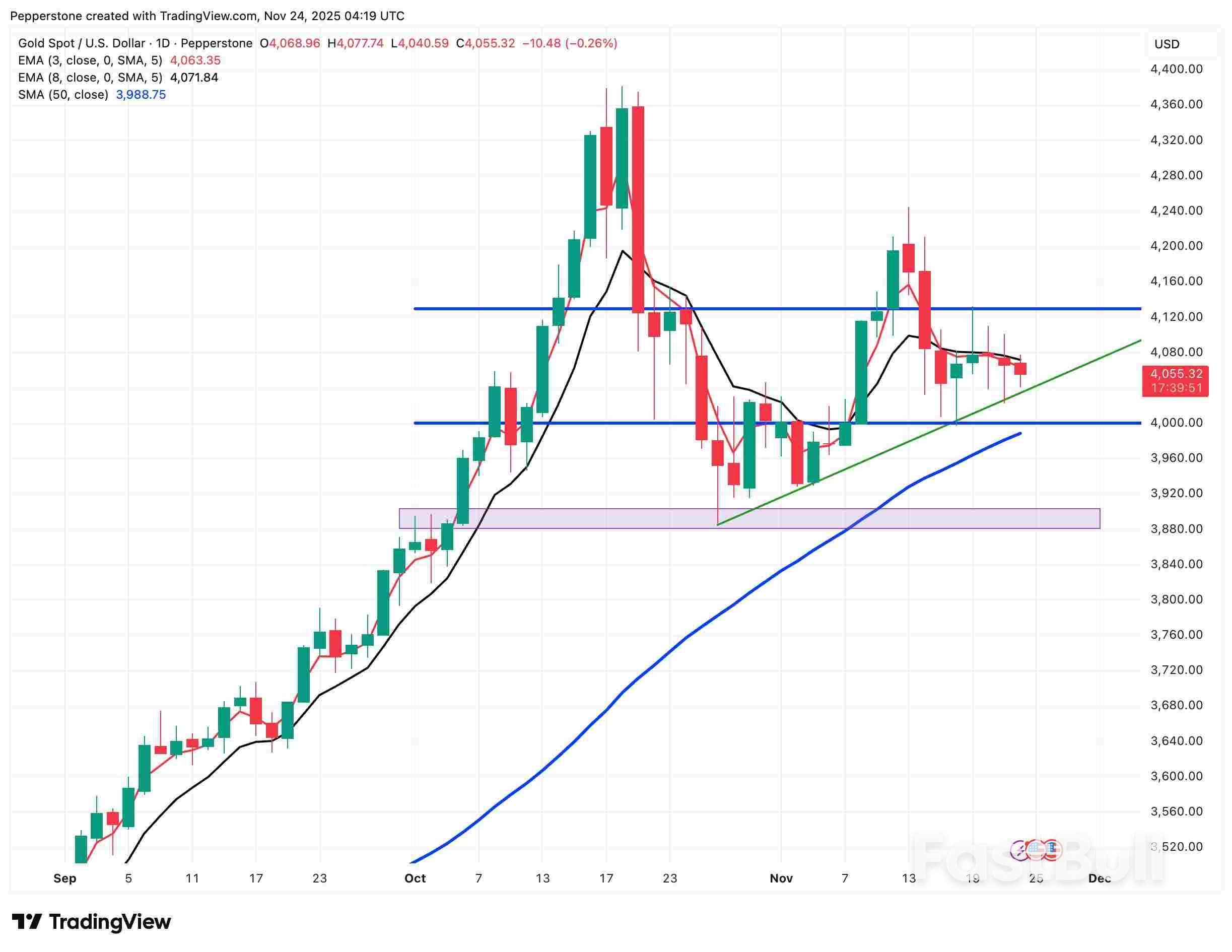
If this trendline is convincingly broken, gold could test the $4,000 psychological level and the 50-day moving average, which may offer temporary support before a deeper correction unfolds.
Conversely, if buying pressure returns and short-term sentiment stabilizes, the key to an upward move will be whether gold can break last week's range top at $4,130 and the mid-November high of $4,250.
The primary force influencing gold remains market uncertainty over the US economic outlook, which has become more pronounced.
On the employment front, data noise is increasing. September's nonfarm payrolls rose by 119,000, well above expectations of 50,000, but the previous two months were revised down by 33,000, and the unemployment rate jumped to a four-year high of 4.4%. Meanwhile, initial jobless claims declined, but continuing claims continued to rise.
These conflicting signals make it difficult for the market to assess whether the labor market is cooling or fluctuating, complicating the Fed's rate path projections.
Fed policy divisions are also becoming more visible. According to the October meeting minutes, most officials believe "further rate cuts could entrench inflation," with hawks like Collins and Logan reinforcing this view. However, New York Fed Governor Williams unexpectedly signaled a dovish stance last Friday, suggesting room for near-term rate cuts.
As one of the Fed's "big three," alongside Powell and Jefferson, Williams usually leans hawkish. His dovish guidance led the market to dramatically repricing December rate cuts from 30% to roughly 70%.
Complicating matters further, key economic releases have been disrupted. The Bureau of Labor Statistics confirmed that the October nonfarm payroll report is postponed, with November's report delayed until December 16; October CPI was canceled, and November CPI will be released on December 18. In other words, the Fed may have to base its December meeting decisions on outdated September data.
The mix of confusing employment signals, extended data gaps, and sharp revisions to rate cut expectations makes gold's short-term direction harder to gauge. Yet, this uncertainty continues to support safe-haven demand, providing a floor for prices.
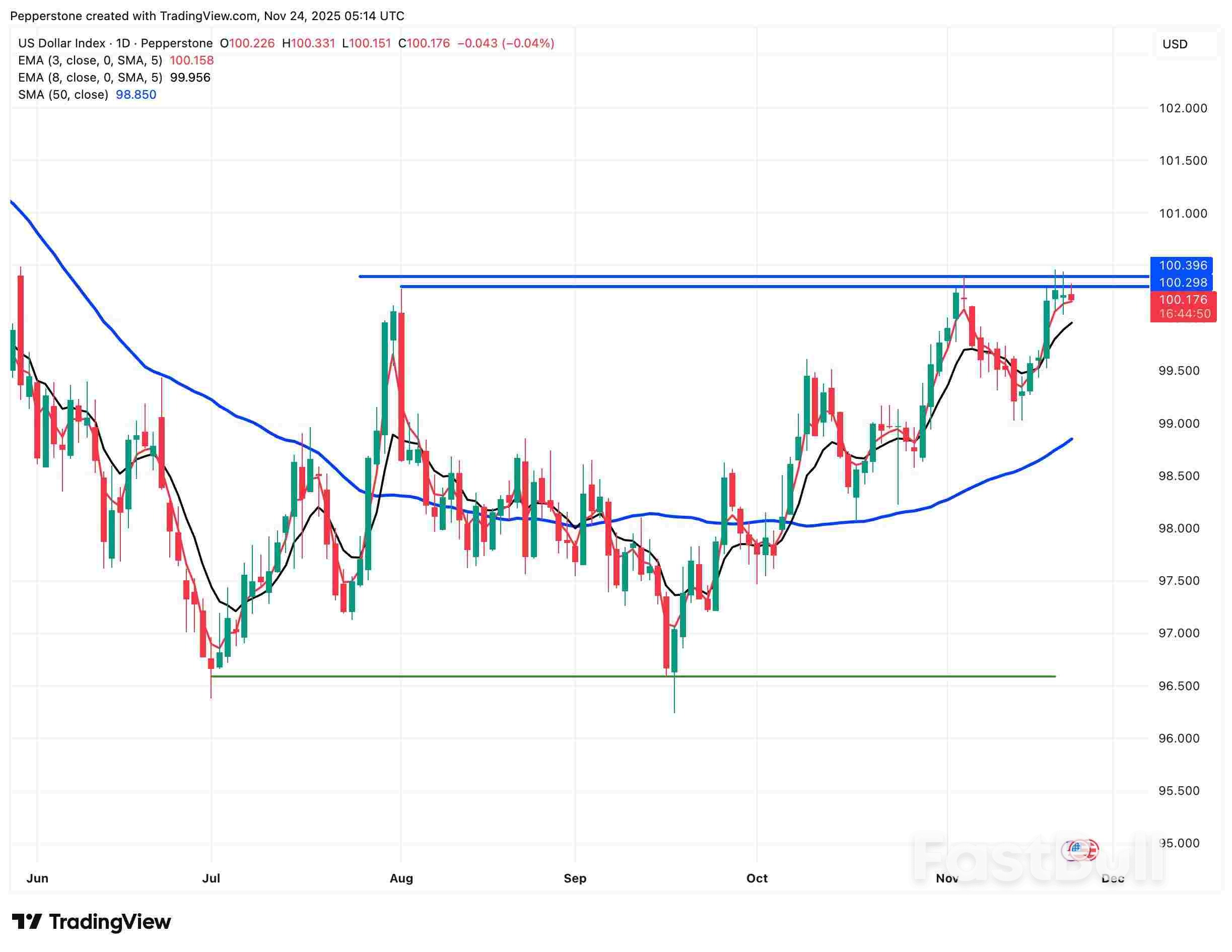
Meanwhile, rising rate cut expectations have pushed US Treasury yields lower, with the two-year yield dipping below 3.5% last Friday, theoretically supporting non-yielding gold. However, the dollar remains strong above 100, limiting upward momentum for gold.
As markets reassess the likelihood of a year-end Fed rate cut, developments in the Russia-Ukraine conflict are also under scrutiny. Recently, US media reported that the Trump team proposed a 28-point Ukraine peace plan covering territorial, military, and diplomatic issues.
In reality, this plan remains far from implementation. Its provisions would require significant concessions from Ukraine, the EU has voiced objections, and Russia has stated it has not discussed the details with the US. Ambiguity in the plan and an unclear path to execution make it difficult for the market to view it as a genuine sign of easing tensions.
Amid persistent geopolitical risks, skepticism over the peace outlook remains. Short-term breakthroughs appear unlikely, supporting safe-haven demand and providing a floor for gold.
Overall, gold continued its choppy pattern last week. Mixed released data and delayed upcoming releases make it hard for traders to form a consensus on the Fed's rate path, keeping trend-following moves limited in the short term. Unless there is a major surprise, gold is likely to remain range-bound ahead of the next Fed meeting.
This week, the US Thanksgiving holiday shortens trading days and reduces liquidity. While major data releases are limited, September retail sales and PPI are key, as they directly reflect economic health and inflation trends, influencing market expectations and gold.
The market expects September retail sales to rise 0.4% month-on-month, slightly below August's 0.6%, while PPI year-on-year is expected to remain at 2.6%.
If retail sales are soft and inflation remains moderate, rate cut expectations may rise further, potentially pushing gold toward $4,100. Conversely, strong data could temper rate cut bets, putting gold at risk of breaking below $4,000.

Choosing the best gold trading platform in 2025 is crucial for investors seeking to trade gold efficiently. With various platforms offering different features, fees, and tools, it's important to make an informed decision. This guide will help you compare the top platforms available and find the one that suits your trading style and goals.
When choosing the best gold trading platform, it's important to look at factors such as ease of use, fees, and available trading tools. A platform should cater to both beginners and advanced traders, offering a variety of features that enhance trading efficiency. The best platforms will also offer educational resources for traders to improve their skills.
Security is a top priority when selecting a trading platform for gold. Ensure the platform is regulated by credible authorities like the FCA, ASIC, or SEC. This ensures that your investments are protected, and the platform adheres to industry standards. The best gold trading platforms will offer secure transactions and user data protection, making safety a key feature.
Fees and transaction costs can significantly impact your profitability. The best platform for trading gold will offer transparent fee structures with competitive spreads. Always check for hidden costs such as withdrawal fees or inactivity charges. Comparing transaction fees across different platforms will help you choose the best platform for gold trading, ensuring you get the best value for your trades.
Advanced features such as real-time price charts, technical analysis tools, and market news are essential for effective gold trading. The best gold trading platforms provide these tools to help traders make informed decisions. Additionally, some platforms offer automated trading features and mobile apps for on-the-go access, making them ideal for active traders.
The best gold trading platforms offer excellent customer support, ensuring that traders can get assistance when needed. Look for platforms that provide 24/7 support, live chat options, and comprehensive FAQs. Furthermore, educational resources like webinars, tutorials, and market insights can help you improve your trading skills and understand the gold market better.
Pepperstone is one of the most reliable brokers for gold trading, offering tight spreads, competitive fees, and high leverage. It's regulated in multiple jurisdictions, ensuring a safe and secure trading experience. It’s considered one of the best gold trading platforms due to its fast execution speeds and advanced trading tools.
Capital.com offers an easy-to-use platform with low fees, making it one of the best platforms for trading gold. It also provides access to a wide range of assets, including CFDs and commodities. The platform's intuitive interface and educational resources make it suitable for both beginner and experienced traders.
Eightcap is known for its low spreads and high-quality customer service. It offers both MetaTrader 4 and MetaTrader 5, providing advanced charting and analysis tools. As one of the best online gold trading platforms, Eightcap allows traders to trade gold with flexible leverage options and a secure trading environment.
FP Markets is a great choice for both new and experienced traders. With competitive spreads, low trading costs, and a range of gold trading tools, it’s considered one of the best platforms for gold trading. The platform also offers access to educational resources and 24/7 customer support.
AvaTrade is a well-regulated platform with a reputation for excellent customer service. The platform offers a wide range of gold trading options, including CFDs, and is known for its low fees and diverse educational resources. AvaTrade is ideal for those looking for a secure, user-friendly experience in the gold market.
XM offers one of the best trading experiences for gold traders with its flexible account types, low minimum deposit requirements, and tight spreads. The platform is regulated in several countries and provides various trading tools to help investors stay on top of the gold market.
IC Markets is renowned for its fast execution speeds and low fees. With a range of gold trading tools and platforms like MetaTrader 4 and 5, it’s one of the best platforms for gold trading. Traders can take advantage of its low spreads and high leverage options for a dynamic trading experience.
Global Prime offers a premium trading experience for gold traders, providing excellent customer support and some of the best spreads in the industry. It’s a top choice for those looking for a high-quality platform with advanced trading features and superior customer service.
BlackBull Markets offers competitive spreads and a user-friendly platform for gold trading. It is regulated in New Zealand and provides a secure trading environment, making it one of the best gold trading platforms. BlackBull Markets also offers a range of educational materials to help traders improve their skills.
Fusion Markets is known for its low fees and excellent customer service. It’s an ideal platform for traders looking to trade gold with minimal costs. With its tight spreads and professional trading tools, Fusion Markets offers a great trading experience for both novice and experienced traders.
If you're new to gold trading, the best gold trading platform for you will have a simple interface, low minimum deposits, and educational resources. Look for platforms that offer demo accounts, so you can practice trading without risk. The best platform for trading gold for beginners will guide you through the basics and help you build confidence.
Active traders need a platform with fast execution speeds, low fees, and advanced charting tools. The best trading platform for gold will offer real-time data, customizable charts, and a wide range of technical indicators to help you make quick, informed decisions. Look for platforms that provide leverage options to maximize trading potential.
For long-term investors, the best platform for gold trading will offer secure storage options, low fees, and a reliable track record. Ensure the platform is regulated and provides a seamless withdrawal process. The best online gold trading platform will also allow you to hold physical gold or gold-backed assets, which are ideal for long-term wealth preservation.
Each trader has different needs. Beginners should prioritize user-friendly platforms with educational tools, while active traders will focus on execution speeds and advanced trading tools. Long-term investors should look for reliable platforms with low fees and high-security measures. The best gold trading platforms offer customized solutions to suit different trading styles.
One of the most common mistakes traders make is ignoring the fees and spreads associated with a platform. Always check for hidden costs such as withdrawal fees, inactivity charges, and high spreads. The best gold trading platforms offer transparent pricing and competitive spreads, which can make a big difference in your profitability.
Security should be a top priority when choosing a platform. Ensure the platform is regulated by trusted authorities like the FCA, SEC, or ASIC. The best platform for gold trading will adhere to strict security standards, safeguarding your investments and personal information.
It’s crucial to test any new platform using a demo account before committing real funds. The best gold trading platforms offer demo accounts that let you practice trading and familiarize yourself with the platform’s features without risk.
Good customer support is essential, especially when you encounter issues with trading. Choose platforms that offer 24/7 customer support through live chat, email, or phone. The best online gold trading platforms also provide comprehensive educational resources to help you improve your trading skills.
When trading gold, having access to the right tools is essential for success. Many platforms offer basic features, but the best platforms for gold trading provide a wide range of tools, including real-time data, charting tools, and automated trading options. Don't settle for a platform that limits your trading potential.
Gold has historically been a stable investment, and if you had invested $1000 in gold 10 years ago, your investment would have appreciated over time. However, the performance of gold can vary based on market conditions. The best gold trading platforms provide tools to track such investments and help you make informed decisions in the future.
Gold trading can be profitable, especially during times of economic uncertainty or inflation. By using the best trading platform for gold, you can access advanced tools and strategies that can help maximize profitability. However, it is important to understand the risks and market dynamics before diving in.
Like any investment, gold trading carries risks. The price of gold can fluctuate based on economic factors, geopolitical events, and market speculation. The best gold trading platforms will help mitigate risks by offering tools like stop-loss orders, educational resources, and expert market analysis to guide your decisions.
Choosing the best gold trading platform is crucial for your success in the gold market. With the right platform, you can access the tools, resources, and security needed to trade confidently and profitably in 2025 and beyond.
Today in Germany, we receive the Ifo indicator for November. The PMI released on Friday surprised on the downside, although this mainly seems like an "adjustment" from very high numbers in the past months. Even after the decline the composite PMI is still at the highest level in one and a half years when excluding the October reading.
On Wednesday, we will keep an eye on the UK as Chancellor Reeves presents the Autumn budget. Gilts and GBP will be sensitive to how an inevitable fiscal tightening looks and whether the fiscal gap is plugged sufficiently. Markets soured on the UK when Reeves recently scrapped plans to hike the income tax rate.
On Thursday, we look for euro area credit growth data and Danish retail sales for October. Regarding retail sales, our Spending Monitor showed a 0.6% m/m decline in real retail spending in October, and we expect spending growth to remain muted.
Rounding off the week, we receive the flash estimates of inflation in Germany, France, Italy, and Spain which together will reveal almost entirely how inflation in the euro area fared ahead of the aggregate data next week.
What happened overnight
In the Ukraine war, US Secretary of State Marco Rubio stated that peace talks in Geneva "showed meaningful progress" but declined to share details. On Sunday, US President Donald Trump urged Ukraine to accept the 28-point plan, blaming Ukraine and Europe for the lack of a truce.
In the euro area, November PMIs were close to expectations with the composite PMI falling marginally to 52.4 from 52.5 in October (cons: 52.5). The manufacturing PMI declined to 49.7 from 50.0 (cons: 50.1) and the services PMI climbed to 53.1 from 53.0 (cons: 52.8). The price indices showed an uptick in input prices and marginal decline in output prices. Inflation remains under control and risk has shifted from inflation being too high to instead being too low. With growth still holding up, we expect the ECB to be on hold at 2.0% in the coming year despite inflation forecasted to fall below the 2% target.
The ECB's indicator of negotiated wages declined by more than expected to 1.9% y/y in Q3 (cons: 2.5 y/y) compared to 4.0% y/y in Q2 and 2.5% y/y in Q1. A faster-than-expected decline in wages is a downside risk to our outlook of unchanged ECB policy rates, as it would lower services inflation which is the main category holding overall inflation up.
In the US, New York Fed President John Williams said that he still saw "room for further adjustment", backing a cut at the next meeting in December. Markets are now pricing about a 60% likelihood of a rate cut in December. Meanwhile, Fed vice chair Philip Jefferson and Boston Fed President Susan Collins did not really comment on the near-term rate outlook and Dallas Fed President Logan reiterated her earlier view that she would find it difficult to cut rates in December.
November flash PMIs landed close to expectations. The manufacturing PMI declined to 51.9 from 52.5 in October and appeared weaker than the headline index suggests. The order-inventory balance turned sharply lower to 46.1 from 49.5 and all else equal, weaker order-inventory predicts weaker output growth as well. Services PMI on the other hand increased to 55.0 from 54.8 in October, with both new orders and price indices turning higher. Overall, the flash print was a mixed bag for the Fed, with some concerning signals surrounding the manufacturing growth momentum.
Equities: Equities stabilized on Friday after several unsuccessful attempts earlier in the week. The S&P 500 finally closed 1% higher, Russell 2000 gained a full 3%, while European Stoxx 600 edged 0.3% lower. Importantly, this was not a rebound led by last week's most-sold names. Instead, markets saw a selective rotation, with investors refraining from buying the dip in the most heavily sold AI names (or in Bitcoin for that matter, down -2% on Friday despite -20% over the last month). Rather, it was small caps and sectors such as materials, healthcare, and consumer discretionary that fared the best. Similarly, we are not seeing the rebound spread to the AI hardware region – Asia – this morning, although European and US futures are higher.
A selective rebound makes sense to us, as last week's selloff was unusual – not in magnitude, but in the fact that the drawdown in equities was not synchronized with other asset classes. While the S&P 500 is 4% off its highs, yields, copper prices, gold, and credit spreads are little changed. We interpret this as a sign that the November selloff is neither macro-driven nor liquidity related. As such, the fundamental read-across to equities outside the AI theme – such as European markets – should be limited.
Is this a buying opportunity then? In a sense, yes. We remain positive on equities on a 3-6 months horizon with a slight equity overweight stance. However, the fact that the equity selloff has not been mirrored in other asset classes also means that positioning support remain absent. Investors have not panicked into bonds – quite the opposite, according to November's fund manager survey, which showed extremely low cash levels. Our correction monitor, which tracks indicators such as the VIX, CTA hedge fund beta, or bull-bear spreads, is far from oversold conditions. As such, we are refraining from increasing the equity overweight further for now.
FI and FX: Dovish comments from Fed's dove Williams sent US rates lower – UST10y from 4.15% to 4.05% – and raised the probability of a December cut to 16bp from a 7bp low after the FOMC Minutes. It supported risk sentiment and lifted equities to a decent c. +1% close after a rough week. Equity futures are in green this morning, while Japan is closed for holiday. The USD's outperformance pulled EUR/USD toward 1.1500. EUR/SEK and EUR/NOK trade around 11.00 and 11.80, respectively.

The Pound US Dollar (GBP/USD) exchange rate fell over a cent last week, as hawkish Federal Reserve interest rate expectations and a cautious market mood turbocharged USD demand.
Latest — Exchange Rates:
Pound to Dollar (GBP/USD): 1.30964 (-0.01%)
Euro to Dollar (EUR/USD): 1.15105 (-0.03%)
Dollar to Japanese Yen (USD/JPY): 156.5935 (+0.13%)
WEEKLY RECAP:
The US Dollar (USD) strengthened through the first half of last week, underpinned by a cautious market mood.
This risk-off sentiment was triggered by equity market jitters and concerns over global growth, and drove investors towards safe-haven assets like the 'Greenback'.
The upside in USD was then compounded through the middle of the week, with the release of the minutes from the Fed's latest policy meeting.
The minutes showed that most policymakers are resistant to further easing, leading the odds for a December rate cut from the US central bank to fall dramatically.
This momentum then carried through into the latter half of the week, with the release of the latest non-farm payroll data.
September's delayed data showed the US economy added 119,000 jobs, smashing forecasts and cementing bets that a December rate cut is likely off the table.
The Pound (GBP) struggled to put up much resistance against the US Dollar last week amid a run of lacklustre UK economic releases.
The most notable pressure came with the release of the UK's consumer price index, which reported the first fall in inflation in five months and ramped up expectations the Bank of England (BoE) will press ahead with a December rate cut.
Underwhelming data at the end of the week also proved a headache for Sterling, as it reported a slowdown in the UK's vital services sector in November, as well as a surprise contraction in retail sales in October.
On top of this, GBP sentiment was also undermined throughout the session by a sense of caution ahead of the UK's autumn budget.
The Pound US Dollar exchange rate is poised for a potentially volatile week, with the UK's highly anticipated autumn budget expected to dominate headlines.
Sterling will likely drift sideways until Wednesday, as traders hold off on major positions before seeing Reeves's fiscal priorities. Reaction to her proposals is then set to define GBP/USD's next moves.
If the budget raises doubts – whether due to limited detail, an emphasis on tax increases or insufficient reassurance for bond investors – the Pound could risk striking new multi-month lows.
Meanwhile, the coming week will see the release of a number of US economic indicators previously delayed by the US government shutdown, with the US Dollar potentially faltering if they also surprise to the upside, similarly to the payrolls figures.
728 RM B 7/F GEE LOK IND BLDG NO 34 HUNG TO RD KWUN TONG KLN HONG KONG


White Label
Data API
Web Plug-ins
Poster Maker
Affiliate Program
The risk of loss in trading financial instruments such as stocks, FX, commodities, futures, bonds, ETFs and crypto can be substantial. You may sustain a total loss of the funds that you deposit with your broker. Therefore, you should carefully consider whether such trading is suitable for you in light of your circumstances and financial resources.
No decision to invest should be made without thoroughly conducting due diligence by yourself or consulting with your financial advisors. Our web content might not suit you since we don't know your financial conditions and investment needs. Our financial information might have latency or contain inaccuracy, so you should be fully responsible for any of your trading and investment decisions. The company will not be responsible for your capital loss.
Without getting permission from the website, you are not allowed to copy the website's graphics, texts, or trademarks. Intellectual property rights in the content or data incorporated into this website belong to its providers and exchange merchants.
Not Logged In
Log in to access more features

FastBull Membership
Not yet
Purchase


Log In
Sign Up


