• Trade
  • Markets
  • Copy
  • Contests
  • News
  • 24/7
  • Calendar
  • Q&A
  • Chats
Trending
Screeners
SYMBOL
LAST
BID
ASK
HIGH
LOW
NET CHG.
%CHG.
SPREAD
SPX
S&P 500 Index
6857.13
6857.13
6857.13
6865.94
6827.13
+7.41
+ 0.11%
--
DJI
Dow Jones Industrial Average
47850.93
47850.93
47850.93
48049.72
47692.96
-31.96
-0.07%
--
IXIC
NASDAQ Composite Index
23505.13
23505.13
23505.13
23528.53
23372.33
+51.04
+ 0.22%
--
USDX
US Dollar Index
98.870
98.950
98.870
98.980
98.870
-0.110
-0.11%
--
EURUSD
Euro / US Dollar
1.16556
1.16563
1.16556
1.16561
1.16408
+0.00111
+ 0.10%
--
GBPUSD
Pound Sterling / US Dollar
1.33407
1.33414
1.33407
1.33413
1.33165
+0.00136
+ 0.10%
--
XAUUSD
Gold / US Dollar
4219.85
4220.19
4219.85
4221.12
4194.54
+12.68
+ 0.30%
--
WTI
Light Sweet Crude Oil
59.277
59.314
59.277
59.469
59.187
-0.106
-0.18%
--

Community Accounts

Signal Accounts
--
Profit Accounts
--
Loss Accounts
--
View More

Become a signal provider

Sell trading signals to earn additional income

View More

Guide to Copy Trading

Get started with ease and confidence

View More

Signal Accounts for Members

All Signal Accounts

Best Return
  • Best Return
  • Best P/L
  • Best MDD
Past 1W
  • Past 1W
  • Past 1M
  • Past 1Y

All Contests

  • All
  • Trump Updates
  • Recommend
  • Stocks
  • Cryptocurrencies
  • Central Banks
  • Featured News
Top News Only
Share

Cctv - China, France: Signed Protocol On Sanitary, Phytosanitary Requirements For Export Of French Alfalfa Grass

Share

India's NIFTY IT Index Last Up 1.3%

Share

India's Nifty 50 Index Rises 0.35%

Share

Israel Sets 2026 Defence Budget At $34 Billion

Share

Russia Says Azov Sea's Port Of Temryuk Damaged In Ukrainian Attack

Share

Israel's Defense Budget For 2026 Will Be 112 Billion Israeli Shekels - Defense Minister Office

Share

One India Rate Panel Member Ram Singh Was Of View That Stance Should Be Changed To 'Accommodative' From 'Neutral' - Monetary Policy Committee Statement

Share

Reserve Bank Of India Chief: Will Continue To Meet Productive Needs Of Economy In Proactive Manner

Share

Reserve Bank Of India Chief: System Level Financial Parameters Of Nbfcs Sound

Share

Reserve Bank Of India Chief: Dollar Rupee Swap To Be For 3 Years, To Be Conducted This Month

Share

India's Nifty Realty Index Extend Gains, Last Up 1.4%

Share

India's Nifty Psu Bank Index Rises 1%

Share

Reserve Bank Of India Chief: Commited To Providing Sufficient Durable Liquidity

Share

Reserve Bank Of India Chief: Transmission Has Been Broad Based Across Sectors, Satisfactory

Share

Reserve Bank Of India Chief: As Of Nov 28, India's Forex Reserves Stood At $686 Billion

Share

Reserve Bank Of India Chief: Healthy Services Exports With Strong Remittances To Keep Cad Modest In This Year

Share

Reserve Bank Of India Chief: CPI Inflation Seen At 0.6% In Q3 Fy26

Share

Reserve Bank Of India Chief: Fy26 CPI Inflation Seen At 2% Versus 2.6% Previously

Share

India's Nifty Realty Index Up 1% After Reserve Bank Of India's Rate Cut

Share

India's Nifty Psu Bank Index Turns Positive, Up 0.43% After Reserve Bank Of India's Rate Cut

TIME
ACT
FCST
PREV
Turkey Trade Balance

A:--

F: --

P: --

Germany Construction PMI (SA) (Nov)

A:--

F: --

P: --

Euro Zone IHS Markit Construction PMI (Nov)

A:--

F: --

P: --

Italy IHS Markit Construction PMI (Nov)

A:--

F: --

P: --

U.K. Markit/CIPS Construction PMI (Nov)

A:--

F: --

P: --

France 10-Year OAT Auction Avg. Yield

A:--

F: --

P: --

Euro Zone Retail Sales MoM (Oct)

A:--

F: --

P: --

Euro Zone Retail Sales YoY (Oct)

A:--

F: --

P: --

Brazil GDP YoY (Q3)

A:--

F: --

P: --

U.S. Challenger Job Cuts (Nov)

A:--

F: --

P: --

U.S. Challenger Job Cuts MoM (Nov)

A:--

F: --

P: --

U.S. Challenger Job Cuts YoY (Nov)

A:--

F: --

P: --

U.S. Initial Jobless Claims 4-Week Avg. (SA)

A:--

F: --

P: --

U.S. Weekly Initial Jobless Claims (SA)

A:--

F: --

P: --

U.S. Weekly Continued Jobless Claims (SA)

A:--

F: --

P: --

Canada Ivey PMI (SA) (Nov)

A:--

F: --

P: --

Canada Ivey PMI (Not SA) (Nov)

A:--

F: --

P: --

U.S. Non-Defense Capital Durable Goods Orders Revised MoM (Excl. Aircraft) (SA) (Sept)

A:--

F: --

P: --
U.S. Factory Orders MoM (Excl. Transport) (Sept)

A:--

F: --

P: --

U.S. Factory Orders MoM (Sept)

A:--

F: --

P: --

U.S. Factory Orders MoM (Excl. Defense) (Sept)

A:--

F: --

P: --

U.S. EIA Weekly Natural Gas Stocks Change

A:--

F: --

P: --

Saudi Arabia Crude Oil Production

A:--

F: --

P: --

U.S. Weekly Treasuries Held by Foreign Central Banks

A:--

F: --

P: --

Japan Foreign Exchange Reserves (Nov)

A:--

F: --

P: --

India Repo Rate

A:--

F: --

P: --

India Benchmark Interest Rate

A:--

F: --

P: --

India Reverse Repo Rate

A:--

F: --

P: --

India Cash Reserve Ratio

A:--

F: --

P: --

Japan Leading Indicators Prelim (Oct)

A:--

F: --

P: --

U.K. Halifax House Price Index YoY (SA) (Nov)

--

F: --

P: --

U.K. Halifax House Price Index MoM (SA) (Nov)

--

F: --

P: --

France Current Account (Not SA) (Oct)

--

F: --

P: --

France Trade Balance (SA) (Oct)

--

F: --

P: --

France Industrial Output MoM (SA) (Oct)

--

F: --

P: --

Italy Retail Sales MoM (SA) (Oct)

--

F: --

P: --

Euro Zone Employment YoY (SA) (Q3)

--

F: --

P: --

Euro Zone GDP Final YoY (Q3)

--

F: --

P: --

Euro Zone GDP Final QoQ (Q3)

--

F: --

P: --

Euro Zone Employment Final QoQ (SA) (Q3)

--

F: --

P: --

Euro Zone Employment Final (SA) (Q3)

--

F: --

P: --
Brazil PPI MoM (Oct)

--

F: --

P: --

Mexico Consumer Confidence Index (Nov)

--

F: --

P: --

Canada Unemployment Rate (SA) (Nov)

--

F: --

P: --

Canada Labor Force Participation Rate (SA) (Nov)

--

F: --

P: --

Canada Employment (SA) (Nov)

--

F: --

P: --

Canada Part-Time Employment (SA) (Nov)

--

F: --

P: --

Canada Full-time Employment (SA) (Nov)

--

F: --

P: --

U.S. Dallas Fed PCE Price Index YoY (Sept)

--

F: --

P: --

U.S. PCE Price Index YoY (SA) (Sept)

--

F: --

P: --

U.S. PCE Price Index MoM (Sept)

--

F: --

P: --

U.S. Personal Outlays MoM (SA) (Sept)

--

F: --

P: --

U.S. Core PCE Price Index MoM (Sept)

--

F: --

P: --

U.S. UMich 5-Year-Ahead Inflation Expectations Prelim YoY (Dec)

--

F: --

P: --

U.S. Core PCE Price Index YoY (Sept)

--

F: --

P: --

U.S. 5-10 Year-Ahead Inflation Expectations (Dec)

--

F: --

P: --

U.S. UMich Current Economic Conditions Index Prelim (Dec)

--

F: --

P: --

U.S. UMich Consumer Sentiment Index Prelim (Dec)

--

F: --

P: --

U.S. UMich 1-Year-Ahead Inflation Expectations Prelim (Dec)

--

F: --

P: --

U.S. UMich Consumer Expectations Index Prelim (Dec)

--

F: --

P: --

Q&A with Experts
    • All
    • Chatrooms
    • Groups
    • Friends
    Connecting
    .
    .
    .
    Type here...
    Add Symbol or Code

      No matching data

      All
      Trump Updates
      Recommend
      Stocks
      Cryptocurrencies
      Central Banks
      Featured News
      • All
      • Russia-Ukraine Conflict
      • Middle East Flashpoint
      • All
      • Russia-Ukraine Conflict
      • Middle East Flashpoint
      Search
      Products

      Charts Free Forever

      Chats Q&A with Experts
      Screeners Economic Calendar Data Tools
      Membership Features
      Data Warehouse Market Trends Institutional Data Policy Rates Macro

      Market Trends

      Market Sentiment Order Book Forex Correlations

      Top Indicators

      Charts Free Forever
      Markets

      News

      News Analysis 24/7 Columns Education
      From Institutions From Analysts
      Topics Columnists

      Latest Views

      Latest Views

      Trending Topics

      Top Columnists

      Latest Update

      Signals

      Copy Rankings Latest Signals Become a signal provider AI Rating
      Contests
      Brokers

      Overview Brokers Assessment Rankings Regulators News Claims
      Broker listing Forex Brokers Comparison Tool Live Spread Comparison Scam
      Q&A Complaint Scam Alert Videos Tips to Detect Scam
      More

      Business
      Events
      Careers About Us Advertising Help Center

      White Label

      Data API

      Web Plug-ins

      Affiliate Program

      Awards Institution Evaluation IB Seminar Salon Event Exhibition
      Vietnam Thailand Singapore Dubai
      Fans Party Investment Sharing Session
      FastBull Summit BrokersView Expo
      Recent Searches
        Top Searches
          Markets
          News
          Analysis
          User
          24/7
          Economic Calendar
          Education
          Data
          • Names
          • Latest
          • Prev

          View All

          No data

          Scan to Download

          Faster Charts, Chat Faster!

          Download App
          English
          • English
          • Español
          • العربية
          • Bahasa Indonesia
          • Bahasa Melayu
          • Tiếng Việt
          • ภาษาไทย
          • Français
          • Italiano
          • Türkçe
          • Русский язык
          • 简中
          • 繁中
          Open Account
          Search
          Products
          Charts Free Forever
          Markets
          News
          Signals

          Copy Rankings Latest Signals Become a signal provider AI Rating
          Contests
          Brokers

          Overview Brokers Assessment Rankings Regulators News Claims
          Broker listing Forex Brokers Comparison Tool Live Spread Comparison Scam
          Q&A Complaint Scam Alert Videos Tips to Detect Scam
          More

          Business
          Events
          Careers About Us Advertising Help Center

          White Label

          Data API

          Web Plug-ins

          Affiliate Program

          Awards Institution Evaluation IB Seminar Salon Event Exhibition
          Vietnam Thailand Singapore Dubai
          Fans Party Investment Sharing Session
          FastBull Summit BrokersView Expo

          Bank Of Canada Survey Shows Firms Can’t Shake Trade Pessimism

          Damon

          Central Bank

          Summary:

          The Bank of Canada’s survey of businesses shows firms are still worried the ongoing trade war will limit their sales, though their expectations for inflation eased.

          The Bank of Canada’s survey of businesses shows firms are still worried the ongoing trade war will limit their sales, though their expectations for inflation eased.

          The central bank’s business outlook indicator rose slightly to minus 2.3 in the third quarter, up from minus 2.4 previously. The bank said despite the “gradual improvement,” firms’ outlook and intention “remain subdued.”

          “Expectations for growth in domestic export sales remain soft due to concerns about the broad economic effects of trade tensions,” the bank said in the report released Monday.

          Firms no longer expect sales growth to strengthen. Policymakers said they spoke with exporters of steel and aluminum, who have been hit with major US tariffs, and reported “especially weak outlooks.” Those firms also said the levies are “leading to significant layoffs.”

          Businesses’ inflation worries moderated, and the bank said it sees their one-year-ahead inflation expectations below the peak reached earlier in the trade conflict.

          At the same time, firms expect cost increases amid the trade uncertainty and tariffs, though they reiterated that weaker demand is limiting their ability to pass those higher costs on to consumers.

          The combined evidence of tariff damage, uncertainty and easing inflation expectations all point to an economy increasingly in excess supply, and suggest officials may be more comfortable cutting borrowing costs. The Bank of Canada’s benchmark overnight rate is currently 2.5%, and policymakers next set rates on Oct. 29.

          Markets increasingly expect a quarter percentage point cut at that meeting, after the central bank faded worries about some elevated measures of core inflation and Governor Tiff Macklem reiterated that he viewed both the labor market and growth as “soft.”

          Businesses also reported fewer capacity constraints, and binding labor shortages fell to the lowest level since 2020, the bank said. Firms’ investment intentions remain weak, and most businesses say their outlays are intended to replace or repair machinery and equipment.

          Uncertainty was the most cited response when firms were asked about their most pressing concerns, followed by cost pressures, slowing demand and taxes and regulations.

          The Bank of Canada also released its survey of consumers, which showed perceptions about financial well-being improved modestly in the third quarter. Spending plans also improved, driven by wealthier consumers such as homeowners and older people, the survey found. For less wealthy consumers, including young people and those whose highest level of education is high school, spending intentions declined.

          Consumers also saw a deterioration in the labor market during the third quarter, coinciding with a steady increase in the unemployment rate. The decline in job-finding prospects was particularly sharp for public-sector workers, as the federal government undergoes a spending review.

          Meanwhile, most consumers expect the worst impacts of the trade war on the economy are yet to come. The survey finds about two-thirds of consumers expect Canada will enter a recession over the next 12 months, roughly the same as the previous quarter, but significantly higher than compared to before the trade conflict with the US began.

          Consumers also think the ongoing trade dispute will fuel inflationary pressures. The survey shows consumers’ inflation expectations in the short run remained above pre-pandemic averages, while longer-term inflation expectations also rose.

          Consumers’ inflation expectations for vehicles, which faces US tariffs, rose significantly in the third quarter, remaining comparable to levels seen after the Covid-19 pandemic when supply chain problems drove up prices.

          The survey shows consumers continue to prioritize Canadian-made goods and domestic vacations over American ones. Nearly 60% of respondents said they were spending more on goods made in Canada, while 62% said they’re spending less on US goods. About a third of respondents said they’re spending more on Canadian vacations and 53% said they’re spending less on vacations in the US.

          Source: Bloomberg Europe

          Risk Warnings and Disclaimers
          You understand and acknowledge that there is a high degree of risk involved in trading. Following any strategies or investment methods may lead to potential losses. The content on the site is provided by our contributors and analysts for information purposes only. You are solely responsible for determining whether any trading assets, securities, strategy, or any other product is suitable for investing based on your own investment objectives and financial situation.
          Add to Favorites
          Share

          S&P 500: 3-Year Rally Echoes Late 1990s Gains, but Risks Are Rising

          Adam

          Stocks

          With 10 weeks left in the 2025 calendar year, the S&P 500 (total return) has returned +14.47% YTD, which places the key benchmark on track for its 3rd year in a row of double-digit returns, with 2023 and 2024 SP 500 returns being over 25% annually.
          2025: +14.40% YTD return for SP in 2025
          2024: +27.04%
          2023: +26.19%
          Historically, how often does this pattern happen?
          According to the historical SP 500 return data, infrequently.
          The latest cluster was 2019 – 2021:
          2021: +28.75% return for SP 500
          2020: +18.2% return for SP 500
          2019: +31.8% return for SP 500
          Prior to that period, the longest cluster was the last 5 years of the 20th Century:
          1999: +21.04%
          1998: +28.58%
          1997: +33.36%
          1996: +22.96%
          1995: +37.58%
          Quick analysis: to my knowledge, there has never been 5 years in a row of SP 500 returns like the period from 1995 to 1999, but our data only goes back to 1970. That – I believe – is truly an unprecedented period of annual SP 500 returns.
          2023 – 2025 instance and the 2019 – 2021 instance are slightly more common with +20% returns accompanied by a mid-teens annual return.
          What’s the point of the article? Like late 2024 article about longer-term SP 500 stock returns, I thought 2025 might be a year of “PE compression” since the SP 500 EPS growth in 2023 and 2024 was only +2% in 2023 and +10% in 2024, yet the SP 500 returned 53% cumulatively over the 2 years.
          The point being our 2025 SP 500 return forecast was too conservative, and I wasn’t expecting a +14% YTD return by November ’25.
          Depending on how the last 10 weeks of the year progresses, the probability is growing that 2026 or 2027 is a more difficult year for investors.
          The 5 years at the end of the late 1990’s was followed by a 50% correction in the SP 500, and an 80% correction in the Nasdaq beginning March, 2000 to March, 2003, and the three-year period following Covid was followed by 2022, when the SP 500 fell 18% and the Barclay’s Aggregate fell 13%.
          What’s unspoken about these return patterns is that given current estimates today, 2026 is likely to see 14% EPS growth for the SP 500, which was written about on September 12th, 2025, which means we could very likely see a year of “PE compression” which means SP 500 earnings growth will be mid-teens, and the SP 500 could be something less, like 5% – 10% or even slightly negative, depending on the “macro”.
          Summary / conclusion: After a 15-year secular bull market in stocks (mainly the SP 500 and the Nasdaq), I thought it was worth pointing out these patterns to readers that have emerged over the last 30 – 40 years.
          Since 1970, the SP 500 has averaged 12.43% per year over those 55 years. When we get a series of consecutive years above that average, the probability improves that investors will likely see a year that is below (or well-below) that average.
          2025’s SP 500 total return is better than I thought it would be a year ago, with two consecutive years of +25% returns.

          Source: investing

          Risk Warnings and Disclaimers
          You understand and acknowledge that there is a high degree of risk involved in trading. Following any strategies or investment methods may lead to potential losses. The content on the site is provided by our contributors and analysts for information purposes only. You are solely responsible for determining whether any trading assets, securities, strategy, or any other product is suitable for investing based on your own investment objectives and financial situation.
          Add to Favorites
          Share

          China’s Economic Growth Slows Amid Trump Tariff War and Property Woes

          Warren Takunda

          Economic

          China’s economy grew at its slowest pace in a year in the latest quarter amid a trade war with the US and long-running woes in its property market.
          Fragile domestic demand has left China’s economy heavily reliant on manufacturing and trade, at a time of mounting tensions with the Donald Trump administration.
          GDP rose by 4.8% year on year between July and September, down from the second-quarter growth rate of 5.2%. It expanded by 1.1% in the third quarter compared with the second, the same as the revised growth rate for that quarter.
          “September activity data showed continued weakness in domestic demand, partly due to poor business and household confidence,” noted Kelvin Lam, the senior China+ economist at Pantheon Macroeconomics.
          Investment growth slowed, with property investment diving 13.9% year on year in September, after falling 12.9% in August.
          Consumer demand was still muted, with real growth in retail sales slowing sharply to 3.5%, from 4.1% previously.
          Industrial production was a bright spot, rising by 6.5% in September, better than expected.
          Despite the simmering trade war with Washington, trade also beat analysts’ forecasts, accounting for just over a quarter of the headline growth, broadly unchanged from the second quarter – the onset of the Trump “reciprocal” tariff saga.
          China’s exports to the US fell by 27% year on year last month but shipments to the EU, south-east Asia and Africa grew by 14%, 15.6% and 56.4% respectively as the country diversified away from the American market.
          Beijing could use this to its advantage in talks between its vice-premier He Lifeng and the US treasury secretary, Scott Bessent, in Malaysia this week, and a potential meeting between the countries’ presidents, Trump and Xi Jinping, in South Korea at a later date.
          Chinese “export orders have risen quite strongly, which bodes well for future production growth,” Lam said. “The export sector has been performing better than we previously expected despite higher import tariffs.”
          The headline economic growth figure matched analysts’ expectations, and kept the economy on track for China’s 5% growth target this year. However, questions remain over whether there will be further stimulus measures from Beijing and local authorities.
          “With China on track to hit this year’s growth target, we could see less policy urgency,” said Lynn Song, the chief economist for Greater China at ING.
          “But weak confidence translating to soft consumption, investment, and a worsening property price downturn still need to be addressed.”
          A debt crisis has dented the once-booming property sector. The market weakened again, with further policy measures needed, analysts said. New home prices extended their declines in September, while the volume of residential property transactions fell by 12.5%.
          China’s four-day “fourth plenum” meeting – where Communist party leaders gathered to hammer out the country’s next five-year plan – began on Monday.
          The official Xinhua news agency said that, in a speech at the meeting, Xi “expounded on the party leadership’s draft proposals” for the plan, which will cover 2026-2030. It did not provide any details of the plan.

          Source: Theguardian

          To stay updated on all economic events of today, please check out our Economic calendar
          Risk Warnings and Disclaimers
          You understand and acknowledge that there is a high degree of risk involved in trading. Following any strategies or investment methods may lead to potential losses. The content on the site is provided by our contributors and analysts for information purposes only. You are solely responsible for determining whether any trading assets, securities, strategy, or any other product is suitable for investing based on your own investment objectives and financial situation.
          Add to Favorites
          Share

          Markets Edge Higher As Shutdown Deal Hopes Lift Sentiment

          Glendon

          Forex

          Economic

          Global markets traded with a mildly positive tone as investors entered the U.S. session on Monday, buoyed by some optimism that the prolonged government shutdown could end within days. U.S. top White House economic adviser Kevin Hassett said on CNBC that a resolution was “likely to end sometime this week,” citing signals from the Senate that moderate Democrats may soon move to reopen the government after nationwide “No Kings” protests over the weekend.

          Hassett also warned that if talks stall, the administration may adopt “stronger measures” to push Democrats toward cooperation. But markets appeared focused more on the potential for compromise than confrontation. His comments gave a modest lift to risk sentiment, helping equities stabilize after last week’s volatility.

          Overall, investors appear cautiously optimistic but reluctant to chase risk ahead of confirmation that the US government will indeed reopen. A successful deal this week could add momentum to equities and higher-yielding currencies in the near term, while any renewed political brinkmanship might quickly unwind the fragile calm currently seen across global markets.

          In forex markets, direction remained limited. Kiwi outperformed, followed by Swiss Franc and Dollar. Loonie was the weakest of the majors, trailed by Aussie and Yen, while Euro and Sterling traded largely sideways in the middle of the pack.

          In Europe, at the time of writing, FTSE is up 0.38%. DAX is up 1.48%. CAC is up 0.15%. UK 10-year yield is down -0.025 at 4.512. Germany 10-year yield is up 0.001 at 2.585. Earlier in Asia, Nikkei rose 3.37%. Hong Kong HSI rose 2.42%. China Shanghai SSE rose 0.63%. Singapore was on holiday. Japan 10-year JGB yield rose 0.037 to 1.669.

          BoJ’s Takata repeats call for rate hike warns inflation risks overshooting

          BoJ board member Hajime Takata reinforced his hawkish stance today, arguing that Japan has roughly achieved the 2% inflation goal and now risks overshooting it. In a speech, Takata said steady gains in wages and prices show the economy is strong enough to withstand further normalization, calling the current environment a “prime opportunity to raise interest rates.”

          Takata was one of two board members who dissented at the September meeting, when the BoJ voted to keep its policy rate at 0.5%. He instead proposed a 25bps hike to 0.75%.

          Citing the BOJ’s October Tankan survey and feedback from branch managers, Takata said improvements in employment and income are supporting private consumption. He emphasized that both wage and price-setting behaviors have changed materially, signaling that Japan’s economy has entered a new phase after decades of deflationary mindset.

          NZ CPI jumps to 3% in Q3, hits top of RBNZ target band

          New Zealand’s inflation pulse picked up in the Q3, highlighting lingering price pressures that could restrain the RBNZ from cutting rates too aggressively. Headline CPI rose 1.0% qoq, above forecasts of 0.8% and sharply higher than 0.5% pace in Q2. On an annual basis, inflation climbed from 2.7% yoy to 3.0% yoy, matching expectations but reaching the top of the central bank’s target band and its highest level since mid-2024.

          Much of the rebound came from tradeable prices, which rose 2.2% yoy versus 1.2% previously, suggesting imported cost pressures are resurfacing. By contrast, non-tradeable inflation eased slightly from 3.7% yoy to 3.5%, hinting at some moderation in domestic demand.

          Even so, the composition of inflation is concerning: housing and utilities accounted for nearly one-third of the total rise in the annual CPI. Electricity prices jumped 11.3%, rents increased 2.6%, and local authority rates surged 8.8%.

          With these three categories making up just 17% of the CPI basket, the data underline how sticky living costs have become. For the RBNZ, which only recently delivered an outsized 50bps rate cut to counter slowing growth, this renewed inflation uptick narrows its policy flexibility.

          China GDP growth slows to 4.8% in Q3, property slump deepens

          China’s GDP expanded 4.8% yoy in the Q3, the slowest pace in a year but still slightly ahead of expectations for 4.7%. Even so, with cumulative growth of 5.2% over the first nine months, China remains on track to meet its full-year target of “around 5%”.

          Industrial production provided a bright spot, climbing 6.5% yoy in September, up sharply from August’s 5.2% and well above expectations of 5.0%. Retail sales also beat expectations of 2.9% yoy slightly, rising 3.0% even as the pace slowed from 3.4%, pointing to modest resilience in consumption.

          Yet beneath the surface, the investment picture deteriorated further. Fixed-asset investment slipped -0.5% year-to-date yoy. Property investment fell -13.9%, extending the sector’s prolonged drag on growth. Private investment declined -3.1%, marking a deeper contraction than earlier in the year, and even ex-property investment slowed from 4.2% to 3.0% growth.

          The data reaffirm that while parts of the industrial economy are stabilizing, domestic demand and investor sentiment remain fragile.

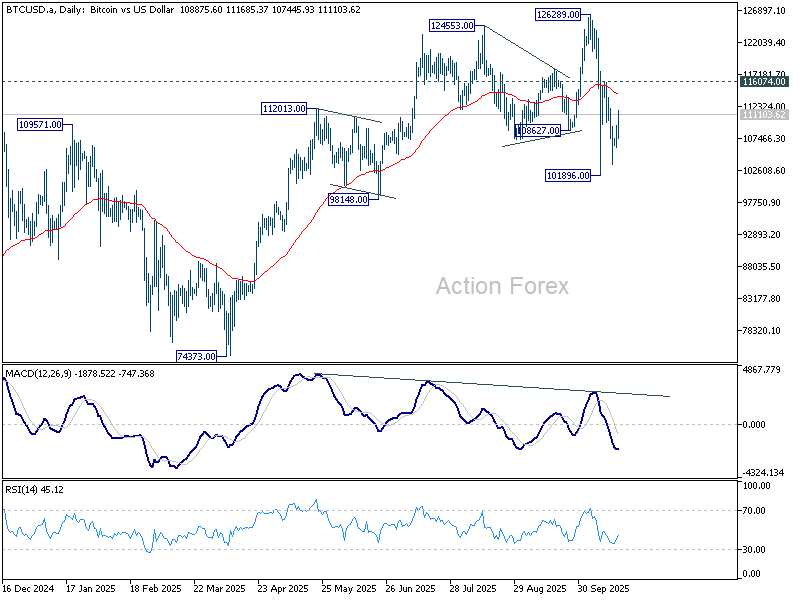
          Bitcoin rebounds as market panic fades, consolidations seen between 101K–126K

          Bitcoin rebounded sharply on Monday, regaining some footing after a two-week selloff driven by risk aversion across global markets. The recovery came as sentiment stabilized following an intense stretch of macro headwinds — including U.S. President Donald Trump’s renewed tariff threats on China and escalating worries over regional banks’ exposure to bad loans. Even expectations of Fed rate cuts failed to cushion the selloff.

          With risk appetite showing tentative signs of recovery, Bitcoin rebounded alongside equities and other higher-beta assets. The technical picture, however, is not totally bullish.

          The earlier break below 108,627 support confirmed that rise from 74,373 to 126,289 has likely completed its five-wave advance. Tentatively, price action from 126,289 is viewed as consolidations to the rise from 74,373 only.

          A push above 116,074 would reinforce this view, and set up the range for the corrective pattern between 101,896 and 126,289. That would imply scope for further consolidation before another run to record highs. The structure suggests the market is resetting rather than reversing.

          Markets Edge Higher As Shutdown Deal Hopes Lift Sentiment_1

          However, the broader trend shows signs of fatigue. W MACD continues to display bearish divergence, warning that upward momentum is fading. A break below 101,896 would put 55 W EMA (now at 96,913) in focus. Sustained move under that level would suggest a deeper correction of the entire uptrend from the 2022 low of 15,452.

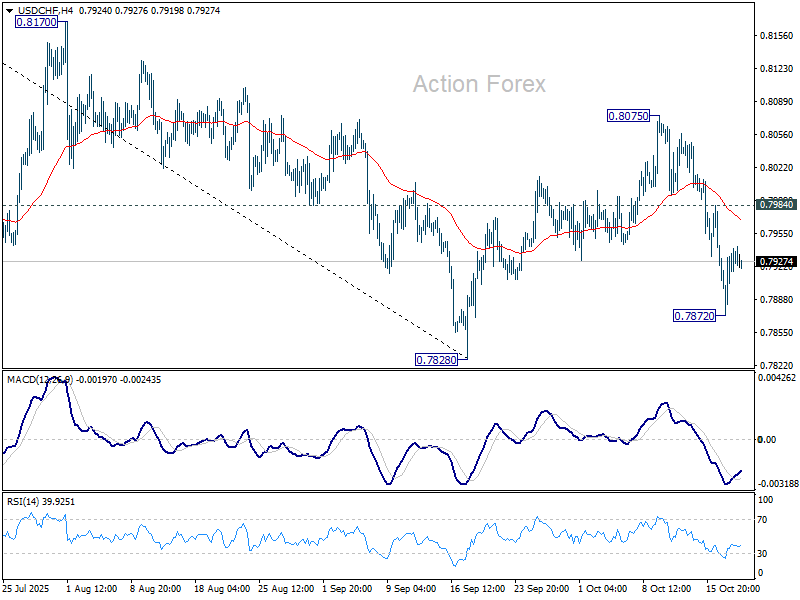
          USD/CHF Mid-Day Outlook

          Daily Pivots: (S1) 0.7893; (P) 0.7916; (R1) 0.7958;

          Range trading continues in USD/CHF and intraday bias stays neutral. Further decline is expected as long as 0.7984 resistance holds. On the downside, below 0.7872 will bring retest of 0.7828. Firm break there will resume larger down trend. However, break of 0.7984 will suggest that corrective pattern from 0.7828 is extending with another rising leg, and target 0.8075 again.

          Markets Edge Higher As Shutdown Deal Hopes Lift Sentiment_2

          In the bigger picture, long term down trend from 1.0342 (2017 high) is still in progress. Next target is 100% projection of 1.0146 (2022 high) to 0.8332 from 0.9200 at 0.7382. In any case, outlook will stay bearish as long as 0.8332 support turned resistance holds (2023 low).


          Source: ACTIONFOREX

          To stay updated on all economic events of today, please check out our Economic calendar
          Risk Warnings and Disclaimers
          You understand and acknowledge that there is a high degree of risk involved in trading. Following any strategies or investment methods may lead to potential losses. The content on the site is provided by our contributors and analysts for information purposes only. You are solely responsible for determining whether any trading assets, securities, strategy, or any other product is suitable for investing based on your own investment objectives and financial situation.
          Add to Favorites
          Share

          GBP/USD survives a major downside breakout: UK CPI coming up

          Adam

          Forex

          Fundamental Overview

          The USD strengthened a bit on Friday following some positive Trump’s comments on China as Treasury yields bounced and erased the Thursday’s losses. Overall, the US dollar performance has been mixed as markets have been driven by quick changes in risk sentiment since Trump’s tariffs threat.
          On the domestic side, the US government shutdown continues to delay many key US economic reports. The dollar “repricing trade” needs strong US data to keep going, especially on the labour market side, so any hiccup on that front is weighing on the greenback.
          The BLS will release the US CPI report on Friday despite the shutdown, so that’s going to be a key risk event. That will need to be seen in the context of US-China relations and any negative shock by that time though. If things go south, then the CPI will not matter much as growth fears will trump everything else.
          On the GBP side, we haven’t got any meaningful change in the fundamentals. The BoE left interest rates unchanged at the last meeting but slowed the pace of QT. The forward guidance was mostly the same with the focus being more on the inflation side now. The UK continues to have a serious inflation problem with high core CPI, high wages and rising consumer inflation expectations.
          We saw some dovish repricing following the soft UK employment report with the market now seeing 11 bps of easing by year-end and 50 bps by the end of 2026. This week we have the UK CPI report which is going to be more important for the BoE.

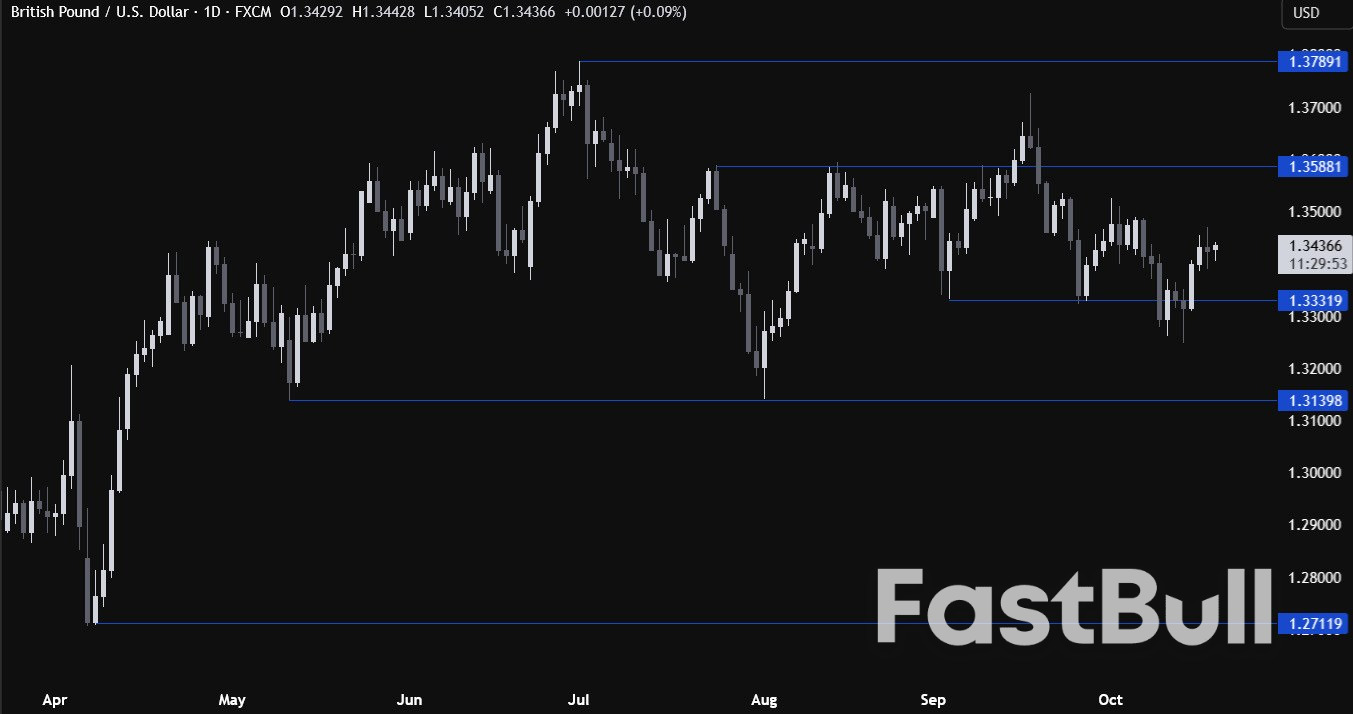
          GBPUSD Technical Analysis – Daily Timeframe

          GBP/USD survives a major downside breakout: UK CPI coming up_1GBPUSD daily

          On the daily chart, we can see that GBPUSD probed below the key 1.3332 level a couple of times in the past two weeks but eventually the breakout got invalidated and the price bounced back strongly. If the price rises all the way back to the 1.3588 level, we can expect the sellers to step in there with a defined risk above the resistance to position for a drop back into the 1.3332 level. The buyers, on the other hand, will want to see the price breaking higher to increase the bullish bets into the 1.3789 level next.

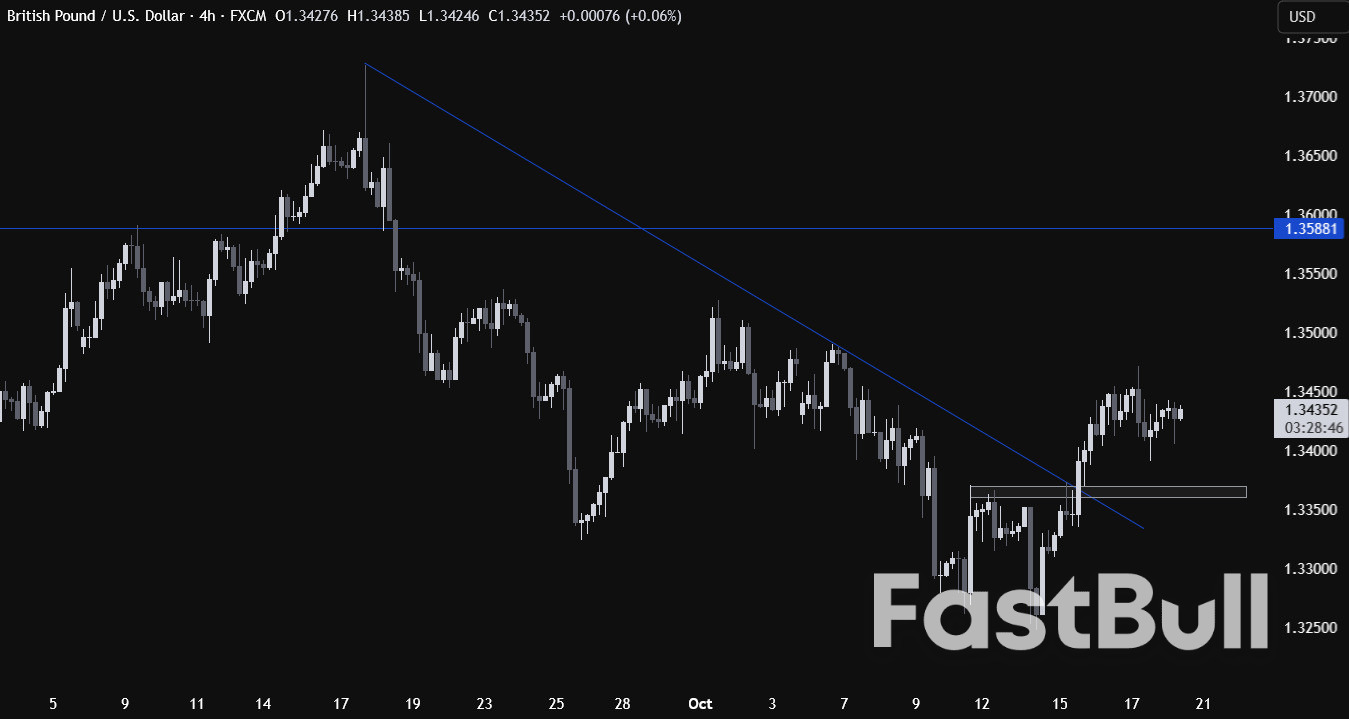
          GBPUSD Technical Analysis – 4 hour Timeframe

          GBP/USD survives a major downside breakout: UK CPI coming up_2GBPUSD 4 hour

          On the 4 hour chart, we can see that we have a minor support zone around the 1.3365 level. If we get a pullback, we can expect the buyers to step in there with a defined risk below the support to position for a rally into the 1.3588 level. The sellers, on the other hand, will want to see the price breaking lower to pile in for a drop into new lows.

          GBPUSD Technical Analysis – 1 hour Timeframe

          GBP/USD survives a major downside breakout: UK CPI coming up_3GBPUSD 1 hour

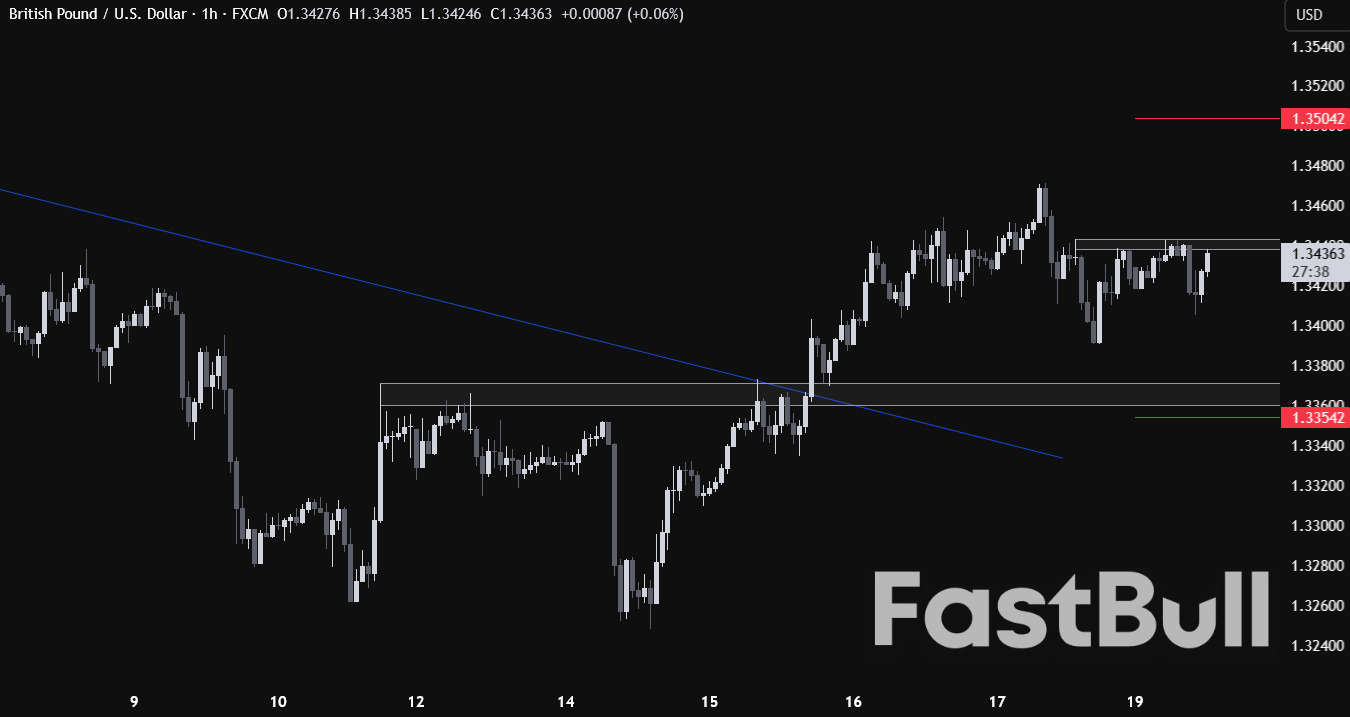
          On the 1 hour chart, we can see that we have a minor resistance zone around the 1.3443 level. This is where we can expect the sellers to step in with a defined risk above the resistance to position for a pullback into the 1.3365 support. The buyers, on the other hand, will look for a break higher to increase the bullish bets into new highs. The red lines define the average daily range for today.

          Upcoming Catalysts

          On Wednesday, we have the UK CPI report, while on Friday we get the US CPI and the US Flash PMIs data. Keep in mind that the US-China developments continue to be a key market focus.

          Source: investinglive

          Risk Warnings and Disclaimers
          You understand and acknowledge that there is a high degree of risk involved in trading. Following any strategies or investment methods may lead to potential losses. The content on the site is provided by our contributors and analysts for information purposes only. You are solely responsible for determining whether any trading assets, securities, strategy, or any other product is suitable for investing based on your own investment objectives and financial situation.
          Add to Favorites
          Share

          EUR/USD Near Fair Value as US Credit Concerns Support Further Euro Strength

          Adam

          Forex

          As Jamie Dimon warned, there may be more ‘cockroaches’ (i.e. distressed lenders) out there after two US regional banks reported credit issues last week. Markets will be looking very closely for evidence of that, and the dollar continues to face substantial downside risks. Later this week, US CPI should not come in hot enough to derail Fed easing plans.

          USD: Still Downside Risks

          Concerns about the health of regional banks and the broader quality of credit in the US remain very central for FX markets. On Friday, some recovery in sentiment helped the dollar rebound, signalling that going forward, some harder evidence backing those concerns is probably required to pressure the dollar again. That will be looked for in this week’s regional lenders’ earnings releases. Here, risks appear tilted on the downside for the dollar.
          Indications that lending issues don’t extend beyond Zions Bancorp and Western Alliance could offer some further relief to the dollar, but it might not be enough to fully price out concerns about the underlying health of the credit market and have the greenback reclaim all losses. On the contrary, evidence of contagion to other lenders or signals of larger credit quality issues can easily send DXY falling 1%+ in the next few days.
          On Friday, the BLS will publish the delayed CPI numbers for September. We are aligned with consensus in expecting a 0.3% MoM core read – which should further endorse a 25bp cut by the Fed next week. Barring major deviations from consensus, the inflation release should not have major FX implications, with jobs markets playing a more important role for rate expectations.

          EUR: At Fair Value

          The eurozone calendar is empty until Friday’s PMI and EUR/USD moves will primarily depend on market sentiment about the US credit market. What is important to note is that EUR/USD is spot on its short-term fair value (1.167) despite the recent rally. That is partly because the starting point of a week ago was one of moderate undervaluation, but also because US lending condition fears go hand in hand with dovish repricing in Fed expectations. The EUR:USD two-year swap rate gap tightened sharply to 104bp before re-widening to 110bp after Friday’s risk re-rating. But it remains some 4-5bp tighter than a week ago and 7-8bp tighter than the start of October.
          The calm on the French political side allowed the euro to recover a bit, but it’s hard to get too comfortable with France. S&P downgraded the country from AA- to A+ in an unscheduled move on Friday, despite a draft budget providing for a deficit reduction having been released. As discussed, the decision to freeze the pension reform complicates budgetary decisions ahead, even if it allows a temporary political reprieve. And the budget discussions are set to intensify in the coming days and weeks. Given the fragility of the government, it remains too early to price out the French effect from the euro fully.
          But this week the focus should stay on the US, and a further souring of credit sentiment could send EUR/USD on a path to 1.180.

          GBP: Room to Soften vs EUR

          Our economics team expects Wednesday’s UK services inflation to undershoot the BoE’s projection with a 4.6% read, which is also below the 4.8% consensus. That can modestly move the needle to the dovish side in the GBP swap curve and weigh on the pound this week.
          Incidentally, expect a steady flow of information about the content of the November budget in the coming weeks. That appears like a double-edged sword for sterling. Any concerns about fiscal sustainability will hit back-end gilts and spill over into the pound, while higher taxation should dampen growth and raise chances of earlier BoE easing.
          We retain a bullish bias on EUR/GBP, and see risks skewed to 0.88 into the budget event risk.

          CEE: Local and Global Story Provides More Room for Rally

          This week, central bank meetings and geopolitics are in focus. Today, wage data, industrial production, and PPI will be published in Poland. While calendar effects and a low comparison base provide a good foundation for industrial production, foreign developments point in the opposite direction.
          On Tuesday, the National Bank of Hungary is expected to keep its rates unchanged at 6.50%. More interesting will be the forward guidance, given the weak economy and renewed calls from the government for lower rates. However, hawkish pushback from the central bank can be expected, as headlines in recent days have indicated. On Wednesday, we should see strong retail sales in Poland continuing their recovery.
          On Thursday, the Central Bank of Turkey will continue its cutting cycle, where we expect a slowdown to 150bp after inflation surprised to the upside in September. Therefore, the risk is also for a smaller or no rate cut.
          Outside the calendar, we will also be watching a possible meeting between the American and Russian presidents in Budapest, announced last week, which could bring some progress in the Ukraine-Russia conflict and have an impact on the CEE region. Here we see HUF and PLN as the biggest potential beneficiaries in a possible market reaction, with the market already confirming this bias on Friday. On top of that, we are approaching the blackout period of the Czech National Bank, and this week we might see the first interviews.
          As we discussed here on Friday, CEE FX has a good constellation of conditions for further rally with a potential boost from a Ukraine-Russia ceasefire. At the same time, EUR/USD has bounced upward, and local rates have stabilised after a rapid rally. We are therefore bullish on the CEE region this week, where hawkish stances from NBH and CNB could add to the momentum. In detail, however, EUR/PLN has reached the bottom of its usual range, and the room here is limited. On the other hand, EUR/HUF could return to 388 and EUR/CZK to 24.250.

          Source: investing

          Risk Warnings and Disclaimers
          You understand and acknowledge that there is a high degree of risk involved in trading. Following any strategies or investment methods may lead to potential losses. The content on the site is provided by our contributors and analysts for information purposes only. You are solely responsible for determining whether any trading assets, securities, strategy, or any other product is suitable for investing based on your own investment objectives and financial situation.
          Add to Favorites
          Share

          Chinese Regulators Halt Ant Group, JD.com Stablecoin Plans

          Samantha Luan

          Economic

          Cryptocurrency

          Forex

          What to Know:

          ● Ant Group and JD.com plans paused by Chinese regulators.
          ● Projects affected are stablecoins for RMB and HKD.
          ● Hong Kong's stablecoin future now uncertain.

          Chinese regulators have intervened, halting Ant Group and JD.com's plans to launch stablecoins in Hong Kong, marking another instance of China's strict control over digital currencies.

          The move highlights China's intent to safeguard its financial authority, slowing Hong Kong's ambition to be a stablecoin hub, with potential impacts on regional digital asset flows.Chinese regulators, including the PBoC, have blocked Ant Group and JD.com from launching stablecoins in Hong Kong.The halt underscores China's control over digital currencies and impacts Hong Kong's position as a potential stablecoin hub.

          China's Regulatory Clampdown on Ant Group and JD.com

          Chinese tech giants, Ant Group and JD.com, halted stablecoin projects following a regulatory intervention from the People’s Bank of China. These projects aimed to establish stablecoins tied to the RMB and HKD.The halt is influenced by concerns from the Cyberspace Administration of China. Both tech firms have been at the forefront of digital payment innovations and were expected to lead in Hong Kong's crypto landscape.

          Hong Kong's Stablecoin Aspirations Crippled

          The decision impacts Hong Kong’s ambitions to be a stablecoin hub, potentially slowing the city’s digital asset industry. This move sends a signal about China’s tight grip on its digital economy.Financially, both Ant Group and JD.com had significant resources committed to these projects. The halt affects future market dynamics, especially for RMB and HKD-pegged stablecoins in the region. Ye Zhiheng, Executive Director, Intermediaries Division, Hong Kong SFC, remarked, "The city's evolving framework for stablecoin issuers had 'heightened the risk of fraud,' underscoring the fine line between innovation and oversight."

          China's Digital Currency Control Strategy Analyzed

          Mainland China has historically blocked private cryptocurrency initiatives, evident in earlier bans like the prohibition on ICOs in 2017. These actions are part of an ongoing trend to centralize control.Experts predict a slower uptake for new stablecoin projects in Hong Kong. Based on prior interventions, digital yuan remains a priority for the Chinese government, maintaining its financial sovereignty.

          Source: CryptoSlate

          To stay updated on all economic events of today, please check out our Economic calendar
          Risk Warnings and Disclaimers
          You understand and acknowledge that there is a high degree of risk involved in trading. Following any strategies or investment methods may lead to potential losses. The content on the site is provided by our contributors and analysts for information purposes only. You are solely responsible for determining whether any trading assets, securities, strategy, or any other product is suitable for investing based on your own investment objectives and financial situation.
          Add to Favorites
          Share
          FastBull
          Copyright © 2025 FastBull Ltd

          728 RM B 7/F GEE LOK IND BLDG NO 34 HUNG TO RD KWUN TONG KLN HONG KONG

          TelegramInstagramTwitterfacebooklinkedin
          App Store Google Play Google Play
          Products
          Charts

          Chats

          Q&A with Experts
          Screeners
          Economic Calendar
          Data
          Tools
          Membership
          Features
          Function
          Markets
          Copy Trading
          Latest Signals
          Contests
          News
          Analysis
          24/7
          Columns
          Education
          Company
          Careers
          About Us
          Contact Us
          Advertising
          Help Center
          Feedback
          User Agreement
          Privacy Policy
          Business

          White Label

          Data API

          Web Plug-ins

          Poster Maker

          Affiliate Program

          Risk Disclosure

          The risk of loss in trading financial instruments such as stocks, FX, commodities, futures, bonds, ETFs and crypto can be substantial. You may sustain a total loss of the funds that you deposit with your broker. Therefore, you should carefully consider whether such trading is suitable for you in light of your circumstances and financial resources.

          No decision to invest should be made without thoroughly conducting due diligence by yourself or consulting with your financial advisors. Our web content might not suit you since we don't know your financial conditions and investment needs. Our financial information might have latency or contain inaccuracy, so you should be fully responsible for any of your trading and investment decisions. The company will not be responsible for your capital loss.

          Without getting permission from the website, you are not allowed to copy the website's graphics, texts, or trademarks. Intellectual property rights in the content or data incorporated into this website belong to its providers and exchange merchants.

          Not Logged In

          Log in to access more features

          FastBull Membership

          Not yet

          Purchase

          Become a signal provider
          Help Center
          Customer Service
          Dark Mode
          Price Up/Down Colors

          Log In

          Sign Up

          Position
          Layout
          Fullscreen
          Default to Chart
          The chart page opens by default when you visit fastbull.com