

Markets
News
Analysis
User
24/7
Economic Calendar
Education
Data
- Names
- Latest
- Prev



Signal Accounts for Members
All Signal Accounts
All Contests
 Euro Zone IHS Markit Construction PMI (Nov)
A:--
F: --
P: --
 Italy IHS Markit Construction PMI (Nov)
A:--
F: --
P: --
 U.K. Markit/CIPS Construction PMI (Nov)
A:--
F: --
P: --
 France 10-Year OAT Auction Avg. Yield
A:--
F: --
P: --
Euro Zone Retail Sales MoM (Oct)A:--
F: --
P: --
Euro Zone Retail Sales YoY (Oct)A:--
F: --
P: --
 Brazil GDP YoY (Q3)
A:--
F: --
P: --
 U.S. Challenger Job Cuts (Nov)
A:--
F: --
P: --
U.S. Challenger Job Cuts MoM (Nov)A:--
F: --
P: --
U.S. Challenger Job Cuts YoY (Nov)A:--
F: --
P: --
U.S. Initial Jobless Claims 4-Week Avg. (SA)A:--
F: --
P: --
U.S. Weekly Initial Jobless Claims (SA)A:--
F: --
P: --
U.S. Weekly Continued Jobless Claims (SA)A:--
F: --
P: --
 Canada Ivey PMI (SA) (Nov)
A:--
F: --
P: --
Canada Ivey PMI (Not SA) (Nov)A:--
F: --
P: --
U.S. Non-Defense Capital Durable Goods Orders Revised MoM (Excl. Aircraft) (SA) (Sept)A:--
F: --
U.S. Factory Orders MoM (Excl. Transport) (Sept)A:--
F: --
P: --
U.S. Factory Orders MoM (Sept)A:--
F: --
P: --
U.S. Factory Orders MoM (Excl. Defense) (Sept)A:--
F: --
P: --
U.S. EIA Weekly Natural Gas Stocks ChangeA:--
F: --
P: --
Saudi Arabia Crude Oil ProductionA:--
F: --
P: --
U.S. Weekly Treasuries Held by Foreign Central BanksA:--
F: --
P: --
 Japan Foreign Exchange Reserves (Nov)
A:--
F: --
P: --
 India Repo Rate
A:--
F: --
P: --
India Benchmark Interest RateA:--
F: --
P: --
India Reverse Repo RateA:--
F: --
P: --
India Cash Reserve RatioA:--
F: --
P: --
Japan Leading Indicators Prelim (Oct)A:--
F: --
P: --
U.K. Halifax House Price Index YoY (SA) (Nov)A:--
F: --
P: --
U.K. Halifax House Price Index MoM (SA) (Nov)A:--
F: --
P: --
France Current Account (Not SA) (Oct)--
F: --
P: --
France Trade Balance (SA) (Oct)--
F: --
P: --
France Industrial Output MoM (SA) (Oct)--
F: --
P: --
Italy Retail Sales MoM (SA) (Oct)--
F: --
P: --
Euro Zone Employment YoY (SA) (Q3)--
F: --
P: --
Euro Zone GDP Final YoY (Q3)--
F: --
P: --
Euro Zone GDP Final QoQ (Q3)--
F: --
P: --
Euro Zone Employment Final QoQ (SA) (Q3)--
F: --
P: --
Euro Zone Employment Final (SA) (Q3)--
F: --
Brazil PPI MoM (Oct)--
F: --
P: --
 Mexico Consumer Confidence Index (Nov)
--
F: --
P: --
Canada Unemployment Rate (SA) (Nov)--
F: --
P: --
Canada Labor Force Participation Rate (SA) (Nov)--
F: --
P: --
Canada Employment (SA) (Nov)--
F: --
P: --
Canada Part-Time Employment (SA) (Nov)--
F: --
P: --
Canada Full-time Employment (SA) (Nov)--
F: --
P: --
U.S. Personal Income MoM (Sept)--
F: --
P: --
U.S. Dallas Fed PCE Price Index YoY (Sept)--
F: --
P: --
U.S. PCE Price Index YoY (SA) (Sept)--
F: --
P: --
U.S. PCE Price Index MoM (Sept)--
F: --
P: --
U.S. Personal Outlays MoM (SA) (Sept)--
F: --
P: --
U.S. Core PCE Price Index MoM (Sept)--
F: --
P: --
U.S. UMich 5-Year-Ahead Inflation Expectations Prelim YoY (Dec)--
F: --
P: --
U.S. Core PCE Price Index YoY (Sept)--
F: --
P: --
U.S. Real Personal Consumption Expenditures MoM (Sept)--
F: --
P: --
U.S. 5-10 Year-Ahead Inflation Expectations (Dec)--
F: --
P: --
U.S. UMich Current Economic Conditions Index Prelim (Dec)--
F: --
P: --
U.S. UMich Consumer Sentiment Index Prelim (Dec)--
F: --
P: --
U.S. UMich 1-Year-Ahead Inflation Expectations Prelim (Dec)--
F: --
P: --
U.S. UMich Consumer Expectations Index Prelim (Dec)--
F: --
P: --


No matching data

Latest Views
Latest Views
Trending Topics
Top Columnists
Latest Update
White Label
Data API
Web Plug-ins
Affiliate Program
View All
No data
A trade group representing nearly all major automakers warned on Tuesday that new 25% tariffs on imports from Canada and Mexico imposed by US President Donald Trump will lead to drastic price hikes.
A trade group representing nearly all major automakers warned on Tuesday that new 25% tariffs on imports from Canada and Mexico imposed by US President Donald Trump will lead to drastic price hikes.
"All automakers will be impacted by these tariffs on Canada and Mexico," said John Bozzella, who heads the Alliance for Automotive Innovation that represents all major automakers in the US except Tesla. Members include General Motors, Ford, Toyota, Volkswagen, Hyundai, and Stellantis.
"Most anticipate the price of some vehicle models will increase by as much as 25%, and the negative impact on vehicle price and vehicle availability will be felt almost immediately."
Automakers have sounded the alarm that the tariffs will disrupt the integrated supply chain across North America that has been in place for more than 25 years. Some auto parts can cross a border six or more times before final assembly.
"You just can't relocate automotive production and the supply chain overnight. That's the challenge and the dilemma: auto tariffs in North America could end up increasing costs on consumers before jobs come back to the country," Bozzella added.
Stellantis told dealers on Tuesday that the automaker continues to engage with the Trump administration on the tariffs that would add a "cost burden" impacting customers.
"Because the industry is highly integrated across North America, these tariffs will put Stellantis' flagship Chrysler, Dodge, Jeep, and Ram brands at a competitive disadvantage versus Korean, Japanese and European importers," the automaker said in an email seen by Reuters.
Many automakers met with Commerce Secretary Howard Lutnick last week to urge the administration not to move ahead with broad tariff hikes.
Last month, Ford chief executive officer Jim Farley warned that 25% tariffs on Mexico and Canada would "blow a hole" in the US auto industry. "What we're seeing is a lot of cost, a lot of chaos," he said last month.
The United Auto Workers praised Trump, noting his plans for further tariff actions in April.
"We are glad to see an American president take aggressive action on ending the free trade disaster that has dropped like a bomb on the working class," the union said. "We look forward to working with the White House to shape the auto tariffs in April, to benefit the working class."
The American International Automobile Dealers Association noted that dealers already face rising vehicle and parts prices and high interest rates. "Tariffs could directly contribute to thousands of extra dollars on sticker prices," the group said.
US President Donald Trump said on Tuesday he received a letter from Ukrainian President Volodymyr Zelenskiy, in which the Ukrainian leader expressed willingness to come to the negotiating table over the Russia-Ukraine war.
"Ukraine is ready to come to the negotiating table as soon as possible to bring lasting peace closer. Nobody wants peace more than the Ukrainians," Trump said in an address to Congress on Tuesday while quoting from the letter.
Trump also said he had been in "serious discussions with Russia", and had "received strong signals that they are ready for peace".
"Wouldn't that be beautiful?" he said. "It's time to stop this madness. It's time to halt the killing. It's time to end this senseless war. If you want to end wars you have to talk to both sides."
Trump was expected to further outline his plans for Ukraine and Russia in the speech to Congress, but did not reveal any further details on how he plans to end Europe's biggest conflict since World War Two.
Trump said Ukraine was ready to sign a minerals deal with the US, which Washington says is crucial to secure continued US backing for Ukraine's defence.
Four sources told Reuters that the Trump administration and Ukraine plan to sign the deal in return for military aid, which Trump has paused. But later on Tuesday US Treasury Secretary Scott Bessent told Fox News, "There is no signing planned," according to a post on X by a Fox reporter.
Trump gave no further details on the minerals deal, leaving its fate unclear.
Early on Tuesday, Zelenskiy pledged to repair relations with the US after what he described as a "regrettable" Oval Office clash with Trump last week.
Zelenskiy said he wanted to "make things right" and was ready "any time and in any convenient format" to sign the minerals deal, which he left on the table during a visit to Washington after the Oval Office argument with Trump.
His statement came a day after Trump halted military aid to Ukraine, his latest move to upend US policy and adopt a more conciliatory stance towards Russia.
"My team and I stand ready to work under President Trump’s strong leadership to get a peace that lasts," Zelenskiy said in his statement on X. The statement made no mention of the pause in US military supplies.
Zelenskiy's statement was clearly aimed at stressing Kyiv's gratitude following the explosive confrontation at the White House, at which Trump and Vice President JD Vance scolded Zelenskiy as insufficiently appreciative.
"We do really value how much America has done to help Ukraine maintain its sovereignty and independence," Zelenskiy wrote. "Our meeting in Washington...did not go the way it was supposed to be. It is regrettable that it happened this way. It is time to make things right."
Zelenskiy outlined a path towards a peace agreement, which he said could begin with a release of prisoners and a halt to air and sea attacks, if Russia did the same.
"Then we want to move very fast through all next stages and to work with the US to agree a strong final deal."
Geopolitical shift
Earlier, Ukrainian Prime Minister Denys Shmyhal said Ukraine's forces could hold their own on the battlefield against Russian troops, but that Kyiv would do everything possible to continue cooperating with the US.
"We will continue to work with the US through all available channels in a calm manner," Shmyhal said. "We only have one plan — to win and to survive."
In Moscow, the Kremlin said cutting off US military aid to Ukraine was the best possible step towards peace, although it was waiting to confirm Trump's move.
US Democrats have raised an outcry over Trump's abrupt pivot towards Russia, the most dramatic geopolitical shift in generations for Washington, where governments under both parties since the 1940s have prioritised defending Europe from a hostile Moscow.
Pressure on Europe
The pause in US military aid puts more pressure on European allies who have publicly embraced Zelenskiy since the Oval Office blow-up. Britain and France, whose leaders both visited the White House last week, have offered troops to help guard a potential ceasefire.
On Tuesday, Germany's conservatives and Social Democrats announced proposals to set up a €500 billion (US$531 billion or RM2.36 trillion) fund to help ramp up defence spending.
European Commission President Ursula von der Leyen unveiled proposals to mobilise up to €800 billion for EU defence spending. The 27-nation bloc holds an emergency summit on Thursday.
French President Emmanuel Macron's office said the president had spoken with both the US and Ukrainian leaders and welcomed Zelenskiy's will to re-engage with Trump.
But French Prime Minister Francois Bayrou was sharply critical of Trump's move to pause military supplies.
"Suspending aid during a war to a country under attack means abandoning the country under attack and accepting or hoping that the aggressor will win," he said during a parliamentary debate.
Ukrainians were stunned and many described Washington's move as a betrayal. Oleksandr Merezhko, head of the Ukrainian Parliament's foreign affairs committee, said it looked like Trump was "pushing us towards capitulation".
"Yes, it is betrayal, let's call it like it is," said lawyer Olena Bilova, 47, in Kyiv. "But let's hope that American civil society and the elites of the European Union will not leave us alone."
Key Highlights
WTI Crude Oil prices started a fresh decline below the $70.00 support.
It traded below a key contracting triangle at $67.85 on the 4-hour chart.
Gold prices started another increase and surpassed the $2,895 resistance.
Bitcoin restarted its decrease and traded below $88,000.
WTI Crude Oil Price Technical Analysis
WTI Crude Oil price failed to clear the $71.20 resistance. The price started a fresh decline below $70.20 and $70.00 to enter a bearish zone.
Looking at the 4-hour chart of XTI/USD, the price settled below the 100 simple moving average (red, 4-hour) and the 200 simple moving average (green, 4-hour). It traded below a key contracting triangle at $67.85.
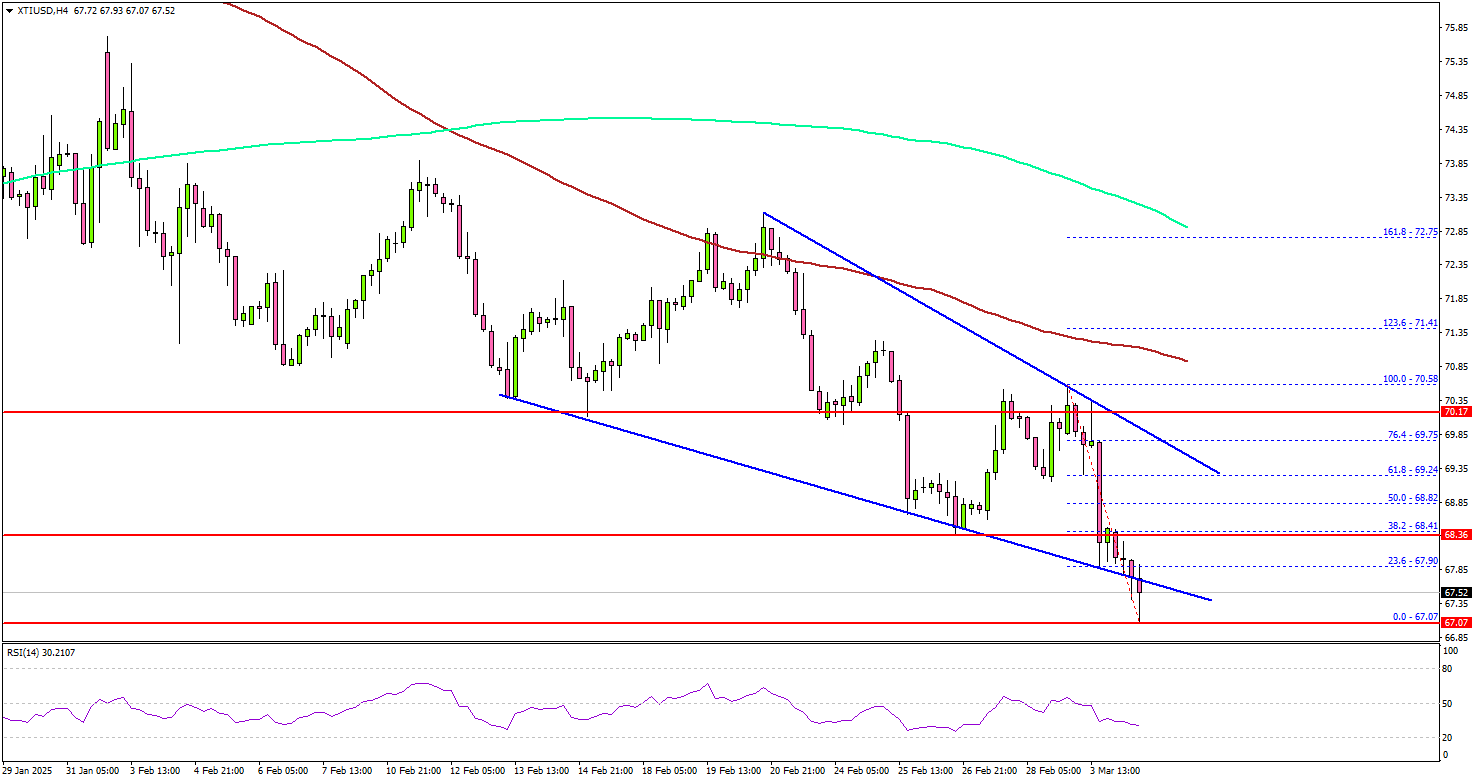
The bears seem to be in action below the $68.80 pivot level. On the upside, the price is facing hurdles near the $68.40 level. The main hurdle is now near the $69.20 zone, above which the price may perhaps accelerate higher.
In the stated case, it could even visit the $70.80 resistance and the 100 simple moving average (red, 4-hour). Any more gains might call for a test of the $72.00 resistance zone in the near term.
On the downside, the first major support sits near the $67.00 zone. A daily close below $67.00 could open the doors for a larger decline. The next major support is $65.80. Any more losses might send oil prices toward $65.00 in the coming days.
Looking at Gold, there was a strong increase above the $2,895 level and the price could extend gains in the near term.
Economic Releases to Watch Today
Euro Zone Services PMI for Feb 2025 – Forecast 50.7, versus 50.7 previous.
UK Services PMI for Feb 2025 – Forecast 51.1, versus 51.1 previous.
US Services PMI for Feb 2025 – Forecast 49.7, versus 49.7 previous.
US ISM Services Index for Feb 2025 – Forecast 52.9, versus 52.8 previous.
China plans to issue 500 billion yuan (US$69 billion or RM306.46 billion) in special sovereign bonds, as it seeks to boost capital at its biggest banks to support the economic recovery, according to the government’s annual work report.
The debt will be issued to replenish core Tier-1 capital at big state-owned banks, beef up their operations and their capability to service the real economy, according to the report seen by Bloomberg News.
The plan to help out the banks, which are struggling with record low margins, was first flagged as far back as September. The government later said it would tap special sovereign bonds to fund the injections.
China is beefing up the strength of its banking system — even though the top six have capital levels that exceed requirements — after enacting a string of stimulus policies including cuts to mortgage rates and key policy rates. Enlisted to support the economy over the past few years, the lenders are battling record low margins, slowing profit growth and rising bad debt.
China’s biggest banks include Industrial & Commercial Bank of China Ltd and Agricultural Bank of China Ltd, among others.
China reiterated its vigilance on risk in the work report, saying it will replenish “risk mitigation resources”, such as the deposit insurance fund and financial stability fund, as well as improve its contingency plan for external shocks.
It will also work to foster mergers and acquisitions to help with risk reduction and transformation at the nation’s small- and medium-sized financial institutions.
As for the larger lenders, authorities are looking to add at least 400 billion yuan of fresh capital into the first batch of three lenders by as soon as end-June, people familiar with the matter have said. The total injections could amount to as much as one trillion yuan for the largest lenders, Bloomberg News reported last year.
The U.S. administration has implemented blanket tariffs on Canada and Mexico after a 30-day reprieve with 25% on all imports except 10% on Canadian energy. An additional 10% tariff on China is also planned.
Canada has been hit with its largest trade shock in nearly 100 years and responded promptly with 25% tariffs on $30 billion of U.S. goods, rising to $155 billion in 21 days. Evolving trade policies and government responses still remain highly uncertain as we highlighted in our first economic takeaways a month ago.
But, as we assess the implications of the implementation of tariffs on our forecasts—to be released in our Financial Markets Monthly next week—here is a cheat sheet summary of what we know and are incorporating into our outlook.
Lack of precedence for economic shock
This is not 2018 and we have a limited experience for this magnitude of a trade shock. In 2018-19, tariff policies raised the average import duty from 1.5% to approximately 3%. As of March 4, the average tariff rate quadruples to nearly 12%. That’s the largest trade shock to the U.S. and Canada since the 1930s.
Interestingly, these tariffs apply to double the share of U.S. imports (Canada + Mexico = 30%) than China-only tariffs (15%). The U.S. economy, in particular, has experienced a sizeable economic shock since 2018—prices are up 29% since Donald Trump’s first day in office eight years ago and we suspect the sensitivity to inflation is much higher now than before.
Impact is highly variable depending on duration
The ultimate impact of these tariffs on Canada and the U.S. will depend on how long they—and retaliatory measures—remain in place. Those are political decisions and difficult to economically forecast. The movement of currencies is key as well, because it can buffer some of the impact on inflation and growth on both sides of the border.
As a specific timeline, we previously delineated a duration of three to six months to show material mark downs in growth for the Canadian and U.S. economies. Tariffs would likely reduce real gross domestic product growth to zero in 2025 if implemented beyond a year and lead to a 2% contraction in 2026 with a peak unemployment rate more than 8%.
Canada’s deeply U.S-integrated manufacturing sector (about 10% of GDP) is particularly vulnerable, along with its heartland in Ontario and Quebec. Alberta and New Brunswick are also among the vulnerable provinces due to their commodity exposure, but the lower tariff rate implies an easier adjustment. Again, these scenarios make many assumptions about the path of currencies, retaliatory measures, central bank responses and fiscal packages. Read more on our scenario analysis here.
The damage is already in play
The threat of tariffs alone has already been enough to create an impact. We have already seen early evidence of stockpiling from U.S. importers ahead of the tariff implementation, a feature in our Playbook for how to measure a tariff shock in Canada. This has worsened the U.S. trade deficit and mechanically pushed down U.S. GDP nowcasts.
Meanwhile, uncertainty measures are at or near all-time highs, which will weigh on business investment and hiring in Canada. Surveys like the ISM Manufacturing indicator showed a surge in expectations for prices combined with a drop in new orders and employment activity in February—a stagflationary sentiment likely to reveal itself in a variety of other indicators into March.
A stagflationary shock for the U.S.
While Canada’s concerns are tilted towards the growth side, we expect the U.S. will struggle with the inflationary impact of broad-based tariffs. With a persistent tariff, we expect the U.S. could see a year-over-year rise in core inflation of 0.5-1 percentage point, pushing it above 3% by the end of 2025. However, growth would also need to be downgraded with our forecast suggesting that U.S. growth would move sideways in 2025 with risks to the downside should tariffs expand to Europe or globally. Growth would likely be materially impacted as well with tariffs in place for at least six months.
That said, we expect a very tight labor market and lack of labor supply will keep a lid on how high the unemployment rate can rise. That will make the U.S. Federal Reserve’s job especially challenging as they maneuver a supply-side shock to inflation that could be unresponsive to interest rate hikes. Currently, we have the Fed on hold for 2025, but further deterioration in sentiment or investment could prompt higher probabilities of additional cuts.
Incoming near-term support
Central bankers and governments may have time. Indeed, they might need time to develop strategies to react. The Bank of Canada has been noncommittal in how it would respond to a tariff shock—waiting to see whether inflation or growth dominate. Without tariffs, we expected the BoC to gradually cut rates to 2.25%. Now, we expect that the longer tariffs remain in play, the greater the likelihood that rates fall faster and by a larger magnitude.
Provincial and federal stimulus packages will also matter. A prolonged trade shock means governments would have to respond to both the immediate recession, while also strengthening the underlying economy that is ill positioned to absorb such a shock. Targeted support would help to offset the growth impact, while broad-based cash transfers risk inflation that would complicate the BoC’s job and limit future fiscal firepower. Prorogued legislatures at the federal level and in Ontario conveniently give policymakers more time to plan their reaction, while automatic stabilizers like employment insurance or Crown financial programs likely provide latitude to address many immediate concerns.
An eye on medium- and longer-term solutions
There are longer-term plays available to facilitate export diversification and stronger domestic growth drivers despite the hurdles facing the Canadian economy. One is the U.S.’s recognition of the importance of Canadian commodities. Lower tariff rates on Canadian energy and critical minerals reveal how big a global player Canada is on oil, gas, potash, agrifood, uranium and other essentials without easy substitutes. Expanding a cross-border partnership in these areas could refocus the relationship, while underpinning a greater value capture in manufacturing and ancillary services, and greater trade diversification.
There is increasing consensus in Canada on the urgency of addressing structural growth impediments from interprovincial trade barriers to peer-lagging business investment and high regulatory burdens. There are no easy fixes for U.S. tariffs. These issues could only be addressed over time, but would unequivocally be positive for the Canadian economy.
Trade turbulence is likely to be a persistent theme
While our current focus is on 25% across the board tariffs on Canadian and Mexican goods, there are other trade-related deadlines coming. In addition to the planned March 12 implementation of previously announced steel and aluminum tariffs, April 2 is the next trigger date. The U.S. administration is expecting trade analysis from several agencies to support reciprocal tariffs, while its already put out a notice for stakeholder views on USMCA/CUSMA in advance of July 2026 renegotiations. Ongoing trade disruption means both economies can expect to be beset by policy uncertainty that weighs on business investment.
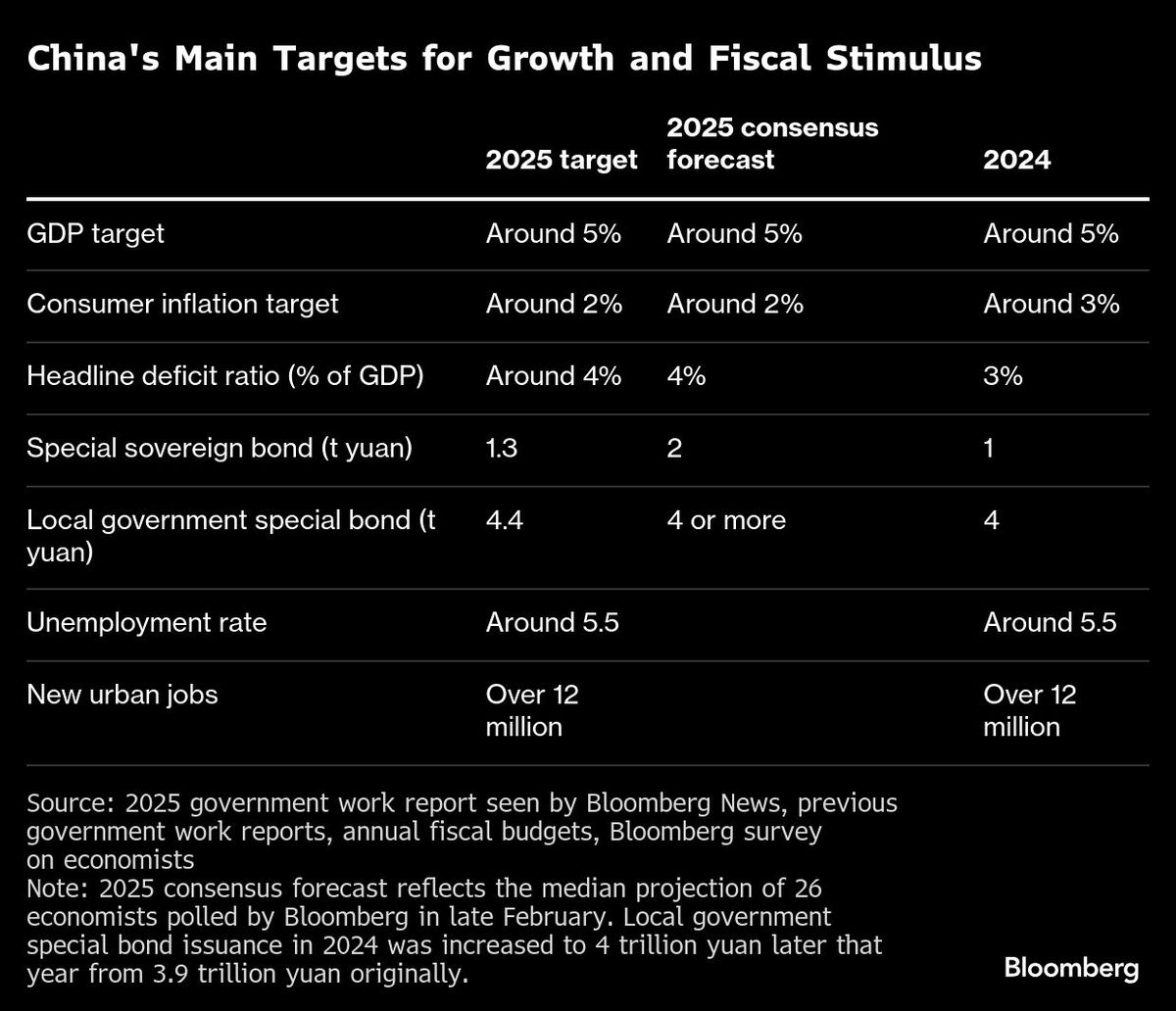
China set its economic growth goal at about 5% for 2025, raising expectations for officials to unleash more stimulus as they confront a trade war with the US.
Premier Li Qiang announced the target on Wednesday morning as he delivered the government’s annual work report to the national Parliament in Beijing. This marks the third straight year has China maintained that goal, but repeating it again will be difficult.
China also set this year’s fiscal deficit target to around 4% of gross domestic product (GDP) — the highest level in more than three decades, according to the work report. The GDP and general budget deficit goals are in line with economist expectations heading into the meeting.
“It’s an ambitious growth target, and it means the authorities will still need to support growth,” said Raymond Yeung, the chief economist for Greater China at Australia and New Zealand Banking Group. “This number reflects authorities are determined to support growth against the backdrop of external uncertainties and trade tensions with the US.”
The meeting of the National People’s Congress comes one day after Donald Trump imposed another 10% tariff on China, threatening to cripple the export engine that last year contributed to almost a third of economic expansion. Adding to Beijing’s problems, the nation is on track to record its longest streak of deflation since the 1960s, while the property crash has yet to bottom out.
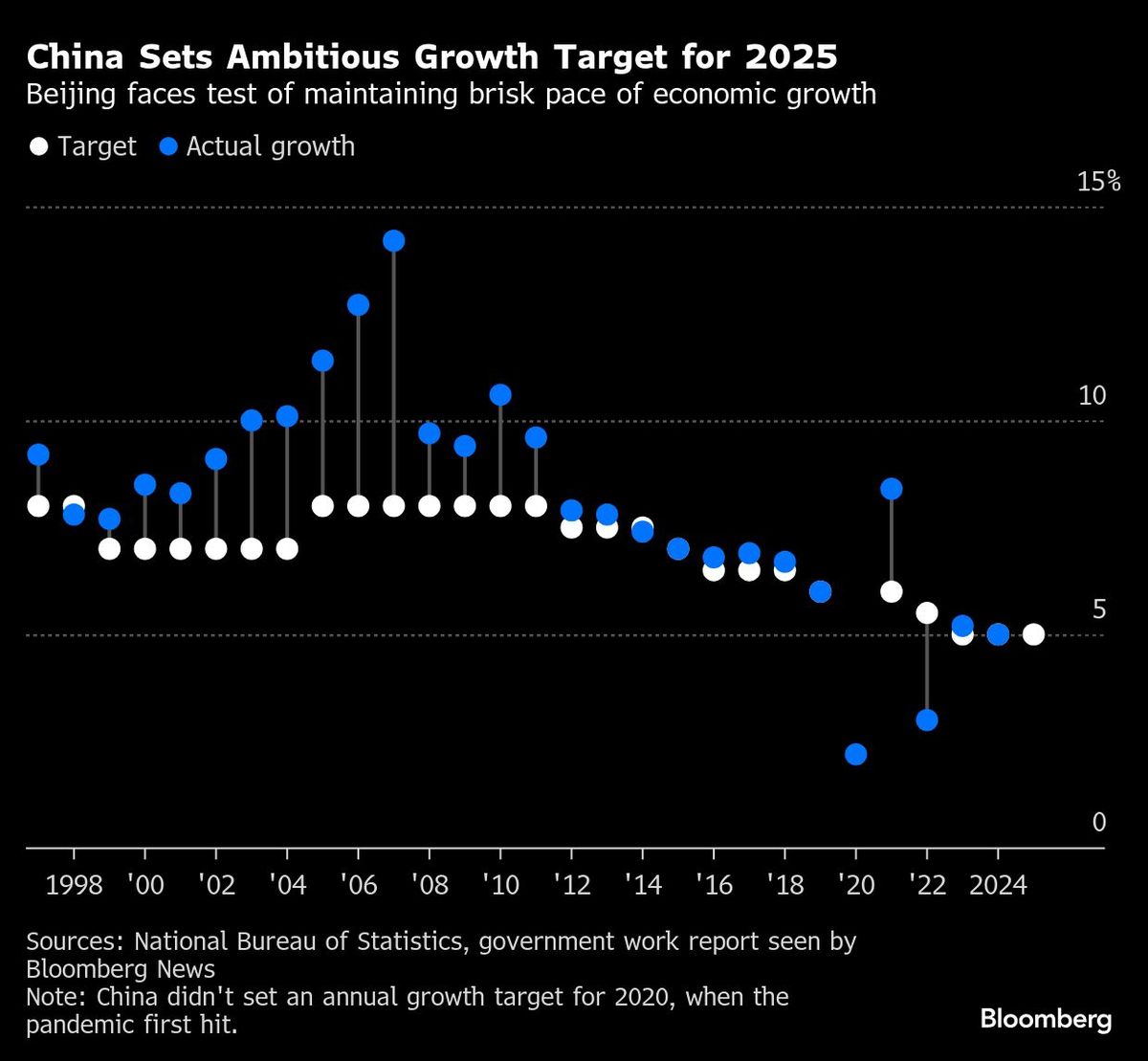
President Xi Jinping’s bullish goal will likely require his lieutenants to roll out more aggressive stimulus as promised in December. Economists have called for that campaign to include greater public spending directed, at least in part, towards boosting weak consumer spending.
The target “underscores our resolve to meet difficulties head-on and strive hard to deliver,” said Li. “In setting the growth rate at around 5%, we have taken into account the need to stabilise employment, prevent risks, and improve the people’s well-being.”
The central bank will cut interest rates and the amount of cash lenders must set aside in reserves “at an appropriate time,” Li said, after reiterating the government endorses a “moderately loose” monetary policy.
Maintaining a brisk pace of economic growth is important to social stability. Every one percentage of GDP expansion can lead to the creation about 2.5 million new jobs, making around 5% growth a necessity to keep employment steady, according to estimates by Zhu Baoliang, formerly the chief economist at think tank the State Information Center. The government forecast over 12 million graduates will enter the job market in 2025, slightly higher than last year.
China needs to achieve a growth rate of around 5% to fulfill Xi’s pledge of turning it into a “medium-developed country” by 2035, which economists say implied doubling in the size of the economy from 2020 levels.
Supporting economy
The growth and budget targets mean “the government is willing to support the economy,” said Vey-Sern Ling, the managing director of Union Bancaire Privee. “This should be reassuring to the markets.”
There are recent signs pointing to an improving outlook for the economy. DeepSeek’s recent breakthrough in artificial intelligence boosted market sentiment, as did a rare meeting between Xi and home-grown technology champions.
But the question now is how long the momentum will last in the face of Trump’s unpredictable tariff announcements and the intensifying competition between China and the US for tech supremacy.
A Bloomberg survey on 77 analysts forecast the Chinese economy will only grow 4.5% in 2025, reflecting the challenge of meeting the official target again this year.
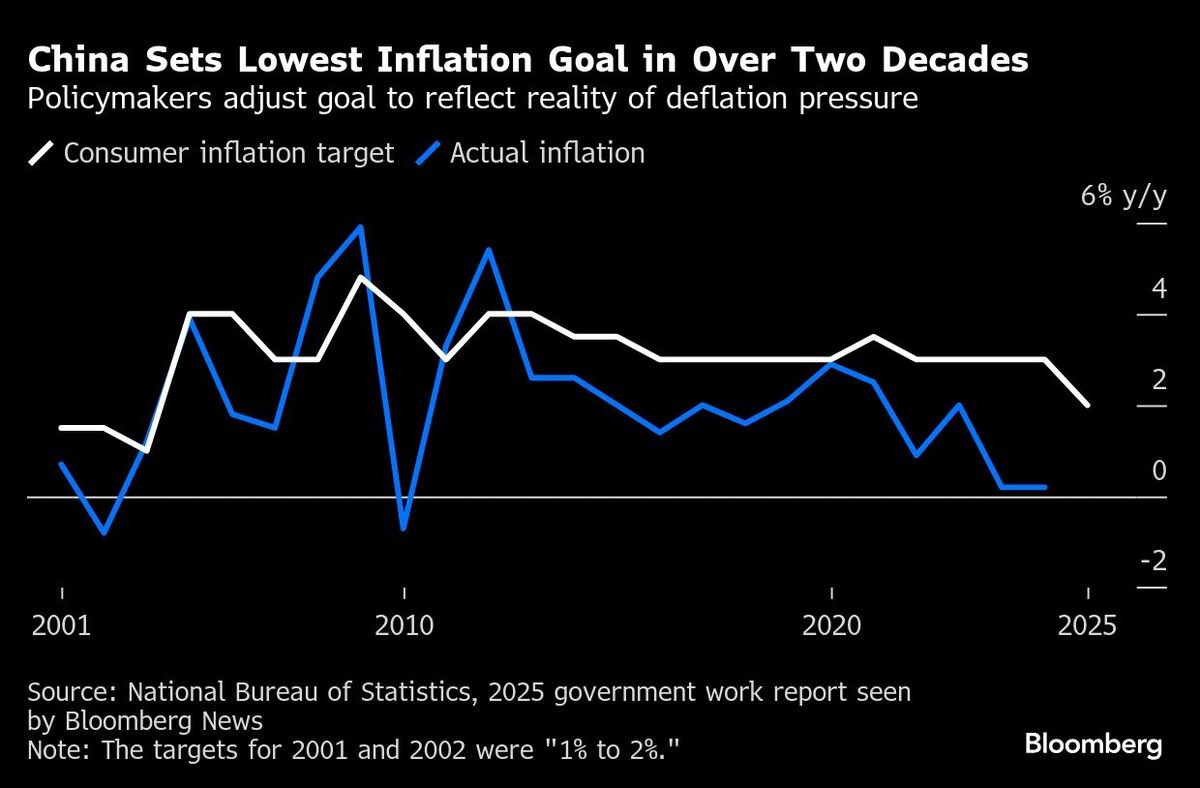
In a tacit recognition of deflationary pressures, the government lowered its official target for consumer price increase to around 2%, according to the report, the lowest since 2003. While that goal was largely regarded as a ceiling in the past, trimming it shows officials have conceded faster price growth will be a challenge after consumer inflation reached only 0.2% for the past two years. A growing chorus of economists are calling for the government to make the target a binding one for policies.
Li’s report delivered to thousands of delegates at the Great Hall of the People will also provide clues on authorities’ specific plans for fiscal and monetary stimulus, which could impact global commodity prices and inflation.
“This is positive and important as a growth stabilising factor,” Wee Khoon Chong, a senior Asia-Pacific market strategist for Bank of New York Mellon Corp, said of China’s targets. “All that’s needed now is effective implementation of all measures announced. We expect further credit and monetary easing to complement China fiscal strategy.”
728 RM B 7/F GEE LOK IND BLDG NO 34 HUNG TO RD KWUN TONG KLN HONG KONG


White Label
Data API
Web Plug-ins
Poster Maker
Affiliate Program
The risk of loss in trading financial instruments such as stocks, FX, commodities, futures, bonds, ETFs and crypto can be substantial. You may sustain a total loss of the funds that you deposit with your broker. Therefore, you should carefully consider whether such trading is suitable for you in light of your circumstances and financial resources.
No decision to invest should be made without thoroughly conducting due diligence by yourself or consulting with your financial advisors. Our web content might not suit you since we don't know your financial conditions and investment needs. Our financial information might have latency or contain inaccuracy, so you should be fully responsible for any of your trading and investment decisions. The company will not be responsible for your capital loss.
Without getting permission from the website, you are not allowed to copy the website's graphics, texts, or trademarks. Intellectual property rights in the content or data incorporated into this website belong to its providers and exchange merchants.
Not Logged In
Log in to access more features

FastBull Membership
Not yet
Purchase


Log In
Sign Up


