• Trade
  • Markets
  • Copy
  • Contests
  • News
  • 24/7
  • Calendar
  • Q&A
  • Chats
Trending
Screeners
SYMBOL
LAST
BID
ASK
HIGH
LOW
NET CHG.
%CHG.
SPREAD
SPX
S&P 500 Index
6857.13
6857.13
6857.13
6865.94
6827.13
+7.41
+ 0.11%
--
DJI
Dow Jones Industrial Average
47850.93
47850.93
47850.93
48049.72
47692.96
-31.96
-0.07%
--
IXIC
NASDAQ Composite Index
23505.13
23505.13
23505.13
23528.53
23372.33
+51.04
+ 0.22%
--
USDX
US Dollar Index
98.850
98.930
98.850
98.980
98.810
-0.130
-0.13%
--
EURUSD
Euro / US Dollar
1.16573
1.16582
1.16573
1.16613
1.16408
+0.00128
+ 0.11%
--
GBPUSD
Pound Sterling / US Dollar
1.33474
1.33483
1.33474
1.33519
1.33165
+0.00203
+ 0.15%
--
XAUUSD
Gold / US Dollar
4223.89
4224.30
4223.89
4229.22
4194.54
+16.72
+ 0.40%
--
WTI
Light Sweet Crude Oil
59.320
59.357
59.320
59.469
59.187
-0.063
-0.11%
--

Community Accounts

Signal Accounts
--
Profit Accounts
--
Loss Accounts
--
View More

Become a signal provider

Sell trading signals to earn additional income

View More

Guide to Copy Trading

Get started with ease and confidence

View More

Signal Accounts for Members

All Signal Accounts

Best Return
  • Best Return
  • Best P/L
  • Best MDD
Past 1W
  • Past 1W
  • Past 1M
  • Past 1Y

All Contests

  • All
  • Trump Updates
  • Recommend
  • Stocks
  • Cryptocurrencies
  • Central Banks
  • Featured News
Top News Only
Share

Russian President Putin Thanks Indian Prime Minister Modi For Attention To Ukraine Peace Efforts

Share

Russian President Putin: India-Russia Relations Should Grow And Touch New Heights

Share

Russian President Putin: India Is Not Neutral, India Is On The Side Of Peace

Share

Russian President Putin: We Support Every Effort Towards Peace

Share

Russian President Putin: The World Should Return To Peace

Share

India Prime Minister Modi: We Should All Pursue Peace Together

Share

Ukmto Says A Vessel Reports Sighting Small Craft At A Range Of 1-2 Cables And They Are Under Fire

Share

Ukmto Says It Received Reports Of An Incident 15 Nm West Of Yemen

Share

Dollar/Yen Falls To 154.46, Lowest Since November 17

Share

Citigroup Sets 2026 STOXX 600 Target At 640 On Fiscal Tailwinds

Share

Reserve Bank Of India Chief Malhotra On Rupee: Fluctuations Can Happen, Effort Is To Reduce Undue Volatility

Share

Reserve Bank Of India Chief Malhotra On Rupee: Allow Markets To Determine Levels On Currency

Share

Sri Lanka's CSE All Share Index Down 1.2%

Share

Iw Institute: German Economy Faces Tepid Growth In 2026 Due To Global Trade Slowdown

Share

Stats Office - Seychelles November Inflation At 0.02% Year-On-Year

Share

[Market Update] Spot Silver Prices Rose 2.00% Intraday, Currently Trading At $58.27 Per Ounce

Share

S.Africa's Gross Reserves At $72.068 Billion At End November - Central Bank

Share

[Market Update] Spot Silver Broke Through $58/ounce, Up 1.56% On The Day

Share

Dollar/Yen Down 0.33% To 154.61

Share

Kremlin Says No Plans For Putin-Trump Call For Now

TIME
ACT
FCST
PREV
Turkey Trade Balance

A:--

F: --

P: --

Germany Construction PMI (SA) (Nov)

A:--

F: --

P: --

Euro Zone IHS Markit Construction PMI (Nov)

A:--

F: --

P: --

Italy IHS Markit Construction PMI (Nov)

A:--

F: --

P: --

U.K. Markit/CIPS Construction PMI (Nov)

A:--

F: --

P: --

France 10-Year OAT Auction Avg. Yield

A:--

F: --

P: --

Euro Zone Retail Sales MoM (Oct)

A:--

F: --

P: --

Euro Zone Retail Sales YoY (Oct)

A:--

F: --

P: --

Brazil GDP YoY (Q3)

A:--

F: --

P: --

U.S. Challenger Job Cuts (Nov)

A:--

F: --

P: --

U.S. Challenger Job Cuts MoM (Nov)

A:--

F: --

P: --

U.S. Challenger Job Cuts YoY (Nov)

A:--

F: --

P: --

U.S. Initial Jobless Claims 4-Week Avg. (SA)

A:--

F: --

P: --

U.S. Weekly Initial Jobless Claims (SA)

A:--

F: --

P: --

U.S. Weekly Continued Jobless Claims (SA)

A:--

F: --

P: --

Canada Ivey PMI (SA) (Nov)

A:--

F: --

P: --

Canada Ivey PMI (Not SA) (Nov)

A:--

F: --

P: --

U.S. Non-Defense Capital Durable Goods Orders Revised MoM (Excl. Aircraft) (SA) (Sept)

A:--

F: --

P: --
U.S. Factory Orders MoM (Excl. Transport) (Sept)

A:--

F: --

P: --

U.S. Factory Orders MoM (Sept)

A:--

F: --

P: --

U.S. Factory Orders MoM (Excl. Defense) (Sept)

A:--

F: --

P: --

U.S. EIA Weekly Natural Gas Stocks Change

A:--

F: --

P: --

Saudi Arabia Crude Oil Production

A:--

F: --

P: --

U.S. Weekly Treasuries Held by Foreign Central Banks

A:--

F: --

P: --

Japan Foreign Exchange Reserves (Nov)

A:--

F: --

P: --

India Repo Rate

A:--

F: --

P: --

India Benchmark Interest Rate

A:--

F: --

P: --

India Reverse Repo Rate

A:--

F: --

P: --

India Cash Reserve Ratio

A:--

F: --

P: --

Japan Leading Indicators Prelim (Oct)

A:--

F: --

P: --

U.K. Halifax House Price Index YoY (SA) (Nov)

--

F: --

P: --

U.K. Halifax House Price Index MoM (SA) (Nov)

--

F: --

P: --

France Current Account (Not SA) (Oct)

--

F: --

P: --

France Trade Balance (SA) (Oct)

--

F: --

P: --

France Industrial Output MoM (SA) (Oct)

--

F: --

P: --

Italy Retail Sales MoM (SA) (Oct)

--

F: --

P: --

Euro Zone Employment YoY (SA) (Q3)

--

F: --

P: --

Euro Zone GDP Final YoY (Q3)

--

F: --

P: --

Euro Zone GDP Final QoQ (Q3)

--

F: --

P: --

Euro Zone Employment Final QoQ (SA) (Q3)

--

F: --

P: --

Euro Zone Employment Final (SA) (Q3)

--

F: --

P: --
Brazil PPI MoM (Oct)

--

F: --

P: --

Mexico Consumer Confidence Index (Nov)

--

F: --

P: --

Canada Unemployment Rate (SA) (Nov)

--

F: --

P: --

Canada Labor Force Participation Rate (SA) (Nov)

--

F: --

P: --

Canada Employment (SA) (Nov)

--

F: --

P: --

Canada Part-Time Employment (SA) (Nov)

--

F: --

P: --

Canada Full-time Employment (SA) (Nov)

--

F: --

P: --

U.S. Dallas Fed PCE Price Index YoY (Sept)

--

F: --

P: --

U.S. PCE Price Index YoY (SA) (Sept)

--

F: --

P: --

U.S. PCE Price Index MoM (Sept)

--

F: --

P: --

U.S. Personal Outlays MoM (SA) (Sept)

--

F: --

P: --

U.S. Core PCE Price Index MoM (Sept)

--

F: --

P: --

U.S. UMich 5-Year-Ahead Inflation Expectations Prelim YoY (Dec)

--

F: --

P: --

U.S. Core PCE Price Index YoY (Sept)

--

F: --

P: --

U.S. 5-10 Year-Ahead Inflation Expectations (Dec)

--

F: --

P: --

U.S. UMich Current Economic Conditions Index Prelim (Dec)

--

F: --

P: --

U.S. UMich Consumer Sentiment Index Prelim (Dec)

--

F: --

P: --

U.S. UMich 1-Year-Ahead Inflation Expectations Prelim (Dec)

--

F: --

P: --

U.S. UMich Consumer Expectations Index Prelim (Dec)

--

F: --

P: --

Q&A with Experts
    • All
    • Chatrooms
    • Groups
    • Friends
    Connecting
    .
    .
    .
    Type here...
    Add Symbol or Code

      No matching data

      All
      Trump Updates
      Recommend
      Stocks
      Cryptocurrencies
      Central Banks
      Featured News
      • All
      • Russia-Ukraine Conflict
      • Middle East Flashpoint
      • All
      • Russia-Ukraine Conflict
      • Middle East Flashpoint
      Search
      Products

      Charts Free Forever

      Chats Q&A with Experts
      Screeners Economic Calendar Data Tools
      Membership Features
      Data Warehouse Market Trends Institutional Data Policy Rates Macro

      Market Trends

      Market Sentiment Order Book Forex Correlations

      Top Indicators

      Charts Free Forever
      Markets

      News

      News Analysis 24/7 Columns Education
      From Institutions From Analysts
      Topics Columnists

      Latest Views

      Latest Views

      Trending Topics

      Top Columnists

      Latest Update

      Signals

      Copy Rankings Latest Signals Become a signal provider AI Rating
      Contests
      Brokers

      Overview Brokers Assessment Rankings Regulators News Claims
      Broker listing Forex Brokers Comparison Tool Live Spread Comparison Scam
      Q&A Complaint Scam Alert Videos Tips to Detect Scam
      More

      Business
      Events
      Careers About Us Advertising Help Center

      White Label

      Data API

      Web Plug-ins

      Affiliate Program

      Awards Institution Evaluation IB Seminar Salon Event Exhibition
      Vietnam Thailand Singapore Dubai
      Fans Party Investment Sharing Session
      FastBull Summit BrokersView Expo
      Recent Searches
        Top Searches
          Markets
          News
          Analysis
          User
          24/7
          Economic Calendar
          Education
          Data
          • Names
          • Latest
          • Prev

          View All

          No data

          Scan to Download

          Faster Charts, Chat Faster!

          Download App
          English
          • English
          • Español
          • العربية
          • Bahasa Indonesia
          • Bahasa Melayu
          • Tiếng Việt
          • ภาษาไทย
          • Français
          • Italiano
          • Türkçe
          • Русский язык
          • 简中
          • 繁中
          Open Account
          Search
          Products
          Charts Free Forever
          Markets
          News
          Signals

          Copy Rankings Latest Signals Become a signal provider AI Rating
          Contests
          Brokers

          Overview Brokers Assessment Rankings Regulators News Claims
          Broker listing Forex Brokers Comparison Tool Live Spread Comparison Scam
          Q&A Complaint Scam Alert Videos Tips to Detect Scam
          More

          Business
          Events
          Careers About Us Advertising Help Center

          White Label

          Data API

          Web Plug-ins

          Affiliate Program

          Awards Institution Evaluation IB Seminar Salon Event Exhibition
          Vietnam Thailand Singapore Dubai
          Fans Party Investment Sharing Session
          FastBull Summit BrokersView Expo

          Australia And US Sign Multi-billion Dollar Investment And Defense Deal

          Owen Li

          Political

          Summary:

          Investing.com -- Australia and the United States signed a major investment agreement on Monday that includes billions in critical minerals projects, defense systems, and other investments, according t...

          Australia and the United States signed a major investment agreement on Monday that includes billions in critical minerals projects, defense systems, and other investments, according to the White House.

          The deal commits both nations to invest more than $3 billion in critical mineral projects over the next six months. Additionally, the Pentagon will invest in a Gallium refinery in Western Australia.

          As part of the agreement, Australia will purchase $1.2 billion in Anduril unmanned underwater vehicles and will receive Apache helicopters in a separate $2.6 billion deal.

          Australia’s superannuation funds will significantly increase their investments in the United States, reaching $1.44 trillion by 2035 - almost $1 trillion more than current levels.

          The agreement also includes a $2 billion investment from Australia in U.S. companies for its Joint Air Battle Management System.

          Source: Investing

          Risk Warnings and Disclaimers
          You understand and acknowledge that there is a high degree of risk involved in trading. Following any strategies or investment methods may lead to potential losses. The content on the site is provided by our contributors and analysts for information purposes only. You are solely responsible for determining whether any trading assets, securities, strategy, or any other product is suitable for investing based on your own investment objectives and financial situation.
          Add to Favorites
          Share

          What will happen next in this topsy-turvy stock market? Choose your own Wall Street adventure!

          Adam

          Stocks

          Economic

          The stock market is sending mixed signals at the moment, caught in a tangle of overlapping anxieties. Predicting its next move depends heavily on which narrative you want to believe.

          Adventure No. 1: Trouble with banks

          You could choose door No. 1 and subscribe to the dominant concern of the week: A number of high-profile bankruptcies in consumer-facing industries may have exposed an underlying economic weakness that threatens parts of the banking sector.
          A small number of regional banks have reported some bad loans this past week. The bankruptcies of a major auto parts company and a subprime auto lender have exposed bigger lenders, including JPMorgan and Wall Street finance company Jefferies, to potentially significant losses.
          A number of the lenders are alleging they were victims of fraud. But if you believe these are canaries in the coal mine – and not a series of isolated incidents – it might mean a growing number of consumers won’t be able to pay back their loans or may rein in their spending with companies that owe banks a bunch of money. That could drag down lenders that are most susceptible if the economy really starts to take a turn for the worse.
          To paraphrase JPMorgan CEO Jamie Dimon this week, these bank problems may be cockroaches that could signal the presence of other hidden cockroaches.

          Adventure No. 2: The trade route

          Markets hit their most recent record just last Wednesday. But they started to stumble after China ramped up export controls on key rare-earth minerals that the Trump administration has been negotiating for months to free up. Those rare-earths are used in practically everything that beeps, including consumer electronics and military equipment.
          President Donald Trump last Friday said he’s had enough, threatening a major re-escalation of the global trade war. He said he’d send China’s tariffs higher by 100 percentage points and saw no need to meet with Chinese leader Xi Jinping in a high-profile planned meeting in South Korea later this month.
          Trump and his administration quickly walked back those threats, confirming a Xi meeting was still on. And today Trump said he understood significantly higher tariffs on China wouldn’t be sustainable.
          But Trump has changed his mind on tariffs before, and it’s too soon to count out a major escalation in trade tensions. If that happens, Morgan Stanley analysts predicted the market could quickly tumble 11% into a correction.

          Adventure No. 3: The AI bubble

          Big Tech and the promise of AI have fueled the historic rise in stocks this year, particularly since April. But analysts have warned in recent months that this is a one-legged stool – and AI companies’ high valuations can’t support the market forever.
          Some see echoes of the dot-com bubble in the late 1990s that went bust in the early 2000s. Stocks have never been pricier as measured by the ratio of share price to companies’ actual sales. And the top eight most valuable stocks on the market – all worth north of $1 trillion – are all heavily invested in AI.
          All that froth suggests to some that valuations have gotten out of whack with reality, and the AI-powered gains are due for a serious reality check.
          Still, bubbles are notoriously hard to predict, and Wall Street’s majority opinion appears to be that the run-up in AI stocks as just the beginning of a long-run trend that will power the stock market for many years to come.

          Adventure No. 4: Stagflation and the Fed

          Investors have largely ignored the economic impact of President Donald Trump’s tariffs over the past six months, as prognosticators’ worst predictions about high inflation and a slowing economy have failed to come to fruition.
          However, inflation is on the rise, albeit slowly. Hiring has slowed to a crawl. Trade with the United States has slowed due to higher tariffs. And some consumers have been jostled by rising prices, with delinquencies and subprime debt rising for lower-income tiers.
          Ironically, cracks in the economy have helped drive stocks higher, because the underperforming job market forced the wait-and-see Federal Reserve to lose patience and start its recent rate-cutting campaign.
          But the Fed may not be able to cut rates for long if so-called stagflation – high inflation and stagnant economic growth – becomes a real concern. At that point, the Fed may be forced to deal with an inflation problem all over again.

          Adventure No. 5: Buy the dip

          Geopolitical tensions could be easing in Ukraine and the Middle East, and meetings are lined up between Trump and his Chinese counterpart; and with Russia’s President Vladimir Putin. As with the recent ceasefire in Gaza, those meetings have the potential to turn down the temperature, at least somewhat, in some of the most concerning parts of the globe.
          Meanwhile, worries about oversupply have pressured the oil market, with the price of Brent and WTI both at near five-month lows – potentially easing the inflation burden for Americans, if gas prices follow oil prices lower.
          And the latest concerns about regional banks, though bringing back bad memories of a couple years ago, may prove to be as contained as the regional bank crisis of 2023.
          More bad headlines may continue to jostle the markets in the near-term. But not much has really changed: Stocks are down just about 2% from their record high. If they fall further, that could present a good buying opportunity to get back into the market when stocks are relatively cheap.
          “We would view deeper pullbacks as opportunities to lean in, as the bull market still deserves the benefit of the doubt,” said Keith Lerner, chief market strategist at Truist, in a note to clients Friday
          Put another way: “We are keeping our powder dry and ready to buy the dip,” said Mohit Kumar, chief economist at Jefferies.

          Source: cnn

          To stay updated on all economic events of today, please check out our Economic calendar
          Risk Warnings and Disclaimers
          You understand and acknowledge that there is a high degree of risk involved in trading. Following any strategies or investment methods may lead to potential losses. The content on the site is provided by our contributors and analysts for information purposes only. You are solely responsible for determining whether any trading assets, securities, strategy, or any other product is suitable for investing based on your own investment objectives and financial situation.
          Add to Favorites
          Share

          Trump Signs Agreement On Critical Minerals With Australia

          Devin

          Economic

          US President Donald Trump signed an agreement with visiting Australian Prime Minister Anthony Albanese to boost access to critical minerals and rare earths as the US looks to reduce reliance on Chinese supply chains.

          “We are discussing critical minerals and rare earths and we’re going to be signing an agreement that’s been negotiated over a period of four or five months,” Trump said at the White House on Monday as the two leaders met. “In about a year from now, we’ll have so much critical mineral and rare earths that you won’t know what to do with them.”

          Albanese said the deal represented an $8.5 billion “pipeline that we have ready to go.” He hailed the agreement on minerals and rare earths as “taking it to the next level,” praising the economic and defense cooperation between the two countries. The two leaders said the agreement would include Australian processing of rare earths.

          The sitdown, Albanese’s first White House visit since Trump retook power, comes as the Australian PM looks to shore up ties with the US, using his nation’s wealth in critical minerals as leverage. China’s move to impose unprecedented export restrictions on rare earths has rattled economies across the globe, with US Treasury Secretary Scott Bessent saying last week that allies — including Australia — are in talks about a united response.

          Australia, which holds the world’s fourth-largest deposits of rare earths, has sough to position itself as a viable alternative to China for supplies crucial for industries covering semiconductors, defense technology, renewable energy and other sectors. The country is also the base of the only producer of so-called heavy rare earths outside China through Lynas Rare Earths Ltd.

          Efforts to secure a deal were underway well ahead of Albanese’s visit. More than a dozen Australian mining firms held meetings last month in Washington with officials from various agencies and were told the US was looking for ways to obtain equity-like stakes in companies, according to people familiar with the talks, part of a broader American strategy to develop supply chains to compete with China.

          Australian Treasurer Jim Chalmers met with US investors from firms including Blackstone Inc. and Blue Owl Capital in New York last week to pitch his country as a stable, resource-rich destination for global capital and a key partner in efforts to diversify critical supply chains.

          Earlier: Australia Pitches to Be US Fix for China’s Rare Earths Curbs

          There has been growing confidence that Australia and the United States would begin discussions on how Canberra could provide secure rare earth shipments and bolster US capabilities. That belief has sparked investor enthusiasm, sending shares of miners such as Lynas up by over 150% during the past 12 months.

          Trump on Monday said the two leaders would also discuss “trade, submarines, lots of other military equipment,” with defense matters high on the agenda.

          At issue are plans for the US under the Aukus pact to sell Australia as many as five nuclear-powered Virginia-class submarines by the early 2030s. Australia and the UK would then design and build a next-generation submarine partly using American technology, due to be completed in the 2040s.

          The US president has pressed Canberra to increase defense spending to 3.5% of gross domestic product from around 2% now, a move Australia has so far resisted.

          The Aukus pact was signed by former President Joe Biden’s team in 2021 to counter Chinese military expansion in the Indo-Pacific region and the submarine deal is central to the collective security agreement. The Trump administration, however, is reviewing the pact to determine if it is “aligned with the President’s America First agenda,” according to the Pentagon, raising fears that Trump could quit the agreement.

          Officials from Australia and the UK, though, have downplayed that prospect. And Trump on Monday suggested that he planned to push forward with the submarine sales.

          “We are doing that,” Trump said in response to a question about expediting the sales.

          “We have the best submarines in the world, anywhere in the world, and we’re building a few more, currently under construction. And now we’re starting, we have it all set with Anthony,” Trump said. “I think it’s really moving along very rapidly, very well.”

          Still, Trump suggested he was unlikely to offer Australia tariff relief, which Canberra has sought as a nation that runs a trade deficit with the US. Trump hit Australian goods with a baseline 10% tariff.

          “Australia pays very low tariffs — very very low tariffs,” Trump said.
          Source: Bloomberg Europe

          To stay updated on all economic events of today, please check out our Economic calendar
          Risk Warnings and Disclaimers
          You understand and acknowledge that there is a high degree of risk involved in trading. Following any strategies or investment methods may lead to potential losses. The content on the site is provided by our contributors and analysts for information purposes only. You are solely responsible for determining whether any trading assets, securities, strategy, or any other product is suitable for investing based on your own investment objectives and financial situation.
          Add to Favorites
          Share

          What Could Possibly Stop This Gold Rally? Drivers and Headwinds Behind 2025’s Record Surge

          Adam

          Commodity

          Gold (XAU) has been on an unstoppable rally, breaking record after record in 2025. The price has surged to $4,380 as investors rush toward safe-haven assets. Central banks, sovereign funds, and institutional buyers are accumulating physical gold at a pace not seen in decades.
          Moreover, the rate cuts, rising inflation, and mounting geopolitical tensions have created the perfect storm for gold.
          But can anything stop this rally?
          This article presents a balanced outlook, exploring the powerful forces behind gold’s historic surge and the key economic, political, and technical risks that could challenge its momentum.

          The Key Drivers of the Gold Surge

          Physical Delivery Pressure Sparks Supply Shock
          The gold market has seen a sharp increase in buyers demanding physical delivery. The price has surged above $4,200 as physical supply in London struggles to keep pace with futures market claims.
          Moreover, Basel III rules reclassified physical gold as a Tier 1 high-quality liquid asset for U.S. banks on 1 July 2025. Gold now sits with Treasuries and cash, accounting for 100% of capital reserves. Previously, it was treated as a Tier 3 asset, valued at only 50% of its market price. This change has made gold far more attractive to commercial banks and institutional investors as a core reserve asset.
          This shift helps explain the rising demand for physical bullion and the growing reluctance of central banks to lease gold into the market. Moreover, as the exchange-traded products (ETPs) like SPDR Gold Trust (GLD) grow, their fully allocated holdings reduce the amount of gold available in the market.
          This is more than just a temporary supply issue. The scale of purchases and delivery requests suggests that sovereign buyers like China and global institutions are seeking physical gold rather than paper claims.
          Moreover, Western central banks have become increasingly cautious, cutting back on gold leasing and restricting supply to bullion dealers. As a result, physical shortages now pose a serious risk to the solvency of short positions in the futures market.
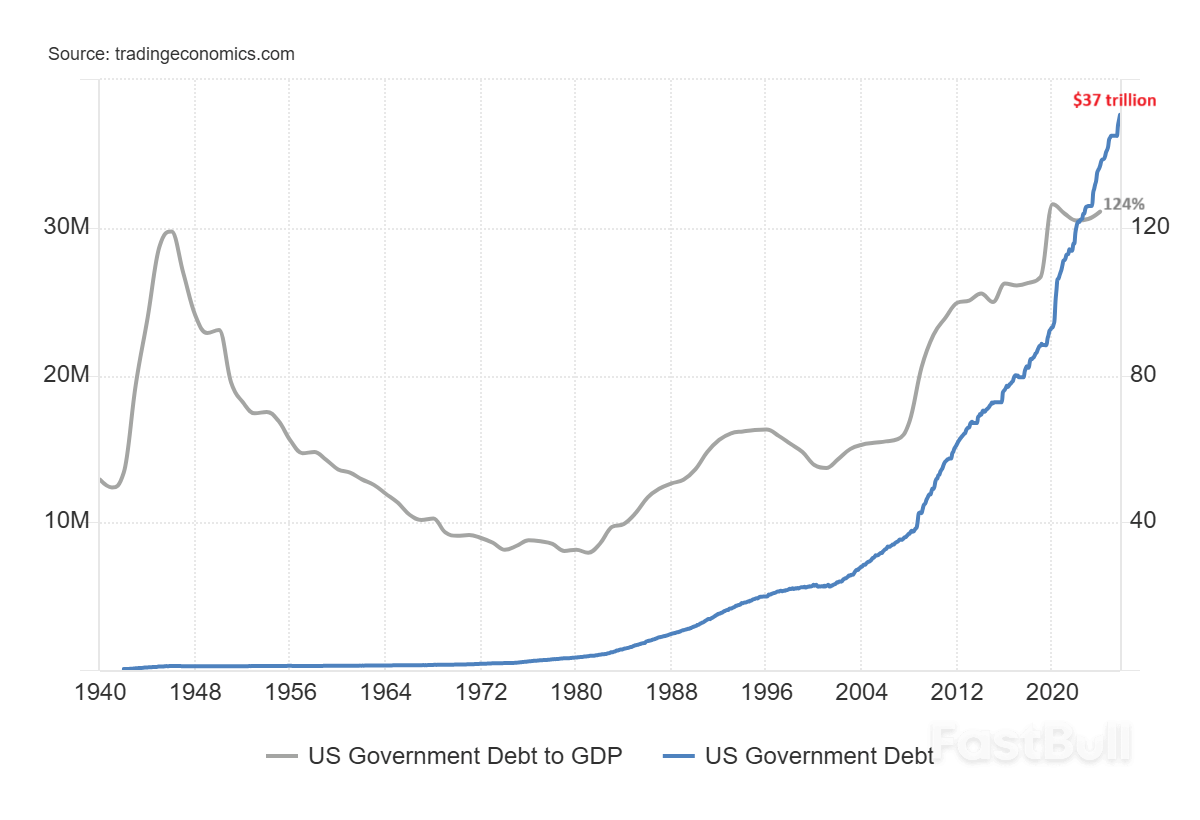
          This structural shift reflects a broader loss of trust in fiat currencies. Sovereign debt has surged, and inflation is now viewed as a tool to manage debt by inflating nominal GDP. The chart below shows that the US public debt has surged over $37 trillion, with an increase of over $400 billion this month alone, pushing the debt-to-GDP ratio to 124%. This ratio is near the pandemic-era highs.
          What Could Possibly Stop This Gold Rally? Drivers and Headwinds Behind 2025’s Record Surge_1
          This relentless debt expansion fuels expectations of continued dollar debasement, making gold more attractive as a store of value. As fiscal risks grow, investors increasingly seek protection in hard assets, reinforcing gold’s long-term bullish outlook.
          Inflation Revival and the Collapse in Fiat Trust
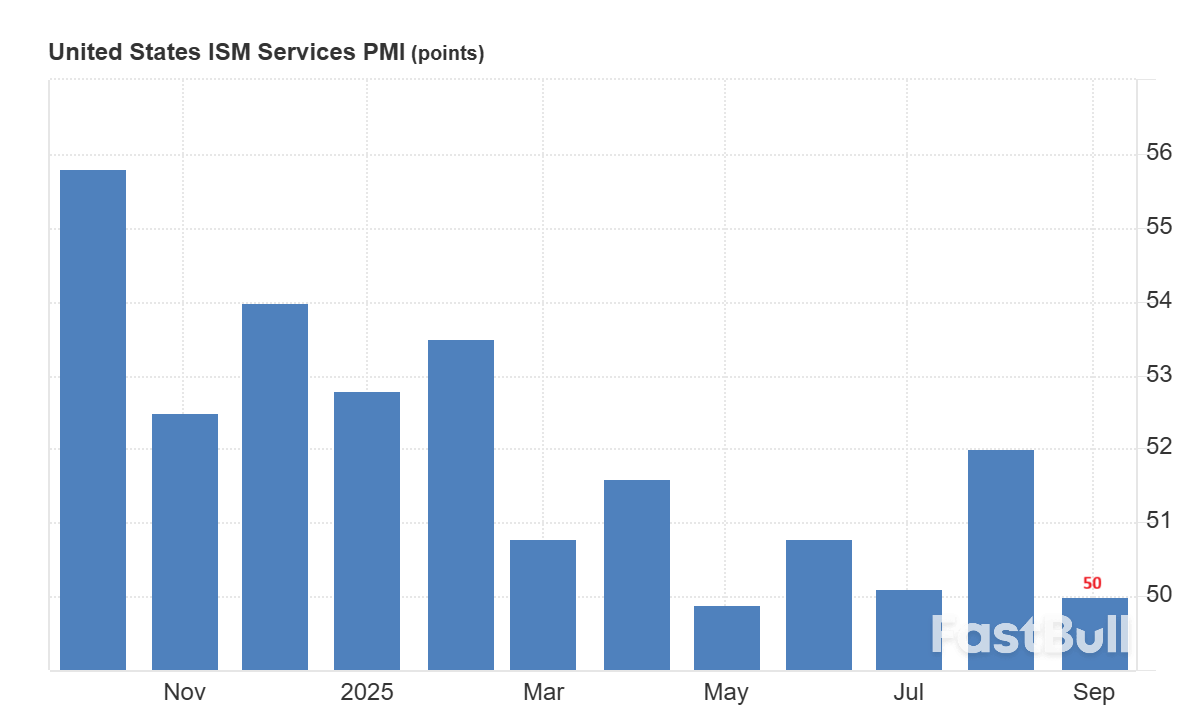
          The chart below shows that the September ISM Services PMI dropped to 50.0, signalling stagnation. The New Orders index fell to 50.4%, pointing to a weakening outlook.
          What Could Possibly Stop This Gold Rally? Drivers and Headwinds Behind 2025’s Record Surge_2
          On the other hand, the Employment sub-index also contracted. However, the main concern is inflation, as the Producer Price Index surged, reflecting rising input costs and mounting pressure on profit margins.
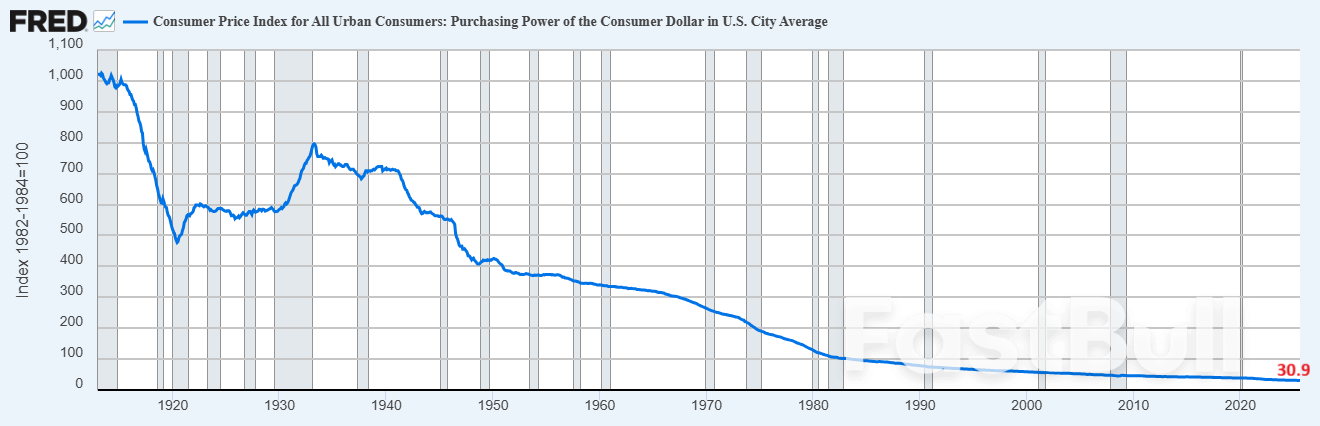
          The long-term data confirms the structural weakness of the U.S. dollar. The chart below shows that the CPI purchasing power index has fallen from 796 in April 1933 to just 30.9 in August 2025, which is a significant decline in purchasing power. This decline is even more when measured against gold.
          What Could Possibly Stop This Gold Rally? Drivers and Headwinds Behind 2025’s Record Surge_3
          Developed economies are trapped between slow growth and high debt. The policy response is clear: fiscal stimulus and suppressed interest rates. Inflation has become a feature, not a flaw.
          This environment supports hard assets. With rising inflation expectations and waning confidence in fiat currencies, gold remains the preferred store of value.

          What Could Stop the Gold Rally?

          A Stronger U.S. Dollar Could Derail the Rally
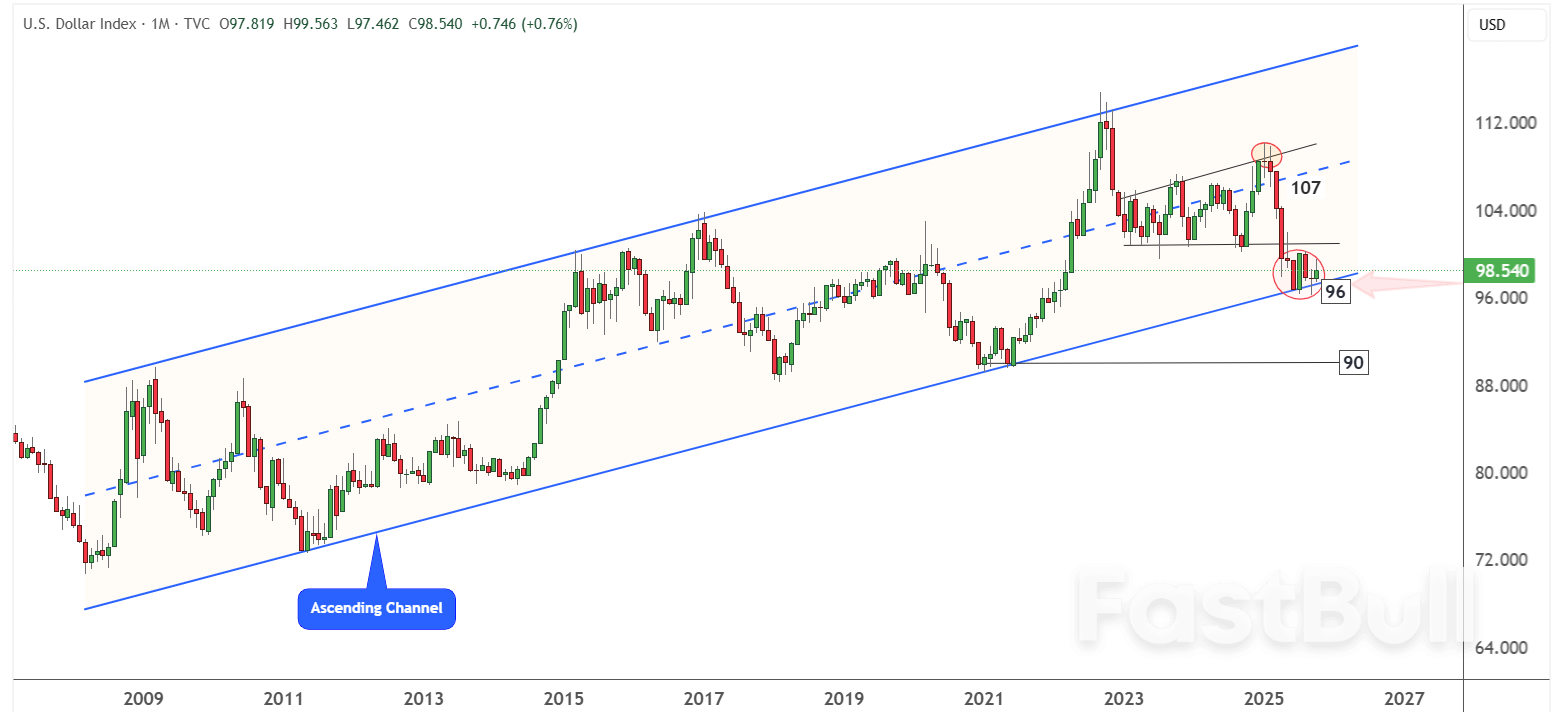
          A rebound in the U.S. dollar index would pose a serious headwind for the gold rally. The U.S. dollar index has recovered from its long-term support near the 96 level and regained ground as global yields and risk aversion have increased.
          When the U.S. dollar appreciates, gold becomes more expensive for foreign currency holders, reducing demand and increasing the cost of dollar-denominated gold.
          Moreover, a surprise decision to maintain higher U.S. interest rates or signs of a stronger U.S. economy could reverse expectations of rate cuts. This may potentially halt the gold’s current bullish momentum. In fact, the recent drop in gold prices on Friday from a record high of $4,380 was partly triggered by a rebound in the U.S. dollar index.
          Furthermore, gold’s attractiveness is inversely related to real yields and expected interest rate paths. If U.S. jobs, inflation, or growth data surprise to the upside, the Federal Reserve may keep rates higher for longer. This could trigger a sharper decline in gold prices from current levels. Easing inflation or strong employment figures may also weaken gold’s appeal as an inflation hedge.
          The chart below shows the long-term picture for the U.S. Dollar Index, which is rebounding from a key support zone. If the index fails to break below the 96 level, it could trigger a correction in gold prices. However, a break below the 96 level will trigger a strong drop to the 90 level.
          What Could Possibly Stop This Gold Rally? Drivers and Headwinds Behind 2025’s Record Surge_4
          Geopolitical De-Escalation May Remove Safe-Haven Demand
          The recent surge in gold prices rests heavily on its safe-haven appeal amid escalating geopolitical tensions. If these tensions ease, it could lead to a swift correction in gold. De-escalation in U.S.–China trade friction or resolution of conflicts in the Middle East may reduce the uncertainty premium currently priced into gold.
          If geopolitical tensions ease, investors may rotate out of gold and back into risk assets such as equities and corporate bonds, removing one of the key drivers of the recent rally. When safe-haven demand fades, gold may give back some of its gains after a strong rally. While many of gold’s long-term drivers are structural, a reduction in external shocks could act as a short-term brake on its momentum.
          Profit-Taking Threatens Short-Term Stability
          The gold market has posted remarkable gains, including record highs, sharp short-term rallies, and extended overbought technical readings. These rapid run-ups leave the market vulnerable to profit-taking. Hedge funds, traders, and long-term investors may lock in gains due to the overheated market conditions.
          A wave of profit-taking can trigger a cascade:
          Falling momentum
          Reduced speculative buying
          Increased defensive selling
          Steeper retracement
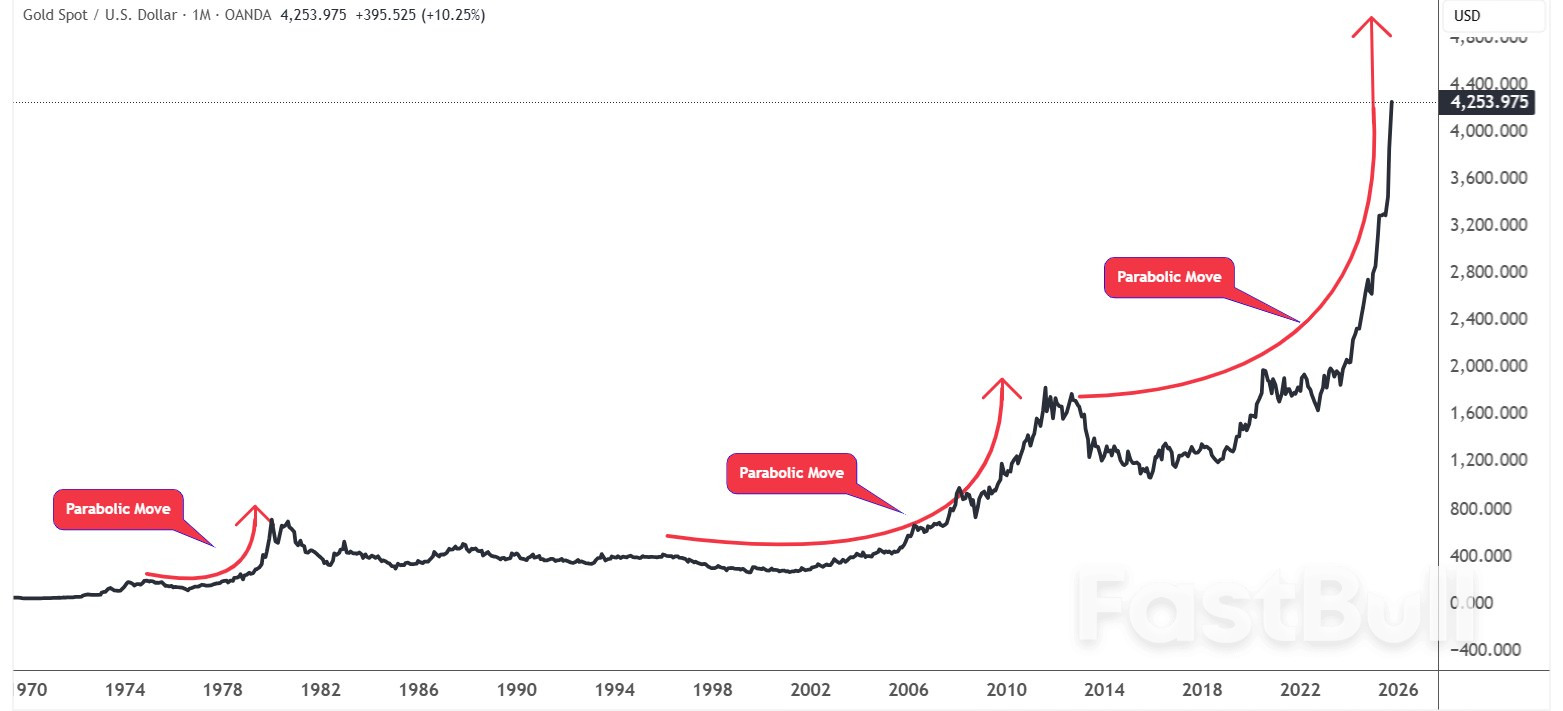
          Since gold is trading within a parabolic trend, the market can self-correct even if the underlying fundamentals remain supportive, as a healthy reset before resuming the uptrend.
          The chart below shows that gold has been trading within a parabolic trend, resulting in extraordinary surges during each cycle. The first major surge occurred between the August 1976 low of $100 and the January 1980 peak of $873, resulting in an approximate 773% increase.
          What Could Possibly Stop This Gold Rally? Drivers and Headwinds Behind 2025’s Record Surge_5
          A similar parabolic move took place from the September 1999 low of $253.60 to the September 2011 high of $1,921, marking a 657% increase.
          The current rally began from the December 2015 low of $1,046.45 and is showing the same parabolic characteristics. If the pattern continues, projections based on historical moves suggest this parabolic advance could extend toward the $8,000 to $10,000 range over the next few years.
          However, the parabolic moves come with a strong correction on the way. If the fundamentals improve, then the price correction might be steeper than expected within the same bullish overview.
          Overbought Signals Suggest a Technical Pullback Ahead
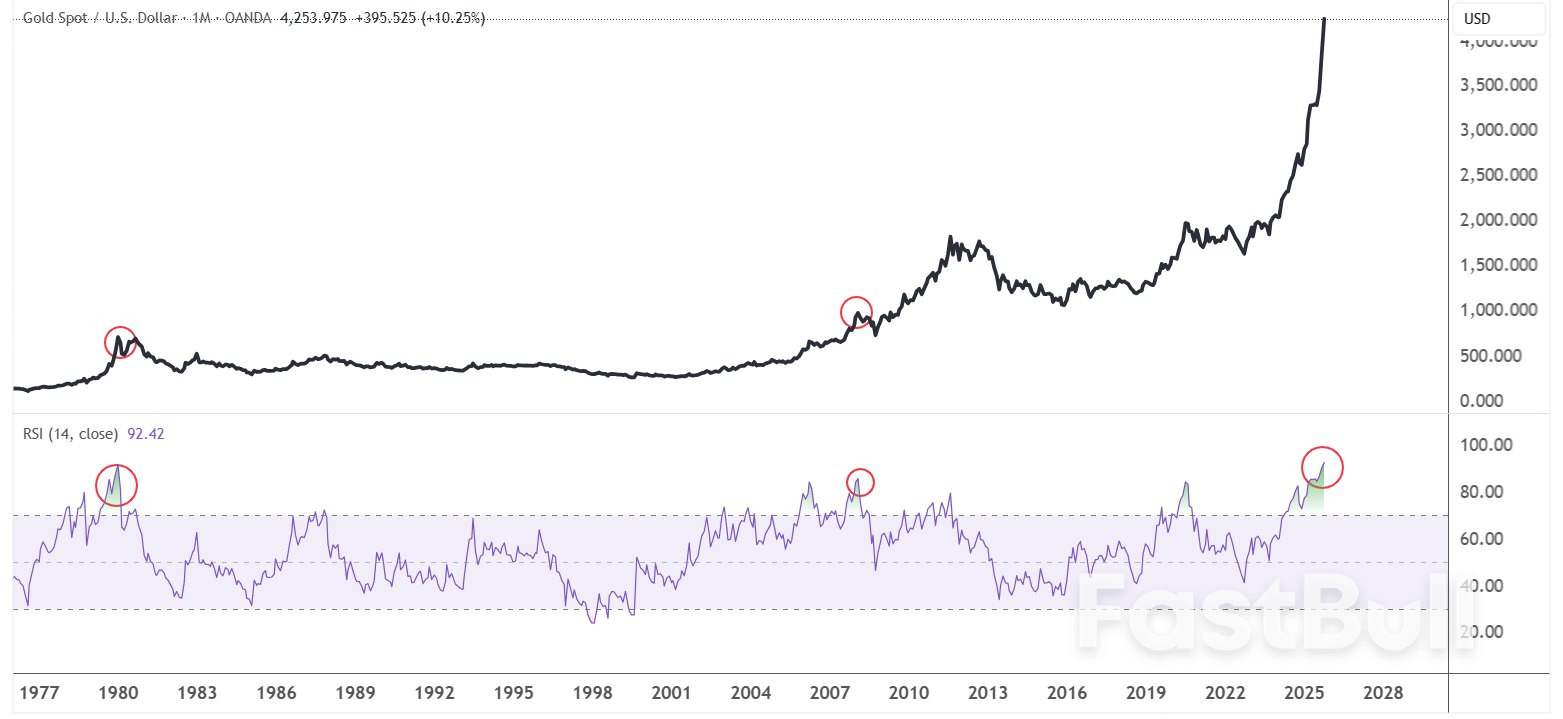
          From a technical analysis viewpoint, gold is facing a clear risk of a pullback. The chart below shows that the RSI has reached levels not seen since the 1980s, indicating that gold has entered extremely overbought territory.
          While the current parabolic move may not yet be complete and could still extend toward the $10,000 zone, the RSI suggests overheating. This indicates the market may be due for a pullback. A correction from current levels would be healthy and could attract new buyers, reinforcing the longer-term target near $10,000.
          What Could Possibly Stop This Gold Rally? Drivers and Headwinds Behind 2025’s Record Surge_6
          The gold price cannot rise without corrections. Pullbacks are a healthy sign and necessary to sustain bullish momentum. If gold continues to surge without pausing, it often leads to a top followed by a prolonged consolidation to absorb the gains.
          One example can be seen in the chart above, where the RSI reached around the 85 level in February 2008, resulting in a sharp drop in gold during the financial crisis of 2008. The price then rebounded and surged to a major peak in 2011.
          Based on the above discussion, it is clear that the gold market may face a correction from current levels, and such pullbacks should be viewed as buying opportunities for long-term investors.

          How Seasonality Shapes Gold’s Year-End Moves?

          Gold follows seasonal patterns that often repeat over decades. These patterns help identify likely inflecion points and guide strategies based on historical behaviour. The current rally aligns with seasonal strength and long-term bullish cycles.
          Historically, gold performs well from late Q3 through Q1 of the following year. This seasonal trend aligns with rising physical demand from India and China during their festival and wedding seasons. In addition, central banks often accumulate reserves before year-end to strengthen their balance sheets.
          Over the past 20 years, gold has often posted strong gains between September and February. However, events like the 2008 financial crisis and the COVID-19 shock in 2019 temporarily disrupted this seasonal pattern.
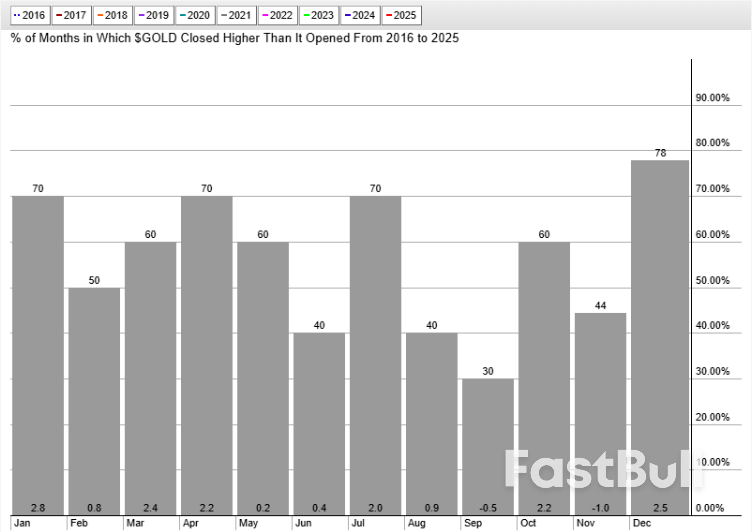
          The chart below shows the seasonal trend over the last 10 years, highlighting that January, April, and December have consistently been positive months, where gold prices closed higher than their opening levels. October also shows a moderately bullish tendency, with a 60% probability of a positive close.
          What Could Possibly Stop This Gold Rally? Drivers and Headwinds Behind 2025’s Record Surge_7
          When gold prices peak in October, a correction in November leads to strong positive price action in December, helping the metal close the year higher.
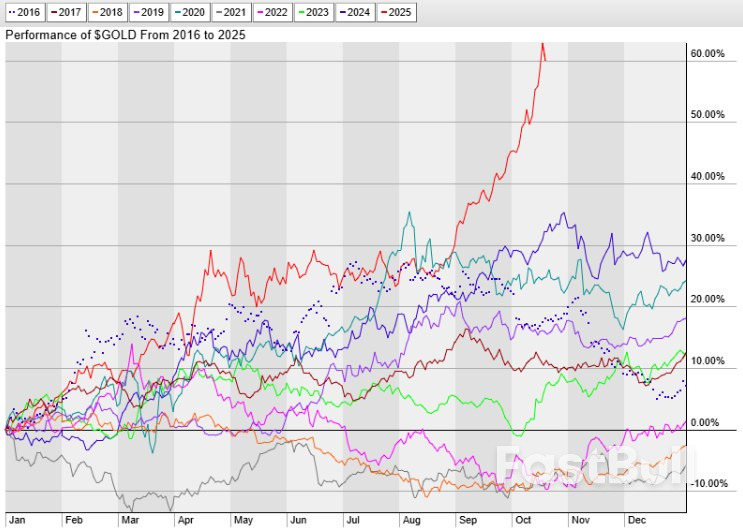
          The chart below also shows that 2025 has been extremely bullish due to ongoing geopolitical crises, but the price action remains similar to 2024. The escalation of conflicts in the Middle East in 2024 and renewed trade tensions from the 2025 Trump tariffs have intensified volatility. Since prices are attempting a surge in October within the extended zone, a short-term correction may now emerge, creating potential buying opportunities in November.
          What Could Possibly Stop This Gold Rally? Drivers and Headwinds Behind 2025’s Record Surge_8

          Conclusion – The Bigger Picture

          Gold has surged to record highs, driven by strong demand, inflation fears, and global instability. Physical shortages, central bank buying, and the collapse of trust in fiat currencies continue to fuel this rally.
          However, the market is not without risk. A rebound in the U.S. dollar, falling geopolitical tensions, or stronger economic data could trigger a strong correction. Profit-taking and technical overbought signals also increase the chance of short-term pullbacks. Since the price is trading in a parabolic trend, the correction might be steeper than expected.
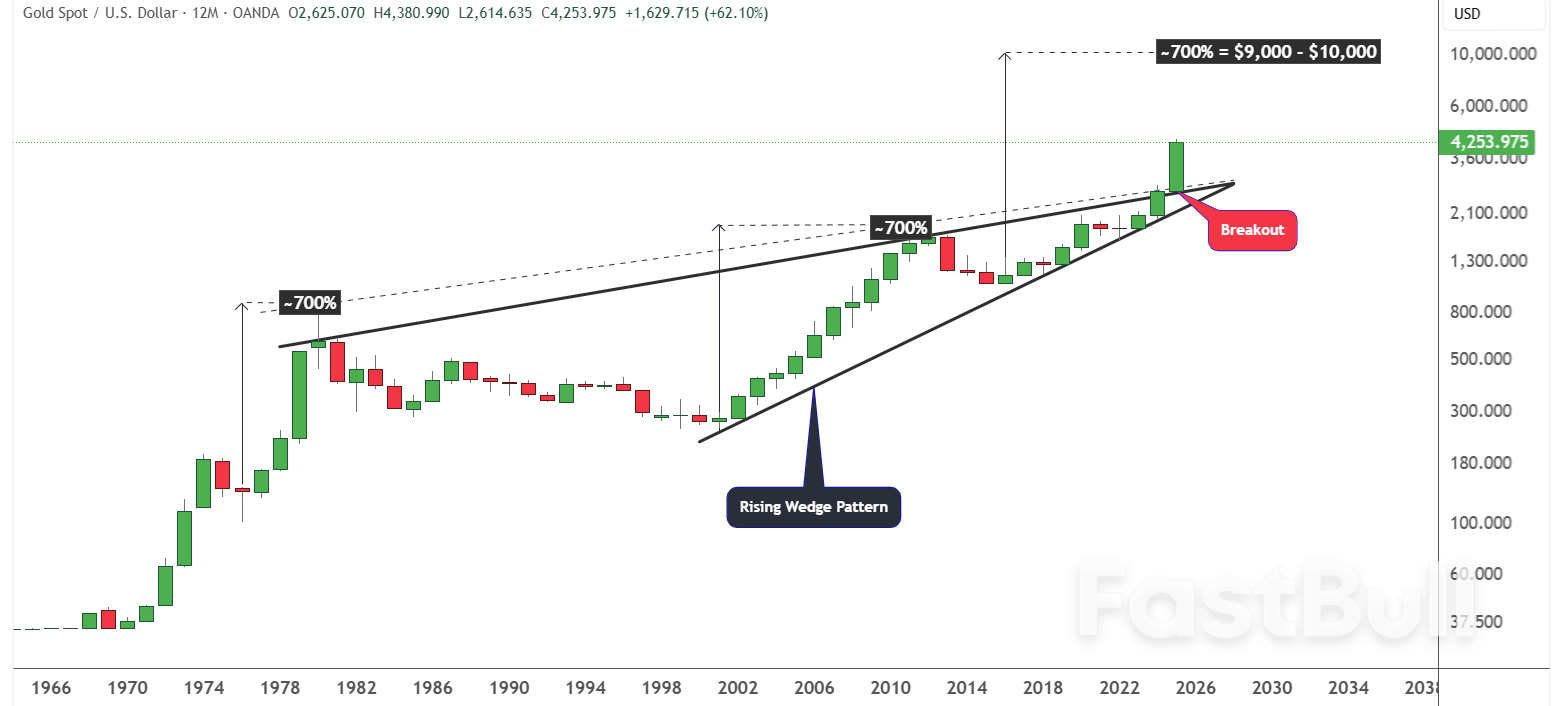
          However, the long-term trend remains strongly bullish. The chart below confirms a major structural breakout in the gold market in 2024, indicating that prices could advance toward the $9,000–$10,000 range. This range is a measured move projected from this breakout pattern.
          What Could Possibly Stop This Gold Rally? Drivers and Headwinds Behind 2025’s Record Surge_9
          If history repeats, temporary setbacks will not end the rally. These pullbacks will only recharge the next leg higher. The gold market may pause, but the bigger picture still points to a strong uptrend.
          Any correction within this parabolic move could offer a strategic entry point for long-term investors. The key support levels within this trend remain near the $4,000 and $3,500 zones, where rising debt, persistent inflation, and strong demand for hard assets are likely to drive gold to new highs.

          Source: fxempire

          Risk Warnings and Disclaimers
          You understand and acknowledge that there is a high degree of risk involved in trading. Following any strategies or investment methods may lead to potential losses. The content on the site is provided by our contributors and analysts for information purposes only. You are solely responsible for determining whether any trading assets, securities, strategy, or any other product is suitable for investing based on your own investment objectives and financial situation.
          Add to Favorites
          Share

          The AI Fever: Bubble or Will It Keep Rising?

          Adam

          Stocks

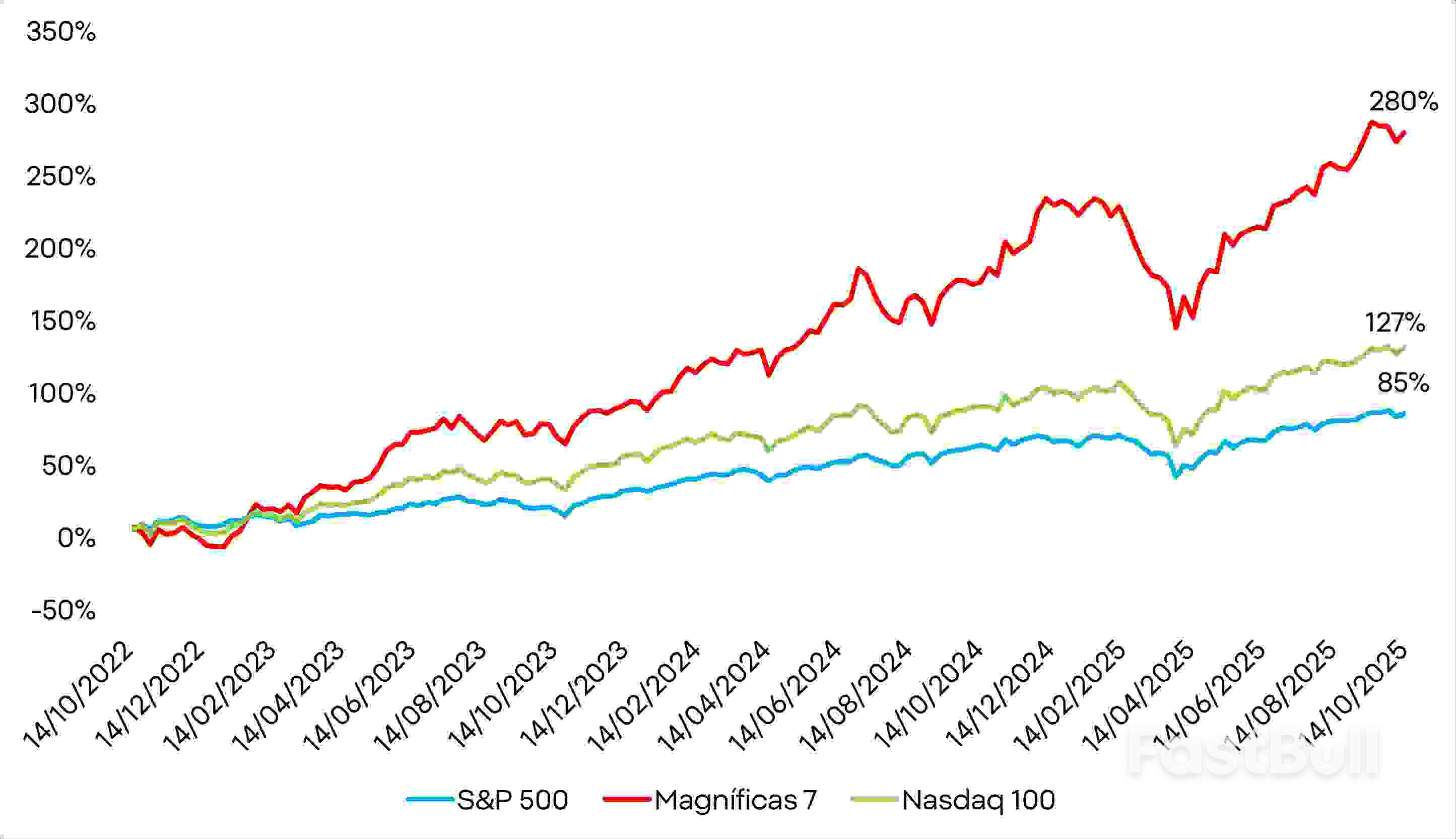
          Artificial intelligence has gone from being a promise to becoming the driving force behind a new stock market era. The S&P 500 began its current bullish streak on October 12, 2022, shortly before the launch of ChatGPT. Since then, it has gained 85%. Over the past twelve months, the index has risen 15%—double the average increase seen in the third year of a bull market. Investors, fascinated yet uneasy, are asking whether we’re witnessing a genuine technological revolution or the prelude to another financial bubble.
          The AI Fever: Bubble or Will It Keep Rising?_1
          The numbers speak for themselves. Nvidia has surged 1,500% in just three years; Meta Platforms, more than 450%. The ten largest companies on Wall Street now account for 40% of the S&P 500 and 22% of global market capitalization. At the peak of the dot-com bubble, that figure barely reached 14%. Current levels are historic, but unlike back then, today’s tech giants are generating real profits—not empty promises.
          Across the ten biggest market bubbles of the past century, average gains from trough to peak were around 244%. That suggests that the “Magnificent Seven” may still have some room left—but not much. And the timing also aligns with the historical average of roughly two and a half years. Are we in a bubble?
          High Valuations—but With Real Support
          Valuations are high, yes—but not the highest in history. And more importantly, today’s leading tech companies are delivering strong, sustained profits.
          While current valuations are elevated compared to the broader market and historical averages, they remain far below those of Internet stocks before the dot-com crash.In late 1999, Cisco traded at 96.7 times future earnings, Oracle at 92.1, and eBay at an incredible 351.7. Today’s AI leaders are much more restrained: Microsoft (32.2), Apple (31.9), Meta (24.1), and Alphabet (23.4). Even Amazon (30) and Nvidia (31.8) sit below their five-year averages. Only Tesla stands out with a multiple of 186.In other words, prices are demanding, but they’re backed by tangible earnings—not by speculative dreams.
          Stock prices have risen sharply, but so far this has been accompanied by solid and sustained earnings growth, rather than wild speculation about the future. This is unusual compared to past bubbles, where favored companies were often driven by lofty expectations of dominance, not by proven performance.
          Previous bubbles also tended to coincide with periods of intense competition, as investors and newcomers flooded the market. This time, enthusiasm for AI is concentrated in just a handful of companies.
          A key metric to watch is the gap between return on invested capital (ROIC) and the weighted average cost of capital (WACC). Today, that spread remains positive—meaning firms are still generating returns well above their financing costs. As long as it stays that way, the expansion cycle can continue. True bubbles burst when capital costs rise or returns fall enough to close that gap.
          On a macro level, the context is also different. During the dot-com era, the Federal Reserve began raising interest rates, triggering a wave of defaults. Today, the opposite is happening: rates are being cut, and the Fed’s balance-sheet reduction program has been paused.

          A Revaluation, Not a Fad

          The rise of artificial intelligence is concentrated in a few hands, but it’s not built on pure speculation.The profits of leading companies are growing in step with their stock prices. Taiwan Semiconductor, the world’s largest chipmaker, recently raised its already-lofty revenue forecasts—clear evidence that demand remains red-hot.
          One of the companies most exposed to the AI boom is OpenAI. Its latest deal with Broadcom—adding to agreements with Nvidia and AMD—pushes its estimated spending above one trillion dollars. Despite skepticism around that number, the company reportedly has $100 billion available from Nvidia investments, hasn’t yet tapped debt markets, and enjoys support from the Trump administration.
          That last point may prove crucial. The race for AI dominance is also a geopolitical battle. Whoever leads—whether the U.S. or China—will control the global economy of the future. Economic efforts and government spending to secure that lead will likely intensify in the coming months, benefiting the industry’s key players.

          Lessons from the Past

          The comparison to the 1990s is inevitable, but the differences are profound. Then, soaring stocks often belonged to young, unprofitable startups.Today, the leaders of the AI rally are mature, profitable giants.
          Take OpenAI: it now has about 700 million users—roughly 9% of the world’s population—up from 500 million in March. Its revenues are on track to triple from 2024 levels.
          There are also at least three additional reasons why AI doesn’t resemble a classic bubble:
          Cross-industry integration: AI is embedded across nearly every sector, not isolated in one niche.
          Immediate productivity gains: measurable efficiency and cost savings are already visible.
          Strategic backing: governments and economic blocs are funding AI as a geopolitical priority, justifying unprecedented levels of investment and debt.

          Risks on the Horizon

          Of course, risks remain. The gap between investment and returns could widen if spending accelerates too fast.Rising leverage, China’s capital race, and the possible use of opaque financial vehicles could inflate systemic risks.There’s also a chance that AI might fall short of its revolutionary promises—or that today’s data-center chips could become obsolete before delivering their expected returns.And mounting energy costs, driven by the electricity demands of massive data centers, add another layer of pressure.

          Conclusion: The Road Ahead

          History shows that bubbles burst when profits no longer justify valuations or when credit dries up. So far, there’s no sign of either.Artificial intelligence is creating real value, boosting productivity, and opening new economic opportunities.
          Far from being a bubble, this could well be the beginning of the greatest economic transformation in modern history. The challenge is no longer to fear AI’s rise, but to learn how to harness it. Those who understand it first will lead the next decad
          The AI Fever: Bubble or Will It Keep Rising?_2
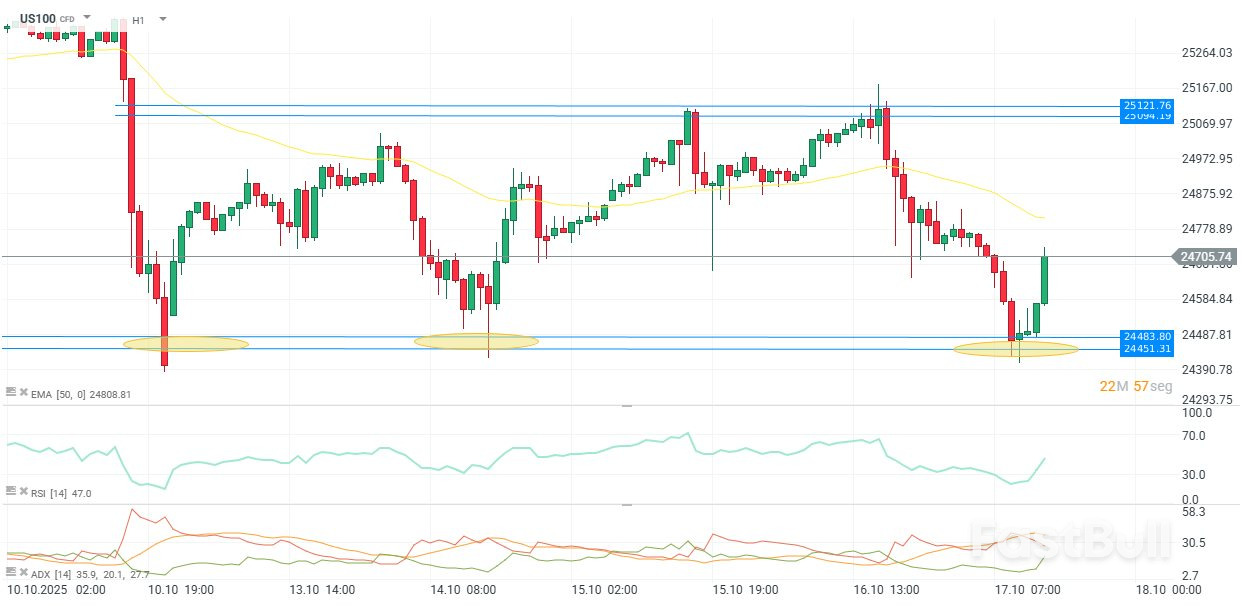
          With earnings season underway and results so far looking strong, the Nasdaq 100 could be the best-performing U.S. index for the rest of the year, at a time when some doubts are beginning to emerge about regional banks. Source: Xstation

          Source: xtb

          Risk Warnings and Disclaimers
          You understand and acknowledge that there is a high degree of risk involved in trading. Following any strategies or investment methods may lead to potential losses. The content on the site is provided by our contributors and analysts for information purposes only. You are solely responsible for determining whether any trading assets, securities, strategy, or any other product is suitable for investing based on your own investment objectives and financial situation.
          Add to Favorites
          Share

          Trump Says AUKUS Deal Is Proceeding ‘Rapidly’ In Boost For Pact

          Olivia Brooks

          Political

          President Donald Trump says the AUKUS pact between the US, Australia and the UK is “moving along very rapidly,” signaling he’ll allow the Biden-era partnership to go ahead eve as his administration reviews whether to keep it going.

          “It was made a while ago, and nobody did anything about it,” Trump said during a meeting with Australia Prime Minister Anthony Albanese. “It was going too slowly. Now we’re starting, we have it all set.”

          The Trump administration announced a review of the pact earlier this year, raising fears from allies that he was preparing to kill it. But it aligns with some of his top advisers’ belief that the US should focus more of its military assets on Asia, and may emerge as a rare program dating from former President Joe Biden’s administration that Trump won’t scrap.

          AUKUS is intended to check China’s military advance in the Indo-Pacific region. Central to the agreement is the project — expected to cost hundreds of billions of dollars — to help Australia develop a fleet of nuclear-powered submarines over 30 years. Another pillar is a defense technology sharing agreement.

          Trump’s remarks will be a relief for Albanese’s government, which has pushed to make sure the agreement remains intact. Speaking alongside Trump, US Secretary of the Navy John Phelan said the review was really meant to improve the AUKUS framework and “clarify some of the ambiguity that was in the prior agreement.”

          Asked to comment on Phelan’s remarks, Trump said they were “minor details” and the US was going “full-steam ahead.”

          Source: Bloomberg Europe

          Risk Warnings and Disclaimers
          You understand and acknowledge that there is a high degree of risk involved in trading. Following any strategies or investment methods may lead to potential losses. The content on the site is provided by our contributors and analysts for information purposes only. You are solely responsible for determining whether any trading assets, securities, strategy, or any other product is suitable for investing based on your own investment objectives and financial situation.
          Add to Favorites
          Share

          Wall Street has been worried about bad loans for weeks. Now those fears are spreading

          Adam

          Stocks

          Economic

          Several financial groups are wrestling with bad loans, raising worries on Wall Street of more to come.
          For weeks, investors have focused on Jefferies Financial Group, an investment bank that has at least $45 million worth of exposure to First Brands, an auto-parts supplier that filed for bankruptcy last month.
          But on Thursday, they turned some of their attention to two regional banks, Western Alliance Bancorp and Zions Bancorp, after concerns about some of their loans as well.
          All three banks’ stocks suffered their steepest single-day losses in over six months on Thursday. That anxiety played out in the market at large as well, with the Dow shedding 0.65% that day. Meanwhile, investors flocked to safe havens, including US Treasuries, gold and silver.
          If all this is bringing back memories of the 2023 regional banking crisis, you’re not alone. For now, it’s unclear if there’s a risk to the broader market or if this is just a few bad eggs.

          What’s happening with Jefferies?

          Jefferies, like several other financial groups, offered funding to First Brands through third-party factoring, which is when a business promises to repay lenders when one of its customers pays an outstanding balance.
          But creditors allege First Brands used the same invoice multiple times to access funds from private lenders that were unaware of the double dipping. Translation: Lenders like Jefferies might not have provided financing to First Brands if they had had a more complete picture.
          All told, Jefferies’ $45 million exposure to First Brands represents less than 5% of its pre-tax income from last year, meaning its exposure to First Brands alone is unlikely to cause it to shutter.
          Jefferies CEO Rich Handler and president Brian Friedman stressed that in a statement issued earlier this week aiming to calm investors.
          But investors seem more concerned about whether Jefferies missed warning signs in this case, which reportedly is being investigated by the Department of Justice for potential fraud, and if it’s missed similar signs elsewhere. The company declined to comment.

          What’s going on with Western Alliance and Zions?

          Both stocks sank by over 10% on Thursday following disclosures that they lent to businesses they claimed defrauded them.
          Zions (ZION) said in a Wednesday filing with the Securities and Exchange Commission that it anticipates losing $60 million as a result.
          Western Alliance (WAL) didn’t share how much it expects to lose. Instead, it shared in a Thursday morning filing that it “initiated a lawsuit alleging fraud by the borrower.” Because of this, it said it now has more loans at risk of not being repaid.
          Representatives from Zions and Western Alliance didn’t respond to CNN’s requests for comment.

          Should you brace for more market worries?

          As JPMorgan Chase CEO Jamie Dimon said this week, before details emerged about Zions and Western Alliance: “When you see one cockroach, there are probably more.”
          And JPMorgan isn’t exactly in the clear either. It’s poised to suffer $170 million from soured loans to Tricolor, another company that declared bankruptcy last month. JPMorgan is the nation’s largest bank, and lawyers representing the trustees of bankrupt Tricolor have alleged that the company was engaged in fraud, Bloomberg has reported.
          But the question is: How many other cockroaches are there?

          Source: cnn

          To stay updated on all economic events of today, please check out our Economic calendar
          Risk Warnings and Disclaimers
          You understand and acknowledge that there is a high degree of risk involved in trading. Following any strategies or investment methods may lead to potential losses. The content on the site is provided by our contributors and analysts for information purposes only. You are solely responsible for determining whether any trading assets, securities, strategy, or any other product is suitable for investing based on your own investment objectives and financial situation.
          Add to Favorites
          Share
          FastBull
          Copyright © 2025 FastBull Ltd

          728 RM B 7/F GEE LOK IND BLDG NO 34 HUNG TO RD KWUN TONG KLN HONG KONG

          TelegramInstagramTwitterfacebooklinkedin
          App Store Google Play Google Play
          Products
          Charts

          Chats

          Q&A with Experts
          Screeners
          Economic Calendar
          Data
          Tools
          Membership
          Features
          Function
          Markets
          Copy Trading
          Latest Signals
          Contests
          News
          Analysis
          24/7
          Columns
          Education
          Company
          Careers
          About Us
          Contact Us
          Advertising
          Help Center
          Feedback
          User Agreement
          Privacy Policy
          Business

          White Label

          Data API

          Web Plug-ins

          Poster Maker

          Affiliate Program

          Risk Disclosure

          The risk of loss in trading financial instruments such as stocks, FX, commodities, futures, bonds, ETFs and crypto can be substantial. You may sustain a total loss of the funds that you deposit with your broker. Therefore, you should carefully consider whether such trading is suitable for you in light of your circumstances and financial resources.

          No decision to invest should be made without thoroughly conducting due diligence by yourself or consulting with your financial advisors. Our web content might not suit you since we don't know your financial conditions and investment needs. Our financial information might have latency or contain inaccuracy, so you should be fully responsible for any of your trading and investment decisions. The company will not be responsible for your capital loss.

          Without getting permission from the website, you are not allowed to copy the website's graphics, texts, or trademarks. Intellectual property rights in the content or data incorporated into this website belong to its providers and exchange merchants.

          Not Logged In

          Log in to access more features

          FastBull Membership

          Not yet

          Purchase

          Become a signal provider
          Help Center
          Customer Service
          Dark Mode
          Price Up/Down Colors

          Log In

          Sign Up

          Position
          Layout
          Fullscreen
          Default to Chart
          The chart page opens by default when you visit fastbull.com