• Trade
  • Markets
  • Copy
  • Contests
  • News
  • 24/7
  • Calendar
  • Q&A
  • Chats
Trending
Screeners
SYMBOL
LAST
BID
ASK
HIGH
LOW
NET CHG.
%CHG.
SPREAD
SPX
S&P 500 Index
6827.42
6827.42
6827.42
6899.86
6801.80
-73.58
-1.07%
--
DJI
Dow Jones Industrial Average
48458.04
48458.04
48458.04
48886.86
48334.10
-245.98
-0.51%
--
IXIC
NASDAQ Composite Index
23195.16
23195.16
23195.16
23554.89
23094.51
-398.69
-1.69%
--
USDX
US Dollar Index
97.950
98.030
97.950
98.500
97.950
-0.370
-0.38%
--
EURUSD
Euro / US Dollar
1.17394
1.17409
1.17394
1.17496
1.17192
+0.00011
+ 0.01%
--
GBPUSD
Pound Sterling / US Dollar
1.33707
1.33732
1.33707
1.33997
1.33419
-0.00148
-0.11%
--
XAUUSD
Gold / US Dollar
4299.39
4299.39
4299.39
4353.41
4257.10
+20.10
+ 0.47%
--
WTI
Light Sweet Crude Oil
57.233
57.485
57.233
58.011
56.969
-0.408
-0.71%
--

Community Accounts

Signal Accounts
--
Profit Accounts
--
Loss Accounts
--
View More

Become a signal provider

Sell trading signals to earn additional income

View More

Guide to Copy Trading

Get started with ease and confidence

View More

Signal Accounts for Members

All Signal Accounts

Best Return
  • Best Return
  • Best P/L
  • Best MDD
Past 1W
  • Past 1W
  • Past 1M
  • Past 1Y

All Contests

  • All
  • Trump Updates
  • Recommend
  • Stocks
  • Cryptocurrencies
  • Central Banks
  • Featured News
Top News Only
Share

Thai Leader Anutin: Landmine Blast That Killed Thai Soldiers 'Not A Roadside Accident'

Share

Thai Leader Anutin: Thailand To Continue Military Action Until 'We Feel No More Harm'

Share

Cambodian Prime Minister Hun Manet Says He Had Phone Calls With Trump And Malaysian Leader Anwar About Ceasefire

Share

Cambodia's Hun Manet Says USA, Malaysia Should Verify 'Which Side Fired First' In Latest Conflict

Share

Cambodia's Hun Manet: Cambodia Maintains Its Stance In Seeking Peaceful Resolution Of Disputes

Share

Nasdaq Companies: Allergan, Ferrovia, Insmed, Monolithic Power Systems, Seagate Technology, And Western Digital Will Be Added To The NASDAQ 100 Index. Biogen, CdW, GlobalFoundries, Lululemon, ON Semiconductor, And Tradedesk Will Be Removed From The NASDAQ 100 Index

Share

Witkoff Headed To Berlin This Weekend To Meet With Zelenskiy, European Leaders -Wsj Reporter On X

Share

Russia Attacks Two Ukrainian Ports, Damaging Three Turkish-Owned Vessels

Share

[Historic Flooding Occurs In At Least Four Rivers In Washington State Due To Days Of Torrential Rains] Multiple Areas In Washington State Have Been Hit By Severe Flooding Due To Days Of Torrential Rains, With At Least Four Rivers Experiencing Historic Flooding. Reporters Learned On The 12th That The Floods Caused By The Torrential Rains In Washington State Have Destroyed Homes And Closed Several Highways. Experts Warn That Even More Severe Flooding May Occur In The Future. A State Of Emergency Has Been Declared In Washington State

Share

Trump Says Proposed Free Economic Zone In Donbas Would Work

Share

Trump: I Think My Voice Should Be Heard

Share

Trump Says Will Be Choosing New Fed Chair In Near Future

Share

Trump Says Proposed Free Economic Zone In Donbas Complex But Would Work

Share

Trump Says Land Strikes In Venezuela Will Start Happening

Share

US President Trump: Thailand And Cambodia Are In A Good Situation

Share

State Media: North Korean Leader Kim Hails Troops Returning From Russia Mission

Share

The 10-year Treasury Yield Rose About 5 Basis Points During The "Fed Rate Cut Week," And The 2/10-year Yield Spread Widened By About 9 Basis Points. On Friday (December 12), In Late New York Trading, The Yield On The Benchmark 10-year US Treasury Note Rose 2.75 Basis Points To 4.1841%, A Cumulative Increase Of 4.90 Basis Points For The Week, Trading Within A Range Of 4.1002%-4.2074%. It Rose Steadily From Monday To Wednesday (before The Fed Announced Its Rate Cut And Treasury Bill Purchase Program), Subsequently Exhibiting A V-shaped Recovery. The 2-year Treasury Yield Fell 1.82 Basis Points To 3.5222%, A Cumulative Decrease Of 3.81 Basis Points For The Week, Trading Within A Range Of 3.6253%-3.4989%

Share

Trump: Lots Of Progress Being Made On Russia-Ukraine

Share

NOPA November US Soybean Crush Estimated At 220.285 Million Bushels

Share

SPDR Gold Trust Reports Holdings Up 0.22%, Or 2.28 Tonnes, To 1053.11 Tonnes By Dec 12

TIME
ACT
FCST
PREV
U.K. Trade Balance Non-EU (SA) (Oct)

A:--

F: --

P: --

U.K. Trade Balance (Oct)

A:--

F: --

P: --

U.K. Services Index MoM

A:--

F: --

P: --

U.K. Construction Output MoM (SA) (Oct)

A:--

F: --

P: --

U.K. Industrial Output YoY (Oct)

A:--

F: --

P: --

U.K. Trade Balance (SA) (Oct)

A:--

F: --

P: --

U.K. Trade Balance EU (SA) (Oct)

A:--

F: --

P: --

U.K. Manufacturing Output YoY (Oct)

A:--

F: --

P: --

U.K. GDP MoM (Oct)

A:--

F: --

P: --

U.K. GDP YoY (SA) (Oct)

A:--

F: --

P: --

U.K. Industrial Output MoM (Oct)

A:--

F: --

P: --

U.K. Construction Output YoY (Oct)

A:--

F: --

P: --

France HICP Final MoM (Nov)

A:--

F: --

P: --

China, Mainland Outstanding Loans Growth YoY (Nov)

A:--

F: --

P: --

China, Mainland M2 Money Supply YoY (Nov)

A:--

F: --

P: --

China, Mainland M0 Money Supply YoY (Nov)

A:--

F: --

P: --

China, Mainland M1 Money Supply YoY (Nov)

A:--

F: --

P: --

India CPI YoY (Nov)

A:--

F: --

P: --

India Deposit Gowth YoY

A:--

F: --

P: --

Brazil Services Growth YoY (Oct)

A:--

F: --

P: --

Mexico Industrial Output YoY (Oct)

A:--

F: --

P: --

Russia Trade Balance (Oct)

A:--

F: --

P: --

Philadelphia Fed President Henry Paulson delivers a speech
Canada Building Permits MoM (SA) (Oct)

A:--

F: --

P: --

Canada Wholesale Sales YoY (Oct)

A:--

F: --

P: --

Canada Wholesale Inventory MoM (Oct)

A:--

F: --

P: --

Canada Wholesale Inventory YoY (Oct)

A:--

F: --

P: --

Canada Wholesale Sales MoM (SA) (Oct)

A:--

F: --

P: --

Germany Current Account (Not SA) (Oct)

A:--

F: --

P: --

U.S. Weekly Total Rig Count

A:--

F: --

P: --

U.S. Weekly Total Oil Rig Count

A:--

F: --

P: --

Japan Tankan Large Non-Manufacturing Diffusion Index (Q4)

--

F: --

P: --

Japan Tankan Small Manufacturing Outlook Index (Q4)

--

F: --

P: --

Japan Tankan Large Non-Manufacturing Outlook Index (Q4)

--

F: --

P: --

Japan Tankan Large Manufacturing Outlook Index (Q4)

--

F: --

P: --

Japan Tankan Small Manufacturing Diffusion Index (Q4)

--

F: --

P: --

Japan Tankan Large Manufacturing Diffusion Index (Q4)

--

F: --

P: --

Japan Tankan Large-Enterprise Capital Expenditure YoY (Q4)

--

F: --

P: --

U.K. Rightmove House Price Index YoY (Dec)

--

F: --

P: --

China, Mainland Industrial Output YoY (YTD) (Nov)

--

F: --

P: --

China, Mainland Urban Area Unemployment Rate (Nov)

--

F: --

P: --

Saudi Arabia CPI YoY (Nov)

--

F: --

P: --

Euro Zone Industrial Output YoY (Oct)

--

F: --

P: --

Euro Zone Industrial Output MoM (Oct)

--

F: --

P: --

Canada Existing Home Sales MoM (Nov)

--

F: --

P: --

Euro Zone Total Reserve Assets (Nov)

--

F: --

P: --

U.K. Inflation Rate Expectations

--

F: --

P: --

Canada National Economic Confidence Index

--

F: --

P: --

Canada New Housing Starts (Nov)

--

F: --

P: --

U.S. NY Fed Manufacturing Employment Index (Dec)

--

F: --

P: --

U.S. NY Fed Manufacturing Index (Dec)

--

F: --

P: --

Canada Core CPI YoY (Nov)

--

F: --

P: --

Canada Manufacturing Unfilled Orders MoM (Oct)

--

F: --

P: --

Canada Manufacturing New Orders MoM (Oct)

--

F: --

P: --

Canada Core CPI MoM (Nov)

--

F: --

P: --

Canada Manufacturing Inventory MoM (Oct)

--

F: --

P: --

Canada CPI YoY (Nov)

--

F: --

P: --

Canada CPI MoM (Nov)

--

F: --

P: --

Canada CPI YoY (SA) (Nov)

--

F: --

P: --

Canada Core CPI MoM (SA) (Nov)

--

F: --

P: --

Q&A with Experts
    • All
    • Chatrooms
    • Groups
    • Friends
    Connecting
    .
    .
    .
    Type here...
    Add Symbol or Code

      No matching data

      All
      Trump Updates
      Recommend
      Stocks
      Cryptocurrencies
      Central Banks
      Featured News
      • All
      • Russia-Ukraine Conflict
      • Middle East Flashpoint
      • All
      • Russia-Ukraine Conflict
      • Middle East Flashpoint
      Search
      Products

      Charts Free Forever

      Chats Q&A with Experts
      Screeners Economic Calendar Data Tools
      Membership Features
      Data Warehouse Market Trends Institutional Data Policy Rates Macro

      Market Trends

      Market Sentiment Order Book Forex Correlations

      Top Indicators

      Charts Free Forever
      Markets

      News

      News Analysis 24/7 Columns Education
      From Institutions From Analysts
      Topics Columnists

      Latest Views

      Latest Views

      Trending Topics

      Top Columnists

      Latest Update

      Signals

      Copy Rankings Latest Signals Become a signal provider AI Rating
      Contests
      Brokers

      Overview Brokers Assessment Rankings Regulators News Claims
      Broker listing Forex Brokers Comparison Tool Live Spread Comparison Scam
      Q&A Complaint Scam Alert Videos Tips to Detect Scam
      More

      Business
      Events
      Careers About Us Advertising Help Center

      White Label

      Data API

      Web Plug-ins

      Affiliate Program

      Awards Institution Evaluation IB Seminar Salon Event Exhibition
      Vietnam Thailand Singapore Dubai
      Fans Party Investment Sharing Session
      FastBull Summit BrokersView Expo
      Recent Searches
        Top Searches
          Markets
          News
          Analysis
          User
          24/7
          Economic Calendar
          Education
          Data
          • Names
          • Latest
          • Prev

          View All

          No data

          Scan to Download

          Faster Charts, Chat Faster!

          Download App
          English
          • English
          • Español
          • العربية
          • Bahasa Indonesia
          • Bahasa Melayu
          • Tiếng Việt
          • ภาษาไทย
          • Français
          • Italiano
          • Türkçe
          • Русский язык
          • 简中
          • 繁中
          Open Account
          Search
          Products
          Charts Free Forever
          Markets
          News
          Signals

          Copy Rankings Latest Signals Become a signal provider AI Rating
          Contests
          Brokers

          Overview Brokers Assessment Rankings Regulators News Claims
          Broker listing Forex Brokers Comparison Tool Live Spread Comparison Scam
          Q&A Complaint Scam Alert Videos Tips to Detect Scam
          More

          Business
          Events
          Careers About Us Advertising Help Center

          White Label

          Data API

          Web Plug-ins

          Affiliate Program

          Awards Institution Evaluation IB Seminar Salon Event Exhibition
          Vietnam Thailand Singapore Dubai
          Fans Party Investment Sharing Session
          FastBull Summit BrokersView Expo

          Analysis-High-priced stocks and bonds raise tariff threat for markets

          Adam

          Bond

          Stocks

          Summary:

          Markets diverge as stocks rally on AI optimism and hopes for Fed cuts, while bonds and gold signal growth fears from Trump’s tariffs. Investors brace for potential correction as uncertainties mount.

          Global markets are telling conflicting stories about the possible longer-term impact of U.S. tariffs on growth, a schism that investors say means either stocks or bonds could see a steep correction once it's clear which is right.
          U.S. President Donald Trump's erratic approach to trade policy that generated so much volatility earlier this year seems to have left markets wary of reacting to his near-daily announcements on who, or what, might get hit with tariffs.
          The latest target is Canada, which on Thursday Trump said will face a 35% duty, while most other trading partners will get blanket tariffs of 15% or 20%, eliciting barely a flutter in the broader markets. An announcement on Europe is imminent.
          Investors say this apparent composure is less about confidence in an ultimately benign longer-term outlook, and more typical of a late-stage bull market, where the optimists scramble to catch the rally before it fizzles out, while the pessimists quietly prepare for trickier times ahead.
          In one corner are riskier assets like stocks and cryptocurrencies. Shares on Wall Street have hit record highs, powered by enthusiasm around artificial intelligence and the prospect of a string of interest-rate cuts from the Federal Reserve as the economy gradually slows and the hit to inflation from tariffs proves mild so far. Bitcoin is near a record $112,000.
          In the other corner are government bonds, gold and even crude oil, all of which are reflecting a belief that tariffs could derail the U.S. economy and growth everywhere will falter.
          Premier Miton chief investment officer Neil Birrell said the second half of this year will be when the impact of Trump's tariffs becomes obvious.
          "It's difficult for me to look at all this with any form of confidence or certainty," he said, referring to the unpredictability of Trump's policymaking and the possible impact of his "One Big Beautiful Bill".
          His main concern about stocks was U.S. households' high participation in Wall Street, where a decline could quickly spread globally.
          "Any stress in the U.S. economy that impacts the consumer and then impacts equity markets becomes a rather brutal and bloody downward spiral."
          'This can't continue'
          Trump's 90-day pause after April 2's "Liberation Day" tariff announcement has been replaced by a scattergun application of levies on trading partners large and small, right ahead of the second-quarter earnings season which may yield the first clues about how severe the hit to corporate profits could be.
          "Things have settled down but not in a positive way," Amundi's head of global macro Mahmood Pradhan said.
          "The effective tariff rate for all imports coming into the U.S., if you calculated an average across the board, would be about 15%," he said. "This is broadly negative for growth in every country that is involved in world trade."
          The World Bank last month cut its global growth forecast for 2025 by four-tenths of a percentage point to 2.3%, saying that higher tariffs and heightened uncertainty posed a "significant headwind" for nearly all economies.
          With so much uncertainty hanging over U.S. assets, investors' cash has flowed elsewhere for much of this year, into the likes of European stocks and bonds, gold, Chinese tech stocks or emerging market currencies.
          Greasing the wheels of the stock market rally has been anticipation that Fed Chair Jerome Powell will cave to pressure from Trump to deliver a rapid string of rate cuts.
          Yet the data has been too strong to justify an aggressive loosening of monetary policy and too soft to argue that tariffs are having no effect. U.S. employment figures show the economy is still creating jobs at a firm clip, while business activity surveys show factories and services are flagging.
          In the meantime, Trump's landmark tax cut and spending bill will add an extra $3.3 trillion to the national deficit.
          Benchmark 10-year U.S. Treasury yields (^TNX) have retreated from January's 15-month peaks at 4.8% to 4.35%.
          "Bonds are much more focused on growth (falling) than on inflation so when you see an upturn in trade war announcements bond yields tilt towards lower growth and rate cuts. But equities are emboldened because tariffs haven't shown up in the inflation numbers yet," Joost van Leenders, senior investment strategist at Dutch asset manager Van Lanschot Kempen, said.
          "We don't think this can continue," he said, adding he remains neutral on equities, with a small overweight position in government bonds.
          Gold (GC=F) has staged a blistering 26% rally this year, topping $3,300 an ounce, serving as a hedge against macro and geopolitical uncertainty, as well as an alternative to the dollar, the biggest tariff casualty, which has lost over 10% in value this year against a basket of currencies .
          Kevin Thozet, investment committee member at French asset manager Carmignac, said he is hedging against a fall in the U.S. stock market, but believes this is unlikely right now because retail traders are diving in to buy market dips.
          Further out, he said Trump's tax cut bill might offset some of the impact of tariffs, but the extra debt it could take to fund those cuts could drive the 10-year Treasury yield to 5% in the coming three months, a level that policymakers worry about given its impact on households, companies and the government.
          "We see significant cracks in U.S. markets, even though the Fed has ample room to cut," he said.

          Source: Reuters

          Risk Warnings and Disclaimers
          You understand and acknowledge that there is a high degree of risk involved in trading. Following any strategies or investment methods may lead to potential losses. The content on the site is provided by our contributors and analysts for information purposes only. You are solely responsible for determining whether any trading assets, securities, strategy, or any other product is suitable for investing based on your own investment objectives and financial situation.
          Add to Favorites
          Share

          China’s deflationary slide is worsening as companies spiral into price wars

          Adam

          Economic

          From coffee to cars to real estate, there’s a recurring pattern in China: companies rush into an industry, then resort to discounts to stay afloat. That has economists worried.
          Natixis’ study of 2,500 listed Chinese companies reinforce how volume is growing while value is being hurt by deflationary pressure, Alicia Garcia Herrero, the firm’s chief economist for Asia-Pacific, said on a webinar Friday. “You can see it sector by sector, company by company.”
          “On the surface you’re dominating, but deep inside you’re paying a high price to dominate,” she said. “You don’t get the revenue needed to continue.”
          A reflection of the breadth of impact, consumer prices fell by 0.1% in the first six months of the year from a year ago, while factory-gate producer prices dropped by 2.8%, official data shows. In that time, only seven of 48 producer price sub-categories rose, versus about half of the 37 consumer price components.
          That fierce and often unproductive competition is described as “involution” in China. The government has picked up on the term in recent policy documents, calling for efforts to tackle the trend.
          While the trend has made tech and products more affordable for the mass market, it has also underscored worries of a vicious cycle that forces businesses to cut more jobs.
          “With involution, the Chinese economy feels much colder than the headline growth suggests,” Larry Hu, chief China economist at Macquarie, said in a report Thursday. He pointed out that mainland China-listed “A share” companies expanded their workforces by just 1% in 2024, the slowest on record.
          “From a more fundamental perspective, involution is both a feature and a bug of the ‘China model,’” he said. “Massive investment leads to price wars and poor returns for shareholders. But for policymakers, intense competition could help achieve industrial upgrading and self-reliance.”
          China’s push into electric cars has been the most apparent example, with industry giant BYD offering some discounts of nearly 30% or more this year and smartphone company Xiaomi pricing its latest SUV below that of Tesla’s Model Y.
          U.S. coffee giant Starbucks has struggled in China with falling sales as it maintains prices of around 30 yuan per cup ($4.20) — while a host of rivals from Luckin Coffee to boutiques sell lattes for as low as 9.9 yuan.
          Even in commercial real estate, property owners who have tried to raise prices in Beijing ended up facing higher vacancies, Rayman Zhang, managing director for North China, at property manager JLL, told reporters Thursday. He noted that there’s still insufficient demand — with little expectation for a turnaround in the near future.
          China is expected Tuesday to report second-quarter gross domestic product growth of 5.2% from a year ago, according to a Reuters poll. That would be slower than the 5.4% increase in the first quarter, but in line with the national target of around 5% growth for the year.
          But the second half of the year will likely reveal a far more stressful picture, warned Jianwei Xu, senior economist for Greater China at Natixis. He was also speaking at Friday’s webinar.
          “We are seeing the profits especially for manufacturing companies, are still decreasing,” he said. “There could be more households under stress in [the second half of the year] because it will be more difficult to find a job.”
          A different challenge
          This isn’t the first time China has dealt with overcapacity, analysts pointed out, referencing excessive capacity in the state-dominated commodities sector about a decade ago. But this time, fewer state-owned companies are involved, making it more difficult for policymakers to act.
          “The dominance of private firms in industries with overcapacity tends to complicate the coordination of mergers, even with government guidance,” Robin Xing, chief China economist at Morgan Stanley, and a team said in a report Thursday.
          “The economy is also starting from a weaker point, which necessitates more demand-side stimulus to counter the impact of supply reduction,” the report said. “However, the government’s debt level is already high (~100% of GDP), which may constrain its willingness and ability to undertake aggressive fiscal expansion.”
          China’s top leaders are expected to maintain the current fiscal stimulus at a high-level Politburo meeting late this month. Beijing in March raised the country’s fiscal deficit for the year to 4% — up from 3% last year.

          source : cnbc

          To stay updated on all economic events of today, please check out our Economic calendar
          Risk Warnings and Disclaimers
          You understand and acknowledge that there is a high degree of risk involved in trading. Following any strategies or investment methods may lead to potential losses. The content on the site is provided by our contributors and analysts for information purposes only. You are solely responsible for determining whether any trading assets, securities, strategy, or any other product is suitable for investing based on your own investment objectives and financial situation.
          Add to Favorites
          Share

          Oil Rises On Speculation Trump Plans To Sanction Russian Crude

          Thomas

          Economic

          Commodity

          Oil gained as traders braced for fresh US efforts to crimp Russian energy exports.

          West Texas Intermediate advanced more than 2% to top $68 a barrel after President Donald Trump said he plans to make a “major statement” on Russia on Monday and reiterated criticism of President Vladimir Putin. One sanctions bill, which at least 85 senators have endorsed, would levy 500% tariffs on China and India if they make any purchases of Russian energy.

          “The US could decide to impose new sanctions on Russia as early as the beginning of next week,” according to a report from Commerzbank AG. “Lower oil supply from Russia is probably one reason why oil prices have so far been able to absorb the significant increase in OPEC+ production so well.”

          Limiting the rally, Trump also threatened a 35% tariff on some Canadian goods. The tax doesn’t apply to goods that are traded within the rules of the US-Mexico-Canada Agreement, and the exclusion is poised to remain in place. The US is also expected to keep a lower 10% tariff on some energy-related imports.

          Saudi Arabia, meanwhile, raised crude output far above its OPEC+ quota last month, joining other producers in a rush to export oil out of the Persian Gulf as Israel went to war with Iran, according to the International Energy Agency.

          “Traders are looking through the report, recognizing that the increase came during a period of extreme regional risk and strong local demand,” said Rebecca Babin, a senior energy trader at CIBC Private Wealth Group. “Notably, Saudi flows to China appear set to increase in August, with pricing remaining firm — a more important signal for the market than June’s overproduction.”

          Separately, OPEC+ has been discussing a pause in further production increases from October, by which time it may have completed its planned revival of 2.2 million barrels a day of idle capacity. World oil consumption will grow by just 700,000 barrels a day in 2025, the slowest pace in 16 years excluding the 2020 pandemic slump, according to the IEA.

          Source: Yahoo Finance

          To stay updated on all economic events of today, please check out our Economic calendar
          Risk Warnings and Disclaimers
          You understand and acknowledge that there is a high degree of risk involved in trading. Following any strategies or investment methods may lead to potential losses. The content on the site is provided by our contributors and analysts for information purposes only. You are solely responsible for determining whether any trading assets, securities, strategy, or any other product is suitable for investing based on your own investment objectives and financial situation.
          Add to Favorites
          Share

          In big shift, Shanghai regulator mulls policy responses to stablecoins and cryptocurrencies

          Adam

          Cryptocurrency

          A Shanghai regulator said it held a meeting this week for local government officials to consider strategic responses to stablecoins and digital currencies - a marked shift in tone for China where crypto trading is banned.
          The Thursday meeting was organised by the Shanghai State-owned Assets Supervision and Administration Commission and follows calls by experts and major companies in China to develop a yuan-pegged stablecoin.
          We need to have "greater sensitivity to emerging technologies and enhanced research into digital currencies," He Qing, the regulator's director, told the meeting according to a post on the body's official WeChat account.
          Photos of the meeting showed some 60-70 attendees.
          Shanghai is China's main international financial hub and often leads pilot programmes for regulatory change.
          "Given China's strong fintech ecosystem, it has the potential to be a key player in shaping the future of blockchain-based payments," said Nick Ruck, director at LVRG Research.
          Blockchain-based stablecoins - which are typically pegged to a fiat currency and offer faster and cheaper transactions - have gained much momentum worldwide. One estimate by ARK Investment Management puts the transaction value of stablecoins globally last year at $15.6 trillion, surpassing that of Visa. It noted that the value per transaction tends to be much higher.
          In the U.S., where the legal framework is more developed, more and more companies such as Amazon and Walmart are looking at launching stablecoins.
          In Asia, South Korea's new government has pledged to allow companies to introduce won-based stablecoins and develop the necessary infrastructure, though the central bank has cautioned that it should be a gradual adoption.
          E-commerce firm JD.com and fintech giant Ant Group are urging China's central bank to authorise yuan-based stablecoins to counter the growing sway of U.S. dollar-linked cryptocurrencies, sources have said.
          The companies plan to apply for stablecoin licenses in Hong Kong, where stablecoin legislation is scheduled to take effect on August 1.
          HURDLES
          At the Shanghai meeting, a policy expert from Guotai Haitong Securities spoke about the history, types and characteristics of cryptocurrencies and stablecoins, and analysed global regulatory frameworks and strategic approaches, the regulator's post said.
          The expert explained the opportunities and challenges facing stablecoins and offered policy suggestions for digital currency development, the post added.
          Separately, Yang Tao, the deputy director of the think tank National Institution for Finance and Development, said this week that China should explore the issuance of yuan-based stablecoins in the Shanghai Pilot Free Trade Zone and in Hong Kong simultaneously.
          Any change in China may not come easily, with the country's capital controls likely to be a key hurdle to the development of stablecoins, market participants have said.
          The central bank's governor Pan Gongsheng also said last month that the boom in digital currencies and stablecoins poses huge challenges to financial regulation.
          Mainland China banned cryptocurrency trading and mining in 2021 due to concerns about the stability of the financial system.
          While the debate around stablecoins in China has heated up of late, the outlook for other cryptocurrencies is less clear. Outside mainland China, non-stablecoin digital currencies continue to increase in popularity with bitcoin climbing to an all-time high above $118,000 on Friday.

          source :reuters

          Risk Warnings and Disclaimers
          You understand and acknowledge that there is a high degree of risk involved in trading. Following any strategies or investment methods may lead to potential losses. The content on the site is provided by our contributors and analysts for information purposes only. You are solely responsible for determining whether any trading assets, securities, strategy, or any other product is suitable for investing based on your own investment objectives and financial situation.
          Add to Favorites
          Share

          Q2 Earnings Preview: Can Corporate Profits Justify S&P 500’s Record-Setting Rally?

          Adam

          Stocks

          Wall Street’s second quarter earnings season begins next week, when notable names like JPMorgan Chase, Citigroup, Wells Fargo & Company, BlackRock, Bank of America, Goldman Sachs, Morgan Stanley, Johnson & Johnson, United Airlines, and Netflix all deliver their financial results.
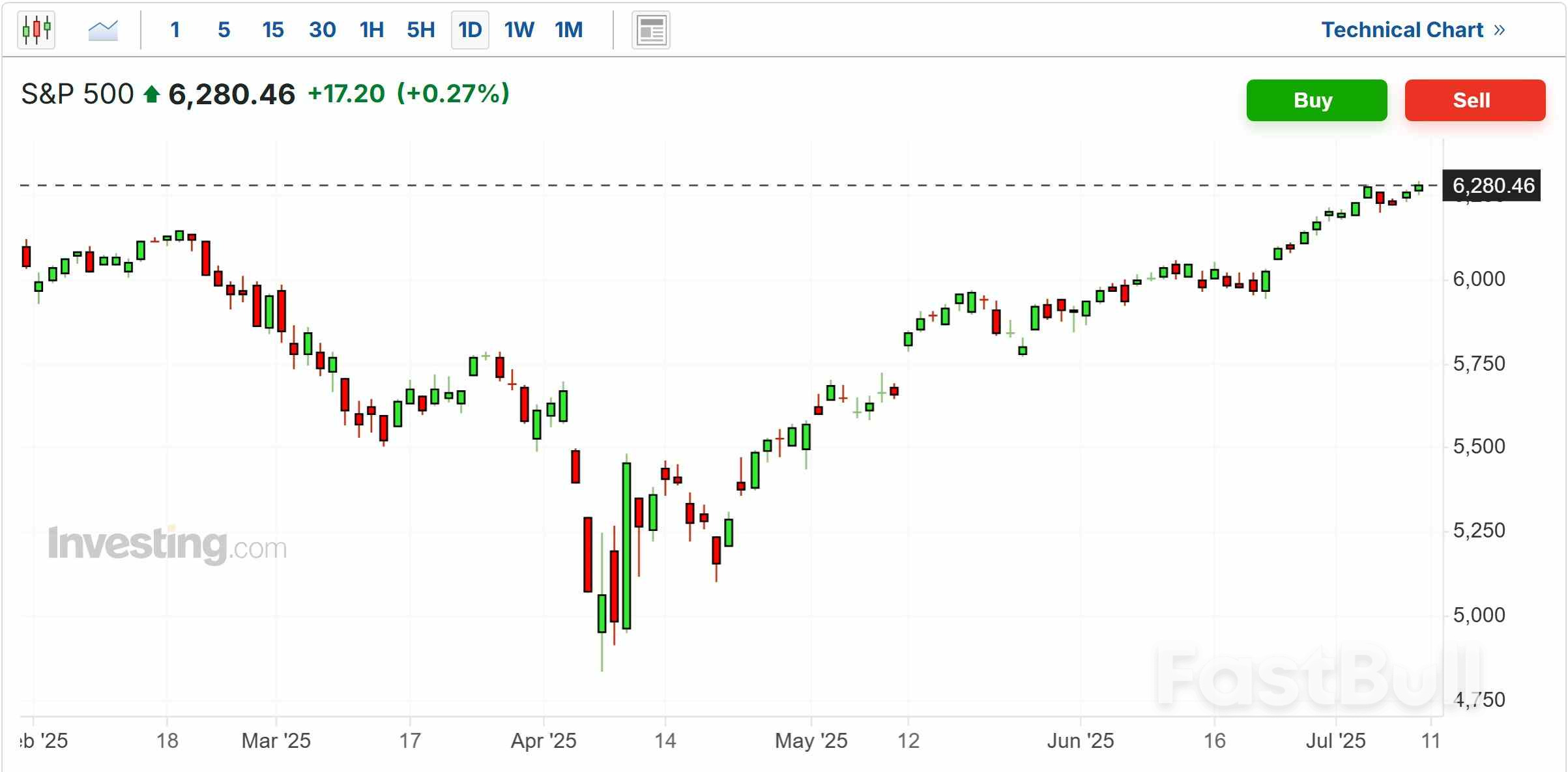
          With the S&P 500 trading at all-time highs after a robust rally from its April lows, investors are now looking to corporate earnings to determine whether the market’s momentum is sustainable.
          Q2 Earnings Preview: Can Corporate Profits Justify S&P 500’s Record-Setting Rally?_1
          From technology to manufacturing, each S&P 500 sector is facing significant headwinds this quarter, and the upcoming earnings season will be a telling indicator of how these companies are adapting and forecasting future demand.
          Here’s what to watch as the Q2 earnings season unfolds:

          Tariffs: The Unseen Earnings Villain

          The biggest wild card this quarter is the sudden escalation in U.S. trade tariffs under President Donald Trump. On July 8, sweeping new 50% tariffs were announced on imported copper, with threats of more to come on semiconductors and pharmaceuticals. The deadline for 14 nations to cut deals is set for Aug. 1, but so far, only the UK and Vietnam have reached agreements.
          The risk: these tariffs could squeeze profit margins and disrupt supply chains, especially for multinationals and manufacturers. Analysts estimate that tariffs could reduce S&P 500 earnings growth by approximately 2 percentage points in Q2.
          Q2 Earnings Preview: Can Corporate Profits Justify S&P 500’s Record-Setting Rally?_2
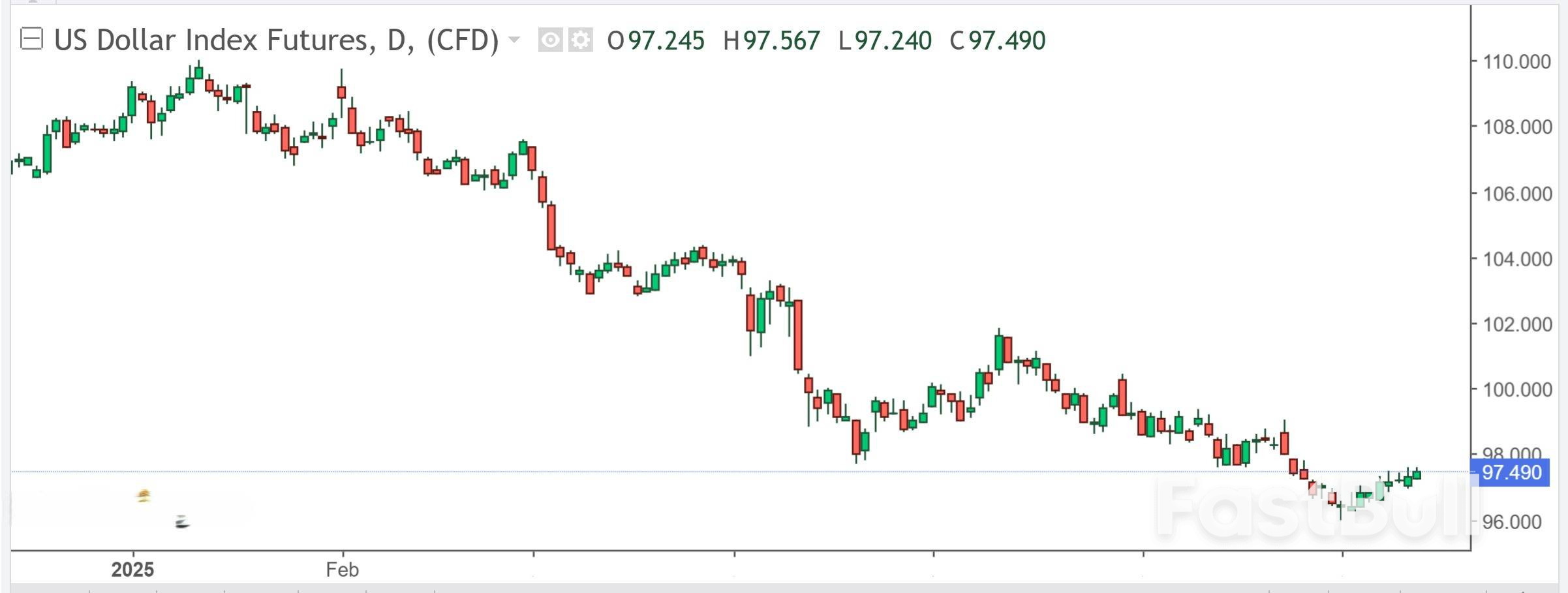
          While a 7% drop in the dollar index during Q2 provides some offset for U.S. exporters, the true bottom-line impact will only start to show up in these earnings reports.

          Earnings Growth Expectations

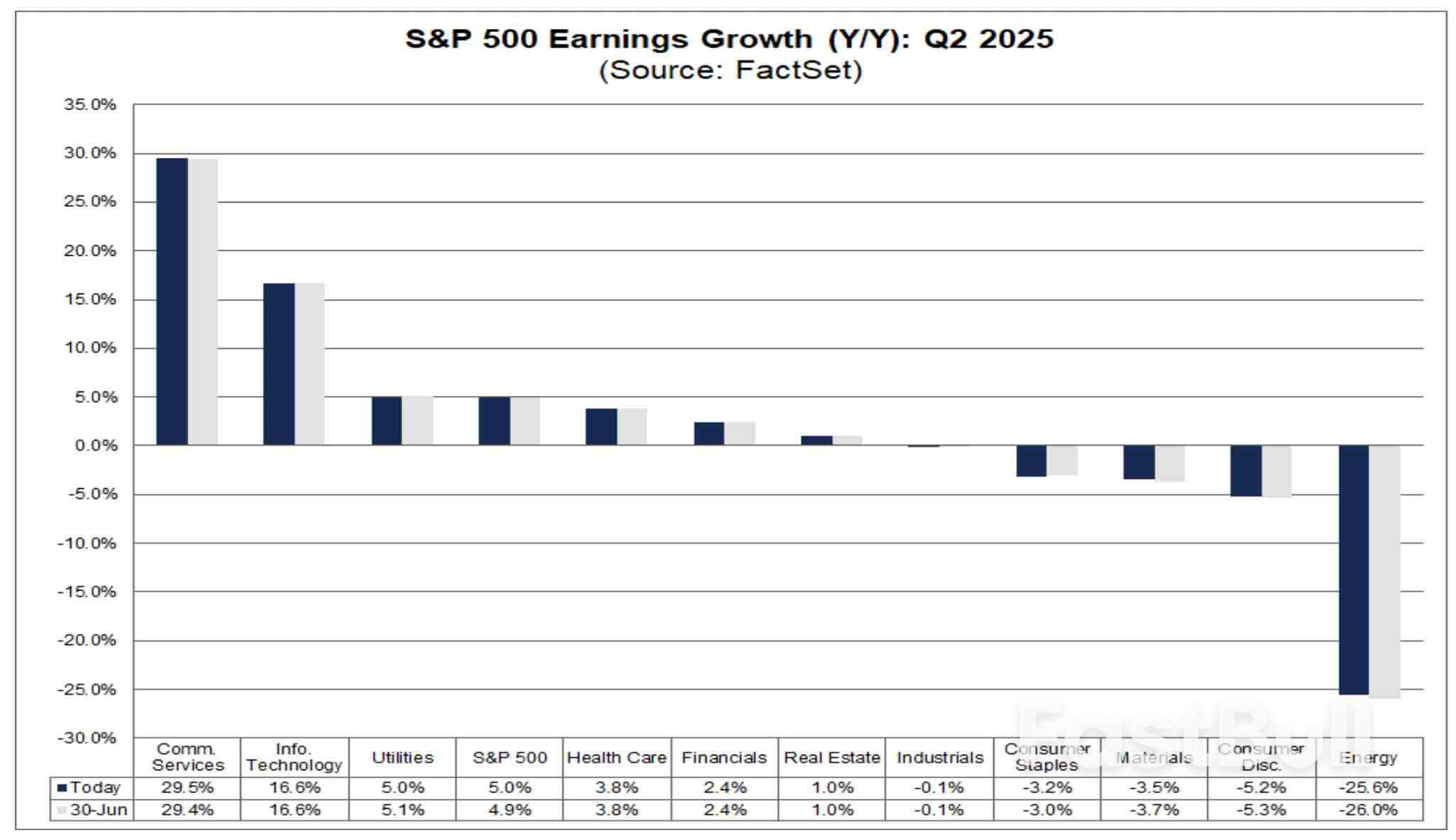
          S&P 500 earnings are expected to grow by 5.0% year-over-year in Q2, according to FactSet, a sharp deceleration from the 13.7% growth posted in Q1. While this marks the slowest growth pace since Q4 2023, a low bar could provide opportunities for companies to exceed expectations, provided they navigate the season’s challenges effectively.
          Q2 Earnings Preview: Can Corporate Profits Justify S&P 500’s Record-Setting Rally?_3

          Sector Performance

          Communication Services: The sector is expected to report the highest annual earnings growth rate, at +29.5%. Some of the biggest names in the space include Meta Platforms, Netflix, Walt Disney, as well as Verizon, and AT&T.
          Technology: The information technology sector is also set to report robust earnings growth, driven by continued demand for AI and cloud computing. Companies like Nvidia, Microsoft, Alphabet, and Advanced Micro Devices are likely to post strong results.
          Consumer Discretionary: Retailers and e-commerce companies face challenges from slowing consumer spending and rising costs. The sector includes notable companies like Amazon, Walmart, Home Depot, McDonald’s Corporation, and Coca-Cola.
          Energy: Energy companies, which includes oil and gas giants such as ExxonMobil, Chevron, and ConocoPhillips, may see lower profits due to declining oil and gas prices compared to last year.

          Guidance for the Second Half

          Monitoring corporate guidance will be critical, as forward-looking commentary on tariffs, cost pressures, and consumer demand could drive significant stock price swings.
          Companies that signal resilience in the face of economic uncertainty will likely be rewarded, while those that fail to meet or beat consensus estimates risk outsized downside moves. In this environment, even minor disappointments in results or outlooks can trigger sharp pullbacks.

          Key Stocks to Watch for Q2 Earnings Season

          The U.S. stock market enters Q2 earnings season in a precarious position. The S&P 500’s nearly 28% rebound from April lows has pushed valuations to elevated levels, with the forward price-to-earnings (P/E) ratio hovering around 20.6, well above its long-term average of 15.8.
          This frothy backdrop leaves little room for disappointment, particularly for the dominant tech and growth stocks that led the recent rally, as investors demand robust earnings growth to justify current prices.
          Some of the notable names to make the cut include Capital One Financial, CoreWeave, Truist Financial, Circle Internet Group, AngloGold Ashanti, Credo Technology, Xpeng, Astera Labs, TKO Group Holdings, IONQ, Celsius Holdings, Hims Hers Health, and Tempus AI .

          The Bottom Line

          As investors navigate this high-stakes season, resilience and adaptability will be key. Whether the market can clear the low earnings bar or succumbs to policy-driven volatility remains to be seen, but Q2 earnings will undoubtedly shape the trajectory of 2025’s second half.
          Savvy investors will need to be highly discerning, focusing on companies with clear visibility into their future earnings power and resilience to external shocks.
          Be sure to check out InvestingPro to stay in sync with the market trend and what it means for your trading. Leveraging InvestingPro can unlock a world of investment opportunities while minimizing risks amid the challenging market backdrop.

          Source: investing

          Risk Warnings and Disclaimers
          You understand and acknowledge that there is a high degree of risk involved in trading. Following any strategies or investment methods may lead to potential losses. The content on the site is provided by our contributors and analysts for information purposes only. You are solely responsible for determining whether any trading assets, securities, strategy, or any other product is suitable for investing based on your own investment objectives and financial situation.
          Add to Favorites
          Share

          USDJPY Moves Above The 38.2% Of The Move Down From The 2025 Trading Range

          Blue River

          Technical Analysis

          Forex

          Economic

          USDJPY moves above 38.2% retracement

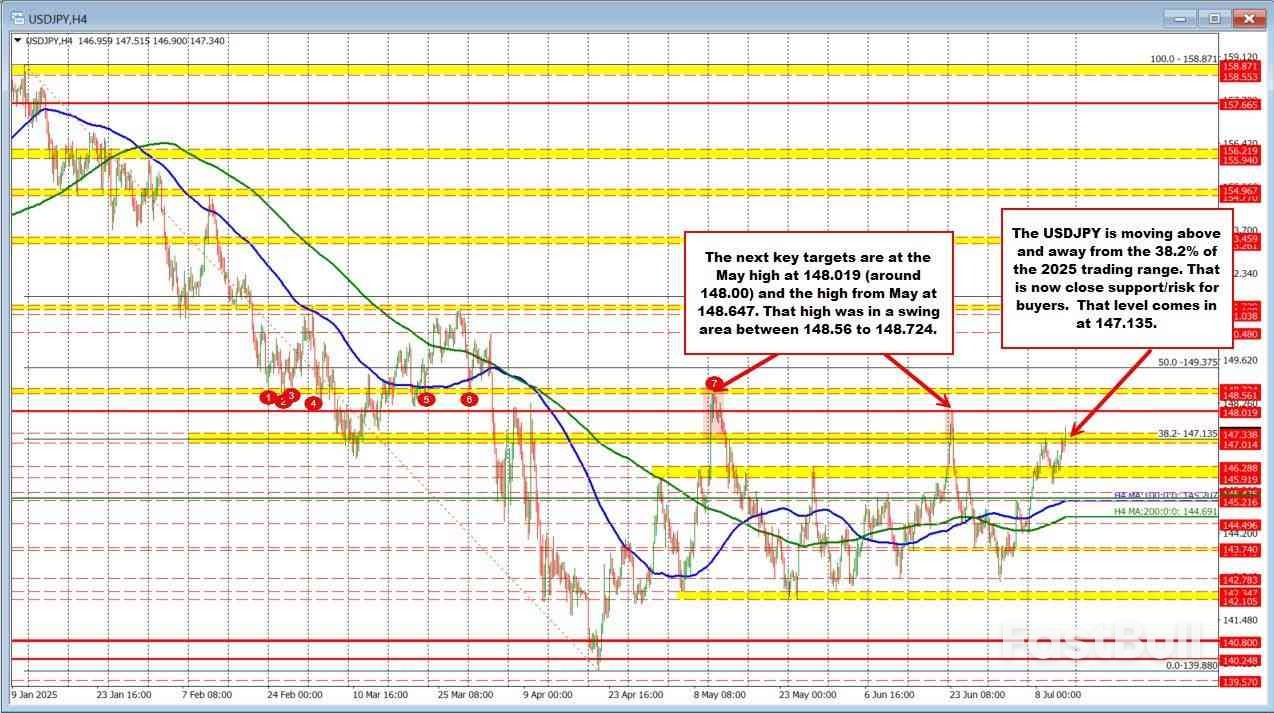
          The USDJPY has moved above the 38.2% retracement of the 2025 trading range, measured from the January 10 high to the April 22 low. That retracement level comes in at 147.135, and it's aligned with a key swing area between 147.014 and 147.338. The pair has extended to a high of 147.515, marking the third attempt to break and hold above this level since the April low.

          Previous moves above the 38.2% retracement—on May 12 and June 23—ultimately failed to hold, but this renewed push gives buyers another opportunity to seize control. From a technical perspective, staying above 147.135 is now critical. If that support holds, upside targets include the June high at 148.019, followed by the May high at 148.647, which sits within a notable swing area between 148.56 and 148.724 (highlighted by red circles on the chart). That swing area increases the May highs importance

          The market is once again testing the waters for a bullish breakout. The question now is: Will buyers finally maintain momentum above the 38.2% retracement, or will this be another failed attempt? The close risk level for USD bulls is clear—hold above 147.135 to keep the bullish case alive.

          Source: ForexLive

          To stay updated on all economic events of today, please check out our Economic calendar
          Risk Warnings and Disclaimers
          You understand and acknowledge that there is a high degree of risk involved in trading. Following any strategies or investment methods may lead to potential losses. The content on the site is provided by our contributors and analysts for information purposes only. You are solely responsible for determining whether any trading assets, securities, strategy, or any other product is suitable for investing based on your own investment objectives and financial situation.
          Add to Favorites
          Share

          Fall in UK GDP Puts Focus Back on Expectations of Tax Rises in Autumn Budget

          Warren Takunda

          Economic

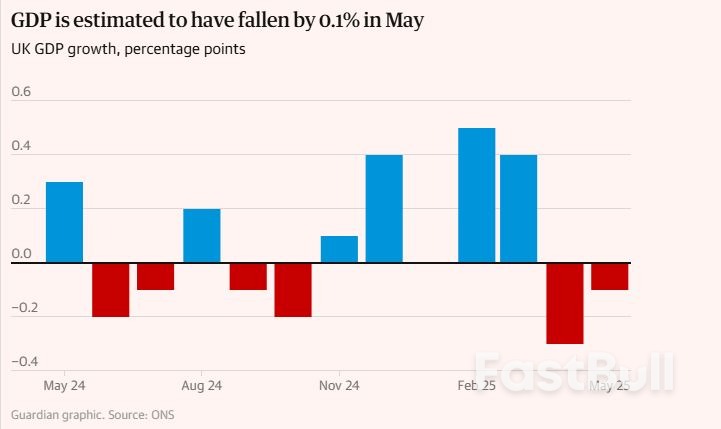
          May’s unexpected 0.1% decline in GDP will make depressing reading for Rachel Reeves before a tough budget in the autumn.
          Stronger-than-expected growth would have helped to alleviate the squeeze on the public finances – but there is nothing in this latest data pointing to an upturn.
          The 0.1% fall in May is marginal, but it follows a 0.3% contraction in April. The Office for National Statistics (ONS) has revised up March’s growth, to 0.4% – but barring a bumper June, it looks like the economy may well have been going backwards in the second quarter of the year.
          “May’s downbeat outturn means a contraction in GDP across the second quarter looks a racing certainty,” said Suren Thiru of the Institute of Chartered Accountants in England and Wales.
          The news comes just as Reeves and her team were daring to hope that business confidence was recovering after a tough few months despite the uncertain global backdrop.
          It makes a rate cut from the Bank of England in August, which was already anticipated, look all but certain. It also appears to strengthen the arguments of the monetary policy committee’s more dovish members, including Alan Taylor and Swati Dhingra, who have raised concerns of late about the weakness of the economy.
          Taylor used a speech last week to suggest the MPC should make three more cuts in 2025 because of the “deteriorating outlook”.Fall in UK GDP Puts Focus Back on Expectations of Tax Rises in Autumn Budget_1
          These monthly figures are frequently revised, but the ONS attributes May’s contraction to a sharp fall in industrial production, which was down 0.9%. That was partly offset by a modest 0.1% increase in services output.
          Within industrial production the decline was driven by a contraction in manufacturing, which was down 1%, after a 0.7% fall in April.
          The manufacturing contraction included a very sharp 3.7% decline in vehicle manufacturing, after a 9.5% drop in April, which the ONS said reflected model changeovers by carmakers – as well as the effect of car tariffs, which have since been lifted under the trade deal struck with the US.
          At this point it is all but impossible to disentangle the economic impacts of Donald Trump’s tariffs, and the increases in business taxes and the minimum wage that came in April.
          However, fresh speculation about tax rises, after a U-turn on Reeves’s £5bn welfare cuts package to head off a Commons defeat last week, risks dampening the mood for consumers and companies in the run-up to the autumn. The shadow chancellor Mel Stride’s response to the GDP figures called this a “ticking tax timebomb”.
          Or as the chief economist of the Institute of Directors, Anna Leach, put it: “Despite the welcome launch of a plethora of government strategies, and a spending review which stuck to the pre-set envelope, we’re back worrying about tax rises in the forthcoming budget,” while underlying growth in the economy, for the moment, remains “tepid and beset with risk”.

          Source: Theguardian

          To stay updated on all economic events of today, please check out our Economic calendar
          Risk Warnings and Disclaimers
          You understand and acknowledge that there is a high degree of risk involved in trading. Following any strategies or investment methods may lead to potential losses. The content on the site is provided by our contributors and analysts for information purposes only. You are solely responsible for determining whether any trading assets, securities, strategy, or any other product is suitable for investing based on your own investment objectives and financial situation.
          Add to Favorites
          Share
          FastBull
          Copyright © 2025 FastBull Ltd

          728 RM B 7/F GEE LOK IND BLDG NO 34 HUNG TO RD KWUN TONG KLN HONG KONG

          TelegramInstagramTwitterfacebooklinkedin
          App Store Google Play Google Play
          Products
          Charts

          Chats

          Q&A with Experts
          Screeners
          Economic Calendar
          Data
          Tools
          Membership
          Features
          Function
          Markets
          Copy Trading
          Latest Signals
          Contests
          News
          Analysis
          24/7
          Columns
          Education
          Company
          Careers
          About Us
          Contact Us
          Advertising
          Help Center
          Feedback
          User Agreement
          Privacy Policy
          Business

          White Label

          Data API

          Web Plug-ins

          Poster Maker

          Affiliate Program

          Risk Disclosure

          The risk of loss in trading financial instruments such as stocks, FX, commodities, futures, bonds, ETFs and crypto can be substantial. You may sustain a total loss of the funds that you deposit with your broker. Therefore, you should carefully consider whether such trading is suitable for you in light of your circumstances and financial resources.

          No decision to invest should be made without thoroughly conducting due diligence by yourself or consulting with your financial advisors. Our web content might not suit you since we don't know your financial conditions and investment needs. Our financial information might have latency or contain inaccuracy, so you should be fully responsible for any of your trading and investment decisions. The company will not be responsible for your capital loss.

          Without getting permission from the website, you are not allowed to copy the website's graphics, texts, or trademarks. Intellectual property rights in the content or data incorporated into this website belong to its providers and exchange merchants.

          Not Logged In

          Log in to access more features

          FastBull Membership

          Not yet

          Purchase

          Become a signal provider
          Help Center
          Customer Service
          Dark Mode
          Price Up/Down Colors

          Log In

          Sign Up

          Position
          Layout
          Fullscreen
          Default to Chart
          The chart page opens by default when you visit fastbull.com