• Trade
  • Markets
  • Copy
  • Contests
  • News
  • 24/7
  • Calendar
  • Q&A
  • Chats
Trending
Screeners
SYMBOL
LAST
BID
ASK
HIGH
LOW
NET CHG.
%CHG.
SPREAD
SPX
S&P 500 Index
6827.42
6827.42
6827.42
6899.86
6801.80
-73.58
-1.07%
--
DJI
Dow Jones Industrial Average
48458.04
48458.04
48458.04
48886.86
48334.10
-245.98
-0.51%
--
IXIC
NASDAQ Composite Index
23195.16
23195.16
23195.16
23554.89
23094.51
-398.69
-1.69%
--
USDX
US Dollar Index
97.950
98.030
97.950
98.500
97.950
-0.370
-0.38%
--
EURUSD
Euro / US Dollar
1.17394
1.17409
1.17394
1.17496
1.17192
+0.00011
+ 0.01%
--
GBPUSD
Pound Sterling / US Dollar
1.33707
1.33732
1.33707
1.33997
1.33419
-0.00148
-0.11%
--
XAUUSD
Gold / US Dollar
4299.39
4299.39
4299.39
4353.41
4257.10
+20.10
+ 0.47%
--
WTI
Light Sweet Crude Oil
57.233
57.485
57.233
58.011
56.969
-0.408
-0.71%
--

Community Accounts

Signal Accounts
--
Profit Accounts
--
Loss Accounts
--
View More

Become a signal provider

Sell trading signals to earn additional income

View More

Guide to Copy Trading

Get started with ease and confidence

View More

Signal Accounts for Members

All Signal Accounts

Best Return
  • Best Return
  • Best P/L
  • Best MDD
Past 1W
  • Past 1W
  • Past 1M
  • Past 1Y

All Contests

  • All
  • Trump Updates
  • Recommend
  • Stocks
  • Cryptocurrencies
  • Central Banks
  • Featured News
Top News Only
Share

USA Embassy In Lithuania: Maria Kalesnikava Is Not Going To Vilnius

Share

USA Embassy In Lithuania: Other Prisoners Are Being Sent From Belarus To Ukraine

Share

Ukraine President Zelenskiy: Five Ukrainians Released By Belarus In US-Brokered Deal

Share

USA Vilnius Embassy: USA Stands Ready For "Additional Engagement With Belarus That Advances USA Interests"

Share

USA Vilnius Embassy: Belarus, USA, Other Citizens Among The Prisoners Released Into Lithuania

Share

USA Vilnius Embassy: USA Will Continue Diplomatic Efforts To Free The Remaining Political Prisoners In Belarus

Share

USA Vilnius Embassy: Belarus Releases 123 Prisoners Following Meeting Of President Trump's Envoy Coale And Belarus President Lukashenko

Share

USA Vilnius Embassy: Masatoshi Nakanishi, Aliaksandr Syrytsa Are Among The Prisoners Released By Belarus

Share

USA Vilnius Embassy: Maria Kalesnikava And Viktor Babaryka Are Among The Prisoners Released By Belarus

Share

USA Vilnius Embassy: Nobel Peace Prize Laureate Ales Bialiatski Is Among The Prisoners Released By Belarus

Share

Belarusian Presidential Administration Telegram Channel: Lukashenko Has Pardoned 123 Prisoners As Part Of Deal With US

Share

Two Local Syrian Officials: Joint US-Syrian Military Patrol In Central Syria Came Under Fire From Unknown Assailants

Share

Israeli Military Says It Targeted 'Key Hamas Terrorist' In Gaza City

Share

Rwanda's Actions In Eastern Drc Are A Clear Violation Of Washington Accords Signed By President Trump - Secretary Of State Rubio

Share

Israeli Military Issues Evacuation Warning In Southern Lebanon Village Ahead Of Strike - Spokesperson On X

Share

Belarusian State Media Cites US Envoy Coale As Saying He Discussed Ukraine And Venezuela With Lukashenko

Share

Belarusian State Media Cites US Envoy Coale As Saying That US Removes Sanctions On Belarusian Potassium

Share

Thai Prime Minister: No Ceasefire Agreement With Cambodia

Share

US, Ukraine To Discuss Ceasefire In Berlin Ahead Of European Summit

Share

Incoming Czech Prime Minister Babis: Czech Republic Will Not Take On Guarantees For Ukraine Financing, European Commission Must Find Alternatives

TIME
ACT
FCST
PREV
U.K. Trade Balance Non-EU (SA) (Oct)

A:--

F: --

P: --

U.K. Trade Balance (Oct)

A:--

F: --

P: --

U.K. Services Index MoM

A:--

F: --

P: --

U.K. Construction Output MoM (SA) (Oct)

A:--

F: --

P: --

U.K. Industrial Output YoY (Oct)

A:--

F: --

P: --

U.K. Trade Balance (SA) (Oct)

A:--

F: --

P: --

U.K. Trade Balance EU (SA) (Oct)

A:--

F: --

P: --

U.K. Manufacturing Output YoY (Oct)

A:--

F: --

P: --

U.K. GDP MoM (Oct)

A:--

F: --

P: --

U.K. GDP YoY (SA) (Oct)

A:--

F: --

P: --

U.K. Industrial Output MoM (Oct)

A:--

F: --

P: --

U.K. Construction Output YoY (Oct)

A:--

F: --

P: --

France HICP Final MoM (Nov)

A:--

F: --

P: --

China, Mainland Outstanding Loans Growth YoY (Nov)

A:--

F: --

P: --

China, Mainland M2 Money Supply YoY (Nov)

A:--

F: --

P: --

China, Mainland M0 Money Supply YoY (Nov)

A:--

F: --

P: --

China, Mainland M1 Money Supply YoY (Nov)

A:--

F: --

P: --

India CPI YoY (Nov)

A:--

F: --

P: --

India Deposit Gowth YoY

A:--

F: --

P: --

Brazil Services Growth YoY (Oct)

A:--

F: --

P: --

Mexico Industrial Output YoY (Oct)

A:--

F: --

P: --

Russia Trade Balance (Oct)

A:--

F: --

P: --

Philadelphia Fed President Henry Paulson delivers a speech
Canada Building Permits MoM (SA) (Oct)

A:--

F: --

P: --

Canada Wholesale Sales YoY (Oct)

A:--

F: --

P: --

Canada Wholesale Inventory MoM (Oct)

A:--

F: --

P: --

Canada Wholesale Inventory YoY (Oct)

A:--

F: --

P: --

Canada Wholesale Sales MoM (SA) (Oct)

A:--

F: --

P: --

Germany Current Account (Not SA) (Oct)

A:--

F: --

P: --

U.S. Weekly Total Rig Count

A:--

F: --

P: --

U.S. Weekly Total Oil Rig Count

A:--

F: --

P: --

Japan Tankan Large Non-Manufacturing Diffusion Index (Q4)

--

F: --

P: --

Japan Tankan Small Manufacturing Outlook Index (Q4)

--

F: --

P: --

Japan Tankan Large Non-Manufacturing Outlook Index (Q4)

--

F: --

P: --

Japan Tankan Large Manufacturing Outlook Index (Q4)

--

F: --

P: --

Japan Tankan Small Manufacturing Diffusion Index (Q4)

--

F: --

P: --

Japan Tankan Large Manufacturing Diffusion Index (Q4)

--

F: --

P: --

Japan Tankan Large-Enterprise Capital Expenditure YoY (Q4)

--

F: --

P: --

U.K. Rightmove House Price Index YoY (Dec)

--

F: --

P: --

China, Mainland Industrial Output YoY (YTD) (Nov)

--

F: --

P: --

China, Mainland Urban Area Unemployment Rate (Nov)

--

F: --

P: --

Saudi Arabia CPI YoY (Nov)

--

F: --

P: --

Euro Zone Industrial Output YoY (Oct)

--

F: --

P: --

Euro Zone Industrial Output MoM (Oct)

--

F: --

P: --

Canada Existing Home Sales MoM (Nov)

--

F: --

P: --

Euro Zone Total Reserve Assets (Nov)

--

F: --

P: --

U.K. Inflation Rate Expectations

--

F: --

P: --

Canada National Economic Confidence Index

--

F: --

P: --

Canada New Housing Starts (Nov)

--

F: --

P: --

U.S. NY Fed Manufacturing Employment Index (Dec)

--

F: --

P: --

U.S. NY Fed Manufacturing Index (Dec)

--

F: --

P: --

Canada Core CPI YoY (Nov)

--

F: --

P: --

Canada Manufacturing Unfilled Orders MoM (Oct)

--

F: --

P: --

Canada Manufacturing New Orders MoM (Oct)

--

F: --

P: --

Canada Core CPI MoM (Nov)

--

F: --

P: --

Canada Manufacturing Inventory MoM (Oct)

--

F: --

P: --

Canada CPI YoY (Nov)

--

F: --

P: --

Canada CPI MoM (Nov)

--

F: --

P: --

Canada CPI YoY (SA) (Nov)

--

F: --

P: --

Canada Core CPI MoM (SA) (Nov)

--

F: --

P: --

Q&A with Experts
    • All
    • Chatrooms
    • Groups
    • Friends
    Connecting
    .
    .
    .
    Type here...
    Add Symbol or Code

      No matching data

      All
      Trump Updates
      Recommend
      Stocks
      Cryptocurrencies
      Central Banks
      Featured News
      • All
      • Russia-Ukraine Conflict
      • Middle East Flashpoint
      • All
      • Russia-Ukraine Conflict
      • Middle East Flashpoint
      Search
      Products

      Charts Free Forever

      Chats Q&A with Experts
      Screeners Economic Calendar Data Tools
      Membership Features
      Data Warehouse Market Trends Institutional Data Policy Rates Macro

      Market Trends

      Market Sentiment Order Book Forex Correlations

      Top Indicators

      Charts Free Forever
      Markets

      News

      News Analysis 24/7 Columns Education
      From Institutions From Analysts
      Topics Columnists

      Latest Views

      Latest Views

      Trending Topics

      Top Columnists

      Latest Update

      Signals

      Copy Rankings Latest Signals Become a signal provider AI Rating
      Contests
      Brokers

      Overview Brokers Assessment Rankings Regulators News Claims
      Broker listing Forex Brokers Comparison Tool Live Spread Comparison Scam
      Q&A Complaint Scam Alert Videos Tips to Detect Scam
      More

      Business
      Events
      Careers About Us Advertising Help Center

      White Label

      Data API

      Web Plug-ins

      Affiliate Program

      Awards Institution Evaluation IB Seminar Salon Event Exhibition
      Vietnam Thailand Singapore Dubai
      Fans Party Investment Sharing Session
      FastBull Summit BrokersView Expo
      Recent Searches
        Top Searches
          Markets
          News
          Analysis
          User
          24/7
          Economic Calendar
          Education
          Data
          • Names
          • Latest
          • Prev

          View All

          No data

          Scan to Download

          Faster Charts, Chat Faster!

          Download App
          English
          • English
          • Español
          • العربية
          • Bahasa Indonesia
          • Bahasa Melayu
          • Tiếng Việt
          • ภาษาไทย
          • Français
          • Italiano
          • Türkçe
          • Русский язык
          • 简中
          • 繁中
          Open Account
          Search
          Products
          Charts Free Forever
          Markets
          News
          Signals

          Copy Rankings Latest Signals Become a signal provider AI Rating
          Contests
          Brokers

          Overview Brokers Assessment Rankings Regulators News Claims
          Broker listing Forex Brokers Comparison Tool Live Spread Comparison Scam
          Q&A Complaint Scam Alert Videos Tips to Detect Scam
          More

          Business
          Events
          Careers About Us Advertising Help Center

          White Label

          Data API

          Web Plug-ins

          Affiliate Program

          Awards Institution Evaluation IB Seminar Salon Event Exhibition
          Vietnam Thailand Singapore Dubai
          Fans Party Investment Sharing Session
          FastBull Summit BrokersView Expo

          After Putin Call, Trump Says Russia And Ukraine To Start 'immediate' Talks On Ceasefire

          Olivia Brooks

          Political

          Russia-Ukraine Conflict

          Summary:

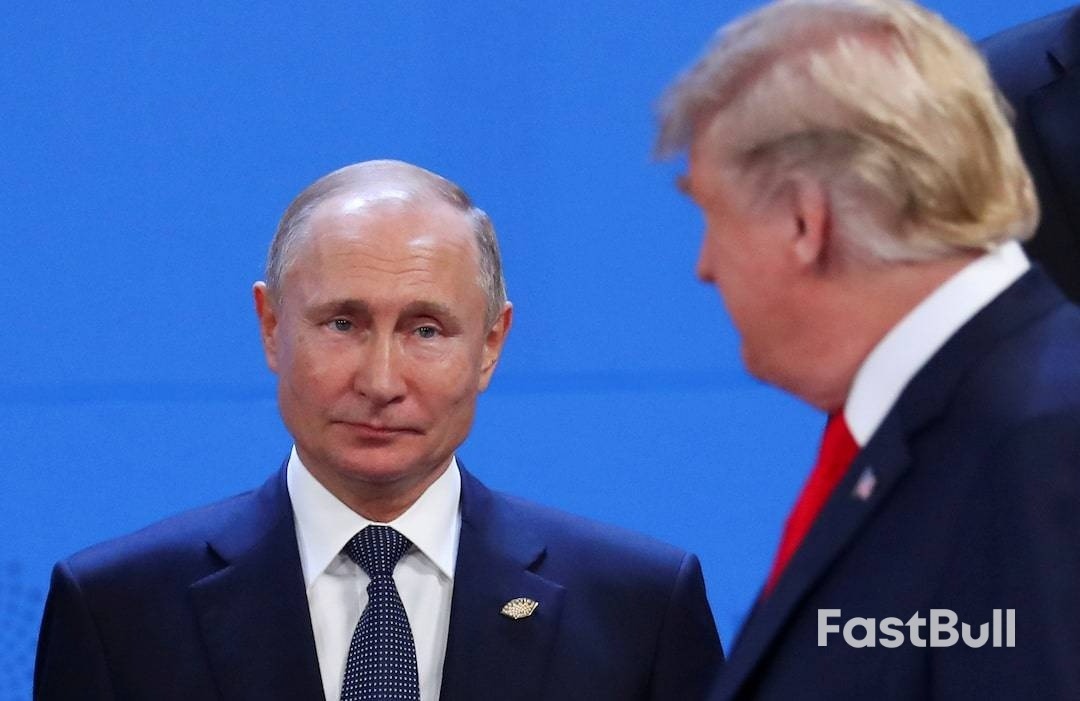
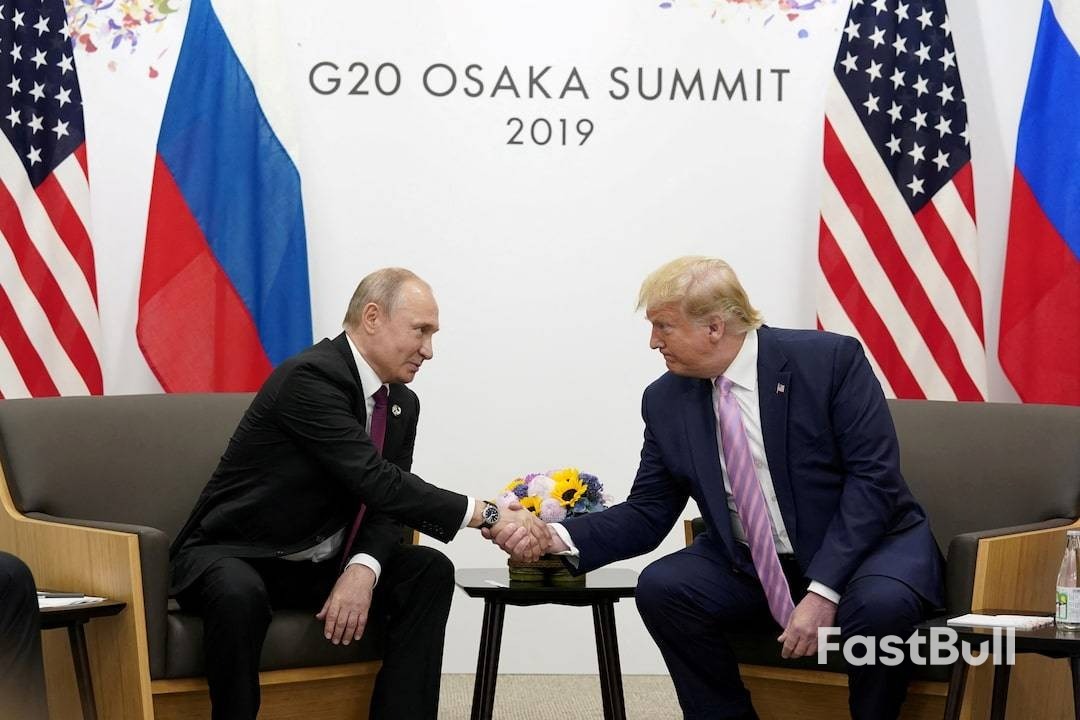
          U.S. President Donald Trump said on Monday that Russia and Ukraine "will immediately start negotiations" toward a ceasefire and an end to their three-year-old war, speaking after he held a call with Russia's President Vladimir Putin.

          U.S. President Donald Trump said on Monday that Russia and Ukraine "will immediately start negotiations" toward a ceasefire and an end to their three-year-old war, speaking after he held a call with Russia's President Vladimir Putin.

          "Negotiations between Russia and Ukraine will begin immediately," Trump said in a Truth Social post following his call with Putin, which lasted two hours.

          After the call, Putin said efforts to end the war were "generally on the right track" and that Moscow was ready to work with Ukraine on a potential peace deal.

          "We have agreed with the president of the United States that Russia will propose and is ready to work with the Ukrainian side on a memorandum on a possible future peace accord," Putin told reporters near the Black Sea resort of Sochi.

          There was no immediate comment from Ukrainian President Volodymyr Zelenskiy on the statement that talks would begin immediately. A source familiar with the matter earlier said Zelenskiy spoke "for a few minutes" with Trump before the U.S. leader's call with Putin.

          Kyiv has said it is ready for a ceasefire now while Moscow has said conditions must be met first.

          In his social media post, Trump said the Vatican, "as represented by the Pope, has stated that it would be very interested in hosting the negotiations. Let the process begin!"

          Putin and Trump spoke after direct talks last week in Turkey between Moscow and Kyiv, the first since 2022 in the early months of Russia's invasion of Ukraine. Talks last week failed to agree on a truce.

          U.S. Vice President JD Vance earlier repeated a warning that Washington could walk away from the peace process.

          Putin said the memorandum would define "a number of positions, such as, for example, the principles of settlement, the timing of a possible peace agreement."

          He said that if appropriate agreements were reached, there could be a ceasefire, adding that direct talks between Russia and Ukraine gave "reason to believe that we are generally on the right track."

          "The main thing for us is to eliminate the root causes of this crisis," Putin said. "We just need to determine the most effective ways to move towards peace.

          Item 1 of 5 Vice President JD Vance talks to reporters on board of the Air Force Two at Leonardo da Vinci International Airport, in Rome, Monday, May 19, 2025. Jacquelyn Martin/Pool via REUTERS

          [1/5]Vice President JD Vance talks to reporters on board of the Air Force Two at Leonardo da Vinci International Airport, in Rome, Monday, May 19, 2025. Jacquelyn Martin/Pool via REUTERS Purchase Licensing Rights, opens new tab.

          He thanked Trump for supporting the resumption of direct talks between Moscow and Kyiv and said Trump noted Russia's support for peace, though the key question was how to move towards peace.

          Trump, who has promised to bring a swift end to Europe's deadliest war since World War Two, has repeatedly called for a ceasefire after three years when Washington joined other Western countries in arming Ukraine.

          European leaders have said they want the United States to join them in imposing tough new sanctions on Russia for refusing a ceasefire. The leaders of Britain, France, Germany and Italy spoke to Trump on Sunday ahead of his call with Putin.

          Putin was speaking from Russia's Black Sea resort of Sochi while Trump was in Washington.

          Shortly before the call, Vance told reporters that Washington recognised there was "a bit of an impasse here".

          "And I think the president's going to say to President Putin: 'Look, are you serious? Are you real about this?'" Vance said as he prepared to depart from a visit to Italy.

          "I think honestly that President Putin, he doesn't quite know how to get out of the war," Vance said.

          He said it "takes two to tango. I know the president's willing to do that, but if Russia is not willing to do that, then we're eventually just going to say, 'This is not our war.'"

          "We're going to try to end it, but if we can't end it, we're eventually going to say: 'You know what? That was worth a try, but we're not doing any more.'"

          White House press secretary Karoline Leavitt told reporters that Trump wanted to see a ceasefire, but that he had grown "weary and frustrated with both sides of the conflict".

          Asked if a package of secondary sanctions against Russia remains on the table, she said: "I think everything's on the table."

          Putin, whose forces control a fifth of Ukraine and are advancing, has stood firm on his conditions for ending the war, despite public and private pressure from Trump and repeated warnings from European powers.

          Reporting by Guy Faulconbridge and Vladimir Soldatkin in Moscow, Max Hunder and Tom Balmforth in Kyiv, Maxim Rodionov in London and Steve Holland, Susan Heavey Rami Ayyub and David Brunstrom in Washington; Editing by Clarence Fernandez, Gareth Jones and Cynthia Osterman

          Source: Reuters

          Risk Warnings and Disclaimers
          You understand and acknowledge that there is a high degree of risk involved in trading. Following any strategies or investment methods may lead to potential losses. The content on the site is provided by our contributors and analysts for information purposes only. You are solely responsible for determining whether any trading assets, securities, strategy, or any other product is suitable for investing based on your own investment objectives and financial situation.
          Add to Favorites
          Share

          Central Bank Body BIS Flags Potential for Dollar Scramble

          Manuel

          Forex

          Central Bank

          Central bank body the Bank for International Settlements has flagged a possible scramble for dollars could be triggered if whipsawed investors begin to unwind positions in the $113 trillion FX swap market amid U.S. volatility.
          The BIS recently estimated that funds and other non-bank financial firms had more than $80 trillion in FX swaps - money borrowed in the U.S. currency with the promise to pay it back at an agreed exchange rate at a later date.
          Effectively a form of short-term debt, swaps tend to be held 'off balance sheet' and are not to be factored in regulatory capital requirements.
          The issues come if investors suddenly rush to unwind these positions, the head of the BIS' monetary and economics department, Hyun-Song Shin, said in a lecture at the London School of Economics.
          Investors who have hedged positions are often holding euros or yen but still have the dollar repayment obligations.
          "If you have to roll over that swap you have to join the scramble (for dollars)," Shin said, adding that can then cause a rapid spike in the value of the U.S. currency.
          The comments come after market turmoil in April when President Donald Trump launched the U.S. into a full blown trade war and consigned the dollar to its weakest start to a year in over 35 years.
          On Friday too, Moody's stripped the U.S. of its last remaining triple-A credit rating, underscoring concerns about the huge increase in U.S. government debt over the last 15 years.
          Shin also touched on whether U.S. exceptionalism - investors' strong preference and incentive to buy U.S. assets - had been eroded by this year's turbulence.
          He noted the highly unusual combination of U.S. stocks, bonds and the dollar all selling off in tandem but said it was still too soon to know whether major investors were selling down their U.S. assets or just hedging.
          However, they are likely to be at least thinking about whether strategic changes might be warranted, Shin added

          Source:Reuters

          Risk Warnings and Disclaimers
          You understand and acknowledge that there is a high degree of risk involved in trading. Following any strategies or investment methods may lead to potential losses. The content on the site is provided by our contributors and analysts for information purposes only. You are solely responsible for determining whether any trading assets, securities, strategy, or any other product is suitable for investing based on your own investment objectives and financial situation.
          Add to Favorites
          Share

          S&P 500 Gains & Losses Today: Solar Stocks Fall, UnitedHealth Shares Jump

          Manuel

          Stocks

          Economic

          UnitedHealth Group (UNH) stock jumped 8.2%, marking the top daily performance in the S&P 500. While Monday's move higher extended a recovery that began late last week, shares of the insurance giant had been under heavy pressure after reports of a Justice Department investigation into possible Medicare fraud compounded news about the departure of UnitedHealth's top executive and suspension of its guidance. As the stock rebounded, filings showed that incoming CEO Stephen Hemsley purchased a significant stake in the company.
          The Food and Drug Administration granted full approval for the protein-based COVID-19 vaccine produced by Novavax (NVAX), and shares of the biotech firm surged 15%. Shares of fellow vaccine maker Moderna (MRNA) were up 6.2%.
          Dollar General (DG) shares advanced 4.9%, adding to gains posted at the end of last week after Walmart (WMT) discussed tariff-related price increases on its earnings call. Analysts have highlighted that Dollar General has limited tariff exposure compared with some of its rivals in discount retail.
          Shares of several solar energy companies moved lower after Republican leaders in the House reportedly committed to eliminating certain clean energy tax credits earlier than anticipated. An initial budget proposal from the House Ways and Means Committee released last week included plans to roll back many provisions of the Inflation Reduction Act, including tax credits for residential solar installations. Shares of panel manufacturer First Solar (FSLR) sank 7.6%, losing the most of any S&P 500 stock, while shares of solar equipment maker Enphase Energy (ENPH) lost 3.2%.
          The uncertain policy outlook pressured other stocks in the renewable energy space. Shares of power generator AES Corp. (AES), whose portfolio includes solar, wind, hydro, and energy storage projects, fell 4.1%.
          Best Buy (BBY) shares sank 3% after Wells Fargo trimmed its price target on the electronics retailer's stock. Although analysts noted the potential for customers to pull forward their purchases in anticipation of tariff impacts, they remain cautious of significant uncertainties and risks in the market.
          Source: Investopedia
          To stay updated on all economic events of today, please check out our Economic calendar
          Risk Warnings and Disclaimers
          You understand and acknowledge that there is a high degree of risk involved in trading. Following any strategies or investment methods may lead to potential losses. The content on the site is provided by our contributors and analysts for information purposes only. You are solely responsible for determining whether any trading assets, securities, strategy, or any other product is suitable for investing based on your own investment objectives and financial situation.
          Add to Favorites
          Share

          JPMorgan to Support Bitcoin Buying Despite Jamie Dimon´s Ongoing Skepticism

          Manuel

          Cryptocurrency

          JPMorgan CEO Jamie Dimon said the Wall Street lender plans to offer Bitcoin (BTC) to its customers in a stark shift from his historical stance toward the digital asset.
          During JPMorgan’s Investor Day, Dimon reiterated that he is “not a fan” of Bitcoin, but acknowledged that clients will continue to demand access to it.
          He said: “I don’t think you should smoke, but I defend your right to smoke. I defend your right to buy Bitcoin.”
          He also clarified that the bank does not plan on offering custody services.

          Dimon maintains skepticism

          Dimon’s criticism of crypto is consistent with past remarks. In a January interview, he called Bitcoin “worthless.” He tied it to criminal activity, repeating concerns raised in his 2023 Senate testimony, in which he advocated for shutting down the industry altogether.
          At the 2024 World Economic Forum in Davos, he referred to Bitcoin as a “pet rock,” while in April of the same year, Dimon called crypto a “Ponzi Scheme.”
          In his May 19 remarks, he also stated that “blockchain doesn’t matter as much” as people think. However, JPMorgan has continued to build infrastructure around blockchain technology for institutional use.
          Earlier this month, Kinexys completed a test transaction that bridged its private network to a public layer-1 blockchain, using tokenized short-term Treasury assets and real-time settlement protocols. Chainlink and Ondo Finance participated in this pilot.
          Additionally, Kinexys processes over $2 billion in transactions daily and plans to scale up dollar-euro settlements using JPM Coin, JPMorgan’s proprietary token.

          JPMorgan increases crypto exposure

          Amid the remarks on Bitcoin offering, JPMorgan’s 13F filing with the US Securities and Exchange Commission (SEC) for the first quarter of 2025 showed a dramatic increase in crypto exposure through exchange-traded funds (ETFs).
          As of March 31, the firm reported $16.3 million in crypto-related holdings, up from $1 million at the end of 2024. The lender’s crypto exposure is primarily via Bitcoin and Ethereum-linked instruments.
          As of March 31, JPMorgan held a little over 263,000 shares of BlackRock’s iShares Bitcoin Trust (IBIT) and around 3000 shares of Bitwise’s spot Bitcoin ETF (BITB).
          The lender also held shares of Grayscale’s Bitcoin Trust (GBTC) and Mini Trust ETFs, Fidelity’s Wise Origin Bitcoin Fund (FBTC), and new allocations to Bitwise and Franklin Templeton Ethereum products.
          The firm’s crypto-related holdings are just a tiny fraction of its $4.4 trillion in assets under management at the end of the first quarter.
          It’s unclear how much of the portfolio reflects proprietary positioning versus facilitation of client demand. The bank has previously clarified that holding some ETF allocations could be a part of its market-making services.

          Source: Cryptostale

          Risk Warnings and Disclaimers
          You understand and acknowledge that there is a high degree of risk involved in trading. Following any strategies or investment methods may lead to potential losses. The content on the site is provided by our contributors and analysts for information purposes only. You are solely responsible for determining whether any trading assets, securities, strategy, or any other product is suitable for investing based on your own investment objectives and financial situation.
          Add to Favorites
          Share

          Bond Investors Detect Trouble in US Debt Stripped of AAA Rating

          Manuel

          Economic

          Bond

          Even before talk of fresh unfunded tax cuts took center stage in the budget wrangling on Capitol Hill, US bond investors were making their views loud and clear: If the government keeps spending more than it takes in, there will be consequences.
          Sure enough, one blow landed late Friday, when Moody’s Ratings revealed it had run out of patience and was lowering its credit score on the world’s biggest borrower below the top triple-A level. It cited a years-long pattern of rising debt and budget deficits, which show no sign of abating amid deeply-rooted political polarization.
          While the Moody’s decision was anticipated given the flood of red ink in Washington, and it trailed moves from the likes of S&P Global Ratings, investors responded by lifting the yield on US 30-year bonds above 5% for a time on Monday to the highest since November 2023.
          That reinforces what many in financial markets have been highlighting: Unless the US gets its finances in order and soon, the perceived risks of lending to the government will increase, and borrowing costs on long-term Treasury debt will climb even further. That would make reducing the deficit even harder and lift the cost of money for households and companies throughout the economy.
          “This is a reminder that it is expensive to kick the fiscal can down the road,” said Priya Misra, portfolio manager at JPMorgan Asset Management, after the downgrade on Friday.
          The yield on the 10-year note is up about a third of a percentage point this month alone. Embedded in the market is a rise in the premium investors demand to shoulder the risk of owning longer-term US debt. But even shorter-term securities due in two years or less are yielding more than 4%.
          “The bond market is skeptical that the Trump administration and Republicans will offset some of the deficit challenges,” said Michael Arone, chief investment strategist at State Street Global Advisors. What this means is that “rates will remain higher and more volatile” than some investors currently expect, he said.
          Markets have a history of being the arbiter of fiscal discipline for spendthrift countries, and the recent spike in yields is beginning to echo past instances when so-called bond vigilantes wielded their power in protest of profligacy. The theory goes that if investors impose higher borrowing costs, governments eventually bow to the pressure and retrench.
          This time, though, the stakes are much higher. Even though America’s premier position in global finance is still secure, the government faces less borrowing flexibility at a time when international demand for Treasuries — and the US dollar — is increasingly in doubt.
          Moody’s flagged a decline in “debt affordability” and identified higher Treasury yields as a factor hurting US fiscal sustainability. A walk through the numbers reveals what it means by this concept, and explains why doubts around the sustainability of US debt have become a regular talking point among investors, central bankers and financiers from Jamie Dimon to Warren Buffett.
          While current US yields between 4% and 5% are near levels that prevailed before 2007 and the financial crisis — and the US historically has paid far higher rates at times — debt and deficits now are exponentially bigger, and that makes all the difference.
          A then-and-now look at the fiscal landscape since 2007 reveals a staggering transformation. The amount of outstanding Treasuries has skyrocketed from $4.5 trillion to nearly $30 trillion today — a reflection of the explosion in borrowing during Covid. Annual gross sales of government debt have also ballooned, from $362 billion in 2007 to $2.6 trillion last year, according to Sifma, the bond market’s trade group.
          More alarmingly, the ratio of total US public debt to the size of the economy has risen from about 35% in 2007 to 100% now, according to the Congressional Budget Office. Interest payments alone were about $880 billion in 2024, CBO data show.
          Enter the budget talks, and a deficit in the trillions running at 6.5% of the economy appears entrenched as tax cuts backed by President Donald Trump loom in Washington’s latest spending plan without sufficient offsetting cost cuts or revenue to pay for them. Trump is pushing for the budget bill’s passage even as hardline Republicans bristle at the prospect of wider gaps.
          “The current plan that they’re putting forward is not going to make a material reduction in the deficit in my view,” said David Rogal, portfolio manager of fundamental fixed income group at BlackRock Inc. and a member of the Treasury Borrowing Advisory Committee, an elite group of bond market participants. “The funding gaps open up next year and the year after, where there’s close to $2 trillion if the deficit stays on its current course. How we deal with that is going to be very important.”
          The precarious nature of the situation isn’t lost on US Treasury Secretary Scott Bessent, who acknowledged to US lawmakers earlier this month that the nation’s debt path is unsustainable. He also indicated an awareness of the power of the bond vigilantes, adding it’s “very difficult to know” the tipping point at which investors would “rebel.”
          As for the downgrade, Bessent told NBC’s Meet the Press on Sunday that “Moody’s is a lagging indicator — that’s what everyone thinks of credit agencies,” and lambasted the spending under the Biden administration.
          But Moody’s said its action reflected not just excessive spending during successive administrations, but a bleak outlook for the fiscal picture and the expectation for “larger deficits as entitlement spending rises while government revenue remains broadly flat.”
          Without political will to rein in spending in a meaningful way, and no guarantee that tax cuts will goose the economy enough to allow the government to grow out of its debt problems, Bessent will have to hope that a tipping point into rebellion doesn’t occur anytime soon in the bond market.
          Already, there have been rumblings from investors like Eurizon SLJ Capital’s Stephen Jen that a bond-market blowup may be needed to force real progress on fixing the budget.

          What Bloomberg Strategists Say...

          “Moody’s decision underscores deeper structural concerns. The risk is that bond vigilantes re-emerge, pushing yields higher as term premiums adjust to the new fiscal reality. That could weigh on equity valuations and rekindle broader doubts over the resilience of US assets.”
          — Mary Nicola, Macro Strategist
          In the meantime, the Treasury is walking a fine line as investors grow wary of taking on long-term securities and are turning instead to debt with shorter maturities. For an agency that seeks the lowest financing cost over time and extols a regular and predictable approach, the response has been one of selling more short-term debt, where there is better demand.
          “It’s a very delicate balance between how much you can issue further out in the long end relative to demand,” said John Madziyire, senior portfolio manager at Vanguard. “And I’ll say that’s one of the things that limits how far out the Treasury can issue.”
          Bessent has maintained the same debt mix as his predecessor Janet Yellen, who moved toward selling more bills following a bond-market tempest in late 2023. That has lowered the average maturity of the government’s IOUs. The result: increased hazards around smoothly rolling over big amounts of debt as it comes due, especially in another debt-ceiling standoff scenario, and a situation that creates a point of vulnerability.
          “The more you have to roll over and the more politicized the debt ceiling is, the more risk you’re putting into the system,” said Greg Peters, who helps manage more than $850 billion as co-chief investment officer at PGIM Fixed Income and is also a TBAC member.
          Of course, the US is unique compared with other countries in having a vast money market industry rather than relying on bank savings accounts. The current stash of nearly $7 trillion in these funds means there is a regular buyer of Treasury bills that extends from four weeks to 12 months. That funding mix provides Treasury with a lot of wiggle room, but the longer Treasury yields remain in a 4%-plus zone, the cost of rolling over a growing debt pile keeps rising.
          “Now Scott Bessent’s Treasury Department is funding short rather than long and you have huge refinancing obligations,” James Millstein, co-chairman at Guggenheim Securities and a former US Treasury official, told Bloomberg TV on Monday.
          The debt problem and the expectation among watchdogs including the CBO that US entitlement spending will only shoot higher in the years ahead leaves the Treasury with little choice but to retain its current funding mix and wait for a window of lower longer-dated yields.
          “Ultimately the issuance strategy can help, but the big picture will depend on whether the budget deficits themselves are improving,” said Guneet Dhingra, head of US interest-rate strategy at BNP Paribas.
          For now, the US has still has scope to manage its debt should lawmakers continue to run up deficits. An investor standoff that forces a yield surge beyond 5% would likely encourage other long-term natural buyers such as pension funds and insurers to step in. Even in the case of an unruly rise in bond yields or messy auction, market participants said it’s likely that the Federal Reserve would intervene and buy Treasuries as a backstop.
          “If you had a really sloppy auction, say a 30-year or 10-year, and the bond market really got unsettled, then I think at that point the Fed would probably step in,” said Jurrien Timmer, director of global macro at Fidelity Investments. “It’s part of the Fed’s job to maintain orderly markets.”
          Zooming out from a historical perspective, though, the US has already breached a worrisome threshold. Historian and former Bloomberg Opinion contributor Niall Ferguson cites a different type of tipping point: When the cost of paying interest exceeds US defense spending, that puts a great power’s influence in jeopardy. This already happened in the US last year.
          “Debt is a problem, but you know, what is even more of a problem is not addressing it,” said Sinead Colton Grant, chief investment officer at BNY Wealth.

          Source: Bloomberg

          To stay updated on all economic events of today, please check out our Economic calendar
          Risk Warnings and Disclaimers
          You understand and acknowledge that there is a high degree of risk involved in trading. Following any strategies or investment methods may lead to potential losses. The content on the site is provided by our contributors and analysts for information purposes only. You are solely responsible for determining whether any trading assets, securities, strategy, or any other product is suitable for investing based on your own investment objectives and financial situation.
          Add to Favorites
          Share

          Crude Oil Recovers After Chinese Data, Goldman Upgrade

          Adam

          Economic

          Oil prices have staged a decent recovery as the day has progressed following renewed demand concerns to start the week. Oil prices faced pressure on two fronts in early trade as lackluster retail sales data from China weighed on sentiment.

          Chinese Data and Moody’s Downgrade

          Retail sales, which reflect consumer spending, grew by 5.1% in April, slowing from 5.9% in March and falling short of the 5.5% forecast. Economists blame the slowdown on U.S. tariffs affecting consumer confidence and weak domestic demand.
          This was further compounded by a Moody’s downgrade of the United States from AAA to Aa1, raising concerns around the US economic outlook. This comes after last week's US data hinted at a potential slowdown. Consumer confidence data from the US also painted a dour picture, however there does appear to be some room for optimism.

          Goldman Sachs Raises Oil Demand Outlook

          With demand concerns returning to the fore Goldman Sachs decision to increase its global oil demand forecast came at a perfect time and may have mitigated some selling pressure.
          Goldman Sachs analysts have raised their forecast for global oil demand, predicting an increase of 600,000 barrels per day this year and 400,000 barrels per day in 2026.
          Despite this, the bank kept its oil price predictions unchanged at $60 per barrel for Brent crude and $56 per barrel for West Texas Intermediate (WTI) for 2025. Currently, Brent crude is trading above $65 per barrel, and WTI is over $62.
          Goldman Sachs raised its oil demand forecast, citing optimism about a potential trade war resolution and a US-Iran nuclear deal.
          However, the Investment Bank warned that if the tariff war continues and harms the global economy, Brent crude prices could fall to $40 per barrel by late 2026. This would also require OPEC+ to fully restore the supply cuts made in 2022, according to the analysts.
          So a slight ray of hope where demand is concerned but the prices discussed in the Goldman note raises affordability concerns particularly for US Oil producers. The $56 a barrel mark has been touted by some as a break-even point for US producers, with a drop below this price level likely to affect production and output. Interesting times for Oil markets and a potentially bumpy ride ahead.

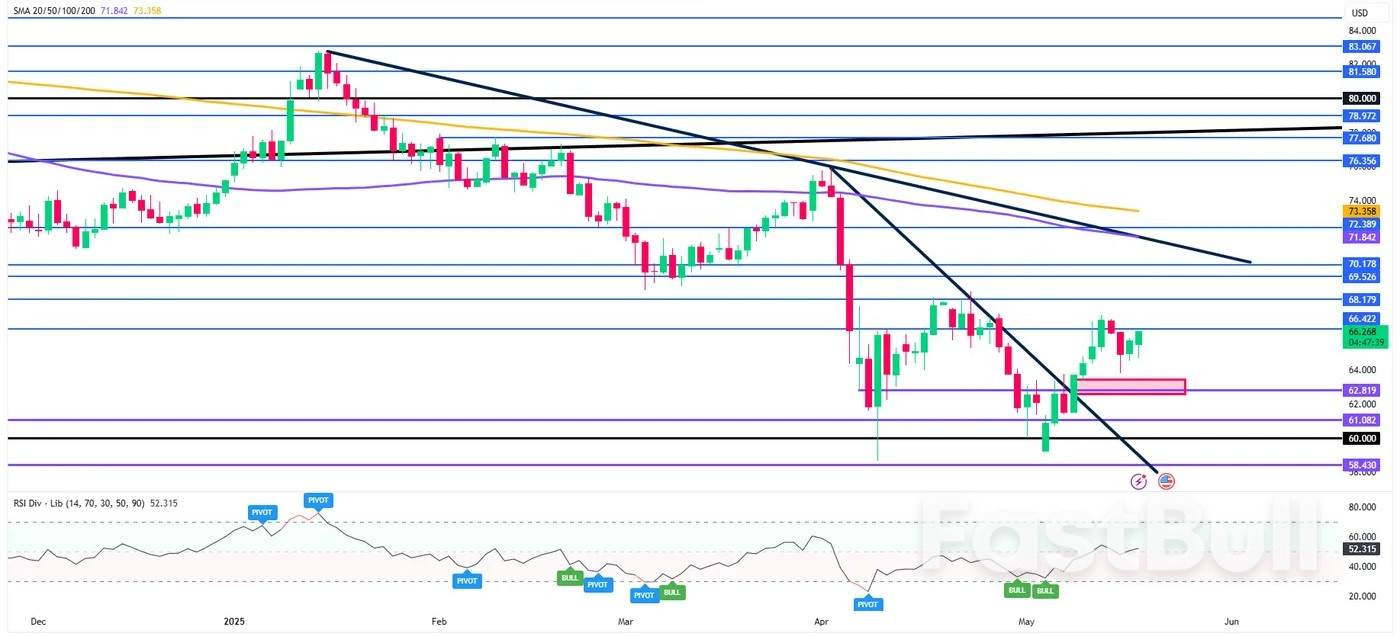
          Technical Analysis - Brent Crude

          From a technical standpoint. Brent crude posted a bullish inside bar close on Friday.
          This is usually a hint at further upside something which has materialized as the day progressed.
          As things stand, the Oil price approaching a resistance level at 66.42 with a break of the previous high potentially leading to a retest of resistance at 68.17.
          The period-14 RSI on the daily timeframe has also crossed back above the 50 neutral level which signals a shift in momentum from bearish to bullish.
          If however bears are to return and push prices lower, immediate support rests at 65.00 and 64.00 before the 62.81 handle comes into focus.
          Brent Crude Oil Daily Chart, May 19, 2025
          Crude Oil Recovers After Chinese Data, Goldman Upgrade_1

          Client Sentiment Data - WTI Oil

          Looking at OANDA client sentiment data and market participants are Net-Long on WTI with 74% of traders holding long positions. I prefer to take a contrarian view toward crowd sentiment and thus the fact that so many traders are long means WTI prices could decline further.

          Source: marketpulse

          To stay updated on all economic events of today, please check out our Economic calendar
          Risk Warnings and Disclaimers
          You understand and acknowledge that there is a high degree of risk involved in trading. Following any strategies or investment methods may lead to potential losses. The content on the site is provided by our contributors and analysts for information purposes only. You are solely responsible for determining whether any trading assets, securities, strategy, or any other product is suitable for investing based on your own investment objectives and financial situation.
          Add to Favorites
          Share

          US Consumer Sentiment Slumps, Households Brace for Inflation Surge

          Manuel

          Economic

          U.S. consumer sentiment deteriorated further in May, with one-year inflation expectations soaring to levels last seen in late 1981 amid escalating fears over the economic impact of President Donald Trump's trade policy.
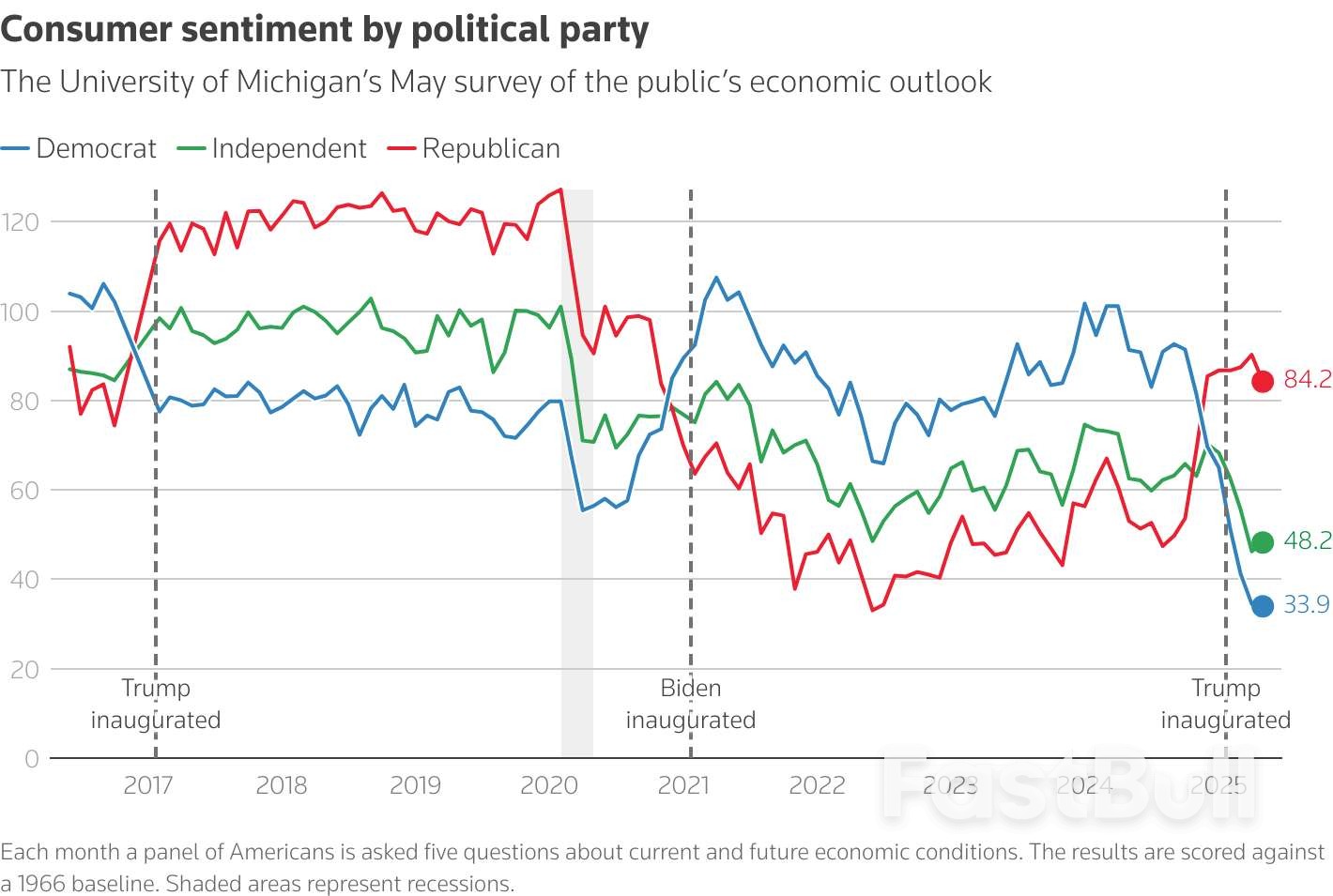
          The University of Michigan's Surveys of Consumers on Friday showed a significant decline in morale among Republicans, suggesting that even Trump's base was becoming concerned with the president's sweeping tariffs, which this week led retail giant Walmart to warn that it would start raising prices at the end of month because of increased costs from import duties.
          It was the first time that sentiment dropped among Republicans since Trump's November 5 electoral victory. The continued slump in overall sentiment and jump in inflation expectations suggested a retrenchment in consumer spending was probably underway that could temper economists' expectations for a rebound in economic growth this quarter.US Consumer Sentiment Slumps, Households Brace for Inflation Surge_1
          The economy contracted in the first quarter for the first time in three years amid a flood of imports as businesses tried to beat the higher costs associated with tariffs. Retail sales were almost flat in April.
          "The consumer is plainly worried and reading between the lines it is not just price increases that are worrying, it is the fact that many goods may be impossible to find as the reduction in port activity means shortages could develop within months," said Christopher Rupkey, chief economist at FWDBONDS.
          "The outlook continues to darken and one wonders how long this can continue before the economy actually slips over the edge into recession."
          The University of Michigan's consumer sentiment index dropped to 50.8 this month, the lowest level since June 2022, from a final reading of 52.2 in April. Economists polled by Reuters had forecast the index would rise to 53.4.
          Sentiment dropped 7% among Republicans, offsetting an improvement among independents. The mood remained gloomy among Democrats.
          The survey was conducted between April 22 and May 13, wrapping up two days after the U.S. and China de-escalated their trade war. Duties on Chinese imports were slashed to 30% from 145% for 90 days as part of the deal reached last weekend by Washington and Beijing.
          The University of Michigan said the initial reaction mirrored the minor improvement in sentiment seen following the delayed implementation in April of Trump's country-specific duties until July.
          "Tariffs were spontaneously mentioned by nearly three-quarters of consumers, up from almost 60% in April; uncertainty over trade policy continues to dominate consumers' thinking about the economy," said Joanne Hsu, the Surveys of Consumers director. "Consumers continue to express somber views about the economy."
          Consumers' 12-month inflation expectation soared to 7.3%, the highest level since November 1981, from 6.5% in April. Both Democrats and Republicans anticipated higher near-term inflation. The jump pointed to higher prices in the months ahead despite benign consumer prices in April, which economists attributed to businesses still selling inventory accumulated ahead of tariffs.

          PRICE HIKES LOOMING

          Auto manufacturers also have announced price increases, and economists expect inflation to pick up by the middle of this year. Long-run inflation expectations increased to 4.6% in the University of Michigan data, the highest level since March 1991, from 4.4% in April amid a large jump among Republicans. Rising inflation expectations could complicate matters for the Federal Reserve as it weighs its next monetary policy move.
          "The key idea to remember here is that inflation expectations are the primary transmission mechanism, along with external retaliation, that turns tariffs into a sustained increase in the price level or inflation," said Joseph Brusuelas, chief economist at RSM US. "The idea that the Federal Reserve is going to hike rates anytime soon should be summarily dismissed."
          Fed Chair Jerome Powell warned on Thursday that "we may be entering a period of more frequent, and potentially more persistent, supply shocks - a difficult challenge for the economy and for central banks. The U.S. central bank left its benchmark overnight interest rate in the 4.25%-4.50% range earlier this month.
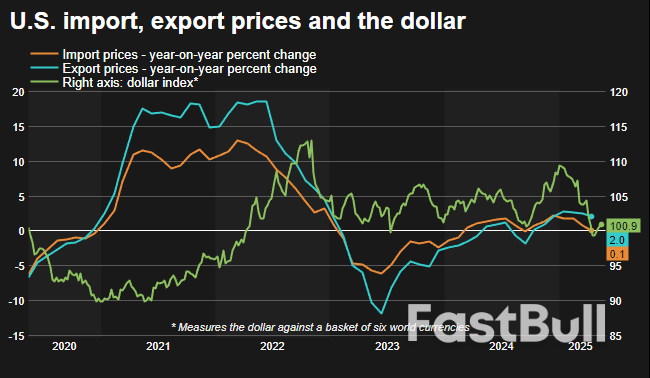
          Higher inflation was flagged in a separate report from the Labor Department's Bureau of Labor Statistics that showed prices for imported capital goods jumped 0.6% in April, while those of consumer goods excluding motor vehicles increased 0.3%. Overall import prices, which exclude tariffs, gained 0.1% after falling 0.4% in March. The reading confounded economists' expectations for a 0.4% decline.US Consumer Sentiment Slumps, Households Brace for Inflation Surge_2
          "Our tariff pass-through analysis indicates that costs are still largely being borne by U.S. importers," said Pooja Sriram, an economist at Barclays. That is at odds with the White House's narrative.
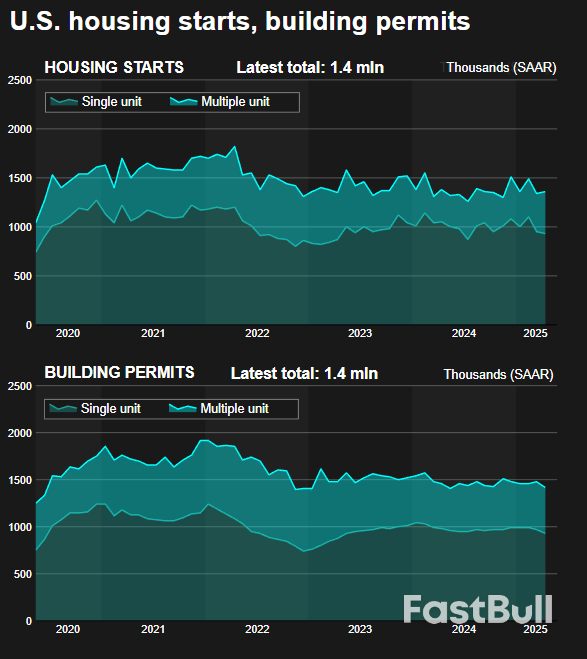
          Tariffs are also weighing on activity in the housing market.
          A separate report from the Commerce Department's Census Bureau showed single-family housing starts, which account for the bulk of homebuilding, dropped 2.1% to a seasonally adjusted annual rate of 927,000 units last month, the lowest level in nine months. Permits for future construction of single-family housing declined 5.1% to a rate of 922,000 units, suggesting the weakness might persist. There is also a glut of unsold new homes on the market.
          Indeed, a National Association of Home Builders survey on Thursday showed sentiment among single-family homebuilders plunged to a 1-1/2-year low in May, with 78% of builders reporting "difficulties pricing their homes recently due to uncertainty around material prices."
          "Builders are hitting the brakes this year in response to high uncertainty for costs and future demand," said Ben Ayers, a senior economist at Nationwide. "We expect starts to fade further over the summer as conditions remain challenging for builder profitability."US Consumer Sentiment Slumps, Households Brace for Inflation Surge_3

          Source: Reuters

          To stay updated on all economic events of today, please check out our Economic calendar
          Risk Warnings and Disclaimers
          You understand and acknowledge that there is a high degree of risk involved in trading. Following any strategies or investment methods may lead to potential losses. The content on the site is provided by our contributors and analysts for information purposes only. You are solely responsible for determining whether any trading assets, securities, strategy, or any other product is suitable for investing based on your own investment objectives and financial situation.
          Add to Favorites
          Share
          FastBull
          Copyright © 2025 FastBull Ltd

          728 RM B 7/F GEE LOK IND BLDG NO 34 HUNG TO RD KWUN TONG KLN HONG KONG

          TelegramInstagramTwitterfacebooklinkedin
          App Store Google Play Google Play
          Products
          Charts

          Chats

          Q&A with Experts
          Screeners
          Economic Calendar
          Data
          Tools
          Membership
          Features
          Function
          Markets
          Copy Trading
          Latest Signals
          Contests
          News
          Analysis
          24/7
          Columns
          Education
          Company
          Careers
          About Us
          Contact Us
          Advertising
          Help Center
          Feedback
          User Agreement
          Privacy Policy
          Business

          White Label

          Data API

          Web Plug-ins

          Poster Maker

          Affiliate Program

          Risk Disclosure

          The risk of loss in trading financial instruments such as stocks, FX, commodities, futures, bonds, ETFs and crypto can be substantial. You may sustain a total loss of the funds that you deposit with your broker. Therefore, you should carefully consider whether such trading is suitable for you in light of your circumstances and financial resources.

          No decision to invest should be made without thoroughly conducting due diligence by yourself or consulting with your financial advisors. Our web content might not suit you since we don't know your financial conditions and investment needs. Our financial information might have latency or contain inaccuracy, so you should be fully responsible for any of your trading and investment decisions. The company will not be responsible for your capital loss.

          Without getting permission from the website, you are not allowed to copy the website's graphics, texts, or trademarks. Intellectual property rights in the content or data incorporated into this website belong to its providers and exchange merchants.

          Not Logged In

          Log in to access more features

          FastBull Membership

          Not yet

          Purchase

          Become a signal provider
          Help Center
          Customer Service
          Dark Mode
          Price Up/Down Colors

          Log In

          Sign Up
          Position
          Layout
          Fullscreen
          Default to Chart
          The chart page opens by default when you visit fastbull.com