• Trade
  • Markets
  • Copy
  • Contests
  • News
  • 24/7
  • Calendar
  • Q&A
  • Chats
Trending
Screeners
SYMBOL
LAST
BID
ASK
HIGH
LOW
NET CHG.
%CHG.
SPREAD
SPX
S&P 500 Index
6966.29
6966.29
6966.29
6978.37
6917.65
+44.83
+ 0.65%
--
DJI
Dow Jones Industrial Average
49504.06
49504.06
49504.06
49571.41
49197.06
+237.96
+ 0.48%
--
IXIC
NASDAQ Composite Index
23671.34
23671.34
23671.34
23721.15
23426.48
+191.33
+ 0.81%
--
USDX
US Dollar Index
98.860
98.940
98.860
98.980
98.600
+0.290
+ 0.29%
--
EURUSD
Euro / US Dollar
1.16309
1.16389
1.16309
1.16618
1.16179
-0.00271
-0.23%
--
GBPUSD
Pound Sterling / US Dollar
1.33930
1.34121
1.33930
1.34505
1.33922
-0.00468
-0.35%
--
XAUUSD
Gold / US Dollar
4509.15
4509.15
4509.15
4517.06
4452.75
+31.36
+ 0.70%
--
WTI
Light Sweet Crude Oil
58.641
58.670
58.641
59.589
57.491
+0.393
+ 0.67%
--

Community Accounts

Signal Accounts
--
Profit Accounts
--
Loss Accounts
--
View More

Become a signal provider

Sell trading signals to earn additional income

View More

Guide to Copy Trading

Get started with ease and confidence

View More

Signal Accounts for Members

All Signal Accounts

Best Return
  • Best Return
  • Best P/L
  • Best MDD
Past 1W
  • Past 1W
  • Past 1M
  • Past 1Y

All Contests

  • All
  • Trump Updates
  • Recommend
  • Stocks
  • Cryptocurrencies
  • Central Banks
  • Featured News
Top News Only
Share

Consumer Bankers Association: Banks Respond To Proposed Cap On Credit Card Interest Rates In The US

Share

[US Commerce Department Withdraws Plan To Add Chinese-Made Drones To So-Called "Controlled List"] The US Commerce Department Said On Friday (9th) That It Has Withdrawn A Plan To Restrict The Import Of Chinese-made Drones In Order To Address "national Security" Concerns

Share

Bill Ackman: Trump's Call For One Year Cap On Credit Card Interest Rates At 10% "Is A Mistake"

Share

USA And Venezuela Have Returned Tanker Minerva To Venezuelan Waters - Venezuela Statement

Share

Trump: Effective January 20, 2026, I, As President Of United States, Am Calling For A One Year Cap On Credit Card Interest Rates Of 10%

Share

Nasdaq: Walmart Inc. Will Become A Component Of Nasdaq-100 Index

Share

Bessent Says US Treasury Can Easily Cover Any Tariff Refunds

Share

Bessent: USA Has Seen 'Very, Very Little' Pass Through Of Tariffs To Consumers In The Form Of Higher Prices

Share

Bessent: Any Tariff Refunds Would Flow Out Over Weeks, Months, Possibly A Year

Share

Bessent Says Australia, India Invited To G7 Meeting On Critical Minerals

Share

Treasury's Bessent: Goal Of Mortgage Buybacks Is To Roughly Match Rate Of Mbs Rolloff From Fed Balance Sheet

Share

California's Budget Plan Proposes To Collect More Taxes On Delivery Apps

Share

US President Trump: It Was A Very Good Meeting

Share

USA Energy Secretary: I Am In Touch With Venezuela

Share

USA Energy Secretary Chris Wright: Chevron Timeline Is Of 18-24 Months For Venezuela

Share

U.S. Agriculture Secretary Rollins: The Trump Administration Has Suspended Federal Funding To Minnesota, Effective Immediately. This Includes Currently Activated Funds And Any Funds That May Be Approved In The Future

Share

The Two-year US Treasury Yield Rose About 4.4 Basis Points On Non-farm Payrolls Day, And Has Risen About 5.9 Basis Points This Week. On Friday (January 9), In Late New York Trading, The Yield On The Benchmark 10-year US Treasury Note Fell 0.19 Basis Points To 4.1653%, Reaching A Daily High Of 4.2028% When The US Non-farm Payrolls Report Was Released At 21:30 Beijing Time. The Yield Experienced Two Waves Of Upward Movement Followed By Pullbacks During The Day, And Has Fallen A Cumulative 2.53 Basis Points This Week, Trading Within The 4.2028%-4.1221% Range. The Two-year US Treasury Yield Rose 4.39 Basis Points To 3.5321%, Rising To 3.5342% After The Non-farm Payrolls Report Was Released, And Subsequently Exhibiting A W-shaped Pattern, Rising A Cumulative 5.88 Basis Points This Week. It Remained Below 3.48% From January 5-8, And Has Been Rising Steadily Since January 8

Share

SPDR Gold Holdings Down 0.24%, Or 2.57 Tonnes

Share

[Public Expectations Warm Up Canadian Prime Minister's Visit To China] According To The Global Times, The Canadian Prime Minister's Office Announced That Prime Minister Mark Carney Will Visit China From January 13th To 17th To Discuss Trade, Energy, And Security Issues. If The Trip Takes Place, It Will Be The First Visit To China By A Canadian Prime Minister Since 2017. Canadian Media Generally Hold High Expectations For Carney's Visit, Describing It As A "reset" Or "cautious Restart" Of Sino-Canadian Relations. These Keywords Reflect Canada's Objective Understanding Of The Current State Of Sino-Canadian Relations. The Global News Canada Described It As: "For Farmers In Saskatchewan, This Visit Is Something They've Been Eagerly Anticipating." This Vivid Metaphor Expresses The Fervent Hope Of The Canadian Public For A Warming Of Sino-Canadian Relations

Share

Trafigura, Vitol Providing Logistical, Marketing Services For Sale Of Venezuelan Oil At Request Of US Government - Trafigura Statement

TIME
ACT
FCST
PREV
U.S. Average Hourly Wage MoM (SA) (Dec)

A:--

F: --

P: --
U.S. Average Weekly Working Hours (SA) (Dec)

A:--

F: --

P: --

U.S. New Housing Starts Annualized MoM (SA) (Oct)

A:--

F: --

P: --
U.S. Total Building Permits (SA) (Oct)

A:--

F: --

P: --

U.S. Building Permits MoM (SA) (Oct)

A:--

F: --

P: --

U.S. Annual New Housing Starts (SA) (Oct)

A:--

F: --

P: --
U.S. U6 Unemployment Rate (SA) (Dec)

A:--

F: --

P: --

U.S. Manufacturing Employment (SA) (Dec)

A:--

F: --

P: --
U.S. Labor Force Participation Rate (SA) (Dec)

A:--

F: --

P: --

U.S. Private Nonfarm Payrolls (SA) (Dec)

A:--

F: --

P: --
U.S. Unemployment Rate (SA) (Dec)

A:--

F: --

P: --
U.S. Nonfarm Payrolls (SA) (Dec)

A:--

F: --

P: --
U.S. Average Hourly Wage YoY (Dec)

A:--

F: --

P: --
Canada Full-time Employment (SA) (Dec)

A:--

F: --

P: --

Canada Part-Time Employment (SA) (Dec)

A:--

F: --

P: --

Canada Unemployment Rate (SA) (Dec)

A:--

F: --

P: --

Canada Labor Force Participation Rate (SA) (Dec)

A:--

F: --

P: --

U.S. Government Employment (Dec)

A:--

F: --

P: --

Canada Employment (SA) (Dec)

A:--

F: --

P: --

U.S. UMich Consumer Expectations Index Prelim (Jan)

A:--

F: --

P: --

U.S. UMich Consumer Sentiment Index Prelim (Jan)

A:--

F: --

P: --

U.S. UMich Current Economic Conditions Index Prelim (Jan)

A:--

F: --

P: --

U.S. UMich 1-Year-Ahead Inflation Expectations Prelim (Jan)

A:--

F: --

P: --

U.S. UMich 5-Year-Ahead Inflation Expectations Prelim YoY (Jan)

A:--

F: --

P: --

U.S. 5-10 Year-Ahead Inflation Expectations (Jan)

A:--

F: --

P: --

China, Mainland M1 Money Supply YoY (Dec)

--

F: --

P: --

China, Mainland M0 Money Supply YoY (Dec)

--

F: --

P: --

China, Mainland M2 Money Supply YoY (Dec)

--

F: --

P: --

U.S. Weekly Total Oil Rig Count

A:--

F: --

P: --

U.S. Weekly Total Rig Count

A:--

F: --

P: --

Indonesia Retail Sales YoY (Nov)

--

F: --

P: --

Euro Zone Sentix Investor Confidence Index (Jan)

--

F: --

P: --

India CPI YoY (Dec)

--

F: --

P: --

Germany Current Account (Not SA) (Nov)

--

F: --

P: --

Canada National Economic Confidence Index

--

F: --

P: --

FOMC Member Barkin Speaks
U.S. 3-Year Note Auction Yield

--

F: --

P: --

U.S. 10-Year Note Auction Avg. Yield

--

F: --

P: --

Japan Trade Balance (Customs Data) (SA) (Nov)

--

F: --

P: --

Japan Trade Balance (Nov)

--

F: --

P: --

U.K. BRC Overall Retail Sales YoY (Dec)

--

F: --

P: --

U.K. BRC Like-For-Like Retail Sales YoY (Dec)

--

F: --

P: --

Turkey Retail Sales YoY (Nov)

--

F: --

P: --

U.S. NFIB Small Business Optimism Index (SA) (Dec)

--

F: --

P: --

Brazil Services Growth YoY (Nov)

--

F: --

P: --

Canada Building Permits MoM (SA) (Nov)

--

F: --

P: --

U.S. CPI MoM (SA) (Dec)

--

F: --

P: --

U.S. CPI YoY (Not SA) (Dec)

--

F: --

P: --

U.S. Real Income MoM (SA) (Dec)

--

F: --

P: --

U.S. CPI MoM (Not SA) (Dec)

--

F: --

P: --

U.S. Core CPI (SA) (Dec)

--

F: --

P: --

U.S. Core CPI YoY (Not SA) (Dec)

--

F: --

P: --

U.S. Core CPI MoM (SA) (Dec)

--

F: --

P: --

U.S. Weekly Redbook Index YoY

--

F: --

P: --

U.S. New Home Sales Annualized MoM (Oct)

--

F: --

P: --

U.S. Annual Total New Home Sales (Oct)

--

F: --

P: --

U.S. Cleveland Fed CPI MoM (SA) (Dec)

--

F: --

P: --

China, Mainland Imports YoY (CNH) (Dec)

--

F: --

P: --

China, Mainland Trade Balance (CNH) (Dec)

--

F: --

P: --

Q&A with Experts
    • All
    • Chatrooms
    • Groups
    • Friends
    john flag
    3311132
    Why does it keep showing that the verification code has expired?
    are you trying to register for the contest or something
    john flag
    ZK6WXRW2EY
    Hello/Good evening, I'm currently in Benin. I'm creating my account for the contest, and it's asking me to link my number, but it says "SMS sending failed." 😌
    @ZK6WXRW2EYyou should try to contact the support team
    "Nawhdir. Øt" recalled a message
    Nawhdir. Øt flag
    john
    @johnIt's unusual for you to be active this morning.
    Nawhdir. Øt flag
    cancer energy that spreads.
    Prashant S flag
    hello
    john flag
    Nawhdir. Øt
    @Nawhdir. Øtam all around person,,
    john flag
    Nawhdir. Øt
    @Nawhdir. Øtwhat are you watching in the market this morning ?
    john flag
    Nawhdir. Øt
    @Nawhdir. ØtI had came to check the price of gold and am happy to see that we closed above 4500
    john flag
    Prashant S
    hello
    @Prashant Shello and good morning
    Smart Trader flag
    john
    @john🫣
    3311907 flag
    F
    3311907 flag
    GOLD WILL JUMP BITE ON MONDAY
    3311907 flag
    UP TO 4560
    john flag
    Smart Trader
    @Smart Traderas l slept I left the price below 4500 and this was not pleasing to me
    john flag
    3311907
    GOLD WILL JUMP BITE ON MONDAY
    @Visitor3311907yeah we may see such a move
    john flag
    3311907
    GOLD WILL JUMP BITE ON MONDAY
    @Visitor3311907maybe the bulls we aim for 4600 next week
    Wan Bunna flag
    down a bit more before moving to 4550
    Wan Bunna flag
    4550 is the highest point of gold this month
    Wan Bunna flag
    so on Monday Gold may be down to 4460 then up to 4550
    Type here...
    Add Symbol or Code

      No matching data

      All
      Trump Updates
      Recommend
      Stocks
      Cryptocurrencies
      Central Banks
      Featured News
      • All
      • Russia-Ukraine Conflict
      • Middle East Flashpoint
      • All
      • Russia-Ukraine Conflict
      • Middle East Flashpoint
      Search
      Products

      Charts Free Forever

      Chats Q&A with Experts
      Screeners Economic Calendar Data Tools
      Membership Features
      Data Warehouse Market Trends Institutional Data Policy Rates Macro

      Market Trends

      Market Sentiment Order Book Forex Correlations

      Top Indicators

      Charts Free Forever
      Markets

      News

      News Analysis 24/7 Columns Education
      From Institutions From Analysts
      Topics Columnists

      Latest Views

      Latest Views

      Trending Topics

      Top Columnists

      Latest Update

      Signals

      Copy Rankings Latest Signals Become a signal provider AI Rating
      Contests
      Brokers

      Overview Brokers Assessment Rankings Regulators News Claims
      Broker listing Forex Brokers Comparison Tool Live Spread Comparison Scam
      Q&A Complaint Scam Alert Videos Tips to Detect Scam
      More

      Business
      Events
      Careers About Us Advertising Help Center

      White Label

      Data API

      Web Plug-ins

      Affiliate Program

      Awards Institution Evaluation IB Seminar Salon Event Exhibition
      Vietnam Thailand Singapore Dubai
      Fans Party Investment Sharing Session
      FastBull Summit BrokersView Expo
      Recent Searches
        Top Searches
          Markets
          News
          Analysis
          User
          24/7
          Economic Calendar
          Education
          Data
          • Names
          • Latest
          • Prev

          View All

          No data

          Scan to Download

          Faster Charts, Chat Faster!

          Download App
          English
          • English
          • Español
          • العربية
          • Bahasa Indonesia
          • Bahasa Melayu
          • Tiếng Việt
          • ภาษาไทย
          • Français
          • Italiano
          • Türkçe
          • Русский язык
          • 简中
          • 繁中
          Open Account
          Search
          Products
          Charts Free Forever
          Markets
          News
          Signals

          Copy Rankings Latest Signals Become a signal provider AI Rating
          Contests
          Brokers

          Overview Brokers Assessment Rankings Regulators News Claims
          Broker listing Forex Brokers Comparison Tool Live Spread Comparison Scam
          Q&A Complaint Scam Alert Videos Tips to Detect Scam
          More

          Business
          Events
          Careers About Us Advertising Help Center

          White Label

          Data API

          Web Plug-ins

          Affiliate Program

          Awards Institution Evaluation IB Seminar Salon Event Exhibition
          Vietnam Thailand Singapore Dubai
          Fans Party Investment Sharing Session
          FastBull Summit BrokersView Expo

          A ‘seismic’ Nvidia shift, AI chip shortages and how it’s threatening to hike gadget prices

          Adam

          Economic

          Summary:

          A surge in AI-driven chip demand and Nvidia’s shift to advanced LPDDR memory are straining global semiconductor supply chains, driving up memory prices, threatening gadget shortages, and likely pushing smartphone and PC costs higher.

          The cost of your smartphone might rise, analysts are warning, as the AI boom clogs up supply chains and a recent change by Nvidia to its products could make it worse.
          AI data centers, on which tech giants globally are spending hundreds of billions of dollars, require chips from suppliers, like Nvidia, which relies on many different components and companies to create its coveted graphics processing units.
          But other companies like AMD , the hyperscalers like Google and Microsoft , and other component suppliers all rely on this supply chain.
          Many parts of the supply chain can’t keep up with demand, and it’s slowing down components that are critical for some of the world’s most popular consumer electronics. Those components are seeing huge spikes in prices, threatening price rises for the end product and could even lead to shortages of some devices.
          “We see the rapid increase in demand for AI in data centers driving bottlenecks in many areas,” Peter Hanbury, partner in the technology practice at Bain & Company, told CNBC.
          Where is the supply chain clogged?
          One of the starkest assessments came from Alibaba CEO Eddie Wu, CEO of Chinese tech giant Alibaba.
          Wu, whose company is building its own AI infrastructure and designs its own chips, said last week that there are shortages across semiconductor manufacturers, memory chips and storage devices like hard drives.
          “There is a situation of undersupply,” Wu said, adding that the “supply side is going to be a relatively large bottleneck.” He added this could last two to three years.
          Bain and Co.’s Hanbury said there are shortages of hard disk drives, or HDDs, which store data. HDDs are used in the data center. These are preferred by hyperscalers,: big companies like Microsoft and Google. But, with HDDs at capacity, these firms have shifted to using solid-state drives, or SSDs, another type of storage device.
          However, these SSDs are key components for consumer electronics.
          The other big focus is on a type of chip under the umbrella of memory called dynamic random-access memory or DRAM. Nvidia’s chips use high-bandwidth memory which is a type of chip that stacks multiple DRAM semiconductors.
          Memory prices have surged as a result of the huge demand and lack of supply. Counterpoint Research said it expects memory prices to rise 30% in the fourth quarter of this year and another 20% in early 2026. Even small imbalances in supply and demand can have major knock on effects on memory pricing. And because of the demand for HBM and GPUs, chipmakers are prioritizing these over other types of semiconductors.
          “DRAM is certainly a bottleneck as AI investments continue to feed the imbalance between demand and supply with HBM for AI being prioritized by chipmakers,” MS Hwang, research director at Counterpoint Research, told CNBC.
          “Imbalances of 1-2% can trigger sharp price increases and we’re seeing that figure hitting 3% levels at the moment – this is very significant.”
          Why are there issues?
          Building up capacity in various areas of the semiconductor supply chain can be capital-intensive. And it’s an industry that’s known to be risk-averse and did not add the capacity necessary to meet the projections provided by key industry players, Bain & Co.’s Hanbur said.
          “The direct cause of the shortage is the rapid increase in demand for data center chips,” Hanbury said.
          “Basically, the suppliers worried the market was too optimistic and they did not want to overbuild very expensive capacity so they did not build to the estimates provided by their customers. Now, the suppliers need to add capacity quickly but as we know, it takes 2-3 years to add semiconductor manufacturing fabs.”
          Nvidia at the center
          A lot of attention is on Nvidia given it dominates when it comes to the chips that are being put into AI data centers.
          It is a huge customer of high bandwidth memory, for example. And its products are manufactured by TSMC which also has other major customers like Apple.
          But analysts are focused on a change Nvidia has made to its products that has the potential to add major pressure to consumer electronics supply chains. The U.S. giant is increasingly shifting toward using a type of memory in its products called Low-Power Double Data Rate (LPDDR). This is seen as more power efficient than the previous Double Data Rate, or DDR memory.
          The problem is, Nvidia is increasingly using the latest generation of LPDDR memory, which is also used by high-end consumer electronics makers such as Samsung and Apple
          .
          Typically, the industry would just be dealing with demand for this product from a handful of big electronics players. But now Nvidia, which has huge scale, is entering the mix.
          “We also see a bigger risk on the horizon is with advanced memory as Nvidia’s recent pivot to LPDDR means they’re a customer on the scale of a major smartphone maker — a seismic shift for the supply chain which can’t easily absorb this scale of demand,” Hwang from Counterpoint Research said.
          How AI boom is impacting consumer electronics
          Here’s the link between all of this.
          From chip manufacturers like TSMC, Intel and Samsung, there is only so much capacity. If there is huge demand for certain types of chips, then these companies will prioritize those, especially from their larger customers. That can lead to shortages of other types of semiconductors elsewhere.
          Memory chips, in particular DRAM which has seen prices shoot up, is of particular concern because it’s used in so many devices from smartphones to laptops. And this could lead to price rises in the world’s favorite electronics.
          DRAM and storage represent around 10% to 25% of the bill of materials for a typical PC or smartphone, according to Hanbury of Bain & Co. A price increase of 20% to 30% in these components would increase the total bill of materials costs by 5% to 10%.
          “In terms of timing, the impact will likely start shortly as component costs are already increasing and likely accelerate into next year,” Hanbury said.
          On top of this, there is now demand from players involved in AI data centers like Nvidia, for components that would have typically been used for consumer devices such as LPDDR which adds more demand to a supply constrained market.
          If electronics firms can’t get their hands on the components needed for their devices because they’re in short supply or going toward AI data centers, then there could be shortages of the world’s most popular gadgets.
          “Beyond the rise in cost there’s a second issue and that’s the inability to secure enough components, which constrains the production of electronic devices,” Counterpoint Research’s Hwang said.
          What are tech firms saying?
          A number of electronics companies have warned about the impact they are seeing from all of this.
          Xiaomi , the third-biggest smartphone vendor globally, said it expects that consumers will see “a sizeable rise in product retail prices,” according to a Reuters reported this month.
          Jeff Clark, chief operating officer at Dell , this month said the price rises of components is “unprecedented.”
          “We have not seen costs move at the rate that we’ve seen,” Clark said on an earnings call, adding that the pressure is seen across various types of memory chips and storage hard drives.
          The unintended consequences The AI infrastructure players are using similar chips to those being used in consumer electronics. These are often some of the more advanced semiconductors on the market.
          But there are legacy chips which are manufactured by the same companies that the AI market is relying on. As these manufacturers shift attention to serving their AI customers, there could be unintended consequences for other industries.
          “For example, many other markets depend on the same underlying semiconductor manufacturing capabilities as the data center market” including automobiles, industrials and aerospace and defense, which “will likely see some impact from these price increases as well,” Hanbury said.

          Source: cnbc

          To stay updated on all economic events of today, please check out our Economic calendar
          Risk Warnings and Disclaimers
          You understand and acknowledge that there is a high degree of risk involved in trading. Following any strategies or investment methods may lead to potential losses. The content on the site is provided by our contributors and analysts for information purposes only. You are solely responsible for determining whether any trading assets, securities, strategy, or any other product is suitable for investing based on your own investment objectives and financial situation.
          Add to Favorites
          Share

          OBR Complained to Treasury Before Budget About Leaks Spreading ‘Misconceptions’

          Warren Takunda

          Economic

          The Office for Budget Responsibility complained to senior Treasury officials in the run-up to the budget about a flurry of leaks that it said spread “misconceptions” about its forecasts, it has emerged.
          Prof David Miles of the OBR’s budget responsibility committee told MPs on the Treasury select committee on Tuesday that the watchdog had raised the issue of leaks with the department before the chancellor’s statement last week.
          “I think it was clear that there was lots of information appearing in the press which perhaps wouldn’t normally be out there and that this wasn’t from our point of view particularly helpful,” he said. He added: “We made it clear that they were not helpful and that we weren’t in a position of course to put them right.”
          Miles was appearing before the committee after the OBR chair, Richard Hughes, resigned on Monday, taking responsibility for the inadvertent release of its budget documents about an hour before Rachel Reeves stood up to announce her tax and spending plans.
          Hughes’s departure also followed the publication on Friday of a letter that took what he called the “unusual step” of spelling out the evolution of the OBR’s forecasts over time, prompting a furious row about Reeves’s account of the backdrop to her budget decisions.
          Miles said the letter was published because the watchdog felt the public had received a false impression, which was “damaging to the OBR and to the process”.
          However, he denied that, as opposition politicians have claimed, the OBR’s letter showed Reeves was misleading in her 4 November pre-budget speech, in which she underlined the perilous state of the public finances.
          He said the OBR’s forecasts “didn’t suggest that the fiscal outlook was problem free” and described the margin for error, or headroom, on the chancellor’s fiscal rules, which was £4.2bn in the 31 October forecast, as a “sliver”, and “wafer thin”.
          “I don’t think it was misleading for the chancellor to say that the fiscal position was very challenging,” he said.
          But Miles did highlight two “misconceptions” – the idea that the OBR had shifted the time period over which it assesses the yields on government bonds, perhaps under pressure from government; or that its forecasts had swung dramatically at the last minute, affecting Labour’s decision-making.
          Miles told MPs there was “a view that the OBR’s forecasts were wildly fluctuating in the process both leading up to the pre-measures forecast, and perhaps after it as well, and that that had made the budget process more chaotic than it otherwise would have been”.
          His evidence also flatly contradicted a government briefing on 14 November, as markets reacted to news that Reeves had dropped plans to raise income tax, which suggested that decision resulted from improved forecasts.
          “There seemed to be a misconception that there seemed to have been some good news, and I’m not sure where that came from: it didn’t exist,” he told the committee.
          “What had happened is that the forecast for headroom had gradually improved a little bit in the run-up to 31 October” (when the final ‘pre-measures’ forecast was sent to Reeves).
          Questioned by the Conservative former Treasury minister John Glen, Miles said the watchdog wanted to make clear that it was not “either the patsy that was doing what the government wanted, or that through its own fickle behaviour changing from one day to the next, depending on whether it was sunny or cloudy, that that was making it virtually impossible for the government”.
          As OBR officials were being questioned by MPs, the Bank of England governor, Andrew Bailey, was defending the institution against attacks.
          Speaking at a Bank press conference to launch its financial stability report, Bailey said: “The reason the OBR was created was to ensure there was a source of independent forecasting and an independent assessment of fiscal policy.”
          He added: “So attacks on the OBR in terms of the principle, I would say ‘no, can we please remember why it was done and the principles underlying it’.”
          Miles added that the slew of leaks may have hit economic growth by exaggerating consumer and business uncertainty, which “may well have been exacerbated by leaks which some days seemed to be suggesting one thing and the next day something different”. He added: “I don’t think that can have helped.”
          He defended the OBR’s decision to reassess its forecasts for the economy’s underlying productivity outlook this summer. Reeves and Keir Starmer have expressed frustration that this rethink, which led to a downgrade in growth forecasts, had not taken place earlier.
          Miles said it had been important to wait until the impact of the big economic shocks of Covid and Russia’s invasion of Ukraine had faded, and it would have been “trigger-happy” to move earlier.

          Source: Theguardian

          To stay updated on all economic events of today, please check out our Economic calendar
          Risk Warnings and Disclaimers
          You understand and acknowledge that there is a high degree of risk involved in trading. Following any strategies or investment methods may lead to potential losses. The content on the site is provided by our contributors and analysts for information purposes only. You are solely responsible for determining whether any trading assets, securities, strategy, or any other product is suitable for investing based on your own investment objectives and financial situation.
          Add to Favorites
          Share

          Dollar Recovers Ground Vs Yen; Euro Steadies After Inflation Data

          Blue River

          Forex

          Economic

          The dollar regained ground against the yen, recovering from Monday's selloff, even as expectations for a December rate hike by the Bank of Japan lingered, while the euro edged up after data on Tuesday showed euro zone inflation was slightly hotter-than-expected.

          The greenback rose 0.3% against the yen to 156.00, after hitting a two-week low on Monday, following a sale of 10-year Japanese government bonds which saw the strongest demand since September.

          "The auction result appears to have provided a measure of reassurance to the market," said Shoki Omori, chief desk strategist at Mizuho in Tokyo.

          Stocks, bonds, cryptocurrencies and the dollar all tumbled on Monday after Bank of Japan Governor Kazuo Ueda said that the central bank would consider the "pros and cons" of raising interest rates at its next policy meeting, sending Japanese two-year yields above 1% for the first time since 2008 and prompting a spillover into global bond markets.

          "We're basically back to where we started before Ueda's remarks yesterday, which is maybe a bit perplexing considering that swaps still price about an 80% chance of a Dec hike," said Michael Brown, senior research strategist at Pepperstone.

          "To me it speaks to everything still being very much USD-driven, with the pressure on the buck seen yesterday amid increasing expectations that (Kevin) Hassett will get the Fed Chair gig having given way to slightly more rational conditions today, as participants re-focus on what remains a solid U.S. growth outlook, even with a 25-basis-point Fed cut next week very much on the cards," he said.

          Data on Monday showed weaker-than-expected manufacturing data from the U.S., heaping pressure on the Federal Reserve to cut interest rates this month.

          Fed funds futures are pricing an 87% probability of a 25-basis-point cut at the Fed's next meeting on December 10, compared with a 63% chance a month ago, according to the CME Group's FedWatch tool.

          The euro was 0.1% higher at $1.16200 after data showed inflation in the 20 nations sharing the euro accelerated to 2.2% last month from 2.1% in October, a small rise that is unlikely to be too concerning for the European Central Bank.

          Inflation in the euro zone is practically at the ECB's 2% target, ECB policymaker Joachim Nagel said in an interview published on Tuesday.

          "This (inflation data) comes at a time where some had claimed we could yet see another cut from the ECB, although the likeliness is that their easing cycle is over," said Joshua Mahony, chief market analyst at Scope Markets.

          Sterling edged 0.1% lower to $1.3207 , having touched its highest level in a month on Monday.

          The Bank of England cut the amount of capital it estimates lenders need to hold in a bid to boost lending and stimulate the economy in the first reduction to bank capital requirements since the financial crisis.

          Leading cryptocurrency bitcoin rose 2% to $88,255, pulling away from the 10-day low touched in the previous session.

          Source: Kitco

          To stay updated on all economic events of today, please check out our Economic calendar
          Risk Warnings and Disclaimers
          You understand and acknowledge that there is a high degree of risk involved in trading. Following any strategies or investment methods may lead to potential losses. The content on the site is provided by our contributors and analysts for information purposes only. You are solely responsible for determining whether any trading assets, securities, strategy, or any other product is suitable for investing based on your own investment objectives and financial situation.
          Add to Favorites
          Share

          The Fed Has Rarely Been So Divided Over Its Long-Term Plan for Interest Rates

          Adam

          Economic

          Central Bank

          After cutting interest rates by more than a percentage point, Federal Reserve officials are now wondering where to stop – and finding there’s more disagreement than ever.
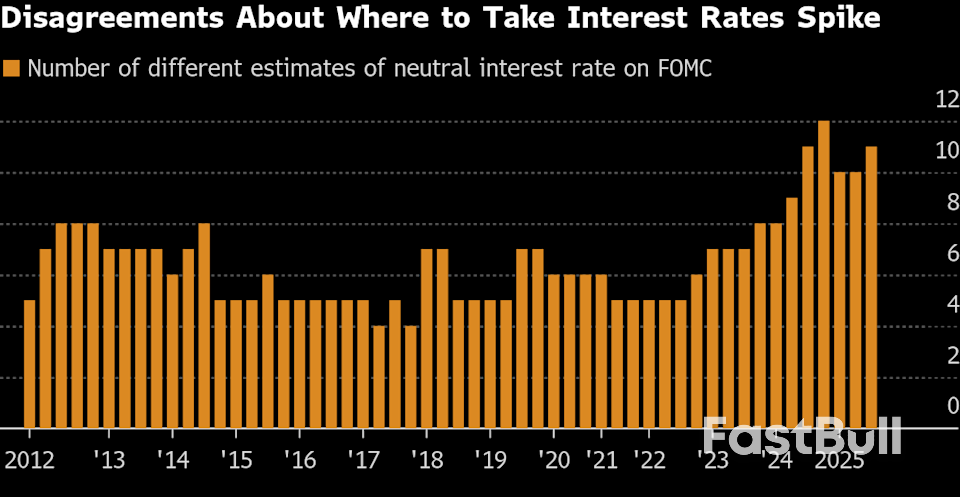
          In the past year or so, prescriptions for where rates should end up have diverged by the most since at least 2012, when US central bankers started publishing their estimates. That’s feeding into an unusually public split over whether to deliver another cut next week, and what comes after that.
          Fed Chair Jerome Powell has acknowledged “strongly differing views” across the rate-setting committee about which of their two goals – stable prices and maximum employment – to prioritize. It boils down to a question of whether the economy needs a touch more gas to shore up job markets, or whether policymakers should take their foot off the pedal because inflation is above-target and tariffs could push it higher still.
          But that raises another question — one that’s more abstract but increasingly important to the whole debate: what rate of interest would neither stimulate the economy nor squeeze it? This is the presumed endpoint of the cutting cycle. It’s known as the “neutral” rate. And right now the collective Fed is struggling to figure out what it is.
          ‘All Over the Place’
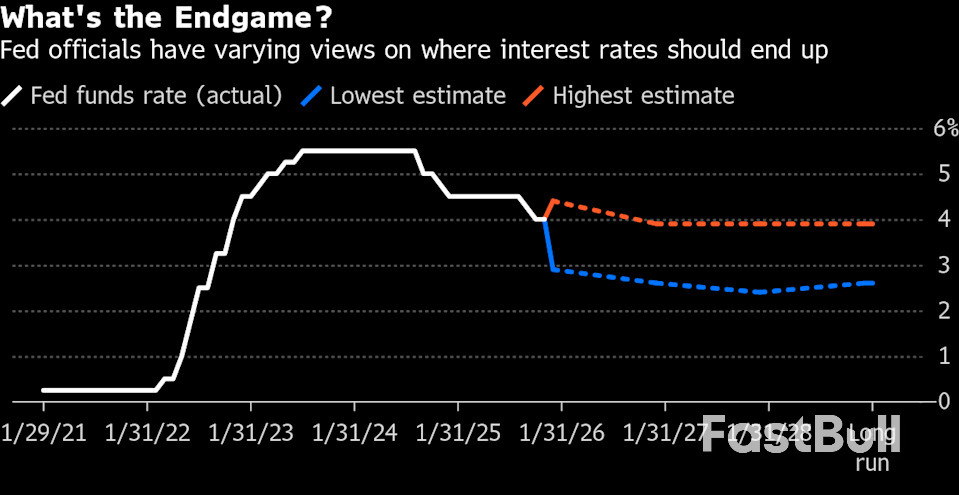
          In September, the last time they published projections, 19 officials came up with 11 different estimates, ranging from 2.6% to 3.9% — the latter number being roughly where rates are now.
          “We have people all over the place,” says Stephen Stanley, chief US economist for Santander. “There’s always a degree of disagreement on that, but the current range is wider.”
          The Fed Has Rarely Been So Divided Over Its Long-Term Plan for Interest Rates_1
          Stanley also thinks the estimates are becoming more important, as the Fed’s benchmark arrives at the upper edge of that range. “It starts to become potentially a binding constraint for some of the more hawkish Fed members,” he says. “It definitely means that each successive cut becomes harder and harder.”
          All of this is borne out in some recent Fedspeak. Philadelphia Fed President Anna Paulson explained on Nov. 20 why the twin risks of higher inflation and unemployment, combined with rates that may already be near neutral, have left her heading into the December meeting with caution.
          “Monetary policy has to walk a fine line,” she said. “Each rate cut brings us closer to the level where policy flips from restraining activity a bit to the place where it starts to provide a boost.”
          The neutral rate of interest is also known as r-star, based on the mathematical notation used to represent it in models, or the natural rate. It can’t be directly observed, only inferred, and has generated intense debate for more than a century. Some economists, including John Maynard Keynes, have questioned whether it’s really a useful tool at all — but few modern central bankers would agree.
          The idea is at the “heart of monetary theory and practice,” according to New York Fed chief John Williams, a specialist on the topic. He’s argued that failure on the part of policymakers to diagnose shifts in the natural or neutral rates of interest and unemployment can have profound consequences, citing the spike in inflation expectations in the 1960s and ‘70s.
          The neutral rates are widely seen as driven by long-term shifts in things like demographics, technology, productivity and debt burdens, which affect patterns of savings and investment.
          Which Direction?
          At the Fed, alongside the lack of consensus on where they are right now, there’s also disagreement about which way they’re headed.
          Minneapolis Fed President Neel Kashkari predicts that widespread adoption of artificial intelligence will lead to faster productivity growth, pushing the neutral interest rate up as new investment opportunities boost demand for capital.
          Fed Governor Stephen Miran, President Donald Trump’s latest appointment to the central bank, says present-day policies should also play a part in the debate. In his first policy speech after joining the Fed, Miran made the case that Trump’s tariffs, immigration curbs and tax cuts have combined to drive the neutral rate lower, even if only temporarily — so the Fed should ease policy sharply to avoid hurting the economy.
          The Fed Has Rarely Been So Divided Over Its Long-Term Plan for Interest Rates_2
          Williams last month expressed doubts about allowing short-term changes into the calculation. He argues that global trends such as aging populations are holding estimates of the rate at historically low levels.
          For a decade or so before the pandemic, when inflation was subdued and interest rates near zero, policymakers seemed to more or less agree where neutral was. But the surge in prices since then – as well as the uncertainty over trade and immigration, and what AI will do to the economy — have left some analysts wondering if diverging estimates are the new normal.
          What’s more, the Fed is set for a change of leadership in 2026, with Trump vowing to pick a new chair who’s committed to lower interest rates, and the president may have other opportunities to staff the central bank with his allies. The new policymakers are expected to argue for cheaper money, like Miran has, and may also estimate that neutral is lower right now.
          ‘Only a Tool’
          Since the neutral rate of interest is for economists what “dark matter” is to astronomers — something that can’t be seen directly — there are policymakers who prefer to judge it, in Powell’s words, “by its works.”
          St. Louis Fed President Alberto Musalem says low default rates show financial conditions remain supportive for the economy. His Cleveland Fed counterpart, Beth Hammack, says narrow credit spreads imply monetary policy is “only barely restrictive, if at all.”
          Drawing clues from financial markets, though, isn’t a straightforward task. Some Fed officials see the yield on 10-year Treasury bonds (^TNX), which has been hovering around 4%, as evidence that financial conditions aren’t holding the economy back. Others say that those measures reflect expectations about the economy’s path, as well as strong global demand for safe assets, meaning they’re of little use when trying to estimate neutral rates.
          With so much uncertainty around the outlook, divisions over the neutral rate aren’t likely to disappear when Fed officials reveal their latest estimates next week.
          Meanwhile, it’ll be more concrete things – “the labor data and the price data” — that drive actual policy calls, according to Patrick Harker, who headed the Philadelphia Fed until he retired this year.
          The neutral rate is “a useful conceptual tool, but it’s only a tool. It doesn’t drive policy decisions,” Harker says. “I don’t ever remember a case where everybody sat around and the entire conversation was, what is r-star?”

          Source: Bloomberg

          To stay updated on all economic events of today, please check out our Economic calendar
          Risk Warnings and Disclaimers
          You understand and acknowledge that there is a high degree of risk involved in trading. Following any strategies or investment methods may lead to potential losses. The content on the site is provided by our contributors and analysts for information purposes only. You are solely responsible for determining whether any trading assets, securities, strategy, or any other product is suitable for investing based on your own investment objectives and financial situation.
          Add to Favorites
          Share

          OECD Credits AI Spending For Holding Global Growth Together

          Justin

          Economic

          On Tuesday, the Organization for Economic Co-operation and Development (OECD) announced that global GDP is holding up better than expected, as a rise in artificial intelligence investment helps mitigate the impact of U.S. tariff hikes.

          The OECD warned that this resilience is still brittle and that any renewed trade disputes or unfulfilled AI aspirations could jeopardize the future.

          In the OECD Economic Outlook, the organization estimated that global growth would decline moderately from 3.2% in 2025 to 2.9% in 2026, leaving its forecasts unchanged from those in its prior estimates in September. The OECD projected that global growth would recover to 3.1% in 2027.

          OECD projects global growth amid tariff challenges

          OECD forecasts that near-term activity will decrease as higher effective tariff rates progressively feed through, weighing on investment and trade, amid continued geopolitical and economic uncertainty. The organization claimed that growth is likely to firm again later in 2026 as the impact of tariffs fades, financial conditions recover, and lower inflation stimulates consumption, with rising Asian economies being the leading drivers of global growth.

          According to OECD, the U.S. economy is expected to fall from 2.8% in 2024 to 1.8% in 2025 and then drop to 1.7% in 2026. In 2027, the U.S. economy is projected to be at 1.9%

          The OECD said that AI investment, fiscal support, and predicted Federal Reserve rate cuts are helping counter the drag from tariffs on imported products, lower immigration, and federal employment cutbacks.

          The Paris-based organization revised its prediction for the euro zone's 2025 growth to 1.3% from 1.2%, underpinned by strong labor markets and increasing public investment in Germany. According to the organization, growth is expected to slow to 1.2% in 2026, down from 1% previously due to financial constraints in France and Italy.

          According to the OECD Economic Outlook, China's growth is forecast to remain stable at 5% in 2025, up from 4.9% in the previous forecast. The organization expects China's growth to drop to 4.4% in 2026, unchanged from the last outlook, as fiscal assistance expires and new U.S. tariffs on products imported from China take effect.

          Japan's GDP is predicted to rise 1.3% in 2025, up from 1.1%, driven by strong corporate earnings and investment, before dropping to 0.9% in 2026.

          OECD warns of persistent global inflation risks

          The Paris-based organization said that inflation is forecast to drop in most G20 economies as economic growth moderates and labor market pressures ease. The OECD stated that headline inflation remains sticky in some locations but is predicted to return to its goal by 2027 in almost all major economies.

          According to the International Economic Organization, global trade growth is predicted to decrease from 4.​2% in 2025 to 2.3% in 2026 as the full effects of tariffs weigh on investment and consumption.

          The OECD Economic Outlook revealed that most major economies are expected to return to their inflation targets set by central banks by mid-2027. In the U.S., inflation is expected to peak in mid-2026, following a period of tariff pass-through, and then decline.

          In China and certain emerging countries, inflation is predicted to rise gradually as excess production capacity is eliminated.

          The Paris-based organization stated that countries need to discover ways of participating cooperatively within the global trading system. Additionally, the organization stated that countries need to work together to make trade policy more predictable and secure a lasting resolution to trade disputes.

          According to OECD, most major central banks are likely to hold or cut borrowing prices during the coming year as inflation pressures recede. The Federal Reserve is expected to lower rates somewhat by the end of 2026, barring any inflation surprises from tariffs.

          The international economic organization said that central banks should remain sensitive to fluctuations in inflation dynamics. The financial watchdog further claimed that steady policy rate reductions can continue if underlying inflation continues to decline and expectations remain anchored.

          The OECD warned that countries experiencing tariff-driven price pressures may need to be more cautious, adjusting the pace of interest-rate cuts to avoid reigniting inflation.

          Source: CryptoSlate

          To stay updated on all economic events of today, please check out our Economic calendar
          Risk Warnings and Disclaimers
          You understand and acknowledge that there is a high degree of risk involved in trading. Following any strategies or investment methods may lead to potential losses. The content on the site is provided by our contributors and analysts for information purposes only. You are solely responsible for determining whether any trading assets, securities, strategy, or any other product is suitable for investing based on your own investment objectives and financial situation.
          Add to Favorites
          Share

          Estonia Is Writing Its Own Playbook To Build A Defense Industry

          Justin

          Political

          From a control tower overlooking a muddy field in central Estonia, Maido Ruusmann and a pair of local investors watched as a meter-long spy drone was launched into the air using a giant elastic band. It climbed to a height of a kilometer and traced circles in the sky, sending data and images back to about a dozen people huddled around monitors on the ground below.

          Ruusmann, a member of parliament from the southern part of the country, organized the demonstration less for national security reasons than for local economic ones. Like many rural areas, his hometown of Tõrva has seen its population decline over the years. Ruusmann was hoping that if the investors were to reach a deal with Skyassist, the Ukrainian defense company that manufactures the drone, they would set up a production facility in his region.

          "We need to be salesmen for our town. All local governments have to compete for people and investment," he said later by phone. "The defense and drone industry is the industry of the future."

          Estonia's relationship with its eastern neighbor and former occupier is tense. Russia took years to remove its troops after Estonia regained its independence in 1991. And as Russian President Vladimir Putin has become more aggressive about reclaiming his country's former territories, Estonia has been vocal about the threat posed by Moscow.

          Since 2022, the year Russia launched its full-scale invasion of Ukraine, Estonia has hiked taxes, cut public spending and increased borrowing to triple its defense budget from €776 million ($897 million) to €2.4 billion in 2026. Military spending next year will translate to over 5% of the nation's gross domestic product, the highest in Europe. Though widely seen as necessary, that spending — most of which has gone towards foreign weapon systems such as US-made HIMARS rocket launchers — is also a burden. It comes in the wake of a multi-year recession, and as Estonia struggles with the euro area's highest rate of inflation.

          Estonia's Defense Ministry is now focused on keeping more of that money in the country by channeling it into a domestic defense sector. Leveraging Estonia's status as a globally competitive startup hub, Tallinn announced in January that it would set aside €100 million to launch one of Europe's first funds explicitly focused on weapons.

          That has supercharged a growing ecosystem of local defense startups, many of which were founded by Ukrainians or use that country's battlefields to test out their products. With governments across the EU beefing up their defense budgets — Germany alone has committed to spending more than €500 billion on defense between 2026 and 2029 — the hope is that Estonian companies will eventually draw international investment.

          Tõrva is a bucolic lakeside town of 2,600 people that comes alive during the summer, when tourists arrive to enjoy its saunas and annual Fire Festival. While those months are crucial for the region's economy, average incomes remain among the lowest in the country. The biggest industries have long been agriculture and timber, and the largest employer is a woodworking factory.

          The question of how to reinvigorate Tõrva's economy was on Ruusmann's mind last July when he was approached at the Fire Festival by a Skyassist representative. The dronemaker's Kyiv plant had recently been hit in a Russian air strike, but even before that, the company was looking to expand its manufacturing footprint in Europe.

          "Unfortunately, there are no completely safe places in Ukraine today," said Skyassist's chief executive officer Igor Krynychko, who had only a few days earlier touted his product in neighboring Latvia.

          At the time, Ruusmann, Tõrva's former mayor, was working with officials from neighboring towns to find tenants for a proposed €10 million industrial park that they hoped would become an economic hub for the region. Ruusmann, who has made several trips to Ukraine, most recently to deliver generators as part of a political delegation, had been wondering whether defense companies might be a good option.

          "It was an interesting coincidence, because it's exactly what we had been talking about," he said.

          Defense is a relatively new industry in Estonia, as the private sector wasn't allowed to manufacture weapons domestically until 2018. "If you went to a bank five years ago to talk about making lethal weapons, they would send you away immediately," said Jens Haug, who is on the management team for Nitrotol, an Estonian maker of explosives. That changed after a lobbying push.

          "They are much more accommodating now," Haug noted.

          The sector has grown quickly — there are around 200 companies in the defense industry association, including dronemaker Threod and unmanned vehicles builder Milrem — and sales by Estonian defense companies rose from €245 million in 2022 to €500 million in 2024. The amount of defense-linked government spending going into the Estonian economy is also increasing. In 2023, it was €395 million; in 2024, it was €489 million.

          Estonia's size and newness to the sector, however, pose challenges. European governments typically purchase weapons from US manufacturers or their own domestic defense giants. While larger nations can keep tax revenues within their borders through deals with homegrown companies, Estonia is simply too small a market to adopt that model.

          "The defense industry here needs to be international by its nature," said Nele Loorents, a research fellow at the International Center for Defence and Security in Tallinn.

          Estonia is also treading carefully when it comes to partnerships with foreign defense giants. Military procurement cycles can last for years, with bad decisions having expensive and long-lasting consequences. Estonian officials learned that the hard way in the 1990s, when its first major weapons purchase from a state-owned Israeli company delivered dated artillery and guns that didn't work. (Some issues were eventually resolved, and the deal was later viewed more positively.)

          Tallinn recently declined an offer from the German defense group Rheinmetall to build a new ammunition plant in the country on the grounds that, according to the Defense Ministry, the terms weren't favorable enough. Rheinmetall did not respond to a request for comment, but similar projects are moving ahead in Lithuania and Latvia.

          One advantage Estonia does have is that its defense officials can be nimble when needed. As Russia's war in Ukraine escalated, it quickly became clear that Europe lacked production capacity for artillery shells. Estonia, which wasn't making any shells at the time, took this as a mandate. The government is now finalizing a deal with an artillery ammo manufacturer.

          "From a national security standpoint, if you have production capacity in the country, you can use that for your own needs in a crisis situation," said Indrek Sirp, special advisor for defense industry development at the Ministry of Defense.

          For the last two years, Sirp has been busy scouting sites that could host industrial parks for arms manufacturers. In April, the government selected two locations: one in Ermistu, in southwestern Estonia; the other in Põhja-Kiviõli, in the northeast of the country. Tallinn plans to spend about €50 million on infrastructure before missiles and explosives companies move in, and he anticipates they will need to put in another €200 to €300 million. In November, citing market interest, Sirp said the government would look into creating two additional industrial parks.

          Despite broad public support for bulking up Estonia's defenses, however, some of these efforts have run into red tape and community resistance. In Ermistu, three local nonprofits and dozens of individuals filed a lawsuit to halt development on the industrial park, accusing the government of ignoring environmental and noise considerations. That worries some in the defense sector, who say that legal and bureaucratic obstacles to arms production could slow things down at a critical moment.

          "We haven't moved fast enough," said Kalev Stoicescu, chair of the Estonian parliament's national defense committee. "What we initially wanted to do in four-to-eight years, we now need to do in one-to-three years because we don't know how the international security situation will develop."

          For Ukrainian arms manufacturers accustomed to working at the speed of war, adapting to their new context may also be an adjustment.

          "​​The main challenge is the excessive bureaucracy of the European market," said Krynychko, Skyassist's CEO. "Sometimes we see that some of the requirements of European licensing systems do not quite correspond to the requirements of real combat."

          Source: Bloomberg Europe

          Risk Warnings and Disclaimers
          You understand and acknowledge that there is a high degree of risk involved in trading. Following any strategies or investment methods may lead to potential losses. The content on the site is provided by our contributors and analysts for information purposes only. You are solely responsible for determining whether any trading assets, securities, strategy, or any other product is suitable for investing based on your own investment objectives and financial situation.
          Add to Favorites
          Share

          More 'tug-of-war' between growth and value stocks expected next year

          Adam

          Stocks

          Investors received another vote of confidence that stocks will extend their rally next year.
          RBC Capital Markets has joined other major firms in setting a bullish year-end price target for 2026, with analysts expecting the benchmark S&P 500 (^GSPC) to hit 7,750 by next December. But even as the firm sees continued prominence from the megacap AI winners — despite valuation fears and macroeconomic uncertainty — RBC analysts see a contest playing out between growth and value stocks.
          “While we give an edge to value and the broader market over growth and the Mag 7 for now, we think it’s important to keep in mind that this tug of war may not be over yet,” wrote analysts led by Lori Calvasina, head of US equity strategy.
          It's a compelling end-of-year projection that shows you can be bullish even if you're not sure which part of the market will be pulling the lion's share of wagon — and a dose of validation for the index fund crowd.
          Calvasina wrote that even as this year was defined by the success of the top 10 market cap names, leadership is primed to rotate, in large part thanks to sentiment. AI jitters and concerns surrounding the heavy concentration of the stock market tied to the AI theme are very real.
          "While we are not in the AI bubble camp, we don’t think these fears are unfounded," she wrote.
          Still, for the rotation into value stocks to take hold, earnings growth dynamics need to shift more clearly in the broader market’s favor.
          RBC's target, which approximates the average of several models ranging from 7,200 to nearly 8,000, implies a gain of roughly 13% from current levels. And it echoes other optimistic projections that foresee double-digit-percentage gains by the end of next year.
          Last week, HSBC analysts set their 2026 price target at 7,500. Deutsche Bank aimed even higher, registering the most bullish call yet at 8,000 and emphasizing AI excitement.
          RBC's shot isn't quite so full-throated, and the bank sees the 2026 growth vs. value tug-of-war being shaped by the same familiar themes that investors have grappled with in 2025, like the labor market, AI, and political risk.
          Calvasina and Co. did, however, issue a reminder not to place too much stock in the Fed's meeting-by-meeting machinations when thinking about the markets next year, as time will flatten any by-meeting decisions.
          Though markets are pricing in an 85% chance that the central bank will reduce rates next week at the conclusion of its last policy meeting of the year, Calvasina wrote that the decision on the December cut ultimately won't matter too much to the year-ahead target, as long as the other cuts in the consensus forecast come through.
          "Historically, when the Fed has made modest cuts in a 12-month period that amount to 1% or less, the S&P 500 has gone up by 13.3% on average during that same time period," she wrote.
          A figure certainly in line with her projected 13% gain.

          Source: finance.yahoo

          Risk Warnings and Disclaimers
          You understand and acknowledge that there is a high degree of risk involved in trading. Following any strategies or investment methods may lead to potential losses. The content on the site is provided by our contributors and analysts for information purposes only. You are solely responsible for determining whether any trading assets, securities, strategy, or any other product is suitable for investing based on your own investment objectives and financial situation.
          Add to Favorites
          Share
          FastBull
          Copyright © 2026 FastBull Ltd

          728 RM B 7/F GEE LOK IND BLDG NO 34 HUNG TO RD KWUN TONG KLN HONG KONG

          TelegramInstagramTwitterfacebooklinkedin
          App Store Google Play Google Play
          Products
          Charts

          Chats

          Q&A with Experts
          Screeners
          Economic Calendar
          Data
          Tools
          Membership
          Features
          Function
          Markets
          Copy Trading
          Latest Signals
          Contests
          News
          Analysis
          24/7
          Columns
          Education
          Company
          Careers
          About Us
          Contact Us
          Advertising
          Help Center
          Feedback
          User Agreement
          Privacy Policy
          Personal Information Protection Statement
          Business

          White Label

          Data API

          Web Plug-ins

          Poster Maker

          Affiliate Program

          Risk Disclosure

          The risk of loss in trading financial instruments such as stocks, FX, commodities, futures, bonds, ETFs and crypto can be substantial. You may sustain a total loss of the funds that you deposit with your broker. Therefore, you should carefully consider whether such trading is suitable for you in light of your circumstances and financial resources.

          No decision to invest should be made without thoroughly conducting due diligence by yourself or consulting with your financial advisors. Our web content might not suit you since we don't know your financial conditions and investment needs. Our financial information might have latency or contain inaccuracy, so you should be fully responsible for any of your trading and investment decisions. The company will not be responsible for your capital loss.

          Without getting permission from the website, you are not allowed to copy the website's graphics, texts, or trademarks. Intellectual property rights in the content or data incorporated into this website belong to its providers and exchange merchants.

          Not Logged In

          Log in to access more features

          FastBull Membership

          Not yet

          Purchase

          Become a signal provider
          Help Center
          Customer Service
          Dark Mode
          Price Up/Down Colors

          Log In

          Sign Up

          Position
          Layout
          Fullscreen
          Default to Chart
          The chart page opens by default when you visit fastbull.com