• Trade
  • Markets
  • Copy
  • Contests
  • News
  • 24/7
  • Calendar
  • Q&A
  • Chats
Trending
Screeners
SYMBOL
LAST
BID
ASK
HIGH
LOW
NET CHG.
%CHG.
SPREAD
SPX
S&P 500 Index
6827.42
6827.42
6827.42
6899.86
6801.80
-73.58
-1.07%
--
DJI
Dow Jones Industrial Average
48458.04
48458.04
48458.04
48886.86
48334.10
-245.98
-0.51%
--
IXIC
NASDAQ Composite Index
23195.16
23195.16
23195.16
23554.89
23094.51
-398.69
-1.69%
--
USDX
US Dollar Index
97.950
98.030
97.950
98.500
97.950
-0.370
-0.38%
--
EURUSD
Euro / US Dollar
1.17394
1.17409
1.17394
1.17496
1.17192
+0.00011
+ 0.01%
--
GBPUSD
Pound Sterling / US Dollar
1.33707
1.33732
1.33707
1.33997
1.33419
-0.00148
-0.11%
--
XAUUSD
Gold / US Dollar
4299.39
4299.39
4299.39
4353.41
4257.10
+20.10
+ 0.47%
--
WTI
Light Sweet Crude Oil
57.233
57.485
57.233
58.011
56.969
-0.408
-0.71%
--

Community Accounts

Signal Accounts
--
Profit Accounts
--
Loss Accounts
--
View More

Become a signal provider

Sell trading signals to earn additional income

View More

Guide to Copy Trading

Get started with ease and confidence

View More

Signal Accounts for Members

All Signal Accounts

Best Return
  • Best Return
  • Best P/L
  • Best MDD
Past 1W
  • Past 1W
  • Past 1M
  • Past 1Y

All Contests

  • All
  • Trump Updates
  • Recommend
  • Stocks
  • Cryptocurrencies
  • Central Banks
  • Featured News
Top News Only
Share

Thai Leader Anutin: Landmine Blast That Killed Thai Soldiers 'Not A Roadside Accident'

Share

Thai Leader Anutin: Thailand To Continue Military Action Until 'We Feel No More Harm'

Share

Cambodian Prime Minister Hun Manet Says He Had Phone Calls With Trump And Malaysian Leader Anwar About Ceasefire

Share

Cambodia's Hun Manet Says USA, Malaysia Should Verify 'Which Side Fired First' In Latest Conflict

Share

Cambodia's Hun Manet: Cambodia Maintains Its Stance In Seeking Peaceful Resolution Of Disputes

Share

Nasdaq Companies: Allergan, Ferrovia, Insmed, Monolithic Power Systems, Seagate Technology, And Western Digital Will Be Added To The NASDAQ 100 Index. Biogen, CdW, GlobalFoundries, Lululemon, ON Semiconductor, And Tradedesk Will Be Removed From The NASDAQ 100 Index

Share

Witkoff Headed To Berlin This Weekend To Meet With Zelenskiy, European Leaders -Wsj Reporter On X

Share

Russia Attacks Two Ukrainian Ports, Damaging Three Turkish-Owned Vessels

Share

[Historic Flooding Occurs In At Least Four Rivers In Washington State Due To Days Of Torrential Rains] Multiple Areas In Washington State Have Been Hit By Severe Flooding Due To Days Of Torrential Rains, With At Least Four Rivers Experiencing Historic Flooding. Reporters Learned On The 12th That The Floods Caused By The Torrential Rains In Washington State Have Destroyed Homes And Closed Several Highways. Experts Warn That Even More Severe Flooding May Occur In The Future. A State Of Emergency Has Been Declared In Washington State

Share

Trump Says Proposed Free Economic Zone In Donbas Would Work

Share

Trump: I Think My Voice Should Be Heard

Share

Trump Says Will Be Choosing New Fed Chair In Near Future

Share

Trump Says Proposed Free Economic Zone In Donbas Complex But Would Work

Share

Trump Says Land Strikes In Venezuela Will Start Happening

Share

US President Trump: Thailand And Cambodia Are In A Good Situation

Share

State Media: North Korean Leader Kim Hails Troops Returning From Russia Mission

Share

The 10-year Treasury Yield Rose About 5 Basis Points During The "Fed Rate Cut Week," And The 2/10-year Yield Spread Widened By About 9 Basis Points. On Friday (December 12), In Late New York Trading, The Yield On The Benchmark 10-year US Treasury Note Rose 2.75 Basis Points To 4.1841%, A Cumulative Increase Of 4.90 Basis Points For The Week, Trading Within A Range Of 4.1002%-4.2074%. It Rose Steadily From Monday To Wednesday (before The Fed Announced Its Rate Cut And Treasury Bill Purchase Program), Subsequently Exhibiting A V-shaped Recovery. The 2-year Treasury Yield Fell 1.82 Basis Points To 3.5222%, A Cumulative Decrease Of 3.81 Basis Points For The Week, Trading Within A Range Of 3.6253%-3.4989%

Share

Trump: Lots Of Progress Being Made On Russia-Ukraine

Share

NOPA November US Soybean Crush Estimated At 220.285 Million Bushels

Share

SPDR Gold Trust Reports Holdings Up 0.22%, Or 2.28 Tonnes, To 1053.11 Tonnes By Dec 12

TIME
ACT
FCST
PREV
U.K. Trade Balance Non-EU (SA) (Oct)

A:--

F: --

P: --

U.K. Trade Balance (Oct)

A:--

F: --

P: --

U.K. Services Index MoM

A:--

F: --

P: --

U.K. Construction Output MoM (SA) (Oct)

A:--

F: --

P: --

U.K. Industrial Output YoY (Oct)

A:--

F: --

P: --

U.K. Trade Balance (SA) (Oct)

A:--

F: --

P: --

U.K. Trade Balance EU (SA) (Oct)

A:--

F: --

P: --

U.K. Manufacturing Output YoY (Oct)

A:--

F: --

P: --

U.K. GDP MoM (Oct)

A:--

F: --

P: --

U.K. GDP YoY (SA) (Oct)

A:--

F: --

P: --

U.K. Industrial Output MoM (Oct)

A:--

F: --

P: --

U.K. Construction Output YoY (Oct)

A:--

F: --

P: --

France HICP Final MoM (Nov)

A:--

F: --

P: --

China, Mainland Outstanding Loans Growth YoY (Nov)

A:--

F: --

P: --

China, Mainland M2 Money Supply YoY (Nov)

A:--

F: --

P: --

China, Mainland M0 Money Supply YoY (Nov)

A:--

F: --

P: --

China, Mainland M1 Money Supply YoY (Nov)

A:--

F: --

P: --

India CPI YoY (Nov)

A:--

F: --

P: --

India Deposit Gowth YoY

A:--

F: --

P: --

Brazil Services Growth YoY (Oct)

A:--

F: --

P: --

Mexico Industrial Output YoY (Oct)

A:--

F: --

P: --

Russia Trade Balance (Oct)

A:--

F: --

P: --

Philadelphia Fed President Henry Paulson delivers a speech
Canada Building Permits MoM (SA) (Oct)

A:--

F: --

P: --

Canada Wholesale Sales YoY (Oct)

A:--

F: --

P: --

Canada Wholesale Inventory MoM (Oct)

A:--

F: --

P: --

Canada Wholesale Inventory YoY (Oct)

A:--

F: --

P: --

Canada Wholesale Sales MoM (SA) (Oct)

A:--

F: --

P: --

Germany Current Account (Not SA) (Oct)

A:--

F: --

P: --

U.S. Weekly Total Rig Count

A:--

F: --

P: --

U.S. Weekly Total Oil Rig Count

A:--

F: --

P: --

Japan Tankan Large Non-Manufacturing Diffusion Index (Q4)

--

F: --

P: --

Japan Tankan Small Manufacturing Outlook Index (Q4)

--

F: --

P: --

Japan Tankan Large Non-Manufacturing Outlook Index (Q4)

--

F: --

P: --

Japan Tankan Large Manufacturing Outlook Index (Q4)

--

F: --

P: --

Japan Tankan Small Manufacturing Diffusion Index (Q4)

--

F: --

P: --

Japan Tankan Large Manufacturing Diffusion Index (Q4)

--

F: --

P: --

Japan Tankan Large-Enterprise Capital Expenditure YoY (Q4)

--

F: --

P: --

U.K. Rightmove House Price Index YoY (Dec)

--

F: --

P: --

China, Mainland Industrial Output YoY (YTD) (Nov)

--

F: --

P: --

China, Mainland Urban Area Unemployment Rate (Nov)

--

F: --

P: --

Saudi Arabia CPI YoY (Nov)

--

F: --

P: --

Euro Zone Industrial Output YoY (Oct)

--

F: --

P: --

Euro Zone Industrial Output MoM (Oct)

--

F: --

P: --

Canada Existing Home Sales MoM (Nov)

--

F: --

P: --

Euro Zone Total Reserve Assets (Nov)

--

F: --

P: --

U.K. Inflation Rate Expectations

--

F: --

P: --

Canada National Economic Confidence Index

--

F: --

P: --

Canada New Housing Starts (Nov)

--

F: --

P: --

U.S. NY Fed Manufacturing Employment Index (Dec)

--

F: --

P: --

U.S. NY Fed Manufacturing Index (Dec)

--

F: --

P: --

Canada Core CPI YoY (Nov)

--

F: --

P: --

Canada Manufacturing Unfilled Orders MoM (Oct)

--

F: --

P: --

Canada Manufacturing New Orders MoM (Oct)

--

F: --

P: --

Canada Core CPI MoM (Nov)

--

F: --

P: --

Canada Manufacturing Inventory MoM (Oct)

--

F: --

P: --

Canada CPI YoY (Nov)

--

F: --

P: --

Canada CPI MoM (Nov)

--

F: --

P: --

Canada CPI YoY (SA) (Nov)

--

F: --

P: --

Canada Core CPI MoM (SA) (Nov)

--

F: --

P: --

Q&A with Experts
    • All
    • Chatrooms
    • Groups
    • Friends
    Connecting
    .
    .
    .
    Type here...
    Add Symbol or Code

      No matching data

      All
      Trump Updates
      Recommend
      Stocks
      Cryptocurrencies
      Central Banks
      Featured News
      • All
      • Russia-Ukraine Conflict
      • Middle East Flashpoint
      • All
      • Russia-Ukraine Conflict
      • Middle East Flashpoint
      Search
      Products

      Charts Free Forever

      Chats Q&A with Experts
      Screeners Economic Calendar Data Tools
      Membership Features
      Data Warehouse Market Trends Institutional Data Policy Rates Macro

      Market Trends

      Market Sentiment Order Book Forex Correlations

      Top Indicators

      Charts Free Forever
      Markets

      News

      News Analysis 24/7 Columns Education
      From Institutions From Analysts
      Topics Columnists

      Latest Views

      Latest Views

      Trending Topics

      Top Columnists

      Latest Update

      Signals

      Copy Rankings Latest Signals Become a signal provider AI Rating
      Contests
      Brokers

      Overview Brokers Assessment Rankings Regulators News Claims
      Broker listing Forex Brokers Comparison Tool Live Spread Comparison Scam
      Q&A Complaint Scam Alert Videos Tips to Detect Scam
      More

      Business
      Events
      Careers About Us Advertising Help Center

      White Label

      Data API

      Web Plug-ins

      Affiliate Program

      Awards Institution Evaluation IB Seminar Salon Event Exhibition
      Vietnam Thailand Singapore Dubai
      Fans Party Investment Sharing Session
      FastBull Summit BrokersView Expo
      Recent Searches
        Top Searches
          Markets
          News
          Analysis
          User
          24/7
          Economic Calendar
          Education
          Data
          • Names
          • Latest
          • Prev

          View All

          No data

          Scan to Download

          Faster Charts, Chat Faster!

          Download App
          English
          • English
          • Español
          • العربية
          • Bahasa Indonesia
          • Bahasa Melayu
          • Tiếng Việt
          • ภาษาไทย
          • Français
          • Italiano
          • Türkçe
          • Русский язык
          • 简中
          • 繁中
          Open Account
          Search
          Products
          Charts Free Forever
          Markets
          News
          Signals

          Copy Rankings Latest Signals Become a signal provider AI Rating
          Contests
          Brokers

          Overview Brokers Assessment Rankings Regulators News Claims
          Broker listing Forex Brokers Comparison Tool Live Spread Comparison Scam
          Q&A Complaint Scam Alert Videos Tips to Detect Scam
          More

          Business
          Events
          Careers About Us Advertising Help Center

          White Label

          Data API

          Web Plug-ins

          Affiliate Program

          Awards Institution Evaluation IB Seminar Salon Event Exhibition
          Vietnam Thailand Singapore Dubai
          Fans Party Investment Sharing Session
          FastBull Summit BrokersView Expo

          3 Blue Chips That Deliver Reliable Income Without Risking Capital

          Adam

          Stocks

          Summary:

          Target, Black Hills, and Lowe’s are reliable blue-chip stocks offering stable dividends. Each boasts over 50 consecutive years of dividend growth, financial strength, and resilience across economic cycles, ensuring steady income.

          Income investors seeking stocks with stable dividends should focus on companies with a proven track record of dividend increases. Investors can generate rising dividends from stocks that have established track records of growing their dividends year after year, even during recessions.
          Blue-chip stocks are established, financially strong, and consistently profitable publicly traded companies. Their strength makes them appealing investments for comparatively safe and reliable dividends and capital appreciation, versus less established stocks.
          We define blue-chip stocks as those with at least 10 consecutive annual dividend increases. These three blue-chip stocks have reliable dividends and steady dividend growth.

          Target Corporation

          Target Corporation (NYSE:TGT) is a general merchandise retailer that operates in the US. The company offers a vast assortment of food products, including dry groceries, dairy, frozen items, and perishables. Additionally, Target operates a large apparel business, featuring many of its private labels. The company offers a wide range of electronics, toys, animal care products, home décor, and more.
          Target posted first-quarter earnings on May 21st, 2025, and results were quite weak once again. Earnings came to $1.30 per share, which missed estimates by 35 cents. Revenue was also 3% lower from the prior year at $23.8 billion, missing estimates by $550 million. Merchandise sales were off 3.1% year-over-year, partially offset by a 13.5% increase in other revenue.
          Digital comparable sales were up 4.7%, with same-day delivery growth of 35%. Strength in Drive Up continues to drive those results. Operating margin was 6.2% of revenue, up from 5.3% a year ago.
          Target’s competitive advantage comes from its everyday low prices on attractive merchandise in its guest-friendly stores. The company is not immune to recessions. In 2008, its earnings per share fell by 14%. Nevertheless, that performance was much better than that of most companies, which saw their earnings collapse during the Great Recession. Moreover, it took only one year for Target’s earnings to return to their pre-crisis level.
          Therefore, while Target is vulnerable to economic downturns, it is much more resilient than most stocks in such periods. Target is combating this in part with its massive push towards digital sales channels.
          Target’s current yield of 4.4% compares quite favorably to the 1.3% yield of the S&P 500. Target has raised its dividend for an impressive 56 consecutive years, placing it in rare company on that measure. The payout ratio is now 61% of earnings for this year, indicating a secure payout.

          Black Hills

          Black Hills (NYSE:BKH) is an electric utility that provides electricity and/or natural gas to customers in Arkansas, Colorado, Iowa, Kansas, Montana, Nebraska, South Dakota, and Wyoming. Black Hills was founded in 1941, and the company is headquartered in Rapid City, South Dakota.
          Black Hills Corp. reported its first-quarter earnings results in May. The company generated revenue of $805 million during the quarter, representing an 11% increase from the same quarter last year. Black Hills Corp. generated earnings per share of $1.87 during the first quarter, which was flat on a year-over-year basis. Q4 and Q1 are typically stronger quarters due to higher natural gas demand for heating, as evidenced by the above-average profitability during the most recent quarter.
          Black Hills Corp. forecasts earnings-per-share of $4.00 to $4.20 for the current Fiscal Year. Current guidance implies that earnings per share will hit a new record high this year.
          As a utility, Black Hills enjoys a recession-proof business model, as people will always need electricity and gas. Today, the company pays out roughly two-thirds of its net profits in the form of dividends. Its decades-long dividend growth track record assures investors that a dividend cut is unlikely from this utility company. The fact that customers tend to stick with their provider means that Black Hills operates a relatively stable business model. The company should also be able to weather future recessions reasonably well, which creates appeal for more conservative investors.
          On average, earnings per share grew by 3% to 4% annually over the past 10 years, which is a solid growth rate for a utility. Black Hills’ growth over the coming years depends on several factors. This includes rate reviews, which drive revenue and profits per kilowatt hour. Rate reviews will enable Black Hills to recover investments in its existing systems, thereby more or less guaranteeing increased revenue over time.
          Black Hills Corporation has increased its dividend for 55 consecutive years, which makes it a Dividend King.

          Lowe’s Companies

          Lowe’s Companies (NYSE:LOW) is the second-largest home improvement retailer in the U.S., behind Home Depot (NYSE:HD). Founded in 1946 and headquartered in Mooresville, North Carolina, the company has a market cap over $120 billion. As of January-end, Lowe’s operated 1,748 home improvement and outlet stores across the U.S., covering about 195 million square feet of retail selling space.
          Lowe’s reported first-quarter 2025 results on May 21st, 2025. Total sales came in at $20.9 billion compared to $21.4 billion in the same quarter a year ago. Comparable sales decreased by 1.7%, while net earnings-per-share (EPS) of $2.92 compared to $3.06 in the first quarter of 2024. Lowe’s was negatively impacted by unfavorable weather, partly offset by mid-single-digit comparable sales growth in Pro and online channels.
          The company repurchased $112 million of common stock in the quarter. Additionally, it paid out $645 million in dividends. Lowe’s reiterated its Fiscal 2025 outlook and still expects to earn diluted EPS of $12.15 to $12.40 on total sales of $83.5 to $84.5 billion.
          Acquisitions are a potential catalyst for Lowe’s growth. On June 2nd, 2025, Lowe’s announced it had closed on the previously announced acquisition of Artisan Design Group (ADG) for $1.325 billion. ADG is a major provider of interior surface design and installation services, such as flooring, cabinets, and countertops, serving homebuilders and property managers across the U.S. It registered $1.8 billion in revenue last year and has a network of over 3,200 installers. The move expands Lowe’s Pro business into a $50 billion market.
          Lowe’s has delivered strong EPS growth, with a 15.7% CAGR from 2015 to 2024 and 16.3% over the past five years. Sales growth, margin gains, and share buybacks powered this. We expect EPS growth of around 9% annually over the next five years.
          This growth will allow the company to continue raising its dividend, as it has for many years. On May 30th, 2025, Lowe’s increased its quarterly dividend by 4.3%, from $1.15 per share to $1.20 per share. This marked the 62nd consecutive year of increasing dividends for the company.
          Lowe’s is a Dividend King; the company has raised its dividend annually for 62 consecutive years, even during recessions, the Great Financial Crisis, and the COVID-19 pandemic. This powerful track record, coupled with the fact that Lowe’s dividend payout ratio is relatively low at 39% for 2025, shows that Lowe’s is a reliable and low-risk dividend stock where investors do not have to worry about a dividend cut. Additionally, the company is likely to experience many years of dividend growth.

          Source: investing

          Risk Warnings and Disclaimers
          You understand and acknowledge that there is a high degree of risk involved in trading. Following any strategies or investment methods may lead to potential losses. The content on the site is provided by our contributors and analysts for information purposes only. You are solely responsible for determining whether any trading assets, securities, strategy, or any other product is suitable for investing based on your own investment objectives and financial situation.
          Add to Favorites
          Share

          Germany, Netherlands, Sweden Oppose EU Common Borrowing

          James Whitman

          Political

          Germany, the Netherlands and Sweden oppose European Union joint borrowing despite mounting global challenges, while Denmark is sceptical, finance ministers from those countries said on the sidelines of a G20 meeting in Durban, South Africa.

          Dutch Finance Minister Eelco Heinen said that a 2 trillion euro ($2.31 trillion) EU budget for 2028 to 2034 proposed on Wednesday by the European Commission was way too large and was "dead on arrival".

          "I'm not in favour of joint borrowing. The Netherlands has never been and will continue on that path," he told Reuters.

          Some members of the 27-country bloc argue that joint debt could help fund the massive EU-wide spending plans that the Commission is seeking, allowing cheap borrowing.

          Common borrowing was first used by the EU to help countries pay for the recovery from the coronavirus pandemic. But then, as now, countries such as the Netherlands, Germany and the Nordics resented having to pay for poorer southern countries that they see as lacking fiscal discipline.

          Swedish Finance Minister Elisabeth Svantesson said the joint debt to deal with the pandemic was exceptional.

          "For us and for the whole parliament, from left to right, it was that we did that once. And that was not to be repeated," she told Reuters.

          Danish Minister of Economic Affairs Stephanie Lose said joint borrowing was sometimes presented as being the answer to all problems, but that it was important to remember the money would have to be repaid.

          German Finance Minister Lars Klingbeil told Reuters on Thursday that the EU had joint debt in what was a crisis situation but this was not appropriate for resolving the bloc's finances.

          "Fortunately, we are not in such a crisis right now," he said.

          The 27 nations agreed in 2020 to jointly borrow 800 billion euros for the Next Generation EU programme, the bloc's pandemic recovery plan.

          Heinen agreed that fund was a one-off, adding, "never again".

          "When that fund was being set up, the Netherlands already said, be careful, because one day that bill will be presented, and that's the moment we're in right now."

          ($1 = 0.8589 euros)

          Source: Reuters

          Risk Warnings and Disclaimers
          You understand and acknowledge that there is a high degree of risk involved in trading. Following any strategies or investment methods may lead to potential losses. The content on the site is provided by our contributors and analysts for information purposes only. You are solely responsible for determining whether any trading assets, securities, strategy, or any other product is suitable for investing based on your own investment objectives and financial situation.
          Add to Favorites
          Share

          Crypto market euphoria; Trump signals opening retirement market to digital assets

          Adam

          Cryptocurrency

          The U.S. House of Representatives has passed a package of key cryptocurrency bills championed by President Donald Trump. The most important among them — the GENIUS Act — received bipartisan support (308 votes in favor, 122 against) and, after previously being approved by the Senate in June, now heads to Trump's desk. The bill introduces a regulatory framework for stablecoins, requiring issuers to comply with anti-money laundering and sanctions regulations.
          The House also passed the CLARITY Act (defining general crypto market regulatory principles) and the Anti-CBDC Surveillance State Act, which aims to block the creation of a U.S. central bank digital currency (CBDC). The latter two bills are still awaiting Senate approval.
          In parallel, Trump is preparing an executive order that would allow $9 trillion in American retirement savings (from 401(k) accounts) to be invested in alternative assets such as cryptocurrencies, gold, and private equity — potentially transforming the structure of the U.S. retirement system.
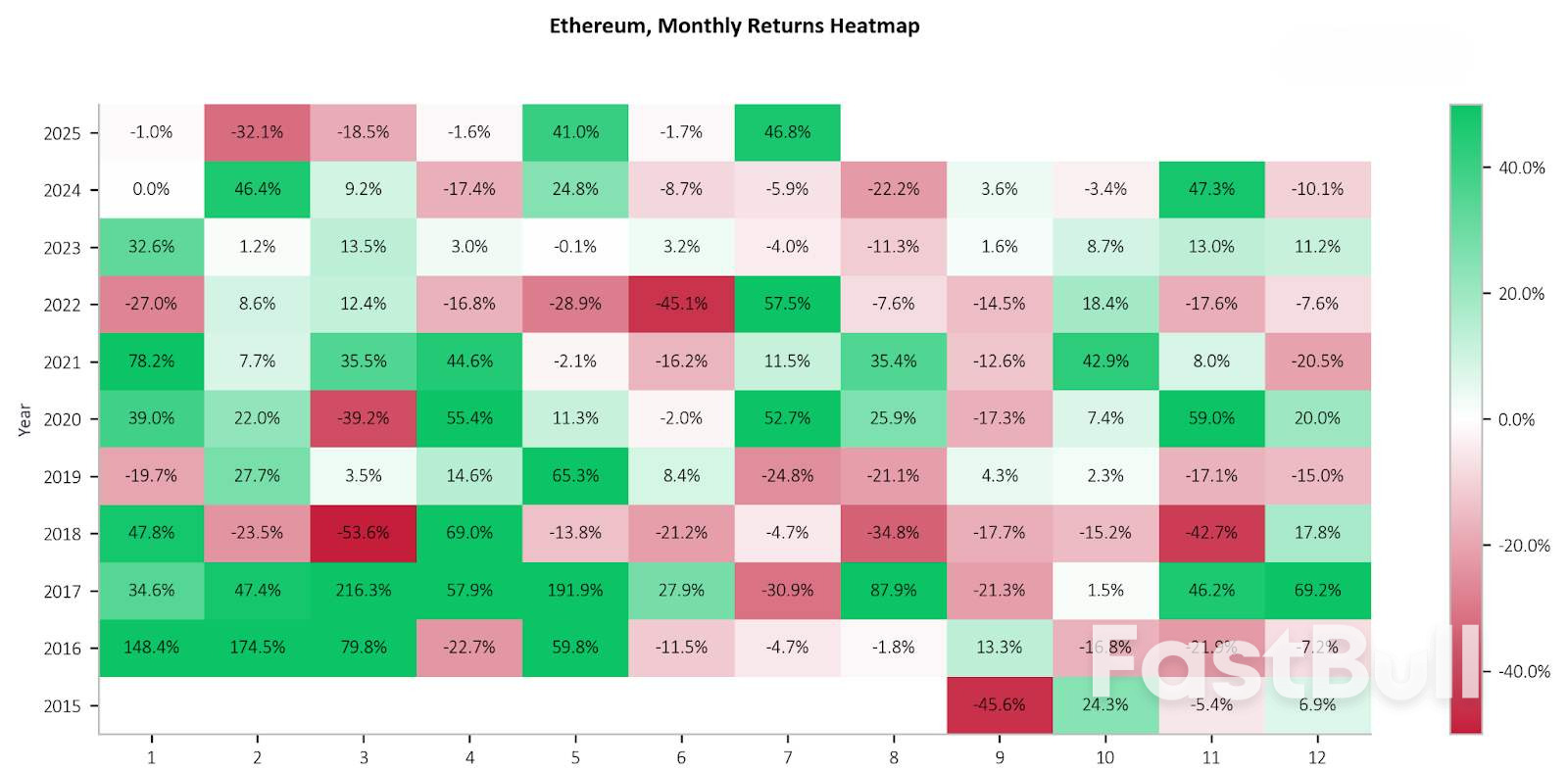
          Crypto market euphoria; Trump signals opening retirement market to digital assets_1
          As legislative progress accelerates, the crypto market is booming. Ethereum is up 51% since the beginning of July, and Bitcoin remains above the $120,000 mark. Altcoins are also gaining, supported by growing institutional interest and reports that giants like Walmart and Amazon are considering issuing their own stablecoins to reduce transaction costs. Market leaders are calling these developments a "breakthrough moment," offering hope for regulatory clarity, increased investor confidence, and a green light for widespread crypto adoption.
          Crypto market euphoria; Trump signals opening retirement market to digital assets_2
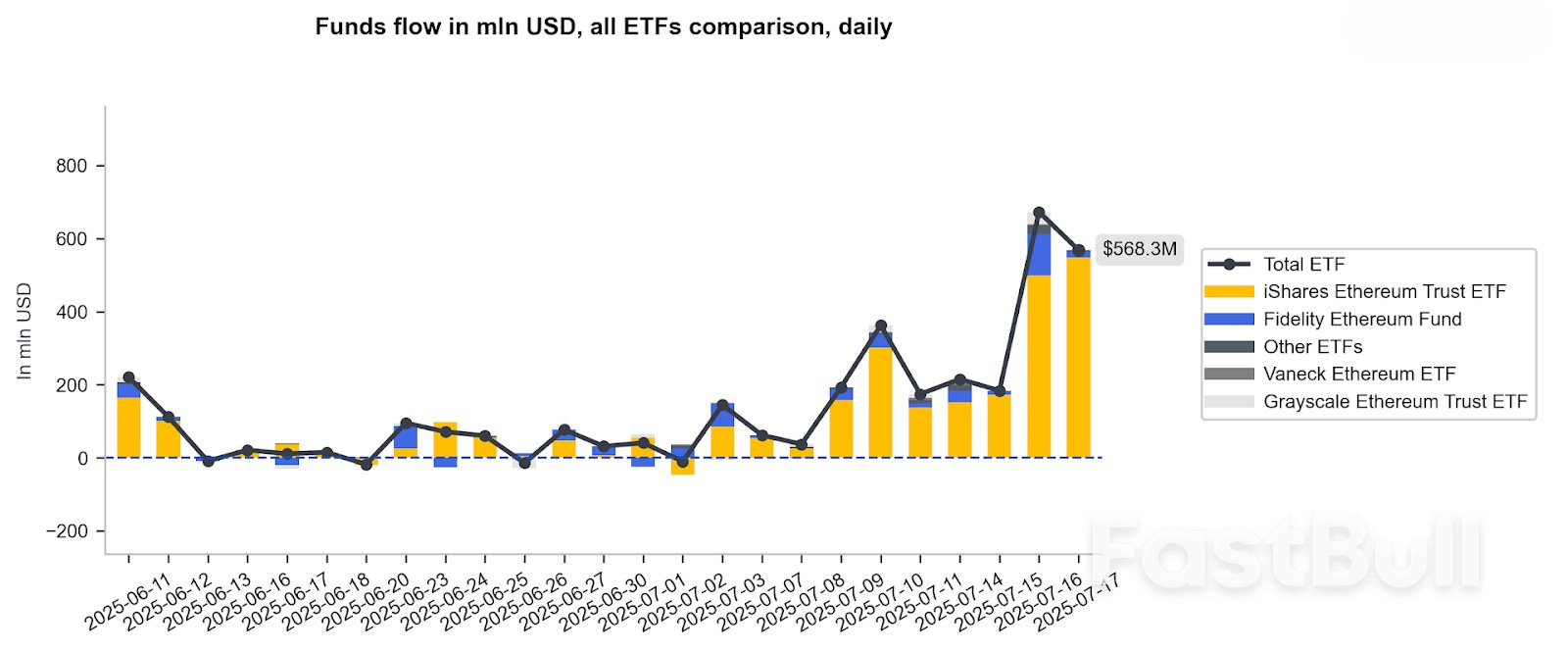
          Institutions are allocating increasing capital into Ethereum. Stablecoin adoption could significantly boost demand for the second-largest cryptocurrency. A notable accumulation trend can be seen via BlackRock’s ETF. Source: XTB Research

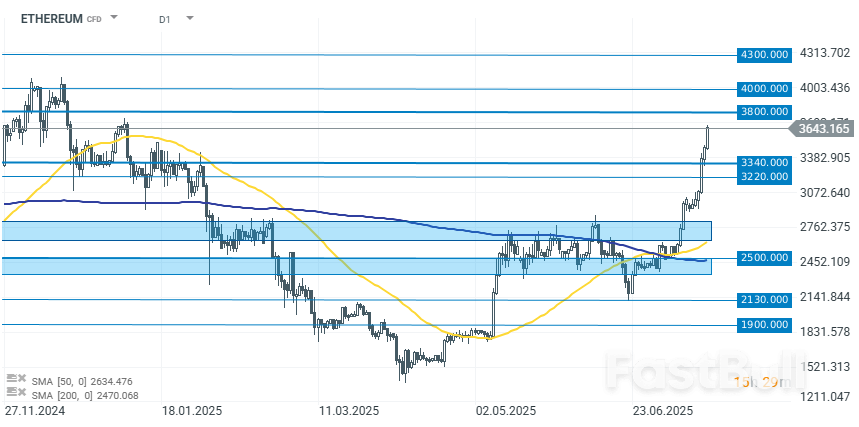
          Ethereum (D1)

          Ethereum is seeing strong gains. However, unlike Bitcoin, Ethereum is still over 33% below its previous all-time high set in November 2021.
          Crypto market euphoria; Trump signals opening retirement market to digital assets_3

          Source: xtb

          Risk Warnings and Disclaimers
          You understand and acknowledge that there is a high degree of risk involved in trading. Following any strategies or investment methods may lead to potential losses. The content on the site is provided by our contributors and analysts for information purposes only. You are solely responsible for determining whether any trading assets, securities, strategy, or any other product is suitable for investing based on your own investment objectives and financial situation.
          Add to Favorites
          Share

          US Consumer Sentiment Rises As Inflation Expectations Improve

          James Whitman

          Economic

          US consumer sentiment rose to a five-month high in early July as expectations about the economy and inflation continued to improve.

          The preliminary July sentiment index rose to 61.8 from 60.7 a month earlier, according to University of Michigan data released Friday. The figure still remains below levels seen throughout last year.

          Consumers expect prices to rise at an annual rate of 4.4% over the next year, down from 5% in the prior month and the lowest since February. They saw costs rising at an annual rate of 3.6% over the next five to 10 years, also the lowest in five months.

          At the same time, concerns about tariffs continue to limit optimism about the outlook for the economy.

          “Consumers’ expectations over business conditions, labor markets, and even their own incomes continue to be weaker than a year ago,” Joanne Hsu, director of the survey, said in a statement.

          “That said, the recent two-month lift in sentiment suggests that consumers believe that the risk of the worst-case scenarios they expected in April and May has eased,’’ Hsu said.

          Consumers’ views of their current personal finances increased, likely supported by the rally in the stock market. The survey concluded on July 14, more than a week after President Donald Trump signed his budget bill into law, extending tax cuts and new breaks for tipped workers.

          Still, Hsu said announcements of higher tariffs or a pickup in inflation would likely restrain sentiment.

          The survey showed the current conditions gauge rose to 66.8 from 64.8, while the expectations index edged up to 58.6.

          The increase in sentiment was driven by Republicans and political independents.

          Source: Bloomberg

          To stay updated on all economic events of today, please check out our Economic calendar
          Risk Warnings and Disclaimers
          You understand and acknowledge that there is a high degree of risk involved in trading. Following any strategies or investment methods may lead to potential losses. The content on the site is provided by our contributors and analysts for information purposes only. You are solely responsible for determining whether any trading assets, securities, strategy, or any other product is suitable for investing based on your own investment objectives and financial situation.
          Add to Favorites
          Share

          Waller makes strongest call yet for rate cut in July, underscoring Fed divide

          Adam

          Economic

          Central Bank

          Federal Reserve governor Christopher Waller made his strongest call yet for a rate cut in July as he again argued that any inflation from tariffs would be temporary, underscoring a divide within the central bank.
          "I believe we should cut the policy rate at our meeting in two weeks," Waller said bluntly in a speech in New York Thursday night, referring to the central bank's July 29-30 policy meeting.
          He argued that the Fed’s policy rate should be 3%, which is 125-150 basis points lower than the current rate of 4.25%-4.5%.
          Waller’s words carry increasing weight since he is considered to be among the candidates to replace Jerome Powell as Fed chair next May, when Powell’s term is up.
          He told Bloomberg Friday that if Trump "says 'Chris we want you to do the job' I would say yes" but stressed that the president "has not contacted me."
          Waller has been outspoken since the Fed’s last meeting in June about the case for cutting rates sooner rather than later, even saying last week that his opinion was "not political." One of his colleagues, Michelle Bowman, has made the same argument for a July cut.
          Their views align with President Trump, who has been hammering the Fed and Chairman Jerome Powell to lower rates by as many as three percentage points.
          The case Waller made again on Thursday night is that tariffs offer one-off price increases, allowing the Fed to "look through" them and refocus on the employment side of its dual mandate.
          And he favors cutting rates now because while the job market looks fine on the surface, private sector job growth is near “stall speed” and other data suggests downside risks to the job market have increased.
          He noted that half of the payroll gain in June reported by the Labor Department came from state and local government, while private payroll employment increases were smaller than in the previous two months.
          “With inflation near target and the upside risks to inflation limited, we should not wait until the labor market deteriorates before we cut the policy rate,” Waller said.
          The new comments are the latest sign of how opposing camps are now forming inside the central bank over Trump's tariffs and how they should affect the Fed's rate decisions.
          Some policymakers are not budging from their view that rates should remain where they are despite intensifying pressure from Trump and his allies to ease monetary policy immediately.
          Federal Reserve governor Adriana Kugler and New York Fed president John Williams both made this argument in speeches delivered Thursday and Wednesday, citing the risk of inflation pressure from tariffs.
          "With the unemployment rate still at historically low levels, elevated short-run inflation expectations, and goods inflation rising due to the upward pressure from tariffs, I find it appropriate to hold our policy rate at the current level for some time," Kugler said in her Thursday speech in Washington, D.C.
          "I judge that inflation is likely to increase further as tariff effects build up during the rest of the year," she added.
          On Wednesday night, Williams stressed that he thinks tariffs are already pushing up inflation and that this will increase in the coming months. He expects tariffs will push up inflation by a full percentage point in the second half of this year and into the first part of 2026.
          "Maintaining this modestly restrictive stance of monetary policy is entirely appropriate to achieve our maximum employment and price stability goals," Williams said in his speech.
          Powell has also argued for more time to assess whether inflation does in fact move higher over the summer, a stance that has frustrated Trump and the White House.
          Williams of the New York Fed made a similar argument Wednesday, saying holding rates steady will allow more time to assess the data.
          Williams said he anticipates inflation will come in between 3% and 3.5% this year and then fall back to about 2.5% next year before reaching 2% in 2027. The Fed's goal is to get inflation back down to 2%.
          Kugler noted that the central bank's still-restrictive policy stance is important to keep longer-run inflation expectations anchored.
          She said she has not seen any progress on headline and core inflation over the past six months, noting that goods inflation has gone up, which reflects some pass-through of increased tariffs.
          Kugler stressed that businesses may not yet be passing the higher tariffs to their selling prices because they are waiting for greater clarity.
          She also noted that tariff rates could increase further, as seen in newly proposed "reciprocal" tariffs on goods from several countries and the new tariffs on copper introduced last week, putting further upward pressure on prices.

          Source: finance.yahoo

          To stay updated on all economic events of today, please check out our Economic calendar
          Risk Warnings and Disclaimers
          You understand and acknowledge that there is a high degree of risk involved in trading. Following any strategies or investment methods may lead to potential losses. The content on the site is provided by our contributors and analysts for information purposes only. You are solely responsible for determining whether any trading assets, securities, strategy, or any other product is suitable for investing based on your own investment objectives and financial situation.
          Add to Favorites
          Share

          Markets May Be Too Complacent About Inflation

          Damon

          Central Bank

          Inflation has been the big economic concern for several years now, across much of the globe (though not quite all, as we’ll see in a moment). But the tentative, broad view has been that prices are now sort-of, kind-of under control. Certainly enough so that markets largely expect central bank interest rates to keep falling, albeit slowly, over the next year or so.

          In the US, President Donald Trump has even gone so far as to put a great deal of pressure on Federal Reserve boss Jerome Powell to cut interest rates, pelting him with insults and even threatening to fire him (which may not even be possible).

          The problem, however, is that prices don’t actually seem to be cooperating with the hopes and dreams of politicians and central bankers. In the UK, we’ve seen inflation come in “hotter” than hoped on a regular basis, with this week’s data no exception.

          And over in the US, even without much obvious impact from tariffs as yet, inflation is nowhere near “beaten,” as my colleague John Authers pointed out earlier this week.

          So progress toward a more “normal” world has been a lot slower than was expected a year ago. And that does rather raise a question. In yesterday’s piece, I pointed out that it’s actually quite tricky for the Bank of England to consider cutting rates aggressively when inflation is barely below Bank rate.

          So what if inflation actually stops falling? What if it starts to perk up again?

          It’s not out of the question. As Vincent Deluard of global financial services company StoneX Group points out, Powell could be forgiven for leaving US interest rates on hold at the next Fed meeting.

          Although US core CPI is rising at an annual rate of 2.7% (as per the June data released last week), US services inflation remains stubbornly high, and there are signs that tariffs may be adding to the cost of durable consumer goods, such as washing machines.

          On this latter point, UBS economist Paul Donovan highlights that it might be easier for companies to push the rising cost of infrequently purchased goods onto consumers. It’s one thing to notice the price of milk or petrol going up, but if you last replaced your telly or washing machine five or more years ago, you’ll probably be less sensitive to price changes.

          Moreover, as Bloomberg columnist Simon White points out, various leading indicators “point to re-acceleration in inflation in the second half of the year, almost regardless of where tariffs settle.” (Those of you with access to Bloomberg terminals can read his work by subscribing to the MacroScope column, which I’d highly recommend.)

          The China Surprise

          Pricing pressures stem from factors including rising freight costs, rising industrial metals prices, and also food prices. But there’s another big potential inflationary force, coming from a surprising direction — China.

          I say surprising because China has a long history of exporting deflation in the form of cheap goods. On top of that, China is among the few economies that are internally battling deflation.

          Indeed, the Chinese government is very keen to put an end to deflation, as this fascinating piece by my Bloomberg Opinion colleague Shuli Ren explains. (One reason this piece in particular caught my eye is because “vicious” private sector competition is not necessarily something one associates with a communist economy.)

          This isn’t a simple battle to win. However, as White notes, the pace of money growth in China now does look as though it’s accelerating. China is hugely significant in terms of the global money supply, so this is worth watching. Indeed, the country is so large that “money in China is the single most important driver of global liquidity,” White says.

          Why does this matter? Without wanting to get too monetarist about it all, more money should mean more borrowing, more spending, more economic activity and more growth, and in turn, more inflation. Given China’s sheer scale, that means more inflation globally.

          Adding it all up, there’s a risk that we’re all being a bit overconfident about the idea that inflation is now behind us as a major issue.

          What could put a serious dent in this thesis? A recession is the most obvious outcome that might stifle inflationary pressure. But even then, any slowdown might take on more stagflationary than deflationary characteristics.

          Also, despite vast government debts, leaders are under pressure to keep spending — or to at least duck hard choices — in order to appease irritated electorates. Japan is merely the latest economy whose election this weekend has been dominated by anger over the cost of living.

          As far as what it all means for your money, all I can suggest is that you stay vigilant, be prepared for more potential bond-market drama, and hold at least some portion of your portfolio in “real” assets, which have a tendency to hold their value in inflationary times. My colleague Merryn had some thoughts on this in her newsletter last week.

          Source: Bloomberg Europe

          Risk Warnings and Disclaimers
          You understand and acknowledge that there is a high degree of risk involved in trading. Following any strategies or investment methods may lead to potential losses. The content on the site is provided by our contributors and analysts for information purposes only. You are solely responsible for determining whether any trading assets, securities, strategy, or any other product is suitable for investing based on your own investment objectives and financial situation.
          Add to Favorites
          Share

          Crypto Market Value Tops $4 Trillion as Stablecoin Bill Passes

          Adam

          Cryptocurrency

          The total market value of cryptoassets surged past $4 trillion for the first time, driven by a rally in altcoins and momentum from a sweeping US legislative push to regulate the sector.
          The milestone followed the passage of the first-ever federal legislation for stablecoins, a key accomplishment during what lawmakers have dubbed “Crypto Week.” The bill, backed by Republicans and championed by President Donald Trump, introduces federal or state oversight of dollar-linked stablecoin, aiming to legitimize a $265 billion market that Citigroup Inc. analysts project could grow to $3.7 trillion by 2030.
          Altcoins — a catch-all term for tokens besides Bitcoin — led the latest leg of the rally, with Ether jumping 22% over the past five days. Bitcoin, the industry’s benchmark asset, hit a record $123,205 earlier this week. Uniswap surged as much as 24% on Friday, while Solana gained 6.5% at one point.
          Thursday also saw the House pass a broader crypto market structure bill, which now awaits Senate consideration.
          Investors have continued to flood into US-listed crypto ETFs. Bitcoin funds have attracted $5.5 billion in inflows so far in July, while Ether ETFs brought in $2.9 billion.

          Source: Bloomberg

          Risk Warnings and Disclaimers
          You understand and acknowledge that there is a high degree of risk involved in trading. Following any strategies or investment methods may lead to potential losses. The content on the site is provided by our contributors and analysts for information purposes only. You are solely responsible for determining whether any trading assets, securities, strategy, or any other product is suitable for investing based on your own investment objectives and financial situation.
          Add to Favorites
          Share
          FastBull
          Copyright © 2025 FastBull Ltd

          728 RM B 7/F GEE LOK IND BLDG NO 34 HUNG TO RD KWUN TONG KLN HONG KONG

          TelegramInstagramTwitterfacebooklinkedin
          App Store Google Play Google Play
          Products
          Charts

          Chats

          Q&A with Experts
          Screeners
          Economic Calendar
          Data
          Tools
          Membership
          Features
          Function
          Markets
          Copy Trading
          Latest Signals
          Contests
          News
          Analysis
          24/7
          Columns
          Education
          Company
          Careers
          About Us
          Contact Us
          Advertising
          Help Center
          Feedback
          User Agreement
          Privacy Policy
          Business

          White Label

          Data API

          Web Plug-ins

          Poster Maker

          Affiliate Program

          Risk Disclosure

          The risk of loss in trading financial instruments such as stocks, FX, commodities, futures, bonds, ETFs and crypto can be substantial. You may sustain a total loss of the funds that you deposit with your broker. Therefore, you should carefully consider whether such trading is suitable for you in light of your circumstances and financial resources.

          No decision to invest should be made without thoroughly conducting due diligence by yourself or consulting with your financial advisors. Our web content might not suit you since we don't know your financial conditions and investment needs. Our financial information might have latency or contain inaccuracy, so you should be fully responsible for any of your trading and investment decisions. The company will not be responsible for your capital loss.

          Without getting permission from the website, you are not allowed to copy the website's graphics, texts, or trademarks. Intellectual property rights in the content or data incorporated into this website belong to its providers and exchange merchants.

          Not Logged In

          Log in to access more features

          FastBull Membership

          Not yet

          Purchase

          Become a signal provider
          Help Center
          Customer Service
          Dark Mode
          Price Up/Down Colors

          Log In

          Sign Up

          Position
          Layout
          Fullscreen
          Default to Chart
          The chart page opens by default when you visit fastbull.com