• Trade
  • Markets
  • Copy
  • Contests
  • News
  • 24/7
  • Calendar
  • Q&A
  • Chats
Trending
Screeners
SYMBOL
LAST
BID
ASK
HIGH
LOW
NET CHG.
%CHG.
SPREAD
SPX
S&P 500 Index
6827.42
6827.42
6827.42
6899.86
6801.80
-73.58
-1.07%
--
DJI
Dow Jones Industrial Average
48458.04
48458.04
48458.04
48886.86
48334.10
-245.98
-0.51%
--
IXIC
NASDAQ Composite Index
23195.16
23195.16
23195.16
23554.89
23094.51
-398.69
-1.69%
--
USDX
US Dollar Index
97.900
97.980
97.900
98.070
97.890
-0.050
-0.05%
--
EURUSD
Euro / US Dollar
1.17413
1.17421
1.17413
1.17447
1.17262
+0.00019
+ 0.02%
--
GBPUSD
Pound Sterling / US Dollar
1.33853
1.33863
1.33853
1.33856
1.33546
+0.00146
+ 0.11%
--
XAUUSD
Gold / US Dollar
4344.84
4345.25
4344.84
4350.16
4294.68
+45.45
+ 1.06%
--
WTI
Light Sweet Crude Oil
57.321
57.351
57.321
57.601
57.194
+0.088
+ 0.15%
--

Community Accounts

Signal Accounts
--
Profit Accounts
--
Loss Accounts
--
View More

Become a signal provider

Sell trading signals to earn additional income

View More

Guide to Copy Trading

Get started with ease and confidence

View More

Signal Accounts for Members

All Signal Accounts

Best Return
  • Best Return
  • Best P/L
  • Best MDD
Past 1W
  • Past 1W
  • Past 1M
  • Past 1Y

All Contests

  • All
  • Trump Updates
  • Recommend
  • Stocks
  • Cryptocurrencies
  • Central Banks
  • Featured News
Top News Only
Share

Kremlin: Ukraine Not Joining NATO Is One Of The Key Questions, But Subject To Special Discussion

Share

Kremlin: After Talks In Berlin Between USA, Europeans And Ukraine, We Expect The USA To Update Moscow On Proposals

Share

EU Official: Witkoff And Kushner Begin Briefing EU Foreign Ministers On Gaza Via Videoconference

Share

Russian Defence Ministry Says Russian Forces Capture Pishchane In Ukraine's Dnipropetrovsk Region

Share

London Metal Exchange: Intends To Publish A Consultation On The Proposed Changes To Our Rules In Response To The Regime Early In2026

Share

London Metal Exchange: Announces Publication Of Update Describing How The London Metal Exchange Plans To Implement The Fca Policy Statement 25/1 On Commodity Reform

Share

USA - Listed Shares Of Gold Miners Rise Premarket After Gold Rises About 1%

Share

The Council Of The European Union: In Light Of The Situation In Venezuela, The Council Decided Today To Extend The Existing Restrictions For Another Year, Until 10 January 2027

Share

Ivory Coast 2025/26 Cocoa Arrivals Reached 894000 T By December 14 Versus 895000 T Year Ago - Exporters' Estimate

Share

Ishares MSCI Chile ETF Up 3.9% Premarket After Jose Antonio Kast Wins Chile's Presidential Election On Sunday

Share

Spain's Debt-To-GDP Ratio Falls To 103.2% In Third Quarter 2025

Share

China's Central Bank: Authorises DBS Bank As Yuan Clearing Bank In Singapore

Share

Bank Of Korea - South Korea Central Bank, Nps Agree To Extend Currency Swap Agreement For Another Year

Share

Poland's CPI At 0.1% Month-On-Month In November Versus 0.1% Released Earlier

Share

London Metal Exchange (LME): Copper Inventories Decreased By 25 Tons, Aluminum Inventories Decreased By 50 Tons, Nickel Inventories Increased By 360 Tons, Zinc Inventories Increased By 2,550 Tons, Lead Inventories Increased By 17,725 Tons, And Tin Inventories Increased By 125 Tons

Share

Polish Inflation At 2.5% Year-On-Year In November

Share

Poland's January-October Import Up 5.4% To 309.3 Billion Euros

Share

Poland's January-October Trade Balance At -5.1 Billion Euros

Share

Poland's January-October Export Up 2.8% To 304.3 Billion Euros

Share

Ceasefire Negotiations Between Ukraine And US Representatives In Berlin To Continue Monday Morning - German Source Familiar With The Schedule

TIME
ACT
FCST
PREV
France HICP Final MoM (Nov)

A:--

F: --

P: --

China, Mainland Outstanding Loans Growth YoY (Nov)

A:--

F: --

P: --

China, Mainland M2 Money Supply YoY (Nov)

A:--

F: --

P: --

China, Mainland M0 Money Supply YoY (Nov)

A:--

F: --

P: --

China, Mainland M1 Money Supply YoY (Nov)

A:--

F: --

P: --

India CPI YoY (Nov)

A:--

F: --

P: --

India Deposit Gowth YoY

A:--

F: --

P: --

Brazil Services Growth YoY (Oct)

A:--

F: --

P: --

Mexico Industrial Output YoY (Oct)

A:--

F: --

P: --

Russia Trade Balance (Oct)

A:--

F: --

P: --

Philadelphia Fed President Henry Paulson delivers a speech
Canada Building Permits MoM (SA) (Oct)

A:--

F: --

P: --

Canada Wholesale Sales YoY (Oct)

A:--

F: --

P: --

Canada Wholesale Inventory MoM (Oct)

A:--

F: --

P: --

Canada Wholesale Inventory YoY (Oct)

A:--

F: --

P: --

Canada Wholesale Sales MoM (SA) (Oct)

A:--

F: --

P: --

Germany Current Account (Not SA) (Oct)

A:--

F: --

P: --

U.S. Weekly Total Rig Count

A:--

F: --

P: --

U.S. Weekly Total Oil Rig Count

A:--

F: --

P: --

Japan Tankan Small Manufacturing Outlook Index (Q4)

A:--

F: --

P: --

Japan Tankan Large Non-Manufacturing Diffusion Index (Q4)

A:--

F: --

P: --

Japan Tankan Large Non-Manufacturing Outlook Index (Q4)

A:--

F: --

P: --

Japan Tankan Large Manufacturing Outlook Index (Q4)

A:--

F: --

P: --

Japan Tankan Small Manufacturing Diffusion Index (Q4)

A:--

F: --

P: --

Japan Tankan Large Manufacturing Diffusion Index (Q4)

A:--

F: --

P: --

Japan Tankan Large-Enterprise Capital Expenditure YoY (Q4)

A:--

F: --

P: --

U.K. Rightmove House Price Index YoY (Dec)

A:--

F: --

P: --

China, Mainland Industrial Output YoY (YTD) (Nov)

A:--

F: --

P: --

China, Mainland Urban Area Unemployment Rate (Nov)

A:--

F: --

P: --

Saudi Arabia CPI YoY (Nov)

A:--

F: --

P: --

Euro Zone Industrial Output YoY (Oct)

--

F: --

P: --

Euro Zone Industrial Output MoM (Oct)

--

F: --

P: --

Canada Existing Home Sales MoM (Nov)

--

F: --

P: --

Euro Zone Total Reserve Assets (Nov)

--

F: --

P: --

U.K. Inflation Rate Expectations

--

F: --

P: --

Canada National Economic Confidence Index

--

F: --

P: --

Canada New Housing Starts (Nov)

--

F: --

P: --

U.S. NY Fed Manufacturing Employment Index (Dec)

--

F: --

P: --

U.S. NY Fed Manufacturing Index (Dec)

--

F: --

P: --

Canada Core CPI YoY (Nov)

--

F: --

P: --

Canada Manufacturing Unfilled Orders MoM (Oct)

--

F: --

P: --

U.S. NY Fed Manufacturing Prices Received Index (Dec)

--

F: --

P: --

U.S. NY Fed Manufacturing New Orders Index (Dec)

--

F: --

P: --

Canada Manufacturing New Orders MoM (Oct)

--

F: --

P: --

Canada Core CPI MoM (Nov)

--

F: --

P: --

Canada Trimmed CPI YoY (SA) (Nov)

--

F: --

P: --

Canada Manufacturing Inventory MoM (Oct)

--

F: --

P: --

Canada CPI YoY (Nov)

--

F: --

P: --

Canada CPI MoM (Nov)

--

F: --

P: --

Canada CPI YoY (SA) (Nov)

--

F: --

P: --

Canada Core CPI MoM (SA) (Nov)

--

F: --

P: --

Canada CPI MoM (SA) (Nov)

--

F: --

P: --

Federal Reserve Board Governor Milan delivered a speech
U.S. NAHB Housing Market Index (Dec)

--

F: --

P: --

Australia Composite PMI Prelim (Dec)

--

F: --

P: --

Australia Services PMI Prelim (Dec)

--

F: --

P: --

Australia Manufacturing PMI Prelim (Dec)

--

F: --

P: --

Japan Manufacturing PMI Prelim (SA) (Dec)

--

F: --

P: --

U.K. Unemployment Claimant Count (Nov)

--

F: --

P: --

U.K. Unemployment Rate (Nov)

--

F: --

P: --

U.K. 3-Month ILO Unemployment Rate (Oct)

--

F: --

P: --

Q&A with Experts
    • All
    • Chatrooms
    • Groups
    • Friends
    Connecting
    .
    .
    .
    Type here...
    Add Symbol or Code

      No matching data

      All
      Trump Updates
      Recommend
      Stocks
      Cryptocurrencies
      Central Banks
      Featured News
      • All
      • Russia-Ukraine Conflict
      • Middle East Flashpoint
      • All
      • Russia-Ukraine Conflict
      • Middle East Flashpoint

      Search
      Products

      Charts Free Forever

      Chats Q&A with Experts
      Screeners Economic Calendar Data Tools
      Membership Features
      Data Warehouse Market Trends Institutional Data Policy Rates Macro

      Market Trends

      Market Sentiment Order Book Forex Correlations

      Top Indicators

      Charts Free Forever
      Markets

      News

      News Analysis 24/7 Columns Education
      From Institutions From Analysts
      Topics Columnists

      Latest Views

      Latest Views

      Trending Topics

      Top Columnists

      Latest Update

      Signals

      Copy Rankings Latest Signals Become a signal provider AI Rating
      Contests
      Brokers

      Overview Brokers Assessment Rankings Regulators News Claims
      Broker listing Forex Brokers Comparison Tool Live Spread Comparison Scam
      Q&A Complaint Scam Alert Videos Tips to Detect Scam
      More

      Business
      Events
      Careers About Us Advertising Help Center

      White Label

      Data API

      Web Plug-ins

      Affiliate Program

      Awards Institution Evaluation IB Seminar Salon Event Exhibition
      Vietnam Thailand Singapore Dubai
      Fans Party Investment Sharing Session
      FastBull Summit BrokersView Expo
      Recent Searches
        Top Searches
          Markets
          News
          Analysis
          User
          24/7
          Economic Calendar
          Education
          Data
          • Names
          • Latest
          • Prev

          View All

          No data

          Scan to Download

          Faster Charts, Chat Faster!

          Download App
          English
          • English
          • Español
          • العربية
          • Bahasa Indonesia
          • Bahasa Melayu
          • Tiếng Việt
          • ภาษาไทย
          • Français
          • Italiano
          • Türkçe
          • Русский язык
          • 简中
          • 繁中
          Open Account
          Search
          Products
          Charts Free Forever
          Markets
          News
          Signals

          Copy Rankings Latest Signals Become a signal provider AI Rating
          Contests
          Brokers

          Overview Brokers Assessment Rankings Regulators News Claims
          Broker listing Forex Brokers Comparison Tool Live Spread Comparison Scam
          Q&A Complaint Scam Alert Videos Tips to Detect Scam
          More

          Business
          Events
          Careers About Us Advertising Help Center

          White Label

          Data API

          Web Plug-ins

          Affiliate Program

          Awards Institution Evaluation IB Seminar Salon Event Exhibition
          Vietnam Thailand Singapore Dubai
          Fans Party Investment Sharing Session
          FastBull Summit BrokersView Expo

          When Will the Crisis in U.S. Housing Affordability End – and How?

          JPMorgan

          Economic

          Summary:

          We think rising incomes can break the U.S. housing market's logjam nationally in about 3.5 years – but for large cities, we see an average of over five years. Here's why.

          First, the good news: The United States hasn't plunged into a recession. Despite more than a year of high interest rates, the economy has shown resilience beyond most economists' predictions.
          But the Federal Reserve (Fed) still hasn't beaten down inflation completely, and the economy's strength could be more long-term than a phase of the economic cycle. Many market participants now believe interest rates will stay higher for longer. And this is prolonging a set of tough challenges in the housing market that have almost put it into a state of suspended animation. The difficulties:
          U.S. home prices are currently at all-time highs, and less affordable (relative to income and mortgage rates) than at the height of the 2006 housing bubble. That's after prices skyrocketed by about 40% during the pandemic.
          Sales of existing homes are very depressed, as bad as after the global financial crisis.
          While buyers wait for prices to fall, sellers won't list their homes because they don't want to sacrifice the low mortgage rates they locked in before the fastest, most aggressive rate hiking cycle in 40 years.
          Prices aren't falling because the market is stuck. Demand has been reduced by high mortgage rates, but supply is even more restricted because of severe underbuilding in the 2010s, relative to population growth.
          High prices, high mortgage rates and a shortage of homes: combined, they've created today's crisis of affordability.
          How do these issues get resolved – and when?

          Rising incomes can restore affordability – given enough time

          First, here's how we don't think the crisis will be resolved: through a crash in home prices.
          The (perhaps natural) assumption is that the housing market can only return to a more “normal” state of affordability and predictable price appreciation after a drop in home prices effectively “clears” the market, and it begins a new cycle. This is certainly not an impossibility, but that would likely require a U.S. recession and a spike in job losses across the economy, neither of which are our base case for the coming years.
          Nor do we think lower mortgage rates are the solution to clearing the logjam. Indeed, surveys of homebuyers find consistently that financing rates aren't their main motivators when they make a purchase. Life stages are: People buy homes when they get married, or when they need to move as they find employment, have children or retire.
          We see another pathway that doesn't involve punishing price declines or a sizeable drop in mortgage rates. It hinges on home affordability.
          Housing affordability could be restored by incomes continuing to rise at a robust rate. We think the path to affordability, for starter homes as well as the luxury market, is that wages rise to catch up to and meet the higher costs.

          When will homes be affordable again?

          How long might it take to restore average levels of affordability – based on historical ratios of home prices to income and factoring in mortgage rates – if incomes were to keep growing at their recent pace, and if mortgage rates didn't decline and home values stayed at all-time highs?
          Our answer: about 3.5 years.
          Our analysis of the timing is notably sensitive to mortgage rates. If the market's pricing of mortgage rates were to fall by just one percentage point, U.S. homes could be affordable again in just two years.
          When Will the Crisis in U.S. Housing Affordability End – and How?_1
          The takeaway: If you are looking to buy a house in the United States, don't wait for – or expect – a home price crash. We don't foresee one coming (thankfully), nor do we think one is necessary to restore affordability at the national level. We think time and continued robust income growth can cure the problem on their own.

          Home prices vary by metro area

          So far, we've talked about the national U.S. housing market. At the city level, it's a more complicated story. Since the pandemic began, metro areas have experienced stark divergences in home price trends. That's not typical, but it's a unique feature of the current housing cycle.
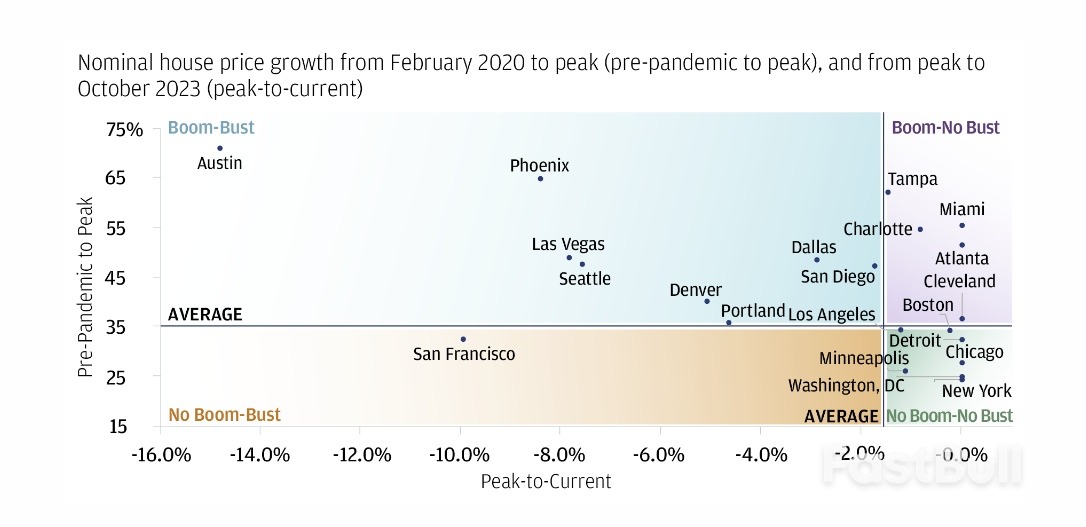
          We've organized these price trends by noting price behavior during the COVID-19 pandemic, and from the pandemic's end (and each city's price peak) until now. Four categories emerge:
          Boom-bust – Mostly in the Southwest, cities such as Austin saw pandemic-era booms and have since crashed. (Home prices in Austin are down about 15% from their peak.) Supply and demand are playing roles, but especially supply. Austin housing inventories are currently 67% above December 2019.
          No boom-but still a bust – Only San Francisco didn't see much of a pandemic boom, yet it still has seen deflation of more than 10% from its peak. In our view, weak demand explains it: Tech sector layoffs and rising remote work patterns have slashed housing demand in the Bay Area.
          Boom-no bust – Mainly in the South, cities such as Miami saw home prices boom during the pandemic and have held their value. Prices in Miami are up 54% since June 2020. Major supply constraints are responsible in these markets. Miami's inventory levels are currently 40% below December 2019.
          No boom-no bust – These metros, among them New York, Washington, DC, and Chicago, didn't see much of a pandemic housing boom (after all, New York and Chicago suffered sizeable population outflows during COVID-19) and have held steady since.
          When Will the Crisis in U.S. Housing Affordability End – and How?_2

          Paths to restored affordability differ by city

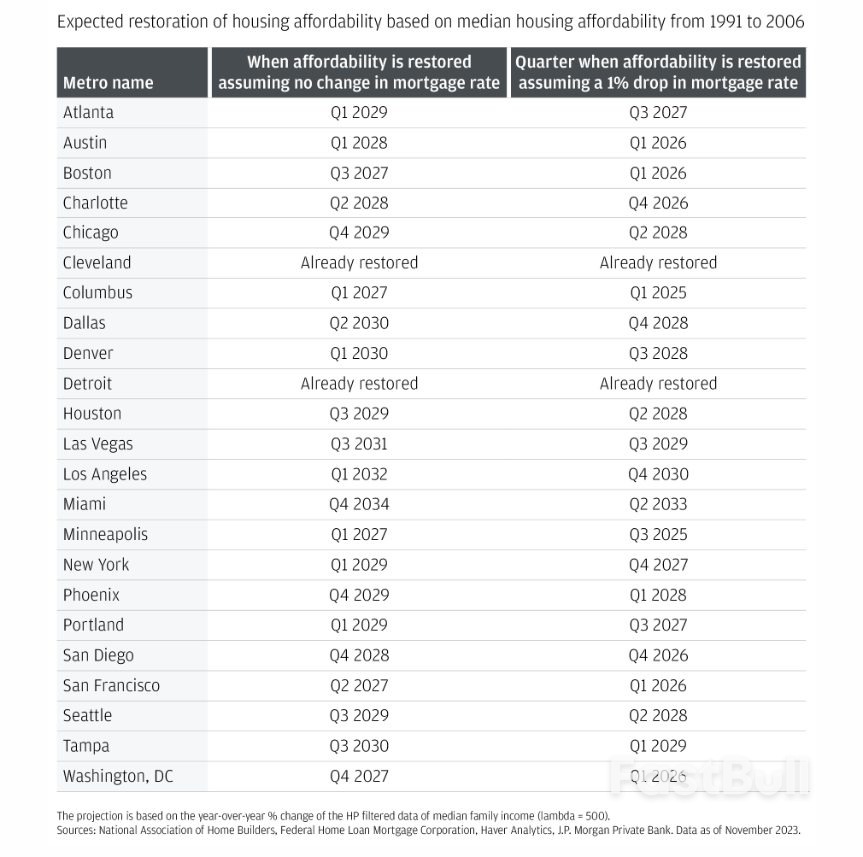
          We did the same affordability analysis for large metro areas as we did for the national market, again assuming mortgage rates and home prices remain unchanged, mapping each city's path to affordability based on recent trends in income growth.
          There are a few interesting observations here.
          First, while our analysis finds affordability restored in an average 3.5 years nationally, the average time is 5.3 years for large metro areas. This is not surprising, as the large cities are where America's housing affordability problems are concentrated. (Affordability is less challenged in rural areas where land is more abundant and zoning restrictions on new development are less onerous.)
          Second, the years-to-affordability calculation for cities diverges widely, ranging from zero years for Cleveland/Detroit to more than 10 years for Miami.
          Miami's currently high housing valuations are driving this result. While the national median home price-to-income ratio currently stands at 3.95, for Miami the ratio is 6.6. (This is not altogether new, but the valuation gap has increased further in recent years: Prior to the pandemic, the national ratio was 3.74 versus 5.25 for Miami.)
          When Will the Crisis in U.S. Housing Affordability End – and How?_3

          Where does new construction fit in?

          So far, we've discussed existing homes, where the affordability crisis and the seizing up of activity have been most extreme. The story is quite different for sales of new homes, which have remained resilient and have risen strongly year-to-date (by more than 20%).
          In the market for new homes, affordability challenges are less intense due to more price deflation and because homebuilders are offering attractive incentives, including below-market mortgage rates (called “buy downs”) that make new construction more affordable.
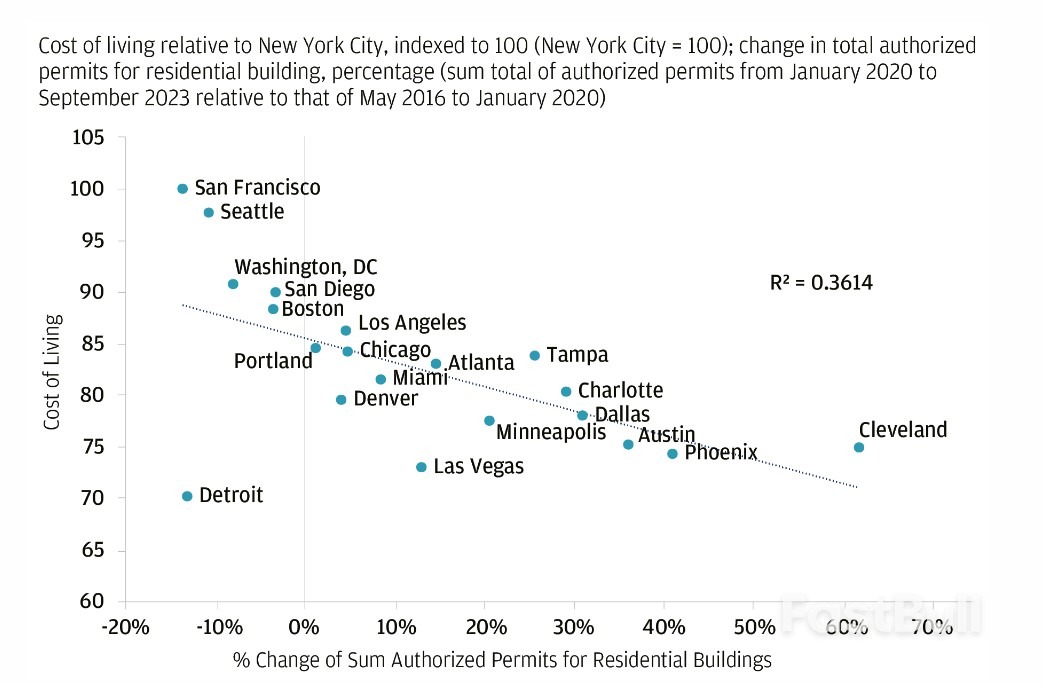
          New construction activity has also been, and continues to be, concentrated in lower-cost-of-living metro areas where younger generations, particularly millennials, have been flocking.
          When Will the Crisis in U.S. Housing Affordability End – and How?_4
          A robust new construction market is a positive development. It could be the way out of America's severe national housing shortage. Builders, however, cannot fix the shortage overnight. Indeed, new housing unit completions make up just 1% of the nation's housing stock annually.
          Declining interest rates could speed up the home building, but they could also reignite inflation – that's the delicate balance the Fed is trying to strike. For now, we don't expect the Fed to begin cutting interest rates until the second half of next year. At that point, and especially by 2025, we think the U.S. housing market will be well on the path toward normalcy and better affordability.
          To stay updated on all economic events of today, please check out our Economic calendar
          Risk Warnings and Disclaimers
          You understand and acknowledge that there is a high degree of risk involved in trading. Following any strategies or investment methods may lead to potential losses. The content on the site is provided by our contributors and analysts for information purposes only. You are solely responsible for determining whether any trading assets, securities, strategy, or any other product is suitable for investing based on your own investment objectives and financial situation.
          Comments
          Add to Favorites
          Share

          Opinion: Biden Is Making More Foreign Policy Messes Than He's Fixing

          Michelle

          Political

          Notwithstanding the temporary truce and hostage deal announced Tuesday, US forces are still on hand in the Middle East to deter Iran and Hezbollah from intervening against Israel in its war with Hamas, putting American troops at risk and threatening to pull the US into another major war in the region. American troops have already been targeted by dozens of drone and missile attacks from Iranian-backed forces in Iraq, Syria and Yemen, and have conducted retaliatory strikes in response. In Eastern Europe, the US is essentially engaged in a proxy war with Russia over the latter's invasion of Ukraine. In East Asia, the US risks a catastrophic showdown with China over the political status of Taiwan.
          During his Oval Office address last month, President Joe Biden argued that all these flashpoints are interconnected fronts in what the administration has previously framed as a global struggle between democracy and autocracy. Biden referenced former Secretary of State Madeleine Albright's quote that America is “the indispensable nation,” adding that “American leadership is what holds the world together.” Biden further asserted that “making sure Israel and Ukraine succeed is vital for America's national security.” In a Washington Post op-ed this weekend, he reiterated that the US is “the essential nation.”
          These claims do not stand up to scrutiny. America's entanglement in these crises is only further overstretching its capabilities, courting unnecessary risks, inflaming local enmities and depriving the American people of resources better used at home. Indeed, the American people are increasingly reluctant to foot the bill indefinitely for military aid to conflicts abroad, with recent polls showing declining support among both Democrats and Republicans for both Israel and Ukraine.
          The decades-long US policy of maintaining permanent friends and enemies in the Middle East has been counterproductive to its stated interest in regional stability. The US in recent years antagonized Iran by imposing a “maximum pressure” campaign of economic sanctions while assassinating key Iranian military figure, Qasem Soleimani. Meanwhile, the US has inadvertently boosted Tehran's regional influence by overthrowing Saddam Hussein's government in Iraq and later by contributing arms to anti-Assad forces during the Syrian Civil War, which ultimately empowered Iran-backed militias in the fight against both ISIS and US-supported Sunni rebels.
          Nor has regional stability been advanced by the United States' partners, whose bad behavior has been enabled by unconditioned support from Washington. The US has consistently backed Israel despite its continued settlement-building in the occupied West Bank and long-standing blockade of Gaza, feeding the underlying Israeli-Palestinian conflict that now threatens to engulf the region.
          And despite its “democracy versus autocracy” rhetoric, the US supported Saudi Arabia's gruesome war against Iranian-backed Houthis in Yemen, which produced what the United Nations called “the worst humanitarian crisis in the world,” with some 377,000 people killed and approximately 80% of the country in need of humanitarian aid. The Biden administration has since doubled down on its security relationship with the Saudis.
          Contrary to the goal of avoiding a broader conflict in the Middle East or Ukraine, the president's Oval Office address last month instead sought to frame these crises in global terms. Biden claimed that if the US does not thwart distant adversaries, they and others will be emboldened to pursue further aggression, and American alliances will be undermined. This reasoning is based on dubious assumptions drawn from WWII and the Cold War, respectively known as the “Munich analogy” and the “domino theory.”
          Biden claimed that if Russia is not stopped in Ukraine, Putin will march on to Poland or the Baltic states. This is not plausible. Russia does not have the material capability to try to conquer Eastern Europe, even if it wanted to. Even without the US and Canada, European NATO members in 2022 spent vastly more on defense and retained many more active duty personnel than Russia, had a combined GDP nearly nine times larger, a population 3.5 times larger and their own nuclear deterrent. Russia's poor performance in Ukraine makes this fear even more remote.
          The president also made a veiled suggestion that if Russia is not decisively defeated in Ukraine, China would be emboldened to invade Taiwan. This assumption is similarly unfounded. As political scientists like Daryl Press and Jonathan Mercer have argued, states tend to predict an adversary's future behavior based on current capabilities and perceived interests rather than past behavior in a separate context. If China invaded Taiwan, it would most likely be because Beijing has a greater stake in Taiwan than Washington does, possesses a military advantage a hundred miles off its coast and believes it has no path to peaceful reunification — not because the US wavered in its support for Ukraine.
          Meanwhile, there is no sign America's treaty allies are losing faith in the credibility of its commitment to their defense. Low defense spending on the part of capable states like Japan and Germany indicates America's allies remain all too confident they can continue passing the buck to Uncle Sam. Were the US to do less for their defense, Japan and Germany would almost certainly do more out of their imperative for self-preservation — not simply surrender their sovereignty to China or Russia.
          The US should adopt a more restrained grand strategy, one that would more rigorously set priorities among foreign interests, entail fewer risks of entanglement, be less prone to provoke distant rivals and be more aligned with America's domestic resources and needs.
          First, the US should not maintain eternal allies and enemies. As former President Richard Nixon once said, “Our interests must shape our commitments, rather than the other way around.” Military alliances are commitments to wage war on another's behalf if necessary. America should therefore enter alliances to counterbalance specific threats when they emerge; as threats change, so should alliances. Alliances involve significant costs and risks and must therefore be guided by truly vital security interests, not pretensions of global leadership.
          Second, the US should stop uniting its adversaries. By framing international politics as a fight between democracy and autocracy, the US is merely ensuring that it has lots of enemies arrayed against it. The growing security alignment between China, Russia and Iran is largely based on a common threat from the United States, rather than an attempt to export a given regime type (which they don't share). The US itself has by far the most extensive record of trying to impose its own values on others by force. Prudent rapprochements with former adversaries should be made when there are no vital interests in dispute.
          Third, the United States should shift the burden of managing regional threats over to its regional partners, especially in the Middle East and Europe. Ammunition shortages resulting from the wars in Ukraine and Gaza are only one demonstration that America's resources are finite.
          Scaling back America's overextended military presence would incentivize capable regional states with an interest in self-preservation to pool forces to counterbalance local threats. Burden-shifting to regional partners would also mitigate the risk of the US getting pulled into a major war and reduce the substantial costs of maintaining forces overseas. The United States' favorable power position and distance from Eurasia allows it to pass the buck to others while remaining secure.
          Finally, if the US wants to advance democratic values around the world, it should do so by providing a compelling model of successful democracy at home that's worthy of being emulated abroad. Biden declares that “America is a beacon to the world.” Yet as America attempts to prop up its empire, its republic is hurting. We should save the republic, not the empire.

          Source: CNN

          Risk Warnings and Disclaimers
          You understand and acknowledge that there is a high degree of risk involved in trading. Following any strategies or investment methods may lead to potential losses. The content on the site is provided by our contributors and analysts for information purposes only. You are solely responsible for determining whether any trading assets, securities, strategy, or any other product is suitable for investing based on your own investment objectives and financial situation.
          Comments
          Add to Favorites
          Share

          US Weekly Jobless Claims Fall; Business Spending on Equipment Easing

          Glendon

          Economic

          The number of Americans filing new claims for unemployment benefits fell more than expected last week, but that likely does not change the view that the labor market is gradually slowing as higher interest rates cool demand in the economy.
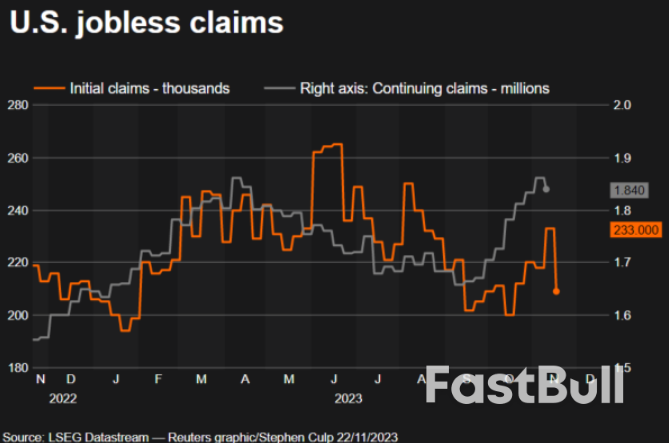
          Though the weekly jobless claims report from the Labor Department on Wednesday also showed unemployment rolls declining for the first-time since mid-September, they remained near the highs for this year. The drop in both initial and continuing claims likely reflected ongoing challenges ironing out seasonal fluctuations from the data.
          Slowing demand for labor and subsiding inflation have led economists and financial markets to conclude the Federal Reserve was done hiking interest rates in the current cycle.
          "Looking past seasonal noise, we think the claims data are consistent with a job market that is cooling enough to keep rate hikes off the table, but too strong to make rate cuts a consideration any time soon," said Nancy Vanden Houten, lead U.S. economist at Oxford Economics in New York.
          Initial claims for state unemployment benefits dropped 24,000 to a seasonally adjusted 209,000 for the week ended Nov. 18. The decline more than reversed the jump in the prior week, which had lifted claims to a three-month high. Economists polled by Reuters had forecast 226,000 claims for the latest week.
          The data was released a day early because of the Thanksgiving holiday on Thursday.
          Unadjusted claims rose 21,239 to 238,677 last week. Claims in California surged 7,911. There were also significant increases in filings in Kentucky, Oregon, Kentucky and Illinois. Only Texas reported a decrease in claims in excess of 1,000.
          US Weekly Jobless Claims Fall; Business Spending on Equipment Easing_1
          Minutes of the Fed's Oct. 31-Nov. 1 meeting published on Tuesday showed that while policymakers viewed labor market conditions as having "remained tight," they noted that "they had eased since earlier in the year, partly as a result of recent increases in labor supply."
          Stocks on Wall Street were trading higher. The dollar rose against a basket of currencies. Prices of shorter-dated U.S. Treasuries fell.

          LABOR MARKET SLOWING

          Financial markets are anticipating a rate cut in the middle of 2024, according to CME Group's FedWatch Tool. Most economists, however, view a rate cut as premature.
          Indeed, a survey from the University of Michigan on Wednesday showed consumers this month anticipating higher inflation both in the near and long term. The rise in inflation expectations, especially over the next five years to the highest level since 2011, could worry policymakers. Since March 2022, the U.S. central bank has hiked its policy rate by 525 basis points to the current 5.25%-5.50% range.
          US Weekly Jobless Claims Fall; Business Spending on Equipment Easing_2
          "This will remind policymakers that it will be some time before the Fed can consider the 2021-22 surge in inflation to have truly been contained and reversed," said Conrad DeQuadros, senior economic advisor at Brean Capital in New York.
          But other economists were not too concerned, with Daniel Silver, an economist at JPMorgan, arguing that "we should also keep in mind that this increase in inflation expectations has not been evident to the same degree in some other related measures."
          A survey from the New York Fed this month showed softer inflation expectations in October.
          The claims data covered the period during which the government surveyed businesses for the nonfarm payrolls component of November's employment report.
          Claims rose marginally between the October and November survey weeks. The economy created 150,000 jobs in October.
          Though the labor market is steadily slowing, there are signs the moderation is broadening out. According to the Bank of America Institute, an analysis of internal data showed a rise in "pay disruptions" over 2023, consistent with rising joblessness.
          It noted that this phenomenon, previously confined to higher-income groups, appeared to be extending to middle- and lower-income cohorts. The institute also said there was a significant slowdown in job-to-job moves, consistent with slower hiring and workers' reluctance to move against an uncertain economic backdrop.
          Data next week on the number of people receiving benefits after an initial week of aid, a proxy for hiring, will offer more clues on the health of the labor market in November. Continuing claims fell 22,000 to 1.840 million during the week ending Nov. 11, the latest claims report showed. They had increased since mid-September, hitting a two-year high in early November.
          Most economists expect them to resume their upward trend in the coming weeks. A combination of easing labor market conditions and difficulties adjusting the data for seasonal fluctuations following an unprecedented surge in applications for jobless benefits early in the COVID-19 pandemic have pushed continuing claims higher.
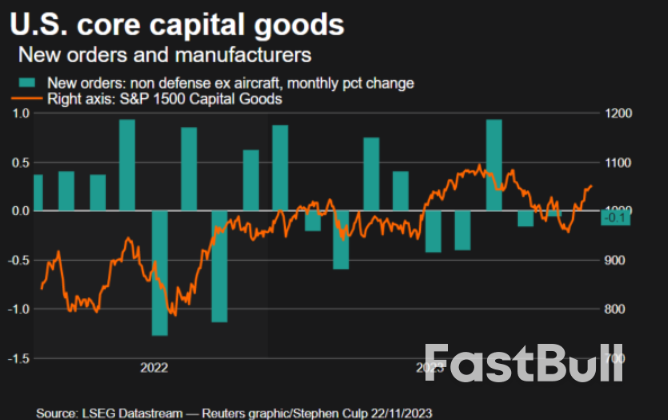
          Slowing economic demand was evident in a report from the Commerce Department on Wednesday showing business spending on equipment struggling to rebound early in the fourth quarter. Non-defense capital goods orders excluding aircraft, a closely watched proxy for business spending plans, dipped 0.1% last month after falling 0.2% in September, the Commerce Department's Census Bureau said.
          Core capital goods shipments were unchanged for a second straight month. Shipments of non-defense capital goods dropped 0.3% following a 0.2% decline in the prior month.
          These shipments feed into the calculation of equipment spending in the gross domestic product report. Business spending on equipment contracted in the third quarter. The economy grew at a 4.9% annualized rate in the July-September quarter. Growth estimates for the fourth quarter are mostly below a 2% pace.
          "It's true that the recent drop-back in bond yields may provide some support for investment, but borrowing costs are likely to remain considerably higher than they were a couple of years ago for the foreseeable future," said Andrew Hunter, deputy chief U.S. economist at Capital Economics. "And with banks continuing to tighten lending standards too, there appears to be little chance of an imminent recovery."
          US Weekly Jobless Claims Fall; Business Spending on Equipment Easing_3

          Source: REUTERS

          To stay updated on all economic events of today, please check out our Economic calendar
          Risk Warnings and Disclaimers
          You understand and acknowledge that there is a high degree of risk involved in trading. Following any strategies or investment methods may lead to potential losses. The content on the site is provided by our contributors and analysts for information purposes only. You are solely responsible for determining whether any trading assets, securities, strategy, or any other product is suitable for investing based on your own investment objectives and financial situation.
          Comments
          Add to Favorites
          Share

          Will Eurozone's PMI Data Be Good News for Euro?

          Justin

          Forex

          Economic

          EZ flash business PMIs to tick higher

          A couple of dim US data was the key catalyst behind the euro’s 2.0% rally against the greenback last week. The common currency experienced one of its most constructive sessions so far this year, drifting as high as $1.0939, but domestic tailwinds remain absent in the euro area, making investors wonder whether the bullish trend reversal in the pair is underpinned by transitory factors.
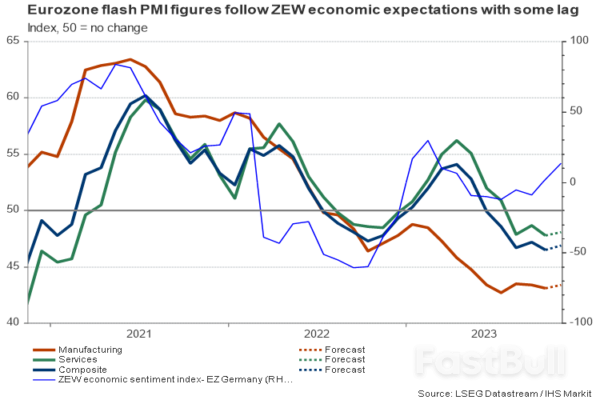
          Eurozone’s flash business PMI figures could provide fresh insight on the state of the economy on Thursday. According to the survey, business sentiment both in the manufacturing and services sectors has been in a gloom-mode since May, with the composite PMI index further easing in the contraction area to 46.5 in October.
          While the previous release painted a blurry picture for Q4 after a marginal GDP contraction in Q3, analysts are now projecting that November’s readings could show some recovery. Specifically, expectations are for the manufacturing PMI index to climb moderately to 43.4 from 43.1 previously, and the services PMI index to tick up to 48.1 from 47.8 last month. Regional PMI data from Germany and France, which are the worst performing economies in the bloc, might also reveal a slight rebound when they are released ahead of the Eurozone-wide numbers.

          There are some signs of business stability

          Such a negligible increase would not be a game changer for the euro, but something is better than nothing. Besides, there is some evidence of economic optimism that could lead to a positive data surprise. The ZEW economic sentiment index, which tracks experts’ Eurozone outlook over the next six months, surged exponentially from 2.3 to 13.8 in November. The German index experienced a similar acceleration, turning positive for the first time since April. Although the current conditions index remained well dipped in the negative region, and a dynamic GDP growth rebound is definitely not in sight, the improvement in expectations indicates that investors are hopeful that conditions may not deteriorate further.
          Will Eurozone's PMI Data Be Good News for Euro?_1
          With inflation moving in the right direction in major economies, and therefore pushing additional rate increases out of the conversation, investors’ morale might brighten. This is also reflected in the rocket rally the German DAX 30 index, as well as other global stock indices, staged last week.

          Rate cut projections

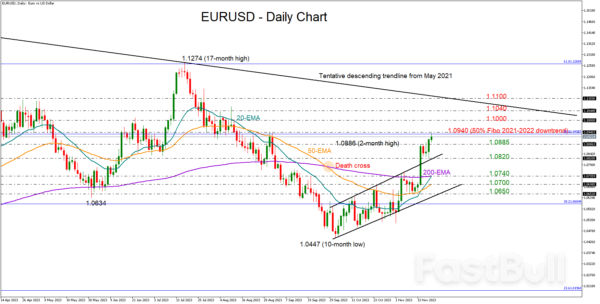
          As regards the persisting rate cut projections for 2024, futures markets are pricing in 95bps of policy easing by the end of 2024 for the ECB, but a stronger-than-expected rebound in business PMI figures could create some doubts about whether such a heavy rate reduction is necessary. If that turns out to be the case, EURUSD could attract fresh buying interest. Technically, the pair needs to overcome the 1.0940 resistance to access the 1.1000-1.1040 caution zone.
          If the PMI data miss expectations and the details present a continuous decline in employment demand and new orders, EURUSD could drift lower in fears the recession risks could prompt rate cuts in 2024. Sellers might wait for a close below the 1.0820 floor before pressing the price towards the 200-day exponential moving average (SMA) at 1.0740.
          Will Eurozone's PMI Data Be Good News for Euro?_2

          Source: XM

          To stay updated on all economic events of today, please check out our Economic calendar
          Risk Warnings and Disclaimers
          You understand and acknowledge that there is a high degree of risk involved in trading. Following any strategies or investment methods may lead to potential losses. The content on the site is provided by our contributors and analysts for information purposes only. You are solely responsible for determining whether any trading assets, securities, strategy, or any other product is suitable for investing based on your own investment objectives and financial situation.
          Comments
          Add to Favorites
          Share

          Does Santa Claus Rally Really Exist?

          Justin

          Economic

          We are nearing the end of another trading year and the newswires are crammed with stories about the famous Santa Claus rally. In a nutshell, the market believes that risky assets tend to rally towards the end of the year. Most analysts calculate the assets’ performance during the last five trading days of the year and the first two of the new year when analysing this “phenomenon”. However, others are confident that this rally tends to start after the annual Thanksgiving holiday.
          Consequently, we decided to have a look at the performance of the main tradable assets for the period between the Thanksgiving holiday and the last trading day of the year. We selected 1991 as our starting year, not for the lack of data but because we feel that this timeframe is a closer match to current market conditions.

          S&P 500 index sends the strongest message

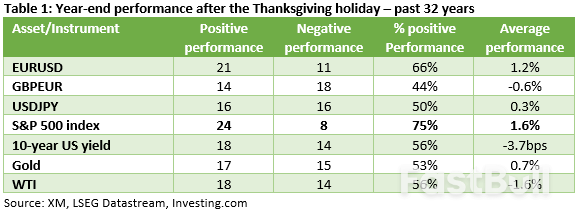
          Table 1 below presents our findings for the 32 years of market data examined. After a quick glance, one can see that there is no widespread rally at the instruments in question. However, there are some interesting results. The S&P 500 index is sending the strongest message as it has managed to finish the year in the green in 75% of the periods examined, i.e. 24 years, with an respectable average gain of 1.6% achieved. Regarding the FX world, only EURUSD tends to exhibit a pattern with 66% of the years ending on a positive note and recording a decent return of 1.2% on average.
          Does Santa Claus Rally Really Exist?_1
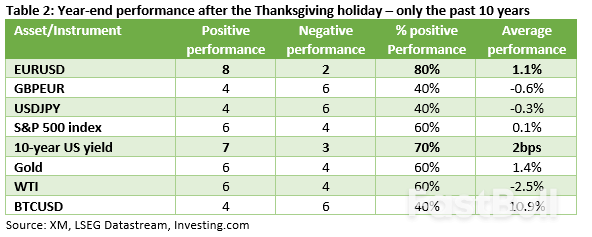
          When focusing only on the past 10 years, the results somewhat change. More specifically, EURUSD tends to rally after the Thanksgiving holiday with an average gain of 1.1%. The 10-year US yield exhibits a similar score, but the average yield increase is just 2bps, which is rather miniscule for its standards. We have also included BTCUSD (Bitcoin) in Table 2 below, but the results do not really confirm the Santa Claus rally, despite the 10.9% average rally.
          Does Santa Claus Rally Really Exist?_2

          What happens in the pre-election years?

          We could not complete our analysis without the main 2024 event: the US election held in November. Such a major event affects investment decisions long before the actual election date as market participants prepare for the next administration. Therefore, we examined the year-end performance of key assets, after the Thanksgiving holiday, in the eight pre-elections years appearing in our data. Interestingly, only the performance of the S&P500 index stands out. Except for 2015, this index tends to end the year positively with an average gain of 4.3% registered.

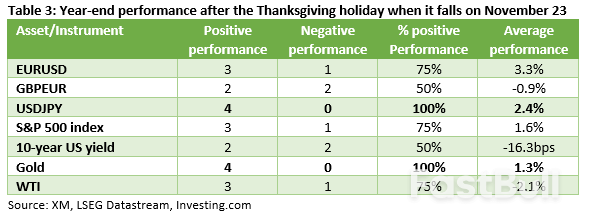
          What happens when the Thanksgiving holiday falls on November 23?

          Our final step was to examine the performance of these assets when the Thanksgiving holiday falls on November 23, like in 2023. We found four instances in the 1991-2022 period when this occurred: in 1995, 2000, 2006 and 2017. A smaller sample to play with but we have two assets, gold and USDJPY, rallying in these four periods. Gold is seen gaining 1.3% on average, while USDJPY tends to climb by 2.4%.
          Does Santa Claus Rally Really Exist?_3
          To sum up, the market appears to be gearing up for a Santa Claus rally and, according to our findings, the S&P500 index tends to confirm this expectation when examining the 32 years of data. Drilling down to just the past 10 years, EURUSD exhibits a strong tendency to rally into year-end. Finally, when the Thanksgiving holiday falls on November 23, USDJPY and gold appear to enjoy a strong upleg by the end of the trading year.

          Source:XM

          To stay updated on all economic events of today, please check out our Economic calendar
          Risk Warnings and Disclaimers
          You understand and acknowledge that there is a high degree of risk involved in trading. Following any strategies or investment methods may lead to potential losses. The content on the site is provided by our contributors and analysts for information purposes only. You are solely responsible for determining whether any trading assets, securities, strategy, or any other product is suitable for investing based on your own investment objectives and financial situation.
          Comments
          Add to Favorites
          Share

          Olive Oil Producers Turn to Tourists to Combat Soaring Costs, Extreme Weather

          Thomas

          Commodity

          Maria Angela Macchia jams a 10-foot pole topped with an electric comb into the upper reaches of a 200-year-old olive tree and revs the engine. The long-toothed tool, created to extract stubborn fruit from the highest branches, vigorously shakes the crown of the tree, sending a trickle of olives cascading to the green nets below. To an onlooker, the stream is impressive. But Macchia frowns: The yield is only a fraction of what she got when she shook the same tree the previous year at I Moricci, her 19th century farmhouse on Tuscan hillside outside of Peccioli, southeast of Pisa.
          Extreme rains across Italy in the spring knocked many of the olive flowers off Macchia's 900 trees before the fruit could form, and she's expecting this year's oil output to plummet by about three-quarters. To help make up some of the earnings shortfall, Macchia has been hosting groups of tourists, organised through the Rotterdam-based vacation planners Triptoscana. The visitors stay on her farm and help pick the olives and explore the region during down time. At the end, they get a half-litre bottle of oil to take home.
          The nine-member group I joined representing four nationalities reflects a growing movement in olive oil tourism across the Mediterranean. Travellers get a taste of the work that goes into producing some of the world's top extra virgin olive oil, while they provide an alternate source of revenue for farmers whose earnings have increasingly suffered from rising production costs and the effects of extreme weather linked to climate change.
          "People really take part in the harvest — they get into the rhythm of it," Macchia says. But, she adds, "it's a lot of work. Every year is different to the next, and there's a lot that goes into making the oil that gets to their tables."
          Triptoscana's five-day tour costs €745 (RM3,805), including two days of picking and a visit to the frantoio — the place where the bitter-tasting fruit is pressed into the liquid gold that is extra virgin oil. Macchia benefits from booking apartments at I Moricci that might normally be empty during off-season; she also has free labour helping her harvest the olives. Our group spent about six hours in the field each day; the roughly 500kg we picked over the two days would yield about 70 litres of oil.
          Macchia's olive shaker — two oversize comb-shaped heads on a telescopic pole powered by a car battery — is as high-tech as picking gets at an independent farm like hers. After the tree tops are combed, guests use plastic hand-rakes to scrape the remaining olives off, branch by branch.
          After picking, the olives are taken directly to the press to stop natural oxidation from spoiling the fresh flavour. Outside the frantoio, where the heady smell of olive oil hangs like a cloud, local farmers wait outside as if they were expectant fathers: Their harvest passes through an assembly line of machines that clean the olives before mashing them into a pulp and then separating the oil from the remaining sludge. Every byproduct is used. The pulp serves as fertiliser or is sold to commercial producers to extract more nectar for lower-grade oils. The bits of crushed olive pits are dried and sold as fuel for wood-burning stoves.
          To be considered extra virgin oil, the olives must be cold-pressed mechanically and have an acidity of less than 0.8%. The oil, which can cost upwards of €30 a litre, has rich, earthy flavours and often a spicy aftertaste. It's primarily a condiment used to drizzle on top of soups, fish and vegetables, to mix into salads and sometimes for sautéing.
          In fact, cooking with olive oil is costlier than ever. The hit to harvests linked to extreme weather has coincided with a surge in demand from health-conscious consumers. Global olive oil production is expected to fall this season to 1.97 million tons, a 23% decline from the average of the previous four years, according to Olive Oil Times, a trade publication that tracks the industry. Spain, which has traditionally produced about half the world's olive oil, is suffering a second year of drought that cut last year's harvest by more than half; only marginal improvement is expected this year. Greek producers were slammed by cataclysmic rains and hail in September that damaged trees. Greek oil production is expected to drop 40% from last year's bumper crop, Olive Oil Times reported. Meanwhile, in Italy, the cost of olive oil was 49% higher in October than in the previous year; in Spain, where grocers are now locking up olive oil to combat shoplifting, it's up almost 74%.
          My Spanish-born colleague Javier Blas, who covers the petroleum industry for Bloomberg, recently wrote about his personal shock at seeing the price of olive oil rise to an all-time record this year, contributing to the jump in the cost of all kinds of classic Mediterranean dishes from paella to pizza. In August, a metric ton of olive oil cost about 10 times a metric ton of crude. In 2019, he wrote, the cost ratio was less than 5 to 1.
          Producers such as Macchia may be able to charge top dollar for premium oils, but it's not enough to compensate for the drop in output and the rising cost of fertiliser, labour, glass bottles and electricity. That's where the olive tourism movement hopes to make a difference. Olive-picking experiences and oil tastings have been available for some years in Mediterranean countries, but Italy is using a new law that came into effect last year to try to attract tourists to olive groves outside of picking season.
          Budget law 169/19 makes it easier for producers to charge admission for events related to oil production and is modelled on similar legislation for wine that helped Italian wine producers become international favourites. Events range from concerts in century-old olive fields to meditation and yoga sessions among the trees to cycling and trekking routes in growing regions. More than 25,000 people took part in a "Walk Through the Olive Fields" event in 163 oil-producing towns and villages in October, organised by Citta dell'Olio, a national alliance that backs the tourism effort.
          Fabiola Pulieri, an olive oil sommelier, who literally wrote the book on the subject — Olive Tourism, Opportunities for Producers and Regions (Agra Editrice) — says olive tourism could help raise the profile of independent producers much like Italy's wine law created brand awareness about Italian wines.
          "Now there are opportunities 365 days a year, not just during the harvest and pressing season in October and November to take advantage of tourism and give an economic boost to producers," she says.
          Other countries offer similar opportunities, for olive-oil-minded tourists. Good Life Greece organises picking holidays on the island of Syros, and the olive groves are a five minute walk from the beach. You can pick Dalmatian olives off 1,000-year-old trees in Solta, Croatia, organised by Olynthia, a premium brand oil. Fans of Don Quixote can visit the groves of Garcia de la Cruz in La Mancha, Spain, with same-day olive-picking tours that includes a visit to their 17th century olive press (and yes there are windmill "to tilt at").
          Struggling producers see a side benefit to increased tourism — namely, the recognition of the amount of work that goes into making one little bottle of olive oil. "The most important thing is that [people] get to see that you don't just open the faucet and oil comes out," Macchia says.
          "After you have gone through that, you think to yourself, ‘Good oil should be expensive for all the trouble it takes to produce'," says David Sheridan, a senior judge at the Hartford Superior Court, who made the trip to I Moricci with his wife and daughter.
          Macchia, who gave up her career as a goldsmith 25 years ago to go into farming, says she's hopeful the tourism push will get more people interested in top-quality oil like hers.
          "Out of 100 people, there are probably four that are interested in olive oil," she says. "But for me, that's enough, and those are the people I want to focus on."

          Source: Bloomberg

          Risk Warnings and Disclaimers
          You understand and acknowledge that there is a high degree of risk involved in trading. Following any strategies or investment methods may lead to potential losses. The content on the site is provided by our contributors and analysts for information purposes only. You are solely responsible for determining whether any trading assets, securities, strategy, or any other product is suitable for investing based on your own investment objectives and financial situation.
          Comments
          Add to Favorites
          Share

          Green Energy Is a Necessity – And A Business Opportunity

          Kevin Du

          Economic

          This year, the UAE will emerge on the world's stage like never before. We're all looking to the future. Not just to Cop28, when the world will converge at Expo City to discuss global progress towards the Paris Agreement, but beyond.
          When the UAE's Year of Sustainability concludes, how will we continue to work towards a sustainable future?
          Some international observers have raised doubts about our commitment to climate action given our historical role as one of the world's main hydrocarbon producers. Perhaps they're unaware of the progress we have made in recent years in diversifying our economy and transitioning away from fossil fuels.
          Today, the UAE is home to several vast renewable energy power plants, including the Arab world's largest civilian nuclear energy plant and the Mohammed bin Rashid Al Maktoum Solar Park, the largest single-site solar park in the world. By 2030, it will have a 5,000 MW capacity, and when completed, it will save more than 6.5 million tonnes of carbon emissions every year.
          The UAE is also home to the International Renewable Energy Agency, as well as Masdar, one of the world's largest clean energy companies, which has invested in numerous projects around the globe.
          A lesser-known component of the UAE's leadership in sustainability is its focus on green financing, which is playing a vital role in the fight against climate change. A 2022 report by the Independent High-Level Expert Group on Climate Finance estimates that annual investments in climate action need to increase to $1 trillion in 2025 and $2.4 trillion by 2030 for us to meet climate targets.
          The UAE has decisively stepped up, investing $100 billion in renewable energy over the past 15 years. Together with the US, it has pledged to invest a further $100 billion in financing and other support by 2035.
          UAE entities are following suit. Masdar recently completed its first green bond issuance for $750 million 10-year senior unsecured notes at London Stock Exchange. Additionally, Taqa recently listed its dual-tranche $1.5 billion bonds on the Abu Dhabi Securities Exchange's main market. This debt capital will fund several new clean energy projects.
          Such critical investment is transforming the cost of green energy. In 2009, the cost of Masdar solar energy was about 40 cents for every kilowatt hour. Today, thanks in large part to Masdar's investments, it's under 2 cents – among the cheapest energy in the world.
          The UAE makes a compelling business case for sustainable development and investment in renewable energy, leveraging its excellent reputation for excelling in business.
          Masdar City, which has been pioneering sustainable urban development for 15 years, exemplifies this. Its leaders have prioritised green innovation, research and development, and technology, and it is now home to one of the largest clusters of Leed Platinum buildings in the world.
          The commercial buildings currently have a 98 per cent occupancy rate, and Masdar City remains one of the most sought-after areas in Abu Dhabi for homebuyers in 2023. Additionally, three net-zero energy projects are under construction in the city.
          The growth of Masdar City has paved the way for the formation of the Masdar Green Real Estate Investment Trust (Reit), the first of its kind in the region. It was established in 2020 at the Abu Dhabi Global Market (ADGM) with an initial valuation of more than $250 million.
          Today, it is one of the few green Reits worldwide consisting entirely of Leed Platinum and Gold buildings, and its valuation is nearly $750 million. This year, it issued a memorandum allowing third-party institutional investors to buy into the fund.
          ADGM and the Dubai International Financial Centre (DIFC) are other national examples of sustainable finance.
          ADGM has recently partnered with the Global Green Finance Index, which reports on the quality and depth of the green finance offerings of the world's leading financial centres. It is also exploring the introduction of its own Sustainable Finance Regulatory Framework.
          According to DIFC chief executive Arif Amiri, market capitalisation of ESG-inspired bonds now makes up more than 10 per cent of total outstanding bonds, worth more than $10 billion. This underlines the potential of private finance to incentivise the adoption of more sustainable practices by its investee companies.
          Other UAE entities, including the Abu Dhabi Investment Authority and Mubadala, are also prioritising climate finance, with total investments in the hundreds of billions.
          These measures are already having far-reaching impacts, even in traditional areas of the UAE economy, as evidenced by Adnoc Distribution's recent pledge to lower the carbon footprint of its operations using sustainability-linked funding.
          Some have critiqued the UAE's use of oil revenue in climate action, but this has allowed it to diversify its economy and kickstart a world-leading renewable energy sector while the world continues its gradual transition from fossil fuels.
          Thanks to these investments, sustainable industries and sectors will soon outpace oil. In the first quarter of 2023 alone, the UAE's economy grew by 3.8 per cent on an annual basis thanks to non-oil sectors. This follows a credit rating of AA2 by Moody's, affirming the strength of the economy.
          Our trajectory is clear – and this is only the beginning. The UAE has a legacy of engaging with global entities such as the UN and World Bank to drive progress, share best practices, and offer international development aid. National initiatives undertaken in conjunction with these organisations such as the Zayed Sustainability Prize continue helping sustainability projects around the world scale and thrive.
          This legacy of international collaboration will continue at Cop28, through which we will strive to help other countries, particularly developing countries, address the economic realities of sustainability, including the initial cost.
          This is at the heart of realising the Paris Agreement. Transitioning to clean energy isn't just a necessity. It's also a lucrative business opportunity, as we have demonstrated – but it's one that requires serious capital.

          Source: The National News

          To stay updated on all economic events of today, please check out our Economic calendar
          Risk Warnings and Disclaimers
          You understand and acknowledge that there is a high degree of risk involved in trading. Following any strategies or investment methods may lead to potential losses. The content on the site is provided by our contributors and analysts for information purposes only. You are solely responsible for determining whether any trading assets, securities, strategy, or any other product is suitable for investing based on your own investment objectives and financial situation.
          Comments
          Add to Favorites
          Share
          FastBull
          Copyright © 2025 FastBull Ltd

          728 RM B 7/F GEE LOK IND BLDG NO 34 HUNG TO RD KWUN TONG KLN HONG KONG

          TelegramInstagramTwitterfacebooklinkedin
          App Store Google Play Google Play
          Products
          Charts

          Chats

          Q&A with Experts
          Screeners
          Economic Calendar
          Data
          Tools
          Membership
          Features
          Function
          Markets
          Copy Trading
          Latest Signals
          Contests
          News
          Analysis
          24/7
          Columns
          Education
          Company
          Careers
          About Us
          Contact Us
          Advertising
          Help Center
          Feedback
          User Agreement
          Privacy Policy
          Business

          White Label

          Data API

          Web Plug-ins

          Poster Maker

          Affiliate Program

          Risk Disclosure

          The risk of loss in trading financial instruments such as stocks, FX, commodities, futures, bonds, ETFs and crypto can be substantial. You may sustain a total loss of the funds that you deposit with your broker. Therefore, you should carefully consider whether such trading is suitable for you in light of your circumstances and financial resources.

          No decision to invest should be made without thoroughly conducting due diligence by yourself or consulting with your financial advisors. Our web content might not suit you since we don't know your financial conditions and investment needs. Our financial information might have latency or contain inaccuracy, so you should be fully responsible for any of your trading and investment decisions. The company will not be responsible for your capital loss.

          Without getting permission from the website, you are not allowed to copy the website's graphics, texts, or trademarks. Intellectual property rights in the content or data incorporated into this website belong to its providers and exchange merchants.

          Not Logged In

          Log in to access more features

          FastBull Membership

          Not yet

          Purchase

          Become a signal provider
          Help Center
          Customer Service
          Dark Mode
          Price Up/Down Colors

          Log In

          Sign Up
          Position
          Layout
          Fullscreen
          Default to Chart
          The chart page opens by default when you visit fastbull.com