Markets
News
Analysis
User
24/7
Economic Calendar
Education
Data
- Names
- Latest
- Prev


Signal Accounts for Members
All Signal Accounts
All Contests


Turkey Trade BalanceA:--
F: --
P: --
Germany Construction PMI (SA) (Nov)A:--
F: --
P: --
Euro Zone IHS Markit Construction PMI (Nov)A:--
F: --
P: --
Italy IHS Markit Construction PMI (Nov)A:--
F: --
P: --
U.K. Markit/CIPS Construction PMI (Nov)A:--
F: --
P: --
France 10-Year OAT Auction Avg. YieldA:--
F: --
P: --
Euro Zone Retail Sales MoM (Oct)A:--
F: --
P: --
Euro Zone Retail Sales YoY (Oct)A:--
F: --
P: --
Brazil GDP YoY (Q3)A:--
F: --
P: --
U.S. Challenger Job Cuts (Nov)A:--
F: --
P: --
U.S. Challenger Job Cuts MoM (Nov)A:--
F: --
P: --
U.S. Challenger Job Cuts YoY (Nov)A:--
F: --
P: --
U.S. Initial Jobless Claims 4-Week Avg. (SA)A:--
F: --
P: --
U.S. Weekly Initial Jobless Claims (SA)A:--
F: --
P: --
U.S. Weekly Continued Jobless Claims (SA)A:--
F: --
P: --
Canada Ivey PMI (SA) (Nov)A:--
F: --
P: --
Canada Ivey PMI (Not SA) (Nov)A:--
F: --
P: --
U.S. Non-Defense Capital Durable Goods Orders Revised MoM (Excl. Aircraft) (SA) (Sept)A:--
F: --
U.S. Factory Orders MoM (Excl. Transport) (Sept)A:--
F: --
P: --
U.S. Factory Orders MoM (Sept)A:--
F: --
P: --
U.S. Factory Orders MoM (Excl. Defense) (Sept)A:--
F: --
P: --
U.S. EIA Weekly Natural Gas Stocks ChangeA:--
F: --
P: --
Saudi Arabia Crude Oil ProductionA:--
F: --
P: --
U.S. Weekly Treasuries Held by Foreign Central BanksA:--
F: --
P: --
Japan Foreign Exchange Reserves (Nov)A:--
F: --
P: --
India Repo RateA:--
F: --
P: --
India Benchmark Interest RateA:--
F: --
P: --
India Reverse Repo RateA:--
F: --
P: --
India Cash Reserve RatioA:--
F: --
P: --
Japan Leading Indicators Prelim (Oct)A:--
F: --
P: --
U.K. Halifax House Price Index YoY (SA) (Nov)--
F: --
P: --
U.K. Halifax House Price Index MoM (SA) (Nov)--
F: --
P: --
France Current Account (Not SA) (Oct)--
F: --
P: --
France Trade Balance (SA) (Oct)--
F: --
P: --
France Industrial Output MoM (SA) (Oct)--
F: --
P: --
Italy Retail Sales MoM (SA) (Oct)--
F: --
P: --
Euro Zone Employment YoY (SA) (Q3)--
F: --
P: --
Euro Zone GDP Final YoY (Q3)--
F: --
P: --
Euro Zone GDP Final QoQ (Q3)--
F: --
P: --
Euro Zone Employment Final QoQ (SA) (Q3)--
F: --
P: --
Euro Zone Employment Final (SA) (Q3)--
F: --
Brazil PPI MoM (Oct)--
F: --
P: --
Mexico Consumer Confidence Index (Nov)--
F: --
P: --
Canada Unemployment Rate (SA) (Nov)--
F: --
P: --
Canada Labor Force Participation Rate (SA) (Nov)--
F: --
P: --
Canada Employment (SA) (Nov)--
F: --
P: --
Canada Part-Time Employment (SA) (Nov)--
F: --
P: --
Canada Full-time Employment (SA) (Nov)--
F: --
P: --
U.S. Dallas Fed PCE Price Index YoY (Sept)--
F: --
P: --
U.S. PCE Price Index YoY (SA) (Sept)--
F: --
P: --
U.S. PCE Price Index MoM (Sept)--
F: --
P: --
U.S. Personal Outlays MoM (SA) (Sept)--
F: --
P: --
U.S. Core PCE Price Index MoM (Sept)--
F: --
P: --
U.S. UMich 5-Year-Ahead Inflation Expectations Prelim YoY (Dec)--
F: --
P: --
U.S. Core PCE Price Index YoY (Sept)--
F: --
P: --
U.S. 5-10 Year-Ahead Inflation Expectations (Dec)--
F: --
P: --
U.S. UMich Current Economic Conditions Index Prelim (Dec)--
F: --
P: --
U.S. UMich Consumer Sentiment Index Prelim (Dec)--
F: --
P: --
U.S. UMich 1-Year-Ahead Inflation Expectations Prelim (Dec)--
F: --
P: --
U.S. UMich Consumer Expectations Index Prelim (Dec)--
F: --
P: --


No matching data
Latest Views
Latest Views
Trending Topics
Top Columnists
Latest Update
White Label
Data API
Web Plug-ins
Affiliate Program
View All

No data
The US economy lost 32'000 jobs in November. And no, it's not AI's fault. Small companies with fewer than 50 employees shed 120'000 jobs last month, according to the latest ADP report.
The US economy lost 32'000 jobs in November. And no, it's not AI's fault. Small companies with fewer than 50 employees shed 120'000 jobs last month, according to the latest ADP report. Those losses outweighed gains in bigger companies. Overall, 32'000 people lost their jobs — the fourth negative print in the last six months. On average, the big and beautiful US economy has added fewer than 20'000 jobs per month over the past six months — a level comfortably pointing at recession.
Add to that the big companies, like Apple and Microsoft, planning headcount reductions — this time citing AI — and you get a pretty… amazing picture for the financial markets.
The job losses will push the Federal Reserve (Fed) toward faster and deeper rate cuts. And if, on top of that, people slow their spending because they're out of work and inflation eases, that would be the cherry on top.
Odd, but that's exactly how markets process information.
Yesterday was a typical "bad news is good news" session. You could see the cheery mood across US assets: job losses sent the 2-year Treasury yield below 3.50%, the probability of a 25bp cut in December rose to 90%, and the S&P 500 traded at 6'862 — just 58 points, or less than 1%, below its all-time high.
Interestingly, technology stocks — normally more sensitive to yields because much of their valuation is based on future revenue discounted to today — barely moved. The Magnificent Seven stayed stoic. Microsoft was busy denying a report from The Information claiming it lowered growth targets for AI software sales after many salespeople missed their goals last fiscal year. Investors read it as: "They're not selling enough AI products, their targets are being lowered, and all these investments could be garbage." Microsoft shares closed 2.5% lower. Nvidia lost 1% despite news that it could get approval to sell chips to China — if China is still willing to buy, which is no longer guaranteed.
Tesla, on the other hand, gained more than 4% — for reasons I can't fully explain. Tesla sales are crashing in Europe, the company warned that UK sales are weakening, and Michael Burry called Tesla "ridiculously overvalued." I agree. Tesla has become a massive meme stock, with a PE ratio near 300: you buy the share for around $446.74 as per yesterday's close and earn roughly $1.50 per share. Expensive, yes — but some people like it. Plus, there was some non-EV-friendly news: Trump lowered climate goals, which sent Stellantis up almost 8% in Milan. Go figure why Tesla rallied.
Overall, the US session was solid. And the Japanese session was excellent, as a sale of 30-year government bonds drew the strongest demand since 2019 — at the current multi-decade high yield, near 3.40%. Given that pressure in JGBs has been a major risk to global risk appetite — even more so since the Bank of Japan (BoJ) head on Monday hinted at a possible rate hike this month — the rally in JGBs helped lift the Nikkei by 2%.
US futures, however, look mixed despite the rally in Asia. Nasdaq futures are slightly negative at the time of writing. Perhaps Morgan Stanley's news that it is considering offloading some data-center exposure didn't help. According to their calculations, the big cloud companies will spend around $3 trillion on data centers through 2028, but their cash flow can fund only half. Oracle's CDS — now a barometer of AI-related risk — spiked to a 16-year high, hinting that appetite is fading.
Investors are awaiting tomorrow's PCE numbers, which could further clear the path for rate cuts beyond December. At this pace of economic deterioration, the Fed may have little choice but to cut further. The question is whether softening Fed expectations will revive tech risk appetite, or if the rally will shift to non-tech and smaller companies. The Russell 2000, for example, rallied nearly 2% yesterday on the back of the weak ADP report. Fading AI enthusiasm due to high valuations, combined with lower yields, could push funds toward these companies.
In FX, the US dollar slipped below its 50-DMA and is testing a major Fibonacci support — if broken, it could enter a medium-term bearish zone. The broadly softening USD, on rising dovish Fed expectations, lifted the EURUSD above its 100-DMA. Europeans are unlikely to move rates next year, as inflation is around 2% and risks are two-sided. In Switzerland, zero inflation and strong demand for the franc continue to worry the Swiss National Bank (SNB), which doesn't want to cut rates below zero. If the Fed cuts enough to lift global risk appetite, it could reduce the rush to Swiss francs.
A Fed cut is also positive for European stocks: lower US yields lift equities, and a stronger euro enhances returns in USD terms.
Elsewhere, copper rallied more than 2% on COMEX, amid concerns that potential US tariffs could squeeze supply. Metals remain investor favorites as appetite for traditional currencies wanes.
As we head toward year-end: it's time to explore non-tech, non-US pockets of the market. Emerging-market indices benefit when the dollar softens, and European indices have performed very well this year to close the valuation gap. There's certainly more to take advantage of, though it's less flashy than the US tech story.
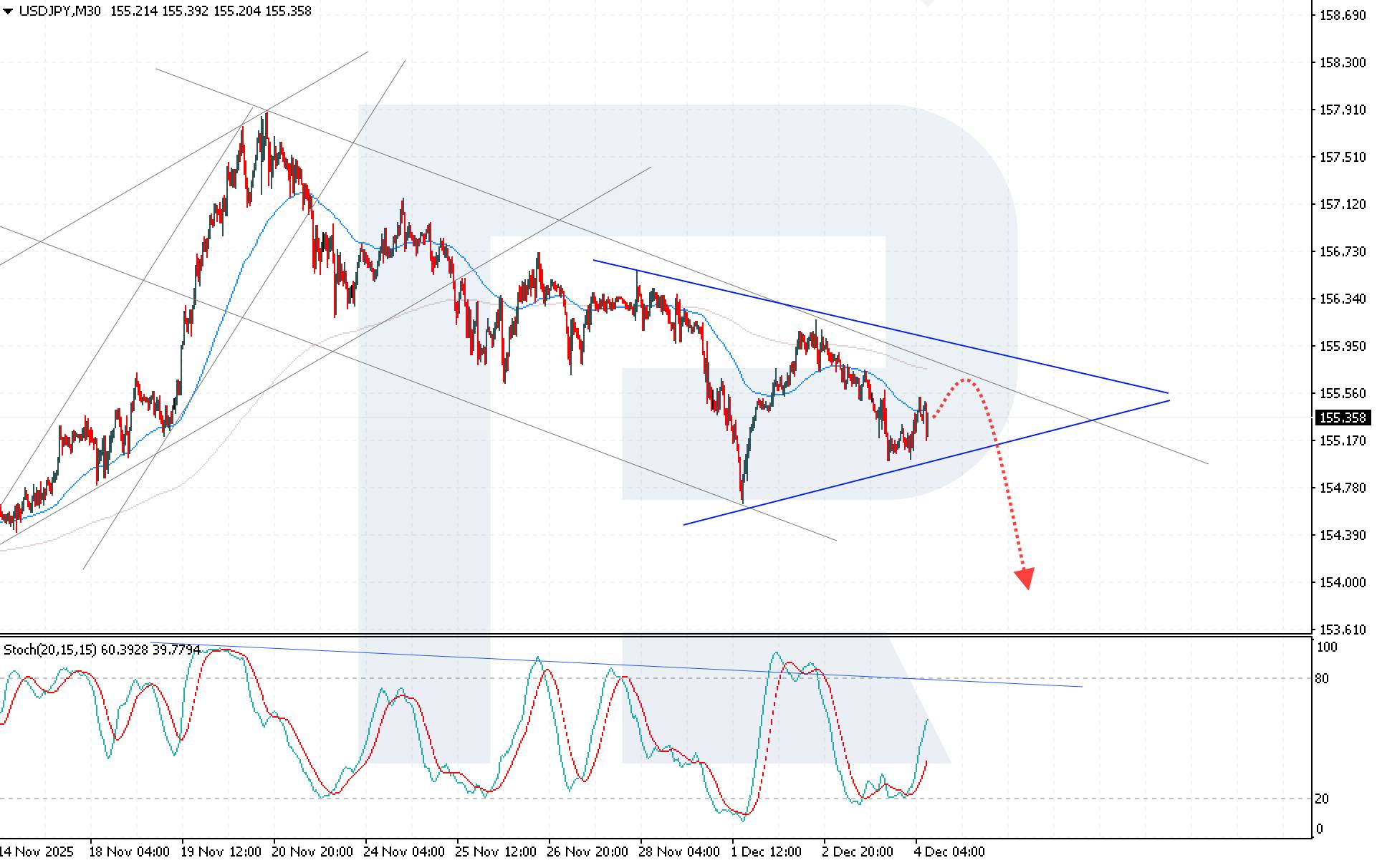
The USDJPY rate is slightly strengthening after rebounding from the 154.90 support level. Meanwhile, the Japanese yen remains near its strongest level in two weeks as the market increases bets that the Bank of Japan will raise interest rates this month.
Additional support for the yen came from a weakening US dollar. Soft US labour market data boosted expectations that the Federal Reserve will cut the benchmark interest rate at the December meeting. The ADP Research report released on Wednesday showed the largest decline in private sector employment since March 2023 – minus 32 thousand jobs, while analysts had expected an increase of 10 thousand.
The statistics strengthen the case for further easing by the Federal Reserve. Labour demand in the US remains weak, consumer spending is beginning to weaken, and inflation risks are diminishing. Against this backdrop, the USDJPY forecast for today remains negative.
The USDJPY pair is undergoing a correction, forming a Triangle pattern. Sellers continue to keep the price below the EMA-65, maintaining an overall bearish tone.
The USDJPY forecast suggests a short-term bullish correction towards 155.55. This area acts as key resistance within the Triangle. After testing the 155.55 level, the pair could resume its downward movement towards 153.85. The Stochastic Oscillator confirms the likelihood of a bearish scenario: its signal lines have turned upwards from oversold territory and are approaching the descending resistance line.
A consolidation below 154.65 will serve as key confirmation of continued downward momentum and signal a breakout below the Triangle's lower boundary.
SummaryAmid weak US labour market data and expectations of Fed policy easing, the USDJPY rate remains under pressure. Technical analysis of USDJPY indicates a high probability of a bearish impulse towards 153.85 if the price consolidates below 154.65.
EURUSD 2026-2027 forecast: key market trends and future predictionsThis article provides the EURUSD forecast for 2026 and 2027 and highlights the main factors determining the direction of the pair's movements. We will apply technical analysis, take into account the opinions of leading experts, large banks, and financial institutions, and study AI-based forecasts. This comprehensive insight into EURUSD predictions should help investors and traders make informed decisions.
Gold (XAUUSD) forecast 2026 and beyond: expert insights, price predictions, and analysisThis article offers a Gold (XAUUSD) price forecast for 2026 and beyond, combining technical analysis, expert forecasts, and key macroeconomic factors. It explains the drivers behind gold's recent surge, explores potential scenarios including a move toward 4,500 to 5,000 USD per ounce, and highlights why the metal remains a strong hedge during global uncertainty.
US stocks pushed higher in the latest session, extending their recent momentum as weaker-than-expected US jobs data strengthened expectations for an imminent Federal Reserve rate cut. The Dow led the gains, rising 0.86% to close at 47,882, while the S&P 500 added 0.30% to finish at 6,849. The Nasdaq advanced more modestly, up 0.17% at 23,454.
The softer ADP Non-Farm figures drove Treasury yields lower, with the 2-year slipping 2.4 basis points to 3.484% and the 10-year easing 2.7 basis points to 4.059%. The US dollar also weakened further, with the USD Index falling 0.46% to 98.87. Oil prices continued to move higher as faltering Russia–Ukraine peace talks kept geopolitical tensions elevated. Brent crude rose 0.56% to settle at $62.80, while WTI crude climbed 0.82% to $59.12. Gold traded in another rare tight range, slipping marginally by 0.05% to close at $4,204.13.
Sterling jumped into trader focus yesterday as the FX Gods aligned to see it drive higher against the dollar and on the crosses. Cable powered over 1% on the day with little respite in the move, and it was a similar story on the crosses with EUR/GBP losing 0.6% across all three trading sessions. There was no definitive driver of the move, but it does appear that a few different factors combined to see the outsized move occur. Most traders agree that the speculative side of the market was short, and stop-losses in Cable above 1.3270 and 1.3300 would have contributed to the move.
Services and Composite PMI data also came in stronger than expected, but not by a degree that you would normally expect to move the market by that degree. The weaker US ADP number would have contributed to the move in Cable, and this could have fed through to cross moves as well, but overall traders feel that the move may have been overdone given other moves in the majors. Now, traders will be watching the pound closely in coming sessions to see whether the move is justified or whether we see a bit of retracement back into recent ranges.
The macroeconomic calendar is quieter during the first two sessions of the day today, but attention will shift back to the US tonight with some more key labour-market indicators due. Investors will be watching Challenger job cuts data earlier in the session, which has sprung up in importance since the government shutdown; last time out, they came in at 173%, and anything higher is likely to back last night's ADP data miss and push rate-cut expectations up even further.
Later in the session, we have the release of the weekly unemployment claims, with expectations for a 219k print firmly priced in. Canada's Ivey PMI is also scheduled north of the border, with anything significantly off the expected 53.6 print likely to see volatility in the loonie.
White Label
Data API
Web Plug-ins
Poster Maker
Affiliate Program
The risk of loss in trading financial instruments such as stocks, FX, commodities, futures, bonds, ETFs and crypto can be substantial. You may sustain a total loss of the funds that you deposit with your broker. Therefore, you should carefully consider whether such trading is suitable for you in light of your circumstances and financial resources.
No decision to invest should be made without thoroughly conducting due diligence by yourself or consulting with your financial advisors. Our web content might not suit you since we don't know your financial conditions and investment needs. Our financial information might have latency or contain inaccuracy, so you should be fully responsible for any of your trading and investment decisions. The company will not be responsible for your capital loss.
Without getting permission from the website, you are not allowed to copy the website's graphics, texts, or trademarks. Intellectual property rights in the content or data incorporated into this website belong to its providers and exchange merchants.
Not Logged In
Log in to access more features

FastBull Membership
Not yet
Purchase
Log In
Sign Up