• Trade
  • Markets
  • Copy
  • Contests
  • News
  • 24/7
  • Calendar
  • Q&A
  • Chats
Trending
Screeners
SYMBOL
LAST
BID
ASK
HIGH
LOW
NET CHG.
%CHG.
SPREAD
SPX
S&P 500 Index
6870.39
6870.39
6870.39
6895.79
6858.28
+13.27
+ 0.19%
--
DJI
Dow Jones Industrial Average
47954.98
47954.98
47954.98
48133.54
47871.51
+104.05
+ 0.22%
--
IXIC
NASDAQ Composite Index
23578.12
23578.12
23578.12
23680.03
23506.00
+72.99
+ 0.31%
--
USDX
US Dollar Index
98.950
99.030
98.950
99.060
98.740
-0.030
-0.03%
--
EURUSD
Euro / US Dollar
1.16426
1.16443
1.16426
1.16715
1.16277
-0.00019
-0.02%
--
GBPUSD
Pound Sterling / US Dollar
1.33312
1.33342
1.33312
1.33622
1.33159
+0.00041
+ 0.03%
--
XAUUSD
Gold / US Dollar
4197.91
4197.91
4197.91
4259.16
4191.87
-9.26
-0.22%
--
WTI
Light Sweet Crude Oil
59.809
60.061
59.809
60.236
59.187
+0.426
+ 0.72%
--

Community Accounts

Signal Accounts
--
Profit Accounts
--
Loss Accounts
--
View More

Become a signal provider

Sell trading signals to earn additional income

View More

Guide to Copy Trading

Get started with ease and confidence

View More

Signal Accounts for Members

All Signal Accounts

Best Return
  • Best Return
  • Best P/L
  • Best MDD
Past 1W
  • Past 1W
  • Past 1M
  • Past 1Y

All Contests

  • All
  • Trump Updates
  • Recommend
  • Stocks
  • Cryptocurrencies
  • Central Banks
  • Featured News
Top News Only
Share

[Moodeng Surges Over 43% In The Last 24 Hours, With A Current Market Cap Of $104 Million.] December 7Th, According To Gmgn Market Data, The Solana-Based Meme Coin Moodeng Surged Over 43% In The Past 24 Hours, With A Market Capitalization Currently Standing At 104 Million USD

Share

Jerusalem-German Chancellor Merz: We Have Not Discussed A Visit To Germany By Israeli Prime Minister Benjamin Netanyahu, Not An Issue At The Moment

Share

Israeli Prime Minister Netanyahu: We're Close To The Second Phase Of Trump's Gaza Plan

Share

West Africa's ECOWAS Bloc: 'Strongly Condemns' Attempted Military Coup In Benin

Share

Israeli Prime Minister Netanyahu: Political Annexation Of The West Bank Remains A Subject Of Discussion

Share

Israeli Prime Minister Netanyahu: Sovereign Power Of Security From The Jordan River To The Mediterranean Will Always Remain In Israel's Hands

Share

Israeli Prime Minister Netanyahu: We Believe There Is A Path To A Workable Peace With Our Palestinian Neighbors

Share

Israeli Prime Minister Netanyahu: I Will Meet Trump This Month

Share

Egypt's Net Foreign Reserves Rise To $50.216 Billion In November From $50.071 Billion In October

Share

Uganda Opposition Candidate Says He Was Beaten By Security Forces

Share

Benin's Foreign Minister Bakari:Large Part Of The Army And National Guard Still Loyalist And Are Controlling The Situation

Share

Russian Defence Ministry: Russian Troops Complete Capture Of Rivne In Ukraine's Donetsk Region

Share

Russian Defence Ministry: Russian Troops Carried Out Group Strike Overnight On Ukraine's Transport Infrastructure Facilities, Fuel And Energy Complexes, And Long-Range Drone Complexes

Share

Russian Defence Ministry: Russian Forces Capture Kucherivka In Ukraine's Kharkiv Region

Share

US Envoy Kellogg Says Ukraine Peace Deal Is Really Close

Share

US Embassy In India- US Under Secretary Of State For Political Affairs Allison Hooker Will Visit New Delhi And Bengaluru, India, From December 7 To 11

Share

Japan Prime Minister Takaichi: To Respond Calmly And Resolutely To The Development

Share

UBS Plans To Cut Further 10000 Jobs By 2027, Swiss Newspaper Sonntagsblick Reports

Share

India Clean Energy Ministry: No Advisory Issued To Pause Or Halt New Clean Enegry Financing

Share

[Win Surges Over 90% In 24 Hours, Market Cap Reaches $57.5 Million] December 7Th, According To Htx Market Data, Win Surged Over 90% In The Past 24 Hours, Currently Trading At $0.0000575, With A Market Cap Of $57.5 Million

TIME
ACT
FCST
PREV
Euro Zone Employment YoY (SA) (Q3)

A:--

F: --

P: --

Euro Zone GDP Final YoY (Q3)

A:--

F: --

P: --

Euro Zone GDP Final QoQ (Q3)

A:--

F: --

P: --

Euro Zone Employment Final QoQ (SA) (Q3)

A:--

F: --

P: --

Euro Zone Employment Final (SA) (Q3)

A:--

F: --

P: --
Brazil PPI MoM (Oct)

A:--

F: --

P: --

Mexico Consumer Confidence Index (Nov)

A:--

F: --

P: --

Canada Unemployment Rate (SA) (Nov)

A:--

F: --

P: --

Canada Labor Force Participation Rate (SA) (Nov)

A:--

F: --

P: --

Canada Employment (SA) (Nov)

A:--

F: --

P: --

Canada Part-Time Employment (SA) (Nov)

A:--

F: --

P: --

Canada Full-time Employment (SA) (Nov)

A:--

F: --

P: --

U.S. Personal Income MoM (Sept)

A:--

F: --

P: --

U.S. PCE Price Index YoY (SA) (Sept)

A:--

F: --

P: --

U.S. PCE Price Index MoM (Sept)

A:--

F: --

P: --

U.S. Personal Outlays MoM (SA) (Sept)

A:--

F: --

P: --

U.S. Core PCE Price Index MoM (Sept)

A:--

F: --

P: --

U.S. Core PCE Price Index YoY (Sept)

A:--

F: --

P: --

U.S. UMich 5-Year-Ahead Inflation Expectations Prelim YoY (Dec)

A:--

F: --

P: --

U.S. Real Personal Consumption Expenditures MoM (Sept)

A:--

F: --

P: --

U.S. 5-10 Year-Ahead Inflation Expectations (Dec)

A:--

F: --

P: --

U.S. UMich Current Economic Conditions Index Prelim (Dec)

A:--

F: --

P: --

U.S. UMich Consumer Sentiment Index Prelim (Dec)

A:--

F: --

P: --

U.S. UMich 1-Year-Ahead Inflation Expectations Prelim (Dec)

A:--

F: --

P: --

U.S. UMich Consumer Expectations Index Prelim (Dec)

A:--

F: --

P: --

U.S. Weekly Total Rig Count

A:--

F: --

P: --

U.S. Weekly Total Oil Rig Count

A:--

F: --

P: --

U.S. Unit Labor Cost Prelim (SA) (Q3)

--

F: --

P: --

U.S. Consumer Credit (SA) (Oct)

A:--

F: --

P: --

China, Mainland Foreign Exchange Reserves (Nov)

A:--

F: --

P: --

China, Mainland Exports YoY (USD) (Nov)

--

F: --

P: --

China, Mainland Imports YoY (CNH) (Nov)

--

F: --

P: --

China, Mainland Imports YoY (USD) (Nov)

--

F: --

P: --

China, Mainland Imports (CNH) (Nov)

--

F: --

P: --

China, Mainland Trade Balance (CNH) (Nov)

--

F: --

P: --

China, Mainland Exports (Nov)

--

F: --

P: --

Japan Wages MoM (Oct)

--

F: --

P: --

Japan Trade Balance (Oct)

--

F: --

P: --

Japan Nominal GDP Revised QoQ (Q3)

--

F: --

P: --

Japan Trade Balance (Customs Data) (SA) (Oct)

--

F: --

P: --

Japan GDP Annualized QoQ Revised (Q3)

--

F: --

P: --
China, Mainland Exports YoY (CNH) (Nov)

--

F: --

P: --

China, Mainland Trade Balance (USD) (Nov)

--

F: --

P: --

Germany Industrial Output MoM (SA) (Oct)

--

F: --

P: --

Euro Zone Sentix Investor Confidence Index (Dec)

--

F: --

P: --

Canada Leading Index MoM (Nov)

--

F: --

P: --

Canada National Economic Confidence Index

--

F: --

P: --

U.S. Dallas Fed PCE Price Index YoY (Sept)

--

F: --

P: --

U.S. 3-Year Note Auction Yield

--

F: --

P: --

U.K. BRC Overall Retail Sales YoY (Nov)

--

F: --

P: --

U.K. BRC Like-For-Like Retail Sales YoY (Nov)

--

F: --

P: --

Australia Overnight (Borrowing) Key Rate

--

F: --

P: --

RBA Rate Statement
RBA Press Conference
Germany Exports MoM (SA) (Oct)

--

F: --

P: --

U.S. NFIB Small Business Optimism Index (SA) (Nov)

--

F: --

P: --

Mexico Core CPI YoY (Nov)

--

F: --

P: --

Mexico 12-Month Inflation (CPI) (Nov)

--

F: --

P: --

Mexico PPI YoY (Nov)

--

F: --

P: --

Mexico CPI YoY (Nov)

--

F: --

P: --

U.S. Weekly Redbook Index YoY

--

F: --

P: --

Q&A with Experts
    • All
    • Chatrooms
    • Groups
    • Friends
    Connecting
    .
    .
    .
    Type here...
    Add Symbol or Code

      No matching data

      All
      Trump Updates
      Recommend
      Stocks
      Cryptocurrencies
      Central Banks
      Featured News
      • All
      • Russia-Ukraine Conflict
      • Middle East Flashpoint
      • All
      • Russia-Ukraine Conflict
      • Middle East Flashpoint

      Search
      Products

      Charts Free Forever

      Chats Q&A with Experts
      Screeners Economic Calendar Data Tools
      Membership Features
      Data Warehouse Market Trends Institutional Data Policy Rates Macro

      Market Trends

      Market Sentiment Order Book Forex Correlations

      Top Indicators

      Charts Free Forever
      Markets

      News

      News Analysis 24/7 Columns Education
      From Institutions From Analysts
      Topics Columnists

      Latest Views

      Latest Views

      Trending Topics

      Top Columnists

      Latest Update

      Signals

      Copy Rankings Latest Signals Become a signal provider AI Rating
      Contests
      Brokers

      Overview Brokers Assessment Rankings Regulators News Claims
      Broker listing Forex Brokers Comparison Tool Live Spread Comparison Scam
      Q&A Complaint Scam Alert Videos Tips to Detect Scam
      More

      Business
      Events
      Careers About Us Advertising Help Center

      White Label

      Data API

      Web Plug-ins

      Affiliate Program

      Awards Institution Evaluation IB Seminar Salon Event Exhibition
      Vietnam Thailand Singapore Dubai
      Fans Party Investment Sharing Session
      FastBull Summit BrokersView Expo
      Recent Searches
        Top Searches
          Markets
          News
          Analysis
          User
          24/7
          Economic Calendar
          Education
          Data
          • Names
          • Latest
          • Prev

          View All

          No data

          Scan to Download

          Faster Charts, Chat Faster!

          Download App
          English
          • English
          • Español
          • العربية
          • Bahasa Indonesia
          • Bahasa Melayu
          • Tiếng Việt
          • ภาษาไทย
          • Français
          • Italiano
          • Türkçe
          • Русский язык
          • 简中
          • 繁中
          Open Account
          Search
          Products
          Charts Free Forever
          Markets
          News
          Signals

          Copy Rankings Latest Signals Become a signal provider AI Rating
          Contests
          Brokers

          Overview Brokers Assessment Rankings Regulators News Claims
          Broker listing Forex Brokers Comparison Tool Live Spread Comparison Scam
          Q&A Complaint Scam Alert Videos Tips to Detect Scam
          More

          Business
          Events
          Careers About Us Advertising Help Center

          White Label

          Data API

          Web Plug-ins

          Affiliate Program

          Awards Institution Evaluation IB Seminar Salon Event Exhibition
          Vietnam Thailand Singapore Dubai
          Fans Party Investment Sharing Session
          FastBull Summit BrokersView Expo

          The Japanese Yen Will Likely Remain Weak for Months to Come

          Goldman Sachs

          Economic

          Forex

          Summary:

          The Japanese yen has been steadily depreciating since the beginning of the year, thanks in part to the delayed prospect of rate cuts by the US Federal Reserve and the strength of the US economy...
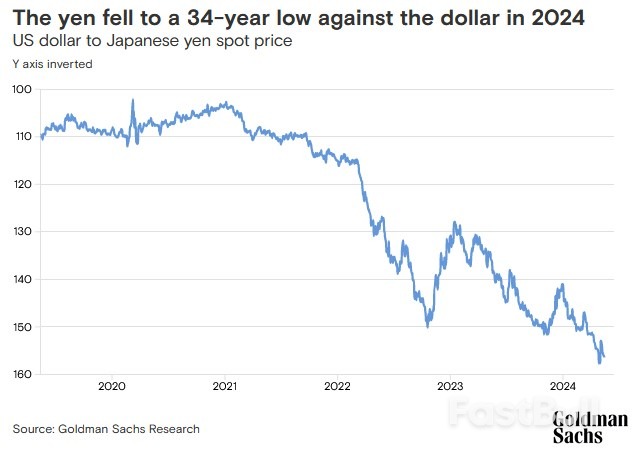
          The Japanese yen has been steadily depreciating since the beginning of the year, thanks in part to the delayed prospect of rate cuts by the US Federal Reserve and the strength of the US economy. Goldman Sachs Research expects the yen to remain at or above 150 to the dollar over a 12-month horizon. In late April, the yen hit 157.8 to the dollar, a level not seen since 1990. On April 29 and May 2, Japan's finance ministry made two apparent interventions in the foreign exchange markets, selling dollars to shore up its currency.
          We spoke to Goldman Sachs Research economist Tomohiro Ota and senior currency strategist Michael Cahill about the yen's slide and its implications for Japanese central banking policy and its economy.
          What has driven the decline of the yen this year?
          Cahill: First and foremost, it's the macro environment that is weighing on the yen. The yen tends to appreciate when recession risk is high — when yields are lower, and people are worried about growth. But we've had the opposite of that recently. We've seen surprisingly resilient growth, especially in the US, which has come despite the Fed keeping its rates high. Instead of having high recession risk, we're tracking US growth at around 3% despite high yields. That combination is weighing on the yen.
          Ota: Apart from those big structural factors, there was also a short-term event that may have triggered additional depreciation in the last couple of weeks. After the Bank of Japan held its monetary policy meeting in April, it sent two signals: one, that it does not react directly to the FX markets, and two, that its primary policy target is sustainable inflation. To the BOJ, the dollar-yen rate matters only when currency fluctuations have some impact on reaching their target.
          What about individual Japanese people investing in foreign securities?
          Cahill: It's hard to gauge the impact of this on foreign exchange. One thing we can say, with a longer-term perspective on yen depreciation, is that in US dollar terms, it has been much more attractive for Japan-based investors to invest abroad, on an unhedged basis, than for foreign investors to invest in Japan on an unhedged basis. Part of what makes it attractive is that, even though yen yields have risen, they've been very low compared to the rise in other markets, especially the US. That's a big reason why the yen has been more responsive to US yields in particular.
          Ota: Another aspect of cross-border cash flows is that we've had an extension of a tax benefit for retail investors, in a scheme that allows investment in securities. Through it, many retail investors reportedly decided to invest in foreign equities more than before, which creates a net outflow to other markets, although it is difficult to know exactly how much this affects the yen.
          The Japanese Yen Will Likely Remain Weak for Months to Come_1
          Is there a line in the sand for the BOJ — a threshold for yen depreciation that policymakers will defend?
          Cahill: We've found out that the authorities are much more sensitive to the pace of depreciation and to disjointed moves that are out of line with other market fundamentals. That is also what matters economically. I'd be surprised if they have a long-term target of any kind.
          In March, the BOJ ended its negative interest rate policy, raising borrowing costs for the first time since 2007. It also removed the cap on 10-year Japanese government bonds. How has that filtered through the FX market since? And how has that policy shift filtered through Japan's economy?
          Ota: The consensus view is that there has been no significant impact on the Japanese economy. The rate hike was only 10 basis points, which was a minimal increase. And in its March meeting, the BOJ announced that they will continue buying the same volume of Japanese government bonds every month, so it didn't signal a move to quantitative tightening. They maintained that stance after their April meeting as well.
          Cahill: And on the FX side — FX is a relative game. Even as we had a rate increase in Japan, we've also been pricing out rate cuts around the world. In the US, for example, we've moved to pricing in only two rate cuts this year. In effect, that has made it so that the BOJ's movements barely register. The other important thing is that they described their rate hike as exiting their extraordinary easing policies, not as the launch of a big tightening campaign.
          When might the BOJ raise interest rates again?
          Ota: The market consensus now is that the BOJ will raise its policy rate again in September or October. Some economists expect a July hike, but in the most recent survey, the consensus lies with September or October. We expect the next hike to come in October.
          What is your take on the BOJ's terminal rate? What's a simple way of understanding that idea, and why is it important for investors?
          Ota: Japan is now at a crossroads. We've been in a deflationary environment for more than two decades, but the BOJ is now saying that sustainable inflation is their base case scenario. We also think that the Japanese economy has a good chance of getting out of the so-called deflation trap. In that case, near-zero interest rates are not justifiable. The terminal rate is where the policy rate is expected to peak during the business cycle. Right now, the consensus is that Japan's policy rate will peak around 0.75%. But we think it could go as high as 1.5%. If households and firms become convinced that higher inflation is here to stay, that will change pricing and spending behaviour. In turn, the BOJ should be able to raise the policy rate further without restricting the economy too much. This matters for investors trying to gauge how the market (and the economy) will respond to rate hikes.
          How might the BOJ react to further yen weakness — or will it?
          Ota: Although we expect the next rate hike to come in October, there is a low bar for it to come somewhat earlier. That's because the next hike is expected to be another relatively small one — 15 basis points this time. But we do not expect the BOJ to cite yen weakness as the primary reason for raising the policy rate.
          Cahill: If the yen weakens enough to impact the inflation outlook, that could in principle lead to faster rate hikes from the BOJ. In fact, the BOJ has said that exchange rate fluctuations might have a bigger impact on price-setting behaviour right now. But keep in mind that a modestly weaker yen would help the BOJ reach its inflation target. And, importantly, Japan has more targeted tools to deal with exchange rate volatility that looks out of step with fundamentals. With about $1 trillion in foreign exchange reserves, Japan is one of the largest reserve managers in the world. So the ministry of finance has plenty of capacity to intervene in the FX market if it needs to. But there are limits on how effectively authorities can manage the exchange rate without taking more decisive action that could have unwelcome side effects.
          What is Goldman Sachs Research's outlook for GDP growth in the coming 12 months, and how has that shifted since the start of the year?
          Ota: Currently our GDP growth forecast for the calendar year 2024 is 0.5%. This is lower than our initial forecast in November last year of 1.5%. The main reason for that downgrade is a temporary drop in consumption in the January-March period, reflecting the fact that some Japanese automobile companies had to close their production lines because of problems with the quality assurance process. But that is a temporary issue and doesn't change our macro narrative. Following this brief setback, we expect positive growth for the rest of the year, including a temporary consumption boost from an income tax cut over the summer.
          What is your outlook for the yen over the next six and 12 months, and why?
          Cahill: We expect the yen to remain around current weak levels over the next 6-12 months. The bottom line is that the macro environment should continue to weigh on this safe-haven currency, and the Fed cuts (and BOJ hikes) that we expect probably won't provide that much support. We think recession risk remains fairly low, and there is not much room for 10-year US yields to rally, which is what would typically strengthen the yen. The yen could weaken further if the US economy proves even more resilient than we expect, and if the Fed delivers even fewer rate cuts down the line.
          To stay updated on all economic events of today, please check out our Economic calendar
          Risk Warnings and Disclaimers
          You understand and acknowledge that there is a high degree of risk involved in trading. Following any strategies or investment methods may lead to potential losses. The content on the site is provided by our contributors and analysts for information purposes only. You are solely responsible for determining whether any trading assets, securities, strategy, or any other product is suitable for investing based on your own investment objectives and financial situation.
          Add to Favorites
          Share

          Why Oil May Regain Upward Momentum

          Samantha Luan

          Economic

          Commodity

          Dynamics in the global oil markets have shown little change over the past couple of weeks with pessimism still high and hedge funds still leaning towards the short side of the market. Over the past week, Brent prices remained range-bound in the $83.45-83.60/bbl range with the prolonged sideways price movement pushing volatility lower.
          The realized annualized 30-trading-day front-month Brent volatility clocked in at just 16.9% at settlement on 20 May, a 2.1 ppt w/w reduction while the 10-trading-day volatility measure came in 7.4 ppt w/w lower at just 12.5%. Front-month Brent settled at $83.71/bbl on 20 May, good for a 0.35/bbl w/w increase but considerably lower than the $1.44/bbl increase predicted by Standard Chartered’s machine-learning oil price modeling tool, SCORPIO.
          Oil markets continue to be lackluster compared with the strength displayed by metals and gas markets. StanChart has predicted that the bearish sentiment coupled with low market volatility are likely to persist until OPEC+ announces its new policy during its next meeting scheduled for early June. However, StanChart notes that the exact timing of that unilateral announcement is uncertain because voluntary cuts are outside the scope of the OPEC+ ministerial meeting. The experts have predicted that positive developments by OPEC+ could trigger another oil price rally.
          In contrast to oil markets, natural gas markets have turned much more positive in recent weeks thanks in large part to improved supply/demand balances. Henry Hub gas prices are up 55.2% over the past 30 days to $2.78/MMBtu while TFF gas has jumped 42.0% from its February lows to change hands at €34.6/MWh. An early heatwave in Texas has helped make U.S. natural gas
          the strongest of the major commodities for a second successive week while the positive sentiment in Europe’s gas markets is being driven by concerns about prolonged maintenance outages in Norway, with the Troll field and Kollsnes processing plant still offline.
          Pipeline gas supplies to Europe hit a low of 178.9 mcm/day on Tuesday, the lowest since September while the previously huge inventory buildup has slowed down.
          The latest data by Gas Infrastructure Europe (GIE) shows that EU gas inventories stood at 77.88 billion cubic meters (bcm), good for a 2.11 bcm y/y increase. However, it’s important to note that whereas inventories are still 16.83 bcm above the five-year average, that surplus is being steadily eroded, having fallen on 32 of the past 34 days for a cumulative decrease of 5.5 bcm over the timeframe. Last week, the continent’s gas inventories increased by 2.28 bcm,
          lagging the 2.61 bcm increase over the same period last year and the five-year average
          of 2.67 bcm. The muted pace of inventory increases coupled with evidence of strong LNG demand in Asia have been supporting the ongoing natural gas rally.
          However, it’s going to be interesting to see if the gas rally will hold, with predictions that Europe’s gas flows will gradually return to normal by the end of May. Meanwhile, warmer weather forecast until the end of May has dampened gas demand, resulting in European gas storage facilities surpassing 67% capacity.

          Energy Stocks Giving Up Gains

          The end of the early-year oil price rally has forced energy stocks to give up some gains. The sector has lost 5% over the past six weeks bringing its gains in the year-to-date to 11.46%, slightly below the 11.56% return by the S&P 500. The energy sector has slipped several spots in sector rankings and is now the 5th best-performing sector behind Communication Services (21.32%), Information Technology (16.60%), Utilities(14.51%) and Financials (11.80%). Only the Real Estate sector is in the red with a -4.21% return so far in the current year.
          That said, Wall Street largely remains bullish on oil and gas stocks. A week ago, Oppenheimer Asset Management revealed it holds a favorable outlook on the equities market, especially the Energy and Consumer Discretionary sector.
          “We remain positive on equities” as “92% (459 firms) of the companies in the S&P 500 index having reported Q1 results, earnings are exceeding expectations. Profits are up 5.5% overall on the back of 3.8% revenue growth,” Oppenheimer stated in an investor note. “Eight of the 11 sectors are showing positive earnings growth, with six up at double digit rates. These include communication services (+42%), consumer discretionary (+39%), utilities (+31%), information technology (+14%), financials (+11%) and real estate (+11%),” the investment firm added.
          Despite posting another disappointing earnings season, Oppenheimer has indicated that Energy likely has further upside though not necessarily in a straight line.
          Meanwhile, we recently highlighted that oil and gas stocks are likely to continue outperforming the market regardless of whether Biden or Trump ascends into the Oval Office come 2025, though clean energy investments could face considerable risk if Trump wins.

          Source:oilprice

          To stay updated on all economic events of today, please check out our Economic calendar
          Risk Warnings and Disclaimers
          You understand and acknowledge that there is a high degree of risk involved in trading. Following any strategies or investment methods may lead to potential losses. The content on the site is provided by our contributors and analysts for information purposes only. You are solely responsible for determining whether any trading assets, securities, strategy, or any other product is suitable for investing based on your own investment objectives and financial situation.
          Add to Favorites
          Share

          Gold Price Holds Steady: Technicals Hint Rebound, But News Keeps Market Wary

          Glendon

          Economic

          Gold prices have been on a rollercoaster ride in recent weeks, defying expectations and leaving investors scratching their heads. The price of gold is hovering around $2,350 per ounce, down slightly from yesterday's close. This article delves into the technical analysis of gold, explores relevant news impacting its price, and examines whether a potential rebound is on the horizon.

          Technical Analysis: A Bullish Battle on the Charts

          While the current price movement might suggest a bearish trend, technical indicators tell a slightly different story. Here's a closer look:
          Relative Strength Index (RSI): The RSI for gold is currently at 48, indicating that the market is neither overbought nor oversold. This suggests potential room for upward movement if the right catalysts emerge.
          Moving Averages: The 50-day and 200-day moving averages are currently converging, hinting at a possible price direction shift in the near future. A breakout above these averages could signal a bullish trend.
          Support and Resistance Levels: The key support level for gold is around $2,320, and the resistance level sits at $2,380. A break above the resistance could trigger further buying momentum.
          However, it's important to acknowledge the presence of some bearish indicators as well:
          Failed Breakout: A recent attempt to break above the $2,400 level failed, suggesting a lack of buying pressure at that price point.

          News Roundup: Geopolitical Tensions and US Economic Data

          Geopolitical tensions and economic data are two major factors influencing the price of gold. Here are some key news items to consider:
          No Major Escalation: Despite ongoing concerns, there haven't been any significant escalations in geopolitical tensions recently. This could be contributing to the current lull in gold prices, as investors seek less safe-haven assets.
          Mixed US Economic Data: Recent economic data from the US has been mixed. While a stronger-than-expected jobs report might indicate a robust economy, concerns about inflation remain. This uncertainty could be keeping gold prices somewhat stable.
          Federal Reserve Policy: The upcoming Federal Open Market Committee (FOMC) meeting in June will be closely watched. If the Fed signals a more aggressive approach to raising interest rates, it could strengthen the US Dollar and put downward pressure on gold prices.

          Expert Opinions: Divergent Views on Gold's Future

          Financial experts are divided on the future trajectory of gold prices. Some analysts believe a correction is still possible, with prices potentially dipping below $2,300 in the short term. Others are more optimistic, predicting a rebound towards $2,400 or even higher, fueled by potential geopolitical turmoil or a resurgence of inflation fears.

          What to Watch Out For

          Investors should keep a close eye on the following developments:
          Geopolitical Developments: Any significant escalation in global tensions could trigger a flight to safety, boosting gold prices.
          US Inflation Data: Upcoming inflation data releases in the US will be crucial in determining the Fed's monetary policy decisions, which could impact the USD and subsequently influence gold prices.
          Technical Chart Signals: A decisive break above or below key support and resistance levels on the gold price chart will provide clearer technical direction.

          Conclusion: A Cautious Outlook with Potential for Change

          The current outlook for gold prices is uncertain. While technical analysis hints at a possible rebound, geopolitical and economic factors will play a significant role. Investors should conduct thorough research, consider expert opinions, and monitor the evolving news landscape before making any investment decisions related to gold. Remember, gold can be a valuable asset for portfolio diversification, but it's essential to understand the risks involved.
          To stay updated on all economic events of today, please check out our Economic calendar
          Risk Warnings and Disclaimers
          You understand and acknowledge that there is a high degree of risk involved in trading. Following any strategies or investment methods may lead to potential losses. The content on the site is provided by our contributors and analysts for information purposes only. You are solely responsible for determining whether any trading assets, securities, strategy, or any other product is suitable for investing based on your own investment objectives and financial situation.
          Add to Favorites
          Share

          Orr Says RBNZ Would Only Hike to Curb Inflation Expectations

          Samantha Luan

          Economic

          Central Bank

          New Zealand central bank Governor Adrian Orr downplayed the chances of another interest rate hike, saying the bank would only tighten policy further if it felt it needed to contain inflation expectations.
          “Another rate hike would only be meaningful if we thought inflation expectations were getting away on us again, starting to rise because of the persistence of actual inflation,” Orr said in an interview on Bloomberg Television Thursday in Wellington. “We are confident that we will get inflation down to the 1-3% band, we'd just like to make sure we get there soon without risking another blowout in expectations.”
          The Reserve Bank held its benchmark rate at 5.5% yesterday but surprised markets by saying it considered a hike. The RBNZ also raised the forward track for the cash rate, signaling increased risk of further tightening.
          Orr was asked whether another rate hike would be effective given inflation is elevated in areas of the economy that are less sensitive to monetary policy, such as insurance costs and local government taxes.
          “We know that forward-looking inflation is heavily influenced by the current level of inflation, so that's our main concern,” he said.
          Two-year ahead inflation expectations declined to 2.33% in the second quarter from 2.5% in the first, according to a survey of businesses published by the RBNZ this month. That was the lowest reading in almost three years. A measure of household expectations was more elevated at 3%.
          The central bank aims to keep inflation around the 2% midpoint of its 1-3% target band. Inflation eased to 4% in the first quarter, but a measure of domestic price pressures barely slowed to 5.8%.
          The RBNZ has said it has limited tolerance for further upside inflation surprises. But Orr said its patience has not yet run out and policy would not hinge on a single data point, such as the second-quarter inflation print due in July.
          “What we are showing is that we've got a lot of patience,” he said, adding the RBNZ's central projection is to keep the Official Cash Rate at 5.5% into next year.
          “We believe that will have inflation back down within the band, and at that point we can start thinking about normalizing interest rates,” he said.
          Orr said the sticky prices the bank has talked about “have been well signaled and they are in our inflation projections.”
          “So it'd have to be something over and above that again to really surprise us,” he said. “We think the risks are balanced.”

          Source: Bloomberg

          To stay updated on all economic events of today, please check out our Economic calendar
          Risk Warnings and Disclaimers
          You understand and acknowledge that there is a high degree of risk involved in trading. Following any strategies or investment methods may lead to potential losses. The content on the site is provided by our contributors and analysts for information purposes only. You are solely responsible for determining whether any trading assets, securities, strategy, or any other product is suitable for investing based on your own investment objectives and financial situation.
          Add to Favorites
          Share

          [U.S.] April Existing Home Sales: Slowdown for the Second Consecutive Month

          FastBull Featured

          Data Interpretation

          On May 22nd, local time, the National Association of Realtors announced home sales data in April:
          The total number of April home sales came in at 4.14 million, compared to an expectation of 4.21 million and the previous 4.22 million.
          The April home sales dipped 1.9% from a month ago, compared to an expected increase of 0.8% and the previous decrease of 3.7%.
          This data has slowed for two months. At the end of April, total housing inventory reached 1.21 million, up 9% MoM and 16.3% YoY. Unsold inventory sits at a 3.5-month supply at the current sales pace, up from 3.2 months in March and 3.0 months in April 2023. For homes priced $1 million or more, inventory and sales increased by 34% and 40%, respectively, from a year ago.
          The median existing-home price was $407,600 in April, up 5.7% YoY, which was also the highest level in any April data since 1999 when records began.
          Home sales changed little overall, but the upper-end market is experiencing a sizable gain due to more supply coming onto the market. Properties typically remained on the market for 26 days in April, down from 33 days in March but up from 22 days in April 2023, indicating that market demand for homes remains strong. Moreover, home prices hit a new record high in April, but the rate of price increases should be slower as home inventories continue to grow.
          Furthermore, the release of the April CPI data made the slowdown in housing inflation the highlight of the report. At the same time, subsequent statements by officials made several references to it, which caused the market to focus on it for evidence of a continued slowdown in housing inflation. This allowed the data to be laced with a strong market sentiment, so its impact naturally expanded.
          Home sales decline for the second month gives hopes of a continuous decline in housing inflation. Additionally, market expectations of interest rate cuts were boosted, which caused the USDX to fall from highs during the U.S. session.

          U.S. April Existing Home Sales

          Risk Warnings and Disclaimers
          You understand and acknowledge that there is a high degree of risk involved in trading. Following any strategies or investment methods may lead to potential losses. The content on the site is provided by our contributors and analysts for information purposes only. You are solely responsible for determining whether any trading assets, securities, strategy, or any other product is suitable for investing based on your own investment objectives and financial situation.
          Add to Favorites
          Share

          German Wages Jump at Start of Year in Risk to Inflation Path

          Alex

          Economic

          German wages rose sharply at the start of 2024 — dealing a blow to the European Central Bank as it decides whether inflation is slowing enough to reduce interest rates.
          Negotiated pay increased 6.2% in the first quarter, the Bundesbank said Wednesday in its monthly report. That exceeded estimates by analysts at Bloomberg Economics, Citi and Morgan Stanley, though the figure includes one-off payments to compensate workers for the surging cost of living.
          The data come just a day before a highly anticipated reading for the 20-nation euro zone as a whole. The worry is that stronger-than-expected salary gains in Europe’s largest economy mean inflation will take longer to return to the 2% target.
          “Overall, there are still risks to the fundamental disinflation process,” the Bundesbank said. “Wage growth has recently been stronger than expected. As a result, still-high price pressure on services in particular could persist for longer.”
          ECB officials have left little doubt that borrowing costs will be lowered on June 6, though they won’t commit to a path beyond that and say they’ll be guided by data. They currently see inflation returning to their goal in the second half of 2025 and will publish updated projections in just over two weeks.
          But the newest data out of Germany mean that the euro-zone wide figure for negotiated pay will show an acceleration, increasing the risk that officials deliver less easing after June than currently predicted, said Tomasz Wieladek, an economist at T. Rowe Price.
          “This will be a significant challenge to the idea that the ECB will deliver sequential rate cuts,” he said in a statement. “Wage data will allow the ECB to cut significantly eventually. But in the meantime, until the point when the data supports additional cuts, the ECB will need to be patient.”
          Greg Fuzesi of JPMorgan took a similar view, warning that “the data could remind some policymakers of the difficulty of the ‘last mile,” with recent productivity disappointments also playing into this.”
          Consumer-price growth in Germany will probably pick up in May and fluctuate around a slightly higher level in the coming months, the Bundesbank said. At the same time, the economy is set to gather pace as higher pay underpins consumption and confidence in the struggling manufacturing sector returns.

          German Growth

          Gross domestic product is likely to edge higher in the second quarter after it unexpectedly expanded between January and March, it said.
          The Bundesbank warned that, for now, demand in manufacturing and construction continues to be weak — reflecting subdued global trade, higher borrowing costs and increased policy uncertainty. With a sustained industrial revival requiring a broad-based advance in new orders, improving sentiment “probably won’t be reflected in a noticeable increase in production momentum until the second half of the year,” it said.
          Service providers, though, are likely to continue their recovery.
          “Rising real disposable household incomes are likely to gain the upper hand over consumer uncertainty,” the Bundesbank said. “Further gains in purchasing power are to be expected as the labor market is likely to remain robust and wages will continue to rise sharply.”

          Source:Bloomberg

          To stay updated on all economic events of today, please check out our Economic calendar
          Risk Warnings and Disclaimers
          You understand and acknowledge that there is a high degree of risk involved in trading. Following any strategies or investment methods may lead to potential losses. The content on the site is provided by our contributors and analysts for information purposes only. You are solely responsible for determining whether any trading assets, securities, strategy, or any other product is suitable for investing based on your own investment objectives and financial situation.
          Add to Favorites
          Share

          USD/JPY Forecast: Services PMIs to Impact BoJ and Fed Rate Hike Bets

          Alex

          Economic

          Forex

          The Services PMI and the Bank of Japan
          Preliminary private sector PMI numbers for May will put the USD/JPY in focus.
          Economists forecast the Jibun Bank Manufacturing PMI to rise from 49.6 to 49.7 in May. Moreover, economists expect the Jibun Bank Services PMI to fall from 54.3 to 53.8.
          The Jibun Bank Services PMI will likely impact buyer demand for the Japanese Yen. Following the Spring wage hikes, the BoJ hopes the services sector can fuel demand-driven inflation and allow for a higher interest rate environment. Furthermore, the services sector contributes over 60% to the Japanese economy.
          However, investors must consider the sub-components, including input prices, employment, and new orders.
          Beyond the numbers, investors should monitor for Bank of Japan commentary. Views on inflation, the economic outlook, and the timing for an interest rate hike could move the dial. Yen weakness continues to leave the BoJ under pressure to fuel expectations of a summer rate hike.

          US Economic Calendar: The Services Sector, the Labor Market, and the Fed

          Later in the Thursday session, US jobless claims data and preliminary private sector PMIs warrant investor attention.
          Economists forecast initial jobless claims to fall from 222k to 220k in the week ending May 18. Tighter labor market conditions could support wage growth and increase disposable income. Upward trends in disposable income may fuel consumer spending and demand-driven inflation. Moreover, tighter labor market conditions could leave a Fed interest rate hike on the table.
          However, the S&P Global Services PMI could impact the Fed rate path more. The services sector contributes over 70% to the US economy, with housing services inflation a focal point.
          Economists forecast the S&P Global Services PMI to remain unchanged at 51.3. Better-than-expected figures may fuel speculation about a Fed rate hike. However, investors should consider the sub-components, including prices and employment.
          Investors should also track FOMC member reaction to the stats after the more hawkish-than-expected FOMC Meeting Minutes.

          Short-term Forecast

          Near-term trends for the USD/JPY will hinge on the Services PMIs and views on monetary policy. Better-than-expected US PMI numbers could raise investor bets on a Fed interest rate hike and tilt monetary policy divergence toward the US dollar.

          USD/JPY Price Action

          Daily Chart
          USD/JPY Forecast: Services PMIs to Impact BoJ and Fed Rate Hike Bets_1
          The USD/JPY held comfortably above the 50-day and 200-day EMAs, affirming the bullish price signals.
          A USD/JPY breakout from the 157 handle would support a move to the 158 handle. A return to the 158 handle could give the bulls a run at the April 29 high of 160.209.
          On Thursday (May 22), Services PMIs and US labor market data need consideration.
          Alternatively, a USD/JPY fall through the 155 handle could give the bears a run at the 50-day EMA. A break below the 50-day EMA could signal a drop toward the 151.685 support level.
          The 14-day RSI at 59.57 suggests a USD/JPY return to the April 29 high of 160.209 before entering overbought territory.

          Source: FX Empire

          To stay updated on all economic events of today, please check out our Economic calendar
          Risk Warnings and Disclaimers
          You understand and acknowledge that there is a high degree of risk involved in trading. Following any strategies or investment methods may lead to potential losses. The content on the site is provided by our contributors and analysts for information purposes only. You are solely responsible for determining whether any trading assets, securities, strategy, or any other product is suitable for investing based on your own investment objectives and financial situation.
          Add to Favorites
          Share
          FastBull
          Copyright © 2025 FastBull Ltd

          728 RM B 7/F GEE LOK IND BLDG NO 34 HUNG TO RD KWUN TONG KLN HONG KONG

          TelegramInstagramTwitterfacebooklinkedin
          App Store Google Play Google Play
          Products
          Charts

          Chats

          Q&A with Experts
          Screeners
          Economic Calendar
          Data
          Tools
          Membership
          Features
          Function
          Markets
          Copy Trading
          Latest Signals
          Contests
          News
          Analysis
          24/7
          Columns
          Education
          Company
          Careers
          About Us
          Contact Us
          Advertising
          Help Center
          Feedback
          User Agreement
          Privacy Policy
          Business

          White Label

          Data API

          Web Plug-ins

          Poster Maker

          Affiliate Program

          Risk Disclosure

          The risk of loss in trading financial instruments such as stocks, FX, commodities, futures, bonds, ETFs and crypto can be substantial. You may sustain a total loss of the funds that you deposit with your broker. Therefore, you should carefully consider whether such trading is suitable for you in light of your circumstances and financial resources.

          No decision to invest should be made without thoroughly conducting due diligence by yourself or consulting with your financial advisors. Our web content might not suit you since we don't know your financial conditions and investment needs. Our financial information might have latency or contain inaccuracy, so you should be fully responsible for any of your trading and investment decisions. The company will not be responsible for your capital loss.

          Without getting permission from the website, you are not allowed to copy the website's graphics, texts, or trademarks. Intellectual property rights in the content or data incorporated into this website belong to its providers and exchange merchants.

          Not Logged In

          Log in to access more features

          FastBull Membership

          Not yet

          Purchase

          Become a signal provider
          Help Center
          Customer Service
          Dark Mode
          Price Up/Down Colors

          Log In

          Sign Up

          Position
          Layout
          Fullscreen
          Default to Chart
          The chart page opens by default when you visit fastbull.com