• Trade
  • Markets
  • Copy
  • Contests
  • News
  • 24/7
  • Calendar
  • Q&A
  • Chats
Trending
Screeners
SYMBOL
LAST
BID
ASK
HIGH
LOW
NET CHG.
%CHG.
SPREAD
SPX
S&P 500 Index
6813.67
6813.67
6813.67
6861.30
6801.50
-13.74
-0.20%
--
DJI
Dow Jones Industrial Average
48396.36
48396.36
48396.36
48679.14
48317.93
-61.68
-0.13%
--
IXIC
NASDAQ Composite Index
23067.53
23067.53
23067.53
23345.56
23012.00
-127.63
-0.55%
--
USDX
US Dollar Index
97.790
97.870
97.790
98.070
97.740
-0.160
-0.16%
--
EURUSD
Euro / US Dollar
1.17601
1.17609
1.17601
1.17686
1.17262
+0.00207
+ 0.18%
--
GBPUSD
Pound Sterling / US Dollar
1.33944
1.33953
1.33944
1.34014
1.33546
+0.00237
+ 0.18%
--
XAUUSD
Gold / US Dollar
4321.98
4322.41
4321.98
4350.16
4294.68
+22.59
+ 0.53%
--
WTI
Light Sweet Crude Oil
56.637
56.667
56.637
57.601
56.625
-0.596
-1.04%
--

Community Accounts

Signal Accounts
--
Profit Accounts
--
Loss Accounts
--
View More

Become a signal provider

Sell trading signals to earn additional income

View More

Guide to Copy Trading

Get started with ease and confidence

View More

Signal Accounts for Members

All Signal Accounts

Best Return
  • Best Return
  • Best P/L
  • Best MDD
Past 1W
  • Past 1W
  • Past 1M
  • Past 1Y

All Contests

  • All
  • Trump Updates
  • Recommend
  • Stocks
  • Cryptocurrencies
  • Central Banks
  • Featured News
Top News Only
Share

EU's Kallas: China Is Increasingly Weaponizing Economic Ties For Political Gains

Share

Fbi Director: A Fifth Individual Believed To Be Planning A Separate Attack Arrested By Fbi New Orleans

Share

New York Fed President Williams: The 2% Inflation Target Must Be Achieved Without Impacting The Job Market

Share

New York Fed President Williams: Monetary Policy Very Focused On Balancing Job, Inflation Risks

Share

New York Fed President Williams Expects USA Unemployment To Be 4.5% By End Of 2025

Share

New York Fed President Williams: Labor Market Risks Have Risen As Risks To Inflation Have Eased

Share

New York Fed President Williams Expects Inflation To Move To 2.5% In 2026, 2% In 2027

Share

New York Fed President Williams Sees Tariffs As A One-Off Price Adjustment, Not Spilling Over Into Broader Inflation

Share

New York Fed President Williams: Labor Market Cooling Has Been Gradual Process

Share

New York Fed President Williams Expects Active Usage Of Standing Repo Facility To Manage Liquidity

Share

New York Fed President Williams: Critical For USA Central Bank To Get Inflation Back To 2%

Share

New York Fed President Williams Expects 2026 GDP Growth To Hit 2.25%, Well Above 2025 Rate

Share

New York Fed President Williams Projects Jobless Rate Will Come Back Down Over Next Few Years

Share

New York Fed President Williams: Fed Policy Has Moved Toward Neutral From Modestly Restrictive

Share

Federal Reserve Governor Milan: I Would Be Happy To Vote For The Re-election Of Regional Fed Presidents

Share

Miran: What Is Most Surprising Is How Nice And Collegial The Fed Has Been

Share

Miran: The Least Attractive Part Of Being At The Fed Is Having Only 1 Of 12 Votes On A Committee

Share

White House To Host Press Call On Russia-Ukraine Peace Talks

Share

Miran: Was Delighted To Vote In Favor Of Reappointing Current Reserve Bank Presidents, Think They Are Doing A Good Job

Share

Miran: The Reserve Banks Play A Valuable Role In Providing Local Perspectives And Contacts

TIME
ACT
FCST
PREV
Japan Tankan Small Manufacturing Outlook Index (Q4)

A:--

F: --

P: --

Japan Tankan Large Non-Manufacturing Outlook Index (Q4)

A:--

F: --

P: --

Japan Tankan Large Manufacturing Outlook Index (Q4)

A:--

F: --

P: --

Japan Tankan Small Manufacturing Diffusion Index (Q4)

A:--

F: --

P: --

Japan Tankan Large-Enterprise Capital Expenditure YoY (Q4)

A:--

F: --

P: --

U.K. Rightmove House Price Index YoY (Dec)

A:--

F: --

P: --

China, Mainland Industrial Output YoY (YTD) (Nov)

A:--

F: --

P: --

China, Mainland Urban Area Unemployment Rate (Nov)

A:--

F: --

P: --

Saudi Arabia CPI YoY (Nov)

A:--

F: --

P: --

Euro Zone Industrial Output YoY (Oct)

A:--

F: --

P: --

Euro Zone Industrial Output MoM (Oct)

A:--

F: --

P: --

Canada Existing Home Sales MoM (Nov)

A:--

F: --

P: --

Canada National Economic Confidence Index

A:--

F: --

P: --

Canada New Housing Starts (Nov)

A:--

F: --

P: --
U.S. NY Fed Manufacturing Employment Index (Dec)

A:--

F: --

P: --

U.S. NY Fed Manufacturing Index (Dec)

A:--

F: --

P: --

Canada Core CPI YoY (Nov)

A:--

F: --

P: --

Canada Manufacturing Unfilled Orders MoM (Oct)

A:--

F: --

P: --

U.S. NY Fed Manufacturing Prices Received Index (Dec)

A:--

F: --

P: --

U.S. NY Fed Manufacturing New Orders Index (Dec)

A:--

F: --

P: --

Canada Manufacturing New Orders MoM (Oct)

A:--

F: --

P: --

Canada Core CPI MoM (Nov)

A:--

F: --

P: --

Canada Trimmed CPI YoY (SA) (Nov)

A:--

F: --

P: --

Canada Manufacturing Inventory MoM (Oct)

A:--

F: --

P: --

Canada CPI YoY (Nov)

A:--

F: --

P: --

Canada CPI MoM (Nov)

A:--

F: --

P: --

Canada CPI YoY (SA) (Nov)

A:--

F: --

P: --

Canada Core CPI MoM (SA) (Nov)

A:--

F: --

P: --

Canada CPI MoM (SA) (Nov)

A:--

F: --

P: --

Federal Reserve Board Governor Milan delivered a speech
U.S. NAHB Housing Market Index (Dec)

A:--

F: --

P: --

Australia Composite PMI Prelim (Dec)

--

F: --

P: --

Australia Services PMI Prelim (Dec)

--

F: --

P: --

Australia Manufacturing PMI Prelim (Dec)

--

F: --

P: --

Japan Manufacturing PMI Prelim (SA) (Dec)

--

F: --

P: --

U.K. 3-Month ILO Employment Change (Oct)

--

F: --

P: --

U.K. Unemployment Claimant Count (Nov)

--

F: --

P: --

U.K. Unemployment Rate (Nov)

--

F: --

P: --

U.K. 3-Month ILO Unemployment Rate (Oct)

--

F: --

P: --

U.K. Average Weekly Earnings (3-Month Average, Including Bonuses) YoY (Oct)

--

F: --

P: --

U.K. Average Weekly Earnings (3-Month Average, Excluding Bonuses) YoY (Oct)

--

F: --

P: --

France Services PMI Prelim (Dec)

--

F: --

P: --

France Composite PMI Prelim (SA) (Dec)

--

F: --

P: --

France Manufacturing PMI Prelim (Dec)

--

F: --

P: --

Germany Services PMI Prelim (SA) (Dec)

--

F: --

P: --

Germany Manufacturing PMI Prelim (SA) (Dec)

--

F: --

P: --

Germany Composite PMI Prelim (SA) (Dec)

--

F: --

P: --

Euro Zone Composite PMI Prelim (SA) (Dec)

--

F: --

P: --

Euro Zone Services PMI Prelim (SA) (Dec)

--

F: --

P: --

Euro Zone Manufacturing PMI Prelim (SA) (Dec)

--

F: --

P: --

U.K. Services PMI Prelim (Dec)

--

F: --

P: --

U.K. Manufacturing PMI Prelim (Dec)

--

F: --

P: --

U.K. Composite PMI Prelim (Dec)

--

F: --

P: --

Euro Zone ZEW Economic Sentiment Index (Dec)

--

F: --

P: --

Germany ZEW Current Conditions Index (Dec)

--

F: --

P: --

Germany ZEW Economic Sentiment Index (Dec)

--

F: --

P: --

Euro Zone Trade Balance (Not SA) (Oct)

--

F: --

P: --

Euro Zone ZEW Current Conditions Index (Dec)

--

F: --

P: --

Euro Zone Trade Balance (SA) (Oct)

--

F: --

P: --

U.S. Retail Sales MoM (Excl. Gas Stations & Vehicle Dealers) (SA) (Oct)

--

F: --

P: --

U.S. Retail Sales MoM (Excl. Automobile) (SA) (Oct)

--

F: --

P: --

Q&A with Experts
    • All
    • Chatrooms
    • Groups
    • Friends
    Connecting
    .
    .
    .
    Type here...
    Add Symbol or Code

      No matching data

      All
      Trump Updates
      Recommend
      Stocks
      Cryptocurrencies
      Central Banks
      Featured News
      • All
      • Russia-Ukraine Conflict
      • Middle East Flashpoint
      • All
      • Russia-Ukraine Conflict
      • Middle East Flashpoint

      Search
      Products

      Charts Free Forever

      Chats Q&A with Experts
      Screeners Economic Calendar Data Tools
      Membership Features
      Data Warehouse Market Trends Institutional Data Policy Rates Macro

      Market Trends

      Market Sentiment Order Book Forex Correlations

      Top Indicators

      Charts Free Forever
      Markets

      News

      News Analysis 24/7 Columns Education
      From Institutions From Analysts
      Topics Columnists

      Latest Views

      Latest Views

      Trending Topics

      Top Columnists

      Latest Update

      Signals

      Copy Rankings Latest Signals Become a signal provider AI Rating
      Contests
      Brokers

      Overview Brokers Assessment Rankings Regulators News Claims
      Broker listing Forex Brokers Comparison Tool Live Spread Comparison Scam
      Q&A Complaint Scam Alert Videos Tips to Detect Scam
      More

      Business
      Events
      Careers About Us Advertising Help Center

      White Label

      Data API

      Web Plug-ins

      Affiliate Program

      Awards Institution Evaluation IB Seminar Salon Event Exhibition
      Vietnam Thailand Singapore Dubai
      Fans Party Investment Sharing Session
      FastBull Summit BrokersView Expo
      Recent Searches
        Top Searches
          Markets
          News
          Analysis
          User
          24/7
          Economic Calendar
          Education
          Data
          • Names
          • Latest
          • Prev

          View All

          No data

          Scan to Download

          Faster Charts, Chat Faster!

          Download App
          English
          • English
          • Español
          • العربية
          • Bahasa Indonesia
          • Bahasa Melayu
          • Tiếng Việt
          • ภาษาไทย
          • Français
          • Italiano
          • Türkçe
          • Русский язык
          • 简中
          • 繁中
          Open Account
          Search
          Products
          Charts Free Forever
          Markets
          News
          Signals

          Copy Rankings Latest Signals Become a signal provider AI Rating
          Contests
          Brokers

          Overview Brokers Assessment Rankings Regulators News Claims
          Broker listing Forex Brokers Comparison Tool Live Spread Comparison Scam
          Q&A Complaint Scam Alert Videos Tips to Detect Scam
          More

          Business
          Events
          Careers About Us Advertising Help Center

          White Label

          Data API

          Web Plug-ins

          Affiliate Program

          Awards Institution Evaluation IB Seminar Salon Event Exhibition
          Vietnam Thailand Singapore Dubai
          Fans Party Investment Sharing Session
          FastBull Summit BrokersView Expo

          S&P 500 Index: Chart Analysis Ahead of Fed News

          FXOpen

          Stocks

          Technical Analysis

          Summary:

          Today, with traders worldwide focused on the Federal Reserve's interest rate decision and Chair Powell's subsequent press conference, there is reason to highlight another statistic. According to media reports, in 20 out of 20 instances when equity markets were near record highs and the Fed cut rates, the S&P 500 rose over the following 12 months.

          On 2 December, we noted that the final month of the year is traditionally favourable for the S&P 500 index (US SPX 500 mini on FXOpen), as:

          → since around the 1950s, December has been positive in more than 70% of cases;

          → the average monthly gain is approximately +1.0%.

          Today, with traders worldwide focused on the Federal Reserve's interest rate decision and Chair Powell's subsequent press conference, there is reason to highlight another statistic. According to media reports, in 20 out of 20 instances when equity markets were near record highs and the Fed cut rates, the S&P 500 rose over the following 12 months.

          Given the current backdrop — proximity to all-time highs and expectations of rate cuts — it is possible that this could become the 21st such case.

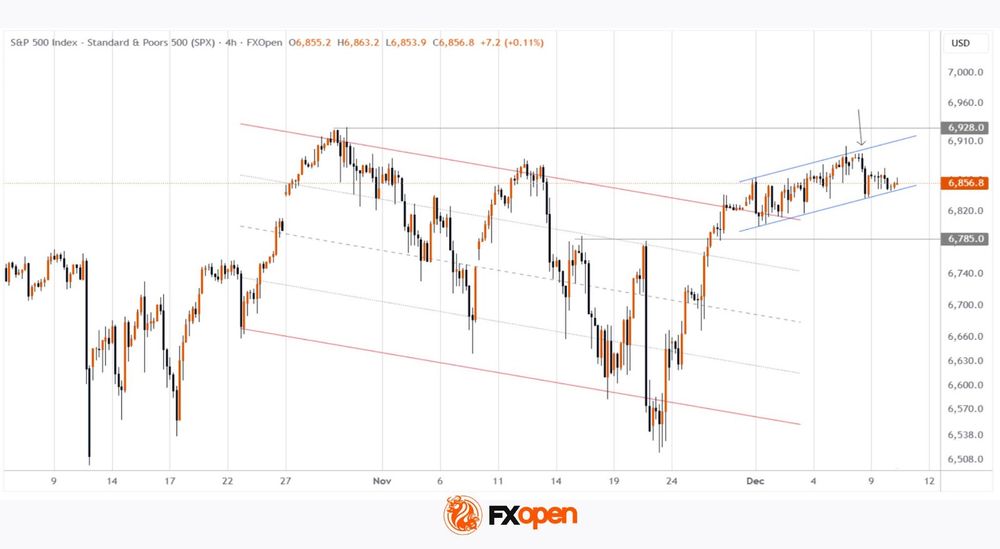
          An analysis of price action on the 4-hour chart of the S&P 500 (US SPX 500 mini on FXOpen) suggests that the stock market is reflecting nervous anticipation of the news, as the index is trading at roughly the same levels as at the start of December.
          Technical Analysis of the S&P 500 Chart

          From the demand side:

          → the price has managed to hold firmly above the 6785 level (which may act as support going forward) and has broken above a previously formed descending channel (shown in red);

          → an ascending channel formed in early December, which can be interpreted as cautious optimism ahead of the news.

          From the supply side:

          → the late-October record high may act as psychological resistance;

          → yesterday's decline (indicated by the arrow) suggests that bears are ready to act more aggressively if given a catalyst.

          Overall, taking the above into account, it is reasonable to suggest that the S&P 500 market (US SPX 500 mini on FXOpen) is in a "calm before the storm" phase. Be prepared for volatility spikes later today, starting from 22:00 GMT+3.

          Source: ACTIONFOREX

          Risk Warnings and Disclaimers
          You understand and acknowledge that there is a high degree of risk involved in trading. Following any strategies or investment methods may lead to potential losses. The content on the site is provided by our contributors and analysts for information purposes only. You are solely responsible for determining whether any trading assets, securities, strategy, or any other product is suitable for investing based on your own investment objectives and financial situation.
          Add to Favorites
          Share

          IMF Urges China to Shift Toward Consumption-Led Growth Amid Global Trade Tensions, Upgrades 2025 Outlook

          Gerik

          Economic

          Export-Led Model Reaches Limits Amid Global Pushback

          The International Monetary Fund (IMF) has urged China to quicken the pace of structural reforms, warning that its current growth model rooted in investment-heavy production and export dominance is no longer sustainable in a geopolitically sensitive global environment. The statement comes as China’s trade surplus reached a record $1 trillion for the year through November 2025, signaling continued reliance on external demand despite rising trade frictions, particularly with the United States.
          According to the IMF's annual Article IV review, the country’s disproportionate contribution to global growth expected to account for up to 40% in 2025 has raised concerns that China is compensating for its domestic slowdown by capturing a larger share of international markets. This has led to accusations of “flooding” emerging markets with low-cost goods redirected from the US due to ongoing tariffs imposed under President Donald Trump’s trade policy.
          The Fund highlighted that China’s size and role in global trade now make its current growth path a source of international tension, weakening the long-term viability of export-dependency.

          Urgent Need for Domestic Demand Rebalancing

          The IMF emphasized that China's long-standing reliance on exports and credit-fueled investment needs to give way to a consumption-led model. This transition, according to the Fund, should be supported by stronger macroeconomic stimulus, reform of the social safety net, and measures to reduce household savings rates currently elevated due to inadequate public welfare coverage and economic uncertainty.
          The IMF noted that the expansion of domestic consumption is not merely a policy option but a structural imperative, as global conditions increasingly constrain China’s external growth engines. A key causal factor remains under-consumption at home, which is both a symptom and a driver of broader economic imbalances.

          Growth Outlook Raised, But Risks Remain Embedded

          Despite its structural critique, the IMF upgraded China’s GDP forecast for 2025 to 5.0% from 4.8%, reflecting stronger-than-expected resilience. The forecast for 2026 was also raised to 4.5% from 4.2%. The upward revisions suggest that near-term policy support and exports remain effective growth levers, but the Fund cautioned that this resilience masks deeper vulnerabilities.
          Three areas of concern were singled out: the ongoing correction in China’s property market, elevated levels of local government debt, and weak domestic demand. These issues are interconnected real estate remains a major household asset class, and its downturn undermines consumer confidence, further suppressing spending. Meanwhile, local government fiscal stress, exacerbated by declining land sales and off-balance-sheet borrowing, limits room for regional stimulus.

          IMF Calls for Broader Reforms and Social Safety Net Expansion

          In addition to macroeconomic stimulus, the IMF urged Beijing to implement broader reforms aimed at stabilizing long-term growth. These include strengthening the social protection system to reduce precautionary savings, recalibrating industrial policy to prevent overcapacity, and accelerating adjustments in the property sector to restore balance between supply and genuine demand.
          The Fund’s endorsement of Beijing’s resilience offers political value for China amid intensifying scrutiny from trading partners. However, the IMF’s repeated call for consumption-led reforms also reflects a growing impatience within the global financial community for China to evolve its growth model in a way that better aligns with global economic stability.
          The IMF’s latest assessment of China underscores a dual narrative: strong headline growth masks an increasingly fragile underlying structure. While exports and industrial policy continue to deliver results in the short term, the long-term sustainability of China’s growth depends on a more balanced domestic economy. With external pressures rising and internal vulnerabilities deepening, the urgency for structural reform particularly to stimulate household consumption and reduce systemic reliance on credit and trade surpluses has become central to China’s future economic strategy.

          Source: Reuters

          To stay updated on all economic events of today, please check out our Economic calendar
          Risk Warnings and Disclaimers
          You understand and acknowledge that there is a high degree of risk involved in trading. Following any strategies or investment methods may lead to potential losses. The content on the site is provided by our contributors and analysts for information purposes only. You are solely responsible for determining whether any trading assets, securities, strategy, or any other product is suitable for investing based on your own investment objectives and financial situation.
          Add to Favorites
          Share

          South Korea Eyes $3.1 Billion Public-Private Foundry to Boost Chip Sovereignty and AI Readiness

          Gerik

          Economic

          A Nationally Coordinated Push for Chip Resilience

          In a decisive step to bolster its semiconductor sector amid growing global competition and supply chain vulnerabilities, South Korea is weighing the establishment of a 12-inch, 40-nanometre foundry valued at approximately $3.06 billion. The proposed project would be financed through a public-private partnership, as confirmed by the Ministry of Industry on Wednesday. The announcement followed a high-level strategy meeting led by President Lee Jae Myung and attended by executives from Samsung Electronics and SK Hynix two of the country’s chipmaking giants as well as policymakers and industry experts.
          The foundry aims to support fabless semiconductor firms by offering essential facilities for chip prototyping, development, and testing, particularly in the context of AI-driven chip design. While South Korea is globally dominant in memory chips, its position in the foundry and fabless sectors lags behind Taiwan and the United States. The initiative seeks to close this gap by expanding domestic capacity and stimulating ecosystem-wide innovation.

          AI Era Demands Stronger Fabless and Foundry Collaboration

          President Lee emphasized that semiconductors are South Korea’s most competitive global sector and highlighted the need for a “new leap forward” in chip strategy particularly as artificial intelligence reshapes the global semiconductor landscape. A stronger foundry base would not only reduce development lead times for fabless firms but also enable more experimentation in AI accelerator chips and domain-specific architectures.
          The 40-nanometre process node though not cutting-edge is a practical starting point for a government-backed facility that targets startups and design firms, where cost and accessibility matter more than raw performance. This approach mirrors strategies seen in other countries such as Japan and the US, where state-supported fabs are helping to democratize chip innovation.

          Strengthening Defense Autonomy Through Chip Production

          Another strategic component of the initiative involves building local capacity for defense-related semiconductors. Currently, 99% of chips used in South Korea’s defense sector are imported, raising concerns about security and continuity in a geopolitical crisis. The government plans to promote the domestic production of critical military-use semiconductors and may amend existing laws to prioritize the procurement of locally made chips for national security infrastructure.
          This policy reflects a causal relationship between import dependence and defense vulnerability highlighting how chip sovereignty has become a pillar of broader national security planning.

          Centralized Governance for a National Chip Strategy

          To oversee the implementation and coordination of these efforts, a special presidential committee on semiconductors will be established. This committee will function as a centralized “control tower,” streamlining policymaking, funding allocation, and private-sector collaboration. This governance model mirrors successful frameworks seen in other industrial policy domains, designed to prevent fragmentation and accelerate strategic outcomes.
          South Korea’s $3.1 billion foundry proposal marks a proactive turn in national semiconductor strategy, signaling a commitment not only to maintain its edge in memory chips but also to foster a more balanced and self-reliant chip ecosystem. As geopolitical risk, AI disruption, and defense considerations converge, the creation of a domestically oriented foundry represents a foundational move toward long-term technological sovereignty and industrial resilience.

          Source: Reuters

          To stay updated on all economic events of today, please check out our Economic calendar
          Risk Warnings and Disclaimers
          You understand and acknowledge that there is a high degree of risk involved in trading. Following any strategies or investment methods may lead to potential losses. The content on the site is provided by our contributors and analysts for information purposes only. You are solely responsible for determining whether any trading assets, securities, strategy, or any other product is suitable for investing based on your own investment objectives and financial situation.
          Add to Favorites
          Share

          EU to Fast-Track Power Grid Projects Amid Soaring Energy Costs and Security Fears

          Gerik

          Economic

          High Energy Costs Undermine European Competitiveness

          Faced with industrial energy prices more than double those in the United States and China, the European Union is preparing to fast-track electricity grid upgrades to bring relief to manufacturers and consumers. Industries across Europe have warned that elevated energy costs are eroding the continent’s competitiveness and deterring investment. The urgency of the crisis has compelled Brussels to adopt a more interventionist approach to modernizing power infrastructure, transitioning from years of fragmented national planning to centralized EU-led coordination.
          According to draft proposals seen by Reuters, the European Commission will introduce legislation that imposes a two-year cap on permitting times for grid projects a drastic reduction from current processes that can take up to a decade. If authorities fail to respond within the designated timeframe, permits would be automatically granted. This mechanism marks a significant shift in regulatory oversight, aiming to eliminate one of the key bottlenecks stalling infrastructure development.
          The move comes in response to growing concerns that Europe’s ageing grid infrastructure cannot accommodate the continent’s surging renewable power supply. Wind and solar generation by nature intermittent requires a flexible and responsive grid to prevent curtailments. In the absence of such infrastructure, operators are often forced to switch off renewable energy sources to prevent overload, resulting in wasted low-cost power and higher costs for consumers.

          Systemic Inefficiencies and Lost Renewable Potential

          The need for reform is underscored by staggering inefficiencies. Industry data reveals that over 500 gigawatts of wind power capacity equivalent to multiple times Europe’s current wind output is currently stuck in connection queues, awaiting permits to access the grid. Without swift action, this backlog risks stalling Europe’s energy transition and prolonging dependence on fossil fuels.
          A notable example of the grid’s limitations occurred earlier this year when a severe blackout in Iberia exposed the weakness of cross-border interconnectivity. To address this, the EU will implement top-down planning of transnational grid infrastructure and trigger a “gap-filling” process that actively solicits project proposals where none currently exist.
          The EU has already allocated €30 billion from its 2028–2034 budget to fund cross-border electricity infrastructure. These funds will support the Commission’s broader ambition to integrate regional power systems and create a unified, flexible electricity market capable of absorbing rising shares of renewable energy.

          Streamlining Approvals, But Not Without Controversy

          To expedite projects, Brussels also proposes to eliminate certain environmental assessment requirements for grid infrastructure an unprecedented step that has drawn criticism from environmental campaigners. While the Commission argues that delayed grid upgrades are indirectly harming climate progress by wasting renewable output, critics warn that sidelining environmental evaluations could backfire, especially in sensitive ecological zones.
          The balance between speed and sustainability remains a contentious policy trade-off, especially as Europe commits to meeting its 2030 climate targets.

          Security and Foreign Investment Scrutiny Tightened

          Beyond economics, energy security is an increasingly prominent driver of reform. After multiple incidents of undersea cable sabotage allegedly by Russian-linked vessels EU member states have grown more vigilant about the vulnerability of energy networks.
          In response, the draft proposals introduce new requirements for EU-funded cross-border energy projects to undergo rigorous security screenings. These include physical and cybersecurity risk assessments and enhanced oversight of foreign ownership. Regional groups of governments, regulators, and corporate stakeholders will review each project to flag ownership structures originating from geopolitical rivals.
          The language of the draft explicitly warns that foreign involvement from third countries with diverging strategic interests poses a threat to energy reliability and cross-border power flows. This mirrors recent trends in other sectors, where the EU has taken a more protectionist stance on critical infrastructure, particularly when Chinese or Russian entities are involved.
          The European Union’s upcoming reforms represent a turning point in energy infrastructure policy. By slashing red tape, centralizing project planning, and tightening security oversight, Brussels aims to rebuild its power grids to meet both decarbonization goals and economic imperatives. However, the success of this initiative will depend on whether these accelerated pathways can balance speed with environmental responsibility and withstand political negotiation across the EU bloc. As energy costs, supply security, and geopolitical tensions converge, the grid has become both a technical and strategic battlefield for Europe’s future.

          Source: Reuters

          To stay updated on all economic events of today, please check out our Economic calendar
          Risk Warnings and Disclaimers
          You understand and acknowledge that there is a high degree of risk involved in trading. Following any strategies or investment methods may lead to potential losses. The content on the site is provided by our contributors and analysts for information purposes only. You are solely responsible for determining whether any trading assets, securities, strategy, or any other product is suitable for investing based on your own investment objectives and financial situation.
          Add to Favorites
          Share

          Weakening Japanese Economy Adds To Upward Pressure On USDJPY

          Justin

          Stocks

          Forex

          The USDJPY pair is undergoing a correction amid weak Japanese data and moderately positive US statistics, with the rate currently at 156.72.

          USDJPY forecast: key trading points

          · Japan's economy contracted more sharply in Q3 than preliminary estimates indicated
          · The Reuters Tankan index for manufacturers declined to +10 in December 2025
          · Concerns about fiscal policy and slowing growth worsened business sentiment in Japan
          · USDJPY forecast for 10 December 2025: 157.80

          Fundamental analysis

          The USDJPY rate is declining after three consecutive days of growth. The Japanese yen is once again under pressure because revised data showed a deeper contraction in the Japanese economy in Q3 than originally expected. The Reuters Tankan index for Japanese manufacturers fell to +10 in December 2025 from November's nearly four-year high of +17, as concerns over fiscal policy and slowing growth weighed on business sentiment.

          Markets are forming expectations of a possible BoJ rate hike next week and are closely watching Governor Ueda's comments after the meeting, as they will define the policy trajectory for 2026.

          Meanwhile, the US Bureau of Labor Statistics reported with a delay that job openings in the US increased by 12 thousand to 7.670 million in October 2025, up from 7.658 million in September.

          USDJPY technical analysis

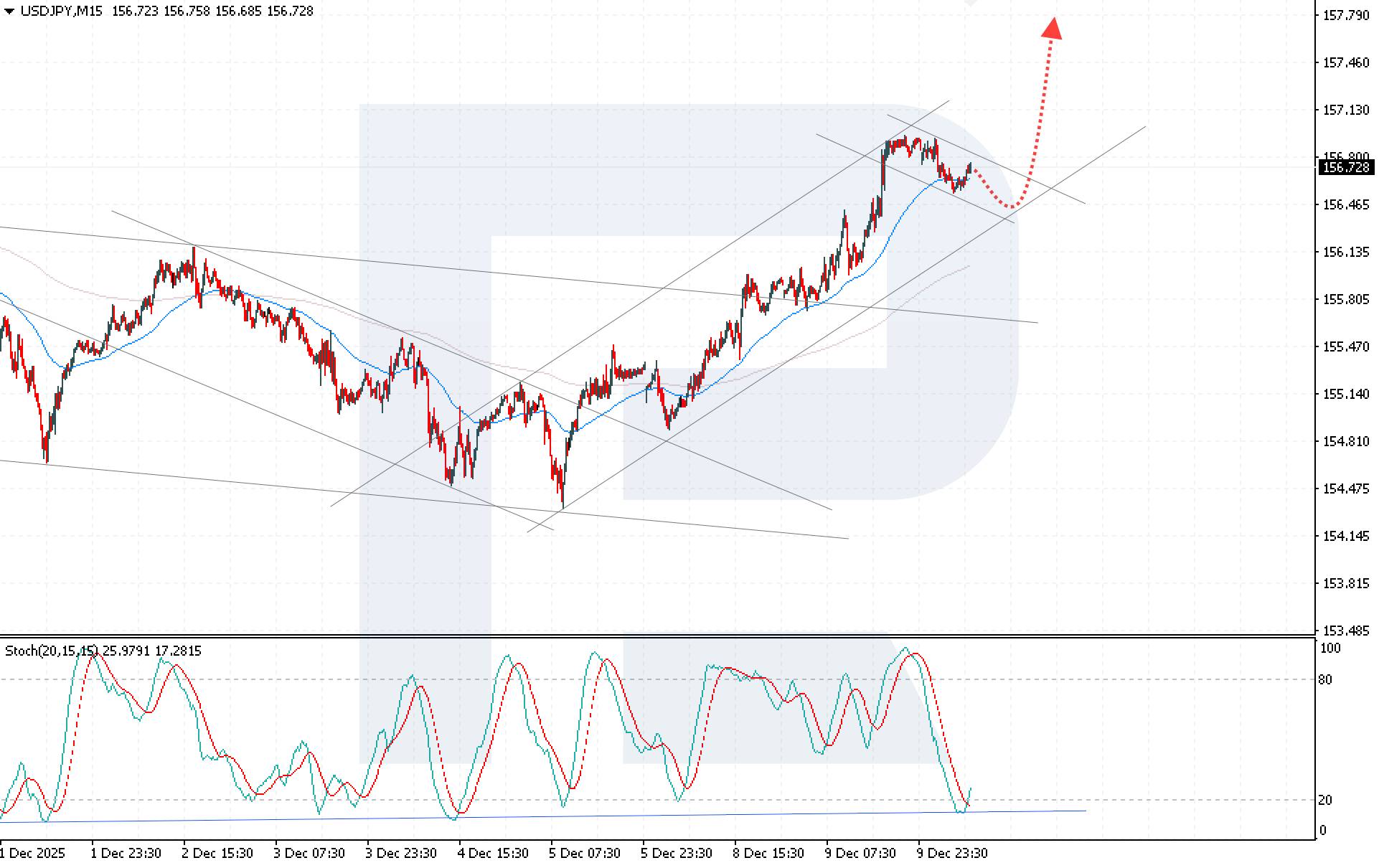
          The USDJPY rate is correcting after rebounding from the 156.90 resistance level. Despite the decline, buyers are keeping the price above the EMA-65, indicating persistent upward pressure.

          The USDJPY forecast for today suggests the bearish correction may end, followed by continued growth towards 157.80. The Stochastic Oscillator further supports the bullish scenario: its signal lines have reached oversold territory and turned upwards.

          A consolidation above 156.90 will confirm full-fledged bullish momentum and indicate that the price is exiting the corrective channel.
          Weakening Japanese Economy Adds To Upward Pressure On USDJPY_1

          Summary

          The weakening of the Japanese economy, coupled with supportive US data, creates conditions for sustained bullish momentum. The USDJPY technical analysis confirms the potential for renewed growth towards 157.80 if the price breaks above 156.90.

          Weakening Japanese Economy Adds To Upward Pressure On USDJPY_2EURUSD 2026-2027 forecast: key market trends and future predictions

          This article provides the EURUSD forecast for 2026 and 2027 and highlights the main factors determining the direction of the pair's movements. We will apply technical analysis, take into account the opinions of leading experts, large banks, and financial institutions, and study AI-based forecasts. This comprehensive insight into EURUSD predictions should help investors and traders make informed decisions.

          Weakening Japanese Economy Adds To Upward Pressure On USDJPY_3Gold (XAUUSD) forecast 2026 and beyond: expert insights, price predictions, and analysis

          Dive deep into the Gold (XAUUSD) price outlook for 2026 and beyond, combining technical analysis, expert forecasts, and key macroeconomic factors. It explains the drivers behind gold's recent surge, explores potential scenarios including a move toward 4,500 to 5,000 USD per ounce, and highlights why the metal remains a strong hedge during global uncertainty.

          Source: RoboForex

          Risk Warnings and Disclaimers
          You understand and acknowledge that there is a high degree of risk involved in trading. Following any strategies or investment methods may lead to potential losses. The content on the site is provided by our contributors and analysts for information purposes only. You are solely responsible for determining whether any trading assets, securities, strategy, or any other product is suitable for investing based on your own investment objectives and financial situation.
          Add to Favorites
          Share

          Winds Shift, Hawks Circle

          Danske Bank

          Forex

          Political

          Economic

          Central Bank

          Everybody knows the Federal Reserve (Fed) will announce a 25bp rate cut today. I know it, you know it, he/she/it knows it, my five-year-old knows it, my cat, your dog, the birds in the sky. Everyone knows the Fed is lowering rates later today. Market pricing is giving it roughly an 88% probability — too high for the Fed to walk back in the absence of an emergency.

          What we don't know is what Fed members are planning for next year. How many cuts they anticipate, and whether their projections will convince markets to react accordingly.

          For the doves, the case for rate cuts is clear: the US labour market has softened, partly due to a combination of aggressive anti-immigration policies, tariff uncertainty and fears around AI-related job displacement. Tariff-led price pressures, meanwhile, still haven't shown up materially since tariffs were announced in April. Add to that the political noise — with Donald Trump pressuring the Fed to cut rates, at times with aggressive public remarks — and poor Jerome Powell is hearing things he probably never expected to hear in his lifetime.

          For the most extreme doves, the Fed has "plenty of room" to cut. Kevin Hassett — one of Trump's favourite candidates to lead the Fed next year — said yesterday that the rise of AI gives the Fed an opportunity to run easier policy because lower rates could lift both aggregate supply and demand. Higher supply, he argues, could help contain inflation.

          Others think it may be wiser to pause for thought. AI-driven productivity gains are real. But looming inflation risks from tariffs still require a careful playbook — particularly if AI-driven disinflation doesn't materialise fast enough to neutralize potential tariff-led inflation.

          So, it's complicated. All eyes will be on the Fed's dot plot. Any hawkish tilt or reluctance to signal further cuts could trigger another repricing and weigh on sentiment.

          The good news: investors aren't walking into this meeting blindly. Money markets have already trimmed their expectations from 2–4 cuts next year to just two, reducing the risk of a sharp reaction to a "hawkish cut."

          And judging by yields, the message from investors is clear: they're not buying the dovish narrative. Instead, investors worry that lower yields could revive inflation and ultimately prevent the Fed from cutting more — or even force a hike. The proof: the US 10-year yield has climbed since the Fed began cutting in September.

          This disconnect between Fed policy and market yields suggests lower policy rates are not fully transmitting. No matter what Fed officials think, markets remain worried about inflation. They won't absorb lower policy rates until they see evidence of inflation falling. That dynamic could prevent the S&P 500 from pushing higher into year-end.

          Meanwhile, global winds are turning hawkish, as well. The Reserve Bank of Australia (RBA) said this week it debated an "extended pause or a hike," and markets now price a rate increase by June — a stark reversal from expectations of a cut just a month ago. The Australian 10-year yield has jumped from ~4.10% in late October to above 4.80%.

          The Bank of Canada (BoC) is expected to hold today, but markets are almost fully pricing a hike by late 2026, on the back of strong Canadian labour data. Canadian 10-year yields have risen from around 3% to near 3.50%.

          The European Central Bank (ECB) isn't expected to cut next year, and Isabel Schnabel said this week she's comfortable with market pricing that the ECB's next move could be a hike. The European 10-year yield is now around 2.85%, up from ~2.50% in October.

          The Reserve Bank of New Zealand (RBNZ) watchers have also shifted from expecting a September cut to expecting a hike. The 10-year yield has spiked from ~4% to above 4.6%.

          And the Bank of Japan (BoJ) is widely expected to hike next week. The Japanese 10-year is flirting with 2%, raising the risk of Japanese pension funds and insurers — major US Treasury holders — repatriating capital back home, and pull the rug from under the feet of US treasuries.

          Consequently, even though equity investors still debate whether the tech sector is in bubble territory, global bond investors have little doubt about two things: DM debt is unsustainably high, and central bank expectations are shifting hawkish. The latter pushes the yields higher.

          And if yields continue pushing higher, valuations will come under pressure — especially for highly leveraged companies.

          So, today's reaction to the Fed will likely set the tone for the remainder of the year: will Santa bring gifts, or stay snowed out? Answer in a few hours.

          Source: Danske Bank

          To stay updated on all economic events of today, please check out our Economic calendar
          Risk Warnings and Disclaimers
          You understand and acknowledge that there is a high degree of risk involved in trading. Following any strategies or investment methods may lead to potential losses. The content on the site is provided by our contributors and analysts for information purposes only. You are solely responsible for determining whether any trading assets, securities, strategy, or any other product is suitable for investing based on your own investment objectives and financial situation.
          Add to Favorites
          Share

          Market Quick Take - 10 December 2025

          SAXO

          Commodity

          Stocks

          Forex

          Market drivers and catalysts

          · Equities: Equities traded mixed, with flat U.S. and softer Europe and Asia as investors wait for the Fed and key China data
          · Volatility: VIX mid-teens, short-term vols jump into Fed, SPX 0DTE implies ±0.6%
          · Digital Assets: Options heavy put demand in IBIT/MSTR/miners, ETHA balanced and structured
          · Fixed Income: US Treasury yields at high end of recent range ahead of FOMC
          · Currencies: FX volatility extremely muted ahead of FOMC, JPY weak
          · Commodities: Silver trades above USD 60 as industrial demand fuels supply concerns
          · Macro events: Bank of Canada Rate Decision, FOMC rate decision

          Macro headlines

          · SpaceX, the Elon Musk-led company, is said to be moving ahead with plans for an IPO in mid-to-late 2026 that would value the company at USD 1.5 trillion and raise more than USD 30 billion, making it the largest IPO ever.
          · France's National Assembly approved next year's social security bill by 247–234, boosting the odds of a year‑end budget and easing calls for Prime Minister Sebastien Lecornu to resign, with Lecornu saying the vote shows compromise is possible even as the main budget will be tougher and the government's stance unchanged.
          · US job openings rose to a five‑month high of 7.67 million in October while layoffs climbed to 1.85 million, the highest since early 2023, and hiring fell by 218,000, with Stephen Stanley saying the labour market is slowing but not as sharply as some alternative indicators suggest.
          · Ahead of today's widely expected hawkish rate cut from the FOMC, bond traders are betting on a shallower path of Federal Reserve interest-rate cuts in the year ahead, with just two 25 bps cuts expected during the first half. The change is part of a global move to wager that major central banks will slow or halt their monetary easing.

          Equities

          · USA: U.S. equities ended mixed, with the S&P 500 flat, the Nasdaq slightly higher and the Dow down 0.4% as traders weighed fresh labour data ahead of the Federal Reserve decision. Job openings rose to about 7.67 million in October, keeping the Fed's data-dependent stance in focus while markets price a 25 basis point cut this week, and JPMorgan fell 4.7% after guiding 2026 expenses to roughly 105 billion, dragging peers. Nvidia eased 0.3% on talk China may curb H200 chip purchases despite U.S. export clearance with a surcharge, while Home Depot slipped 1.3% and Paramount, Netflix and Warner Bros Discovery moved on the evolving Hollywood deal saga, with investors now watching the Fed's guidance on the 2026 rate path.
          · Europe: European equities edged lower, with the Euro Stoxx 50 down 0.1% and the Stoxx 600 near flat as investors stayed cautious ahead of Wednesday's Federal Reserve decision, where a 25 bp cut is widely expected but the 2026 policy path remains unclear. EssilorLuxottica dropped 5.6% after Warby Parker unveiled glasses with built-in artificial intelligence (AI) features in partnership with Google, while Thyssenkrupp slid around 6.5% on guidance that pointed to a possible 800-million-euro loss in 2026. By contrast, defence stocks rallied after reports that German lawmakers will sign off on 29 procurement deals totalling about 52 billion euros next week, lifting Hensoldt, Rheinmetall, Leonardo, BAE Systems and Thales as markets focus on European rearmament and budget debates.
          · Asia: Asian trading was weaker, with Hong Kong's Hang Seng index down 1.3% to around 25,434, a two-week low as losses spread across sectors ahead of the Federal Reserve decision and key Chinese inflation data. Talk of a "hawkish cut" and uncertainty around U.S. policy in 2026 kept investors cautious, while mainland shares eased before November consumer price index (CPI) and producer price index (PPI) releases even as the Politburo pledged stronger 2026 support through proactive fiscal and loose monetary policy. Tech and consumer names led declines, with Pop Mart off 5.4%, SMIC down 4.2% and Xiaomi, Meituan and China Resources Land losing about 3–4%, and the focus now shifts to how Beijing's support plans feed through to earnings and sentiment.

          Volatility

          · Equity volatility is edging higher into tonight's Fed decision, but we are still in a mid-teens regime rather than full risk-off. VIX closed near 16.9 (+1.6%), with short-dated gauges like VIX1D jumping more sharply as traders pay up for very local protection. SPX finished around 6,840, down just 0.1%, yet 0DTE options price an intraday move of about ±43 points (≈0.6%), while FOMC-day straddles imply almost ±1% after the announcement, the largest expected Fed move since March.
          · Skew remains contained and VVIX is below 100, so demand is focused on near-the-money hedges rather than crash protection, with some strategists even advocating selling rich FOMC straddles given how small recent realized moves have been.

          Digital Assets

          · Crypto markets are firm but not euphoric as traders also key in on the Fed. Bitcoin trades around 92–93k after bouncing from November's sharp drawdown, with price action choppy but range-bound ahead of the "hawkish cut" many expect. Ether holds just above 3,300 and continues to slightly outperform, while majors like Solana, XRP and the miner complex (MSTR, MARA, RIOT, CLSK, CIFR) trade higher, helped by the prospect of easier policy and improving risk sentiment.
          · Options flow in crypto remains put-heavy, with sizeable long-dated protection in IBIT and MSTR as investors hedge equity-style proxies and miners, whereas ETHA shows a more balanced mix of calls and puts, pointing to structured upside rather than outright downside bets.

          Fixed Income

          · US treasury yields trade near the highs of the recent range since September ahead of the FOMC meeting Wednesday, with the benchmark 2-year treasury yield near 3.61%, while the 10-year benchmark yield closed about a basis point higher near 4.19% on Tuesday before pulling back slightly overnight.
          · Japanese government bonds traded quietly and within recent ranges, save for at the front end of the yield curve, where the 2-year JGB benchmark yield poked to a marginal new high for the cycle above 1.08% before easing to within Tuesday's trading range below 1.075%.
          · The German 10-year Bund yield rose to marginal new highs since March yesterday, nearly touching 2.88%, before easing back to 2.85% into the close.

          Commodities

          · Silver surged to a fresh record above USD 60, supported by rate-cut expectations and after The Silver Institute said demand is set to expand across key technology sectors such as solar (PV), EVs and related infrastructure, as well as data centres and AI. The gold-silver ratio has slipped to a four-year low around 68.5, marginally below its 25-year average, underscoring silver's strong relative performance.
          · Gold trades calmly around USD 4,200 ahead of today's widely expected US rate cut. An uptrend from the October correction low offers support at USD 4,118 while resistance remains firm around USD 4,250.
          · Crude trades near recent lows amid ongoing concerns about global oversupply in the coming months. In its latest monthly update, the EIA said US production hit a record this year before slowing in 2026. Meanwhile, the API reported a 4.8 million barrel draw in crude stockpiles, partly offset by a sharp build in gasoline inventories. Brent remains stuck in a narrow four-dollar range, with downside attention focused on support around USD 62.
          · The BCOM Grains Index fell to a six-week low following the December WASDE report. Wheat came under pressure after the USDA raised world ending stocks for the 2025–26 season by slightly more than expected, while soybeans remain weighed down by the lack of Chinese buying. Corn, by contrast, edged higher on stronger export demand expectations.

          Currencies

          · The dollar traded quietly ahead of today's FOMC meeting, with the expectation that the Fed is likely delivering the last cut until after a new Fed Chair takes over next May, but with significant delays in US data meaning that odds might shift in coming weeks. EURUSD edged below the 1.1650, while USDJPY rose, mostly as a function of JPY weakness.
          · The Australian dollar remains firm after the recent hawkish RBA meeting and on rising Australian bond yields. AUDUSD, trading near 0.6650, is eyeing the huge overhead resistance level, the top of the range for 2025 at 0.6707, while AUDJPY rose above 104.00 for the first time since July of 2024.

          Source: SAXO

          Risk Warnings and Disclaimers
          You understand and acknowledge that there is a high degree of risk involved in trading. Following any strategies or investment methods may lead to potential losses. The content on the site is provided by our contributors and analysts for information purposes only. You are solely responsible for determining whether any trading assets, securities, strategy, or any other product is suitable for investing based on your own investment objectives and financial situation.
          Add to Favorites
          Share
          FastBull
          Copyright © 2025 FastBull Ltd

          728 RM B 7/F GEE LOK IND BLDG NO 34 HUNG TO RD KWUN TONG KLN HONG KONG

          TelegramInstagramTwitterfacebooklinkedin
          App Store Google Play Google Play
          Products
          Charts

          Chats

          Q&A with Experts
          Screeners
          Economic Calendar
          Data
          Tools
          Membership
          Features
          Function
          Markets
          Copy Trading
          Latest Signals
          Contests
          News
          Analysis
          24/7
          Columns
          Education
          Company
          Careers
          About Us
          Contact Us
          Advertising
          Help Center
          Feedback
          User Agreement
          Privacy Policy
          Business

          White Label

          Data API

          Web Plug-ins

          Poster Maker

          Affiliate Program

          Risk Disclosure

          The risk of loss in trading financial instruments such as stocks, FX, commodities, futures, bonds, ETFs and crypto can be substantial. You may sustain a total loss of the funds that you deposit with your broker. Therefore, you should carefully consider whether such trading is suitable for you in light of your circumstances and financial resources.

          No decision to invest should be made without thoroughly conducting due diligence by yourself or consulting with your financial advisors. Our web content might not suit you since we don't know your financial conditions and investment needs. Our financial information might have latency or contain inaccuracy, so you should be fully responsible for any of your trading and investment decisions. The company will not be responsible for your capital loss.

          Without getting permission from the website, you are not allowed to copy the website's graphics, texts, or trademarks. Intellectual property rights in the content or data incorporated into this website belong to its providers and exchange merchants.

          Not Logged In

          Log in to access more features

          FastBull Membership

          Not yet

          Purchase

          Become a signal provider
          Help Center
          Customer Service
          Dark Mode
          Price Up/Down Colors

          Log In

          Sign Up

          Position
          Layout
          Fullscreen
          Default to Chart
          The chart page opens by default when you visit fastbull.com
