

Markets
News
Analysis
User
24/7
Economic Calendar
Education
Data
- Names
- Latest
- Prev



Signal Accounts for Members
All Signal Accounts
All Contests
 Turkey Trade Balance
A:--
F: --
P: --
 Germany Construction PMI (SA) (Nov)
A:--
F: --
P: --
 Euro Zone IHS Markit Construction PMI (Nov)
A:--
F: --
P: --
 Italy IHS Markit Construction PMI (Nov)
A:--
F: --
P: --
 U.K. Markit/CIPS Construction PMI (Nov)
A:--
F: --
P: --
 France 10-Year OAT Auction Avg. Yield
A:--
F: --
P: --
Euro Zone Retail Sales MoM (Oct)A:--
F: --
P: --
Euro Zone Retail Sales YoY (Oct)A:--
F: --
P: --
 Brazil GDP YoY (Q3)
A:--
F: --
P: --
 U.S. Challenger Job Cuts (Nov)
A:--
F: --
P: --
U.S. Challenger Job Cuts MoM (Nov)A:--
F: --
P: --
U.S. Challenger Job Cuts YoY (Nov)A:--
F: --
P: --
U.S. Initial Jobless Claims 4-Week Avg. (SA)A:--
F: --
P: --
U.S. Weekly Initial Jobless Claims (SA)A:--
F: --
P: --
U.S. Weekly Continued Jobless Claims (SA)A:--
F: --
P: --
 Canada Ivey PMI (SA) (Nov)
A:--
F: --
P: --
Canada Ivey PMI (Not SA) (Nov)A:--
F: --
P: --
U.S. Non-Defense Capital Durable Goods Orders Revised MoM (Excl. Aircraft) (SA) (Sept)A:--
F: --
U.S. Factory Orders MoM (Excl. Transport) (Sept)A:--
F: --
P: --
U.S. Factory Orders MoM (Sept)A:--
F: --
P: --
U.S. Factory Orders MoM (Excl. Defense) (Sept)A:--
F: --
P: --
U.S. EIA Weekly Natural Gas Stocks ChangeA:--
F: --
P: --
Saudi Arabia Crude Oil ProductionA:--
F: --
P: --
U.S. Weekly Treasuries Held by Foreign Central BanksA:--
F: --
P: --
 Japan Foreign Exchange Reserves (Nov)
A:--
F: --
P: --
 India Repo Rate
A:--
F: --
P: --
India Benchmark Interest RateA:--
F: --
P: --
India Reverse Repo RateA:--
F: --
P: --
India Cash Reserve RatioA:--
F: --
P: --
Japan Leading Indicators Prelim (Oct)A:--
F: --
P: --
U.K. Halifax House Price Index YoY (SA) (Nov)--
F: --
P: --
U.K. Halifax House Price Index MoM (SA) (Nov)--
F: --
P: --
France Current Account (Not SA) (Oct)--
F: --
P: --
France Trade Balance (SA) (Oct)--
F: --
P: --
France Industrial Output MoM (SA) (Oct)--
F: --
P: --
Italy Retail Sales MoM (SA) (Oct)--
F: --
P: --
Euro Zone Employment YoY (SA) (Q3)--
F: --
P: --
Euro Zone GDP Final YoY (Q3)--
F: --
P: --
Euro Zone GDP Final QoQ (Q3)--
F: --
P: --
Euro Zone Employment Final QoQ (SA) (Q3)--
F: --
P: --
Euro Zone Employment Final (SA) (Q3)--
F: --
Brazil PPI MoM (Oct)--
F: --
P: --
 Mexico Consumer Confidence Index (Nov)
--
F: --
P: --
Canada Unemployment Rate (SA) (Nov)--
F: --
P: --
Canada Labor Force Participation Rate (SA) (Nov)--
F: --
P: --
Canada Employment (SA) (Nov)--
F: --
P: --
Canada Part-Time Employment (SA) (Nov)--
F: --
P: --
Canada Full-time Employment (SA) (Nov)--
F: --
P: --
U.S. Dallas Fed PCE Price Index YoY (Sept)--
F: --
P: --
U.S. PCE Price Index YoY (SA) (Sept)--
F: --
P: --
U.S. PCE Price Index MoM (Sept)--
F: --
P: --
U.S. Personal Outlays MoM (SA) (Sept)--
F: --
P: --
U.S. Core PCE Price Index MoM (Sept)--
F: --
P: --
U.S. UMich 5-Year-Ahead Inflation Expectations Prelim YoY (Dec)--
F: --
P: --
U.S. Core PCE Price Index YoY (Sept)--
F: --
P: --
U.S. 5-10 Year-Ahead Inflation Expectations (Dec)--
F: --
P: --
U.S. UMich Current Economic Conditions Index Prelim (Dec)--
F: --
P: --
U.S. UMich Consumer Sentiment Index Prelim (Dec)--
F: --
P: --
U.S. UMich 1-Year-Ahead Inflation Expectations Prelim (Dec)--
F: --
P: --
U.S. UMich Consumer Expectations Index Prelim (Dec)--
F: --
P: --


No matching data

Latest Views
Latest Views
Trending Topics
Top Columnists
Latest Update
White Label
Data API
Web Plug-ins
Affiliate Program
View All
No data
Headline unemployment rose to 5.0% in the three months to September, the highest level since February 2021.
Headline unemployment rose to 5.0% in the three months to September, the highest level since February 2021, though concerns over data quality continue to plague these figures. The Bank of England, however, per the November MPR forecasts issued last week, expect unemployment to rise further in the months ahead, now expecting joblessness to peak at 5.1% in early 2026.
Meanwhile, despite slack continuing to emerge, earnings pressures persist. Overall pay rose 4.8% YoY in the three months to September, while regular pay rose by 4.6% YoY, this latter figure being the slowest pace since April 2022, but still a relatively rapid clip. Importantly, in what remains an unusual dynamic for a DM economy, earnings growth in the public sector continues to outpace that in the private sector. This does, at least, suggest a diminished risk of such a pace of earnings growth, which overall is clearly still incompatible with a return to the 2% inflation target, prompting persistent price pressures, with private earnings growth moderating once again in September, to 4.2% YoY.
Turning to the more timely HMRC PAYE payrolls metric, which pointed to payrolled employment falling by a huge 32,000 in October, not only the second straight monthly decline, but also the largest such decline since November 2020.
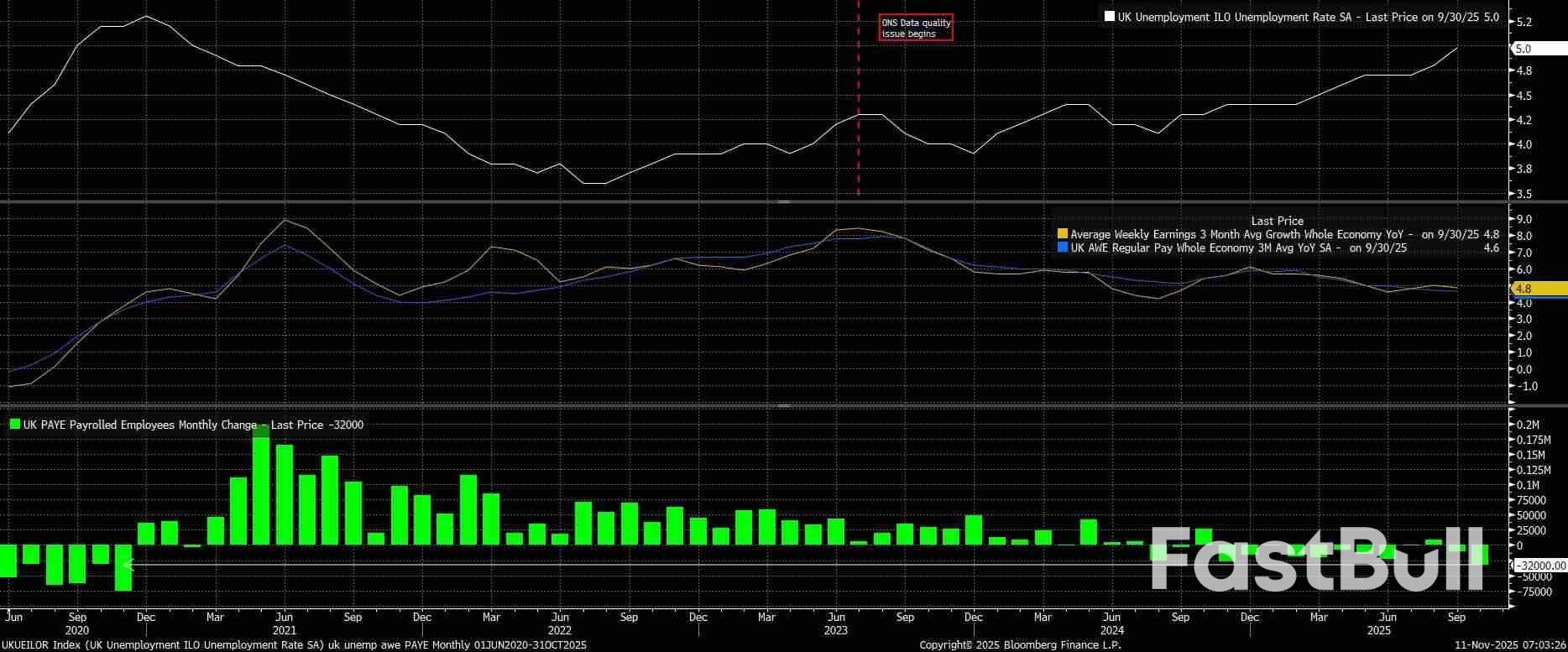
Taking a step back, this morning's figures point to the labour market continuing to weaken, as most had expected it would do so. Last week, the Bank of England's Monetary Policy Committee opened the door to a 25bp cut in December, not only having held Bank Rate steady via the narrowest possible 5-4 margin, but also with the removal of prior guidance around a 'careful' pace of easing moving forwards.
Hence, this morning's data is likely to do little to deter the dovish contingent on the Committee from again voting for a 25bp cut at the final meeting of the year, with my base case now being that such a reduction is delivered, with Governor Bailey joining the doves to vote through such an action. That base case, however, which would likely be followed up with another cut at the February meeting, does hinge not only on further disinflationary progress being evidenced in the upcoming October and November CPI reports, but also there being little by way of surprise, or worse inflationary policies, announced in Chancellor Reeves's late-November Budget.
![eToro Copy Trading: Can You Really Make Money? [Pros & Cons]_1](https://img.fastbull.com/prod/image/2025/11/8B4EEB9C138A4C75ADE8A1DDBD061850.png "eToro Copy Trading: Can You Really Make Money? [Pros & Cons]_1") eToro Copy Trading allows users to automatically mirror the trades of successful investors in real time. This innovative feature makes investing more accessible to beginners who want exposure to global markets without advanced trading skills. In this article, we explore how etoro copy trading works, its benefits, risks, and real profit potential.
eToro Copy Trading allows users to automatically mirror the trades of successful investors in real time. This innovative feature makes investing more accessible to beginners who want exposure to global markets without advanced trading skills. In this article, we explore how etoro copy trading works, its benefits, risks, and real profit potential.
eToro Copy Trading allows users to automatically replicate the trades of top-performing investors on the platform. When you click “Copy,” your account mirrors each trade they execute in real time. This makes it possible to gain market exposure even without deep trading knowledge.
There are no extra charges for using etoro copy trading. However, you still pay the usual spreads, overnight fees, and potential currency conversion costs depending on your assets. Understanding these costs helps avoid surprises when calculating returns.
According to eToro’s public performance data, the top 50 traders averaged around 30.4% annual returns in 2021. However, the average copier’s profit is lower due to timing, risk appetite, and emotional decision-making. Real profitability depends on trader selection and long-term consistency.
| Group | Average Return | Holding Period |
|---|---|---|
| Top 50 Traders | +30.4% yearly | 12 months |
| Average Copiers | +8.2% yearly | 6 months |
| New Users (first 3 months) | -2.7% | 3 months |
Copy trading on eToro works best for investors who want exposure to multiple markets without active management. It’s most effective when:
Not ideal for high-frequency traders, or those who prefer full autonomy over each position. The breakeven point typically appears when average monthly returns exceed 1–1.5% after fees and compounding. For those willing to learn and manage risk, copy trading etoro can be a practical passive income path.
To begin etoro copy trading, sign up on the platform and complete the KYC process. You’ll need to upload:
Verification typically takes 1–2 business days. The minimum deposit varies by region—$50 for the U.S., $200 for most countries, and higher in select jurisdictions.
Log in and go to the “Discover” tab to access the CopyTrader dashboard. You can browse top investors and review their trading stats. Each trader’s profile includes:
Use eToro’s advanced search filters to refine your selection. You can filter by location, return rate, active weeks, and risk level. Traders are categorized by the 4-Star Rating System:
| Level | Requirements | Typical Return |
|---|---|---|
| Cadet | New traders under 6 months | 0–10% |
| Champion | Steady 12-month performance | 10–20% |
| Elite | Popular Investors with >500 copiers | 15–30% |
| Elite Pro | Top-tier, verified experts | 30%+ |
Always read trader profiles carefully—look for consistent returns, moderate drawdowns, and long-term track records.
Choose a trader and decide how much to allocate (minimum $200). You can set a Copy Stop-Loss (CSL) to limit losses—for example, stop copying if the value drops below 60% of your investment.
eToro offers proportional copying, ensuring your exposure matches the trader’s relative position size. Once you click “Copy,” the system automatically replicates open trades and future ones.
Before risking real money, activate the $100,000 virtual portfolio via the etoro copy trading app. This lets you practice and analyze your strategy in real time without financial risk. Once confident, you can transition to a live account.
Go to the Portfolio tab to monitor your performance. You can:
Effective monitoring is key to long-term success in copy trading etoro.
Expecting 100%+ annual returns is unrealistic. The most consistent traders achieve 15–30% yearly gains. Focus on sustainable returns that align with your risk tolerance and account balance.
Never copy just one trader. Diversify across at least three individuals with different trading styles—stocks, crypto, and commodities. This minimizes correlation risk and improves portfolio stability.
Allocate 10–20% of your total funds per trader. For example, with $1,000, copy five traders with $200 each. Always leave 10% cash reserves to adjust or rebalance later.
Review your portfolio every 30 days. Replace underperforming traders, add capital to consistent ones, and follow the 30-60-90 day evaluation cycle to maintain balance.
There isn’t a single “best” trader—your choice depends on goals, risk tolerance, and time horizon. Many investors filter for low-risk (score 3–5) traders with over two years of consistent returns. Check the Popular Investor leaderboard for verified top performers before starting etoro copy trading.
There are no additional fees to use CopyTrader itself. You only pay standard etoro copy trading fees such as spreads, overnight financing, and currency conversion if applicable. Always review the fee breakdown under each asset before copying.
Yes—when done wisely. Copy trading helps beginners learn by observing professional strategies while diversifying their portfolio. However, it still carries risk, so testing with the demo feature in the etoro copy trading app is recommended first.
Returns vary widely. Top investors may earn 20–35% per year, while the average copier might see 5–15%, depending on trader selection and timing. Remember, all results fluctuate with market conditions, and performance is not guaranteed.
eToro Copy Trading offers a simplified way to participate in global markets by mirroring top-performing investors. When combined with smart diversification, risk control, and consistent monitoring, etoro copy trading can become a practical strategy for long-term portfolio growth and learning.
Emirates airline's boss Tim Clark, who has led the business for more than two decades, is charting a course for its growth in the next 20 years that sets up its next leader on a path for more success, he has told The National.
This blueprint for future expansion entails Emirates moving to a larger hub at the new terminal in Al Maktoum International Airport (DWC), taking delivery of another 300 aircraft on order, mapping "sizeable" network growth to routes in Africa and Latin America and leveraging its partnership with sister airline flydubai, he said.
"I am trying to get a set of plans, set the dye so to speak, so that over the next 15 to 20 years we know where we are going," he told The Inside Brief with Manus Cranny at the airline group's headquarters.
"We've got a range of products coming, I'd like to see that one get going, and then the successors to me and many others in the business are following a path and if they follow that path based on what we've done in the past, they will be successful."
Sticking to Emirates' business model, without deviating towards distractions like buying another business, is essential for the airline's continued success.
"If you deviate from that, for whatever reason, temptations as they've been coming forward, like you decide to acquire another business … then you will find that difficult," Mr Clark said. "Keep focus on what we're doing."
The airline's expansion is inextricably tied to Dubai's own growth, propelling the emirate and its airline into the next 50 years, according to the aviation veteran.
"Dubai has got a very long period of time going forward where it will be successful because … it doesn't change its model. It grows its model," he said. "If we all do the same thing, then taken together with the city, I can see in 50 years this being a serious player, more seriously than it is today."
"So with me out of it, at least we would have set them on the path... What they do with it after that is up to them," he said.
Mr Clark, whose aviation career spans 50 years, became the carrier's president in 2003 and has driven its rapid growth into the world's largest international airline. Emirates promoted two senior Emirati executives, Adel Al Redha and Adnan Kazim, to deputy president roles under Mr Clark, who postponed his retirement during Covid and has not set a new date.
Emirates last week posted record half-year profits after tax, up 13 per cent to Dh9.9 billion ($2.7 billion), amid "strong and sustained" travel demand across regions that withstood geopolitical turbulence and macroeconomic uncertainty.
It maintained its position as the world's most profitable airline for the period and expects this demand resilience to continue for the rest of the financial year.
Even with more than 270 planes in its fleet and flights to more than 150 destinations around the world, Emirates still has not reached the limits of its growth, according to Mr Clark.
"When I looked at the way we could now reach most cities on the planet, how the [Airbus] A380 was scaling our operation, I thought there is so much more to do even today," he said.
With the "300-odd aircraft we have on order and how the network is going to expand over the next 15 years, you really haven't seen anything yet".
"So there's a lot do. At no point did we actually say 'Well that's it, we've reached the limits of our capabilities.'"
With regional carriers emulating its model, and with new start-ups such as Saudi Arabia's Riyadh Air emerging on the scene, Emirates is not complacent about its success.
Asked if Emirates would consider an initial public offering, Mr Clark questioned the necessity of listing the world's most profitable airline and a strategic government asset, but said the decision is up to its government shareholder.
The Emirates Group "is very profitable, he said. "It has a very strong balance sheet. It has a lot of cash on it and the way the business is evolving ... we see a progression of that. So in the end, why would you want to do that if you didn't need the money in the first place?"
The airline is a strategic asset and a pillar of the Dubai economy, so the government would wish to retain some control over it, he added.
"It provides people-power to the city and it is therefore strategically very important that the government keeps some kind of control one way or the other of this very important asset. If you put it in the hands of third parties, the agendas tend to contra-rotate, and that may not suit what the government would want to do in the future," Mr Clark said.
"I think that unless the terms of trade ... move against Dubai, I don't think that is something that they would do in the future. However, that's me speaking. I'm not a member of the government," he added.
Nothing became the US federal government shutdown like the ending of it.Late Monday, the Senate passed a temporary funding measure that would allow a reopening, paving the way for the House to hold its own vote Wednesday. Ahead of the Senate vote, markets reacted with joy. This was surprising on several levels. First, it was amazing that it was the Democrats, not Republicans, who conceded. Only last week, they'd won big in midterm elections, a victory widely attributed (even by the president himself) to the shutdown. As they were ahead in political battle, many Democrats were baffled (and infuriated) that eight of their senators had decided to stand down. Many found the timing of the concession close to inexplicable.
Prediction market odds that the shutdown would end this week had dropped sharply as election results came out last Tuesday. They rose above 90% Sunday evening as news of the compromise began to leak:
Second, the market jamboree in response to the reopening news was surprising because asset prices had previously given no sign that the shutdown was having any effect. Volatility has continued to slide lower across bonds, stocks and currencies since the shutdown started on Oct. 1. US stocks haven't gained much compared to bonds or to stocks in the rest of the world — but neither have they lost much. Rather, the weeks of shutdown continued a holding pattern, with generally strong earnings more than enough to counteract any political problems:
And yet somehow the Nasdaq Composite index put together a 2.3% gain Monday, its best day since May. It's just about possible to argue that this shutdown was on the verge of inflicting real damage. We were about to find out what happened to the economy and society if the poor could no longer use their food stamps, while the wealthy couldn't travel by air. It wouldn't have been pretty, which might explain why the Democratic moderates acted as they did. But these were still conjectural issues, and they hadn't yet been priced in.
Another faintly plausible explanation is that this episode demonstrates that President Donald Trump and the Republicans have great power at present, and are blessed with unimpressive opponents. Until such time as the electorate votes them out, they're in the driving seat as few governments have been in recent memory. If you like their agenda, which many investors do, that's good to know. If it ends in failure — still perfectly possible — the defeat will be self-inflicted through their policy's inherent flaws, and not imposed by someone else.
The best explanation for markets is the simplest. This was a genuine surprise, and provided a handy excuse. As Points of Return has explained on many occasions, valuations look mightily stretched, so there is plentiful justification for caution and profit-taking. But valuation is useless for short-term market timing.At one point on Friday, the Nasdaq 100 index had put in a 5.9% fall from peak-to-trough in only seven trading days. With no great restrictions on liquidity, many saw the mini-correction as creating a good opportunity to buy on the dip. So they did.
For markets, the clearest impact of the shutdown was in removing official US data, which can be labor-intensive to compile. The numbers can be politically contentious, but there's still no good substitute.
Without official unemployment data for September or October, there has been a cottage industry in finding alternative indicators. Torsten Slok, the chief US economist at Apollo Management, has a great catalogue. The two best-established non-government labor surveys didn't look great. The estimate of private sector payroll changes by ADP suggests that growth has ground to a halt, while the Challenger, Gray & Christmas count of layoffs rose sharply last month:
But the long shadow of the pandemic, and the shorter one of the shutdown, blur the picture. Indeed.com, the online job search company, shows that job postings have been falling almost without interruption for four years. Postings are nearly back to their pre-pandemic level after unprecedented disruption:
During the government's silence, these measures have all received more attention than they normally would. But it's not as though they've created panic or sent markets for a loop. On the contrary, the lack of data has led investors to reserve judgment. The Federal Reserve is famously data-dependent and cares intensely about the labor market — and rather than overreact to the alternative numbers, investors' response has been to leave their projected path for monetary policy completely unchanged. Fed funds futures are projecting almost exactly the same progression for rates now as they did on the eve of the shutdown:
Ultimately, it's good to know that the financial system can survive for a while without any data to feed it. "The relative resilience of the market and investor psychology shows that we aren't flying blind," says Marc Chandler of Bannockburn Global Forex.It's good that this wasn't put to a longer test.
Any contraction in China's exports demands attention. There has been drawn-out trade hostility this year as Washington tries to remake the global trade order. Beijing's growth engine was already weakened by the housing sector's spectacular slump, and its success in finding other customers for its exports was a lifesaver.
The recently announced 12-month truce offers a respite, but then investors got a surprise. In October, it turns out, China's export juggernaut contracted for the first time in eight months. A 25% slump in goods sent to the US over the previous year was enough to offset a rise of approximately 3% in shipments to all other nations. For an economy already slowing amid sluggish consumer spending and investment at home, this was shocking:
Or was it? There is evidence of a temporary setback rather than anything more damaging — and the latest trade truce should in any case help exporters over the coming months. Andy Rothman of Sinology LLC argues that there's no cause for immediate concern, since October had 18 working days compared to 19 in the same month of 2024. Such seasonal discrepancies, he argues, always impact data output.
Louise Loo of Oxford Economics points out that the sudden contraction came after a cyclical high point, which had likely been caused by firms rushing shipments ahead of new tariffs. She argues that the weak October shouldn't detract from China's export resilience, which she expects to recover by the second quarter of 2026. Her optimism rests on three pillars.
First, Beijing doubled down on industrial expansion at the recently concluded fourth plenum — a key meeting in the development of the next five-year plan. Second, exporters have embedded themselves in regional and emerging market supply chains.
Lastly, China's successful use of critical minerals as diplomatic leverage against the US should be an effective deterrent that means few trading partners would try to impose substantive retaliatory tariffs. If this scenario holds, it would help quell the growing anti-China dumping rhetoric outside the US, especially in Europe.
Even with the rollback in US tariffs, export growth still stands to be subdued by Chinese standards. But Loo's revised forecast following the trade truce suggests the deal will make a very big difference:
All else equal, if the truce holds for 12 months, Beijing should achieve its "around 5%" real gross domestic product growth target for 2025 — a goal that consensus deemed nearly out of reach just six months ago. But the country remains uncomfortably reliant on global trade. Gavekal Research's Andrew Batson points out that roughly a third of recent growth has come from net exports. For all the official talk of a pivot toward domestic demand, the shift so far has been more rhetorical than real.
Policymakers in their latest Five-Year Plan expect manufacturing or exports to form a "reasonable share" of economic growth. By conservative estimates, that should be about 25%. As Oxford Economics shows, success in exports has correlated closely with overall industrial production:
Instead, Morgan Stanley's Jenny Zheng estimates that halving fentanyl-related levies to 10% could lift China's export growth by about a percentage point, translating into a 10-basis-point boost to real GDP growth.
Barclays' Yingke Zhou argues that if exports weaken, China could face a "triple whammy" in combination with the prolonged contraction in the property sector and weak private consumption. But that isn't the base case:
As things stand, China appears to have got what it wants, which is control over its own destiny. By using its leverage from rare earths, it has kept US pressure at arm's length. Now, it needs to unlock stronger domestic demand; the real test will be at home.
Zohran Mamdani has made history. This 34-year-old Asian American Democratic socialist will now lead New York, the US' largest city and the world's financial capital, as mayor. A practising Muslim and advocate for Palestine, his constituents now include the largest Jewish community outside Israel.
A few weeks ago, I gave Rafizi Ramli a book: Run Zohran Run! It was about Mamdani's campaign, from underdog status to becoming the overwhelming favourite. I inscribed a short note in it: "Dear Raf, To doing crazy stuff again!".
Many will focus on Mamdani's unique background. However, there is something much deeper we all can learn from his remarkable victory.
The truth is that Mamdani's campaign was a war on multiple fronts: not only against an increasingly Trumpian Republican party, but also against a tired, overcautious Democratic establishment as well as well-funded billionaires hostile to his brand of progressivism.
Many, even some liberals, opposed his ideas about freezing rent hikes to improve New York's dire housing situation and taxing the rich fairly to boost public services in the city, among other things.
Through it all, in the face of pressure to conform, Mamdani arguably stuck to his ideals. Yes, he engaged groups who were uncomfortable with him and stressed that he would be an inclusive mayor. But he has not changed who he is or what he stands for. He resisted easy compromises simply for the sake of making vested interests feel comfortable, refusing to back down on unpopular but necessary truths.
How much he will actually achieve as mayor admittedly remains to be seen. It is true that it is one thing to win elections, but another to govern, especially a city as diverse and complex as New York, what more in the face of Donald Trump's hostile federal administration. Almost a century ago, the job of mayor of New York was dubbed as "the second toughest job in the US, after being president".
Still, his campaign has spoken not only to the young but also voters from all walks of life and, indeed, has captured the imaginations of people around the world. And while New York is a unique place, there is a lesson to be learnt in this very challenging juncture of global history.
It is quite simple: authenticity and clarity matter. Voters flocked to Mamdani not just because he was the so-called insurgent candidate but because he picked up the standard of progressivism that has arguably been fraying in the US and elsewhere. The dithering and indecisiveness of the Democratic Party — including its failure to deliver on desired reforms like universal healthcare, free college education and to end America's costly foreign entanglements have arguably helped the rise of Trump just as much as its de-industrialisation and white anxiety has.
The Democratic establishment unwittingly created a vacuum which its progressive base has desperately wanted to be filled but which their leaders could or would not for whatever reason. And into this breach has stepped Mamdani as well as other progressives such as Bernie Sanders and Alexandria Ocasio-Cortez.
Mamdani's interesting life story, charismatic persona and engaging social media presence really are only facets of his fundamental strength, namely that he understands that voters want change, that this change cannot be long delayed without great cost to society's fabric and that New Yorkers now see him as the best person to deliver it. It was this clarity, his knowing who he is and what he believes in, that has not only won over voters, including fence sitters, but also forced his opponents to clarify what exactly they stand for as well.
What does this have to do with Malaysia? Apart from the fact that we really ought to be restoring local council elections for Kuala Lumpur, I think it is also a reminder that there is a need to be true to ourselves.
Our political season, which is never dormant for long, is starting again with a vengeance. Sabah will go to the polls at the end of November. Sarawak will be next sooner or later and some are even speculating the 16th general election (GE16) could be held as early as the end of next year.
Many of course will look to Mamdani's campaign for inspiration. They will adapt his tagline, the design and style of his social media, the turns of phrase from his speeches. But all this will matter little if authenticity and clarity are forgotten. Style without substance means nothing.
Like people all over the world, Malaysians have time and time again voted for reform, especially Pakatan Harapan and Keadilan's base. In 2008, my colleagues and I were elected to public office despite our lack of experience. My opponent tried to belittle me by saying that I was like a grandson to her. Repeatedly: in 2013, 2018 and 2022, Malaysians put their trust in us and after GE15, Datuk Seri Anwar Ibrahim became prime minister at the head of a unity government.
But Malaysians, arguably, are still waiting for reform. It is not that nothing has been done. But much more still needs to be accomplished, especially in terms of good governance and creating a truly dynamic, inclusive economy. Even when we deliver on our promises, we seem to be scared of owning them, for fear of upsetting the vested interests, forgetting that through thick and thin, it was our core supporters that brought us to where Anwar, Keadilan and PH are today.
Like it or not, many are feeling restless or disappointed. This is the Age of Vibes: both the public and private sectors dismiss the power of emotion to our peril.
Very soon, the various parties will be putting forth their ideas and platforms to voters. The media and commentariat will also be trying to frame the debate based on their respective ideas and agendas.
I would argue that the best way forward for Malaysian progressives is to keep the ideas of authenticity and clarity at the forefront. We cannot forget that our voters want reform and that while it cannot be rushed, it cannot be delayed indefinitely or worse yet, reversed.
Do we still believe in reform? Do we still stand for fairness? For good governance and dignity for all Malaysians, not just for the powerful or the well-connected? If we do: then we must act like it.
We cannot take our voters for granted, assuming they have nowhere to go, no one else to vote for but us. This was Tony Blair's mistake in the UK. We will be replaced if we do not seize the challenge to move Malaysia forward. This will happen as certainly as the sun rises and sets every day.
We owe our voters authenticity and we owe them clarity. They must know who we are and what we stand for. We owe them the truth. It will not be easy, but the great, worthy causes in life rarely are.
This applies not only to political parties and their candidates but the whole ecosystem of public life in Malaysia: the corporate captains, leaders of civil society, the influencers and media practitioners who shape public opinion. We need to remember that the rakyat are our ultimate masters and we cannot disappoint them even as we seek to forge a better, sustainable future for Malaysia.
One certainly wishes Mamdani well. He has a long road ahead of him. It is possible that one mayor cannot change the trajectory of the US. But as I said, his victory has important lessons that leaders all over the world, including Malaysia, would be wise to heed.
Rafizi wrote a post on his social media last week about my gift. When we were staring at the possibility of losing in the party elections in May, we discussed what to do if that transpired. Rafizi decided to resign, but he told me that he respected whatever decision I took. I decided to resign too — I had lost all my party positions and hence, the mandate to push for far-reaching reforms. It was only fair for the new office holders to be given a chance to be appointed to the cabinet.
After our resignations, Rafizi asked me again: Was it crazy to start all over again, having been cabinet ministers?
"This is not the first time we did a crazy thing. Plunging into Keadilan, when it had no hope of ever becoming a government, was even crazier back then."
When we helped to build the party and run in elections, we had thin résumés. When I ran in 2008 as a 26-year-old, Keadilan had only one parliamentary seat, with a smaller presence than Muda has today. But we believed in fairness. We believed in multiracialism. We believed in reform. If power for power's sake was my goal, I would have joined Umno or even PAS.
It is time progressives embraced their core supporters, instead of picking fights or taking them for granted. Voters are tired of progressives working hard to win over their opponents — an almost impossible task. They are tired of progressives who keep finding excuses for not sticking to their values. Yes, winning power is important, but not as an end in itself. Rather, it is a means best used to make the country better for everyone.
Key points:
Two weeks after U.S. President Donald Trump and South Korea's Lee Jae Myung met and announced they had resolved months of negotiations over tariffs and security issues, the two sides have yet to release any agreement on paper.
South Korean officials say the delay appears to centre on discussions over their request for Washington's blessing to build a nuclear-powered submarine, which Lee raised publicly when he met Trump on the sidelines of an Asia-Pacific forum in South Korea last month.
After that meeting officials said they would shortly release a factsheet outlining an agreement on security issues including the submarine, as well as a trade deal first announced at the first Trump-Lee summit in July, under which South Korea would shovel hundreds of billions of dollars into U.S. projects in exchange for lower tariffs.
"Since the matter of building a nuclear-powered submarine has been raised, each of the U.S. departments seems to need some time to adjust their opinions," South Korean Defence Minister Ahn said in an interview with local broadcaster KBS on Sunday.
Washington has approved Seoul's use of nuclear fuel for the submarine but the factsheet is taking longer to finalise because relevant U.S. departments are still giving feedback and there continue to be adjustments on the wording, a senior South Korean presidential official said on Friday.
The White House did not immediately respond to a request for comment.
Lee's position on building the submarine in South Korea also appears at odds with Trump's recent comments on social media, saying it was approved but would be built at a U.S. shipyard. Analysts say there are questions over U.S. willingness to transfer sensitive technology.
The negotiations over the submarine come as the two sides say they have reached an agreement on trade. Disagreements over the structure of the investment fund prevented any joint statements after Lee and Trump's earlier meetings.
"When it comes to tariffs, the draft can be seen finalised and will be made public when the joint factsheet is ready to be announced," a trade ministry official said.
A memorandum of understanding on the $350 billion investment package is also ready, but it has not been signed and how and when to sign it is also yet to be determined, the official said.
"We are waiting for that because we need it to be officially announced to take follow-up measures, such as explaining to parliament about it."
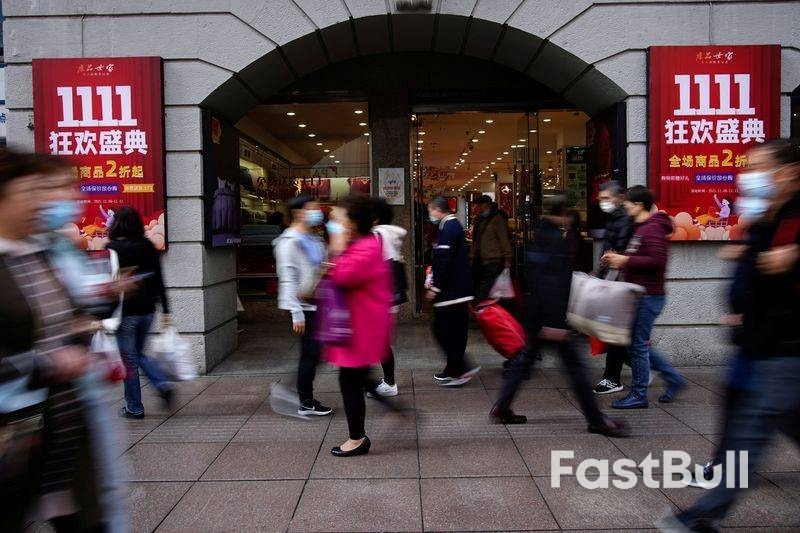
Black Friday? No. Cyber Monday? Nope. Prime Day? Absolutely not. The world's biggest shopping event happens in China each year - and is called Singles' Day.
Originally a holiday to celebrate being single, as a counter to Valentine's Day, the event has grown into a weeks-long online shopping festival that this year began on October 9 and runs through November 11 - making it the longest Singles' Day sales period ever.
The idea for Singles' Day originated at China's Nanjing University back in 1993 and was originally called "Bachelor's Day." On the day, single people treat themselves with gifts and presents, while also organising social gatherings and parties.
Last year, the total value of goods sold during the shopping bonanza - also known as "Double 11" - totaled 1.44 trillion yuan ($202 billion), according to data provider Syntun.
That is almost five times the $41.1 billion U.S. shoppers spent last year during Cyber Week, the period from Black Friday to Cyber Monday, per data from Adobe Analytics.
Cyber Monday immediately follows Black Friday, which falls on the day after the U.S. Thanksgiving Day holiday, the busiest shopping day of the year in the United States.
But growth has been harder to come by for major e-commerce players in China, which have extended their Singles' Day sales period and leaned heavily on subsidies and coupons to entice spending. Last year's sales growth rate of 27% was largely attributed to a longer overall festival period.
This year Alibaba Group pledged 50 billion yuan in subsidies for its 88VIP members over the Singles' Day period.
The event has, in recent years, lost some of its novelty with the rise of other shopping festivals in China, including the midyear "618" sales which is the country's second-largest, and has also lengthened to a weeks-long event.
While Alibaba started "Double 11" in 2009 to win over online shoppers with discounts and promotions, China's major e-commerce platforms now all take part in it.
JD.com joined in 2012 and PDD Holdings-owned Pinduoduo has also become a significant player, offering low-cost products in competition with Alibaba-owned Tmall and Taobao platforms.
Last year, categories covered by a national 150 billion yuan household-appliance-subsidy scheme outperformed. With a higher comparison base this year, those categories are expected to decline. Nomura analysts forecast in October that home appliance sales will fall 20% in the fourth quarter in China.
Instant retail - one-hour delivery of online orders - is also a focus this year. Alibaba and JD.com have poured billions into subsidies throughout 2025 to attract shoppers to rapid-delivery channels, which have been growing faster than e-commerce overall.
Many global companies, from apparel maker Nike to cosmetics firm Estee Lauder and consumer goods giant Procter & Gamble, have a big presence on Chinese e-commerce platforms such as Tmall and JD.com.
Aggressive discounting has been a hallmark of Chinese shopping festivals since pandemic restrictions ended in China in late 2022, though consumption overall has remained sluggish as people save more in the face of macroeconomic challenges and a prolonged property crisis.
According to Alibaba, 35 brands, including Nike, L'Oreal and local firms Anta and Proya, sold more than 100 million yuan of merchandise in the first hour of the sale this year.
At a press conference a few days into its Singles' Day sales period, JD.com said it would list over 100,000 "hit" products at its lowest prices of the year and sell 50,000 pairs of thermal Long Johns at 2 yuan each, shipping included.
Phone sales are expected to be strong this year, given recent launches of Apple's iPhone 17 series and Xiaomi's 17 series in September.
Within the first two hours, sales of iPhone on Apple's Tmall store exceeded the full-day total for the same period last year, according to Alibaba, which did not disclose specific figures.
728 RM B 7/F GEE LOK IND BLDG NO 34 HUNG TO RD KWUN TONG KLN HONG KONG


White Label
Data API
Web Plug-ins
Poster Maker
Affiliate Program
The risk of loss in trading financial instruments such as stocks, FX, commodities, futures, bonds, ETFs and crypto can be substantial. You may sustain a total loss of the funds that you deposit with your broker. Therefore, you should carefully consider whether such trading is suitable for you in light of your circumstances and financial resources.
No decision to invest should be made without thoroughly conducting due diligence by yourself or consulting with your financial advisors. Our web content might not suit you since we don't know your financial conditions and investment needs. Our financial information might have latency or contain inaccuracy, so you should be fully responsible for any of your trading and investment decisions. The company will not be responsible for your capital loss.
Without getting permission from the website, you are not allowed to copy the website's graphics, texts, or trademarks. Intellectual property rights in the content or data incorporated into this website belong to its providers and exchange merchants.
Not Logged In
Log in to access more features

FastBull Membership
Not yet
Purchase


Log In
Sign Up


