Markets
News
Analysis
User
24/7
Economic Calendar
Education
Data
- Names
- Latest
- Prev



Signal Accounts for Members
All Signal Accounts
All Contests


Turkey Trade BalanceA:--
F: --
P: --
Germany Construction PMI (SA) (Nov)A:--
F: --
P: --
Euro Zone IHS Markit Construction PMI (Nov)A:--
F: --
P: --
Italy IHS Markit Construction PMI (Nov)A:--
F: --
P: --
U.K. Markit/CIPS Construction PMI (Nov)A:--
F: --
P: --
France 10-Year OAT Auction Avg. YieldA:--
F: --
P: --
Euro Zone Retail Sales MoM (Oct)A:--
F: --
P: --
Euro Zone Retail Sales YoY (Oct)A:--
F: --
P: --
Brazil GDP YoY (Q3)A:--
F: --
P: --
U.S. Challenger Job Cuts (Nov)A:--
F: --
P: --
U.S. Challenger Job Cuts MoM (Nov)A:--
F: --
P: --
U.S. Challenger Job Cuts YoY (Nov)A:--
F: --
P: --
U.S. Initial Jobless Claims 4-Week Avg. (SA)A:--
F: --
P: --
U.S. Weekly Initial Jobless Claims (SA)A:--
F: --
P: --
U.S. Weekly Continued Jobless Claims (SA)A:--
F: --
P: --
Canada Ivey PMI (SA) (Nov)A:--
F: --
P: --
Canada Ivey PMI (Not SA) (Nov)A:--
F: --
P: --
U.S. Non-Defense Capital Durable Goods Orders Revised MoM (Excl. Aircraft) (SA) (Sept)A:--
F: --
U.S. Factory Orders MoM (Excl. Transport) (Sept)A:--
F: --
P: --
U.S. Factory Orders MoM (Sept)A:--
F: --
P: --
U.S. Factory Orders MoM (Excl. Defense) (Sept)A:--
F: --
P: --
U.S. EIA Weekly Natural Gas Stocks ChangeA:--
F: --
P: --
Saudi Arabia Crude Oil ProductionA:--
F: --
P: --
U.S. Weekly Treasuries Held by Foreign Central BanksA:--
F: --
P: --
Japan Foreign Exchange Reserves (Nov)A:--
F: --
P: --
India Repo RateA:--
F: --
P: --
India Benchmark Interest RateA:--
F: --
P: --
India Reverse Repo RateA:--
F: --
P: --
India Cash Reserve RatioA:--
F: --
P: --
Japan Leading Indicators Prelim (Oct)A:--
F: --
P: --
U.K. Halifax House Price Index YoY (SA) (Nov)--
F: --
P: --
U.K. Halifax House Price Index MoM (SA) (Nov)--
F: --
P: --
France Current Account (Not SA) (Oct)--
F: --
P: --
France Trade Balance (SA) (Oct)--
F: --
P: --
France Industrial Output MoM (SA) (Oct)--
F: --
P: --
Italy Retail Sales MoM (SA) (Oct)--
F: --
P: --
Euro Zone Employment YoY (SA) (Q3)--
F: --
P: --
Euro Zone GDP Final YoY (Q3)--
F: --
P: --
Euro Zone GDP Final QoQ (Q3)--
F: --
P: --
Euro Zone Employment Final QoQ (SA) (Q3)--
F: --
P: --
Euro Zone Employment Final (SA) (Q3)--
F: --
Brazil PPI MoM (Oct)--
F: --
P: --
Mexico Consumer Confidence Index (Nov)--
F: --
P: --
Canada Unemployment Rate (SA) (Nov)--
F: --
P: --
Canada Labor Force Participation Rate (SA) (Nov)--
F: --
P: --
Canada Employment (SA) (Nov)--
F: --
P: --
Canada Part-Time Employment (SA) (Nov)--
F: --
P: --
Canada Full-time Employment (SA) (Nov)--
F: --
P: --
U.S. Dallas Fed PCE Price Index YoY (Sept)--
F: --
P: --
U.S. PCE Price Index YoY (SA) (Sept)--
F: --
P: --
U.S. PCE Price Index MoM (Sept)--
F: --
P: --
U.S. Personal Outlays MoM (SA) (Sept)--
F: --
P: --
U.S. Core PCE Price Index MoM (Sept)--
F: --
P: --
U.S. UMich 5-Year-Ahead Inflation Expectations Prelim YoY (Dec)--
F: --
P: --
U.S. Core PCE Price Index YoY (Sept)--
F: --
P: --
U.S. 5-10 Year-Ahead Inflation Expectations (Dec)--
F: --
P: --
U.S. UMich Current Economic Conditions Index Prelim (Dec)--
F: --
P: --
U.S. UMich Consumer Sentiment Index Prelim (Dec)--
F: --
P: --
U.S. UMich 1-Year-Ahead Inflation Expectations Prelim (Dec)--
F: --
P: --
U.S. UMich Consumer Expectations Index Prelim (Dec)--
F: --
P: --


No matching data
Latest Views
Latest Views
Trending Topics
Top Columnists
Latest Update
White Label
Data API
Web Plug-ins
Affiliate Program
View All

No data
As the chart shows, the Nasdaq 100 index (US Tech 100 mini on FXOpen) has started the week on a positive note amid growing expectations that the longest government shutdown in US history may soon come to an end.
According to Reuters, a bill has been introduced in the Senate proposing amendments to extend government funding until 30 January. The news acted as a bullish catalyst for equity markets. Still, the question remains – is the risk truly behind us?
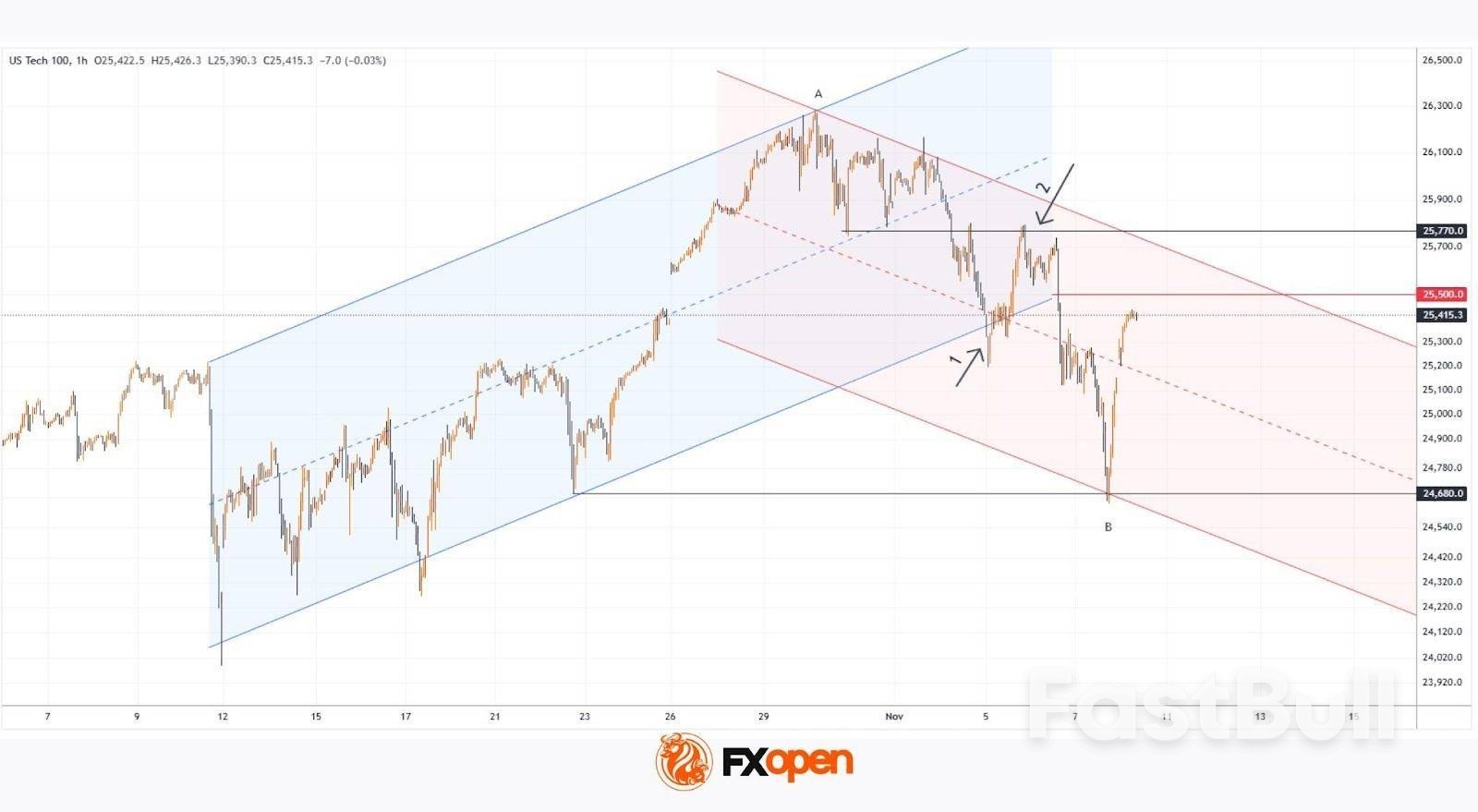
Analysing the hourly chart of the Nasdaq 100 (US Tech 100 mini on FXOpen) on 4 November, we:
→ Drew an ascending channel;
→ Noted signs of momentum exhaustion, as mentioned in our previous headline.
Since then, price action has evolved as follows:
→ The lower boundary of the channel provided support (1), prompting a brief rebound;
→ The 25,770 level acted as resistance (2) on two occasions, strengthening the bears' confidence to push for a downside breakout — which ultimately succeeded.
The index's subsequent movements have now more clearly outlined the formation of a descending channel (shown in red).
From the demand-side perspective:
→ After a false bearish breakout below 24,680 (showing characteristics of a Liquidity Grab pattern), the market staged an aggressive rally from point B;
→ Today's session opened with a bullish gap, and the price has moved above the red median line.
From the supply-side perspective:
→ The 25,500 level, where sellers gained control during the previous channel breakout, may now act as resistance;
→ If the A→B move is viewed as an impulse, today's rally appears to be a corrective rebound consistent with Fibonacci proportions — suggesting that downward momentum could resume within the red channel.
On Monday, gold advanced by more than 1% to 4,050 USD per ounce, reaching a fresh two-week high. The rally was fuelled by mounting concerns over the health of the US economy.
A softening US dollar provided further support for the precious metal, enhancing the affordability of dollar-denominated assets for international buyers.
Data released on Friday revealed that the University of Michigan's consumer sentiment index had fallen to its lowest level in nearly three and a half years. This decline is largely attributed to the ongoing US government shutdown, which has now become the longest in the nation's history. Investors are closely monitoring the situation as the US Senate moves closer to approving a Democratic-backed proposal to reopen the government.
Amid the economic uncertainty, market expectations for the Federal Reserve's next move remain divided. The probability of a 25 basis point rate cut in December is currently priced at approximately 67%, unchanged from the end of last week.
H4 Chart:
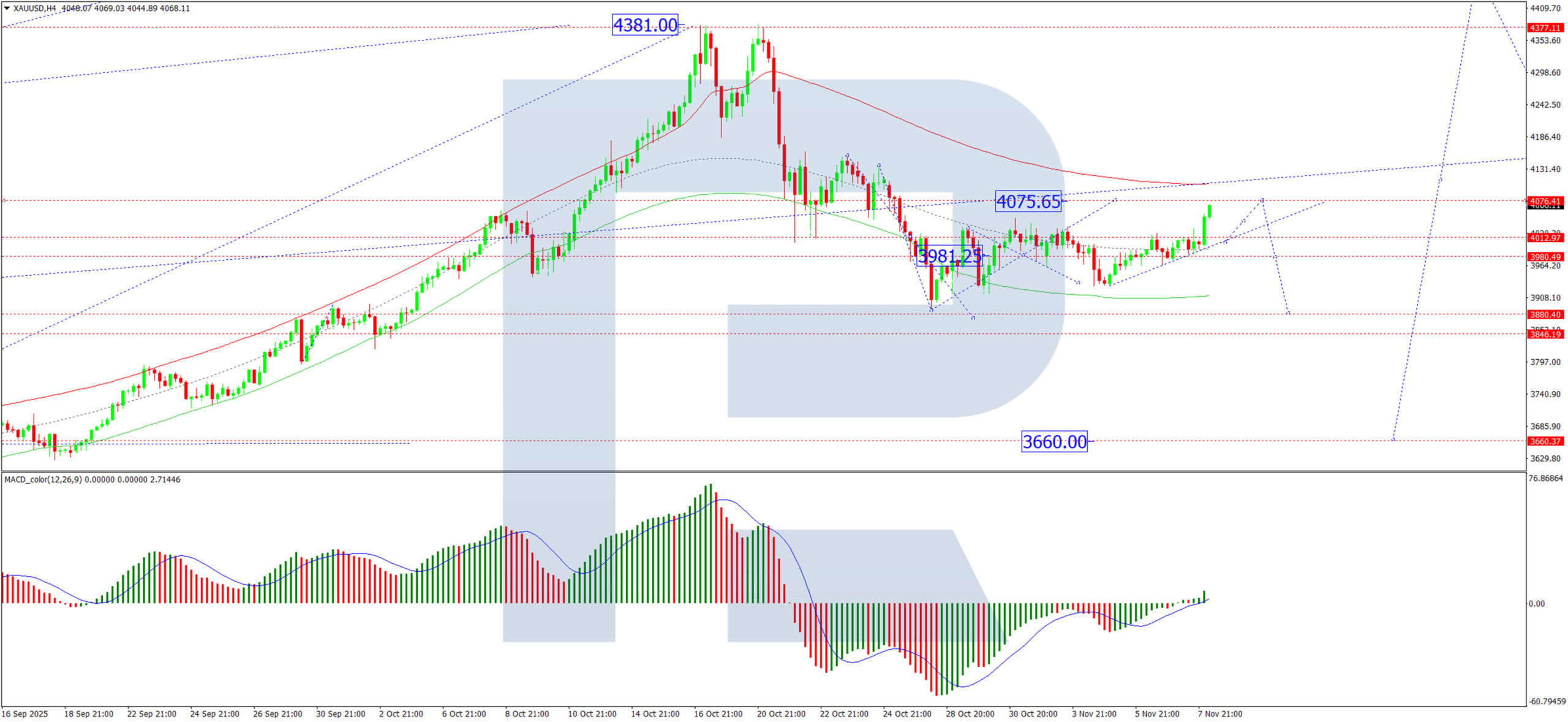
On the H4 chart, XAU/USD is forming a consolidation range around 3,988 USD. A breakout to the upside is expected to initiate a growth wave towards 4,075 USD, which may then be followed by a decline to 4,020 USD (testing the level from below). A subsequent breakdown from this range could extend the correction towards 3,660 USD, where the downward move is anticipated to conclude. This would potentially set the stage for a new upward wave targeting 4,400 USD. The MACD indicator supports this outlook, with its signal line above zero and pointing upward, suggesting continued near-term bullish momentum.
H1 Chart:
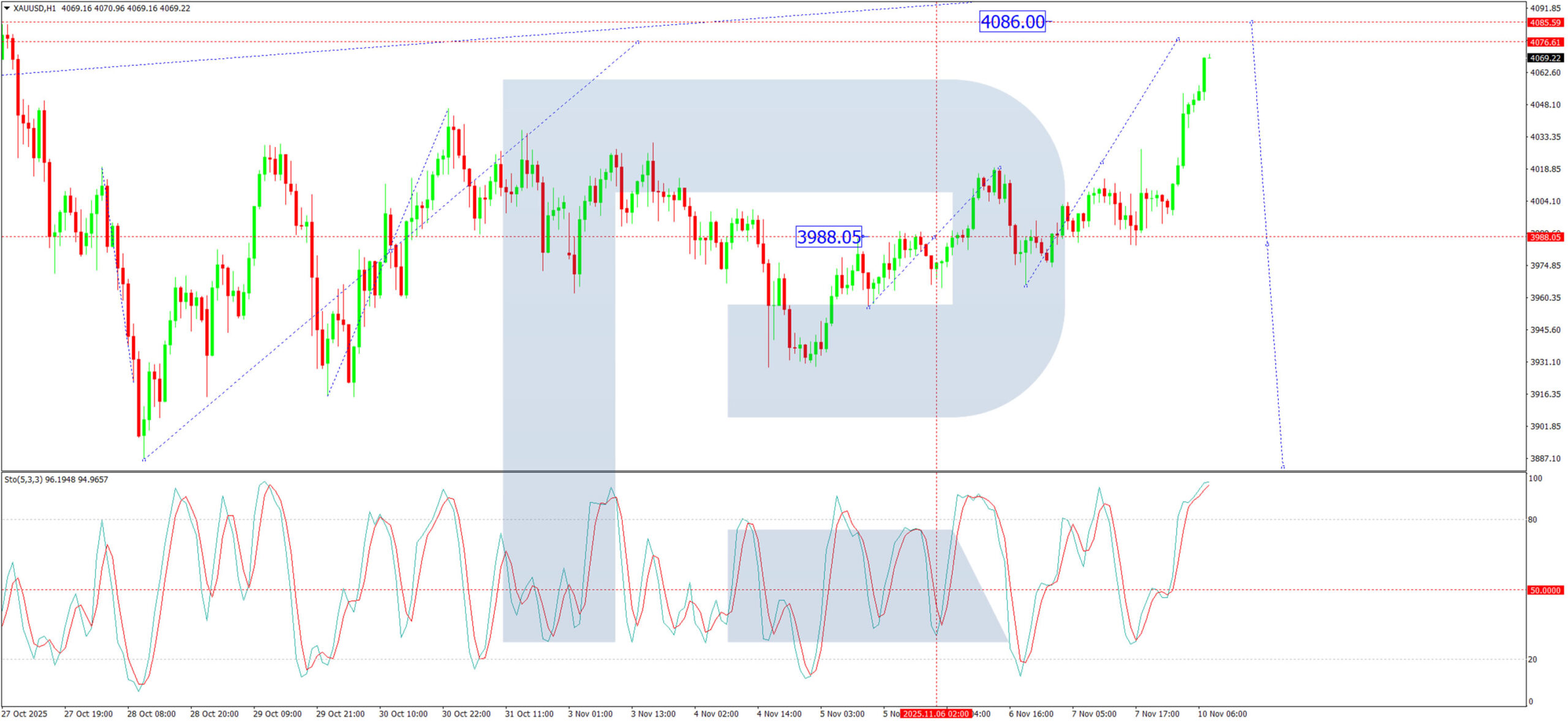
On the H1 chart, the market is also consolidating around 3,988 USD. An upward breakout is likely to propel prices towards 4,075 USD, after which a decline to at least 4,020 USD is expected. The Stochastic oscillator aligns with this view, as its signal line is positioned above 80 and appears poised to reverse downward towards 20, indicating potential for a near-term pullback.
Gold is trading at a two-week high, supported by economic concerns and a weaker US dollar. While the near-term technical structure suggests potential for further gains towards 4,075 USD, a subsequent correction towards 4,020 USD is anticipated. The broader outlook remains constructive, with a deeper corrective move towards 3,660 USD expected to present a buying opportunity ahead of a potential resumption of the broader uptrend.

Developments over the weekend hint at a path to ending the US government shutdown. It seems the prospect of massive flight delays around Thanksgiving and the delay in food aid payments has prompted a group of moderate Democrats to back a proposed compromise bill in the Senate. The compromise is far from meeting the full Democratic demands of a delay in the end of Obamacare healthcare subsidies, and Democrats in the House may still reject the compromise. But the next 48 hours in Congress should tell us whether this initiative has legs. US equity futures are marked close to 1% higher on the news, and Asian equity futures have had a good Monday – helped in part by a proposed dividend tax cut in Korea.
FX markets have responded by taking the risk-sensitive Australian dollar close to 0.5% higher. Remember, we said last week that a cross-rate like AUD/JPY had the highest correlation with the US Nasdaq index, which is marked some 1.2% higher today. USD/JPY is pushing over 154 again, and the prospect of a December Bank of Japan rate hike is being swamped by the use of the yen as a funding currency.
While some might argue that the end of the shutdown could be a risk-on, dollar-negative impulse for the FX markets, its impact may be more mixed. Late last week, the dollar was under pressure on job layoffs and rhetoric that the US economy could contract in the fourth quarter should the shutdown extend. At the same time, Friday's release of poor US consumer sentiment data was read as a dollar negative. Progress to end the shutdown may be felt more by risk-sensitive FX cross rates than the dollar.
Away from politics, it is an exceptionally quiet week for US data, and tomorrow the US observes the Veterans' Day public holiday. Where there is data, the focus will be on tomorrow's release of the NFIB small business optimism index. Plus, there are quite a few Federal Reserve speakers. The probability of a December 25bp Fed cut has dropped to 64%. And without US data, that probability may drop close to 50% as Fed speakers generally point to the need to go slow in cutting rates.
If last week's 100.36 high in DXY is to prove significant, it should not really be making it back above the 99.90/100.00 area now.
EUR/USD is becalmed after finding support below 1.15 last week. Most probably think that 1.15 proves the bottom of the range, but the rally needs a helping hand. One source of that could be an end to the government shutdown and the release of delayed US data, such as the September or October US non-farm payrolls report. But frankly, that feels like clutching at straws as we start the week.
In terms of eurozone data this week, we've got some investor sentiment data both in the form of the Sentix data at 10:30am CET today and the German ZEW tomorrow. And later this week, we should also see third-quarter eurozone GDP data confirmed at 0.2% quarter-on-quarter.
Again, if last week's 1.1470 low is to prove significant, EUR/USD should somehow find support at 1.1515/1530 through the early part of this week.
EUR/GBP is back below 0.88 again as GBP/USD seems to find good demand under 1.31. We still think the prospects of a December 25bp cut from the Bank of England are underpriced. The market now attaches just a 60% probability to such an outcome.
Feeding into the BoE story will be tomorrow's release of the September wage data. This is expected to slow further and give the BoE greater confidence that inflation is less persistent than first thought.
Expect EUR/GBP to meet good demand at 0.8750/60 should it make it that low. We prefer levels above 0.88 now.
After a busy week of central bank meetings, attention will shift to inflation figures in the CEE region. Tomorrow, October's data will be released in Hungary, where we expect only a small change from 4.3% to 4.4% year-on-year. Underlying price pressures still do not favour a change in monetary policy, as we see core inflation moving above 4% again. In the Czech Republic, final inflation figures will also be released, providing a detailed breakdown.
On Wednesday, Romania will also release October inflation, which we expect to slow down slightly from 9.9% to 9.7%, after a September peak. The National Bank of Romania will also make a decision on the same day, but that should be a non-event with rates unchanged at 6.50%.
On Thursday and Friday, Poland and Romania will release third-quarter GDP figures, where we expect some recovery in both cases. On Friday, the Czech National Bank will release the minutes of its last meeting, and Turkey will release inflation expectations.
CEE currencies have had a decent week, with the Hungarian forint remaining the leader of the pack with new highs on Friday. EUR/USD reversal provides something of a boost for the region, while the market is in no hurry to price in more rate cuts following last week's central bank meetings in the Czech Republic and Poland last week. EUR/HUF approached 384 on Friday, and the forint rally seems too fast for us.
On the other hand, on Friday, we saw talks between US President Donald Trump and Hungarian Prime Minister Viktor Orbán providing an exemption from US sanctions on Russian energy, which should be good news for the markets. We therefore remain slightly bullish on HUF, but it would not be surprising to see some correction of Friday's rally today. Overall, though, the conditions for the CEE region remain slightly bullish in our opinion, and we could see some gains this week as well.
U.S. exporters of agricultural goods to China are optimistic that trade between the two countries will return to normalcy after a framework agreement reached last month by their leaders, according to several exporters and industry officials.
The mood this year in the U.S. pavilion at the China International Import Expo (CIIE), China's largest import expo, which began on November 5 and wraps up in Shanghai on Monday, is positive.
"I think people are very hopeful," Jeffrey Lehman, chair of the American Chamber of Commerce in Shanghai, which counts over 1,000 companies among its members, told Reuters at the U.S. Pavilion, which housed exhibits from industry bodies dealing in wine, ginseng, potatoes and more, and was 50% larger than last year's.
"I think the reason why they're here is because they want to engage with new customers. They want to find new opportunities for partnership, and I think they're here because they think that's going to happen," he added.
CIIE kicked off just a week after a meeting between Chinese President Xi Jinping and U.S. President Donald Trump in South Korea that led to a framework agreement to roll back a number of tariffs and export control measures that had been put into place this year, including some that had overtly impacted exhibitors of agricultural products such as soybeans and sorghum.
"We just had this successful meeting in Busan, and so we're celebrating that, but (we) had plans to come even before that meeting. I think that's important to note that we didn't give up on the relationship, that we were working to maintain and continue to strengthen the relationship, even if there were some troubles," said Jim Sutter, CEO of the U.S. Soybean Export Council.
China had shunned soybean purchases from the U.S. 2025 harvest amid rising trade tensions between the two countries but has resumed purchases recently.
Mark Wilson, chairman of the U.S. Grains and BioProducts Council, pointed to recent shipments of soybeans and sorghum bought by China as a positive signal for future trade returning to normal. Prior to this year, China accounted for 95% of the U.S. export market for sorghum, he added.
"I do have hope that they continue talking, because if they can continue talking, they can hopefully work things out, because that's what it takes," Wilson said.
Despite optimism from the U.S. agricultural associations in Shanghai, analysts say the latest trade détente hammered out by Xi and Trump may be no more than a fragile truce in a trade war with root causes still unresolved.
U.S. soybeans still face a 13% tariff, which analysts say makes U.S. shipments to China too expensive for commercial buyers, compared to Brazilian alternatives.
CIIE was launched under President Xi Jinping in 2018 to promote China's free trade credentials and counter criticism of its trade surplus with many countries.
But the expo has its sceptics, as the country's trade surpluses with other markets have only grown in the years since.
China's trade surplus is set to exceed last year's record of roughly $1 trillion as exporters offset a plunge in U.S. sales due to higher U.S. tariffs by selling more to the rest of the world, often at a loss in pursuit of market share.

More than 155 countries, regions and organisations participated in this year's CIIE, the commerce ministry said. Over 4,100 overseas enterprises took part, with U.S. companies maintaining the largest exhibition area for the seventh consecutive year.
This year's expo generated intended turnover of $83.49 billion, an increase of 4.4% over last year and a record high, state media reported.
White Label
Data API
Web Plug-ins
Poster Maker
Affiliate Program
The risk of loss in trading financial instruments such as stocks, FX, commodities, futures, bonds, ETFs and crypto can be substantial. You may sustain a total loss of the funds that you deposit with your broker. Therefore, you should carefully consider whether such trading is suitable for you in light of your circumstances and financial resources.
No decision to invest should be made without thoroughly conducting due diligence by yourself or consulting with your financial advisors. Our web content might not suit you since we don't know your financial conditions and investment needs. Our financial information might have latency or contain inaccuracy, so you should be fully responsible for any of your trading and investment decisions. The company will not be responsible for your capital loss.
Without getting permission from the website, you are not allowed to copy the website's graphics, texts, or trademarks. Intellectual property rights in the content or data incorporated into this website belong to its providers and exchange merchants.
Not Logged In
Log in to access more features

FastBull Membership
Not yet
Purchase
Log In
Sign Up