• Trade
  • Markets
  • Copy
  • Contests
  • News
  • 24/7
  • Calendar
  • Q&A
  • Chats
Trending
Screeners
SYMBOL
LAST
BID
ASK
HIGH
LOW
NET CHG.
%CHG.
SPREAD
SPX
S&P 500 Index
6857.13
6857.13
6857.13
6865.94
6827.13
+7.41
+ 0.11%
--
DJI
Dow Jones Industrial Average
47850.93
47850.93
47850.93
48049.72
47692.96
-31.96
-0.07%
--
IXIC
NASDAQ Composite Index
23505.13
23505.13
23505.13
23528.53
23372.33
+51.04
+ 0.22%
--
USDX
US Dollar Index
98.890
98.970
98.890
98.980
98.890
-0.090
-0.09%
--
EURUSD
Euro / US Dollar
1.16538
1.16545
1.16538
1.16555
1.16408
+0.00093
+ 0.08%
--
GBPUSD
Pound Sterling / US Dollar
1.33387
1.33398
1.33387
1.33391
1.33165
+0.00116
+ 0.09%
--
XAUUSD
Gold / US Dollar
4215.69
4216.14
4215.69
4218.25
4194.54
+8.52
+ 0.20%
--
WTI
Light Sweet Crude Oil
59.270
59.307
59.270
59.469
59.187
-0.113
-0.19%
--

Community Accounts

Signal Accounts
--
Profit Accounts
--
Loss Accounts
--
View More

Become a signal provider

Sell trading signals to earn additional income

View More

Guide to Copy Trading

Get started with ease and confidence

View More

Signal Accounts for Members

All Signal Accounts

Best Return
  • Best Return
  • Best P/L
  • Best MDD
Past 1W
  • Past 1W
  • Past 1M
  • Past 1Y

All Contests

  • All
  • Trump Updates
  • Recommend
  • Stocks
  • Cryptocurrencies
  • Central Banks
  • Featured News
Top News Only
Share

India's NIFTY IT Index Last Up 1.3%

Share

India's Nifty 50 Index Rises 0.35%

Share

Israel Sets 2026 Defence Budget At $34 Billion

Share

Russia Says Azov Sea's Port Of Temryuk Damaged In Ukrainian Attack

Share

Israel's Defense Budget For 2026 Will Be 112 Billion Israeli Shekels - Defense Minister Office

Share

One India Rate Panel Member Ram Singh Was Of View That Stance Should Be Changed To 'Accommodative' From 'Neutral' - Monetary Policy Committee Statement

Share

Reserve Bank Of India Chief: Will Continue To Meet Productive Needs Of Economy In Proactive Manner

Share

Reserve Bank Of India Chief: System Level Financial Parameters Of Nbfcs Sound

Share

Reserve Bank Of India Chief: Dollar Rupee Swap To Be For 3 Years, To Be Conducted This Month

Share

India's Nifty Realty Index Extend Gains, Last Up 1.4%

Share

India's Nifty Psu Bank Index Rises 1%

Share

Reserve Bank Of India Chief: Commited To Providing Sufficient Durable Liquidity

Share

Reserve Bank Of India Chief: Transmission Has Been Broad Based Across Sectors, Satisfactory

Share

Reserve Bank Of India Chief: As Of Nov 28, India's Forex Reserves Stood At $686 Billion

Share

Reserve Bank Of India Chief: Healthy Services Exports With Strong Remittances To Keep Cad Modest In This Year

Share

Reserve Bank Of India Chief: CPI Inflation Seen At 0.6% In Q3 Fy26

Share

Reserve Bank Of India Chief: Fy26 CPI Inflation Seen At 2% Versus 2.6% Previously

Share

India's Nifty Realty Index Up 1% After Reserve Bank Of India's Rate Cut

Share

India's Nifty Psu Bank Index Turns Positive, Up 0.43% After Reserve Bank Of India's Rate Cut

Share

Reserve Bank Of India Chief: Merchandise Exports Face Some Headwinds

TIME
ACT
FCST
PREV
Turkey Trade Balance

A:--

F: --

P: --

Germany Construction PMI (SA) (Nov)

A:--

F: --

P: --

Euro Zone IHS Markit Construction PMI (Nov)

A:--

F: --

P: --

Italy IHS Markit Construction PMI (Nov)

A:--

F: --

P: --

U.K. Markit/CIPS Construction PMI (Nov)

A:--

F: --

P: --

France 10-Year OAT Auction Avg. Yield

A:--

F: --

P: --

Euro Zone Retail Sales MoM (Oct)

A:--

F: --

P: --

Euro Zone Retail Sales YoY (Oct)

A:--

F: --

P: --

Brazil GDP YoY (Q3)

A:--

F: --

P: --

U.S. Challenger Job Cuts (Nov)

A:--

F: --

P: --

U.S. Challenger Job Cuts MoM (Nov)

A:--

F: --

P: --

U.S. Challenger Job Cuts YoY (Nov)

A:--

F: --

P: --

U.S. Initial Jobless Claims 4-Week Avg. (SA)

A:--

F: --

P: --

U.S. Weekly Initial Jobless Claims (SA)

A:--

F: --

P: --

U.S. Weekly Continued Jobless Claims (SA)

A:--

F: --

P: --

Canada Ivey PMI (SA) (Nov)

A:--

F: --

P: --

Canada Ivey PMI (Not SA) (Nov)

A:--

F: --

P: --

U.S. Non-Defense Capital Durable Goods Orders Revised MoM (Excl. Aircraft) (SA) (Sept)

A:--

F: --

P: --
U.S. Factory Orders MoM (Excl. Transport) (Sept)

A:--

F: --

P: --

U.S. Factory Orders MoM (Sept)

A:--

F: --

P: --

U.S. Factory Orders MoM (Excl. Defense) (Sept)

A:--

F: --

P: --

U.S. EIA Weekly Natural Gas Stocks Change

A:--

F: --

P: --

Saudi Arabia Crude Oil Production

A:--

F: --

P: --

U.S. Weekly Treasuries Held by Foreign Central Banks

A:--

F: --

P: --

Japan Foreign Exchange Reserves (Nov)

A:--

F: --

P: --

India Repo Rate

A:--

F: --

P: --

India Benchmark Interest Rate

A:--

F: --

P: --

India Reverse Repo Rate

A:--

F: --

P: --

India Cash Reserve Ratio

A:--

F: --

P: --

Japan Leading Indicators Prelim (Oct)

A:--

F: --

P: --

U.K. Halifax House Price Index YoY (SA) (Nov)

--

F: --

P: --

U.K. Halifax House Price Index MoM (SA) (Nov)

--

F: --

P: --

France Current Account (Not SA) (Oct)

--

F: --

P: --

France Trade Balance (SA) (Oct)

--

F: --

P: --

France Industrial Output MoM (SA) (Oct)

--

F: --

P: --

Italy Retail Sales MoM (SA) (Oct)

--

F: --

P: --

Euro Zone Employment YoY (SA) (Q3)

--

F: --

P: --

Euro Zone GDP Final YoY (Q3)

--

F: --

P: --

Euro Zone GDP Final QoQ (Q3)

--

F: --

P: --

Euro Zone Employment Final QoQ (SA) (Q3)

--

F: --

P: --

Euro Zone Employment Final (SA) (Q3)

--

F: --

P: --
Brazil PPI MoM (Oct)

--

F: --

P: --

Mexico Consumer Confidence Index (Nov)

--

F: --

P: --

Canada Unemployment Rate (SA) (Nov)

--

F: --

P: --

Canada Labor Force Participation Rate (SA) (Nov)

--

F: --

P: --

Canada Employment (SA) (Nov)

--

F: --

P: --

Canada Part-Time Employment (SA) (Nov)

--

F: --

P: --

Canada Full-time Employment (SA) (Nov)

--

F: --

P: --

U.S. Dallas Fed PCE Price Index YoY (Sept)

--

F: --

P: --

U.S. PCE Price Index YoY (SA) (Sept)

--

F: --

P: --

U.S. PCE Price Index MoM (Sept)

--

F: --

P: --

U.S. Personal Outlays MoM (SA) (Sept)

--

F: --

P: --

U.S. Core PCE Price Index MoM (Sept)

--

F: --

P: --

U.S. UMich 5-Year-Ahead Inflation Expectations Prelim YoY (Dec)

--

F: --

P: --

U.S. Core PCE Price Index YoY (Sept)

--

F: --

P: --

U.S. 5-10 Year-Ahead Inflation Expectations (Dec)

--

F: --

P: --

U.S. UMich Current Economic Conditions Index Prelim (Dec)

--

F: --

P: --

U.S. UMich Consumer Sentiment Index Prelim (Dec)

--

F: --

P: --

U.S. UMich 1-Year-Ahead Inflation Expectations Prelim (Dec)

--

F: --

P: --

U.S. UMich Consumer Expectations Index Prelim (Dec)

--

F: --

P: --

Q&A with Experts
    • All
    • Chatrooms
    • Groups
    • Friends
    Connecting
    .
    .
    .
    Type here...
    Add Symbol or Code

      No matching data

      All
      Trump Updates
      Recommend
      Stocks
      Cryptocurrencies
      Central Banks
      Featured News
      • All
      • Russia-Ukraine Conflict
      • Middle East Flashpoint
      • All
      • Russia-Ukraine Conflict
      • Middle East Flashpoint

      Search
      Products

      Charts Free Forever

      Chats Q&A with Experts
      Screeners Economic Calendar Data Tools
      Membership Features
      Data Warehouse Market Trends Institutional Data Policy Rates Macro

      Market Trends

      Market Sentiment Order Book Forex Correlations

      Top Indicators

      Charts Free Forever
      Markets

      News

      News Analysis 24/7 Columns Education
      From Institutions From Analysts
      Topics Columnists

      Latest Views

      Latest Views

      Trending Topics

      Top Columnists

      Latest Update

      Signals

      Copy Rankings Latest Signals Become a signal provider AI Rating
      Contests
      Brokers

      Overview Brokers Assessment Rankings Regulators News Claims
      Broker listing Forex Brokers Comparison Tool Live Spread Comparison Scam
      Q&A Complaint Scam Alert Videos Tips to Detect Scam
      More

      Business
      Events
      Careers About Us Advertising Help Center

      White Label

      Data API

      Web Plug-ins

      Affiliate Program

      Awards Institution Evaluation IB Seminar Salon Event Exhibition
      Vietnam Thailand Singapore Dubai
      Fans Party Investment Sharing Session
      FastBull Summit BrokersView Expo
      Recent Searches
        Top Searches
          Markets
          News
          Analysis
          User
          24/7
          Economic Calendar
          Education
          Data
          • Names
          • Latest
          • Prev

          View All

          No data

          Scan to Download

          Faster Charts, Chat Faster!

          Download App
          English
          • English
          • Español
          • العربية
          • Bahasa Indonesia
          • Bahasa Melayu
          • Tiếng Việt
          • ภาษาไทย
          • Français
          • Italiano
          • Türkçe
          • Русский язык
          • 简中
          • 繁中
          Open Account
          Search
          Products
          Charts Free Forever
          Markets
          News
          Signals

          Copy Rankings Latest Signals Become a signal provider AI Rating
          Contests
          Brokers

          Overview Brokers Assessment Rankings Regulators News Claims
          Broker listing Forex Brokers Comparison Tool Live Spread Comparison Scam
          Q&A Complaint Scam Alert Videos Tips to Detect Scam
          More

          Business
          Events
          Careers About Us Advertising Help Center

          White Label

          Data API

          Web Plug-ins

          Affiliate Program

          Awards Institution Evaluation IB Seminar Salon Event Exhibition
          Vietnam Thailand Singapore Dubai
          Fans Party Investment Sharing Session
          FastBull Summit BrokersView Expo

          Light At The End Of The Government Shutdown Tunnel

          Pepperstone

          Forex

          Political

          Economic

          Summary:

          The Deal The deal that's been cut, largely, mirrors that which was reported by a host of media outlets towards the start of last

          The Deal

          The deal that's been cut, largely, mirrors that which was reported by a host of media outlets towards the start of last week, with negotiations having progressed in earnest since then.

          Put simply, the bipartisan agreement would pave the way for a '3+1' legislative package – namely, a continuing resolution to provide funding to federal agencies until 30th January, along with three 'mini-bus' bills that would fund the Department of Agriculture, Department of Veterans Affairs, and Congressional operations for the entirety of the current fiscal year. In return for their votes, Democrats have obtained a promise from the Trump Admin to rehire federal workers that were fired at the start of the shutdown last month, as well as the promise of a floor vote in the Senate on extending expiring Obamacare tax credits.

          The Vote

          That deal has already cleared an important procedural milestone in the Senate, with the upper house voting 60-40 in favour of advancing a stopgap funding bill that was passed in the house many weeks ago. This bill, for simplicity's sake, is being used as a vehicle for the aforementioned deal, with that framework now to be amended into the text of the aforementioned stopgap measure.

          While that milestone is important, there remain many more hurdles that must be cleared, before federal funding can be restored. The Senate, firstly, must move to a final vote on the spending package which, while possible as soon as today, could be held up by any single Senator refusing to yield back time on the floor. In any case, once the Senate have signed off on the package, the House must also give it the nod, which could also be anything but a quick feat, given that Representatives remain out of town, as they have been since mid-September, and with numerous air travel issues (resulting from the shutdown) complicating their return to DC.

          Impact

          Assuming that, eventually, the above package receives the requisite number of votes in both chambers of Congress, focus among market participants will turn to the impact of the shutdown, both that which has already been wrought, and what may now lie ahead.

          In terms of the impact already seen, it has typically been the 'rule of thumb' that every week of a shutdown subtracts around 0.1pp from US GDP growth in the quarter in question, with the sum total of that lost output then recouped the following month. Arguably, the economic hit from the current shutdown, in the last week or so at least, could be somewhat larger, given factors like the mounting number of air traffic delays.

          As for other areas of the economy, while consumer confidence has taken a substantial hit amid the impasse in Washington DC, with the UMich index falling close to record lows per the preliminary November reading, this has demonstrated little by way of statistically significant correlation with consumer spending for much of the cycle. Furthermore, with the aforementioned agreement including a commitment to full back pay for laid off federal workers, another potential downside consumption risk has been removed.

          In terms of the labour market, it's clear that the October jobs report (more on which below) is going to be an incredibly messy one. Those laid-off federal workers alone, amounting to around 700k, would probably push the headline U-3 unemployment rate to around 4.8%, before one considers any potential related job losses that may have also stemmed from a lack of federal funding. This could also skew the November jobs report as well, depending on the exact timing of the government re-opening, with this week being the reference week for that report. That said, in a similar manner to how lost economic output will be recouped, one would expect the majority of these workers to return to payrolls in short order, if not immediately, once the shutdown comes to an end.

          Data Interruptions To Continue

          Speaking of economic data, even though the government may soon re-open, that does not mean that all of those delayed economic releases will magically be released all of a sudden.

          In terms of employment data, the BLS are likely to be able to release the September jobs report relatively rapidly (it took just 3 working days after the 2013 shutdown ended), with the data having already been collected, and compiled. The October jobs report, though, is a different kettle of fish, with no data collection having taken place amid the shutdown meaning that, while the BLS will now send out the usual surveys upon re-opening, they will be asking the population to reflect on employment conditions around 4 weeks ago, naturally leading to concern over how accurate the data is likely to be. The same applies to the November jobs report, data for which is due to be collected this week, and which may also be delayed depending on when funding is restored.

          The impact of the shutdown on other economic releases is likely to be more significant, and longer-lasting. On inflation, for instance, data for the CPI and PPI reports, and by extension the PCE report, is collected throughout the entirety of the month, with some price data for CPI still collected by physically visiting various outlets. While the BLS could estimate the data that was missing, it seems highly unlikely that the agency would want to go down that path. This raises the risk that the BLS, instead, decide that they are unable to publish CPI data for October, with there also being the potential for the November report never to see the light of day, depending on exactly when the government re-opens.

          Of course, we await confirmation from the agencies in question as to precise data collection, and publication, schedules as and when funding is restored. However, it seems highly likely that interruptions to the usual data docket will persist into the early part of next year, meaning that policymakers and market participants alike are likely to be 'flying blind' for some time to come.

          Looking Ahead

          Naturally, markets have reacted positively to news that the government may soon re-open, with equity futures gaining ground, the dollar a touch firmer, and Treasuries softer across the curve.

          This, while potentially an obvious reaction, does make considerable sense, given that restoration of funding would remove a significant growth headwind, but also a huge chunk of uncertainty which had increasingly been clouding the outlook, allowing participants to re-focus on what remains a solid bull case of the underlying economy remaining robust, earnings growth proving resilient, the monetary backdrop continuing to loosen, and a calmer tone being taken on trade.

          As and when the government re-opens, however, the assumptions underpinning that bull case will now come under the microscope. While we have all, using various private sector data as proxies, operated on the assumption that little has changed with the economy over the last six weeks or so, we may finally soon have some data to prove, or disprove, that theory. There is also the question of the monetary policy backdrop where my base case remains that the Fed will deliver another 25bp cut at the December meeting, despite Chair Powell noting that such a decision is 'far form' a foregone conclusion. Should incoming labour data point to the jobs market continuing to stagnate, as is likely, such a cut is likely to become much more of a 'done deal', opening the door to a potential dovish repricing of rate expectations, with the USD OIS curve implying just a 2-in-3 chance of another cut by year-end.

          Source: Pepperstone

          To stay updated on all economic events of today, please check out our Economic calendar
          Risk Warnings and Disclaimers
          You understand and acknowledge that there is a high degree of risk involved in trading. Following any strategies or investment methods may lead to potential losses. The content on the site is provided by our contributors and analysts for information purposes only. You are solely responsible for determining whether any trading assets, securities, strategy, or any other product is suitable for investing based on your own investment objectives and financial situation.
          Add to Favorites
          Share

          Some Relief

          Justin

          Commodity

          Forex

          Political

          Economic

          Last week was a tough one: it was marked by a cocktail of rare but discouraging US data. Falling yields failed to lift risk appetite, and better-than-expected tech earnings couldn't lure investors back on board. OpenAI even suggested that the US could warrant its trillion-dollar debt — I mean, it was a disaster.

          But this morning, things look calmer. The news that the US government shutdown could finally come to an end lifts market sentiment, after the Senate put together the 60 votes needed to push the deal through its first stage. It's only the opening act in what could still be a drawn-out political drama, but investors are seizing on any sign of progress to end the longest US government shutdown in history and feed on data — data they need to understand where the US economy stands, where inflation and jobs are headed, and what the Federal Reserve (Fed) should do next.

          Speaking of the Fed: some members are cautious, while others appear to be giving more weight to inflation than the weakening jobs market. Last week's Challenger report printed the highest job losses in October since 2003, and Friday's University of Michigan survey hinted at deteriorating sentiment, gloomy expectations, and a mixed inflation outlook, with 1-year inflation expectations rising to 4.7%. It's a close call.

          Yet the secured overnight financing rate (SOFR) tumbled last week below 4%, the lowest in three years. That's not because the Fed decided to cut it — SOFR isn't something the Fed fixes directly. It's a market-driven rate reflecting what banks and investors charge each other for overnight cash secured by Treasuries. When there's plenty of liquidity sloshing around, the rate naturally drops. And there is excess cash in the system: nearly $7.5 trillion sits in US money-market funds, while US Treasury auctions have been thinner — partly because the looming government shutdown complicated issuance plans. In other words, the Fed hasn't pulled the lever — the market has, reacting to all the excess cash. This higher liquidity could give risk assets a lift this week, if the news flow remains calm.

          Futures are hinting at an encouraging start, and if the US government can reopen, it would be the cherry on top. The S&P 500 has rebounded around 2% since rumours of a potential shutdown end broke last Friday.

          Add to that Jensen Huang's comments at TSMC's annual sports day on Saturday — saying "the business is very strong, and it's growing month by month, stronger and stronger," and that they need more chips from TSMC — and investors are forgetting last week's drama. TSMC is up more than 1%, SoftBank jumps 2.5%, Korean SK Hynix is up more than 5% and Nasdaq futures lead gains. Hopefully it lasts!

          In FX, the US dollar is steady this morning. The greenback came under renewed selling pressure last week after failing to break the back of the 200-DMA. The end of the US shutdown should — in theory — give a positive jolt to the dollar and challenge some technical levels against major currencies. The EURUSD last week tested support near the minor 23.6% Fibonacci retracement on the year-to-date rally, around 1.1480. Cable dived but returned above the 38.2% retracement on its own year-to-date rally and the USDJPY initially fell on the Finance Minister showing teeth to the bears. But JPY bears are back since Friday, helping support the US dollar, alongside a jump in US yields this morning that prints a roughly 1% rise across the curve.

          US economic data is light this week due to ongoing shutdown, but earnings from Nvidia-backed neocloud provider CoreWeave, Cisco and Disney will be in focus, along with 13F filings due Friday. Michael Burry's large position against Nvidia and Palantir contributed to last week's risk-off sentiment. Investors will look for evidence of lower exposure or continued bets against tech giants.

          Elsewhere, Chinese inflation unexpectedly rose last month, as factory-gate deflation eased. Unlike the West, which doesn't need more inflation, this is good news for China — they've been trying to boost consumption for years, and production prices have been falling for almost three years. That said, the October surprise could be temporary, partly due to the Golden Week holiday lasting an extra day.

          Still, US crude is better bid this morning, above $60pb, probably helped by encouraging inflation data from China. But US crude remains under pressure within a longer-term negative trend since summer, influenced by OPEC's strategy to release more barrels. The cartel has now announced a pause in output increases between January and March, and this Wednesday's monthly oil report should provide further clarity: will OPEC try to set a floor under prices, or continue letting them slide to gain market share?

          Source: ACTIONFOREX

          To stay updated on all economic events of today, please check out our Economic calendar
          Risk Warnings and Disclaimers
          You understand and acknowledge that there is a high degree of risk involved in trading. Following any strategies or investment methods may lead to potential losses. The content on the site is provided by our contributors and analysts for information purposes only. You are solely responsible for determining whether any trading assets, securities, strategy, or any other product is suitable for investing based on your own investment objectives and financial situation.
          Add to Favorites
          Share

          Japan Signals Pro-Growth Shift as Takaichi's Stimulus Draft Calls for Extended BOJ Support

          Gerik

          Economic

          Takaichi Administration Prepares Pro-Growth Stimulus with BOJ Alignment

          Japan’s government under newly appointed Prime Minister Sanae Takaichi is poised to unveil a wide-ranging economic stimulus package that will, according to a draft outline obtained by Reuters, formally encourage the Bank of Japan (BOJ) to prioritize boosting economic growth alongside price stability. This policy orientation underscores a coordinated fiscal-monetary strategy, with a clear preference for continued accommodative monetary conditions amid lingering economic fragility.
          This draft marks the first significant economic move by the Takaichi administration and may shape the tone of Japanese economic policy for the coming quarters. The government is expected to finalize the stimulus package on November 21.

          Monetary Policy Guidance Reflects Growth-Centric Stance

          The draft explicitly states the importance of guiding monetary policy to achieve "strong economic growth and price stability." Such language reflects a subtle but strategic recalibration in Japan’s policy direction. Rather than focusing narrowly on inflation targets or fiscal consolidation, the government signals an intent to actively coordinate with the BOJ to ensure Japan avoids a return to deflation and instead enters a phase of sustained, stable growth.
          This aligns with Prime Minister Takaichi’s apparent view that premature tightening of monetary policy could jeopardize Japan’s fragile recovery. The encouragement for the BOJ to remain accommodative is thus a proactive attempt to shape policy expectations and mitigate the risks associated with tightening financial conditions globally.
          While the causal link between monetary policy and long-term economic growth remains debated among economists, Japan’s policy trajectory has historically leaned on low interest rates and quantitative easing as tools to combat stagnation. In this context, the government's messaging seeks to maintain this environment rather than risk volatility through abrupt policy normalization.

          Stimulus Content Targets Households, Strategic Investment, and Defence

          The outline reveals that the stimulus will include targeted support for households grappling with rising living costs, which have been exacerbated by commodity price shocks and a weak yen. This component acknowledges the real-time pressures on domestic consumption and attempts to alleviate immediate financial stress on families.
          In parallel, the package will also promote investment in crisis management infrastructure and strategic growth sectors. According to the Nikkei, the plan involves tax cuts aimed at bolstering 17 priority industries, although these sectors were not specified in the draft. These measures indicate a dual intention: to address short-term pain and to enhance Japan’s long-term competitiveness through selective industrial policy.
          Additionally, the package includes a notable commitment to expanding Japan's defense capabilities, likely in response to rising geopolitical tensions in East Asia. This reflects a broader strategic pivot in Japanese policy, where economic stimulus is being coupled with national security objectives.
          This multi-pronged structure suggests a complex policy rationale: short-term consumption support is intended to stimulate demand, while long-term industrial and defense investments aim to enhance resilience. The government appears to be treating growth as both an economic and geopolitical imperative.

          Coordinated Fiscal and Monetary Messaging May Shape BOJ Policy

          Although the Bank of Japan maintains operational independence, government encouragement especially when formalized in stimulus packages—exerts indirect pressure on central bank strategy. The BOJ has recently signaled a clearer economic outlook, but inflation remains below target and wage growth modest. The government's draft indicates a preference for the BOJ to hold interest rates low and avoid actions that could stall momentum.
          This reflects a coordinated approach reminiscent of past Japanese policy eras when "Abenomics" similarly combined fiscal stimulus with ultra-loose monetary policy. The difference now lies in the current inflationary context: while Japan is no longer facing outright deflation, policymakers remain cautious about tightening prematurely.
          The relationship between this guidance and BOJ policy can be described as politically strategic rather than legally binding. The government is setting expectations that may influence future central bank communications or delay normalization measures.

          Stimulus Draft Reflects Growth Over Austerity Mindset

          Japan’s draft stimulus framework under Prime Minister Takaichi marks a departure from traditional fiscal conservatism and positions the government toward a growth-driven recovery narrative. By directly encouraging the BOJ to maintain its accommodative stance and coordinating fiscal outlays across households, industry, and defense, the administration is signaling that economic resilience must take precedence over fiscal tightening in the near term.
          While final details are due later this month, the early messaging suggests that the government views macroeconomic coordination as essential to avoiding deflation and restoring robust, inclusive growth. The market implications are likely to include continued pressure on the yen, increased domestic liquidity, and investor reassessment of Japan’s medium-term policy risks and opportunities.

          Source: Reuters

          To stay updated on all economic events of today, please check out our Economic calendar
          Risk Warnings and Disclaimers
          You understand and acknowledge that there is a high degree of risk involved in trading. Following any strategies or investment methods may lead to potential losses. The content on the site is provided by our contributors and analysts for information purposes only. You are solely responsible for determining whether any trading assets, securities, strategy, or any other product is suitable for investing based on your own investment objectives and financial situation.
          Add to Favorites
          Share

          Goldman Sachs Upgrades India Back To 'overweight'; Sees Nifty Rising 14% By 2026-end

          Daniel Carter

          Stocks

          Goldman Sachs upgraded India to "overweight" from "neutral", reversing its October 2024 downgrade, citing strengthening earnings momentum and policy tailwinds supporting growth.
          The global brokerage has set a 2026 year-end target of 29,000 for the benchmark index Nifty 50, implying a 14% upside from Friday's close.
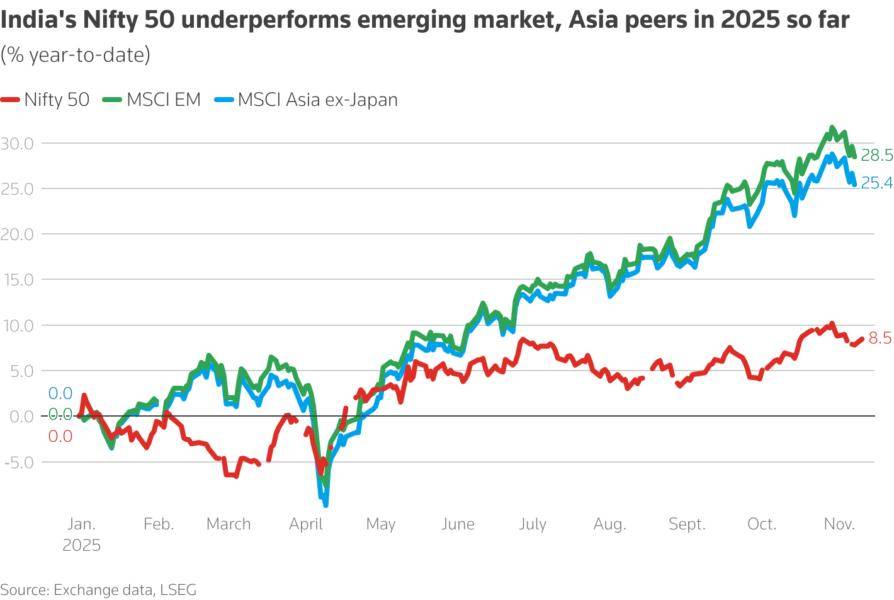
          The index has risen about 8.5% year-to-date, lagging other emerging markets in one of their strongest years.
          However, analysts led by Sunil Koul said the "year-long earnings downgrade cycle" has bottomed out, paving the way for recovery.
          Goldman cited a combination of growth-supportive policies, including rate cuts by the Reserve Bank of India, liquidity easing, bank deregulation, goods and services tax (GST) reductions and a slower pace of fiscal consolidation, as key drivers for the turnaround, in a note post India market hours on Friday.
          The brokerage noted that September-quarter results have largely surprised on the upside, prompting earnings upgrades in select sectors.
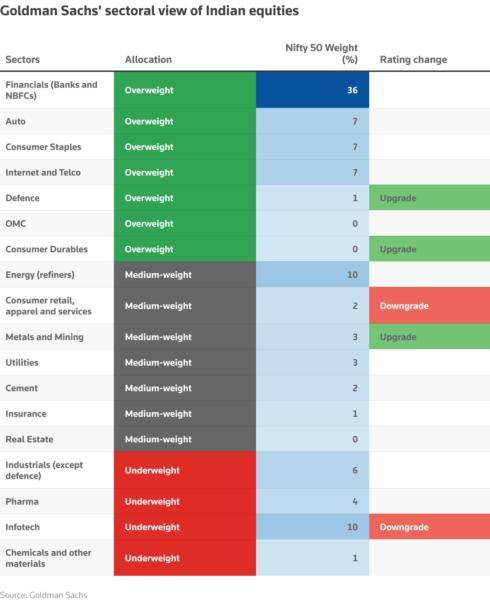
          It expects financials, consumer staples, durables, autos, defence, oil marketing companies and internet and telecom firms to lead this recovery, while remaining cautious on export-oriented IT, pharma, industrials and chemicals amid earnings headwinds and moderating public capex.
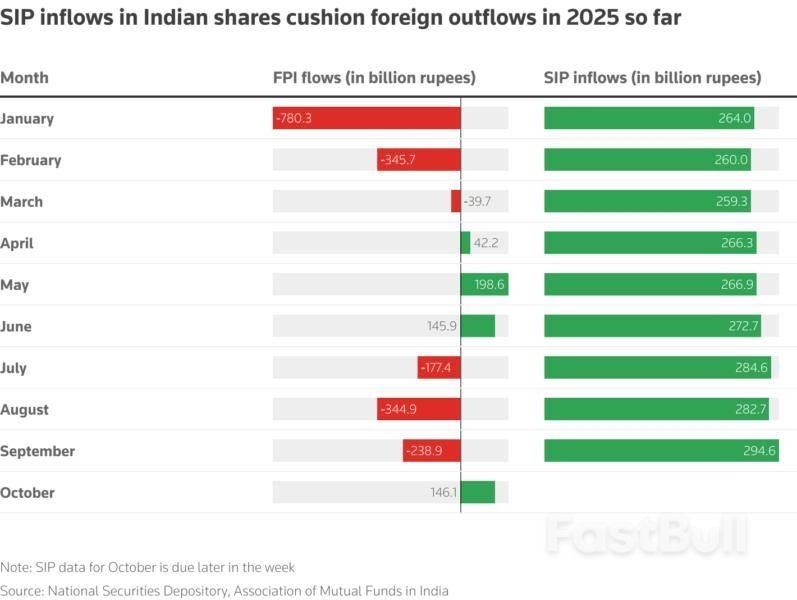
          Despite foreign portfolio investors selling about $30 billion since the Nifty's 2024 peak and $17.4 billion in 2025 so far, Goldman sees signs of a turnaround, helped by record $70 billion of equity purchases by domestic institutions backed by steady retail and SIP inflows.
          With India's valuation premium to emerging markets now sharply lower compared to September 2024 levels, Goldman said it has become "defensible," even if India remains the priciest among peers.
          Amid rising geopolitical and trade risks, Goldman highlighted themes such as domestic self-sufficiency, revival in mass consumption, new-economy sectors and high-growth pockets at fair valuations as key to generating strong returns.
          Goldman Sachs' India upgrade follows a similar move by HSBC in late September, citing improving earnings and policy support.

          Source: TradingView

          Risk Warnings and Disclaimers
          You understand and acknowledge that there is a high degree of risk involved in trading. Following any strategies or investment methods may lead to potential losses. The content on the site is provided by our contributors and analysts for information purposes only. You are solely responsible for determining whether any trading assets, securities, strategy, or any other product is suitable for investing based on your own investment objectives and financial situation.
          Add to Favorites
          Share

          Dollar Finds Support as U.S. Shutdown Nears Resolution and Global Growth Concerns Resurface

          Gerik

          Economic

          Forex

          Dollar Regains Momentum as Shutdown Talks Offset Global Economic Concerns

          The U.S. dollar opened the week on firmer ground in Asian trading as investor sentiment responded to two conflicting market forces: rising global growth fears and cautious optimism that the prolonged U.S. government shutdown may be nearing its conclusion. This slight rebound marked a reversal of the dollar’s three-day decline, with the dollar index rising by 0.2% to 99.740.
          This movement reflects a complex interplay between risk aversion and political stabilization. On one hand, the weakness in recent U.S. economic indicators, particularly consumer sentiment, prompted defensive positioning. On the other hand, bipartisan negotiations in the U.S. Senate gave markets a degree of clarity, reducing immediate fiscal uncertainty.

          Shutdown Optimism Revives Greenback Strength

          Market confidence received a modest boost as Senate Majority Leader John Thune signaled constructive progress in congressional negotiations. The Senate's scheduled vote on Sunday to reopen the government through January 2026 appears to have broken a political impasse that had weighed heavily on consumer confidence. Tony Sycamore, an analyst at IG, noted that the dollar’s decline late last week had likely overstated the shutdown’s drag, making the greenback ripe for a technical recovery if a resolution emerged.
          This hypothesis is supported by the University of Michigan’s early November consumer sentiment reading, which dropped to its lowest level in over three years. The decline was interpreted as a direct consequence of the shutdown’s prolonged effects on household psychology and purchasing expectations. The latest legislative developments, therefore, appear to have moderated those fears, easing some pressure on the dollar.
          This correlation between political gridlock and consumer sentiment does not confirm direct causality, but the temporal alignment of sentiment deterioration with fiscal dysfunction adds weight to that interpretation.

          Yen Weakens as Japan Signals Fiscal Policy Shift

          In contrast, the Japanese yen fell 0.3% to 153.82 per dollar after Japanese Prime Minister Sanae Takaichi signaled that the government may abandon its traditional annual fiscal targets. Instead, Japan plans to adopt multi-year spending assessments, a move widely seen as softening its stance on fiscal consolidation.
          Such a shift in fiscal discipline introduces uncertainty about Japan’s long-term debt trajectory and appears to have softened support for the yen. The Bank of Japan's latest summary of opinions also suggested that the economic outlook is becoming less murky than it was in July, but this perceived improvement has not materially strengthened the currency.
          Here, the relationship between fiscal guidance changes and currency depreciation is a causal one: a softer fiscal stance reduces perceived government creditworthiness and often leads to higher future bond issuance, which in turn pressures the yen.

          Dollar Outlook Supported by Liquidity and Regional Divergence

          Further dollar support may stem from evolving macro conditions in Asia. Eric Robertsen from Standard Chartered pointed out that Asia’s earlier economic momentum partly driven by export front-loading ahead of U.S. tariff deadlines is now waning. With most regional central banks nearing the end of their rate-cut cycles, the capital inflows that supported local currencies may also begin to fade.
          This scenario suggests a divergence in monetary and economic trajectories. As global liquidity potentially contracts in 2026, emerging markets may struggle to attract capital, giving the U.S. dollar a relative advantage. This perspective aligns with Robertsen’s forecast of further dollar gains in the coming year, not because of U.S. strength per se, but due to weakening alternatives.
          This is not a direct causal prediction but rather a correlated trend forecast—global liquidity shrinkage reduces support for risk assets, which typically boosts demand for the dollar as a safe haven.

          Monetary Policy Expectations Remain Stable Ahead of December Fed Meeting

          Despite the market volatility, expectations for Federal Reserve policy have remained largely unchanged. Fed funds futures continue to imply a 67% probability of a 25-basis-point rate cut at the Fed's upcoming December 10 meeting. This indicates that while market participants are reacting to near-term political developments, their medium-term expectations for interest rates are grounded in structural economic data rather than transient fiscal noise.
          In currency trading, the euro slipped 0.1% to $1.155, while sterling softened by 0.2% to $1.314. The Australian dollar edged up 0.1% to $0.6502, reflecting marginal commodity-linked currency resilience, while the New Zealand dollar dipped 0.1% to $0.56265. The offshore yuan remained steady at 7.1261.
          The broader picture is one of mild dollar strength in the context of global uncertainty and policy divergence. Markets remain sensitive to further developments on Capitol Hill, central bank signals, and macroeconomic surprises.
          The U.S. dollar's modest rebound reflects shifting sentiment as political resolution in Washington tempers market anxieties about government dysfunction. However, broader economic databoth domestically and abroad continue to inject volatility into the currency landscape. While the end of the shutdown could restore short-term market stability, the outlook for the dollar will hinge on both fiscal developments and broader liquidity dynamics in the months ahead.

          Source: Reuters

          To stay updated on all economic events of today, please check out our Economic calendar
          Risk Warnings and Disclaimers
          You understand and acknowledge that there is a high degree of risk involved in trading. Following any strategies or investment methods may lead to potential losses. The content on the site is provided by our contributors and analysts for information purposes only. You are solely responsible for determining whether any trading assets, securities, strategy, or any other product is suitable for investing based on your own investment objectives and financial situation.
          Add to Favorites
          Share

          US, China Suspend Mutual Shipping Probes In Sign Tensions Easing

          Samantha Luan

          China–U.S. Trade War

          Economic

          Forex

          The Trump administration has suspended a probe into China's shipbuilding industry, prompting Beijing to reciprocate by shelving its own investigation and putting off special port fees for US vessels.

          The Office of the US Trade Representative said the probe has been suspended for one year as of midnight Monday morning local time. Minutes later, China's Ministry of Transport followed with an announcement that said its actions are being postponed at the same time to implement the consensus reached at recent trade talks with the US.

          The US will continue to negotiate with China about the issues raised in the investigation, the USTR said in the statement.

          The suspensions remove some costs and uncertainty for an industry that had been facing fees to deliver goods to the US. They make good on one of the agreements reached by Presidents Donald Trump and Xi Jinping during talks in South Korea late last month.

          The imposition of port fees on each other's vessels threatened to shake up global shipping, raise freight rates and snarl the flow of goods including key commodities like oil. China's investigation was among retaliatory measures it announced in mid-October and aimed to assess the impact of the US probe into the nation's maritime sector.

          According to a fact sheet released last week, the US will pause tariffs on imports of ship-to-shore cranes and chassis from China, in addition to a suspension of fees levied on Chinese-built and operated merchant ships calling at American ports.

          The US concession was criticized by US industry and labor groups last week, who argued that it will undermine the push by Trump's administration to build up a US shipbuilding sector.

          Trump had been looking to counter China's growing influence on the shipbuilding sector with the now-suspended probe as well as deals with Japan and South Korea to help the US revive a moribund domestic shipbuilding industry.

          Source: Bloomberg Europe

          To stay updated on all economic events of today, please check out our Economic calendar
          Risk Warnings and Disclaimers
          You understand and acknowledge that there is a high degree of risk involved in trading. Following any strategies or investment methods may lead to potential losses. The content on the site is provided by our contributors and analysts for information purposes only. You are solely responsible for determining whether any trading assets, securities, strategy, or any other product is suitable for investing based on your own investment objectives and financial situation.
          Add to Favorites
          Share

          Senate Inches Toward Ending 40-Day Shutdown Amid Partisan Rift Over Healthcare

          Gerik

          Political

          Senate Moves Closer to Reopening Government with Temporary Spending Bill

          After 40 days of a paralyzing federal shutdown, the U.S. Senate has taken a critical step toward restoring government operations by advancing a stopgap funding bill. The measure, passed in a procedural vote with the minimum 60-40 margin needed to overcome a filibuster, would finance the government through January 30, 2026, and incorporate three full-year appropriations bills. If passed in the Senate, it must still return to the House for final approval before reaching President Donald Trump's desk.
          This development signals a potential thaw in the prolonged budgetary standoff, which has left federal workers unpaid, disrupted public services, and raised concerns over economic performance. However, underlying partisan disputes—particularly surrounding healthcare policy—continue to cloud the legislative process.

          Democratic Dissent Reflects Intraparty Division Over ACA Subsidies

          The shutdown’s most contentious point lies in the expiration of enhanced subsidies under the Affordable Care Act (ACA), originally expanded during the pandemic to increase healthcare access. These subsidies, which doubled ACA enrollment to 24 million since 2021, are set to lapse by the end of 2025. Democrats have insisted on extending them as a condition for passing any funding bill. However, intra-party negotiations have forced a compromise: instead of immediate inclusion, a separate vote on subsidy extension will occur in December.
          This concession, arranged by Senators Maggie Hassan, Jeanne Shaheen, and Angus King, drew ire from other Democrats. Senator Chuck Schumer, the party’s Senate leader, notably opposed the bill. Representative Ro Khanna publicly questioned Schumer’s leadership, highlighting tensions over rising healthcare premiums and legislative strategy. This reveals not just a policy conflict but a strategic schism within the Democratic Party.

          Trump's Alternative Proposal Deepens Partisan Friction

          President Trump has added to the complexity by advocating for the replacement of ACA subsidies with direct payments to individuals. He criticized the current subsidy model on his Truth Social platform, calling it a boon for insurance companies and a financial burden for citizens. Trump’s messaging appeals to cost-sensitive voters but sidesteps the potential consequences of dismantling structured insurance subsidies, which healthcare experts warn could increase uninsured rates if enacted abruptly.
          This proposal also introduces a potential causal link between executive policy shifts and voter healthcare access. If subsidies are replaced with direct payments, insurance enrollment might decline due to unpredictability in payment timing or amount. While correlation exists between past subsidy expansions and rising enrollment, the causal effect of shifting to cash payments remains uncertain and politically contentious.

          Shutdown Fallout Spurs Urgency Amid Economic Warning Signs

          The prolonged shutdown has already impacted millions. Federal agencies have frozen hiring and are prohibited from conducting layoffs until at least January 30 under the proposed legislation. Worker unions consider this a temporary victory, especially as over 300,000 federal employees are expected to exit due to Trump’s workforce reduction agenda.
          Delayed back pay and mounting strain on essential workers, such as Border Patrol agents and air-traffic controllers, have raised operational concerns. Notably, the shortage in air-traffic staffing has threatened to disrupt Thanksgiving travel, prompting Senator Thom Tillis to liken the situation to rising external pressure creating internal movement toward resolution.
          White House economic adviser Kevin Hassett warned that if normal air travel does not resume soon, the U.S. could face negative economic growth in the fourth quarter. While this warning is based on projected correlations rather than confirmed causality, the impact of prolonged government inaction on consumer activity and GDP is widely acknowledged by economists.

          Next Steps and Legislative Uncertainty

          Although the Senate has advanced the bill, several hurdles remain. The House must pass the amended version, and Trump must sign it into law. Furthermore, the ACA subsidy vote scheduled for December will likely reintroduce partisan tension, especially if Republicans continue opposing long-term subsidy extensions.
          The ACA enrollment window, which runs until January 15, allows some time to legislate additional support. But with premiums expected to more than double in 2026 absent renewed subsidies, time is of the essence. The political standoff thus not only reflects ideological divisions but also risks tangible consequences for millions of Americans relying on federal healthcare support.
          In sum, while the Senate vote marks progress, it merely postpones deeper ideological conflicts. Healthcare remains the battleground where fiscal responsibility and social safety net priorities collide. As both parties maneuver, the broader public remains vulnerable to the outcomes of unresolved policy debates.

          Source: Reuters

          Risk Warnings and Disclaimers
          You understand and acknowledge that there is a high degree of risk involved in trading. Following any strategies or investment methods may lead to potential losses. The content on the site is provided by our contributors and analysts for information purposes only. You are solely responsible for determining whether any trading assets, securities, strategy, or any other product is suitable for investing based on your own investment objectives and financial situation.
          Add to Favorites
          Share
          FastBull
          Copyright © 2025 FastBull Ltd

          728 RM B 7/F GEE LOK IND BLDG NO 34 HUNG TO RD KWUN TONG KLN HONG KONG

          TelegramInstagramTwitterfacebooklinkedin
          App Store Google Play Google Play
          Products
          Charts

          Chats

          Q&A with Experts
          Screeners
          Economic Calendar
          Data
          Tools
          Membership
          Features
          Function
          Markets
          Copy Trading
          Latest Signals
          Contests
          News
          Analysis
          24/7
          Columns
          Education
          Company
          Careers
          About Us
          Contact Us
          Advertising
          Help Center
          Feedback
          User Agreement
          Privacy Policy
          Business

          White Label

          Data API

          Web Plug-ins

          Poster Maker

          Affiliate Program

          Risk Disclosure

          The risk of loss in trading financial instruments such as stocks, FX, commodities, futures, bonds, ETFs and crypto can be substantial. You may sustain a total loss of the funds that you deposit with your broker. Therefore, you should carefully consider whether such trading is suitable for you in light of your circumstances and financial resources.

          No decision to invest should be made without thoroughly conducting due diligence by yourself or consulting with your financial advisors. Our web content might not suit you since we don't know your financial conditions and investment needs. Our financial information might have latency or contain inaccuracy, so you should be fully responsible for any of your trading and investment decisions. The company will not be responsible for your capital loss.

          Without getting permission from the website, you are not allowed to copy the website's graphics, texts, or trademarks. Intellectual property rights in the content or data incorporated into this website belong to its providers and exchange merchants.

          Not Logged In

          Log in to access more features

          FastBull Membership

          Not yet

          Purchase

          Become a signal provider
          Help Center
          Customer Service
          Dark Mode
          Price Up/Down Colors

          Log In

          Sign Up

          Position
          Layout
          Fullscreen
          Default to Chart
          The chart page opens by default when you visit fastbull.com