

Markets
News
Analysis
User
24/7
Economic Calendar
Education
Data
- Names
- Latest
- Prev



Signal Accounts for Members
All Signal Accounts
All Contests
 Euro Zone IHS Markit Construction PMI (Nov)
A:--
F: --
P: --
 Italy IHS Markit Construction PMI (Nov)
A:--
F: --
P: --
 U.K. Markit/CIPS Construction PMI (Nov)
A:--
F: --
P: --
 France 10-Year OAT Auction Avg. Yield
A:--
F: --
P: --
Euro Zone Retail Sales MoM (Oct)A:--
F: --
P: --
Euro Zone Retail Sales YoY (Oct)A:--
F: --
P: --
 Brazil GDP YoY (Q3)
A:--
F: --
P: --
 U.S. Challenger Job Cuts (Nov)
A:--
F: --
P: --
U.S. Challenger Job Cuts MoM (Nov)A:--
F: --
P: --
U.S. Challenger Job Cuts YoY (Nov)A:--
F: --
P: --
U.S. Initial Jobless Claims 4-Week Avg. (SA)A:--
F: --
P: --
U.S. Weekly Initial Jobless Claims (SA)A:--
F: --
P: --
U.S. Weekly Continued Jobless Claims (SA)A:--
F: --
P: --
 Canada Ivey PMI (SA) (Nov)
A:--
F: --
P: --
Canada Ivey PMI (Not SA) (Nov)A:--
F: --
P: --
U.S. Non-Defense Capital Durable Goods Orders Revised MoM (Excl. Aircraft) (SA) (Sept)A:--
F: --
U.S. Factory Orders MoM (Excl. Transport) (Sept)A:--
F: --
P: --
U.S. Factory Orders MoM (Sept)A:--
F: --
P: --
U.S. Factory Orders MoM (Excl. Defense) (Sept)A:--
F: --
P: --
U.S. EIA Weekly Natural Gas Stocks ChangeA:--
F: --
P: --
Saudi Arabia Crude Oil ProductionA:--
F: --
P: --
U.S. Weekly Treasuries Held by Foreign Central BanksA:--
F: --
P: --
 Japan Foreign Exchange Reserves (Nov)
A:--
F: --
P: --
 India Repo Rate
A:--
F: --
P: --
India Benchmark Interest RateA:--
F: --
P: --
India Reverse Repo RateA:--
F: --
P: --
India Cash Reserve RatioA:--
F: --
P: --
Japan Leading Indicators Prelim (Oct)A:--
F: --
P: --
U.K. Halifax House Price Index YoY (SA) (Nov)A:--
F: --
P: --
U.K. Halifax House Price Index MoM (SA) (Nov)A:--
F: --
P: --
France Current Account (Not SA) (Oct)--
F: --
P: --
France Trade Balance (SA) (Oct)--
F: --
P: --
France Industrial Output MoM (SA) (Oct)--
F: --
P: --
Italy Retail Sales MoM (SA) (Oct)--
F: --
P: --
Euro Zone Employment YoY (SA) (Q3)--
F: --
P: --
Euro Zone GDP Final YoY (Q3)--
F: --
P: --
Euro Zone GDP Final QoQ (Q3)--
F: --
P: --
Euro Zone Employment Final QoQ (SA) (Q3)--
F: --
P: --
Euro Zone Employment Final (SA) (Q3)--
F: --
Brazil PPI MoM (Oct)--
F: --
P: --
 Mexico Consumer Confidence Index (Nov)
--
F: --
P: --
Canada Unemployment Rate (SA) (Nov)--
F: --
P: --
Canada Labor Force Participation Rate (SA) (Nov)--
F: --
P: --
Canada Employment (SA) (Nov)--
F: --
P: --
Canada Part-Time Employment (SA) (Nov)--
F: --
P: --
Canada Full-time Employment (SA) (Nov)--
F: --
P: --
U.S. Personal Income MoM (Sept)--
F: --
P: --
U.S. Dallas Fed PCE Price Index YoY (Sept)--
F: --
P: --
U.S. PCE Price Index YoY (SA) (Sept)--
F: --
P: --
U.S. PCE Price Index MoM (Sept)--
F: --
P: --
U.S. Personal Outlays MoM (SA) (Sept)--
F: --
P: --
U.S. Core PCE Price Index MoM (Sept)--
F: --
P: --
U.S. UMich 5-Year-Ahead Inflation Expectations Prelim YoY (Dec)--
F: --
P: --
U.S. Core PCE Price Index YoY (Sept)--
F: --
P: --
U.S. Real Personal Consumption Expenditures MoM (Sept)--
F: --
P: --
U.S. 5-10 Year-Ahead Inflation Expectations (Dec)--
F: --
P: --
U.S. UMich Current Economic Conditions Index Prelim (Dec)--
F: --
P: --
U.S. UMich Consumer Sentiment Index Prelim (Dec)--
F: --
P: --
U.S. UMich 1-Year-Ahead Inflation Expectations Prelim (Dec)--
F: --
P: --
U.S. UMich Consumer Expectations Index Prelim (Dec)--
F: --
P: --


No matching data

Latest Views
Latest Views
Trending Topics
Top Columnists
Latest Update
White Label
Data API
Web Plug-ins
Affiliate Program
View All
No data
Charts show that the euro strengthened against the Canadian dollar on Thursday, with the pair climbing above 1.6460 for the first time since spring 2009, when the world was still reeling from the global financial crisis.
Charts show that the euro strengthened against the Canadian dollar on Thursday, with the pair climbing above 1.6460 for the first time since spring 2009, when the world was still reeling from the global financial crisis.
The current weakness of the Canadian dollar is being influenced by several factors:
→ Trade relations with the United States – according to media reports, some Canadian industries such as steel and automotive manufacturing are facing competitive disadvantages under the current agreement.
→ Oil prices have fallen to a five-month low, partly due to expectations surrounding a potential meeting between the US and Russian presidents. As we noted on 13 October, the XTI/USD exchange rate could drift towards $55 per barrel.
Meanwhile, the euro has benefited from the softening of the US dollar. Notably, the DXY index has turned lower from a key resistance level — the upper boundary of the channel identified in our 9 October analysis.
However, an examination of the EUR/CAD chart suggests that the current upward momentum may be losing steam.
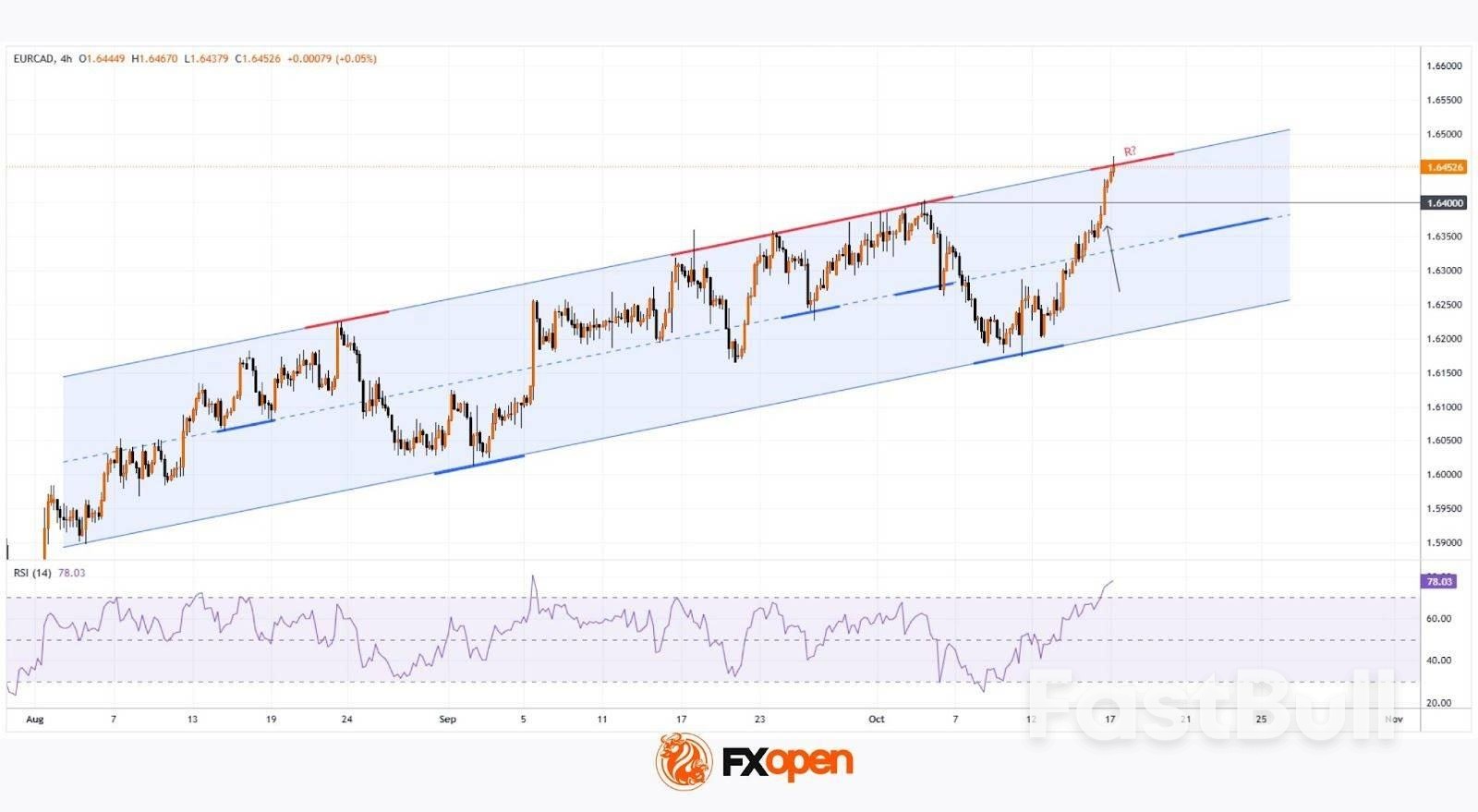
Price movements — with key turning points shown in bold — outline a rising channel that has remained relevant since August.
The bearish case rests on the following factors:→ The pair has reached the upper boundary of the channel, which has repeatedly acted as strong resistance and may do so again.→ The sharp mid-October rally pushed the RSI indicator into extreme overbought territory.
On the other hand, price action continues to reflect strong demand, as seen in the clean breakout above the previous peak near 1.6400, which occurred on a wide bullish candle with minimal pullback.
In these conditions, it is reasonable to assume that:→ After a 1.6% rise in seven days, some long holders may start taking profits, leading to consolidation near the upper boundary of the channel;→ If a correction from the upper channel line develops, it is likely to be shallow, as bullish activity could re-emerge around the median line, reinforced by the former resistance at 1.6400.
European Central Bank President Christine Lagarde has taken her mantra that interest rates are in a “good place” to Washington and received backup from nearly all her colleagues that also made the trip.
Policymakers speaking on the sidelines of the IMF’s annual meetings in the US capital echoed Lagarde in signaling that the ECB is unlikely to cut its deposit rate, which has been at 2% since June, at this month’s meeting.
Thoughts beyond that weren’t quite so aligned.
Some warned that inflation risks are more on the downside and argued that a rate cut is the more likely next move. Others expressed concern that price pressures may turn out to be stronger than thought and opened the door to a hike as the ECB’s next step.
Yet others — still suffering from ripple effects of the unconventional tools used to tackle past crises — want to preserve firepower and see the ECB’s job done unless it encounters another big shock.
Chief Economist Philip Lane stuck to the script on how policy will be set looking ahead. “We mean it when we say it’s kind of data-dependent, meeting by meeting,” he said during a panel discussion, reiterating the ECB’s official line.
What follows is a list of highlights from interviews and comments published this week:
Christine Lagarde, president:
“We are in a good place. But we have to anticipate anything happening,” she said in an interview with CNBC. “We’re positioned to respond just in case.”
Asked whether monetary easing is over, she said “I would never say that because I think the job of a central banker is never done.”
Philip Lane, chief economist:
“We’re going to really be trying to be as open-minded as possible, go meeting by meeting,” he said. “If we want to do something, we will do it” and “we can change our mind eight times a year,” but “we mean it when we say it’s kind of data dependent, meeting by meeting.”
Joachim Nagel, Governing Council member from Germany:
“I’m rather comfortable where we are,” he told Bloomberg TV. “When there’s new data coming that gives me maybe a different opinion, I’m open to change something. But for the moment I would say it’s good where we are.”
Francois Villeroy de Galhau, Governing Council member from France:
“If there is a next move, a rate cut is more plausible, more likely than a rate hike,” he said in a Bloomberg TV interview. “I see few risks on the upside” but “there are more risks on the downside.”
“We are in a good place but I fully agree with Christine Lagarde, our president, that a good place is not a fixed place.”
Pierre Wunsch, Governing Council member from Belgium:
We don’t “see big risks to inflation on the upside or downside,” but “if I would have to choose between risk on the upside or downside, I would say probably a bit more on the downside because of the appreciation of the euro, cheap Chinese imports and the economy.” Still, “we’re in a good place.”
Martin Kocher, Governing Council member from Austria:
“There is a good argument to be made for not adjusting policy rates, for not trying to over-engineer what we are doing as long as we are close to the 2%, as long as there is no shocks from the outside that might lead us to other conclusions,” he said. “We are in a good place,” and “it’s important to have dry powder, acting power and quickly adjust policy according to what is coming.”
Olli Rehn, Governing Council member from Finland:
“We have risks that are two sided,” and “it’s important in the current context where we have pervasive uncertainty still due to trade wars and due to geopolitical tensions that we maintain full freedom of action, we maintain optionality in monetary policy.”
Gabriel Makhlouf, Governing Council member from Ireland:
“I’m more focused on pressures that are going to push inflation up rather than pressures that are going to reduce growth,” he said in an interview. “On this debate about undershooting, I’m more worried that we’re going to be over than under 2%.”
“For me, the next move is two-sided,” he added. “I’m not in the camp of those who think that we need another cut. I’m in the camp that says we’re probably in a fine position, but we need to pay attention to the fact that actually there are price pressures out there.”
Madis Muller, Governing Council member from Estonia:
With interest rates at an appropriate level, officials should be “patient” and mindful of developments that could pull price pressures in both directions. China’s export controls “show how barriers to free trade introduced by other countries can have an inflationary impact also in Europe.”
“It is hard to predict when will it be justified to change rates again, and I personally don’t see why we should have an easing bias.”
Primoz Dolenc, Governing Council member from Slovenia:
“Current data show that the inflation undershoot we had projected for next year might even be slightly less pronounced than expected.” This “will probably be reflected in our next projection.”
While risks to the growth outlook are “still a little bit to the downside,” those to inflation are “more or less balanced.” For monetary policy, this means that “the next interest-rate move could go in either direction.” But “we’re in balance and I’d find it really hard to find evidence to change monetary policy right now or in the next months.”
Edward Scicluna, Governing Council member from Malta:
“It’s not so straightforward whether higher trade tariffs will be disinflationary or inflationary,” he said. “The jury is still out and we shouldn’t jump to conclusions as this is crucial.”
He doesn’t foresee changes to borrowing costs at the end of month, but expects a “more intense” debate in December, when more data — including fresh staff projections — are on hand. However, he said that “for me, it would need convincing arguments to support another cut. The onus is on those who want to cut further to convince the rest of us.”
Until mid-October, the Indian rupee was Asia’s worst-performing currency of 2025. It was heading for its biggest annual drop since 2022 — the year Russia’s invasion of Ukraine sent oil prices soaring past $100 per barrel, a major blow for India, which imports about 90% of its crude.This year, the rupee’s weakness has been fueled by higher US tariffs on Indian exports and a wave of foreign outflows from local equities. By Oct. 14, it had fallen to a near-record low of 88.8025 per dollar. Then, over just three days, the rupee rebounded more than 1% — a move traders attributed to central bank intervention.
Now the rupee is at a crucial juncture. There are tentative signs US-India trade ties may be improving, which could ease pressure on the currency. But if that doesn’t happen, the Reserve Bank of India may be forced to step in again — especially if it suspects a pickup in speculative bets against the rupee.The RBI grew alarmed in mid-October as the rupee neared 89 to the dollar, and was determined not to let the currency breach its record low of 88.8050, according to a person familiar with the matter.In response, it’s understood that the RBI sold US dollars from its foreign exchange reserves, in both the spot and offshore markets.
In the weeks prior, the central bank also built up short dollar positions worth at least $15 billion in the offshore non-deliverable forwards market. In effect, the RBI was betting on a weaker US dollar — and shoring up the rupee — by entering contracts to sell the greenback at a future date.While the new RBI governor earlier this year showed a willingness to loosen the central bank’s tight grip on the currency, traders now expect it to intervene more aggressively to stamp out what it believes are speculative bets on the currency’s decline. It has ample firepower to do so, with nearly $700 billion in foreign-exchange reserves — among the largest in the world and enough to cover about 11 months of imports.
The rupee first dipped in January before it eked out slight gains against the dollar in March and April. At its strongest, in early May, the currency traded at 83.7538 per dollar. This was around the same time investors bet India would be among the first to clinch a trade deal with the US. Expectations of lower tariffs on Indian exports fueled optimism that foreign capital would flow into the country as companies sought manufacturing hubs outside of China.
The tide turned in July, when President Donald Trump announced plans to impose higher-than-anticipated tariffs and threatened to penalize India for purchasing Russian energy and weapons. The levies dashed New Delhi’s hopes of preferential treatment over its Asian peers and the rupee suffered its worst monthly loss since 2022. In August, the US set tariffs on most Indian exports at 50% — the highest across Asia — which included a “secondary” 25% penalty tariff for India’s trade with Russia. The rupee fell to a series of record lows, breaching 88 per dollar.
In September, the currency weakened further after reports that President Trump had urged European nations to impose similar Russia-related penalty tariffs on Indian imports, and that the US planned to raise the fee for its high-skilled H-1B visa — the vast majority of which go to Indian-born workers — from a few hundred dollars to $100,000.A frantic foreign exodus from Indian equities this year due to US tariffs, pricey stock valuations, slowing economic growth and persistently soft corporate earnings, has piled additional pressure on the rupee. As of Oct. 15, foreign investors had pulled out more than $16.5 billion from Indian shares this year, closing in on a record outflow set in 2022.
The rupee’s overall depreciation this year didn’t come as a huge surprise; the currency has lost value every year since 2018. What made its weakness stand out is that the US dollar itself has been slipping, while many emerging-market currencies in the region have strengthened.The rupee slumped this year as peers such as the Taiwan dollar, Malaysian ringgit, Thai baht and South Korean won strengthened.One reason is that those countries face far less US tariffs on their exports. India’s economy — though largely driven by its domestic market — has been hit particularly hard because the US is its largest export market.
Another drag on the rupee has been India’s persistent current account deficit, which means it imports more than it exports. India must buy foreign currency — normally US dollars — to pay for those imports, which weakens demand for the rupee. By contrast, Taiwan, Malaysia, Thailand and South Korea are all running current account surpluses, which means they export more than they import, earning foreign currency from their sales abroad.Fears that the US dollar will continue to fall amid trade frictions, policy uncertainties and potential Federal Reserve rate cuts have also prompted exporters elsewhere in Asia to sell more of their dollar holdings than usual and convert the proceeds back into their local currencies, further amplifying their value.
A weaker rupee makes Indian goods and services cheaper abroad, boosting export competitiveness. This helps to offset the tariff pressures facing exporters, as India seeks to expand its markets by signing trade deals with countries such as the UK.It’s also a boon for families of Indian workers abroad who send money home. India is the world’s largest recipient of remittances, with a record $137 billion flowing into the country in 2024, according to the World Bank. A softer currency means every dollar remitted buys more rupees, lifting household incomes and consumption.
On the flip side, a weaker rupee makes imports more expensive, pushing up the cost of essential items such as oil, fertilizers and electronics, most of which India buys from overseas.
South Korea remains in intensive talks with the US to iron out final details of its $350 billion investment pledge, including a possible currency swap line aimed at safeguarding the Asian nation from potential financial instability.
Several senior officials from Seoul, including presidential policy chief Kim Yong-beom and Trade Minister Yeo Han-koo, are in Washington this week seeking to finalize the agreement before the Asia-Pacific Economic Cooperation summit later this month. Policy Chief Kim also met with Commerce Secretary Howard Lutnick and other US officials during the visit.
The trade talks have been in deadlock for more than two months, with the two countries divided over the implementation of the $350 billion investment fund. The investment pledge is the centerpiece of a trade agreement that capped US duties on Korean goods at 15%. With the details still unresolved, the US has yet to lower tariffs on cars from 25%, leaving South Korean automakers at a disadvantage against their Japanese rivals.
President Donald Trump has repeatedly insisted that Seoul’s investment package be made “upfront.” South Korea pushed back, arguing that the amount represents more than 80% of its foreign exchange reserves. Officials warned that such an outflow could weaken the won and have pressed the US to establish a currency swap arrangement.
With exports equivalent to over 40% of South Korea’s GDP, the finalized trade deal is expected to provide greater stability and confidence in its economy.
Finance Minister Koo Yun-cheol said he had conveyed to Treasury Secretary Scott Bessent that making the investment upfront in cash would not be feasible given Korea’s foreign-exchange constraints.
“Once an alternative structure is proposed, we’ll assess the associated FX demand and whether it can be managed within a range that ensures stability in Korea’s currency market,” Koo told reporters in Washington during a televised interview. “Depending on how that changes, we’ll then determine whether a currency swap is necessary, whether it’s feasible, and if so, to what extent it should be pursued.”
The Munhwa Ilbo newspaper earlier reported that Korea is in discussions with the US on an Argentina-style currency swap to help curb volatility in its FX market. The arrangement would likely be made through US Treasury funding, rather than a direct deal between the Federal Reserve and the Bank of Korea, the report said.
Policy Chief Kim also visited the US Office of Management and Budget on Thursday to discuss a shipbuilding initiative known as “Make American Shipbuilding Great Again,” according to Yonhap News.
His visit comes after China sanctioned the US unit of South Korean shipbuilding giant Hanwha Ocean Co., and threatened further retaliatory measures against the industry. The US State Department condemned China’s actions as an “irresponsible attempt” to disrupt shipbuilding cooperation between Korea and the US, Yonhap reported.
728 RM B 7/F GEE LOK IND BLDG NO 34 HUNG TO RD KWUN TONG KLN HONG KONG


White Label
Data API
Web Plug-ins
Poster Maker
Affiliate Program
The risk of loss in trading financial instruments such as stocks, FX, commodities, futures, bonds, ETFs and crypto can be substantial. You may sustain a total loss of the funds that you deposit with your broker. Therefore, you should carefully consider whether such trading is suitable for you in light of your circumstances and financial resources.
No decision to invest should be made without thoroughly conducting due diligence by yourself or consulting with your financial advisors. Our web content might not suit you since we don't know your financial conditions and investment needs. Our financial information might have latency or contain inaccuracy, so you should be fully responsible for any of your trading and investment decisions. The company will not be responsible for your capital loss.
Without getting permission from the website, you are not allowed to copy the website's graphics, texts, or trademarks. Intellectual property rights in the content or data incorporated into this website belong to its providers and exchange merchants.
Not Logged In
Log in to access more features

FastBull Membership
Not yet
Purchase


Log In
Sign Up


