• Trade
  • Markets
  • Copy
  • Contests
  • News
  • 24/7
  • Calendar
  • Q&A
  • Chats
Trending
Screeners
SYMBOL
LAST
BID
ASK
HIGH
LOW
NET CHG.
%CHG.
SPREAD
SPX
S&P 500 Index
6857.13
6857.13
6857.13
6865.94
6827.13
+7.41
+ 0.11%
--
DJI
Dow Jones Industrial Average
47850.93
47850.93
47850.93
48049.72
47692.96
-31.96
-0.07%
--
IXIC
NASDAQ Composite Index
23505.13
23505.13
23505.13
23528.53
23372.33
+51.04
+ 0.22%
--
USDX
US Dollar Index
98.760
98.840
98.760
98.980
98.750
-0.220
-0.22%
--
EURUSD
Euro / US Dollar
1.16682
1.16690
1.16682
1.16692
1.16408
+0.00237
+ 0.20%
--
GBPUSD
Pound Sterling / US Dollar
1.33583
1.33592
1.33583
1.33601
1.33165
+0.00312
+ 0.23%
--
XAUUSD
Gold / US Dollar
4227.29
4227.63
4227.29
4230.62
4194.54
+20.12
+ 0.48%
--
WTI
Light Sweet Crude Oil
59.400
59.437
59.400
59.469
59.187
+0.017
+ 0.03%
--

Community Accounts

Signal Accounts
--
Profit Accounts
--
Loss Accounts
--
View More

Become a signal provider

Sell trading signals to earn additional income

View More

Guide to Copy Trading

Get started with ease and confidence

View More

Signal Accounts for Members

All Signal Accounts

Best Return
  • Best Return
  • Best P/L
  • Best MDD
Past 1W
  • Past 1W
  • Past 1M
  • Past 1Y

All Contests

  • All
  • Trump Updates
  • Recommend
  • Stocks
  • Cryptocurrencies
  • Central Banks
  • Featured News
Top News Only
Share

Equinor: Preliminary Estimates Indicate Reservoirs May Contain Between 5 -18 Million Standard Cubic Meters Of Recoverable Oil Equivalents

Share

Japan Chief Cabinet Secretary Kihara: Government To Take Appropriate Steps On Excessive And Disorderly Moves In Foreign Exchange Market, If Necessary

Share

[Report: Amazon Pays €180 Million To Italy To End Tax And Labor Investigations] Amazon Has Paid A Settlement And Dismantled Its Monitoring System For Delivery Drivers In Italy, Ending An Investigation Into Alleged Tax Fraud And Illegal Labor Practices. In July 2024, The Group's Logistics Services Division Was Accused Of Circumventing Labor And Tax Laws By Relying On Cooperatives Or Limited Liability Companies To Supply Workers, Evading VAT, And Reducing Social Security Payments. Sources Say The Group Has Now Paid Approximately €180 Million To Italian Tax Authorities As Part Of A €1 Billion Settlement Involving 33 Companies

Share

Airbus - Booked 797 Gross Aircraft Orders In January-November

Share

[Market Update] Spot Gold Broke Through $4,230 Per Ounce, Up 0.51% On The Day

Share

Reserve Bank Of India Chief Malhotra: There Will Be Ample Liquidity As Long As We Are In An Easing Cycle

Share

Reserve Bank Of India Chief Malhotra: Quantum Of System Liquidity Will Be Managed To Ensure Monetary Transmission Is Happening

Share

China's Foreign Ministry: World Bank, IMF, WTO Top Officials To Join

Share

China's Foreign Ministry: China To Hold 1+1 Dialogue With International Economic Orgs On Dec 9

Share

Reserve Bank Of India Chief Malhotra: 5% Of Inr Depreciation Leads To 35 Bps Of Inflation

Share

Eurostoxx 50 Futures Up 0.14%, DAX Futures Up 0.12%, CAC 40 Futures Up 0.26%, FTSE Futures Up 0.03%

Share

Getlink - Over 1 Million Trucks Crossed Channel Since January 2025

Share

Malaysia International Reserves At $124.1 Billion On November 28 Versus$124.1 Billion On November 14 - Central Bank

Share

Reserve Bank Of India Chief Malhotra: Conscious Effort On Diversifying Gold Reserves

Share

Russian President Putin Thanks Indian Prime Minister Modi For Attention To Ukraine Peace Efforts

Share

Russian President Putin: India-Russia Relations Should Grow And Touch New Heights

Share

Russian President Putin: India Is Not Neutral, India Is On The Side Of Peace

Share

Russian President Putin: We Support Every Effort Towards Peace

Share

Russian President Putin: The World Should Return To Peace

Share

India Prime Minister Modi: We Should All Pursue Peace Together

TIME
ACT
FCST
PREV
Euro Zone IHS Markit Construction PMI (Nov)

A:--

F: --

P: --

Italy IHS Markit Construction PMI (Nov)

A:--

F: --

P: --

U.K. Markit/CIPS Construction PMI (Nov)

A:--

F: --

P: --

France 10-Year OAT Auction Avg. Yield

A:--

F: --

P: --

Euro Zone Retail Sales MoM (Oct)

A:--

F: --

P: --

Euro Zone Retail Sales YoY (Oct)

A:--

F: --

P: --

Brazil GDP YoY (Q3)

A:--

F: --

P: --

U.S. Challenger Job Cuts (Nov)

A:--

F: --

P: --

U.S. Challenger Job Cuts MoM (Nov)

A:--

F: --

P: --

U.S. Challenger Job Cuts YoY (Nov)

A:--

F: --

P: --

U.S. Initial Jobless Claims 4-Week Avg. (SA)

A:--

F: --

P: --

U.S. Weekly Initial Jobless Claims (SA)

A:--

F: --

P: --

U.S. Weekly Continued Jobless Claims (SA)

A:--

F: --

P: --

Canada Ivey PMI (SA) (Nov)

A:--

F: --

P: --

Canada Ivey PMI (Not SA) (Nov)

A:--

F: --

P: --

U.S. Non-Defense Capital Durable Goods Orders Revised MoM (Excl. Aircraft) (SA) (Sept)

A:--

F: --

P: --
U.S. Factory Orders MoM (Excl. Transport) (Sept)

A:--

F: --

P: --

U.S. Factory Orders MoM (Sept)

A:--

F: --

P: --

U.S. Factory Orders MoM (Excl. Defense) (Sept)

A:--

F: --

P: --

U.S. EIA Weekly Natural Gas Stocks Change

A:--

F: --

P: --

Saudi Arabia Crude Oil Production

A:--

F: --

P: --

U.S. Weekly Treasuries Held by Foreign Central Banks

A:--

F: --

P: --

Japan Foreign Exchange Reserves (Nov)

A:--

F: --

P: --

India Repo Rate

A:--

F: --

P: --

India Benchmark Interest Rate

A:--

F: --

P: --

India Reverse Repo Rate

A:--

F: --

P: --

India Cash Reserve Ratio

A:--

F: --

P: --

Japan Leading Indicators Prelim (Oct)

A:--

F: --

P: --

U.K. Halifax House Price Index YoY (SA) (Nov)

A:--

F: --

P: --

U.K. Halifax House Price Index MoM (SA) (Nov)

A:--

F: --

P: --

France Current Account (Not SA) (Oct)

--

F: --

P: --

France Trade Balance (SA) (Oct)

--

F: --

P: --

France Industrial Output MoM (SA) (Oct)

--

F: --

P: --

Italy Retail Sales MoM (SA) (Oct)

--

F: --

P: --

Euro Zone Employment YoY (SA) (Q3)

--

F: --

P: --

Euro Zone GDP Final YoY (Q3)

--

F: --

P: --

Euro Zone GDP Final QoQ (Q3)

--

F: --

P: --

Euro Zone Employment Final QoQ (SA) (Q3)

--

F: --

P: --

Euro Zone Employment Final (SA) (Q3)

--

F: --

P: --
Brazil PPI MoM (Oct)

--

F: --

P: --

Mexico Consumer Confidence Index (Nov)

--

F: --

P: --

Canada Unemployment Rate (SA) (Nov)

--

F: --

P: --

Canada Labor Force Participation Rate (SA) (Nov)

--

F: --

P: --

Canada Employment (SA) (Nov)

--

F: --

P: --

Canada Part-Time Employment (SA) (Nov)

--

F: --

P: --

Canada Full-time Employment (SA) (Nov)

--

F: --

P: --

U.S. Personal Income MoM (Sept)

--

F: --

P: --

U.S. Dallas Fed PCE Price Index YoY (Sept)

--

F: --

P: --

U.S. PCE Price Index YoY (SA) (Sept)

--

F: --

P: --

U.S. PCE Price Index MoM (Sept)

--

F: --

P: --

U.S. Personal Outlays MoM (SA) (Sept)

--

F: --

P: --

U.S. Core PCE Price Index MoM (Sept)

--

F: --

P: --

U.S. UMich 5-Year-Ahead Inflation Expectations Prelim YoY (Dec)

--

F: --

P: --

U.S. Core PCE Price Index YoY (Sept)

--

F: --

P: --

U.S. Real Personal Consumption Expenditures MoM (Sept)

--

F: --

P: --

U.S. 5-10 Year-Ahead Inflation Expectations (Dec)

--

F: --

P: --

U.S. UMich Current Economic Conditions Index Prelim (Dec)

--

F: --

P: --

U.S. UMich Consumer Sentiment Index Prelim (Dec)

--

F: --

P: --

U.S. UMich 1-Year-Ahead Inflation Expectations Prelim (Dec)

--

F: --

P: --

U.S. UMich Consumer Expectations Index Prelim (Dec)

--

F: --

P: --

Q&A with Experts
    • All
    • Chatrooms
    • Groups
    • Friends
    Connecting
    .
    .
    .
    Type here...
    Add Symbol or Code

      No matching data

      All
      Trump Updates
      Recommend
      Stocks
      Cryptocurrencies
      Central Banks
      Featured News
      • All
      • Russia-Ukraine Conflict
      • Middle East Flashpoint
      • All
      • Russia-Ukraine Conflict
      • Middle East Flashpoint

      Search
      Products

      Charts Free Forever

      Chats Q&A with Experts
      Screeners Economic Calendar Data Tools
      Membership Features
      Data Warehouse Market Trends Institutional Data Policy Rates Macro

      Market Trends

      Market Sentiment Order Book Forex Correlations

      Top Indicators

      Charts Free Forever
      Markets

      News

      News Analysis 24/7 Columns Education
      From Institutions From Analysts
      Topics Columnists

      Latest Views

      Latest Views

      Trending Topics

      Top Columnists

      Latest Update

      Signals

      Copy Rankings Latest Signals Become a signal provider AI Rating
      Contests
      Brokers

      Overview Brokers Assessment Rankings Regulators News Claims
      Broker listing Forex Brokers Comparison Tool Live Spread Comparison Scam
      Q&A Complaint Scam Alert Videos Tips to Detect Scam
      More

      Business
      Events
      Careers About Us Advertising Help Center

      White Label

      Data API

      Web Plug-ins

      Affiliate Program

      Awards Institution Evaluation IB Seminar Salon Event Exhibition
      Vietnam Thailand Singapore Dubai
      Fans Party Investment Sharing Session
      FastBull Summit BrokersView Expo
      Recent Searches
        Top Searches
          Markets
          News
          Analysis
          User
          24/7
          Economic Calendar
          Education
          Data
          • Names
          • Latest
          • Prev

          View All

          No data

          Scan to Download

          Faster Charts, Chat Faster!

          Download App
          English
          • English
          • Español
          • العربية
          • Bahasa Indonesia
          • Bahasa Melayu
          • Tiếng Việt
          • ภาษาไทย
          • Français
          • Italiano
          • Türkçe
          • Русский язык
          • 简中
          • 繁中
          Open Account
          Search
          Products
          Charts Free Forever
          Markets
          News
          Signals

          Copy Rankings Latest Signals Become a signal provider AI Rating
          Contests
          Brokers

          Overview Brokers Assessment Rankings Regulators News Claims
          Broker listing Forex Brokers Comparison Tool Live Spread Comparison Scam
          Q&A Complaint Scam Alert Videos Tips to Detect Scam
          More

          Business
          Events
          Careers About Us Advertising Help Center

          White Label

          Data API

          Web Plug-ins

          Affiliate Program

          Awards Institution Evaluation IB Seminar Salon Event Exhibition
          Vietnam Thailand Singapore Dubai
          Fans Party Investment Sharing Session
          FastBull Summit BrokersView Expo

          Cautious Tone As Prices Turn Choppy, All Eyes on U.S.-China Talks

          Pepperstone

          Commodity

          Technical Analysis

          Summary:

          After a sharp 5.3% drop last Tuesday, gold found support around $4,000 and entered a consolidation phase. Softening US inflation and market bets on two more rate cuts before year-end have capped further declines, while positive signals from US-China trade talks have weighed on safe-haven demand, limiting gold's upside.

          After a sharp 5.3% drop last Tuesday, gold found support around $4,000 and entered a consolidation phase. Softening US inflation and market bets on two more rate cuts before year-end have capped further declines, while positive signals from US-China trade talks have weighed on safe-haven demand, limiting gold's upside.

          Looking ahead, the FOMC decision, U.S. Q3 GDP and core PCE data, along with the highly anticipated meeting between Trump and Xi, will be key risk events for gold prices this week.

          Technical Observation: Tug-of-War Between Bulls and Bears, Awaiting Direction

          On the XAUUSD daily chart, gold snapped its nine-week winning streak last week, with heavy profit-taking on Tuesday contributing to a weekly decline of over 3%, though the retreat found support near $4,000.

          Since then, bulls and bears have been evenly matched, with long upper and lower wicks reflecting a tug-of-war and no clear directional bias. Near-term upside remains capped by the 5-day EMA, while support comes from the lower boundary of the late-August ascending channel, around the 20-day MA.
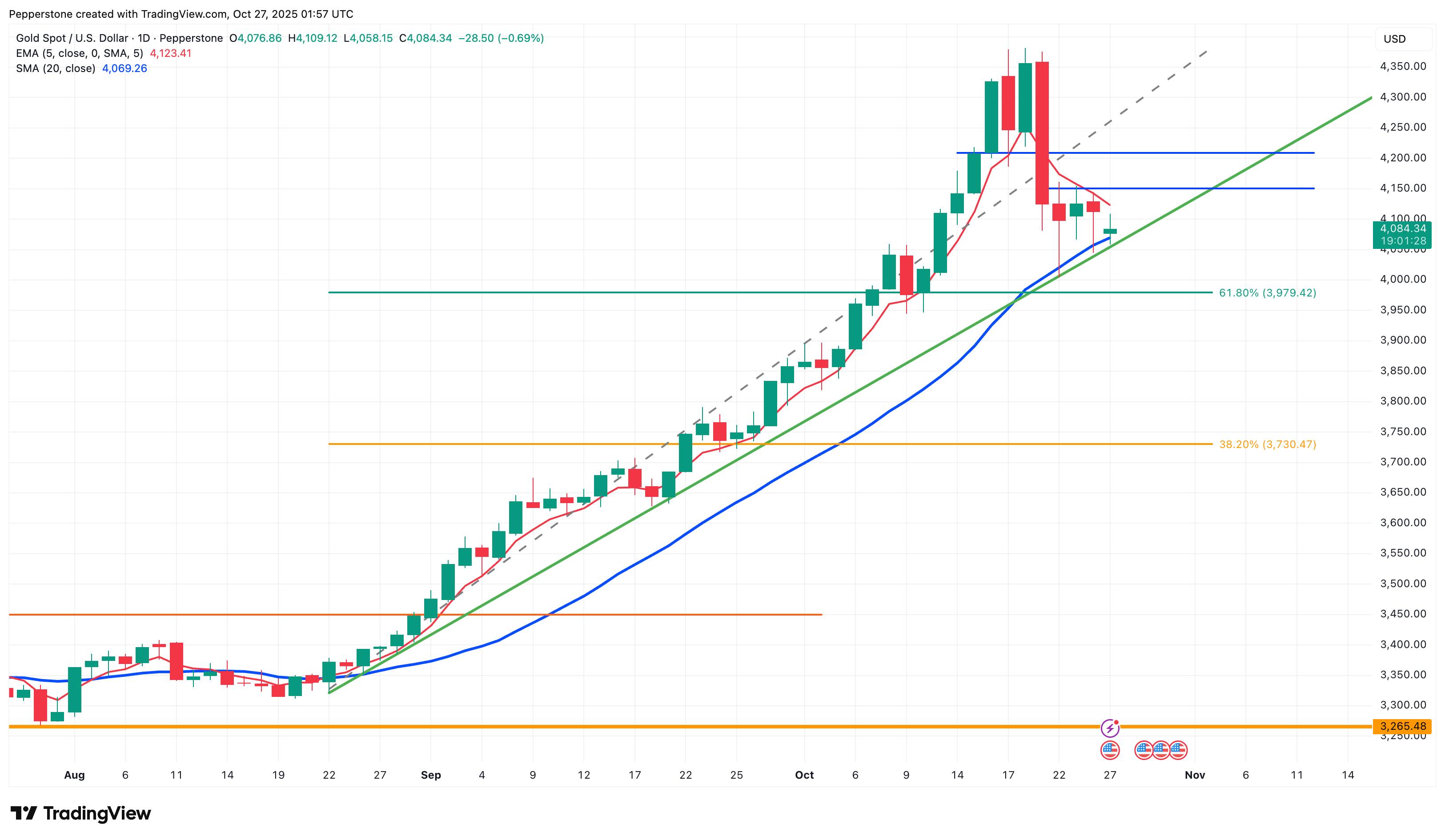
          If buying pressure strengthens and gold closes back above $4,100, the consolidation high at $4,150 since last Wednesday would be the next resistance level before challenging $4,200.

          Conversely, if prices continue to retreat, support at the late-August channel bottom and the $4,000 round number will be key. A breach of these levels could push gold toward the 61.8% Fibonacci retracement of the recent rally, around $3,980.

          Mixed Signals: Long-Term Support Holds, Short-Term Pressure Remains

          Despite ongoing US government shutdown risks, elevated fiscal deficits, and persistent geopolitical tensions providing a supportive backdrop, gold's latest boost comes from September US inflation data. Last Friday, core CPI rose 3.0% YoY, below the 3.1% forecast, while core services inflation fell to a cycle low of 3.5%. This cooling trend reinforces market expectations for two more rate cuts this year, supporting non-yielding assets like gold.

          At the same time, US-China trade talks in Kuala Lumpur have eased risk sentiment. Bessent confirmed that a "successful framework for leaders" was reached, broadly matching market expectations: China may moderately ease rare earth export controls, while the Trump administration could extend the 90-day tariff pause and withdraw the threat of a 100% additional tariff.

          This development lifted sentiment, prompting safe-haven flows to exit gold and shift into risk assets. CME's recent 5.2% increase in gold and silver margins has further restrained short-term buying momentum.

          Overall, after dropping from the all-time high of $4,381, gold found temporary support around $4,000 and entered a consolidation phase. While technical profit-taking and easing trade tensions caused short-term volatility, the key drivers for gold's medium- to long-term outlook—Fed rate cut expectations, central bank purchases, and geopolitical safe-haven demand—remain intact.

          In my view, near-term upside appears constrained, with gold likely to trade within a neutral to slightly bearish range this week, depending on risk sentiment and key economic developments.

          Focus on US Risk Events and US-China Talks

          This week features a dense schedule of central bank meetings and key economic data. For gold, the Fed meeting, Powell's speech, Q3 US GDP, and September core PCE data are the main highlights.

          With an October rate cut largely priced in, attention will focus on Powell's tone and forward guidance. If he acknowledges the cooling inflation and signals a potential end to balance sheet runoff in the coming months again, expectations for a 25bp cut in December would be reinforced, supporting gold. Conversely, if he emphasizes that tariff effects are still working through the economy and uncertainty remains in policy direction, gold may face pressure.

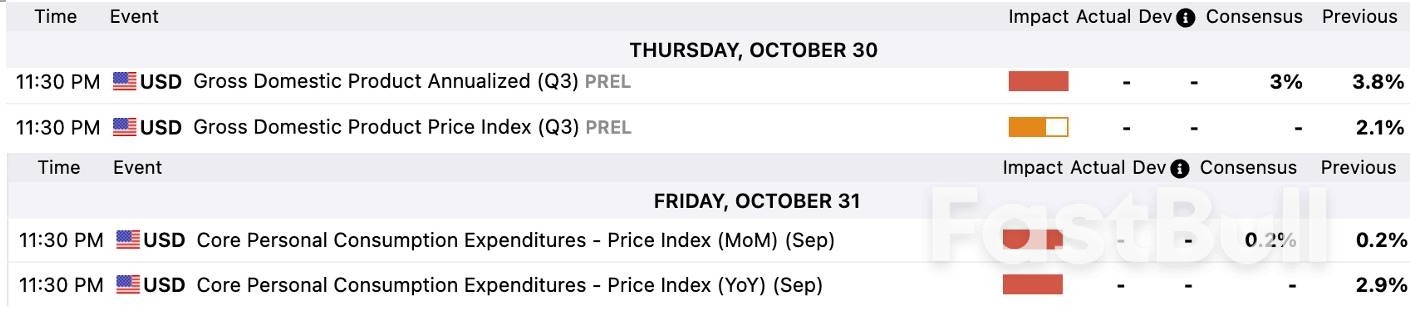
          Although GDP and PCE data will be released after the Fed meeting, traders should still watch closely. The consensus is for Q3 US GDP annualized growth to slow to 3.0% (from 3.8%), while September core PCE is expected to remain at 2.9% YoY. Data confirming slowing growth and moderate inflation would further reinforce rate cut expectations, supporting gold.
          Beyond short-term data-driven swings, the US-China leaders' meeting at the APEC summit could be a key catalyst for gold's next move. With positive signals already sent from the Kuala Lumpur talks, markets expect the meeting to focus on confirming concession details. As long as both sides avoid escalating tensions, any level of concession will reduce safe-haven demand, posing a short-term headwind for gold.

          Source: Pepperstone

          Risk Warnings and Disclaimers
          You understand and acknowledge that there is a high degree of risk involved in trading. Following any strategies or investment methods may lead to potential losses. The content on the site is provided by our contributors and analysts for information purposes only. You are solely responsible for determining whether any trading assets, securities, strategy, or any other product is suitable for investing based on your own investment objectives and financial situation.
          Add to Favorites
          Share

          Gold Market Boom Triggers Hiring Frenzy and Soaring Salaries for Precious Metals Traders

          Gerik

          Economic

          Commodity

          Gold’s Meteoric Rise Reshapes the Trading Landscape

          The global gold market is undergoing a structural transformation as trading houses, hedge funds, and banks race to hire experienced precious metals traders amid surging demand and soaring prices. This hiring spree unprecedented in scale is reshaping what was once considered a niche segment of commodities trading.
          With gold prices climbing steadily and forecasted by Lombard Odier to reach $4,600 per ounce next year, market participants are expanding their precious metals teams or entering the sector for the first time. This trend is being driven by both macroeconomic appeal and tactical opportunities, leading to aggressive recruitment and a dramatic rise in trader compensation.

          From Fringe to Frontline: The Changing Role of Gold Traders

          Traditionally dominated by a handful of global banks such as JPMorgan Chase, UBS, and HSBC the gold trading market operated with relatively lean teams. But this year, the dynamics have shifted sharply. Leading commodity trading firms like Trafigura and Gunvor have aggressively built out dedicated teams, while players such as IXM and Mercuria have intensified recruitment efforts.
          Alex Kerr from Aurex Group described the shift as “a moment in the sun” for precious metals traders, who are now being courted by hedge funds, industrial refiners, and asset managers in addition to banks. This diversification of demand has upended traditional career paths and inflated compensation packages, especially for those with hands-on experience in physical metals logistics.
          This evolution reflects both a causal and a correlational dynamic. On the one hand, rising gold prices and arbitrage opportunities have directly incentivized firms to increase their trading exposure. On the other, the perception of gold as a hedge against inflation, geopolitical uncertainty, and fiat devaluation is attracting broader institutional participation, which in turn fuels hiring demand.

          LBMA Conference Highlights Industry’s Turning Point

          The industry's changing fortunes were a central theme at the London Bullion Market Association (LBMA) conference held in Kyoto. LBMA CEO Ruth Crowell acknowledged that the sector, long seen as peripheral, is now entering a more mainstream phase. She cited a surge in both trading volume and client participation as evidence that the market is undergoing a structural elevation.
          This view is supported by hard data. In the first quarter of 2025 alone, the top 12 global banks earned $500 million in precious metals trading revenues double the quarterly average over the past decade and the second-highest in ten years, according to Crisil Coalition Greenwich. Such profits illustrate a causal link between market volatility, arbitrage flows, and institutional performance.

          Talent Scarcity Drives Up Compensation

          One of the biggest constraints to growth is the extreme shortage of experienced traders. Years of underinvestment in talent combined with an aging workforce and the broader shift of graduates toward tech and data roles has left the industry with a thin pipeline. The result is intense competition for a limited number of qualified professionals, pushing bonus multiples to two or three times those at traditional banks, especially for physical metals traders.
          Nicholas Snoek of HC Group emphasized that physical traders are in even shorter supply, with many recent retirees and a lack of junior replacements. This imbalance is now causing significant movement across all seniority levels, with traders frequently shifting between banks, trading houses, and hedge funds.

          New Entrants and Institutional Expansion

          Beyond traditional commodity firms, a growing number of financial institutions are expanding into precious metals. Gunvor, for instance, is building a full value chain from raw concentrates to refined bars and has recently hired several top traders from rivals. Banks like Singapore’s DBS and OCBC, as well as France’s Societe Generale, are also entering the hiring race, driven by strong client demand and the sector’s growing profit potential.
          The influx of new entrants and the expansion of existing players illustrate a causal feedback loop: rising gold market volatility attracts institutional capital, which in turn creates more trading opportunities, fueling further demand for skilled professionals.

          A Talent War in a Golden Era

          The gold market is no longer a niche it has become a core strategic asset class for institutions seeking to capitalize on macro volatility, inflation concerns, and de-dollarization themes. As firms rush to scale up, they face a talent bottleneck that is inflating salaries and transforming the dynamics of commodities trading.
          Unless training pipelines and recruitment strategies evolve quickly, the imbalance between trader supply and demand may persist, keeping the cost of talent high and making the precious metals desk one of the most lucrative frontiers in global finance. The current surge is not just a hiring spree it marks the emergence of gold as a critical pillar in the next phase of institutional investment and risk management.

          Source: Bloomberg

          To stay updated on all economic events of today, please check out our Economic calendar
          Risk Warnings and Disclaimers
          You understand and acknowledge that there is a high degree of risk involved in trading. Following any strategies or investment methods may lead to potential losses. The content on the site is provided by our contributors and analysts for information purposes only. You are solely responsible for determining whether any trading assets, securities, strategy, or any other product is suitable for investing based on your own investment objectives and financial situation.
          Add to Favorites
          Share

          Poland Could Cut Interest Rates Again In Early 2026, Central Banker Kotecki Says

          Samantha Luan

          Forex

          Political

          Economic

          Poland's Monetary Policy Council can hold off on further interest rate cuts for now to assess the impact of its monetary policy easing, before returning to cuts at the start of next year, said MPC member Ludwik Kotecki.The key rate has fallen by 125 basis points to 4.5% in 2025 and Poland's central bank chief Adam Glapinski said this month he still sees some room to cut rates, but it remains unclear whether such a move would come in November.Kotecki said next month would be a good time to assess Polish economic conditions and the central bank's actions so far. In November, a new inflation projection prepared by the National Bank of Poland will be published.

          "For now, before reviewing the November inflation projection, my baseline scenario is that I would wait a while before making another decision to cut interest rates," he told Reuters in an interview."If nothing extraordinary happens, I believe we should resume discussions about interest rate cuts at the beginning of next year, and in the meantime, calmly monitor changes in prices, wages, and other macroeconomic parameters."The inflation projection will show when and how quickly inflation, according to NBP analysts, will reach the target of 2.5%. Although inflation is no longer a macroeconomic problem, it is still not at the target. It is closer to 3% than 2.5%, he said.

          In September, inflation in Poland was 2.9% year-on-year, while the central bank's inflation target is 1.5-3.5%.

          Kotecki said that if the November projection indicates a faster decline in inflation towards the middle of the central bank's target of 2.5%, it would be an argument for cutting rates in November."However, this hasn't been evident so far, especially in the case of core inflation. Its level has consistently hovered around 3% or slightly above 3%, including in the last projection. The latter also showed that core inflation is not reaching 2.5%," he said."If we want to achieve inflation at the 2.5% target, we should set these rates a bit higher. And this is another reason why I believe we should proceed with restraint," he said.

          Nevertheless, he said it was not a question of "if" but "when" to ease rates further."I don't rule out that the key interest rate could be further reduced next year, to as much as 4%, perhaps even slightly below 4%," Kotecki said.

          Source: TradingView

          To stay updated on all economic events of today, please check out our Economic calendar
          Risk Warnings and Disclaimers
          You understand and acknowledge that there is a high degree of risk involved in trading. Following any strategies or investment methods may lead to potential losses. The content on the site is provided by our contributors and analysts for information purposes only. You are solely responsible for determining whether any trading assets, securities, strategy, or any other product is suitable for investing based on your own investment objectives and financial situation.
          Add to Favorites
          Share

          ECB Poised to Hold Rates as Euro Zone Faces Weak Growth and Tariff Fallout

          Gerik

          Economic

          A Crucial Week for Euro Zone Data and Monetary Policy

          The European Central Bank (ECB) is heading into its policy meeting in Florence amid a pivotal week of economic updates that will test the euro zone’s resilience in the face of external and internal pressures. On Thursday, the region will receive its first estimate of third-quarter GDP an indicator that will help quantify the damage inflicted by recent US tariffs and sluggish consumption trends. Hours later, the ECB will announce whether it will adjust or maintain its 2% deposit rate, widely expected to remain unchanged.
          Forecasts suggest the economy likely posted minimal growth of just 0.1% in Q3, repeating the underwhelming pace from the second quarter. This stagnation follows a short-lived expansion surge earlier in the year as firms rushed to get ahead of tariff deadlines, only for activity to reverse sharply once levies took effect in April and July. Germany, the region’s largest economy, contracted 0.3% in Q2, and analysts fear its output may have flatlined again raising the risk of a technical recession.

          Tariff Headwinds and Industrial Struggles

          The US-EU agreement reached in July, which imposed a 15% tariff on most goods exported from the bloc, has become a defining factor in the region’s deceleration. Germany, with its export-heavy manufacturing base, is particularly exposed. Weak factory data and limited capacity utilization are constraining investment and productivity. Barclays’ Christian Keller emphasized that without a rebound in private consumption still tepid despite strong labor market indicators the euro area risks stagnation in domestic demand. This points to a clear causal relationship between tariff-induced export declines and business hesitation in expanding capital expenditure.
          The ECB’s upcoming Bank Lending Survey may offer further insight into whether its policy stance is effectively reaching consumers and businesses. Analysts will be looking to see if borrowing conditions are improving or if banks remain cautious due to weak macro signals.

          Inflation Eases, Reinforcing the Case for a Rate Pause

          Friday’s inflation data is also expected to show modest relief, with headline inflation forecast to ease to 2.1% from 2.2% in September. Such a trend would support the ECB’s assertion that inflationary pressures have largely normalized. With market pricing already anticipating a prolonged rate pause and potential undershoot of the inflation target next year, the ECB appears comfortable sitting tight for now.
          Katharine Neiss from PGIM Fixed Income cautioned that while inflation appears to be under control, it could settle slightly below target in the medium term. This raises the possibility of a “low-flation” scenario by 2026, where persistent sub-2% inflation could force the ECB into renewed easing a shift from its earlier hawkish posture.

          Mixed Signals from Business Activity and Policy Outlook

          While recent Purchasing Managers’ Index (PMI) data surprised to the upside showing the strongest private-sector expansion since May 2024 economists remain skeptical. Ruben Segura-Cayuela of Bank of America warned against overinterpreting the PMI surge, citing past instances where they proved to be unreliable forward indicators. His view highlights a divergence between sentiment surveys and hard data, underscoring uncertainty in the ECB’s decision-making environment.
          Germany is expected to be a critical swing factor. Chancellor Friedrich Merz’s plans to stimulate the economy through large-scale infrastructure and defense spending could support growth but only from 2026 onward. Until then, Germany risks another quarter of negative growth, which would mark its third consecutive contraction and officially tip the economy into recession. The Bundesbank has already hinted that Q3 output will likely remain flat.
          Meanwhile, France continues to be a source of risk due to political instability and mounting fiscal challenges. Its growing budget deficit has become a concern for euro zone stability and investor sentiment. Soeren Radde of Point72 highlighted France as a potential drag on fourth-quarter sentiment, warning that without fiscal discipline, its structural imbalances could overshadow temporary gains elsewhere in the bloc.

          Policy Patience Amid Weak Recovery Prospects

          As the ECB gathers in Florence, it faces a challenging landscape. While inflation is moderating and business surveys hint at recovery, the underlying economic engine remains sluggish. Tariff-induced headwinds, subdued consumer activity, and fragmented national dynamics make it difficult for policymakers to pivot decisively in any direction.
          The most prudent course for now is likely a steady hand. The ECB is expected to maintain its current policy rate, with forward guidance emphasizing cautious monitoring rather than immediate action. But unless core economies like Germany and France can show convincing signs of recovery, even that cautious stability could soon give way to renewed debate over stimulus in early 2026.

          Source: Bloomberg

          To stay updated on all economic events of today, please check out our Economic calendar
          Risk Warnings and Disclaimers
          You understand and acknowledge that there is a high degree of risk involved in trading. Following any strategies or investment methods may lead to potential losses. The content on the site is provided by our contributors and analysts for information purposes only. You are solely responsible for determining whether any trading assets, securities, strategy, or any other product is suitable for investing based on your own investment objectives and financial situation.
          Add to Favorites
          Share

          Asian Markets Rally as Trump’s Trade Push Propels Nikkei Past 50,000

          Gerik

          Economic

          Stocks

          Record-Setting Day for Asian Stocks Amid US-Led Trade Optimism

          Markets across Asia began the week with robust gains, spurred by renewed momentum in US trade diplomacy and favorable domestic political developments. Japan’s Nikkei 225 index surged 2.1% to close at 50,329.08, crossing the symbolic 50,000 threshold for the first time, while South Korea’s Kospi rose 2% to a record 4,018.73. The rally comes as US President Donald Trump intensifies efforts to secure trade agreements across Asia and prepares for a pivotal summit with Chinese President Xi Jinping.
          The coordinated progress in trade talks is reinforcing optimism that tensions between the world’s two largest economies may be easing. US and Chinese negotiators signaled over the weekend that a framework agreement is taking shape, ahead of a planned meeting between Trump and Xi at the Asia-Pacific Economic Cooperation (APEC) summit in South Korea.

          US-Led Trade Framework Revives Risk Appetite

          Trump’s Asian tour, which included stops in Malaysia, Thailand, Cambodia, and Vietnam, yielded preliminary trade deals with each of these nations. These developments not only signal a return to bilateral engagement but also raise the likelihood of reducing long-standing frictions in global trade. According to SPI Asset Management’s Stephen Innes, this round of diplomacy “isn’t just photo-op diplomacy” but involves a deeper roadmap to mitigate economic fragmentation.
          Investors interpreted these signals as supportive of global growth, with the positive trade narrative layered on top of already strong US equity performance. The S&P 500, Dow Jones Industrial Average, and Nasdaq all closed at record highs the previous Friday, driven by lower-than-expected inflation data and robust corporate earnings, reinforcing risk-on sentiment globally.

          Japan’s Domestic Tailwinds Add to Market Momentum

          In addition to external catalysts, Japan’s domestic political environment contributed to the Nikkei’s breakout. Newly appointed Prime Minister Sanae Takaichi has garnered strong public support for her economic and defense-oriented policies. Approval ratings from major polls range from 58.7% to 74%, bolstering investor confidence in the new administration’s stability.
          Her market-friendly stance, particularly her pledge to increase defense spending to 2% of GDP by 2026, has lifted shares of defense contractors. Kawasaki Heavy Industries gained 8.7%, IHI Corp. rose 2.6%, and Hitachi advanced 2.7% clear beneficiaries of the administration’s budgetary priorities. These gains suggest a causal relationship between government policy announcements and sector-specific rallies.
          Moreover, speculation around Japan's consideration to purchase American-made Ford F-150 trucks as part of a goodwill gesture to reduce trade friction added another layer of optimism regarding US-Japan relations.

          Broader Asia Joins the Rally

          The bullish mood spread across the region. Hong Kong’s Hang Seng index rose 1% to 26,427.34, while China’s Shanghai Composite gained 1% to reach 3,991.35. Taiwan’s Taiex increased by 2.1%, and India’s Sensex added 0.5%. Australia’s S&P/ASX 200 also edged up 0.3%, continuing the region-wide advance.
          The APEC Secretariat’s latest report released Monday projected a slowdown in annual GDP growth for member economies from 3.6% in 2024 to 3% in 2025 partly due to lingering tariffs and trade restrictions. However, market reaction suggests that investors are betting on near-term diplomacy and recovery outweighing structural headwinds.

          Currency and Oil Markets Echo Positive Sentiment

          The US dollar strengthened slightly to 153.15 yen, reflecting expectations of continued capital flows into US assets. Meanwhile, oil markets edged up modestly, with US benchmark crude rising to $61.65 per barrel and Brent crude at $65.32. These modest gains suggest a correlation between improved global outlook and energy demand expectations, though not yet a full-scale rally.
          Monday’s broad-based rally in Asia underscores how quickly investor sentiment can shift when geopolitical conditions stabilize and macroeconomic data aligns with political momentum. As Trump’s trade talks signal a thaw in global economic tensions and Japan's new government delivers early confidence, regional markets appear to be entering a phase of renewed optimism. Yet, sustaining this momentum will depend on the durability of trade agreements and whether diplomatic progress translates into long-term structural reforms.

          Source: AP

          To stay updated on all economic events of today, please check out our Economic calendar
          Risk Warnings and Disclaimers
          You understand and acknowledge that there is a high degree of risk involved in trading. Following any strategies or investment methods may lead to potential losses. The content on the site is provided by our contributors and analysts for information purposes only. You are solely responsible for determining whether any trading assets, securities, strategy, or any other product is suitable for investing based on your own investment objectives and financial situation.
          Add to Favorites
          Share

          Trump Says U.S., China Close To Trade Deal Ahead Of Xi Talks, TikTok Decision

          Samantha Luan

          Forex

          Political

          China–U.S. Trade War

          Economic

          Trump Says U.S., China Close To Trade Deal Ahead Of Xi Talks, TikTok Decision_1

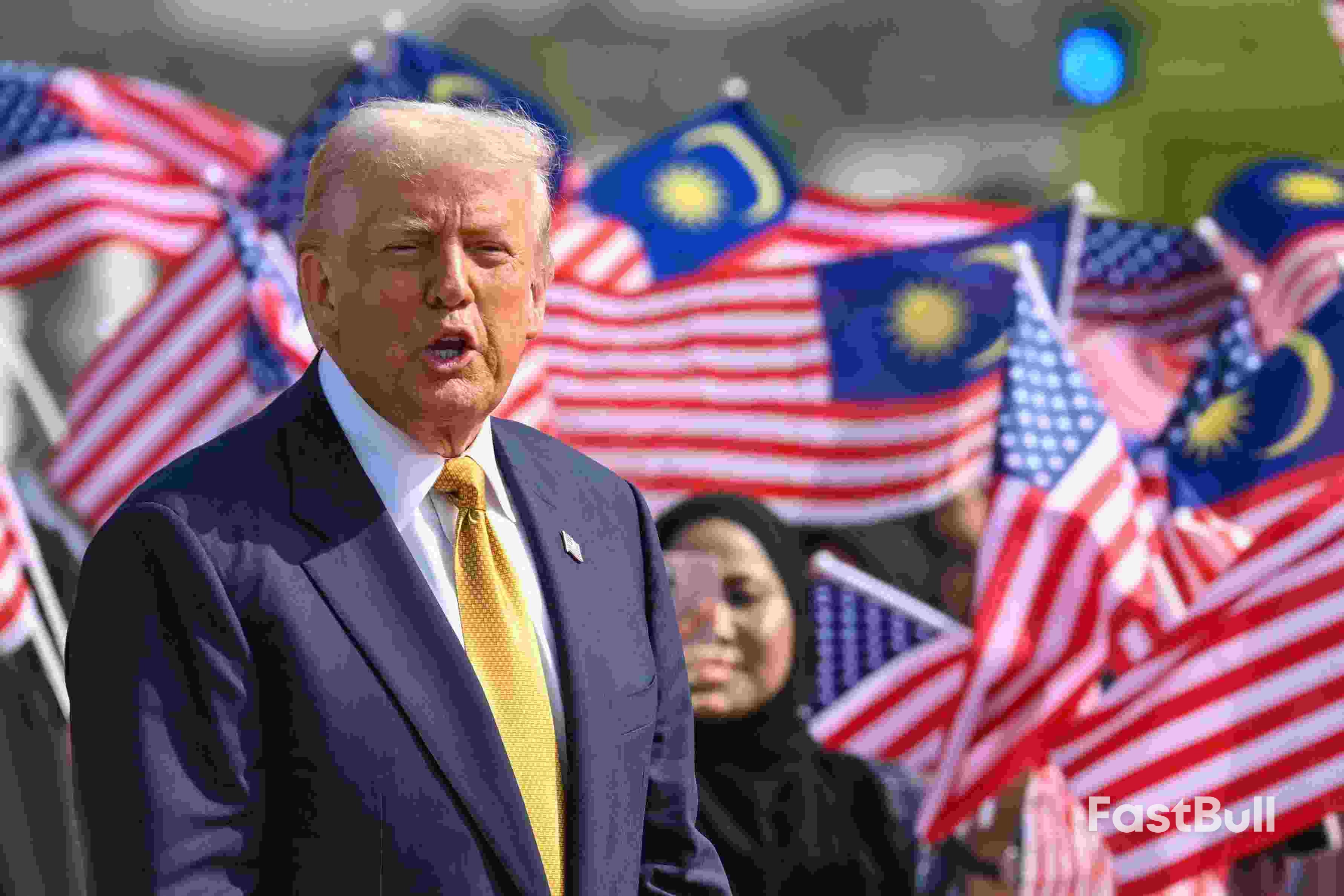
          U.S. President Donald Trump looks on next to people waving Malaysian national flags before he departs on Air Force One from Kuala Lumpur International Airport in Sepang on Oct. 27, 2025.

          U.S. President Donald Trump said that Washington and Beijing were poised to "come away with" a trade deal ahead of his expected meeting with Chinese leader Xi Jinping.Speaking aboard Air Force One en route to Japan from Malaysia, Trump added that he could sign a final deal on TikTok as early as Thursday."I have a lot of respect for President Xi, and we are going to come away with the deal," Trump said.He began his whirlwind weeklong Asia trip on Sunday with a flurry of trade deals and a peace agreement aimed at strengthening his position before meeting Xi.

          During his first stop in Malaysia, Trump signed separate trade and mineral agreements with his Malaysian and Cambodian counterparts, as well as frameworks for trade pacts with Thailand and Vietnam.The four countries, part of an 11-member regional bloc called the Association of Southeast Asian Nations (ASEAN), pledged to remove trade barriers, provide preferential market access to U.S. goods, and increase purchases of American agricultural, energy products, and aircraft.They also agreed to cooperate with Washington on export controls, sanctions and access to critical minerals — commitments that appear to strengthen Trump's standing in a region where Beijing has a growing clout.

          Wendy Cutler, senior vice president at Asia Society Policy Institute, said that the agreements focused on "cooperation rather than hard commitments," with many important points "considerably shorter" than prior U.S. trade agreements."The U.S. can impose tariffs or terminate the agreement if it considers Malaysia in violation of commitments," Cutler added.In Japan, Trump is expected to meet Prime Minister Sanae Takaichi and the emperor before flying to South Korea, capping the trip with a of the Asia-Pacific Economic Cooperation, or APEC, summit.

          Chinese Premier Li Qiang, who also flew in to Malaysia for the 28th China-ASEAN Summit, stopped by Singapore, where he witnessed the signing of eight agreements covering trade and the digital economy.

          Scant details

          But while the diplomatic momentum appeared strong, few details were released about the scope of the new trade frameworks.Under the agreements, Washington will keep a 19% tariff rate on most exports from Malaysia, Cambodia and Thailand, while some products will face no duties, according to joint statements from the White House.Tariffs on Vietnam will remain at 20% with some goods eligible for duty-free access, according to the joint statement. Vietnam, which recorded a trade surplus of $123 billion with the U.S. last year, also pledged to step up purchases of American products to address the trade imbalance.

          Malaysia agreed not to impose bans or quotas on U.S.-bound exports of critical minerals and to speed up development of its rare-earth projects needed by American companies.The country, which sits on an estimated 16.1 million tonnes of rare earth deposits, has enforced a nationwide moratorium on the export of unprocessed rare earth materials since last year to develop its downstream industries and prevent resource exploitation.

          Thailand will ease tariff barriers on U.S. goods by accepting some American-made vehicles, medical devices and pharmaceuticals, and by importing ethanol for fuel. It also pledged to relax foreign ownership restrictions for U.S. investors in the telecommunications sector.The agreements left open the possibility of additional product exemptions to be decided later, said Michael Wan, economist at MUFG Bank. He noted that sectoral tariffs on pharmaceuticals and electronics would remain key, as would questions over the legality of Trump's use of an emergency powers law to impose them.

          Peace deal

          Aside from trade agreements, Trump announced the formalization of an extended truce between Thailand and Cambodia, building on a ceasefire that he brokered in July following their violent border clashes this summer.Trump, who has cast himself as a global peace broker, said the deal showed his administration has done "something that a lot of people said couldn't be done, and we saved maybe millions of lives.""My administration immediately began working to prevent the conflict from escalating," Trump said. "Everybody was sort of amazed that we got it done so quickly."

          Trump-Xi Seoul meeting

          As Trump mingled with other leaders, U.S. and Chinese negotiators met on the sidelines of the ASEAN summit, where the bilateral talks yielded a framework ahead of an expected meeting between Trump and Xi in South Korea on Thursday."Markets are increasingly getting used to a 'punch-first, negotiate-second' tariffs overture," said John Woods, chief investment officer at Lombard Odier.Chinese top trade negotiator Li Chenggang said Sunday that a preliminary consensus had been reached after "very intense discussions" on a range of issues, including export controls, fentanyl and shipping fees.

          The next step, he said, was for both sides to complete their domestic approval procedures.In an interview with CBS on Sunday, U.S. Treasury Secretary Scott Bessent said that Trump's threat of 100% tariffs is "effectively off the table" after a "very good two-day meeting" with Chinese officials.Speaking separately to ABC News' "This Week," Bessent said the negotiations produced a "substantial framework" that could ease concerns among American soybean farmers over China's boycott.

          China bought more than half of U.S. soybeans in 2023 and 2024, accounting for nearly $12.8 billion in 2024. But Beijing halted purchases earlier this year after Trump ignited a trade war.Bessent also told ABC News that he expected China to delay its rare earth export controls, set to take effect in the coming weeks, by one year. Trump and Xi could "consummate" a deal to allow TikTok to continue to operate in the U.S., Bessent added.

          "We believe both sides, after testing the other's boundaries, will likely make concessions again," said Ting Lu, China economist at Nomura, who expects the additional 100% tariffs on Chinese goods will "surely not be implemented" with both sides likely to extend the existing tariff truce.In return, Lu added, Beijing may resume purchases of U.S. soybeans and ease the enforcement of its rare earth export controls.

          Source: CNBC

          To stay updated on all economic events of today, please check out our Economic calendar
          Risk Warnings and Disclaimers
          You understand and acknowledge that there is a high degree of risk involved in trading. Following any strategies or investment methods may lead to potential losses. The content on the site is provided by our contributors and analysts for information purposes only. You are solely responsible for determining whether any trading assets, securities, strategy, or any other product is suitable for investing based on your own investment objectives and financial situation.
          Add to Favorites
          Share

          Bitcoin Surges As Gold Stalls In Fed Anticipation

          Olivia Brooks

          Cryptocurrency

          Key Takeaways:

          ●Bitcoin experiences growth as gold steadies before Federal Reserve announcements.
          ●The BTC/gold ratio nears a high of 27:1.
          ●Renewed risk appetite drives institutional shifts towards Bitcoin.

          Gold prices have stalled, while Bitcoin's momentum increases as the BTC/gold ratio surges ahead of anticipated U.S. Federal Reserve announcements, reflecting renewed risk appetite in financial markets.

          This event highlights a shift towards Bitcoin at risk-on points, affecting capital allocations and potentially influencing crypto and gold markets as investors anticipate Federal policy changes.

          Gold's recent price pause coincides with renewed momentum in Bitcoin, as the BTC/gold ratio surges. This occurs amidst revived risk appetite ahead of expected U.S. Federal Reserve announcements. The Federal Reserve's policies often influence market dynamics.

          Bitcoin currently trades at $111,641.73, while gold stands at $4,113.45 per ounce. This marks a record high in the BTC/gold ratio, approaching 27:1. Increased institutional allocations to Bitcoin ETFs reflect a shift in investment strategies.

          The market impact is significant, with Bitcoin outperforming gold dramatically over the past five years by 756.7% compared to gold's 116.2% return. Risk-on capital has shifted away from gold in favor of BTC, influencing market trends.

          Institutional investments lean towards Bitcoin amid dovish Federal Reserve expectations, reducing demand for gold-backed products. Official ETF flows corroborate this trend, showcasing a financial shift towards more volatile assets.

          The BTC/gold ratio has not prompted direct comments from major industry figures like Michael Saylor or Cathie Wood. Historically, Bitcoin exhibits speculative tendencies, while gold maintains its position as a safe haven asset. "The recent uptick in the BTC/gold ratio illustrates not just a change in asset preference but also an evolving market strategy leading into Fed Week," said Alice Brown, Cryptocurrency Analyst, Market Trends Inc.

          Potential outcomes include continued Bitcoin dominance in the face of speculative inflows contrasted with gold's stable conservative demand. Historical precedents highlight moments where both assets diverged significantly in market behavior during crisis and risk-on phases.

          Source: CryptoSlate

          Risk Warnings and Disclaimers
          You understand and acknowledge that there is a high degree of risk involved in trading. Following any strategies or investment methods may lead to potential losses. The content on the site is provided by our contributors and analysts for information purposes only. You are solely responsible for determining whether any trading assets, securities, strategy, or any other product is suitable for investing based on your own investment objectives and financial situation.
          Add to Favorites
          Share
          FastBull
          Copyright © 2025 FastBull Ltd

          728 RM B 7/F GEE LOK IND BLDG NO 34 HUNG TO RD KWUN TONG KLN HONG KONG

          TelegramInstagramTwitterfacebooklinkedin
          App Store Google Play Google Play
          Products
          Charts

          Chats

          Q&A with Experts
          Screeners
          Economic Calendar
          Data
          Tools
          Membership
          Features
          Function
          Markets
          Copy Trading
          Latest Signals
          Contests
          News
          Analysis
          24/7
          Columns
          Education
          Company
          Careers
          About Us
          Contact Us
          Advertising
          Help Center
          Feedback
          User Agreement
          Privacy Policy
          Business

          White Label

          Data API

          Web Plug-ins

          Poster Maker

          Affiliate Program

          Risk Disclosure

          The risk of loss in trading financial instruments such as stocks, FX, commodities, futures, bonds, ETFs and crypto can be substantial. You may sustain a total loss of the funds that you deposit with your broker. Therefore, you should carefully consider whether such trading is suitable for you in light of your circumstances and financial resources.

          No decision to invest should be made without thoroughly conducting due diligence by yourself or consulting with your financial advisors. Our web content might not suit you since we don't know your financial conditions and investment needs. Our financial information might have latency or contain inaccuracy, so you should be fully responsible for any of your trading and investment decisions. The company will not be responsible for your capital loss.

          Without getting permission from the website, you are not allowed to copy the website's graphics, texts, or trademarks. Intellectual property rights in the content or data incorporated into this website belong to its providers and exchange merchants.

          Not Logged In

          Log in to access more features

          FastBull Membership

          Not yet

          Purchase

          Become a signal provider
          Help Center
          Customer Service
          Dark Mode
          Price Up/Down Colors

          Log In

          Sign Up

          Position
          Layout
          Fullscreen
          Default to Chart
          The chart page opens by default when you visit fastbull.com