• Trade
  • Markets
  • Copy
  • Contests
  • News
  • 24/7
  • Calendar
  • Q&A
  • Chats
Trending
Screeners
SYMBOL
LAST
BID
ASK
HIGH
LOW
NET CHG.
%CHG.
SPREAD
SPX
S&P 500 Index
6857.13
6857.13
6857.13
6865.94
6827.13
+7.41
+ 0.11%
--
DJI
Dow Jones Industrial Average
47850.93
47850.93
47850.93
48049.72
47692.96
-31.96
-0.07%
--
IXIC
NASDAQ Composite Index
23505.13
23505.13
23505.13
23528.53
23372.33
+51.04
+ 0.22%
--
USDX
US Dollar Index
98.980
99.060
98.980
99.000
98.740
0.000
0.00%
--
EURUSD
Euro / US Dollar
1.16443
1.16450
1.16443
1.16715
1.16408
-0.00002
0.00%
--
GBPUSD
Pound Sterling / US Dollar
1.33305
1.33315
1.33305
1.33622
1.33165
+0.00034
+ 0.03%
--
XAUUSD
Gold / US Dollar
4222.23
4222.57
4222.23
4230.62
4194.54
+15.06
+ 0.36%
--
WTI
Light Sweet Crude Oil
59.332
59.362
59.332
59.543
59.187
-0.051
-0.09%
--

Community Accounts

Signal Accounts
--
Profit Accounts
--
Loss Accounts
--
View More

Become a signal provider

Sell trading signals to earn additional income

View More

Guide to Copy Trading

Get started with ease and confidence

View More

Signal Accounts for Members

All Signal Accounts

Best Return
  • Best Return
  • Best P/L
  • Best MDD
Past 1W
  • Past 1W
  • Past 1M
  • Past 1Y

All Contests

  • All
  • Trump Updates
  • Recommend
  • Stocks
  • Cryptocurrencies
  • Central Banks
  • Featured News
Top News Only
Share

India's Forex Reserves Fall To $686.23 Billion As Of Nov 28

Share

Reserve Bank Of India Says Federal Government Had No Outstanding Loans With It As On Nov 28

Share

Lebanon Says Ceasefire Talks Aim Mainly At Halting Israel's Hostilities

Share

Russia Plans To Boost Oil Exports From Western Ports By 27% In December From November -Sources And Reuters Calculations

Share

Sberbank- Estimated Investment Of $100 Million In Technology, Team Expansion, And New Offices In India

Share

Sberbank Says Sberbank Unveils Major Expansion Strategy For India, Plans Full-Scale Banking, Education, And Tech Transfer

Share

India Government: Expect That Flight Schedules Will Begin To Stabilise And Return To Normal By Dec 6

Share

EU: Tiktok Agrees To Changes To Advertising Repositories To Ensure Transparency, No Fine

Share

EU Tech Chief: Not EU's Intention To Impose Highest Fines, X Fine Is Proportionate, Based On Nature Of Infringement, Impact On EU Users

Share

EU Regulators: EU Investigation Into X's Dissemination Of Illegal Content, Measures To Counter Disinformation Continues

Share

Ukraine's Military Says It Hit Russian Port In Krasnodar Region

Share

Jumped The Gun, Says Morgan Stanley, Reverses Dec Fed Rate Call To 25Bps Cut

Share

Lebanese President Aoun:Lebanon Welcomes Any Country Keeping Its Forces In South Lebanon To Help Army After End Of Unifil's Mission

Share

China Cabinet Meeting: Will Firmly Prevent Major Fire Incidents

Share

China Cabinet Meeting: China To Crack Down On Abuse Of Power In Enterprise-Related Law Enforcement

Share

[Shanghai Futures Exchange: Adjustment Of Margin Ratios And Price Limits For Fuel Oil And Other Futures Contracts] After Research And Decision, Effective From The Closing Settlement On Tuesday, December 9, 2025, The Margin Ratios And Price Limits Will Be Adjusted As Follows: The Price Limit For Fuel Oil And Petroleum Asphalt Futures Contracts Will Be Adjusted To 7%, The Margin Ratio For Hedging Positions Will Be Adjusted To 8%, And The Margin Ratio For General Positions Will Be Adjusted To 9%

Share

Lebanese President Aoun:Lebanon Opted For Negotiations With Israel To Avoid Another Round Of Violence

Share

Chile's Consumer Prices Up 0.3% Month-On-Month In November

Share

Standard Chartered: Settlement Was Deemed Appropriate In Bringing In 'Mercy Investment Services & Others V. Standard Chartered' Case To Close

Share

Reuters Poll - Bank Of Canada Will Hold Overnight Rate At 2.25% On December 10, Say 33 Economists

TIME
ACT
FCST
PREV
U.S. Challenger Job Cuts MoM (Nov)

A:--

F: --

P: --

U.S. Initial Jobless Claims 4-Week Avg. (SA)

A:--

F: --

P: --

U.S. Weekly Initial Jobless Claims (SA)

A:--

F: --

P: --

U.S. Weekly Continued Jobless Claims (SA)

A:--

F: --

P: --

Canada Ivey PMI (SA) (Nov)

A:--

F: --

P: --

Canada Ivey PMI (Not SA) (Nov)

A:--

F: --

P: --

U.S. Non-Defense Capital Durable Goods Orders Revised MoM (Excl. Aircraft) (SA) (Sept)

A:--

F: --

P: --
U.S. Factory Orders MoM (Excl. Transport) (Sept)

A:--

F: --

P: --

U.S. Factory Orders MoM (Sept)

A:--

F: --

P: --

U.S. Factory Orders MoM (Excl. Defense) (Sept)

A:--

F: --

P: --

U.S. EIA Weekly Natural Gas Stocks Change

A:--

F: --

P: --

Saudi Arabia Crude Oil Production

A:--

F: --

P: --

U.S. Weekly Treasuries Held by Foreign Central Banks

A:--

F: --

P: --

Japan Foreign Exchange Reserves (Nov)

A:--

F: --

P: --

India Repo Rate

A:--

F: --

P: --

India Benchmark Interest Rate

A:--

F: --

P: --

India Reverse Repo Rate

A:--

F: --

P: --

India Cash Reserve Ratio

A:--

F: --

P: --

Japan Leading Indicators Prelim (Oct)

A:--

F: --

P: --

U.K. Halifax House Price Index YoY (SA) (Nov)

A:--

F: --

P: --

U.K. Halifax House Price Index MoM (SA) (Nov)

A:--

F: --

P: --

France Current Account (Not SA) (Oct)

A:--

F: --

P: --

France Trade Balance (SA) (Oct)

A:--

F: --

P: --

France Industrial Output MoM (SA) (Oct)

A:--

F: --

P: --

Italy Retail Sales MoM (SA) (Oct)

A:--

F: --

P: --

Euro Zone Employment YoY (SA) (Q3)

A:--

F: --

P: --

Euro Zone GDP Final YoY (Q3)

A:--

F: --

P: --

Euro Zone GDP Final QoQ (Q3)

A:--

F: --

P: --

Euro Zone Employment Final QoQ (SA) (Q3)

A:--

F: --

P: --

Euro Zone Employment Final (SA) (Q3)

A:--

F: --

P: --
Brazil PPI MoM (Oct)

--

F: --

P: --

Mexico Consumer Confidence Index (Nov)

--

F: --

P: --

Canada Unemployment Rate (SA) (Nov)

--

F: --

P: --

Canada Labor Force Participation Rate (SA) (Nov)

--

F: --

P: --

Canada Employment (SA) (Nov)

--

F: --

P: --

Canada Part-Time Employment (SA) (Nov)

--

F: --

P: --

Canada Full-time Employment (SA) (Nov)

--

F: --

P: --

U.S. Personal Income MoM (Sept)

--

F: --

P: --

U.S. Dallas Fed PCE Price Index YoY (Sept)

--

F: --

P: --

U.S. PCE Price Index YoY (SA) (Sept)

--

F: --

P: --

U.S. PCE Price Index MoM (Sept)

--

F: --

P: --

U.S. Personal Outlays MoM (SA) (Sept)

--

F: --

P: --

U.S. Core PCE Price Index MoM (Sept)

--

F: --

P: --

U.S. UMich 5-Year-Ahead Inflation Expectations Prelim YoY (Dec)

--

F: --

P: --

U.S. Core PCE Price Index YoY (Sept)

--

F: --

P: --

U.S. Real Personal Consumption Expenditures MoM (Sept)

--

F: --

P: --

U.S. 5-10 Year-Ahead Inflation Expectations (Dec)

--

F: --

P: --

U.S. UMich Current Economic Conditions Index Prelim (Dec)

--

F: --

P: --

U.S. UMich Consumer Sentiment Index Prelim (Dec)

--

F: --

P: --

U.S. UMich 1-Year-Ahead Inflation Expectations Prelim (Dec)

--

F: --

P: --

U.S. UMich Consumer Expectations Index Prelim (Dec)

--

F: --

P: --

U.S. Weekly Total Rig Count

--

F: --

P: --

U.S. Weekly Total Oil Rig Count

--

F: --

P: --

U.S. Consumer Credit (SA) (Oct)

--

F: --

P: --

China, Mainland Foreign Exchange Reserves (Nov)

--

F: --

P: --

China, Mainland Exports YoY (USD) (Nov)

--

F: --

P: --

China, Mainland Imports YoY (CNH) (Nov)

--

F: --

P: --

China, Mainland Imports YoY (USD) (Nov)

--

F: --

P: --

China, Mainland Trade Balance (CNH) (Nov)

--

F: --

P: --

China, Mainland Exports (Nov)

--

F: --

P: --

Q&A with Experts
    • All
    • Chatrooms
    • Groups
    • Friends
    Connecting
    .
    .
    .
    Type here...
    Add Symbol or Code

      No matching data

      All
      Trump Updates
      Recommend
      Stocks
      Cryptocurrencies
      Central Banks
      Featured News
      • All
      • Russia-Ukraine Conflict
      • Middle East Flashpoint
      • All
      • Russia-Ukraine Conflict
      • Middle East Flashpoint

      Search
      Products

      Charts Free Forever

      Chats Q&A with Experts
      Screeners Economic Calendar Data Tools
      Membership Features
      Data Warehouse Market Trends Institutional Data Policy Rates Macro

      Market Trends

      Market Sentiment Order Book Forex Correlations

      Top Indicators

      Charts Free Forever
      Markets

      News

      News Analysis 24/7 Columns Education
      From Institutions From Analysts
      Topics Columnists

      Latest Views

      Latest Views

      Trending Topics

      Top Columnists

      Latest Update

      Signals

      Copy Rankings Latest Signals Become a signal provider AI Rating
      Contests
      Brokers

      Overview Brokers Assessment Rankings Regulators News Claims
      Broker listing Forex Brokers Comparison Tool Live Spread Comparison Scam
      Q&A Complaint Scam Alert Videos Tips to Detect Scam
      More

      Business
      Events
      Careers About Us Advertising Help Center

      White Label

      Data API

      Web Plug-ins

      Affiliate Program

      Awards Institution Evaluation IB Seminar Salon Event Exhibition
      Vietnam Thailand Singapore Dubai
      Fans Party Investment Sharing Session
      FastBull Summit BrokersView Expo
      Recent Searches
        Top Searches
          Markets
          News
          Analysis
          User
          24/7
          Economic Calendar
          Education
          Data
          • Names
          • Latest
          • Prev

          View All

          No data

          Scan to Download

          Faster Charts, Chat Faster!

          Download App
          English
          • English
          • Español
          • العربية
          • Bahasa Indonesia
          • Bahasa Melayu
          • Tiếng Việt
          • ภาษาไทย
          • Français
          • Italiano
          • Türkçe
          • Русский язык
          • 简中
          • 繁中
          Open Account
          Search
          Products
          Charts Free Forever
          Markets
          News
          Signals

          Copy Rankings Latest Signals Become a signal provider AI Rating
          Contests
          Brokers

          Overview Brokers Assessment Rankings Regulators News Claims
          Broker listing Forex Brokers Comparison Tool Live Spread Comparison Scam
          Q&A Complaint Scam Alert Videos Tips to Detect Scam
          More

          Business
          Events
          Careers About Us Advertising Help Center

          White Label

          Data API

          Web Plug-ins

          Affiliate Program

          Awards Institution Evaluation IB Seminar Salon Event Exhibition
          Vietnam Thailand Singapore Dubai
          Fans Party Investment Sharing Session
          FastBull Summit BrokersView Expo

          Capital at Risk: Nature through An Investment Lens

          Blackrock

          Energy

          Summary:

          Only a portion of natural capital’s value to the economy is priced into markets today. But we expect asset prices will adjust to better reflect both the risks and opportunities linked to natural capital – a trend we are already starting to see.

          Valuing natural resources

          The economy depends on natural resources. Their value derives not only from their use as direct inputs to production – such as timber for construction – but also for their benefits to society like living trees that help clean the air. Economists use the term “natural capital” to refer to the total value that natural resources provide to the economy and to people.

          Ecosystem services grow when better priced

          Change in global ecosystem service volumes, 1900-2015Capital at Risk: Nature through An Investment Lens_1

          Drivers of asset repricing

          The primary driver of asset repricing is increasing physical risks: natural resources are increasingly strained, which pushes up costs for companies that rely on them. Biodiversity loss is reducing nature’s resilience and productivity in many regions, further driving physical risks. In addition to these physical risks, the policy response to natural capital stress is growing, especially in Europe. Technological advances and shifts in consumer and investor preferences can also influence natural capital value in the market.

          Identifying risks and opportunities

          Fully accounting for natural capital-related risks in investment portfolios depends on overcoming challenges with data and analysis. Right now, there is limited data on how exposed companies are to natural capital risks, but new corporate disclosure standards, data collection tools and models may help in the future. At BlackRock, we are also using new AI tools to help fill the data gap in the near term.
          In addition to managing risks, many clients are interested in gaining exposure to natural capital-related opportunities. They include solutions that: 1) use natural capital more efficiently – like precision agriculture; 2) support a circular economy by reducing and recovering waste – like businesses that use waste to create new goods; 3) restore nature – like reforestation; and 4) harness natural capital to generate new products or business models – for example, by using emerging synthetic biology alternatives.
          Near-term capital allocation opportunities include thematic strategies and systematic signals, as well as nature- and biodiversity-themed green bonds. In the longer term, we expect private markets to provide a significant opportunity for investing in natural capital solutions.

          Risk Warnings and Disclaimers
          You understand and acknowledge that there is a high degree of risk involved in trading. Following any strategies or investment methods may lead to potential losses. The content on the site is provided by our contributors and analysts for information purposes only. You are solely responsible for determining whether any trading assets, securities, strategy, or any other product is suitable for investing based on your own investment objectives and financial situation.
          Add to Favorites
          Share

          Asian Markets Bounce Back; Eyes on Local Data, Not Just US CPI

          XM

          Economic

          Stocks

          Forex

          A cautious rebound for stocks

          Stock markets in Asia have not been immune to the global selloff in August amid the unwinding of the yen carry trade and renewed fears about a US recession. Japanese stocks, in particular, were hit hard by the sudden surge in the yen; the Nikkei 225 Index tumbled by almost 20% between July 31 and August 5.
          Asian Markets Bounce Back; Eyes on Local Data, Not Just US CPI_1
          But a recovery is underway, with the Nikkei recouping about 50% of its losses, while the MSCI AC Asia ex Japan Index has gone a step further and reached the 61.8% Fibonacci retracement of its decline.
          However, markets remain quite jittery and it’s been a cautious recovery, not just in Asia, but on Wall Street too. A lot is riding on the latest CPI and retail sales reports out of the US due on Wednesday and Thursday, respectively, to further calm market nerves. But it’s not just concerns about the US economy that’s weighing on risk sentiment.

          Asian tigers no longer roaring

          The Chinese economy seems to be stuck in a rut, while Japan’s economy has been shrinking since the third quarter of 2023. GDP figures for the latter are out on Wednesday (23:50 GMT) and analysts expect positive growth of 0.5% quarter-on-quarter for the second quarter.
          Asian Markets Bounce Back; Eyes on Local Data, Not Just US CPI_2
          An in-line or somewhat softer-than-projected reading would probably help ease concerns that the Bank of Japan is proceeding too rapidly with policy normalization, potentially boosting both the Nikkei and the yen. But a much stronger-than-expected rebound in GDP could spur a negative reaction as it would increase bets that the BoJ will hike interest rates again this year.

          RBA’s next move more likely to be down

          Next doing the rounds will be the Australian employment report on Thursday at 01:30 GMT. Australia’s labour market likely added 20k jobs in July, down from the prior 50.2k. The unemployment rate is expected to have held steady at 4.1%. Figures released earlier this week showed that wage growth was unchanged at a near historical high of 4.1% y/y in Q2, supporting the case for no rate cuts anytime soon.
          Asian Markets Bounce Back; Eyes on Local Data, Not Just US CPI_3
          Worries about the economy have kept the Reserve Bank of Australia on the sidelines despite persistently high inflation. But there’s been some progress more recently on reducing inflation and investors no longer see any chance of an RBA rate hike this year. That could easily change, though, if the jobs numbers point to an improving labour market.

          Chinese consumers still not spending

          The Australian dollar could certainly benefit from some upbeat data as it’s still down by about 9% against its US counterpart from its July peak. However, just as significant for the aussie will be China’s latest stats on industrial output and retail sales coming up 30 minutes later.
          Although Chinese industrial production continues to grow at a satisfactory pace in spite of all the challenges, sluggish consumer spending poses a dilemma for authorities who seem opposed to big fiscal stimulus packages. Retail sales were up just 2.0% y/y in June and are expected to have picked up slightly to 2.6% y/y in July.
          Asian Markets Bounce Back; Eyes on Local Data, Not Just US CPI_4

          Risk of increased volatility

          If the incoming data are mostly positive and contribute to brightening the market mood, the aussie, stocks and other risk assets could enjoy a further bounce back over the next few days, though the yen might suffer a pullback unless it can find support in the Japanese GDP numbers.
          On the whole, it’s more likely that the data will add to the choppiness in the markets, amid all the uncertainties and thinner trading volumes during the peak summer holiday season, with the primary focus remaining on Fed expectations and US recession risks.
          To stay updated on all economic events of today, please check out our Economic calendar
          Risk Warnings and Disclaimers
          You understand and acknowledge that there is a high degree of risk involved in trading. Following any strategies or investment methods may lead to potential losses. The content on the site is provided by our contributors and analysts for information purposes only. You are solely responsible for determining whether any trading assets, securities, strategy, or any other product is suitable for investing based on your own investment objectives and financial situation.
          Add to Favorites
          Share

          Producer Price Index: Wholesale Inflation Cools In July

          Cohen

          Economic

          Wholesale inflation cooled more than expected last month. Here is the latest news release from the Bureau of Labor Statistics.

          The producer price index for final demand increased 0.1% month-over-month (s.a.), less than the expected 0.2% growth. On a non-seasonally adjusted annual basis, headline PPI decelerated from 2.7% in June to 2.2% in July, coming in below the expected 2.3% growth.

          Core PPI (excluding food and energy) for final demand was flat last month, less than the expected 0.2% growth. On a non-seasonally adjusted annual basis, core PPI decelerated from 3.0% year-over-year in June to 2.4% in July, coming in below the expected 2.7% growth.

          Below is a chart of the historical series with a callout to the most recent 12 months.
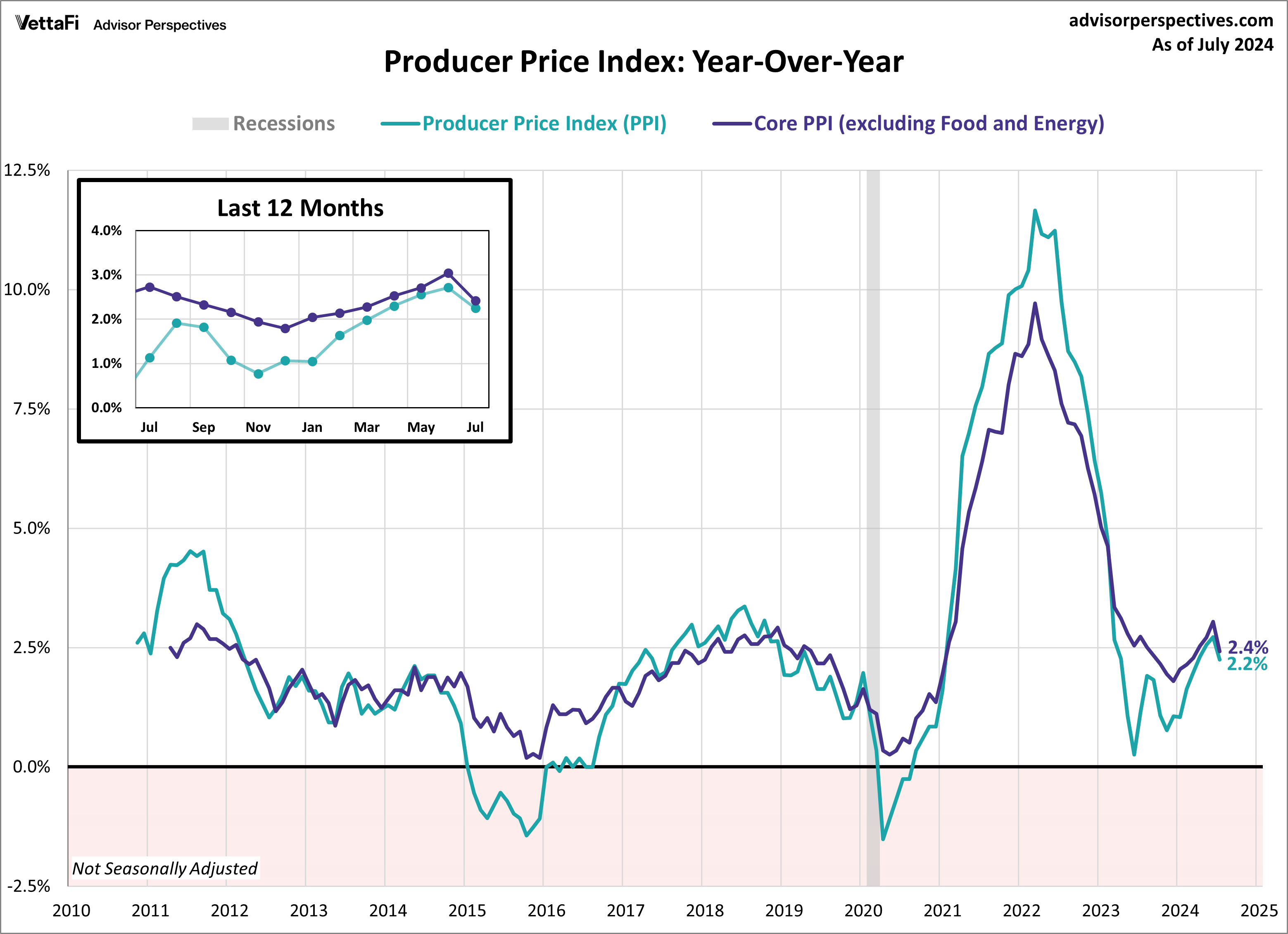
          The BLS shifted its focus to its new "final demand" series in 2014, a shift I support. However, the data for these series are only constructed back to November 2009 for headline and April 2010 for core.

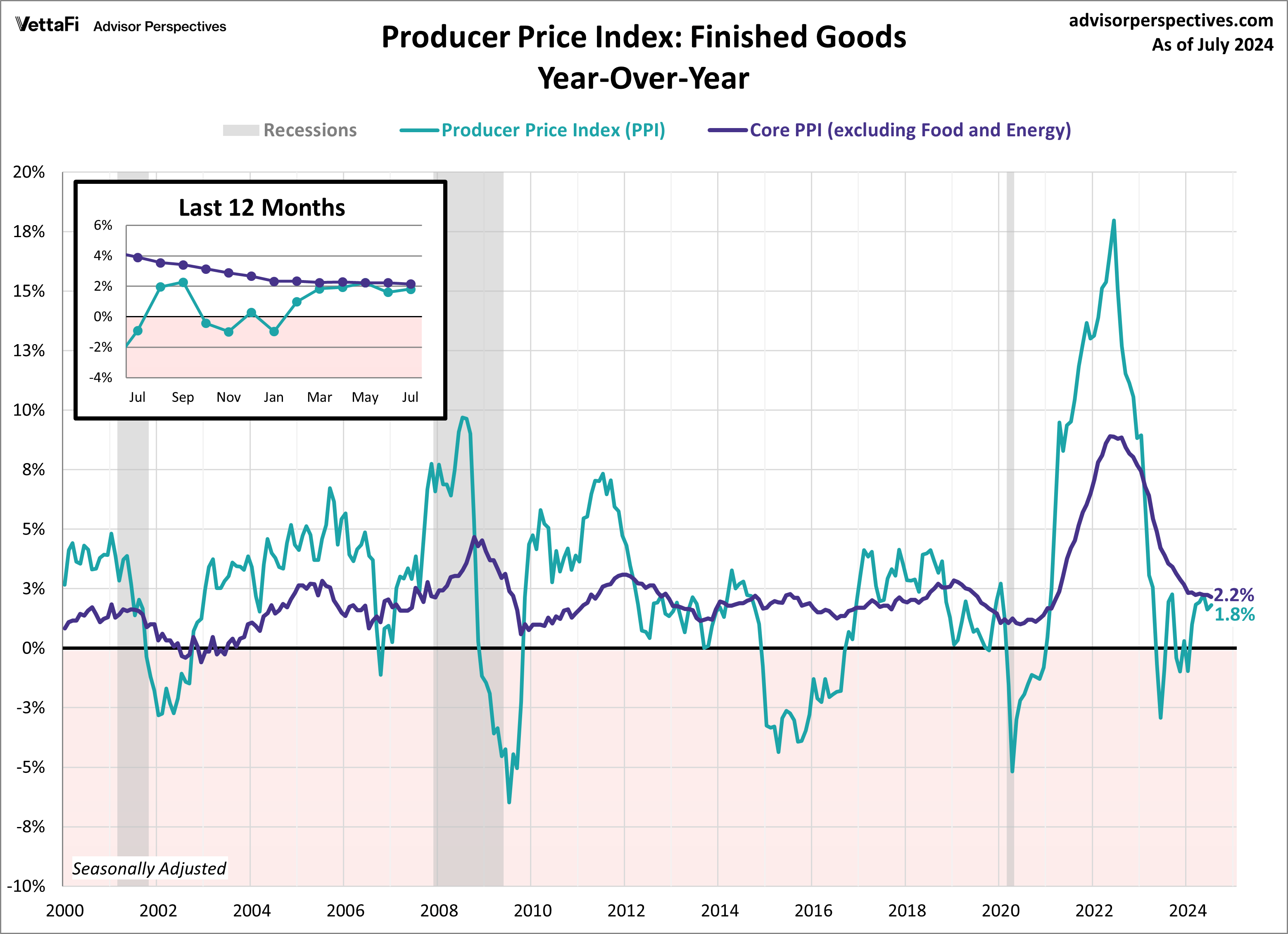
          Since our focus is on longer-term trends, we continue to track the legacy PPI for finished goods, which the BLS also includes in its monthly updates. We will see in a later overlay chart that the final demand and finished goods indexes are highly correlated.

          The July PPI for finished goods rose 0.5% month-over-month seasonally adjusted, up from the previous month's 0.4% decline. On an annual basis, headline PPI for finished goods is currently at 1.8% year-over-year, up from 1.6% the previous month (seasonally adjusted).

          Core PPI for finished goods rose 0.1% month-over-month, unchanged from the previous month. On an annual basis, core PPI for finished goods is currently at 2.2% year-over-year, unchanged from the previous month (seasonally adjusted).
          Both PPI and CPI illustrate monthly price changes, however, as their names suggest, the Producer Price Index measures price changes from the producer perspective whereas the Consumer Price Index measures price changes from the consumer perspective.

          PPI is thought to be a leading indicator of consumer inflation because, for the most part, when producers pay more for goods and services they are likely to pass along those higher costs to the consumer. With that being said, during the last recession producers were unable to pass along price increases, demonstrating the higher volatility of core PPI than core CPI.
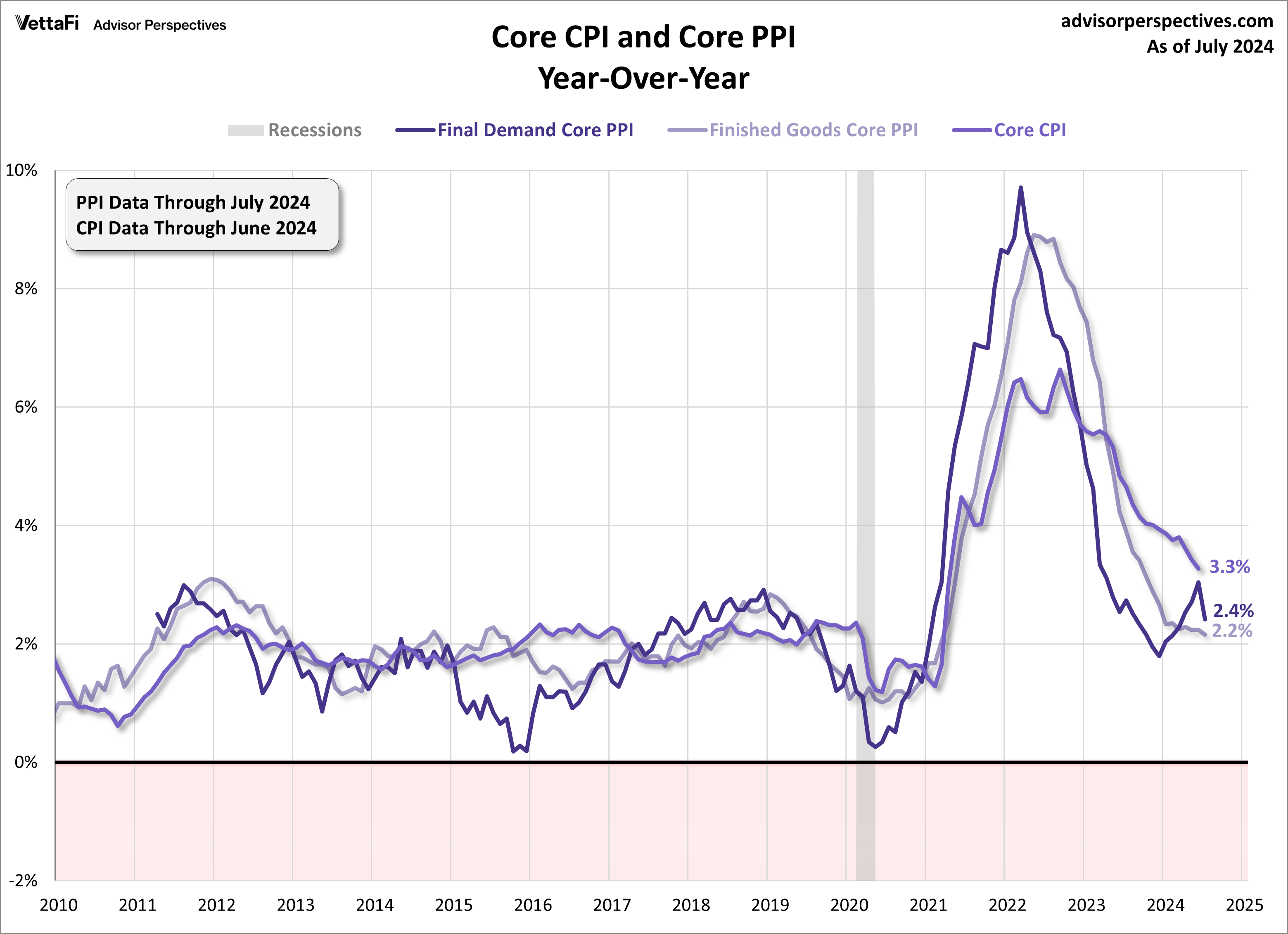
          The Fed has been in a tightening cycle to tackle high inflation, among other things. Inflation has eased over the few years, but the threat of a resurgence hangs in the air. On the other hand, the threat of disinflation has started to emerge. Thus, a few big questions remain: "When will the Fed begin to cut rates?", "Has the Fed waited too long to begin to cut rates?" and "Will there be a recession?"

          Source: SEEKINGALPHA

          To stay updated on all economic events of today, please check out our Economic calendar
          Risk Warnings and Disclaimers
          You understand and acknowledge that there is a high degree of risk involved in trading. Following any strategies or investment methods may lead to potential losses. The content on the site is provided by our contributors and analysts for information purposes only. You are solely responsible for determining whether any trading assets, securities, strategy, or any other product is suitable for investing based on your own investment objectives and financial situation.
          Add to Favorites
          Share

          Is the U.S. a Market Economy or a Mixed Economy?

          Glendon

          Economic

          The economic structure of the United States has been the subject of extensive debate, particularly when it comes to defining whether it is a market economy or a mixed economy. On one hand, the U.S. is often hailed as the epitome of a capitalist, free-market system where supply and demand dictate the economy. On the other hand, government intervention, regulations, and public services point to characteristics of a mixed economy. This article explores the nuances of the U.S. economic system, examining its market-based foundations and the role of government in shaping economic outcomes.

          Defining Economic Systems

          Before delving into the specifics of the U.S. economy, it’s important to understand the basic definitions of the terms "market economy" and "mixed economy."

          Market Economy

          A market economy is a system where economic decisions—such as the production, distribution, and pricing of goods and services—are determined by the interactions of individuals and businesses in the marketplace. In this system, the laws of supply and demand guide economic activities, with minimal government intervention. Private ownership of property and businesses is a fundamental characteristic, and the role of the state is limited to enforcing contracts and protecting property rights.

          Mixed Economy

          A mixed economy, on the other hand, combines elements of both market economies and planned economies. In a mixed economy, the government plays a more significant role in regulating and sometimes participating in the economy. While market forces largely determine economic activities, the government intervenes to correct market failures, provide public goods and services, and ensure a fair distribution of wealth. This intervention can take the form of regulations, subsidies, social welfare programs, and public ownership of certain industries.

          The United States: A Historical Perspective

          The U.S. economy has evolved over time, shaped by historical events, policy decisions, and ideological shifts. While the country has a strong foundation in market principles, various factors have led to increased government involvement over the years.

          The Early Years: Laissez-Faire Capitalism

          During the 19th century, the U.S. economy was characterized by laissez-faire capitalism, with minimal government intervention. The Industrial Revolution spurred rapid economic growth, driven by innovation, entrepreneurship, and a free-market ethos. The government’s role was largely confined to enforcing contracts and protecting property rights, allowing businesses to operate with considerable autonomy.
          However, the rapid industrialization also led to significant social and economic inequalities, with poor working conditions, monopolies, and environmental degradation becoming prevalent. These issues eventually prompted calls for government intervention to address the negative externalities of unchecked capitalism.

          The Progressive Era and the New Deal

          The early 20th century marked a shift towards greater government involvement in the economy. The Progressive Era (1890s-1920s) saw the introduction of regulatory measures to curb the excesses of big business and protect workers and consumers. Antitrust laws, labor regulations, and consumer protection laws were enacted to address market failures and promote fair competition.
          The Great Depression of the 1930s further accelerated this trend. The economic crisis exposed the vulnerabilities of a purely market-driven system, leading to the implementation of the New Deal by President Franklin D. Roosevelt. The New Deal introduced a range of government programs aimed at providing relief, recovery, and reform, including public works projects, social security, and financial regulation. This era marked a significant expansion of the government’s role in the economy, laying the groundwork for the modern mixed economy.

          Characteristics of the U.S. Economy

          Today, the U.S. economy exhibits characteristics of both a market economy and a mixed economy, reflecting its complex and dynamic nature. Below are some of the key features that define the U.S. economic system.

          Market Economy Characteristics

          Private Ownership: The U.S. economy is predominantly based on private ownership of property and businesses. Individuals and corporations own and control the majority of economic resources, including land, capital, and labor. This private ownership is a cornerstone of the market economy, driving innovation, competition, and economic growth.
          Market-Based Pricing: Prices for goods and services in the U.S. are largely determined by the forces of supply and demand. Consumers and producers interact in the marketplace to negotiate prices, with minimal government interference. This market-based pricing mechanism allocates resources efficiently and responds to changes in consumer preferences and technological advancements.
          Entrepreneurship and Competition: The U.S. economy encourages entrepreneurship and competition, with a relatively low level of government regulation in most industries. This competitive environment fosters innovation, improves productivity, and leads to the development of new products and services. Startups and small businesses play a vital role in driving economic growth and job creation.
          Capital Markets: The U.S. has highly developed capital markets, including stock exchanges, bond markets, and venture capital. These markets facilitate the efficient allocation of capital to businesses and entrepreneurs, enabling them to grow and expand. The robust financial system is a key feature of the U.S. market economy, providing opportunities for investment and wealth creation.

          Mixed Economy Characteristics

          Government Regulation: While the U.S. economy is market-based, it is also heavily regulated by the government. Federal and state regulations cover a wide range of areas, including environmental protection, labor standards, consumer safety, and financial markets. These regulations are designed to correct market failures, protect public health and safety, and ensure fair competition.
          Public Goods and Services: The government provides a range of public goods and services that are not efficiently provided by the private sector. These include infrastructure, education, healthcare, and national defense. Public investment in these areas is essential for the overall functioning of the economy and the well-being of society.
          Social Welfare Programs: The U.S. government operates various social welfare programs aimed at reducing poverty and inequality. Programs such as Social Security, Medicare, Medicaid, and unemployment insurance provide a safety net for individuals and families, helping to mitigate the negative impacts of economic downturns and market failures.
          Fiscal and Monetary Policy: The government actively uses fiscal and monetary policy to influence economic outcomes. Fiscal policy, including government spending and taxation, is used to stabilize the economy, promote growth, and redistribute wealth. Monetary policy, managed by the Federal Reserve, involves controlling the money supply and interest rates to achieve macroeconomic objectives such as controlling inflation and maintaining full employment.

          The Balance Between Market and Government

          The U.S. economy’s blend of market and mixed economy characteristics reflects a balance between the principles of capitalism and the need for government intervention. This balance is not static; it shifts in response to changing economic conditions, political ideologies, and societal needs.

          The Role of Government in Times of Crisis

          Historically, the U.S. government has stepped in to play a more active role during times of economic crisis. For example, during the Great Depression, the New Deal programs significantly expanded the government’s role in the economy. Similarly, the 2008 financial crisis prompted massive government intervention, including bank bailouts, stimulus packages, and regulatory reforms.
          The COVID-19 pandemic is another recent example where the government played a crucial role in stabilizing the economy. Trillions of dollars in economic relief were provided to individuals, businesses, and local governments, highlighting the importance of government intervention in managing economic crises.

          The Debate Over Government Intervention

          The extent of government intervention in the economy remains a contentious issue in U.S. politics. Advocates of a market economy argue that excessive regulation and government involvement can stifle innovation, reduce efficiency, and limit individual freedom. They contend that the market, if left to its own devices, is the best mechanism for allocating resources and creating wealth.
          On the other hand, proponents of a mixed economy argue that government intervention is necessary to address market failures, protect public interests, and promote social equity. They believe that a purely market-driven economy can lead to inequality, environmental degradation, and economic instability, necessitating a strong role for the government in regulating and guiding economic activities.

          Conclusion

          So, is the United States a market economy or a mixed economy? The answer is that it is both. The U.S. economy is fundamentally a market economy, with private ownership, market-based pricing, and a strong emphasis on entrepreneurship and competition. However, it also incorporates elements of a mixed economy, with significant government regulation, public goods and services, social welfare programs, and active fiscal and monetary policy.
          This hybrid economic model has allowed the United States to achieve significant economic growth, innovation, and prosperity while also addressing the social and economic challenges that arise from a purely market-driven system. The balance between market forces and government intervention continues to evolve, reflecting the dynamic nature of the U.S. economy and the diverse needs of its population.
          As the global economy faces new challenges in the 21st century, the U.S. economic system will likely continue to adapt, blending market principles with targeted government interventions to ensure sustainable growth, stability, and equity for all its citizens.
          To stay updated on all economic events of today, please check out our Economic calendar
          Risk Warnings and Disclaimers
          You understand and acknowledge that there is a high degree of risk involved in trading. Following any strategies or investment methods may lead to potential losses. The content on the site is provided by our contributors and analysts for information purposes only. You are solely responsible for determining whether any trading assets, securities, strategy, or any other product is suitable for investing based on your own investment objectives and financial situation.
          Add to Favorites
          Share

          FintechZoom CRM Stock Analysis: Salesforce's Market Performance & Insights

          Glendon

          Economic

          Salesforce Inc. (CRM) has established itself as a dominant player in the cloud computing and customer relationship management (CRM) industry. With a strong market presence and a history of robust growth, Salesforce's stock has been a focal point for investors looking to capitalize on the growing demand for cloud-based services. In this article, we delve into how FintechZoom provides comprehensive coverage and analysis of Salesforce (CRM) stock, offering valuable insights, real-time data, and advanced analytical tools. Additionally, we’ll explore how FastBull enhances this analysis, providing investors with a powerful combination of tools for making informed decisions.

          Salesforce (CRM) Overview

          Salesforce is a global leader in CRM software, offering a wide range of cloud-based solutions for businesses of all sizes. The company’s software enables businesses to manage customer relationships, track sales, and automate various marketing processes. Salesforce’s innovative approach to CRM has not only revolutionized the industry but also positioned the company as a critical player in the broader technology sector.
          Salesforce has consistently delivered strong financial performance, with significant revenue growth driven by its subscription-based model and expanding customer base. The company’s strategic acquisitions, including MuleSoft, Tableau, and Slack, have further strengthened its market position and expanded its product offerings. These factors have made Salesforce a favorite among investors, with CRM stock often viewed as a reliable growth stock in the tech sector.

          Key Factors Influencing CRM Stock

          Revenue Growth and Profitability: Salesforce’s consistent revenue growth, driven by its subscription model and global customer base, is a key factor influencing its stock performance. Investors closely monitor the company’s ability to maintain its growth trajectory while improving profitability.
          Strategic Acquisitions: Salesforce has made several strategic acquisitions to enhance its product offerings and expand its market reach. These acquisitions, including Tableau, MuleSoft, and Slack, have been critical in driving the company’s growth and are closely watched by investors.
          Cloud Computing Industry Trends: As a leader in cloud computing, Salesforce is directly influenced by trends in the broader cloud computing industry. The growing demand for cloud-based services and the shift towards digital transformation are key drivers of Salesforce’s growth.
          Market Competition: Salesforce operates in a highly competitive market, facing competition from other tech giants like Microsoft, Oracle, and SAP. The company’s ability to innovate and maintain its market leadership is a crucial factor in its stock performance.
          Economic Conditions and Market Sentiment: Like all stocks, Salesforce’s stock performance is influenced by broader economic conditions and market sentiment. Factors such as interest rates, economic growth, and investor confidence play a role in determining the stock’s price movements.

          FintechZoom’s Comprehensive Analysis of CRM Stock

          FintechZoom is a leading financial technology platform that offers extensive coverage and analysis of Salesforce (CRM) stock. The platform provides investors with a range of tools and resources designed to help them make informed decisions in the complex and rapidly changing world of stock trading.

          Key Features of FintechZoom’s CRM Stock Analysis

          Real-Time Stock Data and Market Updates: FintechZoom provides real-time stock quotes, market data, and news updates for CRM stock. This feature is essential for investors who need to stay informed about the latest developments and market movements affecting Salesforce.
          In-Depth Financial Analysis: FintechZoom offers detailed financial analysis of Salesforce, including key metrics such as revenue growth, earnings per share (EPS), and operating margins. This analysis helps investors understand the financial health of the company and its potential for future growth.
          Advanced Charting and Technical Analysis Tools: FintechZoom’s advanced charting tools allow investors to analyze CRM stock trends, apply technical indicators, and customize charts to align with their investment strategies. These tools are crucial for identifying patterns and making data-driven trading decisions.
          Historical Data and Performance Metrics: FintechZoom provides access to historical data and performance metrics for CRM stock. This data is valuable for understanding the stock’s past performance and making predictions about future price movements.
          Market Sentiment and Analyst Ratings: FintechZoom aggregates market sentiment, analyst ratings, and price targets for CRM stock. This information provides investors with a comprehensive view of how the market perceives Salesforce and its potential for future growth.
          News Aggregation and Analysis: The platform consolidates news articles, reports, and analyst commentary related to Salesforce, giving investors a centralized resource for staying informed about the latest developments.

          Enhancing CRM Stock Analysis with FintechZoom

          Real-Time Data and News

          One of the critical aspects of investing in CRM stock is staying updated with real-time data. FintechZoom excels in providing continuous updates on Salesforce’s stock price, trading volume, and related news. This feature is particularly important during earnings seasons or when significant corporate announcements are made, as these events can lead to rapid stock price movements.

          Comprehensive Financial Metrics

          FintechZoom’s financial analysis tools offer a deep dive into Salesforce’s financial statements, including income statements, balance sheets, and cash flow statements. Investors can use these tools to assess Salesforce’s financial stability, profitability, and growth potential. Additionally, FintechZoom allows users to compare Salesforce’s financial metrics with those of its competitors, providing a broader context for investment decisions.

          Advanced Charting Tools

          For investors who rely on technical analysis, FintechZoom’s advanced charting capabilities are invaluable. The platform offers customizable charts with a wide range of technical indicators, including moving averages, RSI, MACD, and Bollinger Bands. These tools enable investors to identify key support and resistance levels, monitor price trends, and develop trading strategies tailored to Salesforce’s stock behavior.

          Historical Performance Analysis

          Understanding the historical performance of CRM stock is crucial for making informed predictions about its future movements. FintechZoom provides access to historical price data, earnings reports, and other performance metrics, allowing investors to analyze how Salesforce has responded to various market conditions over time. This analysis can be instrumental in forecasting future price movements and identifying long-term investment opportunities.

          FastBull’s Role in CRM Stock Analysis

          FastBull is a fintech platform that specializes in real-time market signals and expert analysis. When integrated with FintechZoom’s comprehensive platform, FastBull’s tools provide investors with additional resources to optimize their investment strategies in CRM stock.

          FastBull’s Contributions to CRM Stock Analysis

          Real-Time Market Signals: FastBull offers real-time market signals that alert investors to significant market movements and potential trading opportunities. For CRM stock, these signals can help investors identify entry and exit points, particularly during periods of high volatility.
          Expert Analysis and Strategic Insights: FastBull provides detailed reports and expert commentary on Salesforce’s market position, competitive landscape, and future growth prospects. This analysis complements FintechZoom’s coverage by offering investors a deeper understanding of the factors driving CRM stock’s performance.
          Strategic Trading Recommendations: FastBull’s trading strategies are designed to help investors navigate the complexities of trading CRM stock. These strategies are based on a combination of technical and fundamental analysis, providing actionable insights for optimizing trades.

          The Power of Integration

          The collaboration between FastBull and FintechZoom creates a powerful synergy for investors. By combining FastBull’s real-time market signals and expert analysis with FintechZoom’s comprehensive data and tools, investors are equipped with a robust toolkit for making informed decisions and maximizing their returns on CRM stock.

          Conclusion

          Salesforce (CRM) remains a key player in the tech industry, with its stock performance closely watched by investors worldwide. FintechZoom provides a comprehensive platform for analyzing CRM stock, offering real-time data, in-depth financial analysis, advanced charting tools, and expert insights. The integration of FastBull’s real-time market signals and strategic analysis further enhances FintechZoom’s offerings, giving investors a complete set of tools to navigate the complexities of CRM stock investing.
          As the market continues to evolve, the collaboration between FintechZoom and FastBull highlights the importance of fintech innovation in shaping the future of stock analysis and investment strategies. With the right tools and insights, investors can make informed decisions, capitalize on opportunities, and effectively manage risks in the ever-changing landscape of the stock market.
          To stay updated on all economic events of today, please check out our Economic calendar
          Risk Warnings and Disclaimers
          You understand and acknowledge that there is a high degree of risk involved in trading. Following any strategies or investment methods may lead to potential losses. The content on the site is provided by our contributors and analysts for information purposes only. You are solely responsible for determining whether any trading assets, securities, strategy, or any other product is suitable for investing based on your own investment objectives and financial situation.
          Add to Favorites
          Share

          Local Conditions Key to Development of Nation's New Forces

          Thomas

          Economic

          As a tech reporter, I am most impressed with one line in the resolution of the third plenary session of the 20th Central Committee of the Communist Party of China and that is: "to foster new quality productive forces in line with local conditions".
          The line reflects an acknowledgment of the complexities and diverse conditions across different regions in China and emphasizes the need to tailor these efforts to local conditions. A particularly illustrative case is the development of China's semiconductor industry, as I have witnessed its ups and downs in the past decade, highlighting the necessity of this tailored approach.
          The integrated circuit industry is a cornerstone of modern economies, serving as a strategic, foundational and leading sector. Recognizing its importance, China has implemented various policies to support and guide the healthy growth of its semiconductor industry. These policies have borne fruit, with the industry showing significant advancements in technology and an acceleration in the growth of domestic companies.
          However, this rapid growth has not been without issues. Enthusiasm for investing in the semiconductor industry has soared, just as the National Development and Reform Commission said in October 2020 that a number of "three-no" companies — entities lacking experience, technology and talent — had got involved in the chip industry.
          Some local governments, eager to capitalize on the semiconductor boom, had overlooked the industry's inherent complexities, leading to hasty projects and wasteful investments, the NDRC said. This rush had resulted in several failures, with significant financial and resource losses.
          A striking example is the Wuhan Hongxin Semiconductor Manufacturing project, which was slated to be a major player in the industry with an ambitious investment plan of 128 billion yuan ($17.9 billion), according to China Economic Weekly. The media reported that by the end of 2019, 15.3 billion yuan had already been invested in the project, and an investment of 8.7 billion yuan was planned for 2020.
          However, by April 2020, the project was facing a significant funding gap, putting its future at risk. Despite the initial hype, the project stalled, exemplifying the pitfalls of excessive ambition and insufficient planning, China Economic Weekly reported. Similarly, other regions like Hebei province have experienced setbacks in their attempts to establish a foothold in the semiconductor industry.
          These incidents underscore the broader lesson that developing new quality productive forces requires a nuanced approach. It is crucial to consider local conditions and avoid a one-size-fits-all strategy.
          For regions with strong economic foundation, robust research capabilities and a favorable innovation environment, it is appropriate to accelerate efforts in developing new quality productive forces. Conversely, areas lacking these conditions should proceed more cautiously, ensuring a steady and realistic pace that aligns with their actual capabilities.
          Hong Qunlian, a researcher at the Academy of Macroeconomic Research under the NDRC, said, "We must adhere to reality and must not follow the crowd blindly. While nurturing new quality productive forces is a universal goal, China's diverse regional contexts require tailored approaches."
          Development strategies should reflect each area's unique stage of growth, functional positioning, resource endowment and industrial base. A nuanced, region-specific approach helps prevent wasteful investments and unrealistic projects, he said.
          Meanwhile, it takes time to cultivate new quality productive forces, and it is a gradual process that cannot be rushed. It is vital to respect the natural progression of technological innovation and industry development, ensuring that efforts are paced according to local capabilities.
          Moreover, effective development requires both an active government and a dynamic market. The government can facilitate by setting policies, guiding investments and creating a supportive environment for innovation. Meanwhile, the market should drive technological and industrial innovation, allowing businesses to take the lead.
          In conclusion, the experience of China's semiconductor industry vividly illustrates the necessity of adapting the development of new quality productive forces to local conditions. The lesson is clear: success in this endeavor requires a balanced, thoughtful approach that recognizes the unique circumstances of each region. Only by doing so can China avoid the pitfalls of hasty development and build a robust, innovative economy that stands the test of time.

          Source: China Daily

          To stay updated on all economic events of today, please check out our Economic calendar
          Risk Warnings and Disclaimers
          You understand and acknowledge that there is a high degree of risk involved in trading. Following any strategies or investment methods may lead to potential losses. The content on the site is provided by our contributors and analysts for information purposes only. You are solely responsible for determining whether any trading assets, securities, strategy, or any other product is suitable for investing based on your own investment objectives and financial situation.
          Add to Favorites
          Share

          Bitcoin Price May Need 3 Months to Copy Gold Bull Run

          Warren Takunda

          Cryptocurrency

          Bitcoin may need a matter of months to stage a rebound and follow gold, one analyst argues.
          In an X post on Aug. 13, founder of quantitative Bitcoin and digital asset fund Capriole Investments, said BTC price action still looks “promising.”

          "Rough rule of thumb" sees Bitcoin lagging gold

          Bitcoin has disappointed on a macro level in recent months thanks to staying rangebound while other assets head higher.
          Prior to last week’s mass sell-off, both gold and United States stocks indices were hitting records — while Bitcoin failed to copy them.
          Now, Capriole’s Edwards says, there may not be long to wait.
          Uploading a chart comparing BTC price action to that of gold since late 2019, Edwards concluded that once gold begins a new trend, Bitcoin simply requires time before following suit.
          Overlaying XAU/USD onto BTC/USD, it becomes apparent that the latency period for Bitcoin is around three months.
          “As a rough rule of thumb, macro Bitcoin trends are often lagged behind gold by a few months,” he commented.Bitcoin Price May Need 3 Months to Copy Gold Bull Run_1

          “Looks promising.”BTC/USD vs. XAU/USD chart. Source: Charles Edwards/X

          Forecast sees "favorable" BTC price growth

          XAU/USD hit its most recent all-time high in mid-July, data from Cointelegraph Markets Pro and TradingView confirms.
          Looking toward the future, other popular Bitcoin market commentators suggested that the gold narrative could produce results for long-suffering hodlers next year.
          William Clemente, co-founder of crypto research firm Reflexivity, highlighted another chart comparing gold price behavior following the launch of its exchange-traded funds (ETFs) in 2004.
          “Gold had roughly 10-12 months of consolidation before marking up post-launch,” he noted on X alongside a chart from Quinn Thompson, founder and CIO of macro crypto hedge fund Lekker Capital.
          “If BTC follows, confluence with other factors pointing towards favorable performance into 2025.”

          Bitcoin Price May Need 3 Months to Copy Gold Bull Run_2BTC/USD vs. XAU/USD chart. Source: William Clemente/X

          Zooming out, meanwhile, both gold and Bitcoin remain in a privileged position. Even after its early August drop, Bitcoin remains the year’s best-performing macro asset, with gold close behind.
          “Bitcoin and Gold are now the top performing major assets in 2024. Going back to 2011, we've never seen these two in the #1/#2 spots for any calendar year,” Charlie Bilello, chief market strategist at wealth management firm Creative Planning, wrote in part of X commentary on Aug. 4.
          BTC/USD is up 34% year-to-date, with XAU/USD at around 19%.

          Source: Cointelegraph

          Risk Warnings and Disclaimers
          You understand and acknowledge that there is a high degree of risk involved in trading. Following any strategies or investment methods may lead to potential losses. The content on the site is provided by our contributors and analysts for information purposes only. You are solely responsible for determining whether any trading assets, securities, strategy, or any other product is suitable for investing based on your own investment objectives and financial situation.
          Add to Favorites
          Share
          FastBull
          Copyright © 2025 FastBull Ltd

          728 RM B 7/F GEE LOK IND BLDG NO 34 HUNG TO RD KWUN TONG KLN HONG KONG

          TelegramInstagramTwitterfacebooklinkedin
          App Store Google Play Google Play
          Products
          Charts

          Chats

          Q&A with Experts
          Screeners
          Economic Calendar
          Data
          Tools
          Membership
          Features
          Function
          Markets
          Copy Trading
          Latest Signals
          Contests
          News
          Analysis
          24/7
          Columns
          Education
          Company
          Careers
          About Us
          Contact Us
          Advertising
          Help Center
          Feedback
          User Agreement
          Privacy Policy
          Business

          White Label

          Data API

          Web Plug-ins

          Poster Maker

          Affiliate Program

          Risk Disclosure

          The risk of loss in trading financial instruments such as stocks, FX, commodities, futures, bonds, ETFs and crypto can be substantial. You may sustain a total loss of the funds that you deposit with your broker. Therefore, you should carefully consider whether such trading is suitable for you in light of your circumstances and financial resources.

          No decision to invest should be made without thoroughly conducting due diligence by yourself or consulting with your financial advisors. Our web content might not suit you since we don't know your financial conditions and investment needs. Our financial information might have latency or contain inaccuracy, so you should be fully responsible for any of your trading and investment decisions. The company will not be responsible for your capital loss.

          Without getting permission from the website, you are not allowed to copy the website's graphics, texts, or trademarks. Intellectual property rights in the content or data incorporated into this website belong to its providers and exchange merchants.

          Not Logged In

          Log in to access more features

          FastBull Membership

          Not yet

          Purchase

          Become a signal provider
          Help Center
          Customer Service
          Dark Mode
          Price Up/Down Colors

          Log In

          Sign Up

          Position
          Layout
          Fullscreen
          Default to Chart
          The chart page opens by default when you visit fastbull.com