

Markets
News
Analysis
User
24/7
Economic Calendar
Education
Data
- Names
- Latest
- Prev



Signal Accounts for Members
All Signal Accounts
All Contests
 Euro Zone IHS Markit Construction PMI (Nov)
A:--
F: --
P: --
 Italy IHS Markit Construction PMI (Nov)
A:--
F: --
P: --
 U.K. Markit/CIPS Construction PMI (Nov)
A:--
F: --
P: --
 France 10-Year OAT Auction Avg. Yield
A:--
F: --
P: --
Euro Zone Retail Sales MoM (Oct)A:--
F: --
P: --
Euro Zone Retail Sales YoY (Oct)A:--
F: --
P: --
 Brazil GDP YoY (Q3)
A:--
F: --
P: --
 U.S. Challenger Job Cuts (Nov)
A:--
F: --
P: --
U.S. Challenger Job Cuts MoM (Nov)A:--
F: --
P: --
U.S. Challenger Job Cuts YoY (Nov)A:--
F: --
P: --
U.S. Initial Jobless Claims 4-Week Avg. (SA)A:--
F: --
P: --
U.S. Weekly Initial Jobless Claims (SA)A:--
F: --
P: --
U.S. Weekly Continued Jobless Claims (SA)A:--
F: --
P: --
 Canada Ivey PMI (SA) (Nov)
A:--
F: --
P: --
Canada Ivey PMI (Not SA) (Nov)A:--
F: --
P: --
U.S. Non-Defense Capital Durable Goods Orders Revised MoM (Excl. Aircraft) (SA) (Sept)A:--
F: --
U.S. Factory Orders MoM (Excl. Transport) (Sept)A:--
F: --
P: --
U.S. Factory Orders MoM (Sept)A:--
F: --
P: --
U.S. Factory Orders MoM (Excl. Defense) (Sept)A:--
F: --
P: --
U.S. EIA Weekly Natural Gas Stocks ChangeA:--
F: --
P: --
Saudi Arabia Crude Oil ProductionA:--
F: --
P: --
U.S. Weekly Treasuries Held by Foreign Central BanksA:--
F: --
P: --
 Japan Foreign Exchange Reserves (Nov)
A:--
F: --
P: --
 India Repo Rate
A:--
F: --
P: --
India Benchmark Interest RateA:--
F: --
P: --
India Reverse Repo RateA:--
F: --
P: --
India Cash Reserve RatioA:--
F: --
P: --
Japan Leading Indicators Prelim (Oct)A:--
F: --
P: --
U.K. Halifax House Price Index YoY (SA) (Nov)A:--
F: --
P: --
U.K. Halifax House Price Index MoM (SA) (Nov)A:--
F: --
P: --
France Current Account (Not SA) (Oct)--
F: --
P: --
France Trade Balance (SA) (Oct)--
F: --
P: --
France Industrial Output MoM (SA) (Oct)--
F: --
P: --
Italy Retail Sales MoM (SA) (Oct)--
F: --
P: --
Euro Zone Employment YoY (SA) (Q3)--
F: --
P: --
Euro Zone GDP Final YoY (Q3)--
F: --
P: --
Euro Zone GDP Final QoQ (Q3)--
F: --
P: --
Euro Zone Employment Final QoQ (SA) (Q3)--
F: --
P: --
Euro Zone Employment Final (SA) (Q3)--
F: --
Brazil PPI MoM (Oct)--
F: --
P: --
 Mexico Consumer Confidence Index (Nov)
--
F: --
P: --
Canada Unemployment Rate (SA) (Nov)--
F: --
P: --
Canada Labor Force Participation Rate (SA) (Nov)--
F: --
P: --
Canada Employment (SA) (Nov)--
F: --
P: --
Canada Part-Time Employment (SA) (Nov)--
F: --
P: --
Canada Full-time Employment (SA) (Nov)--
F: --
P: --
U.S. Personal Income MoM (Sept)--
F: --
P: --
U.S. Dallas Fed PCE Price Index YoY (Sept)--
F: --
P: --
U.S. PCE Price Index YoY (SA) (Sept)--
F: --
P: --
U.S. PCE Price Index MoM (Sept)--
F: --
P: --
U.S. Personal Outlays MoM (SA) (Sept)--
F: --
P: --
U.S. Core PCE Price Index MoM (Sept)--
F: --
P: --
U.S. UMich 5-Year-Ahead Inflation Expectations Prelim YoY (Dec)--
F: --
P: --
U.S. Core PCE Price Index YoY (Sept)--
F: --
P: --
U.S. Real Personal Consumption Expenditures MoM (Sept)--
F: --
P: --
U.S. 5-10 Year-Ahead Inflation Expectations (Dec)--
F: --
P: --
U.S. UMich Current Economic Conditions Index Prelim (Dec)--
F: --
P: --
U.S. UMich Consumer Sentiment Index Prelim (Dec)--
F: --
P: --
U.S. UMich 1-Year-Ahead Inflation Expectations Prelim (Dec)--
F: --
P: --
U.S. UMich Consumer Expectations Index Prelim (Dec)--
F: --
P: --


No matching data

Latest Views
Latest Views
Trending Topics
Top Columnists
Latest Update
White Label
Data API
Web Plug-ins
Affiliate Program
View All
No data
At the start of the month, the BTC/USD rate was hovering around $115k. Historically, October and November have been months when the price of the leading cryptocurrency has shown its strongest gains. A
At the start of the month, the BTC/USD rate was hovering around $115k. Historically, October and November have been months when the price of the leading cryptocurrency has shown its strongest gains. A rise towards a new all-time high (ATH) could have continued this "tradition"; however, following Trump's statement about the potential introduction of 100% tariffs on trade with China, the coin's price plummeted to $105k. And although the meeting between US and Chinese leaders scheduled for 30 October was expected to ease some concerns, as we can see, Bitcoin's price has not yet fully recovered from the shocking crash on 10 October. The question of whether the month will turn out to be bullish therefore remains open.
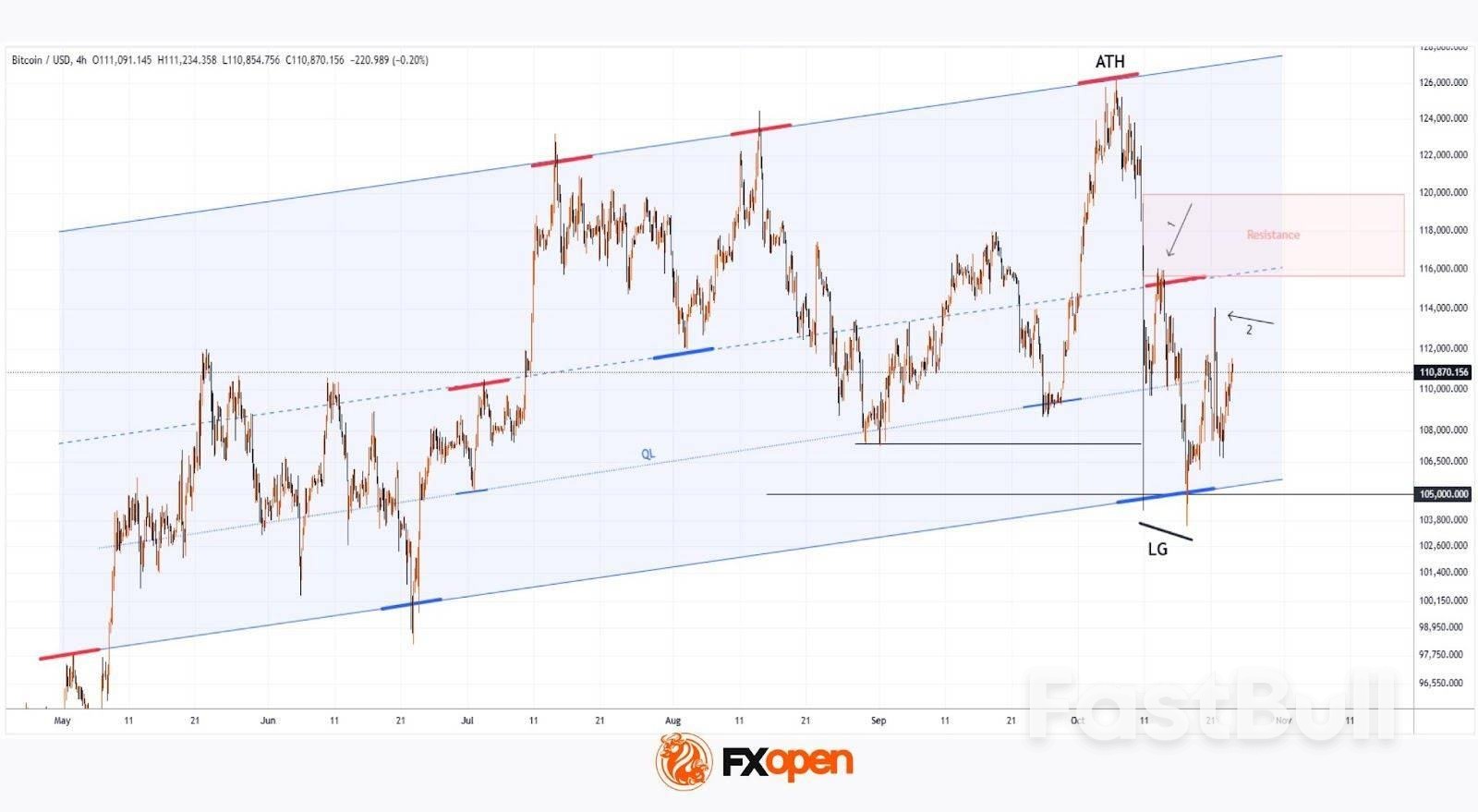
BTC/USD chart analysis shows that price fluctuations since early May have formed an ascending channel, with key reversals marked in red and blue.
Recent news has created a positive fundamental backdrop:
→ Trump has pardoned Binance founder Changpeng Zhao (known as CZ), who in turn suggested that Bitcoin's market capitalisation could surpass that of gold.
→ Analysts at VanEck believe that the market remains bullish, and that the October decline is merely a correction.
Notably, in October Bitcoin's price dipped below several key support levels:
→ On 10 October it fell below the September low and the psychological $105k level.
→ On 17 October – below the 10 October low.
The subsequent rebounds confirm that:
→ the lower boundary of the channel remains relevant;
→ buyers were aggressive and successful, as Bitcoin's price quickly rebounded towards $110k.
From this, it is reasonable to assume that in October, Smart Money used selling flows to build long positions (the 17 October drop resembles a Liquidity Grab pattern).
The wide range between $116k and $120k appears to be a strong resistance zone, as sellers held clear dominance there just two weeks ago.
Arrows on the chart indicate that selling pressure was both aggressive and effective:
1 → pushing the price down from the blue median;
2 → around the $114k level this week.
At present, Bitcoin's price is near the QL line, which divides the mentioned channel into its two lower quarters – an area where the price may find short-term balance. Today's US inflation data release will largely determine the next move:
→ upward towards the median (which would improve the chances of a bullish October);
→ downward towards the channel's lower boundary (which would once again test the bulls' ability to defend the $105k level).
The rise of artificial intelligence has transformed how investors trade across markets. Finding the best AI trading platform in 2025 means identifying solutions that combine automation, data-driven insights, and precision forecasting. This guide explores the leading AI platforms helping traders enhance accuracy, reduce risk, and make smarter investment decisions.
An AI trading platform uses artificial intelligence to analyze data, detect patterns, and execute trades automatically based on pre-set algorithms or adaptive learning models. The best AI trading platform combines speed, accuracy, and data analysis to help traders make informed decisions in real time.
Unlike traditional trading tools, AI systems can process millions of data points across global markets, news feeds, and social sentiment faster than any human could. This makes them invaluable for predicting price movements, identifying profitable entry points, and managing risk across different asset classes—from stocks and forex to crypto.
In essence, AI trading platforms act as intelligent assistants that continuously learn from data. Whether you're looking for the best AI crypto trading platform or tools for stock analysis, these systems are designed to enhance trading precision, automate repetitive tasks, and improve returns through real-time adaptation.
Choosing the best AI trading platform depends on your trading goals, technical skills, and asset preferences. While some traders focus on automation and advanced analytics, others prioritize simplicity, low fees, or asset coverage. Below are key factors to help identify which platform suits you best.
When deciding what is the best AI trading platform for your needs, prioritize transparency, security, and proven accuracy. For day traders, the best AI day trading platform combines rapid order execution with smart data insights—helping you stay ahead in volatile markets.
In 2025, traders have more choices than ever when it comes to AI-powered investing. The best AI trading platforms differ in pricing, data access, and strategy flexibility. The table below compares five leading solutions by subscription cost, free trial options, data integration, and backtesting capabilities—helping you decide what is the best AI trading platform for your needs.
| Platform | Subscription Fees | Free Trial | Data Integration | Backtesting Tools |
|---|---|---|---|---|
| Trade Ideas | $118/month (Standard) or $228/month (Premium) | 7-day free trial | Real-time U.S. stock data, AI pattern recognition | Advanced strategy simulator with real market replay |
| Tickeron | $90–$250/month (plan-based) | Free basic access | AI-generated stock signals and chart pattern library | Integrated backtesting with visualized win/loss ratios |
| Capitalise.ai | Free via partnered brokers (like Binance or Interactive Brokers) | Yes | API and broker-linked data streaming | No-code backtesting with natural language input |
| Kavout | Custom pricing (enterprise and retail tiers) | Free demo | Quantitative AI engine using K-score analytics | Deep learning–driven portfolio simulation |
| eToro AI | Free access with standard eToro account | Yes | Social sentiment data + AI-powered risk scoring | Community-based strategy tracking and analytics |
Each of these best AI trading platforms offers a distinct balance between cost, technology, and accessibility. For traders who focus on equities, best AI stock trading platforms like Trade Ideas or Tickeron provide robust pattern recognition. Meanwhile, for crypto enthusiasts, the best AI crypto trading platform choices often include broker-linked tools such as Capitalise.ai or multi-asset ecosystems like eToro. Your final decision should align with your trading frequency, technical skill, and preferred market.
Yes, when used correctly, the best AI trading platforms can provide consistent performance advantages. These systems analyze massive amounts of market data, detect patterns faster than humans, and execute trades automatically. However, results depend on market conditions and model accuracy—so it’s crucial to choose a reputable, well-tested system like a best AI based trading platform with proven backtesting results.
AI trading can be profitable if users understand its limitations and optimize parameters properly. The best AI bot trading platform reduces emotional bias and executes high-frequency strategies that can outperform manual trading. Still, profitability depends on strategy design, data quality, and consistent market analysis—especially in volatile sectors such as crypto or tech stocks. Experienced traders often use the best AI day trading platform for rapid decision-making and intraday opportunities.
Absolutely. Many of the best AI trading platforms are designed for beginners, offering no-code automation tools and visual dashboards. Platforms like Capitalise.ai and eToro allow users to create automated strategies through natural language or follow community insights. Whether you trade stocks or digital assets, the best AI crypto trading platforms and best AI stock trading platforms now make it possible for newcomers to learn while trading safely and efficiently.
In conclusion, choosing the best AI trading platform depends on your trading style, risk tolerance, and market focus. AI-powered tools can analyze data, automate strategies, and enhance decision-making across stocks and crypto. By selecting a reliable and transparent platform, traders can trade smarter, faster, and with greater confidence in 2025.
A prolonged shutdown of the US government amid a standoff over funding between Republicans and Democrats in Congress could dent economic growth in the fourth quarter, but much of the lost output would be recovered when normal operations resume.
Economists estimated that the shutdown was shaving 0.1 to 0.2 percentage points off annualised inflation-adjusted gross domestic product growth per week. The hit from the shutdown, now in its third week, would be largely on consumer spending and lost federal worker productivity. About 700,000 federal workers have been furloughed while nearly as many are working without pay, which could force households to defer spending.
Many are set to miss their first full paycheck on Friday. The White House has suggested federal workers are not guaranteed retroactive pay when the government reopens, and President Donald Trump's administration has laid off some furloughed workers. Government contractors have also been sent home and normally do not receive back pay.
"There is going to be an impact on the economy," said Gregory Daco, chief economist at EY-Parthenon. "It's not going to push the economy into recession, but the longer this drags on, the more permanent losses are for Fed workers that may have had to cut back on expenses because they haven't been paid or because, essentially, while they are expecting retroactive pay, they're just being more judicious with their finances."
Congress sometimes passes annual funding for some federal departments as was the case ahead of the 2018-2019 shutdown, when large sections of the government were funded. This time, none of the departments are funded, with wider ripple effects beyond federal workers.
Though active-duty military personnel were paid last week, there have been media reports that some were underpaid. A number of states, including New York and Texas have warned that food stamps, which lower-income households depend on to supplement their grocery budgets, would not be available if the shutdown continues into November. In Pennsylvania, the state government said food stamp payments would end beginning Oct 16.
"There are the short-term effects which are already playing out, and then there are the longer-term effects which are more difficult to calibrate and that will depend specifically on when and if it's resolved," said Brian Bethune, an economics professor at Boston College. "But as this drags on, these short-term effects definitely accumulate."
Similar views were shared by the nonpartisan Congressional Budget Office, whose latest assessment showed the negative effects on the economy "will be temporary" and "increase with a longer shutdown." During the 34-day shutdown starting in late December 2018, the longest on record, GDP growth almost braked in the fourth quarter before accelerating in the January-March quarter.
Financial markets have so far shrugged off the shutdown, which has had knock-on effects on businesses that receive contracts from the government and others seeking permits and certifications. Oxford Economics estimated that US$800 million (RM3.3 billion) in new federal awards were at risk of disruption for every business day that the shutdown continued in October, with potential negative effects on the labour market.
"While contractors can manage through a short-lived suspension of federal activity, a protracted shutdown can significantly impact their cash flow, potentially leading to furloughs, pay cuts, or even layoffs," said Bernard Yaros, lead US economist at Oxford Economics.
Yaros said delayed government spending could be made up once normal operations resumed.
"However, the longer the shutdown lasts, the greater the likelihood that some contractors will never recoup all the income lost during the budget impasse," he said.
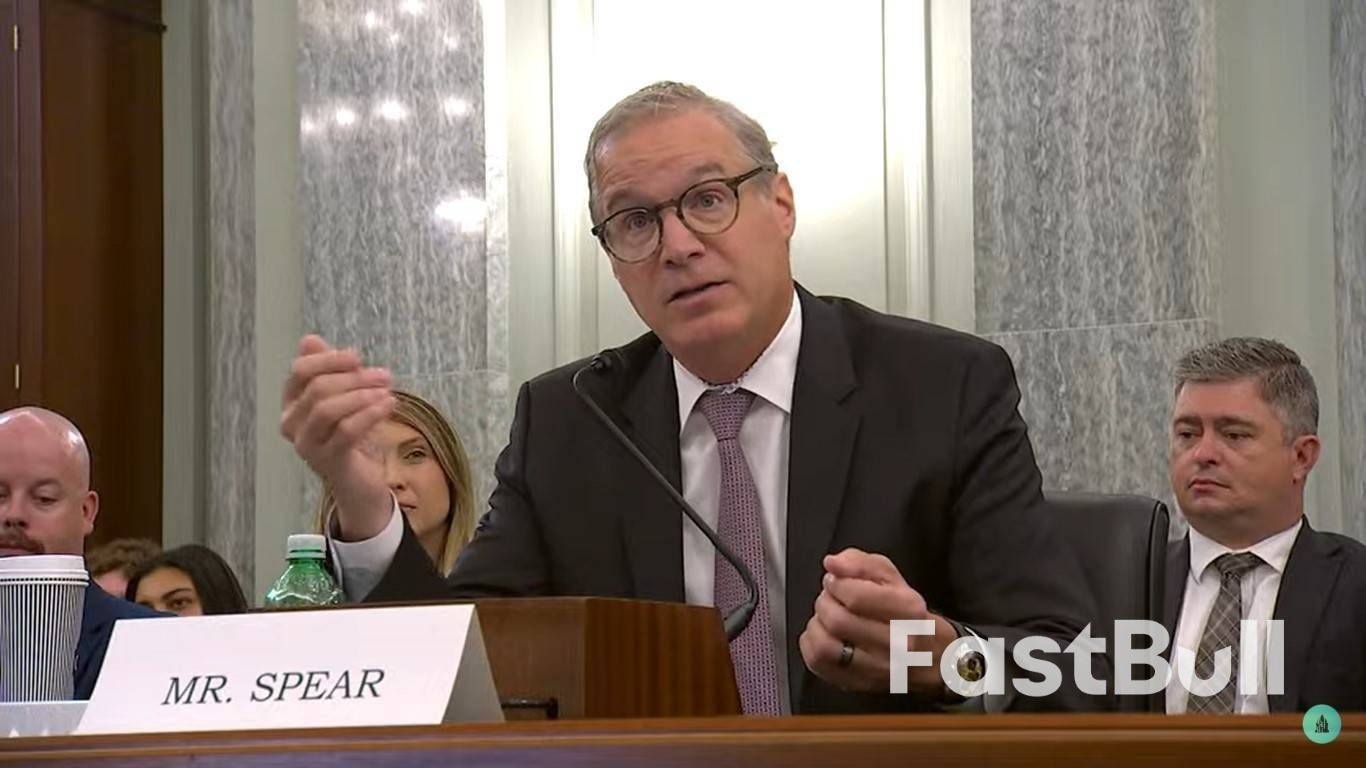
The American trucking industry is facing unprecedented challenges, marked by a deepening economic crisis and deteriorating highway safety standards. While supply chain disruptions during the COVID-19 pandemic brought attention to the transportation sector, the narrative surrounding these issues has been largely mischaracterized, particularly regarding the nature and extent of the purported truck driver shortage in America.
The American Truck Association (ATA) has consistently promoted the idea of a chronic truck driver shortage to Congress and the public. During the height of the COVID-19 pandemic, when supply chains experienced significant strain, this narrative gained considerable traction. Responding to what was portrayed as an urgent crisis, both state and federal governments implemented policy changes aimed at rapidly expanding the truck driver workforce. These measures included lowering standards for commercial driver's license (CDL) qualification, relaxing training requirements, and easing restrictions on who could obtain licenses.
The regulatory changes had far-reaching consequences that extended beyond simply increasing the number of available drivers. The trucking industry witnessed an influx of inadequately trained individuals, many of whom reportedly lacked proper understanding of American road regulations and language proficiency. This situation created a dangerous precedent on highways across the nation.Safety standards deteriorated as inexperienced drivers operating older, poorly maintained vehicles became more common on American roads. Reports indicate that some of these new entrants regularly exceeded legal driving hour limitations, operating vehicles for 18-20 hours per day—almost double the legally permitted duration.
What has followed has been described as the "Great Freight Recession," characterized as the most severe economic downturn the freight industry has ever experienced. American truck drivers, long considered the backbone of the national supply chain, have seen their livelihoods threatened by the availability of cheaper labor.As economic pressures mounted, more carriers began hiring drivers willing to work for lower wages, creating a race to the bottom in terms of both compensation and compliance with regulations. This competitive disadvantage forced even legitimate operators to consider similar practices to avoid bankruptcy, further exacerbating industry-wide problems.
Perhaps most damaging has been the impact on generational trucking businesses, many of which were long-term members of the ATA.Family-owned trucking firms with decades of history and commitment to legal operation have found themselves unable to compete with operators who disregard regulatory requirements. Many of these established businesses have been forced to shut down, unable to maintain profitability while adhering to safety standards and labor regulations. Others are still around, but barely hanging on.
The disappearance of these legitimate operators represents not just a loss of businesses but the erosion of a culture of professionalism and safety within the industry. Their replacement with operators willing to cut corners has fundamentally altered the trucking landscape in America.
The current crisis in the trucking industry can be traced back to a fundamental mischaracterization of market conditions. Capacity issues experienced during COVID were temporary phenomena that could have been addressed through market mechanisms such as increased compensation and better incentives for qualified American drivers.Instead, the promotion of a perpetual driver shortage narrative by the ATA has led to policies that have undermined safety standards and destabilized the economic foundation of the trucking industry. What the trucking sector needs is not simply more drivers, but rather a renewed commitment to fair labor practices and rigorous safety standards that protect both drivers and the public.
The rise of meme coins has created a new wave of trading opportunities for investors seeking both fun and profit. Choosing the best meme coin trading platform is essential for navigating this volatile market. In this guide, we compare top platforms in 2025 based on features, fees, and security to help you trade smarter and safer.
Before choosing the best meme coin trading platform, traders should understand what truly defines a reliable and efficient exchange. Meme coins like Dogecoin, Shiba Inu, and PEPE are highly volatile, so the right platform must offer strong performance, security, and ease of use.
Ultimately, a great meme coin platform combines strong security, low fees, wide coin access, and an intuitive user experience—making it easier for traders to stay ahead of market trends and capitalize on opportunities effectively.
Choosing the best meme coin trading platform in 2025 depends on several factors—supported tokens, liquidity, user experience, and security. Below is a comparison of the leading exchanges to help you decide which is the best platform for trading meme coins this year.
| Platform Name | Supported Meme Coins | Key Highlights | Best For | Overall Rating |
|---|---|---|---|---|
| Binance | Dogecoin, Shiba Inu, PEPE, BONK | Massive liquidity and global market access | Active traders and long-term investors | ⭐⭐⭐⭐⭐ (9.5/10) |
| OKX | Dogecoin, Shiba Inu, PEPE | Advanced charting tools and derivatives support | Professional and experienced traders | ⭐⭐⭐⭐ (9.2/10) |
| KuCoin | Dogecoin, PEPE, FLOKI | Strong community trading and earning programs | Meme coin enthusiasts and casual investors | ⭐⭐⭐⭐ (8.9/10) |
| Bybit | Shiba Inu, PEPE | Fast execution speed and mobile-friendly design | Short-term traders and mobile users | ⭐⭐⭐½ (8.7/10) |
| Bitget | Dogecoin, Shiba Inu, BONK | Copy trading and intuitive beginner interface | New traders exploring meme coins | ⭐⭐⭐½ (8.5/10) |
Each exchange brings unique advantages—some focus on liquidity, others on usability or community rewards. Before deciding where to trade, compare their features and choose the best trading platform for meme coins that fits your goals and trading experience.
When comparing the best meme coin trading platform options in 2025, fees play a decisive role—especially for high-frequency or arbitrage traders. Below we explore how each leading exchange handles spot and futures trading fees, maker/taker structures, and special discounts that can boost profitability for active meme coin traders.
Binance remains one of the best platforms for trading meme coins due to its dynamic fee system. Spot trading fees start at 0.1%, with users enjoying an additional 25% discount when paying fees using BNB tokens. Futures traders can further reduce costs via VIP tiers based on trading volume. Deposit fees are zero, and withdrawal fees depend on blockchain conditions, often refunded through periodic promotions.
MEXC has become a favorite among meme coin traders because it offers a 0% maker fee on spot markets, making it one of the best trading platforms for meme coins for scalpers and high-frequency users. The exchange also periodically offers taker fee rebates for trading popular meme pairs like DOGE/USDT or SHIB/USDT. Futures fees remain competitive with simple and transparent pricing.
OKX combines deep liquidity with a transparent fee structure. It offers discounts for holding OKB tokens, making it another best meme coin trading platform for users seeking institutional-grade performance. For active traders, the maker/taker structure starts at 0.08%/0.10% and can drop significantly as trading volumes increase.
KuCoin’s fee model focuses on rewarding active users through its KCS token system. By holding or paying with KCS, traders can get up to a 20% discount on all trading fees. This structure, paired with a wide range of meme coin listings, positions KuCoin as one of the best platforms for trading meme coins among retail investors.
Bybit’s low-fee environment is built for professional and arbitrage traders. Spot trading fees start at 0.1%, while futures offer a favorable 0.01% maker and 0.06% taker structure. The platform occasionally runs cashback campaigns for meme coin transactions, helping traders save more during volatile periods.
For high-frequency and arbitrage-focused meme coin traders, these exchanges’ low or zero maker fees can significantly increase profitability. The key is choosing the best trading platform for meme coins that matches your trading volume, preferred pairs, and liquidity needs.
Selecting the best meme coin trading platform is not just about finding low fees—it’s about matching your priorities as a trader. Each user values different factors such as security, asset variety, and usability. Here are several key perspectives to consider before deciding which is the best platform for trading meme coins for you.
In summary, the “right” platform depends on your style—whether you value cost-efficiency, security, or innovation. Balancing these factors ensures your chosen platform supports sustainable and safe meme coin trading.
Most popular meme coins operate on Ethereum and BNB Chain due to their liquidity and ecosystem size. However, Solana-based meme coins like BONK are gaining traction for lower fees and faster transaction speeds.
Yes, but it depends on your capital, strategy, and market volatility. Consistent profits usually come from disciplined trading and proper risk management rather than speculation alone.
Major exchanges such as Binance, OKX, and KuCoin are commonly used to buy top meme coins like DOGE, SHIB, and PEPE. For newly launched coins, decentralized exchanges may list them earlier but carry higher risk—choose carefully when using any best meme coin trading platform.
In conclusion, choosing the best meme coin trading platform depends on your trading preferences and goals. Platforms like TradingView and Thinkorswim offer powerful charting tools and market analysis, making them suitable for traders looking to explore meme coins. Assess each platform’s features to find the best fit for your trading style in 2025.
Two years ago, after Hamas killed and kidnapped its way across southern Israel, Prime Minister Benjamin Netanyahu seemed finished. "Mr. Security," as he billed himself, would either resign in shame or be driven out by a devastated public.
Yet this week he promoted his candidacy in next year's election by saying he'd saved the nation from oblivion with a slew of military successes against Iran and its proxy militias. Between those and a fractured opposition, it's looking like the country's longest-serving leader may hold onto his post for a while longer.
"He doesn't need to win the next election, just not to lose it," said Nadav Shtrauchler, a political adviser who's worked closely with Netanyahu in the past, referring to the possibility of remaining in power without a majority. "He's still there, astounding observers, whether they're impressed or frustrated."
Netanyahu, who's clocked 17 non-consecutive years at the top, out-polls all other candidates for the job. And while surveys show that his coalition — the most right-wing in Israel's history — won't attract enough votes to form the next government, neither will the opposition.
When the election is held — it's due by next October — the country risks a repeat of the years 2019-2022, when it was dragged through five ballots while a transitional government with limited authority ran the country. Apart from 18 months of that period, Netanyahu held power.
This week, Netanyahu told parliament that what he has accomplished in the two years since Hamas' Oct. 7, 2023 attacks, especially by bombing Iran's nuclear facilities in June, ensures unprecedented national safety.
If his opponents were in charge, he said, "You Members of Knesset, all citizens of Israel without exception — Jews, Arabs, leftists, rightists, ultra-Orthodox, secularists — would all go up in atomic smoke."
A day earlier, he announced that Israel's battles against Hamas, Lebanon's Hezbollah, the Houthis of Yemen, and their sponsor Iran — alongside the collapse of former Syrian President Bashar al-Assad's regime — had so boosted the country's strategic position since 2023 that he's renaming them the "War of Redemption."
What he didn't say, but everyone understood, is that the name applies to his political career as well.
For his critics, who are legion in Israel and abroad, this seems beyond belief. He was in charge on Oct. 7, 2023, the day of Hamas' attack and the worst single-day in the Jewish state's history. Indicted by the International Criminal Court for alleged war crimes in Gaza, on trial in Tel Aviv for bribery and fraud, Netanyahu, 76, who denies all the accusations, should be at his political end point.
Sever Plocker, a longstanding commentator at the centrist Yedioth Ahronoth newspaper, wrote this week what many believe — that unless Netanyahu is replaced the country can't move on. Netanyahu, Plocker wrote, is "one of the most hated statesmen in the world" and "Israel today is more isolated than ever before."
Netanyahu's handling of the war in Gaza, in which tens of thousands of Palestinians have been killed, humanitarian aid was and continues to be blocked and much of the strip reduced to rubble, alienated many around the world. That derailed Israel's hopes for the normalization of ties with more Arab and Muslim countries — a major strategic goal at home and in the US.
US President Donald Trump hopes to one day persuade Saudi Crown Prince Mohammed bin Salman to recognize Israel and join the so-called Abraham Accords — one of Trump's flagship achievements in his first term. The kingdom's de-facto ruler has so far held off. Publicly, he has set an independent Palestinian state as a precondition — an idea opposed by Netanyahu and his coalition partners.
The economy and businesses have also taken a hit from mass call ups of Israelis for reserve duty. The country's gross domestic product is still smaller, in shekel and real terms, than it was on the eve of the conflict.
Netanyahu dominates the Likud Party, whose domestic base makes little distinction between fealty to the prime minister and to the party. The opposition, a mix of secular leftists and nationalist hawks, is united only by opposition to him, making it unlikely that an alternative coalition can emerge.
The prime minister's legal troubles have discouraged most politicians from working with him in recent years, driving Netanyahu into the arms of the ultra-nationalists and ultra-Orthodox with whom he now shares power. That pact holds two key threats to the government: a walkout from far-right partners if Hamas isn't quickly disarmed and removed from positions of influence in Gaza, and a law exempting the ultra-Orthodox from military conscription.
Finance Minister Bezalel Smotrich and National Security Minister Itamar Ben Gvir are skeptical that Trump's plan for peace in Gaza — announced with great fanfare earlier this month — can bring down Hamas, designated a terrorist group by the US and many others. They have voiced hopes of resettling Gaza with Israeli Jews and annexing the West Bank — which both Trump, and consequently Netanyahu, reject.
The Trump administration is pushing Netanyahu to be patient about Gaza and not return to war. It wants Israel to focus on rebuilding in parts of the strip even if armed Hamas militants are still operating elsewhere.
The conscription of ultra-Orthodox men, also known as Haredim, still lingers over the government. In July, the United Torah Judaism and Shas parties quit government — though stopped short of collapsing it — and are still boycotting votes on any government-proposed legislation, de facto paralyzing the cabinet and feeding a dynamic that could see it fall apart.
The two parties are unlikely to fully rejoin the government unless a bill exempting most ultra-Orthodox men from military service gets underway. The exemption on religious grounds is unpopular among many voters, including Netanyahu's base, which wants to see Haredi men share the burden of fighting.
Gila Gamliel, a cabinet member in his party, said in a radio interview this week, "I believe that the government can serve out its term."
Few Israeli governments have achieved this, and speculation has been rife that Netanyahu will call early elections to harness the small popularity boost on the back of military gains and the return of hostages from Gaza.
But this week Netanyahu hinted he intends to hold off on elections when he said he wanted to pass the 2026 budget "soon." In the past, Israeli lawmakers have often blocked the passing of budgets as a way to bring down governments.
While Netanyahu got a shot in the arm after the remaining living hostages were released from Gaza, not everyone lays the win at his feet. Trump's son-in-law and confidant, Jared Kushner, and Middle East envoy Steve Witkoff spoke to families in Tel Aviv's Hostage Square as exchanges took place. They were hailed for their role in securing the deal, but Witkoff was met with jeers when he tried to credit the Israeli prime minister.
Trump gained a great deal of the praise for the ceasefire in Gaza, and he remains a key asset for Netanyahu. Addressing Israeli lawmakers last week, Trump urged President Isaac Herzog to pardon the prime minister.
Strategist Shtrauchler said that wasn't coincidental.
"Trump effectively launched Netanyahu's election campaign," he said. "The prime minister is counting on Trump's presence moving forward. They are fully coordinated."
Business activity in the euro area unexpectedly reached its highest level since May 2024 as outperformance by Germany helped offset weakness in France.
The Composite Purchasing Managers' Index compiled by S&P Global increased to 52.2 in October from 51.2 in September, further above the 50 threshold separating growth from contraction. Analysts had predicted an almost unchanged reading.
The surprise was driven by services, particularly in Germany, which saw its best month on the composite measure since May 2023. That sector, however, weighed on neighbouring France, whose reading slipped for a 14th straight month as the country is gripped once again by political turmoil.
"While the economic situation in Germany brightened significantly in October, the rate of contraction has accelerated for two months in a row in France," Cyrus de la Rubia, an economist at Hamburg Commercial Bank, said Friday in a statement. "As a result, economic growth in the eurozone, even though accelerating a bit, has been much weaker than it otherwise could have been."
Europe has so far weathered the trade storm unleashed by Donald Trump's tariffs, though growth remains well below the pace seen in the US. Help is on the way from higher defence spending across the region and an infrastructure revamp in Germany. But in the meantime, France's perilous fiscal predicament — and President Emmanuel Macron's repeated struggles to find a solution — are contributing to output that's creeping only slowly higher.
Despite the lacklustre growth, the European Central Bank isn't inclined to shift interest rates lower, following eight cuts in the space of a year. With inflation around its 2% target, borrowing costs are expected to be left unchanged next week.
"The composite PMI survey for the euro area adds to the case for the ECB to keep interest rates unchanged this month. It suggests the economy remains resilient in the face of the rise in US tariffs and some inflationary pressures persist," said Bloomberg Economics.
De la Rubia said price gains in the services sector remain moderate.
"The rate of inflation for sales prices has risen slightly, but remains close to the long-term average," he said. "Cost increases were slightly lower in October, so there is little danger from this side in the short term. The ECB, which pays particular attention to inflation in the service sector, is likely to see this data as confirmation of its stance not to implement further interest-rate cuts."
PMIs are closely watched by markets as they arrive early in the month and are good at revealing trends and turning points in an economy. A measure of breadth of changes in output rather than depth, business surveys can sometimes be difficult to map directly to quarterly GDP.
Data later Friday showed the UK's composite PMI increased more than anticipated, to 51.1. The US' reading is expected to dip to 53.5.
728 RM B 7/F GEE LOK IND BLDG NO 34 HUNG TO RD KWUN TONG KLN HONG KONG


White Label
Data API
Web Plug-ins
Poster Maker
Affiliate Program
The risk of loss in trading financial instruments such as stocks, FX, commodities, futures, bonds, ETFs and crypto can be substantial. You may sustain a total loss of the funds that you deposit with your broker. Therefore, you should carefully consider whether such trading is suitable for you in light of your circumstances and financial resources.
No decision to invest should be made without thoroughly conducting due diligence by yourself or consulting with your financial advisors. Our web content might not suit you since we don't know your financial conditions and investment needs. Our financial information might have latency or contain inaccuracy, so you should be fully responsible for any of your trading and investment decisions. The company will not be responsible for your capital loss.
Without getting permission from the website, you are not allowed to copy the website's graphics, texts, or trademarks. Intellectual property rights in the content or data incorporated into this website belong to its providers and exchange merchants.
Not Logged In
Log in to access more features

FastBull Membership
Not yet
Purchase


Log In
Sign Up


