• Trade
  • Markets
  • Copy
  • Contests
  • News
  • 24/7
  • Calendar
  • Q&A
  • Chats
Trending
Screeners
SYMBOL
LAST
BID
ASK
HIGH
LOW
NET CHG.
%CHG.
SPREAD
SPX
S&P 500 Index
6870.39
6870.39
6870.39
6895.79
6858.28
+13.27
+ 0.19%
--
DJI
Dow Jones Industrial Average
47954.98
47954.98
47954.98
48133.54
47871.51
+104.05
+ 0.22%
--
IXIC
NASDAQ Composite Index
23578.12
23578.12
23578.12
23680.03
23506.00
+72.99
+ 0.31%
--
USDX
US Dollar Index
98.880
98.960
98.880
98.960
98.730
-0.070
-0.07%
--
EURUSD
Euro / US Dollar
1.16527
1.16534
1.16527
1.16717
1.16341
+0.00101
+ 0.09%
--
GBPUSD
Pound Sterling / US Dollar
1.33275
1.33284
1.33275
1.33462
1.33136
-0.00037
-0.03%
--
XAUUSD
Gold / US Dollar
4205.60
4206.01
4205.60
4218.85
4190.61
+7.69
+ 0.18%
--
WTI
Light Sweet Crude Oil
59.315
59.345
59.315
60.084
59.291
-0.494
-0.83%
--

Community Accounts

Signal Accounts
--
Profit Accounts
--
Loss Accounts
--
View More

Become a signal provider

Sell trading signals to earn additional income

View More

Guide to Copy Trading

Get started with ease and confidence

View More

Signal Accounts for Members

All Signal Accounts

Best Return
  • Best Return
  • Best P/L
  • Best MDD
Past 1W
  • Past 1W
  • Past 1M
  • Past 1Y

All Contests

  • All
  • Trump Updates
  • Recommend
  • Stocks
  • Cryptocurrencies
  • Central Banks
  • Featured News
Top News Only
Share

Ivory Coast 2025/26 Cocoa Arrivals Reached 803000 T By December 7 Versus 820000 T A Year Ago - Exporters' Estimate

Share

EU To Delay Proposals For Automotive Sector, Including Co2 Emissions, To Dec 16, Draft EU Commission Document Shows

Share

Kremlin: India Buys Energy Where It Is Profitable To And As Far As We Understand They Will Continue To Do That

Share

Turkey's Main Banking Index Up 2.5%

Share

Turkey's Main BIST-100 Index Up 1.9%

Share

Hungary's Preliminary November Budget Balance Huf -403 Billion

Share

Indian Rupee Down 0.1% At 90.07 Per USA Dollar As Of 3:30 P.M. Ist, Previous Close 89.98

Share

India's Nifty 50 Index Provisionally Ends 0.96% Lower

Share

[JPMorgan: US Stock Rally May Stagnate Following Fed Rate Cut] JPMorgan Strategists Say The Recent Rally In US Stocks May Stall As Investors Take Profits Following The Anticipated Fed Rate Cut. The Market Currently Predicts A 92% Probability Of The Fed Lowering Borrowing Costs On Wednesday. Expectations Of A Rate Cut Have Continued To Rise, Fueled By Positive Signals From Policymakers In Recent Weeks. "Investors May Be More Inclined To Lock In Gains At The End Of The Year Rather Than Increase Directional Exposure," Mislav Matejka's Team Wrote In A Report

Share

Russian Defence Ministry: Russian Forces Take Control Of Novodanylivka In Ukraine's Zaporizhzhia Region

Share

Russian Defence Ministry: Russian Forces Take Control Of Chervone In Ukraine's Donetsk Region

Share

French Finance Ministry: Government Started Process To Block Temporarily Shein Platform

Share

Finance Minister: Indonesia To Impose Coal Export Tax Of Up To 5% Next Year

Share

[Trump Considering Fired Homeland Security Secretary Noem? White House Denies] According To Reports From US Media Outlets Such As The Daily Beast And The UK's Independent, The White House Has Denied Reports That US President Trump Is Considering Firing Homeland Security Secretary Noem. White House Spokesperson Abigail Jackson Posted On Social Media On The 7th Local Time, Calling The Claims "fake News" And Stating That "Secretary Noem Has Done An Excellent Job Implementing The President's Agenda And 'making America Safe Again'."

Share

HKEX: Standard Chartered Bought Back 571604 Total Shares On Other Exchanges For Gbp9.5 Million On Dec 5

Share

Morgan Stanley Reiterates Bullish Outlook On US Stocks Due To Fed Rate Cut Expectations. Morgan Stanley Strategists Believe That The US Stock Market Faces A "bullish Outlook" Given Improved Earnings Expectations And Anticipated Fed Rate Cuts. They Expect Strong Corporate Earnings By 2026, And Anticipate The Fed Will Cut Rates Based On Lagging Or Mildly Weak Labor Markets. They Expect The US Consumer Discretionary Sector And Small-cap Stocks To Continue To Outperform

Share

China's National Development And Reform Commission Announced That Starting From 24:00 On December 8, The Retail Price Limit For Gasoline And Diesel In China Will Be Reduced By 55 Yuan Per Ton, Which Translates To A Reduction Of 0.04 Yuan Per Liter For 92-octane Gasoline, 0.05 Yuan Per Liter For 95-octane Gasoline, And 0.05 Yuan Per Liter For 0# Diesel

Share

Tkms CEO: US Security Strategy Highlights Need For Europe To Take Care Of Its Own Defences

Share

USA S&P 500 E-Mini Futures Up 0.1%, NASDAQ 100 Futures Up 0.18%, Dow Futures Down 0.02%

Share

London Metal Exchange (LME): Copper Inventories Increased By 2,000 Tons, Aluminum Inventories Decreased By 2,500 Tons, Nickel Inventories Increased By 228 Tons, Zinc Inventories Increased By 2,375 Tons, Lead Inventories Decreased By 3,725 Tons, And Tin Inventories Decreased By 10 Tons

TIME
ACT
FCST
PREV
France Industrial Output MoM (SA) (Oct)

A:--

F: --

P: --
France Trade Balance (SA) (Oct)

A:--

F: --

P: --
Euro Zone Employment YoY (SA) (Q3)

A:--

F: --

P: --
Canada Part-Time Employment (SA) (Nov)

A:--

F: --

P: --

Canada Unemployment Rate (SA) (Nov)

A:--

F: --

P: --

Canada Full-time Employment (SA) (Nov)

A:--

F: --

P: --

Canada Labor Force Participation Rate (SA) (Nov)

A:--

F: --

P: --

Canada Employment (SA) (Nov)

A:--

F: --

P: --

U.S. PCE Price Index MoM (Sept)

A:--

F: --

P: --

U.S. Personal Income MoM (Sept)

A:--

F: --

P: --

U.S. Core PCE Price Index MoM (Sept)

A:--

F: --

P: --

U.S. PCE Price Index YoY (SA) (Sept)

A:--

F: --

P: --

U.S. Core PCE Price Index YoY (Sept)

A:--

F: --

P: --

U.S. Personal Outlays MoM (SA) (Sept)

A:--

F: --

P: --
U.S. 5-10 Year-Ahead Inflation Expectations (Dec)

A:--

F: --

P: --

U.S. Real Personal Consumption Expenditures MoM (Sept)

A:--

F: --

P: --
U.S. Weekly Total Rig Count

A:--

F: --

P: --

U.S. Weekly Total Oil Rig Count

A:--

F: --

P: --

U.S. Consumer Credit (SA) (Oct)

A:--

F: --

P: --
China, Mainland Foreign Exchange Reserves (Nov)

A:--

F: --

P: --

Japan Trade Balance (Oct)

A:--

F: --

P: --

Japan Nominal GDP Revised QoQ (Q3)

A:--

F: --

P: --

China, Mainland Imports YoY (CNH) (Nov)

A:--

F: --

P: --

China, Mainland Exports (Nov)

A:--

F: --

P: --

China, Mainland Imports (CNH) (Nov)

A:--

F: --

P: --

China, Mainland Trade Balance (CNH) (Nov)

A:--

F: --

P: --

China, Mainland Exports YoY (USD) (Nov)

A:--

F: --

P: --

China, Mainland Imports YoY (USD) (Nov)

A:--

F: --

P: --

Germany Industrial Output MoM (SA) (Oct)

A:--

F: --

P: --
Euro Zone Sentix Investor Confidence Index (Dec)

A:--

F: --

P: --

Canada National Economic Confidence Index

--

F: --

P: --

U.K. BRC Like-For-Like Retail Sales YoY (Nov)

--

F: --

P: --

U.K. BRC Overall Retail Sales YoY (Nov)

--

F: --

P: --

Australia Overnight (Borrowing) Key Rate

--

F: --

P: --

RBA Rate Statement
RBA Press Conference
Germany Exports MoM (SA) (Oct)

--

F: --

P: --

U.S. NFIB Small Business Optimism Index (SA) (Nov)

--

F: --

P: --

Mexico 12-Month Inflation (CPI) (Nov)

--

F: --

P: --

Mexico Core CPI YoY (Nov)

--

F: --

P: --

Mexico PPI YoY (Nov)

--

F: --

P: --

U.S. Weekly Redbook Index YoY

--

F: --

P: --

U.S. JOLTS Job Openings (SA) (Oct)

--

F: --

P: --

China, Mainland M1 Money Supply YoY (Nov)

--

F: --

P: --

China, Mainland M0 Money Supply YoY (Nov)

--

F: --

P: --

China, Mainland M2 Money Supply YoY (Nov)

--

F: --

P: --

U.S. EIA Short-Term Crude Production Forecast For The Year (Dec)

--

F: --

P: --

U.S. EIA Natural Gas Production Forecast For The Next Year (Dec)

--

F: --

P: --

U.S. EIA Short-Term Crude Production Forecast For The Next Year (Dec)

--

F: --

P: --

EIA Monthly Short-Term Energy Outlook
U.S. API Weekly Gasoline Stocks

--

F: --

P: --

U.S. API Weekly Cushing Crude Oil Stocks

--

F: --

P: --

U.S. API Weekly Crude Oil Stocks

--

F: --

P: --

U.S. API Weekly Refined Oil Stocks

--

F: --

P: --

South Korea Unemployment Rate (SA) (Nov)

--

F: --

P: --

Japan Reuters Tankan Non-Manufacturers Index (Dec)

--

F: --

P: --

Japan Reuters Tankan Manufacturers Index (Dec)

--

F: --

P: --

Japan Domestic Enterprise Commodity Price Index MoM (Nov)

--

F: --

P: --

Japan Domestic Enterprise Commodity Price Index YoY (Nov)

--

F: --

P: --

China, Mainland PPI YoY (Nov)

--

F: --

P: --

Q&A with Experts
    • All
    • Chatrooms
    • Groups
    • Friends
    Connecting
    .
    .
    .
    Type here...
    Add Symbol or Code

      No matching data

      All
      Trump Updates
      Recommend
      Stocks
      Cryptocurrencies
      Central Banks
      Featured News
      • All
      • Russia-Ukraine Conflict
      • Middle East Flashpoint
      • All
      • Russia-Ukraine Conflict
      • Middle East Flashpoint

      Search
      Products

      Charts Free Forever

      Chats Q&A with Experts
      Screeners Economic Calendar Data Tools
      Membership Features
      Data Warehouse Market Trends Institutional Data Policy Rates Macro

      Market Trends

      Market Sentiment Order Book Forex Correlations

      Top Indicators

      Charts Free Forever
      Markets

      News

      News Analysis 24/7 Columns Education
      From Institutions From Analysts
      Topics Columnists

      Latest Views

      Latest Views

      Trending Topics

      Top Columnists

      Latest Update

      Signals

      Copy Rankings Latest Signals Become a signal provider AI Rating
      Contests
      Brokers

      Overview Brokers Assessment Rankings Regulators News Claims
      Broker listing Forex Brokers Comparison Tool Live Spread Comparison Scam
      Q&A Complaint Scam Alert Videos Tips to Detect Scam
      More

      Business
      Events
      Careers About Us Advertising Help Center

      White Label

      Data API

      Web Plug-ins

      Affiliate Program

      Awards Institution Evaluation IB Seminar Salon Event Exhibition
      Vietnam Thailand Singapore Dubai
      Fans Party Investment Sharing Session
      FastBull Summit BrokersView Expo
      Recent Searches
        Top Searches
          Markets
          News
          Analysis
          User
          24/7
          Economic Calendar
          Education
          Data
          • Names
          • Latest
          • Prev

          View All

          No data

          Scan to Download

          Faster Charts, Chat Faster!

          Download App
          English
          • English
          • Español
          • العربية
          • Bahasa Indonesia
          • Bahasa Melayu
          • Tiếng Việt
          • ภาษาไทย
          • Français
          • Italiano
          • Türkçe
          • Русский язык
          • 简中
          • 繁中
          Open Account
          Search
          Products
          Charts Free Forever
          Markets
          News
          Signals

          Copy Rankings Latest Signals Become a signal provider AI Rating
          Contests
          Brokers

          Overview Brokers Assessment Rankings Regulators News Claims
          Broker listing Forex Brokers Comparison Tool Live Spread Comparison Scam
          Q&A Complaint Scam Alert Videos Tips to Detect Scam
          More

          Business
          Events
          Careers About Us Advertising Help Center

          White Label

          Data API

          Web Plug-ins

          Affiliate Program

          Awards Institution Evaluation IB Seminar Salon Event Exhibition
          Vietnam Thailand Singapore Dubai
          Fans Party Investment Sharing Session
          FastBull Summit BrokersView Expo

          Bitcoin Eyes All-time-high As Crypto Frenzy Returns

          IG

          Cryptocurrency

          Summary:

          What has triggered the explosive demand for the king coin, and how far can it go?
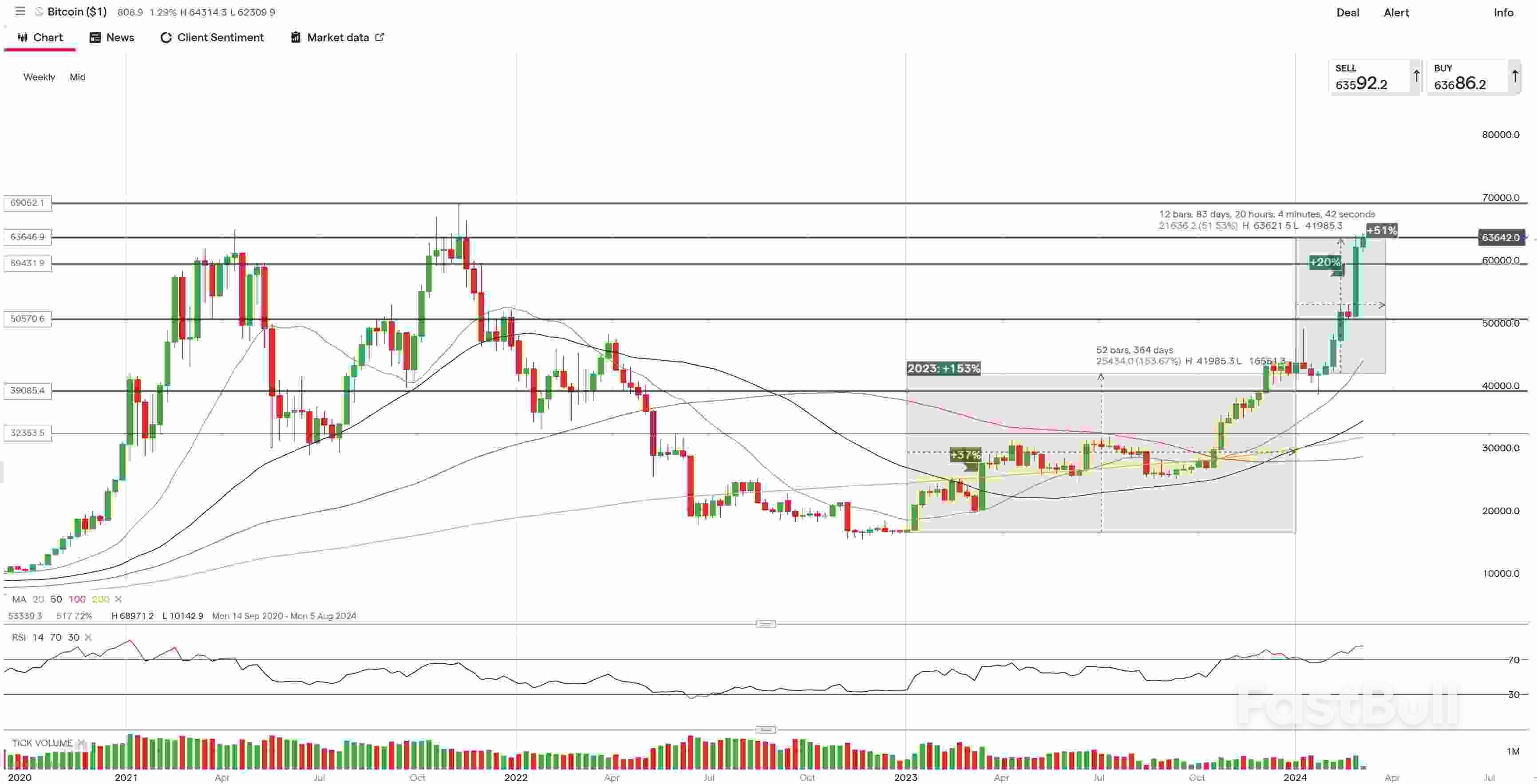
          Bitcoin and its companions are making a roaring comeback in 2024, with prices skyrocketing nearly 50% in the first two months. The king of crypto, Bitcoin, has climbed back to its November 2021 highs and is seemingly on track to mark an all-time high in March. What has triggered the explosive demand for the king coin, and how far can it go?
          Why Bitcoin prices soar in 2024?

          During the past week alone, Bitcoin surged by 20%, reaching a high of USD $64,000, marking its best weekly performance in nearly 12 months and continuing the strong rally that began in early 2023.Bitcoin Eyes All-time-high As Crypto Frenzy Returns_1
          The launch of spot Bitcoin ETFs in January 2024 has been the latest catalyst and a major contributor to the explosive demand for Bitcoin.These ETFs, similar to traditional ETFs, track the price of an underlying asset, in this case, Bitcoin. Unlike directly purchasing Bitcoin, which involves the complexities of cryptocurrency exchanges and managing private keys, spot Bitcoin ETFs are much more straightforward. The underlying Bitcoin is held in secure storage by the regulated ETF provider, and investors can simply buy and sell shares of the ETF through their existing brokerage accounts, just like any other stock. Furthermore, as trading takes place on regulated stock exchanges, it further enhances the security and liquidity of the investment.The launch of the first eleven spot Bitcoin ETFs hit the market with a bang. The first day of trading witnessed a remarkable $4.6 billion in volume, exceeding expectations and highlighting significant interest in these new investment vehicles. According to Standard Chartered, these ETFs would attract between $50 billion and $100 billion this year.

          What is Bitcoin halving?

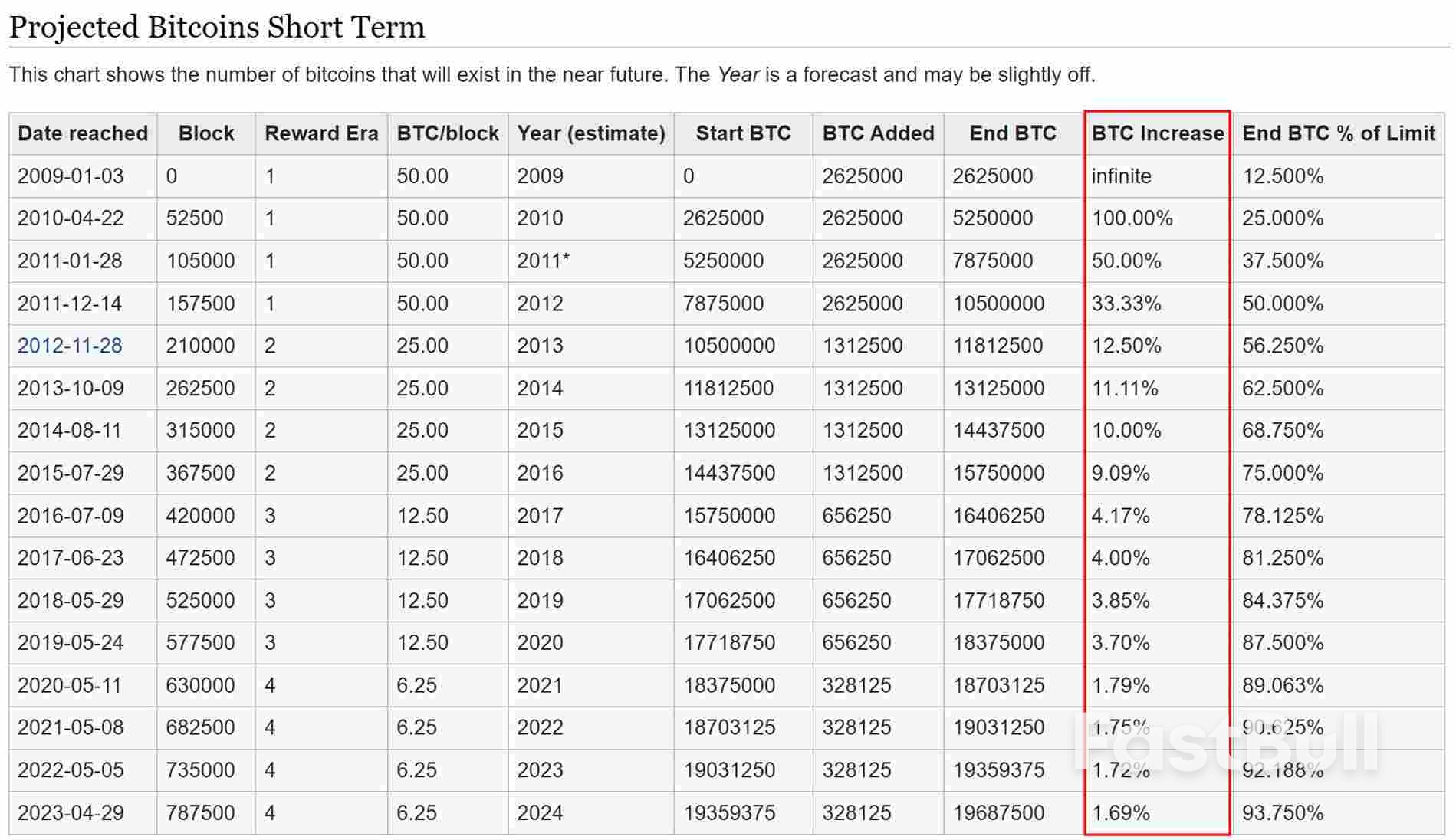
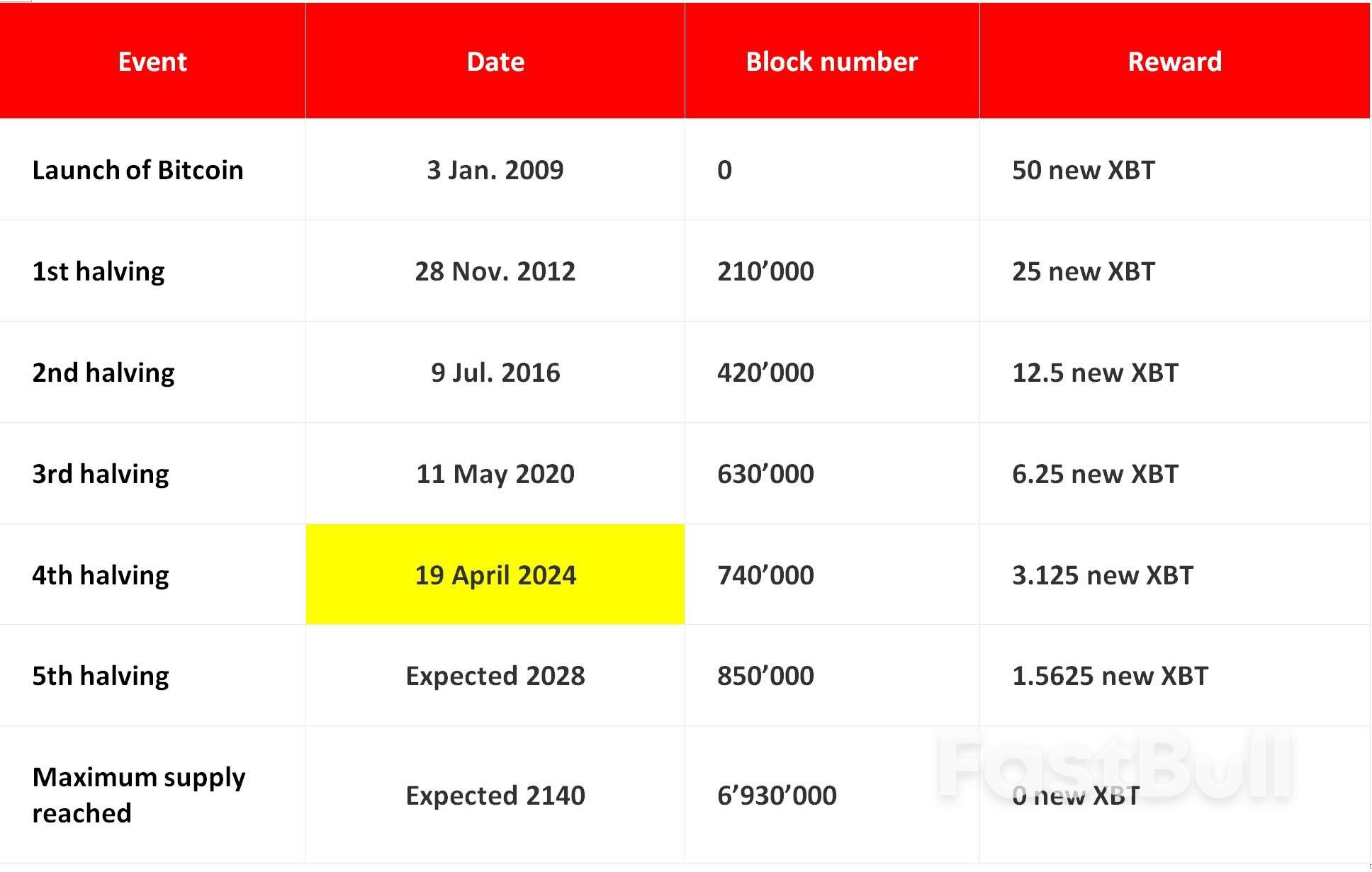
          Another crucial factor that bakes into Bitcoin’s surging prices is an upcoming event call Bitcoin halving. Bitcoin halving is a pre-programmed event that cuts the reward for mining new blocks in half. (As demonstrated in chart below)
          This occurs roughly every four years, with the aim to control the supply of new Bitcoins entering circulation. The next Bitcoin halving is scheduled on April 19, 2024.Bitcoin Eyes All-time-high As Crypto Frenzy Returns_2
          The direct impact of halving is a reduction in the total number of new Bitcoins in circulation. As shown in the table above, the rate at which new Bitcoins are added has been slowing down year by year.
          Bitcoin Eyes All-time-high As Crypto Frenzy Returns_3
          This reduction in supply is often viewed positively from a long-term perspective, as it potentially contributes to price appreciation due to scarcity dynamics. Additionally, the halving event is poised to change the mining landscape. As the block reward shranks, less profitable miners may be forced to shut down their operations, consequently leading to lower supply and higher mining centralization.
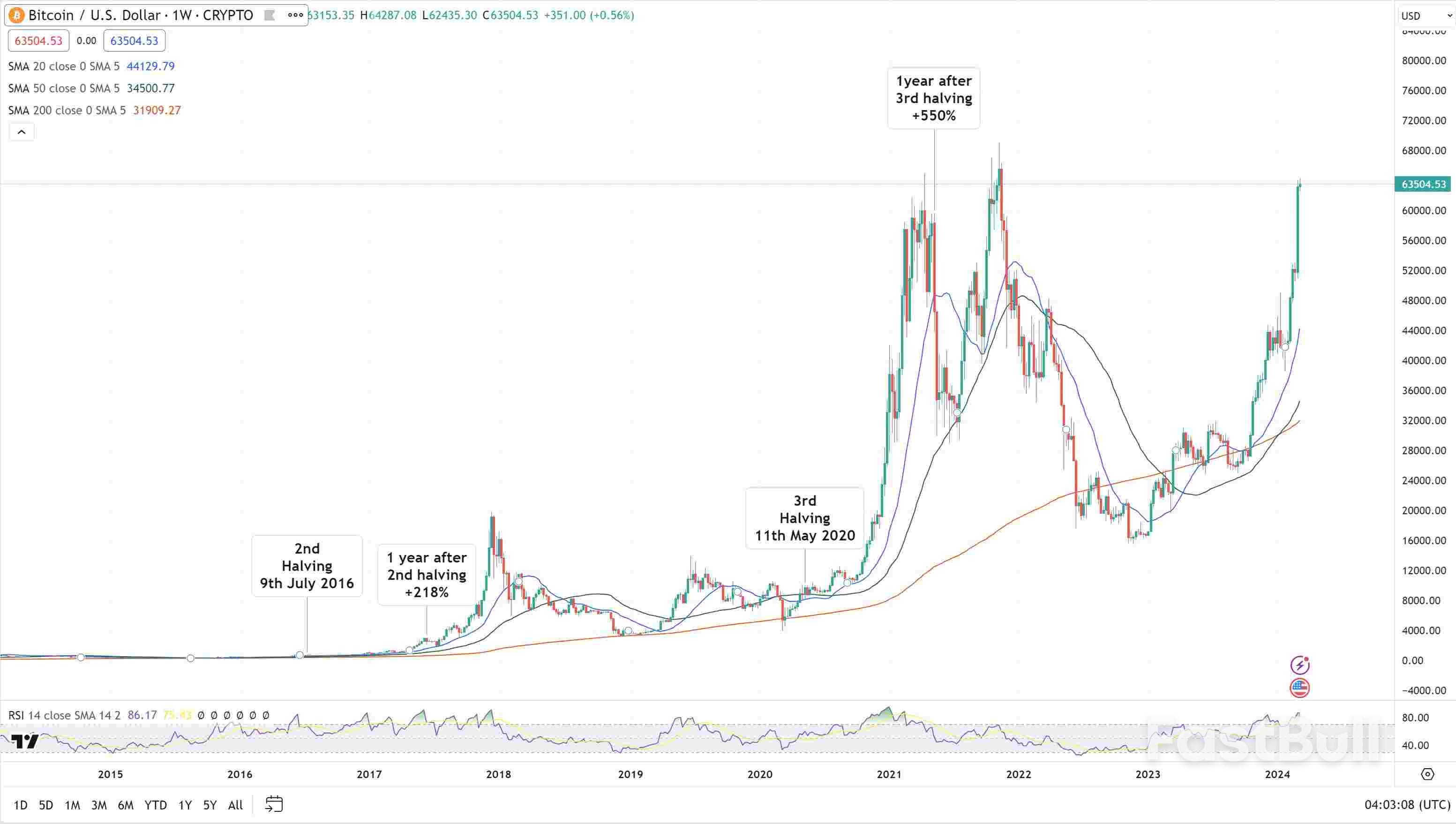
          In the short term, the notable impact is the increased volatility of the price. Historically, as evidenced by the preceding three halving events, the first month following the halving has seen an average price increase of 2%, but a more significant rise could be observed in the subsequent six to twelve months.Bitcoin Eyes All-time-high As Crypto Frenzy Returns_4
          Bitcoin Eyes All-time-high As Crypto Frenzy Returns_5

          Summary

          While historical observations do not guarantee future performance, it is evident that the upcoming halving event has begun to contribute to short-term price volatility for Bitcoin. Moreover, with the influx of investors from a broader market, thanks to the game-changing spot Bitcoin ETFs, it is not hard to foresee that Bitcoin and other cryptocurrencies will remain in the spotlight in the coming months.
          Risk Warnings and Disclaimers
          You understand and acknowledge that there is a high degree of risk involved in trading. Following any strategies or investment methods may lead to potential losses. The content on the site is provided by our contributors and analysts for information purposes only. You are solely responsible for determining whether any trading assets, securities, strategy, or any other product is suitable for investing based on your own investment objectives and financial situation.
          Add to Favorites
          Share

          Dampened by Rain: UK Retail Sales Growth Hindered by Inclement Weather, Report Indicates

          Ukadike Micheal

          Economic

          Forex

          In February, retail sales growth in the U.K. faced a slowdown, registering a 1.1% year-on-year increase, down from the prior month's 1.2% and the three-month average of 1.4%, according to the BRC-KPMG Retail Sales Monitor report. The impact of the wettest February on record was evident, with the subdued consumer demand attributed to the relentless rainfall. Annual growth, which stood at 5.2% in February the previous year, faced a notable decline.
          Despite the overall slowdown, food sales remained a key driver, witnessing a 6.0% year-on-year increase over the three months to February, albeit lower than the 8.3% growth observed a year earlier. In contrast, nonfood sales for the same period saw a 2.5% decline compared to the previous year's growth of 3.2%. The adverse weather conditions played a pivotal role, as consumers hesitated even during traditionally lucrative periods like Valentine's Day.
          Helen Dickinson, Chief Executive of the British Retail Consortium, acknowledged the challenging scenario, stating, “Not even Valentine’s Day lifted customers out of the gloom, and gifting products that typically sell well, like jewelry and watches, failed to deliver." However, she noted a silver lining with increased sales of toys during the rainy weather, as parents sought indoor entertainment for their children.
          Looking ahead, the forecast remains cautious for retailers, anticipating continued lower demand despite signs of slowing inflation and expected improvement in household finances. KPMG U.K.'s Head of Consumer Markets, Leisure, and Retail, Linda Ellett, highlighted the additional challenges retailers face with imminent increases in labor costs and business rates. The stress on the cost agenda for retailers prompts hopes for positive announcements in the upcoming Chancellor’s Spring Budget to potentially kickstart a spending revival on the high street.
          From a technical standpoint, the retail sales data reflects the intricate interplay between consumer behavior and external factors. Weather-induced fluctuations, such as the impact of record rainfall, underscore the vulnerability of consumer spending patterns. As retailers grapple with various cost pressures, including labor and business rates, the market awaits fiscal interventions that could influence the trajectory of retail sales in the U.K. The delicate balance between consumer sentiment, economic factors, and policy decisions adds complexity to predicting future trends in the retail sector. As the industry navigates through these challenges, the market's response to potential fiscal measures will be crucial in shaping the retail landscape in the months ahead.

          Source: Wall Street Journal

          To stay updated on all economic events of today, please check out our Economic calendar
          Risk Warnings and Disclaimers
          You understand and acknowledge that there is a high degree of risk involved in trading. Following any strategies or investment methods may lead to potential losses. The content on the site is provided by our contributors and analysts for information purposes only. You are solely responsible for determining whether any trading assets, securities, strategy, or any other product is suitable for investing based on your own investment objectives and financial situation.
          Add to Favorites
          Share

          French Industrial Sector Experiences Greater-than-Anticipated Decline in Early 2024

          Ukadike Micheal

          Forex

          Economic

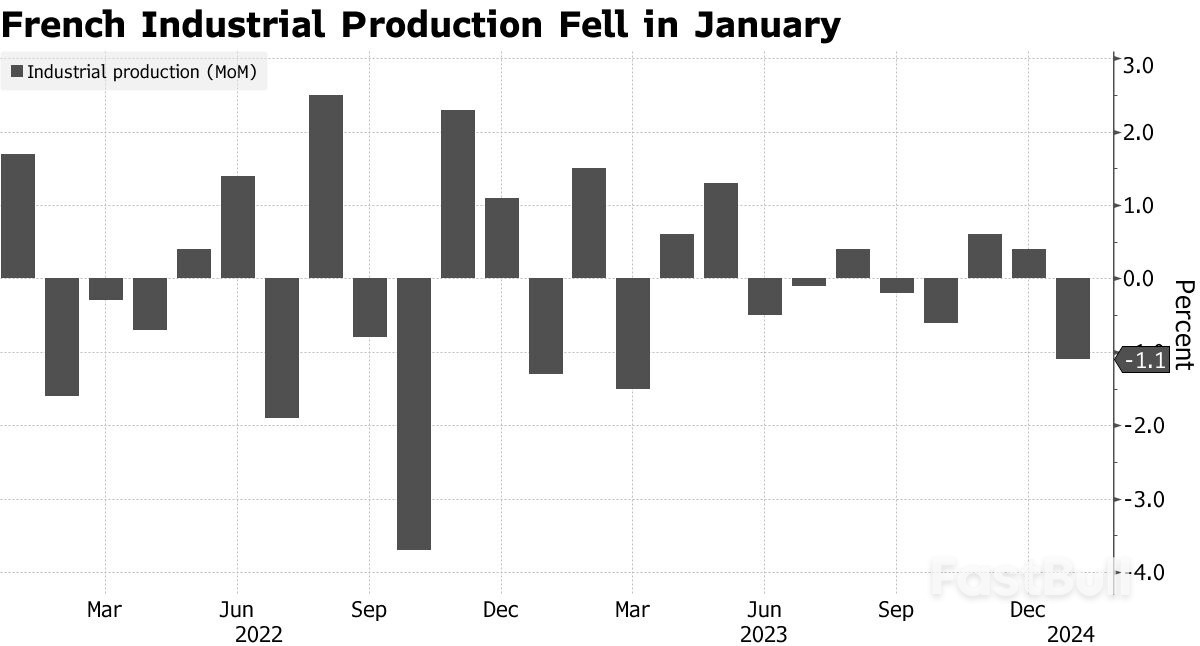
          French industrial production faced a steeper decline than anticipated at the beginning of the year, heightening concerns about the eurozone's second-largest economy struggling to regain traction post the energy crisis. In January, output recorded a 1.1% contraction, notably surpassing the 0.1% decline predicted by economists surveyed by Bloomberg. Furthermore, December's figure underwent a revision from a previously reported 1.1% expansion to a more modest 0.4%, accentuating the economic challenges faced by France.French Industrial Sector Experiences Greater-than-Anticipated Decline in Early 2024_1
          This downturn in industrial production aligns with the broader economic slowdown experienced by France, which had initially exhibited greater resilience than its European counterparts to the energy crisis and subdued global demand in the early part of 2022. Last month, the French government revised its growth forecast for the year downward, citing geopolitical tensions, a slowdown in China, and Germany's recession. The new projection of 1% growth, down from 1.4%, underscores the prevailing economic headwinds.
          French Finance Minister Bruno Le Maire has advocated for addressing underlying growth difficulties within Europe, urging the European Central Bank (ECB) to ease its restrictive policy. However, most ECB Governing Council members have signaled a preference for seeing more progress in combating inflation before considering adjustments to their stance. Despite ongoing economic challenges, no immediate policy changes are anticipated at the upcoming ECB meeting.
          The latest data reveals a particularly weak performance in manufacturing output, which contracted by 1.6% in January, marking the most significant month-on-month drop since October 2022. Notably, the production of transport materials, including automobiles, saw a substantial decline of 5.3%, indicating broader challenges in key sectors.
          From a technical standpoint, the industrial production data signals potential ripple effects in the market. The manufacturing sector's contraction, especially in vital areas like automotive production, could contribute to a broader economic slowdown. Investors and analysts closely monitor such indicators, considering the interconnectedness of manufacturing health with overall economic performance. Additionally, the divergence between economic projections and actual performance highlights the complexity of forecasting in a dynamic global landscape.
          As France grapples with these economic challenges, the market's response to potential policy shifts and global economic developments will be pivotal. The delicate balance between addressing immediate concerns and fostering long-term growth will likely shape the trajectory of France's economic recovery. In conclusion, the recent industrial production figures underscore the need for a comprehensive approach to navigate the evolving economic landscape, with both policymakers and market participants closely observing indicators for insights into the future of the French economy.

          Source: National Institute of Statistics and Economic Studies

          To stay updated on all economic events of today, please check out our Economic calendar
          Risk Warnings and Disclaimers
          You understand and acknowledge that there is a high degree of risk involved in trading. Following any strategies or investment methods may lead to potential losses. The content on the site is provided by our contributors and analysts for information purposes only. You are solely responsible for determining whether any trading assets, securities, strategy, or any other product is suitable for investing based on your own investment objectives and financial situation.
          Add to Favorites
          Share

          Decline in Oil Prices Persists Amid Disappointment in China's Economic Reforms among Investors

          Ukadike Micheal

          Economic

          Commodity

          Oil prices declined for a second consecutive day on Tuesday, as China's efforts to reshape its economy in the face of post-COVID stuttering growth failed to impress investors concerned about a slowdown in consumption. Brent futures for May dropped 0.4% to $82.48 a barrel, while U.S. West Texas Intermediate (WTI) fell 0.5% to $78.33. Brent was poised for its fifth consecutive session of decline. China, aiming to transform its economic development model and control industrial overcapacity, set a 2024 economic growth target of around 5%, in line with analysts' expectations. However, achieving this goal might prove challenging due to the absence of the favorable base effect from the COVID-impacted 2022, potentially dampening investor sentiment.
          The world's leading crude importer pledged to enhance the exploration and development of oil and natural gas resources while simultaneously tightening control over fossil fuel consumption. Although this target could boost fuel consumption if realized, concerns loomed over achieving it, given China's unique economic circumstances in 2023. As the largest crude importer, China's stance on oil and gas resources and consumption has significant implications for global markets.
          Despite concerns about China's demand outlook weighing on prices, various supply factors and geopolitical tensions provided some support to crude. Major oil producers' decision, led by the Organization of the Petroleum Exporting Countries and its allies (OPEC+), to extend voluntary oil output cuts into the second quarter aimed to stabilize prices amidst global growth concerns and increasing output outside the group.
          In contrast, U.S. crude oil inventories were anticipated to have increased by approximately 2.6 million barrels last week, according to a preliminary Reuters poll on Monday. Distillates and gasoline stockpiles, on the other hand, were predicted to decrease. The complex interplay between supply, demand, and geopolitical factors continued to shape the oil market dynamics.
          "The market has been moving higher in recent weeks amid improving fundamentals. Rising spot prices indicate the physical market has begun to tighten amid a host of other supply-side disruptions," noted analysts at ANZ in a Monday briefing.
          As oil prices responded to these multifaceted influences, a technical viewpoint highlighted the intricacies of market dynamics. The convergence of geopolitical tensions, OPEC+ decisions, and inventory forecasts underscored the complexity of forecasting and understanding oil price movements. Investors and analysts alike scrutinized these factors, balancing short-term fluctuations with long-term trends in an industry where multiple variables come into play.
          In conclusion, the oil market's trajectory reflects a delicate balance between global economic shifts, geopolitical uncertainties, and supply-demand dynamics. As China's economic reforms and global geopolitical tensions impact oil prices, market participants navigate a landscape influenced by both macroeconomic trends and nuanced technical factors. The coming days will reveal how these elements continue to shape the energy sector, emphasizing the need for a comprehensive understanding of the multifaceted forces at play in the oil market.

          Source: Reuters

          To stay updated on all economic events of today, please check out our Economic calendar
          Risk Warnings and Disclaimers
          You understand and acknowledge that there is a high degree of risk involved in trading. Following any strategies or investment methods may lead to potential losses. The content on the site is provided by our contributors and analysts for information purposes only. You are solely responsible for determining whether any trading assets, securities, strategy, or any other product is suitable for investing based on your own investment objectives and financial situation.
          Add to Favorites
          Share

          Japanese Yen Bulls Shrug off Stronger Tokyo CPI Print, Subdued USD Price Action

          Samantha Luan

          Economic

          Forex

          The Japanese Yen (JPY) struggles to capitalize on the stronger Tokyo CPI-inspired modest uptick, though manages to hold above last week's swing low against its American counterpart through the Asian session on Tuesday. The uncertainty over the Bank of Japan's (BoJ) plan to tighten its monetary policy holds back the JPY bulls from placing aggressive bets. The downside, however, remains cushioned amid expectations that the BoJ will pivot away from its ultra-loose monetary policy settings if wage negotiations result in bumper pay hikes. Adding to this, speculations that Japanese authorities will intervene to prop up the domestic currency and the cautious market mood lend some support to the safe-haven JPY.
          The US Dollar (USD), on the other hand, continues with its struggle to gain any meaningful traction in the wake of growing acceptance that the Federal Reserve (Fed) will start cutting interest rates in June. This further contributes to capping the upside for the US/JPY pair. Traders, however, seem reluctant and prefer to wait for move cues about the Fed's rate-cut path. Hence, the focus remains glued to Fed Chair Jerome Powell's congressional testimony on Wednesday and Thursday. this week's important US macro data, including the closely-watched Nonfarm Payrolls (NFP) on Friday, will play a key role in influencing the USD price dynamics and help determine the near-term trajectory for the currency pair.

          Daily digest market movers: Japanese Yen fails to attract any meaningful buying amid BoJ policy uncertainty

          A rise in Tokyo CPI renews chatter that the Bank of Japan will exit the negative interest rates regime in the coming month and provides a modest lift to the Japanese Yen.
          The Statistics Bureau reported that consumer inflation in Japan's capital rebounded to the 2.5% YoY rate in February from a 22-month low of 1.6% in the previous month.
          Meanwhile, a core reading, which excludes both energy and fresh food, fell to 3.1% last month from 3.3% in January, though remained above the BoJ’s 2% annual target.
          Sticky inflation, along with expectations for another bumper pay hike this year, should allow the BoJ to end its ultra-loose monetary policy settings sooner rather than later.
          The au Jibun Bank Service PMI for Japan was finalized at 52.9 for February as compared to the preliminary estimate of 52.5 and the 53.1 registered in the previous month.
          Japan's economy minister, Yoshitaka Shindo, denied a media report over the weekend that Japan is considering calling an end to deflation in the wake of rising prices.
          The US Dollar bulls remain on the defensive amid firming expectations that the Federal Reserve will eventually start cutting interest rates at the June policy meeting.
          Atlanta Fed President Raphael Bostic does not anticipate back-to-back rate cuts when they begin and still expects only two 25-basis point rate cuts by the end of this year.
          Bostic further said that inflation is on track to return to the 2% target, but he needs to see more progress and gain confidence in disinflation before voting to reduce policy rates.
          Traders now seem reluctant and prefer to wait on the sidelines ahead of this week's important US macro releases, starting with the ISM Services PMI later this Tuesday.
          The focus, however, remains on Fed Chair Jerome Powell's semi-annual congressional testimony on Wednesday and Thursday, and the US Nonfarm Payrolls (NFP) on Friday.

          Technical analysis: USD/JPY nees to surpass 150.80-150.85 region for bulls to seize near-term control

          From a technical perspective, the USD/JPY pair has been oscillating in a familiar range over the past three weeks or so. This constitutes the formation of a rectangle on short-term charts. Against the backdrop of a rally from the December 2023 low, this might still be categorized as a bullish consolidation phase. Moreover, oscillators on the daily chart are holding comfortably in the positive territory and suggest that the path of least resistance for spot prices is to the upside.
          That said, it will still be prudent to wait for a sustained breakout through the trading range hurdle, around the 150.75-150.85 region, which coincides with the YTD peak touched in February, before positioning for any further gains. The USD/JPY pair might then surpass the 151.00 mark and accelerate the momentum towards the 151.45 intermediate resistance en route to the 152.00 neighbourhood, or a multi-decade peak set in October 2022 and retested in November 2023.
          On the flip side, the 150.00 psychological mark now seems to protect the immediate downside. Any further decline is likely to attract fresh buyers near last week's swing low, around the 149.20 area. This is followed by the 149.00 mark, which if broken might shift the bias in favour of bears. The subsequent could drag the USD/JPY pair to the 148.30 support en route to the 148.00 mark and the 100-day Simple Moving Average (SMA), currently pegged near the 147.80 region.

          Source:FXStreet

          To stay updated on all economic events of today, please check out our Economic calendar
          Risk Warnings and Disclaimers
          You understand and acknowledge that there is a high degree of risk involved in trading. Following any strategies or investment methods may lead to potential losses. The content on the site is provided by our contributors and analysts for information purposes only. You are solely responsible for determining whether any trading assets, securities, strategy, or any other product is suitable for investing based on your own investment objectives and financial situation.
          Add to Favorites
          Share

          Economic Outlook for the US, Europe and Japan

          Damon

          Economic

          Comments on the US Economy
          The US economy continues to show signs of going stronger. Despite slower household spending in 2023, its year-on-year growth remains at its long-term average. The labor market remains strong and wages and real disposable income grow solidly. These factors will continue to underpin US consumer spending going forward. In contrast, consumption growth will slow from 2023 due to a significant reduction in household savings.
          Wages continue to grow at the long-term average rate, despite a slowdown in labor demand due to fewer job openings. Excess demand for labor, at 2.8 million, is still about 1.5 million above pre-pandemic levels. The slowdown in the labor participation rate may have the Fed concerned that the labor surplus will put upward pressure on wages.
          January's inflation data suggests that inflation progress is still likely to stagnate or reverse. Equally worrisome, measures for manufacturing and services prices, as reported by the Institute for Supply Management, have increased. Small businesses are increasingly considering increasing prices and raising wages. The Fed could therefore maintain restrictive monetary policy for some time to ensure that inflation falls to 2% sustainably.
          The first Fed rate cut could be delayed until July. Looking back, most rate-cutting cycles start with year-on-year nominal gross domestic product (GDP) growing at a lower rate than the interest rate. The market now expects the rate cut is most likely in September. However, the nominal growth rate may fall below the policy rate in the second quarter. Therefore, it is speculated that the rate will likely be cut in July when the real interest rate may also be above 3%.
          The Fed's rate cuts in the upcoming easing cycle will depend on the nature of the "economic soft landing". Productivity growth and the Fed's view of the real neutral rate are important factors for determining the forward-looking policy. A repeat of what happened in the mid-1990s - when productivity growth did start to soar, which would imply a higher real neutral rate - could mean that expectations of a total of 150-200 basis point cuts in the next few years are too high.

          European Economic Outlook

          The Eurozone economy is showing signs of slight improvement. In the fourth quarter of last year, the euro area economy stagnated, with unexpected growth in Spain and Italy, a downturn in France, and a recession in Germany. The euro area is expected to recover gradually in the first half of this year, driven by consumer spending.
          Individual consumption is improving. Consumer confidence remains subdued as economic uncertainty reduces spending willingness. Looking ahead, a strong labor market, wage growth, and declining inflation will raise real incomes and lead to a recovery in consumption.
          The job market is coming into better balance. Employment growth outpaced GDP growth in the fourth quarter of last year, and the unemployment rate remains at historically low levels. The labor market is undergoing a cyclical rebalancing. Given the high employment rate and rising labor costs, hiring is likely to slow in the coming quarters, which in turn will stabilize wages.
          The sustainability of disinflation depends on the outlook for wages and productivity. The slowdown in energy and commodity prices is the main reason for the decline in headline inflation. Meanwhile, services inflation has proven sticky supported by salary increases. Rising wages and declining labor productivity are likely to continue to put upward pressure on labor costs.
          The European Central Bank will proceed cautiously and will focus on second-round effects, especially on historically high wage inflation, firms' profit margins, and weak productivity. Policymakers will likely seek reassurance of wage growth stabilization before embarking on monetary policy easing.

          Japanese Economic Outlook

          Economic growth has been sluggish due to a technical recession in the fourth quarter of last year. Weakness is likely to persist in the first quarter of this year, given the impact of the Noto earthquake and the disruption to the production of automobiles. A mild recovery is expected in the second half of 2024 as wage growth will provide support for consumer spending. GDP is projected to increase by 0.5% in 2024, and by 1.2% in 2025.
          Inflation continues to slow, mainly due to the continued decline in goods inflation. However, service inflation is sticky. Japan has a severe labor shortage and wages are likely to increase more after this spring's wage negotiations. There is a tendency for price increases among firms to be passed on to consumers (the services component of the Producer Price Index remains grew at a high level of 2.1% year-on-year, with companies ranging from insurers to delivery partners reporting higher costs). Inflation has slowed but is likely to stagnate around 2%.
          Our attention should turn to what decision the Bank of Japan (BOJ) will make. Recent officials' speeches have consistently indicated that if there is sufficient evidence of a wage-price spiral, action to raise rates may be taken. The upcoming negotiated wage data are expected to be higher than last year, so the BOJ may ignore the current economic downturn and raise interest rates in April. However, given the weak economic recovery, the central bank will take a cautious approach to deciding how much rates will rise.
          Rising inflation justifies a rate hike, but Japan's real interest rates are in negative territory, which in turn counteracts economic growth. Therefore the BOJ's balance in this regard is critical. Any rate hike will push up real interest rates, potentially leading to further economic weakness. The BOJ is not expected to sharply raise interest rates until some progress has been made in the economic recovery.
          To stay updated on all economic events of today, please check out our Economic calendar
          Risk Warnings and Disclaimers
          You understand and acknowledge that there is a high degree of risk involved in trading. Following any strategies or investment methods may lead to potential losses. The content on the site is provided by our contributors and analysts for information purposes only. You are solely responsible for determining whether any trading assets, securities, strategy, or any other product is suitable for investing based on your own investment objectives and financial situation.
          Add to Favorites
          Share

          Pound to Australian Dollar Strengthens Amid Data Releases

          Warren Takunda

          Central Bank

          Economic

          Forex

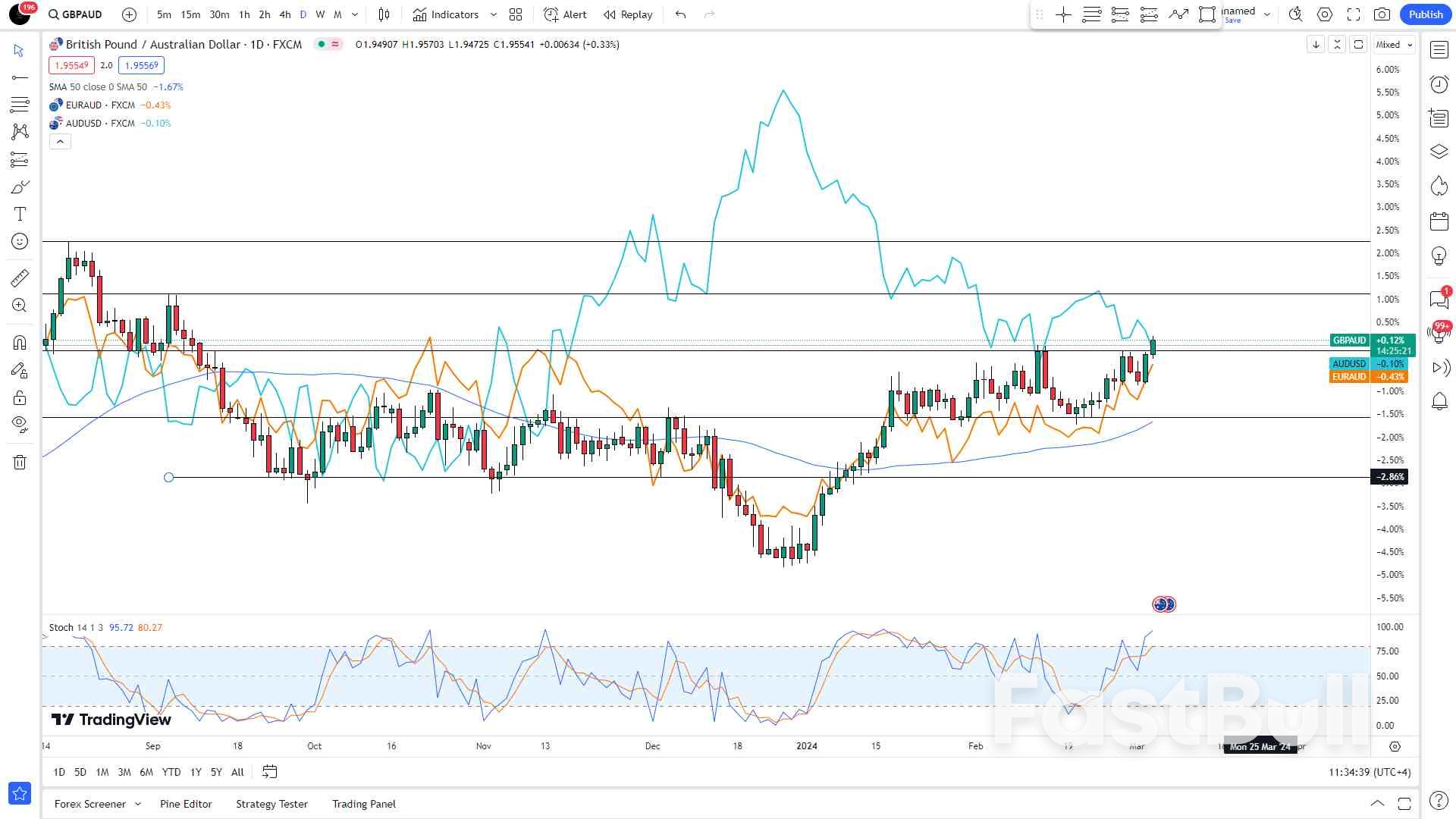
          The Pound to Australian Dollar exchange rate (GBP/AUD) is strong as a new week begins. There's a bunch of data coming from Australia, and the UK's budget is in the middle of the week.
           Pound to Australian Dollar Strengthens Amid Data Releases_1
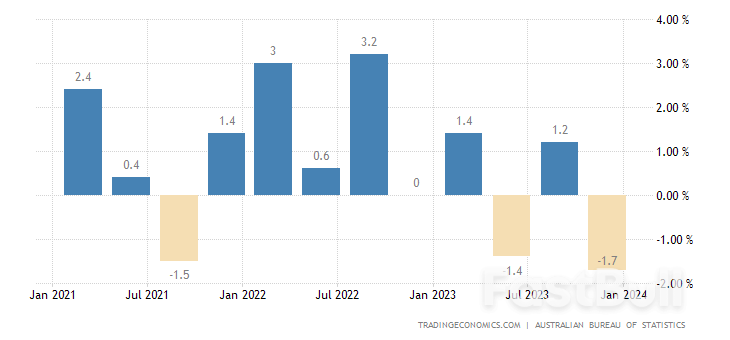
          On Monday, the Aussie dollar is a bit weaker after news came out about Australian business inventory. It showed a big 1.7% drop, meaning the economy slowed down more towards the end of the year. This drop in inventory is going to have a big bad effect on the economy's growth in the last part of the year. It's going to subtract a lot, even more than what we expected.
          Also, in February, job ads went down by 2.8%. This suggests that there might be fewer jobs coming up and that the unemployment rate could go up little by little.
          In January, the number of approvals for new homes also went down by 1%. This is a sign that the year is starting slowly for new home building. Even though it's low, we need to be careful when looking at housing data at the end and beginning of the year
           Pound to Australian Dollar Strengthens Amid Data Releases_2
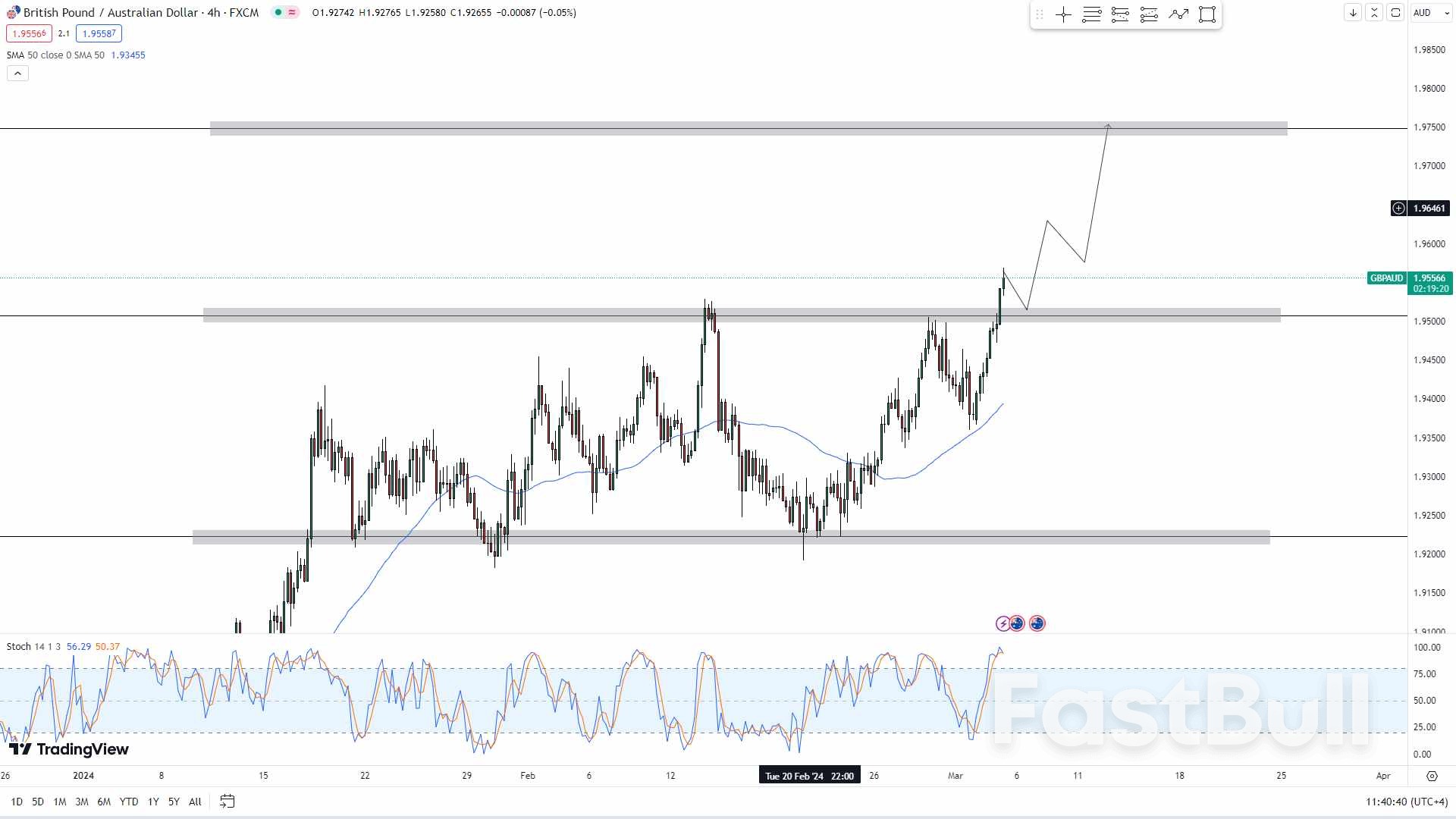
          Right now, the Pound to Australian Dollar exchange rate is a bit higher at 1.95538, and the Euro to Aussie is a little higher too at 1.6635. The Australian Dollar to U.S. Dollar is staying the same at 0.6519. For almost a year, the AUD/USD has been trading between 0.6300-0.6900. It's not likely to go higher until the Fed starts cutting rates, and if they cut more and faster than the RBA.
          Until the AUD/USD goes up, the Australian Dollar might stay weaker against the Pound and the Euro.
           Pound to Australian Dollar Strengthens Amid Data Releases_3
          Looking at GBP/AUD, things seem okay. The pair is trading above the nine-day moving average, which is a good sign. Last week, the exchange rate didn't drop much, so that's good too. The pair is still above the major moving averages, and the RSI and ADX are positive. This means GBP/AUD is in a good position, and it might test 1.67 this week.
          This week, there's a lot of data coming out, which is important for economists. There are ten big data releases. The most important one is on Wednesday, where we'll see how the economy did at the end of 2023. This could affect when rates get cut.
          Before the GDP release, we'll see the Judo Bank PMI and the current account update. These probably won't have a big impact on the Aussie. On Thursday, there's another update on trade and home loan figures. This will give us more information about the housing market.
           Pound to Australian Dollar Strengthens Amid Data Releases_4

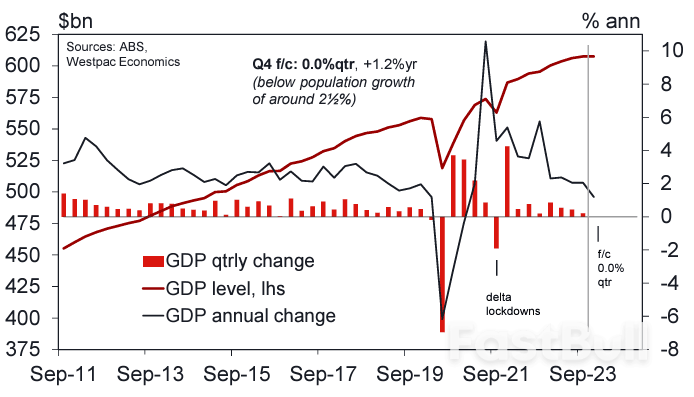
          Above: Aus GDP release will likely show Australia’s economy slowed further in the December quarter against the backdrop of high inflation, higher interest rates and global uncertainty. Image: Westpac.

          Money and FX markets are ready for rate cuts to start in September. One rate cut is already priced in for this year. There's a 75% chance of another rate cut, but this could change after this week's data.
          If the data isn't good, the market might think there's a bigger chance of another rate cut. This could make the Aussie dollar weaker. One thing that might make the Pound move is the UK budget announcement on Wednesday. This is the only important event on the UK calendar.
          If Chancellor Jeremy Hunt doesn't get the budget right, the Pound could fall by 2%. But if there's good news about easing taxes, the Pound could go up. Boosting UK productivity with tax breaks for businesses could also make the Pound stronger.
          But if the Chancellor announces big tax cuts that the bond market thinks are too much, like what happened in 2022, it could be bad for the Pound.
          ING thinks there's a risk if the bond market starts asking for higher returns on UK bonds. This could put pressure on the Pound again. Short-term models say the Pound could fall by 2% if investors want more returns on UK bonds.
          To stay updated on all economic events of today, please check out our Economic calendar
          Risk Warnings and Disclaimers
          You understand and acknowledge that there is a high degree of risk involved in trading. Following any strategies or investment methods may lead to potential losses. The content on the site is provided by our contributors and analysts for information purposes only. You are solely responsible for determining whether any trading assets, securities, strategy, or any other product is suitable for investing based on your own investment objectives and financial situation.
          Add to Favorites
          Share
          FastBull
          Copyright © 2025 FastBull Ltd

          728 RM B 7/F GEE LOK IND BLDG NO 34 HUNG TO RD KWUN TONG KLN HONG KONG

          TelegramInstagramTwitterfacebooklinkedin
          App Store Google Play Google Play
          Products
          Charts

          Chats

          Q&A with Experts
          Screeners
          Economic Calendar
          Data
          Tools
          Membership
          Features
          Function
          Markets
          Copy Trading
          Latest Signals
          Contests
          News
          Analysis
          24/7
          Columns
          Education
          Company
          Careers
          About Us
          Contact Us
          Advertising
          Help Center
          Feedback
          User Agreement
          Privacy Policy
          Business

          White Label

          Data API

          Web Plug-ins

          Poster Maker

          Affiliate Program

          Risk Disclosure

          The risk of loss in trading financial instruments such as stocks, FX, commodities, futures, bonds, ETFs and crypto can be substantial. You may sustain a total loss of the funds that you deposit with your broker. Therefore, you should carefully consider whether such trading is suitable for you in light of your circumstances and financial resources.

          No decision to invest should be made without thoroughly conducting due diligence by yourself or consulting with your financial advisors. Our web content might not suit you since we don't know your financial conditions and investment needs. Our financial information might have latency or contain inaccuracy, so you should be fully responsible for any of your trading and investment decisions. The company will not be responsible for your capital loss.

          Without getting permission from the website, you are not allowed to copy the website's graphics, texts, or trademarks. Intellectual property rights in the content or data incorporated into this website belong to its providers and exchange merchants.

          Not Logged In

          Log in to access more features

          FastBull Membership

          Not yet

          Purchase

          Become a signal provider
          Help Center
          Customer Service
          Dark Mode
          Price Up/Down Colors

          Log In

          Sign Up
          Position
          Layout
          Fullscreen
          Default to Chart
          The chart page opens by default when you visit fastbull.com