• Trade
  • Markets
  • Copy
  • Contests
  • News
  • 24/7
  • Calendar
  • Q&A
  • Chats
Trending
Screeners
SYMBOL
LAST
BID
ASK
HIGH
LOW
NET CHG.
%CHG.
SPREAD
SPX
S&P 500 Index
6827.42
6827.42
6827.42
6899.86
6801.80
-73.58
-1.07%
--
DJI
Dow Jones Industrial Average
48458.04
48458.04
48458.04
48886.86
48334.10
-245.98
-0.51%
--
IXIC
NASDAQ Composite Index
23195.16
23195.16
23195.16
23554.89
23094.51
-398.69
-1.69%
--
USDX
US Dollar Index
97.980
98.060
97.980
98.070
97.920
+0.030
+ 0.03%
--
EURUSD
Euro / US Dollar
1.17315
1.17322
1.17315
1.17447
1.17262
-0.00079
-0.07%
--
GBPUSD
Pound Sterling / US Dollar
1.33679
1.33689
1.33679
1.33740
1.33546
-0.00028
-0.02%
--
XAUUSD
Gold / US Dollar
4346.37
4346.78
4346.37
4348.78
4294.68
+46.98
+ 1.09%
--
WTI
Light Sweet Crude Oil
57.416
57.446
57.416
57.601
57.194
+0.183
+ 0.32%
--

Community Accounts

Signal Accounts
--
Profit Accounts
--
Loss Accounts
--
View More

Become a signal provider

Sell trading signals to earn additional income

View More

Guide to Copy Trading

Get started with ease and confidence

View More

Signal Accounts for Members

All Signal Accounts

Best Return
  • Best Return
  • Best P/L
  • Best MDD
Past 1W
  • Past 1W
  • Past 1M
  • Past 1Y

All Contests

  • All
  • Trump Updates
  • Recommend
  • Stocks
  • Cryptocurrencies
  • Central Banks
  • Featured News
Top News Only
Share

Polish Inflation At 2.5% Year-On-Year In November

Share

Poland's January-October Import Up 5.4% To 309.3 Billion Euros

Share

Poland's January-October Trade Balance At -5.1 Billion Euros

Share

Poland's January-October Export Up 2.8% To 304.3 Billion Euros

Share

Ceasefire Negotiations Between Ukraine And US Representatives In Berlin To Continue Monday Morning - German Source Familiar With The Schedule

Share

Spain's IBEX Hits Fresh Record High, Up Over 1%

Share

Spot Silver Rises Nearly 3% To $63.82/Oz

Share

Philippine Maritime Council: Expresses Alarm Over Recent Harassment Of Filipino Fishermen In South China Sea Shoal

Share

France's Foreign Minister Says He Suggesd To EU's Kallas That US Representatives Brief EU Foreign Ministers On Gaza Peace Plan During Their Meeting

Share

India Trade Secretary: Prime Facie Don't See A Case Of Rice Dumping To USA And There Is No Active Investigation On That

Share

India Trade Secretary: India's Rice Exported To USA Largely Limited To Basmati And At Price Higher Than General Price Of Rice

Share

India Trade Secretary: India Can Raise Shipments To Russia In Sectors Like Automobiles And Pharmaceuticals

Share

India Trade Secretary:India-Oman Trade Deal Completed And Will Be Signed Soon

Share

Burberry Shares Top FTSE Gainer, Up 3.5% In Positive European Luxury Sector

Share

India Trade Secretary: India-US Close To A “Framework” Deal But Won't Give A Timeline

Share

Yemen's Southern Transitional Council (Stc) Launches Military Operation In Abyan

Share

India Trade Official: As Mexico Has Raised Tariffs On Mfn Basis, We Don't See A Recourse In WTO

Share

India Trade Official: India Has Proposed A “Preferential Trade Agreement” With Mexico

Share

India Trade Official: Mexico's Primary Target Is Not To Hit Indian Exports

Share

India Trade Official: India, Mexico Have Agreed To Pursue A Trade Agreement To Mitigate The Impact Promptly

TIME
ACT
FCST
PREV
France HICP Final MoM (Nov)

A:--

F: --

P: --

China, Mainland Outstanding Loans Growth YoY (Nov)

A:--

F: --

P: --

China, Mainland M2 Money Supply YoY (Nov)

A:--

F: --

P: --

China, Mainland M0 Money Supply YoY (Nov)

A:--

F: --

P: --

China, Mainland M1 Money Supply YoY (Nov)

A:--

F: --

P: --

India CPI YoY (Nov)

A:--

F: --

P: --

India Deposit Gowth YoY

A:--

F: --

P: --

Brazil Services Growth YoY (Oct)

A:--

F: --

P: --

Mexico Industrial Output YoY (Oct)

A:--

F: --

P: --

Russia Trade Balance (Oct)

A:--

F: --

P: --

Philadelphia Fed President Henry Paulson delivers a speech
Canada Building Permits MoM (SA) (Oct)

A:--

F: --

P: --

Canada Wholesale Sales YoY (Oct)

A:--

F: --

P: --

Canada Wholesale Inventory MoM (Oct)

A:--

F: --

P: --

Canada Wholesale Inventory YoY (Oct)

A:--

F: --

P: --

Canada Wholesale Sales MoM (SA) (Oct)

A:--

F: --

P: --

Germany Current Account (Not SA) (Oct)

A:--

F: --

P: --

U.S. Weekly Total Rig Count

A:--

F: --

P: --

U.S. Weekly Total Oil Rig Count

A:--

F: --

P: --

Japan Tankan Small Manufacturing Outlook Index (Q4)

A:--

F: --

P: --

Japan Tankan Large Non-Manufacturing Diffusion Index (Q4)

A:--

F: --

P: --

Japan Tankan Large Non-Manufacturing Outlook Index (Q4)

A:--

F: --

P: --

Japan Tankan Large Manufacturing Outlook Index (Q4)

A:--

F: --

P: --

Japan Tankan Small Manufacturing Diffusion Index (Q4)

A:--

F: --

P: --

Japan Tankan Large Manufacturing Diffusion Index (Q4)

A:--

F: --

P: --

Japan Tankan Large-Enterprise Capital Expenditure YoY (Q4)

A:--

F: --

P: --

U.K. Rightmove House Price Index YoY (Dec)

A:--

F: --

P: --

China, Mainland Industrial Output YoY (YTD) (Nov)

A:--

F: --

P: --

China, Mainland Urban Area Unemployment Rate (Nov)

A:--

F: --

P: --

Saudi Arabia CPI YoY (Nov)

A:--

F: --

P: --

Euro Zone Industrial Output YoY (Oct)

--

F: --

P: --

Euro Zone Industrial Output MoM (Oct)

--

F: --

P: --

Canada Existing Home Sales MoM (Nov)

--

F: --

P: --

Euro Zone Total Reserve Assets (Nov)

--

F: --

P: --

U.K. Inflation Rate Expectations

--

F: --

P: --

Canada National Economic Confidence Index

--

F: --

P: --

Canada New Housing Starts (Nov)

--

F: --

P: --

U.S. NY Fed Manufacturing Employment Index (Dec)

--

F: --

P: --

U.S. NY Fed Manufacturing Index (Dec)

--

F: --

P: --

Canada Core CPI YoY (Nov)

--

F: --

P: --

Canada Manufacturing Unfilled Orders MoM (Oct)

--

F: --

P: --

U.S. NY Fed Manufacturing Prices Received Index (Dec)

--

F: --

P: --

U.S. NY Fed Manufacturing New Orders Index (Dec)

--

F: --

P: --

Canada Manufacturing New Orders MoM (Oct)

--

F: --

P: --

Canada Core CPI MoM (Nov)

--

F: --

P: --

Canada Trimmed CPI YoY (SA) (Nov)

--

F: --

P: --

Canada Manufacturing Inventory MoM (Oct)

--

F: --

P: --

Canada CPI YoY (Nov)

--

F: --

P: --

Canada CPI MoM (Nov)

--

F: --

P: --

Canada CPI YoY (SA) (Nov)

--

F: --

P: --

Canada Core CPI MoM (SA) (Nov)

--

F: --

P: --

Canada CPI MoM (SA) (Nov)

--

F: --

P: --

Federal Reserve Board Governor Milan delivered a speech
U.S. NAHB Housing Market Index (Dec)

--

F: --

P: --

Australia Composite PMI Prelim (Dec)

--

F: --

P: --

Australia Services PMI Prelim (Dec)

--

F: --

P: --

Australia Manufacturing PMI Prelim (Dec)

--

F: --

P: --

Japan Manufacturing PMI Prelim (SA) (Dec)

--

F: --

P: --

U.K. Unemployment Claimant Count (Nov)

--

F: --

P: --

U.K. Unemployment Rate (Nov)

--

F: --

P: --

U.K. 3-Month ILO Unemployment Rate (Oct)

--

F: --

P: --

Q&A with Experts
    • All
    • Chatrooms
    • Groups
    • Friends
    Connecting
    .
    .
    .
    Type here...
    Add Symbol or Code

      No matching data

      All
      Trump Updates
      Recommend
      Stocks
      Cryptocurrencies
      Central Banks
      Featured News
      • All
      • Russia-Ukraine Conflict
      • Middle East Flashpoint
      • All
      • Russia-Ukraine Conflict
      • Middle East Flashpoint

      Search
      Products

      Charts Free Forever

      Chats Q&A with Experts
      Screeners Economic Calendar Data Tools
      Membership Features
      Data Warehouse Market Trends Institutional Data Policy Rates Macro

      Market Trends

      Market Sentiment Order Book Forex Correlations

      Top Indicators

      Charts Free Forever
      Markets

      News

      News Analysis 24/7 Columns Education
      From Institutions From Analysts
      Topics Columnists

      Latest Views

      Latest Views

      Trending Topics

      Top Columnists

      Latest Update

      Signals

      Copy Rankings Latest Signals Become a signal provider AI Rating
      Contests
      Brokers

      Overview Brokers Assessment Rankings Regulators News Claims
      Broker listing Forex Brokers Comparison Tool Live Spread Comparison Scam
      Q&A Complaint Scam Alert Videos Tips to Detect Scam
      More

      Business
      Events
      Careers About Us Advertising Help Center

      White Label

      Data API

      Web Plug-ins

      Affiliate Program

      Awards Institution Evaluation IB Seminar Salon Event Exhibition
      Vietnam Thailand Singapore Dubai
      Fans Party Investment Sharing Session
      FastBull Summit BrokersView Expo
      Recent Searches
        Top Searches
          Markets
          News
          Analysis
          User
          24/7
          Economic Calendar
          Education
          Data
          • Names
          • Latest
          • Prev

          View All

          No data

          Scan to Download

          Faster Charts, Chat Faster!

          Download App
          English
          • English
          • Español
          • العربية
          • Bahasa Indonesia
          • Bahasa Melayu
          • Tiếng Việt
          • ภาษาไทย
          • Français
          • Italiano
          • Türkçe
          • Русский язык
          • 简中
          • 繁中
          Open Account
          Search
          Products
          Charts Free Forever
          Markets
          News
          Signals

          Copy Rankings Latest Signals Become a signal provider AI Rating
          Contests
          Brokers

          Overview Brokers Assessment Rankings Regulators News Claims
          Broker listing Forex Brokers Comparison Tool Live Spread Comparison Scam
          Q&A Complaint Scam Alert Videos Tips to Detect Scam
          More

          Business
          Events
          Careers About Us Advertising Help Center

          White Label

          Data API

          Web Plug-ins

          Affiliate Program

          Awards Institution Evaluation IB Seminar Salon Event Exhibition
          Vietnam Thailand Singapore Dubai
          Fans Party Investment Sharing Session
          FastBull Summit BrokersView Expo

          Bank of Japan Holds Rates With a Hike Likely in May

          ING

          Central Bank

          Summary:

          The Bank of Japan (BoJ) unanimously voted to keep its policy rate unchanged at 0.5%. Governor Kazuo Ueda did not indicate when the next rate hike might occur but emphasised the Bank's commitment to its normalisation strategy. Given the strong preliminary Shunto results, inflation and private consumption will be key to watch in the coming months.

          Governor Ueda was quite cautious in his guidance

          The BoJ statement showed that its assessment of inflation and growth hasn't changed much. However, there was much more emphasis on the uncertainties surrounding US trade policy. Governor Ueda also made several comments on tariff risks during his press conference. Ueda indicated that he would wait and see how the US tariff issues unfold, so markets may be betting more on a July hike than a May hike.
          However, our attention is more on his remarks regarding recent wage negotiations, which, while expected, were still stronger than anticipated. The BoJ is closely monitoring the potential upside risks to inflation. Additionally, the recent rise in Japanese government bonds (JGBs) reflects the market's reaction to inflation and economic data developments.
          Ueda believes it is not time for the BoJ to step into the bond market, which signals that he is biased on the tightening stance. By giving mixed signals, both hawkish and dovish, the BoJ is likely to retain some room for manoeuvre in future policy meetings. We believe that unless the tariff issue escalates more than what has already been revealed, the BoJ's priority should be given to inflation, consumption and wage growth.

          BoJ watch

          The preliminary Shunto results suggest another year of above 5% wage growth, which should support the BoJ's virtuous cycle of wage growth and sustainable inflation. The BoJ would like to see how companies pass on the input price rises to retail prices. Usually, companies raise their prices in the first month of their fiscal year, April.
          Therefore, the upcoming inflation data is the key to watch. Tomorrow's CPI inflation is expected to ease to 3.5% YoY in February from 4.0% in January due to renewed government energy subsidies and a stabilisation of fresh food prices. We expect the easing to be temporary and inflation to pick up again in March and April. More important to watch should be the April Tokyo CPI data which will be released a few days before the BoJ's April/May meeting. If April Tokyo inflation reaccelerates as we expect, then the odds of a May hike should increase.

          Core inflation is expected to stay above 2% for a considerable time

          Bank of Japan Holds Rates With a Hike Likely in May_1

          Source:ING

          Risk Warnings and Disclaimers
          You understand and acknowledge that there is a high degree of risk involved in trading. Following any strategies or investment methods may lead to potential losses. The content on the site is provided by our contributors and analysts for information purposes only. You are solely responsible for determining whether any trading assets, securities, strategy, or any other product is suitable for investing based on your own investment objectives and financial situation.
          Add to Favorites
          Share

          Nvidia Ceo Jensen Huang Says Tariff Impact Won't Be Meaningful In The Near Term

          Devin

          Economic

          Nvidia CEO Jensen Huang downplayed the negative impact from President Donald Trump's tariffs, saying there won't be any significant damage in the short run.

          "We've got a lot of AI to build. AI is the foundation, the operating system of every industry going forward. ... We are enthusiastic about building in America," Huang said Wednesday in a CNBC "Squawk on the Street" interview. "Partners are working with us to bring manufacturing here. In the near-term, the impact of tariffs won't be meaningful."

          Trump has launched a new trade war by imposing tariffs against Washington's three biggest trading partners, drawing immediate responses from Mexico, Canada and China. Recently, Trump said he would not change his mind about enacting sweeping "reciprocal tariffs" on other countries that put up trade barriers to U.S. goods. The White House said those tariffs are set to take effect April 2.

          Shares of Nvidia have fallen more than 20% from its record high reached in January. The stock suffered a massive sell-off earlier this year due to concerns sparked by Chinese AI lab DeepSeek that companies could potentially get greater performance in AI on far lower infrastructure costs. Huang has pushed back on that theory, saying DeepSeek popularized reasoning models that will need more chips.

          Nvidia, which designs and manufactures graphics processing units that are essential to the AI boom, has been restricted from doing business in China due to export controls that were increased at the end of the Biden administration.

          Huang previously said the company's percentage of revenue in China has fallen by about half due to the export restrictions, adding that there are other competitive pressures in the country, including from Huawei.

          Source: CNBC

          To stay updated on all economic events of today, please check out our Economic calendar
          Risk Warnings and Disclaimers
          You understand and acknowledge that there is a high degree of risk involved in trading. Following any strategies or investment methods may lead to potential losses. The content on the site is provided by our contributors and analysts for information purposes only. You are solely responsible for determining whether any trading assets, securities, strategy, or any other product is suitable for investing based on your own investment objectives and financial situation.
          Add to Favorites
          Share

          New Zealand Dollar's Budding Recovery Rests With the Fed

          Warren Takunda

          Economic

          The New Zealand Dollar will drop against the Pound, Euro and other major currencies if the Federal Reserve strikes a hawkish tone later today by warning it is not ready to cut interest rates anytime soon.
          However, any developments that boost expectations for U.S. interest rate cuts - for example, Fed fears of an economic slowdown - would help U.S. equity markets and extend this week's nascent recovery by the Kiwi.
          "Recent economic data has signalled a slowdown in the U.S., fuelling expectations that the Fed will implement three rate cuts in 2025, starting in June or July. The key question is whether Jerome Powell will adopt a dovish tone," says Ricardo Evangelista, Senior Analyst at ActivTrades.
          Doing so would reinforce growing expectations for rate cuts, explains Evangelista, which would boost U.S. equities and sentiment-linked proxies such as NZD.
          "Hopes of a continued equity rebound have stalled for now, with investors stepping away from risk assets ahead of today’s Fed decision," says Boris Kovacevic, Global Macro Strategist at Convera.
          However, should the Fed's focus be on Trump's tariffs and their potential inflationary impact, it might strike a more 'hawkish' tone that pushes back against rate cut bets, leading to stock market losses.
          Here, we would anticipate NZD to retreat to recent lows against most G10 peers.
          The New Zealand Dollar has fallen sharply against the Pound and Euro amidst a selloff in U.S. stock markets, reflecting the currency's well-established 'high beta' to global investor sentiment.
          However, NZD/USD has been trending higher in March as the U.S. Dollar is struggling amongst a belief that the U.S. economic exceptionalism of 2024 is rapidly fading.
          This has come about as businesses and consumers grow more cautious amidst President Donald Trump's erratic approach to tariffs, which risk raising inflation and hampering businesses.New Zealand Dollar's Budding Recovery Rests With the Fed_1

          Above: NZD vs. GBP rises as the U.S. S&P 500 recovers (lower panel).

          The Fed must give its verdict and try to steer markets accordingly. Given policy from the White House is so opaque, the difficulty facing the Fed is elevated.
          The Fed will keep interest rates unchanged but release new economic and interest rate projections, which will sway markets.
          Should Jerome Powell and his team indicate it is more concerned about the potential of an economic slowdown, then markets will increase bets for another rate cut before mid-year.
          This would bolster stocks and the New Zealand Dollar.
          However, should Powell focus on the inflationary risks of tariffs, the odds of such a cut would fade, stocks would falter, and NZD would be dragged lower again.
          "The bar for rate cuts has crept higher, driven by concerns that inflation remains uncomfortably sticky. Selling resumed on Wall Street with the largest technology names being hit the hardest," says Kovacevic.

          Source: Poundsterlinglive

          To stay updated on all economic events of today, please check out our Economic calendar
          Risk Warnings and Disclaimers
          You understand and acknowledge that there is a high degree of risk involved in trading. Following any strategies or investment methods may lead to potential losses. The content on the site is provided by our contributors and analysts for information purposes only. You are solely responsible for determining whether any trading assets, securities, strategy, or any other product is suitable for investing based on your own investment objectives and financial situation.
          Add to Favorites
          Share

          Gold Price Surpasses $3,000 Per Ounce for The First Time in History

          FXOpen

          Commodity

          Just five days ago, we noted that gold was approaching the $3,000 level and suggested that a breakout could occur this month.

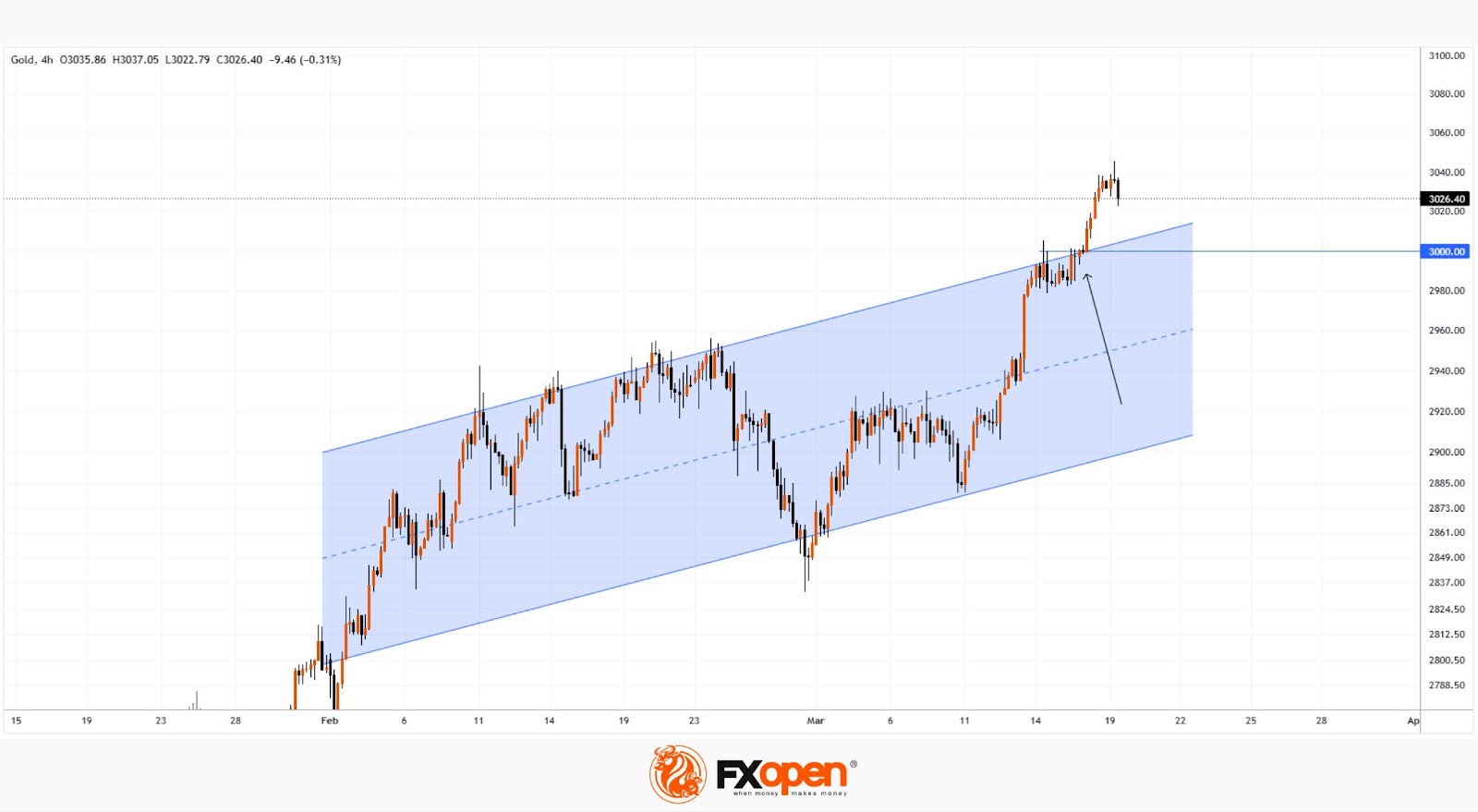
          Yesterday, as shown on the XAU/USD chart, the spot price of gold rose above the psychological $3,000 mark for the first time ever. The new all-time high now stands at around $3,045.

          Why Is Gold Rising?

          Bullish sentiment is being driven by traders positioning themselves ahead of a key event—the Federal Reserve’s interest rate decision, set to be announced today. According to ForexFactory, analysts expect rates to remain unchanged at 4.5%, but surprises cannot be ruled out.

          Additionally, gold is becoming more attractive as a safe-haven asset. As reported by Reuters:

          → Tensions in the Middle East are escalating—Israel warns of further casualties, as airstrikes in Gaza have already resulted in over 400 deaths.

          → Gold is gaining amid uncertainty over US tariffs.

          Technical Analysis of XAU/USD Chart

          In the short term, gold’s price action has formed movements that outline an ascending channel (marked in blue), with key developments including:

          → A breakout (as shown by the arrow) above not only the psychological $3,000 level but also the upper boundary of the channel.

          → A prior consolidation zone formed between $3,000 and $2,980.

          It seems the bulls were looking for confirmation and confidence before attempting to break through resistance. The fact that they succeeded suggests this resistance zone may now act as support, making a retest of $3,000 possible.

          However, the future direction of gold prices will largely depend on the news backdrop. Brace for volatility—the Fed’s interest rate decision will be released today at 21:00 GMT+3, followed by a press conference by Chair Jerome Powell at 21:30 GMT+3.

          Source: ACTIONFOREX

          Risk Warnings and Disclaimers
          You understand and acknowledge that there is a high degree of risk involved in trading. Following any strategies or investment methods may lead to potential losses. The content on the site is provided by our contributors and analysts for information purposes only. You are solely responsible for determining whether any trading assets, securities, strategy, or any other product is suitable for investing based on your own investment objectives and financial situation.
          Add to Favorites
          Share

          Bitcoin Is Just Seeing a ‘Normal Correction,’ Cycle Peak Is Yet to Come: Analysts

          Warren Takunda

          Cryptocurrency

          Bitcoin’s correction from its January peak is a typical cycle pullback and is not out of the ordinary, with a price top still on the horizon, crypto analysts and executives tell Cointelegraph.
          “I don’t think the bull run is over; I think the peak of the cycle has been pushed back due to macro conditions, and global liquidity isn’t pretty, which isn’t helping crypto,” Collective Shift CEO Ben Simpson told Cointelegraph.

          Bitcoin experiencing expected retracement

          “It is only the third or fourth correction we’ve had over 25% we’ve had in Bitcoin this cycle compared to 12 last cycle,” Simpson said.
          Bitcoin is down 24% from its all-time high of $109,000 on Jan. 20 amid uncertainty around US President Donald Trump’s tariffs and the future of US interest rates, but Simpson called it “a normal correction.”
          “Things got overheated, and they needed to cool down, and the market needed to find a new foundation, and now we’re waiting for the next new narrative,” he said.Bitcoin Is Just Seeing a ‘Normal Correction,’ Cycle Peak Is Yet to Come: Analysts_1

          Bitcoin is down 13.58% over the past month. Source: CoinMarketCap

          Derive founder Nick Forster shared a similar view, telling Cointelegraph that Bitcoin “is likely in a normal correction phase, with the cycle peak still to come.”
          “Historically, Bitcoin experiences these types of corrections during long-term rallies, and there’s no reason to believe this time is different,” he said.
          After Trump’s election in November, Bitcoin surged almost 36% over a month, hitting $100,000 for the first time in December. At the time of publication, Bitcoin is trading at $82,824, according to CoinMarketCap.
          However, Forster added that the six-month fate of Bitcoin seems increasingly tied to traditional markets. Similarly, Independent Reserve CEO Adrian Przelozny told Cointelegraph that it isn’t just Bitcoin being impacted by the macroeconomic conditions.
          “This is pervading all asset classes and may lead to a spike in global inflation and a contraction in international growth,” Przelozny said.Bitcoin Is Just Seeing a ‘Normal Correction,’ Cycle Peak Is Yet to Come: Analysts_2

          Source: Charles Edwards

          Forster said Bitcoin’s current price trend aligns with past behavior before a price rally, even though it appears “tumultuous” at the moment.

          Bitcoin’s current trend may “change quickly”

          Collective Shift’s Simpson said the next narrative will likely revolve around US rate cuts, easing quantitative tightening, and increasing global liquidity.
          However, Capriole Investments founder Charles Edwards said he isn’t so sure if the Bitcoin bull run is over or not.
          The odds are “50:50, in my opinion,” Edwards told Cointelegraph.
          “Yes, from an onchain perspective at present, but that could change quickly if the Fed starts easing in the second half of the year, stops balance sheet reduction, and dollar liquidity grows as a result, which I think has decent odds of happening,” Edwards explained.
          The comments come a day after CryptoQuant founder and CEO Ki Young Ju declared that the “Bitcoin bull cycle is over.”
          “Expecting 6-12 months of bearish or sideways price action,” Ju said.

          Source: Cointelegraph

          Risk Warnings and Disclaimers
          You understand and acknowledge that there is a high degree of risk involved in trading. Following any strategies or investment methods may lead to potential losses. The content on the site is provided by our contributors and analysts for information purposes only. You are solely responsible for determining whether any trading assets, securities, strategy, or any other product is suitable for investing based on your own investment objectives and financial situation.
          Add to Favorites
          Share

          Is Trump Driving the US into a Recession? – In Charts

          Warren Takunda

          Economic

          Prospects for the US economy have cooled significantly in a matter of months. After outperforming its international peers last year, warning lights are flashing on a dashboard of economic indicators as analysts warn that Donald Trump’s erratic approach is hitting the world’s largest economy.
          Fears of a US recession this year are growing, in what is being called a “Trumpcession”, amid a sharp decline in business and consumer confidence as the president threatens punitive import tariffs on US allies and enemies alike.
          Most economists reckon a recession – defined as two consecutive quarters of shrinking economic output – can be avoided. But it is clear there are storm clouds gathering within the president’s first 100 days back in the White House.

          GDP

          US growth in gross domestic product (GDP) had outpaced international peers in recent years, and since the Covid pandemic in particular – helped by the Biden administration pumping billions of dollars into the economy through the Inflation Reduction Act. The former president did not get much credit, though, as voters felt the squeeze from the period of high inflation triggered by the pandemic and Russia’s war in Ukraine.Is Trump Driving the US into a Recession? – In Charts_1
          This week, the Atlanta Federal Reserve’s GDPNow, which measures GDP economic growth in real time, suggested the US economy would contract at an annual rate of 2% in the first quarter. However, this widely followed indicator can be volatile, and it is heavily influenced by the US trade deficit, which soared in January.Is Trump Driving the US into a Recession? – In Charts_2

          Trade balance

          The US goods trade gap surged to $153.3bn in January. This was driven by record import volumes, an increase of $36.2bn to $329.5bn in total, as US businesses rushed to bring shipments into the country to avoid potential tariffs.Is Trump Driving the US into a Recession? – In Charts_3

          US gold imports

          A significant driver of the import rise was inbound shipments of “finished metal shapes”, which include bars of gold. The trend is also attributed to traders rushing to get ahead of potential US tariffs. A widening trade deficit would normally weigh on a country’s GDP, because imports are subtracted from the measurement. But because gold bought to sit in a vault is not consumed or used in production, it is excluded.Is Trump Driving the US into a Recession? – In Charts_4
          This means the Atlanta Fed is likely to be overestimating the hit to first-quarter GDP. Still, there are other signs that the US economy is cooling.

          Inflation

          Trump had promised to “bring prices down, starting on day one” and “cut energy costs in half within 12 months after taking office”.
          Official figures show the headline annual rate as measured by the consumer price index was 2.8% in February, after an unexpected rise to 3% in January from 2.9% in December. Energy costs are down by 0.2% on an annual basis.
          The Organisation for Economic Co-operation and Development (OECD) said on Monday that Trump’s trade wars risked stoking inflation. It increased its US inflation forecast for 2025 to 2.8%, up from a previous estimate of 2.1% made in December.Is Trump Driving the US into a Recession? – In Charts_5

          Employment

          The US jobs market has boomed in recent years, and the unemployment rate dropped to 3.5% in early 2023, the lowest level since the year of the first moon landing in 1969. The rate has ticked higher in recent months, but remains historically low at 4.1%. This has been spurred by rapid growth in the numbers of jobs being added to the economy.
          Wage growth has also strengthened, and has remained above inflation since early 2023, helping households to rebuild some of their purchasing power lost during the recent rise in living costs.Is Trump Driving the US into a Recession? – In Charts_6

          Stocks

          The US stock market has powered to record highs in recent years. Tech stocks and the “magnificent seven” – Alphabet, Amazon, Apple, Microsoft, Meta, Nvidia and Tesla – have led the charge in particular, buoyed up by investors betting on the growth of artificial intelligence.
          The Biden administration oversaw a strong stock market performance, helped by the economic recovery from the pandemic. However, Wall Street surged after Trump’s election victory in November, amid investor expectations for tax cuts that could increase company profits. Markets have been rattled in Trump’s first 100 days amid concerns over his erratic approach to the economy and the threat of tariffs hitting growth and stoking inflation.Is Trump Driving the US into a Recession? – In Charts_7

          The US dollar

          The US dollar had been rising sharply against other leading currencies, reflecting the strength of the economy and investor concerns that Trump’s policies could stoke inflation. Tariffs pushing up the price of imported goods, driving up inflation, could force the US Federal Reserve to hold back from cutting interest rates.
          With inflation having fallen back, the Fed cut its benchmark rate last year by a whole percentage point – from a range between 5.25% and 5% to between 4.25% and 4.5%. Higher inflation could limit its capacity for further rate cuts.
          A dramatically slowing economy could force the central bank to take action to lower borrowing costs. This has led to a pullback in the dollar in recent weeks.
          Washington has long held a “strong dollar” policy in the view that it supports the purchasing power of US consumers, helping to keep inflation low. The dollar is also used as the currency of choice for world trade and underpins the financial system. The US Treasury secretary, Scott Bessent, has said this approach is not changing. But Trump has argued that a weaker dollar would benefit US manufacturing by making exports cheaper for overseas buyers.Is Trump Driving the US into a Recession? – In Charts_8

          Prices of inputs for manufactured products

          Business surveys have shown a marked increase in input costs for US manufacturers, providing an early warning sign for growth and inflation. The price gauge on the Institute for Supply Management (ISM) manufacturing purchasing managers’ index (PMI) shows raw material costs rose sharply at the start of this year, in the first signs of supplier difficulties and discussions about who will pay for tariffs. The rise in input costs could dent US manufacturing output, and is likely to be passed on to consumers in the form of higher prices for finished goods.Is Trump Driving the US into a Recession? – In Charts_9

          Consumer spending

          US consumer spending unexpectedly dropped in January for the first time in almost two years, with a fall of 0.2%, the biggest decrease in nearly four years. Cold temperatures in some parts of the country, as well as wildfires in California, were likely to have hit spending. However, some analysts warn consumer sentiment has taken a knock amid mounting concern over the strength of the economy.Is Trump Driving the US into a Recession? – In Charts_10

          Source: Theguardian

          To stay updated on all economic events of today, please check out our Economic calendar
          Risk Warnings and Disclaimers
          You understand and acknowledge that there is a high degree of risk involved in trading. Following any strategies or investment methods may lead to potential losses. The content on the site is provided by our contributors and analysts for information purposes only. You are solely responsible for determining whether any trading assets, securities, strategy, or any other product is suitable for investing based on your own investment objectives and financial situation.
          Add to Favorites
          Share

          Japanese Yen Continues to Slide As Bank of Japan Disappoints Markets

          Michelle

          Economic

          Forex

          The USD/JPY pair surged to 149.58 on Wednesday, marking its fourth consecutive day of gains as the Japanese yen extended its decline. The Bank of Japan’s (BoJ) latest policy decision failed to inspire confidence, leaving investors underwhelmed and further weakening the yen.

          Key factors driving USD/JPY movement

          As expected, the Bank of Japan maintained its benchmark interest rate at 0.5% while reiterating its forecast that the Japanese economy will grow above its potential level. However, the central bank also acknowledged emerging signs of economic fragility, adopting a cautious tone in its outlook. Policymakers emphasised the need to gather and analyse more data before making significant moves, particularly in light of global economic risks.

          A key concern is the potential impact of US tariff hikes, which could weigh heavily on Japan’s export-driven economy. Investors are now closely monitoring comments from BoJ Governor Kazuo Ueda for further insights into the central bank’s strategy and future policy direction.

          Recent data has painted a mixed picture of Japan’s economic health. The monthly Reuters Tankan survey revealed growing pessimism among Japanese manufacturers in March, citing concerns over US trade policies and China’s slowing economy. On a brighter note, Japan’s trade balance shifted to a surplus in February, driven by robust export growth. However, this improvement has done little to strengthen the yen amid broader market concerns.

          Technical analysis of USD/JPY

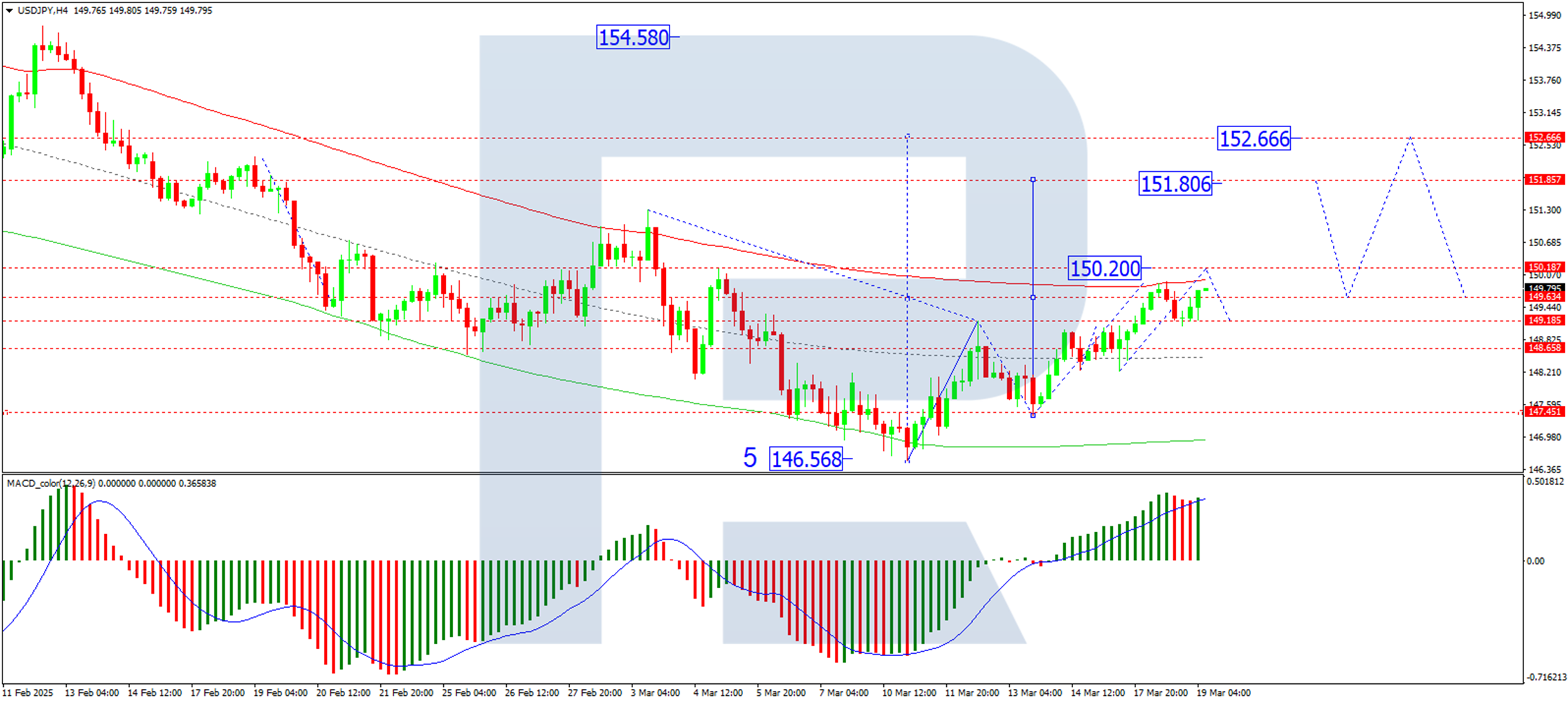
          On the H4 chart, USD/JPY is forming a bullish wave structure, targeting 150.20. Upon reaching this level, a corrective pullback to 149.20 is possible, likely establishing a consolidation range near the current highs. A breakout above this range could signal further upward momentum, with the next target at 151.80. This scenario is supported by the MACD indicator, with its signal line remaining above zero and trending upwards.

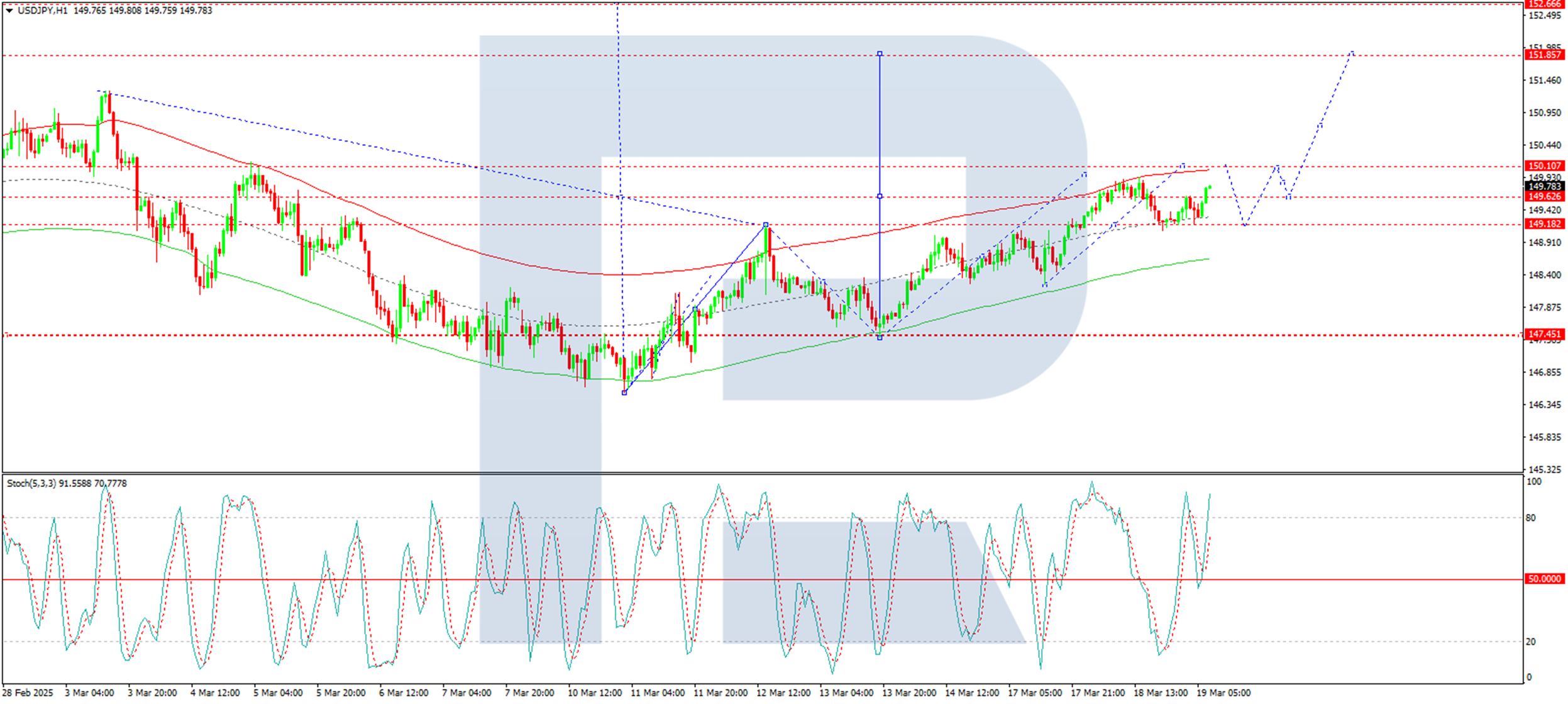
          The H1 chart shows USD/JPY developing a growth wave toward 150.20, representing the midpoint of the third wave in the current structure. A consolidation range is expected to form around 149.62, with an upward breakout potentially opening the path to 151.80. The Stochastic oscillator corroborates this outlook, with its signal line above 50 pointing upward.

          Conclusion

          The Japanese yen’s decline reflects market disappointment with the Bank of Japan’s cautious stance and lack of decisive action. While Japan’s trade balance has shown improvement, concerns over global economic risks and domestic manufacturing sentiment continue to weigh on the currency. From a technical perspective, USD/JPY remains in a bullish trend, with key resistance levels at 150.20 and 151.80. Traders should monitor BoJ Governor Ueda’s statements and upcoming economic data for further clues on the yen’s trajectory.

          Source: ACTIONFOREX

          To stay updated on all economic events of today, please check out our Economic calendar
          Risk Warnings and Disclaimers
          You understand and acknowledge that there is a high degree of risk involved in trading. Following any strategies or investment methods may lead to potential losses. The content on the site is provided by our contributors and analysts for information purposes only. You are solely responsible for determining whether any trading assets, securities, strategy, or any other product is suitable for investing based on your own investment objectives and financial situation.
          Add to Favorites
          Share
          FastBull
          Copyright © 2025 FastBull Ltd

          728 RM B 7/F GEE LOK IND BLDG NO 34 HUNG TO RD KWUN TONG KLN HONG KONG

          TelegramInstagramTwitterfacebooklinkedin
          App Store Google Play Google Play
          Products
          Charts

          Chats

          Q&A with Experts
          Screeners
          Economic Calendar
          Data
          Tools
          Membership
          Features
          Function
          Markets
          Copy Trading
          Latest Signals
          Contests
          News
          Analysis
          24/7
          Columns
          Education
          Company
          Careers
          About Us
          Contact Us
          Advertising
          Help Center
          Feedback
          User Agreement
          Privacy Policy
          Business

          White Label

          Data API

          Web Plug-ins

          Poster Maker

          Affiliate Program

          Risk Disclosure

          The risk of loss in trading financial instruments such as stocks, FX, commodities, futures, bonds, ETFs and crypto can be substantial. You may sustain a total loss of the funds that you deposit with your broker. Therefore, you should carefully consider whether such trading is suitable for you in light of your circumstances and financial resources.

          No decision to invest should be made without thoroughly conducting due diligence by yourself or consulting with your financial advisors. Our web content might not suit you since we don't know your financial conditions and investment needs. Our financial information might have latency or contain inaccuracy, so you should be fully responsible for any of your trading and investment decisions. The company will not be responsible for your capital loss.

          Without getting permission from the website, you are not allowed to copy the website's graphics, texts, or trademarks. Intellectual property rights in the content or data incorporated into this website belong to its providers and exchange merchants.

          Not Logged In

          Log in to access more features

          FastBull Membership

          Not yet

          Purchase

          Become a signal provider
          Help Center
          Customer Service
          Dark Mode
          Price Up/Down Colors

          Log In

          Sign Up

          Position
          Layout
          Fullscreen
          Default to Chart
          The chart page opens by default when you visit fastbull.com