
• Trade
  • Markets
  • Copy
  • Contests
  • News
  • 24/7
  • Calendar
  • Q&A
  • Chats
Trending
Screeners
SYMBOL
LAST
BID
ASK
HIGH
LOW
NET CHG.
%CHG.
SPREAD
SPX
S&P 500 Index
6827.42
6827.42
6827.42
6899.86
6801.80
-73.58
-1.07%
--
DJI
Dow Jones Industrial Average
48458.04
48458.04
48458.04
48886.86
48334.10
-245.98
-0.51%
--
IXIC
NASDAQ Composite Index
23195.16
23195.16
23195.16
23554.89
23094.51
-398.69
-1.69%
--
USDX
US Dollar Index
97.980
98.060
97.980
98.070
97.920
+0.030
+ 0.03%
--
EURUSD
Euro / US Dollar
1.17313
1.17320
1.17313
1.17447
1.17283
-0.00081
-0.07%
--
GBPUSD
Pound Sterling / US Dollar
1.33628
1.33638
1.33628
1.33740
1.33546
-0.00079
-0.06%
--
XAUUSD
Gold / US Dollar
4341.41
4341.84
4341.41
4347.21
4294.68
+42.02
+ 0.98%
--
WTI
Light Sweet Crude Oil
57.537
57.574
57.537
57.601
57.194
+0.304
+ 0.53%
--

Community Accounts

Signal Accounts
--
Profit Accounts
--
Loss Accounts
--
View More

Become a signal provider

Sell trading signals to earn additional income

View More

Guide to Copy Trading

Get started with ease and confidence

View More

Signal Accounts for Members

All Signal Accounts

Best Return
  • Best Return
  • Best P/L
  • Best MDD
Past 1W
  • Past 1W
  • Past 1M
  • Past 1Y

All Contests

  • All
  • Trump Updates
  • Recommend
  • Stocks
  • Cryptocurrencies
  • Central Banks
  • Featured News
Top News Only
Share

Stats Office - Botswana November Consumer Inflation At 0.0% Month-On-Month

Share

Stats Office - Botswana November Consumer Inflation At 3.8% Year-On-Year

Share

Statistics Bureau - Kazakhstan's Jan-Nov Industrial Output +7.4% Year-On-Year

Share

Fca: Sets Out Plans To Help Build Mortgage Market Of Future

Share

Eurostoxx 50 Futures Up 0.38%, DAX Futures Up 0.43%, FTSE Futures Up 0.37%

Share

[Delivery Of New US Presidential Aircraft Delayed Again] According To The Latest Timeline Released By The US Air Force, The Delivery Of The First Of The Two Newly Commissioned Air Force One Presidential Aircraft Will Not Be Earlier Than 2028. This Means That The Delivery Of The New Air Force One Has Been Delayed Once Again

Share

German Nov Wholesale Prices +0.3% Month-On-Month

Share

Norway's Nov Trade Balance Nok 41.3 Billion - Statistics Norway

Share

German Nov Wholesale Prices +1.5% Year-On-Year

Share

Romania's Adjusted Industrial Production +0.4% Month-On-Month In October, +0.2% Year-On-Year - Statistics Board

Share

Russia Says It Destroyed 130 Ukrainian Drones Overnight, Some Moscow Airports Disrupted

Share

EU Commissioner Kos: This Is No Time To Speculate On Timeframe For Ukraine's Accession To EU

Share

Lithuania Foreign Minister: Ukraine Needs Article 5-Alike Security Guarantees, With Nuclear Deterrent

Share

Russia's Central Bank Says It Seeks 18.2 Trillion Roubles In Damages From Euroclear

Share

Lithuania's Foreign Minister Says Expects EU Today To Broaden Belarus Sanctions Regime To Include Hybrid Activity

Share

India's Nifty 50 Index Pares Losses, Last Down 0.1%

Share

EU's Kallas: Important To Have Belgium On Board For Reparations Loan

Share

EU's Kallas: Work On Reparations Loan For Ukraine "Increasingly Difficult" But Still Have Some Days To Reach Agreement

Share

EU's Kallas: If Russian Agression Is Rewarded, We Will See More Of It

Share

India's Sept WPI Inflation Revised To 0.19% Year-On-Year

TIME
ACT
FCST
PREV
U.K. Trade Balance Non-EU (SA) (Oct)

A:--

F: --

P: --

France HICP Final MoM (Nov)

A:--

F: --

P: --

China, Mainland Outstanding Loans Growth YoY (Nov)

A:--

F: --

P: --

China, Mainland M2 Money Supply YoY (Nov)

A:--

F: --

P: --

China, Mainland M0 Money Supply YoY (Nov)

A:--

F: --

P: --

China, Mainland M1 Money Supply YoY (Nov)

A:--

F: --

P: --

India CPI YoY (Nov)

A:--

F: --

P: --

India Deposit Gowth YoY

A:--

F: --

P: --

Brazil Services Growth YoY (Oct)

A:--

F: --

P: --

Mexico Industrial Output YoY (Oct)

A:--

F: --

P: --

Russia Trade Balance (Oct)

A:--

F: --

P: --

Philadelphia Fed President Henry Paulson delivers a speech
Canada Building Permits MoM (SA) (Oct)

A:--

F: --

P: --

Canada Wholesale Sales YoY (Oct)

A:--

F: --

P: --

Canada Wholesale Inventory MoM (Oct)

A:--

F: --

P: --

Canada Wholesale Inventory YoY (Oct)

A:--

F: --

P: --

Canada Wholesale Sales MoM (SA) (Oct)

A:--

F: --

P: --

Germany Current Account (Not SA) (Oct)

A:--

F: --

P: --

U.S. Weekly Total Rig Count

A:--

F: --

P: --

U.S. Weekly Total Oil Rig Count

A:--

F: --

P: --

Japan Tankan Small Manufacturing Outlook Index (Q4)

A:--

F: --

P: --

Japan Tankan Large Non-Manufacturing Diffusion Index (Q4)

A:--

F: --

P: --

Japan Tankan Large Non-Manufacturing Outlook Index (Q4)

A:--

F: --

P: --

Japan Tankan Large Manufacturing Outlook Index (Q4)

A:--

F: --

P: --

Japan Tankan Small Manufacturing Diffusion Index (Q4)

A:--

F: --

P: --

Japan Tankan Large Manufacturing Diffusion Index (Q4)

A:--

F: --

P: --

Japan Tankan Large-Enterprise Capital Expenditure YoY (Q4)

A:--

F: --

P: --

U.K. Rightmove House Price Index YoY (Dec)

A:--

F: --

P: --

China, Mainland Industrial Output YoY (YTD) (Nov)

A:--

F: --

P: --

China, Mainland Urban Area Unemployment Rate (Nov)

A:--

F: --

P: --

Saudi Arabia CPI YoY (Nov)

A:--

F: --

P: --

Euro Zone Industrial Output YoY (Oct)

--

F: --

P: --

Euro Zone Industrial Output MoM (Oct)

--

F: --

P: --

Canada Existing Home Sales MoM (Nov)

--

F: --

P: --

Euro Zone Total Reserve Assets (Nov)

--

F: --

P: --

U.K. Inflation Rate Expectations

--

F: --

P: --

Canada National Economic Confidence Index

--

F: --

P: --

Canada New Housing Starts (Nov)

--

F: --

P: --

U.S. NY Fed Manufacturing Employment Index (Dec)

--

F: --

P: --

U.S. NY Fed Manufacturing Index (Dec)

--

F: --

P: --

Canada Core CPI YoY (Nov)

--

F: --

P: --

Canada Manufacturing Unfilled Orders MoM (Oct)

--

F: --

P: --

U.S. NY Fed Manufacturing Prices Received Index (Dec)

--

F: --

P: --

U.S. NY Fed Manufacturing New Orders Index (Dec)

--

F: --

P: --

Canada Manufacturing New Orders MoM (Oct)

--

F: --

P: --

Canada Core CPI MoM (Nov)

--

F: --

P: --

Canada Trimmed CPI YoY (SA) (Nov)

--

F: --

P: --

Canada Manufacturing Inventory MoM (Oct)

--

F: --

P: --

Canada CPI YoY (Nov)

--

F: --

P: --

Canada CPI MoM (Nov)

--

F: --

P: --

Canada CPI YoY (SA) (Nov)

--

F: --

P: --

Canada Core CPI MoM (SA) (Nov)

--

F: --

P: --

Canada CPI MoM (SA) (Nov)

--

F: --

P: --

Federal Reserve Board Governor Milan delivered a speech
U.S. NAHB Housing Market Index (Dec)

--

F: --

P: --

Australia Composite PMI Prelim (Dec)

--

F: --

P: --

Australia Services PMI Prelim (Dec)

--

F: --

P: --

Australia Manufacturing PMI Prelim (Dec)

--

F: --

P: --

Japan Manufacturing PMI Prelim (SA) (Dec)

--

F: --

P: --

U.K. Unemployment Claimant Count (Nov)

--

F: --

P: --

U.K. Unemployment Rate (Nov)

--

F: --

P: --

Q&A with Experts
    • All
    • Chatrooms
    • Groups
    • Friends
    Connecting
    .
    .
    .
    Type here...
    Add Symbol or Code

      No matching data

      All
      Trump Updates
      Recommend
      Stocks
      Cryptocurrencies
      Central Banks
      Featured News
      • All
      • Russia-Ukraine Conflict
      • Middle East Flashpoint
      • All
      • Russia-Ukraine Conflict
      • Middle East Flashpoint

      Search
      Products

      Charts Free Forever

      Chats Q&A with Experts
      Screeners Economic Calendar Data Tools
      Membership Features
      Data Warehouse Market Trends Institutional Data Policy Rates Macro

      Market Trends

      Market Sentiment Order Book Forex Correlations

      Top Indicators

      Charts Free Forever
      Markets

      News

      News Analysis 24/7 Columns Education
      From Institutions From Analysts
      Topics Columnists

      Latest Views

      Latest Views

      Trending Topics

      Top Columnists

      Latest Update

      Signals

      Copy Rankings Latest Signals Become a signal provider AI Rating
      Contests
      Brokers

      Overview Brokers Assessment Rankings Regulators News Claims
      Broker listing Forex Brokers Comparison Tool Live Spread Comparison Scam
      Q&A Complaint Scam Alert Videos Tips to Detect Scam
      More

      Business
      Events
      Careers About Us Advertising Help Center

      White Label

      Data API

      Web Plug-ins

      Affiliate Program

      Awards Institution Evaluation IB Seminar Salon Event Exhibition
      Vietnam Thailand Singapore Dubai
      Fans Party Investment Sharing Session
      FastBull Summit BrokersView Expo
      Recent Searches
        Top Searches
          Markets
          News
          Analysis
          User
          24/7
          Economic Calendar
          Education
          Data
          • Names
          • Latest
          • Prev

          View All

          No data

          Scan to Download

          Faster Charts, Chat Faster!

          Download App
          English
          • English
          • Español
          • العربية
          • Bahasa Indonesia
          • Bahasa Melayu
          • Tiếng Việt
          • ภาษาไทย
          • Français
          • Italiano
          • Türkçe
          • Русский язык
          • 简中
          • 繁中
          Open Account
          Search
          Products
          Charts Free Forever
          Markets
          News
          Signals

          Copy Rankings Latest Signals Become a signal provider AI Rating
          Contests
          Brokers

          Overview Brokers Assessment Rankings Regulators News Claims
          Broker listing Forex Brokers Comparison Tool Live Spread Comparison Scam
          Q&A Complaint Scam Alert Videos Tips to Detect Scam
          More

          Business
          Events
          Careers About Us Advertising Help Center

          White Label

          Data API

          Web Plug-ins

          Affiliate Program

          Awards Institution Evaluation IB Seminar Salon Event Exhibition
          Vietnam Thailand Singapore Dubai
          Fans Party Investment Sharing Session
          FastBull Summit BrokersView Expo

          EUR/USD Slips Below 1.1150 as U.S. Inflation Expectations Surprise to the Upside and ECB Dovishness Weighs on Euro

          Warren Takunda

          Traders' Opinions

          Summary:

          The euro came under renewed pressure on Friday, with EUR/USD tumbling to near 1.1150 as strong U.S. inflation expectations and Fed rate stability bets boosted the U.S. dollar.

          SELL EURUSD
          Close Time
          CLOSED

          1.11500

          Entry Price

          1.09510

          TP

          1.12800

          SL

          1.17313 -0.00081 -0.07%

          130.0

          Pips

          Loss

          1.09510

          TP

          1.12800

          Exit Price

          1.11500

          Entry Price

          1.12800

          SL
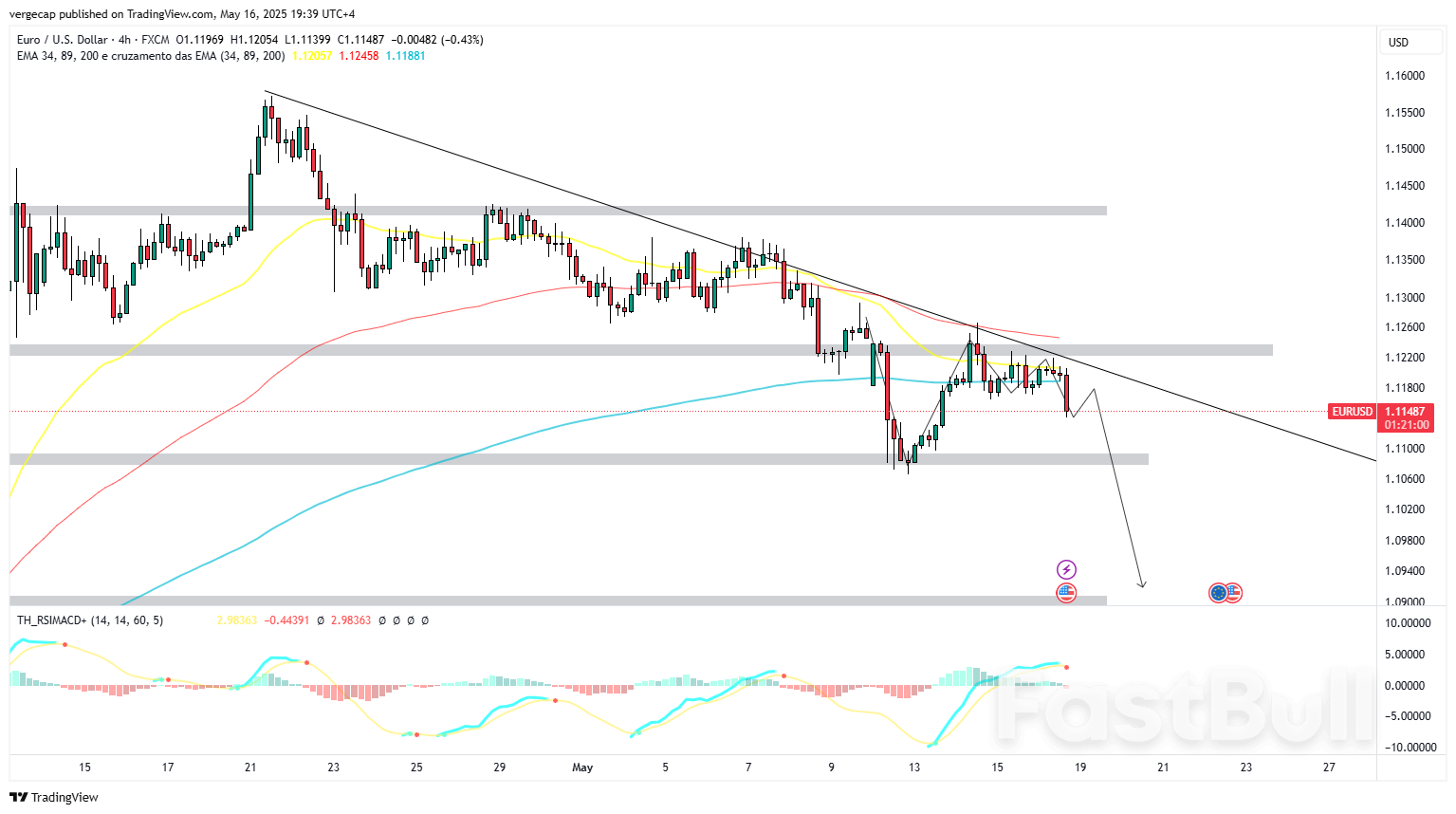
          The euro lost ground against the U.S. dollar on Friday, sliding toward the 1.1150 level during North American trading, as a potent combination of stronger-than-expected U.S. inflation expectations and softening economic sentiment stoked demand for the greenback. This marked a stark reversal from the currency pair’s early-week gains, with markets now leaning toward further downside pressure in the near term.
          At the heart of the U.S. dollar’s resurgence was the University of Michigan’s flash consumer sentiment survey for May, which showed inflation expectations jumping notably. One-year inflation expectations surged to 7.3%, up from 6.5% in April—an alarming signal for the Federal Reserve, which has consistently emphasized the importance of inflation dynamics in guiding its policy outlook.
          The report also showed a sharp deterioration in consumer sentiment, with the headline Consumer Sentiment Index falling to 50.8—its lowest reading since June 2022. That marked the fifth consecutive decline in sentiment and underscored ongoing economic anxiety among households despite a resilient labor market.
          Yet it was the inflation data that captured the most attention. Markets swiftly interpreted the uptick as a roadblock for any near-term Fed rate cuts. The CME FedWatch Tool now indicates a 91.8% probability that the Fed will hold interest rates steady at its June meeting, and a 65.1% chance of no change in July, reinforcing the case for prolonged monetary policy restraint.
          The U.S. Dollar Index (DXY), which tracks the greenback’s performance against a basket of major peers, climbed back above the 101.00 mark following the data, clawing back earlier losses. The dollar’s recovery drove EUR/USD lower, snapping the euro’s recent momentum.
          Across the Atlantic, dovish commentary from European Central Bank (ECB) policymakers deepened the euro’s sell-off. Speaking on Friday, ECB Governing Council member Martins Kazaks told Bloomberg that the central bank may proceed with “a couple” of interest rate cuts this year, emphasizing the need to evaluate policy “meeting by meeting” given prevailing global trade uncertainty and soft economic conditions.
          The dovish tones followed a downward revision to the Eurozone’s first-quarter GDP, which now stands at 0.3% quarter-on-quarter, compared to an earlier 0.4% estimate. While employment growth remained resilient, rising 0.3% versus initial expectations of 0.1%, the downward GDP revision painted a picture of an economy struggling to gain traction amid global headwinds.
          In a broader context, expectations for ECB easing have been bolstered by signs that inflation is gradually moving toward the central bank’s 2% target. With energy prices subdued and global demand faltering, analysts believe the ECB may act preemptively to shield the economy from stagnation. Traders are increasingly pricing in at least two more rate cuts by year-end, barring an inflationary shock.

          Technical AnalysisEUR/USD Slips Below 1.1150 as U.S. Inflation Expectations Surprise to the Upside and ECB Dovishness Weighs on Euro_1

          From a technical standpoint, EUR/USD is showing signs of further weakness. The pair remains trapped within a bearish corrective channel and is trading below the key pivot zone of 1.12229, suggesting that bullish momentum remains fragile. Notably, the pair has failed to break above the 1.1250 resistance level—a key barrier aligned with the 38.2% Fibonacci retracement from the recent bullish leg between 1.0730 and 1.1572.
          With the Relative Strength Index (RSI) failing to deliver a decisive bullish divergence and the pair trading beneath the 50-period Exponential Moving Average (EMA), technical pressure continues to skew to the downside.
          A sustained break below 1.1150—a level that coincides with the 50% Fibonacci retracement—to open the door for further losses toward 1.1082 and potentially as low as 1.0951 in the coming sessions. As long as EUR/USD remains capped beneath 1.12229, the bearish scenario remains intact.
          TRADE RECOMMENDATION
          SELL EURUSD
          ENTRY PRICE: 1.1150
          STOP LOSS: 1.1280
          TAKE PROFIT: 1.0951
          Risk Warnings and Disclaimers
          You understand and acknowledge that there is a high degree of risk involved in trading. Following any strategies or investment methods may lead to potential losses. The content on the site is provided by our contributors and analysts for information purposes only. You are solely responsible for determining whether any trading assets, securities, strategy, or any other product is suitable for investing based on your own investment objectives and financial situation.
          Add to Favorites
          Share

          Gold Falls as Trade Deal Hopes Dent Safe-Haven Demand

          Warren Takunda

          Economic

          Summary:

          Gold prices slipped below $3,200 during Friday's European session as optimism surrounding a potential US-China trade breakthrough diminished safe-haven appeal.

          SELL XAUUSD
          Close Time
          CLOSED

          3206.00

          Entry Price

          3120.00

          TP

          3280.00

          SL

          4341.41 +42.02 +0.98%

          308.9

          Pips

          Profit

          3120.00

          TP

          3175.11

          Exit Price

          3206.00

          Entry Price

          3280.00

          SL

          Gold prices came under renewed selling pressure on Friday, paring back much of the gains from the previous session’s recovery, as investor sentiment turned optimistic over global trade negotiations. The precious metal slid back below the $3,200 mark during early European trading, extending an intraday downtrend amid waning demand for traditional safe-haven assets.
          At the heart of the market’s shift is progress on a tentative US-China trade truce. Both economic superpowers have agreed to sharply reduce tariffs and initiate a 90-day window aimed at finalizing a more comprehensive deal. Comments from US President Donald Trump further buoyed investor optimism after he hinted at productive talks with other key trading partners, including India, Japan, and South Korea. This optimism, however, has dulled demand for gold, which typically benefits from market uncertainty and geopolitical risk.
          Even so, the broader macroeconomic and geopolitical landscape remains far from calm. Negotiators from Russia and Ukraine are holding peace talks in Istanbul — the first direct dialogue in three years — alongside a US delegation. But the absence of Russian President Vladimir Putin has already curbed expectations of any meaningful breakthrough. Simultaneously, Israel's military campaign in Gaza has intensified, with Thursday alone witnessing the deaths of at least 143 Palestinians in what is now one of the deadliest episodes in the conflict this year.
          Such geopolitical tensions would typically bolster gold demand. However, Friday’s market action suggests that risk appetite, bolstered by trade optimism and slightly better-than-feared retail data, has temporarily overshadowed these global concerns.
          Meanwhile, softening US inflation and consumer data released this week have reignited expectations for a series of interest rate cuts by the Federal Reserve. On Thursday, the US Producer Price Index (PPI) for final demand unexpectedly dropped 0.5% in April — its steepest decline since 2023 — building on Tuesday’s subdued Consumer Price Index (CPI) data. The CPI rose at an annual pace of just 2.2%, its slowest since February 2021. These trends point to easing price pressures and may offer the Fed more room to pivot toward a more accommodative monetary policy.
          The Department of Commerce also reported a slowdown in consumer spending, with retail sales rising just 0.1% in April — a sharp moderation from March’s upwardly revised 1.7% gain. While this further supports a dovish Fed outlook, it also raises concerns about the broader growth trajectory of the US economy, reinforcing forecasts of a sluggish expansion in coming quarters.
          Despite the supportive macroeconomic backdrop for gold — especially a weakening US Dollar and declining Treasury yields — the metal has struggled to build upward momentum. The US Dollar has remained under pressure for a second straight session, reflecting the market’s conviction that the Fed may soon cut rates. Yet gold has not capitalized on this, highlighting the metal's current vulnerability to broader risk sentiment shifts.
          Technical Analysis Gold Falls as Trade Deal Hopes Dent Safe-Haven Demand_1
          From a technical standpoint, gold remains firmly ensnared in a bearish correction phase. The price continues to trade below the critical $3,260 resistance level and its 50-day Exponential Moving Average (EMA50), reinforcing a broader downtrend bias. The failure to hold above $3,200 opens the door for a retest of the crucial $3,120 support zone — the level from which Thursday’s recovery initially sprung.
          Analysts also note the development of a negative divergence on the Relative Strength Index (RSI), suggesting waning bullish momentum despite prior price increases. This bearish RSI signal, coupled with the persistent price rejection at the upper boundary of a descending channel, adds to the probability of further declines in the near term.
          As long as gold remains below the $3,260 resistance level, technical indicators point toward a continued bearish trend. A confirmed break below $3,200 could trigger an accelerated decline toward $3,120, with intermediate support expected around $3,180. Only a sustained rebound above $3,260 would negate this bearish setup and shift the short-term bias.
          TRADE RECOMMENDATION
          SELL GOLD
          ENTRY PRICE: 3206
          STOP LOSS: 3280
          TAKE PROFIT: 3120
          Risk Warnings and Disclaimers
          You understand and acknowledge that there is a high degree of risk involved in trading. Following any strategies or investment methods may lead to potential losses. The content on the site is provided by our contributors and analysts for information purposes only. You are solely responsible for determining whether any trading assets, securities, strategy, or any other product is suitable for investing based on your own investment objectives and financial situation.
          Add to Favorites
          Share

          WTI Dips Below $62 Amid Inventory Build and Iran Risk, Weekly Outlook Mixed

          Warren Takunda

          Commodity

          Summary:

          WTI oil prices declined for the third straight session to $61.10, pressured by rising inventories and Iran deal speculation.

          SELL WTI
          Close Time
          CLOSED

          61.000

          Entry Price

          57.000

          TP

          63.500

          SL

          57.537 +0.304 +0.53%

          250.0

          Pips

          Loss

          57.000

          TP

          63.508

          Exit Price

          61.000

          Entry Price

          63.500

          SL

          West Texas Intermediate (WTI) crude oil extended its losing streak into a third consecutive session on Friday, slipping to around $61.10 a barrel in early European trade. Despite the persistent decline, prices are still on course for a modest weekly gain, as rekindled optimism surrounding US-China trade relations provides a counterweight to intensifying global supply concerns.
          The interplay between bullish geopolitical developments and bearish supply fundamentals has left oil traders in a state of flux. While headlines around the long-embattled US-China trade dynamic helped lift sentiment earlier in the week, the crude market's upside potential continues to be capped by the specter of a resurgent Iranian oil supply and rising global inventories.
          Market sentiment received a boost earlier this week after the United States and China—the world’s two largest oil consumers—announced a preliminary breakthrough in trade talks. According to official statements, the US has agreed to cut tariffs on Chinese imports from a punitive 145% to 30%. In return, China will lower its tariffs on American goods from 125% to 10%.
          This bilateral gesture of economic de-escalation has injected a dose of confidence into global markets, raising hopes that trade flows and industrial activity will rebound—potentially reviving demand for crude oil, which has remained subdued in recent quarters amid fears of a global slowdown.
          “This deal has the potential to restore investor confidence in the global growth story, which had been deeply eroded by prolonged tariff tensions,” noted Helima Croft, head of global commodity strategy at RBC Capital Markets. “Oil, being the most demand-sensitive asset in the macro complex, has responded accordingly—though gains remain tentative.”
          However, any relief rally in oil remains undercut by speculation that a new US-Iran nuclear agreement could soon materialize, potentially ending years of sanctions on Tehran’s oil exports. President Donald Trump hinted earlier in the week that negotiations were progressing and that Iran had “sort of” accepted the terms of a renewed framework.
          While no formal agreement has been reached, and several contentious issues reportedly remain unresolved, the mere possibility of Iranian barrels re-entering the market has forced traders to reassess supply risks. According to ING analysts cited by Reuters, the successful implementation of a deal could allow Iran to ramp up its crude production by as much as 400,000 barrels per day, further exacerbating concerns of oversupply.
          In addition to the Iran factor, the International Energy Agency (IEA) added fuel to bearish sentiment by revising its global supply forecast upwards by 380,000 barrels per day. The revision reflects stronger-than-expected output from Saudi Arabia and other members of the OPEC+ alliance, many of whom have been steadily easing their voluntary production curbs amid improved fiscal balances and competitive pressures.
          Further weighing on the market was an unexpected rise in US crude stockpiles, as revealed by the latest Energy Information Administration (EIA) data. Inventories increased last week, defying analyst expectations of a drawdown, and signaling tepid domestic demand or increased refinery maintenance. This inventory build, coupled with looming additions from both sanctioned and unsanctioned producers, reinforces the notion that supply continues to outstrip demand.
          Technical Analysis WTI Dips Below $62 Amid Inventory Build and Iran Risk, Weekly Outlook Mixed_1
          From a technical perspective, the price of WTI crude appears to be approaching a critical resistance level. A horizontal ceiling around the $62.00 mark is likely to attract selling pressure. This zone has historically acted as a barrier, capping previous attempts at bullish breakouts. If the price fails to convincingly breach this level, a corrective move lower could be imminent. In that scenario, downside targets emerge around the $57.00 handle—marking a key support area where buyers have previously stepped in.
          TRADE RECOMMENDATION
          SELL WTI
          ENTRY PRICE: 61.00
          STOP LOSS: 63.50
          TAKE PROFIT: 57.00
          Risk Warnings and Disclaimers
          You understand and acknowledge that there is a high degree of risk involved in trading. Following any strategies or investment methods may lead to potential losses. The content on the site is provided by our contributors and analysts for information purposes only. You are solely responsible for determining whether any trading assets, securities, strategy, or any other product is suitable for investing based on your own investment objectives and financial situation.
          Add to Favorites
          Share

          A New Bullish Leg Could Unfold If Bitcoin Breaks Above Key Resistance

          Manuel

          Cryptocurrency

          Summary:

          A solid move above this level would reinforce the bullish setup and increase the probability of further gains.

          BUY BTC-USDT
          Close Time
          CLOSED

          103950.0

          Entry Price

          108000.0

          TP

          100000.0

          SL

          89603.4 +575.7 +0.65%

          1781.2

          Pips

          Profit

          100000.0

          SL

          105731.2

          Exit Price

          103950.0

          Entry Price

          108000.0

          TP

          During his appearance at the Consensus 2025 conference in Toronto, Eric Trump—son of former President Donald Trump—publicly voiced his support for Bitcoin, referring to it as “digital gold” and praising its role as a reliable store of value. Speaking on a well-attended panel, Trump described how his perception of cryptocurrencies has evolved over time. Although his career has traditionally revolved around real estate, he explained that recent political shifts have driven him to explore the crypto world more seriously.
          On Tuesday, U.S.-listed spot Bitcoin ETFs experienced notable outflows totaling $96.14 million, with the bulk of the withdrawals coming from Fidelity’s FBTC and Hashdex’s DEFI funds, which recorded daily outflows of $22.9 million and $2.6 million, respectively, according to data from SoSoValue.
          The remaining ETFs showed no activity in terms of flows, with no additional inflows or outflows. For BlackRock’s IBIT, the absence of movement ended a remarkable 20-session inflow streak during which the leading ETF had attracted over $5.2 billion.
          Until May 9, Bitcoin ETFs had recorded four consecutive weeks of net inflows—setting a new record in 2025. Among them, IBIT had emerged as the top performer, even outpacing inflows into the largest gold ETF for the year.
          As of Tuesday, the combined net inflows across all U.S. spot Bitcoin ETFs had reached $41 billion since their January 2024 debut. At the same time, assets under management (AUM) across these vehicles have surpassed $120 billion—a historic milestone for the industry.
          Investor interest in Bitcoin ETFs is often seen as a proxy for broader market sentiment. While flows have recently stalled, macroeconomic factors are likely to remain a key influence on Bitcoin’s price direction in the near term, with other variables gradually coming into play.
          JPMorgan Chase, one of the most influential global investment banks, recently suggested that Bitcoin may outperform gold in the second half of 2025. The bank attributes this to rising corporate demand and growing state-level adoption of Bitcoin as a treasury reserve asset in the U.S.
          In a client note cited by The Block on Thursday, JPMorgan expressed a constructive outlook on Bitcoin (BTC), highlighting how institutional capital flows and a favorable macro backdrop are working in favor of the leading cryptocurrency.
          Historically, gold has been the go-to hedge for investors during times of economic uncertainty. However, JPMorgan’s research suggests Bitcoin is rapidly emerging as a credible alternative.
          Analyst Nikolaos Panigirtzoglou pointed out a notable shift in the "debasement trade"—a strategy where investors buy gold and Bitcoin to protect against the erosion of fiat currencies. While both assets benefited from this dynamic late last year, the trend has since diverged.
          “From mid-February to mid-April, gold rose at Bitcoin’s expense,” Panigirtzoglou wrote. “But over the past three weeks, we’ve seen the opposite—Bitcoin has been climbing as gold gives up ground.”A New Bullish Leg Could Unfold If Bitcoin Breaks Above Key Resistance_1

          Technical Analysis

          Bitcoin has recently found support above the 100- and 200-period moving averages on the 1-hour chart, currently located around 103,358 and 102,798, respectively. This zone could act as a launchpad for the next bullish impulse, especially as institutional adoption appears to be reigniting upward momentum from the $93,000 level. Furthermore, the support area near $101,000 has consistently held firm, helping to fuel upward movements from this region. If the price manages to hold above this support, we could see a renewed push toward the $107,000 resistance level.
          The RSI currently sits near 56, indicating neutral momentum without signs of overbought conditions. This leaves room for additional upside if the price can decisively break above the $104,000 resistance level—a barrier that has capped recent rallies. A solid move above this level would reinforce the bullish setup and increase the probability of further gains. Conversely, a decisive break below the local support zone could trigger a deeper corrective phase in the short term.
          Trading Recommendations
          Trading direction: Buy
          Entry price: 103810
          Target price: 108000
          Stop loss: 99000
          Validity: May 26, 2025 15:00:00
          Risk Warnings and Disclaimers
          You understand and acknowledge that there is a high degree of risk involved in trading. Following any strategies or investment methods may lead to potential losses. The content on the site is provided by our contributors and analysts for information purposes only. You are solely responsible for determining whether any trading assets, securities, strategy, or any other product is suitable for investing based on your own investment objectives and financial situation.
          Add to Favorites
          Share

          Correction May Sustain Bearish Momentum Toward Key Support

          Manuel

          Central Bank

          Economic

          Summary:

          EUR/USD has entered a corrective phase after reaching a local high of 1.1572 on April 21, since then, the pair has struggled to make new highs and instead formed a series of lower lows.

          SELL EURUSD
          Close Time
          CLOSED

          1.11857

          Entry Price

          1.09520

          TP

          1.14000

          SL

          1.17313 -0.00081 -0.07%

          30.4

          Pips

          Profit

          1.09520

          TP

          1.11553

          Exit Price

          1.11857

          Entry Price

          1.14000

          SL

          Retail sales data for April showed a modest increase of just 0.1%, beating market expectations but falling well short of the 1.5% rise seen in the previous month. This marks a potential turning point, indicating that U.S. consumers may be starting to pull back on spending. At the same time, the Producer Price Index (PPI) fell by 0.5% on a monthly basis, signaling further easing of inflationary pressures at the wholesale level. Together, these figures raise concerns about underlying demand and reinforce the view that inflation may be cooling more rapidly than previously anticipated.
          Meanwhile, Federal Reserve Chair Jerome Powell, speaking alongside Fed strategist Thomas Laubach, reiterated the importance of reassessing the Fed’s communication framework on inflation and employment. The market response to Powell’s remarks was muted, with investors shifting their focus toward potential currency interventions in Asia and the deteriorating tone of negotiations between Russia and Ukraine.
          Signs of cooling inflation were further confirmed by the latest Consumer Price Index (CPI) figures. Both headline and core CPI rose by just 0.2% in April, coming in below consensus forecasts of a 0.3% monthly increase. On an annual basis, core inflation—which excludes volatile food and energy prices—remained steady at 2.8%, showing little momentum toward renewed price acceleration.
          This softer inflation print has once again drawn market attention to the Federal Reserve’s next moves. While a rate cut in the immediate term remains unlikely, the latest data has fueled speculation that policy easing may be on the horizon. According to the CME FedWatch tool, the probability of a rate cut at the June 18 meeting remains low at just 8.2%, but this rises to 38.6% for July and jumps to 77.1% for September—suggesting that investors expect easing to begin in the second half of the year.
          Still, cautionary voices persist. Chicago Fed President Austan Goolsbee warned that even existing tariffs could continue to place upward pressure on prices. Analysts at Deutsche Bank added that any softening in U.S.-China trade tensions is unlikely to trigger a meaningful shift in the Fed’s current policy stance.
          Across the Atlantic, European Central Bank (ECB) policymaker and Governor of the Bank of France François Villeroy de Galhau stated on Wednesday that protectionist policies announced by the Trump administration are likely to reignite inflation in the U.S., not in Europe—setting the stage for a potential ECB rate cut by summer. Looking ahead, the main driver for the euro remains the stalled trade negotiations between the European Union and the United States.
          During European trading hours, German Finance Minister Lars Klingbeil addressed parliament, stating that the EU is fully prepared with countermeasures should the talks with Washington collapse. However, he emphasized that Europe’s priority remains reaching an agreement with the U.S. “We hope the negotiations yield a positive outcome,” Klingbeil said, adding, “We must respond to U.S. tariffs with unity and resolve.”
          Meanwhile, revised Eurozone GDP data for the first quarter showed the economy expanding at a slightly slower pace of 0.3%, compared to the initial estimate and previous reading of 0.4%. On a year-over-year basis, growth held steady at 1.2%, in line with forecasts. Employment data also improved, with job growth rising 0.3% quarter-over-quarter from January to March, up from a preliminary reading of 0.1%.Correction May Sustain Bearish Momentum Toward Key Support_1

          Technical Analysis

          EUR/USD has entered a corrective phase after reaching a local high of 1.1572 on April 21. Since then, the pair has struggled to make new highs and instead formed a series of lower lows. Moreover, the price has closed decisively below the 100- and 200-period moving averages—currently positioned at 1.1294 and 1.1232, respectively—suggesting the correction could deepen further, with potential downside targets near the 1.0952 level.
          The Relative Strength Index (RSI) has failed to break above the 56 mark. While this level is typically viewed as neutral, in the context of a corrective move, it has previously marked turning points for renewed selling pressure. Should this pattern hold, sellers may re-enter from this region. On the flip side, a new higher high would invalidate the current bearish setup and could fuel further upside momentum.
          Trading Recommendations
          Trading direction: Sell
          Entry price: 1.1185
          Target price: 1.0952
          Stop loss: 1.1400
          Validity: May 23, 2025 15:00:00
          Risk Warnings and Disclaimers
          You understand and acknowledge that there is a high degree of risk involved in trading. Following any strategies or investment methods may lead to potential losses. The content on the site is provided by our contributors and analysts for information purposes only. You are solely responsible for determining whether any trading assets, securities, strategy, or any other product is suitable for investing based on your own investment objectives and financial situation.
          Add to Favorites
          Share

          Rebound, Not Reversal

          Eva Chen

          Forex

          Economic

          Summary:

          USDCAD has found buyers near the key support level of 1.3746. While there are signs of improving market sentiment, the path of least resistance remains downward.

          SELL USDCAD
          Close Time
          CLOSED

          1.39762

          Entry Price

          1.34720

          TP

          1.41990

          SL

          1.37632 -0.00068 -0.05%

          207.9

          Pips

          Profit

          1.34720

          TP

          1.37683

          Exit Price

          1.39762

          Entry Price

          1.41990

          SL

          Fundamentals

          Since May 6, USDCAD has been on an upward trajectory, now having recovered to the key psychological level of 1.4000. Recently, with the conclusion of trade agreements and an overall rebound in market sentiment, the market has generally calmed, with volatility subsiding.
          Thus far, May has been a challenging month for the Canadian dollar. Trade between Canada and the United States has not shown any signs of alleviating the tense situation between the two countries. The renegotiation of the United States-Mexico-Canada Agreement (USMCA) appears to be taking longer than other international trade agreements for both nations. Meanwhile, the US dollar has shown signs of recovery, though it still faces resistance ahead.
          According to informed sources, US officials engaged in global trade negotiations have not attempted to include monetary policy commitments in the agreements.
          Given the volatility of the US dollar and its lack of safe-haven appeal, asset managers should seek greater diversification in their foreign exchange reserves, especially considering the noticeable trend of exiting the US dollar in April.
          Rebound, Not Reversal_1

          Technical Analysis

          The recent rebound in USDCAD is based on the key support level of 1.3746 not being breached. Subsequently, bulls successfully broke through the MA20, signaling a renewed short-term upside interest.
          Momentum indicators have begun to rise, reinforcing the ongoing bullish momentum. However, for a genuine rebound to take place, bulls must decisively break through the near-term high of 1.4180. If achieved, the medium-term downtrend targeting the 1.3472 level would be invalidated.
          It is important to note that the Relative Strength Index (RSI) is still hovering below the neutral 50 level, indicating that bulls have not yet fully taken control. Deeper pullbacks may find firmer support near the rising trendline from December 2023 at 1.3645. If the psychological level of 1.3600 is also breached, more aggressive selling could occur, heading towards the double-bottom area of 1.3472 from August to September.
          Overall, USDCAD has found some bullish momentum in the short term, but unless it can decisively break through the key resistance of 1.4180, the rebound may be short-lived.

          Trading Recommendations

          Trading Direction: Sell
          Entry Price: 1.4050
          Target Price: 1.3472
          Stop Loss: 1.4199
          Valid Until: May 30, 2025, 23:55:00
          Support: 1.3899/1.3845/1.3753
          Resistance: 1.4019/1.4078/1.4180
          Risk Warnings and Disclaimers
          You understand and acknowledge that there is a high degree of risk involved in trading. Following any strategies or investment methods may lead to potential losses. The content on the site is provided by our contributors and analysts for information purposes only. You are solely responsible for determining whether any trading assets, securities, strategy, or any other product is suitable for investing based on your own investment objectives and financial situation.
          Add to Favorites
          Share

          NZD/USD Slips as Powell Comments and US Data Dent Risk Appetite

          Warren Takunda

          Economic

          Traders' Opinions

          Summary:

          The New Zealand Dollar dipped as investor appetite soured despite Wellington’s NZ$190 million social investment fund initiative.

          SELL NZDUSD
          Close Time
          CLOSED

          0.58700

          Entry Price

          0.57400

          TP

          0.59700

          SL

          0.57835 -0.00205 -0.35%

          100.0

          Pips

          Loss

          0.57400

          TP

          0.59702

          Exit Price

          0.58700

          Entry Price

          0.59700

          SL

          The New Zealand Dollar (NZD) fell sharply on Thursday, succumbing to risk-off sentiment and a firmer US Dollar, even as the domestic government unveiled a targeted NZ$190 million ($112 million) social investment fund aimed at improving long-term social outcomes. While the initiative underscores a fiscally responsible and data-driven policy direction, it failed to offset the pressure stemming from global macroeconomic headwinds and the enduring strength of the Greenback, particularly following comments from Federal Reserve Chair Jerome Powell.
          At the time of writing, NZD/USD was trading at 0.5870, down 0.43% on the day, marking a reversal from earlier week gains. The Kiwi’s retreat underscores the market’s preference for safety as a murky economic outlook in both the US and New Zealand clouds sentiment.
          In a development that typically might favor risk currencies like the NZD, US inflation data came in cooler than expected. April’s Producer Price Index (PPI) rose just 0.1% month-on-month versus expectations of a 0.3% increase, while core PPI eased to 0.2% from the prior 0.3%. On the surface, this reinforced bets that the Fed may be nearing its pivot point in the tightening cycle, potentially paving the way for rate cuts later this year.
          However, the market reaction was far from straightforward.
          Offsetting the soft inflation print, Federal Reserve Chair Jerome Powell delivered a subtly hawkish message, acknowledging that the Fed may need to adapt its policy framework to accommodate persistent and more frequent supply shocks — a nod to the structural changes underway in the post-pandemic global economy. “The framework needs to be robust to many circumstances, including a world where supply shocks may be more frequent and persistent,” Powell stated in remarks reported by Reuters.
          His comments, while not overtly dovish, signaled a Federal Reserve still cautious about loosening policy too soon. This nuanced tone, combined with weaker-than-expected US retail sales figures (flat in April vs. 0.4% forecast), underpinned modest support for the US Dollar. Market participants interpreted Powell’s stance as an affirmation that the Fed is in no rush to ease, especially with inflation expectations still delicately balanced.
          On the home front, the New Zealand government’s pre-budget announcement of a NZ$190 million social investment fund was met with a muted market response. Finance Minister Nicola Willis emphasized that the initiative aims to create “smarter, earlier” interventions to improve outcomes for vulnerable communities — a signal of Wellington’s continued commitment to data-led governance and fiscal prudence.
          “It’s about government investing earlier, smarter, and with much more transparent measurement of the impact interventions are having,” said Willis.
          Despite the program’s social merit and long-term focus, currency traders were unmoved, as the short-term economic outlook remains dominated by global factors, including China’s faltering recovery and uncertainty over the Reserve Bank of New Zealand’s (RBNZ) policy trajectory. Investors are awaiting concrete signs of domestic economic resilience before pricing in any substantial upside for the Kiwi.
          Traders are now turning their attention to a pair of crucial domestic data points that could influence the NZD's next directional bias. Thursday evening’s release of the Business NZ Performance of Manufacturing Index (PMI), last seen at 53.2, will be scrutinized for signs of whether New Zealand’s industrial momentum is holding up. A soft reading could further dampen sentiment toward the Kiwi.
          More critical, perhaps, is Friday’s RBNZ two-year inflation expectations survey. Previously at 2.06%, an uptick could reignite market expectations for prolonged RBNZ hawkishness — a possible support pillar for NZD. However, if expectations ease, it would reinforce dovish bets and increase downside risk.

          Technical AnalysisNZD/USD Slips as Powell Comments and US Data Dent Risk Appetite_1

          From a technical perspective, NZD/USD has surrendered gains from earlier this week, falling back below the psychological 0.5900 threshold. Price action is struggling to maintain traction above the 23.6% Fibonacci retracement at 0.5900 and 78.6% Fibonacci extension at 0.5930. This area now acts as immediate resistance.
          If downside momentum persists, the next key support lies around 0.5820 (38.2% Fibonacci retracement), with further weakness exposing 0.5740–0.5760, a zone defined by the 78.6% retracement and full Fibonacci extension levels.
          Still, the decline could prove corrective rather than impulsive. Should NZD/USD hold above the weekly low of 0.5847 and manage to reclaim the 0.5900–0.5930 region, bulls may target a retest of the monthly high at 0.6023. A breakout beyond the April peak at 0.6029 and the November high at 0.6038 would clear the way toward 0.6070 — a key Fibonacci extension zone.
          TRADE RECOMMENDATION
          SELL NZDUSD
          ENTYR PRICE: 0.5870
          STOP LOSS: 0.5970
          TAKKE PROFIT: 0.5740
          Risk Warnings and Disclaimers
          You understand and acknowledge that there is a high degree of risk involved in trading. Following any strategies or investment methods may lead to potential losses. The content on the site is provided by our contributors and analysts for information purposes only. You are solely responsible for determining whether any trading assets, securities, strategy, or any other product is suitable for investing based on your own investment objectives and financial situation.
          Add to Favorites
          Share
          FastBull
          Copyright © 2025 FastBull Ltd

          728 RM B 7/F GEE LOK IND BLDG NO 34 HUNG TO RD KWUN TONG KLN HONG KONG

          TelegramInstagramTwitterfacebooklinkedin
          App Store Google Play Google Play
          Products
          Charts

          Chats

          Q&A with Experts
          Screeners
          Economic Calendar
          Data
          Tools
          Membership
          Features
          Function
          Markets
          Copy Trading
          Latest Signals
          Contests
          News
          Analysis
          24/7
          Columns
          Education
          Company
          Careers
          About Us
          Contact Us
          Advertising
          Help Center
          Feedback
          User Agreement
          Privacy Policy
          Business

          White Label

          Data API

          Web Plug-ins

          Poster Maker

          Affiliate Program

          Risk Disclosure

          The risk of loss in trading financial instruments such as stocks, FX, commodities, futures, bonds, ETFs and crypto can be substantial. You may sustain a total loss of the funds that you deposit with your broker. Therefore, you should carefully consider whether such trading is suitable for you in light of your circumstances and financial resources.

          No decision to invest should be made without thoroughly conducting due diligence by yourself or consulting with your financial advisors. Our web content might not suit you since we don't know your financial conditions and investment needs. Our financial information might have latency or contain inaccuracy, so you should be fully responsible for any of your trading and investment decisions. The company will not be responsible for your capital loss.

          Without getting permission from the website, you are not allowed to copy the website's graphics, texts, or trademarks. Intellectual property rights in the content or data incorporated into this website belong to its providers and exchange merchants.

          Not Logged In

          Log in to access more features

          FastBull Membership

          Not yet

          Purchase

          Become a signal provider
          Help Center
          Customer Service
          Dark Mode
          Price Up/Down Colors

          Log In

          Sign Up

          Position
          Layout
          Fullscreen
          Default to Chart
          The chart page opens by default when you visit fastbull.com