• Trade
  • Markets
  • Copy
  • Contests
  • News
  • 24/7
  • Calendar
  • Q&A
  • Chats
Trending
Screeners
SYMBOL
LAST
BID
ASK
HIGH
LOW
NET CHG.
%CHG.
SPREAD
SPX
S&P 500 Index
6870.39
6870.39
6870.39
6895.79
6858.28
+13.27
+ 0.19%
--
DJI
Dow Jones Industrial Average
47954.98
47954.98
47954.98
48133.54
47871.51
+104.05
+ 0.22%
--
IXIC
NASDAQ Composite Index
23578.12
23578.12
23578.12
23680.03
23506.00
+72.99
+ 0.31%
--
USDX
US Dollar Index
98.950
99.030
98.950
99.060
98.740
-0.030
-0.03%
--
EURUSD
Euro / US Dollar
1.16426
1.16443
1.16426
1.16715
1.16277
-0.00019
-0.02%
--
GBPUSD
Pound Sterling / US Dollar
1.33312
1.33342
1.33312
1.33622
1.33159
+0.00041
+ 0.03%
--
XAUUSD
Gold / US Dollar
4197.91
4197.91
4197.91
4259.16
4191.87
-9.26
-0.22%
--
WTI
Light Sweet Crude Oil
59.809
60.061
59.809
60.236
59.187
+0.426
+ 0.72%
--

Community Accounts

Signal Accounts
--
Profit Accounts
--
Loss Accounts
--
View More

Become a signal provider

Sell trading signals to earn additional income

View More

Guide to Copy Trading

Get started with ease and confidence

View More

Signal Accounts for Members

All Signal Accounts

Best Return
  • Best Return
  • Best P/L
  • Best MDD
Past 1W
  • Past 1W
  • Past 1M
  • Past 1Y

All Contests

  • All
  • Trump Updates
  • Recommend
  • Stocks
  • Cryptocurrencies
  • Central Banks
  • Featured News
Top News Only
Share

White House: Trump Signs Bill That Nullifies A Bureau Of Land Management Rule Relating To "National Petroleum Reserve In Alaska Integrated Activity Plan Record Of Decision"

Share

Putin, Modi Agree To Expand And Widen India-Russia Trade, Strengthen Friendship

Share

Colombia Inflation Was +0.07% In November -Government Statistics Agency (Reuters Poll: +0.20%)

Share

Colombia 12-Month Inflation Was +5.30% In November -Government Statistics Agency (Reuters Poll: +5.45%)

Share

White House: US, Ukraine Officials Had Productive Meeting, Further Talks Set

Share

Pentagon - State Department Approves Potential Sale Of Small Diameter Bombs-Increment I And Related Equipment To South Korea For $111.8 Million

Share

US State Dept: Parties Will Reconvene Tomorrow To Continue Advancing Discussions

Share

US State Dept: Parties Agreed That Real Progress Toward Any Agreement Depends On Russia's Readiness To Show Serious Commitment To Long-Term Peace

Share

US State Dept: Parties Also Separately Reviewed Future Prosperity Agenda

Share

US State Dept: American And Ukrainians Also Agreed On Framework Of Security Arrangements And Discussed Necessary Deterrence Capabilities

Share

US State Dept: Participants Discussed Results Of Recent Meeting Of American Side With Russians And Steps That Could Lead To Ending This War

Share

US State Dept: Umerov Reaffirmed That Ukraine's Priority Is Securing A Settlement That Protects Its Independence And Sovereignty

Share

Pentagon: US State Dept Approves Potential Sale Of Joint Air-To-Surface Standoff Missiles With Extended Range To Italy For An Estimated Cost Of $301 Million

Share

EU Commission Chief Von Der Leyen, Germany's Merz Say They Held 'Constructive' Talks With Belgian Prime Minister De Wever On Russian Frozen Assets

Share

Pentagon: US State Dept Approves Sale Of Aim-120C-8 Advanced Medium Range Air-To-Air Missiles To Denmark For An Estimated Cost Of $730 Million

Share

U.S. Senate Republican Senator Marshall (echoing The Trump Administration's Position): Netflix's Acquisition Of Warner Bros. Discovery Is A "serious Red Flag."

Share

SPDR Gold Trust Reports Holdings Down 0.03%, Or 0.33 Tonnes, To 1050.25 Tonnes By Dec 5

Share

The Canadian Prime Minister's Office: The Meeting Between Prime Minister Carney, US President Trump, And Mexican President Sinbaum Lasted 45 Minutes

Share

S&P Dow Jones Indices: Crh, Carvana, And Comfort Systems USA Will Be Included In The S&P 500 Index

Share

Waymo, The Self-driving Car Division Of Google's Parent Company Alphabet, Has Voluntarily Applied To The National Highway Traffic Safety Administration (NHTSA) For A Software Recall

TIME
ACT
FCST
PREV
Italy Retail Sales MoM (SA) (Oct)

A:--

F: --

P: --

Euro Zone Employment YoY (SA) (Q3)

A:--

F: --

P: --

Euro Zone GDP Final YoY (Q3)

A:--

F: --

P: --

Euro Zone GDP Final QoQ (Q3)

A:--

F: --

P: --

Euro Zone Employment Final QoQ (SA) (Q3)

A:--

F: --

P: --

Euro Zone Employment Final (SA) (Q3)

A:--

F: --

P: --
Brazil PPI MoM (Oct)

A:--

F: --

P: --

Mexico Consumer Confidence Index (Nov)

A:--

F: --

P: --

Canada Unemployment Rate (SA) (Nov)

A:--

F: --

P: --

Canada Labor Force Participation Rate (SA) (Nov)

A:--

F: --

P: --

Canada Employment (SA) (Nov)

A:--

F: --

P: --

Canada Part-Time Employment (SA) (Nov)

A:--

F: --

P: --

Canada Full-time Employment (SA) (Nov)

A:--

F: --

P: --

U.S. Personal Income MoM (Sept)

A:--

F: --

P: --

U.S. PCE Price Index YoY (SA) (Sept)

A:--

F: --

P: --

U.S. PCE Price Index MoM (Sept)

A:--

F: --

P: --

U.S. Personal Outlays MoM (SA) (Sept)

A:--

F: --

P: --

U.S. Core PCE Price Index MoM (Sept)

A:--

F: --

P: --

U.S. Core PCE Price Index YoY (Sept)

A:--

F: --

P: --

U.S. UMich 5-Year-Ahead Inflation Expectations Prelim YoY (Dec)

A:--

F: --

P: --

U.S. Real Personal Consumption Expenditures MoM (Sept)

A:--

F: --

P: --

U.S. 5-10 Year-Ahead Inflation Expectations (Dec)

A:--

F: --

P: --

U.S. UMich Current Economic Conditions Index Prelim (Dec)

A:--

F: --

P: --

U.S. UMich Consumer Sentiment Index Prelim (Dec)

A:--

F: --

P: --

U.S. UMich 1-Year-Ahead Inflation Expectations Prelim (Dec)

A:--

F: --

P: --

U.S. UMich Consumer Expectations Index Prelim (Dec)

A:--

F: --

P: --

U.S. Weekly Total Rig Count

A:--

F: --

P: --

U.S. Weekly Total Oil Rig Count

A:--

F: --

P: --

U.S. Unit Labor Cost Prelim (SA) (Q3)

--

F: --

P: --

U.S. Consumer Credit (SA) (Oct)

A:--

F: --

P: --

China, Mainland Foreign Exchange Reserves (Nov)

--

F: --

P: --

China, Mainland Exports YoY (USD) (Nov)

--

F: --

P: --

China, Mainland Imports YoY (CNH) (Nov)

--

F: --

P: --

China, Mainland Imports YoY (USD) (Nov)

--

F: --

P: --

China, Mainland Imports (CNH) (Nov)

--

F: --

P: --

China, Mainland Trade Balance (CNH) (Nov)

--

F: --

P: --

China, Mainland Exports (Nov)

--

F: --

P: --

Japan Wages MoM (Oct)

--

F: --

P: --

Japan Trade Balance (Oct)

--

F: --

P: --

Japan Nominal GDP Revised QoQ (Q3)

--

F: --

P: --

Japan Trade Balance (Customs Data) (SA) (Oct)

--

F: --

P: --

Japan GDP Annualized QoQ Revised (Q3)

--

F: --

P: --
China, Mainland Exports YoY (CNH) (Nov)

--

F: --

P: --

China, Mainland Trade Balance (USD) (Nov)

--

F: --

P: --

Germany Industrial Output MoM (SA) (Oct)

--

F: --

P: --

Euro Zone Sentix Investor Confidence Index (Dec)

--

F: --

P: --

Canada Leading Index MoM (Nov)

--

F: --

P: --

Canada National Economic Confidence Index

--

F: --

P: --

U.S. Dallas Fed PCE Price Index YoY (Sept)

--

F: --

P: --

U.S. 3-Year Note Auction Yield

--

F: --

P: --

U.K. BRC Overall Retail Sales YoY (Nov)

--

F: --

P: --

U.K. BRC Like-For-Like Retail Sales YoY (Nov)

--

F: --

P: --

Australia Overnight (Borrowing) Key Rate

--

F: --

P: --

RBA Rate Statement
RBA Press Conference
Germany Exports MoM (SA) (Oct)

--

F: --

P: --

U.S. NFIB Small Business Optimism Index (SA) (Nov)

--

F: --

P: --

Mexico Core CPI YoY (Nov)

--

F: --

P: --

Mexico 12-Month Inflation (CPI) (Nov)

--

F: --

P: --

Mexico PPI YoY (Nov)

--

F: --

P: --

Q&A with Experts
    • All
    • Chatrooms
    • Groups
    • Friends
    Connecting
    .
    .
    .
    Type here...
    Add Symbol or Code

      No matching data

      All
      Trump Updates
      Recommend
      Stocks
      Cryptocurrencies
      Central Banks
      Featured News
      • All
      • Russia-Ukraine Conflict
      • Middle East Flashpoint
      • All
      • Russia-Ukraine Conflict
      • Middle East Flashpoint
      Search
      Products

      Charts Free Forever

      Chats Q&A with Experts
      Screeners Economic Calendar Data Tools
      Membership Features
      Data Warehouse Market Trends Institutional Data Policy Rates Macro

      Market Trends

      Market Sentiment Order Book Forex Correlations

      Top Indicators

      Charts Free Forever
      Markets

      News

      News Analysis 24/7 Columns Education
      From Institutions From Analysts
      Topics Columnists

      Latest Views

      Latest Views

      Trending Topics

      Top Columnists

      Latest Update

      Signals

      Copy Rankings Latest Signals Become a signal provider AI Rating
      Contests
      Brokers

      Overview Brokers Assessment Rankings Regulators News Claims
      Broker listing Forex Brokers Comparison Tool Live Spread Comparison Scam
      Q&A Complaint Scam Alert Videos Tips to Detect Scam
      More

      Business
      Events
      Careers About Us Advertising Help Center

      White Label

      Data API

      Web Plug-ins

      Affiliate Program

      Awards Institution Evaluation IB Seminar Salon Event Exhibition
      Vietnam Thailand Singapore Dubai
      Fans Party Investment Sharing Session
      FastBull Summit BrokersView Expo
      Recent Searches
        Top Searches
          Markets
          News
          Analysis
          User
          24/7
          Economic Calendar
          Education
          Data
          • Names
          • Latest
          • Prev

          View All

          No data

          Scan to Download

          Faster Charts, Chat Faster!

          Download App
          English
          • English
          • Español
          • العربية
          • Bahasa Indonesia
          • Bahasa Melayu
          • Tiếng Việt
          • ภาษาไทย
          • Français
          • Italiano
          • Türkçe
          • Русский язык
          • 简中
          • 繁中
          Open Account
          Search
          Products
          Charts Free Forever
          Markets
          News
          Signals

          Copy Rankings Latest Signals Become a signal provider AI Rating
          Contests
          Brokers

          Overview Brokers Assessment Rankings Regulators News Claims
          Broker listing Forex Brokers Comparison Tool Live Spread Comparison Scam
          Q&A Complaint Scam Alert Videos Tips to Detect Scam
          More

          Business
          Events
          Careers About Us Advertising Help Center

          White Label

          Data API

          Web Plug-ins

          Affiliate Program

          Awards Institution Evaluation IB Seminar Salon Event Exhibition
          Vietnam Thailand Singapore Dubai
          Fans Party Investment Sharing Session
          FastBull Summit BrokersView Expo

          Understanding Elliott Wave Theory

          Glendon
          Summary:

          Elliott Wave Theory is a technical analysis method that uses recurring wave patterns to identify market trends. It suggests investor psychology creates these waves, with optimism and pessimism driving prices. The theory can be complex, but it can potentially help traders spot turning points in the market. However, it's not foolproof and should be used with other analysis methods.

          Riding the Waves: Understanding Elliott Wave TheoryTraders in the financial markets are constantly searching for an edge, a way to predict the future and capitalize on market trends. One approach that attempts to do this is Elliott Wave Theory, a technical analysis tool developed by Ralph Nelson Elliott in the 1930s.
          Understanding Elliott Wave Theory_1

          A Brief History of Elliott Wave Theory

          Elliott, an accountant by profession, spent years studying historical stock market data. He observed recurring patterns in price movements and theorized that these patterns reflected the psychology of investors. He published his findings in the 1930s, and Elliott Wave Theory has been a subject of debate and fascination ever since.

          The Core of the Theory: Impulse and Corrective Waves

          The theory identifies two main types of waves, visualized on candlestick charts:
          Impulse Waves (1, 3, 5): These waves, often depicted in green or blue on candlestick charts, move in the direction of the larger trend. They reflect periods of increasing investor confidence and drive prices up (or down in a bear market). The body of the candlestick will typically be filled, indicating a close higher (or lower) than the open. Corrective Waves (2, 4): These waves, often depicted in red on candlestick charts, move against the larger trend. They represent periods of doubt and profit-taking, causing temporary setbacks. The candlestick bodies may be filled or hollow depending on whether the close is higher or lower than the open. The Fractal Pattern: Waves Within Waves
          A key concept is the fractal nature of the waves. Each impulse or corrective wave can be further subdivided into five or three smaller waves that follow the same pattern. This creates a nesting doll effect, with larger waves encompassing smaller ones on the candlestick chart.

          Identifying the Waves: No Easy Feat

          While the theory offers a framework, applying it to candlestick charts can be challenging. Identifying the waves with certainty requires experience and a keen understanding of the market. There are specific rules and guidelines to follow, but interpretations can be subjective, leading to disagreements among analysts.

          Elliott Wave Theory: Frequently Asked Questions (FAQs)

          Is Elliott Wave Theory accurate?

          There is no definitive answer. The theory can help identify potential turning points, but it's not foolproof. The subjectivity in wave identification can lead to misinterpretations.

          Is Elliott Wave Theory difficult to learn?

          Yes, it can be. The theory has a complex structure, and mastering wave identification takes time and practice.

          Can Elliott Wave Theory be used for all markets?

          The theory is primarily applied to financial markets like stocks and forex. However, some proponents suggest it can be adapted to other markets with cyclical trends.

          Should I use the Elliott Wave Theory alone?

          No. It's best used in conjunction with other technical analysis tools and fundamental analysis for a more comprehensive market understanding.

          Is it Right for You?

          Despite the challenges, Elliott Wave Theory can be a valuable tool for traders who are willing to invest the time and effort to learn it. It can help identify potential turning points in the market and inform trading decisions based on the patterns seen on candlestick charts. However, it should be used in conjunction with other analysis methods for a more well-rounded approach.
          Remember, Elliott Wave Theory is a complex topic, and this article provides a basic overview. If you're interested in learning more, consider conducting further research and consulting with experienced Elliott Wave practitioners.
          Risk Warnings and Disclaimers
          You understand and acknowledge that there is a high degree of risk involved in trading. Following any strategies or investment methods may lead to potential losses. The content on the site is provided by our contributors and analysts for information purposes only. You are solely responsible for determining whether any trading assets, securities, strategy, or any other product is suitable for investing based on your own investment objectives and financial situation.
          Add to Favorites
          Share

          Dominant Dollar Awaits Crucial ECB Verdict and U.S. GDP Insight

          Samantha Luan

          Economic

          Central Bank

          Forex

          Dollar experienced a broad upsurge overnight, propelled by a robust rebound in benchmark treasury yields and a general mood of risk aversion. This strength continued into the Asian trading session, particularly notable in the greenback's gains against Japanese Yen, which have now extended past the significant 150 mark. Despite verbal interventions from Japan, Yen has received no notable support, leaving Dollar to dominate.
          Attention now turns to the U.S. Q3 GDP data release, which could be pivotal in determining Dollar's short-term momentum. Additionally, the global forex markets are keenly awaiting today's ECB rate decision. While a hold on rates is widely anticipated, investors and analysts are eager to gauge ECB's perspective on the resurgence of inflation risks, economic slowdown, and escalating geopolitical tensions.
          Australian Dollar is the weakest currency for the day so far, feeling pressure from RBA Governor Michele Bullock's cautious remarks about the recent stronger-than-projected CPI data and the chance of a rate hike in November. Sterling and Kiwi Dollar trail behind as subsequent underperformers. In contrast, Canadian Dollar, presently positioned as the second strongest after U.S. Dollar, is attempting to recuperate from the post-BoC dip witnessed yesterday. Swiss Franc holds its ground as the third strongest, engaging in consolidations against both Euro and Sterling.
          From a technical standpoint, NASDAQ resumed the decline from 14446.55 overnight to close at 12821.22. Immediate focus is on 38.2% retracement of 10088.82 to 14446.55 at 12781.89 could prompt downside acceleration through near term channel support. In that case, next target will be 12269.55 resistance turned support.It will be interesting to monitor how the NASDAQ responds to the upcoming GDP data and the subsequent impacts on currencies.
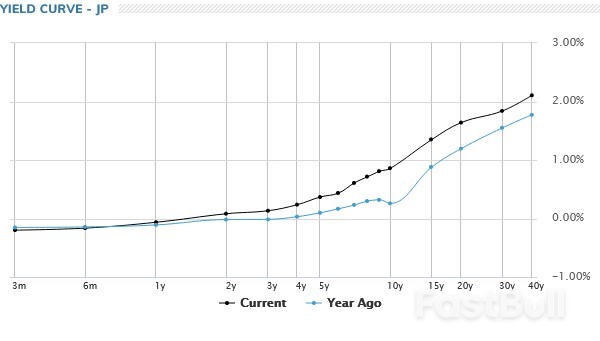
          Dominant Dollar Awaits Crucial ECB Verdict and U.S. GDP Insight_1In Asia, at the time of writing, Nikkei is down -2.16%. Hong Kong HSI is down -0.82%. China Shanghai SSE is down -0.20%. Singapore Strait Times is down -0.41%. Japan 10-year JGB yield is up 0.0251 at 0.886. Overnight, DOW dropped -0.32%. S&P 500 dropped -1.43%. NASDAQ dropped sharply by -2.43%. 10-year yield rose 0.113 to 4.953.

          RBA's Bullock undecided on rate hike following CPI surprise

          In the Senate Economics Committee session today, RBA Governor Michele Bullock indicated that the bank was not entirely caught off guard by the stronger than expected CPI data released yesterday. She refrained from offering a definitive direction for the bank's next steps
          The Q3 and September CPI data, which Bullock admitted "came out a little higher" than the projections in the August Statement on Monetary Policy, still aligned with the bank's expectations. She clarified, "The numbers were pretty much where we thought it would come out".
          When queried on the prospect of another rate hike in the forthcoming meeting, Bullock responded, "We're still analyzing the numbers at the moment. I wouldn't like to say more or less likely, we're still looking at it."
          Bullock reiterated the bank's position, stating, "We've always said we have a low tolerance" on inflation surprises. She added, "We are wary and we don't know if the job has been done yet."
          Looking forward, Bullock hinted at imminent changes to their economic projections, announcing, "We will be releasing a new set of forecasts after the board meeting." Moreover, she alluded to the significance of these revisions by stating, "There is going to be a change to our forecasts. We have to look at whether or not it's material enough to change our views on monetary policy."

          As USD/JPY breaks 150, Japan faces intervention and YCC decision

          In a significant move, USD/JPY surpasses the key psychological level of 150 today, marking its highest point in a year. This uptick has reignited concerns among investors regarding market interventions by Japan, given that the 150 mark is widely regarded as a trigger point for such actions.
          Japanese finance minister Shunichi Suzuki addressed the market developments, reiterating, "I'm watching market moves with a sense of urgency, as before." Notably, despite the heightened speculation, he refrained from commenting on any immediate intervention measures. This silence has led to further ambiguity, especially considering the suspected actions by Japan on October 3 to buy Yen, actions that have yet to be officially confirmed.
          A primary reason for the sustained pressure on Yen can be attributed to increasing yield gap between Japan and other major economies. This disparity intensifies the debate on the necessity for BoJ to revise its yield curve control, especially in light of rising global interest rates. There are rumblings about a possible adjustment to the 10-year yield cap, even though it was adjusted only three months prior, especially with a policy meeting on the horizon.
          Nevertheless, BoJ has consistently asserted that previous adjustments to the yield curve control were primarily to rectify any irregularities in the bond market's operations. The current yield curve appears more natural, especially when contrasted against the noticeable dip in 10-year yield in the curve from a year ago. It remains uncertain whether BoJ feels the immediacy to modify its YCC in the near term.

          Dominant Dollar Awaits Crucial ECB Verdict and U.S. GDP Insight_2ECB to finally pause, EUR/USD looking soft

          Today, ECB is broadly anticipated to maintain its main refinancing rate at 4.50% and the deposit rate at 4.00%. Having increased rates consistently during its previous ten meetings to tackle surging inflation, ECB hinted at a pause last month, reflective of the policy's apparent efficacy, as evidenced by deceleration in the Eurozone economy.
          President Christine Lagarde, along with other top officials, has been keen to redirect discussions toward the duration for which the interest rates might need to remain at these current restrictive thresholds.
          Amid this backdrop, there's also been speculation regarding ECB's potential move for an early reduction in bond holdings within its colossal EUR 1.7T euro Pandemic Emergency Purchase Programme. However, given the prevailing climate of heightened macroeconomic, geopolitical, and financial ambiguities, it's probable that the ECB will resist any hasty decisions to expedite quantitative tightening.
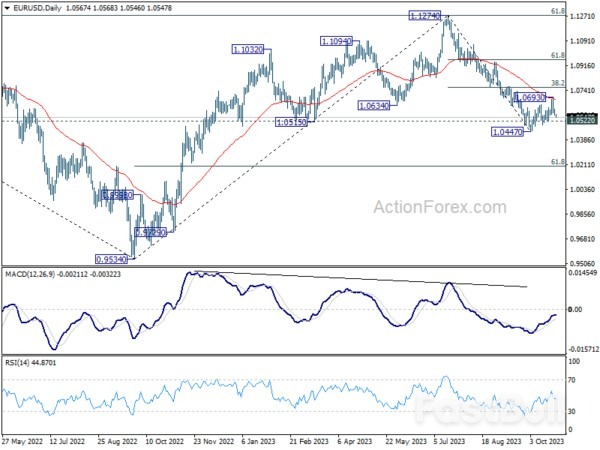
          Technically, it's possible that EUR/USD's recovery from 1.0447 has completed at 1.0693, after rejection by 55 D EMA. Immediate focus for today is 1.0522 minor support. Firm break there should strengthen this bearish case. Further break of 1.0447 will resume whole fall from 1.1274, and target 61.8% retracement of 0.9534 to 1.1274 at 1.0199 next.Dominant Dollar Awaits Crucial ECB Verdict and U.S. GDP Insight_3

          Elsehwere

          U.S. GDP is another major focus today. Durable goods orders, goods trade balance and jobless claims will also be featured.

          USD/JPY Daily Outlook

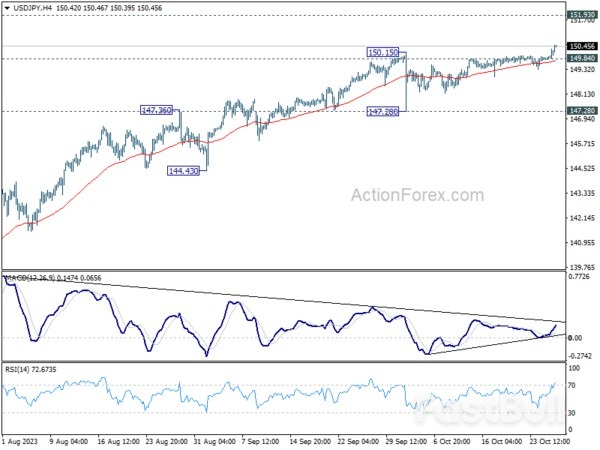
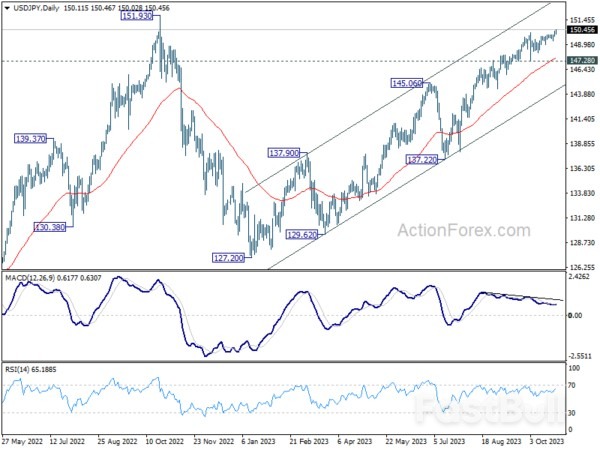
          USD/JPY's rally from 127.20 resumed by breaking through 150.15 resistance. Intraday bias is back on the upside for 151.93 high medium-term resistance next. On the downside, below 149.84 minor support will turn intraday bias neutral first, and bring consolidations. But near-term outlook will now stay bullish as long as 147.28 support holds, even in case of deep retreat.Dominant Dollar Awaits Crucial ECB Verdict and U.S. GDP Insight_4
          In the bigger picture, while rise from 127.20 is strong, it could still be seen as the second leg of the corrective pattern from 151.93 (2022 high). Rejection by 151.93, followed by sustained break of 145.06 resistance turned support will be the first sign that the third leg of the pattern has started. However, sustained break of 151.93 will confirm resumption of long term up trend.

          Dominant Dollar Awaits Crucial ECB Verdict and U.S. GDP Insight_5Source: ActionForex

          To stay updated on all economic events of today, please check out our Economic calendar
          Risk Warnings and Disclaimers
          You understand and acknowledge that there is a high degree of risk involved in trading. Following any strategies or investment methods may lead to potential losses. The content on the site is provided by our contributors and analysts for information purposes only. You are solely responsible for determining whether any trading assets, securities, strategy, or any other product is suitable for investing based on your own investment objectives and financial situation.
          Comments
          Add to Favorites
          Share

          Commodity Currencies and Euro at Strategic Levels

          FXOpen

          Forex

          Yesterday, the corrective pullback for the US dollar in major currency pairs was interrupted. But at the same time, important support held, which may indicate that greenback sellers will make another attempt to resume the downward movement.

          USD/CAD

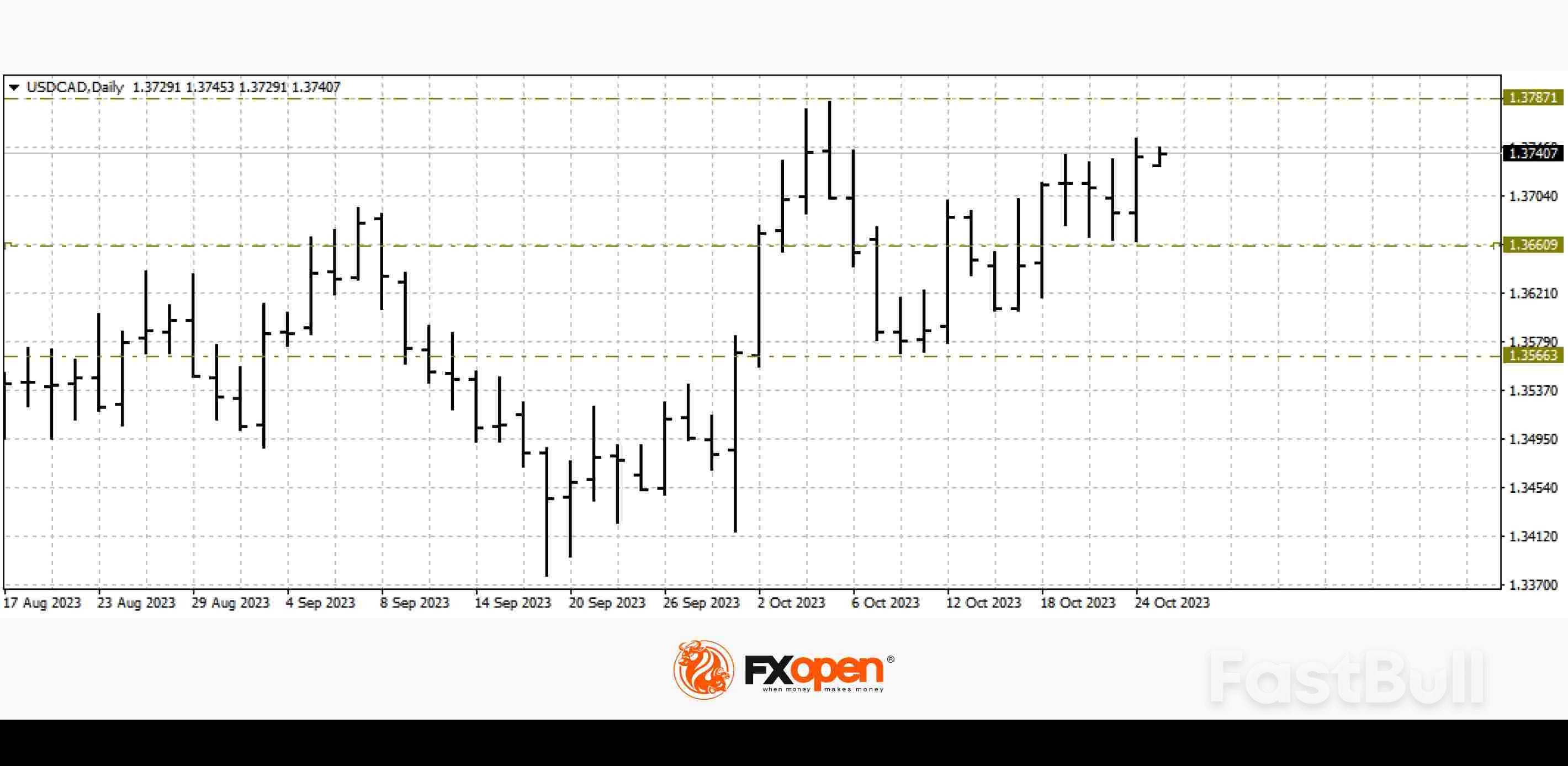
          The USD/CAD currency pair yesterday once again tried to go above 1.3750, but, as we can see, to no avail. Good data on the PMI in the US services sector contributed to the growth of the US dollar, but strategic levels have so far remained untouched.
          Today, the Canadian currency is facing an important fundamental day, and perhaps the pair will be able to get out of the flat corridor between 1.3750 and 1.3650. At 17:00 GMT+3, a meeting of the Bank of Canada will be held, at which a decision on the base interest rate will be announced. A press conference of the Canadian regulator is scheduled a little later, at which Bank of Canada Governor Tiff Macklem and Senior Deputy Governor Caroline Rogers will speak. Analysts assume that the rate will remain at the same level, 5%. For market participants, the comments of officials regarding the regulator's further monetary policy will be primarily important. Commodity Currencies and Euro at Strategic Levels_1

          AUD/USD

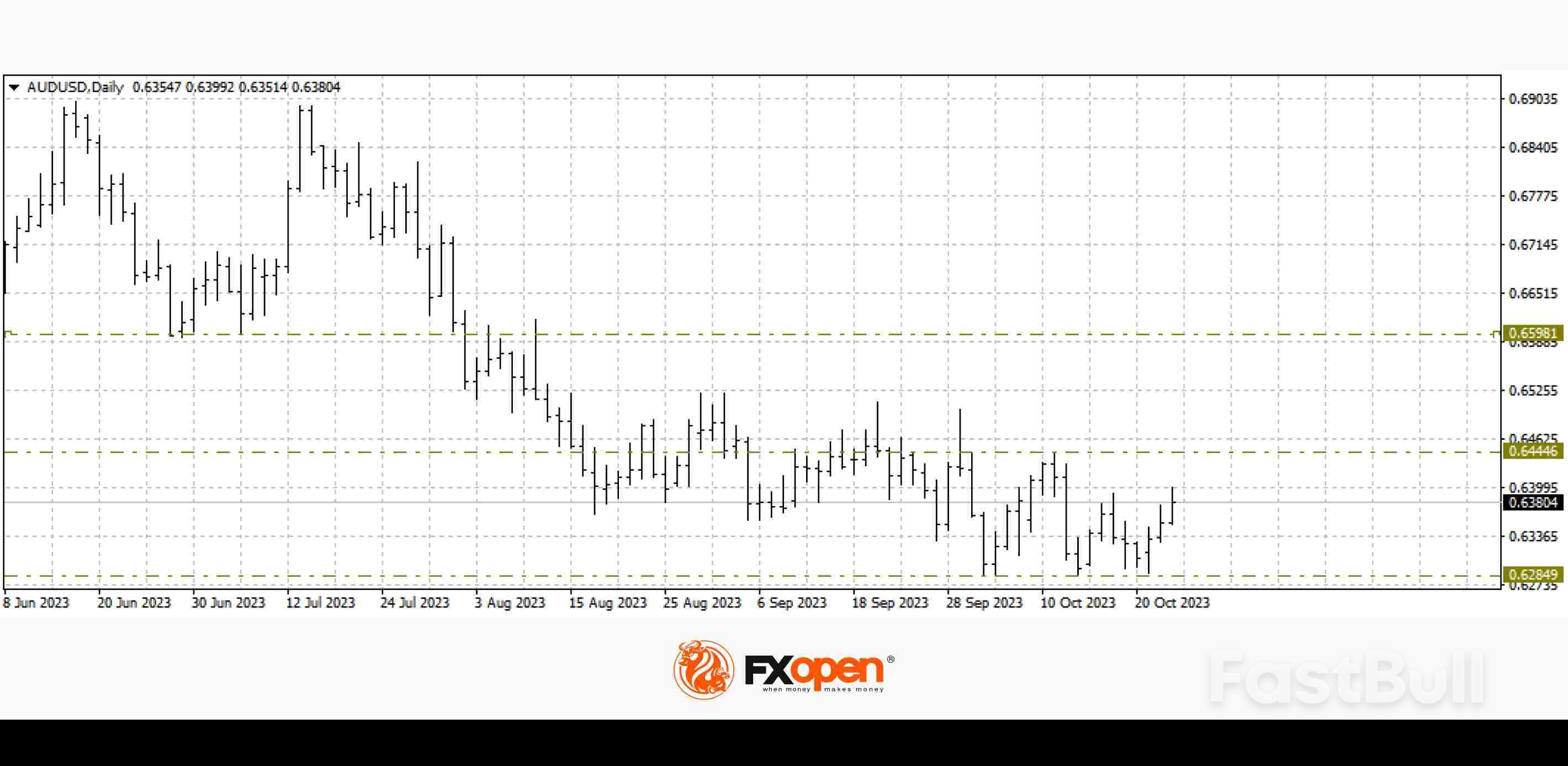
          Last week, the AUD/USD pair dropped below 0.6300, but failed to interrupt the recent extremes. On the daily timeframe, the emergence of a triple bottom figure can be seen. The development of this combination may be a breakdown of the base at 0.5450. A move below 0.6280 will break this combination and could contribute to a new downward impulse in the direction of 0.6000.
          This morning, positive data on the consumer price index in Australia for the third quarter was published. The indicator increased by 1.2% against 0.8% in the previous quarter. At the American session, we are waiting for data on the number of building permits issued in the United States for September, as well as indicators on new home sales for the same period. Commodity Currencies and Euro at Strategic Levels_2

          EUR/USD

          The single European currency is testing support at the alligator lines on the daily timeframe. The recent attempt at growth was interrupted by weak data on the Eurozone Services PMI and Composite PMI. If buyers hold above 1.0600, an upward correction in the direction of 1.0700-1.0800 may resume. A move below 1.0600 could encourage a retest of 1.0450.
          Today at 11:00 GMT+3, we are waiting for data on the business climate index in Germany for October. It is also worth paying attention to the speech of ECB Chairman Christine Lagarde, which is scheduled for 20:00 GMT+3. Commodity Currencies and Euro at Strategic Levels_3
          Risk Warnings and Disclaimers
          You understand and acknowledge that there is a high degree of risk involved in trading. Following any strategies or investment methods may lead to potential losses. The content on the site is provided by our contributors and analysts for information purposes only. You are solely responsible for determining whether any trading assets, securities, strategy, or any other product is suitable for investing based on your own investment objectives and financial situation.
          Comments
          Add to Favorites
          Share

          ECB Expected to Hold Rates, US Q3 GDP Forecast to Hit 4%?

          CMC

          Economic

          Forex

          European markets managed to eke out a gain yesterday in what turned out to be a relatively choppy session, ahead of today's important ECB rate decision.
          US markets on the other hand took their cues from a negative reaction to the latest Q3 numbers from Google owner Alphabet which saw its biggest one-day loss since March 2020, due to a slight miss on its cloud revenues. This in turn saw the Nasdaq 100 fall to 4-month lows, as the rest of the tech sector got sold off heavily, including Facebook owner Meta Platforms, whose shares fell over 4% ahead of the release of their Q3 numbers.
          Having come off such a poor day last night's numbers from Meta really needed to see a decent beat to help reverse some of the negativity from yesterday.
          We do appear to have seen that after Q3 revenues came in at the top end of forecasts at $34.15bn, and profits of $11.58bn or $4.63c a share.
          Operating expenses fell 7% to $20.4bn, with the company adjusting its annual expenses estimate down to $87-89bn.
          Q4 revenues are forecast to come in at $36.5-40bn. No end in sight for the losses in Reality Labs which are expected to continue year over year, where we saw another $3.7bn of losses during the quarter, taking losses year to date to -$11.47bn. Q3 revenue here came in at $210m, pushing total revenue year to date to $825m. The intial gains seen in the aftermath of the Q3 numbers soon disappeared however after the company warned on ad revenues due to a deteriorating economy in Q4.
          Nonetheless last night's slide in US markets and a similar decline in Asia, looks set to translate into a lower European open, ahead of another big macro day with the ECB and US Q3 GDP set to be the major focus.
          Is the ECB done hiking? The decision to hike rates back in September to a record high of 4.5% was somewhat of a surprise given some of the narrative that had been coming from ECB President Christine Lagarde in the lead-up to the decision.
          It has also become apparent that there are clear divisions on the governing council on the future path of monetary policy with the northern part of the euro area, and specifically Germany keen to keep the pressure on, lest inflation run higher despite the recent sharp falls in the headline rate.
          In comments made a week after the decision to raise rates last month Bank of Latvia Governor Martins Kazaks argued that the September increase was appropriate and that future increases couldn't be ruled out given the upside risks posed by higher energy costs and real income growth.
          Nonetheless the tone of the September press conference was one of a wait and see approach from here on in given the downgrade to growth forecasts, which saw 2023 moved down to 0.7% from 0.9%, and in 2024 from 1.5% to 1%, while inflation was revised upwards to 5.6% in 2023 and 3.2% in 2024.
          While ECB President Lagarde has been at pains to insist that the ECB isn't done on the rate hike front, the ECB would be foolhardy in the extreme to hike rates again in a week that has seen economic data show little signs of picking up. It's already almost certain that Q3 saw the EU economy slide into contraction, and the latest October data has shown little sign that is likely to change.
          Moving on to the US economy which is still showing remarkable resilience even after multiple rate hikes. Today we get the first iteration of Q3 GDP and recent data would suggest that today's numbers will confirm that the US economy has grown at the fastest rate since Q4 of 2021, and at over double the rate of Q1 and Q2, which could pose problems for the Federal Reserve when they meet to decide whether to hike rates, or perhaps wait until December.
          In Q1 the US economy managed to grow by 2.2%, followed by 2.1% in Q2. The final revision in Q2 saw personal consumption revised substantially lower to 0.8% from 1.7.
          The slowdown in consumer spending during Q2 was a little worrying given how much of the US economy is driven by consumption, however the retail sales numbers during the summer suggest we've seen a strong rebound since then.
          Nonetheless there was also a sharp revision higher for business investment in factories as the trickle-down effect of the inflation reduction act started to kick in.
          Growth estimates for today's Q3 numbers are higher, with estimates as high as 4.5%, given how strong retail sales have been between July and September, with personal consumption expected to come in at 4%. On prices we're expecting to see a slowdown from 3.7% to 2.5%.
          With a strong labour market and US earnings also looking strong there is a considerable upside risk that a big number today could prompt another spike higher in yields as the market goes to price in one more rate hike between now and the end of the year.
          Weekly jobless claims are expected to rise from 198k to 207k.
          EUR/USD – failed to overcome the 50-day SMA at the 1.0700 area and has slipped back towards trend line support from the recent lows at 1.0450, which is also a key support area.
          GBP/USD – has slipped back from the 1.2300 area and trend line resistance at the trend line from the July highs. Support remains at 1.2100, while a move through 1.2300 is needed to push up to the 200-day SMA at 1.2400.
          EUR/GBP – resistance remains at the highs this week at 0.8740. A move below 0.8680 and the 200-day SMA targets the 0.8620 area.
          USD/JPY – continues to creep higher and has moved above the previous highs at 150.16, making a new high for the year, potentially opening up a move towards 152.20. Support at the lows last week at 148.75.
          To stay updated on all economic events of today, please check out our Economic calendar
          Risk Warnings and Disclaimers
          You understand and acknowledge that there is a high degree of risk involved in trading. Following any strategies or investment methods may lead to potential losses. The content on the site is provided by our contributors and analysts for information purposes only. You are solely responsible for determining whether any trading assets, securities, strategy, or any other product is suitable for investing based on your own investment objectives and financial situation.
          Comments
          Add to Favorites
          Share

          Gold Price Could Soon Surpass $2K, US GDP Next

          TD Securities

          Commodity

          Gold Price Technical Analysis
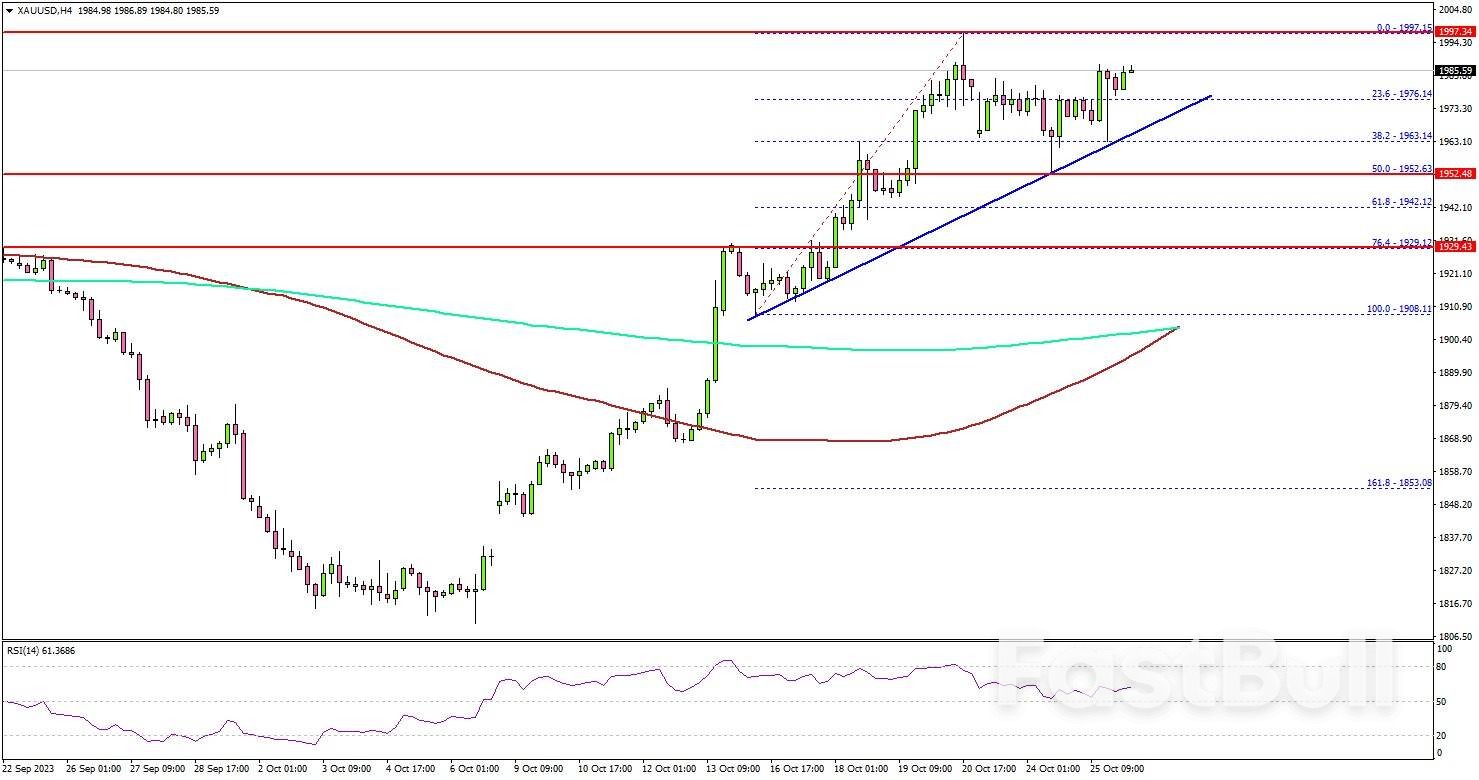
          Gold prices remained in strong demand due to the Israeli–Hamas war. The price rallied above the $1,920 and $1,950 resistance levels.Gold Price Could Soon Surpass $2K, US GDP Next_1
          The 4-hour chart of XAU/USD indicates that the price settled above the $1,965 resistance, the 100 Simple Moving Average (red, 4 hours), and the 200 Simple Moving Average (green, 4 hours).
          It even spiked toward the $2,000 level before the price started a minor downside correction. The price dipped below the $1,965 level. It tested the 50% Fib retracement level of the upward move from the $1,908 swing low to the $1,997 high.
          There is also a connecting bullish trend line forming with support near $1,968 on the same chart. The current price action suggests there are high chances of more upsides above $1,980.
          Immediate resistance is near the $1,995 level. The first major resistance is $2,000. An upside break above the $2,000 level could send the price soaring toward the $2,050 resistance. The next major resistance is near the $2,080 level, above which Gold could revisit the key $2,120 resistance zone.
          On the downside, the price might find support near the $1,968 level. The next key support is near the gap area at $1,950. If the bulls fail to protect the $1,950 support, there is a risk of a major decline. In the stated case, the price could decline toward the $1,930 level.
          Looking at crude oil prices, there was a downside correction and the bears were able to push the price below the $85 level.
          Economic Releases to Watch Today
          US Initial Jobless Claims - Forecast 208K, versus 198K previous.
          US Gross Domestic Product for Q3 2023 (Preliminary) – Forecast 4.2% versus previous 2.1%.

          Risk Warnings and Disclaimers
          You understand and acknowledge that there is a high degree of risk involved in trading. Following any strategies or investment methods may lead to potential losses. The content on the site is provided by our contributors and analysts for information purposes only. You are solely responsible for determining whether any trading assets, securities, strategy, or any other product is suitable for investing based on your own investment objectives and financial situation.
          Comments
          Add to Favorites
          Share

          Bank of Japan (BoJ) Preview: Speculations Over Further Policy Tweak Mount

          IG

          Central Bank

          Economic

          Stocks

          What to expect at the upcoming Bank of Japan (BoJ) meeting?

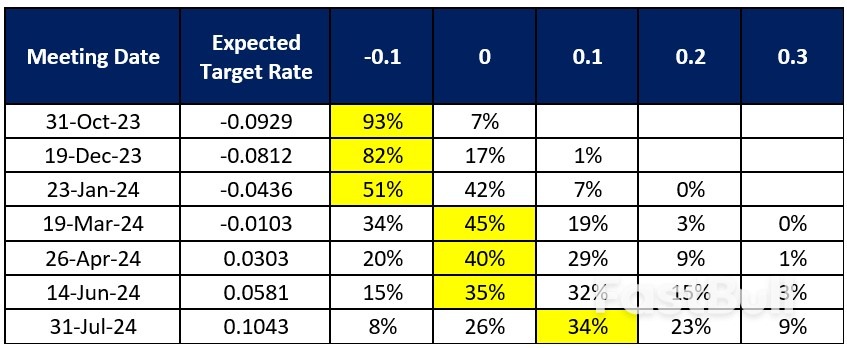
          The BoJ is set to hold their monetary meeting across 30 – 31 October 2023, with wide consensus for its short-term interest rate target to be kept unchanged at -0.1% and for the 10-year bond yield around 0%.
          The key focus will revolve around whether the central bank will deliver further tweaks to its yield curve control policy (currently at a 1% upper limit) or any other policy adjustment, given the recent rise in Japan's 10-year government bond yields to its decade high. Recent media report by Nikkei revealed that it will be a topic of discussion at the upcoming meeting, but there has not been a clear consensus among policymakers around the central bank's next move or its timing just yet.
          Thus far, broad market expectations are priced for Japan to scrap its negative rates in the first half of 2024, still very much anchored by the BoJ Governor Kazuo Ueda's previous comments of having enough data by this year-end to determine its rate outlook.

          Bank of Japan (BoJ) Preview: Speculations Over Further Policy Tweak Mount_1Source: Refinitiv, as of 25 October 2023.

          Upcoming meeting to be a 'live' one

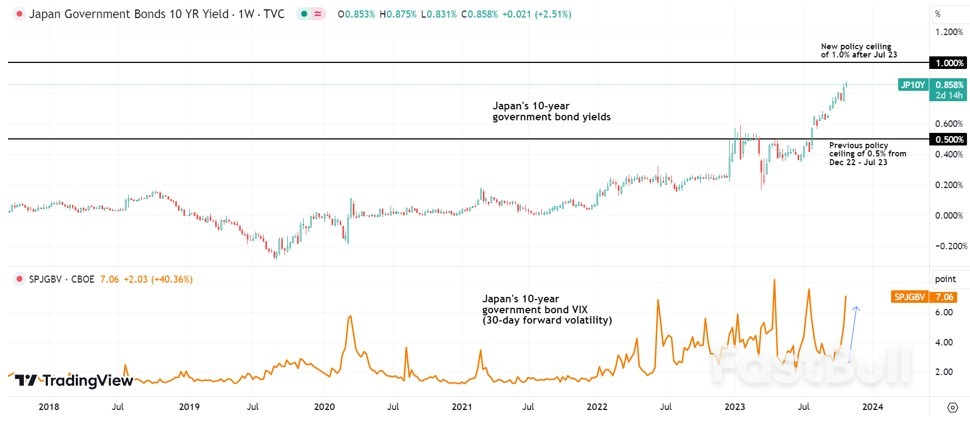
          This week, the Japanese 10-year government bond yields witnessed a fresh decade high, with yields briefly touching the 0.875% level, almost double the 0.460% level just three months back. While there are still room before it tests the BoJ's 1% upper limit, the relentless rise in Japan's 10-year yields reflects some resilience to the six rounds of bond-buying operations by the BoJ since July 2023 and continues to reveal hawkish bets in place for further policy normalisation.
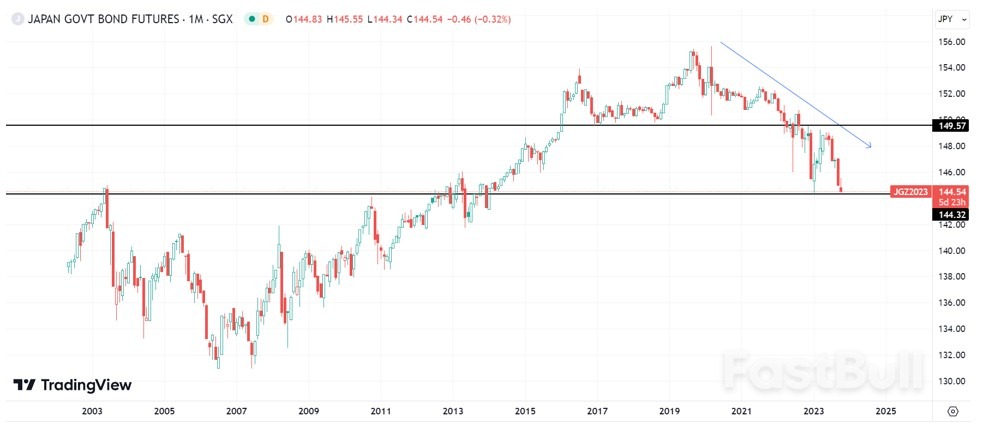
          The implied volatility for the 10-year government bonds futures has also witnessed a surge ahead of the upcoming meeting, suggesting that markets are expecting the meeting to be a 'live' one with possible BoJ policy action. Japanese Government Bond (JGB) futures are also back to retest its nine-year low, with broad positioning in place for potentially weaker bond prices.

          Bank of Japan (BoJ) Preview: Speculations Over Further Policy Tweak Mount_2Source: TradingView

          Bank of Japan (BoJ) Preview: Speculations Over Further Policy Tweak Mount_3Source: TradingView

          Upcoming meeting to bring fresh forecasts on growth and inflation conditions

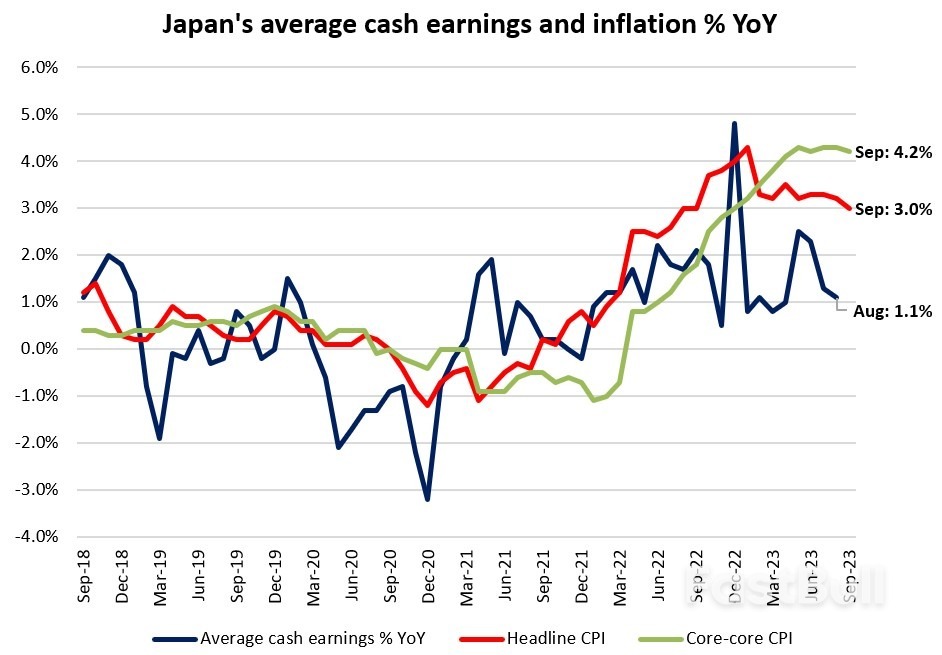
          Back in July this year, inflation forecasts for FY2023 and FY2024 were guided at 2.5% and 1.9% respectively, but current expectations are that these figures may be revised higher at the upcoming meeting. This follows after core inflation in Japan came in higher-than-expected in September for its third straight month, while oil prices have gained more than 20% since its July meeting. Market focus will revolve around policymakers' views of whether an upward revision in the inflation forecasts may meet their condition of 'sustainable inflation' for a policy pivot.
          On the other hand, BoJ doves may still tap on the absence of an upward build in wage pressures to argue their case for more wait-and-see. Japan's wage growth has softened to 1.1% in August, which marked its third straight month of moderation. The conflicting signs seem to make any policy move at the upcoming meeting harder to grasp, with a more even split in views likely to trigger volatility on any BoJ action (or inaction).

          Bank of Japan (BoJ) Preview: Speculations Over Further Policy Tweak Mount_4Source: Refinitiv

          USD/JPY: Respecting the intervention level of 150.00

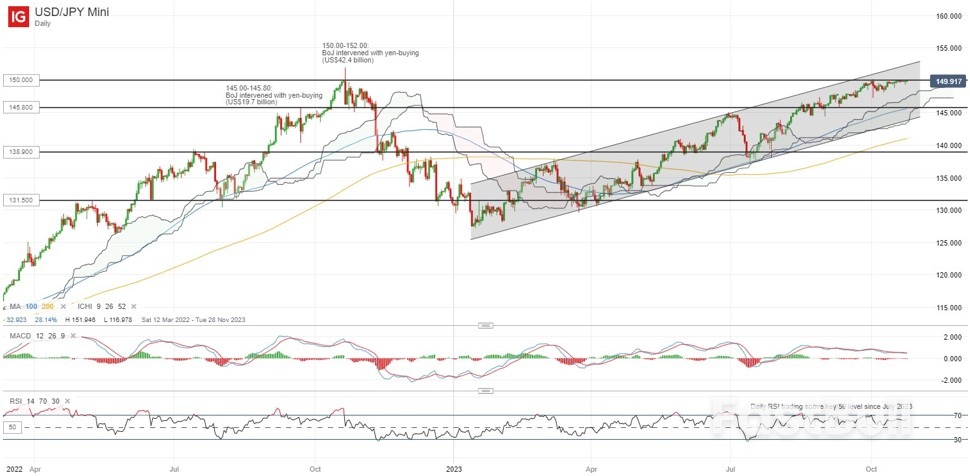
          Rising US-Japan bond yield differentials have been supportive of USD/JPY's upside, but recent moves for the pair has stalled around the key psychological 150.00 level – a level where Japanese authorities intervened back in October 2022 with US$42.4 billion of yen-buying to prop up the currency. A move similar to that of October 2022 was observed recently on 3 October 2023, where a retest of the 150.00 level was met with a strong sell-off of 280 pips within a span of minutes.
          The sharp move has raised speculations of possible intervention efforts by authorities and although it has not been acknowledged by Japanese officials, the 150.00 level is now looked upon as a line of caution for buyers, serving as a key resistance for the USD/JPY to overcome.
          Overall, the higher-highs-higher-lows formation since the start of the year still keeps an upward trend intact for now, with its daily Relative Strength Index (RSI) hovering above the key 50 level. Any success in reclaiming the 150.00 level may support a move towards the 152.00 level, while on the downside, any retracement may leave the 145.80 level on watch as immediate support.

          Bank of Japan (BoJ) Preview: Speculations Over Further Policy Tweak Mount_5Source: IG charts

          Nikkei 225: Attempting to find support from lower channel trendline

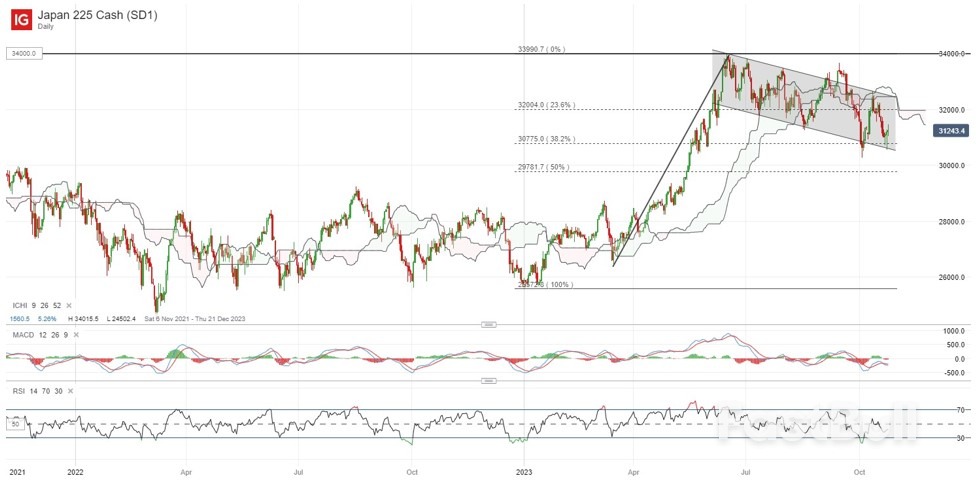
          The Nikkei 225 index has been guided by a falling channel pattern since June this year, with recent moves attempting to find support from the lower channel trendline at the 30,700 level. This level coincides with a 38.2% Fibonacci retracement from its January 2023 low to June 2023 high, which may support some views of a bullish flag formation still in place.
          Any signs of a quicker pivot from current accommodative policies at the upcoming meeting may translate to downside risks for the index, with any breakdown of the lower channel trendline support potentially paving the way to retest the 29,800 level next. On the upside, the upper channel trendline may serve as key resistance to overcome at the 32,400 level.

          Bank of Japan (BoJ) Preview: Speculations Over Further Policy Tweak Mount_6Source: IG charts

          To stay updated on all economic events of today, please check out our Economic calendar
          Risk Warnings and Disclaimers
          You understand and acknowledge that there is a high degree of risk involved in trading. Following any strategies or investment methods may lead to potential losses. The content on the site is provided by our contributors and analysts for information purposes only. You are solely responsible for determining whether any trading assets, securities, strategy, or any other product is suitable for investing based on your own investment objectives and financial situation.
          Comments
          Add to Favorites
          Share

          Canada: Sluggish Growth, Slowing Inflation, Softer Currency

          WELLS FARGO

          Economic

          Forex

          Canadian Growth Challenges Accumulating

          While Canada's economy has shown pockets of strength in recent months, incoming data continues to point to increasing challenges and slower growth for the Canadian economy ahead. The main bright spot for Canada has been the labor market, which added a combined 103,700 jobs in July and August, while hourly wage growth for permanent employees remains elevated at 5.3% year-over-year. Even so, the employment gains are perhaps not as strong as they might appear at first glance. A 48,000 gain in full-time jobs accounted for less than half of the increase, whereas for the outstanding level of employment, full-time jobs make up 82% of total employment. Moreover, the July-August period saw a decline in private sector employees, with the jobs increase instead driven by a rise in public sector employees and self-employment. Other areas of the economy are noticeably less robust. Despite the employment gains, higher interest rates and cost-of-living issues appear to be contributing to consumer caution, with real retail sales having declined for three months in a row through August. More broadly, Canada's Q2 GDP growth contracted at a 0.2% quarter-over-quarter annualized rate and, based on available data for July and preliminary data for August, is at best on track for only very modest positive growth in Q3.Canada: Sluggish Growth, Slowing Inflation, Softer Currency_1
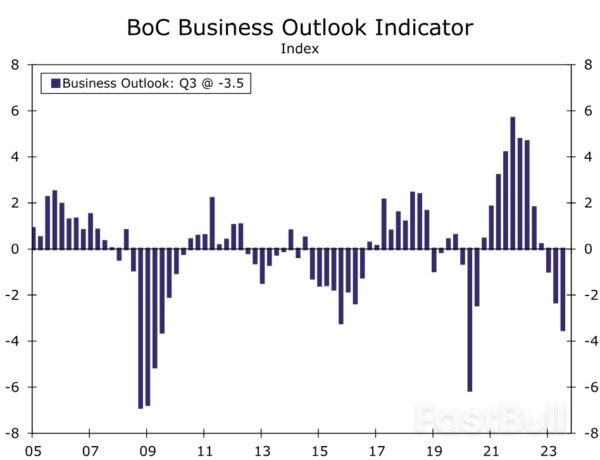
          Canada: Sluggish Growth, Slowing Inflation, Softer Currency_2Moreover, economic fundamentals and forward-looking indicators do not point to an improvement in Canada's growth prospects any time soon. From a consumer perspective, the outlook is mixed. Growth in real household disposable income has returned to positive territory and the household saving rate of 5.1% remains slightly above pre-pandemic levels. However, the Bank of Canada's monetary tightening has led to a rising interest and debt servicing burden for Canadian households. In Q2, interest costs were 9.0% of disposable income, while total debt servicing costs (that is, principal and interest) were 14.8% of disposable income. Those metrics are elevated by historical standards, and suggest continued consumer restraint going forward. The outlook for businesses is similarly subdued. Declining corporate profit growth has led to a drop in business fixed investment through mid-2023, and the central bank's Q3 Business Outlook Survey suggests the outlook may have worsened further since. The Bank of Canada's (BoC) Business Outlook Indicator fell further to -3.5, the weakest reading since the depths of the pandemic. In addition, the Indicators of Future Sales balance, which takes into account factors such as order books, advance bookings, sales inquiries and so on, fell to zero in Q3, also the weakest reading since Q3-2020. Finally, more than half of firms surveyed by the BoC believe that the effects of past monetary tightening on their businesses are far from over. To the extent that more cautious businesses scale back hiring plans, that could add to headwinds for Canadian households and consumers. Against this backdrop we have pared our growth forecast for Canada, and now anticipate GDP growth of 1.1% in 2023 (previously 1.2%) and 0.7% in 2024 (previously 1.0%).

          Canada: Sluggish Growth, Slowing Inflation, Softer Currency_3Canada: Sluggish Growth, Slowing Inflation, Softer Currency_4Canadian Inflation: High, But Heading In The Right Direction

          While recent news on Canadian growth has been disappointing, news on the inflation front has been slightly more hopeful. The message from actual inflation data as well as forward-looking indicators are the same—inflation remains too high for now, but is gradually heading in the right direction. With respect to the September CPI, both headline and core inflation surprised to the downside. The headline CPI slowed to 3.8% year-over-year, while the average core CPI similarly eased to 3.8% year-over-year. Importantly, the average core CPI rose at a 3.67% three-month annualized pace through September. That is less than the increase seen in August, even if the recent trend of underlying inflation remains above the central bank's 2% target and the underlying pace of disinflation remains frustratingly slow.
          Canada: Sluggish Growth, Slowing Inflation, Softer Currency_5Survey data also point to elevated inflation trends that are nonetheless moving in a more favorable direction. The BoC's Business Outlook Survey showed more firms expecting slower input and output price inflation over the next 12 months. For example, the net balance for input price inflation fell to -63 in Q3 from -53 in Q2 (that is, more respondents seeing slower input price inflation), while the net balance for output price inflation fell to -43 in Q3 from -33 in Q2 (more seeing slower output price inflation). In terms of firms' CPI inflation expectations over the next two years, 53% saw inflation above 3% during that period, still high but less than the 64% in Q2 and 79% in Q1. Finally, in a separate survey of consumers during Q3, one-year ahead and two-year ahead inflation expectations were still elevated at 5.03% and 4.04% respectively. Nonetheless, that same survey said consumers who expect more adverse effects from rate hikes are less likely to plan major purchases such as cars or appliances, and more likely to spend on discretionary items like vacations and concerts—a hint perhaps that higher interest rates are having some impact on consumer expectations.

          Bank of Canada's Interest Rate Pause Will Be An Interest Rate Peak

          Against this backdrop of slowing growth and gradually slowing inflation, the Bank of Canada once again held its policy interest rate steady at 5.00% at its October monetary policy announcement. In its accompanying statement, the BoC acknowledged softer economic activity, saying:
          • There is growing evidence that past interest rate increases are dampening economic activity and relieving price pressures.
          • Consumption has been subdued, and weaker demand and higher borrowing costs are weighing on business investment.
          • A range of indicators suggest that supply and demand in the economy are now approaching balance.
          • Economic growth is expected to be weak for the next year before increasing in late 2024 and through 2025.
          The softer outlook is also reflected in the central bank's updated projections, which forecast GDP growth of 1.2% in 2023 (compared to 1.8% in July) and 0.9% in 2024 (compared to 1.2% in July).
          At the same time, the BOC kept the option of further tightening on the table, saying it is "prepared to raise the policy rate further if needed." The central bank clearly remains somewhat wary about the inflation outlook, saying it "is concerned that progress towards price stability is slow and inflationary risks have increased." Those inflation concerns are also reflected in the BoC's updated inflation forecasts, which see CPI inflation at 3.0% for 2024 (previously 2.5%) and 2.2% for 2025 (previously 2.1%).
          Canada: Sluggish Growth, Slowing Inflation, Softer Currency_6Although BoC maintained a moderate rate hike bias, we continue to believe that further tightening remains a possibility rather than a probability. We expect Canadian economic growth to slow more quickly than the central bank's forecast, and as a result, we see slightly slower CPI inflation next year than does the central bank. We believe the Bank of Canada will hold its policy rate steady at 5.00% for an extended period. That said, as growth remains subdued and underlying inflation measures move a bit closer to the central bank's 2% target, we still forecast Bank of Canada rate cuts beginning in Q2-2024, and a cumulative 150 bps of easing to 3.50% by the end of next year. As Canadian growth remains subdued and in the absence of further BoC tightening, we also see potential for further Canadian dollar weakness. The USD/CAD exchange rate has already reached our medium-term target of CAD1.3700, but a further move closer to CAD1.4000 over the next several months cannot be ruled out. We will provide a full assessment and updated currency forecasts in our International Economic Outlook, due for publication later this week.
          To stay updated on all economic events of today, please check out our Economic calendar
          Risk Warnings and Disclaimers
          You understand and acknowledge that there is a high degree of risk involved in trading. Following any strategies or investment methods may lead to potential losses. The content on the site is provided by our contributors and analysts for information purposes only. You are solely responsible for determining whether any trading assets, securities, strategy, or any other product is suitable for investing based on your own investment objectives and financial situation.
          Comments
          Add to Favorites
          Share
          FastBull
          Copyright © 2025 FastBull Ltd

          728 RM B 7/F GEE LOK IND BLDG NO 34 HUNG TO RD KWUN TONG KLN HONG KONG

          TelegramInstagramTwitterfacebooklinkedin
          App Store Google Play Google Play
          Products
          Charts

          Chats

          Q&A with Experts
          Screeners
          Economic Calendar
          Data
          Tools
          Membership
          Features
          Function
          Markets
          Copy Trading
          Latest Signals
          Contests
          News
          Analysis
          24/7
          Columns
          Education
          Company
          Careers
          About Us
          Contact Us
          Advertising
          Help Center
          Feedback
          User Agreement
          Privacy Policy
          Business

          White Label

          Data API

          Web Plug-ins

          Poster Maker

          Affiliate Program

          Risk Disclosure

          The risk of loss in trading financial instruments such as stocks, FX, commodities, futures, bonds, ETFs and crypto can be substantial. You may sustain a total loss of the funds that you deposit with your broker. Therefore, you should carefully consider whether such trading is suitable for you in light of your circumstances and financial resources.

          No decision to invest should be made without thoroughly conducting due diligence by yourself or consulting with your financial advisors. Our web content might not suit you since we don't know your financial conditions and investment needs. Our financial information might have latency or contain inaccuracy, so you should be fully responsible for any of your trading and investment decisions. The company will not be responsible for your capital loss.

          Without getting permission from the website, you are not allowed to copy the website's graphics, texts, or trademarks. Intellectual property rights in the content or data incorporated into this website belong to its providers and exchange merchants.

          Not Logged In

          Log in to access more features

          FastBull Membership

          Not yet

          Purchase

          Become a signal provider
          Help Center
          Customer Service
          Dark Mode
          Price Up/Down Colors

          Log In

          Sign Up

          Position
          Layout
          Fullscreen
          Default to Chart
          The chart page opens by default when you visit fastbull.com