Markets
News
Analysis
User
24/7
Economic Calendar
Education
Data
- Names
- Latest
- Prev



Signal Accounts for Members
All Signal Accounts
All Contests


Brazil IHS Markit Manufacturing PMI (Dec)A:--
F: --
P: --
Canada Manufacturing PMI (SA) (Dec)A:--
F: --
P: --
U.S. IHS Markit Manufacturing PMI Final (Dec)A:--
F: --
P: --
Mexico Manufacturing PMI (Dec)A:--
F: --
P: --
U.S. Weekly Treasuries Held by Foreign Central BanksA:--
F: --
P: --
Philadelphia Fed President Henry Paulson delivers a speech
Japan Manufacturing PMI Final (Dec)A:--
F: --
P: --
China, Mainland Caixin Composite PMI (Dec)A:--
F: --
P: --
China, Mainland Caixin Services PMI (Dec)A:--
F: --
P: --
Indonesia Trade Balance (Nov)A:--
F: --
P: --
Indonesia Core Inflation YoY (Dec)A:--
F: --
P: --
Indonesia Inflation Rate YoY (Dec)A:--
F: --
P: --
Saudi Arabia IHS Markit Composite PMI (Dec)A:--
F: --
P: --
Turkey CPI YoY (Excl. Energy, Food, Beverage, Tobacco & Gold) (Dec)--
F: --
P: --
Turkey CPI YoY (Dec)A:--
F: --
P: --
Turkey PPI YoY (Dec)A:--
F: --
P: --
U.K. Mortgage Approvals (Nov)A:--
F: --
U.K. M4 Money Supply MoM (Nov)A:--
F: --
P: --
U.K. Mortgage Lending (Nov)A:--
F: --
U.K. M4 Money Supply (SA) (Nov)--
F: --
P: --
Euro Zone Sentix Investor Confidence Index (Jan)--
F: --
P: --
U.K. M4 Money Supply YoY (Nov)A:--
F: --
P: --
Canada National Economic Confidence IndexA:--
F: --
P: --
U.S. ISM Inventories Index (Dec)A:--
F: --
P: --
U.S. ISM Output Index (Dec)A:--
F: --
P: --
U.S. ISM Manufacturing PMI (Dec)A:--
F: --
P: --
U.S. ISM Manufacturing Employment Index (Dec)A:--
F: --
P: --
U.S. ISM Manufacturing New Orders Index (Dec)A:--
F: --
P: --
Japan Monetary Base YoY (SA) (Dec)A:--
F: --
P: --
U.K. BRC Shop Price Index YoY (Dec)A:--
F: --
P: --
Japan 10-Year Note Auction Yield--
F: --
P: --
India HSBC Services PMI Final (Dec)--
F: --
P: --
India IHS Markit Composite PMI (Dec)--
F: --
P: --
South Africa IHS Markit Composite PMI (SA) (Dec)--
F: --
P: --
Turkey Trade Balance (Dec)--
F: --
P: --
Italy Composite PMI (Dec)--
F: --
P: --
Italy Services PMI (SA) (Dec)--
F: --
P: --
Germany Composite PMI Final (SA) (Dec)--
F: --
P: --
Euro Zone Composite PMI Final (Dec)--
F: --
P: --
Euro Zone Services PMI Final (Dec)--
F: --
P: --
U.K. Services PMI Final (Dec)--
F: --
P: --
U.K. Composite PMI Final (Dec)--
F: --
P: --
U.K. Total Reserve Assets (Dec)--
F: --
P: --
U.K. Official Reserves Changes (Dec)--
F: --
P: --
Germany 2-Year Schatz Auction Avg. Yield--
F: --
P: --
Mexico Consumer Confidence Index--
F: --
P: --
Germany CPI Prelim MoM (Dec)--
F: --
P: --
Germany CPI Prelim YoY (Dec)--
F: --
P: --
Brazil IHS Markit Services PMI (Dec)--
F: --
P: --
Germany HICP Prelim MoM (Dec)--
F: --
P: --
Brazil IHS Markit Composite PMI (Dec)--
F: --
P: --
Germany HICP Prelim YoY (Dec)--
F: --
P: --
U.S. Weekly Redbook Index YoY--
F: --
P: --
U.S. IHS Markit Services PMI Final (Dec)--
F: --
P: --
U.S. IHS Markit Composite PMI Final (Dec)--
F: --
P: --
China, Mainland Foreign Exchange Reserves (Dec)--
F: --
P: --
U.S. API Weekly Refined Oil Stocks--
F: --
P: --
U.S. API Weekly Gasoline Stocks--
F: --
P: --
U.S. API Weekly Cushing Crude Oil Stocks--
F: --
P: --
U.S. API Weekly Crude Oil Stocks--
F: --
P: --


No matching data
Latest Views
Latest Views
Trending Topics
Top Columnists
Latest Update
White Label
Data API
Web Plug-ins
Affiliate Program
View All

No data
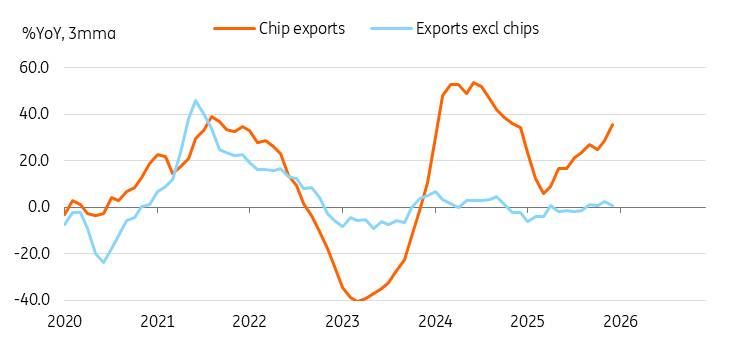
South Korean exports rose a greater-than-expected 13.4% year-on-year in December (vs 8.4% in November, 8.5% market consensus). Of the 15 main export products, six increased. IT exports were particularly strong.

South Korean exports rose a greater-than-expected 13.4% year-on-year in December (vs 8.4% in November, 8.5% market consensus). Of the 15 main export products, six increased. IT exports were particularly strong. Semiconductors rose the most -- by 43.2% -- thanks to robust demand for AI data centres and strong pricing. Other IT products, such as mobile devices (24.7%), computers (36.7%), and displays (0.8%), all increased. Yet autos, petrochemicals, steel, home appliances, and batteries declined. Automotive exports declined by 1.5% due to increased overseas production and temporary product cuts during line maintenance. Steel and petrochemicals continued to decline due to global oversupply and soft prices. Though not major export categories, newly emerging sectors -- primarily K-culture-related products such as food, bio-health, and cosmetics -- posted steady increases.
We expect IT- and K-culture-related products to remain the key drivers of exports in 2026. Despite recent concerns about AI overvaluation, global tech capex is expected to increase. Export items facing global oversupply are expected to undergo industry consolidation and are unlikely to rebound anytime soon.
Meanwhile, imports rose 4.6% YoY in December. Energy imports declined by 6.8% while non-energy imports rose firmly by 7.3%. We believe that increased capital goods imports will boost equipment investment in the current quarter. The trade surplus widened to $12.2 billion in December, likely boosting fourth-quarter 2025 GDP growth.
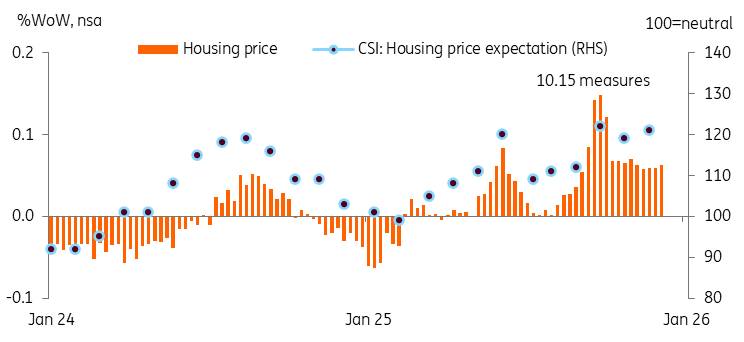
Source: CEIC and ING estimatesThe consumer confidence index slipped to 109.9 from 112.4, but remained above the long-term average. We believe recent KRW depreciation and a sudden stock market correction dampened sentiment. Inflation expectations remain steady at 2.6% for the third consecutive month, indicating no immediate concerns. Yet if the KRW remains around 1,450, both sentiment and activity will likely be affected.
Meanwhile, expectations on housing prices rebounded again. This should concern policymakers. Although strict macroprudential regulations are in place, housing demand in Seoul remains strong, resulting in a K-shaped housing market.
Recent business surveys similarly point to a K-shaped recovery, with manufacturing improving and non-manufacturing deteriorating. The manufacturing purchasing managers' index rose to 50.1, while the business survey index (BSI) outlook also advanced to 95.3 from 93.9 in November. Korean manufacturers are mostly export-oriented. As such, a de-escalation of trade tensions and weaker KRW may work in favour of sentiment. However, the domestically oriented non-manufacturing outlook declined substantially to 87.8 from 91.7. This likely reflects a slowdown in domestic demand as the impact of fiscal stimulus dissipates.
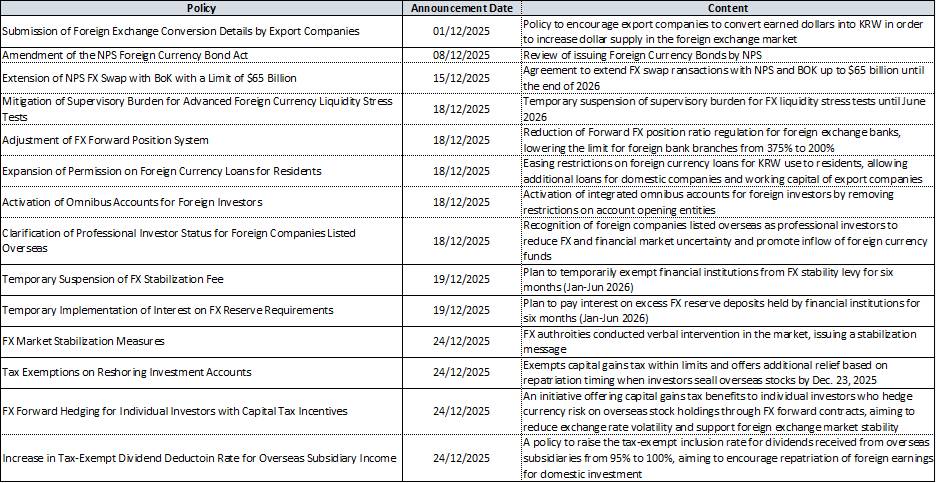
Throughout December, the FX authorities implemented nearly fifteen measures aimed at stabilizing the Korean won. The USDKRW is significantly lower following verbal intervention and smoothing operations in the last week of the year. We don't think it has altered the underlying trend of the KRW weakness. While the upside remains limited by intervention concerns, strong USD funding needs should keep USDKRW above 1,425.
FX relief measures announced in December
Source: BoK, FSC, FSS, MoEF, etc.Recent measures to cool Seoul's property market include tightening loan limits, designating the city a speculative zone with residency conditions, and accelerating urban renewal to increase supply. Since the steps taken on 15 October, housing transactions have declined overall, except in high-activity areas like Gangnam and southern Seoul. We believe stricter rules may temporarily slow down activity, but upward price pressures persist. Although some favour higher property taxes to curb demand, such measures are unlikely to be implemented before June's local government elections. Instead, the government might relax redevelopment rules and lower transaction taxes.
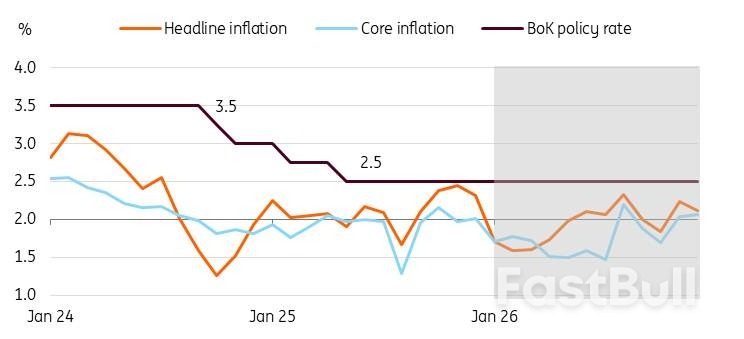
Source: CEICKorea's consumer price inflation eased slightly to 2.3% YoY in December (vs 2.4% in November, 2.3% market consensus). Weak fresh food prices lowered overall inflation, but petrol prices rose meaningfully, mainly due to higher import costs.
Going forward, we expect CPI to drop below 2% in the first half of 2026 mainly due to a high base last year. Still, the Bank of Korea is likely to keep policy rates unchanged at 2.5% in 2026 amid expectations of rising property prices in the Seoul area and the continued weakness of the KRW. Instead, the BoK will seek to expand the role of the Bank Intermediated Lending Support Facility as its favoured monetary policy instrument.
Source: CEIC and ING estimatesJapan's manufacturing activity stalled in December as demand declined at a slower pace from the previous month, a private-sector survey showed, ending a five-month streak of deterioration.
The S&P Global Japan Manufacturing Purchasing Managers' Index (PMI) was flat at 50.0 in December, improving from 48.7 in November and hitting the break-even point separating expansion from contraction.
"Japan's manufacturing industry saw conditions stabilise at the end of the year," said Annabel Fiddes, an economics associate director at S&P Global Market Intelligence.
The decline in new orders in December was the softest since May 2024, the survey showed. Although many firms noted subdued demand, some saw sales had improved, underpinned by new projects and stronger-than-expected customer spending.
While consumer and investment goods sectors reported improvement in business conditions, intermediate goods makers said they were weak.
New export orders declined at a slightly softer pace in December from November, partly affected by weaker demand in Asia, particularly for semiconductors, according to the survey.
Looking ahead to the next 12 months, overall business sentiment eased from November but remained above the survey's long-run average, the survey said.
"New product releases and greater demand across key industries such as autos and semiconductors were anticipated to boost the sector's performance in 2026," Fiddes said.
Some downside risks mentioned by firms were sluggish global economy, an ageing population and rising costs, she said.

Staffing levels in the manufacturing sector rose for the 13th consecutive month, while the rate of input prices accelerated to its highest since April, battered by a combination of increases in raw material, labour and transportation costs as well as the weaker yen.
The Bank of Japan in December raised interest rates to levels unseen in 30 years and signalled its readiness to continue raising rates.
The Guinea-flagged oil tanker MT Bandra, which is under sanctions, is partially seen alongside another vessel at El Palito terminal, near Puerto Cabello, Venezuela December 29, 2025. REUTERS/Juan Carlos Hernandez/File Photo/File Photo
SINGAPORE, Jan 5 (Reuters) - Oil prices inched up on Monday as investors weighed whether political upheaval in OPEC member Venezuela would disrupt shipments after U.S. President Donald Trump seized Venezuelan President Nicolas Maduro, in a well supplied market.
Brent crude futures rose 17 cents to $60.92 a barrel by 0024 GMT, paring earlier losses, while U.S. West Texas Intermediate crude was at $57.43 a barrel, up 11 cents.
The United States snatched Maduro from Caracas at the weekend. Trump said Washington would take control of the oil-producing nation and that the U.S. embargo on all Venezuelan oil remained in full effect.
The U.S. strike on Venezuela to extract the country's president inflicted no damage on the country's oil production and refining industry, two sources with knowledge of operations at state oil company PDVSA said at the weekend.
In a global market with plentiful oil supply, analysts said any further disruption to Venezuela's exports would have little immediate impact on prices.
"We see ambiguous but modest risks to oil prices in the short-run from Venezuela depending on how U.S. sanctions policy evolves," Goldman Sachs analysts led by Daan Struyven said in a January 4 note, keeping its 2026 oil price forecasts unchanged.
Helima Croft, RBC Capital's head of commodities research, said: "Certainly, we think full sanctions relief could unlock several hundred kb/d of production over a 12-month period in an orderly transition situation."
"However, all bets are off in a chaotic change of power scenario like what occurred in Libya or Iraq," she added.
A top Venezuelan official declared on Sunday that the country's government would stay unified behind Maduro.
The Organization of the Petroleum Exporting Countries and their allies, together called OPEC+, decided to hold their output on Sunday.
Analysts are also watching Iran's reaction after Trump threatened on Friday to intervene in a crackdown on protests in the OPEC producer, ratcheting up geopolitical tensions.
At least 16 people have been killed during a week of unrest in Iran, rights groups said on Sunday, as protests over soaring inflation spread across the country.
Reporting by Florence Tan; Editing by Jamie Freed and Sonali Paul

Danish Prime Minister Mette Frederiksen warned President Donald Trump to stop threatening to acquire Greenland just a day after the U.S. carried out a military operation that captured Venezuelan leader Nicolas Maduro.
"The Kingdom of Denmark — and thus Greenland — is part of NATO and is therefore covered by the alliance's security guarantee. We already have a defense agreement between the Kingdom and the United States today, which gives the United States wide access to Greenland," Frederiksen said Sunday, in a statement.
"I would therefore strongly urge the United States to stop the threats against a historically close ally and against another country and another people who have said very clearly that they are not for sale," she said.
The warning from Frederiksen comes after Trump was quoted by The Atlantic magazine, saying, "We do need Greenland, absolutely."
Trump ordered a military operation over the weekend that captured Venezuelan President Nicolas Maduro and his wife. The pair has been brought to the U.S. on drug-related charges.
The operation came after months of U.S. military buildup and threats against Venezuela, which the Trump administration claims is complicit in trafficking drugs to the U.S.
The move to topple Maduro led to speculation that Trump's other territorial ambitions could be obtained by force.
Katie Miller, the wife of top White House aide Stephen Miller, posted to X a map of Greenland covered with an American flag with the caption "SOON," shortly after Maduro was captured.
Trump has long mused about acquiring Greenland, the mineral-rich and self-governing territory of Denmark. Last month, he appointed Louisiana's GOP Gov. Jeff Landry special envoy to Greenland. Trump has also openly spoken about making Canada, an independent nation, the 51st state of the U.S.
Greenland and Canada have both repeatedly rebuked Trump's advances.
President Donald Trump's administration will seek to influence Caracas' policy decisions rather than take over the administration of Venezuela, US secretary of state Marco Rubio said Sunday, walking back Trump's assertion a day earlier that the US would "run" Venezuela.
Trump meant to say the US would run Venezuela's policy, Rubio said Sunday on NBC's Meet the Press television show. "We want Venezuela to move in a certain direction because, not only do we think it's good for the people of Venezuela, it's in our national interest." The US will maintain its "oil blockade" against Venezuela to maintain leverage, Rubio said.
Trump on Saturday said the US would temporarily "run" the Venezuelan government and seek to overhaul its oil sector, hours after he ordered a large-scale military assault that resulted in the capture of Venezuela president Nicolas Maduro. Trump made the claim in a press conference to explain his decision to send in US special forces to arrest Maduro, who has been transported to a US detention facility in Brooklyn, New York.
Events on the ground do not corroborate Trump's claim that the US has asserted control over Venezuela's government. Venezuela's Supreme Court confirmed vice president and energy minister Delcy Rodriguez as the country's interim president on Saturday. Rodriguez in a televised interview called for Maduro's release.
Interior minister Diosdado Cabello — who holds considerable control over the military — said in a video online that he does not recognize Rodriguez as the interim president. Internal divisions between Maduro's administration officials could increase the chances of violence and destabilization.
The national assembly is set to convene on Monday. Lawmakers aligned with Maduro have accused a faction of supporters of his predecessor and mentor, the late former president Hugo Chavez, of handing Maduro over to the US military, according to a document seen by Argus. Doing so could amount to treason under Venezuelan law.
Trump on Saturday said Rodriguez and Rubio had a telephone conversation, during which the acting Venezuelan leader agreed to cooperate with US demands.
Rubio, like Trump, confirmed that the US prefers to deal with the existing government of Venezuela — which it decried as an illegitimate "narco-regime" — rather than the Venezuelan opposition and its nominal leaders, whom the US acknowledged as the winners of last year's presidential election.
Venezuelan opposition leader Maria Corina Machado is "fantastic" but the bulk of her movement "is no longer present inside of Venezuela", Rubio said. "We have short-term things that have to be addressed right away."
Rubio also appeared to be walking back Trump's claim of taking over the Venezuelan oil industry.
"We don't need Venezuela's oil," Rubio said. "We have plenty of oil in the United States."
But the US will not allow "the oil industry in Venezuela to be controlled by adversaries of the United States," he said.
Venezuela has been sending crude to China under a large oil-for-loans program, as well as selling crude to independent refineries.
Trump on Saturday reiterated his complaints that Venezuela's government under Chavez nationalized the assets of US oil companies, which he said was one of the "largest thefts of property" in US history. Trump claimed that future oil revenue in Venezuela would defray the costs of temporarily administering the government.
Chevron operates in Venezuela with state-owned PdV under a waiver from US sanctions and imported about 120,000 b/d of crude from Venezuela to the US in December, based on data from Kpler ship tracking.
Chevron said it "remains focused on the safety and well-being of our employees, as well as the integrity of our assets. We continue to operate in full compliance with all relevant laws and regulations".
ExxonMobil and ConocoPhillips, which lost assets in Venezuela in 2007, have won awards in international tribunals and US courts for the expropriation of their assets in Venezuela.
ConocoPhillips holds the largest claim for expropriated assets, at $12bn. That claim is about to be mostly satisfied as a US court has ordered the auction of PdV-owned US refining company Citgo.
A federal judge overseeing the auction to buy Citgo in November affirmed the winning $5.9bn bid from Amber Energy, an affiliate of New York hedge fund Elliott Investment Management.
White Label
Data API
Web Plug-ins
Poster Maker
Affiliate Program
The risk of loss in trading financial instruments such as stocks, FX, commodities, futures, bonds, ETFs and crypto can be substantial. You may sustain a total loss of the funds that you deposit with your broker. Therefore, you should carefully consider whether such trading is suitable for you in light of your circumstances and financial resources.
No decision to invest should be made without thoroughly conducting due diligence by yourself or consulting with your financial advisors. Our web content might not suit you since we don't know your financial conditions and investment needs. Our financial information might have latency or contain inaccuracy, so you should be fully responsible for any of your trading and investment decisions. The company will not be responsible for your capital loss.
Without getting permission from the website, you are not allowed to copy the website's graphics, texts, or trademarks. Intellectual property rights in the content or data incorporated into this website belong to its providers and exchange merchants.
Not Logged In
Log in to access more features

FastBull Membership
Not yet
Purchase
Log In
Sign Up