
• Trade
  • Markets
  • Copy
  • Contests
  • News
  • 24/7
  • Calendar
  • Q&A
  • Chats
Trending
Screeners
SYMBOL
LAST
BID
ASK
HIGH
LOW
NET CHG.
%CHG.
SPREAD
SPX
S&P 500 Index
6870.39
6870.39
6870.39
6895.79
6858.28
+13.27
+ 0.19%
--
DJI
Dow Jones Industrial Average
47954.98
47954.98
47954.98
48133.54
47871.51
+104.05
+ 0.22%
--
IXIC
NASDAQ Composite Index
23578.12
23578.12
23578.12
23680.03
23506.00
+72.99
+ 0.31%
--
USDX
US Dollar Index
98.740
98.820
98.740
98.960
98.740
-0.210
-0.21%
--
EURUSD
Euro / US Dollar
1.16703
1.16713
1.16703
1.16705
1.16341
+0.00277
+ 0.24%
--
GBPUSD
Pound Sterling / US Dollar
1.33455
1.33465
1.33455
1.33455
1.33151
+0.00143
+ 0.11%
--
XAUUSD
Gold / US Dollar
4217.68
4218.09
4217.68
4218.45
4190.61
+19.77
+ 0.47%
--
WTI
Light Sweet Crude Oil
60.005
60.042
60.005
60.063
59.752
+0.196
+ 0.33%
--

Community Accounts

Signal Accounts
--
Profit Accounts
--
Loss Accounts
--
View More

Become a signal provider

Sell trading signals to earn additional income

View More

Guide to Copy Trading

Get started with ease and confidence

View More

Signal Accounts for Members

All Signal Accounts

Best Return
  • Best Return
  • Best P/L
  • Best MDD
Past 1W
  • Past 1W
  • Past 1M
  • Past 1Y

All Contests

  • All
  • Trump Updates
  • Recommend
  • Stocks
  • Cryptocurrencies
  • Central Banks
  • Featured News
Top News Only
Share

Agriculture Ministry: Uganda October Coffee Shipments Up 38% From Last Year

Share

Russia's Nornickel: Cobalt Production Capacity To Be At Up To 3000 Tons Per Year

Share

Russia's Nornickel: Fully Restarts Cobalt Production In Murmansk Region

Share

India's Nifty Realty Index Down 2.7%

Share

China Vice President, In Meeting With German Foreign Minister: China Willing To Enhance Communication With Germany - Xinhua

Share

Japan Finance Minister Katayama: Will Take Appropriate Action If Necessary

Share

Japan Finance Minister Katayama: Concerned About Forex Moves

Share

Japan Finance Minister Katayama: Recently Seeing One-Sided, Rapid Moves

Share

LME Three-month Copper Rose To $11,771 Per Tonne, Setting A New Record High

Share

Shanghai's Most Active Copper Contract Sets Peak At 93300 Yuan Per Metric Ton

Share

Thai Prime Minister: Thailand Does Not Want Violence

Share

Thai Prime Minister: Ready To Take Necessary Measures To Maintain Security, Sovereignty Of Country

Share

China Politburo: Will Better Coordinate Between China's Economic Work And International Economic And Trade Battle Next Year

Share

China Politburo: Moderately Loose Monetary Policy

Share

China Politburo:Continue To Implement More Active Fiscal Policies

Share

India's SEBI Chair: If Any Entity Wants To Advertise Any Past Return They Can Do Only Via The Platform

Share

Vietnam's Plans To Have Nuclear Power Plant Ready By 2035 Are Too Tight - Ambassador

Share

Japan Still Exploring Options For Future Vietnam Nuclear Projects Involving Small Reactors - Ambassador

Share

Ambassador In Hanoi: Japan Pulls Out Of Plans For Vietnam Nuclear Power Plant Ninh Thuan 2

Share

India's SEBI Chair: Platform Will Allow Investors To Access Verified Returns Of Registered Entities

TIME
ACT
FCST
PREV
U.S. Personal Income MoM (Sept)

A:--

F: --

P: --

U.S. PCE Price Index YoY (SA) (Sept)

A:--

F: --

P: --

U.S. PCE Price Index MoM (Sept)

A:--

F: --

P: --

U.S. Personal Outlays MoM (SA) (Sept)

A:--

F: --

P: --

U.S. Core PCE Price Index MoM (Sept)

A:--

F: --

P: --

U.S. Core PCE Price Index YoY (Sept)

A:--

F: --

P: --

U.S. UMich 5-Year-Ahead Inflation Expectations Prelim YoY (Dec)

A:--

F: --

P: --

U.S. Real Personal Consumption Expenditures MoM (Sept)

A:--

F: --

P: --

U.S. UMich Current Economic Conditions Index Prelim (Dec)

A:--

F: --

P: --

U.S. UMich Consumer Sentiment Index Prelim (Dec)

A:--

F: --

P: --

U.S. UMich 1-Year-Ahead Inflation Expectations Prelim (Dec)

A:--

F: --

P: --

U.S. UMich Consumer Expectations Index Prelim (Dec)

A:--

F: --

P: --

U.S. Weekly Total Rig Count

A:--

F: --

P: --

U.S. Weekly Total Oil Rig Count

A:--

F: --

P: --

U.S. Unit Labor Cost Prelim (SA) (Q3)

--

F: --

P: --

U.S. Consumer Credit (SA) (Oct)

A:--

F: --

P: --

China, Mainland Foreign Exchange Reserves (Nov)

A:--

F: --

P: --

Japan Wages MoM (Oct)

A:--

F: --

P: --

Japan Trade Balance (Oct)

A:--

F: --

P: --

Japan Nominal GDP Revised QoQ (Q3)

A:--

F: --

P: --

Japan Trade Balance (Customs Data) (SA) (Oct)

A:--

F: --

P: --

Japan GDP Annualized QoQ Revised (Q3)

A:--

F: --

P: --
China, Mainland Exports YoY (CNH) (Nov)

A:--

F: --

P: --

China, Mainland Trade Balance (USD) (Nov)

A:--

F: --

P: --

China, Mainland Imports YoY (CNH) (Nov)

A:--

F: --

P: --

China, Mainland Exports (Nov)

A:--

F: --

P: --

China, Mainland Imports (CNH) (Nov)

A:--

F: --

P: --

China, Mainland Trade Balance (CNH) (Nov)

A:--

F: --

P: --

China, Mainland Imports YoY (USD) (Nov)

A:--

F: --

P: --

China, Mainland Exports YoY (USD) (Nov)

A:--

F: --

P: --

Germany Industrial Output MoM (SA) (Oct)

--

F: --

P: --

Euro Zone Sentix Investor Confidence Index (Dec)

--

F: --

P: --

Canada Leading Index MoM (Nov)

--

F: --

P: --

Canada National Economic Confidence Index

--

F: --

P: --

U.S. Dallas Fed PCE Price Index YoY (Sept)

--

F: --

P: --

China, Mainland Trade Balance (USD) (Nov)

--

F: --

P: --

U.S. 3-Year Note Auction Yield

--

F: --

P: --

U.K. BRC Overall Retail Sales YoY (Nov)

--

F: --

P: --

U.K. BRC Like-For-Like Retail Sales YoY (Nov)

--

F: --

P: --

Australia Overnight (Borrowing) Key Rate

--

F: --

P: --

RBA Rate Statement
RBA Press Conference
Germany Exports MoM (SA) (Oct)

--

F: --

P: --

U.S. NFIB Small Business Optimism Index (SA) (Nov)

--

F: --

P: --

Mexico Core CPI YoY (Nov)

--

F: --

P: --

Mexico 12-Month Inflation (CPI) (Nov)

--

F: --

P: --

Mexico PPI YoY (Nov)

--

F: --

P: --

Mexico CPI YoY (Nov)

--

F: --

P: --

U.S. Weekly Redbook Index YoY

--

F: --

P: --

U.S. JOLTS Job Openings (SA) (Oct)

--

F: --

P: --

China, Mainland M2 Money Supply YoY (Nov)

--

F: --

P: --

China, Mainland M0 Money Supply YoY (Nov)

--

F: --

P: --

China, Mainland M1 Money Supply YoY (Nov)

--

F: --

P: --

U.S. EIA Short-Term Crude Production Forecast For The Next Year (Dec)

--

F: --

P: --

U.S. EIA Short-Term Crude Production Forecast For The Year (Dec)

--

F: --

P: --

U.S. EIA Natural Gas Production Forecast For The Next Year (Dec)

--

F: --

P: --

EIA Monthly Short-Term Energy Outlook
U.S. 10-Year Note Auction Avg. Yield

--

F: --

P: --

U.S. API Weekly Cushing Crude Oil Stocks

--

F: --

P: --

U.S. API Weekly Crude Oil Stocks

--

F: --

P: --

U.S. API Weekly Refined Oil Stocks

--

F: --

P: --

Q&A with Experts
    • All
    • Chatrooms
    • Groups
    • Friends
    Connecting
    .
    .
    .
    Type here...
    Add Symbol or Code

      No matching data

      All
      Trump Updates
      Recommend
      Stocks
      Cryptocurrencies
      Central Banks
      Featured News
      • All
      • Russia-Ukraine Conflict
      • Middle East Flashpoint
      • All
      • Russia-Ukraine Conflict
      • Middle East Flashpoint
      Search
      Products

      Charts Free Forever

      Chats Q&A with Experts
      Screeners Economic Calendar Data Tools
      Membership Features
      Data Warehouse Market Trends Institutional Data Policy Rates Macro

      Market Trends

      Market Sentiment Order Book Forex Correlations

      Top Indicators

      Charts Free Forever
      Markets

      News

      News Analysis 24/7 Columns Education
      From Institutions From Analysts
      Topics Columnists

      Latest Views

      Latest Views

      Trending Topics

      Top Columnists

      Latest Update

      Signals

      Copy Rankings Latest Signals Become a signal provider AI Rating
      Contests
      Brokers

      Overview Brokers Assessment Rankings Regulators News Claims
      Broker listing Forex Brokers Comparison Tool Live Spread Comparison Scam
      Q&A Complaint Scam Alert Videos Tips to Detect Scam
      More

      Business
      Events
      Careers About Us Advertising Help Center

      White Label

      Data API

      Web Plug-ins

      Affiliate Program

      Awards Institution Evaluation IB Seminar Salon Event Exhibition
      Vietnam Thailand Singapore Dubai
      Fans Party Investment Sharing Session
      FastBull Summit BrokersView Expo
      Recent Searches
        Top Searches
          Markets
          News
          Analysis
          User
          24/7
          Economic Calendar
          Education
          Data
          • Names
          • Latest
          • Prev

          View All

          No data

          Scan to Download

          Faster Charts, Chat Faster!

          Download App
          English
          • English
          • Español
          • العربية
          • Bahasa Indonesia
          • Bahasa Melayu
          • Tiếng Việt
          • ภาษาไทย
          • Français
          • Italiano
          • Türkçe
          • Русский язык
          • 简中
          • 繁中
          Open Account
          Search
          Products
          Charts Free Forever
          Markets
          News
          Signals

          Copy Rankings Latest Signals Become a signal provider AI Rating
          Contests
          Brokers

          Overview Brokers Assessment Rankings Regulators News Claims
          Broker listing Forex Brokers Comparison Tool Live Spread Comparison Scam
          Q&A Complaint Scam Alert Videos Tips to Detect Scam
          More

          Business
          Events
          Careers About Us Advertising Help Center

          White Label

          Data API

          Web Plug-ins

          Affiliate Program

          Awards Institution Evaluation IB Seminar Salon Event Exhibition
          Vietnam Thailand Singapore Dubai
          Fans Party Investment Sharing Session
          FastBull Summit BrokersView Expo

          Why Is the Rouble So Resilient?

          Damon
          Summary:

          The value of the rouble fell sharply at the start of the war in Ukraine, but rouble sharply as the fighting continued. What is the cause of the rouble's resilience?
          Why Is the Rouble So Resilient?_1
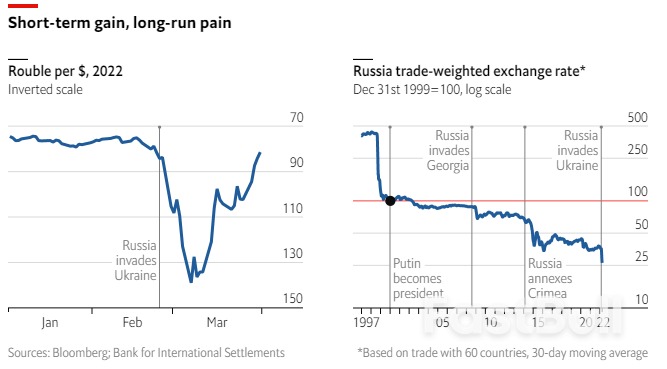
          It was meant to be an economic bazooka that would strike at the heart of Russia's economy. On February 26th, two days after Ukraine was invaded, America and its Western allies froze much of Russia's $640bn war chest of foreign-exchange reserves. Along with other measures, these sanctions were intended to inflict economic pain on the Kremlin. It worked at first: by early March Russia's currency, the rouble, had fallen by 40% against the dollar. By March 31st a dollar could be exchanged for 82 roubles, just 4% lower than the average rate a week before the invasion began.

          What is the cause of the rouble's resilience?

          Russian officials have employed various tactics to defend the value of the currency. First, the central bank raised interest rates on February 28th from 9.5% to 20%. Second, they imposed a 30% fee on purchases of foreign exchange (since lowered to 12%). Third, exporters—such as those selling oil and gas—were mandated to convert 80% of their foreign-exchange earnings to roubles.
          The Kremlin did not stop there. From March 31st it requested that foreign buyers of oil and gas pay in roubles. That would help prop up the currency further. But that is causing a stir in Europe. Three-quarters of Russia's gas exports are piped directly to EU countries, whose contracts stipulate payment in euros. Germany, which gets half of its gas from Russia, is preparing for the possibility of looming gas shortages if a protracted dispute arises. On March 31st Vladimir Putin, Russia's president, threatened to cut off gas supplies to “unfriendly countries” that did not pay in roubles from April 1st. But Russia needs the money as much as Europe needs the gas: in 2021 revenues from oil and gas financed one-third of the government's revenue.
          Although the rouble appears to be defying gravity, two other indicators suggest that the market price may not be all that it seems. First, the one-year forward exchange-rate for roubles against the dollar— a measure of the market's expected exchange rate, given the interest-rate differential between Russia and America—suggests that the rouble may fall by about one-quarter from today's value, to 110 or so to the dollar. Second, with many brokers either wary or prevented from dealing in roubles, the market price will be based on far fewer transactions than usual, in which the participants may have little choice about the price they get. By contrast, the going rate on the black market this week was reportedly between 135 and 250 roubles to the dollar.
          Whatever the latest price, the story of the rouble is one of long-run decay. Russia's debt crisis caused its trade-weighted value to fall by 70% in 1998. But since Mr Putin came to power on December 31st 1999 it has crumbled by a further 70%. Its long-term outlook is bleak, too. If Europe were to quickly wean itself off Russian gas it would take years to install pipeline capacity for alternative buyers in the east. The rouble may have further to fall.

          Source:The Economist

          Risk Warnings and Disclaimers
          You understand and acknowledge that there is a high degree of risk involved in trading. Following any strategies or investment methods may lead to potential losses. The content on the site is provided by our contributors and analysts for information purposes only. You are solely responsible for determining whether any trading assets, securities, strategy, or any other product is suitable for investing based on your own investment objectives and financial situation.
          Comments
          Add to Favorites
          Share

          How the US's Strategic Petroleum Reserve Works

          Owen Li
          US President Joe Biden has announced the release of one million barrels of crude oil every day for the next six months from the Strategic Petroleum Reserve (SPR), the largest such release from the United States stockpile in history.
          The move comes as oil prices have spiked since Moscow's invasion of Ukraine on February 24 and subsequent sanctions slapped on Russia by the US and its allies.
          The latest amount of US oil release would make 180 million barrels available – or the equivalent to about two days of global demand – and marks the third time the US has tapped the SPR in the past six months.
          It is also possible that the International Energy Agency, the world's energy watchdog, of which the US is a member, may also release barrels when IEA countries meet on Friday.
          The 31-member IEA, representing industrialised nations but not including Russia, presided over the fourth coordinated oil release in its history on March 1 of over 60 million barrels of crude – its largest yet.
          As part of the IEA's March release, the US committed to releasing 30 million barrels of SPR oil.
          Before that, Washington pledged in November to release 50 million barrels of SPR oil, though an expected move in tandem from China did not materialise, as prices surged along with demand recovery for the COVID-19 pandemic.
          Here's what you need to know about the SPR and President Biden's announcement:

          Why was the SPR created?

          The US created the SPR in 1975 after an Arab oil embargo led to a spike in gasoline prices and damaged the US economy. US presidents have tapped the stockpile to calm oil markets during war or when hurricanes hit oil infrastructure along the US Gulf of Mexico.
          The reserve currently holds about 586 million barrels in dozens of caverns in four heavily guarded locations on the Louisiana and Texas coasts. The country also maintains small heating oil and gasoline reserves in the US Northeast.

          How does SPR oil reach the market?

          Because of its location near big US refining or petrochemical centres, the SPR can ship as much as 4.4 million barrels per day. It can take only 13 days from a presidential decision for the first oil to enter the country's market, according to the US Department of Energy.
          Under a sale, the Energy Department usually holds an online auction in which energy companies bid on the oil. Under a swap, oil companies take crude but are required to return it, plus interest.
          Prior to the last six months, US presidents have authorised emergency sales from the SPR three times, most recently in 2011 during a war in Libya, an OPEC member. Sales also took place during the Gulf War in 1991 and after Hurricane Katrina in 2005.
          Oil swaps have taken place more frequently, with the last exchange held in September after Hurricane Ida.

          What other countries have strategic reserves?

          The US is responsible for about half of the world's strategic petroleum reserves.
          The US and other IEA member countries including Germany, Japan, Australia and the United Kingdom are required to hold oil in emergency reserves equivalent to 90 days of net oil imports. Japan has one of the largest reserves after China and the US.
          China, an associate member of the IEA and the world's second-leading oil consumer, created its SPR 15 years ago and held its first oil reserve auction in September. Another IEA associate member, India, the third-biggest oil importer and consumer, also maintains a reserve.
          State storage across the Organisation for Economic Co-operation and Development, most of whose members belong to IEA, came to nearly 1.2 billion barrels of crude as of January, according to the IEA.

          SOURCE: REUTERS

          Risk Warnings and Disclaimers
          You understand and acknowledge that there is a high degree of risk involved in trading. Following any strategies or investment methods may lead to potential losses. The content on the site is provided by our contributors and analysts for information purposes only. You are solely responsible for determining whether any trading assets, securities, strategy, or any other product is suitable for investing based on your own investment objectives and financial situation.
          Comments
          Add to Favorites
          Share

          Sanctions Against Russia Pose a Conundrum for Bitcoin

          Kevin Du

          Russia-Ukraine Conflict

          Almost half of Russia’s $630 billion reserves have been seized by foreign governments since the invasion of Ukraine. It was relatively easy to do given modern financial infrastructure.
          The mainstream temptation is to react favorably to this move. Russia will be poorer and so less able to fund its war. The baddies lose, the goodies win.
          Now consider the story of the Canadian truckers who have been criminalized by their own government for seemingly doing little more than protecting their right to work. Invoking emergency legislation, the Canadian government froze 210 bank accounts with deposits of C$7.8 million. And under pressure from the government, GoFundMe withheld C$10m in donations for the cause. The lesson — mess with the government, and we’ll steal your money.
          A key tenet of Bitcoin is its unseizability. Anyone, anywhere can own bitcoin, and be confident it can’t be taken away. That means Canadian truckers and their supporters, but it means the Russian government and their supporters too. You can’t apply Bitcoin principles to one, and not the other.
          In that sense, Bitcoin is a bit like free speech: you can’t cherry pick its merits. As soon as you decide some people are less worthy of free speech than others, you destroy the entire concept. As soon as you start to censor uncensorable money, a large reason for having it disappears.
          Russia clearly didn’t anticipate its foreign reserves would be in scope for sanctions. If it had, it would have been buying up even more gold and Chinese renminbi. The next country thinking of irking Western powers will be sure to hold their reserves in currencies and assets that can’t be confiscated. Like bitcoin.
          When the conflict in Ukraine began, the Bitcoin community was quick to circulate the narrative that Bitcoin made wars less likely. The logic is reasoned. Since the collapse of the gold standard, governments have been free to print as much money as they like, to fund whatever ambitions they have. No ambition is as costly as war, and no cause is easier to justify the need for more money. Indeed, financing the two World Wars and the Vietnam War all served to gradually kill the relationship between money supply and gold. The finite supply of bitcoin changes that. Governments can’t simply run the virtual printing machine to buy the weapons they need, so war becomes unfinanceable.
          But the flip side of that argument is that the enemy who holds bitcoin can only be defeated on the battlefield. Not only are their bitcoin reserves protected from seizure; imposing trade sanctions is tricky because bitcoin transactions are hard to trace.
          This is an uncomfortable conundrum for Bitcoin. It can protect citizens from tyrannical overreach, but it can also protect tyrants with designs on another nation’s citizens.
          Until now, most of the advocacy for Bitcoin has focused on the liberty of the individual versus the state, because it is mainly individuals who have adopted it. As Bitcoin becomes better understood by the higher echelons of the global financial system, the case grows for governments to apportion some of their reserves to it. If and when that happens, expect bitcoin’s price (and Bitcoiners’ wealth) to go north very fast. What’s not to like?
          The Bitcoin community risks confirmation bias by not thinking through the full implications. It would be naive to think there is only upside. They say Bitcoin changes people; that it is “F-you money” and with it you are no longer beholden to anyone. But what if the person, or the government, with bitcoin needs to be held down. What then?

          Source:Bitcoinmagazine.

          Risk Warnings and Disclaimers
          You understand and acknowledge that there is a high degree of risk involved in trading. Following any strategies or investment methods may lead to potential losses. The content on the site is provided by our contributors and analysts for information purposes only. You are solely responsible for determining whether any trading assets, securities, strategy, or any other product is suitable for investing based on your own investment objectives and financial situation.
          Comments
          Add to Favorites
          Share

          Saudi Arabia Real GDP Grows 6.7% in Q4 2021

          Devin
          Saudi Arabia's real Gross Domestic Product (GDP) grew by 6.7% in Q4 2021 compared to Q4 2020. This positive growth was to a large extent due to the increase in oil revenues (+10.9% y-o-y), said Al Rajhi Capital Research.
          The non-oil revenues also increased strongly by 5.1% y-o-y, while government activities expanded by 2.4% y-o-y, according to data issued by the General Authority for Statistics.
          The kingdom's non-oil exports growth for the month of January 2022 increased by 27.5% y-o-y, compared to the increase of 56.1% y-o-y in December 2021. Segment-wise: plastics & rubbers and chemical products rose +28.9% y-o-y and +44.4% y-o-y, respectively.

          Merchandise imports

          Merchandise imports increased 8.1% y-o-y in January 2022 as compared to the increase of 19.4% y-o-y in December 2021. Meanwhile, China is the top export destination and also continued to be the largest import country in January 2022.
          The rating agency S&P affirmed Saudi Arabia's rating at 'A-', but revised its outlook to 'positive' from 'stable', citing improving gross domestic product growth and fiscal dynamics over the medium term.
          Further, The Saudi Central Bank's monthly statistics indicated that the macro-economic conditions are healthy in the kingdom.
          Money Supply
          Money Supply (M3) continued to grow in February 2022 (+7.8% y-o-y) to stand at SR2,330 billion ($621 billion); while M1 and M2 increased 4.3% y-o-y and 5.3% y-o-y, respectively. As per the weekly money supply data by Saudi Central Bank, M3 may be higher in March 2022 than in the month of February 2022.
          Credit to the private sector witnessed a growth of 14.9% y-o-y (+1.6% m-o-m) in February 2022; while bank claims on public sector advanced 11.5% y-o-y (+1.6% m-o-m) in the same month. Meanwhile, deposits rose 8.7% y-o-y (+1.7% m-o-m) in February 2022.
          Meanwhile, LDR came in at 80.83% in February 2022. Q4 2021 labour data: Saudi unemployment rate came in at 11.0% in Q4 2021 as compared to 11.3% from Q3 2021; while overall unemployment in the kingdom came in at 6.9% in Q4 2021 as compared to 6.6% in Q3 2021.

          Labour force

          Further, the Saudi labour force participation rate increased to 51.5% in Q4 2021 (49.8% in Q3 2021).
          Meanwhile, the average monthly wages of Saudi nationals declined 2.8% q-o-q to SR10,186; while the overall monthly wages fell 6.0% q-o-q to SR6,380.
          Banking sector net profit before Zakat and tax increased 55.2% y-o-y to SR4.8 billion in February 2022 as compared to an increase of 5.0% y-o-y in January 2022. However, on a monthly basis, the banking sector profits declined by 10.8% in February 2022 (+5.7% m-o-m in January).
          The monthly mortgage disbursement was SR8.8 billion in Feb 2022 (compared to monthly disbursement of SR14.2 billion in Feb 2021).

          Foreign reserves

          Saudi Central Bank's foreign reserves, on an annual basis, rose 0.05% in February 2022 versus decline of 0.7% y-o-y in January 2022. However, the reserves declined 1.2% m-o-m in February 2022 (-1.9% m-o-m in January).
          Meanwhile, as of February 2022, government reserves with Saudi Central Bank stood at SR368.1 billion (including government current account), which declined 3.0% m-o-m.
          Remittances (Personal Transfers) by Saudi nationals increased 33.7% y-o-y in February 2022 (+45.3% y-o-y in January 2022). However, remittances by non-Saudi nationals declined 0.9% y-o-y in the same month (+3.8% y-o-y in January 2022).

          Source: TradeArabia

          Risk Warnings and Disclaimers
          You understand and acknowledge that there is a high degree of risk involved in trading. Following any strategies or investment methods may lead to potential losses. The content on the site is provided by our contributors and analysts for information purposes only. You are solely responsible for determining whether any trading assets, securities, strategy, or any other product is suitable for investing based on your own investment objectives and financial situation.
          Comments
          Add to Favorites
          Share

          India C.Bank Focussed on Growth, Seen Lagging on Inflation Fight

          Damon
          India C.Bank Focussed on Growth, Seen Lagging on Inflation Fight_1
          Inflation is picking up in India, but the country's central bank is likely to maintain its loose policy even as its global peers raise rates, potentially forcing it to play catch-up aggressively later, economists and analysts say.
          This view represents a shift in expectations, as market participants say the Reserve Bank of India is concerned that Russia's invasion of Ukraine is damaging the global economy and India's recovery prospects, not just boosting prices.
          A Reuters poll in early February found just over half of forecasters expecting the RBI to raise rates at its April meeting, but the war launched three weeks later has upended those predictions.
          RBI watchers now expect the bank to stand pat on April 8, even though inflation has broken above the 6% upper end of the bank's target band for two months.
          Saugata Bhattacharya, chief economist at Axis Bank, who had earlier expected the RBI to raise its reverse-repurchase rate next week, now says global uncertainties mean that "it makes sense to remain at a status quo."
          Supporting such expectations, RBI Governor Shakikanta Das recently warned against a "premature demand compression through monetary policy".
          Deputy Governor Michael Patra said India's growth was as weak as in 2013, when a U.S. policy shift sent capital gushing out of emerging markets. "The recent reverberations of war have in fact, tilted the balance of risks downwards" for the economy, he said.
          But economists warn inflation could spin out of control, hurting investors and savers alike - and most market participants say the RBI is already behind the curve on tackling inflation.
          STOKING RISK OF OVERHEATING
          Economists expect the RBI to raise its retail-inflation projection for the fiscal year starting on Friday by 50 to 80 basis points from the current 4.5%.
          Upward price pressure is expected to continue as the war and resulting economic sanctions on Moscow send prices soaring for the grain, energy and other exports that Russia and Ukraine provide.
          "In the aftermath of the Russia-Ukraine war, the probability that higher-than-expected inflation will persist has increased. The longer we wait to address that, the faster that we may have to play catch-up with it eventually," said Churchil Bhatt, executive vice president of debt investments at Kotak Life Insurance.
          Rising asset prices could feed through to demand-side inflation, while savers are being hurt as their returns lag behind inflation, said Rupa Rege Nitsure, chief economist at L&T Financial Services.
          "By keeping interest rates artificially low, the chances of more aggressive tightening at a later stage have gone up significantly," she said.
          Abhay Gupta, emerging Asia fixed income and forex strategist at BofA Securities, said the RBI must "be vigilant for broader inflationary pressures."
          "Higher uncertainty would reduce room for error and markets would have to price in higher chances of a policy mistake," he said. Risks of eventual economic overheating suggest market interest rates must rise while the rupee should weaken, he said.

          Source: REUTERS

          Risk Warnings and Disclaimers
          You understand and acknowledge that there is a high degree of risk involved in trading. Following any strategies or investment methods may lead to potential losses. The content on the site is provided by our contributors and analysts for information purposes only. You are solely responsible for determining whether any trading assets, securities, strategy, or any other product is suitable for investing based on your own investment objectives and financial situation.
          Comments
          Add to Favorites
          Share

          OPEC+ Sticks to Output Rise Plans for May as US Announces Release of Record Oil Reserves

          Devin
          OPEC+ will add another 432,000 barrels per day of crude to the market in May, staying the course of incremental increases in global oil supply as the US government announced plans to release massive inventory from its strategic reserve to tackle soaring inflation and petrol prices.
          The 23-member super group of producers, led by Saudi Arabia and Russia, agreed to bring the additional barrels in their online meeting on Thursday. The group will hold its next meeting on May 5 to review market dynamics, it said in a statement.
          "Continuing oil market fundamentals and the consensus on the outlook pointed to a well-balanced market, and that current volatility is not caused by fundamentals, but by ongoing geopolitical developments," the statement said.
          The decision to increase output followed earlier reports that the US government was considering the release of about 1 million barrels of oil per day from its strategic petroleum reserve (SPR). A total of 180 million barrels could be released over to rein in inflation in the world's biggest economy.
          The White House on Thursday formally announced the biggest-ever release from its SPR, and said it will continue to add additional barrels to the market for the next six months.
          It is the third time the country is tapping into its SPR in the past six months. The US released 60 million barrels from the reserve in November. It has committed 30 million barrels as part of the International Energy Agency's (IEA) move to release 60 million barrels from emergency stocks.
          The US move will likely reinforce plans of the alliance to "only incrementally add production back to markets … as consuming nations take emergency steps to limit the pass-through effects of high energy prices," said Daniel Richards, Middle East and North Africa economist at Emirates NBD.
          Oil prices fell sharply on reports of US plans to release more inventory. Brent, the global benchmark for two thirds of the world's oil, was 4.62 per cent lower at $108.2 per barrel at 7.29pm UAE time on Thursday. West Texas Intermediate, the gauge that tracks US crude, pared some earlier losses to trade 4.42 per cent lower at $103 a barrel.
          OPEC+ on Wednesday removed the IEA from its trusted data sources. The Joint Technical Committee, which advises Opec+, decided to replace the IEA data with reports from Wood Mackenzie and Rystad Energy, Reuters reported, citing sources.
          The Paris-based IEA advises Western governments on energy policy and has the US as its top financier. The agency's executive director Fatih Birol has been openly critical of OPEC+ members calling on leading producers to do more. Mr Birol is an economist who previously spent five years at Opec in the early 1990s.
          IEA member countries are planning to meet on Friday after the agency last week said it could release more oil into the market "if needed" to tackle soaring prices. The IEA has so far committed to release 61.7 million barrels of oil, about 4 per cent of the group's total reserves.
          "An SPR release is not without its risks," said Edward Bell, senior director of Market Economics at Emirates NBD. "Even if extended over a six-month period … the SPR release wouldn't be enough to compensate for what is appearing to be a material disruption to Russian crude flows."
          After an online meeting of the bloc's technical committee on Wednesday, Opec secretary general Mohammad Barkindo reiterated the importance of the group's role in supporting stability and the rebalancing in the global oil market and said the member countries have done "heavy lifting" and were "instrumental" in support efforts.
          "We urge global leaders to follow this example of multilateralism to … ensure an unhindered, stable and secure flow of energy to the whole world," he said.
          He asked the member countries to stay the course and remain attentive to ever-changing market conditions.
          "We must remain focused on balancing the oil market," he said.
          OPEC+ Sticks to Output Rise Plans for May as US Announces Release of Record Oil Reserves_1The producers' alliance has resisted calls from the US, its European allies and other oil importing nations to increase output amid soaring crude prices and has stuck to its agreed output increases so far.
          The alliance this week sent clear signals that it was unwilling to let global geopolitics dictate its output policies and undermine efforts to stabilise a volatile crude market.
          Suhail Al Mazrouei, Minister of Energy and Infrastructure, said the UAE will work within the framework of the OPEC+ alliance to ensure the stability of the energy market and that the group's oil production plans must stay independent of politics.
          His message was echoed by Saudi Arabia's Energy Minister Prince Abdulaziz bin Salman, who said global oil price volatility would have been worse without the efforts of Opec+.
          Russia, the world's second largest energy exporter, produces about 10 million bpd or about 10 per cent of global output, and OPEC+ must "compartmentalise" political differences for the collective good, he said.
          For several months, the OPEC+ alliance has worked to bring back 5.8 million bpd in production cuts to restore supply that was greatly reduced after the onset of the Covid-19 pandemic in 2020. The alliance achieved a historic reduction of 9.7 million bpd between May 2020 and July of last year.
          From May 2022, the group will follow the new higher baseline levels for several producers in the alliance and an additional 432,000 barrels per day of oil are expected to be added to market on a monthly basis, compared with 400,000 bpd, which had been the monthly target since the third quarter of last year.
          Oil markets have been extremely volatile this year, rocked by Russia's war in Ukraine which is threatening global energy supplies. Brent, which climbed to a notch under $140 per barrel this month, a 14-year high, has given up some gains but is still up about 45 per cent since the start of this year.
          MUFG Bank, Japan's biggest lender, said the current pull back is "detached with market fundamentals" and oil prices have the potential to rise further.
          "This, combined with the physical decoupling from Russian commodities only just starting out, sets the stage for the next rally."
          Ipek Ozkardeskaya, a senior analyst at Swissquote Bank agreed, and said "the price pull backs are still seen as interesting dip buying opportunities to strengthen long positions".
          In the near term, energy markets could tighten further with demand up almost 3 million bpd over last year, reaching pre-pandemic levels in the fourth quarter, Dr Sultan Al Jaber, Minister of Industry and Advanced Technology and UAE Special Envoy for Climate Change, said this week at the energy summit.
          Opec+, which has been shepherding oil prices since 2016, has little spare capacity and most of its members lack the ability to boost production due to years of underinvestment in infrastructure.
          Mr Barkindo welcomed plans by industry stakeholders to increase investment and launch new projects, including Aramco's intention to boost upstream capital spending by about $50 billion this year.
          "This underscores the commitment of the kingdom of Saudi Arabia to address the world's future energy needs," he said.

          Source: The National News.

          Risk Warnings and Disclaimers
          You understand and acknowledge that there is a high degree of risk involved in trading. Following any strategies or investment methods may lead to potential losses. The content on the site is provided by our contributors and analysts for information purposes only. You are solely responsible for determining whether any trading assets, securities, strategy, or any other product is suitable for investing based on your own investment objectives and financial situation.
          Comments
          Add to Favorites
          Share

          A National Bitcoin Strategy Featuring Matthew Pines

          Kevin Du
          In this episode of the "Fed Watch" podcast, CK and I had the privilege to chat with Matthew Pines from the Bitcoin Policy Institute. He recently wrote the fantastic and comprehensive Bitcoin essay for policymakers and the general public, "Bitcoin and US National Security: An Assessment of Bitcoin as a Strategic Opportunity for the United States." Our conversation was a summary of the essay, digging deeper into quality vs quantity adoption, stablecoins, and ways that nations view Central Bank Digital Currencies (CBDCs) differently. It ends with talking about the Federal Reserve (Fed) and their predicament right now over rate hikes with an inverted yield curve.
          "Fed Watch" is a podcast for people interested in central bank current events and how Bitcoin will integrate or replace aspects of the traditional financial system. To understand how bitcoin will become global money, we must first understand what's happening now.

          REPORT SUMMARY

          We started out by discussing who was Pines' target audience and how that affected the structure of the paper. I was curious because the paper is very comprehensive, covering Bitcoin's technical mechanics, recent monetary history and the ways bitcoin could be used to the strategic advantage of the United States.
          Pines responded that he anchored the structure of the paper around Biden's recent executive order. As people are taking a closer look at these topics and as they are writing reports themselves in response to that order, Pines wanted to give them an analytical primer and a summary of how Bitcoin can address the specific concerns of the administration about national security.

          BITCOIN ADOPTION

          Next, we get into some specifics from the report. He mentions that 16% of U.S. adults own bitcoin and other cryptocurrencies. However, this is an overall figure and doesn't speak to the quality of that adoption. For instance, it could be gamblers buying tokens on Coinbase. I wondered if he had insight on adoption by the politically powerful, i.e., business leaders, government officials, influencers, millionaires and billionaires. In essence, I asked Pines to speculate based on his unique knowledge set.
          Pines has a great line when he says, "The power of selective high-value orange-pilling can't be overstated." He says that it's kind of what we all want, but it can turn out badly. He also warns against concentrating too much on politicians. In other words, let Bitcoin's incentives do the work.
          Staying on the policy front for one more question, we ask if adoption is closing the window for potentially devastating policy decisions. If 16% of the public own bitcoin now, how much will that be in one or two years? If 50% of people own bitcoin and even more people within the politically influential class own bitcoin, does that make it nearly impossible to get bad policy? Once again, I'm asking him to speculate on this question.
          Pines' answer is very constructive. He points out that the window of policy is moving in a positive direction, citing Senator Lummis' recent work. He makes the distinction between the legislative and executive branches and says each has a different relationship to policy. The lawmakers are oblivious, but an average employee of the executive branch could perpetuate misunderstanding because they are in a rush to write a brief or complete a report.

          STABLECOINS AND EUROPE

          Now we get into the CBDC discussion, focusing on Europe first. Pines claims that the European Union is inherently threatened by USD stablecoins and bitcoin, because it is the monetary union that underpins the political union. Therefore, the EU is naturally drawn to CBDC solutions.
          Pines also agrees that the Fed differs from the European Central Bank in terms of its pursuit of a CBDC. Basically, the Fed has a great grasp on the issues and forces at play in a CBDC. They are already much more friendly to USD stablecoins than a CBDC, even though they might not know all the strategic advantages that Pines has outlined in his report.
          One of Pines' great points from his report is the ability for the Fed to regulate USD stablecoins and force them to be buyers of U.S. Treasury securities. This could add more demand for Treasuries and even give the Fed a new policy tool.

          THE FED IS TRAPPED

          In the last part of the interview, we have time to quickly cover the Fed's predicament. They have made a massive move to hawkishness, and after only one tiny hike, the yield curve is already inverting, signaling recession. I asked Pines what he thought of this development and what his take on the Fed's options are at this point.
          Pines goes on to expertly describe the situation in which the Fed finds itself as an "irreducibly complex system." The Fed has to poke this complex system increasingly harder each time and wait to see what breaks. Pines says if we want to see where we are headed, we should look to Japan because they are five to 10 years ahead of the rest of the world in monetary experiments like quantitative easing and yield curve control.

          Source: Bitcoinmagazine.com

          Risk Warnings and Disclaimers
          You understand and acknowledge that there is a high degree of risk involved in trading. Following any strategies or investment methods may lead to potential losses. The content on the site is provided by our contributors and analysts for information purposes only. You are solely responsible for determining whether any trading assets, securities, strategy, or any other product is suitable for investing based on your own investment objectives and financial situation.
          Comments
          Add to Favorites
          Share
          FastBull
          Copyright © 2025 FastBull Ltd

          728 RM B 7/F GEE LOK IND BLDG NO 34 HUNG TO RD KWUN TONG KLN HONG KONG

          TelegramInstagramTwitterfacebooklinkedin
          App Store Google Play Google Play
          Products
          Charts

          Chats

          Q&A with Experts
          Screeners
          Economic Calendar
          Data
          Tools
          Membership
          Features
          Function
          Markets
          Copy Trading
          Latest Signals
          Contests
          News
          Analysis
          24/7
          Columns
          Education
          Company
          Careers
          About Us
          Contact Us
          Advertising
          Help Center
          Feedback
          User Agreement
          Privacy Policy
          Business

          White Label

          Data API

          Web Plug-ins

          Poster Maker

          Affiliate Program

          Risk Disclosure

          The risk of loss in trading financial instruments such as stocks, FX, commodities, futures, bonds, ETFs and crypto can be substantial. You may sustain a total loss of the funds that you deposit with your broker. Therefore, you should carefully consider whether such trading is suitable for you in light of your circumstances and financial resources.

          No decision to invest should be made without thoroughly conducting due diligence by yourself or consulting with your financial advisors. Our web content might not suit you since we don't know your financial conditions and investment needs. Our financial information might have latency or contain inaccuracy, so you should be fully responsible for any of your trading and investment decisions. The company will not be responsible for your capital loss.

          Without getting permission from the website, you are not allowed to copy the website's graphics, texts, or trademarks. Intellectual property rights in the content or data incorporated into this website belong to its providers and exchange merchants.

          Not Logged In

          Log in to access more features

          FastBull Membership

          Not yet

          Purchase

          Become a signal provider
          Help Center
          Customer Service
          Dark Mode
          Price Up/Down Colors

          Log In

          Sign Up

          Position
          Layout
          Fullscreen
          Default to Chart
          The chart page opens by default when you visit fastbull.com