• Trade
  • Markets
  • Copy
  • Contests
  • News
  • 24/7
  • Calendar
  • Q&A
  • Chats
Trending
Screeners
SYMBOL
LAST
BID
ASK
HIGH
LOW
NET CHG.
%CHG.
SPREAD
SPX
S&P 500 Index
6834.49
6834.49
6834.49
6840.03
6792.61
+59.73
+ 0.88%
--
DJI
Dow Jones Industrial Average
48134.88
48134.88
48134.88
48289.63
48034.19
+183.04
+ 0.38%
--
IXIC
NASDAQ Composite Index
23307.63
23307.63
23307.63
23307.91
23106.19
+301.28
+ 1.31%
--
USDX
US Dollar Index
98.330
98.410
98.330
98.370
98.050
+0.270
+ 0.28%
--
EURUSD
Euro / US Dollar
1.17068
1.17105
1.17068
1.17375
1.17025
-0.00165
-0.14%
--
GBPUSD
Pound Sterling / US Dollar
1.33729
1.33844
1.33729
1.33938
1.33567
-0.00074
-0.06%
--
XAUUSD
Gold / US Dollar
4338.53
4338.53
4338.53
4356.40
4309.03
+5.87
+ 0.14%
--
WTI
Light Sweet Crude Oil
56.393
56.645
56.393
56.679
55.579
+0.625
+ 1.12%
--

Community Accounts

Signal Accounts
--
Profit Accounts
--
Loss Accounts
--
View More

Become a signal provider

Sell trading signals to earn additional income

View More

Guide to Copy Trading

Get started with ease and confidence

View More

Signal Accounts for Members

All Signal Accounts

Best Return
  • Best Return
  • Best P/L
  • Best MDD
Past 1W
  • Past 1W
  • Past 1M
  • Past 1Y

All Contests

  • All
  • Trump Updates
  • Recommend
  • Stocks
  • Cryptocurrencies
  • Central Banks
  • Featured News
Top News Only
Share

China's November Fuel Oil Imports Up 15% From October

Share

White House: Federal Incumbents Have 12 Months To Submit Relocation Plans

Share

White House: Memorandum Directs Immediate Planning To Relocate Federal Systems Using 7.125-7.4 Ghz Band Of Spectrum So It Can Be Cleared For Commercial 6G Use

Share

A Relevant Official From The National Development And Reform Commission Answered Reporters' Questions Regarding The "Rules On Pricing Behavior Of Internet Platforms"

Share

China Imports No US Soybeans For Third Month, Argentine Arrivals Up 634%

Share

Marco Rubio: Has Refused Visa Application Of Marlon Ochoa & Taken Steps To Impose Visa Restrictions On Another Individual For Undermining Democracy In Honduras

Share

[“Rules On Pricing Behavior Of Internet Platforms” Issued] In Order To Improve The Normalized Price Supervision Mechanism Of Internet Platforms, Regulate Relevant Pricing Behavior, Protect The Legitimate Rights And Interests Of Consumers And Operators, And Promote The Innovation And Healthy Development Of The Platform Economy, The National Development And Reform Commission, The State Administration For Market Regulation, And The Cyberspace Administration Of China Have Formulated The “Rules On Pricing Behavior Of Internet Platforms”

Share

U.S. Treasury Secretary Bessant: Inflation Is Moving Toward The Fed’s 2% Target

Share

Source: Russia's Dmitriev Heading For US To Meet Witkoff, Kushner

Share

The Source: Three-Way Contacts With Participation Of Ukrainian Side Are Not Planned

Share

[Putin: Seizing Russian Assets In Europe Is "Robbery"] On The 19th Local Time, Russian President Vladimir Putin Held His Annual Press Conference In Moscow. Regarding The EU's Freeze On Russian Assets, Putin Said That The Attempt To Seize Russian Assets In Europe "is Not Even Theft, But Robbery." Putin Stated That Russia Will First Defend Its Interests Through Legal Means. Putin Said That "theft" Is Not An Appropriate Word; Theft Refers To The Covert Appropriation Of Another's Property. But For Them, They Are Attempting To Do So Openly, Which Is Clearly Robbery In Broad Daylight

Share

[Trump Administration Proposes New Model For Medicare Spending Cuts] On December 19, Following An Event At The White House With Pharmaceutical Companies, President Trump's Administration Proposed A New Model For Medicare Payments On Certain Drugs Used In Doctors' Offices And Dispensed In Pharmacies. Trump Implemented A Similar Set Of Regulations During His First Term, Which Was Met With Strong Opposition From The Pharmaceutical Industry. For Months, The Threat Of Trump Potentially Reinstating Such Regulations Has Loomed Over Drug Price Negotiations. The Industry Trade Group, The Pharmaceutical Research And Manufacturers Of America (Phrma), Did Not Immediately Respond To A Request For Comment

Share

Trump: Government Of Syria Is Fully In Support Of US

Share

[New York Governor Signs Law Restricting Advanced AI, Faces Opposition From Tech Industry] On December 19, New York Governor Kathy Hochul Signed Legislation (AB 6453, Which Will Take Effect In January 2027), Making New York The Second State In The US To Impose Restrictions On Cutting-edge Artificial Intelligence (AI). AI Developers Will Be Held Legally Responsible For Cyberattacks And Other Disruptive Incidents Facilitated By Their Systems, And Must Develop Security Plans And Alert Regulators Within 72 Hours Of Discovering A Threatening Incident. The Legislation Applies To Companies With Annual Revenue Exceeding $500 Million, With Fines Ranging From $1 Million For The First Offense To $3 Million For Subsequent Offenses

Share

USA Justice Department Will Appeal Dismissal Of Cases Against Trump Foes James, Comey

Share

[Ukrainian President: Situation On The Frontline Is Increasingly Difficult] Ukrainian President Volodymyr Zelenskyy Acknowledged In An Interview On The 19th That The Situation On The Front Lines Is Extremely Complex And Increasingly Difficult. Zelenskyy Stated That He Recently Visited Kupyansk, Located In Eastern Kharkiv Oblast, Where Ukrainian Troops Still Control The Transportation Hub. However, Russian Troops Are "exerting Pressure." Zelenskyy Also Admitted That Due To Various Reasons, "the Supply Of Certain Types Of Ammunition And Anti-aircraft Missiles Has Encountered Problems, And Related Deliveries Have Been Delayed."

Share

On Friday (December 19), In Late New York Trading, S&P 500 Futures Rose 0.93%, Dow Jones Futures Rose 0.40%, NASDAQ 100 Futures Rose 1.31%, And Russell 2000 Futures Rose 0.89%

Share

Fitch On Gabon: Expect A Deceleration To 2.7% Over 2026-2027, As Government Spending Declines Amid Funding Pressures

Share

[Trump Media's Fusion Partner Faces Payment Allegations] The $6 Billion Merger Between US President Trump's Social Media Empire And A Fusion Startup Will Inject Up To $300 Million Into The Ambitious Energy Producer Tae Technologies. Tae Technologies Has Been Repeatedly Accused Of Failing To Pay Suppliers And Vendors. In The Past 16 Months, At Least Nine Suppliers Have Filed Lawsuits Alleging Unpaid Invoices For Specialized Parts, Recruitment Fees, And Rent. Tae Technologies Stated That It Is Conducting A Comprehensive Review Of Overdue Supplier Bills And Will Handle Verified Debts In An Orderly And Responsible Manner In Accordance With Financial Controls And Long-term Operational Plans

Share

Fitch: Forecasts Gabon's Government Debt Will Substantially Increase In 2025, To 80.4% Of GDP

TIME
ACT
FCST
PREV
U.K. GfK Consumer Confidence Index (Dec)

A:--

F: --

P: --

Japan Benchmark Interest Rate

A:--

F: --

P: --

BOJ Monetary Policy Statement
Australia Commodity Price YoY

A:--

F: --

P: --

BOJ Press Conference
Turkey Consumer Confidence Index (Dec)

A:--

F: --

P: --

U.K. Retail Sales YoY (SA) (Nov)

A:--

F: --

P: --
U.K. Core Retail Sales YoY (SA) (Nov)

A:--

F: --

P: --
Germany PPI YoY (Nov)

A:--

F: --

P: --

Germany PPI MoM (Nov)

A:--

F: --

P: --

Germany GfK Consumer Confidence Index (SA) (Jan)

A:--

F: --

P: --
U.K. Retail Sales MoM (SA) (Nov)

A:--

F: --

P: --

France PPI MoM (Nov)

A:--

F: --

P: --

Euro Zone Current Account (Not SA) (Oct)

A:--

F: --

P: --

Euro Zone Current Account (SA) (Oct)

A:--

F: --

P: --

Russia Key Rate

A:--

F: --

P: --

U.K. CBI Distributive Trades (Dec)

A:--

F: --

P: --

U.K. CBI Retail Sales Expectations Index (Dec)

A:--

F: --

P: --

Brazil Current Account (Nov)

A:--

F: --

P: --

Canada Retail Sales MoM (SA) (Oct)

A:--

F: --

P: --
Canada New Housing Price Index MoM (Nov)

A:--

F: --

P: --

Canada Core Retail Sales MoM (SA) (Oct)

A:--

F: --

P: --
U.S. Existing Home Sales Annualized MoM (Nov)

A:--

F: --

P: --
U.S. UMich Consumer Sentiment Index Final (Dec)

A:--

F: --

P: --

U.S. Conference Board Employment Trends Index (SA) (Nov)

A:--

F: --

P: --
Euro Zone Consumer Confidence Index Prelim (Dec)

A:--

F: --

P: --

U.S. UMich 1-Year-Ahead Inflation Expectations Final (Dec)

A:--

F: --

P: --

U.S. UMich Consumer Expectations Index Final (Dec)

A:--

F: --

P: --

U.S. UMich Current Economic Conditions Index Final (Dec)

A:--

F: --

P: --

U.S. Existing Home Sales Annualized Total (Nov)

A:--

F: --

P: --
U.S. Weekly Total Rig Count

A:--

F: --

P: --

U.S. Weekly Total Oil Rig Count

A:--

F: --

P: --

China, Mainland 5-Year Loan Prime Rate

--

F: --

P: --

China, Mainland 1-Year Loan Prime Rate (LPR)

--

F: --

P: --

U.K. Current Account (Q3)

--

F: --

P: --

U.K. GDP Final YoY (Q3)

--

F: --

P: --

U.K. GDP Final QoQ (Q3)

--

F: --

P: --

Italy PPI YoY (Nov)

--

F: --

P: --

Mexico Economic Activity Index YoY (Oct)

--

F: --

P: --

Canada National Economic Confidence Index

--

F: --

P: --

Canada Industrial Product Price Index YoY (Nov)

--

F: --

P: --

U.S. Chicago Fed National Activity Index (Nov)

--

F: --

P: --

Canada Industrial Product Price Index MoM (Nov)

--

F: --

P: --

U.S. Dallas Fed PCE Price Index YoY (Oct)

--

F: --

P: --

RBA Monetary Policy Meeting Minutes
Euro Zone Total Reserve Assets (Nov)

--

F: --

P: --

Mexico Trade Balance (Nov)

--

F: --

P: --

Canada GDP YoY (Oct)

--

F: --

P: --

Canada GDP MoM (SA) (Oct)

--

F: --

P: --

U.S. Core PCE Price Index Prelim YoY (Q3)

--

F: --

P: --

U.S. PCE Price Index Prelim YoY (Q3)

--

F: --

P: --

U.S. Annualized Real GDP Prelim (Q3)

--

F: --

P: --

U.S. Non-Defense Capital Durable Goods Orders MoM (Excl. Aircraft) (Oct)

--

F: --

P: --

U.S. PCE Price Index Prelim QoQ (SA) (Q3)

--

F: --

P: --

U.S. Core PCE Price Index Annualized QoQ Prelim (SA) (Q3)

--

F: --

P: --

U.S. GDP Deflator Prelim QoQ (SA) (Q3)

--

F: --

P: --

U.S. Durable Goods Orders MoM (Excl. Defense) (SA) (Oct)

--

F: --

P: --

U.S. Durable Goods Orders MoM (Excl.Transport) (Oct)

--

F: --

P: --

U.S. Real Personal Consumption Expenditures Prelim QoQ (Q3)

--

F: --

P: --

U.S. Real GDP Annualized QoQ Prelim (SA) (Q3)

--

F: --

P: --

U.S. Durable Goods Orders MoM (Oct)

--

F: --

P: --

Q&A with Experts
    • All
    • Chatrooms
    • Groups
    • Friends
    Connecting
    .
    .
    .
    Type here...
    Add Symbol or Code

      No matching data

      All
      Trump Updates
      Recommend
      Stocks
      Cryptocurrencies
      Central Banks
      Featured News
      • All
      • Russia-Ukraine Conflict
      • Middle East Flashpoint
      • All
      • Russia-Ukraine Conflict
      • Middle East Flashpoint
      Search
      Products

      Charts Free Forever

      Chats Q&A with Experts
      Screeners Economic Calendar Data Tools
      Membership Features
      Data Warehouse Market Trends Institutional Data Policy Rates Macro

      Market Trends

      Market Sentiment Order Book Forex Correlations

      Top Indicators

      Charts Free Forever
      Markets

      News

      News Analysis 24/7 Columns Education
      From Institutions From Analysts
      Topics Columnists

      Latest Views

      Latest Views

      Trending Topics

      Top Columnists

      Latest Update

      Signals

      Copy Rankings Latest Signals Become a signal provider AI Rating
      Contests
      Brokers

      Overview Brokers Assessment Rankings Regulators News Claims
      Broker listing Forex Brokers Comparison Tool Live Spread Comparison Scam
      Q&A Complaint Scam Alert Videos Tips to Detect Scam
      More

      Business
      Events
      Careers About Us Advertising Help Center

      White Label

      Data API

      Web Plug-ins

      Affiliate Program

      Awards Institution Evaluation IB Seminar Salon Event Exhibition
      Vietnam Thailand Singapore Dubai
      Fans Party Investment Sharing Session
      FastBull Summit BrokersView Expo
      Recent Searches
        Top Searches
          Markets
          News
          Analysis
          User
          24/7
          Economic Calendar
          Education
          Data
          • Names
          • Latest
          • Prev

          View All

          No data

          Scan to Download

          Faster Charts, Chat Faster!

          Download App
          English
          • English
          • Español
          • العربية
          • Bahasa Indonesia
          • Bahasa Melayu
          • Tiếng Việt
          • ภาษาไทย
          • Français
          • Italiano
          • Türkçe
          • Русский язык
          • 简中
          • 繁中
          Open Account
          Search
          Products
          Charts Free Forever
          Markets
          News
          Signals

          Copy Rankings Latest Signals Become a signal provider AI Rating
          Contests
          Brokers

          Overview Brokers Assessment Rankings Regulators News Claims
          Broker listing Forex Brokers Comparison Tool Live Spread Comparison Scam
          Q&A Complaint Scam Alert Videos Tips to Detect Scam
          More

          Business
          Events
          Careers About Us Advertising Help Center

          White Label

          Data API

          Web Plug-ins

          Affiliate Program

          Awards Institution Evaluation IB Seminar Salon Event Exhibition
          Vietnam Thailand Singapore Dubai
          Fans Party Investment Sharing Session
          FastBull Summit BrokersView Expo

          What Inflation Alarmists Missed in Their Warnings

          Adam

          Economic

          Summary:

          Inflation warnings missed structural forces. High debt, deficits, and aging demographics limit demand and growth, keeping inflation and yields subdued despite temporary price spikes and monetary concerns.
          Over the last couple of years, inflation alarmists such as Paul Tudor Jones, James Grant, and Jeff Gundlach have all said that inflation is returning with force. In different ways, they each stated that they would not own Treasury bonds due to the expectation that inflation would rise as the dollar declined due to the ongoing deficits.
          They have all argued, in some form or another, that ballooning deficits, tariffs, and the “dollar debasement” would drive inflation much higher, with yields of 6% or more on the 10-year Treasury as inevitable.
          As Jeff Gundlach noted in June of this year, a “reckoning is coming” for U.S. debt, and yields on long-term bonds could continue to rise as the economy weakens. Paul Tudor Jones said in October 2024 that “all roads lead to inflation.” Lastly, in June 2024, James Grant stated that “persistent inflation” is the new norm.
          However, while these are brilliant, well-regarded gentlemen, the forecasts have not panned out, at least so far, as they believed, because they ignored the structural weight of the “3-Ds” (Debt, Deficits, and Demographics) on economic growth, which drives inflation.
          Of course, it hasn’t been just these three gentlemen discussing higher inflation and higher interest rates. Inflation alarmists have filled media headlines over the last few years, making a myriad of claims, but they have misunderstood what drives inflation in a consumer-driven economy. Furthermore, they misjudged the nature of money creation in a debt-saturated system.
          Veil Of Money
          Let’s start by understanding the basics of money supply. The media often states that the Government is “printing money,” which will lead to inflation. The reasoning is sound on the surface; if a government prints more dollars, each of those dollars has less value, in theory. However, that view misses two crucial points. First, as discussed in “Money Printing,” the government does not “print money.”
          “Modern economies operate under an endogenous money system, meaning banks create money in response to economic activity. As the Bank of England explained in its 2014 paper “Money creation in the modern economy,” it is not central banks that directly dictate broad money growth, but rather commercial banks extending credit when they see viable opportunities. Put simply: loans create deposits.“
          Re-read that last bolded sentence, which is the most critical point. The U.S. does not “print” money. All money is lent into existence, as we continued explaining in that post.
          “This means that the growth of the money supply closely follows the economy’s growth. When businesses expand, hire, and invest, banks extend more credit, and the money supply grows. Conversely, when the economy slows and loan demand weakens, money supply growth contracts, regardless of how much the Federal Reserve expands its balance sheet. We saw this after 2008: despite unprecedented quantitative easing, money growth and inflation remained subdued because banks hoarded reserves instead of lending.
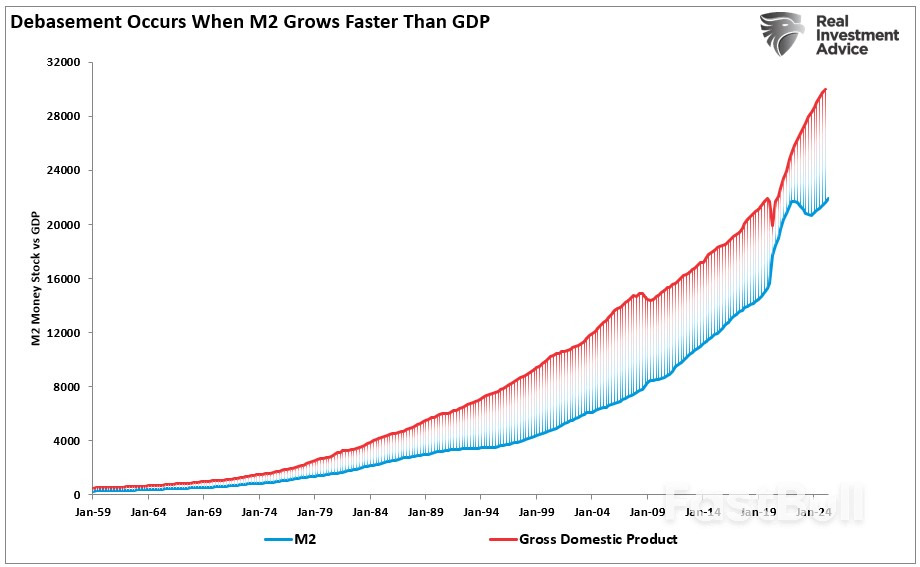
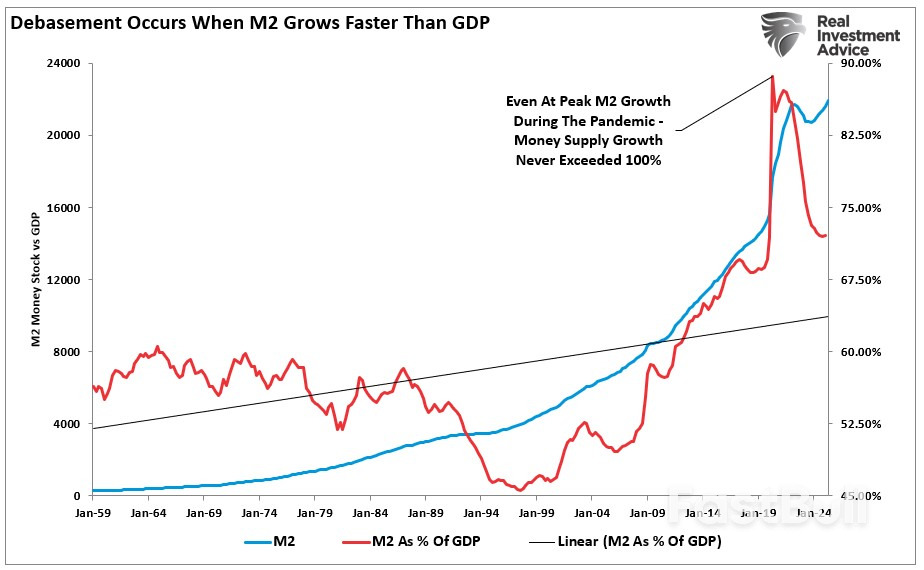
          It’s easy to point to M2 charts and scream “debasement. “ However, the money supply must grow as the economy grows. If it doesn’t, deflationary risks emerge. Therefore, the key is whether money creation exceeds economic growth in a sustained way. Since 1959, the money supply has grown in alignment with economic growth.”
          What Inflation Alarmists Missed in Their Warnings_1
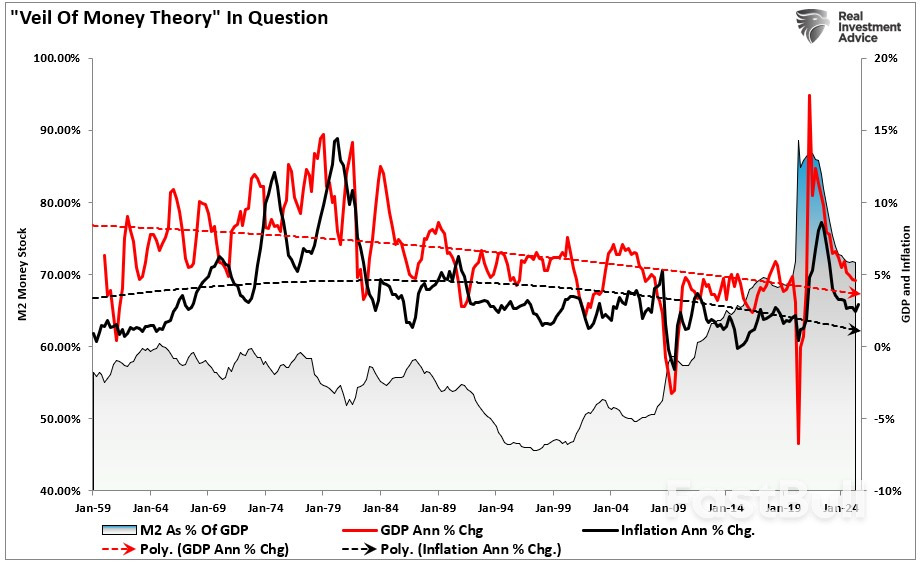
          A better way to assess this is by comparing M2 to GDP. Historically, the two have tracked closely. Even during the COVID-19 shock, M2 as a percentage of GDP remained below 100%, indicating that money supply growth was broadly aligned with economic output. Today, that ratio is falling, not rising.
          What Inflation Alarmists Missed in Their Warnings_2
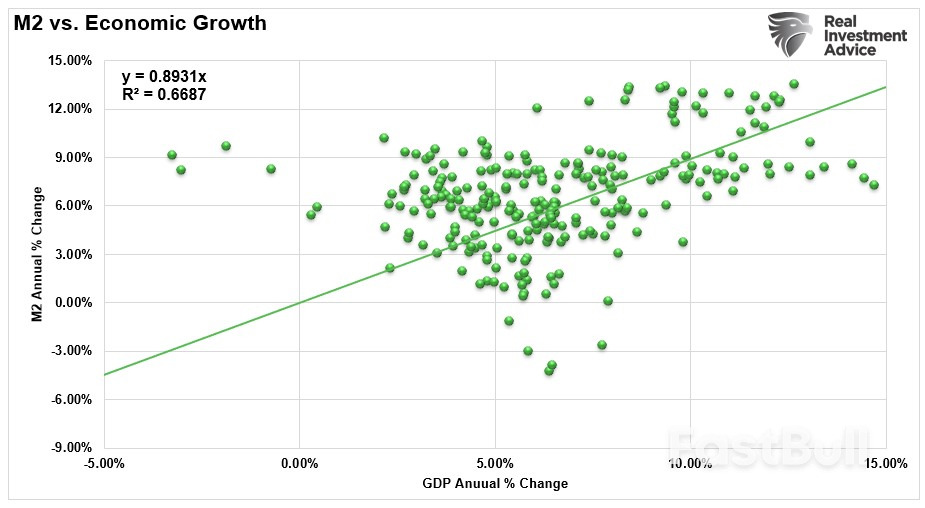
          The reality is that the growth rates of M2 highly correlate with the state of the economy.
          What Inflation Alarmists Missed in Their Warnings_3
          This brings us to the “Veil of Money” theory, which posits that money serves as a neutral medium of exchange, affecting only the nominal price level, but not the underlying fundamental economic factors, such as output, employment, and the allocation of resources. In this view, money overlays the real economy like a veil, and to understand economic activity, one must “pierce the monetary veil.”
          During the pandemic, the money supply spiked. But that’s not the whole story. Bank reserves ballooned, yet lending barely moved. Consumer demand rose temporarily due to direct payments, rather than a structural shift in consumption. Once those payments stopped and the economy reopened, that demand faded, supply increased, and inflation started to recede. In other words, the increase in the money supply did not alter the real economy; in fact, it may have worsened it.
          What Inflation Alarmists Missed in Their Warnings_4
          As such, the problem for the inflation alarmists is that inflation occurs only when demand exceeds supply. In a service-based, aging economy that’s already over-leveraged, such a demand surge rarely occurs sustainably.
          While the inflation surge of 2021 and 2022 was real, it wasn’t systemic. It was the result of excessive government interventions in concert with global supply shocks. That combination created a short-term explosion in prices. But it was never sustainable.
          The 3 D’s: Debt, Deficits, Demographics
          To understand why inflation alarmists have been incorrect, at least so far, you have to understand the “3Ds”: Debt, Deficits, and Demographics.
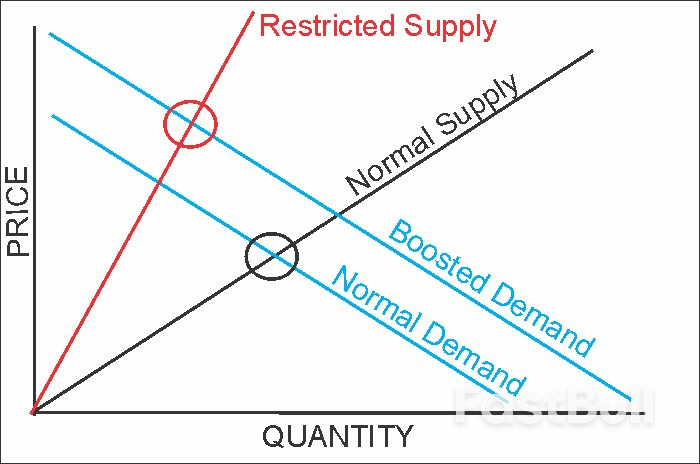
          Let’s return to the basics of “inflation,” which is simply the function of “supply and demand.” Nothing more. Nothing less. As we noted previously:
          “Inflation is the rise in prices due to supply and demand imbalances. Rising wages and consumer demand for products and services that grow faster than the available supply create higher prices (aka inflation). The following economic illustration is taught in every ‘Econ 101’ class. Unsurprisingly, inflation is the consequence if supply is restricted and demand increases via monetary interventions.”
          What Inflation Alarmists Missed in Their Warnings_5
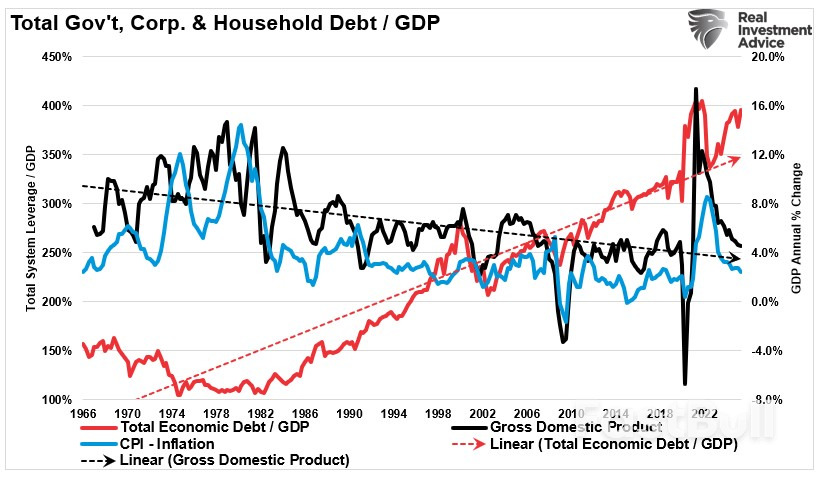
          With this concept in mind, let’s start with the debt. Currently, total U.S. debt, comprising government, corporate, and household debt, stands at record levels. As shown below, when that debt, as a percentage of GDP, grows, it slows economic activity as increased interest payments consume income, thereby limiting consumption and investment.
          What Inflation Alarmists Missed in Their Warnings_6
          What the inflation alarmists miss is that every dollar borrowed must be repaid with future income. As more income is allocated to servicing debt, less is available for spending, which reduces demand in the economy and, as shown, leads to lower inflation. That’s why high debt is deflationary, not inflationary. Such is also why expectations of yields hitting 6% or more remain unfounded, as an economy that is dependent on debt to function can’t support higher rates.
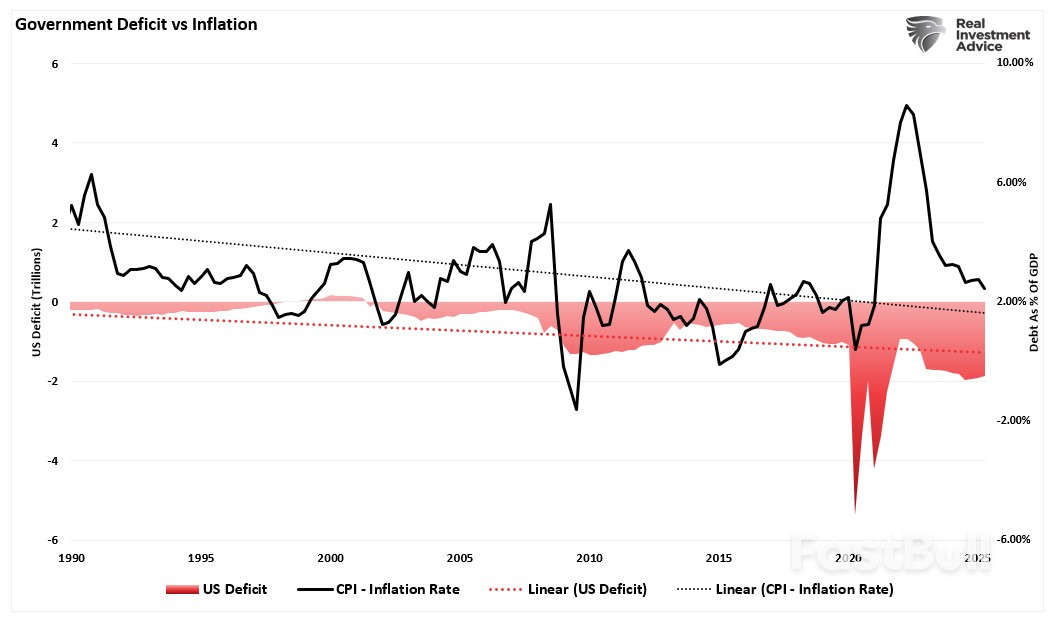
          The second “D”, deficits, are also problematic to the inflation alarmists’ view. Annual deficits are now routine. The government borrows to fund everything from defense to entitlements to foreign aid, with the Congressional Budget Office projecting trillion-dollar deficits for the next decade.
          As the deficit grows, more money is diverted from productive investments into debt service, which again negatively impacts economic activity. As shown, when the deficit is reduced, it is because economic activity has increased, resulting in higher revenue for the government and potentially leading to inflationary pressures.
          What Inflation Alarmists Missed in Their Warnings_7
          The long-term consequence of persistent deficits is low growth as more debt is needed to generate less output. That dynamic has played out in Japan, Europe, and now the U.S. However, ironically, while everyone hopes for lower inflation, which is economically repressive, we should be discussing how to increase inflation through stronger economic growth.
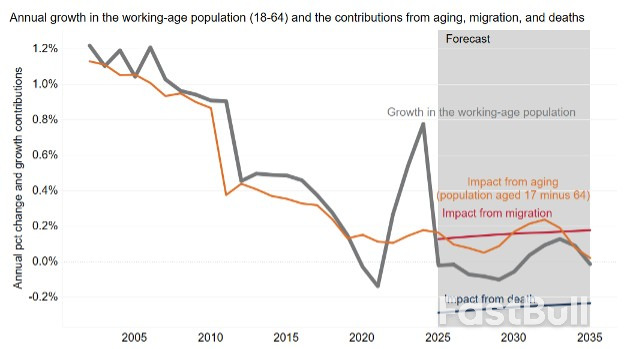
          Lastly, the most overlooked driver of disinflation is the decline of demographics in the U.S. The population is aging, and the U.S. workforce growth rate is falling. Immigration has slowed. Birth rates are down. Fewer workers and more retirees result in lower production and consumption. Older people spend less. They don’t buy homes, take out loans, and live on fixed incomes, which translates to lower economic velocity.
          What Inflation Alarmists Missed in Their Warnings_8
          At the same time, entitlements such as Social Security and Medicare are proliferating, absorbing an increasing share of the federal budget. That adds to debt, increasing deficits, which feeds into economic retardation.
          Put all three together, high debt, chronic deficits, and an aging population, and you get structural stagnation, keeping inflation low, capping long-term rates, and reducing economic prosperity.
          What the Market Is Telling You
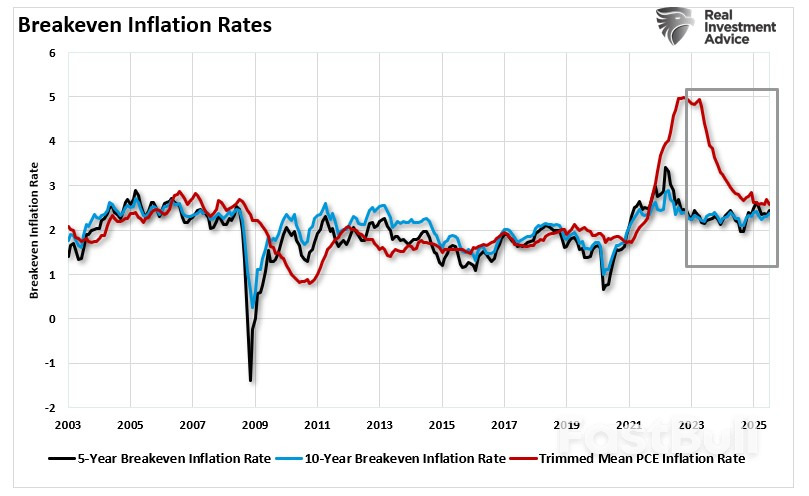
          The bond market isn’t stupid. When inflation spiked, yields rose, briefly. But as soon as growth slowed and fiscal drag returned, yields fell. Long-term expectations remain subdued, with the 10-year breakeven inflation rate still near 2.3 percent. The Fed’s own projections indicate that inflation will return to target over time.
          As shown, the spike in the Fed’s preferred measure of inflation, the trimmed mean PCE inflation rate, has returned to the bond market’s view of inflation. While the Fed took a lot of heat for saying inflation would be “transient,” ultimately, they were correct.
          What Inflation Alarmists Missed in Their Warnings_9
          If inflation were going to stay hot, you’d see it in long-dated yields and in the breakeven rates. However, for now, at least, you don’t. That’s because markets understand what Wall Street celebrities don’t: structural forces matter more than temporary shocks.
          If you’re expecting another surge in inflation, you’re betting against demographics, debt dynamics, and deficit math. That’s probably going to be a bad bet.
          Here’s what you should prepare for instead:
          Inflation will remain volatile but is expected to trend lower.
          Long-term yields will stay capped by debt service constraints.
          Growth will slow as the stimulus fade continues.
          The Fed will pivot again — not toward more hikes, but to rate cuts and balance sheet expansion.
          Does this mean we won’t ever see another rise in inflationary pressures? No. In fact, we should be hopeful for such due to economic growth that leads to broader economic prosperity.
          However, the calls for runaway inflation and 6 percent interest rates are primarily a misunderstanding of the world in which we live. We are not in a 1970s cycle, but rather in a debt cycle where every dollar of growth incurs more debt, and every attempt to tighten policy leads to deflationary pressures.
          That’s not a theory. It’s what the data shows. And until something changes in the structure of our economy, it’s what you should expect.

          Source: investing

          To stay updated on all economic events of today, please check out our Economic calendar
          Risk Warnings and Disclaimers
          You understand and acknowledge that there is a high degree of risk involved in trading. Following any strategies or investment methods may lead to potential losses. The content on the site is provided by our contributors and analysts for information purposes only. You are solely responsible for determining whether any trading assets, securities, strategy, or any other product is suitable for investing based on your own investment objectives and financial situation.
          Add to Favorites
          Share

          EU Folds On Russian Asset 'Reparations', Commits $105BN Loan To Ukraine

          Justin

          Russia-Ukraine Conflict

          Europe has folded rather quickly on EU leaders' controversial plan to confiscate Russian assets held in Belgium's depository Euroclear to use as a reparations loan for Ukraine.

          On Friday it became clear in the two day Brussels summit the EU was unable to agree on the plan, but instead has opted to raise €90 billion ($105 billion) in joint borrowing, with Hungary, the Czech Republic and Slovakia choosing not to take part.

          via Associated Press

          Not only had objecting member states like Hungary sent EU leaders scrambling to circumvent a normal vote, but Belgium has remained unwavering in insisting on unlimited guarantees tied to assets held on its territory.

          Fearing immediate Russian retaliation, Belgium wanted assurance that the rest of the EU would step in and absorb whatever retaliatory measures, including lawsuits, would result from the asset seizure.

          Belgian Prime Minister Bart De Wever recently summed up the dilemma best: "We do not wish to be at war with Russia. We must negotiate based on reality, not fantasy. In reality, you don't steal money from a foreign central bank. Stealing from a central bank is like robbing an embassy."

          So it appears EU leadership has backed down, perhaps having learned their lesson from Biden weaponizing the dollar early in the Ukraine war. As a reminder, here's what President Vladimir Putin had to say by way of warning back in spring of 2024:

          "The dollar is the cornerstone of the United States' power... it is the main weapon used by the U.S. to preserve its power across the world," the Russian leader said. "As soon as the political leadership decided to use the dollar as a tool of political struggle, a blow was dealt to this American power."

          As for the failed effort to permanently seize the some 210 billion euros ($247bn) in Russian assets held in Europe, EU officials had played down the possibility of an alternative plan right up to the eve of the summit.

          And just like that, France's Macron calls for renewed push for diplomacy with Moscow...

          German Chancellor Friedrich Merz spearheaded the efforts, but now the setback marks a blow for he and European Commission President Ursula von der Leyen, who had pitched the reparations loan hard while not presenting another alternative.

          Still, Danish Prime Minister Mette Frederiksen proclaimed that the immediate objective had been met. "The bottom line is that our support for Ukraine is secured," Frederiksen told reporters. But Russia won't be the one being forced to pay for wartime destruction.

          As it stands now, EU member states will borrow from financial markets and cover the interest costs themselves. The loan is intended to be interest-free for now, with no clear future plan on just how it will be recouped. European Council President Antonio Costa said that "technical aspects of the reparations loan" must still be "worked out."

          In the end this marks another behind the scenes victory for Russia after ramping up the pressure on Belgium. RT underscores in its story headlined EU's plan to steal Russian assets for Ukraine fails that "Without the EU war chest, Zelensky faces a short-term economic crisis. Ukraine needs some €72 billion to repay a G7 loan and stay afloat fiscally."

          Source: Zero Hedge

          Risk Warnings and Disclaimers
          You understand and acknowledge that there is a high degree of risk involved in trading. Following any strategies or investment methods may lead to potential losses. The content on the site is provided by our contributors and analysts for information purposes only. You are solely responsible for determining whether any trading assets, securities, strategy, or any other product is suitable for investing based on your own investment objectives and financial situation.
          Add to Favorites
          Share

          As Global Scrutiny Grows, Chinese Firms Look To Call Singapore Home

          Justin

          Forex

          Economic

          Key points:

          · Chinese firms seek to move to Singapore amid Sino-U.S. tensions
          · Singapore offers strategic advantages
          · Relocation benefits smaller firms, big firms face challenges

          A growing number of Chinese companies are looking to domicile in Singapore, betting a move to the trade-focused city-state would reduce risks their operations get disrupted by Sino-U.S. geopolitical tensions.

          The trend, billed as "Singapore washing" by some analysts, started gaining traction near the end of U.S. President Donald Trump's first presidency and has since accelerated, spreading to various sectors from critical minerals to tech and biotechnology, analysts and experts said.

          "Demand has always been rising...and the key thing right now is that it's probably going to accelerate at a more rapid pace," said KG Tan, CEO of InCorp Group, which helps companies relocate or expand in nine Asia-Pacific locations.

          There is no official data on how many Chinese companies are domiciled in Singapore, but Tan said interest from Chinese firms is "very strong" with about 15-20% more inquiries now year-on-year.

          Singapore-domiciled companies include optical products maker Terahop, backed by China-based Zhongji Innolight, which set up shop in the city in 2018.

          More recent additions include data centre operator DayOne, spun off from GDS Holdings; Manus AI, an artificial intelligence agent from China's Butterfly Effect; and ChemLex, an AI-powered chemical synthesis company.

          Neither Manus AI's nor Terahop's websites make reference to their Chinese backers. ChemLex CEO Sean Lin said he considers his Shanghai-founded startup a Singapore company.

          DayOne CEO Jamie Khoo said in July that it always intended to split from its Chinese parent, as both companies operate under different regulatory regimes. Manus AI and Terahop did not respond to requests for comment.

          SINGAPORE PROVIDES A STRATEGIC SWEET SPOT

          Singapore offers an attractive base for firms looking to navigate U.S. tariffs and maintain access to key American technologies whose sales are restricted in China. Washington imposes tariffs of just 10% on goods from Singapore.

          "The Singapore brand is trusted worldwide. Singapore is valued for its international flavour, neutrality, and is culturally easy for Chinese firms and their expats to adapt to," said Maybank China economist Erica Tay.

          "With a whopping 28 free trade agreements, it is also a good base from which to grow markets outside China."

          But that advantage has also left Singapore on a tightrope, as the U.S. steps up its scrutiny over Chinese firms and as some of those foreign entities have been involved in criminal activities.

          Singapore-based data centre firm Megaspeed, which split from a Chinese gaming firm in 2023, faces a U.S. probe for allegedly diverting Nvidiachips used for AI.

          The Asian country also had its biggest money laundering case involving foreigners of Chinese origin in 2023, and is investigating a conglomerate, owned by a Cambodian citizen of Chinese origins and accused of running vast scam centre operations.

          The U.S. Department of Commerce and China's Ministry of Commerce did not respond to requests for comment. Reuters has asked the Singapore government for comment.

          TOO BIG TO HIDE

          While a relocation in theory offers businesses more flexibility in managing tariffs, export controls and other protective trade policies, such moves do not guarantee firms freedom from political or regulatory heat.

          Fast fashion firm Shein and short video platform TikTok, among the early movers to Singapore, notably failed to shield their operations from Western scrutiny.

          Shein ran into political opposition in the U.S. and the UK over its efforts to go public there and also had to seek Beijing's nod for its listing plans, despite having moved its headquarters from Nanjing to Singapore.

          It is now seeking China's blessing for a stock market debut in Hong Kong, and reportedly considering relocation back to China.

          TikTok, owned by China's ByteDance, saw its Singaporean CEO Chew Shou Zi repeatedly grilled over his links to the Chinese government at a Congressional hearing in Washington in 2024.

          ByteDance, which is required to sell its U.S. operation to a consortium of American and global investors to meet national security requirements, signed off on the sale deal, TikTok said on Thursday.

          A failed effort by Yuxiao Fund, a Singapore-registered Chinese investor, to boost its stake in Australian rare earths miner Northern Mineralsin 2024 due to its China link also highlights the limits of being based in Singapore.

          Experts argue the strategy mostly works for smaller firms but provides less wriggle room for big businesses.

          "It's the low-profile entities like family offices and trading companies which tend to have an easier time avoiding attention," said Chong Ja Ian, political scientist at the National University of Singapore.

          Some have already taken note of the growing scrutiny.

          Dou Changlin, the chief operating officer of Shandong Boan Biotechnology, which provides clinical services for global drugmakers, said its Singapore subsidiary is used to fund the company's U.S. operations.

          While the structure has helped it meet funding needs from Singapore, not from China which has stepped up scrutiny of capital flows, Dou cautions U.S. authorities could eventually draw a connection with its Chinese parent company.

          "We are very small in the U.S., I don't think we're on the radar of the U.S. government yet," he said.

          Source: TradingView

          To stay updated on all economic events of today, please check out our Economic calendar
          Risk Warnings and Disclaimers
          You understand and acknowledge that there is a high degree of risk involved in trading. Following any strategies or investment methods may lead to potential losses. The content on the site is provided by our contributors and analysts for information purposes only. You are solely responsible for determining whether any trading assets, securities, strategy, or any other product is suitable for investing based on your own investment objectives and financial situation.
          Add to Favorites
          Share

          FX Outlook: BRICS Quietly Leaving the Treasury Market

          Adam

          Forex

          Economic

          This week’s central bank meetings have not been explosive for FX markets, but have provided some support to sterling and weighed on the yen. We note in the overnight release of US Treasury TIC data for October that the BRICS nations’ holdings of US Treasuries continue to edge lower. For today, the focus will be on how far USD/JPY has to rise

          USD: Short-Term Resilience

          The dollar is proving surprisingly resilient despite the release of a very soft US November CPI reading yesterday. It may be that the numbers seem too good to be true, which prevented a bigger reaction in FX and interest rate markets. In fact, 2-year US Treasury yields ended yesterday’s session unchanged on the day. However, the data leaves the idea of Fed cuts in 2026 intact, with the market now anticipating one 25bp cut by April and another by September. For today’s US session, there’s little meaningful data apart from housing starts and home sales, plus the final read of consumer confidence and inflation expectations for December. We doubt these will move markets.
          Overnight, the US Treasury TIC data for October was released. This is a volatile series and the net purchases of US long-term securities – at $17.5bn – were the lowest since the net $24bn outflow in April. These figures do bounce around a lot, so it is far too early to conclude there are any strong signs of a rotation away from US asset markets. However, one enduring trend is the continuing fall of Treasury holdings amongst the BRICS nations. In October, these were China (-$11.8bn), India (-$12bn) and Brazil (-$5bn).
          Across the foreign official sector, foreign official holdings of Treasury Bonds and Notes were off $22bn, though partially offset by a $14bn increase in T-bill holdings. We think the decline in India’s holdings probably relates to FX intervention to support the rupee, but suspect there are also geopolitical factors at play too. However, this year has shown that the private sector is more than willing to buy Treasuries and our call for a weaker dollar in 2026 is based on foreign investors increasing their hedge ratios on US assets rather than selling them outright.
          Yen weakness today is making DXY look bid. Here, USD/JPY may stay bid after the Bank of Japan Governor said the BoJ needed to see the impact of the rate hike before moving again. That could mean another six to 12 months! Short-term resistance for DXY is at 98.75/80.

          EUR: EU Leaders Deliver

          Late last night, EU leaders managed to secure a EUR90bn loan for Ukraine. The money would be funded from the joint EU budget (excluding Hungary, Slovakia and the Czech Republic) and would not involve frozen Russian assets. That is probably the best outcome for the euro in that it does not raise challenges over property rights nor require some imaginative use of emergency legislation. Presumably, it should also add another EUR90bn to the EU’s pool of safe faxed income assets – and should find willing buyers.
          EUR/USD is drifting towards the lower end of recent ranges. Yesterday’s ECB meeting was not a market mover after all, and the new set of forecasts probably leaves room now for market rates to be priced both higher and lower from here. Look out for the eurozone December consumer confidence data later in the day. Let’s see if EUR/USD support holds at 1.1680/1700 and option activity drags it back to 1.1750 by 1600CET today.

          GBP: Bears Need Patience

          Sterling drew some support from a Bank of England press release which was not as dovish as we had expected. Many of the decision-makers cited the fact that expectations for wage growth remained stubbornly high and were concerned about structurally high inflation.
          We suspect that these wage expectations will come down in the New Year in line with lower headline inflation. In all, we continue to expect 25bp rate cuts in February and April, compared to market pricing of just one cut. And that should mean EUR/GBP continues to find support ahead of 0.87.

          Source: investing

          To stay updated on all economic events of today, please check out our Economic calendar
          Risk Warnings and Disclaimers
          You understand and acknowledge that there is a high degree of risk involved in trading. Following any strategies or investment methods may lead to potential losses. The content on the site is provided by our contributors and analysts for information purposes only. You are solely responsible for determining whether any trading assets, securities, strategy, or any other product is suitable for investing based on your own investment objectives and financial situation.
          Add to Favorites
          Share

          EUR/USD, GBP/USD And EUR/GBP Forecasts – US Dollar Continues to Fight Back on Friday

          Blue River

          Forex

          Technical Analysis

          EUR/USD Technical Analysis

          The Euro has started to drift a little bit lower again during the Friday session as it looks like we are in fact going to see more continuation of this consolidation. That was my base case a few days ago; if you had been watching then, I don't think we would have broken out. I think we don't have anywhere to be.

          So, 1.18 I think continues to be a ceiling that extends about 50, maybe 75 pips. And then the floor is probably 1.15, maybe 1.14. With this being the case, I do think that we start to drift lower, and in fact, that's already starting to happen. So, I am bearish, short-term. In the intermediate term, I'm probably neutral. Longer term, I think I'm still bearish, but that obviously can change in a few months.

          GBP/USD Technical Analysis

          The British pound looks very much the same in the sense that it can't break over the recent ceiling at 1.34, so with that being said, I think you have a scenario where we could start to fade a bit. I mentioned yesterday that if we could break down below the Wednesday lows, I think this thing starts to unravel. We go down to the 1.32 level and then 1.30. I still believe that's the case. However, if we can break above 1.35, then obviously something changed, and it's very likely we're going higher.

          EUR/GBP Technical Analysis

          With the price action that we've seen in both the Euro and the pound against the US dollar, they are doing almost nothing against each other. We are sitting at a support level in the form of 0.8750, which continues to be important. It had previously been significant resistance, and now we're trying to figure out whether or not the breakout and the pullback lead to a rally towards 0.89, or if we break down.

          If we break down below 0.87, then I think the market will probably unravel a bit, maybe goes looking for the 200-day EMA. But as things stand right now, this is a neutral with a slightly bullish connotation to it. But really, this is more short-term trading back and forth than anything else.

          Source: FX Empire

          Risk Warnings and Disclaimers
          You understand and acknowledge that there is a high degree of risk involved in trading. Following any strategies or investment methods may lead to potential losses. The content on the site is provided by our contributors and analysts for information purposes only. You are solely responsible for determining whether any trading assets, securities, strategy, or any other product is suitable for investing based on your own investment objectives and financial situation.
          Add to Favorites
          Share

          North American Morning Briefing: Stock Futures Up as Investors Bet on Fed Rate Cuts -2-

          Adam

          Stocks

          North American Construction Group Strengthens Its Presence In Western Australia With The Acquisition Of Iron Mine Contracting, A Diversified Mining Services Contractor; to Buy Iron Mine Contracting for About C$115M
          Reitmans Canada 3Q Net Income CAD 0.9M; 3Q Gross Profit CAD 109.6M; 3Q Revenue CAD 194.9M; 3Q Adj EBITDA CAD 5.6M; 3Q EPS CAD 0.02; Reports 3Q Revenue of CAD 194.9 Million
          Sony to Take Control of 'Peanuts' Franchise
          TransAlta Provides Notice to Mothball Sheerness Unit 1; Sheerness Unit 1 to Be Temporarily Mothballed April 1; Sheerness Unit 1 to Be Mothballed for Up to Two Years
          Expected Major Events for Friday
          00:01/UK: Dec UK Consumer Confidence Survey
          00:01/UK: Nov UK monthly automotive manufacturing figures
          00:01/UK: Nov Zoopla House Price Index
          07:00/GER: Dec GfK consumer climate survey
          07:00/GER: Nov PPI
          07:00/UK: Nov Public sector finances
          07:00/UK: Nov UK monthly retail sales figures
          07:45/FRA: Nov PPI
          08:59/JPN: Japan Monetary Policy Meeting decision
          08:59/JPN: Dec Monthly Economic Report
          09:00/ITA: Dec Consumer Confidence Survey
          09:00/ITA: Dec Business Confidence Survey
          09:30/UK: Nov Monthly Insolvency statistics
          09:30/UK: 3Q Bank of England statistics on UK banks' external claims
          10:00/ITA: Oct Balance of Payments
          10:00/ITA: Oct Industrial turnover
          11:00/UK: Dec CBI Distributive Trades Survey
          13:30/CAN: Nov New Housing Price Index
          13:30/CAN: Oct Retail trade
          15:00/US: Oct Employment Trends Index
          15:00/US: Nov Employment Trends Index
          15:00/US: Nov Existing Home Sales
          15:00/US: Dec University of Michigan Survey of Consumers - final
          All times in GMT. Powered by Onclusive and Dow Jones.
          Expected Earnings for Friday
          Bio-Path Holdings Inc (BPTH) is expected to report for 3Q.
          Carnival Corp (CCL) is expected to report $0.24 for 4Q.
          Conagra Brands Inc (CAG) is expected to report $0.43 for 2Q.
          Lamb Weston Holdings Inc (LW) is expected to report $0.60 for 2Q.
          Paychex Inc (PAYX) is expected to report $1.12 for 2Q.
          TX Rail Products Inc (TXRP) is expected to report for 4Q.
          Winnebago Industries Inc (WGO) is expected to report $0.00 for 1Q.
          Powered by Onclusive and Dow Jones.
          ANALYST RATINGS ACTIONS
          ABM Industries Cut to Neutral From Buy by UBS
          Allstate Cut to Market Perform From Outperform by William Blair
          Americold Realty Trust Cut to Neutral From Outperform by Baird
          Camden Property Trust Raised to Neutral From Underweight by JP Morgan
          Cinemark Cut to Equal-Weight From Overweight by Morgan Stanley
          Core Scientific Raised to Market Outperform From Market Perform by Citizens
          Edwards Lifesciences Raised to Overweight From Neutral by JP Morgan
          Energy Transfer Cut to Equal-Weight From Overweight by Morgan Stanley
          Enphase Energy Raised to Neutral From Sell by Goldman Sachs
          Enterprise Pdts Partners Cut to Underweight From Equal-Weight by Morgan Stanley
          Evergy Cut to Neutral From Outperform by Mizuho
          Federal Realty Raised to Overweight From Neutral by JP Morgan
          GE Vernova Raised to Buy From Hold by Jefferies
          Glacier Bancorp Raised to Overweight From Neutral by Piper Sandler
          Helmerich & Payne Raised to Overweight From Neutral by Piper Sandler
          Heritage Commerce Cut to Neutral From Buy by DA Davidson
          Kemper Corp Cut to Underperform From Market Perform by William Blair
          Kennedy-Wilson Holdings Cut to Underweight From Neutral by JP Morgan
          Lennar Cut to Underperform From In-Line by Evercore ISI Group
          Lennar Cut to Underperform From Neutral by B of A Securities
          Lennar Cut to Underperform From Sector Perform by RBC Capital
          Lineage Cut to Neutral From Outperform by Baird
          Merck Raised to Outperform From Market Perform by BMO Capital
          Micron Technology Raised to Buy From Neutral by B of A Securities
          Nabors Raised to Overweight From Underweight by Piper Sandler
          NMI Holdings Raised to Outperform From Market Perform by Keefe, Bruyette & Woods
          PayPal Holdings Cut to Underweight From Equal-Weight by Morgan Stanley
          PennyMac Mtg Invt Tr Raised to Outperform From Market Perform by Keefe, Bruyette & Woods
          Penumbra Raised to Overweight From Neutral by JP Morgan
          Public Storage Cut to Neutral From Overweight by JP Morgan
          Ranger Energy Services Raised to Overweight From Neutral by Piper Sandler
          Realty Income Cut to Underweight From Neutral by JP Morgan
          Regency Centers Cut to Neutral From Overweight by JP Morgan
          Rivian Automotive Raised to Outperform From Neutral by Baird
          Sealed Air Cut to Neutral From Outperform by Baird
          Shake Shack Raised to Neutral From Underweight by JP Morgan
          Sherwin-Williams Raised to Buy From Neutral by Citigroup
          Simulations Plus Cut to Neutral From Buy by BTIG
          SmartStop Self REIT Cut to Underweight From Neutral by JP Morgan
          Sphere Entertainment Raised to Overweight From Equal-Weight by Morgan Stanley
          Two Harbors Cut to Hold From Buy by Maxim Group
          UDR Inc Cut to Underweight From Neutral by JP Morgan
          Verrica Pharmaceuticals Raised to Buy From Hold by Brookline Capital
          Warner Music Group Raised to Overweight From Equal-Weight by Morgan Stanley
          Welltower Cut to Neutral From Overweight by JP Morgan
          This article is a text version of a Wall Street Journal newsletter published earlier today.

          Source: morningstar

          Risk Warnings and Disclaimers
          You understand and acknowledge that there is a high degree of risk involved in trading. Following any strategies or investment methods may lead to potential losses. The content on the site is provided by our contributors and analysts for information purposes only. You are solely responsible for determining whether any trading assets, securities, strategy, or any other product is suitable for investing based on your own investment objectives and financial situation.
          Add to Favorites
          Share

          Oil Prices Stable After Trump Says He Won't Rule Out War With Venezuela

          Glendon

          Political

          Commodity

          U.S. crude oil prices were stable on Friday after President Donald Trump told NBC News that he will not rule out war with OPEC member Venezuela.

          "I don't rule it out, no," Trump told the news outlet in a phone interview. He declined to say whether overthrowing President Nicolas Maduro is his goal.

          "He knows exactly what I want," Trump told NBC. "He knows better than anybody."

          The oil market right now is not indicating a major risk of a supply disruption. U.S. crude oil rose 29 cents, or 0.5%, to $56.44 per barrel, while global benchmark Brent was up 31 cents, or 0.5% to $60.31.

          The U.S. benchmark fell to four year lows earlier this week as traders priced in the possibility of a peace agreement in Ukraine that would bring more Russian crude into a well supplied market.

          Trump has been ramping up pressure on Maduro. He ordered a blockade of sanctions oil tankers off the South American nation's coast after seizing a vessel a last week.

          The U.S. has staged a major military buildup in the Caribbean and launched deadly strikes on boats that it claims are trafficking drugs to the U.S. The legality of those strikes is disputed and has been the subject of scrutiny by Congress.

          Venezuela is a founding member of OPEC and has the largest proven oil reserves in the world. It is exporting about 749,000 barrels per day this year with at least half that oil going to China, according to data from Kpler. Venezuela exports about 132,000 bpd to the U.S., according to Kpler.

          Source: CNBC

          Risk Warnings and Disclaimers
          You understand and acknowledge that there is a high degree of risk involved in trading. Following any strategies or investment methods may lead to potential losses. The content on the site is provided by our contributors and analysts for information purposes only. You are solely responsible for determining whether any trading assets, securities, strategy, or any other product is suitable for investing based on your own investment objectives and financial situation.
          Add to Favorites
          Share
          FastBull
          Copyright © 2025 FastBull Ltd

          728 RM B 7/F GEE LOK IND BLDG NO 34 HUNG TO RD KWUN TONG KLN HONG KONG

          TelegramInstagramTwitterfacebooklinkedin
          App Store Google Play Google Play
          Products
          Charts

          Chats

          Q&A with Experts
          Screeners
          Economic Calendar
          Data
          Tools
          Membership
          Features
          Function
          Markets
          Copy Trading
          Latest Signals
          Contests
          News
          Analysis
          24/7
          Columns
          Education
          Company
          Careers
          About Us
          Contact Us
          Advertising
          Help Center
          Feedback
          User Agreement
          Privacy Policy
          Personal Information Protection Statement
          Business

          White Label

          Data API

          Web Plug-ins

          Poster Maker

          Affiliate Program

          Risk Disclosure

          The risk of loss in trading financial instruments such as stocks, FX, commodities, futures, bonds, ETFs and crypto can be substantial. You may sustain a total loss of the funds that you deposit with your broker. Therefore, you should carefully consider whether such trading is suitable for you in light of your circumstances and financial resources.

          No decision to invest should be made without thoroughly conducting due diligence by yourself or consulting with your financial advisors. Our web content might not suit you since we don't know your financial conditions and investment needs. Our financial information might have latency or contain inaccuracy, so you should be fully responsible for any of your trading and investment decisions. The company will not be responsible for your capital loss.

          Without getting permission from the website, you are not allowed to copy the website's graphics, texts, or trademarks. Intellectual property rights in the content or data incorporated into this website belong to its providers and exchange merchants.

          Not Logged In

          Log in to access more features

          FastBull Membership

          Not yet

          Purchase

          Become a signal provider
          Help Center
          Customer Service
          Dark Mode
          Price Up/Down Colors

          Log In

          Sign Up

          Position
          Layout
          Fullscreen
          Default to Chart
          The chart page opens by default when you visit fastbull.com