Markets
News
Analysis
User
24/7
Economic Calendar
Education
Data
- Names
- Latest
- Prev


Signal Accounts for Members
All Signal Accounts
All Contests


France Trade Balance (SA) (Oct)A:--
F: --
Euro Zone Employment YoY (SA) (Q3)A:--
F: --
Canada Part-Time Employment (SA) (Nov)A:--
F: --
P: --
Canada Unemployment Rate (SA) (Nov)A:--
F: --
P: --
Canada Full-time Employment (SA) (Nov)A:--
F: --
P: --
Canada Labor Force Participation Rate (SA) (Nov)A:--
F: --
P: --
Canada Employment (SA) (Nov)A:--
F: --
P: --
U.S. PCE Price Index MoM (Sept)A:--
F: --
P: --
U.S. Personal Income MoM (Sept)A:--
F: --
P: --
U.S. Core PCE Price Index MoM (Sept)A:--
F: --
P: --
U.S. PCE Price Index YoY (SA) (Sept)A:--
F: --
P: --
U.S. Core PCE Price Index YoY (Sept)A:--
F: --
P: --
U.S. Personal Outlays MoM (SA) (Sept)A:--
F: --
U.S. 5-10 Year-Ahead Inflation Expectations (Dec)A:--
F: --
P: --
U.S. Real Personal Consumption Expenditures MoM (Sept)A:--
F: --
U.S. Weekly Total Rig CountA:--
F: --
P: --
U.S. Weekly Total Oil Rig CountA:--
F: --
P: --
U.S. Consumer Credit (SA) (Oct)A:--
F: --
China, Mainland Foreign Exchange Reserves (Nov)A:--
F: --
P: --
Japan Trade Balance (Oct)A:--
F: --
P: --
Japan Nominal GDP Revised QoQ (Q3)A:--
F: --
P: --
China, Mainland Imports YoY (CNH) (Nov)A:--
F: --
P: --
China, Mainland Exports (Nov)A:--
F: --
P: --
China, Mainland Imports (CNH) (Nov)A:--
F: --
P: --
China, Mainland Trade Balance (CNH) (Nov)A:--
F: --
P: --
China, Mainland Exports YoY (USD) (Nov)A:--
F: --
P: --
China, Mainland Imports YoY (USD) (Nov)A:--
F: --
P: --
Germany Industrial Output MoM (SA) (Oct)A:--
F: --
Euro Zone Sentix Investor Confidence Index (Dec)A:--
F: --
P: --
Canada National Economic Confidence IndexA:--
F: --
P: --
U.K. BRC Like-For-Like Retail Sales YoY (Nov)--
F: --
P: --
U.K. BRC Overall Retail Sales YoY (Nov)--
F: --
P: --
Australia Overnight (Borrowing) Key Rate--
F: --
P: --
RBA Rate Statement
RBA Press Conference
Germany Exports MoM (SA) (Oct)--
F: --
P: --
U.S. NFIB Small Business Optimism Index (SA) (Nov)--
F: --
P: --
Mexico 12-Month Inflation (CPI) (Nov)--
F: --
P: --
Mexico Core CPI YoY (Nov)--
F: --
P: --
Mexico PPI YoY (Nov)--
F: --
P: --
U.S. Weekly Redbook Index YoY--
F: --
P: --
U.S. JOLTS Job Openings (SA) (Oct)--
F: --
P: --
China, Mainland M1 Money Supply YoY (Nov)--
F: --
P: --
China, Mainland M0 Money Supply YoY (Nov)--
F: --
P: --
China, Mainland M2 Money Supply YoY (Nov)--
F: --
P: --
U.S. EIA Short-Term Crude Production Forecast For The Year (Dec)--
F: --
P: --
U.S. EIA Natural Gas Production Forecast For The Next Year (Dec)--
F: --
P: --
U.S. EIA Short-Term Crude Production Forecast For The Next Year (Dec)--
F: --
P: --
EIA Monthly Short-Term Energy Outlook
U.S. API Weekly Gasoline Stocks--
F: --
P: --
U.S. API Weekly Cushing Crude Oil Stocks--
F: --
P: --
U.S. API Weekly Crude Oil Stocks--
F: --
P: --
U.S. API Weekly Refined Oil Stocks--
F: --
P: --
South Korea Unemployment Rate (SA) (Nov)--
F: --
P: --
Japan Reuters Tankan Non-Manufacturers Index (Dec)--
F: --
P: --
Japan Reuters Tankan Manufacturers Index (Dec)--
F: --
P: --
Japan Domestic Enterprise Commodity Price Index MoM (Nov)--
F: --
P: --
Japan Domestic Enterprise Commodity Price Index YoY (Nov)--
F: --
P: --
China, Mainland PPI YoY (Nov)--
F: --
P: --
China, Mainland CPI MoM (Nov)--
F: --
P: --


No matching data
Latest Views
Latest Views
Trending Topics
Top Columnists
Latest Update
White Label
Data API
Web Plug-ins
Affiliate Program
View All

No data
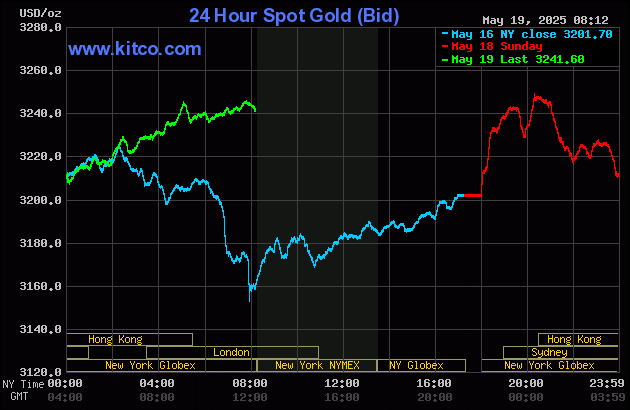
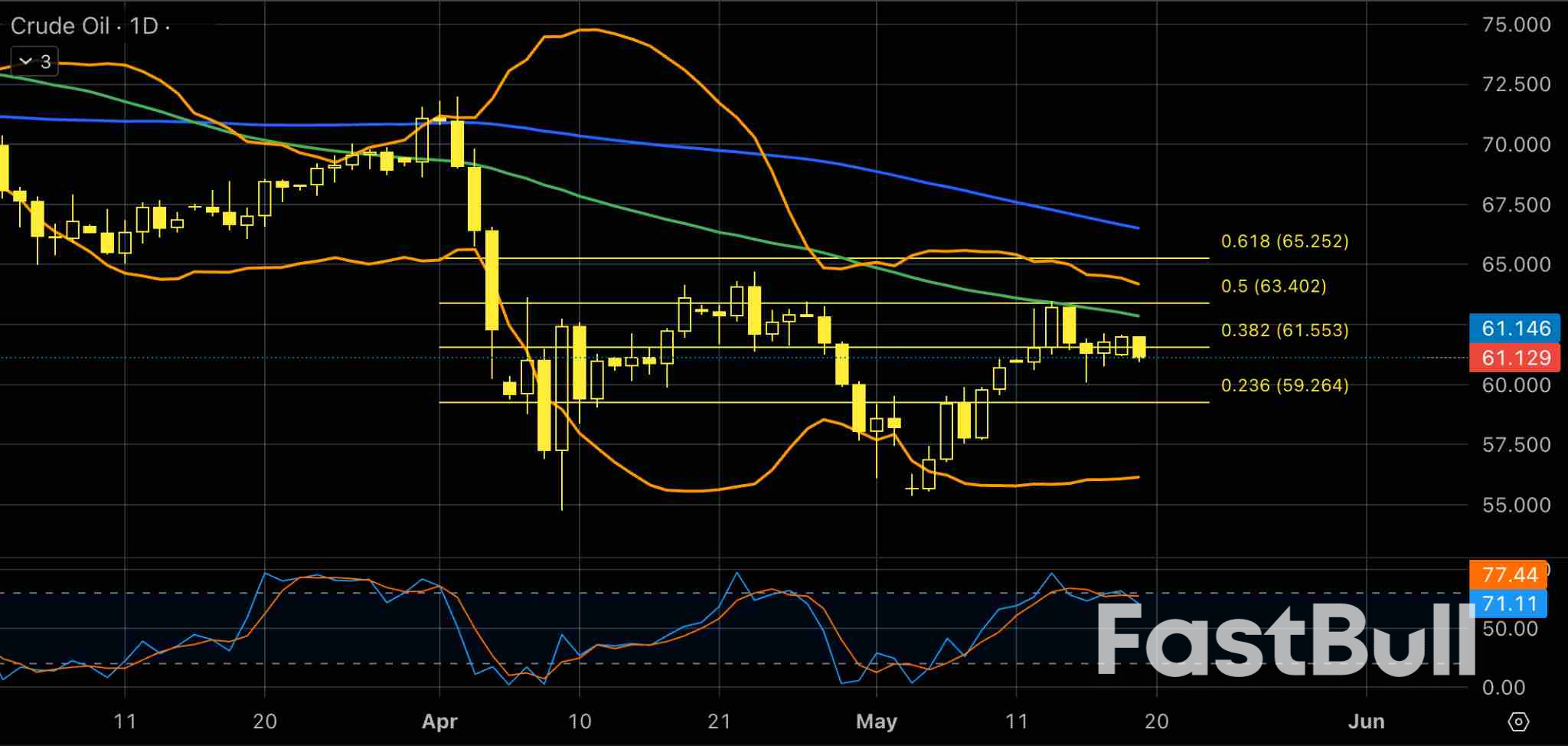
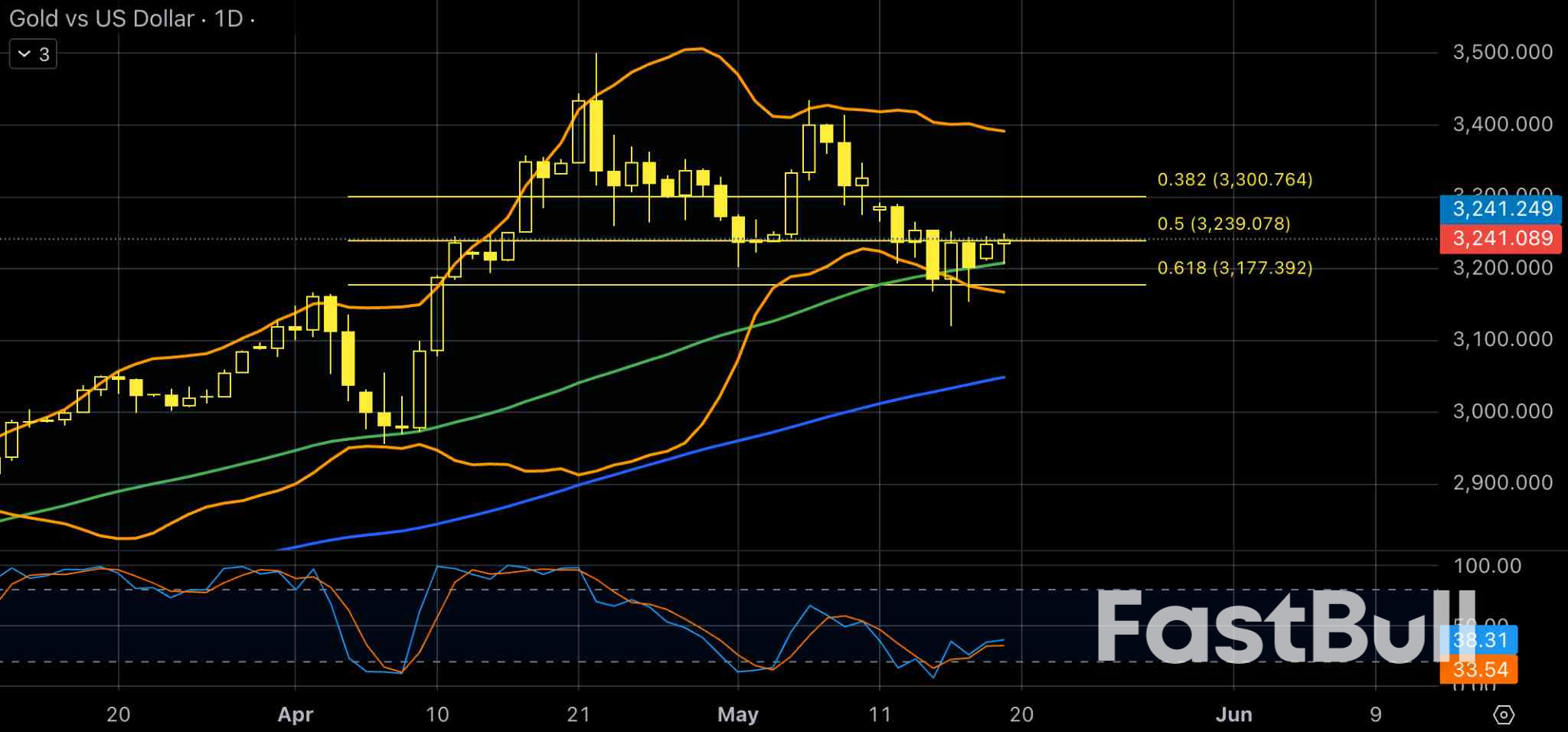
Oil prices steadied amid Iran-U.S. tensions and weak Chinese data, with bearish technical signals. Gold rose on U.S. credit downgrade but faces resistance as overvaluation concerns limit near-term upside.

Moody's decision to downgrade the U.S. credit rating may have consequences for your money, experts say.
The debt downgrade put immediate pressure on bond prices, sending yields higher on Monday morning. The 30-year U.S. bond yield traded above 5% and the 10-year yield topped 4.5%, hitting key levels at a time when the economy is already showing signs of strain from President Donald Trump's unfolding tariff policy.
Treasury bonds influence rates for a wide range of consumer loans like 30-year fixed mortgages, and to some extent also affect products including auto loans and credit cards.
"It's really hard to avoid the impact on consumers," said Brian Rehling, head of global fixed income strategy at Wells Fargo Investment Institute.
The major credit rating agency cut the United States' sovereign credit rating on Friday by one notch to Aa1 from Aaa, the highest possible.
In doing so, it cited the increasing burden of the federal government's budget deficit. Republicans' attempts to make President Donald Trump's 2017 tax cuts permanent as part of the reconciliation package threaten to increase the federal debt by trillions of dollars.
More from FA Playbook:
Here's a look at other stories impacting the financial advisor business.
"When our credit rating goes down, the expectation is that the cost of borrowing will increase," said Ivory Johnson, a certified financial planner and founder of Delancey Wealth Management in Washington, D.C.
That's because when "a country represents a bigger credit risk, the creditors will demand to be compensated with higher interest rates," said Johnson, a member of CNBC's Financial Advisor council.
Americans struggling to keep up with sky-high interest charges aren't likely to get much relief any time soon amid Moody's downgrade.
"Economic uncertainty, especially regarding tariff policy, has the Fed — and a lot of businesses — on hold," said Ted Rossman, a senior industry analyst at Bankrate.
Atlanta Fed President Raphael Bostic said on CNBC's "Squawk Box" Monday that he now sees only one rate cut this year as the central bank tries to balance inflationary pressures with worries of a potential recession. Federal Reserve Chair Jerome Powell also recently noted that tariffs may slow growth and boost inflation, making it harder to lower the central bank's benchmark as previously expected.
Douglas Boneparth, another CFP and the president of Bone Fide Wealth in New York, agreed that the downgrade could translate to higher interest rates on consumer loans.
"Downgrades can raise borrowing costs over time," said Boneparth, who is also on CNBC's FA council.
"Think higher rates on mortgages, credit cards, and personal loans, especially if confidence in U.S. credit weakens further," he said.
Some loans could see more direct impacts because their rates are tied to bond prices.
Since mortgage rates are largely tied to Treasury yields and the economy, "30-year mortgages are going to be most closely correlated, and longer-term rates are already moving higher," Rehling said.
The average rate for a 30-year, fixed-rate mortgage was 6.92% as of May 16, while the 15-year, fixed-rate is 6.26%, according to Mortgage News Daily.
Although credit cards and auto loan rates more directly track the federal funds rate, the nation's financial challenges also play a key role in the Federal Reserve's stance on interest rates. "The fed funds rate is higher than it would be if the U.S. was in a better fiscal situation," Rehling said.
Since December 2024, the overnight lending rate has been in a range between 4.25%-4.5%. As a result, the average credit card rate is currently 20.12%, down only slightly from a record 20.79% set last summer, according to Ted Rossman, a senior industry analyst at Bankrate.
Credit card rates tend to mirror Fed actions, so "higher for longer" would keep the average credit card rate around 20% through the rest of the year, Rossman said.
Before its downgrade, Moody's was the last of the major credit rating agencies to have the U.S. at the highest possible rating.
Standard & Poor's downgraded the nation's credit rating in August 2011, and Fitch Ratings cut it in August 2023. "We've been through this before," Rehling said.
Still, the move highlights the country's fiscal challenges, Rehling said: "The U.S. still maintains its dominance as the safe haven economy of the world, but it puts some chinks in the armor."


Hey crypto enthusiasts! While your focus might be on Bitcoin charts and altcoin movements, a significant shift just happened in the traditional finance world that could send ripples into the digital asset space. The US 30-year Treasury yield just climbed to a level not seen since November 2023, hitting 5.02%. What does this seemingly distant financial metric have to do with your crypto portfolio? Potentially, a lot. This surge didn’t happen in a vacuum; it closely followed a major announcement from credit rating agency Moody’s.
Let’s break it down. The US 30-year Treasury yield represents the return an investor receives for holding a U.S. government bond for 30 years. Think of it as the interest rate the U.S. government pays to borrow money over the long term. It’s a crucial benchmark for long-term interest rates across the entire economy, influencing everything from mortgage rates to corporate borrowing costs.
When the yield goes up, it means investors are demanding a higher return to lend money to the government for such a long period. A jump to 5.02%, the highest point since November 2023, signals a significant shift in the bond market. This could be driven by several factors:
Adding fuel to the fire, this yield surge occurred shortly after Moody’s announced on the evening of May 16 that it had downgraded the U.S. government’s credit rating. The rating moved from the top-tier Aaa to Aa1. This Moody’s US downgrade is a big deal because credit ratings are essentially grades given by agencies like Moody’s, S&P, and Fitch, assessing a borrower’s ability to repay debt. A downgrade suggests a slightly increased risk, even for a borrower as historically safe as the U.S. government.
While still a high rating (Aa1 is the second-highest tier), a downgrade from Aaa can rattle investor confidence and potentially increase the perceived risk of holding U.S. debt, contributing to the demand for higher yields.
The Treasury yield impact extends far beyond just government bonds. As a benchmark, the 30-year yield influences a wide range of long-term interest rates. Higher Treasury yields generally lead to:
The recent move to 5.02% is part of broader bond market trends that have seen yields fluctuate based on economic data, inflation reports, Federal Reserve policy expectations, and now, credit rating assessments. The bond market is often seen as a forward-looking indicator. The current trends suggest that investors are factoring in persistent inflation, potential future rate hikes (or fewer cuts than previously expected), and increased fiscal risk.
These trends indicate a market environment where the cost of capital is rising. This can pose challenges for businesses relying on borrowing and can influence investment decisions across all asset classes.
Now, for the question many of you are asking: What does this mean for crypto? The crypto market reaction to traditional finance shifts isn’t always direct or immediate, but macro factors play a significant role, especially in times of uncertainty.
When safe-haven assets like U.S. Treasuries offer increasingly attractive returns (like 5.02% on a 30-year bond), the relative appeal of volatile, risk-on assets like cryptocurrencies can diminish. Investors who prioritize capital preservation might opt for the higher yield on government bonds rather than the potential high returns (and high risks) of crypto.
However, it’s important to remember that the crypto market has its own unique drivers, including technological developments, regulatory news, and adoption rates. While macro headwinds can create pressure, they don’t solely dictate crypto’s trajectory.
The current environment presents challenges but also offers opportunities for informed investors.
Challenges:
Insights:
The surge in the US 30-year Treasury yield to 5.02% and the preceding Moody’s US downgrade are significant developments in the traditional financial world. They highlight ongoing fiscal challenges and political risks facing the U.S. economy. These factors contribute to rising borrowing costs and can influence global investment flows.
While the direct Treasury yield impact on daily crypto prices can be hard to isolate, these macro bond market trends create a backdrop of tighter financial conditions. The potential crypto market reaction is one of increased sensitivity to risk-off sentiment and potentially reduced liquidity compared to periods of ultra-low interest rates.
For crypto investors, staying aware of these broader economic shifts is vital. It’s a reminder that the crypto market doesn’t exist in a vacuum and is increasingly influenced by global macroeconomic forces. As markets continue to digest these developments, vigilance and a well-thought-out strategy remain your best tools.
White Label
Data API
Web Plug-ins
Poster Maker
Affiliate Program
The risk of loss in trading financial instruments such as stocks, FX, commodities, futures, bonds, ETFs and crypto can be substantial. You may sustain a total loss of the funds that you deposit with your broker. Therefore, you should carefully consider whether such trading is suitable for you in light of your circumstances and financial resources.
No decision to invest should be made without thoroughly conducting due diligence by yourself or consulting with your financial advisors. Our web content might not suit you since we don't know your financial conditions and investment needs. Our financial information might have latency or contain inaccuracy, so you should be fully responsible for any of your trading and investment decisions. The company will not be responsible for your capital loss.
Without getting permission from the website, you are not allowed to copy the website's graphics, texts, or trademarks. Intellectual property rights in the content or data incorporated into this website belong to its providers and exchange merchants.
Not Logged In
Log in to access more features

FastBull Membership
Not yet
Purchase
Log In
Sign Up