• Trade
  • Markets
  • Copy
  • Contests
  • News
  • 24/7
  • Calendar
  • Q&A
  • Chats
Trending
Screeners
SYMBOL
LAST
BID
ASK
HIGH
LOW
NET CHG.
%CHG.
SPREAD
SPX
S&P 500 Index
6846.50
6846.50
6846.50
6878.28
6827.18
-23.90
-0.35%
--
DJI
Dow Jones Industrial Average
47739.31
47739.31
47739.31
47971.51
47611.93
-215.67
-0.45%
--
IXIC
NASDAQ Composite Index
23545.89
23545.89
23545.89
23698.93
23455.05
-32.22
-0.14%
--
USDX
US Dollar Index
99.000
99.080
99.000
99.000
99.000
+0.050
+ 0.05%
--
EURUSD
Euro / US Dollar
1.16364
1.16387
1.16364
1.16364
1.16322
0.00000
0.00%
--
GBPUSD
Pound Sterling / US Dollar
1.33168
1.33294
1.33168
1.33178
1.33140
-0.00037
-0.03%
--
XAUUSD
Gold / US Dollar
4189.70
4190.14
4189.70
4218.85
4175.92
-8.21
-0.20%
--
WTI
Light Sweet Crude Oil
58.555
58.807
58.555
60.084
58.495
-1.254
-2.10%
--

Community Accounts

Signal Accounts
--
Profit Accounts
--
Loss Accounts
--
View More

Become a signal provider

Sell trading signals to earn additional income

View More

Guide to Copy Trading

Get started with ease and confidence

View More

Signal Accounts for Members

All Signal Accounts

Best Return
  • Best Return
  • Best P/L
  • Best MDD
Past 1W
  • Past 1W
  • Past 1M
  • Past 1Y

All Contests

  • All
  • Trump Updates
  • Recommend
  • Stocks
  • Cryptocurrencies
  • Central Banks
  • Featured News
Top News Only
Share

SPDR Gold Holdings Down 0.11%, Or 1.14 Tonnes

Share

On Monday (December 8), In Late New York Trading, S&P 500 Futures Fell 0.21%, Dow Jones Futures Fell 0.43%, NASDAQ 100 Futures Fell 0.08%, And Russell 2000 Futures Fell 0.04%

Share

Morgan Stanley: Data Center ABS Spreads Are Expected To Widen In 2026

Share

(US Stocks) The Philadelphia Gold And Silver Index Closed Down 2.34% At 311.01 Points. (Global Session) The NYSE Arca Gold Miners Index Closed Down 2.17%, Hitting A Daily Low Of 2235.45 Points; US Stocks Remained Slightly Down Before The Opening Bell—holding Steady Around 2280 Points—before Briefly Rising Slightly

Share

IMF: IMF Executive Board Approves Extension Of The Extended Credit Facility Arrangement With Nepal

Share

Trump: Same Approach Will Apply To Amd, Intel, And Other Great American Companies

Share

Trump: Department Of Commerce Is Finalizing Details

Share

Trump: $25% Will Be Paid To United States Of America

Share

Trump: President Xi Responded Positively

Share

[Consumer Discretionary ETFs Fell Over 1.4%, Leading The Decline Among US Sector ETFs; Semiconductor ETFs Rose Over 1.1%] On Monday (December 8), The Consumer Discretionary ETF Fell 1.45%, The Energy ETF Fell 1.09%, The Internet ETF Fell 0.18%, The Regional Banks ETF Rose 0.34%, The Technology ETF Rose 0.70%, The Global Technology ETF Rose 0.93%, And The Semiconductor ETF Rose 1.13%

Share

Trump: I Have Informed President Xi, Of China, That United States Will Allow Nvidia To Ship Its H200 Products To Approved Customers In China

Share

Argentina's Merval Index Closed Up 0.02% At 3.047 Million Points. It Rose To A New Daily High Of 3.165 Million Points In Early Trading In Buenos Aires Before Gradually Giving Back Its Gains

Share

US Stock Market Closing Report | On Monday (December 8), The Magnificent 7 Index Fell 0.20% To 208.33 Points. The "mega-cap" Tech Stock Index Fell 0.33% To 405.00 Points

Share

Pentagon - USA State Dept Approves Potential Sale Of Hellfire Missiles To Belgium For An Estimated $79 Million

Share

Toronto Stock Index .GSPTSE Unofficially Closes Down 141.44 Points, Or 0.45 Percent, At 31169.97

Share

The Nasdaq Golden Dragon China Index Closed Up Less Than 0.1%. Nxtt Rose 21%, Microalgo Rose 7%, Daqo New Energy Rose 4.3%, And 21Vianet, Baidu, And Miniso All Rose More Than 3%

Share

The S&P 500 Initially Closed Down More Than 0.4%, With The Telecom Sector Down 1.9%, And Materials, Consumer Discretionary, Utilities, Healthcare, And Energy Sectors Down By As Much As 1.6%, While The Technology Sector Rose 0.7%. The NASDAQ 100 Initially Closed Down 0.3%, With Marvell Technology Down 7%, Fortinet Down 4%, And Netflix And Tesla Down 3.4%

Share

IMF: Review Pakistan Authorities To Draw The Equivalent Of About US$1 Billion

Share

President Trump Is Committed To The Continued Cessation Of Violence And Expects The Governments Of Cambodia And Thailand To Fully Honor Their Commitments To End This Conflict - Senior White House Official

Share

[Water Overflows From Spent Fuel Pool At Japanese Nuclear Facility] According To Japan's Nuclear Waste Management Company, Following A Strong Earthquake Off The Coast Of Aomori Prefecture Late On December 8th, Workers At The Nuclear Waste Treatment Plant In Rokkasho Village, Aomori Prefecture, Discovered "at Least 100 Liters Of Water" On The Ground Around The Spent Fuel Pool During An Inspection. Analysis Suggests This Water "may Have Overflowed Due To The Earthquake's Shaking." However, It Is Reported That The Overflowed Water "remains Inside The Building And Has Not Affected The External Environment."

TIME
ACT
FCST
PREV
France Trade Balance (SA) (Oct)

A:--

F: --

P: --
Euro Zone Employment YoY (SA) (Q3)

A:--

F: --

P: --
Canada Part-Time Employment (SA) (Nov)

A:--

F: --

P: --

Canada Unemployment Rate (SA) (Nov)

A:--

F: --

P: --

Canada Full-time Employment (SA) (Nov)

A:--

F: --

P: --

Canada Labor Force Participation Rate (SA) (Nov)

A:--

F: --

P: --

Canada Employment (SA) (Nov)

A:--

F: --

P: --

U.S. PCE Price Index MoM (Sept)

A:--

F: --

P: --

U.S. Personal Income MoM (Sept)

A:--

F: --

P: --

U.S. Core PCE Price Index MoM (Sept)

A:--

F: --

P: --

U.S. PCE Price Index YoY (SA) (Sept)

A:--

F: --

P: --

U.S. Core PCE Price Index YoY (Sept)

A:--

F: --

P: --

U.S. Personal Outlays MoM (SA) (Sept)

A:--

F: --

P: --
U.S. 5-10 Year-Ahead Inflation Expectations (Dec)

A:--

F: --

P: --

U.S. Real Personal Consumption Expenditures MoM (Sept)

A:--

F: --

P: --
U.S. Weekly Total Rig Count

A:--

F: --

P: --

U.S. Weekly Total Oil Rig Count

A:--

F: --

P: --

U.S. Consumer Credit (SA) (Oct)

A:--

F: --

P: --
China, Mainland Foreign Exchange Reserves (Nov)

A:--

F: --

P: --

Japan Trade Balance (Oct)

A:--

F: --

P: --

Japan Nominal GDP Revised QoQ (Q3)

A:--

F: --

P: --

China, Mainland Imports YoY (CNH) (Nov)

A:--

F: --

P: --

China, Mainland Exports (Nov)

A:--

F: --

P: --

China, Mainland Imports (CNH) (Nov)

A:--

F: --

P: --

China, Mainland Trade Balance (CNH) (Nov)

A:--

F: --

P: --

China, Mainland Exports YoY (USD) (Nov)

A:--

F: --

P: --

China, Mainland Imports YoY (USD) (Nov)

A:--

F: --

P: --

Germany Industrial Output MoM (SA) (Oct)

A:--

F: --

P: --
Euro Zone Sentix Investor Confidence Index (Dec)

A:--

F: --

P: --

Canada National Economic Confidence Index

A:--

F: --

P: --

U.K. BRC Like-For-Like Retail Sales YoY (Nov)

--

F: --

P: --

U.K. BRC Overall Retail Sales YoY (Nov)

--

F: --

P: --

Australia Overnight (Borrowing) Key Rate

--

F: --

P: --

RBA Rate Statement
RBA Press Conference
Germany Exports MoM (SA) (Oct)

--

F: --

P: --

U.S. NFIB Small Business Optimism Index (SA) (Nov)

--

F: --

P: --

Mexico 12-Month Inflation (CPI) (Nov)

--

F: --

P: --

Mexico Core CPI YoY (Nov)

--

F: --

P: --

Mexico PPI YoY (Nov)

--

F: --

P: --

U.S. Weekly Redbook Index YoY

--

F: --

P: --

U.S. JOLTS Job Openings (SA) (Oct)

--

F: --

P: --

China, Mainland M1 Money Supply YoY (Nov)

--

F: --

P: --

China, Mainland M0 Money Supply YoY (Nov)

--

F: --

P: --

China, Mainland M2 Money Supply YoY (Nov)

--

F: --

P: --

U.S. EIA Short-Term Crude Production Forecast For The Year (Dec)

--

F: --

P: --

U.S. EIA Natural Gas Production Forecast For The Next Year (Dec)

--

F: --

P: --

U.S. EIA Short-Term Crude Production Forecast For The Next Year (Dec)

--

F: --

P: --

EIA Monthly Short-Term Energy Outlook
U.S. API Weekly Gasoline Stocks

--

F: --

P: --

U.S. API Weekly Cushing Crude Oil Stocks

--

F: --

P: --

U.S. API Weekly Crude Oil Stocks

--

F: --

P: --

U.S. API Weekly Refined Oil Stocks

--

F: --

P: --

South Korea Unemployment Rate (SA) (Nov)

--

F: --

P: --

Japan Reuters Tankan Non-Manufacturers Index (Dec)

--

F: --

P: --

Japan Reuters Tankan Manufacturers Index (Dec)

--

F: --

P: --

Japan Domestic Enterprise Commodity Price Index MoM (Nov)

--

F: --

P: --

Japan Domestic Enterprise Commodity Price Index YoY (Nov)

--

F: --

P: --

China, Mainland PPI YoY (Nov)

--

F: --

P: --

China, Mainland CPI MoM (Nov)

--

F: --

P: --

Italy Industrial Output YoY (SA) (Oct)

--

F: --

P: --

Q&A with Experts
    • All
    • Chatrooms
    • Groups
    • Friends
    Connecting
    .
    .
    .
    Type here...
    Add Symbol or Code

      No matching data

      All
      Trump Updates
      Recommend
      Stocks
      Cryptocurrencies
      Central Banks
      Featured News
      • All
      • Russia-Ukraine Conflict
      • Middle East Flashpoint
      • All
      • Russia-Ukraine Conflict
      • Middle East Flashpoint
      Search
      Products

      Charts Free Forever

      Chats Q&A with Experts
      Screeners Economic Calendar Data Tools
      Membership Features
      Data Warehouse Market Trends Institutional Data Policy Rates Macro

      Market Trends

      Market Sentiment Order Book Forex Correlations

      Top Indicators

      Charts Free Forever
      Markets

      News

      News Analysis 24/7 Columns Education
      From Institutions From Analysts
      Topics Columnists

      Latest Views

      Latest Views

      Trending Topics

      Top Columnists

      Latest Update

      Signals

      Copy Rankings Latest Signals Become a signal provider AI Rating
      Contests
      Brokers

      Overview Brokers Assessment Rankings Regulators News Claims
      Broker listing Forex Brokers Comparison Tool Live Spread Comparison Scam
      Q&A Complaint Scam Alert Videos Tips to Detect Scam
      More

      Business
      Events
      Careers About Us Advertising Help Center

      White Label

      Data API

      Web Plug-ins

      Affiliate Program

      Awards Institution Evaluation IB Seminar Salon Event Exhibition
      Vietnam Thailand Singapore Dubai
      Fans Party Investment Sharing Session
      FastBull Summit BrokersView Expo
      Recent Searches
        Top Searches
          Markets
          News
          Analysis
          User
          24/7
          Economic Calendar
          Education
          Data
          • Names
          • Latest
          • Prev

          View All

          No data

          Scan to Download

          Faster Charts, Chat Faster!

          Download App
          English
          • English
          • Español
          • العربية
          • Bahasa Indonesia
          • Bahasa Melayu
          • Tiếng Việt
          • ภาษาไทย
          • Français
          • Italiano
          • Türkçe
          • Русский язык
          • 简中
          • 繁中
          Open Account
          Search
          Products
          Charts Free Forever
          Markets
          News
          Signals

          Copy Rankings Latest Signals Become a signal provider AI Rating
          Contests
          Brokers

          Overview Brokers Assessment Rankings Regulators News Claims
          Broker listing Forex Brokers Comparison Tool Live Spread Comparison Scam
          Q&A Complaint Scam Alert Videos Tips to Detect Scam
          More

          Business
          Events
          Careers About Us Advertising Help Center

          White Label

          Data API

          Web Plug-ins

          Affiliate Program

          Awards Institution Evaluation IB Seminar Salon Event Exhibition
          Vietnam Thailand Singapore Dubai
          Fans Party Investment Sharing Session
          FastBull Summit BrokersView Expo

          US Trade Deficit Narrowed In August As Imports Declined

          James Whitman

          Economic

          Summary:

          The US trade deficit shrank in August as imports declined by the most in four months, official data showed Wednesday after a lengthy delay due to a government shutdown.

          The US trade deficit shrank in August as imports declined by the most in four months, official data showed Wednesday after a lengthy delay due to a government shutdown.

          The goods and services trade gap narrowed almost 24% from the prior month to $59.6 billion, the Commerce Department said. The median estimate in a Bloomberg survey of economists was for a $60.4 billion deficit.

          The trade report had been scheduled for release on Oct. 7 but was delayed by the longest federal government shutdown, which ended last week. The agency said an updated release date for the September trade data, initially slated for Nov. 4, has yet to be determined.

          In August, the value of imports decreased 5.1%, while exports edged up. The figures aren't adjusted for inflation.

          A month earlier, the trade deficit widened as companies raced to import goods and materials before President Donald Trump unveiled new tariffs on global trading partners.

          The large monthly swings in trade this year have introduced similar volatility in the government's measure of economic activity — gross domestic product. Prior to the August data, the Federal Reserve Bank of Atlanta's GDPNow forecast saw net exports contributing 0.57 percentage point to third-quarter GDP.

          The slump in imports was led by a sharp drop in inbound shipments of nonmonetary gold, the agency said. Imports of capital goods including computer accessories and communications equipment also fell.

          On an inflation-adjusted basis, the merchandise trade deficit narrowed to $83.7 billion in August, the smallest since the end of 2023.

          Source: Bloomberg

          To stay updated on all economic events of today, please check out our Economic calendar
          Risk Warnings and Disclaimers
          You understand and acknowledge that there is a high degree of risk involved in trading. Following any strategies or investment methods may lead to potential losses. The content on the site is provided by our contributors and analysts for information purposes only. You are solely responsible for determining whether any trading assets, securities, strategy, or any other product is suitable for investing based on your own investment objectives and financial situation.
          Add to Favorites
          Share

          Yen Extends Losses As Japan Floats Tweak to 2013 BoJ Framework

          Michelle

          Forex

          Economic

          Yen's selloff accelerated again today despite repeated warnings from top Japanese officials that they are monitoring FX markets with a "strong sense of urgency." The latest remarks came after Finance Minister Satsuki Katayama met BoJ Governor Kazuo Ueda and Economic Revitalisation Minister Minoru Kiuchi, where all sides reaffirmed their commitment to the 2013 joint agreement to achieve 2% inflation.

          Yet markets latched on to Katayama's admission that she has proposed a technical tweak to the joint agreement while keeping substantial elements intact. Any hint of modification is noteworthy. The original 2013 statement—signed under intense pressure from then-Prime Minister Shinzo Abe—called on the BoJ to achieve its 2% inflation target "at the earliest date possible" and committed both sides to defeating deflation. That language remained unchanged even after inflation has exceeded 2% for more than three years.

          What the tweak entails is still unclear, but investors see it through the lens of Prime Minister Sanae Takaichi's clear pro-growth agenda and her administration's resistance to any rapid tightening. A revised framework that places greater emphasis on supporting the economy—or softens the urgency around 2%—could effectively tie the BoJ's hands and delay the next rate hike.

          Yen bears also remain emboldened by expectations that Takaichi will deliver a massive fiscal package underpinned by ultra-low borrowing costs. Kyodo reported this week that the stimulus could exceed JPY 20 trillion, funded largely through an extra budget of around JPY 17 trillion. While Katayama said no final decision on size has been made, the political direction is clear: Tokyo wants growth first, tightening later.

          Sterling, meanwhile, is holding steady after slightly stronger-than-expected headline UK inflation. But the details still show price pressures peaked in September at levels below the BoE's own projections. That keeps a December rate cut firmly on the table, with swaps pricing around an 80% probability. Friday's October retail sales and November PMIs are expected to reinforce the slowdown narrative.

          The Autumn Budget next week remains the final catalyst. Markets will watch closely for clarity on whether tax measures will be deployed to plug the fiscal gap—an outcome that could shape the BoE's path beyond December.

          In the broader currency space so far today, Euro is the strongest performer, followed by Dollar and Loonie. Kiwi sits at the bottom, followed by Yen and Aussie, while Sterling and Swiss Franc are trading mid-pack.

          In Europe, at the time of writing, FTSE is down -0.06%. DAX is up 0.22%. CAC is flat. UK 10-year yield is up 0.003 at 4.560. Germany 10-year yield is down -0.018 at 2.689. Earlier in Asia, Nikkei fell -0.34%. Hong Kong HSI fell -0.38%. China Shanghai SSE rose 0.18%. Singapore Strait Times rose 0.01%. Japan 10-year JGB yield rose 0.023 to 1.772.

          Eurozone CPI finalized at 2.1%, services lead price pressure

          Eurozone CPI was finalized at 2.1% yoy in October, edging down from September's 2.2% and keeping headline inflation close to the ECB's target. Core CPI held steady at 2.4% yoy, unchanged from the previous month.

          Services remained the dominant driver of inflation in Eurozone, contributing +1.54 percentage points, followed by food, alcohol and tobacco at +0.48 pp, while energy once again exerted a mild drag by -0.08pp.

          Across the EU, inflation softened slightly to 2.5% yoy from September's 2.6%. Price dynamics continued to diverge sharply across member states: Cyprus recorded the lowest annual rate at 0.2%, followed by France (0.8%) and Italy (1.3%). At the other end of the spectrum, Romania remained an outlier at 8.4%, with Estonia (4.5%) and Latvia (4.3%) also posting elevated readings. Compared with the previous month, inflation eased in fifteen member states, held steady in three, and increased in nine.

          UK CPI slows to 3.6%, keeping BoE on track for December cut

          UK inflation eased in October, with headline CPI slowing from 3.8% yoy to 3.6%, just above the market's 3.5% forecast. Core inflation (excluding energy, food, alcohol and tobacco) matched expectations at 3.4% yoy, down from 3.5% previously.

          Goods inflation cooled, slipping from 2.9% yoy to 2.6%, while services inflation—still the stickiest component—eased from 4.7% to 4.5%.

          On a monthly basis, headline CPI rose 0.4% mom.

          The figures point to steady, gradual deceleration rather than sharp disinflation, leaving the BoE's December cut narrative largely intact. Markets are unlikely to adjust pricing meaningfully until the Autumn Budget clarifies the fiscal stance. For now, the data reinforces a picture of easing, but not yet subdued, domestic price pressures.

          Australia wage price index rises 0.8% qoq in Q3, private sector underperforms

          Australia's wage price index rose 0.8% qoq in Q3, matching expectations and holding the same pace as Q2. The headline stability masks a mild divergence across sectors: private-sector wages increased 0.7% qoq while public-sector wages climbed 0.9% qoq, continuing their recent outperformance.

          On an annual basis, wage growth came in at 3.4% yoy, unchanged from Q2. Public-sector pay rose 3.8% yoy, edging up from last year's 3.7%. Private-sector wage growth slowed to 3.2% yoy from 3.5% in September 2024. This marks the third consecutive quarter in which public wages have grown faster than their private counterparts.

          USD/JPY Mid-Day Outlook

          Daily Pivots: (S1) 154.98; (P) 155.36; (R1) 155.89;

          USD/JPY's rally continues today and breaks above 100% projection of 146.58 to 153.26 from 149.37 at 156.05. There is no sign of topping yet and the break of medium term rising channel indicates upside acceleration. Intraday bias stays on the upside. Next target is 158.85 key structural resistance, and then 161.8% projection at 160.17. On the downside, below 155.20 minor support will turn intraday bias neutral and bring consolidations, before staging another rise.
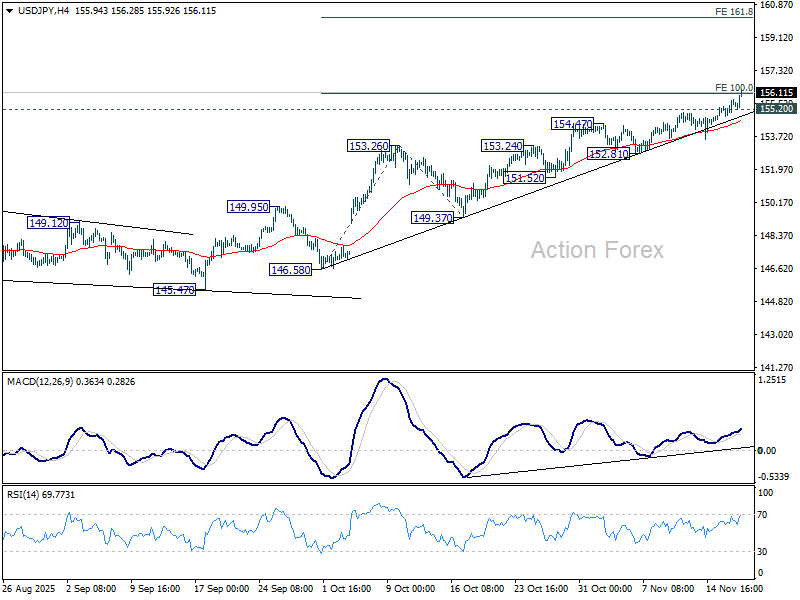
          In the bigger picture, current development suggests that corrective pattern from 161.94 (2024 high) has completed with three waves at 139.87. Larger up trend from 102.58 (2021 low) could be ready to resume through 161.94 high. On the downside, break of 150.90 restiveness turned support will dampen this bullish view and extend the corrective pattern with another falling leg.
          Source: ACTIONFOREX

          To stay updated on all economic events of today, please check out our Economic calendar
          Risk Warnings and Disclaimers
          You understand and acknowledge that there is a high degree of risk involved in trading. Following any strategies or investment methods may lead to potential losses. The content on the site is provided by our contributors and analysts for information purposes only. You are solely responsible for determining whether any trading assets, securities, strategy, or any other product is suitable for investing based on your own investment objectives and financial situation.
          Add to Favorites
          Share

          Sharp Disagreements Over Economy Threaten Federal Reserve Interest Rate Cut

          Warren Takunda

          Economic

          What was once seen as a near-certain cut in interest rates next month now looks more like a coin flip as Federal Reserve officials sharply disagree over the economy’s health and whether stubborn inflation or weak hiring represent a bigger threat.
          In several speeches in the past week, some policymakers have registered greater concern over persistent inflation in an echo of the “affordability” concerns that played a large role in elections earlier this month.
          At the same time, another camp is much more concerned about meager hiring and the threat that the “low-hire, low-fire“ job market could worsen into one where layoffs become more widespread.
          The turmoil on the Fed’s 19-member interest-rate setting committee reflects a deeply uncertain economic outlook brought about by multiple factors, including tariffs, artificial intelligence, and changes in immigration and tax policies.
          “It’s reflective of a ton of uncertainty,” said Luke Tilley, chief economist at M&T Bank. “It’s not surprising at all that there’s a wide divergence of opinions.”
          Fewer rate cuts by the Fed could leave borrowing costs for homes and cars elevated. More expensive mortgages and auto loans contribute to the widespread view, according to polls, that the cost of living is too high.
          Some Fed watchers say that an unusually high number of dissents are possible at the December 9-10 meeting, regardless of whether the central bank reduces rates or not. Krishna Guha, an analyst at Evercore ISI, said a decision to cut could lead to as many as four or five dissents, while a decision to keep rates unchanged could produce three.
          Four dissenting votes would be highly unusual, given the Fed’s history of seeking consensus. The last time four officials dissented was in 1992, under then-Chair Alan Greenspan.
          Fed governor Christopher Waller on Monday noted that critics of the Fed often accuse it of “group think,” since many of its decisions are made unanimously.
          “People who are accusing us of this, get ready,” Waller said Monday in remarks in London. “You might see the least group think you’ve seen ... in a long time.”
          The differences have been exacerbated by the government shutdown’s interruption of economic data, a particular challenge for a Fed that Chair Jerome Powell has often described as “data dependent.” The government’s last jobs report was for August, and inflation for September.
          September jobs data will finally be published Thursday, and are expected to show a small gain of 50,000 jobs that month and an unchanged unemployment rate at a still-low 4.3%.
          For now, Wall Street investors put the odds of a December rate cut at 50-50, according to CME Fedwatch, down sharply from nearly 94% a month ago. The decline has contributed to the stock market’s drops this week.
          After cutting their key rate in September for the first time this year, Fed policymakers signaled they expected to cut twice more, in October and December.
          But after implementing a second reduction Oct. 29, Powell poured cold water on the prospects of another cut, describing it as “not a foregone conclusion — far from it.”
          And speeches last week by a raft of regional Fed officials pushed the market odds of a December cut even lower. Susan Collins, president of the Federal Reserve Bank of Boston, said, “in all of my conversations with contacts across New England, I hear concerns about elevated prices.”
          Collins said that keeping the Fed’s key rate at its current level of about 3.9% would help bring inflation down. The economy “has been holding up quite well” even with interest rates where they are, she added.
          Several other regional presidents voiced similar concerns, including Raphael Bostic of the Atlanta Fed, Alberto Musalem of the St. Louis Fed, and Jeffrey Schmid at the Kansas City Fed. Musalem, Collins, and Schmid are among the 12 officials who vote on policy this year. Schmid dissented in October in favor of keeping rates unchanged.
          “When I talk to contacts in my district, I hear continued concern over the pace of price increases,” Schmid said Friday. “Some of this has to do with the effect of tariffs on input prices, but it is not just tariffs — or even primarily tariffs — that has people worried. I hear concerns about rising health care costs and insurance premiums, and I hear a lot about electricity.”
          On Monday, however, Waller argued that sluggish hiring is a bigger concern, and renewed his call for a rate cut next month.
          “The labor market is still weak and near stall speed,” he said. “Inflation through September continued to show relatively small effects from tariffs and support the hypothesis that tariffs ... are not a persistent source of inflation.”
          Waller also dismissed the concern — voiced by Schmid and others — that the Fed should keep rates elevated because inflation has topped the Fed’s 2% target for five years. So far that hasn’t led the public to worry that inflation will stay elevated for an extended period, Waller noted.
          “You can’t just sort of say it’s been above target for five years, so I’m not going to cut,” he added. “You got to give us better answers than that.”
          There could be consensus for an interest rate cut if, say, new data for October and November show the economy shedding jobs, according to Esther George, the former president of the Kansas City Fed.
          It’s also worth noting that many economists had expected multiple dissents in September, but instead only Stephen Miran, a governor appointed that month by President Donald Trump, voted against the rate cut decision, in favor of an even bigger reduction.
          “Registering a dissent is a hard decision, and I think you’re going to find people that are speaking today that wouldn’t follow through with a vote in that direction,” she said. “I think you’re going to find enough consensus, whichever way they go.”

          Source: AP

          To stay updated on all economic events of today, please check out our Economic calendar
          Risk Warnings and Disclaimers
          You understand and acknowledge that there is a high degree of risk involved in trading. Following any strategies or investment methods may lead to potential losses. The content on the site is provided by our contributors and analysts for information purposes only. You are solely responsible for determining whether any trading assets, securities, strategy, or any other product is suitable for investing based on your own investment objectives and financial situation.
          Add to Favorites
          Share

          Japan-China tensions trigger Nikkei 225 sell-off as tourism stocks plunge

          Adam

          Stocks

          What happened

          Diplomatic tensions escalated after Prime Minister Sanae Takaichi stated in parliament on 7 November that a Chinese military action against Taiwan could constitute an existential threat to Japan, potentially warranting a military response from Tokyo. Beijing responded over the weekend by issuing a travel advisory and expressing concerns regarding the safety of Chinese nationals in Japan.
          The Chinese Foreign Ministry asserted that recent statements on Taiwan had undermined the foundation of bilateral relations and called upon Takaichi to retract her remarks. On Monday, Takaichi characterised her comments as 'hypothetical' and pledged to refrain from making similar statements in parliamentary proceedings.

          Nikkei plunges below 50,000 and yen weakens

          Heightened diplomatic tensions with China triggered significant investor concern, with travel and retail-oriented equities experiencing substantial sell-offs following Beijing's advisory to Chinese citizens against visiting Japan. Beauty and personal care company Shiseido witnessed its shares decline by 12%, while department store operator Isetan Mitsukoshi fell over 11%, and Ryohin Keikaku, parent company of Muji, shed more than 9% of its market value.
          Combined with concerns regarding elevated valuations in US technology equities, the Nikkei 225 declined 3% across the first two trading sessions this week, falling beneath the 50,000 threshold. The yen simultaneously weakened, breaching 155 against the dollar.

          Market vulnerability and economic backdrop

          Recent developments reinforce external perceptions of Takaichi's hardline conservative positioning, which has clearly unsettled Beijing. While the market reaction appears pronounced, the underlying concerns are legitimate.
          The timing proves particularly inopportune given Japan's fragile economic landscape. Japan's third-quarter gross domestic product (GDP) contracted by 1.8% on an annualised basis, marking the first contraction in six quarters. The deceleration stemmed from a sharper decline in net exports and softened private consumption. Households continue to grapple with rising costs amid anaemic real wage growth, while the broader economy confronts external headwinds including US tariffs. Domestic consumption has failed to generate meaningful momentum in retail sales, rendering tourism revenues increasingly critical to economic growth.

          Tourism impact

          Visitors from mainland China, Hong Kong and Macau represent approximately 27% of all foreign arrivals to Japan in 2024, totalling close to 9.8 million visitors. Should tensions persist, tangible impacts on retail and tourism-related equities could materialise. That said, visitors from other regions may partially offset this demand contraction. Notably, Japan's recent decision to triple the tourism tax to ¥3000 suggests authorities believe current visitor volumes exceed optimal levels, indicating some buffer capacity exists.
          It is worth noting that certain equities most severely affected in this episode, such as Shiseido, were already contending with separate operational challenges—the geopolitical tensions merely amplified pre-existing vulnerabilities.

          Trade implications

          Should tensions intensify further, disruptions could extend into the trade relationship, which remains asymmetric yet mutually significant. Japan maintains a ¥6.4 trillion trade deficit with China in 2024 and depends heavily on Chinese imports for consumer electronics, household appliances and critical rare-earth metals—inputs essential for Japanese manufacturers to sustain export competitiveness. Conversely, Japan dominates the global supply of semiconductor manufacturing equipment and precision machinery crucial to China's technology sector and industrial ambitions. Any sustained trade disruption would prove detrimental to both economies.

          Technical analysis

          Nikkei 225
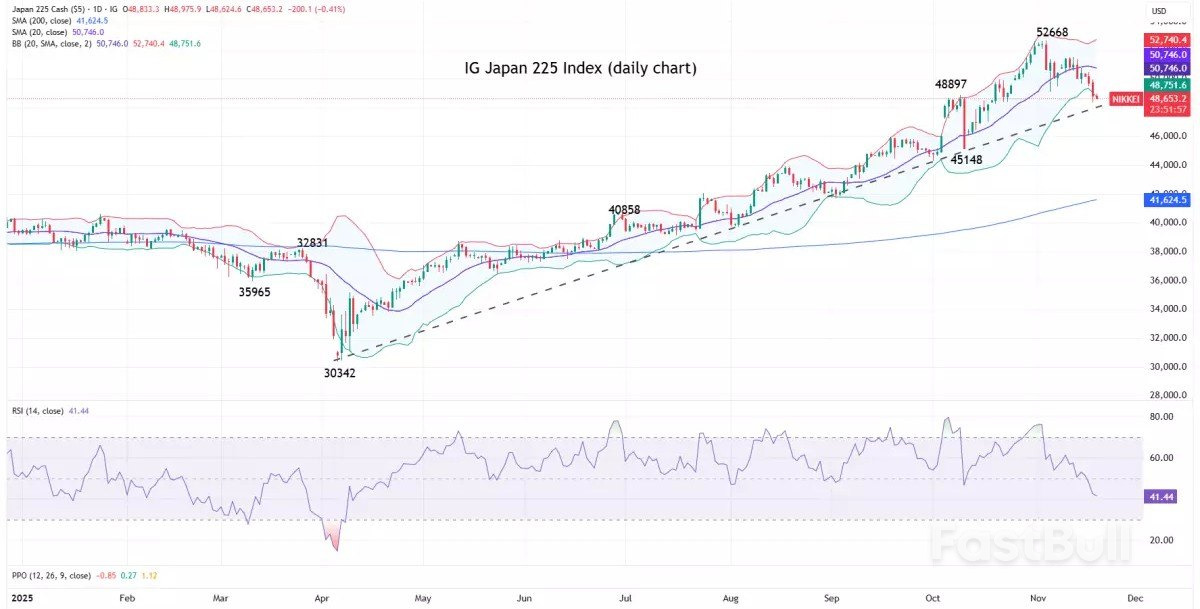
          The Japan 225 index has declined approximately 8% from its early November peak, but given it continues trading above the 200-day moving average (MA), the medium-term ascending trend remains intact. The trend line originating from early April is likely to provide support around 48,000. The Bollinger Bands also indicate an oversold condition, which could potentially drive a technical rebound towards immediate resistance around 51,500. However, should the index breach below 48,000, the next material support lies near 45,000.
          Figure 1: Japan 225 daily price chart

          Japan-China tensions trigger Nikkei 225 sell-off as tourism stocks plunge_1as of 19 November 2025. Past performance is not a reliable indicator of future performance.
          USD/JPY
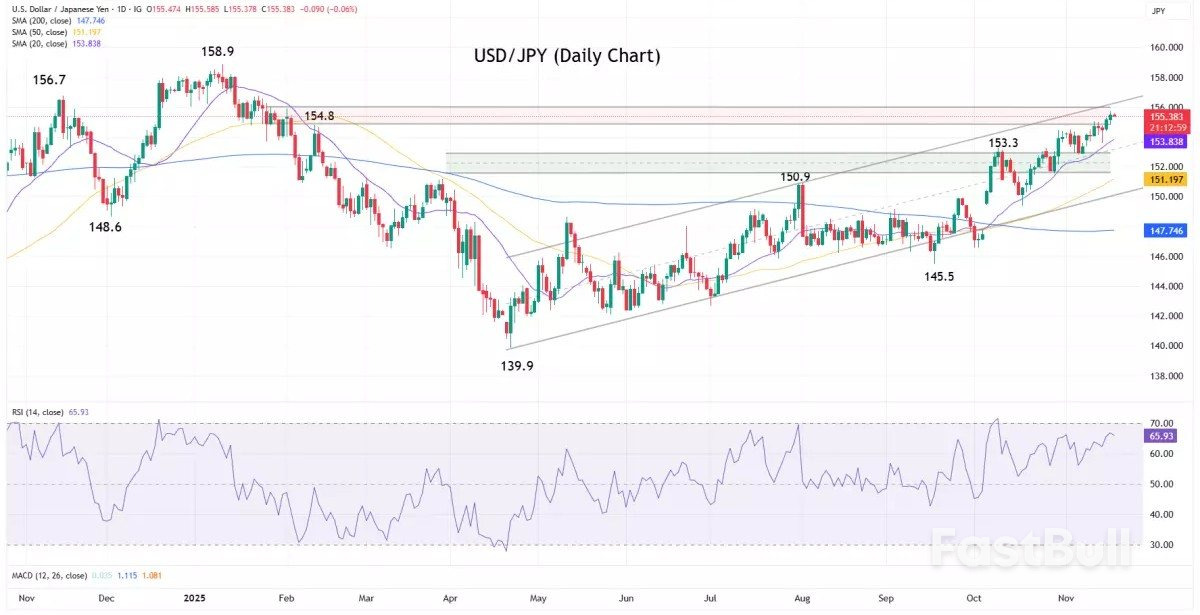
          USD/JPY has gained momentum following the breakout in early October after Takaichi's election as president of the Liberal Democratic Party. The pair currently trades at the resistance range of 154.8-156. Should the US dollar strengthen further beyond this resistance range, January's high at 158.9 will come into focus. Conversely, a rejection below 156 would likely suggest consolidation within the 153-155 range, with 151.6 acting as key support.
          Figure 2: USD/JPY daily price chart

          Japan-China tensions trigger Nikkei 225 sell-off as tourism stocks plunge_2as of 19 November 2025. Past performance is not a reliable indicator of future performance.

          Source: ig

          Risk Warnings and Disclaimers
          You understand and acknowledge that there is a high degree of risk involved in trading. Following any strategies or investment methods may lead to potential losses. The content on the site is provided by our contributors and analysts for information purposes only. You are solely responsible for determining whether any trading assets, securities, strategy, or any other product is suitable for investing based on your own investment objectives and financial situation.
          Add to Favorites
          Share

          US Trade Deficit Narrows Sharply in August As Imports Fall

          Glendon

          Forex

          Economic

          The U.S. trade deficit narrowed more than expected in August as imports declined, but trade could still subtract from economic growth in the third quarter.

          The trade gap contracted 23.8% to $59.6 billion, the Commerce Department's Bureau of Economic Analysis and Census Bureau said on Wednesday. Economists polled by Reuters had forecast the trade deficit would ease to $61.0 billion.

          Imports decreased 5.1% to $340.4 billion, while exports edged up 0.1% to $280.8 billion.

          The report, which was initially scheduled for release on October 7, was delayed because of the recently ended 43-day shutdown of the government.

          President Donald Trump's protectionist trade policy, marked by sweeping tariffs, has caused big swings in imports and the trade deficit, distorting the overall economic picture.

          The U.S. Supreme Court early this month heard arguments on the legality of Trump's import duties, with justices raising doubts about his authority to impose tariffs under the 1977 International Emergency Economic Powers Act.

          Trade sliced off a record 4.68 percentage points from gross domestic product in the first quarter before adding all that back to GDP in the April-June quarter. Estimates for third-quarter GDP growth are well above a 3.0% annualized rate.

          The third-quarter GDP report was due in late October but delayed by the government shutdown. The economy grew at a 3.8% pace in the second quarter, with a smaller trade deficit being the key driver.

          Source: Reuters

          To stay updated on all economic events of today, please check out our Economic calendar
          Risk Warnings and Disclaimers
          You understand and acknowledge that there is a high degree of risk involved in trading. Following any strategies or investment methods may lead to potential losses. The content on the site is provided by our contributors and analysts for information purposes only. You are solely responsible for determining whether any trading assets, securities, strategy, or any other product is suitable for investing based on your own investment objectives and financial situation.
          Add to Favorites
          Share

          Vietnam Police Open Criminal Probe Of 2nd Germany-Based Activist

          Winkelmann

          Political

          Economic

          Vietnam police issued an arrest warrant for a well-known lawyer and activist based in Germany for alleged anti-state activities, the second government critic in that country to be targeted this week on the same charges.

          Nguyen Van Dai is accused of "producing, storing, distributing or disseminating information, documents or materials aimed at opposing the Socialist Republic of Vietnam," according to a statement on the public security ministry's website. He is a Vietnamese citizen, police said.

          "Every time you accuse me from afar like this, tens of thousands of curious Vietnamese people" search his name, Dai said in a message to police posted on social media. "You are doing free media for me more effectively than international agencies."

          The 56-year-old said he's been a political refugee since 2018 and protected by the German government under the 1951 Geneva convention.

          The German embassy in Hanoi didn't immediately respond to a request for comment.

          The same charges were leveled earlier this week against Berlin-based journalist Le Trung Khoa, the editor of Thoibao.de, a Vietnamese-language news site for the diaspora. Police launched a criminal investigation into Khoa on Monday, who in turn criticized Vietnam's lack of freedom of expression and of the press.

          Dai was previously sentenced to 15 years in jail and five years of house arrest in Vietnam after being convicted of trying to overthrow the government in April 2018. He was released later that year and flew to Germany with his wife as well as colleague Le Thu Ha, who had been sentenced to nine years in prison.

          Dai and Ha were both members of the Brotherhood for Democracy, which was formed in 2013 to provide human rights training and legal assistance to Vietnamese.

          Vietnam's government has "intensified its crackdown on dissent to punish people simply for raising concerns or complaints about government policies or local officials," Human Rights Watch said in an April 21 report.

          There are more than 160 political and religious prisoners in Vietnam, including bloggers, labor union and democracy advocates, the rights agency said earlier this month.

          Source: Bloomberg Europe

          To stay updated on all economic events of today, please check out our Economic calendar
          Risk Warnings and Disclaimers
          You understand and acknowledge that there is a high degree of risk involved in trading. Following any strategies or investment methods may lead to potential losses. The content on the site is provided by our contributors and analysts for information purposes only. You are solely responsible for determining whether any trading assets, securities, strategy, or any other product is suitable for investing based on your own investment objectives and financial situation.
          Add to Favorites
          Share

          China-led central bank gold buying spree could stress global markets - SocGen

          Adam

          Commodity

          Robust physical demand for platinum and silver has highlighted the fragility of global supply chains. While the gold market has not seen the same kind of disruption, it may not be immune to similar volatility, according to one investment bank.
          In their latest report, commodity analysts at Société Générale said they are closely watching official-sector gold demand, as they believe ongoing central bank purchases could lead to another short squeeze similar to what was seen in silver and platinum.
          Global central banks have increased their gold reserves by roughly 1,000 tonnes in each of the last three years. Although demand is expected to be slightly weaker this year, the World Gold Council forecasts that holdings could still rise by as much as 950 tonnes, well above long-term averages.
          Société Générale is issuing early warning signals that this demand for physical metal could put additional stress on a market dominated by paper holdings. The analysts said that even a 1% shift in reserve assets would spark a “gold frenzy.”
          They added that China will continue to dominate the gold market.
          “If instead of our previous assumption of central banks selling US assets and diverting a small proportion into gold, we could, alternatively, assume that central banks reallocate an additional 1% of their total reserves into gold and do not sell foreign assets,” they said. “China alone would require 276t alone but if we sum across all countries represented, we arrive at a very significant 762t of total flows. If we take that 762t and spread it over a three-year horizon, this will equate to 64t a quarter, almost the same level as under the assumption that foreign holders reduce their exposure to US assets, that is central to our gold forecasting model.”
          SocGen’s latest comments come as official-sector gold demand continues to attract significant market attention. Analysts note that global central bank gold purchases have helped create substantial value in the gold market, establishing new support levels at each major breakout.
          Analysts expect that growing economic and geopolitical uncertainty will continue to prompt central banks to diversify their holdings into gold. At the same time, America’s ongoing trade war has pushed many nations to reduce their reliance on the U.S. dollar and move into an asset with no third-party or geopolitical risk.
          Although central bank demand remains robust, the World Gold Council notes that 66% of official purchases in the third quarter have gone unreported. Because central bank demand is often opaque, analysts must estimate buying using a range of data sources.
          SocGen is monitoring central bank demand through U.K. trade data.
          “Data released on 13 November, which includes September activity, pointed to an increase in export activity of 55.4 tonnes, which is 15 tonnes below the same month in 2023 and 70 tonnes below the seasonal norm. As prices declined in the latter half of October, this provided a better entry point for central bank buying, so we would expect export activity to have picked up (and a reduction in LBMA tonnage) last month. Seasonally, on average, there are 140 tonnes of exports out of the UK to all destinations in the month of October. We will have to wait until 12 December to see that data,” the analysts said.
          SocGen has also seen a slight slowdown in U.K. gold exports to China.
          “Total UK gold export data includes exports to China, and the HMRC dataset reports 15t of gold exports to China in September, up from 10t in August. However, September has seen an average of 47t of exports out of the UK into China (2022–2024). September’s export number is the lowest level going back to 2022. Seasonally, we would expect exports to reach 60t in October,” the analysts said.
          While China imported 10 tonnes of gold from the U.K. in September, it reported only a 1-tonne increase in its official reserves.
          According to the Financial Times, SocGen estimates—based on trade data—that China’s total purchases could reach as much as 250 tonnes this year, or more than one-third of total global central bank demand.

          Source: kitco

          Risk Warnings and Disclaimers
          You understand and acknowledge that there is a high degree of risk involved in trading. Following any strategies or investment methods may lead to potential losses. The content on the site is provided by our contributors and analysts for information purposes only. You are solely responsible for determining whether any trading assets, securities, strategy, or any other product is suitable for investing based on your own investment objectives and financial situation.
          Add to Favorites
          Share
          FastBull
          Copyright © 2025 FastBull Ltd

          728 RM B 7/F GEE LOK IND BLDG NO 34 HUNG TO RD KWUN TONG KLN HONG KONG

          TelegramInstagramTwitterfacebooklinkedin
          App Store Google Play Google Play
          Products
          Charts

          Chats

          Q&A with Experts
          Screeners
          Economic Calendar
          Data
          Tools
          Membership
          Features
          Function
          Markets
          Copy Trading
          Latest Signals
          Contests
          News
          Analysis
          24/7
          Columns
          Education
          Company
          Careers
          About Us
          Contact Us
          Advertising
          Help Center
          Feedback
          User Agreement
          Privacy Policy
          Business

          White Label

          Data API

          Web Plug-ins

          Poster Maker

          Affiliate Program

          Risk Disclosure

          The risk of loss in trading financial instruments such as stocks, FX, commodities, futures, bonds, ETFs and crypto can be substantial. You may sustain a total loss of the funds that you deposit with your broker. Therefore, you should carefully consider whether such trading is suitable for you in light of your circumstances and financial resources.

          No decision to invest should be made without thoroughly conducting due diligence by yourself or consulting with your financial advisors. Our web content might not suit you since we don't know your financial conditions and investment needs. Our financial information might have latency or contain inaccuracy, so you should be fully responsible for any of your trading and investment decisions. The company will not be responsible for your capital loss.

          Without getting permission from the website, you are not allowed to copy the website's graphics, texts, or trademarks. Intellectual property rights in the content or data incorporated into this website belong to its providers and exchange merchants.

          Not Logged In

          Log in to access more features

          FastBull Membership

          Not yet

          Purchase

          Become a signal provider
          Help Center
          Customer Service
          Dark Mode
          Price Up/Down Colors

          Log In

          Sign Up

          Position
          Layout
          Fullscreen
          Default to Chart
          The chart page opens by default when you visit fastbull.com
