• Trade
  • Markets
  • Copy
  • Contests
  • News
  • 24/7
  • Calendar
  • Q&A
  • Chats
Trending
Screeners
SYMBOL
LAST
BID
ASK
HIGH
LOW
NET CHG.
%CHG.
SPREAD
SPX
S&P 500 Index
6870.39
6870.39
6870.39
6895.79
6858.28
+13.27
+ 0.19%
--
DJI
Dow Jones Industrial Average
47954.98
47954.98
47954.98
48133.54
47871.51
+104.05
+ 0.22%
--
IXIC
NASDAQ Composite Index
23578.12
23578.12
23578.12
23680.03
23506.00
+72.99
+ 0.31%
--
USDX
US Dollar Index
98.880
98.960
98.880
98.960
98.730
-0.070
-0.07%
--
EURUSD
Euro / US Dollar
1.16535
1.16542
1.16535
1.16717
1.16341
+0.00109
+ 0.09%
--
GBPUSD
Pound Sterling / US Dollar
1.33203
1.33212
1.33203
1.33462
1.33136
-0.00109
-0.08%
--
XAUUSD
Gold / US Dollar
4206.45
4206.88
4206.45
4218.85
4190.61
+8.54
+ 0.20%
--
WTI
Light Sweet Crude Oil
59.486
59.516
59.486
60.084
59.291
-0.323
-0.54%
--

Community Accounts

Signal Accounts
--
Profit Accounts
--
Loss Accounts
--
View More

Become a signal provider

Sell trading signals to earn additional income

View More

Guide to Copy Trading

Get started with ease and confidence

View More

Signal Accounts for Members

All Signal Accounts

Best Return
  • Best Return
  • Best P/L
  • Best MDD
Past 1W
  • Past 1W
  • Past 1M
  • Past 1Y

All Contests

  • All
  • Trump Updates
  • Recommend
  • Stocks
  • Cryptocurrencies
  • Central Banks
  • Featured News
Top News Only
Share

Russian Defence Ministry: Russian Forces Take Control Of Novodanylivka In Ukraine's Zaporizhzhia Region

Share

Russian Defence Ministry: Russian Forces Take Control Of Chervone In Ukraine's Donetsk Region

Share

French Finance Ministry: Government Started Process To Block Temporarily Shein Platform

Share

Finance Minister: Indonesia To Impose Coal Export Tax Of Up To 5% Next Year

Share

[Trump Considering Fired Homeland Security Secretary Noem? White House Denies] According To Reports From US Media Outlets Such As The Daily Beast And The UK's Independent, The White House Has Denied Reports That US President Trump Is Considering Firing Homeland Security Secretary Noem. White House Spokesperson Abigail Jackson Posted On Social Media On The 7th Local Time, Calling The Claims "fake News" And Stating That "Secretary Noem Has Done An Excellent Job Implementing The President's Agenda And 'making America Safe Again'."

Share

HKEX: Standard Chartered Bought Back 571604 Total Shares On Other Exchanges For Gbp9.5 Million On Dec 5

Share

Morgan Stanley Reiterates Bullish Outlook On US Stocks Due To Fed Rate Cut Expectations. Morgan Stanley Strategists Believe That The US Stock Market Faces A "bullish Outlook" Given Improved Earnings Expectations And Anticipated Fed Rate Cuts. They Expect Strong Corporate Earnings By 2026, And Anticipate The Fed Will Cut Rates Based On Lagging Or Mildly Weak Labor Markets. They Expect The US Consumer Discretionary Sector And Small-cap Stocks To Continue To Outperform

Share

China's National Development And Reform Commission Announced That Starting From 24:00 On December 8, The Retail Price Limit For Gasoline And Diesel In China Will Be Reduced By 55 Yuan Per Ton, Which Translates To A Reduction Of 0.04 Yuan Per Liter For 92-octane Gasoline, 0.05 Yuan Per Liter For 95-octane Gasoline, And 0.05 Yuan Per Liter For 0# Diesel

Share

Tkms CEO: US Security Strategy Highlights Need For Europe To Take Care Of Its Own Defences

Share

USA S&P 500 E-Mini Futures Up 0.1%, NASDAQ 100 Futures Up 0.18%, Dow Futures Down 0.02%

Share

London Metal Exchange (LME): Copper Inventories Increased By 2,000 Tons, Aluminum Inventories Decreased By 2,500 Tons, Nickel Inventories Increased By 228 Tons, Zinc Inventories Increased By 2,375 Tons, Lead Inventories Decreased By 3,725 Tons, And Tin Inventories Decreased By 10 Tons

Share

Swiss Sight Deposits Of Domestic Banks At 440.519 Billion Sfr In Week Ending December 5 Versus 437.298 Billion Sfr A Week Earlier

Share

Czech November Jobless Rate 4.6% Versus Mkt Fcast 4.7%

Share

Czech Jobless Rate Unchanged At 4.6% In November

Share

Singapore Central Bank Data: November Foreign Exchange Reserves At $400.0 Billion

Share

Fitch On EMEA Homebuilders Says Weak Demand Is Likely To Constrain Completions And New Starts, Despite Easing Inflation And Gradual Rate Cuts

Share

French Otc Day-Ahead Baseload Power Price At 22.50 EUR/Mwh, Down 35.3% From The Price Paid Friday For Monday Delivery - Lseg Data

Share

Cambodia Information Minister: 4 Cambodian Civilians Killed, 9 Injured Amid Conflict With Thailand

Share

Tkms CEO: With Meko Frigates We Are Offering To German Government An Alternative To Delayed F126 Frigates

Share

Tkms CEO: Expect Decision On Canadian Submarine Order In 2026

TIME
ACT
FCST
PREV
France Industrial Output MoM (SA) (Oct)

A:--

F: --

P: --
France Trade Balance (SA) (Oct)

A:--

F: --

P: --
Euro Zone Employment YoY (SA) (Q3)

A:--

F: --

P: --
Canada Part-Time Employment (SA) (Nov)

A:--

F: --

P: --

Canada Unemployment Rate (SA) (Nov)

A:--

F: --

P: --

Canada Full-time Employment (SA) (Nov)

A:--

F: --

P: --

Canada Labor Force Participation Rate (SA) (Nov)

A:--

F: --

P: --

Canada Employment (SA) (Nov)

A:--

F: --

P: --

U.S. PCE Price Index MoM (Sept)

A:--

F: --

P: --

U.S. Personal Income MoM (Sept)

A:--

F: --

P: --

U.S. Core PCE Price Index MoM (Sept)

A:--

F: --

P: --

U.S. PCE Price Index YoY (SA) (Sept)

A:--

F: --

P: --

U.S. Core PCE Price Index YoY (Sept)

A:--

F: --

P: --

U.S. Personal Outlays MoM (SA) (Sept)

A:--

F: --

P: --
U.S. 5-10 Year-Ahead Inflation Expectations (Dec)

A:--

F: --

P: --

U.S. Real Personal Consumption Expenditures MoM (Sept)

A:--

F: --

P: --
U.S. Weekly Total Rig Count

A:--

F: --

P: --

U.S. Weekly Total Oil Rig Count

A:--

F: --

P: --

U.S. Consumer Credit (SA) (Oct)

A:--

F: --

P: --
China, Mainland Foreign Exchange Reserves (Nov)

A:--

F: --

P: --

Japan Trade Balance (Oct)

A:--

F: --

P: --

Japan Nominal GDP Revised QoQ (Q3)

A:--

F: --

P: --

China, Mainland Imports YoY (CNH) (Nov)

A:--

F: --

P: --

China, Mainland Exports (Nov)

A:--

F: --

P: --

China, Mainland Imports (CNH) (Nov)

A:--

F: --

P: --

China, Mainland Trade Balance (CNH) (Nov)

A:--

F: --

P: --

China, Mainland Exports YoY (USD) (Nov)

A:--

F: --

P: --

China, Mainland Imports YoY (USD) (Nov)

A:--

F: --

P: --

Germany Industrial Output MoM (SA) (Oct)

A:--

F: --

P: --
Euro Zone Sentix Investor Confidence Index (Dec)

A:--

F: --

P: --

Canada National Economic Confidence Index

--

F: --

P: --

U.K. BRC Like-For-Like Retail Sales YoY (Nov)

--

F: --

P: --

U.K. BRC Overall Retail Sales YoY (Nov)

--

F: --

P: --

Australia Overnight (Borrowing) Key Rate

--

F: --

P: --

RBA Rate Statement
RBA Press Conference
Germany Exports MoM (SA) (Oct)

--

F: --

P: --

U.S. NFIB Small Business Optimism Index (SA) (Nov)

--

F: --

P: --

Mexico 12-Month Inflation (CPI) (Nov)

--

F: --

P: --

Mexico Core CPI YoY (Nov)

--

F: --

P: --

Mexico PPI YoY (Nov)

--

F: --

P: --

U.S. Weekly Redbook Index YoY

--

F: --

P: --

U.S. JOLTS Job Openings (SA) (Oct)

--

F: --

P: --

China, Mainland M1 Money Supply YoY (Nov)

--

F: --

P: --

China, Mainland M0 Money Supply YoY (Nov)

--

F: --

P: --

China, Mainland M2 Money Supply YoY (Nov)

--

F: --

P: --

U.S. EIA Short-Term Crude Production Forecast For The Year (Dec)

--

F: --

P: --

U.S. EIA Natural Gas Production Forecast For The Next Year (Dec)

--

F: --

P: --

U.S. EIA Short-Term Crude Production Forecast For The Next Year (Dec)

--

F: --

P: --

EIA Monthly Short-Term Energy Outlook
U.S. API Weekly Gasoline Stocks

--

F: --

P: --

U.S. API Weekly Cushing Crude Oil Stocks

--

F: --

P: --

U.S. API Weekly Crude Oil Stocks

--

F: --

P: --

U.S. API Weekly Refined Oil Stocks

--

F: --

P: --

South Korea Unemployment Rate (SA) (Nov)

--

F: --

P: --

Japan Reuters Tankan Non-Manufacturers Index (Dec)

--

F: --

P: --

Japan Reuters Tankan Manufacturers Index (Dec)

--

F: --

P: --

Japan Domestic Enterprise Commodity Price Index MoM (Nov)

--

F: --

P: --

Japan Domestic Enterprise Commodity Price Index YoY (Nov)

--

F: --

P: --

China, Mainland PPI YoY (Nov)

--

F: --

P: --

Q&A with Experts
    • All
    • Chatrooms
    • Groups
    • Friends
    Connecting
    .
    .
    .
    Type here...
    Add Symbol or Code

      No matching data

      All
      Trump Updates
      Recommend
      Stocks
      Cryptocurrencies
      Central Banks
      Featured News
      • All
      • Russia-Ukraine Conflict
      • Middle East Flashpoint
      • All
      • Russia-Ukraine Conflict
      • Middle East Flashpoint
      Search
      Products

      Charts Free Forever

      Chats Q&A with Experts
      Screeners Economic Calendar Data Tools
      Membership Features
      Data Warehouse Market Trends Institutional Data Policy Rates Macro

      Market Trends

      Market Sentiment Order Book Forex Correlations

      Top Indicators

      Charts Free Forever
      Markets

      News

      News Analysis 24/7 Columns Education
      From Institutions From Analysts
      Topics Columnists

      Latest Views

      Latest Views

      Trending Topics

      Top Columnists

      Latest Update

      Signals

      Copy Rankings Latest Signals Become a signal provider AI Rating
      Contests
      Brokers

      Overview Brokers Assessment Rankings Regulators News Claims
      Broker listing Forex Brokers Comparison Tool Live Spread Comparison Scam
      Q&A Complaint Scam Alert Videos Tips to Detect Scam
      More

      Business
      Events
      Careers About Us Advertising Help Center

      White Label

      Data API

      Web Plug-ins

      Affiliate Program

      Awards Institution Evaluation IB Seminar Salon Event Exhibition
      Vietnam Thailand Singapore Dubai
      Fans Party Investment Sharing Session
      FastBull Summit BrokersView Expo
      Recent Searches
        Top Searches
          Markets
          News
          Analysis
          User
          24/7
          Economic Calendar
          Education
          Data
          • Names
          • Latest
          • Prev

          View All

          No data

          Scan to Download

          Faster Charts, Chat Faster!

          Download App
          English
          • English
          • Español
          • العربية
          • Bahasa Indonesia
          • Bahasa Melayu
          • Tiếng Việt
          • ภาษาไทย
          • Français
          • Italiano
          • Türkçe
          • Русский язык
          • 简中
          • 繁中
          Open Account
          Search
          Products
          Charts Free Forever
          Markets
          News
          Signals

          Copy Rankings Latest Signals Become a signal provider AI Rating
          Contests
          Brokers

          Overview Brokers Assessment Rankings Regulators News Claims
          Broker listing Forex Brokers Comparison Tool Live Spread Comparison Scam
          Q&A Complaint Scam Alert Videos Tips to Detect Scam
          More

          Business
          Events
          Careers About Us Advertising Help Center

          White Label

          Data API

          Web Plug-ins

          Affiliate Program

          Awards Institution Evaluation IB Seminar Salon Event Exhibition
          Vietnam Thailand Singapore Dubai
          Fans Party Investment Sharing Session
          FastBull Summit BrokersView Expo

          U.S. Set to Impose Tariffs Within Weeks as Trump Admin Abandons Multilateral Trade Talks

          Gerik

          Economic

          China–U.S. Trade War

          Summary:

          Facing time constraints and mounting global pressure, the U.S. under President Trump is preparing to impose new tariffs on countries that fail to finalize bilateral trade agreements within the next 2–3 weeks...

          Trump Administration Prepares Tariff Wave Amid Stalled Global Negotiations

          In a bold and decisive statement from Abu Dhabi, U.S. President Donald Trump announced on May 16 that his administration will begin imposing new tariffs on multiple trading partners within the next 2–3 weeks. The announcement reflects the administration’s frustration with the logistical impossibility of negotiating trade agreements simultaneously with up to 150 countries.
          According to Trump, the Treasury Secretary Scott Bessent and Commerce Secretary Howard Lutnick will soon notify foreign governments of revised tariff rates. He emphasized the U.S. would remain “fair” but firm in enforcing new trade terms, a stance that sharply contrasts with multilateral trade frameworks.

          Diplomatic Timeframe Narrowing: From Pause to Penalty

          The decision follows a 90-day tariff suspension announced on April 9, which was intended to allow time for trade negotiations. However, with the grace period nearing its end on July 8, few agreements have been finalized. Only two frameworks—one with the United Kingdom and a second with China—have been formally announced so far, negotiated in Geneva by senior U.S. officials.
          Meanwhile, over 100 countries have expressed interest in commencing talks, creating a bottleneck that U.S. trade officials admit they cannot realistically resolve within the timeframe. As a result, countries that fail to reach a deal may face retaliatory tariffs as high as 50%, a threshold previously mentioned by Trump as a potential ultimate goal by mid-2026.

          Tariff Uncertainty Roils Global Trade Landscape

          The Trump administration’s ambiguous position on tariff levels is generating widespread market anxiety. While the U.S. currently maintains a basic 10% import tariff for most goods, some sectors already face significantly higher rates. Notably, the President has hinted that many countries will soon be subject to rates far exceeding the 10% “floor” cited by Commerce Secretary Lutnick.
          The recent trade deal with the U.K. allows British goods to enter at the 10% rate, but Trump declared that such "generous terms" would not extend to others. For countries like Vietnam, Japan, India, and the EU, which are still in negotiations, the looming threat of elevated tariffs presents significant economic and diplomatic risks.

          Fitch Ratings and Investor Concerns Amplify Policy Volatility

          According to Fitch Ratings, the U.S. average tariff remains elevated at 13%—far above the pre-Trump baseline of 2.3%—even after temporary rollbacks tied to talks with China. While this is down from 23% in early April, the current level still represents a significant departure from historical norms and global trade expectations.
          This persistent unpredictability is sparking strong reactions from financial markets. In recent weeks, stock prices have swung violently in response to mixed messages from the Trump administration—oscillating between aggressive rhetoric and negotiation overtures. Economists now estimate a 50% chance of a U.S. recession, citing the disruptive effects of trade policy as a key risk factor.

          Domestic Impact: Businesses and Consumers Brace for Fallout

          Beyond geopolitics, the uncertainty surrounding Trump’s trade policies is weighing heavily on U.S. businesses and consumers. Unpredictable tariffs complicate supply chains, delay procurement decisions, and create pricing volatility in both imported goods and domestic alternatives.
          While some firms are attempting to frontload imports or reconfigure supply chains, many face rising costs that will eventually pass through to consumers. The short-term benefit of tariff suspensions has failed to provide the stable planning horizon that industries need to manage risk.

          Unilateral Trade Escalation Risks Global Retaliation

          As the July 8 deadline approaches, the Trump administration’s shift toward broad-based tariffs appears imminent. The lack of clarity about specific tariff levels, combined with the collapse of a multilateral strategy, introduces significant volatility into global trade dynamics. Though some deals may still materialize, the broader pattern suggests a return to the “America First” doctrine that prioritizes leverage over cooperation.
          With key U.S. trading partners still awaiting formal terms, and global investors increasingly wary, the coming weeks may mark a turning point in the post-pandemic trade order—one shaped more by bilateral pressure than by rules-based negotiation. Whether this yields stronger U.S. economic outcomes or triggers a wave of global retaliation remains a question markets and policymakers are watching closely.

          Source: Yahoo Finance

          To stay updated on all economic events of today, please check out our Economic calendar
          Risk Warnings and Disclaimers
          You understand and acknowledge that there is a high degree of risk involved in trading. Following any strategies or investment methods may lead to potential losses. The content on the site is provided by our contributors and analysts for information purposes only. You are solely responsible for determining whether any trading assets, securities, strategy, or any other product is suitable for investing based on your own investment objectives and financial situation.
          Add to Favorites
          Share

          Moody’s Downgrades U.S. Credit Rating Amid Soaring Debt and Political Gridlock

          Gerik

          Economic

          U.S. Creditworthiness Takes a Hit Amid Mounting Fiscal Pressures

          In a move that caught markets off guard, Moody’s Investors Service downgraded the U.S. credit rating from Aaa to Aa1 on May 17, 2025, citing concerns over the sustainability of the country’s ballooning national debt, now surpassing $36 trillion. The decision follows a prolonged period of fiscal deterioration and reflects waning confidence in the government's ability to implement credible budget reforms.
          Although Moody’s revised the U.S. outlook from “negative” to “stable,” the downgrade underscores the structural nature of America’s fiscal challenges, particularly the widening gap between revenue generation and expenditure control.

          Political Gridlock Undermines Fiscal Reform

          Moody’s justification centers on repeated failures by successive administrations and Congress to reach bipartisan agreements to contain budget deficits and rising interest obligations. Despite the Trump administration’s renewed promises to balance the federal budget, its signature tax cut extension proposals—touted as legacy-defining legislation—have stumbled in Congress. Resistance from hardline Republicans demanding more aggressive spending cuts has dealt a rare political setback to President Trump.
          Moody’s projects the federal debt-to-GDP ratio to rise from 98% in 2024 to 134% by 2035 unless structural reforms are implemented. These projections imply a worsening fiscal trajectory, making it harder for the U.S. to maintain investor confidence in its long-term credit profile.

          Market Reactions and Broader Financial Implications

          The downgrade has already triggered turbulence in the financial markets. U.S. Treasury yields rose sharply after the announcement, and analysts warn that investor sentiment may weaken further as markets reopen. Long-term yields, in particular, could continue to climb unless offset by flight-to-safety behavior during broader economic uncertainty.
          Jay Hatfield of Infrastructure Capital Advisors emphasized that the downgrade hits at a moment of market fragility, especially as investors digest a wave of recent Trump-imposed tariffs and rising concerns over inflation. Spencer Hakimian of Tolou Capital Management noted that lower credit ratings typically translate into higher borrowing costs—not just for the federal government, but for the broader economy, including businesses and consumers.

          Skepticism and Political Fallout

          The downgrade has reignited partisan tensions. Former Trump economic adviser Stephen Moore denounced the move as irrational, while White House communications director Steven Cheung publicly attacked Moody’s analyst Mark Zandi, calling his assessment politically motivated. Meanwhile, Democrats, including Senate Majority Leader Chuck Schumer, claimed the downgrade reflects the consequences of "reckless" tax-cut policies and the Republican party’s fiscal irresponsibility.
          The U.S. Treasury Department has yet to issue a formal response, but Treasury Secretary Scott Bessent has previously emphasized efforts to reduce the cost of government borrowing. However, the lack of tangible progress in spending restraint or revenue enhancement continues to weigh on the government’s fiscal credibility.

          Historical Context and Long-Term Outlook

          This marks the third credit downgrade in U.S. history. Standard & Poor’s stripped the U.S. of its AAA rating in 2011 during a debt ceiling crisis, and Fitch followed suit in August 2023 amid recurring last-minute debt ceiling negotiations. Moody’s, the last of the three major agencies to maintain a top-tier rating for the U.S., now joins the others in issuing a warning about America's long-term fiscal health.
          Analysts argue that unless Washington can engineer a reliable, bipartisan budget framework, the risk of future downgrades and market instability will persist. Brian Bethune of Boston University stressed the need for a “credible fiscal pact” that places deficits on a downward path. Without it, the cost of inaction will likely be reflected in diminished fiscal flexibility, rising debt service costs, and a weakening of the U.S. dollar’s safe-haven status.
          Moody’s downgrade of U.S. creditworthiness is more than a symbolic move—it is a signal to global investors that America’s long-term fiscal discipline is in question. At a time when interest rates are high, trade tensions are escalating, and debt servicing costs are growing, the downgrade may further strain the government’s capacity to respond to economic shocks. Without a shift toward transparent and sustainable fiscal policy, the U.S. risks not only higher borrowing costs but also a loss of credibility in global capital markets.

          Source: The Independent

          To stay updated on all economic events of today, please check out our Economic calendar
          Risk Warnings and Disclaimers
          You understand and acknowledge that there is a high degree of risk involved in trading. Following any strategies or investment methods may lead to potential losses. The content on the site is provided by our contributors and analysts for information purposes only. You are solely responsible for determining whether any trading assets, securities, strategy, or any other product is suitable for investing based on your own investment objectives and financial situation.
          Add to Favorites
          Share

          Fed’s Stealth Bond Purchases Hint at Strategic Shift as Gold and Bitcoin Surge

          Gerik

          Commodity

          Cryptocurrency

          Bond

          Fed's Quiet Return to Quantitative Easing Signals Policy Recalibration

          In a move that has escaped broad public attention, the U.S. Federal Reserve recently executed large-scale purchases of Treasury bonds amounting to $43.6 billion over just four days. Notably, $8.8 billion was allocated to 30-year bonds on May 8 alone. This activity diverges sharply from the public narrative of monetary tightening, raising speculation that the Fed may be softening its stance to preempt economic headwinds.
          Rather than representing a reversal of official policy, this appears to be a cautious, almost experimental reintroduction of liquidity into the market. For market-savvy investors, the scale and subtlety of these actions serve as an early signal of deeper systemic shifts that could influence global capital flows.

          Commodities React First: Gold as the Barometer of Skepticism

          Gold, long regarded as a hedge against financial uncertainty, has been among the first asset classes to respond. Since early 2024, gold has appreciated significantly, fueled by growing distrust toward central banks and political actors. Unlike fiat currencies, gold responds primarily to quantifiable shifts in monetary supply and sovereign risk—making it a particularly sensitive gauge in the current macroeconomic context.
          The trend is global. China, for example, has expanded its gold import quotas, enabling domestic banks to directly convert U.S. dollars into gold. This maneuver indicates strategic diversification away from U.S. Treasuries, reflecting Beijing’s apprehension about the long-term security of holding $784 billion in U.S. government debt.
          If even 10% of that portfolio were redirected into gold, the impact on global financial markets would be profound.

          Bitcoin Rises on Institutional Validation and Strategic Accumulation

          Bitcoin, often seen as the digital counterpart to gold, has also reacted strongly. After undergoing its latest “halving” event—a reduction in mining rewards that historically precedes multi-year bull cycles—Bitcoin has surged in price and institutional relevance.
          In a noteworthy shift, the Trump administration has embraced Bitcoin at a strategic level, establishing a national reserve of the digital currency. This move, alongside growing inflows into Bitcoin ETFs, indicates that the asset is transitioning from fringe speculation to mainstream acceptance. Fed liquidity, whether explicit or implicit, tends to bolster risk-on assets, giving further upside to the crypto market.

          Central Banks Quietly Prepare for a Global Financial Realignment

          Not only the U.S. and China, but central banks across the globe are increasing their gold holdings and reassessing the composition of their reserves. This coordinated behavior suggests that many monetary authorities are anticipating a systemic recalibration—either from inflation volatility, geopolitical fragmentation, or long-term currency depreciation.
          The import of gold by the U.S. itself reinforces the notion that even Washington is hedging against internal fiscal risks, including the expanding debt burden and weakening sovereign credit profile, recently spotlighted by Moody’s downgrade.

          Emerging Markets and Resource Economies Enter the Spotlight

          While traditional markets brace for turbulence, resource-rich nations—especially in Latin America—are experiencing a wave of investor interest. Brazil stands out. Benefiting from a commodities boom, its financial instruments have soared: the iShares MSCI Brazil ETF and the iShares Latin America 40 ETF have risen approximately 24% year-to-date.
          These gains are not random; they reflect a calculated reallocation of global capital toward economies seen as relatively insulated from Western financial fragility. As the dollar softens and global demand for commodities rises, Brazil and similar economies emerge as both safe havens and growth plays.

          Early Moves in a Broader Monetary Realignment

          The Fed’s discreet re-engagement in bond markets may signal more than tactical liquidity support—it may foreshadow a larger-scale monetary recalibration. As institutional confidence in fiat systems erodes and inflationary pressures remain unresolved, gold and bitcoin are increasingly seen as viable hedges, while Latin America offers geographic and economic diversification.
          While U.S. equities have historically benefitted from loose monetary policy, this time may be different. The evolving distrust in central banking, alongside geopolitical instability, is redistributing market confidence toward non-traditional stores of value and emerging market assets. For investors alert to early policy signals, the window of strategic repositioning is already opening.

          Source: MorningStar

          Risk Warnings and Disclaimers
          You understand and acknowledge that there is a high degree of risk involved in trading. Following any strategies or investment methods may lead to potential losses. The content on the site is provided by our contributors and analysts for information purposes only. You are solely responsible for determining whether any trading assets, securities, strategy, or any other product is suitable for investing based on your own investment objectives and financial situation.
          Add to Favorites
          Share

          Oil Market’s Missing Barrels Have Gone Up In Smoke

          Owen Li

          Economic

          Commodity

          Amid the doom and gloom of falling crude prices and weakening demand growth, oil bulls could find one nugget of cheer in the latest report from the International Energy Agency: a modest upward revision to historical consumption.

          That may not seem terribly exciting, but it wiped out three years’ worth of apparent global oil stockbuilds and drained an ocean of “missing barrels.”

          The world used about 330,000 barrels a day more in 2023 than was previously reported, according to the IEA. Africa accounted for three-quarters of that revision, with higher consumption in Egypt and Nigeria.

          Because of the way forecasts are generated, that historical increase gets rolled forward into subsequent years, raising the level of demand for this year and next even if it does nothing for year-on-year growth.

          Rather than predicting actual oil consumption for 195 countries, analysts tend to forecast incremental demand by region using assumptions about population and economic growth, and then applying those numbers to “known” historical consumption levels.

          Raise the starting point and everything else rises, even as annual growth is unaltered.

          At a stroke, the IEA’s revision wiped out all the stockbuilds it saw in 2022, 2023 and 2024.

          Rather than adding 220 million barrels of oil to global inventories during those three years, the IEA now says we have drawn them down by nearly 75 million barrels. That swing is equivalent to almost three-quarters of the US strategic reserve.

          Before we get too excited, though, the IEA still sees supply running ahead of demand in 2025 and 2026.

          Even if OPEC+ pauses its output increases after the big hikes planned for this month and next, supply will still exceed demand by more than 1 million barrels a day in the third quarter, the agency says. And that’s before any possible return of Iranian barrels.

          The spare oil will head for storage tanks that are a lot less full than previously believed.

          While it’s not a recipe for rising prices, erasure of the missing barrels might help put a floor under them, at least for a little while.

          Exports of US crude are tumbling as OPEC+ restores production into a market grappling with weakening demand because of the trade war and reduced refinery capacity. Average US oil exports dropped 10% to 3.76 million barrels a day in the four weeks through May 9, according to Energy Information Administration data. That’s the slowest pace since January and well below seasonal levels from the past two years.

          US Treasury officials met with Hong Kong banks in April to warn them against facilitating Iranian oil shipments to China, just a month before sanctioning nine non-bank entities allegedly involved in such trades, people familiar with the matter said.

          Canadian oil tycoon Adam Waterous’ Strathcona Resources Ltd. announced plans to make a takeover bid for MEG Energy Corp. that values the oil-sands company at about C$6 billion ($4 billion).

          Vistra Corp. agreed to buy seven gas-fired power plants for $1.9 billion, the latest big US generator betting on the fossil fuel to feed the voracious appetite of artificial intelligence.

          Taiwan is shutting its last nuclear reactor this weekend, putting pressure on the island’s energy-guzzling chipmakers in the face of soaring demand for their products.

          Ice-cream cones will likely cost more this summer as the price of coconut oil, a key ingredient, keeps setting records, Bloomberg Opinion’s Javier Blas writes.

          China’s liquefied natural gas demand may see limited benefit from the recent slash in US tariffs, according to BloombergNEF. The existing levies, domestic economic malaise and elevated LNG prices are set to curb Chinese buying interest. Imports may reach 68 million metric tons — 1.1 million tons more than forecast last month during the peak of the trade war. Yet that’s still 8.2 million tons, or 11%, lower year-on-year.

          Join us in Doha for the Qatar Economic Forum on May 20-22. Since 2021, the forum powered by Bloomberg has convened more than 6,500 influential leaders to explore bold ideas and tackle the challenges shaping the global economy. Request an invitation today.

          Source: Bloomberg Europe

          To stay updated on all economic events of today, please check out our Economic calendar
          Risk Warnings and Disclaimers
          You understand and acknowledge that there is a high degree of risk involved in trading. Following any strategies or investment methods may lead to potential losses. The content on the site is provided by our contributors and analysts for information purposes only. You are solely responsible for determining whether any trading assets, securities, strategy, or any other product is suitable for investing based on your own investment objectives and financial situation.
          Add to Favorites
          Share

          Russian Economic Growth Slows Sharply Amid Sanctions and Oil Revenue Declines

          Gerik

          Economic

          Weak Q1 Signals Mounting Economic Stress for Russia

          The latest data released by Russia’s Federal Statistics Service (Rosstat) reveals that the country’s economic growth slowed significantly in the first quarter of 2025. GDP expanded by only 1.4%, a steep decline from 4.5% in the previous quarter and markedly below the 5.4% growth seen in Q1 2024. The result also fell short of expectations from the Ministry of Economic Development (1.7%) and Bloomberg analysts (1.8%).
          This downturn represents the slowest pace of growth in over a year, raising renewed concerns about the sustainability of Russia’s economic trajectory under prolonged geopolitical and financial pressure.

          Financial Headwinds and Policy Constraints Deepen Economic Challenges

          Egor Susin, an executive at Gazprombank, described the data as indicative of a significant downturn, arguing that Russia is now facing clear signs of economic contraction. Analysts attribute the sluggish growth to several interlinked issues: tight monetary policy from the Bank of Russia, persistent inflation, sanctions-induced supply constraints, and a weakening revenue base from oil exports.
          The impact of declining energy income is particularly pronounced. According to Raiffeisenbank, oil and gas revenues fell by 10% between January and April 2025, weakening the fiscal cushion that has historically helped Russia navigate economic shocks. This drop in hydrocarbon earnings is especially damaging given the country’s reliance on energy exports for budget stability and foreign currency inflows.

          Sanctions and War Pressure Create a Persistent Drag

          In parallel, sanctions stemming from the Ukraine conflict continue to erode Russia’s trade capabilities and investment environment. A recent study by the Stockholm Institute of Transition Economics (SITE) underscores how escalating Western restrictions are compounding internal structural weaknesses, limiting access to critical technology, capital, and markets.
          Additionally, the ongoing conflict poses complex future risks. If peace negotiations between Moscow and Kyiv lead to military expenditure cuts, the Russian economy could experience a further contraction due to reduced government spending—currently a key driver of domestic demand. On the other hand, failure to reach a peace agreement may prompt the EU and U.S. to escalate sanctions, deepening financial isolation and curtailing growth prospects.

          Outlook Uncertain Amid Policy and Geopolitical Crossroads

          The sharp deceleration in Russia’s economic growth illustrates the accumulating toll of international sanctions, inflationary pressures, and energy revenue instability. As the war in Ukraine drags on and oil prices remain subdued, Russia’s macroeconomic stability hangs in the balance. Moving forward, the country’s economic direction will be shaped by geopolitical developments and the government’s ability—or inability—to navigate these challenges with sustainable fiscal and monetary strategies. Without meaningful structural reform or easing of external constraints, Russia may struggle to avoid a deeper slowdown in the coming quarters.

          Source: The Kyiv Independent

          To stay updated on all economic events of today, please check out our Economic calendar
          Risk Warnings and Disclaimers
          You understand and acknowledge that there is a high degree of risk involved in trading. Following any strategies or investment methods may lead to potential losses. The content on the site is provided by our contributors and analysts for information purposes only. You are solely responsible for determining whether any trading assets, securities, strategy, or any other product is suitable for investing based on your own investment objectives and financial situation.
          Add to Favorites
          Share

          "We're Going To Be Fair": Trump Will Set Tariff Rates For Other Nations In Weeks

          Owen Li

          Economic

          President Trump has departed Abu Dhabi aboard Air Force One, concluding a historic week in the Middle East that saw the signing of more than a trillion dollars in deals aimed at advancing his 'America First' agenda.

          Ahead of his departure from the Middle East, President Trump addressed business leaders in Abu Dhabi, stating that his administration will unilaterally set tariff rates for U.S. trading partners within the next two to three weeks.

          "We just reached a fantastic trade deal with the United Kingdom. And we have another big one that we reached with China," the president said.

          He continued, "At the same time, we have 150 countries that want to make a deal—but you're not able to see that many countries." He added that Treasury Secretary Scott Bessent and Commerce Secretary Howard Lutnick "will be sending letters out essentially telling people what "they'll be paying to do business in the United States."

          "I think we're going to be very fair. But it's not possible to meet the number of people that want to see us," Trump said.

          The president did not specify which countries want to make deals, nor the ones that will receive letters.

          Talks remain ongoing with top trading partners, including Japan, South Korea, India, the EU, and China, with recent progress...

          However, the administration appears to have abandoned comprehensive negotiations in favor of setting terms directly for many countries due to what Bloomberg says "the lack of manpower and capacity makes it impossible to hold concurrent negotiations with all the countries caught up in the president's so-called reciprocal tariffs plan."

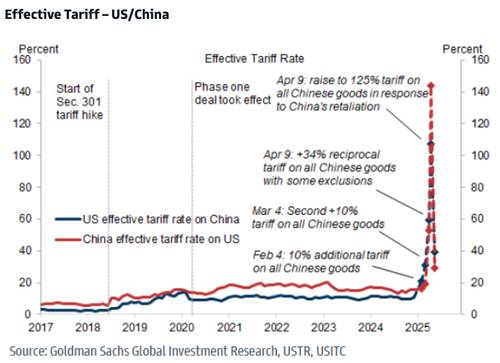
          Earlier this week, the U.S. and China announced a breakthrough trade agreement that temporarily lowered tariffs on each other's products for 90 days. The U.S. dropped its 145% on Chinese goods to 30%, while China lowered levies from 125% to 10%.

          Goldman illustrates the rollercoaster ride of the tit-for-tat trade war between the U.S. and China in recent months, as well as the temporary cooling period aimed at de-escalating tensions.

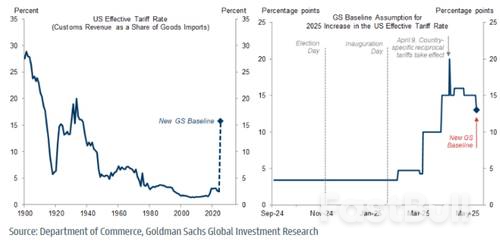
          On Wednesday morning, Goldman analyst Jerry Shen told clients, "We Now Expect the Effective Tariff Rate to increase by 13pp."

          Last week, Trump stated, "We have four or five other deals coming immediately. We have many deals coming down the line. Ultimately, we're just signing the rest of them in."

          Source: Zero Hedge

          To stay updated on all economic events of today, please check out our Economic calendar
          Risk Warnings and Disclaimers
          You understand and acknowledge that there is a high degree of risk involved in trading. Following any strategies or investment methods may lead to potential losses. The content on the site is provided by our contributors and analysts for information purposes only. You are solely responsible for determining whether any trading assets, securities, strategy, or any other product is suitable for investing based on your own investment objectives and financial situation.
          Add to Favorites
          Share

          U.S.–China Tariff Truce Sparks Short-Term Import Boom, But Supply Chain Risks Loom

          Gerik

          Economic

          Tariff Easing Triggers Sudden Spike in U.S. Imports

          Following a temporary agreement between the United States and China to reduce import tariffs over a 90-day period starting May 14, 2025, U.S. importers are racing to capitalize on the window of lower costs. The accord, negotiated in Geneva, saw Washington lower tariffs on Chinese goods from 145% to 30%, while Beijing reciprocated by slashing tariffs on American products from 125% to 10%.
          Almost immediately, U.S. retailers and manufacturers accelerated orders to stockpile goods, particularly in preparation for seasonal demand surges during Black Friday and Christmas. This preemptive behavior illustrates a calculated response to anticipated price increases once the preferential rates expire.

          Container Bookings and Freight Rates Soar

          The logistical ripple effects have been significant. Data from Vizion shows container bookings from China to the U.S. rose 277% in the week beginning May 5—just a day after the agreement was announced. Similarly, German container carrier Hapag-Lloyd recorded a 50% rise in bookings along the same route compared to the previous week. To manage the surge, shipping lines raised freight rates by 8%, with expectations for further hikes up to 50% within the next 10 days.
          This spike in shipping demand has intensified pressure on American ports. Facilities like Los Angeles and Houston are facing congestion and delays, while importers are increasingly using bonded warehouses to delay customs clearance and defer tax liabilities until the goods are released into the domestic market.

          A Narrow Window for Trade Gains Amid Long-Term Downturn

          Despite the temporary surge in import volume, analysts caution that the broader trade outlook remains bleak. Port of Los Angeles Executive Director Gene Seroka forecasts a 25% year-on-year drop in May imports, while Global Port Tracker projects a 20.5% decline to 1.66 million TEUs—ending a streak of 19 consecutive months of growth.
          The anticipated contraction stems from earlier inventory accumulation. After President Trump imposed sweeping tariffs of up to 145% on April 9, many businesses paused or canceled new orders. This led to a sharp 50% drop in container bookings in the final week of April, before the temporary relief was enacted. The retail sector's reaction also reflects this volatility: while sales in March rose 1.7% due to anticipatory buying, April saw a stagnation with just 0.1% growth as consumers pulled back amid price uncertainty and inflation fears.

          Policy Volatility Undermines Supply Chain Stability

          The fluctuating nature of U.S.–China trade policy is raising red flags among analysts and logistics professionals. Repeated policy reversals—characterized as an on-off switch approach—are undermining supply chain resilience. The abrupt imposition and reversal of tariffs compel businesses to adopt short-term survival strategies rather than long-term planning, increasing vulnerability to price shocks and logistical disruptions.
          Experts warn that unless governments and corporations pivot toward more adaptable, long-term frameworks, these policy-driven surges and contractions will continue to destabilize international commerce. Strategic foresight, diversified sourcing, and improved policy coordination are being cited as essential components for mitigating future volatility.
          The current surge in imports may offer short-lived benefits for U.S. retailers and logistics providers, but it underscores a deeper issue: the fragility of a trade system beholden to abrupt policy changes. Without structural adjustments in how nations approach trade negotiations and how businesses prepare for regulatory shifts, the global supply chain will remain exposed to recurring cycles of disorder. The temporary reduction in tariffs has offered a window of relief—but also a warning about the cost of reactive trade strategy.

          Source: CNBC

          To stay updated on all economic events of today, please check out our Economic calendar
          Risk Warnings and Disclaimers
          You understand and acknowledge that there is a high degree of risk involved in trading. Following any strategies or investment methods may lead to potential losses. The content on the site is provided by our contributors and analysts for information purposes only. You are solely responsible for determining whether any trading assets, securities, strategy, or any other product is suitable for investing based on your own investment objectives and financial situation.
          Add to Favorites
          Share
          FastBull
          Copyright © 2025 FastBull Ltd

          728 RM B 7/F GEE LOK IND BLDG NO 34 HUNG TO RD KWUN TONG KLN HONG KONG

          TelegramInstagramTwitterfacebooklinkedin
          App Store Google Play Google Play
          Products
          Charts

          Chats

          Q&A with Experts
          Screeners
          Economic Calendar
          Data
          Tools
          Membership
          Features
          Function
          Markets
          Copy Trading
          Latest Signals
          Contests
          News
          Analysis
          24/7
          Columns
          Education
          Company
          Careers
          About Us
          Contact Us
          Advertising
          Help Center
          Feedback
          User Agreement
          Privacy Policy
          Business

          White Label

          Data API

          Web Plug-ins

          Poster Maker

          Affiliate Program

          Risk Disclosure

          The risk of loss in trading financial instruments such as stocks, FX, commodities, futures, bonds, ETFs and crypto can be substantial. You may sustain a total loss of the funds that you deposit with your broker. Therefore, you should carefully consider whether such trading is suitable for you in light of your circumstances and financial resources.

          No decision to invest should be made without thoroughly conducting due diligence by yourself or consulting with your financial advisors. Our web content might not suit you since we don't know your financial conditions and investment needs. Our financial information might have latency or contain inaccuracy, so you should be fully responsible for any of your trading and investment decisions. The company will not be responsible for your capital loss.

          Without getting permission from the website, you are not allowed to copy the website's graphics, texts, or trademarks. Intellectual property rights in the content or data incorporated into this website belong to its providers and exchange merchants.

          Not Logged In

          Log in to access more features

          FastBull Membership

          Not yet

          Purchase

          Become a signal provider
          Help Center
          Customer Service
          Dark Mode
          Price Up/Down Colors

          Log In

          Sign Up

          Position
          Layout
          Fullscreen
          Default to Chart
          The chart page opens by default when you visit fastbull.com