• Trade
  • Markets
  • Copy
  • Contests
  • News
  • 24/7
  • Calendar
  • Q&A
  • Chats
Trending
Screeners
SYMBOL
LAST
BID
ASK
HIGH
LOW
NET CHG.
%CHG.
SPREAD
SPX
S&P 500 Index
6827.42
6827.42
6827.42
6899.86
6801.80
-73.58
-1.07%
--
DJI
Dow Jones Industrial Average
48458.04
48458.04
48458.04
48886.86
48334.10
-245.98
-0.51%
--
IXIC
NASDAQ Composite Index
23195.16
23195.16
23195.16
23554.89
23094.51
-398.69
-1.69%
--
USDX
US Dollar Index
97.950
98.030
97.950
98.500
97.950
-0.370
-0.38%
--
EURUSD
Euro / US Dollar
1.17394
1.17409
1.17394
1.17496
1.17192
+0.00011
+ 0.01%
--
GBPUSD
Pound Sterling / US Dollar
1.33707
1.33732
1.33707
1.33997
1.33419
-0.00148
-0.11%
--
XAUUSD
Gold / US Dollar
4299.39
4299.39
4299.39
4353.41
4257.10
+20.10
+ 0.47%
--
WTI
Light Sweet Crude Oil
57.233
57.485
57.233
58.011
56.969
-0.408
-0.71%
--

Community Accounts

Signal Accounts
--
Profit Accounts
--
Loss Accounts
--
View More

Become a signal provider

Sell trading signals to earn additional income

View More

Guide to Copy Trading

Get started with ease and confidence

View More

Signal Accounts for Members

All Signal Accounts

Best Return
  • Best Return
  • Best P/L
  • Best MDD
Past 1W
  • Past 1W
  • Past 1M
  • Past 1Y

All Contests

  • All
  • Trump Updates
  • Recommend
  • Stocks
  • Cryptocurrencies
  • Central Banks
  • Featured News
Top News Only
Share

USA Embassy In Lithuania: Maria Kalesnikava Is Not Going To Vilnius

Share

USA Embassy In Lithuania: Other Prisoners Are Being Sent From Belarus To Ukraine

Share

Ukraine President Zelenskiy: Five Ukrainians Released By Belarus In US-Brokered Deal

Share

USA Vilnius Embassy: USA Stands Ready For "Additional Engagement With Belarus That Advances USA Interests"

Share

USA Vilnius Embassy: Belarus, USA, Other Citizens Among The Prisoners Released Into Lithuania

Share

USA Vilnius Embassy: USA Will Continue Diplomatic Efforts To Free The Remaining Political Prisoners In Belarus

Share

USA Vilnius Embassy: Belarus Releases 123 Prisoners Following Meeting Of President Trump's Envoy Coale And Belarus President Lukashenko

Share

USA Vilnius Embassy: Masatoshi Nakanishi, Aliaksandr Syrytsa Are Among The Prisoners Released By Belarus

Share

USA Vilnius Embassy: Maria Kalesnikava And Viktor Babaryka Are Among The Prisoners Released By Belarus

Share

USA Vilnius Embassy: Nobel Peace Prize Laureate Ales Bialiatski Is Among The Prisoners Released By Belarus

Share

Belarusian Presidential Administration Telegram Channel: Lukashenko Has Pardoned 123 Prisoners As Part Of Deal With US

Share

Two Local Syrian Officials: Joint US-Syrian Military Patrol In Central Syria Came Under Fire From Unknown Assailants

Share

Israeli Military Says It Targeted 'Key Hamas Terrorist' In Gaza City

Share

Rwanda's Actions In Eastern Drc Are A Clear Violation Of Washington Accords Signed By President Trump - Secretary Of State Rubio

Share

Israeli Military Issues Evacuation Warning In Southern Lebanon Village Ahead Of Strike - Spokesperson On X

Share

Belarusian State Media Cites US Envoy Coale As Saying He Discussed Ukraine And Venezuela With Lukashenko

Share

Belarusian State Media Cites US Envoy Coale As Saying That US Removes Sanctions On Belarusian Potassium

Share

Thai Prime Minister: No Ceasefire Agreement With Cambodia

Share

US, Ukraine To Discuss Ceasefire In Berlin Ahead Of European Summit

Share

Incoming Czech Prime Minister Babis: Czech Republic Will Not Take On Guarantees For Ukraine Financing, European Commission Must Find Alternatives

TIME
ACT
FCST
PREV
U.K. Trade Balance Non-EU (SA) (Oct)

A:--

F: --

P: --

U.K. Trade Balance (Oct)

A:--

F: --

P: --

U.K. Services Index MoM

A:--

F: --

P: --

U.K. Construction Output MoM (SA) (Oct)

A:--

F: --

P: --

U.K. Industrial Output YoY (Oct)

A:--

F: --

P: --

U.K. Trade Balance (SA) (Oct)

A:--

F: --

P: --

U.K. Trade Balance EU (SA) (Oct)

A:--

F: --

P: --

U.K. Manufacturing Output YoY (Oct)

A:--

F: --

P: --

U.K. GDP MoM (Oct)

A:--

F: --

P: --

U.K. GDP YoY (SA) (Oct)

A:--

F: --

P: --

U.K. Industrial Output MoM (Oct)

A:--

F: --

P: --

U.K. Construction Output YoY (Oct)

A:--

F: --

P: --

France HICP Final MoM (Nov)

A:--

F: --

P: --

China, Mainland Outstanding Loans Growth YoY (Nov)

A:--

F: --

P: --

China, Mainland M2 Money Supply YoY (Nov)

A:--

F: --

P: --

China, Mainland M0 Money Supply YoY (Nov)

A:--

F: --

P: --

China, Mainland M1 Money Supply YoY (Nov)

A:--

F: --

P: --

India CPI YoY (Nov)

A:--

F: --

P: --

India Deposit Gowth YoY

A:--

F: --

P: --

Brazil Services Growth YoY (Oct)

A:--

F: --

P: --

Mexico Industrial Output YoY (Oct)

A:--

F: --

P: --

Russia Trade Balance (Oct)

A:--

F: --

P: --

Philadelphia Fed President Henry Paulson delivers a speech
Canada Building Permits MoM (SA) (Oct)

A:--

F: --

P: --

Canada Wholesale Sales YoY (Oct)

A:--

F: --

P: --

Canada Wholesale Inventory MoM (Oct)

A:--

F: --

P: --

Canada Wholesale Inventory YoY (Oct)

A:--

F: --

P: --

Canada Wholesale Sales MoM (SA) (Oct)

A:--

F: --

P: --

Germany Current Account (Not SA) (Oct)

A:--

F: --

P: --

U.S. Weekly Total Rig Count

A:--

F: --

P: --

U.S. Weekly Total Oil Rig Count

A:--

F: --

P: --

Japan Tankan Large Non-Manufacturing Diffusion Index (Q4)

--

F: --

P: --

Japan Tankan Small Manufacturing Outlook Index (Q4)

--

F: --

P: --

Japan Tankan Large Non-Manufacturing Outlook Index (Q4)

--

F: --

P: --

Japan Tankan Large Manufacturing Outlook Index (Q4)

--

F: --

P: --

Japan Tankan Small Manufacturing Diffusion Index (Q4)

--

F: --

P: --

Japan Tankan Large Manufacturing Diffusion Index (Q4)

--

F: --

P: --

Japan Tankan Large-Enterprise Capital Expenditure YoY (Q4)

--

F: --

P: --

U.K. Rightmove House Price Index YoY (Dec)

--

F: --

P: --

China, Mainland Industrial Output YoY (YTD) (Nov)

--

F: --

P: --

China, Mainland Urban Area Unemployment Rate (Nov)

--

F: --

P: --

Saudi Arabia CPI YoY (Nov)

--

F: --

P: --

Euro Zone Industrial Output YoY (Oct)

--

F: --

P: --

Euro Zone Industrial Output MoM (Oct)

--

F: --

P: --

Canada Existing Home Sales MoM (Nov)

--

F: --

P: --

Euro Zone Total Reserve Assets (Nov)

--

F: --

P: --

U.K. Inflation Rate Expectations

--

F: --

P: --

Canada National Economic Confidence Index

--

F: --

P: --

Canada New Housing Starts (Nov)

--

F: --

P: --

U.S. NY Fed Manufacturing Employment Index (Dec)

--

F: --

P: --

U.S. NY Fed Manufacturing Index (Dec)

--

F: --

P: --

Canada Core CPI YoY (Nov)

--

F: --

P: --

Canada Manufacturing Unfilled Orders MoM (Oct)

--

F: --

P: --

Canada Manufacturing New Orders MoM (Oct)

--

F: --

P: --

Canada Core CPI MoM (Nov)

--

F: --

P: --

Canada Manufacturing Inventory MoM (Oct)

--

F: --

P: --

Canada CPI YoY (Nov)

--

F: --

P: --

Canada CPI MoM (Nov)

--

F: --

P: --

Canada CPI YoY (SA) (Nov)

--

F: --

P: --

Canada Core CPI MoM (SA) (Nov)

--

F: --

P: --

Q&A with Experts
    • All
    • Chatrooms
    • Groups
    • Friends
    Connecting
    .
    .
    .
    Type here...
    Add Symbol or Code

      No matching data

      All
      Trump Updates
      Recommend
      Stocks
      Cryptocurrencies
      Central Banks
      Featured News
      • All
      • Russia-Ukraine Conflict
      • Middle East Flashpoint
      • All
      • Russia-Ukraine Conflict
      • Middle East Flashpoint
      Search
      Products

      Charts Free Forever

      Chats Q&A with Experts
      Screeners Economic Calendar Data Tools
      Membership Features
      Data Warehouse Market Trends Institutional Data Policy Rates Macro

      Market Trends

      Market Sentiment Order Book Forex Correlations

      Top Indicators

      Charts Free Forever
      Markets

      News

      News Analysis 24/7 Columns Education
      From Institutions From Analysts
      Topics Columnists

      Latest Views

      Latest Views

      Trending Topics

      Top Columnists

      Latest Update

      Signals

      Copy Rankings Latest Signals Become a signal provider AI Rating
      Contests
      Brokers

      Overview Brokers Assessment Rankings Regulators News Claims
      Broker listing Forex Brokers Comparison Tool Live Spread Comparison Scam
      Q&A Complaint Scam Alert Videos Tips to Detect Scam
      More

      Business
      Events
      Careers About Us Advertising Help Center

      White Label

      Data API

      Web Plug-ins

      Affiliate Program

      Awards Institution Evaluation IB Seminar Salon Event Exhibition
      Vietnam Thailand Singapore Dubai
      Fans Party Investment Sharing Session
      FastBull Summit BrokersView Expo
      Recent Searches
        Top Searches
          Markets
          News
          Analysis
          User
          24/7
          Economic Calendar
          Education
          Data
          • Names
          • Latest
          • Prev

          View All

          No data

          Scan to Download

          Faster Charts, Chat Faster!

          Download App
          English
          • English
          • Español
          • العربية
          • Bahasa Indonesia
          • Bahasa Melayu
          • Tiếng Việt
          • ภาษาไทย
          • Français
          • Italiano
          • Türkçe
          • Русский язык
          • 简中
          • 繁中
          Open Account
          Search
          Products
          Charts Free Forever
          Markets
          News
          Signals

          Copy Rankings Latest Signals Become a signal provider AI Rating
          Contests
          Brokers

          Overview Brokers Assessment Rankings Regulators News Claims
          Broker listing Forex Brokers Comparison Tool Live Spread Comparison Scam
          Q&A Complaint Scam Alert Videos Tips to Detect Scam
          More

          Business
          Events
          Careers About Us Advertising Help Center

          White Label

          Data API

          Web Plug-ins

          Affiliate Program

          Awards Institution Evaluation IB Seminar Salon Event Exhibition
          Vietnam Thailand Singapore Dubai
          Fans Party Investment Sharing Session
          FastBull Summit BrokersView Expo

          [U.S.] National Average Gas Price Drops to $4.16 per Gallon

          FastBull Featured

          Economic

          AAA (American Automobile Association) announced the latest national average gas price at $4.16/gallon, down further from $4.21/gallon on Monday.
          Most Americans have changed their driving habits due to high gas prices. But with gas below $4 a gallon at nearly half of the gas stations around the country, it's possible that gas demand could rise.
          According to new data from the Energy Information Administration (EIA), gas demand increased from 8.52 million b/d to 9.25 million b/d last week. The estimated rate is 80,000 b/d lower than last year, but it could slow pump price decreases if the trend holds.
          Additionally, total domestic gasoline stocks decreased by 3.3 million bbl to 225.1 million bbl, signaling that higher demand reduced inventory last week.
          This will have an impact on the July CPI. Among the CPI energy sub-items in June, gas prices rose 11.2% month-on-month (vs. 4.1% in May), contributing 64 basis points to the CPI increase MoM and accounting for half of the total. If these factors continue to be held, energy inflation is expected to show a significant decline from June.
          This could drive tourist demand, which will result in higher airfares and hotel prices and then affect core inflation. June CPI showed a 1.8% MoM decrease in airfares (vs. a 12.6% increase in May) and a 3.3% MoM drop in hotel prices (vs. a 2.0% increase in May). It is unusual during the peak tourist season. That seems due to the fact that previous price levels have been too much higher than the average, reflecting that high oil prices have dampened consumer demand. Tourist demand remains strong, however. The good news is that the weight of the two is not large. Overall, the continued decline in the average gas price across the U.S. may make inflation less "tight" in July.

          AAA Report

          To stay updated on all economic events of today, please check out our Economic calendar
          Risk Warnings and Disclaimers
          You understand and acknowledge that there is a high degree of risk involved in trading. Following any strategies or investment methods may lead to potential losses. The content on the site is provided by our contributors and analysts for information purposes only. You are solely responsible for determining whether any trading assets, securities, strategy, or any other product is suitable for investing based on your own investment objectives and financial situation.
          Comments
          Add to Favorites
          Share

          Occidental to Cut Debt and Distribute Cash, Won't Raise Oil Output

          Damon
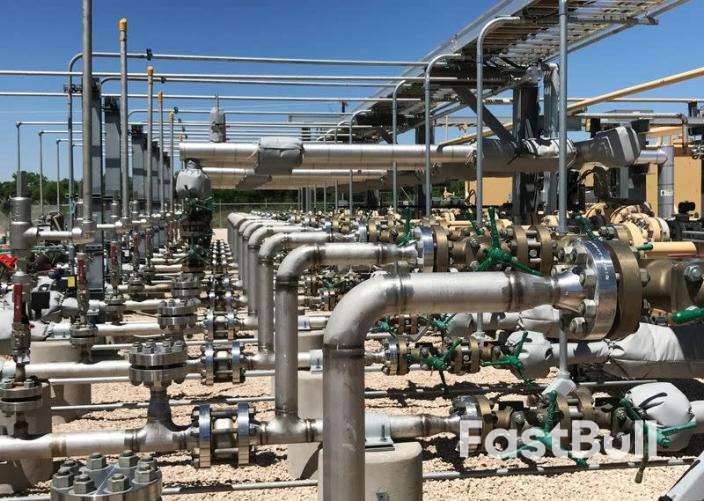
          Occidental Petroleum Corp plans to use the bonanza from high oil and gas prices to accelerate debt payments and cash distribution to shareholders but will not raise oil production, Chief Executive Vicki Hollub said on Wednesday.Occidental to Cut Debt and Distribute Cash, Won't Raise Oil Output_1
          White House officials have been urging oil producers to invest in more oil production to bring fuel prices down to consumers. The top oil producers in the U.S. and Europe posted record earnings in the second quarter, but kept a check on investments.
          Occidental on Tuesday posted higher than expected earnings in the second quarter, but cut its 2022 output outlook for the main unconventional basin in the United States, knocking its shares down more than 6% to close at $60.99.
          The company also said it resumed a buyback program after reaching its short-term debt reduction goals in the second quarter. With a cleaner balance sheet, the U.S. oil producer said it can now slightly raise dividends and sustain stock repurchases "over the next few years".
          Occidental also said it wants to accelerate a three-year target to bring debt down to $15 billion, from more than $21 billion now. Investment targets were unchanged.
          "We don't feel the need to grow production until we get beyond that point," Hollub told analysts on a webcast to discuss second quarter earnings. "Because we feel like one of the best values right now is investment in our own stock."
          United Nations Secretary-General Antonio Guterres on Wednesday slammed the "grotesque greed" of oil companies, urging governments globally to "tax these excessive profits" to support the most vulnerable people.
          The Permian basin this year should deliver around 521,000 barrels of oil equivalent per day (boed) for the company, from around 532,000 boed projected in May, it said.
          The reduction follows third party processing issues and a partial Permian production transfer to Colombian oil producer Ecopetrol, with whom Occidental signed a joint venture.
          Total 2022 production outlook was kept stable at around 1.55 million boed, with higher production in the Rockies and the Gulf of Mexico basins offsetting losses in the Permian.

          Source: Yahoo

          Risk Warnings and Disclaimers
          You understand and acknowledge that there is a high degree of risk involved in trading. Following any strategies or investment methods may lead to potential losses. The content on the site is provided by our contributors and analysts for information purposes only. You are solely responsible for determining whether any trading assets, securities, strategy, or any other product is suitable for investing based on your own investment objectives and financial situation.
          Comments
          Add to Favorites
          Share

          As Inflation Bites, Japan's PM Finds Unlikely Ally in Labour Unions

          Alex
          As Japan faces its first major battle with inflation in decades, Prime Minister Fumio Kishida is extending a rare olive branch to labour unions, who he sees as crucial to his wider push to boost household wealth.
          Wage stagnation has blighted Japan's workers for years as the country was mired in a deflationary mindset that stopped firms raising salaries, and as weakened unions shied away from demanding more pay.
          As part of his "new capitalism" platform to widen wealth distribution, Kishida has urged firms to boost pay and give households spending power to tolerate higher prices.
          He is also approaching unions for help in achieving what other countries would frown upon: a spiral of rising inflation triggering strong wage growth.
          In January, Kishida became the first premier in almost a decade to attend a new year party held by Rengo, the main umbrella union, in a rare gesture to organised labour by the head of the pro-business Liberal Democratic Party.
          At the event, he called for labour union help in achieving "a bold turnaround in the downtrend in wage levels seen in recent years" and "wage hikes befitting an era of new capitalism."
          In June, he made a similarly rare visit to Toyota Motor Corp's factory in what some politicians saw as a bid to court union votes.
          The attempt to close some of the distance between unions and government illustrates the depth of Japan's economic woes and has, at least for now, put Kishida on the same side as organised labour in calling for higher wages.

          Seizing The Moment

          Japan's recent union history has been unspectacular.
          Most unions are in-house bodies representing employees at their firms, rather than on an industry basis. As such, they tend to prioritise job security over pay.
          Now, however, conditions for higher wages appear to be falling into place in ways never seen in deflation-prone Japan.
          The job market is at its tightest in decades and inflation exceeded the central bank's 2% target for the first time in seven years, pressuring firms to raise wages.
          Shedding its image as a counter-force to a pro-business government, labour unions, too, are warming to the administration as they seek ways to put their ideas into practice beyond relying on a weak, fragmented opposition.
          Tomoko Yoshino, head of Rengo, attended a ruling party meeting in April as a token gesture of support toward its policy on work-style reform.
          "It's true some of Kishida's proposals mesh with ours," such as steps to narrow income disparity, said Hiroya Nakai, an executive at Japanese Association of Metal, Machinery and Manufacturing Workers - a union for small manufacturers.
          "At times it's necessary to make proposals to the ruling party," he said.
          The relationship between Kishida and unions contrasts with that of many other countries, where governments see current demands for wage hikes as a risk that could trigger unwelcome inflation.
          It also highlights Japan's unique situation where a tight job market does not necessarily lead to broad-based wage rises.
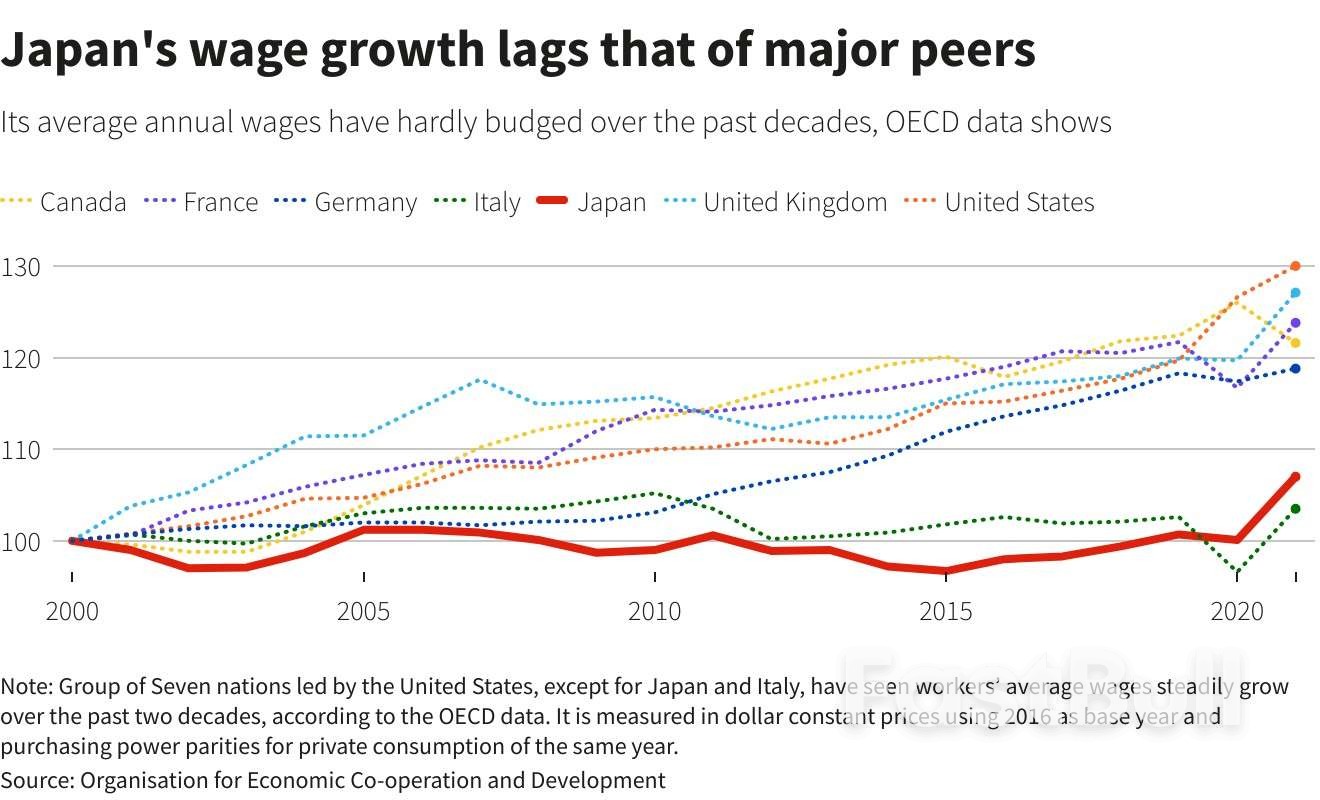
          Japan's average wages have hardly risen since the early 1990s and were the lowest among G7 advanced nations last year, according to OECD data.As Inflation Bites, Japan's PM Finds Unlikely Ally in Labour Unions_1As Inflation Bites, Japan's PM Finds Unlikely Ally in Labour Unions_2
          There are signs of change as a rapidly ageing society intensifies labour shortages. Firms agreed with unions to raise average wages by 2.07% this fiscal year, up from 1.78% last year to mark the biggest hike since 2015, Rengo estimates show.
          With inflation rising above 2%, unions are gearing up to demand even higher pay next year.
          "We must bear in mind that inflation is accelerating and pushing real wages into negative territory," said Akira Nidaira, an executive at Rengo. "The key is whether Japan can finally eradicate the public's deflationary mindset."

          Deflation Is Over

          Many analysts, however, doubt unions have the teeth to demand wage hikes big enough to offset rising inflation, and see the changing nature of work undermine such efforts.
          "Japan's job market is diversifying, raising questions about the relevance of labour unions," said Kotaro Tsuru, a professor at Keio University. "If they cling to their traditional focus on protecting permanent workers' jobs, their fate is sealed."
          As Japan's labour market tightens, job security has become less attractive for younger workers who change employers more often than their older counterparts.
          Tracking global trends, union membership has been declining longer term. It hit 16.9% in 2021, hovering near an all-time low and well below 30.5% in 1982.
          "I don't think labour unions are playing their role. Wages aren't rising as much as I hoped," said a 25-year-old employee at a major Japanese manufacturer and in-house union member.
          "Unions might prove useful some day but on a daily basis, they don't seem to be pro-active," said the employee, who spoke on condition of anonymity due to the sensitivity of the matter.
          Also working against unions, almost 40% of employees are now non-regular workers and mostly unprotected by unions.
          While some unions now allow non-regular workers to join, most still prioritise permanent workers.
          "Labour unions haven't adapted themselves to the changing needs of the younger generation," said Hisashi Yamada, senior economist at Japan Research Institute.
          "Accustomed to prolonged economic stagnation, they seem to have forgotten how to demand wage hikes," he said. "That needs to change as the era of deflation and dis-inflation is over."

          Source: Reuters

          Risk Warnings and Disclaimers
          You understand and acknowledge that there is a high degree of risk involved in trading. Following any strategies or investment methods may lead to potential losses. The content on the site is provided by our contributors and analysts for information purposes only. You are solely responsible for determining whether any trading assets, securities, strategy, or any other product is suitable for investing based on your own investment objectives and financial situation.
          Comments
          Add to Favorites
          Share

          South African Bank Official Slammed for Spreading Misinformation About Crypto

          Damon
          The deputy governor of the South African Reserve Bank has been accused of promoting misinformation surrounding the illicit use of cryptocurrencies.South African Bank Official Slammed for Spreading Misinformation About Crypto_1
          Kuben Naidoo has been called out by Steven Sidley, a South African professor, and author, for claiming that "90%" of crypto transactions are used for illicit purposes.
          Touting insider knowledge from a colleague in the U.S., Naidoo's statements were pulled apart by Sidley, who called the information "claptrap" and "balderdash," amongst other things. He said that Naidoo's statements are the kind that grabs the headlines but are based on misinformation that threatens the progress of a nascent industry.
          Speaking at a webinar in mid-July, Naidoo said that cryptocurrency regulations in South Africa were about 12-18 months away. In all likelihood, the central bank will treat cryptocurrencies as assets rather than a currency. It will prioritize investor protection in the regulations.

          Sidley lays down the facts

          In an opinion piece for South African publication "The Daily Maverick," Sidley pointed out that only 0.15% of cryptocurrency transactions have a criminal element, citing a report by Chainalysis. According to Sidley, Chainalysis is used by the Federal Bureau of Investigation in the U.S.A. and regulatory bodies worldwide.
          In contrast, Sidley noted that 5% of transactions in fiat currencies are done for criminal reasons, almost fifty times more than crypto.
          He also pointed out that the public nature of blockchain transactions negates the likelihood of a criminal transaction going unnoticed. He added that money used in fiat crime is often harder to trace, calling attention to the so-called leaked Panama papers that revealed the financial maneuvers of multiple individuals and companies.
          Sidley, a renowned writer, playwright, and co-author of "Beyond Bitcoin: Decentralized Finance and the End of Banks," also criticized the decision to regulate crypto like financial assets. It seems, he says, like the central bank wants to "shoehorn" crypto assets into archaic asset regulations drafted for older financial instruments, like stocks, currencies, and commodities.
          Instead, he advocates that cryptocurrencies be defined as a new type of digital asset before regulation is considered.

          Naidoo names key body to oversee AML and KYC

          In July, Naidoo said that the first step to cryptocurrency regulation is to declare cryptocurrencies as a financial product, bringing them under the jurisdiction of the Financial Intelligence Centre, where transactions would be monitored for money laundering, tax evasion, and terrorist activities financing.
          He said that it is not the job of the reserve bank to adjudicate crypto's merits but to inform investors of the risks. He added that crypto is far too volatile to be used as a payment method.
          The SARB's regulations would see crypto exchanges in the country comply with Know-Your-Customer regulations.

          Source: beincrypto

          Risk Warnings and Disclaimers
          You understand and acknowledge that there is a high degree of risk involved in trading. Following any strategies or investment methods may lead to potential losses. The content on the site is provided by our contributors and analysts for information purposes only. You are solely responsible for determining whether any trading assets, securities, strategy, or any other product is suitable for investing based on your own investment objectives and financial situation.
          Comments
          Add to Favorites
          Share

          OPEC: Malaysia to Raise Monthly Crude Oil Output to 595,000 Barrels in Sept 2022

          Owen Li
          The Organization of the Petroleum Exporting Countries (OPEC) said non-OPEC participating country Malaysia will raise its monthly crude oil output to 595,000 barrels in September 2022 from 594,000 barrels in August 2021 at time when insufficient investment into the upstream oil and gas sector will impact the availability of adequate crude oil supply in a timely manner to meet growing demand for the commodity beyond 2023.
          In a statement on Wednesday (Aug 3), OPEC said participating countries decided to "adjust upward the (collective) production level for OPEC and non-OPEC participating countries by 0.1 mb/d (100,000 barrels/day) for the month of September 2022".
          OPEC had issued its statement in conjunction with the 31st OPEC and non-OPEC Ministerial Meeting, which was held virtually on Wednesday.
          According to OPEC, the meeting noted the dynamic and rapidly evolving oil market fundamentals, which necessitate continuous assessment of market conditions.
          OPEC said the meeting noted that the severely limited availability of excess oil output capacity necessitates the utilisation of such capacity with great caution in response to severe oil supply disruptions.
          "The meeting noted that chronic underinvestment in the oil sector has reduced excess capacities along the value chain (upstream/midstream/downstream).
          "The meeting highlighted with particular concern that insufficient investment into the upstream sector will impact the availability of adequate supply in a timely manner to meet growing demand beyond 2023 from non-participating non-OPEC oil-producing countries, some OPEC member countries and participating non-OPEC oil-producing countries.
          "It (the meeting) noted that preliminary data for OECD (Organisation for Economic Co-operation and Development) commercial oil stocks level stood at 2,712 mb (2.71 billion barrels) in June 2022, which was 163 mb (163 million barrels) lower than the same time last year, and 236 mb (236 million barrels) below the 2015-2019 average, and that emergency oil stocks have reached their lowest levels in more than 30 years.
          "The meeting also noted that Declaration of Cooperation conformity has averaged 130% since May 2020, supported by voluntary contributions of some participating countries," OPEC said.
          According to OPEC's website, its 13 member countries are Algeria, Angola, Congo, Equatorial Guinea, Gabon, Iran, Iraq, Kuwait, Libya, Nigeria, Saudi Arabia, the United Arab Emirates, and Venezuela.
          Online reports indicated that Malaysia was among the 10 countries that joined OPEC in 2016 to form the group known as non-OPEC participating countries, which include Azerbaijan, Bahrain, Brunei, Kazakhstan, Mexico, Oman, Russia, South Sudan, and Sudan.
          Collectively, OPEC's 13 member countries and the 10 non-OPEC participating nations are known as OPEC Plus.
          At the time of writing, Malaysian national oil company Petroliam Nasional Bhd (Petronas) has not issued a statement in response to OPEC's statement in conjuction with the 31st OPEC and non-OPEC Ministerial Meeting.

          Source: Theedgemarkets

          Risk Warnings and Disclaimers
          You understand and acknowledge that there is a high degree of risk involved in trading. Following any strategies or investment methods may lead to potential losses. The content on the site is provided by our contributors and analysts for information purposes only. You are solely responsible for determining whether any trading assets, securities, strategy, or any other product is suitable for investing based on your own investment objectives and financial situation.
          Comments
          Add to Favorites
          Share

          Kim, Pelosi Agree to Support Efforts for Denuclearization of North Korea

          Damon
          National Assembly Speaker Kim Jin-pyo and U.S. House Speaker Nancy Pelosi said Thursday they agreed to support efforts by Seoul and Washington for the denuclearization of North Korea, voicing concerns over the North's escalating threats.
          "The two sides expressed concern over the grave situation in which North Korea's level of threat is heightening," said Kim, reading a joint press statement following a meeting between the two speakers.
          "Based on a powerful and extended deterrence against North Korea that our public can recognize, we agree to support the two governments' efforts for denuclearization and peace through international cooperation and diplomatic dialogues," the statement said.
          The speakers noted the expanding ties between the allies, mentioning how the South Korea-U.S. alliance has been widening to areas, such as defense security, the economy and technology.
          To better support these ties, Kim said the speakers agreed on reviewing a resolution marking the 70th anniversary of the two countries.
          North Korea has conducted a series of short- to long-range missile tests so far this year and has widely been expected to carry out what would be its seventh nuclear test.
          Thursday's meeting came amid heightened tensions between the U.S. and China in the wake of her high-profile visit to Taiwan.Kim, Pelosi Agree to Support Efforts for Denuclearization of North Korea_1
          Pelosi arrived in Seoul on Wednesday night from Taiwan where she reaffirmed unwavering U.S. commitment to supporting the island's democracy. China denounced her trip to Taiwan, which it regards as a renegade province, and announced live-fire military drills around the island.
          Her two-day trip also includes a visit to the inter-Korean truce village of Panmunjom later Thursday. She is also expected to speak by phone with President Yoon Suk-yeol, who is currently on holiday.
          Pelosi's delegation includes House Foreign Affairs Committee Chair Gregory Meeks and House Veterans Affairs Committee Chair Mark Takano, as well as other lawmakers, such as Suzan DelBene, Raja Krishnamoorthi and Andy Kim.
          South Korea is one of the legs on Pelosi's Asian tour that already has taken her to Singapore, Malaysia and Taiwan. After South Korea, she plans to visit Japan. Pelosi is the first U.S. House speaker to visit South Korea since former Speaker Dennis Hastert in 2002.

          Source: Yonhap

          Risk Warnings and Disclaimers
          You understand and acknowledge that there is a high degree of risk involved in trading. Following any strategies or investment methods may lead to potential losses. The content on the site is provided by our contributors and analysts for information purposes only. You are solely responsible for determining whether any trading assets, securities, strategy, or any other product is suitable for investing based on your own investment objectives and financial situation.
          Comments
          Add to Favorites
          Share

          U.S. Senate's Proposed Clean Energy Investment Reaffirms Climate Ambition

          Alex
          Last week, the U.S. Senate proposed its $739bn Inflation Reduction Act as a replacement of the $1.75tn Build Back Better bill that only passed the House at the end of last year. In a positive surprise, $369bn of the Inflation Reduction Act is planned to be dedicated to energy security, clean energy, and climate-change-related investments. In this article, we discuss the effects of the proposed investment in facilitating the U.S.' energy transition (as opposed to assessing the impact of the act on inflation) and conclude that it would put the country on a more likely path to achieve President Biden's climate goals.U.S. Senate's Proposed Clean Energy Investment Reaffirms Climate Ambition_1

          Clean energy manufacturing tax credits to become broader

          Tax credits for clean energy manufacturing was the backbone of the energy and climate section of the Build Back Better proposal, with a sweeping $320bn planned. The generous tax credits had raised hopes and interests for clean energy developers to accelerate project rollouts.
          A significant drop from what was offered in Build Back Better, the Inflation Reduction Act only plans to spend over $60bn to facilitate clean energy manufacturing through production tax credits (PTCs) and investment tax credits (ITCs) that can be applied to all parts of the value chain. Yet despite the lower spending amount, the Inflation Reduction Act would still play a powerful role in facilitating clean energy development through the extension of many clean energy tax credits, as well as the creation/increase of credits categories for some emerging, not-yet-commercialized technologies.

          More generous hydrogen and CCS credits despite stricter qualification rules

          Two important emerging decarbonization technologies, hydrogen production and carbon capture and storage (CCS), both made it to the proposed Inflation Reduction Act under the clean energy tax credits.
          Same as Build Back Better, the Inflation Reduction Act would introduce hydrogen PTCs of between $0.6/kg and $3/kg. The difference is that the newly proposed rules would increase the emissions threshold of eligible clean hydrogen production from a 25% reduction of emissions compared to gray hydrogen production (using natural gas) to a 56% emissions reduction from gray hydrogen production. Furthermore, to receive the highest credits, a project needs to emit lower than 0.45kg of CO2 per kg of hydrogen, versus the previous 0.5 kg of CO2 per kg of hydrogen in Build Back Better. Despite the stricter qualification provision, the hydrogen PTCs would largely lower the cost of hydrogen production. Bloomberg New Energy Finance estimates that at this PTC level, clean hydrogen production could already be cost competitive with gray hydrogen production.
          The U.S. is the second largest consumer and producer of hydrogen behind China. The U.S. produces roughly 10 million tonnes of hydrogen per year, accounting for 11% of the production globally. The development of hydrogen in the U.S. is going to accelerate in the next decade, with the Infrastructure Investment and Jobs Act dedicating $9.5bn to clean hydrogen development and the clean hydrogen tax credits if the latter passes Congress.
          As for CCS, both the Build Back Better bill and the Inflation Reduction Act intend to raise Section 45Q tax credits from $50/tonne to $85/tonne of CO2 captured and stored – (if prevailing wage, hour, and apprenticeship requirements are met). And the value would increase to as high as $180/tonne for direct air capture, a more costly technology which directly removes CO2 from the atmosphere. It is nonetheless worth noting that the Inflation Reduction Act plans to lower capture thresholds for projects to qualify.
          Section 45Q credits – even at their current levels – are seen as a major revenue source for CCS project developers and a key driver for CCS deployment in the U.S. More generous CCS tax credits can further cement the U.S.' leading position in the technology, while a stricter emissions threshold can prompt developers to explore more advanced CCS technologies.U.S. Senate's Proposed Clean Energy Investment Reaffirms Climate Ambition_2

          Biofuels to receive support as well

          In addition to a $500m grant package to promote biofuels production and improve related infrastructure, the Inflation Reduction Act plans to extend the current $1/gallon tax credits for biodiesel, renewable diesel, and alternative fuels until 2024. This extension would uphold the continuing diversification of biofuels supply beyond conventional ethanol.
          Besides, the Act would establish a new tax credit category for sustainable aviation fuels (SAFs), set at a maximum of $1.75/gallon. SAFs are considered one of the key pathways to help decarbonize the aviation industry, which currently accounts for 2%-3% of global greenhouse gas emissions. This year, the Biden administration announced an ambitious goal to slash aviation emissions in the US by 20% by 2030 though ramping up the production of SAFs. The proposed tax credits would not only reduce the cost of SAF production, but also narrow the now c.$0.7/gallon of price gap between SAFs and renewable diesel (with SAFs being more expensive). This outlook would potentially incentivize renewable diesel facilities – that often times are able to produce SAFs – to shift to producing more SAFs.

          Solar and wind tax credits extended

          Among other things, the Inflation Reduction Act would extend current incentives for wind and solar projects for at least 10 years. For wind projects, the PTCs have already expired, meaning that projects that commenced construction this year cannot claim any credits. The new proposal would make the expired credits available again. For solar projects, the biggest change is that instead of only the ITCs, they would be eligible to choose PTCs as well. The Act would also create two new sets of tax credits for projects that are 'technology-neutral'—eligible projects need to be power generation facilities that have net-zero greenhouse gas emissions. All these would help sustain renewable installation, further drive down cost, and accelerate the decarbonization of the power sector in the U.S.

          EV development to be boosted by sustained tax credits

          Under the proposal, tax credits for electric vehicles (EVs) would remain at the current level of up to $7,500 for each new vehicle purchased and $4,500 for a second-hand EV. This will continue to spur EV adoption in the country. Nevertheless, these tax credits are granted with the conditions that the minerals used to produce EVs will need to be produced in the US or a country with whom the U.S. is a free trade partner; batteries in EVs should also have a significant share of components that are produced in North America. This will help build a stronger domestic supply chain, but it could take time before a mature supply chain takes shape.
          Additionally, as opposed to a Build Back Better rule that EVs would no longer be eligible for credits if a manufacturer had already sold 200,000 cars, the Inflation Reduction Act would set up caps on maximum retail prices below which an EV owner can apply for the credits. This clause would widen the eligibility of EV credits because companies such as Tesla, GM, and Toyota have already hit the 200,000 limit, although some expensive EV models, such as from Tesla, would still be excluded.
          Moreover, the Inflation Reduction Act will put a wage limit on customers who can apply for EV credits, a specification to boost EV purchases among middle/lower-class customers.
          In general, the newly proposed rules would make EV credits more available to more people who need it. Although there is no increase in the total tax credits, the fact that it is in the Inflation Reduction Act emphasizes the importance for EVs to receive continuous support. Therefore, we are maintaining our two scenarios for electrification in the transport sector in the US this decade. In our baseline scenario, the share of electric new passenger vehicles (LDVs) will grow from 4% to 34% by 2030 (including a small share of plug-in hybrids). This means six million new EV sales by 2030, with large underlying differences from state to state, especially between rural and urban areas. In the step-up scenario, which is aligned with the U.S.' target to increase the share of EV sales in total vehicle sales to 50% by 2030, more generous legislative and regulatory support will be needed to make EV models more affordable, charging infrastructure more extended, and traditional cars relatively more costly.U.S. Senate's Proposed Clean Energy Investment Reaffirms Climate Ambition_3

          Separately passed CHIPS and Science Act to boost U.S. semiconductor manufacturing and competitiveness

          In late July, Congress passed another bill – the CHIPS and Science Act – and it is now being sent to President Biden to be signed into law. This bill ­will allocate around $52bn in subsidy and $24bn in manufacturing tax credits to enhance semiconductor production, as well as $200bn to support research and development (R&D) in the industry.
          This long-awaited bill will strengthen the U.S.' capacity and competitiveness in chip production, which would then further aid the development of EVs in the U.S., as an EV on average requires twice the number of chips as a traditional car.
          Nevertheless, car manufacturers will need to choose between Chinese and U.S. semiconductor producers as their supplier – the former would likely keep their advantage in the short to medium term while the latter grows their capacity.

          Charging methane leaks: an important punitive measure

          Another key provision in the Inflation Reduction Act is to charge, for the first time, methane emissions from along the oil and gas industry's value chain. With a maximum charge of $1,500/tonne in 2026 for excess methane emissions, this proposed rule can become an important punitive measure to push fossil fuel companies to advance measures to control methane leaking. Indeed, methane is a more powerful greenhouse gas compared to CO2 so its leakage will disproportionally affect global warming. This issue has reattracted attention in the U.S. as a general recovery from the 2020 oil price crash has led to increased oil and production in the country. The U.S. was the world's third largest methane emitter last year and it is imperative for it to cut methane emissions.U.S. Senate's Proposed Clean Energy Investment Reaffirms Climate Ambition_4

          U.S. climate targets more achievable than before

          Since its inauguration, the Biden administration has set aggressive goals to reduce emissions by 50%-52% by 2030 and reach net zero emissions by 2050. Despite a huge cut from the Build Back Better bill, the Inflation Reaction Act would put the U.S. in a better position to achieve its climate targets. Rhodium Group estimates that the Inflation Reduction Act could alone lower the U.S. emissions from 24%-35% to 31%-44% below 2005 levels by 2030.
          Whether the U.S. will really reach the climate targets by 2030 – or even by 2050 – depends on many other factors besides clean energy funding and tax credits. Optimistically, with the expected maturing of clean energy research and development investment, continuing decline of clean energy costs, and the multiplying effect of technology scale-up, slashing nation-wide emissions by half by the end of the decade seem possible. But more measures are also needed to reduce the demand for dirtier economic activities. These include more stringent rules for emissions, a federal tax on emissions, mandates to phase out coal production, or even the establishment of a nationwide carbon price –measures that the U.S. currently lacks.
          Either way, the proposed Inflation Reduction Act is a crucial piece of legislation to decarbonize the U.S. economy, especially given the Supreme Court's recent ruling that the Environmental Protection Agency does not have authority to regulate carbon emissions from power plants. This decision has weakened the executive agency's power to issue sweeping climate change regulations and has put into question the perspective of other efforts such as the SEC's proposal to mandate climate-related data disclosure. Now, all eyes will be on Congress to pass the bill.U.S. Senate's Proposed Clean Energy Investment Reaffirms Climate Ambition_5

          Source: ING

          Risk Warnings and Disclaimers
          You understand and acknowledge that there is a high degree of risk involved in trading. Following any strategies or investment methods may lead to potential losses. The content on the site is provided by our contributors and analysts for information purposes only. You are solely responsible for determining whether any trading assets, securities, strategy, or any other product is suitable for investing based on your own investment objectives and financial situation.
          Comments
          Add to Favorites
          Share
          FastBull
          Copyright © 2025 FastBull Ltd

          728 RM B 7/F GEE LOK IND BLDG NO 34 HUNG TO RD KWUN TONG KLN HONG KONG

          TelegramInstagramTwitterfacebooklinkedin
          App Store Google Play Google Play
          Products
          Charts

          Chats

          Q&A with Experts
          Screeners
          Economic Calendar
          Data
          Tools
          Membership
          Features
          Function
          Markets
          Copy Trading
          Latest Signals
          Contests
          News
          Analysis
          24/7
          Columns
          Education
          Company
          Careers
          About Us
          Contact Us
          Advertising
          Help Center
          Feedback
          User Agreement
          Privacy Policy
          Business

          White Label

          Data API

          Web Plug-ins

          Poster Maker

          Affiliate Program

          Risk Disclosure

          The risk of loss in trading financial instruments such as stocks, FX, commodities, futures, bonds, ETFs and crypto can be substantial. You may sustain a total loss of the funds that you deposit with your broker. Therefore, you should carefully consider whether such trading is suitable for you in light of your circumstances and financial resources.

          No decision to invest should be made without thoroughly conducting due diligence by yourself or consulting with your financial advisors. Our web content might not suit you since we don't know your financial conditions and investment needs. Our financial information might have latency or contain inaccuracy, so you should be fully responsible for any of your trading and investment decisions. The company will not be responsible for your capital loss.

          Without getting permission from the website, you are not allowed to copy the website's graphics, texts, or trademarks. Intellectual property rights in the content or data incorporated into this website belong to its providers and exchange merchants.

          Not Logged In

          Log in to access more features

          FastBull Membership

          Not yet

          Purchase

          Become a signal provider
          Help Center
          Customer Service
          Dark Mode
          Price Up/Down Colors

          Log In

          Sign Up

          Position
          Layout
          Fullscreen
          Default to Chart
          The chart page opens by default when you visit fastbull.com