Markets
News
Analysis
User
24/7
Economic Calendar
Education
Data
- Names
- Latest
- Prev


Signal Accounts for Members
All Signal Accounts
All Contests


Japan Tankan Small Manufacturing Outlook Index (Q4)A:--
F: --
P: --
Japan Tankan Large Non-Manufacturing Outlook Index (Q4)A:--
F: --
P: --
Japan Tankan Large Manufacturing Outlook Index (Q4)A:--
F: --
P: --
Japan Tankan Small Manufacturing Diffusion Index (Q4)A:--
F: --
P: --
Japan Tankan Large Manufacturing Diffusion Index (Q4)A:--
F: --
P: --
Japan Tankan Large-Enterprise Capital Expenditure YoY (Q4)A:--
F: --
P: --
U.K. Rightmove House Price Index YoY (Dec)A:--
F: --
P: --
China, Mainland Industrial Output YoY (YTD) (Nov)A:--
F: --
P: --
China, Mainland Urban Area Unemployment Rate (Nov)A:--
F: --
P: --
Saudi Arabia CPI YoY (Nov)A:--
F: --
P: --
Euro Zone Industrial Output YoY (Oct)A:--
F: --
P: --
Euro Zone Industrial Output MoM (Oct)A:--
F: --
P: --
Canada Existing Home Sales MoM (Nov)A:--
F: --
P: --
Canada National Economic Confidence IndexA:--
F: --
P: --
Canada New Housing Starts (Nov)A:--
F: --
U.S. NY Fed Manufacturing Employment Index (Dec)A:--
F: --
P: --
U.S. NY Fed Manufacturing Index (Dec)A:--
F: --
P: --
Canada Core CPI YoY (Nov)A:--
F: --
P: --
Canada Manufacturing Unfilled Orders MoM (Oct)A:--
F: --
P: --
U.S. NY Fed Manufacturing Prices Received Index (Dec)A:--
F: --
P: --
U.S. NY Fed Manufacturing New Orders Index (Dec)A:--
F: --
P: --
Canada Manufacturing New Orders MoM (Oct)A:--
F: --
P: --
Canada Core CPI MoM (Nov)A:--
F: --
P: --
Canada Trimmed CPI YoY (SA) (Nov)A:--
F: --
P: --
Canada Manufacturing Inventory MoM (Oct)A:--
F: --
P: --
Canada CPI YoY (Nov)A:--
F: --
P: --
Canada CPI MoM (Nov)A:--
F: --
P: --
Canada CPI YoY (SA) (Nov)A:--
F: --
P: --
Canada Core CPI MoM (SA) (Nov)A:--
F: --
P: --
Canada CPI MoM (SA) (Nov)A:--
F: --
P: --
Federal Reserve Board Governor Milan delivered a speech
U.S. NAHB Housing Market Index (Dec)--
F: --
P: --
Australia Composite PMI Prelim (Dec)--
F: --
P: --
Australia Services PMI Prelim (Dec)--
F: --
P: --
Australia Manufacturing PMI Prelim (Dec)--
F: --
P: --
Japan Manufacturing PMI Prelim (SA) (Dec)--
F: --
P: --
U.K. 3-Month ILO Employment Change (Oct)--
F: --
P: --
U.K. Unemployment Claimant Count (Nov)--
F: --
P: --
U.K. Unemployment Rate (Nov)--
F: --
P: --
U.K. 3-Month ILO Unemployment Rate (Oct)--
F: --
P: --
U.K. Average Weekly Earnings (3-Month Average, Including Bonuses) YoY (Oct)--
F: --
P: --
U.K. Average Weekly Earnings (3-Month Average, Excluding Bonuses) YoY (Oct)--
F: --
P: --
France Services PMI Prelim (Dec)--
F: --
P: --
France Composite PMI Prelim (SA) (Dec)--
F: --
P: --
France Manufacturing PMI Prelim (Dec)--
F: --
P: --
Germany Services PMI Prelim (SA) (Dec)--
F: --
P: --
Germany Manufacturing PMI Prelim (SA) (Dec)--
F: --
P: --
Germany Composite PMI Prelim (SA) (Dec)--
F: --
P: --
Euro Zone Composite PMI Prelim (SA) (Dec)--
F: --
P: --
Euro Zone Services PMI Prelim (SA) (Dec)--
F: --
P: --
Euro Zone Manufacturing PMI Prelim (SA) (Dec)--
F: --
P: --
U.K. Services PMI Prelim (Dec)--
F: --
P: --
U.K. Manufacturing PMI Prelim (Dec)--
F: --
P: --
U.K. Composite PMI Prelim (Dec)--
F: --
P: --
Euro Zone ZEW Economic Sentiment Index (Dec)--
F: --
P: --
Germany ZEW Current Conditions Index (Dec)--
F: --
P: --
Germany ZEW Economic Sentiment Index (Dec)--
F: --
P: --
Euro Zone Trade Balance (Not SA) (Oct)--
F: --
P: --
Euro Zone ZEW Current Conditions Index (Dec)--
F: --
P: --
Euro Zone Trade Balance (SA) (Oct)--
F: --
P: --
U.S. Retail Sales MoM (Excl. Automobile) (SA) (Oct)--
F: --
P: --


No matching data
Latest Views
Latest Views
Trending Topics
Top Columnists
Latest Update
White Label
Data API
Web Plug-ins
Affiliate Program
View All

No data
The U.S. dollar extended its gains following the Federal Reserve’s decision to keep interest rates unchanged at 4.25%-4.50%. Market confidence in a sustained high-rate environment supported the greenback...

The year is not off to a good start for the French economy, following a very weak end to 2024. The business climate remained almost stable in France in January, at 95, a level below its long-term average. Business sentiment was stable in the services sector, but below its long-term average in almost all service sub-sectors, except for real estate activities. According to business leaders in the services sector, perceived uncertainty is once again on the rise.
Business sentiment is also stable in the construction and retail sectors, but order books are shrinking. In industry, the business climate is deteriorating due to a sharp fall in order books, which are at their lowest level since 2014. In wholesale trade, the business climate is deteriorating again.
Collectively, these data point to a weak start to 2025, following negative fourth-quarter growth due to political and budgetary uncertainty, the aftermath of the Olympic Games and a less buoyant international environment.
The uncertainty surrounding the 2025 budget continues to weigh on domestic demand, which is likely to persist over the coming months. In particular, household consumption is likely to remain very subdued. Despite falling inflation and rising real wages, increased fears about unemployment and uncertainty are likely to lead to a further rise in the household savings rate. Uncertainty and the limited potential for a fall in long-term interest rates also mean that investment by households and businesses will remain subpar in 2025.
With exports likely to be hit by renewed trade tensions, there is every reason to believe that industrial activity in France will be very modest over the coming months. The service sector, meanwhile, should continue to fare better than industry, but a slowdown is also expected. Today's data indicate that order books are still falling in the construction sector, which is likely to have another difficult year.
The business climate data confirms our forecast of very weak growth in the first quarter, of around 0.1% quarter-on-quarter, compared with -0.1% in the fourth quarter of 2024. This weak start to the year means that GDP growth is likely to be just 0.6% in 2025, compared with 1.1% in 2024 and 2023, lower than the 0.9% expected by the government. A recovery should take place in 2026, but in a difficult international environment and with a restrictive French fiscal policy, it could remain limited to 1%.


The US dollar has staged a recovery this week, corroborating the notion that the latest pullback on news that Trump may adopt a softer stance on tariffs than his pre-inauguration rhetoric suggested, was just a corrective phase.
Tariffs remained the main driver, with Wednesday’s Fed decision adding some extra fuel to the rebound. After Colombia succumbed to Trump’s threats, investors’ concerns were amplified again, with many perhaps thinking that the US President may harden his rhetoric to get what he wants from the rest of the world. And indeed, Trump himself confirmed that view after he rejected reports that US Treasury secretary Scott Bessent is pushing for only 2.5% tariffs that would be gradually lifted to 20%, saying that tariffs would be “much bigger.”
In the shadows of the first imposition of 25% tariffs on Canadian and Mexican imports on February 1, the Fed decided on Wednesday to keep interest rates unchanged. At the press conference following the decision, Fed Chair Powell acknowledged signs of progress in reducing inflation, adding though that “non-market” prices remain stubbornly high and stressing that they are in no hurry to make further adjustments. They will wait for more clarity on the economic front as well as on government policy.
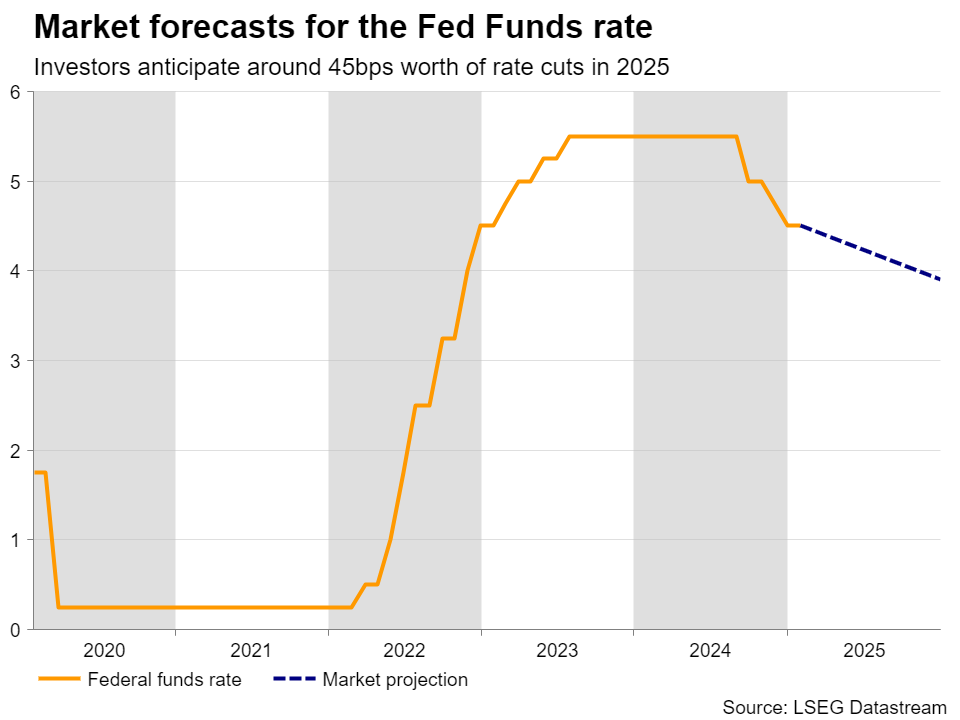
From around 50bps worth of rate reductions for this year, Fed fund futures are now pointing to 45bps as investors lifted only slightly the implied rate path. The next quarter-point reduction is still nearly fully priced in by June.
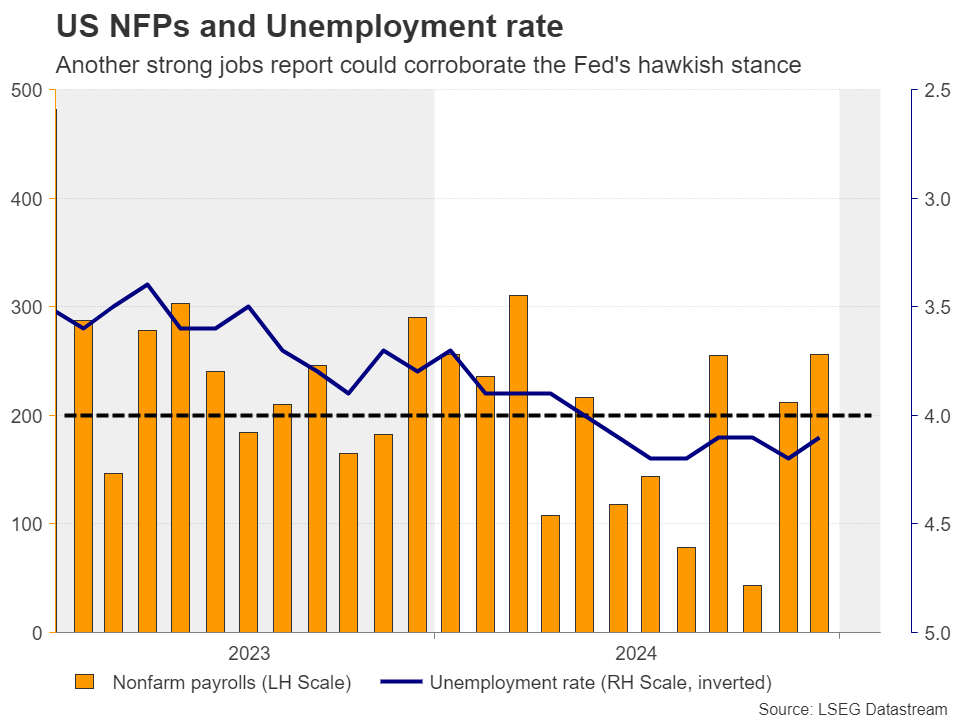
With all that in mind, attention next week is likely to fall on the NFP employment report for January. Powell noted that further labor market weakening is not needed for the inflation target to be met as the path for continued disinflation remains intact. However, he did not mention what will happen in the case of unexpected labor market tightening.
In December, the economy added 256k jobs, with average hourly earnings ticking down, but remaining elevated close to 4.0% y/y. Another round of strong employment and wage growth could intensify concerns about a resurgence of inflation in the months to come, especially if Trump kicks off the tariff game on February 1. Market participants are likely to start doubting again whether two rate cuts will be needed this year, which could allow the US dollar to extend its latest recovery.
The ISM manufacturing and non-manufacturing PMIs on Monday and Wednesday, as well as the ADP private employment report on Wednesday will also be closely monitored ahead of Friday’s NFP data.
After the BoJ, the Fed, the ECB and the BoC, it will be the BoE’s turn to hold its first policy decision for 2025. Following the concerns over the sustainability of the new government’s fiscal plans, where UK bonds and the pound tumbled on fears of a Truss 2.0 budget crisis, investors became more convinced that a rate cut would be appropriate at this gathering.
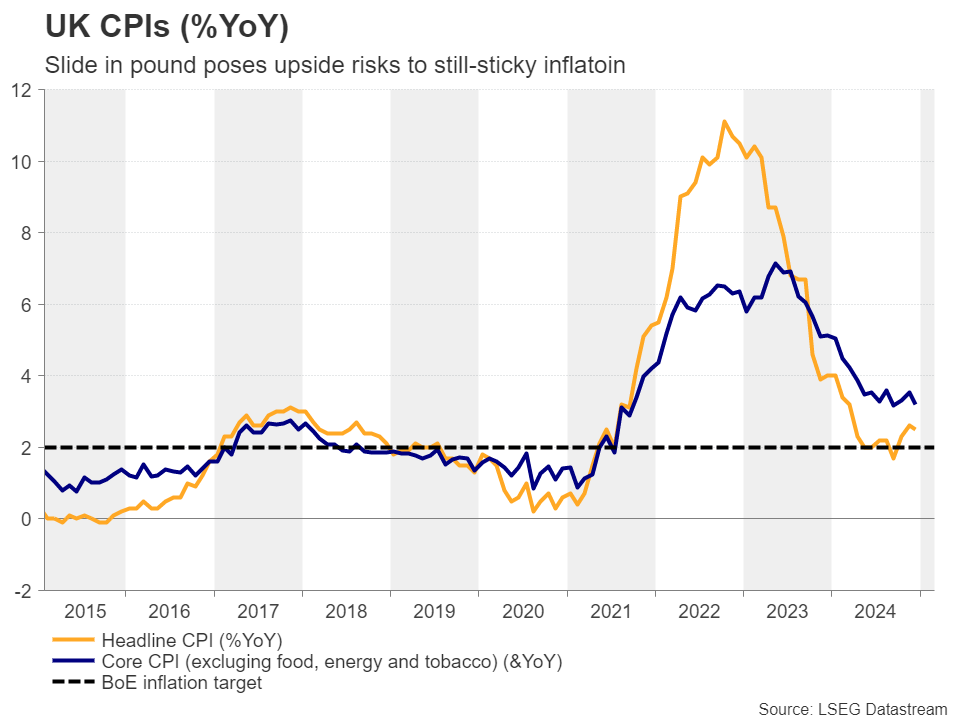
Taking also into account the cooler-than-expected CPI numbers for December and the sluggish UK growth, investors are now penciling in around a 90% chance of a quarter-point rate cut at this gathering, while anticipating nearly another two by the end of the year.
That said, both the headline and the core inflation rates remain above the Bank’s objective of 2%, with the latter standing at 3.2% y/y. What’s more, although the surge in bold yields was largely reversed, the pound recovered only a portion of its losses. It is actually the worst performing major currency so far this year, posing upside risks to UK inflation.
Therefore, even if the well-anticipated rate cut is delivered, it may be a hawkish cut, with the Bank revising up its inflation projections, especially with rent inflation remaining stagnant at 7.6% y/y and services inflation still above 4.0% y/y. Officials may signal that they will take their decisions meeting by meeting, avoiding to pre-commit to any future rate cuts. This may disappoint those expecting another two reductions this year and thereby allow the pound to gain some more ground.
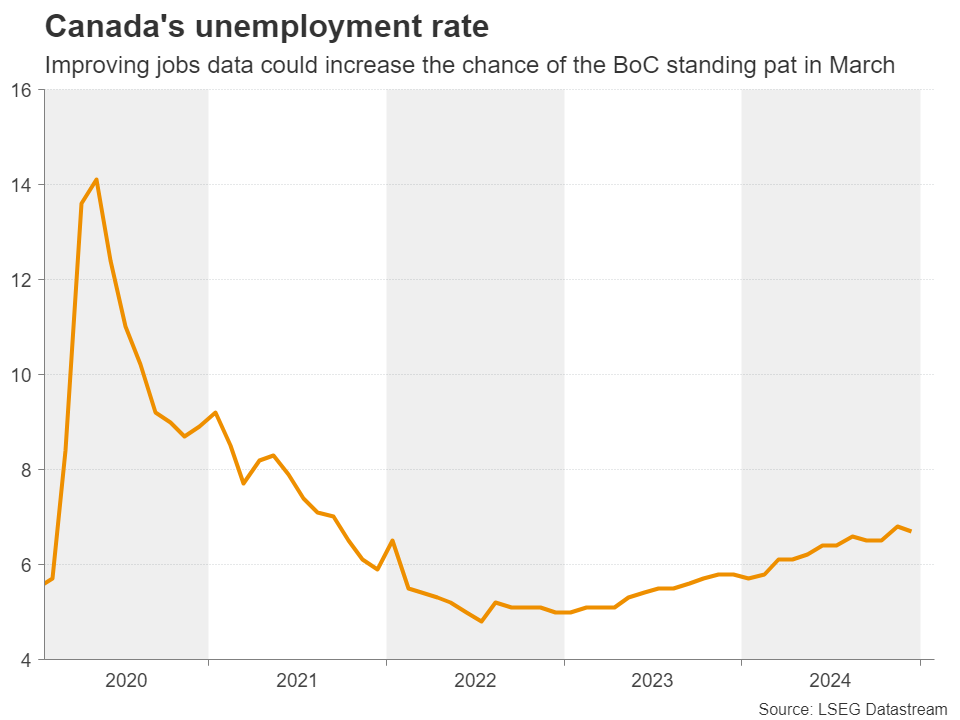
At the same time with the US jobs data, Canada releases its own employment report for January. This week, the Bank of Canada trimmed interest rates by another 25bps and revised down its growth forecasts, noting that they are concerned about US tariffs.
However, they also added that tariffs could also stoke persistently high inflation, which led market participants to pencil in around a 50% probability for policymakers to take the sidelines at the next policy gathering in March.
In other words, the BoC will find itself between a rock and a hard place and Friday’s jobs report may help tilt the scale towards a pause or another rate cut, depending on whether it will come in strong or soft.
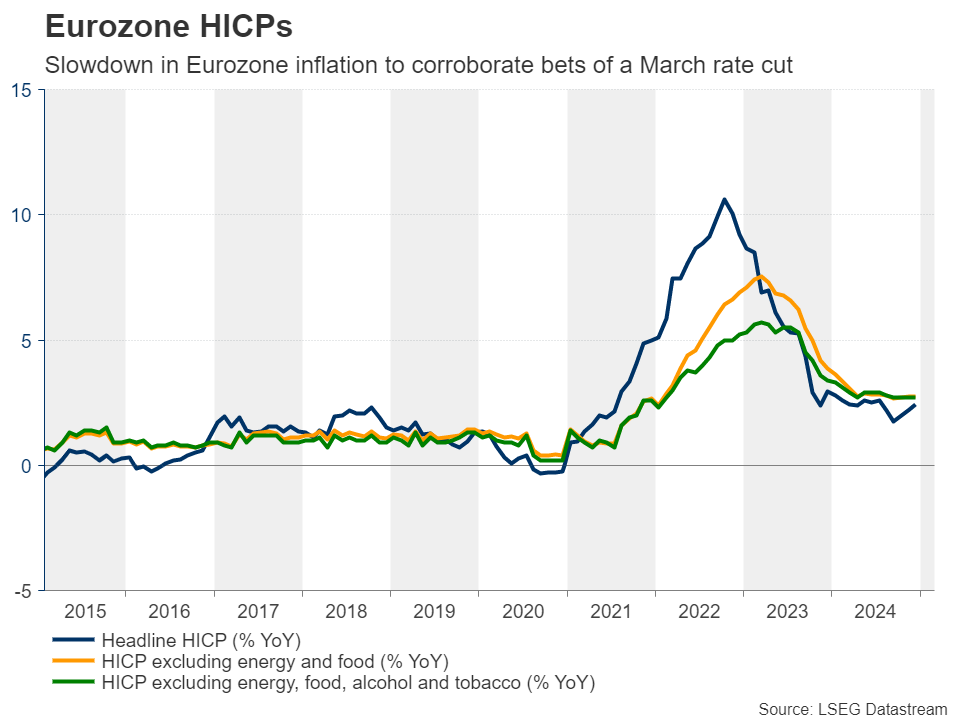
Flying from Canada to the Eurozone, the ECB also decided to reduce interest rates this week, noting that the disinflationary process is well on track and that the economy is still facing headwinds. In the statement, it was noted that the Bank is still not pre-committing to a particular rate path. At the post-decision conference, President Lagarde said that interest rates are still in restrictive territory and that there was no discussion on whether it’s time to stop reducing rates.
The market was quick to price in around an 85% chance for another quarter-point cut in March and should Monday’s flash CPI data reveal cooling inflation, that probability could go even higher, thereby weighing on the euro. Eurozone’s retail sales are also on next week’s agenda.
Elsewhere, during Tuesday’s Asian session, New Zealand’s employment report for Q4 could prove crucial on whether the RBNZ will cut by 25 or 50bps, while the following day, Japan’s wage data for December could shape expectations about the BoJ’s next rate increase.
On the earnings front, the tech-related reporting continues with Alphabet and AMD on Tuesday, and Amazon on Thursday.
White Label
Data API
Web Plug-ins
Poster Maker
Affiliate Program
The risk of loss in trading financial instruments such as stocks, FX, commodities, futures, bonds, ETFs and crypto can be substantial. You may sustain a total loss of the funds that you deposit with your broker. Therefore, you should carefully consider whether such trading is suitable for you in light of your circumstances and financial resources.
No decision to invest should be made without thoroughly conducting due diligence by yourself or consulting with your financial advisors. Our web content might not suit you since we don't know your financial conditions and investment needs. Our financial information might have latency or contain inaccuracy, so you should be fully responsible for any of your trading and investment decisions. The company will not be responsible for your capital loss.
Without getting permission from the website, you are not allowed to copy the website's graphics, texts, or trademarks. Intellectual property rights in the content or data incorporated into this website belong to its providers and exchange merchants.
Not Logged In
Log in to access more features

FastBull Membership
Not yet
Purchase
Log In
Sign Up