• Trade
  • Markets
  • Copy
  • Contests
  • News
  • 24/7
  • Calendar
  • Q&A
  • Chats
Trending
Screeners
SYMBOL
LAST
BID
ASK
HIGH
LOW
NET CHG.
%CHG.
SPREAD
SPX
S&P 500 Index
6827.42
6827.42
6827.42
6899.86
6801.80
-73.58
-1.07%
--
DJI
Dow Jones Industrial Average
48458.04
48458.04
48458.04
48886.86
48334.10
-245.98
-0.51%
--
IXIC
NASDAQ Composite Index
23195.16
23195.16
23195.16
23554.89
23094.51
-398.69
-1.69%
--
USDX
US Dollar Index
97.920
98.000
97.920
98.070
97.810
-0.030
-0.03%
--
EURUSD
Euro / US Dollar
1.17448
1.17456
1.17448
1.17596
1.17262
+0.00054
+ 0.05%
--
GBPUSD
Pound Sterling / US Dollar
1.33848
1.33857
1.33848
1.33961
1.33546
+0.00141
+ 0.11%
--
XAUUSD
Gold / US Dollar
4331.27
4331.70
4331.27
4350.16
4294.68
+31.88
+ 0.74%
--
WTI
Light Sweet Crude Oil
56.864
56.894
56.864
57.601
56.789
-0.369
-0.64%
--

Community Accounts

Signal Accounts
--
Profit Accounts
--
Loss Accounts
--
View More

Become a signal provider

Sell trading signals to earn additional income

View More

Guide to Copy Trading

Get started with ease and confidence

View More

Signal Accounts for Members

All Signal Accounts

Best Return
  • Best Return
  • Best P/L
  • Best MDD
Past 1W
  • Past 1W
  • Past 1M
  • Past 1Y

All Contests

  • All
  • Trump Updates
  • Recommend
  • Stocks
  • Cryptocurrencies
  • Central Banks
  • Featured News
Top News Only
Share

Bank Of America Expects A Deficit In Aluminium Next Year And Sees Prices Pushing Above $3000/T

Share

Fed Data - USA Effective Federal Funds Rate At 3.64 Percent On 12 December On $102 Billion In Trades Versus 3.64 Percent On $99 Billion On 11 December

Share

Brazil's Petrobras Says No Impact Seen On Oil, Petroleum Products Output As Workers Start Planned Strike

Share

Statement: US Travel Group Warns New Proposed Trump Administration Requirements For Foreign Tourists To Provide Social Media Histories Could Mean Millions Of People Opting Not To Visit

Share

Blackrock: Kerry White Will Become Head Of Citi Investment Management At Citi Wealth

Share

Blackrock: Rob Jasminski, Head Of Citi Investment Management, Has Joined With Team

Share

Blackrock: Effective Dec 15, Citi Investment Management Employees Will Join Blackrock

Share

Blackrock: Formally Launch Citi Portfolio Solutions Powered By Blackrock

Share

According To Data From The Federal Reserve Bank Of New York, The Secured Overnight Funding Rate (Sofr) Was 3.67% On The Previous Trading Day (December 15), Compared To 3.66% The Day Before

Share

Peru Energy And Mines Ministry: Copper Production Up 4.8% Year-On-Year In October To 248192 Metric Tons

Share

Security Source: Ukrainian Drones Hits Russian Oil Infrastructure In Caspian Sea For Third Time

Share

Spot Palladium Extends Gains, Last Up 5% To $1562.7/Oz

Share

Mexico's Economy Ministry Announces Start Of Anti-Dumping Investigation And Anti-Subsidy Investigations Into USA Pork Imports

Share

Canada Nov CPI Common +2.8%, CPI Median +2.8%, CPI Trim +2.8% On Year

Share

NY Fed's Empire State Prices Paid Index +37.6 In December Versus+49.0 In November

Share

Canada Nov Consumer Prices +0.1% On Month, +2.2% On Year

Share

Canada Nov CPI Core -0.1% On Month, +2.9% On Year

Share

Canada Nov Core CPI, Seasonally Adjusted +0.2% On Month, Oct +0.3% (Unrevised)

Share

UK Health Minister Streeting On Doctors' Strike: Vote To Go Ahead Reveals The Bma's Shocking Disregard For Patient Safety

Share

Venezuelan State Oil Company Pdvsa Says Was Subject To Cyber Attack But Operations Unaffected

TIME
ACT
FCST
PREV
Japan Tankan Small Manufacturing Outlook Index (Q4)

A:--

F: --

P: --

Japan Tankan Large Non-Manufacturing Outlook Index (Q4)

A:--

F: --

P: --

Japan Tankan Large Manufacturing Outlook Index (Q4)

A:--

F: --

P: --

Japan Tankan Small Manufacturing Diffusion Index (Q4)

A:--

F: --

P: --

Japan Tankan Large Manufacturing Diffusion Index (Q4)

A:--

F: --

P: --

Japan Tankan Large-Enterprise Capital Expenditure YoY (Q4)

A:--

F: --

P: --

U.K. Rightmove House Price Index YoY (Dec)

A:--

F: --

P: --

China, Mainland Industrial Output YoY (YTD) (Nov)

A:--

F: --

P: --

China, Mainland Urban Area Unemployment Rate (Nov)

A:--

F: --

P: --

Saudi Arabia CPI YoY (Nov)

A:--

F: --

P: --

Euro Zone Industrial Output YoY (Oct)

A:--

F: --

P: --

Euro Zone Industrial Output MoM (Oct)

A:--

F: --

P: --

Canada Existing Home Sales MoM (Nov)

A:--

F: --

P: --

Canada National Economic Confidence Index

A:--

F: --

P: --

Canada New Housing Starts (Nov)

A:--

F: --

P: --
U.S. NY Fed Manufacturing Employment Index (Dec)

A:--

F: --

P: --

U.S. NY Fed Manufacturing Index (Dec)

A:--

F: --

P: --

Canada Core CPI YoY (Nov)

A:--

F: --

P: --

Canada Manufacturing Unfilled Orders MoM (Oct)

A:--

F: --

P: --

U.S. NY Fed Manufacturing Prices Received Index (Dec)

A:--

F: --

P: --

U.S. NY Fed Manufacturing New Orders Index (Dec)

A:--

F: --

P: --

Canada Manufacturing New Orders MoM (Oct)

A:--

F: --

P: --

Canada Core CPI MoM (Nov)

A:--

F: --

P: --

Canada Trimmed CPI YoY (SA) (Nov)

A:--

F: --

P: --

Canada Manufacturing Inventory MoM (Oct)

A:--

F: --

P: --

Canada CPI YoY (Nov)

A:--

F: --

P: --

Canada CPI MoM (Nov)

A:--

F: --

P: --

Canada CPI YoY (SA) (Nov)

A:--

F: --

P: --

Canada Core CPI MoM (SA) (Nov)

A:--

F: --

P: --

Canada CPI MoM (SA) (Nov)

A:--

F: --

P: --

Federal Reserve Board Governor Milan delivered a speech
U.S. NAHB Housing Market Index (Dec)

--

F: --

P: --

Australia Composite PMI Prelim (Dec)

--

F: --

P: --

Australia Services PMI Prelim (Dec)

--

F: --

P: --

Australia Manufacturing PMI Prelim (Dec)

--

F: --

P: --

Japan Manufacturing PMI Prelim (SA) (Dec)

--

F: --

P: --

U.K. 3-Month ILO Employment Change (Oct)

--

F: --

P: --

U.K. Unemployment Claimant Count (Nov)

--

F: --

P: --

U.K. Unemployment Rate (Nov)

--

F: --

P: --

U.K. 3-Month ILO Unemployment Rate (Oct)

--

F: --

P: --

U.K. Average Weekly Earnings (3-Month Average, Including Bonuses) YoY (Oct)

--

F: --

P: --

U.K. Average Weekly Earnings (3-Month Average, Excluding Bonuses) YoY (Oct)

--

F: --

P: --

France Services PMI Prelim (Dec)

--

F: --

P: --

France Composite PMI Prelim (SA) (Dec)

--

F: --

P: --

France Manufacturing PMI Prelim (Dec)

--

F: --

P: --

Germany Services PMI Prelim (SA) (Dec)

--

F: --

P: --

Germany Manufacturing PMI Prelim (SA) (Dec)

--

F: --

P: --

Germany Composite PMI Prelim (SA) (Dec)

--

F: --

P: --

Euro Zone Composite PMI Prelim (SA) (Dec)

--

F: --

P: --

Euro Zone Services PMI Prelim (SA) (Dec)

--

F: --

P: --

Euro Zone Manufacturing PMI Prelim (SA) (Dec)

--

F: --

P: --

U.K. Services PMI Prelim (Dec)

--

F: --

P: --

U.K. Manufacturing PMI Prelim (Dec)

--

F: --

P: --

U.K. Composite PMI Prelim (Dec)

--

F: --

P: --

Euro Zone ZEW Economic Sentiment Index (Dec)

--

F: --

P: --

Germany ZEW Current Conditions Index (Dec)

--

F: --

P: --

Germany ZEW Economic Sentiment Index (Dec)

--

F: --

P: --

Euro Zone Trade Balance (Not SA) (Oct)

--

F: --

P: --

Euro Zone ZEW Current Conditions Index (Dec)

--

F: --

P: --

Euro Zone Trade Balance (SA) (Oct)

--

F: --

P: --

U.S. Retail Sales MoM (Excl. Automobile) (SA) (Oct)

--

F: --

P: --

Q&A with Experts
    • All
    • Chatrooms
    • Groups
    • Friends
    Connecting
    .
    .
    .
    Type here...
    Add Symbol or Code

      No matching data

      All
      Trump Updates
      Recommend
      Stocks
      Cryptocurrencies
      Central Banks
      Featured News
      • All
      • Russia-Ukraine Conflict
      • Middle East Flashpoint
      • All
      • Russia-Ukraine Conflict
      • Middle East Flashpoint
      Search
      Products

      Charts Free Forever

      Chats Q&A with Experts
      Screeners Economic Calendar Data Tools
      Membership Features
      Data Warehouse Market Trends Institutional Data Policy Rates Macro

      Market Trends

      Market Sentiment Order Book Forex Correlations

      Top Indicators

      Charts Free Forever
      Markets

      News

      News Analysis 24/7 Columns Education
      From Institutions From Analysts
      Topics Columnists

      Latest Views

      Latest Views

      Trending Topics

      Top Columnists

      Latest Update

      Signals

      Copy Rankings Latest Signals Become a signal provider AI Rating
      Contests
      Brokers

      Overview Brokers Assessment Rankings Regulators News Claims
      Broker listing Forex Brokers Comparison Tool Live Spread Comparison Scam
      Q&A Complaint Scam Alert Videos Tips to Detect Scam
      More

      Business
      Events
      Careers About Us Advertising Help Center

      White Label

      Data API

      Web Plug-ins

      Affiliate Program

      Awards Institution Evaluation IB Seminar Salon Event Exhibition
      Vietnam Thailand Singapore Dubai
      Fans Party Investment Sharing Session
      FastBull Summit BrokersView Expo
      Recent Searches
        Top Searches
          Markets
          News
          Analysis
          User
          24/7
          Economic Calendar
          Education
          Data
          • Names
          • Latest
          • Prev

          View All

          No data

          Scan to Download

          Faster Charts, Chat Faster!

          Download App
          English
          • English
          • Español
          • العربية
          • Bahasa Indonesia
          • Bahasa Melayu
          • Tiếng Việt
          • ภาษาไทย
          • Français
          • Italiano
          • Türkçe
          • Русский язык
          • 简中
          • 繁中
          Open Account
          Search
          Products
          Charts Free Forever
          Markets
          News
          Signals

          Copy Rankings Latest Signals Become a signal provider AI Rating
          Contests
          Brokers

          Overview Brokers Assessment Rankings Regulators News Claims
          Broker listing Forex Brokers Comparison Tool Live Spread Comparison Scam
          Q&A Complaint Scam Alert Videos Tips to Detect Scam
          More

          Business
          Events
          Careers About Us Advertising Help Center

          White Label

          Data API

          Web Plug-ins

          Affiliate Program

          Awards Institution Evaluation IB Seminar Salon Event Exhibition
          Vietnam Thailand Singapore Dubai
          Fans Party Investment Sharing Session
          FastBull Summit BrokersView Expo

          US Consumer Spending Strong In July; Services Inflation Warms Up

          Damon

          Economic

          Summary:

          Consumer spending increases 0.5% in July.Core PCE price index rises 0.3%; up 2.9% year-on-year.Goods trade deficit widens 22.1% to $103.6 billion.

          U.S. consumer spending increased by the most in four months in July while services inflation picked up, but economists did not believe the signs of strong domestic demand would prevent the Federal Reserve from cutting interest rates next month against a backdrop of softening labor market conditions.

          The report from the Commerce Department on Friday showed mild price pressures fromtariffson imports. Economists said the import duties have been slow to feed through to inflation as businesses are selling stocks accumulated before PresidentDonald Trump'ssweeping duties kicked in. Businesses have also been absorbing some of the costs.

          "Sticky service sector inflation all point towards a difficult September policy decision in which we expect the Fed to cut rates by 25 basis points," said Joseph Brusuelas, chief economist at RSM.

          Consumer spending, which accounts for more than two-thirds of economic activity, rose 0.5% last month after an upwardly revised 0.4% gain in June, according to the Commerce Department's Bureau of Economic Analysis.

          Economists polled by Reuters had forecast spending would rise 0.5% after a previously reported 0.3% advance in June.

          Motor vehicle purchases led the broad increase in sales, helping to lift outlays on long-lasting manufactured goods by 1.9%. There were also increases in spending on recreational goods and vehicles, clothing and footwear as well as furnishings and durable household equipment. Spending on food and beverages jumped. But outlays on gasoline and other energy goods declined.

          Overall spending on goods increased 0.8% after rebounding 0.3% in June. Outlays on services rose 0.4%, matching June's gain, and were lifted by financial services and insurance, healthcare as well as housing and utilities. Spending at restaurants and bars as well as on hotel and motel rooms fell.

          Consumption is being supported by low layoffs that are underpinning solid wage growth. Wages increased 0.6% last month, but rising operating costs because of tariffs have left employers reluctant to increase headcount.

          Employment gains have averaged 35,000 jobs per month over the last three months through July compared to 123,000 during the same period in 2024, the government reported this month.

          A survey from the Conference Board on Tuesday showed the share of consumers viewing jobs as "hard to get" jumped to a 4-1/2-year high in August. Fed Chair Jerome Powell last week signaled a possible rate cut at the U.S. central bank's September 16-17 policy meeting, in a nod to increasing labor market risks, but also added that inflation remained a threat.

          The Fed has kept its benchmark overnight interest rate in the 4.25%-4.50% range since December.

          IMPORTS SURGE

          Economists anticipate inflation will start rising in the second half of the year due to rising business costs and an inventory drawdown in the second quarter. Companies from retailers to motor vehicle manufacturers have warned that tariffs are raising their costs, which economists expect will eventually be passed on to consumers.

          The Personal Consumption Expenditures (PCE) Price Index increased 0.2% last month after an unrevised 0.3% rise in June, the BEA said. Goods prices fell 0.1%, pulled down by a 1.7% drop in the costs of gasoline and other energy goods. Recreational goods and vehicles declined 0.9%.

          In the 12 months through July, the PCE Price Index rose 2.6%, matching the gain in June.

          Excluding the volatile food and energy components, the PCE Price Index increased 0.3% last month, matching the rise in June. Services prices increased 0.3%, the most since February, after rising 0.2% for four straight months. It was fueled by a 1.2% jump in the costs of financial services and insurance.

          In the 12 months through July, the so-called core inflation figure advanced 2.9%. That was the largest rise in core PCE inflation since February and followed a 2.8% increase in June. The Fed tracks the PCE price measures for its 2% inflation target.

          The solid consumer spending bodes well for economic growth in the third quarter. But the strong demand is pulling in imports, which could blunt some of the boost to gross domestic product from consumer spending.

          A separate report from the Commerce Department's Census Bureau showed the goods trade deficit soared 22.1% to $103.6 billion last month as imports jumped $18.6 billion to $281.5 billion. Goods exports dipped $0.1 billion to $178.0 billion.

          An ebb in import flows led to a sharp contraction in the trade deficit in the second quarter, which added a record 4.95 percentage points to GDP growth that period.

          The economy grew at a 3.3% annualized rate last quarter. GDP contracted at a 0.5% rate in the January-March quarter, weighed down by a sharp deterioration in the trade deficit that was driven by businesses front-running imports at a record pace as tariffs kicked in.

          Source: TradingView

          To stay updated on all economic events of today, please check out our Economic calendar
          Risk Warnings and Disclaimers
          You understand and acknowledge that there is a high degree of risk involved in trading. Following any strategies or investment methods may lead to potential losses. The content on the site is provided by our contributors and analysts for information purposes only. You are solely responsible for determining whether any trading assets, securities, strategy, or any other product is suitable for investing based on your own investment objectives and financial situation.
          Add to Favorites
          Share

          Pre-Budget Lift for Rachel Reeves as UK Business Confidence Rises

          Warren Takunda

          Economic

          Confidence among UK businesses has grown despite anxiety about the state of the economy, in a rare slice of positive news for the chancellor, Rachel Reeves, in the run-up to her autumn budget.
          An August poll of UK companies by Lloyds Bank showed that improved sentiment among manufacturers and retailers helped push overall optimism within UK plc up by two percentage points, with 54% of companies now feeling confident in the current environment.
          It marked the fourth consecutive monthly increase in overall business sentiment, according to the Lloyds business barometer, driven by a growing number of businesses – roughly 63% – feeling strong about their own trading prospects. On that measurement alone, confidence reached its highest level since 2014.
          About half of all businesses now expect to hire more staff in the coming year despite growing costs. The survey found 38% of companies are expecting to have to raise wages by 3% or more, with the vast majority – 83% – saying that higher employment-related costs would have a limited impact on hiring plans.
          Overall optimism across the private sector comes despite jitters over the state of the economy, with levels of positive sentiment falling for the first time since the drop seen in April, when Donald Trump’s sweeping tariff announcements prompted fears over the future of global trade. Economic confidence fell three points to 44% this month, Lloyds said, although that remained above the longer-term average of 19%.
          However, the fact that business confidence continues to rise amid the economic gloom will be a rare piece of good news for the chancellor, given fears that a fresh round of tax increases – meant to bolster the public finances – could knock confidence and investment across the private sector as companies try to recoup and offset costs. Reeves is expected to announce a date for her autumn budget within days.
          “This continued upward trend in business confidence suggests UK firms remain optimistic about their own trading prospects while there is a modest cooling of confidence in the wider UK economy,” Hann-Ju Ho, a senior economist at Lloyds Bank’s commercial banking arm, said. “Firms are focusing on what they can control, with many looking to pursue growth opportunities, including entering new markets and adopting new technologies.
          “Wage expectations have seen a notable shift this month, but it remains to be seen whether this signals the start of a sustained trend or a temporary uplift, as they have been broadly stable in recent months.”

          Source: Theguardian

          To stay updated on all economic events of today, please check out our Economic calendar
          Risk Warnings and Disclaimers
          You understand and acknowledge that there is a high degree of risk involved in trading. Following any strategies or investment methods may lead to potential losses. The content on the site is provided by our contributors and analysts for information purposes only. You are solely responsible for determining whether any trading assets, securities, strategy, or any other product is suitable for investing based on your own investment objectives and financial situation.
          Add to Favorites
          Share

          Looming U.S. stagflation and gold’s record of multi-year bull runs mean there’s still plenty of price upside – Fidelity’s Samson

          Adam

          Commodity

          Even though gold prices have posted outsized gains over the last couple of years, gold bull markets often last many years once they get going, and with a strong chance of U.S. stagflation on the near-term horizon, investors have no reason to reduce their positions, according to Ian Samson, multi-asset portfolio manager at Fidelity International.
          Samson wrote in a research note that gold has earned its popularity among investors.
          “It was one of the best performing assets in our portfolios last year, rising 27%, and it’s already up another 28% this year (to 25 August),” he noted. “Despite this, bullish environments for gold can run strongly for many years. Gold continues to provide diversification even when bonds do not, maintains an ultimate ‘safe haven’ status, offers protection against inflation and loose economic policies, and benefits from structural trends.”
          Samson said Fidelity’s base case calls for “a US slowdown or even stagflationary environment” in the coming months, and the financial giant is retaining their positive outlook for gold prices. “The Federal Reserve is set to lower interest rates, despite inflation still around 3%, and with tariffs likely to keep prices elevated,” he wrote. “The tariff hit and a slowing labour supply will also lead to a weak growth environment.”
          “This mix of falling interest rates, sticky inflation, and subdued growth should all bolster gold,” Samson said. “It should lead to a subdued US dollar, which is gold’s main competitor as a safe haven and store of value. We have never seen this scale of uncertainty and change around tariff policy, and the effects are yet to dissipate. Gold’s status as the ultimate ‘safe haven’ leaves it well placed for any further surprises.”
          “In addition, the unrelenting size of the US budget deficit raises concerns about monetary debasement, which further boosts the long-term case for gold,” he added.
          Samson said the structural argument for gold investment also remains strong. “Foreign reserve managers are still buying, and global gold ETF holdings continue to increase,” he said. “Multiple countries, including China, India, and Turkey are structurally increasing their holdings of gold, in a bid to diversify exposure away from the US dollar. Gold has long been a store of value and a diversifier, without the credit risk associated with paper currency reserves. More broadly, gold supply is very constrained, meaning even a small increase in portfolio holdings could move the dial. For instance, if foreign investors decide to move some of the 57 trillion US dollars they currently hold in US assets, gold is a likely beneficiary.”
          Samson said that Fidelity International remains “happy to hold gold in our well-diversified multi-asset portfolios.”
          “For much of the year this had been through a combination of passive instruments that track the gold price directly, and through a selection of gold miner equities,” he added. “The latter has outperformed in the last few months and we have taken the opportunity to book some profits, but retain exposure to the gold price.”
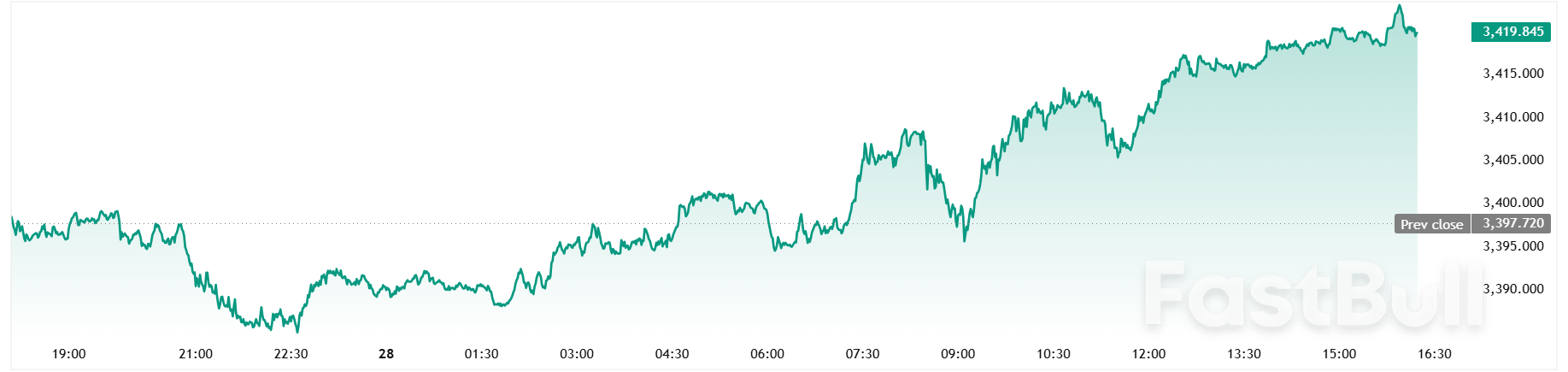
          Gold is still holding comfortably above the $3,400 level on Thursday afternoon after hitting a session high of $3,423.18 per ounce just before 4 pm EDT.
          Looming U.S. stagflation and gold’s record of multi-year bull runs mean there’s still plenty of price upside –  Fidelity’s Samson_1
          Spot gold last traded at $3,419.82 per ounce for a gain of 0.65% on the daily chart.

          Source: kitco

          Risk Warnings and Disclaimers
          You understand and acknowledge that there is a high degree of risk involved in trading. Following any strategies or investment methods may lead to potential losses. The content on the site is provided by our contributors and analysts for information purposes only. You are solely responsible for determining whether any trading assets, securities, strategy, or any other product is suitable for investing based on your own investment objectives and financial situation.
          Add to Favorites
          Share

          US Consumer Sentiment Declines on Dimmer Views of Economic Outlook

          Michelle

          Economic

          Forex

          US consumer sentiment declined to a three-month low as tariff-related concerns about the economic outlook and inflation persisted.

          The final August sentiment index fell to 58.2 from 61.7 a month earlier, according to a University of Michigan survey released Friday. The preliminary reading was 58.6.

          Consumers expect prices to rise at an annual rate of 4.8% over the next year, up from 4.5% last month, data released Friday showed. They saw costs rising at an annual rate of 3.5% over the next five to 10 years. That marked an improvement from the 3.9% seen in the preliminary survey earlier this month.

          The figures underscore consumers’ anxiety about employment prospects and business conditions. About 63% of consumers expect unemployment to rise in the year ahead, an increase from the prior month and well above the same month in 2024. The August jobs report next week is projected to show employment growth remained moderate for another month.

          Federal Reserve Governor Christopher Waller on Thursday said he would support an interest-rate cut in September and anticipates additional easing over the next six months to help bolster job prospects.

          Unease about employment and household finances risks causing consumers, the primary source of economic growth, to pull back.

          “Buying conditions for major purchases like durable goods and vehicles both worsened this month,’’ Joanne Hsu, director of the survey, said in a statement. “Growing shares of consumers mentioned high prices as well as tax/tariff considerations as factors weighing on buying conditions for cars in particular.”

          However, government data released earlier on Friday showed consumer spending in July rose by the most in four months, boosted by income growth.

          That report also highlighted the impact of price pressures on consumer sentiment. The so-called core personal consumption expenditures price index, which excludes food and energy, ticked up to 2.9% on an annual basis, the most since February.

          The university's sentiment survey showed the expectations index dropped to a three-month low of 55.9 -- worse than the preliminary reading of 57.2. The current conditions gauge also fell from a month earlier, to 61.7.

          The survey was conducted July 29 to Aug. 25.

          Source: Bloomberg Europe

          To stay updated on all economic events of today, please check out our Economic calendar
          Risk Warnings and Disclaimers
          You understand and acknowledge that there is a high degree of risk involved in trading. Following any strategies or investment methods may lead to potential losses. The content on the site is provided by our contributors and analysts for information purposes only. You are solely responsible for determining whether any trading assets, securities, strategy, or any other product is suitable for investing based on your own investment objectives and financial situation.
          Add to Favorites
          Share

          CNBC’s Inside India newsletter: India’s three-way balancing act: Tariffs, oil, and uneasy handshakes

          Adam

          Economic

          The big story

          Picture this: you’re at a dinner party with three friends who are struggling to get along. One is picking fights with everyone, another is slipping you secret notes under the table, and the third is that old frenemy you’d rather avoid but can’t ignore. Awkward, right?
          That is where India finds itself. Washington is piling on tariffs, Moscow is keeping India’s energy bills in check with cheap oil, and Beijing, despite a bruised relationship, is preparing to welcome Prime Minister Narendra Modi with open arms at the SCO summit in China this week. India’s juggling act on the world stage has never looked more complicated, or more consequential.
          Trade with the U.S. has become a flashpoint. Washington has imposed a 25% reciprocal tariff on imports from India, followed by another 25% penalty tied to India’s Russian oil purchases. That leaves duties on some Indian exports as high as 50%. The U.S. is India’s single largest export market, worth about $87 billion a year, nearly a fifth of its total merchandise trade. Key Indian sectors such as diamonds, garments and seafood are especially exposed.
          Think of what that means on the ground. Diamond polishers in Gujarat, garment workers in Tirupur, and seafood processors in Kerala all depend on U.S. orders. Electronics and pharma are spared for now, but other sectors — which employ millions — are suddenly exposed.
          The tariff fight comes even as the two countries deepen strategic ties. On a number of fronts, the U.S. and India are cooperating; the two countries are expanding defense cooperation, for instance, working together in the Quad, and advancing semiconductor supply chain talks.
          Major U.S. firms, including Apple, Microsoft, and Amazon, have increased their investments in India in recent years. Yet trade frictions complicate the relationship, raising the question in Delhi: does Washington view India as a true partner, or simply another trading problem to manage?
          Now, let’s turn to Russia. India is the world’s third-largest oil consumer, burning through more than 5 million barrels a day, so cheap energy isn’t a luxury — it’s a necessity. In 2021, just 1% of India’s crude came from Russia. Today it’s more than 35%, around 1.75 million barrels a day, saving Delhi over $17 billion since early 2022, according to analyst estimates. Those discounts have kept inflation in check and given Modi breathing space at home.
          But there’s a second layer here. India is walking a geopolitical tightrope, with Pakistan tensions threatening to boil over. In that context, Russia is a vital security partner and central to India’s defense procurement, making it difficult for Delhi to pull away without weakening its security posture.
          The catch? Washington isn’t impressed. U.S. officials including Peter Navarro and Scott Bessent argue Delhi is “profiteering” by paying above the G7′s $60 price cap on Russian oil and exporting refined fuels back to Europe.
          Then comes Beijing, which represents perhaps the trickiest relationship of all. Modi is preparing for his first trip to China in more than seven years, where he will meet President Xi Jinping and stand alongside Russian President Vladimir Putin. While Beijing says the event is a display of solidarity, tensions between India and China remain unresolved.
          Border clashes in 2020 killed at least 20 Indian soldiers, prompting a freeze in high-level engagement. Since then, India has banned hundreds of Chinese apps, tightened foreign investment rules, and promoted self-reliance in key sectors. Yet trade between the two countries still hit $118 billion last year, with India importing far more than it exports. This imbalance frustrates Delhi but also underscores why cutting ties is not realistic.
          Analysts say Modi is unlikely to secure a major breakthrough when he visits Tianjin. But showing up is a signal in itself — that India is willing to keep lines of communication open, even while deepening defense ties with Washington and buying cheap oil from Moscow.
          Step back, and India’s position looks clearer. The U.S. is its biggest customer but also its harshest critic. Russia keeps the lights on, but at a political cost. China is the rival next door, yet too big to ignore. Delhi calls its approach “strategic autonomy.” It has worked for decades, but today the balancing act is under more pressure than ever.
          Which brings us back to that dinner party. India wants all three guests to remain seated, however awkward the conversation may be. The real test is whether Modi can stop someone from banging the table, throwing down their fork, and storming out.

          Top TV picks on CNBC

          Richard Rossow, Senior Adviser and Chair on India and Emerging Asia Economics at the Center for Strategic and International Studies (CSIS), said that a deal between the U.S. and India is “still very much possible” as the South Asian country puts forth substantial sweeteners.
          Arnab Mitra, India consumer analyst at Goldman Sachs, said there could be a mass consumption revival in India driven by rural demand and upcoming GST reforms.
          Meera Shankar, former Indian ambassador to the U.S., said India will not be able to entirely open up its agricultural sector because of domestic political sensitivities.

          Need to know

          Trade negotiations between India and the U.S. still ongoing. India’s Foreign Affairs Minister Subrahmanyam Jaishankar said that India has “some redlines in the negotiations, to be maintained and defended.” He added that “it is our right to make decisions in our ‘national interest’.”
          India and Russia reaffirm plans to boost bilateral trade. The two countries have vowed to expand their trade ties in a move indicating that U.S. President Donald Trump’s hefty tariffs on New Delhi over its purchase of Russian oil are unlikely to impact their partnership.
          Former Reserve Bank of India Governor urges India to reassess Russian oil purchases. Raghuram Rajan said that Trump’s hefty tariffs send New Delhi a clear “wake-up call” to reduce its dependence on a single trading partner. He added that it is now important for India to “ask who benefits and who is hurt.”
          In the markets
          Indian markets fell Thursday, after a holiday the day before. It marked the first session since the additional 25% tariffs on Indian exports to the U.S. kicked in on Wednesday.
          The benchmark Nifty 50 was down 0.85%, while the BSE Sensex index fell 0.87%. The 50-stock Nifty 50 has risen over 3% since the start of the year, while the BSE Sensex is up 2%.
          The benchmark 10-year Indian government bond yield fell to 6.58%.

          Source: cnbc

          To stay updated on all economic events of today, please check out our Economic calendar
          Risk Warnings and Disclaimers
          You understand and acknowledge that there is a high degree of risk involved in trading. Following any strategies or investment methods may lead to potential losses. The content on the site is provided by our contributors and analysts for information purposes only. You are solely responsible for determining whether any trading assets, securities, strategy, or any other product is suitable for investing based on your own investment objectives and financial situation.
          Add to Favorites
          Share

          Israel Pounds Gaza City Outskirts As Military Push Quickens

          Glendon

          Political

          Middle East Situation

          Israel's military stepped up armed operations around Gaza City on Friday, ending temporary pauses there that had allowed for aid deliveries, as it announced the recovery of the body of Ilan Weiss, a hostage seized by Hamas.

          Israel is pushing ahead with a plan to take full control of the whole Gaza Strip, starting with Gaza City, with the goal of destroying Hamas after nearly 23 months of war, while facing a global outcry over starvation in the besieged enclave.

          "The local tactical pause in military activity will not apply to the area of Gaza City, which constitutes a dangerous combat zone," the Israeli military said.

          The assault on Gaza City has gradually intensified over the past week as Israel has urged civilians to leave for the south of the Palestinian enclave.

          The Israeli military's Arabic-language spokesman Avichay Adraee said the military was operating with great intensity on the outskirts of Gaza City and would "deepen our strikes" as it pressed its assault.

          It announced daily 10-hour tactical pauses in fighting across the enclave and new aid corridors in late July, after months of severely restricted humanitarian deliveries as images of emaciated children drew international criticism.

          Last week the global hunger monitor that works with the United Nations and major aid agencies said it had determined there was famine in Gaza. Israel has rejected that determination.

          Five people, including two children, died from malnutrition and starvation in Gaza over the previous 24 hours, the Gaza Health Ministry said on Friday, bringing the total number of deaths from such cases to 322 since the start of the war.

          Israeli fire across the besieged Palestinian enclave killed 48 people on Friday, local health authorities said.

          Reuters video showed a line of bodies in white bags lying outside al-Shifa Hospital in Gaza City early on Friday as relatives sat crying nearby. One man cradled a much smaller body, one hand held across his face.

          "What is the reason? Why did they strike them? Let them tell us, what did they do while they were sleeping? What did a three-year-old child do?" said Manal Sahweil, a relative of people killed in an airstrike.

          The conflict began with a Hamas-led attack on Israeli communities on October 7, 2023, when gunmen stormed border defences, killing around 1,200 people according to Israeli tallies and seizing about 250 hostages.

          Israeli forces recovered the body of Weiss as well as the remains of a second individual whose identity had yet to be cleared for publication, the office of Israeli Prime Minister Benjamin Netanyahu said.

          An Israeli military official said Weiss was killed on October 7, 2023, and taken from his home by Hamas fighters. His death was determined on December 3, 2023, the official said.

          Israel's military campaign in Gaza has killed more than 63,000 people in Gaza, mostly civilians, according to Gaza health officials.

          Source: Reuters

          Risk Warnings and Disclaimers
          You understand and acknowledge that there is a high degree of risk involved in trading. Following any strategies or investment methods may lead to potential losses. The content on the site is provided by our contributors and analysts for information purposes only. You are solely responsible for determining whether any trading assets, securities, strategy, or any other product is suitable for investing based on your own investment objectives and financial situation.
          Add to Favorites
          Share

          Elephant-dragon Tango: Modi's Visit To China Signals Improving Ties — Will The Bonhomie Last?

          Winkelmann

          Forex

          Political

          Economic

          When Foxconn recalled hundreds of Chinese engineers from a factory in India last month, reportedly following Beijing's directions to curb technology transfer to its neighbor, it was a reminder of the uneasy ties between two of Asia's largest economies.But with both countries facing tariff heat from Washington, could economic challenges push Beijing and New Delhi toward reluctant cooperation, transforming their adversarial relationship?

          That possibility will be tested over the weekend in Tianjin, where India's Prime Minister Narendra Modi is due to meet China's President Xi Jinping for the 25th Shanghai Cooperation Organization summit. It will be Modi's first visit to China in seven years, after the deadly Galwan Valley clashes between Indian and Chinese soldiers in 2020 soured relations.New Delhi and Beijing could engage in talks in Tianjin, as India's foreign ministry has flagged the possibility of bilateral meetings on the sidelines of the summit.

          India-China experts largely do not see the summit as the beginning of a long-lasting friendship between the two countries. "The suspicion of China runs deep in India," Amit Bhandari, senior fellow, energy, investments and connectivity, a think tank Gateway House. But in the face of U.S. tariffs and shifting supply chains, China and India find themselves edging toward each other.During his two-day visit to Delhi, last week, Chinese Foreign minister Wang Yi said that India and China should view each other as "partners" rather than "adversaries or threats"."It is unlikely that Chinese partnership will become like the one India has with Russia or U.S.," Bhandari said.

          India enjoys a goods trade surplus with the U.S, standing at $45.8 billion as of 2024. On the other hand, it has a widening deficit with China, something it has been trying to curb but has been unable to do. India's trade deficit with China was $99.2 billion for the year ended March 2025, up from about $85 billion the year before, with total imports from Beijing touching an all-time high of $113.45 billion."Our trade deficit concerns are two pronged. One is the actual size of the deficit. Two is the fact that the imbalance has continuously been widening year after year," according to the Indian embassy in China. "We continue to engage the Chinese side for addressing market access issues."

          China's close relationship with Pakistan is another sore point for India. According to a report of Stockholm International Peace Research Institute, China delivered major arms to 44 states in 2020–24, with nearly two-thirds of its arms exports, or 63%, going to Pakistan. China supplied 81% of Pakistan's arms imports from 2020 to 2024, compared with 74% between 2015 and 2019, the report said.The SCO meeting is unlikely to resolve disputes or heal old wounds between the two neighbors, according to experts. But Modi's presence in Tianjin could be a signal of willingness to find common ground.

          Economic necessity

          New Delhi has sought to position itself as a manufacturing hub for global companies seeking to diversify supply chains away from China.India, for instance, surpassed China as the top smartphone supplier to the U.S in the second quarter, while China's share of smartphone exports to the U.S. dropped to just 25% from 61% a year earlier, according to research firm Canalys.

          Still, the country has not been able to fully capitalize on the "China Plus One" opportunity partly due to trade barriers between New Delhi and Beijing, said Priyanka Kishore, principal economist at Asian economy and policy-focused think tank Asia Decoded."Countries aspiring to be China+1 destinations need to get their raw materials or intermediate goods from China until the time they can develop their own capabilities at home. Domestically India is not in position to produce and provide all intermediate goods and raw materials," she said.

          Source: CNBC

          To stay updated on all economic events of today, please check out our Economic calendar
          Risk Warnings and Disclaimers
          You understand and acknowledge that there is a high degree of risk involved in trading. Following any strategies or investment methods may lead to potential losses. The content on the site is provided by our contributors and analysts for information purposes only. You are solely responsible for determining whether any trading assets, securities, strategy, or any other product is suitable for investing based on your own investment objectives and financial situation.
          Add to Favorites
          Share
          FastBull
          Copyright © 2025 FastBull Ltd

          728 RM B 7/F GEE LOK IND BLDG NO 34 HUNG TO RD KWUN TONG KLN HONG KONG

          TelegramInstagramTwitterfacebooklinkedin
          App Store Google Play Google Play
          Products
          Charts

          Chats

          Q&A with Experts
          Screeners
          Economic Calendar
          Data
          Tools
          Membership
          Features
          Function
          Markets
          Copy Trading
          Latest Signals
          Contests
          News
          Analysis
          24/7
          Columns
          Education
          Company
          Careers
          About Us
          Contact Us
          Advertising
          Help Center
          Feedback
          User Agreement
          Privacy Policy
          Business

          White Label

          Data API

          Web Plug-ins

          Poster Maker

          Affiliate Program

          Risk Disclosure

          The risk of loss in trading financial instruments such as stocks, FX, commodities, futures, bonds, ETFs and crypto can be substantial. You may sustain a total loss of the funds that you deposit with your broker. Therefore, you should carefully consider whether such trading is suitable for you in light of your circumstances and financial resources.

          No decision to invest should be made without thoroughly conducting due diligence by yourself or consulting with your financial advisors. Our web content might not suit you since we don't know your financial conditions and investment needs. Our financial information might have latency or contain inaccuracy, so you should be fully responsible for any of your trading and investment decisions. The company will not be responsible for your capital loss.

          Without getting permission from the website, you are not allowed to copy the website's graphics, texts, or trademarks. Intellectual property rights in the content or data incorporated into this website belong to its providers and exchange merchants.

          Not Logged In

          Log in to access more features

          FastBull Membership

          Not yet

          Purchase

          Become a signal provider
          Help Center
          Customer Service
          Dark Mode
          Price Up/Down Colors

          Log In

          Sign Up

          Position
          Layout
          Fullscreen
          Default to Chart
          The chart page opens by default when you visit fastbull.com