• Trade
  • Markets
  • Copy
  • Contests
  • News
  • 24/7
  • Calendar
  • Q&A
  • Chats
Trending
Screeners
SYMBOL
LAST
BID
ASK
HIGH
LOW
NET CHG.
%CHG.
SPREAD
SPX
S&P 500 Index
6827.42
6827.42
6827.42
6899.86
6801.80
-73.58
-1.07%
--
DJI
Dow Jones Industrial Average
48458.04
48458.04
48458.04
48886.86
48334.10
-245.98
-0.51%
--
IXIC
NASDAQ Composite Index
23195.16
23195.16
23195.16
23554.89
23094.51
-398.69
-1.69%
--
USDX
US Dollar Index
97.950
98.030
97.950
98.500
97.950
-0.370
-0.38%
--
EURUSD
Euro / US Dollar
1.17394
1.17409
1.17394
1.17496
1.17192
+0.00011
+ 0.01%
--
GBPUSD
Pound Sterling / US Dollar
1.33707
1.33732
1.33707
1.33997
1.33419
-0.00148
-0.11%
--
XAUUSD
Gold / US Dollar
4299.39
4299.39
4299.39
4353.41
4257.10
+20.10
+ 0.47%
--
WTI
Light Sweet Crude Oil
57.233
57.485
57.233
58.011
56.969
-0.408
-0.71%
--

Community Accounts

Signal Accounts
--
Profit Accounts
--
Loss Accounts
--
View More

Become a signal provider

Sell trading signals to earn additional income

View More

Guide to Copy Trading

Get started with ease and confidence

View More

Signal Accounts for Members

All Signal Accounts

Best Return
  • Best Return
  • Best P/L
  • Best MDD
Past 1W
  • Past 1W
  • Past 1M
  • Past 1Y

All Contests

  • All
  • Trump Updates
  • Recommend
  • Stocks
  • Cryptocurrencies
  • Central Banks
  • Featured News
Top News Only
Share

Iranian Media Says 18 Crew Members Of Foreign Tanker Seized In Gulf Of Oman Over Carrying 'Smuggled Fuel' Detained

Share

Regional Governor: Two Killed In Ukrainian Drone Strike On Russia's Saratov

Share

Chinese Foreign Ministry - China Foreign Minister Met With United Arab Emirates Counterpart On Dec 12

Share

China's Central Financial And Economic Affairs Commission Deputy Director: Will Expand Export And Increase Import In 2026

Share

Thai Leader Anutin: Landmine Blast That Killed Thai Soldiers 'Not A Roadside Accident'

Share

Thai Leader Anutin: Thailand To Continue Military Action Until 'We Feel No More Harm'

Share

Cambodian Prime Minister Hun Manet Says He Had Phone Calls With Trump And Malaysian Leader Anwar About Ceasefire

Share

Cambodia's Hun Manet Says USA, Malaysia Should Verify 'Which Side Fired First' In Latest Conflict

Share

Cambodia's Hun Manet: Cambodia Maintains Its Stance In Seeking Peaceful Resolution Of Disputes

Share

Nasdaq Companies: Allergan, Ferrovia, Insmed, Monolithic Power Systems, Seagate Technology, And Western Digital Will Be Added To The NASDAQ 100 Index. Biogen, CdW, GlobalFoundries, Lululemon, ON Semiconductor, And Tradedesk Will Be Removed From The NASDAQ 100 Index

Share

Witkoff Headed To Berlin This Weekend To Meet With Zelenskiy, European Leaders -Wsj Reporter On X

Share

Russia Attacks Two Ukrainian Ports, Damaging Three Turkish-Owned Vessels

Share

[Historic Flooding Occurs In At Least Four Rivers In Washington State Due To Days Of Torrential Rains] Multiple Areas In Washington State Have Been Hit By Severe Flooding Due To Days Of Torrential Rains, With At Least Four Rivers Experiencing Historic Flooding. Reporters Learned On The 12th That The Floods Caused By The Torrential Rains In Washington State Have Destroyed Homes And Closed Several Highways. Experts Warn That Even More Severe Flooding May Occur In The Future. A State Of Emergency Has Been Declared In Washington State

Share

Trump Says Proposed Free Economic Zone In Donbas Would Work

Share

Trump: I Think My Voice Should Be Heard

Share

Trump Says Will Be Choosing New Fed Chair In Near Future

Share

Trump Says Proposed Free Economic Zone In Donbas Complex But Would Work

Share

Trump Says Land Strikes In Venezuela Will Start Happening

Share

US President Trump: Thailand And Cambodia Are In A Good Situation

Share

State Media: North Korean Leader Kim Hails Troops Returning From Russia Mission

TIME
ACT
FCST
PREV
U.K. Trade Balance Non-EU (SA) (Oct)

A:--

F: --

P: --

U.K. Trade Balance (Oct)

A:--

F: --

P: --

U.K. Services Index MoM

A:--

F: --

P: --

U.K. Construction Output MoM (SA) (Oct)

A:--

F: --

P: --

U.K. Industrial Output YoY (Oct)

A:--

F: --

P: --

U.K. Trade Balance (SA) (Oct)

A:--

F: --

P: --

U.K. Trade Balance EU (SA) (Oct)

A:--

F: --

P: --

U.K. Manufacturing Output YoY (Oct)

A:--

F: --

P: --

U.K. GDP MoM (Oct)

A:--

F: --

P: --

U.K. GDP YoY (SA) (Oct)

A:--

F: --

P: --

U.K. Industrial Output MoM (Oct)

A:--

F: --

P: --

U.K. Construction Output YoY (Oct)

A:--

F: --

P: --

France HICP Final MoM (Nov)

A:--

F: --

P: --

China, Mainland Outstanding Loans Growth YoY (Nov)

A:--

F: --

P: --

China, Mainland M2 Money Supply YoY (Nov)

A:--

F: --

P: --

China, Mainland M0 Money Supply YoY (Nov)

A:--

F: --

P: --

China, Mainland M1 Money Supply YoY (Nov)

A:--

F: --

P: --

India CPI YoY (Nov)

A:--

F: --

P: --

India Deposit Gowth YoY

A:--

F: --

P: --

Brazil Services Growth YoY (Oct)

A:--

F: --

P: --

Mexico Industrial Output YoY (Oct)

A:--

F: --

P: --

Russia Trade Balance (Oct)

A:--

F: --

P: --

Philadelphia Fed President Henry Paulson delivers a speech
Canada Building Permits MoM (SA) (Oct)

A:--

F: --

P: --

Canada Wholesale Sales YoY (Oct)

A:--

F: --

P: --

Canada Wholesale Inventory MoM (Oct)

A:--

F: --

P: --

Canada Wholesale Inventory YoY (Oct)

A:--

F: --

P: --

Canada Wholesale Sales MoM (SA) (Oct)

A:--

F: --

P: --

Germany Current Account (Not SA) (Oct)

A:--

F: --

P: --

U.S. Weekly Total Rig Count

A:--

F: --

P: --

U.S. Weekly Total Oil Rig Count

A:--

F: --

P: --

Japan Tankan Large Non-Manufacturing Diffusion Index (Q4)

--

F: --

P: --

Japan Tankan Small Manufacturing Outlook Index (Q4)

--

F: --

P: --

Japan Tankan Large Non-Manufacturing Outlook Index (Q4)

--

F: --

P: --

Japan Tankan Large Manufacturing Outlook Index (Q4)

--

F: --

P: --

Japan Tankan Small Manufacturing Diffusion Index (Q4)

--

F: --

P: --

Japan Tankan Large Manufacturing Diffusion Index (Q4)

--

F: --

P: --

Japan Tankan Large-Enterprise Capital Expenditure YoY (Q4)

--

F: --

P: --

U.K. Rightmove House Price Index YoY (Dec)

--

F: --

P: --

China, Mainland Industrial Output YoY (YTD) (Nov)

--

F: --

P: --

China, Mainland Urban Area Unemployment Rate (Nov)

--

F: --

P: --

Saudi Arabia CPI YoY (Nov)

--

F: --

P: --

Euro Zone Industrial Output YoY (Oct)

--

F: --

P: --

Euro Zone Industrial Output MoM (Oct)

--

F: --

P: --

Canada Existing Home Sales MoM (Nov)

--

F: --

P: --

Euro Zone Total Reserve Assets (Nov)

--

F: --

P: --

U.K. Inflation Rate Expectations

--

F: --

P: --

Canada National Economic Confidence Index

--

F: --

P: --

Canada New Housing Starts (Nov)

--

F: --

P: --

U.S. NY Fed Manufacturing Employment Index (Dec)

--

F: --

P: --

U.S. NY Fed Manufacturing Index (Dec)

--

F: --

P: --

Canada Core CPI YoY (Nov)

--

F: --

P: --

Canada Manufacturing Unfilled Orders MoM (Oct)

--

F: --

P: --

Canada Manufacturing New Orders MoM (Oct)

--

F: --

P: --

Canada Core CPI MoM (Nov)

--

F: --

P: --

Canada Manufacturing Inventory MoM (Oct)

--

F: --

P: --

Canada CPI YoY (Nov)

--

F: --

P: --

Canada CPI MoM (Nov)

--

F: --

P: --

Canada CPI YoY (SA) (Nov)

--

F: --

P: --

Canada Core CPI MoM (SA) (Nov)

--

F: --

P: --

Q&A with Experts
    • All
    • Chatrooms
    • Groups
    • Friends
    Connecting
    .
    .
    .
    Type here...
    Add Symbol or Code

      No matching data

      All
      Trump Updates
      Recommend
      Stocks
      Cryptocurrencies
      Central Banks
      Featured News
      • All
      • Russia-Ukraine Conflict
      • Middle East Flashpoint
      • All
      • Russia-Ukraine Conflict
      • Middle East Flashpoint
      Search
      Products

      Charts Free Forever

      Chats Q&A with Experts
      Screeners Economic Calendar Data Tools
      Membership Features
      Data Warehouse Market Trends Institutional Data Policy Rates Macro

      Market Trends

      Market Sentiment Order Book Forex Correlations

      Top Indicators

      Charts Free Forever
      Markets

      News

      News Analysis 24/7 Columns Education
      From Institutions From Analysts
      Topics Columnists

      Latest Views

      Latest Views

      Trending Topics

      Top Columnists

      Latest Update

      Signals

      Copy Rankings Latest Signals Become a signal provider AI Rating
      Contests
      Brokers

      Overview Brokers Assessment Rankings Regulators News Claims
      Broker listing Forex Brokers Comparison Tool Live Spread Comparison Scam
      Q&A Complaint Scam Alert Videos Tips to Detect Scam
      More

      Business
      Events
      Careers About Us Advertising Help Center

      White Label

      Data API

      Web Plug-ins

      Affiliate Program

      Awards Institution Evaluation IB Seminar Salon Event Exhibition
      Vietnam Thailand Singapore Dubai
      Fans Party Investment Sharing Session
      FastBull Summit BrokersView Expo
      Recent Searches
        Top Searches
          Markets
          News
          Analysis
          User
          24/7
          Economic Calendar
          Education
          Data
          • Names
          • Latest
          • Prev

          View All

          No data

          Scan to Download

          Faster Charts, Chat Faster!

          Download App
          English
          • English
          • Español
          • العربية
          • Bahasa Indonesia
          • Bahasa Melayu
          • Tiếng Việt
          • ภาษาไทย
          • Français
          • Italiano
          • Türkçe
          • Русский язык
          • 简中
          • 繁中
          Open Account
          Search
          Products
          Charts Free Forever
          Markets
          News
          Signals

          Copy Rankings Latest Signals Become a signal provider AI Rating
          Contests
          Brokers

          Overview Brokers Assessment Rankings Regulators News Claims
          Broker listing Forex Brokers Comparison Tool Live Spread Comparison Scam
          Q&A Complaint Scam Alert Videos Tips to Detect Scam
          More

          Business
          Events
          Careers About Us Advertising Help Center

          White Label

          Data API

          Web Plug-ins

          Affiliate Program

          Awards Institution Evaluation IB Seminar Salon Event Exhibition
          Vietnam Thailand Singapore Dubai
          Fans Party Investment Sharing Session
          FastBull Summit BrokersView Expo

          US Budget Surplus Surges to $258 Billion in April, Year-to-Date Deficit Tops $1 Trillion

          Manuel

          Economic

          China–U.S. Trade War

          Summary:

          The budget results indicate the U.S. collected just over $500 million a day from tariffs in April. Trump last month said the collections were about $2 billion a day.

          The U.S. government posted a $258 billion budget surplus for April, up 23%, or about $49 billion, from a year earlier, reflecting strong tax receipts in the final month of the tax season and surging collections of import duties, the Treasury Department said on Monday.
          Treasury reported that net customs duties in April totaled $16 billion, about a $9 billion increase from the year-earlier period. The increase occurred during a month in which President Donald Trump boosted tariffs on Chinese goods to as much as 145% while slapping at least 10% levies on imports of goods from other countries.
          The budget results indicate the U.S. collected just over $500 million a day from tariffs in April. Trump last month said the collections were about $2 billion a day.
          For the first seven months of the fiscal year, net customs duties totaled $63 billion, compared with $48 billion in the same period a year earlier.
          That new revenue, however, is likely to drop off. The U.S. and China over the weekend reached a deal to temporarily ease their steep tariffs on each other, with the U.S. cutting its 145% duties to 30% for the next 90 days, while Chinese levies on U.S. imports will fall to 10% from 125%.
          Receipts last month were driven by a 16% increase in individual non-withheld tax payments, which totaled $460 billion. Individual refunds also rose 16% to $86 billion, detracting from net total budget receipts of $850 billion for the month.
          Treasury reported a $1.049 trillion budget deficit for the first seven months of fiscal 2025, which started Oct. 1, up 23%, or $194 billion, from a year earlier. Fiscal year-to-date receipts of $3.110 trillion and outlays of $4.159 trillion were both records for the year through April, though the deficit itself was not, a Treasury official said.
          After accounting for calendar differences that exaggerated outlays recorded in 2024 and $85 billion in deferred tax receipts from California that had boosted fiscal-year 2024 receipts, the deficit would have been 4% higher, according to the official.
          The 5% increase in unadjusted fiscal year-to-date receipts was driven by a 6% increase in individual paycheck tax withholdings to $2.145 trillion, accounting for the lion's share of the total budget receipts.
          The 9% increase in unadjusted fiscal-year-to-date outlays was driven by higher spending on the Medicare health program for seniors and the disabled, which was up 16% to $658 billion, and on the Medicaid program for lower-income Americans, which was up 6% to $378 billion. Both programs saw enrollment climb and service costs rise.
          Spending on the Social Security retirement program rose 9% to $945 billion on a fiscal-year basis, while payments to cover Treasury debt interest climbed 10% from a year earlier to $684 billion.
          The Treasury official said the weighted average interest rate for the month was 3.29%, up 6 basis points from a year earlier, but close to where it has been for the past five months.

          Source: Reuters

          To stay updated on all economic events of today, please check out our Economic calendar
          Risk Warnings and Disclaimers
          You understand and acknowledge that there is a high degree of risk involved in trading. Following any strategies or investment methods may lead to potential losses. The content on the site is provided by our contributors and analysts for information purposes only. You are solely responsible for determining whether any trading assets, securities, strategy, or any other product is suitable for investing based on your own investment objectives and financial situation.
          Add to Favorites
          Share

          Trump heads to the Middle East with oil, trade and nuclear ambitions on the table

          Adam

          Economic

          U.S. President Donald Trump will touch down in the Persian Gulf region – or as he may soon be calling it, the Arabian Gulf – on May 13, for an official trip with stops in Saudi Arabia, Qatar and the United Arab Emirates.
          The stakes are high, as the visits take place amid turbulent geopolitical tensions. On the agenda will be Israel-Gaza war ceasefire talks, oil, trade, investment deals, and the potential for new policy developments in the areas of advanced semiconductor exports and nuclear programs.
          “We expect to see a lot of announcements. And I think in a broad spectrum of areas as well,” Monica Malik, chief economist at Abu Dhabi Commercial Bank, told CNBC’s Dan Murphy on Friday. She noted the potential removal of Trump’s 10% tariffs on aluminum and steel, which would be a positive for the Gulf states as some of them export those metals to the U.S., though they make up only a small percentage of the countries’ GDPs.
          Trump has long enjoyed a warm relationship with Gulf Arab states, in particular the UAE and Saudi Arabia, where his children have several business ventures and planned real estate projects. Those relationships could strengthen the countries’ hands when it comes to negotiating new trade deals – while also raising concerns among critics over potential conflicts of interest, accusations the Trump family rejects.
          During the president’s initial term in office, his first overseas trip was to Saudi Arabia – a country now hosting the negotiations that Trump hopes will end the Russia-Ukraine war, making the kingdom ever more important to Washington. Qatar, meanwhile, has played a central role in negotiations between Israel and Hamas over ceasefires and hostage releases.

          Wall Street and AI in the Gulf

          The presidential visit is drawing several Wall Street and Silicon Valley titans to the Saudi kingdom. A Saudi-U.S. investment forum announced just this week and set to take place on May 13 in Riyadh will feature guests including BlackRock CEO Larry Fink, Palantir CEO Alex Karp, and CEOs of major firms like Citigroup, IBM, Qualcomm, Alphabet , and Franklin Templeton, among others. White House AI and crypto czar David Sacks will also be in attendance.
          “We also expect to see a lot of investment deals being announced,” Malik said. “And both ways, we’ve already seen the UAE announce a number of investments in the U.S. in areas such as AI, energy, aluminum, but we also think that there will be opportunities for U.S. companies to increase investment.”
          Both Saudi Arabia and the UAE have invested heavily in AI infrastructure with the goal of becoming global hubs for the technology. Therefore, likely top of mind for those leaders is the future of U.S. semiconductor exports, the most advanced of which they so far have not gained access to due to national security concerns. But that may soon be changing.
          The Trump administration on Wednesday announced its plan to rescind a Biden era “AI diffusion rule,” which imposed strict export controls on advanced AI chips, even to U.S.-friendly nations. The rule will be replaced with “a much simpler rule that unleashes American innovation and ensures American AI dominance,” a U.S. Commerce Department spokesperson said Wednesday, though the details of the new rule have not yet been shared.
          UAE-based AI firm G42 has made efforts to align with U.S. regulations, including divesting from Chinese companies and partnering with Microsoft, which last year invested $1.5 billion in G42.

          Nuclear ambitions

          The Trump administration has been actively engaged in talks with Iran over its nuclear program – talks that the UAE and Saudi Arabia have expressed support for. That enthusiasm marks a stark contrast to those countries’ attitudes toward any U.S. deals with Tehran during the Obama years.
          At the same time, Saudi Arabia wants its own civilian nuclear program and has asked the U.S. for approvals and assistance in this direction. Any U.S. support for a Saudi nuclear program was previously contingent on Saudi Arabia normalizing diplomatic relations with U.S. ally Israel – but that could change during this visit, according to media reports citing sources with knowledge of the matter.
          U.S. Energy Secretary Chris Wright, during a visit to the kingdom in April, said that Saudi Arabia and the U.S. were on a “pathway” to a civil nuclear agreement – but that any further announcements would come from Trump himself.

          Israel-Gaza negotiations

          Another major topic will be the future of Gaza. Trump has vowed to bring about an end to the war, while also controversially suggesting that the U.S. could take control of the war-ravaged Strip which he described as “important real estate,” comments that drew strong rebukes from Arab leaders.
          The U.S. has continued to push for ceasefire deals, most recently floating a 21-day cessation of hostilities and release of some hostages, while Israel this week approved expanding fighting and territorial control in Gaza.
          “We have yet to hear a comprehensive plan from the Arab world,” Greg Branch, founder of UAE-based Branch Global Capital Advisors, told CNBC on Friday while discussing Trump’s upcoming visit.
          “If we’re going to see a response that’s going to be Arab-led, it’s probably now or never,” Branch said. “I think that will be handled very delicately behind the scenes … probably more of a long-term geopolitical risk than any immediate macro risk.”

          Oil and financing

          Branch suggested that lifting U.S. sanctions on Syria under its new government could also potentially be discussed. Meanwhile, reports that the Trump administration will announce a U.S. renaming of the Persian Gulf to the Arabian Gulf would be enthusiastically welcomed by Arab states, but could draw severe anger from Iran at a time of delicate nuclear negotiations with Tehran.
          Oil prices will also be in focus; Trump has long pushed OPEC states, led by Saudi Arabia, to pump more oil to lower prices for American consumers. For a combination of reasons, Saudi Arabia is doing precisely that – but it may have to change course in the coming months if prices stay subdued, hurting the kingdom’s revenues.
          In that vein, financing will be an important agenda item for the kingdom during Trump’s visit, according to ADCB’s Malik.
          Saudi Arabia in November pledged to invest $600 billion in the U.S. over the course of Trump’s term — but it also has sky-high costs for its own Vision 2030 investment ambitions. Lower global oil prices and big-ticket public spending projects have brought about widening budget deficits for Riyadh.
          “With oil prices where they are, Saudi will look at more financing support from America as well as they look to progress with their investment program,” Malik said.

          source :cnbc

          To stay updated on all economic events of today, please check out our Economic calendar
          Risk Warnings and Disclaimers
          You understand and acknowledge that there is a high degree of risk involved in trading. Following any strategies or investment methods may lead to potential losses. The content on the site is provided by our contributors and analysts for information purposes only. You are solely responsible for determining whether any trading assets, securities, strategy, or any other product is suitable for investing based on your own investment objectives and financial situation.
          Add to Favorites
          Share

          US SEC Chair Says Agency Plans to Create new Rules for Crypto Tokens

          Manuel

          Political

          Cryptocurrency

          Paul Atkins, the chair of the Securities and Exchange Commission, laid out his vision for overhauling the agency's cryptocurrency policies on Monday, saying he plans to establish guidelines for distributions of crypto tokens that are securities and consider whether additional exemptions are necessary.
          In remarks made at the outset of a public meeting of the SEC's crypto task force, Atkins also indicated that the SEC may consider tweaking its rules so that registered broker-dealers with an alternative trading system - or ATS - can also facilitate trading in non-securities, such as bitcoin or ether, the two largest cryptocurrencies.
          "A key priority of my chairmanship will be to develop a rational regulatory framework for crypto asset markets that establishes clear rules of the road for the issuance, custody and trading of crypto assets while continuing to discourage bad actors from violating the law," Atkins said.
          Atkins, who was sworn in last month, has said his top priority as SEC chair will be to have a firm foundation for digital assets and keep politics out of securities laws.
          The crypto industry has long clashed with regulators over how federal securities laws translate to digital assets, with many arguing that most crypto tokens are more akin to commodities. Tokens classified as securities would require firms to register with the SEC and provide certain disclosures to investors.
          President Donald Trump, who campaigned on promises to be a "crypto president," has pledged to reverse an industry crackdown under former President Joe Biden's SEC, which sued multiple crypto companies, including Coinbase and Kraken, alleging they had flouted its rules. The SEC's new leadership has agreed to withdraw or pause many of those cases.
          Republican SEC Commissioner Hester Peirce is leading the SEC's crypto task force, which is charged with developing rules and guidance for the sector.

          Source: Reuters

          Risk Warnings and Disclaimers
          You understand and acknowledge that there is a high degree of risk involved in trading. Following any strategies or investment methods may lead to potential losses. The content on the site is provided by our contributors and analysts for information purposes only. You are solely responsible for determining whether any trading assets, securities, strategy, or any other product is suitable for investing based on your own investment objectives and financial situation.
          Add to Favorites
          Share

          Iran Rejects 'Unacceptable' US Demand To Dismantle Nuclear Sites

          Owen Li

          Economic

          Iranian President Masoud Pezeshkian has thrown cold water on the possibility of dismantling its nuclear facilities, which Tehran maintains are only for peaceful domestic energy purposes.

          But top US officials have called for just that. Starting earlier this month Secretary of State Marco Rubio said that Iran has to 'walk away' from uranium enrichment and long-range missile development, while Trump's special envoy to the Middle East Steve Witkoff just days ago went further, asserting that Iran's uranium enrichment facilities "have to be dismantled" for Washington to trust that it does not want nuclear arms.

          Pezeshkian in the fresh comments blasted the demand as "unacceptable" and framed it as a matter of national sovereignty and independent development.

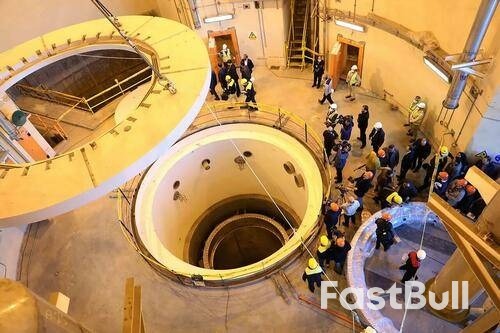
          The Arak heavy water reactor's secondary circuit. Atomic Energy Organization of Iran via AP

          "The discussion that has been raised about dismantling Iran's entire nuclear facilities is unacceptable to us," the Iranian president said, adding that "Iran will not give up its peaceful nuclear rights."

          Still, the country's Foreign Minister Abbas Araqchi acknowledged Sunday that negotiations with the United States in Oman had become "much more serious and frank" - which suggests positive momentum toward restoring a deal or at least an understanding on which to build a working relationship with Washington.

          Araqchi in the comments given to Iran's state-run IRIB TV characterized "forward-moving" talks with the US over an array of complex nuclear-related issues.

          This is despite last Thursday's provocative comments given to Breitbart wherein bluntly stated, "They cannot have centrifuges. They have to downblend all of their fuel that they have there and send it to a far-away place.”

          "An enrichment program can never exist in the state of Iran ever again. That’s our red line," the US envoy asserted further.

          “I just believe they have no choice” but to accept the White House position against enrichment, continued Witkoff. "Obviously, they can say no, and they can test President Trump, but I think that would be an unwise thing to do."

          Iranian leadership has tended to brush off such maximalist demands, hoping instead that they can appeal to President Trump's pragmatic deal-making side and willingness to avoid war at all costs. Israel has long threatened preemptive attack on Iran if it believes Tehran is on the cusp of achieving a nuke. Trump has clearly distanced himself from these Israeli efforts to box him into a corner towards starting a new Middle East conflict.

          President Pezeshkian meanwhile has continued stressing the "peaceful" purposes of the country's nuclear sites, which include the areas of radiopharmaceuticals, healthcare, agriculture, and industry.

          "We are serious in the negotiations and seek an agreement. We hold talks because we want peace," he said. Iranian officials have of late complained that it's very hard to deal with the United States, given rotating administrations which have the capability to reverse key decisions of prior presidents.

          Such was the case with the Obama-brokered JCPOA nuclear deal, which Trump unilaterally pulled out of in April 2018. It's as yet unclear the degree to which that original deal's terms will be restored or held to as part of the new ongoing talks.

          Source: Zero Hedge

          To stay updated on all economic events of today, please check out our Economic calendar
          Risk Warnings and Disclaimers
          You understand and acknowledge that there is a high degree of risk involved in trading. Following any strategies or investment methods may lead to potential losses. The content on the site is provided by our contributors and analysts for information purposes only. You are solely responsible for determining whether any trading assets, securities, strategy, or any other product is suitable for investing based on your own investment objectives and financial situation.
          Add to Favorites
          Share

          Ethereum explodes 42% in one week, outperforming Bitcoin as 60% of holders move into profit

          Adam

          Cryptocurrency

          Ethereum is back in the spotlight after jumping 42% over the past week to trade above $2,500, a level it hasn’t touched since March.
          This marks one of its most notable breakouts in over a year, signaling renewed investor confidence.
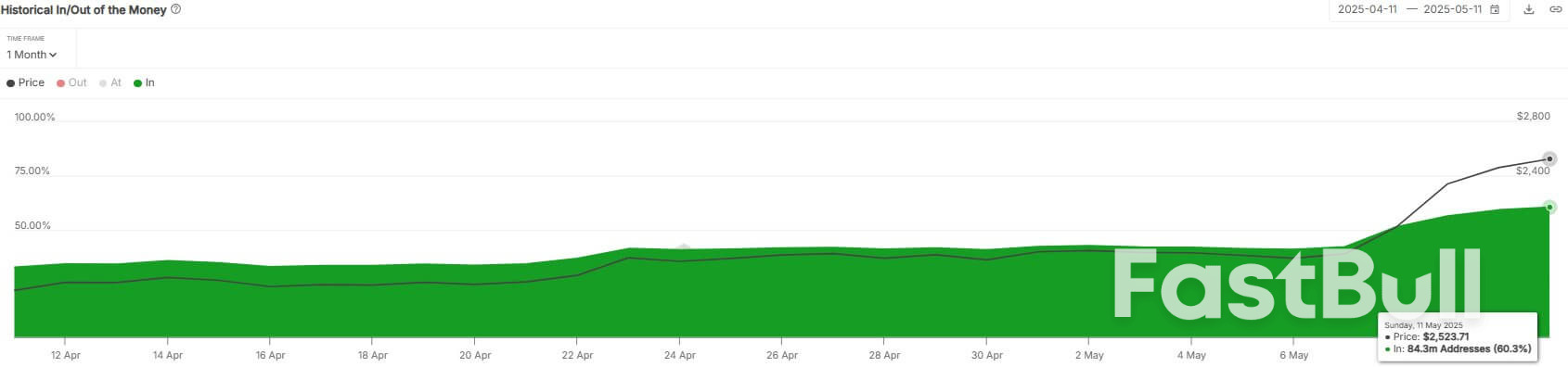
          On-chain data from Sentora (formerly IntoTheBlock) shows that this rally has pushed more than 60% of Ethereum addresses into profit. That’s nearly double the 32% recorded just a month earlier, highlighting the strength of the market’s turnaround.
          Ethereum explodes 42% in one week, outperforming Bitcoin as 60% of holders move into profit_1

          Ethereum’s Profitable Addresses

          Moreover, the rally puts ETH ahead of Bitcoin in terms of recent performance. While Bitcoin climbed just 10% in the same period to surpass $105,000, Ethereum’s sharper rise has surprised many in the market.
          The rally has triggered speculation that Ethereum could be entering a new bullish phase after months of sluggish performance. Sean Dawson, head of research at Dervive.xyz, told CryptoSlate:
          “ETH has a 20% chance of exceeding $4,000 by Christmas (up from 9% last week) and a 12% chance of hitting $5,000. The chance of ETH falling below $1,500 by Christmas has dropped to 15% (down from 40%).”
          What is driving Ethereum’s outperformance?
          Market analysts have pointed out that several key factors, including recent technical improvements, rising institutional backing, and easing global tensions, appear to be fueling Ethereum’s recent surge.
          Last week, Ethereum completed its highly anticipated Pectra upgrade, which unlocked a new set of features for the blockchain network.
          The update introduced improvements across the network’s wallet functionality, streamlined validator performance, and expanded Layer 2 support. These upgrades are expected to make Ethereum more efficient and easier to use across decentralized finance applications.
          Another factor driving ETH’s rally is the fact that several traditional financial institutions, including BlackRock, are deepening their use of Ethereum’s infrastructure through real-world asset tokenization.
          According to data from RWA.xyz, this sector has grown over 10% in the past 30 days, reaching a combined value of $22.1 billion. Ethereum leads the market with $6.9 billion locked in tokenized assets and controls 58% of the market share.
          Meanwhile, macroeconomic developments are also lifting sentiment in the broader market.
          A new trade agreement between the US and UK, alongside a temporary pause in US-China tariff escalations, has helped ease investor fears.
          These geopolitical developments support a broader risk-on mood in global markets, giving Ethereum further room to rise.

          Source: cryptoslate

          Risk Warnings and Disclaimers
          You understand and acknowledge that there is a high degree of risk involved in trading. Following any strategies or investment methods may lead to potential losses. The content on the site is provided by our contributors and analysts for information purposes only. You are solely responsible for determining whether any trading assets, securities, strategy, or any other product is suitable for investing based on your own investment objectives and financial situation.
          Add to Favorites
          Share

          So much for ‘drill, baby, drill’?

          Adam

          Commodity

          America’s oil industry is facing immense pressure during Trump 2.0.
          Even though President Donald Trump vowed to usher in a period of American energy dominance, the administration’s trade war and OPEC’s production hikes have cast a shadow over the oil patch.
          In fact, once-gangbusters US oil production growth is now at risk of grinding to a halt — or even going in reverse.
          Hurt by weakening demand and depressed prices, US oil output is now expected to shrink in 2026, S&P Global Commodity Insights projected on Monday. S&P estimates that US oil production will dip to 13.3 million barrels per day in 2026, a 130,000-barrel decline from its 2025 forecast.
          It would be just the second time in the past decade that US production fell. The only other time was during the Covid-19 crash, when the world economy ground to a halt and oil prices briefly dropped below zero.
          “The US shale oil sector is quite gloomy. They’re battening down the hatches for a storm,” said Bob McNally, president of consulting firm Rapidan Energy Group.
          Diamondback Energy told shareholders last week that US onshore oil production has likely peaked and will start to drop due to plunging prices.
          “We believe we are at a tipping point for US oil production at current commodity prices,” Diamondback CEO Travis Stice said in a shareholder letter.
          Of course, the silver lining for American consumers is that prices at the pump are very much under control. In fact, some analysts expect gas prices will trend even lower in the coming months, an outcome that could help offset potential sticker shock caused by the trade war.
          Sky-high tariffs have caused recession fears that have driven oil prices lower. Crude has also been hit by a surprisingly large increase in production from OPEC and its allies.
          Trump has repeatedly called for OPEC to ramp up supply, in part to drive down inflation and pile pressure on Russia to end the war in Ukraine.
          The ironic part of the gloom and doom in oil country is that Trump’s 2024 campaign was backed enthusiastically by the fossil fuels industry, and the president vowed to send oil production skyrocketing.
          McNally, a former White House energy advisor to President George W. Bush, told CNN on Friday that the oil industry “dodged a bullet” because a Trump loss would have meant tougher regulation and less leasing of federal lands and waters.
          But cutting red tape and green-lighting permits can’t make up for plunging prices in the short term.
          “While the long-term outlook from regulatory and cost perspective is improving vastly over what it would have been had Trump lost,” McNally said, “the president’s priority for lower oil prices is hurting the industry. That’s just true.”
          Even though the United States is the world’s biggest oil producer, it’s also most sensitive to price drops. US crude plunged 20% between Trump’s tariff announcement on “Liberation Day” (April 2) and May 5, when it fell to a four-year low of $57.13 a barrel.
          Crude has bounced back above $60 but remains at or below the level many drillers require to make money.
          In late March, oil executives surveyed by the Federal Reserve Bank of Dallas expressed alarm about the trade war.
          “The administration’s chaos is a disaster for the commodity markets,” one exploration and production executive said. “’Drill, baby, drill’ is nothing short of a myth and populist rallying cry. Tariff policy is impossible for us to predict and doesn’t have a clear goal. We want more stability.”
          McNally expects US oil prices to plunge into the low- to mid-$40s from late summer and into the fall, causing production growth to grind to a halt. He said if prices fall even further, US oil production “could easily” drop in 2026.
          “It’s certainly on the table,” McNally said.
          S&P executives warned on Monday that “extreme uncertainty about the future of US trade” and a looming supply surplus are expected to “hobble” US oil production later this year and next.
          The firm sharply cut its global oil demand growth outlook for 2025 from 1.25 million barrels per day before the April 2 tariff announcement to 750,000 barrels per day now.
          “The Trump administration is creating a regulatory environment that can facilitate oil and gas activity,” said Jim Burkhard, vice president and global head of crude oil research at S&P Global Commodity Insights. “But ultimately, it is the level of oil prices that is the biggest factor in driving US production up or down.”
          Cheap oil and weakening production could ultimately cost jobs in the oil patch or even cause financial stress for drillers.
          In 2020, when oil prices plunged and production crashed, the oil industry experienced a spike in bankruptcies and layoffs.
          However, the oil industry looks more resilient today because of a wave of consolidation in which Big Oil companies with powerful balance sheets gobbled up smaller players.
          In any case, the trouble in the oil world is a windfall for many consumers filling up their gas tanks.
          The national average price for regular gas fell to $3.15 a barrel on Friday, according to AAA. That’s down sharply from $3.64 a gallon at this point last year and a far cry from the June 2022 record high of $5.02 a gallon.
          Cheaper gas prices could help offset potential tariff-driven price increases elsewhere. And they have helped lower the US inflation rate.
          Veteran oil analyst Tom Kloza expects gas prices will continue to move lower.
          “It’s going to be a cheap summer,” Kloza said.

          Source: cnn

          Risk Warnings and Disclaimers
          You understand and acknowledge that there is a high degree of risk involved in trading. Following any strategies or investment methods may lead to potential losses. The content on the site is provided by our contributors and analysts for information purposes only. You are solely responsible for determining whether any trading assets, securities, strategy, or any other product is suitable for investing based on your own investment objectives and financial situation.
          Add to Favorites
          Share

          South Korea Posts Sharpest Economic Decline Among Major Economies in Q1 2025

          Gerik

          Economic

          South Korea Faces Steep Slowdown in Economic Growth

          On May 11, 2025, the Bank of Korea (BOK) released data showing that South Korea’s real gross domestic product (GDP) shrank by 0.246% in the first quarter of the year compared to the previous quarter. This figure marks the worst performance among 19 of the world’s largest economies that have published Q1 GDP data, including China and all 18 member states of the Organisation for Economic Co-operation and Development (OECD).
          This decline reflects a broader deceleration in South Korea’s economic momentum and places the country last in terms of quarterly growth performance, even behind the United States, which posted a more modest contraction of 0.069%.

          Domestic Demand Weakens Under Weight of Inflation and Household Debt

          Analysts widely attribute the contraction to weakening domestic demand. Rising consumer prices and persistently high levels of household debt have curbed spending power across Korean households. This combination has placed sustained pressure on the retail and services sectors, contributing significantly to the overall decline in output.
          Despite the contraction, BOK Governor Rhee Chang Yong cautioned against interpreting the downturn as a reason for immediate monetary easing. He emphasized that while the economy is indeed under pressure, the country is still within a policy cycle of loosening, and any rate cut decisions would need to be carefully timed.

          Comparative Performance of Global Economies

          In contrast to South Korea's contraction, several other major economies saw positive growth in Q1. Ireland led the pack with a 3.219% expansion, followed by China at 1.2%, Indonesia at 1.124%, and Spain at 0.568%. North American economies also performed moderately well, with Canada growing 0.4%. Among key European economies, Italy expanded by 0.26%, Germany by 0.211%, and France by 0.127%. The GDP figures for Japan and the United Kingdom have not yet been released.
          The broad disparity between South Korea’s performance and that of its peers highlights both external competitiveness challenges and internal consumption fragility. The situation raises concerns about South Korea’s resilience in a global context marked by trade volatility, tight monetary conditions, and structural consumer burdens.

          Policy Response: Supplementary Budget and Stimulus Measures

          In response to the slowdown, both the ruling conservative People Power Party (PPP) and the main opposition Democratic Party (DP) agreed on a supplementary budget worth 13.8 trillion won (approximately USD 10.6 billion), passed on May 1. The Ministry of Finance announced plans to disburse 70% of this budget before July to quickly inject liquidity into the economy.
          This fiscal measure underscores a shift toward counter-cyclical stimulus aimed at cushioning domestic demand. It reflects an attempt to balance between monetary restraint—cautiously maintained by the central bank—and proactive government spending to stabilize growth.
          South Korea’s Q1 contraction is not merely a statistical outlier but a reflection of deeper structural vulnerabilities, particularly in household consumption. While external demand remains essential, sustained domestic weakness may continue to weigh on future growth prospects. As global economies show varied trajectories, South Korea's policymakers face a complex balancing act between inflation control, debt management, and the need to reinvigorate internal demand without overreliance on external trade cycles.

          Source: The Korea Herald

          To stay updated on all economic events of today, please check out our Economic calendar
          Risk Warnings and Disclaimers
          You understand and acknowledge that there is a high degree of risk involved in trading. Following any strategies or investment methods may lead to potential losses. The content on the site is provided by our contributors and analysts for information purposes only. You are solely responsible for determining whether any trading assets, securities, strategy, or any other product is suitable for investing based on your own investment objectives and financial situation.
          Add to Favorites
          Share
          FastBull
          Copyright © 2025 FastBull Ltd

          728 RM B 7/F GEE LOK IND BLDG NO 34 HUNG TO RD KWUN TONG KLN HONG KONG

          TelegramInstagramTwitterfacebooklinkedin
          App Store Google Play Google Play
          Products
          Charts

          Chats

          Q&A with Experts
          Screeners
          Economic Calendar
          Data
          Tools
          Membership
          Features
          Function
          Markets
          Copy Trading
          Latest Signals
          Contests
          News
          Analysis
          24/7
          Columns
          Education
          Company
          Careers
          About Us
          Contact Us
          Advertising
          Help Center
          Feedback
          User Agreement
          Privacy Policy
          Business

          White Label

          Data API

          Web Plug-ins

          Poster Maker

          Affiliate Program

          Risk Disclosure

          The risk of loss in trading financial instruments such as stocks, FX, commodities, futures, bonds, ETFs and crypto can be substantial. You may sustain a total loss of the funds that you deposit with your broker. Therefore, you should carefully consider whether such trading is suitable for you in light of your circumstances and financial resources.

          No decision to invest should be made without thoroughly conducting due diligence by yourself or consulting with your financial advisors. Our web content might not suit you since we don't know your financial conditions and investment needs. Our financial information might have latency or contain inaccuracy, so you should be fully responsible for any of your trading and investment decisions. The company will not be responsible for your capital loss.

          Without getting permission from the website, you are not allowed to copy the website's graphics, texts, or trademarks. Intellectual property rights in the content or data incorporated into this website belong to its providers and exchange merchants.

          Not Logged In

          Log in to access more features

          FastBull Membership

          Not yet

          Purchase

          Become a signal provider
          Help Center
          Customer Service
          Dark Mode
          Price Up/Down Colors

          Log In

          Sign Up

          Position
          Layout
          Fullscreen
          Default to Chart
          The chart page opens by default when you visit fastbull.com