• Trade
  • Markets
  • Copy
  • Contests
  • News
  • 24/7
  • Calendar
  • Q&A
  • Chats
Trending
Screeners
SYMBOL
LAST
BID
ASK
HIGH
LOW
NET CHG.
%CHG.
SPREAD
SPX
S&P 500 Index
6851.76
6851.76
6851.76
6878.28
6841.15
-18.64
-0.27%
--
DJI
Dow Jones Industrial Average
47822.36
47822.36
47822.36
47971.51
47709.38
-132.62
-0.28%
--
IXIC
NASDAQ Composite Index
23544.24
23544.24
23544.24
23698.93
23505.52
-33.88
-0.14%
--
USDX
US Dollar Index
99.150
99.230
99.150
99.160
98.730
+0.200
+ 0.20%
--
EURUSD
Euro / US Dollar
1.16184
1.16191
1.16184
1.16717
1.16162
-0.00242
-0.21%
--
GBPUSD
Pound Sterling / US Dollar
1.33114
1.33122
1.33114
1.33462
1.33053
-0.00198
-0.15%
--
XAUUSD
Gold / US Dollar
4194.37
4194.80
4194.37
4218.85
4175.92
-3.54
-0.08%
--
WTI
Light Sweet Crude Oil
58.947
58.977
58.947
60.084
58.837
-0.862
-1.44%
--

Community Accounts

Signal Accounts
--
Profit Accounts
--
Loss Accounts
--
View More

Become a signal provider

Sell trading signals to earn additional income

View More

Guide to Copy Trading

Get started with ease and confidence

View More

Signal Accounts for Members

All Signal Accounts

Best Return
  • Best Return
  • Best P/L
  • Best MDD
Past 1W
  • Past 1W
  • Past 1M
  • Past 1Y

All Contests

  • All
  • Trump Updates
  • Recommend
  • Stocks
  • Cryptocurrencies
  • Central Banks
  • Featured News
Top News Only
Share

Israeli Prime Minister Netanyahu: Hamas Has Violated The Ceasefire Agreement, And We Will Never Allow Its Members To Re-arm Themselves And Threaten US

Share

Israeli Prime Minister Netanyahu: We Are Working To Return The Body Of Another Detainee From The Gaza Strip

Share

Iraq's West Qurna 2 Oil Field Will Increase Oil Production Beyond Normal Levels To Compensate For The Production Stoppage Caused By The Trump Administration's Sanctions Against Russia

Share

Israeli Prime Minister Netanyahu: We Are Close To Completing The First Phase Of Trump’s Plan And Will Now Focus On Disarming Gaza And Seizing Hamas Weapons

Share

Moody's Affirmed Burberry's Long-term Rating Of Baa3 And Revised Its Outlook (from Negative) To Stable

Share

The Trump Administration Supports Iraq's Plan To Transfer Russian Oil Company Lukoil Pjsc's Assets In The West Qurna 2 Oil Field To An American Company

Share

JMA: Tsunami Of 70 Centimetres Observed In Japan's Kuji Port In Iwate Prefecture

Share

The U.S. Bureau Of Labor Statistics Plans To Release A Press Release On January 15, 2026, For November 2025, Along With Data For October

Share

Tiger Global Has Established A New Fund, Aiming To Raise $2 Billion To $3 Billion

Share

The U.S. Bureau Of Labor Statistics Announced That It Will Not Release A Press Release Regarding The U.S. Import And Export Price Index (MXP) For October 2025

Share

The U.S. Bureau Of Labor Statistics (BLS) Will Not Release U.S. October CPI Data

Share

Government Negotiator: Dutch Political Center And Center Right Parties D66,  Cda And Vvd Advised To Start Talks On Possible Government

Share

New York Fed: November Home Price Rise Expectation Steady At 3%

Share

New York Fed: US Households' Personal Finance Worries Grew In November

Share

New York Fed: November Five-Year-Ahead Expected Inflation Rate Unchanged At 3%

Share

New York Fed: Households More Pessimistic On Current, Future Financial Situations In November

Share

New York Fed Report: USA Households' Year-Ahead Expected Inflation Rate Unchanged At 3.2% In November

Share

New York Fed: November Year-Ahead Expected Rise In Medical Costs Highest Since January 2014

Share

New York Fed: Labor Market Expectations Improved In November

Share

New York Fed: November Three-Year-Ahead Expected Inflation Rate Unchanged At 3%

TIME
ACT
FCST
PREV
France Trade Balance (SA) (Oct)

A:--

F: --

P: --
Euro Zone Employment YoY (SA) (Q3)

A:--

F: --

P: --
Canada Part-Time Employment (SA) (Nov)

A:--

F: --

P: --

Canada Unemployment Rate (SA) (Nov)

A:--

F: --

P: --

Canada Full-time Employment (SA) (Nov)

A:--

F: --

P: --

Canada Labor Force Participation Rate (SA) (Nov)

A:--

F: --

P: --

Canada Employment (SA) (Nov)

A:--

F: --

P: --

U.S. PCE Price Index MoM (Sept)

A:--

F: --

P: --

U.S. Personal Income MoM (Sept)

A:--

F: --

P: --

U.S. Core PCE Price Index MoM (Sept)

A:--

F: --

P: --

U.S. PCE Price Index YoY (SA) (Sept)

A:--

F: --

P: --

U.S. Core PCE Price Index YoY (Sept)

A:--

F: --

P: --

U.S. Personal Outlays MoM (SA) (Sept)

A:--

F: --

P: --
U.S. 5-10 Year-Ahead Inflation Expectations (Dec)

A:--

F: --

P: --

U.S. Real Personal Consumption Expenditures MoM (Sept)

A:--

F: --

P: --
U.S. Weekly Total Rig Count

A:--

F: --

P: --

U.S. Weekly Total Oil Rig Count

A:--

F: --

P: --

U.S. Consumer Credit (SA) (Oct)

A:--

F: --

P: --
China, Mainland Foreign Exchange Reserves (Nov)

A:--

F: --

P: --

Japan Trade Balance (Oct)

A:--

F: --

P: --

Japan Nominal GDP Revised QoQ (Q3)

A:--

F: --

P: --

China, Mainland Imports YoY (CNH) (Nov)

A:--

F: --

P: --

China, Mainland Exports (Nov)

A:--

F: --

P: --

China, Mainland Imports (CNH) (Nov)

A:--

F: --

P: --

China, Mainland Trade Balance (CNH) (Nov)

A:--

F: --

P: --

China, Mainland Exports YoY (USD) (Nov)

A:--

F: --

P: --

China, Mainland Imports YoY (USD) (Nov)

A:--

F: --

P: --

Germany Industrial Output MoM (SA) (Oct)

A:--

F: --

P: --
Euro Zone Sentix Investor Confidence Index (Dec)

A:--

F: --

P: --

Canada National Economic Confidence Index

A:--

F: --

P: --

U.K. BRC Like-For-Like Retail Sales YoY (Nov)

--

F: --

P: --

U.K. BRC Overall Retail Sales YoY (Nov)

--

F: --

P: --

Australia Overnight (Borrowing) Key Rate

--

F: --

P: --

RBA Rate Statement
RBA Press Conference
Germany Exports MoM (SA) (Oct)

--

F: --

P: --

U.S. NFIB Small Business Optimism Index (SA) (Nov)

--

F: --

P: --

Mexico 12-Month Inflation (CPI) (Nov)

--

F: --

P: --

Mexico Core CPI YoY (Nov)

--

F: --

P: --

Mexico PPI YoY (Nov)

--

F: --

P: --

U.S. Weekly Redbook Index YoY

--

F: --

P: --

U.S. JOLTS Job Openings (SA) (Oct)

--

F: --

P: --

China, Mainland M1 Money Supply YoY (Nov)

--

F: --

P: --

China, Mainland M0 Money Supply YoY (Nov)

--

F: --

P: --

China, Mainland M2 Money Supply YoY (Nov)

--

F: --

P: --

U.S. EIA Short-Term Crude Production Forecast For The Year (Dec)

--

F: --

P: --

U.S. EIA Natural Gas Production Forecast For The Next Year (Dec)

--

F: --

P: --

U.S. EIA Short-Term Crude Production Forecast For The Next Year (Dec)

--

F: --

P: --

EIA Monthly Short-Term Energy Outlook
U.S. API Weekly Gasoline Stocks

--

F: --

P: --

U.S. API Weekly Cushing Crude Oil Stocks

--

F: --

P: --

U.S. API Weekly Crude Oil Stocks

--

F: --

P: --

U.S. API Weekly Refined Oil Stocks

--

F: --

P: --

South Korea Unemployment Rate (SA) (Nov)

--

F: --

P: --

Japan Reuters Tankan Non-Manufacturers Index (Dec)

--

F: --

P: --

Japan Reuters Tankan Manufacturers Index (Dec)

--

F: --

P: --

Japan Domestic Enterprise Commodity Price Index MoM (Nov)

--

F: --

P: --

Japan Domestic Enterprise Commodity Price Index YoY (Nov)

--

F: --

P: --

China, Mainland PPI YoY (Nov)

--

F: --

P: --

China, Mainland CPI MoM (Nov)

--

F: --

P: --

Q&A with Experts
    • All
    • Chatrooms
    • Groups
    • Friends
    Connecting
    .
    .
    .
    Type here...
    Add Symbol or Code

      No matching data

      All
      Trump Updates
      Recommend
      Stocks
      Cryptocurrencies
      Central Banks
      Featured News
      • All
      • Russia-Ukraine Conflict
      • Middle East Flashpoint
      • All
      • Russia-Ukraine Conflict
      • Middle East Flashpoint
      Search
      Products

      Charts Free Forever

      Chats Q&A with Experts
      Screeners Economic Calendar Data Tools
      Membership Features
      Data Warehouse Market Trends Institutional Data Policy Rates Macro

      Market Trends

      Market Sentiment Order Book Forex Correlations

      Top Indicators

      Charts Free Forever
      Markets

      News

      News Analysis 24/7 Columns Education
      From Institutions From Analysts
      Topics Columnists

      Latest Views

      Latest Views

      Trending Topics

      Top Columnists

      Latest Update

      Signals

      Copy Rankings Latest Signals Become a signal provider AI Rating
      Contests
      Brokers

      Overview Brokers Assessment Rankings Regulators News Claims
      Broker listing Forex Brokers Comparison Tool Live Spread Comparison Scam
      Q&A Complaint Scam Alert Videos Tips to Detect Scam
      More

      Business
      Events
      Careers About Us Advertising Help Center

      White Label

      Data API

      Web Plug-ins

      Affiliate Program

      Awards Institution Evaluation IB Seminar Salon Event Exhibition
      Vietnam Thailand Singapore Dubai
      Fans Party Investment Sharing Session
      FastBull Summit BrokersView Expo
      Recent Searches
        Top Searches
          Markets
          News
          Analysis
          User
          24/7
          Economic Calendar
          Education
          Data
          • Names
          • Latest
          • Prev

          View All

          No data

          Scan to Download

          Faster Charts, Chat Faster!

          Download App
          English
          • English
          • Español
          • العربية
          • Bahasa Indonesia
          • Bahasa Melayu
          • Tiếng Việt
          • ภาษาไทย
          • Français
          • Italiano
          • Türkçe
          • Русский язык
          • 简中
          • 繁中
          Open Account
          Search
          Products
          Charts Free Forever
          Markets
          News
          Signals

          Copy Rankings Latest Signals Become a signal provider AI Rating
          Contests
          Brokers

          Overview Brokers Assessment Rankings Regulators News Claims
          Broker listing Forex Brokers Comparison Tool Live Spread Comparison Scam
          Q&A Complaint Scam Alert Videos Tips to Detect Scam
          More

          Business
          Events
          Careers About Us Advertising Help Center

          White Label

          Data API

          Web Plug-ins

          Affiliate Program

          Awards Institution Evaluation IB Seminar Salon Event Exhibition
          Vietnam Thailand Singapore Dubai
          Fans Party Investment Sharing Session
          FastBull Summit BrokersView Expo

          UK’s £2 Million-Plus Homes Risk Losing 5% In Value Next Year

          Winkelmann

          Political

          Economic

          Summary:

          UK homes worth more than £2 million ($2.7 million) could drop about 5% in value next year as the market adjusts to a so-called mansion tax, according to forecasts from Hamptons.

          UK homes worth more than £2 million ($2.7 million) could drop about 5% in value next year as the market adjusts to a so-called mansion tax, according to forecasts from Hamptons.

          The broker said it expected these homes — most of which are in London — to see a "one-off adjustment" in 2026 based on price reductions that factor in a new levy coming into force in April 2028. Chancellor of the Exchequer Rachel Reeves last month unveiled a tax on homes valued at more than £2 million, with a surcharge starting at £2,500 a year and rising to as much as £7,500.

          A 5% price correction would be the largest annual drop in values since 2009 for homes that have maintained a value of more than £2 million during those years, according to Hamptons' data. The broker said it expected London to be the only region in Britain to see house prices fall in 2025, predicting a 0.5% decline in the year compared to growth of as much as 5% in other regions.

          "It's hard to ignore the growing drag of taxation and politics," Aneisha Beveridge, head of research at Hamptons said in a report. London "is being held back by higher stamp duty and broader tax anxieties, locking some owners into their homes and others out of buying them."

          The housing market has endured disruption partly caused by hikes to stamp duty and the abolition of a system that allowed wealthy foreigners, or so-called non-doms, to avoid UK taxes on their overseas earnings. The changes have disproportionately impacted activity in London, where the market has also been affected by fiscal worries, as Labour raises revenue to pay for higher public spending.

          The new mansion tax targets less than 1% of all properties in England. However, most homes worth more than £2 million are in London, where property agents are warning the tax could amplify turbulence in the city's market.

          London's already weak house price growth is set to significantly trail the rest of Britain for at least the next two years. Hamptons predicts London will be the only region to not see house prices rise next year, and says it will lag behind other UK regions in growth by as much as roughly 16 percentage points between 2024 and 2028.

          The broker expects house prices to rise by 2.5% across Britain in 2026, followed by 2% growth in 2027 and a further 1.5% in 2028. It said political uncertainty will become a more prominent driver of property sentiment in 2028 — the year before the next planned general election.

          Based on market views on interest rates, the base rate could move further downwards next year and "settle" at about 3.25% at the end of 2026, Hamptons said. This should increase Britons' chances of securing mortgage deals below 4%, it added.

          "Inflation is easing, mortgage rates are falling, and affordability is improving," Hamptons' Beveridge said. "At the same time, the balance of power is shifting: the Midlands is forecast to have seen more price growth than London since prices bottomed out after the 2008 financial crash."

          Source: Bloomberg Europe

          To stay updated on all economic events of today, please check out our Economic calendar
          Risk Warnings and Disclaimers
          You understand and acknowledge that there is a high degree of risk involved in trading. Following any strategies or investment methods may lead to potential losses. The content on the site is provided by our contributors and analysts for information purposes only. You are solely responsible for determining whether any trading assets, securities, strategy, or any other product is suitable for investing based on your own investment objectives and financial situation.
          Add to Favorites
          Share

          Trump-brokered Truce Under Threat As Thailand-Cambodia Fighting Reignites

          Justin

          Political

          Thailand said its fighter jets struck Cambodia on Monday in an attempt to cripple its military capability, as a re-eruption of border hostilities derailed a fragile ceasefire brokered by U.S. President Donald Trump.

          Each side blamed the other for starting clashes that broke out during the night and intensified before dawn and spread to multiple locations, with one Thai soldier and four Cambodian civilians killed, according to officials.

          Cambodia accused Thailand of "inhumane and brutal acts" of aggression, stressing it had not retaliated, while Bangkok said it carried out air strikes on military targets after its neighbour mobilised heavy weaponry and repositioned combat units.

          "The objective of the army is to cripple Cambodia's military capability for a long time to come, for the safety of our children and grandchildren," Thai army chief of staff General Chaipruak Doungprapat said, according to the military.

          The fighting was the fiercest since a five-day exchange of rockets and heavy artillery in July that marked their heaviest clashes in recent history, when at least 48 people were killed and 300,000 displaced before Trump intervened to broker a ceasefire.

          'THERE WILL BE NO TALKS' SAYS THAI PM

          Tensions have simmered since Thailand last month suspended de-escalation measures that were agreed at a summit in Trump's presence, after a Thai soldier was maimed by a landmine that Bangkok said was newly laid by Cambodia.

          Some of the mines that have wounded seven Thai soldiers since July were likely newly laid, Reuters reported in October, based on expert analysis of material shared by Thailand's military.

          Cambodia has denied laying the mines and Thailand has said it will not implement the ceasefire terms until Cambodia apologises.

          Thai Prime Minister Anutin Charnvirakul on Monday said his government would do whatever necessary to protect its territorial integrity and would not engage in dialogue with Cambodia.

          "There will be no talks. If the fighting is to end, (Cambodia) must do what Thailand has set," he said, without elaborating.

          Cambodia's defence ministry said its forces came under sustained attack but were committed to the ceasefire and did not retaliate.

          "Cambodia calls on the international community to strongly condemn Thailand's violations ... as well as demands that Thailand take full responsibility for such brazen acts of aggression," it said in a statement.

          Thailand's army said Cambodia used drones to drop bombs on Thai bases and fired truck-mounted BM-21 rockets towards civilian areas.

          A Thai military official told Reuters targets of air strikes included long-range Chinese-made rockets.

          The U.S. embassy in Thailand did not immediately respond to a request for comment on the unrest. Malaysian Prime Minister Anwar Ibrahim, chair of the regional bloc ASEAN who helped Trump broker the truce, called for calm and for communication channels to stay open.

          "The renewed fighting risks unravelling the careful work that has gone into stabilising relations," Anwar said in an X post.

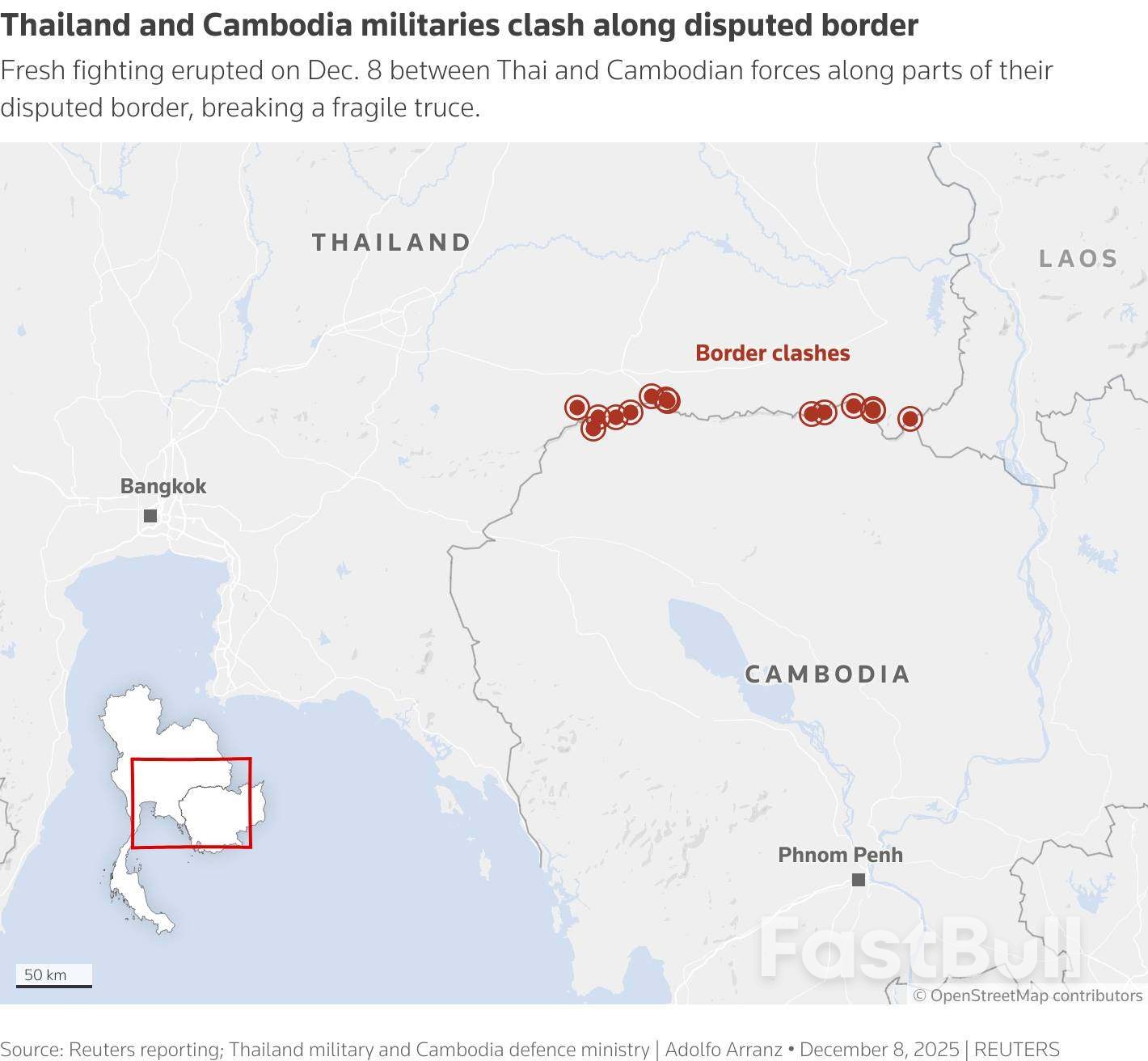
          This map shows locations of military clashes along the disputed border between Thailand and Cambodia.

          'EXPLOSIONS...BOOM BOOM'

          Cambodia's former longtime leader Hun Sen, the influential father of current premier Hun Manet, said Thailand's military was seeking to provoke a retaliatory response.

          "All frontline forces must remain patient because the aggressors have been firing all kinds of weapons," he said on Facebook.

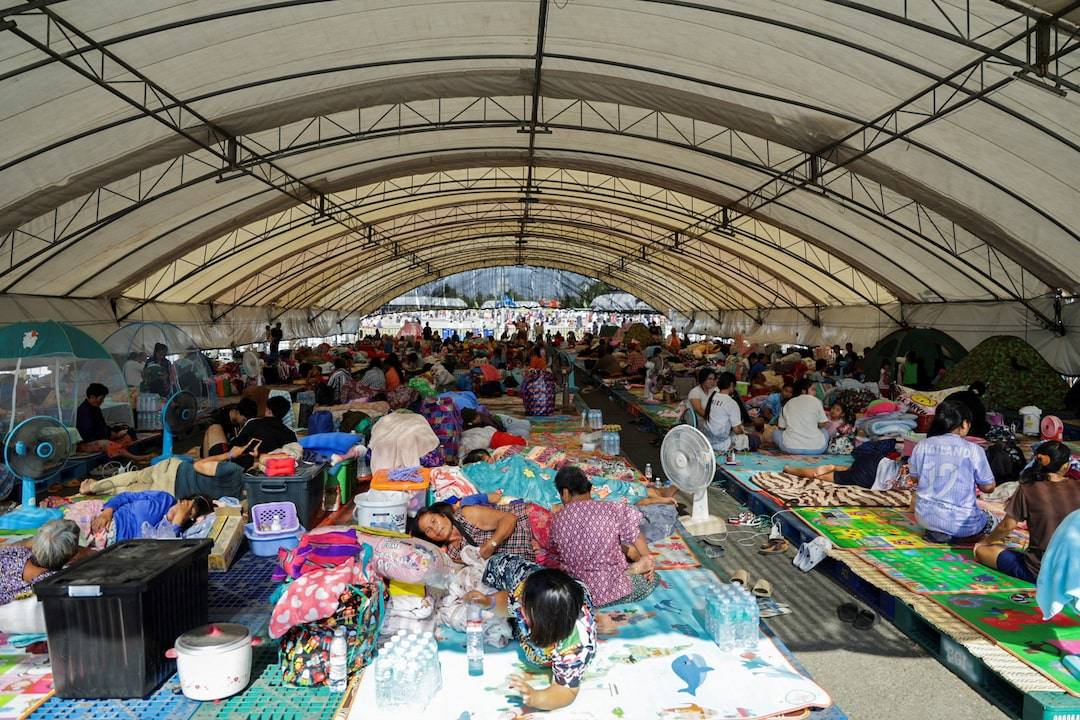
          Thailand evacuated 438,000 civilians across five border provinces and authorities in Cambodia said hundreds of thousands of people had been moved to safety. Thailand's army said 18 soldiers were wounded and Cambodia's government reported nine civilians injured.

          In Cambodia, bottlenecks of trucks and cars formed on country roads and streams of motorcycles and farming vehicles were leaving border areas, local television showed. A verified eyewitness video showed a plume of smoke rising after a Thai airstrike.

          Thai television showed footage of people packed into evacuation camps and others sheltering in bunkers or large concrete water pipes, and the military released a video of what it said was exploding Cambodian artillery.

          Phichet Pholkoet, a resident of Thailand's Ban Kruat district bordering Cambodia, said he had heard gunfire since early morning.

          "It startled me. The explosions were very clear. Boom boom!" he said via telephone. "I could hear everything clearly. Some are heavy artillery, some are small arms."

          BITTER HISTORY

          The use of fighter jets demonstrates Thailand's military advantage over Cambodia, with an armed forces that dwarfs its neighbour in terms of personnel, budget and weaponry.

          Thailand and Cambodia have for more than a century contested sovereignty at undemarcated points along their 817-km (508-mile) land border, with disputes over ancient temples stirring nationalist fervour and occasional armed flare-ups, including a deadly week-long artillery exchange in 2011.

          Tensions rose in May following the killing of a Cambodian soldier during a skirmish, which led to a major troop buildup at the border and escalated into diplomatic breakdowns and armed clashes.

          Source: Reuters

          Risk Warnings and Disclaimers
          You understand and acknowledge that there is a high degree of risk involved in trading. Following any strategies or investment methods may lead to potential losses. The content on the site is provided by our contributors and analysts for information purposes only. You are solely responsible for determining whether any trading assets, securities, strategy, or any other product is suitable for investing based on your own investment objectives and financial situation.
          Add to Favorites
          Share

          Trump Says He Will Sign Executive Order This Week On AI Approval Process

          James Whitman

          Political

          President Donald Trump said on Monday he would sign an executive order this week related to the artificial intelligence approval process to avoid having different rules in each U.S. state.

          "There must be only One Rulebook if we are going to continue to lead in AI... I will be doing a ONE RULE Executive Order this week. You can't expect a company to get 50 Approvals every time they want to do something," Trump said in a post on Truth Social.

          Trump did not provide details on the executive order but Reuters reported last month that the U.S. president was considering an executive order that would seek to preempt state laws on AI through lawsuits and by withholding federal funding.

          ChatGPT maker OpenAI, Alphabet's (GOOGL.O), opens new tab Google, Meta Platforms (META.O), opens new tab, and venture capital firm Andreessen Horowitz have called for national AI standards instead of a 50-state patchwork of laws, saying the laws stifle innovation.

          The move is likely to face pushback from the states, who have previously warned of "disastrous consequences" if the technology is left unregulated.

          Source: Reuters

          Risk Warnings and Disclaimers
          You understand and acknowledge that there is a high degree of risk involved in trading. Following any strategies or investment methods may lead to potential losses. The content on the site is provided by our contributors and analysts for information purposes only. You are solely responsible for determining whether any trading assets, securities, strategy, or any other product is suitable for investing based on your own investment objectives and financial situation.
          Add to Favorites
          Share

          US Dollar: Bulls Watch 98.5 as Critical Support Ahead of Likely Fed Cut

          Adam

          Forex

          The US dollar index has slipped over the past week as more traders expect the Fed to cut rates. It is trying to hold on to the rebound that began near 96.55, but soft US data and stronger major currencies are keeping it stuck around 99. The risk of more weakness is growing.

          Fed Focused Data Destabilizes US Dollar

          ADP data on December 3 showed that the private sector shed 32,000 in November. Markets had expected a gain of about 5,000, so this drop strengthened the view that the labor market is cooling. That shift put early pressure on the US dollar and supported the idea that the Fed may move toward gradual rate cuts rather than a sharp pivot.
          On the same day, ISM services PMI came in at 52.6. It still showed growth because it stayed above 50. The rise was mild and did not point to strong or inflation-driven expansion. When viewed together with the weak ADP report, the message is clear. Growth continues but at a slower pace. This mix softens the case for a strong US dollar built on firm growth and higher rates.
          The market is focused on the Fed meeting ahead. A 25 basis point cut is already heavily priced in. Big investment banks have also shifted toward a December cut in their reports, which has increased pressure on the US dollar in the past few days. The US dollar index (DXY) has drifted lower through the week and has now slipped under key psychological and technical levels.
          There is another twist. Official macro data has a major gap because of the 43-day government shutdown. Employment and inflation figures for October are missing, so the BLS will release them only on December 16 and 18. This means the Fed will walk into the meeting without a full set of essential data. Instead of offering a stable backdrop for the US dollar, this gap encourages expectations of a careful rate cut and keeps the DXY on a softer path.
          The University of Michigan consumer confidence index rose from 51 to 53.3 at the start of December. This helps sentiment a little, yet it does little to change the broader sense of economic fragility.

          Global Currencies and Risk Perception Reflected in US dollar

          The DXY is influenced not just by the US but also by the other currencies in its basket. The picture supporting the US dollar is not perfect on this front either.
          In the Eurozone, annual inflation edged up from 2.1% to 2.2% in November. This reinforced expectations that the European Central Bank will delay an early rate cut. While higher inflation supports the euro, the resulting rise in EUR/USD has become a key factor weighing on the US dollar index.
          In Canada, the Bank of Canada kept its policy rate at 2.25% and inflation within target, reducing the likelihood of further rate cuts. A relatively “tighter” BoC supports the Canadian dollar, providing an alternative to the US dollar.
          Meanwhile, the USD/JPY strengthened against the US dollar in early December. Signals of tightening from the Bank of Japan, along with the gradual unwinding of carry trades, pushed the yen higher. Since the yen has a significant weight in the DXY basket, this helped push the US dollar index lower.
          Weakening signals from China’s economy are reducing risk appetite. The services PMI fell to a five-month low, raising growth concerns. This can prompt investors to move away from riskier global assets and occasionally boost demand for the US dollar as a safe haven.
          Rising oil prices, driven by supply risks from Russia and Venezuela and new G7-EU sanction talks, also support the US dollar in the medium term by lifting inflation expectations for energy.
          Geopolitical risks, including tensions in Ukraine and the Middle East, help maintain the US dollar’s safe-haven appeal. These factors are currently limiting the DXY’s decline rather than pushing it higher.

          Technical Outlook on the US dollar

          US Dollar: Bulls Watch 98.5 as Critical Support Ahead of Likely Fed Cut_1
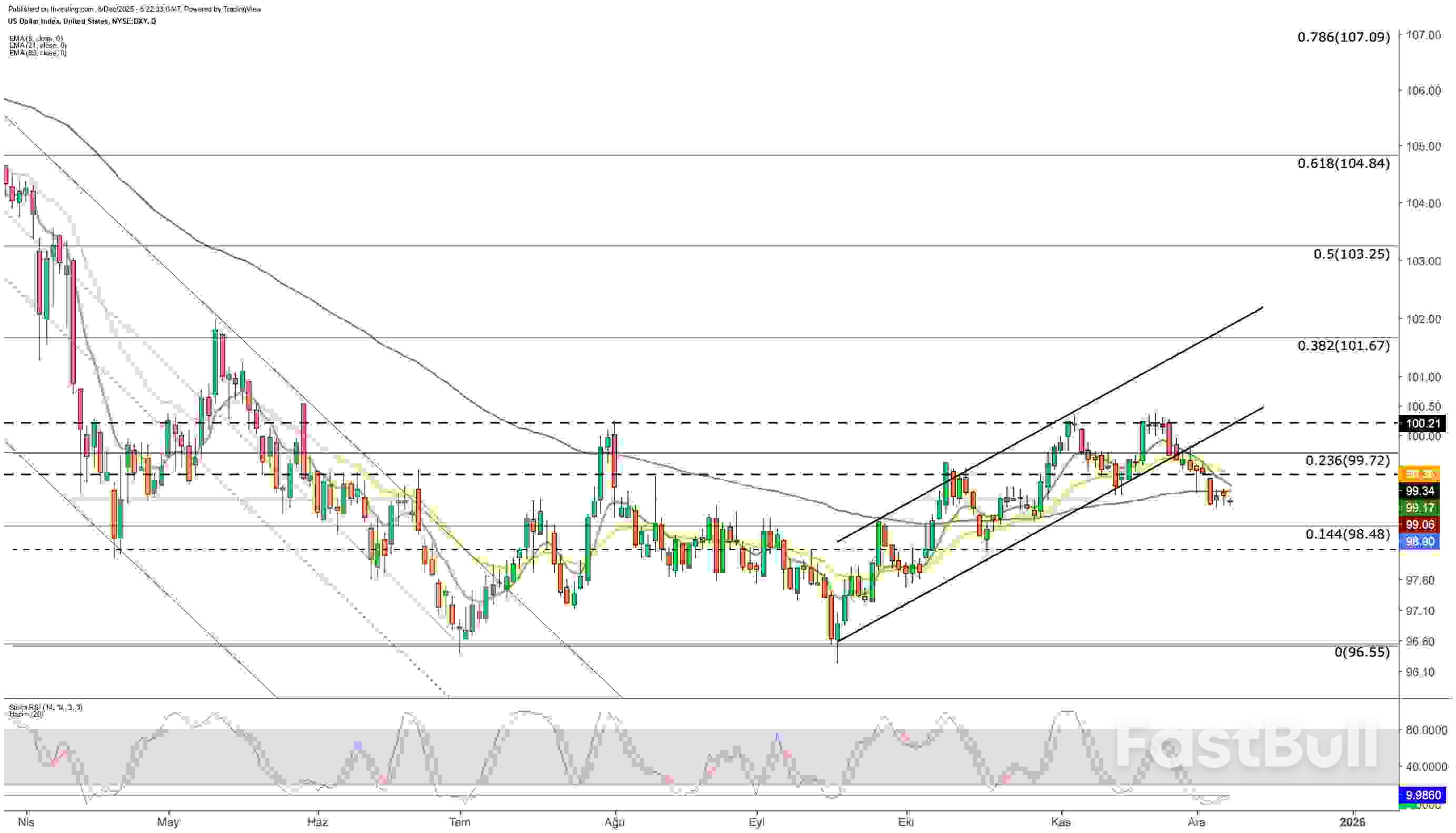
          On the daily chart, the DXY had formed a short-term rising channel, climbing from a low of 96.55 in mid-September up to November. By late November, the lower band of this channel broke, and the index started moving sideways in a weaker range between 99 and 99.5, below both the broken channel support and short-term EMAs (8 and 21).
          A key resistance sits at 99.72, based on Fibonacci retracements from the year’s first-half downtrend. With the index hovering below this level and the 89-day EMA near 99, the short-term EMAs point downward, indicating that bearish momentum remains. Unless the DXY can hold above 99.7, the technical picture does not signal a renewed strengthening of the dollar.
          The key short-term support for the DXY is around 98.50, near the 0.144 Fibonacci level and the 98.5–99 band. This area aligns with previous lows and the middle of a wide horizontal range, acting as a defense for the index. A daily close below 98.5 could lead to a deeper drop toward the September low of 96.55.
          On the upside, the first major resistance is in the 100–100.2 range, where the lower band of the broken channel and the 0.236 Fibonacci level at 99.72 converge. A strong break above this level could trigger a rally toward 101–101.7 (0.382 Fib). However, this should be seen as a correction within the downtrend, not a full trend reversal, as movements below 103.25 (0.5 Fib) remain technically part of the broader downtrend.
          The Stochastic RSI is near the oversold zone, suggesting occasional upside attempts from the 98.5–99 support band. For a stronger rebound, the DXY would need to settle above 99.7 and confirm momentum with daily closes above 100.2.

          Source: investing

          Risk Warnings and Disclaimers
          You understand and acknowledge that there is a high degree of risk involved in trading. Following any strategies or investment methods may lead to potential losses. The content on the site is provided by our contributors and analysts for information purposes only. You are solely responsible for determining whether any trading assets, securities, strategy, or any other product is suitable for investing based on your own investment objectives and financial situation.
          Add to Favorites
          Share

          Japan’s Q3 GDP Revised Sharply Downward: Worst Drop in Two Years, But BOJ Stance Unchanged

          Gerik

          Economic

          Capital Spending Leads to Deeper GDP Contraction

          Japan’s Cabinet Office revised its Q3 GDP figure down to a 2.3% annualized decline, significantly worse than the initial 1.8% estimate and the market forecast of -2.0%. This marks the steepest quarterly decline in two years, mainly driven by a notable revision in capital expenditure, which fell by 0.2%. The initial estimate had projected a 1.0% rise, while analysts had expected a more modest 0.4% increase. The discrepancy in investment spending was the primary driver behind the deeper-than-expected economic contraction.
          On a quarter-over-quarter basis, GDP dropped 0.6%, exceeding both the original estimate of -0.4% and the consensus forecast of -0.5%. Despite the disappointing data, experts believe the drop reflects a temporary correction rather than structural weakness.

          Private Consumption Improves Slightly, But Exports Face US Tariff Pressure

          Private consumption which accounts for over half of Japan’s economy rose 0.2% in Q3 after adjustments were made for dining-out spending, offering a modest boost to domestic demand. However, Japan’s export sector now faces new headwinds after the United States implemented a 15% base tariff on nearly all Japanese goods in September. This replaces a previously planned 27.5% tariff on cars and 25% on other major exports. While lower than initially feared, the broad scope of these tariffs still poses a threat to Japan’s trade outlook.
          Meanwhile, residential investment remained under pressure, affected by stricter energy efficiency regulations that took effect in April. That said, the pace of decline eased slightly to 8.2% from the prior estimate of 9.4%.

          BOJ Policy Normalization Still on Track

          Despite the weak GDP revision, economists widely believe that the Bank of Japan (BOJ) will proceed with its policy normalization path. According to Reuters sources, the BOJ is expected to raise interest rates in its upcoming policy meeting on December 18–19, and the government is likely to support this move.
          Uichiro Nozaki, an analyst at Nomura Securities, emphasized that “this data does not meaningfully alter the overall economic outlook. Expectations for a December rate hike remain strong, largely due to anticipated wage hikes in the upcoming spring season.” As such, the BOJ is unlikely to change course.

          Looking Ahead: Modest Q4 Recovery Expected, But External Pressures Remain

          Economists expect Japan’s economy to return to growth in Q4 2025, supported by a slow but steady recovery in household consumption. However, the external environment remains challenging, particularly due to trade friction and lower corporate earnings.
          Masato Koike of Sompo Institute Plus noted that “while demand for digital technology and automation remains strong, declining corporate profits are likely to weigh on capital investment. Therefore, investment growth may remain moderate.” This highlights a cause-and-effect link between falling business earnings and restrained investment momentum.
          Japan’s Q3 economic performance signals a fragile recovery, with investment declines and trade policy risks outweighing small gains in consumption. Nonetheless, expectations for a BOJ rate hike remain intact, driven by projected wage growth and domestic demand resilience. The final quarter of 2025 will be critical in determining whether Japan’s economy can sustain a recovery path or remains exposed to external shocks.

          Source: Reuters

          To stay updated on all economic events of today, please check out our Economic calendar
          Risk Warnings and Disclaimers
          You understand and acknowledge that there is a high degree of risk involved in trading. Following any strategies or investment methods may lead to potential losses. The content on the site is provided by our contributors and analysts for information purposes only. You are solely responsible for determining whether any trading assets, securities, strategy, or any other product is suitable for investing based on your own investment objectives and financial situation.
          Add to Favorites
          Share

          Berkshire Hathaway Shakes Up Management As Buffett Prepares Handover to Abel

          Michelle

          Stocks

          Economic

          Berkshire Hathaway (BRKa.N), opens new tab announced a shakeup of its top management team on Monday, just weeks before Warren Buffett hands over the reins of the company to Greg Abel.

          The company's longtime finance chief Marc Hamburg, who joined in 1987, will retire on June 1, 2027 after four decades at the conglomerate, while Todd Combs will leave for JPMorgan Chase (JPM.N), opens new tab, Berkshire Hathaway said.

          Charles Chang, CFO of Berkshire Hathaway Energy, will succeed Hamburg next year.

          "Marc has been indispensable to Berkshire and to me. His integrity and judgment are priceless," Buffett said in a statement.

          Abel's transition to CEO on January 1 closes Buffett's extraordinary six decades heading Berkshire Hathaway, where he became a household name, a multi-billionaire and an American success story.

          Combs and another Berkshire investment manager Ted Weschler were once expected to take over the company's equity portfolio, having helped Buffett invest in stocks, but the CEO had in recent years said Abel could handle it.

          The appointments underscore Berkshire's tradition of choosing leaders who uphold its culture, show strong business judgment and support its distinctive operating model, the company said, adding it remains well positioned for the future.

          Berkshire Hathaway also announced changes in its insurance and non insurance operations and named Michael O'Sullivan as the general counsel, marking the creation of a new position at the company.

          However, the lot of non-insurance businesses - including industrial products, building products, BNSF, Berkshire Hathaway Energy, Pilot and McLane - will remain under Abel's direct oversight once he takes over as CEO.

          COMBS TO LEAD JPMORGAN'S NEW INITIATIVE

          JPMorgan said on Monday that Combs, an investment manager of Berkshire, will head the strategic investment group of the firm's new security and resiliency initiative.

          At JPMorgan, Combs will partner with the firm's Commercial & Investment Bank and Asset & Wealth Management units to pursue opportunities spanning middle-market and large corporate clients in defense, aerospace, healthcare and energy, the bank said.

          Earlier this year, the Wall Street giant launched its Security and Resiliency Initiative, a $1.5 trillion, decade-long plan to support industries deemed vital to U.S. economic security and resilience.

          As part of the program, the bank said it will commit up to $10 billion in direct equity and venture capital investments to help selected U.S. companies expand growth, drive innovation and accelerate strategic manufacturing.

          Separately, JPMorgan Chase said it has set up an external advisory council of public- and private-sector leaders to help steer the bank's Security and Resiliency Initiative.

          The council will be chaired by JPMorgan CEO Jamie Dimon, and include members such as Amazon(AMZN.O), opens new tab founder Jeff Bezos, Dell Technologies (DELL.N), opens new tab CEO Michael Dell and former U.S. Secretary of State Condoleezza Rice. Combs will also be a part of this advisory council.

          Combs, who previously served on the JPMorgan board, will join the bank in January and report to Dimon.

          Source: Reuters

          To stay updated on all economic events of today, please check out our Economic calendar
          Risk Warnings and Disclaimers
          You understand and acknowledge that there is a high degree of risk involved in trading. Following any strategies or investment methods may lead to potential losses. The content on the site is provided by our contributors and analysts for information purposes only. You are solely responsible for determining whether any trading assets, securities, strategy, or any other product is suitable for investing based on your own investment objectives and financial situation.
          Add to Favorites
          Share

          Market navigator: week of 8 December 2025

          Adam

          Economic

          What happened last week

          Mixed employment signals: The ADP report revealed 32,000 US private sector job losses in November, the weakest since March 2023, driven by small business contractions. Conversely, continuing jobless claims fell to 1.94 million, a seven-week low. While the labour market has decelerated, the 'low hire, low fire' dynamic indicates resilience, supporting the 2026 economic outlook.
          Inflation meets expectations: The Federal Reserve's (Fed) preferred inflation gauge — core personal consumption expenditures (PCE) index — rose 0.2% month-on-month (MoM) in September, matching expectations. Combined with employment moderation, this strengthens the case for a 25 basis-point December rate cut, with market probability at 86%.
          Oil prices edge higher: WTI crude oil futures climbed 3% to $60.08, the highest since 18 November, supported by rate cut expectations and geopolitical tensions from Russia-Ukraine talks and Venezuelan sanction risks, though OPEC+ supplies capped gains.
          Distress in China's property sector deepens: Following a 42% year-on-year (YoY) decline in new home sales amongst the top 100 developers in October, Shenzhen state-backed Vanke is now seeking to postpone repayment of a RMB 2 billion bond due 15 December by one year. Without 90% bondholder approval, the property conglomerate faces imminent default risk.

          Markets in focus

          Range-bound US market ahead of Fed meeting
          US equity markets traded within a narrow range as investors awaited the Fed's 10 December decision. The S&P 500 advanced 0.3% while the Nasdaq 100 and Dow Jones gained 1.0% and 0.5% respectively. Market breadth indicators, particularly the advance/decline line, rebounded sharply from November's sell-off, signalling support for further index appreciation.
          Technology stocks spearheaded gains last week. Salesforce rallied 13% as the software enterprise exceeded Q3 earnings and revenue expectations, elevated full-year guidance, and revealed robust demand for its new artificial intelligence (AI) agent platform. Meta reportedly plans to reduce metaverse division budgets by 30% in 2026, reallocating resources within Reality Labs. Meta's share price recovered 4% last week, though remains 15% below its previous peak.
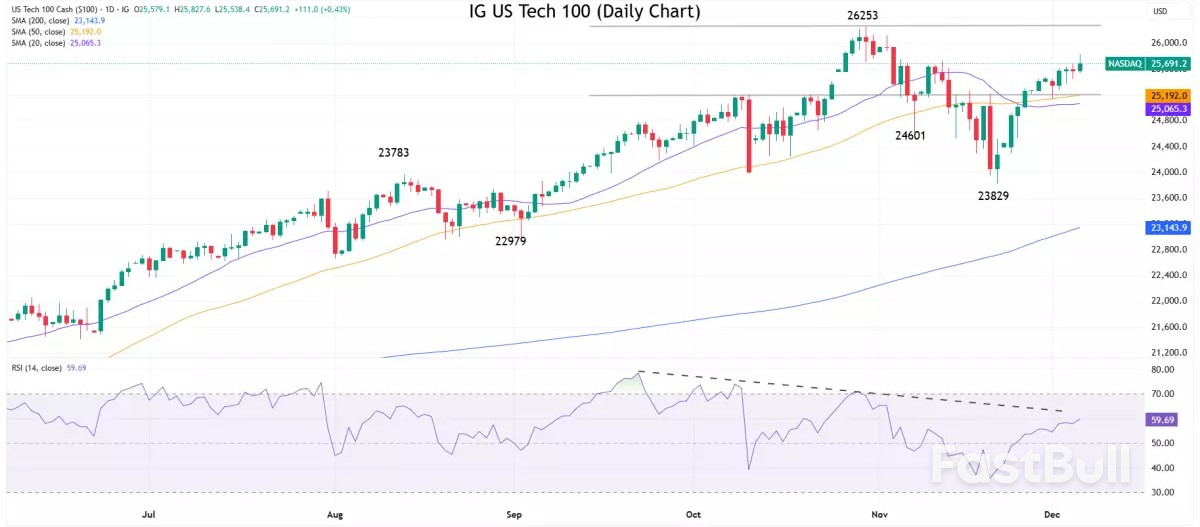
          Following the two-week recovery, the US Tech 100 index trades just 500+ points below its historic high. The index currently tests resistance highlighted in our previous Market Navigator — a decisive break above 25,700 would establish a trajectory towards 26,253. However, we continue monitoring diminishing index momentum, evidenced by lower highs in the relative strength index (RSI). Any corrective movement should encounter support from the 50-day moving average (MA) positioned around 25,200.
          Figure 1: US Tech 100 index (daily) price chart

          Market navigator: week of 8 December 2025_1as of 7 December 2025. Past performance is not a reliable indicator of future performance.

          Low trading volume in Hong Kong equities
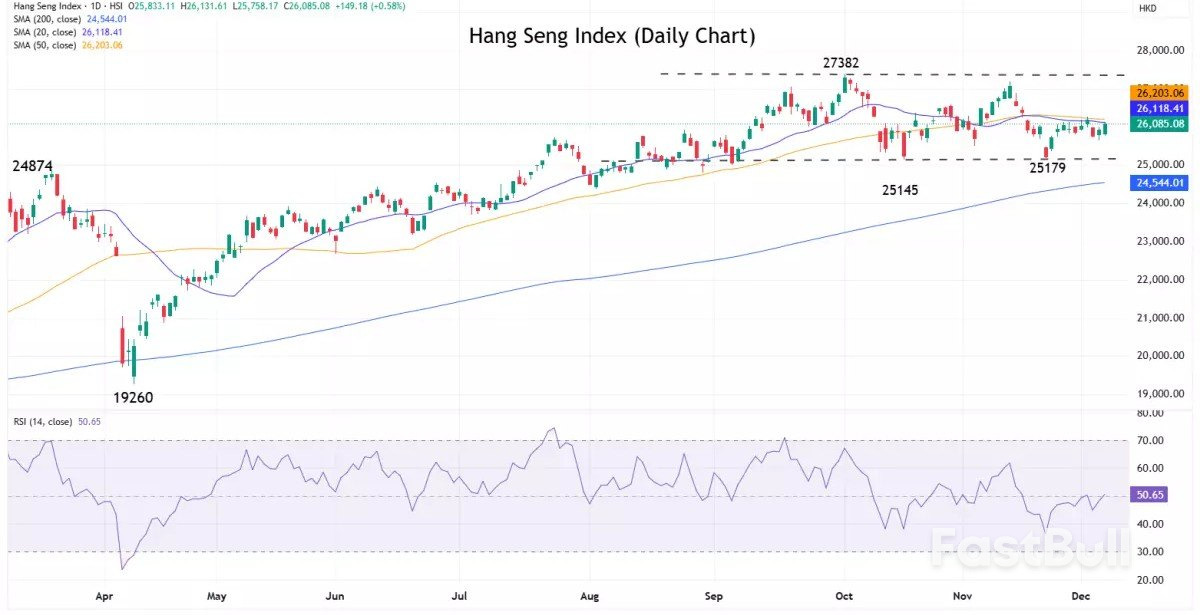
          Having delivered more than 30% gains year-to-date in the Hang Seng Index (HSI), investors have initiated profit-taking as the year closes. Trading volume on the Hong Kong Exchange main board has declined substantially since late November. Average daily turnover contracted to HK$187 billion last week, a 27% reduction compared to the HK$256 billion average recorded across the first eleven months of 2025.
          The HSI maintained a sideways trajectory, advancing modestly by 0.9% last week. The Materials sector led gains, benefiting from rebounding metal prices. Zijin Mining surged 12.1% while China Hongqiao rose 9.3%. Conversely, Shenzhou International emerged as the worst-performing HSI constituent, declining 6.9% as investors secured profits following analyst target price adjustments.
          Market enthusiasm for the initial public offering (IPO) market has similarly waned. Three of four newly listed stocks last week traded below their listing price, with noodle chain operator Guangzhou Xiao Noodles plummeting 27.8% on its inaugural trading day.
          The flat 20-day and 50-day moving averages combined with the neutral RSI on the HSI daily chart underscore the prevailing sideways trend. The index appears positioned to trade within the 25,150 to 27,400 range in the near term. The short-term moving averages will likely present resistance around 26,200 while November's low establishes support near 25,180.
          Figure 2: Hang Seng Index (daily) price chart

          Market navigator: week of 8 December 2025_2as of 7 December 2025. Past performance is not a reliable indicator of future performance.

          Yen recovers on rate hike expectations
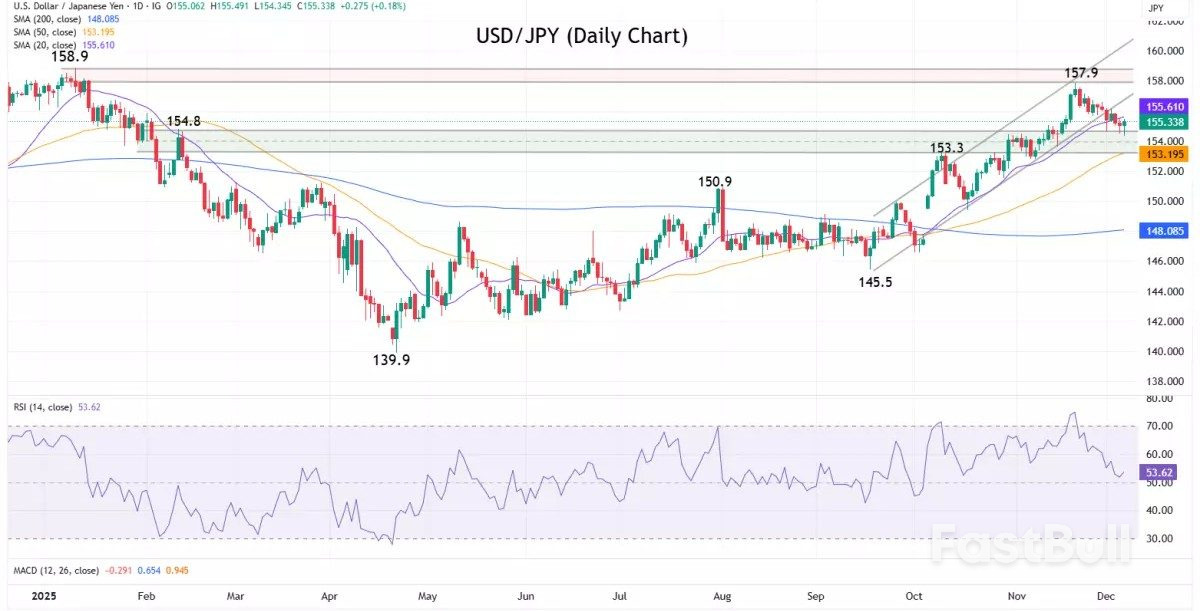
          Bank of Japan (BOJ) Governor Ueda signalled last week that a rate increase may be imminent, as the board weighs the merits of raising interest rates at its 18–19 December meeting. Although Japan's headline inflation has persisted above the 2% target for over three years, the BOJ has exercised caution while awaiting clarity on US tariff implications and sustainable wage growth indicators. Governor Ueda believes tariff risks have diminished and expressed concern that recent yen weakness could elevate import costs, intensifying inflationary pressures. Market participants increased December rate hike probability from approximately 35% to 75%.
          Two-year Japanese Government Bond (JGB) yields, most sensitive to policy rate adjustments, rose above 1% for the first time since 2008 while 10-year JGB yields surged to 1.84%, exceeding China's government bond yield for the first time in history.
          As JGB yields advance, concerns regarding yen carry trade unwinding have intensified. US Treasury yields similarly increased — the 10-year benchmark rose 11 basis points to 4.14% while the 30-year benchmark climbed from 4.67% to 4.79%.
          The yen strengthened against the dollar as central bank policies diverge. USD/JPY breached the ascending channel established since mid-September, declining 0.5% to 155.3 last week. The currency pair approaches the support zone between 153.3 and 154.6. USD/JPY appears positioned to trade sideways within or above this zone unless the BOJ articulates a more hawkish-than-anticipated 2026 stance. The recent high at 157.9 will function as resistance should dovish surprises materialise.
          Figure 3: USD/JPY (daily) price chart

          Market navigator: week of 8 December 2025_3as of 7 December 2025. Past performance is not a reliable indicator of future performance.

          The week ahead

          The coming week centres on pivotal monetary policy decisions from the Reserve Bank of Australia (RBA) and Fed, alongside crucial Chinese inflation data that will shape market expectations across major economies.
          The RBA convenes on Tuesday amid mounting inflationary pressures. October's trimmed mean consumer price index (CPI) surge to 3.3% YoY has fundamentally altered the policy landscape. Markets anticipate the central bank will maintain rates at 3.6% in December. More significantly, investors have begun pricing potential rate increases in 2026 as inflation is projected to rise further before moderating during the first half of next year. Hawkish forward guidance from the RBA would support the Australian dollar but potentially pressure domestic equity markets.
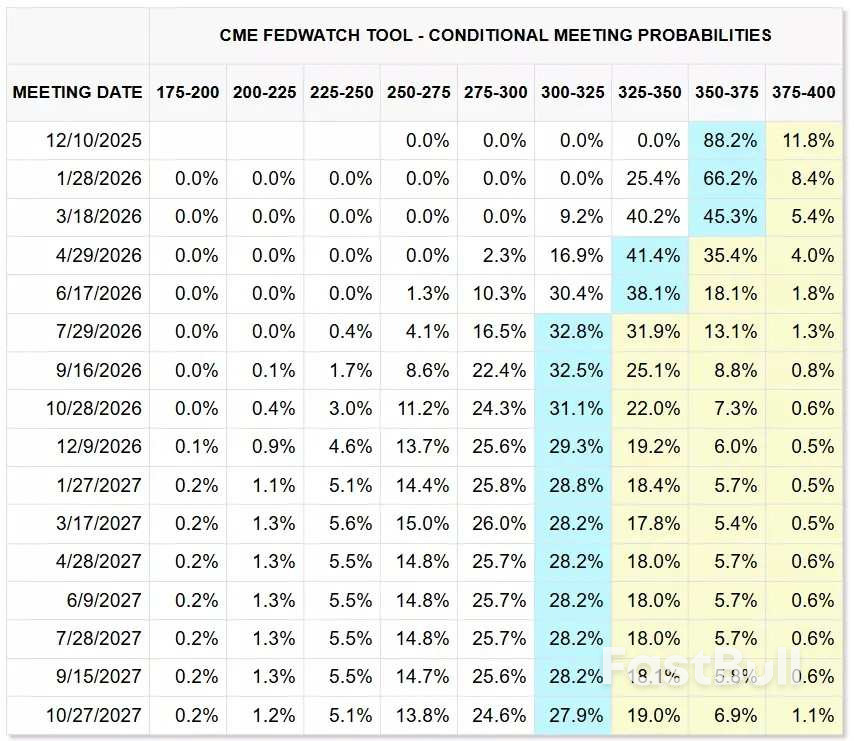
          The Federal Open Market Committee's (FOMC) decision on Thursday early morning carries substantial weight beyond the widely anticipated 25 basis-point reduction to 3.5%–3.75%. Market participants will scrutinise Chair Jerome Powell's press conference for clarity on the 2026 policy trajectory, particularly given uncertainty surrounding potential leadership transitions. Speculation regarding Kevin Hassett as a possible successor has elevated expectations for a more accommodative path. Most market participants anticipate two additional rate cuts next year. The Fed's Summary of Economic Projections will also illuminate the US economic growth trajectory in 2026.
          China's November inflation data on Wednesday provides essential insight into deflationary pressures following October's modest 0.2% YoY reading. The producer price index (PPI) will indicate whether industrial pricing power is stabilising after 37 consecutive months of contraction. These readings arrive alongside trade data on Monday, offering comprehensive perspective on China's economic health as policymakers evaluate further support measures.
          Corporate earnings attention focuses on technology infrastructure leaders Oracle and Broadcom. Both companies' guidance on AI-related revenue growth, cash flow and capital expenditure trends will influence broader technology sector valuations as investors assess the sustainability of the current AI investment cycle.
          Figure 4: US interest rate probabilities
          Market navigator: week of 8 December 2025_4

          Source: ig

          To stay updated on all economic events of today, please check out our Economic calendar
          Risk Warnings and Disclaimers
          You understand and acknowledge that there is a high degree of risk involved in trading. Following any strategies or investment methods may lead to potential losses. The content on the site is provided by our contributors and analysts for information purposes only. You are solely responsible for determining whether any trading assets, securities, strategy, or any other product is suitable for investing based on your own investment objectives and financial situation.
          Add to Favorites
          Share
          FastBull
          Copyright © 2025 FastBull Ltd

          728 RM B 7/F GEE LOK IND BLDG NO 34 HUNG TO RD KWUN TONG KLN HONG KONG

          TelegramInstagramTwitterfacebooklinkedin
          App Store Google Play Google Play
          Products
          Charts

          Chats

          Q&A with Experts
          Screeners
          Economic Calendar
          Data
          Tools
          Membership
          Features
          Function
          Markets
          Copy Trading
          Latest Signals
          Contests
          News
          Analysis
          24/7
          Columns
          Education
          Company
          Careers
          About Us
          Contact Us
          Advertising
          Help Center
          Feedback
          User Agreement
          Privacy Policy
          Business

          White Label

          Data API

          Web Plug-ins

          Poster Maker

          Affiliate Program

          Risk Disclosure

          The risk of loss in trading financial instruments such as stocks, FX, commodities, futures, bonds, ETFs and crypto can be substantial. You may sustain a total loss of the funds that you deposit with your broker. Therefore, you should carefully consider whether such trading is suitable for you in light of your circumstances and financial resources.

          No decision to invest should be made without thoroughly conducting due diligence by yourself or consulting with your financial advisors. Our web content might not suit you since we don't know your financial conditions and investment needs. Our financial information might have latency or contain inaccuracy, so you should be fully responsible for any of your trading and investment decisions. The company will not be responsible for your capital loss.

          Without getting permission from the website, you are not allowed to copy the website's graphics, texts, or trademarks. Intellectual property rights in the content or data incorporated into this website belong to its providers and exchange merchants.

          Not Logged In

          Log in to access more features

          FastBull Membership

          Not yet

          Purchase

          Become a signal provider
          Help Center
          Customer Service
          Dark Mode
          Price Up/Down Colors

          Log In

          Sign Up

          Position
          Layout
          Fullscreen
          Default to Chart
          The chart page opens by default when you visit fastbull.com