• Trade
  • Markets
  • Copy
  • Contests
  • News
  • 24/7
  • Calendar
  • Q&A
  • Chats
Trending
Screeners
SYMBOL
LAST
BID
ASK
HIGH
LOW
NET CHG.
%CHG.
SPREAD
SPX
S&P 500 Index
6818.98
6818.98
6818.98
6861.30
6801.50
-8.43
-0.12%
--
DJI
Dow Jones Industrial Average
48403.67
48403.67
48403.67
48679.14
48317.93
-54.37
-0.11%
--
IXIC
NASDAQ Composite Index
23098.28
23098.28
23098.28
23345.56
23012.00
-96.88
-0.42%
--
USDX
US Dollar Index
97.790
97.870
97.790
98.070
97.740
-0.160
-0.16%
--
EURUSD
Euro / US Dollar
1.17608
1.17615
1.17608
1.17686
1.17262
+0.00214
+ 0.18%
--
GBPUSD
Pound Sterling / US Dollar
1.33935
1.33944
1.33935
1.34014
1.33546
+0.00228
+ 0.17%
--
XAUUSD
Gold / US Dollar
4321.34
4321.75
4321.34
4350.16
4294.68
+21.95
+ 0.51%
--
WTI
Light Sweet Crude Oil
56.649
56.679
56.649
57.601
56.601
-0.584
-1.02%
--

Community Accounts

Signal Accounts
--
Profit Accounts
--
Loss Accounts
--
View More

Become a signal provider

Sell trading signals to earn additional income

View More

Guide to Copy Trading

Get started with ease and confidence

View More

Signal Accounts for Members

All Signal Accounts

Best Return
  • Best Return
  • Best P/L
  • Best MDD
Past 1W
  • Past 1W
  • Past 1M
  • Past 1Y

All Contests

  • All
  • Trump Updates
  • Recommend
  • Stocks
  • Cryptocurrencies
  • Central Banks
  • Featured News
Top News Only
Share

African Stock Market Closing Report | On Monday (December 15), The South African FTSE/Jse Africa Leading 40 Trading Index Closed Down 0.43%, Nearing 105,200 Points

Share

The Athens Stock Exchange Composite Index Closed Up 0.15% At 2107.43 Points

Share

The Offshore Yuan Broke Through 7.04 Against The US Dollar

Share

Fbi Director: A Fifth Individual Believed To Be Planning A Separate Attack Arrested By Fbi New Orleans

Share

New York Fed President Williams: The 2% Inflation Target Must Be Achieved Without Impacting The Job Market

Share

New York Fed President Williams: Monetary Policy Very Focused On Balancing Job, Inflation Risks

Share

New York Fed President Williams Expects USA Unemployment To Be 4.5% By End Of 2025

Share

New York Fed President Williams: Labor Market Risks Have Risen As Risks To Inflation Have Eased

Share

New York Fed President Williams Expects Inflation To Move To 2.5% In 2026, 2% In 2027

Share

New York Fed President Williams Sees Tariffs As A One-Off Price Adjustment, Not Spilling Over Into Broader Inflation

Share

New York Fed President Williams: Labor Market Cooling Has Been Gradual Process

Share

New York Fed President Williams Expects Active Usage Of Standing Repo Facility To Manage Liquidity

Share

New York Fed President Williams: Critical For USA Central Bank To Get Inflation Back To 2%

Share

New York Fed President Williams Expects 2026 GDP Growth To Hit 2.25%, Well Above 2025 Rate

Share

New York Fed President Williams Projects Jobless Rate Will Come Back Down Over Next Few Years

Share

New York Fed President Williams: Fed Policy Has Moved Toward Neutral From Modestly Restrictive

Share

Federal Reserve Governor Milan: I Would Be Happy To Vote For The Re-election Of Regional Fed Presidents

Share

Miran: What Is Most Surprising Is How Nice And Collegial The Fed Has Been

Share

Miran: The Least Attractive Part Of Being At The Fed Is Having Only 1 Of 12 Votes On A Committee

Share

White House To Host Press Call On Russia-Ukraine Peace Talks

TIME
ACT
FCST
PREV
Japan Tankan Small Manufacturing Outlook Index (Q4)

A:--

F: --

P: --

Japan Tankan Large Non-Manufacturing Outlook Index (Q4)

A:--

F: --

P: --

Japan Tankan Large Manufacturing Outlook Index (Q4)

A:--

F: --

P: --

Japan Tankan Small Manufacturing Diffusion Index (Q4)

A:--

F: --

P: --

Japan Tankan Large-Enterprise Capital Expenditure YoY (Q4)

A:--

F: --

P: --

U.K. Rightmove House Price Index YoY (Dec)

A:--

F: --

P: --

China, Mainland Industrial Output YoY (YTD) (Nov)

A:--

F: --

P: --

China, Mainland Urban Area Unemployment Rate (Nov)

A:--

F: --

P: --

Saudi Arabia CPI YoY (Nov)

A:--

F: --

P: --

Euro Zone Industrial Output YoY (Oct)

A:--

F: --

P: --

Euro Zone Industrial Output MoM (Oct)

A:--

F: --

P: --

Canada Existing Home Sales MoM (Nov)

A:--

F: --

P: --

Canada National Economic Confidence Index

A:--

F: --

P: --

Canada New Housing Starts (Nov)

A:--

F: --

P: --
U.S. NY Fed Manufacturing Employment Index (Dec)

A:--

F: --

P: --

U.S. NY Fed Manufacturing Index (Dec)

A:--

F: --

P: --

Canada Core CPI YoY (Nov)

A:--

F: --

P: --

Canada Manufacturing Unfilled Orders MoM (Oct)

A:--

F: --

P: --

U.S. NY Fed Manufacturing Prices Received Index (Dec)

A:--

F: --

P: --

U.S. NY Fed Manufacturing New Orders Index (Dec)

A:--

F: --

P: --

Canada Manufacturing New Orders MoM (Oct)

A:--

F: --

P: --

Canada Core CPI MoM (Nov)

A:--

F: --

P: --

Canada Trimmed CPI YoY (SA) (Nov)

A:--

F: --

P: --

Canada Manufacturing Inventory MoM (Oct)

A:--

F: --

P: --

Canada CPI YoY (Nov)

A:--

F: --

P: --

Canada CPI MoM (Nov)

A:--

F: --

P: --

Canada CPI YoY (SA) (Nov)

A:--

F: --

P: --

Canada Core CPI MoM (SA) (Nov)

A:--

F: --

P: --

Canada CPI MoM (SA) (Nov)

A:--

F: --

P: --

Federal Reserve Board Governor Milan delivered a speech
U.S. NAHB Housing Market Index (Dec)

A:--

F: --

P: --

Australia Composite PMI Prelim (Dec)

--

F: --

P: --

Australia Services PMI Prelim (Dec)

--

F: --

P: --

Australia Manufacturing PMI Prelim (Dec)

--

F: --

P: --

Japan Manufacturing PMI Prelim (SA) (Dec)

--

F: --

P: --

U.K. 3-Month ILO Employment Change (Oct)

--

F: --

P: --

U.K. Unemployment Claimant Count (Nov)

--

F: --

P: --

U.K. Unemployment Rate (Nov)

--

F: --

P: --

U.K. 3-Month ILO Unemployment Rate (Oct)

--

F: --

P: --

U.K. Average Weekly Earnings (3-Month Average, Including Bonuses) YoY (Oct)

--

F: --

P: --

U.K. Average Weekly Earnings (3-Month Average, Excluding Bonuses) YoY (Oct)

--

F: --

P: --

France Services PMI Prelim (Dec)

--

F: --

P: --

France Composite PMI Prelim (SA) (Dec)

--

F: --

P: --

France Manufacturing PMI Prelim (Dec)

--

F: --

P: --

Germany Services PMI Prelim (SA) (Dec)

--

F: --

P: --

Germany Manufacturing PMI Prelim (SA) (Dec)

--

F: --

P: --

Germany Composite PMI Prelim (SA) (Dec)

--

F: --

P: --

Euro Zone Composite PMI Prelim (SA) (Dec)

--

F: --

P: --

Euro Zone Services PMI Prelim (SA) (Dec)

--

F: --

P: --

Euro Zone Manufacturing PMI Prelim (SA) (Dec)

--

F: --

P: --

U.K. Services PMI Prelim (Dec)

--

F: --

P: --

U.K. Manufacturing PMI Prelim (Dec)

--

F: --

P: --

U.K. Composite PMI Prelim (Dec)

--

F: --

P: --

Euro Zone ZEW Economic Sentiment Index (Dec)

--

F: --

P: --

Germany ZEW Current Conditions Index (Dec)

--

F: --

P: --

Germany ZEW Economic Sentiment Index (Dec)

--

F: --

P: --

Euro Zone Trade Balance (Not SA) (Oct)

--

F: --

P: --

Euro Zone ZEW Current Conditions Index (Dec)

--

F: --

P: --

Euro Zone Trade Balance (SA) (Oct)

--

F: --

P: --

U.S. Retail Sales MoM (Excl. Gas Stations & Vehicle Dealers) (SA) (Oct)

--

F: --

P: --

U.S. Retail Sales MoM (Excl. Automobile) (SA) (Oct)

--

F: --

P: --

Q&A with Experts
    • All
    • Chatrooms
    • Groups
    • Friends
    Connecting
    .
    .
    .
    Type here...
    Add Symbol or Code

      No matching data

      All
      Trump Updates
      Recommend
      Stocks
      Cryptocurrencies
      Central Banks
      Featured News
      • All
      • Russia-Ukraine Conflict
      • Middle East Flashpoint
      • All
      • Russia-Ukraine Conflict
      • Middle East Flashpoint
      Search
      Products

      Charts Free Forever

      Chats Q&A with Experts
      Screeners Economic Calendar Data Tools
      Membership Features
      Data Warehouse Market Trends Institutional Data Policy Rates Macro

      Market Trends

      Market Sentiment Order Book Forex Correlations

      Top Indicators

      Charts Free Forever
      Markets

      News

      News Analysis 24/7 Columns Education
      From Institutions From Analysts
      Topics Columnists

      Latest Views

      Latest Views

      Trending Topics

      Top Columnists

      Latest Update

      Signals

      Copy Rankings Latest Signals Become a signal provider AI Rating
      Contests
      Brokers

      Overview Brokers Assessment Rankings Regulators News Claims
      Broker listing Forex Brokers Comparison Tool Live Spread Comparison Scam
      Q&A Complaint Scam Alert Videos Tips to Detect Scam
      More

      Business
      Events
      Careers About Us Advertising Help Center

      White Label

      Data API

      Web Plug-ins

      Affiliate Program

      Awards Institution Evaluation IB Seminar Salon Event Exhibition
      Vietnam Thailand Singapore Dubai
      Fans Party Investment Sharing Session
      FastBull Summit BrokersView Expo
      Recent Searches
        Top Searches
          Markets
          News
          Analysis
          User
          24/7
          Economic Calendar
          Education
          Data
          • Names
          • Latest
          • Prev

          View All

          No data

          Scan to Download

          Faster Charts, Chat Faster!

          Download App
          English
          • English
          • Español
          • العربية
          • Bahasa Indonesia
          • Bahasa Melayu
          • Tiếng Việt
          • ภาษาไทย
          • Français
          • Italiano
          • Türkçe
          • Русский язык
          • 简中
          • 繁中
          Open Account
          Search
          Products
          Charts Free Forever
          Markets
          News
          Signals

          Copy Rankings Latest Signals Become a signal provider AI Rating
          Contests
          Brokers

          Overview Brokers Assessment Rankings Regulators News Claims
          Broker listing Forex Brokers Comparison Tool Live Spread Comparison Scam
          Q&A Complaint Scam Alert Videos Tips to Detect Scam
          More

          Business
          Events
          Careers About Us Advertising Help Center

          White Label

          Data API

          Web Plug-ins

          Affiliate Program

          Awards Institution Evaluation IB Seminar Salon Event Exhibition
          Vietnam Thailand Singapore Dubai
          Fans Party Investment Sharing Session
          FastBull Summit BrokersView Expo

          Ukraine Drops NATO Bid in Strategic Shift Toward Peace Deal with Russia

          Gerik

          Political

          Russia-Ukraine Conflict

          Summary:

          In a major policy reversal, Ukraine has offered to abandon its bid to join NATO in exchange for bilateral security guarantees, signaling a new phase in its pursuit of peace with Russia amid ongoing talks and Western hesitation....

          Kyiv Makes Landmark Concession in Pursuit of Peace

          Ukraine has announced a readiness to relinquish its long-held aspiration of joining NATO, proposing instead a framework of bilateral security guarantees with major allies such as the U.S., the EU, Canada, and Japan. The offer was made during high-level negotiations in Berlin between President Volodymyr Zelenskyy and U.S. officials Steve Witkoff and Jared Kushner. Talks are set to continue, with Zelenskyy describing the move as a “compromise” intended to break a diplomatic deadlock and reduce the risk of renewed aggression from Russia.
          This announcement represents a significant pivot for Kyiv, which for years maintained NATO membership as a cornerstone of its national security policy. Despite widespread public support in Ukraine for alliance membership and years of cooperation with NATO forces, full integration has remained elusive due in large part to concerns among member states about direct confrontation with Russia and Moscow’s persistent threats.

          From Collective Defense to Conditional Security Guarantees

          Zelenskyy acknowledged that NATO accession would have provided Ukraine with the collective defense protections enshrined in Article 5 of the NATO treaty. However, opposition from some key Western allies, including Hungary and Slovakia, as well as a broader fear of escalating the conflict with Russia, have rendered the bid politically untenable. In this context, Ukraine is now seeking a new form of binding bilateral defense arrangements to act as a deterrent.
          Specifically, Kyiv is proposing Article 5–like guarantees from the United States and similar security commitments from European and Pacific partners. These would be designed to ensure that any future aggression from Russia is met with coordinated international response, even in the absence of NATO membership. Zelenskyy emphasized that these guarantees must be part of any final peace agreement, making them a non-negotiable demand in ongoing discussions with Moscow.

          Russia’s Red Lines and the Shifting Negotiation Landscape

          Moscow has long framed NATO expansion as a direct threat to its security and cited Ukraine’s alignment with the West as a primary justification for its 2022 invasion. The Kremlin’s firm opposition to Ukrainian NATO membership has been echoed by pro-Russian voices in Europe and remains a central issue in peace negotiations.
          The abandonment of the NATO bid could be interpreted as a strategic move by Kyiv to remove what has been a persistent sticking point in negotiations. However, Russia continues to oppose the presence of Western forces on Ukrainian soil under any security framework, even those outside NATO. This makes Ukraine’s demand for Western-backed guarantees a complex issue to resolve, particularly if it involves foreign military support or peacekeeping operations.

          Compromise, But No Capitulation

          Zelenskyy’s comments suggest the decision is driven more by realism than defeatism. Despite recognizing the geopolitical limitations of NATO membership, he maintains that Ukraine will not settle for vague promises. The country’s demand for enforceable guarantees reflects both a distrust of Russia’s intentions and a need to assure its population and armed forces that any peace deal will not expose Ukraine to future invasions.
          The decision also signals a tactical shift in how Ukraine hopes to secure Western commitment over the long term focusing less on institutional inclusion and more on tailored bilateral arrangements. These may resemble mutual defense clauses found in U.S. security partnerships with non-NATO allies, a model that could offer a flexible but credible deterrent.

          Peace Talks Continue Under Tight Diplomatic Pressure

          Peace talks between Ukrainian and Russian delegations resumed Monday, though key issues remain unresolved. According to reports, Russia is still resisting the involvement of Ukraine’s allies in any post-war peacekeeping or stabilization roles an issue likely to complicate any agreement that includes Western security guarantees.
          Zelenskyy has pledged to comment on the negotiations after the latest round concludes. Until then, the focus will be on whether Ukraine’s shift away from NATO, though significant, is enough to unlock progress in a stalled diplomatic process. What is clear, however, is that the cost of compromise for Kyiv is high but potentially necessary to end a war that has stretched into its fourth year.
          Ukraine’s willingness to forgo NATO membership marks a profound shift in its security doctrine and a strategic gamble aimed at reshaping the contours of a potential peace agreement. While this pivot may reduce friction in negotiations, it introduces a new set of challenges centered around the credibility and enforceability of alternative security guarantees. The success of this strategy will depend not only on Russia’s reaction, but on the political will of Kyiv’s allies to commit to robust, long-term defense arrangements outside the traditional NATO framework. As the war enters a critical juncture, the geopolitical future of Ukraine is once again being rewritten this time, through compromise rather than confrontation.

          Source: CNBC

          Risk Warnings and Disclaimers
          You understand and acknowledge that there is a high degree of risk involved in trading. Following any strategies or investment methods may lead to potential losses. The content on the site is provided by our contributors and analysts for information purposes only. You are solely responsible for determining whether any trading assets, securities, strategy, or any other product is suitable for investing based on your own investment objectives and financial situation.
          Add to Favorites
          Share

          S&P 500 Index: Chart Analysis After Friday’s Sell-Off

          Michelle

          Stocks

          Technical Analysis

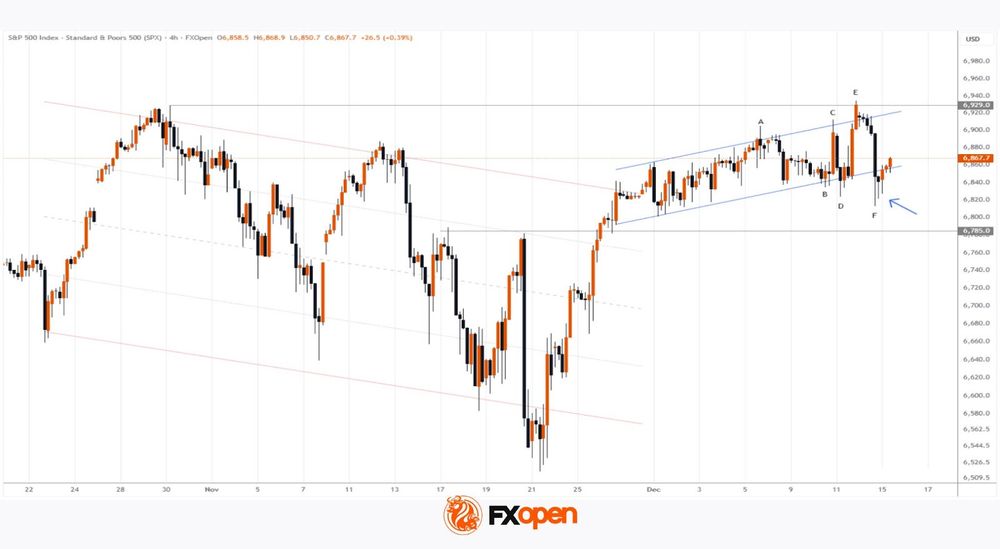
          Trading on 12 December was overshadowed by a sharp decline in the S&P 500 (US SPX 500 mini on FXOpen), with the session low approaching December's previous trough.

          Among the key fundamental drivers behind Friday's drop was the market reaction to Broadcom's quarterly report. Shares (AVGO) plunged more than 10%, possibly as investors aggressively took profits in tech stocks, concerned that the AI hype may be overheated.

          A review of the 4-hour chart of the S&P 500 (US SPX 500 mini on FXOpen) suggests that Friday's negative sentiment may have begun to ease, as the index is now recovering. Overall, this presents an interesting picture from a price-action perspective.

          Technical Analysis of the S&P 500 Chart

          Five days ago, we noted that an ascending channel had formed in early December, which could be interpreted as cautious optimism ahead of key news.

          However, Fed-related announcements triggered a surge in volatility (as we described, "the calm before the storm"), pushing prices beyond both boundaries of the blue channel:

          → The failure to hold above the upper boundary can be seen as bulls lacking confidence to challenge the all-time high. The false break around 6929 looks like a trader trap.

          → Conversely, bears may have been unable to suppress buying near Friday's low, as indicated by the long lower wicks on the candles (highlighted by the arrow).

          The chart now shows a complex Megaphone pattern (marked A–F).

          It is possible that the coming week will be characterised by consolidation following Wednesday–Friday's swings, with market sentiment increasingly influenced by the approaching holiday period.

          Source: ACTIONFOREX

          Risk Warnings and Disclaimers
          You understand and acknowledge that there is a high degree of risk involved in trading. Following any strategies or investment methods may lead to potential losses. The content on the site is provided by our contributors and analysts for information purposes only. You are solely responsible for determining whether any trading assets, securities, strategy, or any other product is suitable for investing based on your own investment objectives and financial situation.
          Add to Favorites
          Share

          Markets Brace for Crucial Jobs Data as Fed Rate Path Sparks 2026 Debate

          Gerik

          Economic

          Fed's Easing Trajectory in 2026 Hinges on Imminent Data

          With 2025 drawing to a close, U.S. bond markets are intensifying focus on the Federal Reserve’s next moves, especially as a backlog of economic data delayed by the fall government shutdown finally comes to light. The immediate catalyst is November’s nonfarm payrolls report, expected to reveal the creation of just 50,000 jobs. This figure will be closely scrutinized for evidence of labor market softening, which many view as critical to justifying further rate cuts.
          The Federal Reserve has already delivered three rate cuts this year, bringing its benchmark range to 3.5–3.75%. However, investors in the Treasury market are betting on two more reductions in 2026, one more than the Fed itself has projected. Should data continue to show signs of cooling particularly in employment or inflation the argument for deeper cuts may strengthen significantly.

          Diverging Views on Labor and Inflation Shape Market Positioning

          Market participants remain divided. George Catrambone of DWS Americas sees weakening job indicators and has positioned for a more aggressive easing trajectory, buying Treasuries on yield spikes. He describes this week’s employment report as “the single most important data point for next year.” In contrast, others like Kevin Flanagan at WisdomTree are skeptical, especially given the complications of data collection during the government shutdown. He believes the Fed is unlikely to cut again as early as January without “visible evidence” of labor deterioration.
          At present, Fed funds futures reflect a rate cut around mid-2026, with a second one priced in for October. But options traders have begun accumulating positions that would benefit from a cut in Q1, signaling that expectations are flexible and data-sensitive.

          Yields in Focus as Market Awaits Directional Clarity

          The yield on the 10-year Treasury has settled around 4.2%, down from recent highs, while the 2-year sits closer to 3.5%, reflecting some moderation in rate hike expectations following Fed Chair Jerome Powell’s recent tone. Powell acknowledged weaker hiring and noted that the current benchmark is within a "broad range" of neutral estimates, which suggests the Fed is not far from pausing its easing cycle.
          However, that interpretation is not universal. Analysts like Ed Harrison at Bloomberg argue that weaker-than-expected jobs data could not only sustain but accelerate the Treasury rally by pulling forward expectations of the next rate cut from June to as early as April.

          Debate Intensifies Amid Political Pressure and Leadership Transition

          Layered atop the economic narrative is an impending shift in Fed leadership. Jerome Powell’s term expires in May 2026, and President Donald Trump is reportedly finalizing his choice for successor. Market speculation suggests that Trump will favor a more dovish candidate, which could tilt policy expectations further toward accommodation, regardless of underlying inflation levels.
          Janet Rilling of Allspring Global Investments believes this political overlay could provide the “cover” for more rate cuts especially if labor markets soften just enough to justify them. She anticipates a mild decline in employment figures, enough to justify dovish positioning without signaling economic distress.

          A Tightly Watched Calendar to Close Out 2025

          The upcoming week is rich with market-moving data. In addition to the jobs report, investors will parse inflation numbers, retail sales, housing market indicators, and PMI data all of which will feed into the Fed’s January policy calculus. This onslaught of releases is occurring just as bond auctions (including 20-year bonds and 5-year TIPS) test demand for long-duration paper.
          Meanwhile, the Fed’s communication schedule includes appearances by officials such as John Williams, Raphael Bostic, and Christopher Waller, who may further clarify the central bank's reaction function heading into Q1 2026.

          Data Will Dictate Whether Cuts Deepen or Pause

          The U.S. bond market is entering a pivotal moment as the macro narrative shifts from a completed easing cycle to an open-ended question about what 2026 will bring. If labor and inflation data confirm signs of economic cooling, investors may press for earlier and deeper cuts than currently signaled by the Fed. However, if resilience persists, the central bank may shift to a holding pattern.
          With Powell's leadership nearing its end and political dynamics set to influence the Fed’s direction, the tension between market pricing and official guidance is poised to define Treasury market volatility well into the new year. The next few weeks will determine whether 2026 will usher in further monetary easing or a strategic pause amid inflationary stickiness.

          Source: Bloomberg

          To stay updated on all economic events of today, please check out our Economic calendar
          Risk Warnings and Disclaimers
          You understand and acknowledge that there is a high degree of risk involved in trading. Following any strategies or investment methods may lead to potential losses. The content on the site is provided by our contributors and analysts for information purposes only. You are solely responsible for determining whether any trading assets, securities, strategy, or any other product is suitable for investing based on your own investment objectives and financial situation.
          Add to Favorites
          Share

          Disagreement at The Fed Serves A Useful Purpose

          Glendon

          Forex

          Economic

          The Federal Reserve's policymakers were far from unanimous in voting for last week's quarter-point cut in interest rates — and that's a good thing. The economic outlook is unusually uncertain, and the risks pull the central bank in opposing directions. Disagreement under such circumstances is healthy. Before much longer, it might be essential.

          Despite the economic fog, investors had firmly priced in a third cut in the space of three months, to a range of 3.5% to 3.75%. This was mainly because the Fed had encouraged them to take one for granted. Such certitude is unhelpful amid so many conflicting economic signals: persistent above-target inflation, continuing confusion over the administration's tariffs, missing data (thanks to the government shutdown), an exuberant stock market and signs that the labor market is softening.

          Reflecting this reality, three voting members of the Federal Open Market Committee dissented, one of them calling for a bigger cut and two for no change. Four nonvoting officials also registered "soft dissents," stating their preference to leave the rate where it was.

          Fed Chair Jerome Powell says the new policy rate is now broadly neutral, meaning that it neither adds to nor subtracts from demand in the economy. In fact, this "neutral" rate is also uncertain. (According to the Fed's new summary of economic projections, officials put it anywhere from 2.5% to 4%.)

          With inflation still above target, aiming to keep policy "slightly restrictive" probably would've made more sense. Still, the truth is that this further quarter-point tweak was, in itself, neither here nor there. What matters as new information arrives is that the central bank keeps, and is understood to keep, an open mind. Unconcealed disagreement among policymakers helps serve this purpose.

          To be fair, the Fed has been admirably clear about one thing: With just a single main instrument of macroeconomic policy, it cannot hit two targets pulling in opposite directions. Thanks mainly to tariffs, there's an upside risk to inflation. Meanwhile, sluggish hiring signals a downside risk to jobs, and there are fears that official statistics are understating the problem.

          These signs of possible stagflation put the central bank in a tough spot. Its dual mandate of stable prices and maximum employment requires it to judge which risk is greater — and right now, there's no clear answer.

          From here on, its predicament will get worse. Powell's term as chair ends in May, and investors are increasingly preoccupied with who will succeed him. The White House has given them every reason to fear that the next leader of the central bank will be chosen based on loyalty and a willingness to cut rates sharply regardless of incoming data. That, in turn, might finally unanchor inflation expectations, raising longer-term interest rates and destabilizing financial markets.

          It's to be hoped that whoever is chosen understands this risk and, once appointed, puts the public interest ahead of White House dictates. It will help if the Fed's other policymakers make a habit of openly dissenting from the chair's position when they disagree on the merits. The notion that apparent consensus enhances the central bank's credibility was always flawed. In the next stage of the Fed's evolution, it might be dangerous.

          Source: Bloomberg Europe

          To stay updated on all economic events of today, please check out our Economic calendar
          Risk Warnings and Disclaimers
          You understand and acknowledge that there is a high degree of risk involved in trading. Following any strategies or investment methods may lead to potential losses. The content on the site is provided by our contributors and analysts for information purposes only. You are solely responsible for determining whether any trading assets, securities, strategy, or any other product is suitable for investing based on your own investment objectives and financial situation.
          Add to Favorites
          Share

          Dutch Manufacturing Set For A Tech-led Growth Pick-up In 2026

          ING

          Forex

          Economic

          Industrial production picking up again, manufacturers more optimistic

          We've seen a notable pick-up in Dutch manufacturing production since August this year. In October, production was significantly higher for the third consecutive month than it was for 11 months prior.

          The technology industry has played an important part in the recent growth. In both machinery production and in that of electrical appliances and means of transport, we're seeing a clear recovery emerging after a period of stagnation. Like their counterparts in the eurozone, Dutch manufacturers have become somewhat more optimistic about the near future since the summer.

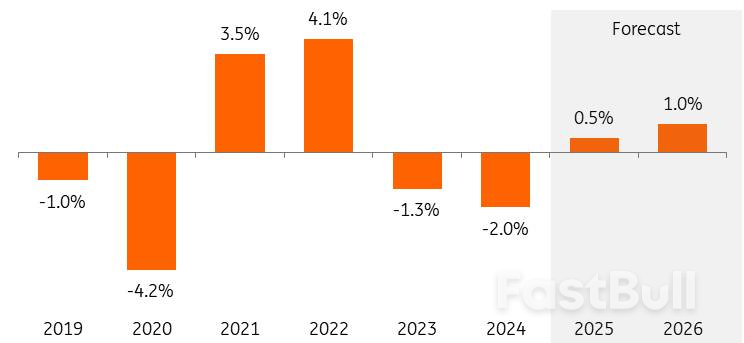
          Now that the unrest around trade tariffs is also easing, production could increase further from +0.5% in 2025 to +1.0% in 2026. Still, many factors continue to slow down growth, such as export restrictions and import tariffs, stiff competition from China and structural factors like grid congestion, nitrogen emission limitations and relatively high energy costs.

          Dutch manufacturing production will grow slightly faster in 2026

          Volume growth of output of Dutch manufacturing

          Source: Statistics Netherlands, Forecast ING Research

          Increasing expenditure is gradually translating into more production

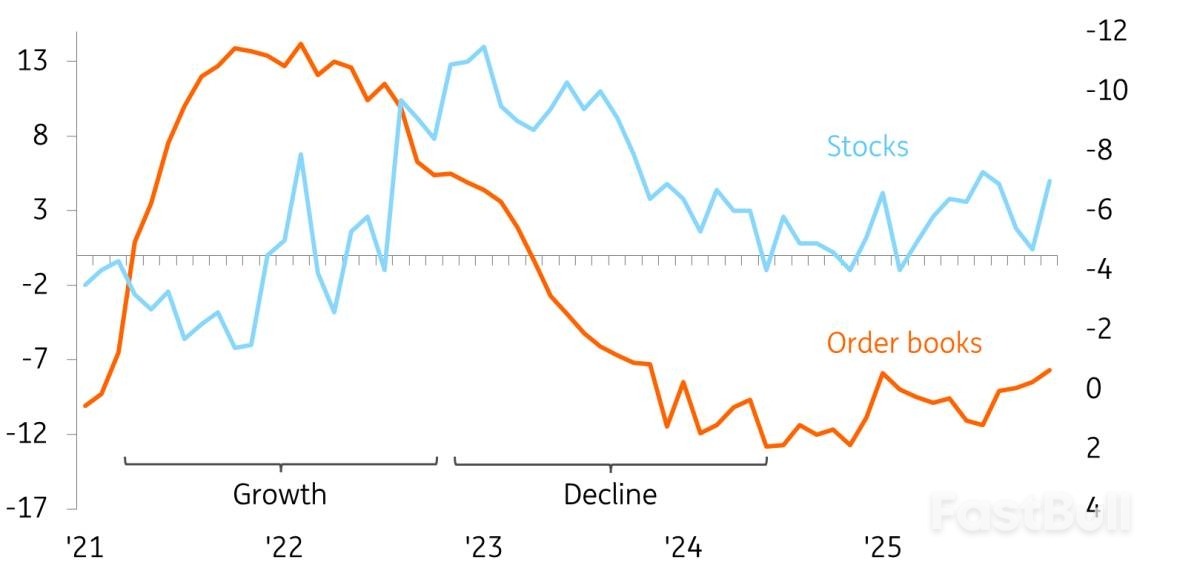
          Increasing consumer spending and additional government investment, in particular, will lead to more manufacturing orders in 2026. Although production expectations have improved and manufacturers have been receiving more new orders for some time, producers have become only slightly more positive about their order books in recent months. Getting the pipeline of customer orders well-filled again is a process that takes time.

          It also takes a while for investments in defence, for example, to translate substantially into more orders and production. Expanding production takes time due to staff shortages and the required construction or conversion of factories. In turn, it isn't surprising that progress in producer confidence and the purchasing managers' index is currently stalling around the long-term average. Like the slight improvement in the orders-to-stocks ratio, sentiment indices do not yet point to substantial growth.

          Ratio between judgment of order books and stocks only slightly improved

          Industrial producers' assessment of order books and stocks of finished products*

          *balance of positive-negative judgments; 2-month moving average, inventory judgment inverted (r.h.axis) Source: Statistics Netherlands, ING Research

          Chip machine demand also contributes to renewed growth

          The gradually increasing global demand for chip machines is yet another growth driver for Dutch manufacturing. The growth of chipmakers and equipment manufacturers remained under pressure in 2025 due to a slower-than-expected normalisation of customer inventories. While semiconductor company ASML continues to keep a close eye on this, ASM and Besi are seeing order growth recover and are optimistic about 2026.

          Investors are also anticipating increasing chip machine demand in 2026. The artificial intelligence boom requires additional chips for data centres, for example, which is creating a growing need for production capacity among semiconductor producers. Demand for chips for applications other than AI, such as consumer electronics, automotive and industrial applications, is also improving.

          Market conditions remain challenging due to US tariffs...

          The uncertainty surrounding the size and impact of US President Donald Trump's import tariffs has caused consumers and businesses to spend only reluctantly. As uncertainties are eased by recent trade deals, the outlook for consumption and investment is improving. Nevertheless, the uniform tariff on EU exports to the US – previously an important growth market for Dutch industry – still remains at 15%. Together with the cooling of the US economy, this will dampen export growth in 2026. The 50% rate on European products and parts made of steel and aluminium is still in place. In fact, the US is bringing more and more products with steel and aluminium parts below the high 50% tariff.

          …trade restrictions, and weakened international competitiveness

          Headwinds and uncertainty also remain due to trade restrictions stemming from increasing technological rivalry with and resource dependence on China. Government policy has an increasingly large and unpredictable influence on market conditions.

          Think of the intervention in Nexperia's business operations and the subsequent export restrictions of essential automotive chips by China. The restrictions on the export of advanced chip machines to China also directly affect Dutch makers and suppliers. At the same time, the persistently expensive euro against the dollar and rising competition from China, which has intensified since Trump's tariffs, are directly – and, through lower exports, indirectly – at the expense of the demand for Dutch products.

          Low demand, high energy costs and cheap imports continue to hurt chemicals and base metals

          Companies in the chemical and base metal sectors, in particular, will continue to face three persistent bottlenecks in 2026:

          1.Low demand in the main markets.
          2.Energy costs that are relatively high in Europe structurally.
          3.An abundance of cheap imports from Asia.

          The relatively large number of eight large chemical plants (or parts thereof) that have been closed in the Netherlands this year will also have a negative impact on growth in the coming years, as part of the production (capacity) has been taken out of the market.

          In that light, the current downward trend in energy prices is encouraging, but not immediately sufficient for renewed growth. This is also expected to continue in 2026, mainly due to increasing global LNG production capacity (especially in the United States and Qatar), and the gas market will structurally expand. This reduces the chance of extreme price peaks and supply problems. The high transport and processing costs of LNG do ensure that energy in Europe remains relatively expensive. LNG imports will continue to be needed for years to meet energy needs.

          Rising defence spending spurs renewed growth of technology industry

          In addition to the increasing demand for chip machines, higher government spending on defence is also gradually increasing product demand. For example, for radars from Thales, frigates from Damen Naval and submarine parts from IHC. The €800 billion from the European Commission's ReArm-Europe programme and the new NATO standard of 3.5% of GDP will consolidate long-term investments.

          An increasing amount of unused capacity is now being used for defence purposes, such as VDL's old Nedcar factory. Drone manufacturing is a fast-growing branch in which the Netherlands excels, previously for civilian purposes. More and more "dual-use companies" are responding to the new growth market by developing new military resources based on existing civilian applications.

          Production development in the food industry stagnates after strong growth

          Production growth in the food industry is set to pause in 2026 after a strong increase in 2025. Based on figures from Statistics Netherlands up to and including September, we assume production growth of at least 3% for 2025. This is partly pent-up demand after several lean years; foreign turnover is also currently growing considerably faster than domestic turnover.

          In terms of production levels, the sector will come close to 2018's peak. The fact that the expected growth will fall in 2026 is mainly due to supply constraints and limited room for expansion investments. The impact of the shrinking livestock herd on the dairy and meat processing industry plays a major role in this. Still, consumer demand is developing positively, and that provides a counterbalance.

          Source: ING

          To stay updated on all economic events of today, please check out our Economic calendar
          Risk Warnings and Disclaimers
          You understand and acknowledge that there is a high degree of risk involved in trading. Following any strategies or investment methods may lead to potential losses. The content on the site is provided by our contributors and analysts for information purposes only. You are solely responsible for determining whether any trading assets, securities, strategy, or any other product is suitable for investing based on your own investment objectives and financial situation.
          Add to Favorites
          Share

          Crypto Winter Triggers Darwinian Shakeout for Digital Asset Treasury Firms

          Gerik

          Economic

          Cryptocurrency

          Bitcoin Crash Exposes Fragility of Treasury-Led Crypto Strategy

          After soaring through much of 2025, digital asset treasury (DAT) companies those holding crypto like bitcoin or ether on their balance sheets have stumbled into a harsh correction. The catalyst was bitcoin’s sudden October plunge, which left many of these firms sitting on steep unrealized losses. Public companies that had mirrored Michael Saylor’s Strategy (MSTR) approach issuing debt and equity to amass bitcoin now face pressure from falling token prices and declining investor confidence.
          Since October 10, Strategy’s share price has dropped about 40%, while peers like KindlyMD, American Bitcoin (ABTC), and ProCap Financial have seen even steeper declines of up to 65%. The broader sell-off has especially punished firms with no underlying cash-generating businesses, exposing the limits of a strategy that relied heavily on token appreciation.

          The mNAV Metric Becomes a Market Litmus Test

          At the center of investor concerns is a valuation metric called mNAV (market cap to net asset value), which compares a firm’s equity value to the crypto it holds. When mNAV falls below 1, it suggests investors view the company as worth less than its digital holdings signaling fears that the firm may be forced to liquidate assets to meet debt or dividend obligations.
          Strategy’s mNAV hovered close to 1x in late November, prompting scrutiny of its sustainability. To ease concerns, the firm announced a $1.44 billion reserve to fund dividends and debt payments over the next 21 months, effectively buying time to weather continued volatility. CEO Phong Le has rejected comparisons to ETFs, asserting that Strategy is a growth-oriented tech firm with bitcoin-backed products not a passive holding vehicle.
          Copycats Falter While Fundamentals Take Priority
          The post-crash phase is exposing deep differences between companies. Of the 100+ bitcoin-holding firms with available data, 65 acquired their tokens above current prices. As a result, five treasury firms collectively sold 1,883 bitcoins last month to limit losses or meet obligations.
          According to analysts at Bernstein, Strategy is expected to survive the downturn due to its scale and cash cushion. However, they warn that imitators who lacked operational depth or over-relied on crypto price appreciation may not recover. Without diversified revenue streams or capital-raising ability, these firms could be permanently discounted or face insolvency.
          Matt Zhang of Hivemind Capital likens the situation to the early 2000s dot-com bust. Firms that merely added “crypto” to their strategy without viable business models are now being weeded out. His firm reviewed more than 100 DATs this year but invested in only a fraction, emphasizing the need for cash flow-generating operations beyond mere token holdings.

          A Darwinian Phase and Potential Consolidation Ahead

          The current turmoil marks the beginning of what Galaxy Digital analyst Will Owens calls a “Darwinian phase” for treasury companies. As capital dries up and valuations compress, consolidation is likely. Stronger players may absorb distressed peers, while others could pivot or vanish altogether.
          New entrants like Twenty One Capital (XXI), backed by Tether and SoftBank, have faced immediate skepticism. Despite holding more bitcoin than Coinbase, its stock fell 19% during its public debut. CEO Jack Mallers insists that XXI should not be compared to passive firms like Strategy, arguing it will build products and cash flow around its crypto base.
          The correction in crypto markets has reset expectations around digital asset treasuries. What was once a momentum-fueled trade now demands operational resilience, capital efficiency, and a clear value proposition. As Strategy fights to defend its model and new players seek to differentiate, only those with scalable, cash-generating businesses will thrive. The era of passive crypto balance sheet plays appears to be ending, replaced by a more mature, competitive, and selective phase of digital asset treasury evolution.

          Source: Yahoo Finance

          To stay updated on all economic events of today, please check out our Economic calendar
          Risk Warnings and Disclaimers
          You understand and acknowledge that there is a high degree of risk involved in trading. Following any strategies or investment methods may lead to potential losses. The content on the site is provided by our contributors and analysts for information purposes only. You are solely responsible for determining whether any trading assets, securities, strategy, or any other product is suitable for investing based on your own investment objectives and financial situation.
          Add to Favorites
          Share

          China's Property Woes Cast Shadow Over Global Markets as Year-End Nears

          Gerik

          Economic

          Vanke Crisis Revives Fears in China’s Fragile Property Market

          As the final full trading week of 2025 begins, the spotlight has returned to China’s ailing property sector, with state-backed developer Vanke struggling to extend a maturing bond. After failing to gain bondholder approval for a one-year extension on a payment due Monday, Vanke announced it would convene a second meeting, triggering sharp declines in its stock across Shenzhen and Hong Kong. The looming possibility of default has reignited deep-rooted concerns about the structural health of China’s real estate sector.
          The timing of this development is particularly sensitive, as global markets are already navigating a crowded macroeconomic calendar, including five G10 central bank decisions and multiple delayed U.S. economic data releases. Against this backdrop, Vanke’s troubles have amplified risk aversion, dampening hopes for a traditional “Santa rally” as the year winds down.

          Weakening Home Prices Underscore Structural Demand Deficit

          Adding to the unease, official Chinese data released Monday revealed that new home prices continued to fall in November. This marks yet another month of decline despite repeated government pledges to stabilize the housing market. The persistence of falling prices suggests that underlying demand remains weak and that policy interventions so far have failed to reverse the sector’s downward trajectory.
          This deterioration is not occurring in isolation. The broader macro environment is signaling stagnation, with recent factory output and retail sales data also missing expectations. The yuan's appreciation to its strongest level in over a year while typically a sign of strength now adds policy complications for Chinese authorities trying to support exports and avoid further tightening of financial conditions.

          Investors Retreat from Risk Amid Deteriorating Sentiment

          The souring mood in Asia was reflected in market action on Monday. The MSCI Asia-Pacific ex-Japan index fell by 1.2%, with South Korea’s benchmark shedding 2.7%, erasing some of the year’s substantial gains. This retreat reflects a broader shift in investor positioning, as many begin locking in profits and scaling back risk exposure heading into the end-of-year holiday period.
          In contrast, early European futures indicated cautious optimism, with the pan-region index, Germany’s DAX, and the U.K.’s FTSE each up between 0.3% and 0.4%. These gains may reflect a temporary decoupling from Asia’s woes, but sentiment remains fragile and highly sensitive to upcoming macroeconomic data and central bank guidance.

          Global Macro Events Loom Large in Market Calculus

          This week’s market direction will also be heavily shaped by policy decisions from the European Central Bank, Bank of England, Bank of Japan, Sweden’s Riksbank, and Norway’s Norges Bank. While the ECB is expected to hold rates steady at 2%, the Bank of Japan may raise its policy rate by 25 basis points, while the Bank of England is seen possibly implementing a modest rate cut. Eurozone and UK inflation figures, due Wednesday, will add further weight to these decisions.
          Delayed U.S. data releases, including nonfarm payrolls, retail sales, and the November CPI, will also play a crucial role in determining global sentiment. These indicators could either reinforce the recent shift away from high-growth tech stocks or restore confidence in the global growth outlook.
          China’s unresolved property crisis is once again exerting a gravitational pull on global market sentiment. The Vanke situation, combined with falling home prices and disappointing macro data, underscores the persistent fragility of domestic demand in the world’s second-largest economy. As global markets brace for a wave of central bank decisions and data prints, the resurgence of China-related risks may limit investor appetite for risk assets, keeping year-end rallies in check and reinforcing a defensive positioning across asset classes.

          Source: Reuters

          To stay updated on all economic events of today, please check out our Economic calendar
          Risk Warnings and Disclaimers
          You understand and acknowledge that there is a high degree of risk involved in trading. Following any strategies or investment methods may lead to potential losses. The content on the site is provided by our contributors and analysts for information purposes only. You are solely responsible for determining whether any trading assets, securities, strategy, or any other product is suitable for investing based on your own investment objectives and financial situation.
          Add to Favorites
          Share
          FastBull
          Copyright © 2025 FastBull Ltd

          728 RM B 7/F GEE LOK IND BLDG NO 34 HUNG TO RD KWUN TONG KLN HONG KONG

          TelegramInstagramTwitterfacebooklinkedin
          App Store Google Play Google Play
          Products
          Charts

          Chats

          Q&A with Experts
          Screeners
          Economic Calendar
          Data
          Tools
          Membership
          Features
          Function
          Markets
          Copy Trading
          Latest Signals
          Contests
          News
          Analysis
          24/7
          Columns
          Education
          Company
          Careers
          About Us
          Contact Us
          Advertising
          Help Center
          Feedback
          User Agreement
          Privacy Policy
          Business

          White Label

          Data API

          Web Plug-ins

          Poster Maker

          Affiliate Program

          Risk Disclosure

          The risk of loss in trading financial instruments such as stocks, FX, commodities, futures, bonds, ETFs and crypto can be substantial. You may sustain a total loss of the funds that you deposit with your broker. Therefore, you should carefully consider whether such trading is suitable for you in light of your circumstances and financial resources.

          No decision to invest should be made without thoroughly conducting due diligence by yourself or consulting with your financial advisors. Our web content might not suit you since we don't know your financial conditions and investment needs. Our financial information might have latency or contain inaccuracy, so you should be fully responsible for any of your trading and investment decisions. The company will not be responsible for your capital loss.

          Without getting permission from the website, you are not allowed to copy the website's graphics, texts, or trademarks. Intellectual property rights in the content or data incorporated into this website belong to its providers and exchange merchants.

          Not Logged In

          Log in to access more features

          FastBull Membership

          Not yet

          Purchase

          Become a signal provider
          Help Center
          Customer Service
          Dark Mode
          Price Up/Down Colors

          Log In

          Sign Up
          Position
          Layout
          Fullscreen
          Default to Chart
          The chart page opens by default when you visit fastbull.com