Markets
News
Analysis
User
24/7
Economic Calendar
Education
Data
- Names
- Latest
- Prev


Signal Accounts for Members
All Signal Accounts
All Contests


U.K. Trade Balance Non-EU (SA) (Oct)A:--
F: --
P: --
U.K. Trade Balance (Oct)A:--
F: --
P: --
U.K. Services Index MoMA:--
F: --
P: --
U.K. Construction Output MoM (SA) (Oct)A:--
F: --
P: --
U.K. Industrial Output YoY (Oct)A:--
F: --
P: --
U.K. Trade Balance (SA) (Oct)A:--
F: --
P: --
U.K. Trade Balance EU (SA) (Oct)A:--
F: --
P: --
U.K. Manufacturing Output YoY (Oct)A:--
F: --
P: --
U.K. GDP MoM (Oct)A:--
F: --
P: --
U.K. GDP YoY (SA) (Oct)A:--
F: --
P: --
U.K. Industrial Output MoM (Oct)A:--
F: --
P: --
U.K. Construction Output YoY (Oct)A:--
F: --
P: --
France HICP Final MoM (Nov)A:--
F: --
P: --
China, Mainland Outstanding Loans Growth YoY (Nov)A:--
F: --
P: --
China, Mainland M2 Money Supply YoY (Nov)A:--
F: --
P: --
China, Mainland M0 Money Supply YoY (Nov)A:--
F: --
P: --
China, Mainland M1 Money Supply YoY (Nov)A:--
F: --
P: --
India CPI YoY (Nov)A:--
F: --
P: --
India Deposit Gowth YoYA:--
F: --
P: --
Brazil Services Growth YoY (Oct)A:--
F: --
P: --
Mexico Industrial Output YoY (Oct)A:--
F: --
P: --
Russia Trade Balance (Oct)A:--
F: --
P: --
Philadelphia Fed President Henry Paulson delivers a speech
Canada Building Permits MoM (SA) (Oct)A:--
F: --
P: --
Canada Wholesale Sales YoY (Oct)A:--
F: --
P: --
Canada Wholesale Inventory MoM (Oct)A:--
F: --
P: --
Canada Wholesale Inventory YoY (Oct)A:--
F: --
P: --
Canada Wholesale Sales MoM (SA) (Oct)A:--
F: --
P: --
Germany Current Account (Not SA) (Oct)A:--
F: --
P: --
U.S. Weekly Total Rig CountA:--
F: --
P: --
U.S. Weekly Total Oil Rig CountA:--
F: --
P: --
Japan Tankan Large Non-Manufacturing Diffusion Index (Q4)--
F: --
P: --
Japan Tankan Small Manufacturing Outlook Index (Q4)--
F: --
P: --
Japan Tankan Large Non-Manufacturing Outlook Index (Q4)--
F: --
P: --
Japan Tankan Large Manufacturing Outlook Index (Q4)--
F: --
P: --
Japan Tankan Small Manufacturing Diffusion Index (Q4)--
F: --
P: --
Japan Tankan Large Manufacturing Diffusion Index (Q4)--
F: --
P: --
Japan Tankan Large-Enterprise Capital Expenditure YoY (Q4)--
F: --
P: --
U.K. Rightmove House Price Index YoY (Dec)--
F: --
P: --
China, Mainland Industrial Output YoY (YTD) (Nov)--
F: --
P: --
China, Mainland Urban Area Unemployment Rate (Nov)--
F: --
P: --
Saudi Arabia CPI YoY (Nov)--
F: --
P: --
Euro Zone Industrial Output YoY (Oct)--
F: --
P: --
Euro Zone Industrial Output MoM (Oct)--
F: --
P: --
Canada Existing Home Sales MoM (Nov)--
F: --
P: --
Euro Zone Total Reserve Assets (Nov)--
F: --
P: --
U.K. Inflation Rate Expectations--
F: --
P: --
Canada National Economic Confidence Index--
F: --
P: --
Canada New Housing Starts (Nov)--
F: --
P: --
U.S. NY Fed Manufacturing Employment Index (Dec)--
F: --
P: --
U.S. NY Fed Manufacturing Index (Dec)--
F: --
P: --
Canada Core CPI YoY (Nov)--
F: --
P: --
Canada Manufacturing Unfilled Orders MoM (Oct)--
F: --
P: --
Canada Manufacturing New Orders MoM (Oct)--
F: --
P: --
Canada Core CPI MoM (Nov)--
F: --
P: --
Canada Manufacturing Inventory MoM (Oct)--
F: --
P: --
Canada CPI YoY (Nov)--
F: --
P: --
Canada CPI MoM (Nov)--
F: --
P: --
Canada CPI YoY (SA) (Nov)--
F: --
P: --
Canada Core CPI MoM (SA) (Nov)--
F: --
P: --


No matching data
Latest Views
Latest Views
Trending Topics
Top Columnists
Latest Update
White Label
Data API
Web Plug-ins
Affiliate Program
View All

No data
President Trump confirmed the U.S. will meet with Iran next week but downplayed the need for a nuclear deal, citing U.S. airstrikes that he claims destroyed key Iranian nuclear sites.
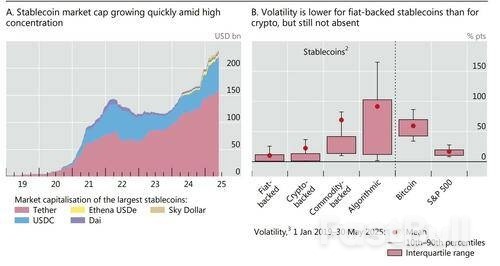
A new report from the Bank for International Settlements (BIS) challenged the notion that stablecoins can serve as money in a modern financial system.

According to the BIS Annual Economic Report 2025, stablecoins fail the fundamental tests of “singleness,” “elasticity” and “integrity,” three critical criteria that define effective monetary instruments.
The BIS described stablecoins as “digital bearer instruments” that resemble financial assets more than actual money. “Stablecoins perform poorly when assessed against the three tests for serving as the mainstay of the monetary system,” the report said.
Unlike central bank-backed money, which is accepted “at par” and requires no background checks, private entities issue stablecoins and often trade at fluctuating rates. This undermines the core principle of monetary singleness, the report claimed.

Elasticity, the second test, is crucial for absorbing shocks and meeting large-value payment demands, BIS said in its report.
It pointed out that “any additional supply of stablecoins thus requires full upfront payment by its holders,” likening it to a “strict cash-in-advance setup” that contrasts with the flexibility of modern banking systems, where central banks provide liquidity as needed.
The third and perhaps most damning failure lies in the area of integrity. The report claimed that stablecoins’ design, especially those transacted via unhosted wallets on public blockchains, makes them prone to financial crime.
“Stablecoins have significant shortcomings when it comes to promoting the integrity of the monetary system,” the BIS noted, emphasizing their vulnerability to money laundering, sanctions evasion and terrorist financing.

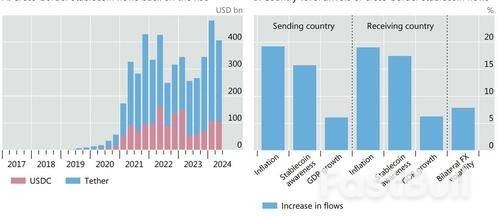
While acknowledging the continued demand for stablecoins due to features like cross-border accessibility and lower transaction costs, the BIS argued that they should only play a limited, well-regulated role.
“Society can re-learn the historical lessons about the limitations of unsound money,” the report cautioned. “Bold action by central banks and other public authorities can push the financial system along the right path, in partnership with the financial sector.”
Circle, the company behind USDC, saw its stock drop more than 15% on Tuesday after the BIS report, hitting $222. CRCL shares had reached an all-time high of $299 on Monday.
Despite its hard take on stablecoins, the BIS report praised tokenization as a “transformative innovation” for the next-generation monetary and financial system. It said tokenization builds on the current financial system rather than replacing it.
Some in the crypto community said it is “no surprise” that the BIS paper was generally negative on stablecoins, given that it is a “regulatory body owned by global central banks.”
“The BIS is hysterical in its opposition to crypto,” Jim Walker, chief economist at Aletheia Capital, wrote. “The first criterion, backed by a central bank, should make it a laughing stock given the historical failures of those institutions around the world.”

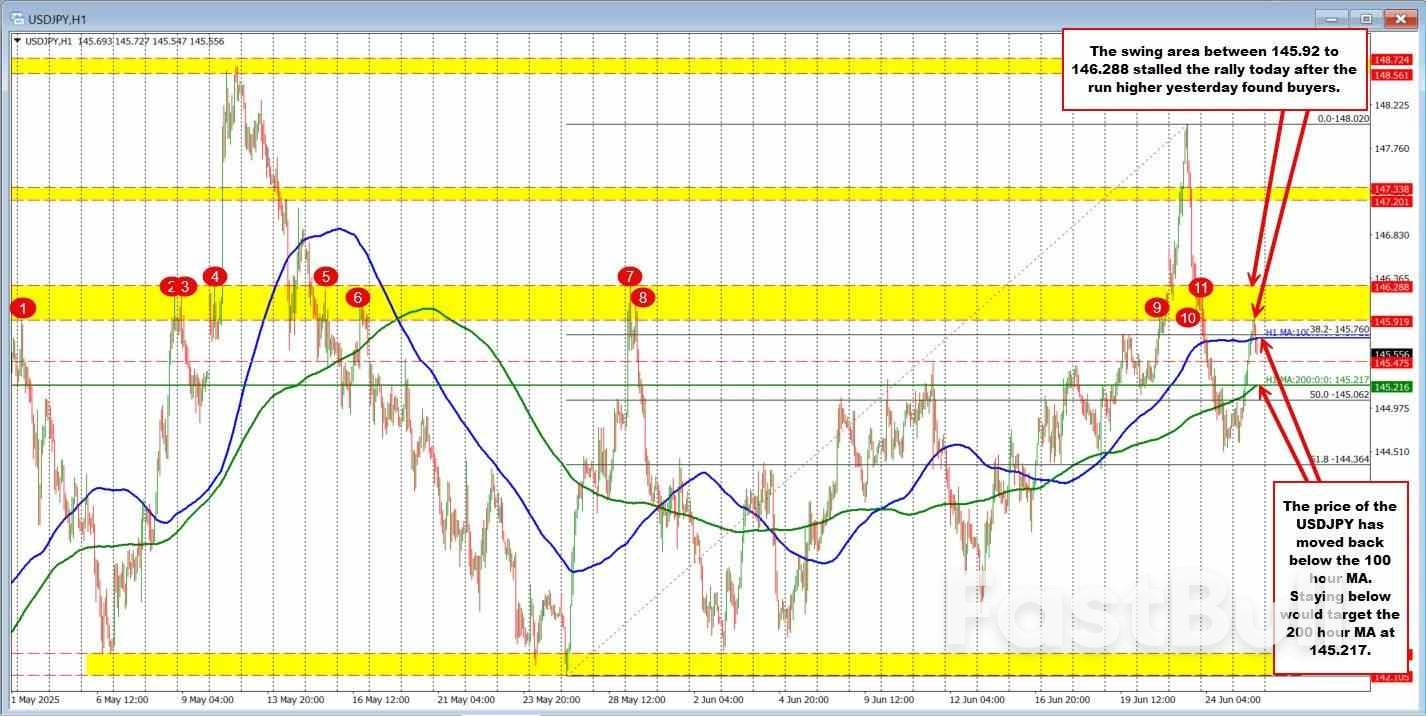
The USDJPY has dipped back below both the 100-hour moving average (145.76) and the 38.2% retracement of the recent move up, tilting the short-term bias to the downside and disappointing the buyers on the break above those levels earlier in the US session. After the break higher, the rally today stalled near the low of the swing area between 145.92 and 146.288, where sellers once again leaned.
The buyers had their shot. They missed.
With the move back below the 100-hour MA confirmed, traders will now focus on the 200-hour moving average at 145.217 and the 50% midpoint at 145.06 as the next key downside targets. Staying below the 100-hour MA keeps sellers in control. Overall, the technical bias is more neutral with the price between the 100/200 hour MAs.
● 145.217 – 200-hour moving average
● 145.06 – 50% retracement
● 145.76 – 100-hour MA (broken)
● 145.92–146.288 – overhead swing zone
A hold below 145.76 would keep the pressure on the downside in the near term.

Sales of new single-family homes dropped 13.7% in May compared with April to 623,000 units on a seasonally-adjusted, annualized basis, according to the U.S. Census.
That sales total was 6.3% lower than May 2024 and well below both the 6-month average of 671,000 and the one-year average of 676,000. It also lags the pre-pandemic average in 2019 of 685,000 units sold.
Wall Street analysts were expecting May new home sales of 695,000, according to estimates from Dow Jones.
This count is based on signed contracts, so people out shopping in May, when mortgage rates remained stubbornly high.
The average rate on the 30-year fixed mortgage started May at 6.83%, rose steadily to just over 7% and then settled back at 6.95% by the end of the month, according to Mortgage News Daily.
"The large fall in new home sales in May cancels out all of the positivity of the past couple of months and serves as a valuable reminder that buyer activity can only rise so far with mortgage rates hugging 7%," wrote Bradley Saunders, an economist with Capital Economics.
Home builders who reported quarterly earnings recently noted high rates cutting into affordability.
"The macro economy remains challenging, as mortgage interest rates have remained higher while consumer confidence has been challenged by a wide range of uncertainties, both domestic and global," said Stuart Miller, co-CEO of Lennar, on a call with analysts following the company's second-quarter earnings release. "Across the housing landscape, actionable demand has been diminished by both affordability and consumer confidence, and therefore has continued to soften."
Lennar reported lowering prices, but KB Home, which reported its quarterly earnings this week, raised prices.
Nationally, the median price of a new home sold in May was $426,600, according to the Census report, 3% above the year-earlier price.
Slower sales resulted in a significant bump higher in supply. There were 507,000 new homes for sales at the end of May. This represents a 9.8-month supply at the current sales rate, which is 15% higher than May 2024.
The last time supply was that high was briefly in the summer of 2022, after the Federal Reserve first started raising interest rates post-pandemic. Before that, supply hadn't been this high since 2009, amid the subprime mortgage crisis and the great recession.
White Label
Data API
Web Plug-ins
Poster Maker
Affiliate Program
The risk of loss in trading financial instruments such as stocks, FX, commodities, futures, bonds, ETFs and crypto can be substantial. You may sustain a total loss of the funds that you deposit with your broker. Therefore, you should carefully consider whether such trading is suitable for you in light of your circumstances and financial resources.
No decision to invest should be made without thoroughly conducting due diligence by yourself or consulting with your financial advisors. Our web content might not suit you since we don't know your financial conditions and investment needs. Our financial information might have latency or contain inaccuracy, so you should be fully responsible for any of your trading and investment decisions. The company will not be responsible for your capital loss.
Without getting permission from the website, you are not allowed to copy the website's graphics, texts, or trademarks. Intellectual property rights in the content or data incorporated into this website belong to its providers and exchange merchants.
Not Logged In
Log in to access more features

FastBull Membership
Not yet
Purchase
Log In
Sign Up