• Trade
  • Markets
  • Copy
  • Contests
  • News
  • 24/7
  • Calendar
  • Q&A
  • Chats
Trending
Screeners
SYMBOL
LAST
BID
ASK
HIGH
LOW
NET CHG.
%CHG.
SPREAD
SPX
S&P 500 Index
6827.42
6827.42
6827.42
6899.86
6801.80
-73.58
-1.07%
--
DJI
Dow Jones Industrial Average
48458.04
48458.04
48458.04
48886.86
48334.10
-245.98
-0.51%
--
IXIC
NASDAQ Composite Index
23195.16
23195.16
23195.16
23554.89
23094.51
-398.69
-1.69%
--
USDX
US Dollar Index
97.950
98.030
97.950
98.500
97.950
-0.370
-0.38%
--
EURUSD
Euro / US Dollar
1.17394
1.17409
1.17394
1.17496
1.17192
+0.00011
+ 0.01%
--
GBPUSD
Pound Sterling / US Dollar
1.33707
1.33732
1.33707
1.33997
1.33419
-0.00148
-0.11%
--
XAUUSD
Gold / US Dollar
4299.39
4299.39
4299.39
4353.41
4257.10
+20.10
+ 0.47%
--
WTI
Light Sweet Crude Oil
57.233
57.485
57.233
58.011
56.969
-0.408
-0.71%
--

Community Accounts

Signal Accounts
--
Profit Accounts
--
Loss Accounts
--
View More

Become a signal provider

Sell trading signals to earn additional income

View More

Guide to Copy Trading

Get started with ease and confidence

View More

Signal Accounts for Members

All Signal Accounts

Best Return
  • Best Return
  • Best P/L
  • Best MDD
Past 1W
  • Past 1W
  • Past 1M
  • Past 1Y

All Contests

  • All
  • Trump Updates
  • Recommend
  • Stocks
  • Cryptocurrencies
  • Central Banks
  • Featured News
Top News Only
Share

Iranian Media Says 18 Crew Members Of Foreign Tanker Seized In Gulf Of Oman Over Carrying 'Smuggled Fuel' Detained

Share

Regional Governor: Two Killed In Ukrainian Drone Strike On Russia's Saratov

Share

Chinese Foreign Ministry - China Foreign Minister Met With United Arab Emirates Counterpart On Dec 12

Share

China's Central Financial And Economic Affairs Commission Deputy Director: Will Expand Export And Increase Import In 2026

Share

Thai Leader Anutin: Landmine Blast That Killed Thai Soldiers 'Not A Roadside Accident'

Share

Thai Leader Anutin: Thailand To Continue Military Action Until 'We Feel No More Harm'

Share

Cambodian Prime Minister Hun Manet Says He Had Phone Calls With Trump And Malaysian Leader Anwar About Ceasefire

Share

Cambodia's Hun Manet Says USA, Malaysia Should Verify 'Which Side Fired First' In Latest Conflict

Share

Cambodia's Hun Manet: Cambodia Maintains Its Stance In Seeking Peaceful Resolution Of Disputes

Share

Nasdaq Companies: Allergan, Ferrovia, Insmed, Monolithic Power Systems, Seagate Technology, And Western Digital Will Be Added To The NASDAQ 100 Index. Biogen, CdW, GlobalFoundries, Lululemon, ON Semiconductor, And Tradedesk Will Be Removed From The NASDAQ 100 Index

Share

Witkoff Headed To Berlin This Weekend To Meet With Zelenskiy, European Leaders -Wsj Reporter On X

Share

Russia Attacks Two Ukrainian Ports, Damaging Three Turkish-Owned Vessels

Share

[Historic Flooding Occurs In At Least Four Rivers In Washington State Due To Days Of Torrential Rains] Multiple Areas In Washington State Have Been Hit By Severe Flooding Due To Days Of Torrential Rains, With At Least Four Rivers Experiencing Historic Flooding. Reporters Learned On The 12th That The Floods Caused By The Torrential Rains In Washington State Have Destroyed Homes And Closed Several Highways. Experts Warn That Even More Severe Flooding May Occur In The Future. A State Of Emergency Has Been Declared In Washington State

Share

Trump Says Proposed Free Economic Zone In Donbas Would Work

Share

Trump: I Think My Voice Should Be Heard

Share

Trump Says Will Be Choosing New Fed Chair In Near Future

Share

Trump Says Proposed Free Economic Zone In Donbas Complex But Would Work

Share

Trump Says Land Strikes In Venezuela Will Start Happening

Share

US President Trump: Thailand And Cambodia Are In A Good Situation

Share

State Media: North Korean Leader Kim Hails Troops Returning From Russia Mission

TIME
ACT
FCST
PREV
U.K. Trade Balance Non-EU (SA) (Oct)

A:--

F: --

P: --

U.K. Trade Balance (Oct)

A:--

F: --

P: --

U.K. Services Index MoM

A:--

F: --

P: --

U.K. Construction Output MoM (SA) (Oct)

A:--

F: --

P: --

U.K. Industrial Output YoY (Oct)

A:--

F: --

P: --

U.K. Trade Balance (SA) (Oct)

A:--

F: --

P: --

U.K. Trade Balance EU (SA) (Oct)

A:--

F: --

P: --

U.K. Manufacturing Output YoY (Oct)

A:--

F: --

P: --

U.K. GDP MoM (Oct)

A:--

F: --

P: --

U.K. GDP YoY (SA) (Oct)

A:--

F: --

P: --

U.K. Industrial Output MoM (Oct)

A:--

F: --

P: --

U.K. Construction Output YoY (Oct)

A:--

F: --

P: --

France HICP Final MoM (Nov)

A:--

F: --

P: --

China, Mainland Outstanding Loans Growth YoY (Nov)

A:--

F: --

P: --

China, Mainland M2 Money Supply YoY (Nov)

A:--

F: --

P: --

China, Mainland M0 Money Supply YoY (Nov)

A:--

F: --

P: --

China, Mainland M1 Money Supply YoY (Nov)

A:--

F: --

P: --

India CPI YoY (Nov)

A:--

F: --

P: --

India Deposit Gowth YoY

A:--

F: --

P: --

Brazil Services Growth YoY (Oct)

A:--

F: --

P: --

Mexico Industrial Output YoY (Oct)

A:--

F: --

P: --

Russia Trade Balance (Oct)

A:--

F: --

P: --

Philadelphia Fed President Henry Paulson delivers a speech
Canada Building Permits MoM (SA) (Oct)

A:--

F: --

P: --

Canada Wholesale Sales YoY (Oct)

A:--

F: --

P: --

Canada Wholesale Inventory MoM (Oct)

A:--

F: --

P: --

Canada Wholesale Inventory YoY (Oct)

A:--

F: --

P: --

Canada Wholesale Sales MoM (SA) (Oct)

A:--

F: --

P: --

Germany Current Account (Not SA) (Oct)

A:--

F: --

P: --

U.S. Weekly Total Rig Count

A:--

F: --

P: --

U.S. Weekly Total Oil Rig Count

A:--

F: --

P: --

Japan Tankan Large Non-Manufacturing Diffusion Index (Q4)

--

F: --

P: --

Japan Tankan Small Manufacturing Outlook Index (Q4)

--

F: --

P: --

Japan Tankan Large Non-Manufacturing Outlook Index (Q4)

--

F: --

P: --

Japan Tankan Large Manufacturing Outlook Index (Q4)

--

F: --

P: --

Japan Tankan Small Manufacturing Diffusion Index (Q4)

--

F: --

P: --

Japan Tankan Large Manufacturing Diffusion Index (Q4)

--

F: --

P: --

Japan Tankan Large-Enterprise Capital Expenditure YoY (Q4)

--

F: --

P: --

U.K. Rightmove House Price Index YoY (Dec)

--

F: --

P: --

China, Mainland Industrial Output YoY (YTD) (Nov)

--

F: --

P: --

China, Mainland Urban Area Unemployment Rate (Nov)

--

F: --

P: --

Saudi Arabia CPI YoY (Nov)

--

F: --

P: --

Euro Zone Industrial Output YoY (Oct)

--

F: --

P: --

Euro Zone Industrial Output MoM (Oct)

--

F: --

P: --

Canada Existing Home Sales MoM (Nov)

--

F: --

P: --

Euro Zone Total Reserve Assets (Nov)

--

F: --

P: --

U.K. Inflation Rate Expectations

--

F: --

P: --

Canada National Economic Confidence Index

--

F: --

P: --

Canada New Housing Starts (Nov)

--

F: --

P: --

U.S. NY Fed Manufacturing Employment Index (Dec)

--

F: --

P: --

U.S. NY Fed Manufacturing Index (Dec)

--

F: --

P: --

Canada Core CPI YoY (Nov)

--

F: --

P: --

Canada Manufacturing Unfilled Orders MoM (Oct)

--

F: --

P: --

Canada Manufacturing New Orders MoM (Oct)

--

F: --

P: --

Canada Core CPI MoM (Nov)

--

F: --

P: --

Canada Manufacturing Inventory MoM (Oct)

--

F: --

P: --

Canada CPI YoY (Nov)

--

F: --

P: --

Canada CPI MoM (Nov)

--

F: --

P: --

Canada CPI YoY (SA) (Nov)

--

F: --

P: --

Canada Core CPI MoM (SA) (Nov)

--

F: --

P: --

Q&A with Experts
    • All
    • Chatrooms
    • Groups
    • Friends
    Connecting
    .
    .
    .
    Type here...
    Add Symbol or Code

      No matching data

      All
      Trump Updates
      Recommend
      Stocks
      Cryptocurrencies
      Central Banks
      Featured News
      • All
      • Russia-Ukraine Conflict
      • Middle East Flashpoint
      • All
      • Russia-Ukraine Conflict
      • Middle East Flashpoint
      Search
      Products

      Charts Free Forever

      Chats Q&A with Experts
      Screeners Economic Calendar Data Tools
      Membership Features
      Data Warehouse Market Trends Institutional Data Policy Rates Macro

      Market Trends

      Market Sentiment Order Book Forex Correlations

      Top Indicators

      Charts Free Forever
      Markets

      News

      News Analysis 24/7 Columns Education
      From Institutions From Analysts
      Topics Columnists

      Latest Views

      Latest Views

      Trending Topics

      Top Columnists

      Latest Update

      Signals

      Copy Rankings Latest Signals Become a signal provider AI Rating
      Contests
      Brokers

      Overview Brokers Assessment Rankings Regulators News Claims
      Broker listing Forex Brokers Comparison Tool Live Spread Comparison Scam
      Q&A Complaint Scam Alert Videos Tips to Detect Scam
      More

      Business
      Events
      Careers About Us Advertising Help Center

      White Label

      Data API

      Web Plug-ins

      Affiliate Program

      Awards Institution Evaluation IB Seminar Salon Event Exhibition
      Vietnam Thailand Singapore Dubai
      Fans Party Investment Sharing Session
      FastBull Summit BrokersView Expo
      Recent Searches
        Top Searches
          Markets
          News
          Analysis
          User
          24/7
          Economic Calendar
          Education
          Data
          • Names
          • Latest
          • Prev

          View All

          No data

          Scan to Download

          Faster Charts, Chat Faster!

          Download App
          English
          • English
          • Español
          • العربية
          • Bahasa Indonesia
          • Bahasa Melayu
          • Tiếng Việt
          • ภาษาไทย
          • Français
          • Italiano
          • Türkçe
          • Русский язык
          • 简中
          • 繁中
          Open Account
          Search
          Products
          Charts Free Forever
          Markets
          News
          Signals

          Copy Rankings Latest Signals Become a signal provider AI Rating
          Contests
          Brokers

          Overview Brokers Assessment Rankings Regulators News Claims
          Broker listing Forex Brokers Comparison Tool Live Spread Comparison Scam
          Q&A Complaint Scam Alert Videos Tips to Detect Scam
          More

          Business
          Events
          Careers About Us Advertising Help Center

          White Label

          Data API

          Web Plug-ins

          Affiliate Program

          Awards Institution Evaluation IB Seminar Salon Event Exhibition
          Vietnam Thailand Singapore Dubai
          Fans Party Investment Sharing Session
          FastBull Summit BrokersView Expo

          Treasury Yields Tumble as Wagers on September Fed Rate Cut Grow

          Manuel

          Bond

          Forex

          Summary:

          The ADP data drew a swift response from US President Donald Trump, stating in a social media post that the Fed needs to cut interest rates, a demand he’s made repeatedly.

          Treasury yields tumbled after weaker-than-expected gauges of job creation and service-sector activity strengthened traders’ conviction that the Federal Reserve could cut interest rates as soon as September.
          Two- to 10-year yields reached the lowest levels since at least May 9 after the ISM Services gauge for last month signaled contraction for the first time in a year. The bond market added to earlier gains unleashed by ADP Research data showing that private-sector job growth was the weakest in two years. The US government’s broader employment data for May, to be released Friday, is expected to show deceleration also.
          The ADP data drew a swift response from US President Donald Trump, stating in a social media post that the Fed needs to cut interest rates, a demand he’s made repeatedly. Traders of swap contracts that predict Fed rate changes priced in higher odds of two quarter-point cuts by year-end, in October and December. The possibility of a move in September increased to more than 90% from around 82%.
          “The data is a sign that the weakening I — and many — have been expecting might be starting to happen,” said Campe Goodman, fixed-income portfolio manager at Wellington Management. Investor focus has been “too much on the longer-term budget issues and not enough on what the near-term growth picture might do.”
          A subsequent drop in oil prices on signs that Saudi Arabia in open to increasing production subsequently spurred yields to session lows, with five- to 30-year tenors sliding at least 10 basis points on the day, the benchmark 10-year note’s to 4.35%.
          Ahead of Wednesday’s data, traders were ramping up bets against Fed rate cuts this year. Expectations have waxed and waned since December, when the central bank did the last of three cuts totaling 100 basis points, setting its target band for the US overnight lending rate at 4.25%-5%. The prospect that the Trump administration’s tariffs agenda will reignite inflation has curbed wagers on additional rate cuts, despite signs of slowing economic growth.
          Friday’s jobs report is forecast to show employers added 130,000 workers in May, following an April increase of 177,000. The unemployment rate is predicted to remain steady at 4.2%, according to a Bloomberg survey of economists.
          “We are looking at the unemployment rate given it’s more of a clear signal,” Molly Brooks McGown, US rates strategist TD Securities, said on Bloomberg Television. An upward move in the unemployment rate to 4.5% — from the current 4.2% — would see the “Fed get more concerned,” Brooks McGown said.
          That would “probably” make most investors more comfortable with the Fed stepping in, she said.

          What Bloomberg Strategists Say

          Donald Trump just posted in reaction to the ADP employment change miss that Fed Chair Jerome Powell “must now LOWER THE RATE.” While it’s unlikely that Powell himself will be influenced by the president’s constructive critique, there are some people with an eye on replacing Powell who may adjust their tone in response. Moreover, bonds are extending their gains following his comments, which may reflect algos trading on Trump headline
          Sebastian Boyd, macro strategist
          Other US economic indicators have continued to show strength. While the ISM Services gauge and its new orders component indicated contraction, its employment measure unexpectedly detected expansion for the first month in three. A gauge of prices paid by businesses in the sector rose more than anticipated to the highest level since November 2022.
          Still, “Treasuries shorts are getting nervous,” said Andrew Brenner, head of international fixed income at NatAlliance Securities.
          A separate US government gauge of hiring strength released Tuesday showed that job openings unexpectedly rose in April in a fairly broad advance and hiring picked up, spurring Treasury yields higher.
          “The JOLTS data seemed to indicate the labor market is holding in better than the ADP report suggests,” said Zachary Griffiths, head of investment-grade and macroeconomic strategy at CreditSights.
          Fading expectations for Fed rate cuts led the Treasury market to a 1% loss in May as measured by a Bloomberg index, its first since December. For 2025 through Tuesday, Treasuries have gained 2.1%.

          Source: Bloomberg

          Risk Warnings and Disclaimers
          You understand and acknowledge that there is a high degree of risk involved in trading. Following any strategies or investment methods may lead to potential losses. The content on the site is provided by our contributors and analysts for information purposes only. You are solely responsible for determining whether any trading assets, securities, strategy, or any other product is suitable for investing based on your own investment objectives and financial situation.
          Add to Favorites
          Share

          Putin Tells Trump Russia has to Respond to Ukrainian Attacks

          Manuel

          Political

          Russia-Ukraine Conflict

          Russian President Vladimir Putin told U.S. President Donald Trump on Wednesday that he would have to respond to high-profile Ukrainian drone attacks on Russia's nuclear-capable bomber fleet and a deadly bridge bombing that Moscow blamed on Kyiv.
          The war in Ukraine is intensifying after nearly four months of cajoling and threats to both Moscow and Kyiv from Trump, who says he wants peace after more than three years of the deadliest conflict in Europe since World War Two.
          After Ukraine bombed bridges and attacked Russia's fleet of nuclear-capable bombers deep in Siberia and Russia's far north, Putin on Wednesday said he did not think Ukraine's leaders wanted peace.
          Shortly after Putin discussed the attacks with top ministers in Moscow, Trump said he had spoken by telephone with Putin for one hour and 15 minutes, and that they had discussed the Ukrainian attacks and Iran.
          "We discussed the attack on Russia’s docked airplanes, by Ukraine, and also various other attacks that have been taking place by both sides. It was a good conversation, but not a conversation that will lead to immediate Peace," Trump said on social media.
          Russia has unleashed several massive aerial attacks on Ukraine over recent weeks.
          "President Putin did say, and very strongly, that he will have to respond to the recent attack on the airfields," Trump said, adding that he hoped Putin could be helpful in U.S. negotiations with Iran over the Islamic Republic's nuclear programme.
          Trump said he believed Putin agreed with Washington that Iran "cannot have a nuclear weapon," and accused Tehran of "slowwalking" decisions regarding the talks.
          Trump has been unusually silent on the Ukrainian attacks on the Russian bombers - one of the three pillars of Russia's nuclear arsenal - though Moscow demanded that the United States and Britain restrain Ukraine.
          The Kremlin said Trump had told Putin that Washington was not informed in advance of the Ukrainian attacks. Trump's Ukraine envoy said the risk of escalation from the war in Ukraine was "going way up" after the strikes.
          Russia and the United States are by far the world's biggest nuclear powers: together they hold about 88% of all nuclear weapons.
          Each has three ways of nuclear attack - strategic bombers, land-launched intercontinental ballistic missiles and submarine-launched ballistic missiles - and any attack on any part of the "triad" is considered a grave escalation.

          WAR OR PEACE?

          In some of his most hawkish remarks in recent months on the outlook for peace, Putin on Wednesday said the bridge attacks had been directed against civilians and accused Ukrainian leadership of being a "terrorist organisation" supported by powers who were becoming "terrorist accomplices."
          "The current Kyiv regime does not need peace at all," Putin said at a meeting with senior officials. "What is there to talk about? How can we negotiate with those who rely on terror?"
          Ukraine has not commented on the bridge attacks. It denies it targets civilians, as does Russia, though civilians have been killed by both sides.
          Kyiv has similarly accused Moscow of not seriously wanting peace, citing as evidence Russian resistance to an immediate ceasefire. Russia says certain conditions must first be met.
          Putin, in his public remarks, did not mention the bomber attacks, which came just before Russia and Ukraine met for direct peace talks in Istanbul where Moscow set out what the United States has called "maximalist" aims.
          Before Putin spoke, other Russian officials said military options were "on the table" for its response to Ukrainian attacks deep inside Russia and accused the West of being involved in them.
          "We urge London and Washington to react in such a way as to stop further escalation," Russian Deputy Foreign Minister Sergei Ryabkov was quoted by the Interfax news agency as saying. Ryabkov oversees relations with the U.S. and arms control.
          British and U.S. officials have said they had no prior knowledge of the weekend attacks on Russian nuclear-capable long-range bombers. The White House has said Trump was not informed of Ukraine's drone attack before it unfolded.

          Source: Reuters

          Risk Warnings and Disclaimers
          You understand and acknowledge that there is a high degree of risk involved in trading. Following any strategies or investment methods may lead to potential losses. The content on the site is provided by our contributors and analysts for information purposes only. You are solely responsible for determining whether any trading assets, securities, strategy, or any other product is suitable for investing based on your own investment objectives and financial situation.
          Add to Favorites
          Share

          Swiss franc’s safe haven status is proving to be a headache for the nation

          Adam

          Forex

          U.S. President Donald Trump’s trade policies have rocked global equities in recent weeks, driving investors to seek out pockets of safety in financial markets.
          One of the beneficiaries of the market volatility has been the Swiss franc
          , widely seen as a safe haven asset in times of macroeconomic or geopolitical uncertainty. The Swiss currency has appreciated 10% against the U.S. dollar since the beginning of the year – but inside Switzerland’s borders, rising demand for the franc is stirring up challenges for policymakers.
          The Swiss franc was last seen trading 0.2% higher against the greenback, with $1 buying around 0.82 Swiss francs. Switzerland’s currency, which was trading flat earlier on Wednesday, rallied after ADP data showed hiring slowed to a two-year low in America’s private sector last month.
          A strong franc puts deflationary pressure on Switzerland. As the currency appreciates, imports – which play a significant role in the country’s economy – become cheaper.
          For some countries, this effect might be a welcome reprieve from sticky inflation. But while many developed markets, such as the U.S. and the U.K., are still working to bring inflation down to their 2% targets, Switzerland is facing the opposite problem: prices are falling too much.
          Swiss inflation turned negative in May, with the country’s Consumer Price Index falling by 0.1% year-on-year. The price of imported goods contracted significantly, falling by 2.4% on an annual basis after staying flat in the previous month.
          Charlotte de Montpellier, senior France and Switzerland economist at ING, noted the role the currency rally was playing in the country’s inflation picture.
          “The latest decline is largely driven by external factors,” she said in a note on Tuesday. “A strong Swiss franc has significantly reduced the cost of imported goods ... Given that imports make up 23% of the CPI basket, this has a notable impact on overall inflation in Switzerland.”
          The May data marked Switzerland’s first return to deflation since the Covid-19 pandemic. It could push the Swiss National Bank toward utilizing two key policies previously implemented to address what De Montpellier labeled a “persistent headache” for the central bank.
          Negative interest rates
          The SNB ended a seven-year stretch of negative interest rates in 2022 — an unpopular policy with savers and lenders, as they eliminate returns on savings deposits and squeeze banks’ margins and profitability.
          At its most recent meeting in March, the central bank cut its key rate by 25 basis points to 0.25%.
          In the wake of this week’s inflation data, the SNB is expected to “seek to combat the appreciation of the Swiss franc with the weapons at its disposal,” De Montpellier said.
          ING expects the SNB to cut its key interest rate by 25 basis points at its next meeting later this month — and De Montpellier argued that further cuts will likely follow.
          “Based on current data, a return to negative interest rates before year-end appears increasingly probable,” she said. “Our base case includes a second 25bp cut in September, bringing the policy rate to -0.25%. While the SNB would prefer to avoid deeper cuts, a 50bp reduction in June cannot be ruled out.”
          While ING expects Swiss policymakers to stop cutting rates at -0.25%, De Montpellier said a further strengthening of the Swiss franc “could force [the SNB’s] hand,” leaving it with little choice but to take rates further into negative territory.
          Lily Fang, a professor of finance at business school INSEAD, told CNBC that current conditions were likely to push Switzerland back into a negative rates environment — a move that SNB Chair Martin Schlegel has stressed remains on the table.
          “The Swiss authorities are clearly concerned, because … it’s a small, open economy that relies on international trade, and the U.S. in particular is their single most important trading partner beyond the EU bloc,” Fang said in a phone call.
          “Switzerland has already gone ahead and lowered rates ahead of the EU. I think it is very likely to go to zero and even negative.”
          Currency intervention
          Another tool the SNB has previously used to cool the Swiss franc is intervening in the foreign exchange market by selling the franc and purchasing foreign currencies.
          However, with U.S. President Donald Trump back in the White House, this strategy now comes with political challenges.
          Back in 2020, the U.S. Treasury, under the first Trump administration, labeled Switzerland a currency manipulator, accusing it of deliberately devaluing the Swiss franc against the greenback. The SNB denied those allegations at the time.
          Trump’s full list of so-called reciprocal tariffs said “currency manipulation and trade barriers” had been factored into calculating the levies individual countries were imposing on the United States. The administration said it had calculated that Switzerland — which abolished all industrial tariffs last year — charged tariffs of 61% to the U.S., and it would therefore slap new tariffs of 31% onto Swiss goods.
          While ING’s De Montpellier acknowledged that any possible FX intervention from the SNB risked “provoking the ire of the US administration,” she argued it was likely the central bank would intervene in markets in the coming months.
          Alex King, a former FX trader and founder of personal finance platform Generation Money, agreed that any direct purchase of foreign currencies by the SNB was “unlikely to sit well with the US administration.”
          “When Switzerland was labelled a currency manipulator in 2020 the threat of tariffs wasn’t such a major factor, but it now has a dilemma on its hands,” he told CNBC in an email. “If it was to intervene directly again in FX markets, it could get hit with higher US tariffs, and the negative impact of this could be worse than short term inflationary pressures.”
          Last month, SNB’s Schlegel said Swiss officials had held constructive talks with the U.S. on the central bank’s FX interventions, in comments cited by Bloomberg.
          “We have never influenced the exchange rate to get us an advantage,” he reportedly told an audience in the Swiss city of Lucerne.
          “I’m not sure that they will immediately go and use currency intervention, market intervention, because the U.S. tends to be … labeling countries ‘manipulators,’” added INSEAD’s Fang. “I don’t think that they really want to be labeled as a manipulator again, [so] I think that they will use that probably as a last resort tool.”

          source :cnbc

          Risk Warnings and Disclaimers
          You understand and acknowledge that there is a high degree of risk involved in trading. Following any strategies or investment methods may lead to potential losses. The content on the site is provided by our contributors and analysts for information purposes only. You are solely responsible for determining whether any trading assets, securities, strategy, or any other product is suitable for investing based on your own investment objectives and financial situation.
          Add to Favorites
          Share

          Trump Breaks Silence On Brazen Ukraine Drone Op In Lengthy Putin Call

          Owen Li

          Political

          After two days of deafening silence from the White House on Ukraine's Sunday massive drone assault, dubbed 'Operation Spider's Web' - which took out many key Russian aircraft, including long-range strategic bombers and likely even Russia's extremely rare A-50 Radar Plane - President Trump has finally reacted publicly.

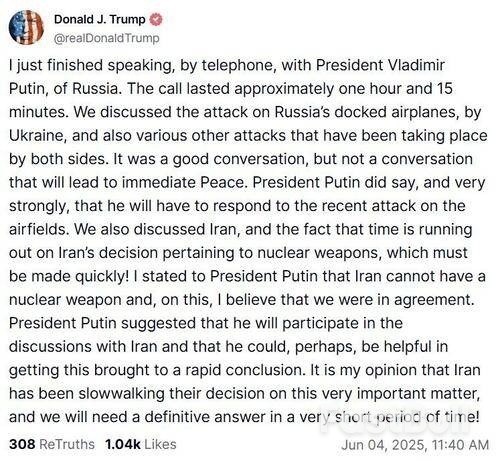
          The president revealed he has held a phone call with President Vladimir Putin on Wednesday, which significantly lasted about an hour and fifteen minutes. Trump warned that peace is not very close on the horizon and that the two leaders covered several pressing issues in their conversation.

          "We discussed the attack on Russia’s docked airplanes, by Ukraine, and also various other attacks that have been taking place by both sides." Trump went on to call it a good conversation, however "not a conversation that will lead to immediate Peace."

          That's when Trump clarified that "President Putin did say, and very strongly, that he will have to respond to the recent attack on the airfields."

          The Russian leader's words are consistent with Dmitry Medvedev's ominous words issued the day prior, wherein the deputy chairman of Russia’s Security Council, said "retribution is inevitable". Medvedev had warned of what's coming:

          "Our Army is pushing forward and will continue to advance. Everything that needs to be blown up will be blown up, and those who must be eliminated will be."

          Below: Ukraine on Wednesday released additional footage of strikes on four Russian air fields, including on two A-50 aircraft in Ivanovo...

          Trump didn't reveal much further in the way of details, after the White House in a Tuesday briefing again affirmed that President Trump did not have foreknowledge of the Ukrainian cross-border operation. (But did US intelligence? very likely so.)

          The fresh Truth Social statement was further taken up with Iran. "I stated to President Putin that Iran cannot have a nuclear weapon and, on this, I believe that we were in agreement. President Putin suggested that he will participate in the discussions with Iran and that he could, perhaps, be helpful in getting this brought to a rapid conclusion," he wrote.

          The US President concluded, "It is my opinion that Iran has been slowwalking their decision on this very important matter, and we will need a definitive answer in a very short period of time!"

          The full statement:

          This comes after the Ayatollah dismissed the latest US proposal which was submitted over the weekend. The central issue is the US demand that uranium enrichment be taken down to zero.

          Whether Iran, Ukraine-Russia, or Gaza - conservative voices have been urging Trump to stand by his campaign promises to end conflicts in hotspots around the world. But the fact remains that the US is still funding and weaponizing one side of these various wars, especially in the case of Ukraine.

          Of note in Trump's phone call with Putin is that nothing was stated from Trump in the way of a US demand that Putin not retaliate against Ukraine (or at least which was not disclosed in his Truth Social post).

          The absence of a preemptive condemnation for any major retaliation is interesting also combined with the White House Press Secretary saying yesterday to reporters that the war is very far away, which suggests it's no longer a top administration priority.

          Source: Zero Hedge

          Risk Warnings and Disclaimers
          You understand and acknowledge that there is a high degree of risk involved in trading. Following any strategies or investment methods may lead to potential losses. The content on the site is provided by our contributors and analysts for information purposes only. You are solely responsible for determining whether any trading assets, securities, strategy, or any other product is suitable for investing based on your own investment objectives and financial situation.
          Add to Favorites
          Share

          Private employers add fewest workers in over 2 years as 'hiring hesitancy' hits a slowing US labor market

          Adam

          Economic

          Private payroll additions tumbled in May as weak consumer sentiment and trade policy uncertainty weighed on hiring.
          On Wednesday, data from ADP showed private payrolls grew by just 37,000 in May, far fewer than the 114,000 expected by economists and below the 60,000 new jobs added in April. This marked the smallest increase in private payrolls since March 2023.
          "The weak numbers we're seeing now does not point to a labor market that's collapsing, but there is hiring hesitancy," ADP chief economist Nela Richardson said on a call with reporters.
          The survey encapsulated the week of May 12, meaning it included the initial reaction to the US-China 90-day tariff pause. Additionally, Trump's baseline tariffs of 10% on various countries were in effect.
          Richardson said trade policy uncertainty is just one of several factors weighing on hiring, with weak consumer sentiment also potentially weighing on labor market activity.
          "It's like driving through fog for some of our firms here," Richardson told Yahoo Finance during the call with reporters. "When you're in that situation, you can't really stop, but you might slow down. And so that's what we're seeing."
          She pointed to strong wage growth and low layoffs as points of strength in the labor market. ADP's May data showed wages for workers who changed jobs grew 7% while wages for those who stayed in the same job grew 4.5%. Both were unchanged from the month prior.
          "The key takeaway is a slowdown in hiring momentum, but still a labor market that's in good enough shape to support consumer spending and provide the Fed the latitude they've had on rates while it continues to decipher its inflation outlook," Richardson said.
          Richardson added that while May's data was weighed down by the economic "fog," it isn't a clear sign the labor market is taking a turn for the worse.
          "I do think that once the uncertainty clears a bit, you'll see more activity in the labor market," Richardson said.
          President Trump posted about the numbers on Truth Social shortly after the release, calling for Federal Reserve Chair Jerome Powell to cut interest rates.
          "ADP NUMBER OUT!!! “Too Late” Powell must now LOWER THE RATE," Trump said. "He is unbelievable!!! Europe has lowered NINE TIMES!"
          In another sign that tariff uncertainty is weighing on economic data, the Institute for Supply Management's Services PMI registered a reading of 49.9 in May, below the 51.6 seen in April and lower than the increase to 52 economists had expected. Readings above 50 for this index indicate an expansion in activity, while readings below 50 indicate contraction. May's data marked just the fourth time the services sector has fallen into contraction in the past five years.
          New orders tumbled to a reading of 46.4 in May, below the 52.3 seen the month prior. Meanwhile, the prices paid index increased to 68.7, up from 65.1 in April. This marked the highest prices paid reading since November 2022, when the Consumer Price Index (CPI) had shown inflation at 7.1%.
          Steve Miller, the chair of ISM's Services Business Survey, said in the release that "Tariff impacts are likely elevating prices paid."
          "May’s PMI level is not indicative of a severe contraction, but rather uncertainty that is being expressed broadly among ISM Services Business Survey panelists," Miller said. "The average reading of 50.8 percent over the last three months still indicates expansion in that time period, but it is a notable shift of 2 percentage points below its average of 52.8 percent over the previous nine months."

          source : finance.yahoo

          To stay updated on all economic events of today, please check out our Economic calendar
          Risk Warnings and Disclaimers
          You understand and acknowledge that there is a high degree of risk involved in trading. Following any strategies or investment methods may lead to potential losses. The content on the site is provided by our contributors and analysts for information purposes only. You are solely responsible for determining whether any trading assets, securities, strategy, or any other product is suitable for investing based on your own investment objectives and financial situation.
          Add to Favorites
          Share

          Most emerging market currencies set to hold on to gains

          Adam

          Forex

          Most emerging market currencies will hold the gains they have made this year or extend them against a retreating dollar in the next six months as traders ditch the U.S. exceptionalism trade that fuelled the greenback's dream run, a Reuters poll of FX strategists found.
          At the start of the year, emerging market currencies looked set for a rough ride on expectations of U.S. economic strength and delayed Federal Reserve interest rate cuts as well as trade tensions.
          But they have since defied expectations as U.S. President Donald Trump's broader-than-expected but erratically implemented tariff together with a deteriorating fiscal outlook have sparked a flight from the dollar and U.S. assets.
          That is expected to continue, with more than half the currencies polled forecast to trade in tight ranges or gain, while the rest were expected to give back only a small portion of this year's strong gains, according to a May 30-June 4 poll of more than 50 foreign exchange strategists.
          "The path of least resistance is a mildly weaker dollar at the moment," said Christopher Turner, head of FX strategy at ING.
          "We think (the decline) will be sort of modest and gradual and that should keep the mindset for investors to buy EM currencies on dips and that's kind of what we're seeing at the moment."
          Separately, the dollar has become a preferred funding currency as Trump's trade war fuels recession fears and outflows from U.S. assets.
          The EM carry trade - borrowing in low-yielding currencies to invest in higher-yielding EM ones - has long attracted investors chasing returns.
          High-yielders like the South African rand and Brazilian real are up around 6.0% and 10.0% respectively this year. The real was predicted to lose only about 2.0%, while the rand is likely to trade in a tight range over the next six months.
          "I think the trend for emerging market currency outperformance can continue in the second half of this year, but there are downside risks to be wary of as well," said Lee Hardman, senior currency economist at MUFG, referring to trade disruption and the potential hit to global growth.
          The Turkish lira, the weakest-performing emerging market currency so far this year, is projected to soften by another 8.0% from 39 per dollar to 42.8/dollar over the next six months.
          In Asia, the heavily managed Chinese yuan is expected to stay rangebound despite widespread concerns about weak demand in its economy, and a standoff with Washington over tariff policy and export controls.
          The Indian rupee, Korean won and Thai baht are all expected to gain just less than 1% by the end of November, pointing to steady but modest appreciation.
          "The big risk we see short-term for emerging market currencies is the risk of a turnaround in dollar sentiment," said Nick Rees, head of Macro Research at Monex Europe.
          "We do expect longer-term depreciation, but by the same token, we think the dollar looks too cheap on a fundamentals basis right now," added Rees.

          source :Reuters

          Risk Warnings and Disclaimers
          You understand and acknowledge that there is a high degree of risk involved in trading. Following any strategies or investment methods may lead to potential losses. The content on the site is provided by our contributors and analysts for information purposes only. You are solely responsible for determining whether any trading assets, securities, strategy, or any other product is suitable for investing based on your own investment objectives and financial situation.
          Add to Favorites
          Share

          The European Central Bank is almost guaranteed to cut rates. Here’s what could happen next

          Adam

          Economic

          Central Bank

          The European Central Bank is all but guaranteed to trim its key interest rate on Thursday.
          Markets were last pricing in an around 99% chance of a 25-basis-point cut, according to LSEG data. That would take the deposit facility rate to 2% — half of the mid-2023 high of 4%.
          But Europe faces a highly uncertain economic outlook, raising the question of what the ECB could do beyond Thursday’s meeting.
          Inflation is now hovering around the central bank’s 2% target again, with flash data on Tuesday showing consumer prices in the euro zone rose just 1.9% in May. Meanwhile, economic growth has still been sluggish: The gross domestic product in the euro zone grew by 0.3% in the first quarter of 2025, according to the latest estimate.
          The bloc faces many unknowns, both at home and abroad. That includes U.S. President Donald Trump’s tariff agenda — widely regarded as having a negative impact on growth — and potential retaliatory moves from the European Union, as well as how the EU’s major rearmament plans and Germany’s big fiscal shift could play out.
          Here’s what analysts say about the central bank’s potential next steps, and what they might mean for consumers.
          Rate outlook for the rest of the year
          Analysts and economists are widely expecting more interest rate cuts from the ECB later in the year, but aren’t counting on the bank to give a strong indication of where exactly rates could be headed.
          Tuesday’s inflation figures increased chances that, after this week, the next rate trim could come as soon as July, said Jack Allen-Reynolds, deputy chief euro zone economist.
          Others struck a more cautious tone, with Barclays economists suggesting in a note last week that rate cuts are on the horizon but won’t be implemented as soon.
          “We believe the ECB will remain non-committal on its policy path and continue to follow a meeting-by-meeting approach to maintain flexibility and optionality in policy calibration,” they said.
          They’re also expecting more rate cuts from the ECB, forecasting two more 25-basis-point reductions in September and December — meaning the ECB would hold rates steady over the summer months.
          Elsewhere, a BofA Global Research report published earlier this week said the ECB was now “running out of reasons not to go below 2%,” echoing the suggestion of further rate cuts on the horizon.
          But, it noted, the ECB is unlikely to give hints about just how low it could go.
          “We expect some acknowledgment that door is open to move rates below 2%, but a very explicit signal is unlikely. Uncertainty on tariffs will give the Governing Council enough cover to not pre-commit to more,” the report said.
          Crucially, the ECB will also publish its latest staff projections this week, highlighting what it expects for inflation and economic growth. That comes after the Organisation for Economic Co-operation and Development’s latest Economic Outlook report, which forecast 1% growth and 2.2% inflation for the euro area this year.

          How rate cuts might affect consumers

          For consumers, more ECB rate cuts would mainly affect borrowing and savings rates.
          Exactly how it plays out for them depends on what type of products they hold, and how long the rates on them are set for, Bas van Geffen, senior macro strategist at RaboResearch, told CNBC.
          For example, he said, a 10-year fixed mortgage and a demand deposit would be affected in different ways.
          “The interest rate on short-term deposits tends to follow the deposit rate quite closely,” he said.
          “A week after the ECB meeting, the policy rate goes into effect. So, if the ECB cuts the deposit rate Thursday, banks will receive 0.25% lower interest on their deposits with the central bank. This may cause them to lower the interest rate they pay on savings accounts as well,” van Geffen explained.
          Products with fixed longer-term rates have a more complicated relationship with central bank interest rates, he said, as they’re not only determined by the current policy rate — which often changes — but also by future expectations.
          “The market has long been expecting the ECB to cut rates this week. So, that may already be included in long-term interest rates to some extent. That also means that these long-term rates do not necessarily change after this week’s policy decision,” van Geffen said.

          source : cnbc

          To stay updated on all economic events of today, please check out our Economic calendar
          Risk Warnings and Disclaimers
          You understand and acknowledge that there is a high degree of risk involved in trading. Following any strategies or investment methods may lead to potential losses. The content on the site is provided by our contributors and analysts for information purposes only. You are solely responsible for determining whether any trading assets, securities, strategy, or any other product is suitable for investing based on your own investment objectives and financial situation.
          Add to Favorites
          Share
          FastBull
          Copyright © 2025 FastBull Ltd

          728 RM B 7/F GEE LOK IND BLDG NO 34 HUNG TO RD KWUN TONG KLN HONG KONG

          TelegramInstagramTwitterfacebooklinkedin
          App Store Google Play Google Play
          Products
          Charts

          Chats

          Q&A with Experts
          Screeners
          Economic Calendar
          Data
          Tools
          Membership
          Features
          Function
          Markets
          Copy Trading
          Latest Signals
          Contests
          News
          Analysis
          24/7
          Columns
          Education
          Company
          Careers
          About Us
          Contact Us
          Advertising
          Help Center
          Feedback
          User Agreement
          Privacy Policy
          Business

          White Label

          Data API

          Web Plug-ins

          Poster Maker

          Affiliate Program

          Risk Disclosure

          The risk of loss in trading financial instruments such as stocks, FX, commodities, futures, bonds, ETFs and crypto can be substantial. You may sustain a total loss of the funds that you deposit with your broker. Therefore, you should carefully consider whether such trading is suitable for you in light of your circumstances and financial resources.

          No decision to invest should be made without thoroughly conducting due diligence by yourself or consulting with your financial advisors. Our web content might not suit you since we don't know your financial conditions and investment needs. Our financial information might have latency or contain inaccuracy, so you should be fully responsible for any of your trading and investment decisions. The company will not be responsible for your capital loss.

          Without getting permission from the website, you are not allowed to copy the website's graphics, texts, or trademarks. Intellectual property rights in the content or data incorporated into this website belong to its providers and exchange merchants.

          Not Logged In

          Log in to access more features

          FastBull Membership

          Not yet

          Purchase

          Become a signal provider
          Help Center
          Customer Service
          Dark Mode
          Price Up/Down Colors

          Log In

          Sign Up

          Position
          Layout
          Fullscreen
          Default to Chart
          The chart page opens by default when you visit fastbull.com