• Trade
  • Markets
  • Copy
  • Contests
  • News
  • 24/7
  • Calendar
  • Q&A
  • Chats
Trending
Screeners
SYMBOL
LAST
BID
ASK
HIGH
LOW
NET CHG.
%CHG.
SPREAD
SPX
S&P 500 Index
6814.50
6814.50
6814.50
6861.30
6801.50
-12.91
-0.19%
--
DJI
Dow Jones Industrial Average
48360.83
48360.83
48360.83
48679.14
48285.67
-97.21
-0.20%
--
IXIC
NASDAQ Composite Index
23089.97
23089.97
23089.97
23345.56
23012.00
-105.19
-0.45%
--
USDX
US Dollar Index
97.970
98.050
97.970
98.070
97.740
+0.020
+ 0.02%
--
EURUSD
Euro / US Dollar
1.17429
1.17436
1.17429
1.17686
1.17262
+0.00035
+ 0.03%
--
GBPUSD
Pound Sterling / US Dollar
1.33657
1.33667
1.33657
1.34014
1.33546
-0.00050
-0.04%
--
XAUUSD
Gold / US Dollar
4303.89
4304.30
4303.89
4350.16
4285.08
+4.50
+ 0.10%
--
WTI
Light Sweet Crude Oil
56.354
56.384
56.354
57.601
56.233
-0.879
-1.54%
--

Community Accounts

Signal Accounts
--
Profit Accounts
--
Loss Accounts
--
View More

Become a signal provider

Sell trading signals to earn additional income

View More

Guide to Copy Trading

Get started with ease and confidence

View More

Signal Accounts for Members

All Signal Accounts

Best Return
  • Best Return
  • Best P/L
  • Best MDD
Past 1W
  • Past 1W
  • Past 1M
  • Past 1Y

All Contests

  • All
  • Trump Updates
  • Recommend
  • Stocks
  • Cryptocurrencies
  • Central Banks
  • Featured News
Top News Only
Share

New York Fed Accepts $2.601 Billion Of $2.601 Billion Submitted To Reverse Repo Facility On Dec 15

Share

Turkey: Shoots Down A Drone In The Black Sea Using F-16 Fighter Jets

Share

Goldman Sachs Says They Believe That The Copper Price Is Vulnerable To An Ai-Linked Price Correction

Share

Goldman Sachs Upgrades 2026 Copper Price Forecast To $11400 From $10,650

Share

Attempts By Ukrainian Troops To Advance From The South-West To Outskirts Of Kupiansk Are Being Thwarted

Share

Russian Troops Control All Of Kupiansk - IFX Cites Russian Military

Share

On Monday (December 15), The South Korean Won Ultimately Rose 0.60% Against The US Dollar, Closing At 1468.91 Won. The Won Was On An Upward Trend Throughout The Day, Rising Significantly At 17:00 Beijing Time And Reaching A Daily High Of 1463.04 Won At 17:36

Share

Health Ministry: Israeli Forces Kill Palestinian Teen In West Bank

Share

New York Federal Reserve President Williams: Over Time, The Size Of Reserves Could Grow From $2.9 Trillion

Share

New York Fed President Williams: AI Valuations Are High, But There Is A Real Driving Factor

Share

New York Federal Reserve President Williams: The Job Market Is In Very Good Shape

Share

New York Fed President Williams: 'Very Supportive' Of USA Central Bank's Decision To Cut Interest Rates Last Week

Share

New York Fed President Williams: 'Too Early To Say' What Central Bank Should Do At January Meeting

Share

New York Fed President Williams: Strong Markets Part Of Reason Why Economy Will Grow Robustly In 2026

Share

New York Fed President Williams: What Constitutes Ample Reserves Will Change Over Time

Share

New York Fed President Williams: Market Valuations 'Elevated,' But There Are Reasons For Pricing

Share

New York Fed President Williams: Ample Reserves System Working Very Well

Share

New York Fed President Williams: Some Signs That Parts Of Underlying Economy Not As Strong As GDP Data Suggests

Share

New York Fed President Williams: Expects Coming Job Data Will Show Gradual Cooling

Share

Ukraine President Zelenskiy: Monitoring Of Ceasefire Should Be Part Of Security Guarantees

TIME
ACT
FCST
PREV
Japan Tankan Small Manufacturing Outlook Index (Q4)

A:--

F: --

P: --

Japan Tankan Large Non-Manufacturing Outlook Index (Q4)

A:--

F: --

P: --

Japan Tankan Large Manufacturing Outlook Index (Q4)

A:--

F: --

P: --

Japan Tankan Small Manufacturing Diffusion Index (Q4)

A:--

F: --

P: --

Japan Tankan Large-Enterprise Capital Expenditure YoY (Q4)

A:--

F: --

P: --

U.K. Rightmove House Price Index YoY (Dec)

A:--

F: --

P: --

China, Mainland Industrial Output YoY (YTD) (Nov)

A:--

F: --

P: --

China, Mainland Urban Area Unemployment Rate (Nov)

A:--

F: --

P: --

Saudi Arabia CPI YoY (Nov)

A:--

F: --

P: --

Euro Zone Industrial Output YoY (Oct)

A:--

F: --

P: --

Euro Zone Industrial Output MoM (Oct)

A:--

F: --

P: --

Canada Existing Home Sales MoM (Nov)

A:--

F: --

P: --

Canada National Economic Confidence Index

A:--

F: --

P: --

Canada New Housing Starts (Nov)

A:--

F: --

P: --
U.S. NY Fed Manufacturing Employment Index (Dec)

A:--

F: --

P: --

U.S. NY Fed Manufacturing Index (Dec)

A:--

F: --

P: --

Canada Core CPI YoY (Nov)

A:--

F: --

P: --

Canada Manufacturing Unfilled Orders MoM (Oct)

A:--

F: --

P: --

U.S. NY Fed Manufacturing Prices Received Index (Dec)

A:--

F: --

P: --

U.S. NY Fed Manufacturing New Orders Index (Dec)

A:--

F: --

P: --

Canada Manufacturing New Orders MoM (Oct)

A:--

F: --

P: --

Canada Core CPI MoM (Nov)

A:--

F: --

P: --

Canada Trimmed CPI YoY (SA) (Nov)

A:--

F: --

P: --

Canada Manufacturing Inventory MoM (Oct)

A:--

F: --

P: --

Canada CPI YoY (Nov)

A:--

F: --

P: --

Canada CPI MoM (Nov)

A:--

F: --

P: --

Canada CPI YoY (SA) (Nov)

A:--

F: --

P: --

Canada Core CPI MoM (SA) (Nov)

A:--

F: --

P: --

Canada CPI MoM (SA) (Nov)

A:--

F: --

P: --

Federal Reserve Board Governor Milan delivered a speech
U.S. NAHB Housing Market Index (Dec)

A:--

F: --

P: --

Australia Composite PMI Prelim (Dec)

--

F: --

P: --

Australia Services PMI Prelim (Dec)

--

F: --

P: --

Australia Manufacturing PMI Prelim (Dec)

--

F: --

P: --

Japan Manufacturing PMI Prelim (SA) (Dec)

--

F: --

P: --

U.K. 3-Month ILO Employment Change (Oct)

--

F: --

P: --

U.K. Unemployment Claimant Count (Nov)

--

F: --

P: --

U.K. Unemployment Rate (Nov)

--

F: --

P: --

U.K. 3-Month ILO Unemployment Rate (Oct)

--

F: --

P: --

U.K. Average Weekly Earnings (3-Month Average, Including Bonuses) YoY (Oct)

--

F: --

P: --

U.K. Average Weekly Earnings (3-Month Average, Excluding Bonuses) YoY (Oct)

--

F: --

P: --

France Services PMI Prelim (Dec)

--

F: --

P: --

France Composite PMI Prelim (SA) (Dec)

--

F: --

P: --

France Manufacturing PMI Prelim (Dec)

--

F: --

P: --

Germany Services PMI Prelim (SA) (Dec)

--

F: --

P: --

Germany Manufacturing PMI Prelim (SA) (Dec)

--

F: --

P: --

Germany Composite PMI Prelim (SA) (Dec)

--

F: --

P: --

Euro Zone Composite PMI Prelim (SA) (Dec)

--

F: --

P: --

Euro Zone Services PMI Prelim (SA) (Dec)

--

F: --

P: --

Euro Zone Manufacturing PMI Prelim (SA) (Dec)

--

F: --

P: --

U.K. Services PMI Prelim (Dec)

--

F: --

P: --

U.K. Manufacturing PMI Prelim (Dec)

--

F: --

P: --

U.K. Composite PMI Prelim (Dec)

--

F: --

P: --

Euro Zone ZEW Economic Sentiment Index (Dec)

--

F: --

P: --

Germany ZEW Current Conditions Index (Dec)

--

F: --

P: --

Germany ZEW Economic Sentiment Index (Dec)

--

F: --

P: --

Euro Zone Trade Balance (Not SA) (Oct)

--

F: --

P: --

Euro Zone ZEW Current Conditions Index (Dec)

--

F: --

P: --

Euro Zone Trade Balance (SA) (Oct)

--

F: --

P: --

Euro Zone Total Reserve Assets (Nov)

--

F: --

P: --

U.K. Inflation Rate Expectations

--

F: --

P: --

Q&A with Experts
    • All
    • Chatrooms
    • Groups
    • Friends
    Connecting
    .
    .
    .
    Type here...
    Add Symbol or Code

      No matching data

      All
      Trump Updates
      Recommend
      Stocks
      Cryptocurrencies
      Central Banks
      Featured News
      • All
      • Russia-Ukraine Conflict
      • Middle East Flashpoint
      • All
      • Russia-Ukraine Conflict
      • Middle East Flashpoint
      Search
      Products

      Charts Free Forever

      Chats Q&A with Experts
      Screeners Economic Calendar Data Tools
      Membership Features
      Data Warehouse Market Trends Institutional Data Policy Rates Macro

      Market Trends

      Market Sentiment Order Book Forex Correlations

      Top Indicators

      Charts Free Forever
      Markets

      News

      News Analysis 24/7 Columns Education
      From Institutions From Analysts
      Topics Columnists

      Latest Views

      Latest Views

      Trending Topics

      Top Columnists

      Latest Update

      Signals

      Copy Rankings Latest Signals Become a signal provider AI Rating
      Contests
      Brokers

      Overview Brokers Assessment Rankings Regulators News Claims
      Broker listing Forex Brokers Comparison Tool Live Spread Comparison Scam
      Q&A Complaint Scam Alert Videos Tips to Detect Scam
      More

      Business
      Events
      Careers About Us Advertising Help Center

      White Label

      Data API

      Web Plug-ins

      Affiliate Program

      Awards Institution Evaluation IB Seminar Salon Event Exhibition
      Vietnam Thailand Singapore Dubai
      Fans Party Investment Sharing Session
      FastBull Summit BrokersView Expo
      Recent Searches
        Top Searches
          Markets
          News
          Analysis
          User
          24/7
          Economic Calendar
          Education
          Data
          • Names
          • Latest
          • Prev

          View All

          No data

          Scan to Download

          Faster Charts, Chat Faster!

          Download App
          English
          • English
          • Español
          • العربية
          • Bahasa Indonesia
          • Bahasa Melayu
          • Tiếng Việt
          • ภาษาไทย
          • Français
          • Italiano
          • Türkçe
          • Русский язык
          • 简中
          • 繁中
          Open Account
          Search
          Products
          Charts Free Forever
          Markets
          News
          Signals

          Copy Rankings Latest Signals Become a signal provider AI Rating
          Contests
          Brokers

          Overview Brokers Assessment Rankings Regulators News Claims
          Broker listing Forex Brokers Comparison Tool Live Spread Comparison Scam
          Q&A Complaint Scam Alert Videos Tips to Detect Scam
          More

          Business
          Events
          Careers About Us Advertising Help Center

          White Label

          Data API

          Web Plug-ins

          Affiliate Program

          Awards Institution Evaluation IB Seminar Salon Event Exhibition
          Vietnam Thailand Singapore Dubai
          Fans Party Investment Sharing Session
          FastBull Summit BrokersView Expo

          Tom Lee Predicts Bitcoin's Rise As Gold's Replacement

          Winkelmann

          Commodity

          Cryptocurrency

          Forex

          Economic

          Summary:

          Tom Lee of Fundstrat Global Advisors suggests Bitcoin will mature as a replacement for gold, supported by increased institutional adoption. He highlights evolving dynamics, including supply constraints and regulatory changes. His forecast anticipates Bitcoin's price escalation.

          Key Points:

          ● Tom Lee foresees Bitcoin replacing gold.
          ● Institutional adoption may end Bitcoin cycles.
          ● Bitcoin projected to spike in value.

          Tom Lee: Bitcoin's Rise and Institutional Adoption

          Tom Lee, co-founder of Fundstrat Global Advisors, asserts Bitcoin is replacing gold and ending its four-year cycle, due to increasing institutional adoption and macroeconomic shifts.Lee's perspective suggests Bitcoin's growing legitimacy could transform global financial landscapes, potentially driving significant price appreciation, attracting investor interest, and impacting associated cryptocurrencies.

          Lee cites Bitcoin's superior properties over gold, emphasizing its role in the financial market. Institutional interest is reportedly rising post-ETF approvals, driving a shift in Bitcoin's traditional boom-bust cycles, potentially altering its market dynamics.The forecast potentially impacts global markets, stirring interest among investors and policymakers. The demand and supply imbalance noted by Lee could drive up Bitcoin's value, affecting how governments and investors view cryptocurrency investments.

          Financial implications include a prospective revaluation of Bitcoin's store of value, with the U.S. possibly integrating it into strategic reserves. Regulatory adaptations could bolster this shift, fostering comfort among institutional stakeholders and promoting further adoption.The potential growth of Bitcoin could affect related cryptocurrencies such as Ethereum and Solana. Lee anticipates significant price movements due to heightened institutional flows and network adoption patterns. The financial landscape may experience material shifts in asset valuation structures.

          Historically, Bitcoin's four-year cycle has led to significant price upticks, but Lee predicts a new paradigm by 2025. As Bitcoin matures, backed by substantial institutional backing, it could surpass gold’s market cap, reshaping investment norms and asset management strategies. Lee remarked, "95% of all Bitcoin has been mined, but 95% of the world doesn't own Bitcoin. There's a huge demand versus supply imbalance."


          Source: CryptoSlate

          To stay updated on all economic events of today, please check out our Economic calendar
          Risk Warnings and Disclaimers
          You understand and acknowledge that there is a high degree of risk involved in trading. Following any strategies or investment methods may lead to potential losses. The content on the site is provided by our contributors and analysts for information purposes only. You are solely responsible for determining whether any trading assets, securities, strategy, or any other product is suitable for investing based on your own investment objectives and financial situation.
          Add to Favorites
          Share

          New Zealand’s Unemployment Rate Rises to 4½ High, Kiwi Pushes Higher

          Blue River

          Technical Analysis

          The New Zealand dollar continues to have a quiet week. In the European session, NZD/USD is trading at 0.5923, up 0.37% on the day. The kiwi has been under pressure, falling 3.4% against the US dollar in July.

          New Zealand’s unemployment rises, job growth declines

          New Zealand’s employment report for Q2 was pretty much as expected, but the news wasn’t good. The unemployment rate rose to 5.2% from 5.1% in Q1, below the consensus of 5.3%. This marked the highest unemployment rate since Q3 2020. Employment Change declined by 0.1%, down from a 0.1% gain in Q1 and matching the consensus. This was the third decline in four quarters.

          The weak figures point to growing slack in the labor market as the economy continues to struggle. Global trade tensions remain high and New Zealand’s export-reliant economy has taken a hit from softer global demand.

          The Reserve Bank of New Zealand will be paying close attention to the weak job numbers, which support a rate cut in order to provide a boost to the economy. The RBNZ maintained rates in July after lowering rates at six consecutive meetings. The conditions for a rate cut at the Aug. 20 meeting seem ripe and the markets have priced in a quarter-point reduction at around 85%.

          We’ll get an updated look at the inflation picture on Thursday. Inflation Expectations rose to 2.3% in the second quarter, the highest in a year. This is the final tier-1 release prior to the August rate meeting.

          Fed expected to cut in September

          Three FOMC members will speak later today and investors will be hoping for some insights regarding the Federal Reserve’s rate plans. The Fed hasn’t lowered rates since December but is widely expected to hit the rate trigger at the September meeting.

          NZD/USD Technical

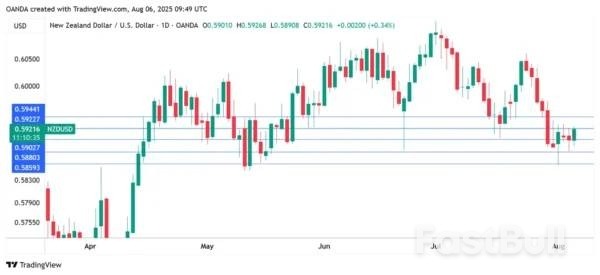
          NZDUSD 1-Day Chart, Aug. 6, 2025

          • NZD/USD has pushed above resistance at 0.5902 and testing 0.5922. Next, there is resistance at 0.5944
          • 0.5880 and 0.5860 are providing support

          Source: ACTIONFOREX

          Risk Warnings and Disclaimers
          You understand and acknowledge that there is a high degree of risk involved in trading. Following any strategies or investment methods may lead to potential losses. The content on the site is provided by our contributors and analysts for information purposes only. You are solely responsible for determining whether any trading assets, securities, strategy, or any other product is suitable for investing based on your own investment objectives and financial situation.
          Add to Favorites
          Share

          Bulls Get Another Reason to Worry As Sentiment Gauge Flashes Red

          Glendon

          Economic

          Stocks

          Stock bulls have another reason to worry that the blistering rally in American equities may be about to cool.

          The Bloomberg Intelligence Market Pulse Index pushed to a “manic” reading last month, a sign that investor exuberance may be running too hot. The measure combines six metrics like market breadth, volatility and leverage to deliver a reading on investor sentiment. When it gets into overheated territory, returns tend to weaken in the following three months.

          The Pulse index’s rise comes after the S&P 500 rallied almost 30% from its April low even as the American economy and labor market have shown signs of weakening. Surveys of investor sentiment indicate bullishness is growing toward alarming levels among Americans. And just this week, Wall Street strategists issued a slew of warnings that equities could face a pullback.

          “Risk taking in the stock market has gotten a bit overheated, so more muted returns may be in store in the next few months,” Michael Casper, senior US equity strategist at BI, said by phone. “But this doesn’t necessarily signal a major selloff is imminent. Sentiment could hover at these levels for awhile, which may lead to a bumpier path for stocks in the second half of the year.”

          The S&P 500 notched its worst week since May last week before dip buyers stepped in to deliver its best one-day gain since that same month. The index slipped 0.5% Tuesday.

          BI’s Pulse index hit 0.6 in July for the second straight month to push it into the “manic” zone. Over the past 30 years, the Russell 3000 Index — a crucial benchmark of the virtually the entire US stock market — has averaged just a 2.9% return over the next three months, according to data compiled by BI’s Casper and Gillian Wolff. When the gauge swings into what BI dubs “panic” territory, the Russell 3000 averages a 9% gain in the next 90 days.

          The index signal jibes with recent warnings from a host of Wall Street strategists. Morgan Stanley’s Mike Wilson sees a correction of up to 10% this quarter, while Evercore’s Julian Emanuel is expecting a drop of up to 15%. A team at Deutsche Bank notes that a small drawdown in equities is overdue.

          Added to bulls’ worries is seasonality. August and September have historically been the two worst months for the S&P 500. Friday’s jobs report showed the labor market cooling, while a private reading on the American services sector on Tuesday signaled a slowdown in output and an increase in price pressures — all while President Donald Trump pushes ahead with tariffs that are the highest since 1934.

          The Pulse index has been a reliable harbinger of market performance in recent years. The readings hit “panic” levels ahead of the March 2023 regional banking crisis, the December 2018 tariff-induced slide and the 2012 European Union debt crisis.

          Among the reasons for the latest “manic” reading were was the re-emergence of the meme frenzy in late July, with retail traders snapping up speculative stocks like Opendoor Technologies Inc. and Kohl’s Corp.

          Of course, sentiment can stay frothy for weeks — even months — before stocks suffer a significant drop. It hit a manic reading during January 2021’s meme craze but hovered in that territory for over a year before the S&P 500 slumped into a bear market.

          Perma-bull Ed Yardeni of eponymous firm Yardeni Research noted that not all signs are ominious. In the week through July 29, a ratio of bulls to bears identified in an Investors Intelligence survey of newsletter writers hovered at a ratio of 2.4, below a long-term average of 2.6 over the past decade, Yardeni Research analysis shows.

          “In other words, sentiment wasn’t overly bullish,” Yardeni wrote in a note to clients on Sunday. “Rather than yet another correction this year, we are more likely to see seasonal choppiness.”

          BI’s Market Pulse Index is based on six inputs: price breadth, pairwise correlation, low-volatility performance, defensive-versus-cyclical performance, high-versus-low leverage performance and high-yield spreads. The major difference last month was that high-yield spreads were manic in July, joining high versus low vol performance in that territory.

          The Market Pulse Index ranges from 0 to 1, with the latter denoting periods of risk-on sentiment, or extreme “mania,” as BI defines it, while a level close to 0 shows a risk-off period of extreme “panic.” In July, the indicator rose to nearly 0.7 — approaching a mania stage.

          Generally, two repeat readings above 0.6, like now, suggests there will be some mean-reversion activity in the equity market over the next three months, with small caps underperforming their larger counterparts, according to Casper. In fact, three months after a manic reading, the small cap Russell 2000 Index historically has underperformed the S&P 500 by 1.8% after such a figure.

          “Stocks have come a long way in a short time and things seem stretched,” said Adam Phillips, managing director of portfolio strategy at EP Wealth Advisors, whose firm is neutral US equities and is snapping up dividend-payers like energy, financial and industrial shares. “We’re not chasing this rally or stepping on the gas pedal.”

          Source: Bloomberg Europe

          To stay updated on all economic events of today, please check out our Economic calendar
          Risk Warnings and Disclaimers
          You understand and acknowledge that there is a high degree of risk involved in trading. Following any strategies or investment methods may lead to potential losses. The content on the site is provided by our contributors and analysts for information purposes only. You are solely responsible for determining whether any trading assets, securities, strategy, or any other product is suitable for investing based on your own investment objectives and financial situation.
          Add to Favorites
          Share

          Oil Prices Rebound as Market Focus Shifts to Trump’s Threat Against Russian Energy Trade

          Gerik

          Economic

          Geopolitical Risk Reignites Market After Four-Day Decline

          Crude oil rebounded midweek after a sustained decline, with Brent climbing back above $68 per barrel and West Texas Intermediate nearing $66. The rally follows speculation that U.S. President Donald Trump may impose secondary sanctions on nations continuing to buy Russian oil such as China and India in a bid to intensify pressure on Moscow.
          The market reaction reflects growing sensitivity to geopolitical developments that may disrupt global trade flows. Trump’s rhetoric has already triggered diplomatic unease, and U.S. envoy Steve Witkoff’s arrival in Moscow for last-minute talks underscores the seriousness of the looming deadline. With just two days left before Trump's ultimatum for a ceasefire in Ukraine, oil traders are recalibrating risk scenarios that could limit Russian exports or provoke retaliatory trade restrictions.

          OPEC+ Output Decision Fuels Oversupply Concerns

          The upward momentum in oil prices is occurring alongside broader uncertainty surrounding supply. OPEC+ recently confirmed its decision to increase production again in September, continuing its gradual rollback of earlier output cuts. This policy shift has sparked concerns that global supply could once again outpace demand, particularly in the context of a weakening economic outlook in major consumer markets.
          The decision by OPEC+ to proceed with production hikes despite price volatility reflects a broader strategy of supply normalization. However, this move, combined with the potential for weaker demand due to economic softening in the United States and Europe, may limit the sustainability of the current price rebound.

          Soft U.S. Economic Data Adds Headwinds to Oil Demand Outlook

          Macroeconomic indicators in the U.S. are also weighing on market sentiment. Recent data revealed stagnation in the services sector in July, adding to signals of a broader economic deceleration. These figures contribute to market fears that slowing domestic activity could reduce near-term energy consumption, weakening the demand side of the oil equation.
          Despite geopolitical premiums, traders remain cautious given these economic indicators. Forward-looking market gauges suggest a loosening of supply-demand balance, with front-month contract spreads narrowing an indication that physical markets may be entering a softer phase.

          Mixed U.S. Inventory Signals Keep Traders Wary

          Data from the petroleum industry has provided a mixed view of short-term supply conditions. U.S. crude inventories reportedly fell by 4.2 million barrels last week, suggesting a drawdown in domestic stockpiles. However, inventory levels at Cushing, Oklahoma the primary delivery point for WTI futures rose, along with distillate reserves. These conflicting signals complicate interpretations of short-term tightness versus longer-term oversupply.
          An official inventory report is expected later, which could provide additional clarity. Until then, the market remains volatile, with investors weighing multiple, and at times contradictory, inputs from policy, macroeconomics, and physical inventory trends.

          Oil Market Caught Between Geopolitical Risk and Economic Softening

          The rebound in oil prices underscores the market's acute responsiveness to geopolitical developments, particularly those involving U.S.-Russia tensions and global energy trade disruptions. However, this upside is tempered by growing concerns over macroeconomic weakness and rising production levels.
          The causal link between Trump’s tariff threats and near-term price action is evident, though the longer-term impact remains contingent on enforcement, global diplomatic responses, and structural supply adjustments. Meanwhile, OPEC+ actions and U.S. economic indicators continue to serve as critical variables in determining whether this rebound is temporary or the beginning of a new upward trend.

          Source: Bloomberg

          To stay updated on all economic events of today, please check out our Economic calendar
          Risk Warnings and Disclaimers
          You understand and acknowledge that there is a high degree of risk involved in trading. Following any strategies or investment methods may lead to potential losses. The content on the site is provided by our contributors and analysts for information purposes only. You are solely responsible for determining whether any trading assets, securities, strategy, or any other product is suitable for investing based on your own investment objectives and financial situation.
          Add to Favorites
          Share

          Asian Shares Trade Mostly Higher After Stocks on Wall Street Extend Losses

          Michelle

          Economic

          Stocks

          Asian shares were mostly higher in muted trading Wednesday, after discouraging signs about the U.S. economy sent Wall Street shares declining.

          Investors are sifting through a slew of corporate earnings reports to assess how businesses may have been affected by U.S. President Donald Trump’s tariffs.

          Among Japanese companies, automakers Honda Motor Co. and Toyota Motor Corp. will report fiscal first quarter results this week, as will electronics and entertainment company Sony Corp.

          Japan’s benchmark Nikkei 225 rose 0.6% to finish at 40,794.86. Australia’s S&P/ASX 200 added 0.8% to 8,843.70. South Korea’s Kospi was little changed, gaining less than 0.1% to 3,198.14.

          Hong Kong’s Hang Seng rose 0.2% to 24,958.75, while the Shanghai Composite gained 0.8% to 3,633.99.

          U.S. futures were up 0.5%.

          On Tuesday, the S&P 500 fell 0.5% to 6,299.19, coming off a whipsaw stretch where it went from its worst day since May to its best since May. The Dow Jones Industrial Average dropped 0.1% to 44,111.74, and the Nasdaq composite fell 0.7% to 20,916.55.

          A weaker-than-expected report on activity for U.S. businesses in services industries like transportation and retail added to worries that Trump’s tariffs may be hurting the economy. But conversely such indicators raise hopes the Federal Reserve may cut interest rates. That along with a stream of stronger-than-expected profit reports from U.S. companies helped to keep losses in check. The S&P 500 remains within 1.4% of its record.

          The pressure is on companies to report bigger profits after the U.S. stock market surged to record after record from a low point in April. The big rally fueled criticism that the broad market had become too expensive.

          For stock prices to look like better bargains, companies could produce bigger profits, or interest rates could fall. The latter may happen in September, when the Fed has its next policy meeting.

          Expectations have built sharply for a rate cut at that meeting since a report on the U.S. job market on Friday came in much weaker than economists expected. Lower interest rates would make stocks look less expensive, while also giving the overall economy a boost. The potential downside is that they could push inflation higher.

          Treasury yields sank sharply after Friday’s release of the jobs report, and they haven’t recovered. The yield on the 10-year Treasury eased to 4.19% from 4.22% late Monday and from 4.39% just before the release of the jobs report. That’s a significant move for the bond market.

          In energy trading, benchmark U.S. crude rose 57 cents to $65.73 a barrel. Brent crude, the international standard, added 64 cents to $68.28 a barrel.

          In currency trading, the U.S. dollar edged up to 147.66 Japanese yen from 147.61 yen. The euro cost $1.1575, down from $1.1579.

          Source: BNN BIoomberg

          To stay updated on all economic events of today, please check out our Economic calendar
          Risk Warnings and Disclaimers
          You understand and acknowledge that there is a high degree of risk involved in trading. Following any strategies or investment methods may lead to potential losses. The content on the site is provided by our contributors and analysts for information purposes only. You are solely responsible for determining whether any trading assets, securities, strategy, or any other product is suitable for investing based on your own investment objectives and financial situation.
          Add to Favorites
          Share

          Euro Zone Retail Sales Beat Expectations, Bolstered by Strong Domestic Demand

          Gerik

          Economic

          Revised Data Reveals Stronger-than-Expected Retail Momentum

          The euro zone retail sector showed unexpected strength in June 2025, with sales rising by 3.1% compared to the same month last year, according to new figures from Eurostat. This figure exceeded the 2.6% increase anticipated by economists and reflects an upward revision to previous months' performance, signaling a more robust trajectory for consumer spending than initially assumed.
          Although monthly retail growth for June came in at 0.3%, slightly below the 0.4% forecast, revisions to April and May data altered the underlying trend, leading to a stronger annual performance. The cumulative effect of these adjustments suggests that the euro zone economy is withstanding external pressures more effectively than earlier projections had implied.

          Domestic Consumption Cushions Trade-Driven Headwinds

          The upward revision to retail data reinforces the narrative that the euro zone’s internal demand is acting as a stabilizing force amid global trade volatility. Despite concerns that protectionist measures and weakening global trade flows might weigh on the region’s economic output, indicators such as GDP growth and consumer sentiment have remained resilient.
          The 3.1% annual rise in retail sales was fueled by a 4.3% increase in non-food product purchases and a 4.0% gain in motor fuel sales. These categories point to broad-based consumer activity, which remains a key driver of overall economic health in the 20-member currency bloc.
          Spain led the region with a 6.4% year-on-year increase in retail sales, while Germany also posted a strong performance with a 4.8% gain both above the euro zone average. These figures highlight how large euro zone economies are contributing disproportionately to the bloc’s retail recovery, driven by solid labor markets and wage growth.

          Retail Data Suggests Structural Resilience Despite External Risks

          The resilience in consumer spending suggests a decoupling between external trade tensions and internal economic activity, at least in the short term. While euro zone exports remain exposed to fluctuations in global trade policy, the domestic economy appears to be anchored by stable employment and improving disposable incomes.
          This relationship is more correlational than causally immune external shocks can eventually transmit inward but for now, the data indicate that the euro zone’s economic foundation remains intact, helped by relatively low inflation and steady monetary policy from the European Central Bank.
          The broader European Union mirrored the euro zone’s performance, with retail sales also increasing by 0.3% month-on-month and 3.1% year-on-year, suggesting that consumer resilience extends beyond the core economies.

          Retail Sector Supports Euro Zone Growth Outlook

          June’s stronger-than-expected retail sales reinforce the view that the euro zone is maintaining its economic footing despite geopolitical headwinds and trade frictions. The positive revisions to prior months and the strength in non-food and fuel-related spending suggest that domestic demand may continue to underpin growth into the third quarter.
          While external risks persist, especially amid a global trade war and slowing industrial activity, the current momentum in household consumption provides a buffer that could delay or mitigate broader economic softening. Future data will need to confirm whether this trend is sustainable, particularly if inflationary pressures or monetary tightening re-emerge.

          Source: Reuters

          To stay updated on all economic events of today, please check out our Economic calendar
          Risk Warnings and Disclaimers
          You understand and acknowledge that there is a high degree of risk involved in trading. Following any strategies or investment methods may lead to potential losses. The content on the site is provided by our contributors and analysts for information purposes only. You are solely responsible for determining whether any trading assets, securities, strategy, or any other product is suitable for investing based on your own investment objectives and financial situation.
          Add to Favorites
          Share

          Political Resistance Builds as BOJ Faces Pressure Over Potential Rate Hikes Amid U.S. Tariff Shock

          Gerik

          Economic

          Concerns Over Monetary Tightening Amid Fragile Recovery

          Ken Saito, a senior member of Japan’s ruling Liberal Democratic Party (LDP), has voiced strong concerns over potential interest rate hikes by the Bank of Japan (BOJ), arguing that the economy remains too fragile to withstand tighter monetary policy. His remarks reflect a growing divide between political leadership and monetary authorities as Japan grapples with mounting economic pressures, including the threat of U.S. tariffs.
          Saito emphasized that if the BOJ acts too aggressively, it risks derailing Japan’s delicate recovery from decades of stagnation and low inflation. His position underscores a potential conflict between short-term political priorities such as stabilizing wages and corporate profitability and the BOJ’s longer-term goal of achieving sustainable inflation above 2%.
          While inflation has been persistent enough to prompt a rate hike to 0.5% earlier this year, real interest rates remain deeply negative, and BOJ Governor Kazuo Ueda has indicated the possibility of further tightening. However, Saito argues that any such move must be carefully coordinated with government policy to avoid undermining wage growth and household consumption.

          U.S. Tariffs Add Pressure to Japan’s Economic Outlook

          A central factor in Saito’s caution is the anticipated impact of increased U.S. tariffs on Japanese exporters, particularly automakers. These levies threaten corporate margins and may hinder wage increases, which are crucial for the BOJ’s inflation outlook. While the central bank is concerned about rising prices, Saito’s comments suggest that policymakers must also account for how external shocks such as trade frictions may suppress domestic demand.
          The link between higher tariffs and constrained wage growth is not merely coincidental but causally significant. If corporate profits are squeezed, firms are less likely to sustain salary increases, potentially stalling the demand-led inflation cycle the BOJ is trying to foster. As such, inflationary pressures may not be as durable as headline figures suggest, particularly if they stem more from cost-push than demand-pull dynamics.

          Political Uncertainty Compounds Economic Risks

          Saito’s warning comes at a time of heightened political instability. Following a disastrous electoral performance, the LDP and its junior coalition partner Komeito have lost control of both houses of parliament. This legislative deadlock complicates economic governance, especially as Prime Minister Shigeru Ishiba resists calls to resign.
          Saito, who is widely viewed as a potential successor due to his experience in trade and economic policy, has called for Ishiba to step down to allow the formation of a new coalition government. He suggests the LDP should seek alignment with moderate opposition parties such as the Japan Innovation Party or the Democratic Party for the People.
          This political maneuvering adds another layer of uncertainty to Japan’s policy landscape. If leadership change occurs, it could reshape fiscal priorities and influence the BOJ’s monetary trajectory. Conversely, prolonged political gridlock could stall necessary reforms or delay coordinated economic responses to external shocks.

          Diverging Policy Paths: Growth Versus Discipline

          Saito’s position also reflects a broader philosophical debate over Japan’s economic strategy. He has rejected calls from opposition parties to lower Japan’s sales tax, framing such moves as short-term populism. Instead, he advocates for policies that generate sustainable growth through rising wages and prices a vision that aligns loosely with the BOJ’s objectives but diverges on timing and method.
          His remarks suggest a correlation between fiscal credibility and political stability. He argues that inconsistent leadership hampers policy continuity and weakens investor confidence. As such, the debate over BOJ rate hikes is not just a monetary issue it is a reflection of deeper structural tensions in Japanese economic policymaking.

          Coordinated Strategy Needed in a Time of Economic and Political Crossroads

          The tension between Japan’s political establishment and its central bank reflects a precarious economic moment. While the BOJ sees the need to raise interest rates to control inflation and normalize policy after years of ultra-loose monetary conditions, political leaders like Saito warn that the timing may be wrong amid trade shocks and electoral instability.
          The effectiveness of Japan’s economic recovery now hinges on the ability of policymakers to synchronize monetary and fiscal tools while maintaining public trust. If misaligned, rate hikes could undermine fragile wage momentum and slow domestic consumption, counteracting inflation targets. A more collaborative and politically coherent approach may be needed to navigate the convergence of inflation, trade tensions, and political upheaval now confronting the Japanese economy.

          Source: Reuters

          To stay updated on all economic events of today, please check out our Economic calendar
          Risk Warnings and Disclaimers
          You understand and acknowledge that there is a high degree of risk involved in trading. Following any strategies or investment methods may lead to potential losses. The content on the site is provided by our contributors and analysts for information purposes only. You are solely responsible for determining whether any trading assets, securities, strategy, or any other product is suitable for investing based on your own investment objectives and financial situation.
          Add to Favorites
          Share
          FastBull
          Copyright © 2025 FastBull Ltd

          728 RM B 7/F GEE LOK IND BLDG NO 34 HUNG TO RD KWUN TONG KLN HONG KONG

          TelegramInstagramTwitterfacebooklinkedin
          App Store Google Play Google Play
          Products
          Charts

          Chats

          Q&A with Experts
          Screeners
          Economic Calendar
          Data
          Tools
          Membership
          Features
          Function
          Markets
          Copy Trading
          Latest Signals
          Contests
          News
          Analysis
          24/7
          Columns
          Education
          Company
          Careers
          About Us
          Contact Us
          Advertising
          Help Center
          Feedback
          User Agreement
          Privacy Policy
          Business

          White Label

          Data API

          Web Plug-ins

          Poster Maker

          Affiliate Program

          Risk Disclosure

          The risk of loss in trading financial instruments such as stocks, FX, commodities, futures, bonds, ETFs and crypto can be substantial. You may sustain a total loss of the funds that you deposit with your broker. Therefore, you should carefully consider whether such trading is suitable for you in light of your circumstances and financial resources.

          No decision to invest should be made without thoroughly conducting due diligence by yourself or consulting with your financial advisors. Our web content might not suit you since we don't know your financial conditions and investment needs. Our financial information might have latency or contain inaccuracy, so you should be fully responsible for any of your trading and investment decisions. The company will not be responsible for your capital loss.

          Without getting permission from the website, you are not allowed to copy the website's graphics, texts, or trademarks. Intellectual property rights in the content or data incorporated into this website belong to its providers and exchange merchants.

          Not Logged In

          Log in to access more features

          FastBull Membership

          Not yet

          Purchase

          Become a signal provider
          Help Center
          Customer Service
          Dark Mode
          Price Up/Down Colors

          Log In

          Sign Up

          Position
          Layout
          Fullscreen
          Default to Chart
          The chart page opens by default when you visit fastbull.com