• Trade
  • Markets
  • Copy
  • Contests
  • News
  • 24/7
  • Calendar
  • Q&A
  • Chats
Trending
Screeners
SYMBOL
LAST
BID
ASK
HIGH
LOW
NET CHG.
%CHG.
SPREAD
SPX
S&P 500 Index
6846.50
6846.50
6846.50
6878.28
6827.18
-23.90
-0.35%
--
DJI
Dow Jones Industrial Average
47739.31
47739.31
47739.31
47971.51
47611.93
-215.67
-0.45%
--
IXIC
NASDAQ Composite Index
23545.89
23545.89
23545.89
23698.93
23455.05
-32.22
-0.14%
--
USDX
US Dollar Index
99.000
99.080
99.000
99.000
99.000
+0.050
+ 0.05%
--
EURUSD
Euro / US Dollar
1.16356
1.16390
1.16356
1.16362
1.16322
-0.00008
-0.01%
--
GBPUSD
Pound Sterling / US Dollar
1.33175
1.33296
1.33175
1.33178
1.33140
-0.00030
-0.02%
--
XAUUSD
Gold / US Dollar
4189.70
4190.14
4189.70
4218.85
4175.92
-8.21
-0.20%
--
WTI
Light Sweet Crude Oil
58.555
58.807
58.555
60.084
58.495
-1.254
-2.10%
--

Community Accounts

Signal Accounts
--
Profit Accounts
--
Loss Accounts
--
View More

Become a signal provider

Sell trading signals to earn additional income

View More

Guide to Copy Trading

Get started with ease and confidence

View More

Signal Accounts for Members

All Signal Accounts

Best Return
  • Best Return
  • Best P/L
  • Best MDD
Past 1W
  • Past 1W
  • Past 1M
  • Past 1Y

All Contests

  • All
  • Trump Updates
  • Recommend
  • Stocks
  • Cryptocurrencies
  • Central Banks
  • Featured News
Top News Only
Share

SPDR Gold Holdings Down 0.11%, Or 1.14 Tonnes

Share

On Monday (December 8), In Late New York Trading, S&P 500 Futures Fell 0.21%, Dow Jones Futures Fell 0.43%, NASDAQ 100 Futures Fell 0.08%, And Russell 2000 Futures Fell 0.04%

Share

Morgan Stanley: Data Center ABS Spreads Are Expected To Widen In 2026

Share

(US Stocks) The Philadelphia Gold And Silver Index Closed Down 2.34% At 311.01 Points. (Global Session) The NYSE Arca Gold Miners Index Closed Down 2.17%, Hitting A Daily Low Of 2235.45 Points; US Stocks Remained Slightly Down Before The Opening Bell—holding Steady Around 2280 Points—before Briefly Rising Slightly

Share

IMF: IMF Executive Board Approves Extension Of The Extended Credit Facility Arrangement With Nepal

Share

Trump: Same Approach Will Apply To Amd, Intel, And Other Great American Companies

Share

Trump: Department Of Commerce Is Finalizing Details

Share

Trump: $25% Will Be Paid To United States Of America

Share

Trump: President Xi Responded Positively

Share

[Consumer Discretionary ETFs Fell Over 1.4%, Leading The Decline Among US Sector ETFs; Semiconductor ETFs Rose Over 1.1%] On Monday (December 8), The Consumer Discretionary ETF Fell 1.45%, The Energy ETF Fell 1.09%, The Internet ETF Fell 0.18%, The Regional Banks ETF Rose 0.34%, The Technology ETF Rose 0.70%, The Global Technology ETF Rose 0.93%, And The Semiconductor ETF Rose 1.13%

Share

Trump: I Have Informed President Xi, Of China, That United States Will Allow Nvidia To Ship Its H200 Products To Approved Customers In China

Share

Argentina's Merval Index Closed Up 0.02% At 3.047 Million Points. It Rose To A New Daily High Of 3.165 Million Points In Early Trading In Buenos Aires Before Gradually Giving Back Its Gains

Share

US Stock Market Closing Report | On Monday (December 8), The Magnificent 7 Index Fell 0.20% To 208.33 Points. The "mega-cap" Tech Stock Index Fell 0.33% To 405.00 Points

Share

Pentagon - USA State Dept Approves Potential Sale Of Hellfire Missiles To Belgium For An Estimated $79 Million

Share

Toronto Stock Index .GSPTSE Unofficially Closes Down 141.44 Points, Or 0.45 Percent, At 31169.97

Share

The Nasdaq Golden Dragon China Index Closed Up Less Than 0.1%. Nxtt Rose 21%, Microalgo Rose 7%, Daqo New Energy Rose 4.3%, And 21Vianet, Baidu, And Miniso All Rose More Than 3%

Share

The S&P 500 Initially Closed Down More Than 0.4%, With The Telecom Sector Down 1.9%, And Materials, Consumer Discretionary, Utilities, Healthcare, And Energy Sectors Down By As Much As 1.6%, While The Technology Sector Rose 0.7%. The NASDAQ 100 Initially Closed Down 0.3%, With Marvell Technology Down 7%, Fortinet Down 4%, And Netflix And Tesla Down 3.4%

Share

IMF: Review Pakistan Authorities To Draw The Equivalent Of About US$1 Billion

Share

President Trump Is Committed To The Continued Cessation Of Violence And Expects The Governments Of Cambodia And Thailand To Fully Honor Their Commitments To End This Conflict - Senior White House Official

Share

[Water Overflows From Spent Fuel Pool At Japanese Nuclear Facility] According To Japan's Nuclear Waste Management Company, Following A Strong Earthquake Off The Coast Of Aomori Prefecture Late On December 8th, Workers At The Nuclear Waste Treatment Plant In Rokkasho Village, Aomori Prefecture, Discovered "at Least 100 Liters Of Water" On The Ground Around The Spent Fuel Pool During An Inspection. Analysis Suggests This Water "may Have Overflowed Due To The Earthquake's Shaking." However, It Is Reported That The Overflowed Water "remains Inside The Building And Has Not Affected The External Environment."

TIME
ACT
FCST
PREV
France Trade Balance (SA) (Oct)

A:--

F: --

P: --
Euro Zone Employment YoY (SA) (Q3)

A:--

F: --

P: --
Canada Part-Time Employment (SA) (Nov)

A:--

F: --

P: --

Canada Unemployment Rate (SA) (Nov)

A:--

F: --

P: --

Canada Full-time Employment (SA) (Nov)

A:--

F: --

P: --

Canada Labor Force Participation Rate (SA) (Nov)

A:--

F: --

P: --

Canada Employment (SA) (Nov)

A:--

F: --

P: --

U.S. PCE Price Index MoM (Sept)

A:--

F: --

P: --

U.S. Personal Income MoM (Sept)

A:--

F: --

P: --

U.S. Core PCE Price Index MoM (Sept)

A:--

F: --

P: --

U.S. PCE Price Index YoY (SA) (Sept)

A:--

F: --

P: --

U.S. Core PCE Price Index YoY (Sept)

A:--

F: --

P: --

U.S. Personal Outlays MoM (SA) (Sept)

A:--

F: --

P: --
U.S. 5-10 Year-Ahead Inflation Expectations (Dec)

A:--

F: --

P: --

U.S. Real Personal Consumption Expenditures MoM (Sept)

A:--

F: --

P: --
U.S. Weekly Total Rig Count

A:--

F: --

P: --

U.S. Weekly Total Oil Rig Count

A:--

F: --

P: --

U.S. Consumer Credit (SA) (Oct)

A:--

F: --

P: --
China, Mainland Foreign Exchange Reserves (Nov)

A:--

F: --

P: --

Japan Trade Balance (Oct)

A:--

F: --

P: --

Japan Nominal GDP Revised QoQ (Q3)

A:--

F: --

P: --

China, Mainland Imports YoY (CNH) (Nov)

A:--

F: --

P: --

China, Mainland Exports (Nov)

A:--

F: --

P: --

China, Mainland Imports (CNH) (Nov)

A:--

F: --

P: --

China, Mainland Trade Balance (CNH) (Nov)

A:--

F: --

P: --

China, Mainland Exports YoY (USD) (Nov)

A:--

F: --

P: --

China, Mainland Imports YoY (USD) (Nov)

A:--

F: --

P: --

Germany Industrial Output MoM (SA) (Oct)

A:--

F: --

P: --
Euro Zone Sentix Investor Confidence Index (Dec)

A:--

F: --

P: --

Canada National Economic Confidence Index

A:--

F: --

P: --

U.K. BRC Like-For-Like Retail Sales YoY (Nov)

--

F: --

P: --

U.K. BRC Overall Retail Sales YoY (Nov)

--

F: --

P: --

Australia Overnight (Borrowing) Key Rate

--

F: --

P: --

RBA Rate Statement
RBA Press Conference
Germany Exports MoM (SA) (Oct)

--

F: --

P: --

U.S. NFIB Small Business Optimism Index (SA) (Nov)

--

F: --

P: --

Mexico 12-Month Inflation (CPI) (Nov)

--

F: --

P: --

Mexico Core CPI YoY (Nov)

--

F: --

P: --

Mexico PPI YoY (Nov)

--

F: --

P: --

U.S. Weekly Redbook Index YoY

--

F: --

P: --

U.S. JOLTS Job Openings (SA) (Oct)

--

F: --

P: --

China, Mainland M1 Money Supply YoY (Nov)

--

F: --

P: --

China, Mainland M0 Money Supply YoY (Nov)

--

F: --

P: --

China, Mainland M2 Money Supply YoY (Nov)

--

F: --

P: --

U.S. EIA Short-Term Crude Production Forecast For The Year (Dec)

--

F: --

P: --

U.S. EIA Natural Gas Production Forecast For The Next Year (Dec)

--

F: --

P: --

U.S. EIA Short-Term Crude Production Forecast For The Next Year (Dec)

--

F: --

P: --

EIA Monthly Short-Term Energy Outlook
U.S. API Weekly Gasoline Stocks

--

F: --

P: --

U.S. API Weekly Cushing Crude Oil Stocks

--

F: --

P: --

U.S. API Weekly Crude Oil Stocks

--

F: --

P: --

U.S. API Weekly Refined Oil Stocks

--

F: --

P: --

South Korea Unemployment Rate (SA) (Nov)

--

F: --

P: --

Japan Reuters Tankan Non-Manufacturers Index (Dec)

--

F: --

P: --

Japan Reuters Tankan Manufacturers Index (Dec)

--

F: --

P: --

Japan Domestic Enterprise Commodity Price Index MoM (Nov)

--

F: --

P: --

Japan Domestic Enterprise Commodity Price Index YoY (Nov)

--

F: --

P: --

China, Mainland PPI YoY (Nov)

--

F: --

P: --

China, Mainland CPI MoM (Nov)

--

F: --

P: --

Italy Industrial Output YoY (SA) (Oct)

--

F: --

P: --

Q&A with Experts
    • All
    • Chatrooms
    • Groups
    • Friends
    Connecting
    .
    .
    .
    Type here...
    Add Symbol or Code

      No matching data

      All
      Trump Updates
      Recommend
      Stocks
      Cryptocurrencies
      Central Banks
      Featured News
      • All
      • Russia-Ukraine Conflict
      • Middle East Flashpoint
      • All
      • Russia-Ukraine Conflict
      • Middle East Flashpoint
      Search
      Products

      Charts Free Forever

      Chats Q&A with Experts
      Screeners Economic Calendar Data Tools
      Membership Features
      Data Warehouse Market Trends Institutional Data Policy Rates Macro

      Market Trends

      Market Sentiment Order Book Forex Correlations

      Top Indicators

      Charts Free Forever
      Markets

      News

      News Analysis 24/7 Columns Education
      From Institutions From Analysts
      Topics Columnists

      Latest Views

      Latest Views

      Trending Topics

      Top Columnists

      Latest Update

      Signals

      Copy Rankings Latest Signals Become a signal provider AI Rating
      Contests
      Brokers

      Overview Brokers Assessment Rankings Regulators News Claims
      Broker listing Forex Brokers Comparison Tool Live Spread Comparison Scam
      Q&A Complaint Scam Alert Videos Tips to Detect Scam
      More

      Business
      Events
      Careers About Us Advertising Help Center

      White Label

      Data API

      Web Plug-ins

      Affiliate Program

      Awards Institution Evaluation IB Seminar Salon Event Exhibition
      Vietnam Thailand Singapore Dubai
      Fans Party Investment Sharing Session
      FastBull Summit BrokersView Expo
      Recent Searches
        Top Searches
          Markets
          News
          Analysis
          User
          24/7
          Economic Calendar
          Education
          Data
          • Names
          • Latest
          • Prev

          View All

          No data

          Scan to Download

          Faster Charts, Chat Faster!

          Download App
          English
          • English
          • Español
          • العربية
          • Bahasa Indonesia
          • Bahasa Melayu
          • Tiếng Việt
          • ภาษาไทย
          • Français
          • Italiano
          • Türkçe
          • Русский язык
          • 简中
          • 繁中
          Open Account
          Search
          Products
          Charts Free Forever
          Markets
          News
          Signals

          Copy Rankings Latest Signals Become a signal provider AI Rating
          Contests
          Brokers

          Overview Brokers Assessment Rankings Regulators News Claims
          Broker listing Forex Brokers Comparison Tool Live Spread Comparison Scam
          Q&A Complaint Scam Alert Videos Tips to Detect Scam
          More

          Business
          Events
          Careers About Us Advertising Help Center

          White Label

          Data API

          Web Plug-ins

          Affiliate Program

          Awards Institution Evaluation IB Seminar Salon Event Exhibition
          Vietnam Thailand Singapore Dubai
          Fans Party Investment Sharing Session
          FastBull Summit BrokersView Expo

          The USD May Remain Strong Following Better-Than-Expected NFP Numbers

          Thomas

          Economic

          Central Bank

          Summary:

          March witnessed a robust surge in hiring, with nonfarm payrolls exceeding expectations by adding 303,000 jobs to the economy...
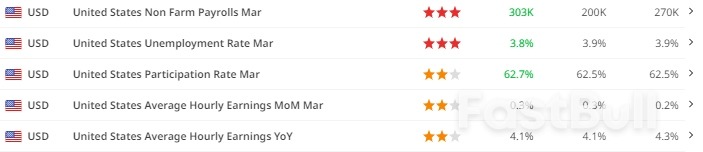
          March witnessed a robust surge in hiring, with nonfarm payrolls exceeding expectations by adding 303,000 jobs to the economy. This impressive growth, coupled with minimal revisions to previous months' data, has propelled the three-month average pace of job gains to its strongest level in a year, standing at 276,000. Notably, the unemployment rate dropped to 3.8%, supported by a resurgence in household employment metrics.
          Economic Calander
          The USD May Remain Strong Following Better-Than-Expected NFP Numbers_1
          The upward trajectory of labour supply was another highlight of March, as evidenced by the participation rate climbing to a four-month high of 62.7%. This sustained growth in labour supply has played a pivotal role in sustaining hiring momentum while alleviating inflationary pressures emanating from the labour market. However, despite the uptick in hiring, wage growth experienced a slowdown, reaching a three-year low of 4.1% on a year-over-year basis.
          In addition to the buoyant labour market, the latest economic forecast update suggests a nuanced approach by the Federal Open Market Committee (FOMC). While initially projecting a 100-basis-point easing in monetary policy this year, recent data indicate a tilt towards a more conservative stance, given the resilience of the labour market. This sentiment underscores the FOMC's inclination to await further progress on the inflation front before contemplating policy adjustments.
          March's employment landscape showcased significant growth across various sectors, with healthcare, government, and leisure & hospitality leading the charge. Construction and retail trade also exhibited notable expansions, contributing to the overall robustness of the job market. Despite these encouraging signs, concerns linger regarding the sustainability of this accelerated growth trajectory.
          Looking ahead, while the labour market remains resilient, indications of a potential slowdown in hiring plans and job openings warrant cautious optimism. Businesses, increasingly content with current staffing levels, coupled with a marginal uptick in layoffs, suggest a more balanced labour market outlook. However, the possibility of a sudden downturn underscores the need for vigilance among FOMC members.
          Ultimately, the primary focus remains on restoring inflation to the Fed's target of 2%, with further progress awaited before any policy adjustments are considered. As analysts await upcoming reports, particularly the CPI report and the Employment Cost Index, the prevailing strength of the labour market suggests a measured approach by the FOMC in navigating the path forward.

          Source: ACY

          To stay updated on all economic events of today, please check out our Economic calendar
          Risk Warnings and Disclaimers
          You understand and acknowledge that there is a high degree of risk involved in trading. Following any strategies or investment methods may lead to potential losses. The content on the site is provided by our contributors and analysts for information purposes only. You are solely responsible for determining whether any trading assets, securities, strategy, or any other product is suitable for investing based on your own investment objectives and financial situation.
          Add to Favorites
          Share

          The Quarter In Review: What Happened In The First Three Months Of 2024?

          JPMorgan

          Economic

          2023’s so-called “everything rally” was confusing to many market watchers, given the pessimistic macro outlook at the beginning of last year. Now, a quarter into 2024, the rally has clearly continued: risk assets like equities, high yield bonds and cryptocurrencies (notably Bitcoin) gained; and defensive asset performance was mixed, with bonds down but gold, oddly, surging.
          What was behind these market moves? To understand them, it is important to unpack some of the things that helped to define the first quarter of 2024.

          Global economic resilience continued:

          The final estimate of 4Q23 U.S. GDP showed that the U.S. economy grew faster than expected, up 3.1% for the year compared to trend growth of 2.0%. Moreover, cooling inflation and 12 consecutive months of positive real wage growth improved consumer sentiment, which now sits just five points shy of its long-term average. Despite this, gold rallied, perhaps playing catch-up after its sluggish performance in 2021 and 2022. Outside of the U.S., Eurozone inflation similarly cooled, while Japanese 4Q23 GDP growth was also revised higher and the Bank of Japan formally ended negative interest rate policy, reflecting strong economic momentum.

          Equity market strength broadened out:

          Against this macro backdrop, global stocks rallied. In fact, markets in the U.S., Japan, Germany, France and Latin America all hit all-time highs in 1Q24. In the U.S., these all-time highs came alongside greater market breadth, with more companies participating in gains than in 2023. Internationally, a broad pick-up in PMIs across Europe, Japan and some emerging markets point to continued improvement in business sentiment, boding well for future market returns.

          Duration dove on changing rate expectations:

          At the start of the year, markets were expecting a total of 175 bps of interest rate cuts, a significant divergence from the Federal Reserve’s December “dot plot”. A massive course correction has happened since then, spurred by economic resiliency. As a result, longer-duration bonds suffered. High yield, however, did quite well, a reflection of confidence in the economic outlook and a lower sensitivity to interest rates. Encouragingly, the Fed did not adjust the “dot plot” for 2024 at its March meeting, making another course correction unlikely.
          All told, the first quarter was an interesting start to what will surely continue to be an eventful year. Lingering geopolitical uncertainty and an upcoming U.S. presidential election, coupled with the divergence in performance across assets, underscores the importance of diversification in a fundamentally uncertain world.The Quarter In Review: What Happened In The First Three Months Of 2024?_1
          To stay updated on all economic events of today, please check out our Economic calendar
          Risk Warnings and Disclaimers
          You understand and acknowledge that there is a high degree of risk involved in trading. Following any strategies or investment methods may lead to potential losses. The content on the site is provided by our contributors and analysts for information purposes only. You are solely responsible for determining whether any trading assets, securities, strategy, or any other product is suitable for investing based on your own investment objectives and financial situation.
          Add to Favorites
          Share

          The Wobbling Yen: A Double-Edged Sword for Japan

          Glendon

          Economic

          Japan's Finance Minister, Shunichi Suzuki, recently found himself caught in the crosscurrents of a weakening Yen. While refraining from commenting directly on recent currency movements, he offered a measured response that captured the essence of the situation: "I can't comment specifically on recent currency moves," Suzuki said. "But it's important for exchange rates to move stably reflecting fundamentals. Excessive volatility is undesirable."
          This statement highlights the delicate balancing act Japan faces with a depreciating Yen. On the one hand, a weaker Yen presents potential benefits:
          Export Advantage: Japanese exports become more competitive in the global market as their prices fall in foreign currency terms. This can lead to increased export volumes and potentially higher profits for Japanese businesses, particularly in sectors like automobiles and electronics.
          Tourism Boom: Tourists visiting Japan enjoy the benefit of a stronger purchasing power with a weaker Yen. This can entice more foreign visitors, leading to a rise in tourism revenue and a boost for the hospitality industry.
          However, the flip side of the coin reveals potential pitfalls:
          Imported Inflation: The cost of imported raw materials and finished goods increases as the Yen weakens. This can translate to higher consumer prices across the board, disproportionately impacting Japanese households as essential goods like food and energy are often imported. This erosion of purchasing power can dampen economic growth.
          "Hollowing Out" of Industries: While a weaker Yen might initially boost exports, it can lead to a long-term trend of "hollowing out" domestic industries. Companies might prioritize overseas production due to lower costs, potentially leading to job losses in Japan and a decline in domestic manufacturing capabilities.

          Minister Suzuki's Measured Response: Stability Over Speculation

          Minister Suzuki's emphasis on stable exchange rates reflecting fundamentals suggests a preference for a Yen that aligns with Japan's economic realities and avoids excessive volatility. This could imply a willingness to intervene in the foreign exchange market if the Yen weakens too rapidly, although his statement doesn't explicitly confirm this. His measured approach highlights the need to balance:
          Supporting Exporters and Tourism: Maintaining a somewhat weaker Yen can continue to benefit these sectors, which are crucial drivers of economic growth.
          Curbing Inflation and Protecting Consumers: Preventing the Yen from weakening excessively is crucial to controlling inflation and protecting household budgets.

          Looking Ahead: Navigating Uncertain Seas

          The future path of the Yen will depend on a confluence of factors:
          The Bank of Japan's Role: The Bank of Japan's monetary policy plays a significant role. Will they adjust policies to address the Yen's depreciation? Their current ultra-loose stance, with low interest rates, contributes to the Yen's weakness. A shift towards a more hawkish stance could strengthen the Yen but dampen economic growth.
          Global Economic Conditions: Broader global economic health and currency market movements will also influence the Yen's trajectory. The rising US dollar, driven by expectations of interest rate hikes from the Federal Reserve, is putting downward pressure on many currencies, including the Yen.
          Potential Intervention: Whether the Japanese government decides to intervene in the foreign exchange market remains to be seen. Intervention can be a risky strategy, potentially triggering currency wars with other nations.
          Minister Suzuki's statement reflects the need for a cautious and strategic approach. By carefully monitoring the Yen's value, considering all factors involved, and taking calculated steps, Japan can navigate the challenges and opportunities presented by a weaker Yen. The path forward requires a delicate balancing act, ensuring economic stability while fostering growth and prosperity for all stakeholders.
          To stay updated on all economic events of today, please check out our Economic calendar
          Risk Warnings and Disclaimers
          You understand and acknowledge that there is a high degree of risk involved in trading. Following any strategies or investment methods may lead to potential losses. The content on the site is provided by our contributors and analysts for information purposes only. You are solely responsible for determining whether any trading assets, securities, strategy, or any other product is suitable for investing based on your own investment objectives and financial situation.
          Add to Favorites
          Share

          China Maintains Yuan Defense After Currency Nears Red Line

          Owen Li

          Economic

          Forex

          Central Bank

          The People’s Bank of China kept its daily reference rate for the managed currency broadly unchanged, implying to traders that yuan stability is key. China sets the so-called fixing at 9:15 a.m. local time, around which the currency is then permitted to trade in a 2% range.
          Traders have been eyeing the fixing for signs of where Beijing wants to guide the yuan after it weakened to within a whisker of the edge of its trading range last week. China’s policymakers have been vigilant of currency pressure which can spill over to local stocks and bonds, despite the fact that the country’s export engine would benefit from a weaker yuan.
          “Such a move to keep the fix steady should dampen any form of imagination that markets may have on steady RMB policy,” said Christopher Wong, an FX strategist at Oversea-Chinese Banking Corp. “There is lingering speculation of a further weakening in the yuan but that’s not the message policymakers want to send out.”
          Recent resilience in the dollar — a result of bets that the Federal Reserve will keep its policy rates higher for longer — is making the PBOC’s mandate of steadying the yuan even more difficult. The currency has also come under pressure as investors sour on the prospects for China’s economic growth.

          Stability Prized

          Stability tends to be prized because rapid yuan drops can also lead to a vicious cycle of capital outflows and exacerbated losses. As a regional currency anchor, any message which triggers yuan volatility can quickly spill over into other markets.
          The yuan traded little changed around 7.2330 per dollar after the steady fixing, which was set at 7.0947. China’s large state-owned banks sold dollars in the morning but only in limited quantities, according to traders who asked not to be named as they were not authorized to speak publicly.
          For Fiona Lim, a senior FX strategist at Malayan Banking Bhd., the new line in the sand for the yuan seems to be around 7.24 per dollar given Monday’s fixing. The PBOC may only allow its currency weaken beyond that level when the broader market environment supports significant dollar strength, she said.
          That’s a view shared by Fidelity International economist Peiqian Liu.
          “If dollar strength is more persistent and structural in nature, we could see the PBOC gradually loosen its control over the fix but if it’s more speculative and volatile, the central bank may prefer to keep the yuan fix stable,” she said.

          Red Line

          Complicating matters is the yuan weakening toward the edge of its trading band.
          The PBOC has stepped in aggressively to stabilize the yuan on each of the five occasions it neared that policy red line in past years. It has adopted tools ranging from verbal warnings to boosting the cost of short wagers against the currency.
          The yuan has never moved outside of its permitted range in history. So there is little guidance on what may happen to China’s spot market if the currency tries to touch the weak end this time around.
          What’s more certain is that investors will likely see trading disruptions, with some transactions not being able to go through. That’s based on what happened in a corner of the spot market last week, when traders weren’t able to execute some trades as the yuan neared the weak end of the band.
          “I think the pressure is rising for an increase in volatility for both fixing and spot and it’s increasingly difficult for the PBOC to draw a hard line here if the dollar continues to strengthen,” said Xiaojia Zhi head of research at Credit Agricole CIB. “That said, the PBOC would remain mindful to manage the expectations.”

          Source: Bloomberg

          To stay updated on all economic events of today, please check out our Economic calendar
          Risk Warnings and Disclaimers
          You understand and acknowledge that there is a high degree of risk involved in trading. Following any strategies or investment methods may lead to potential losses. The content on the site is provided by our contributors and analysts for information purposes only. You are solely responsible for determining whether any trading assets, securities, strategy, or any other product is suitable for investing based on your own investment objectives and financial situation.
          Add to Favorites
          Share

          Forex-Light Wind in Dollar's Sails after Bumper US Payrolls

          Thomas

          Economic

          Forex

          U.S. consumer price inflation for March on Wednesday and a European Central Bank (ECB) policy meeting on Thursday will be the main economic markers for the big global currencies this week.
          Those follow a week of vacillation as traders watched Japanese authorities talk their currency higher, and as U.S. services, the closely watched employment report on Friday and a bunch of Federal Reserve speakers sent mixed signals on rates.
          The dollar was just marginally higher, with the Swiss franc, Canadian dollar and Japan's yen the main losers among the six currencies in the dollar's trade-weighted index.
          The dollar "can remain supported this week if the U.S. CPI for March remains solid as we expect," analysts at Commonwealth Bank of Australia said.
          In the United States, a tight job market and limited progress on inflation in the last couple of months have amplified calls among top officials, including Fed Chair Jerome Powell, to be "patient" as they approach the decision on when to cut rates.
          The March consumer price index is key for market participants seeking evidence that factors that made inflation accelerate more than expected at the start of the year are abating.
          Yields on U.S. debt have meanwhile pushed higher. At the short end of the curve, the two-year yield, which reflects interest rate move expectations, hit 4.7820%, the highest since Nov. 28.
          Following the jobs data, the U.S. rate futures market has reduced the odds of a June rate cut to 50%, down from 66% late on Thursday, the CME's FedWatch tool showed.
          The dollar's biggest gains this year have been against the two big funding currencies for carry trades, the yen and Swiss franc. Both are down roughly 7% each versus the dollar this year.
          The Japanese yen weakened 0.11% to 151.79 per dollar. Yen futures data from CFTC showed non-commercial short positions had climbed to 143,230 contracts on April 2, the largest since December 2023.
          "The upside in dollar-yen is limited and the daily range is very low because of the risk of intervention by Japanese authorities," said Nomura currency strategist Jin Moteki.
          That low volatility and the widening spreads between dollar and yen yields was spurring more carry trades, leading to increased short positions on yen, he said.
          The euro was flat at $1.0834, while sterling was last trading at $1.2631, down 0.08% on the day.
          The base case for the ECB is to hold rates this week and possibly reinforce the possibility of a cut in June. But while the ECB is increasingly confident that inflation is heading back to its 2% target, it has remained vague about further easing.
          The kiwi dipped initially but was subsequently flat at $0.6016 heading into a Reserve Bank of New Zealand (RBNZ) policy meeting on Wednesday. It has shed 3.5% in three weeks, however, as markets bet the recent weakness in economic data could make the RBNZ dovish.
          Westpac analysts said the scenario of "a less dovish Fed contrasting with a more dovish RBNZ" could potentially push the currency to November lows around $0.59.
          Chinese markets reopened after holidays on Thursday and Friday to more weakness in the currency, keeping the yuan close to last week's four-and-a-half-month low.
          Gold prices hit a record high, and are up 16% since mid-February.
          In cryptocurrencies, bitcoin last rose 2.72% to $69,500.82.

          Source: Reuters

          To stay updated on all economic events of today, please check out our Economic calendar
          Risk Warnings and Disclaimers
          You understand and acknowledge that there is a high degree of risk involved in trading. Following any strategies or investment methods may lead to potential losses. The content on the site is provided by our contributors and analysts for information purposes only. You are solely responsible for determining whether any trading assets, securities, strategy, or any other product is suitable for investing based on your own investment objectives and financial situation.
          Add to Favorites
          Share

          RBNZ Seen Pushing Back Against Bets On Early Interest-Rate Cuts

          Samantha Luan

          Economic

          New Zealand’s central bank may this week push back against investor bets that interest-rate cuts are coming, even though the economy has slumped into a double-dip recession.
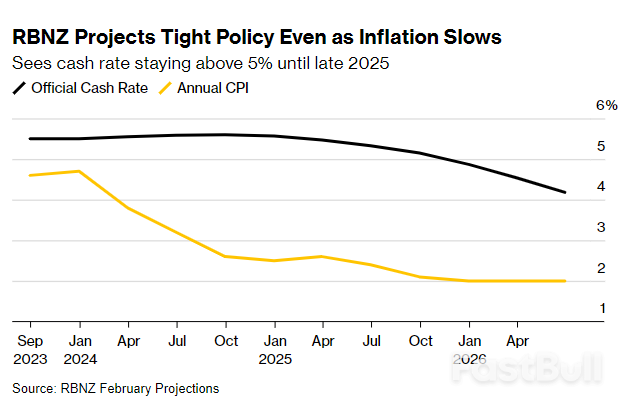
          The Reserve Bank will keep the Official Cash Rate at 5.5% for a sixth straight meeting Wednesday in Wellington, according to all 15 economists in a Bloomberg News survey. They expect policymakers to stress the need for rates to stay restrictive for a prolonged period to tame inflation.
          “Markets have taken a more aggressive view on the timing and extent of OCR cuts. Those expectations will be disappointed this time around,” said Kelly Eckhold, chief New Zealand economist at Westpac Banking Corp. in Auckland. “There is little to support the idea that interest rates can be cut much earlier than the RBNZ previously assumed.”
          The central bank in February projected it won’t start easing policy until 2025, citing concerns that record immigration will add to demand. Since then, data showed the economy slid back into recession in the second half of 2023, prompting investors to fully price in a pivot to rate cuts in the third quarter of this year.RBNZ Seen Pushing Back Against Bets On Early Interest-Rate Cuts_1
          The RBNZ will release Wednesday’s decision at 2 p.m. local time. It is a policy review rather than a full Monetary Policy Statement, so the bank won’t publish fresh economic forecasts or hold a news conference with Governor Adrian Orr.
          Most economists expect the first rate cut will occur in the fourth quarter, although some see one as early as August. Westpac and ANZ Bank don’t see cuts starting until early 2025.
          By contrast, investors are pricing two cuts and a 70% chance of a third before the end of this year, swaps data show.
          Central banks globally are focused on how quickly inflation is slowing and when they can begin easing. The Swiss National Bank unveiled a surprise rate cut last month — the first by a Group-of-10 central bank — while the Reserve Bank of Australia has indicated its next move is down. The Federal Reserve continues to signal as many as three cuts this year, although the start of any easing remains unclear.
          A Fed cut this year might allow the RBNZ to ease earlier than it projects by pushing up the New Zealand dollar and suppressing imported inflation, Chief Economist Paul Conway said last month.
          For now, inflation at 4.7% remains well above the RBNZ’s 1-3% target band and latest price indicators have been less benign than the RBNZ would like, said Stephen Toplis, head of research at Bank of New Zealand in Wellington.
          While there are also signs of “increasing economic distress,” suggesting a weaker growth outlook, “we do not believe there is sufficient evidence at this juncture for the bank to signal an earlier move” on rates, Toplis said. BNZ expects the first cut will occur in November.

          Source:Bloomberg

          To stay updated on all economic events of today, please check out our Economic calendar
          Risk Warnings and Disclaimers
          You understand and acknowledge that there is a high degree of risk involved in trading. Following any strategies or investment methods may lead to potential losses. The content on the site is provided by our contributors and analysts for information purposes only. You are solely responsible for determining whether any trading assets, securities, strategy, or any other product is suitable for investing based on your own investment objectives and financial situation.
          Add to Favorites
          Share

          Five Themes to Watch as Earnings Season Begins: ‘A Little Inflation in the System Isn’t A Bad Thing for Corporate Profits’

          Samantha Luan

          Economic

          Yes, the S&P 500 Index rose 10% from January to March. Strategists, however, predict that S&P 500 companies will post their smallest year-over-year profit growth since 2019, just 3.9%, in the first quarter, according to data compiled by Bloomberg Intelligence. But in this case the market may be onto something, because those forecasts could very well turn out to be overly gloomy — like they were in the fourth quarter, when expectations were for around 1% growth and the actual results turned out to be over 8%.
          “With traders anticipating interest-rate cuts by the Federal Reserve later this year, that will likely feed into even stronger consumer spending, economic activity and, in turn, better earnings growth and higher stock prices,” Wendy Soong, senior analyst at BI, said over the phone.
          Earnings season kicks into full swing Friday, with JPMorgan Chase & Co., Wells Fargo & Co. and Citigroup Inc. reporting. Other companies including BlackRock Inc. — world’s largest asset manager — and State Street Corp., along with Delta Air Lines Inc. will deliver results this week.
          Here’s a look at five key themes to watch:

          Concentrated Growth

          A resilient economy and strong consumer demand are expected to fuel a rise in earnings growth for S&P 500 companies for a second straight quarter following three straight quarters of profit contraction. And strong margins from big tech firms will likely be a key driver.
          Profits for the seven biggest growth companies in the S&P 500 — Apple Inc., Microsoft Corp., Alphabet Inc., Amazon.com Inc., Nvidia Corp., Meta Platforms Inc. and Tesla Inc. — are on course to rise 38% in the first quarter, according to Bloomberg Intelligence. When excluding them, the rest of the index’s profits are anticipated to shrink by 2%.
          Wall Street expects this trend to reverse as the year progresses. In the fourth quarter, those seven firms are expected to post earnings growth of 15% compared with 18% for the rest of the S&P 500, according to data compiled by David Kelly, chief global strategist at JPMorgan Asset Management.

          Raising Expectations

          Analysts have been raising their earnings forecasts faster than they are marking them down for previously unloved groups, from health care to utilities.
          In fact, seven of 11 sectors in the S&P 500 are poised to see profit growth accelerate over the next year. Utilities, financials and health care are the lead sectors when ranked by 25th-percentile earnings revisions, with energy, materials and communication services at the bottom, BI data show.

          Cash Hordes

          Corporate cash and free cash flow are at record high levels, setting the stage for a recovery in how the largest US companies deploy their capital, whether through payouts to stockholders or investing in expanding their businesses.
          Shareholder payouts rebounded in the fourth quarter for S&P 500 companies, and buybacks revived after four consecutive quarters of declines, BI data show. An increase in capital expenditures will depend on a rebound outside the heavy-spending technology sector, BI’s Soong said.

          Margins Improving

          Traders will be keeping a close eye on operating margins, a key gauge of profitability that historically offers a signal on where a company’s stock price is headed.
          The gap between rising consumer and producer prices has narrowed significantly over the past year thanks to corporate cost-cutting that drove profits higher, as well as an unexpected artificial intelligence boom. Analysts now see operating margins for the first quarter at 15%, with the worst of the pain in the rear-view mirror as forecasts improve in the coming quarters, data compiled by BI show.

          Sector Picking

          Traders aren’t expecting share prices to move in unison this earnings season. Differing inflation outlooks for S&P 500 sectors has left a gauge of expected one-month correlation in the index’s stocks hovering near its lowest since 2018, Bloomberg data show. A reading of 1 means securities will move in lockstep, it’s currently at 0.16.
          This comes as three of the 11 groups — communication services, technology and utilities — are expected to post profit expansions of more than 20%, while energy, materials and health-care companies will likely see profits shrink. Contrary to popular belief, moderate inflation historically has been good for earnings broadly because it promotes growth, lending and borrowing, according to Dan Eye, chief investment officer at Fort Pitt Capital Group.
          “Earnings are in nominal terms, so having a little inflation in the system isn’t a bad thing for corporate profits,” Eye said. “The stock market clearly sniffed that out in the first quarter, given the big rally.”

          Source: CFO Daily

          To stay updated on all economic events of today, please check out our Economic calendar
          Risk Warnings and Disclaimers
          You understand and acknowledge that there is a high degree of risk involved in trading. Following any strategies or investment methods may lead to potential losses. The content on the site is provided by our contributors and analysts for information purposes only. You are solely responsible for determining whether any trading assets, securities, strategy, or any other product is suitable for investing based on your own investment objectives and financial situation.
          Add to Favorites
          Share
          FastBull
          Copyright © 2025 FastBull Ltd

          728 RM B 7/F GEE LOK IND BLDG NO 34 HUNG TO RD KWUN TONG KLN HONG KONG

          TelegramInstagramTwitterfacebooklinkedin
          App Store Google Play Google Play
          Products
          Charts

          Chats

          Q&A with Experts
          Screeners
          Economic Calendar
          Data
          Tools
          Membership
          Features
          Function
          Markets
          Copy Trading
          Latest Signals
          Contests
          News
          Analysis
          24/7
          Columns
          Education
          Company
          Careers
          About Us
          Contact Us
          Advertising
          Help Center
          Feedback
          User Agreement
          Privacy Policy
          Business

          White Label

          Data API

          Web Plug-ins

          Poster Maker

          Affiliate Program

          Risk Disclosure

          The risk of loss in trading financial instruments such as stocks, FX, commodities, futures, bonds, ETFs and crypto can be substantial. You may sustain a total loss of the funds that you deposit with your broker. Therefore, you should carefully consider whether such trading is suitable for you in light of your circumstances and financial resources.

          No decision to invest should be made without thoroughly conducting due diligence by yourself or consulting with your financial advisors. Our web content might not suit you since we don't know your financial conditions and investment needs. Our financial information might have latency or contain inaccuracy, so you should be fully responsible for any of your trading and investment decisions. The company will not be responsible for your capital loss.

          Without getting permission from the website, you are not allowed to copy the website's graphics, texts, or trademarks. Intellectual property rights in the content or data incorporated into this website belong to its providers and exchange merchants.

          Not Logged In

          Log in to access more features

          FastBull Membership

          Not yet

          Purchase

          Become a signal provider
          Help Center
          Customer Service
          Dark Mode
          Price Up/Down Colors

          Log In

          Sign Up

          Position
          Layout
          Fullscreen
          Default to Chart
          The chart page opens by default when you visit fastbull.com