• Trade
  • Markets
  • Copy
  • Contests
  • News
  • 24/7
  • Calendar
  • Q&A
  • Chats
Trending
Screeners
SYMBOL
LAST
BID
ASK
HIGH
LOW
NET CHG.
%CHG.
SPREAD
SPX
S&P 500 Index
6827.42
6827.42
6827.42
6899.86
6801.80
-73.58
-1.07%
--
DJI
Dow Jones Industrial Average
48458.04
48458.04
48458.04
48886.86
48334.10
-245.98
-0.51%
--
IXIC
NASDAQ Composite Index
23195.16
23195.16
23195.16
23554.89
23094.51
-398.69
-1.69%
--
USDX
US Dollar Index
97.950
98.030
97.950
98.500
97.950
-0.370
-0.38%
--
EURUSD
Euro / US Dollar
1.17394
1.17409
1.17394
1.17496
1.17192
+0.00011
+ 0.01%
--
GBPUSD
Pound Sterling / US Dollar
1.33707
1.33732
1.33707
1.33997
1.33419
-0.00148
-0.11%
--
XAUUSD
Gold / US Dollar
4299.39
4299.39
4299.39
4353.41
4257.10
+20.10
+ 0.47%
--
WTI
Light Sweet Crude Oil
57.233
57.485
57.233
58.011
56.969
-0.408
-0.71%
--

Community Accounts

Signal Accounts
--
Profit Accounts
--
Loss Accounts
--
View More

Become a signal provider

Sell trading signals to earn additional income

View More

Guide to Copy Trading

Get started with ease and confidence

View More

Signal Accounts for Members

All Signal Accounts

Best Return
  • Best Return
  • Best P/L
  • Best MDD
Past 1W
  • Past 1W
  • Past 1M
  • Past 1Y

All Contests

  • All
  • Trump Updates
  • Recommend
  • Stocks
  • Cryptocurrencies
  • Central Banks
  • Featured News
Top News Only
Share

Chinese Foreign Ministry - China Foreign Minister Met With United Arab Emirates Counterpart On Dec 12

Share

China's Central Financial And Economic Affairs Commission Deputy Director: Will Expand Export And Increase Import In 2026

Share

Thai Leader Anutin: Landmine Blast That Killed Thai Soldiers 'Not A Roadside Accident'

Share

Thai Leader Anutin: Thailand To Continue Military Action Until 'We Feel No More Harm'

Share

Cambodian Prime Minister Hun Manet Says He Had Phone Calls With Trump And Malaysian Leader Anwar About Ceasefire

Share

Cambodia's Hun Manet Says USA, Malaysia Should Verify 'Which Side Fired First' In Latest Conflict

Share

Cambodia's Hun Manet: Cambodia Maintains Its Stance In Seeking Peaceful Resolution Of Disputes

Share

Nasdaq Companies: Allergan, Ferrovia, Insmed, Monolithic Power Systems, Seagate Technology, And Western Digital Will Be Added To The NASDAQ 100 Index. Biogen, CdW, GlobalFoundries, Lululemon, ON Semiconductor, And Tradedesk Will Be Removed From The NASDAQ 100 Index

Share

Witkoff Headed To Berlin This Weekend To Meet With Zelenskiy, European Leaders -Wsj Reporter On X

Share

Russia Attacks Two Ukrainian Ports, Damaging Three Turkish-Owned Vessels

Share

[Historic Flooding Occurs In At Least Four Rivers In Washington State Due To Days Of Torrential Rains] Multiple Areas In Washington State Have Been Hit By Severe Flooding Due To Days Of Torrential Rains, With At Least Four Rivers Experiencing Historic Flooding. Reporters Learned On The 12th That The Floods Caused By The Torrential Rains In Washington State Have Destroyed Homes And Closed Several Highways. Experts Warn That Even More Severe Flooding May Occur In The Future. A State Of Emergency Has Been Declared In Washington State

Share

Trump Says Proposed Free Economic Zone In Donbas Would Work

Share

Trump: I Think My Voice Should Be Heard

Share

Trump Says Will Be Choosing New Fed Chair In Near Future

Share

Trump Says Proposed Free Economic Zone In Donbas Complex But Would Work

Share

Trump Says Land Strikes In Venezuela Will Start Happening

Share

US President Trump: Thailand And Cambodia Are In A Good Situation

Share

State Media: North Korean Leader Kim Hails Troops Returning From Russia Mission

Share

The 10-year Treasury Yield Rose About 5 Basis Points During The "Fed Rate Cut Week," And The 2/10-year Yield Spread Widened By About 9 Basis Points. On Friday (December 12), In Late New York Trading, The Yield On The Benchmark 10-year US Treasury Note Rose 2.75 Basis Points To 4.1841%, A Cumulative Increase Of 4.90 Basis Points For The Week, Trading Within A Range Of 4.1002%-4.2074%. It Rose Steadily From Monday To Wednesday (before The Fed Announced Its Rate Cut And Treasury Bill Purchase Program), Subsequently Exhibiting A V-shaped Recovery. The 2-year Treasury Yield Fell 1.82 Basis Points To 3.5222%, A Cumulative Decrease Of 3.81 Basis Points For The Week, Trading Within A Range Of 3.6253%-3.4989%

Share

Trump: Lots Of Progress Being Made On Russia-Ukraine

TIME
ACT
FCST
PREV
U.K. Trade Balance Non-EU (SA) (Oct)

A:--

F: --

P: --

U.K. Trade Balance (Oct)

A:--

F: --

P: --

U.K. Services Index MoM

A:--

F: --

P: --

U.K. Construction Output MoM (SA) (Oct)

A:--

F: --

P: --

U.K. Industrial Output YoY (Oct)

A:--

F: --

P: --

U.K. Trade Balance (SA) (Oct)

A:--

F: --

P: --

U.K. Trade Balance EU (SA) (Oct)

A:--

F: --

P: --

U.K. Manufacturing Output YoY (Oct)

A:--

F: --

P: --

U.K. GDP MoM (Oct)

A:--

F: --

P: --

U.K. GDP YoY (SA) (Oct)

A:--

F: --

P: --

U.K. Industrial Output MoM (Oct)

A:--

F: --

P: --

U.K. Construction Output YoY (Oct)

A:--

F: --

P: --

France HICP Final MoM (Nov)

A:--

F: --

P: --

China, Mainland Outstanding Loans Growth YoY (Nov)

A:--

F: --

P: --

China, Mainland M2 Money Supply YoY (Nov)

A:--

F: --

P: --

China, Mainland M0 Money Supply YoY (Nov)

A:--

F: --

P: --

China, Mainland M1 Money Supply YoY (Nov)

A:--

F: --

P: --

India CPI YoY (Nov)

A:--

F: --

P: --

India Deposit Gowth YoY

A:--

F: --

P: --

Brazil Services Growth YoY (Oct)

A:--

F: --

P: --

Mexico Industrial Output YoY (Oct)

A:--

F: --

P: --

Russia Trade Balance (Oct)

A:--

F: --

P: --

Philadelphia Fed President Henry Paulson delivers a speech
Canada Building Permits MoM (SA) (Oct)

A:--

F: --

P: --

Canada Wholesale Sales YoY (Oct)

A:--

F: --

P: --

Canada Wholesale Inventory MoM (Oct)

A:--

F: --

P: --

Canada Wholesale Inventory YoY (Oct)

A:--

F: --

P: --

Canada Wholesale Sales MoM (SA) (Oct)

A:--

F: --

P: --

Germany Current Account (Not SA) (Oct)

A:--

F: --

P: --

U.S. Weekly Total Rig Count

A:--

F: --

P: --

U.S. Weekly Total Oil Rig Count

A:--

F: --

P: --

Japan Tankan Large Non-Manufacturing Diffusion Index (Q4)

--

F: --

P: --

Japan Tankan Small Manufacturing Outlook Index (Q4)

--

F: --

P: --

Japan Tankan Large Non-Manufacturing Outlook Index (Q4)

--

F: --

P: --

Japan Tankan Large Manufacturing Outlook Index (Q4)

--

F: --

P: --

Japan Tankan Small Manufacturing Diffusion Index (Q4)

--

F: --

P: --

Japan Tankan Large Manufacturing Diffusion Index (Q4)

--

F: --

P: --

Japan Tankan Large-Enterprise Capital Expenditure YoY (Q4)

--

F: --

P: --

U.K. Rightmove House Price Index YoY (Dec)

--

F: --

P: --

China, Mainland Industrial Output YoY (YTD) (Nov)

--

F: --

P: --

China, Mainland Urban Area Unemployment Rate (Nov)

--

F: --

P: --

Saudi Arabia CPI YoY (Nov)

--

F: --

P: --

Euro Zone Industrial Output YoY (Oct)

--

F: --

P: --

Euro Zone Industrial Output MoM (Oct)

--

F: --

P: --

Canada Existing Home Sales MoM (Nov)

--

F: --

P: --

Euro Zone Total Reserve Assets (Nov)

--

F: --

P: --

U.K. Inflation Rate Expectations

--

F: --

P: --

Canada National Economic Confidence Index

--

F: --

P: --

Canada New Housing Starts (Nov)

--

F: --

P: --

U.S. NY Fed Manufacturing Employment Index (Dec)

--

F: --

P: --

U.S. NY Fed Manufacturing Index (Dec)

--

F: --

P: --

Canada Core CPI YoY (Nov)

--

F: --

P: --

Canada Manufacturing Unfilled Orders MoM (Oct)

--

F: --

P: --

Canada Manufacturing New Orders MoM (Oct)

--

F: --

P: --

Canada Core CPI MoM (Nov)

--

F: --

P: --

Canada Manufacturing Inventory MoM (Oct)

--

F: --

P: --

Canada CPI YoY (Nov)

--

F: --

P: --

Canada CPI MoM (Nov)

--

F: --

P: --

Canada CPI YoY (SA) (Nov)

--

F: --

P: --

Canada Core CPI MoM (SA) (Nov)

--

F: --

P: --

Q&A with Experts
    • All
    • Chatrooms
    • Groups
    • Friends
    Connecting
    .
    .
    .
    Type here...
    Add Symbol or Code

      No matching data

      All
      Trump Updates
      Recommend
      Stocks
      Cryptocurrencies
      Central Banks
      Featured News
      • All
      • Russia-Ukraine Conflict
      • Middle East Flashpoint
      • All
      • Russia-Ukraine Conflict
      • Middle East Flashpoint
      Search
      Products

      Charts Free Forever

      Chats Q&A with Experts
      Screeners Economic Calendar Data Tools
      Membership Features
      Data Warehouse Market Trends Institutional Data Policy Rates Macro

      Market Trends

      Market Sentiment Order Book Forex Correlations

      Top Indicators

      Charts Free Forever
      Markets

      News

      News Analysis 24/7 Columns Education
      From Institutions From Analysts
      Topics Columnists

      Latest Views

      Latest Views

      Trending Topics

      Top Columnists

      Latest Update

      Signals

      Copy Rankings Latest Signals Become a signal provider AI Rating
      Contests
      Brokers

      Overview Brokers Assessment Rankings Regulators News Claims
      Broker listing Forex Brokers Comparison Tool Live Spread Comparison Scam
      Q&A Complaint Scam Alert Videos Tips to Detect Scam
      More

      Business
      Events
      Careers About Us Advertising Help Center

      White Label

      Data API

      Web Plug-ins

      Affiliate Program

      Awards Institution Evaluation IB Seminar Salon Event Exhibition
      Vietnam Thailand Singapore Dubai
      Fans Party Investment Sharing Session
      FastBull Summit BrokersView Expo
      Recent Searches
        Top Searches
          Markets
          News
          Analysis
          User
          24/7
          Economic Calendar
          Education
          Data
          • Names
          • Latest
          • Prev

          View All

          No data

          Scan to Download

          Faster Charts, Chat Faster!

          Download App
          English
          • English
          • Español
          • العربية
          • Bahasa Indonesia
          • Bahasa Melayu
          • Tiếng Việt
          • ภาษาไทย
          • Français
          • Italiano
          • Türkçe
          • Русский язык
          • 简中
          • 繁中
          Open Account
          Search
          Products
          Charts Free Forever
          Markets
          News
          Signals

          Copy Rankings Latest Signals Become a signal provider AI Rating
          Contests
          Brokers

          Overview Brokers Assessment Rankings Regulators News Claims
          Broker listing Forex Brokers Comparison Tool Live Spread Comparison Scam
          Q&A Complaint Scam Alert Videos Tips to Detect Scam
          More

          Business
          Events
          Careers About Us Advertising Help Center

          White Label

          Data API

          Web Plug-ins

          Affiliate Program

          Awards Institution Evaluation IB Seminar Salon Event Exhibition
          Vietnam Thailand Singapore Dubai
          Fans Party Investment Sharing Session
          FastBull Summit BrokersView Expo

          The Stocks to Watch When Supreme Court Rules on Trump’s Tariffs

          Manuel

          Political

          China–U.S. Trade War

          Summary:

          The S&P 500 Index has since rallied 39% from the lows hit that month. It closed at a record high Thursday, in part because tariffs have settled lower than
          An upcoming US Supreme Court ruling on the legality of the sweeping tariffs that President Donald Trump rolled out in April — briefly sending markets worldwide into a tailspin — could be the next test for stocks that have been flying high.
          The S&P 500 Index has since rallied 39% from the lows hit that month. It closed at a record high Thursday, in part because tariffs have settled lower than Trump’s highest threats, while support has come from an artificial-intelligence investment boom and a US economy that has kept expanding fast enough to throw off record corporate profits.
          If the nation’s top court says Trump exceeded his authority with the blanket tariffs on countries around the globe, there will still be significant uncertainty. The White House could use other laws to reimpose some new levies, for example. Bond traders could push up yields over worries about the deficit, and that concern could spread into the equity market.
          However, companies eager for a relief will likely to have to wait until at least January. With the Supreme Court beginning a four-week holiday recess, the window has all but closed for a ruling this year on challenges to Trump’s sweeping import taxes.
          But when a decision does come, market participants say the initial reaction, at least, would likely be positive for stocks should the court strike down the tariffs. A ruling upholding the tariffs would likely have the opposite effect.
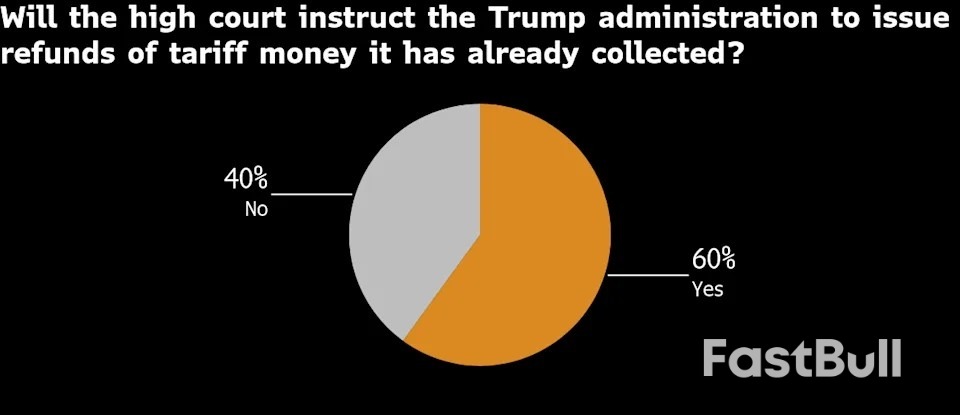
          There are a few reasons why. Striking down the tariffs would eliminate a tax that many businesses haven’t completely passed along to customers, resulting in a drag on the bottom line. Refunds on what they’ve already paid could provide a windfall. And consumer spending may get a boost, too, given that Democrats in Congress estimate tariffs have cost the average American family some $1,200 over the past 10 months.
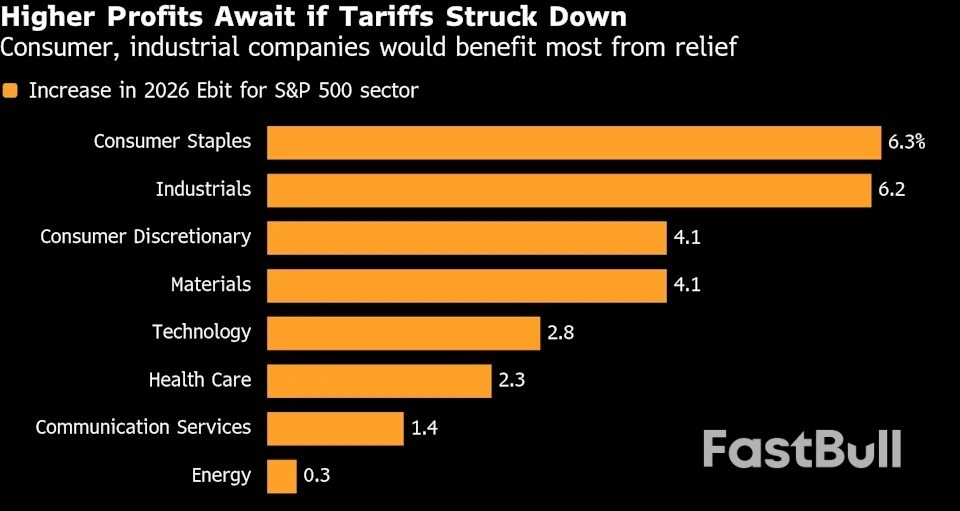
          Overall, a ruling against the tariffs would boost the earnings of companies in the S&P 500 Index, before interest and taxes, by 2.4% in 2026 compared to current-year levels, Wells Fargo & Co. Chief Equity Strategist Ohsung Kwon estimated in October.
          “That’s good for the market generally, because they look at tariffs as a tax,” said James St. Aubin, chief investment officer at Ocean Park Asset Management. “This will be a catalyst for a little bit of a rally.”The Stocks to Watch When Supreme Court Rules on Trump’s Tariffs_1
          Some companies, and their stocks, stand to benefit more than others. The tariffs have been particularly painful for those that are heavily dependent on imported goods, such as apparel companies and toymakers. Financial firms, for their part, stand to benefit from a more confident or flush consumer.
          “On the flip side,” said Haris Khurshid, chief investment officer at Karobaar Capital, “materials, commodities and domestic producers that benefited from protectionism might lag a bit.”
          Here’s a look at some of the sectors and companies with the most at stake when the decision does come:

          Consumer

          Clothing and toy companies — both heavily dependent on imports from China and other Asian countries targeted with some of the highest tariffs — are seen as clear winners, according to BI. Nike Inc. and Mattel Inc. are potential standouts.
          Others include Deckers Outdoor Corp., Under Armour Inc., Crocs Inc., and American Eagle Outfitters Inc., all of which have struggled with tariff-related uncertainty. Home furnishing stocks have been volatile too, including Wayfair Inc., Williams-Sonoma Inc. and RH.
          Texas Capital’s Eric Wold singled out some potential winners among the leisure-related companies he follows: boat-maker Brunswick Corp., toymaker Funko Inc. and Topgolf Callaway Brands Corp.

          Industrials

          Industrial manufacturing giants Caterpillar Inc. and Deere & Co. are among the firms set to benefit the most from tariff refunds, according to Wells Fargo’s Kwon. Stanley Black & Decker Inc., Fortive Corp. and Lennox International Inc. also make the list.The Stocks to Watch When Supreme Court Rules on Trump’s Tariffs_2
          Shares of automakers General Motors Co. and Ford Motor Co. advanced during the Supreme Court hearing last month, when the justices’ skepticism about the administration’s arguments increased market speculation that the tariffs would be struck down. While the case doesn’t affect the industry-specific tariff on automakers, they stand to gain from a stronger consumer.
          Hedgeye also sees positive implications for transport stocks, expecting a boost if the tariffs are struck down and importers move to snap up inventory before any new ones are imposed. That could benefit United Parcel Service Inc., FedEx Corp. and trucking companies.
          Financials
          Major banks such as JPMorgan Chase & Co. and Goldman Sachs Group Inc. faced volatility earlier this year, alongside private equity giants like Blackstone Inc., amid concerns that Trump’s trade war will slow economic activity. Financial-technology companies such as Affirm Holdings Inc. and Block Inc. are prone to big swings, as are stocks linked to cryptocurrencies.
          Lower tariffs may ease pressure on US consumers and support the broader economy. If inflation expectations move lower, it’ll also support the case for more rate cuts by the Federal Reserve, Clear Street analyst Owen Lau said.
          Lower interest rates encourage “loan growth, refinancing, stronger equities markets and even higher consumer spending,” Lau said, “which will fundamentally benefit financial stocks in general.”

          Source: Bloomberg

          Risk Warnings and Disclaimers
          You understand and acknowledge that there is a high degree of risk involved in trading. Following any strategies or investment methods may lead to potential losses. The content on the site is provided by our contributors and analysts for information purposes only. You are solely responsible for determining whether any trading assets, securities, strategy, or any other product is suitable for investing based on your own investment objectives and financial situation.
          Add to Favorites
          Share

          Trump Administration Turning to Private Firms in Cyber Offensive

          Manuel

          Political

          President Donald Trump’s administration is preparing to turn to private businesses to help mount offensive cyberattacks against foreign adversaries, according to people familiar with the matter, potentially expanding a shadowy electronic conflict typically conducted by secretive intelligence agencies.
          The White House plans to make public its intention to enlist private companies in more aggressive efforts to go after criminal and state-sponsored hackers in a new national cyber strategy, a draft of which has been viewed by industry officials and experts. The strategy is expected to be released by the Office of the National Cyber Director in the coming weeks.
          The draft, described to Bloomberg News by multiple people, says the federal government should unleash private businesses as it moves to impose consequences on foreign adversaries who breach critical infrastructure and telecommunications networks, or who cripple businesses with ransomware attacks. The draft didn’t provide many details on how the administration would use the companies.
          A spokesperson for the Office of the National Cyber Director would not comment on the draft because it is not finalized but said the administration is committed to cybsecurity for Americans and US infrastructure, networks and information.
          The administration is expected to provide more information after the release of the strategy, as well as an executive order that could outline private firms’ roles and provide them with more legal protections, the people said. Legislation might also be required.
          The push to include industry would open lucrative new business opportunities to firms that have traditionally contracted with the government on defensive strategies rather than offensive measures. But it comes with risks.
          There is currently no legal basis for private firms to conduct their own offensive cyber operations. Additionally, any operations to take down adversary infrastructure could put private firms in the crosshairs of foreign government entities, whose intelligence services often use affiliates to carry out their cyberattacks.
          But the drive to enlist private companies reflects a growing view within the intelligence community and the administration that the US needs more capacity to fight hostile hacking groups that often work with abundant foreign state support. Adding those firms would both expand the government’s cyber warfare resources and free up intelligence agencies and the military to focus on work only they can handle.
          Discussions on contracting out offensive cyber operations were already underway in Joe Biden’s White House, though his administration didn’t settle on a policy, said people familiar with those deliberations.
          The cyber strategy draft, some five pages long, also calls for streamlining data security and cyber regulations, the modernization of federal systems, securing critical infrastructure and promoting adoption of post-quantum cryptography and secure quantum computing. The White House has invited industry officials to give feedback on the draft, which could still change, the people said.
          Trump administration officials have for months made clear they intend to take more aggressive action against criminal and state-sponsored hackers. Alexei Bulazel, the National Security Council’s senior director for cyber, declared at a security conference in September that the administration is “unapologetic, unafraid to do offensive cyber.”
          And tucked inside Trump’s multi-trillion-dollar tax and spending law is a little-noticed provision designating a $1 billion boost for offensive cyber operations, which have typically been conducted by the military’s Cyber Command or intelligence agencies. The law does not prescribe how the money be spent, but its inclusion in Trump’s cornerstone bill is a signal of offensive cyber’s importance to the administration.
          Many cybersecurity firms known for defensive operations could easily apply their expertise and their technology to launch attacks, but offensive work would be financially and legally risky, potentially turning off customers and investors alike, said Michael Janke, co-founder of Datatribe, a tech foundry for cyber startups. Legislation, however, could hinder companies that want to remain discreet regarding the use of their tools.
          “That gray area provides a lot for both government and commercial to flow within,” he said. “Once you shrink that to legislation, you may not have that gray area.”

          Source: Bloomberg

          Risk Warnings and Disclaimers
          You understand and acknowledge that there is a high degree of risk involved in trading. Following any strategies or investment methods may lead to potential losses. The content on the site is provided by our contributors and analysts for information purposes only. You are solely responsible for determining whether any trading assets, securities, strategy, or any other product is suitable for investing based on your own investment objectives and financial situation.
          Add to Favorites
          Share

          White House AI czar defends Trump push to rein in state rules

          Manuel

          Political

          Stocks

          White House AI czar David Sacks defended President Donald Trump’s push to rein in state-level regulation of artificial intelligence over objections from Democrats, saying the move seeks to ease a growing compliance burden for companies.
          Under the directive signed by Trump on Thursday, Sacks said, the administration is moving toward developing with Congress a common standard for oversight of the emerging technology. Right now, AI model development can take place across multiple states, each with its own regulatory standards.
          “You have fifty different states running in fifty different directions. That type of compliance regime will be hard for small companies and startups, especially innovators,” Sacks said in an interview Friday on Bloomberg Tech. “What we need is a single federal or national framework for AI regulation.”
          Championed by Sacks, the order culminates months of lobbying by AI companies led by OpenAI and Alphabet Inc.’s Google as well as venture capital giant Andreessen Horowitz, who have warned that state laws popping up across the country risk overwhelming a nascent industry and potentially harming US competitiveness with China in artificial intelligence. The measure marks the latest in a series of moves by Trump to boost the AI industry, including steps to make it easier to build infrastructure and increase energy supply for power-hungry data centers.
          Trump directed the US attorney general to create a task force to challenge state rules that run afoul of his goal of promoting AI adoption. It also permits the Commerce Department to review whether federal broadband funding should be revoked from localities’ with AI measures that the administration deems onerous. Future discretionary grants may also be withheld by other agencies, unless states back away from enacting laws that the Trump team sees as impeding innovation.
          The order is widely expected to face legal challenges, especially from states with provisions already in place. California State Senator Scott Wiener, who crafted landmark legislation in the Golden State that Governor Gavin Newsom signed in September, said that setting safety rules has been “a core pillar of state law for decades.”
          “It’s absurd for Trump to think he can weaponize the DOJ and Commerce to undermine those state rights,” Wiener said in a statement. “If the Trump Administration tries to enforce this ridiculous order, we will see them in court.”
          Sacks said the provision calling for the Justice Department to sue states over AI rules was designed to go after the most burdensome regulations. He expressed uncertainty about whether the administration would seek to challenge California or New York, but he did single out a law in Colorado seeking to prohibit algorithmic discrimination as “probably the most excessive.”
          Trump pivoted to the executive order after White House officials and Republican lawmakers failed to include similar legislation preempting state AI laws in a must-pass defense bill earlier this month. Hours after the White House signing ceremony, Democratic US Senator Brian Schatz said he planned legislation that would seek a full repeal of the order.
          “Embracing the amazing possibilities of AI can’t come at the cost of leaving Americans vulnerable to its profound risks, which is exactly what this executive order does,” Schatz said in a statement. “Congress has a responsibility to get this technology right – and quickly – but states must be allowed to act in the public interest in the meantime.”
          US lawmakers have struggled for years to pass comprehensive AI legislation, and there’s currently no federal standard governing the technology, leaving local authorities to fill that void. The order calls for Sacks and other administration officials to work with Congress on legislation for a “minimally burdensome national standard.”
          As AI becomes a central part of daily life, taking on roles such as assessing job applications, identifying criminal suspects, handling medical claims and creating content nearly impossible to distinguish from genuine photos or video, state lawmakers have expressed eagerness to impose some rules of the road. Trump’s order will complicate those efforts, putting any state passing legislation into potential conflict with the White House.
          Tech companies have largely opposed state-level regulatory efforts, particularly in California and New York, that would hold companies accountable for harms caused by AI products like chatbots. Trump and his allies have touted the AI boom as a plus to the US economy, even as it poses political challenges, including voter concerns that data centers are spiking energy bills and fears that the technology will spur job losses.
          Sacks, a venture capitalist who joined the administration in January, pushed back against those concerns on employment, saying that so far the AI race in the US has generated more jobs than it has cost.
          “We are seeing an overall AI boom that’s benefiting the economy,” he said. “Certainly there can be job displacement in the future but we have not seen any of that so far. It’s been quite the opposite.”

          Source: Bloomberg

          Risk Warnings and Disclaimers
          You understand and acknowledge that there is a high degree of risk involved in trading. Following any strategies or investment methods may lead to potential losses. The content on the site is provided by our contributors and analysts for information purposes only. You are solely responsible for determining whether any trading assets, securities, strategy, or any other product is suitable for investing based on your own investment objectives and financial situation.
          Add to Favorites
          Share

          Oil Swings Near Lowest Since October With Surplus in Focus

          Manuel

          Commodity

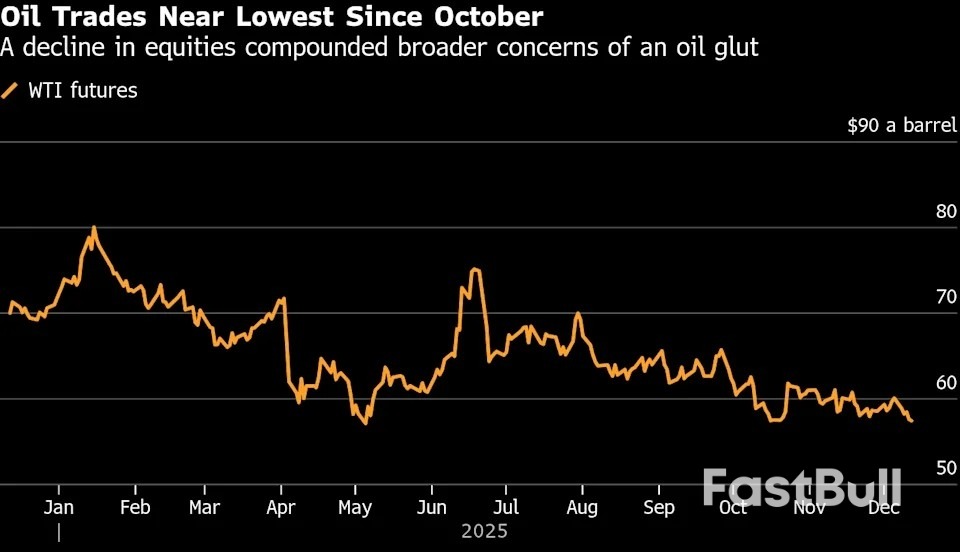
          Oil prices fluctuated, hovering above the lowest levels in about two months as weakness in US equities markets added to bearish sentiment about oversupply.
          West Texas Intermediate traded above $57 a barrel, while Brent traded above $61 a barrel in thin trading. Diesel futures, which were down about 0.7%, lagged the oil complex on Friday, while a selloff in US stocks dragged global gauges from the brink of record highs.
          Concerns about oversupply have helped to push crude toward the lower end of a band it has traded in since mid-October, with Brent futures slowly trending toward $60 a barrel. Prices have not dipped below the key psychological level since May.Oil Swings Near Lowest Since October With Surplus in Focus_1
          The International Energy Agency on Thursday reiterated its prediction for an unprecedented surplus — although slightly below its forecast last month — and said global inventories have swollen to a four-year high.
          Geopolitical tensions may add some support to oil prices. President Donald Trump announced new sanctions on three of Venezuelan counterpart Nicolas Maduro’s nephews as well as six oil tankers, after the US seized a supertanker off the coast of the Latin American nation on Wednesday.
          The ship seizure was just the beginning of a new phase in the Trump administration’s ramped-up pressure campaign against the Venezuelan president, according to people familiar with the operation. The act of economic statecraft is designed to deny Maduro a lifeline of oil revenue and force him to relinquish power, the people said.
          And a murky outlook for a peace deal to end Russia’s war in Ukraine — which could lower prices by eliminating sanctions on Russian crude — is also helping to support oil.
          “Ukraine also seems to keep targeting Russian oil assets even as negotiations for peace are in the works which seems to be keeping a psychological floor in crude,” said Dennis Kissler, senior vice president for trading at BOK Financial Securities Inc.

          Source: Bloomberg

          Risk Warnings and Disclaimers
          You understand and acknowledge that there is a high degree of risk involved in trading. Following any strategies or investment methods may lead to potential losses. The content on the site is provided by our contributors and analysts for information purposes only. You are solely responsible for determining whether any trading assets, securities, strategy, or any other product is suitable for investing based on your own investment objectives and financial situation.
          Add to Favorites
          Share

          Thai PM Says No Ceasefire Yet In Cambodia Conflict After Phone Call With Trump

          Justin

          Political

          Thailand's Prime Minister Anutin Charnvirakul looks on ahead of making offerings to monks, on the day he speaks to members of the media to announce the dissolution of parliament at the Government House in Bangkok, Thailand, December 12, 2025. REUTERS/Chalinee Thirasupa

          BANGKOK, Dec 12 (Reuters) - Thai Prime Minister Anutin Charnvirakul confirmed on Friday that there was no ceasefire yet with Cambodia and said he had spoken by telephone with U.S. President Donald Trump and told him Bangkok was not the aggressor in the conflict with its neighbour.

          Anutin said Trump told him he wanted the two countries to return to a ceasefire first agreed in July. He added that the U.S. president had not indicated that trade tariffs would be used as part of his efforts to end the fighting.

          Anutin's remarks came as heavy border clashes between the two countries continued for a fifth day.

          "He (Trump) wanted a ceasefire. I told him to ask our friends - don't just say a ceasefire but to tell the world that Cambodia will cease fire, withdraw its troops, remove all mines it has planted, and show them that they must stop everything first," Anutin told reporters.

          "Right now, there is no ceasefire yet, the fighting is still ongoing," he said.

          Thailand and Cambodia have been exchanging rockets and artillery at multiple locations along their disputed 817-km (508-mile) frontier in some of the most intense clashes since a five-day battle in July, which Trump stopped with calls to both leaders to halt their worst conflict in recent history.

          Trump is keen to intervene again to salvage the truce he brokered. He met Anutin and Cambodian Prime Minister Hun Manet in Malaysia in October, where they signed an expanded ceasefire agreement.

          Trump, who has repeatedly said he deserves the Nobel Peace Prize, lauded himself on Thursday as a global peacemaker and had on Thursday expressed confidence he would get the truce "back on track".

          This week's clashes have killed at least 20 people, with more than 260 wounded, according to tallies by both countries, which have blamed each other for reigniting the conflict.

          It was not immediately clear if Trump had spoken also to Cambodian Prime Minister Hun Manet.

          Cambodian government spokesperson Pen Bona earlier on Friday said he was not aware a call had been scheduled between Hun Manet and Trump, adding "but normally, our PM is always ready to talk".

          Hun Manet in August nominated Trump for the Nobel Peace Prize.

          Source: Reuters

          Risk Warnings and Disclaimers
          You understand and acknowledge that there is a high degree of risk involved in trading. Following any strategies or investment methods may lead to potential losses. The content on the site is provided by our contributors and analysts for information purposes only. You are solely responsible for determining whether any trading assets, securities, strategy, or any other product is suitable for investing based on your own investment objectives and financial situation.
          Add to Favorites
          Share

          Deutsche Bank, Goldman See Fed Cuts Rekindling Dollar’s Slide

          Adam

          Forex

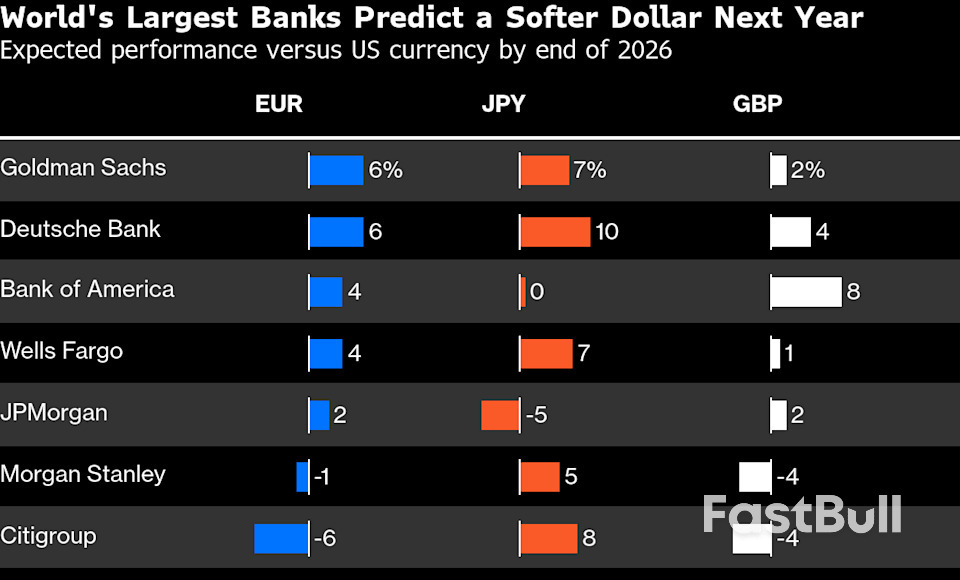
          Deutsche Bank AG, Goldman Sachs Group Inc. and other Wall Street banks are forecasting that the US dollar will resume its slide next year as the Federal Reserve keeps nudging down interest rates.
          The currency has stabilized over the past six months after tumbling by the most since the early 1970s during the first half of the year when President Donald Trump’s trade war unleashed havoc in global markets.
          But strategists expect the greenback to weaken again in 2026 as the US central bank continues to ease monetary policy just as others hold steady or move closer toward raising rates. That rift would give investors an incentive to sell US debt and shift the cash to countries where payouts are higher.
          As a result, forecasters at more than half a dozen major investment banks are largely predicting that the dollar will slip against major counterparts like the yen, euro and pound. According to the consensus estimates compiled by Bloomberg, a widely tracked index of the dollar will weaken some 3% by the end of 2026.
          “There is ample room for markets to price in a deeper cutting cycle,” said David Adams, head of G-10 foreign-exchange strategy at Morgan Stanley, which expects the dollar to drop 5% in the first half of the year. “That leaves plenty of capacity for further dollar weakness.”
          Deutsche Bank, Goldman See Fed Cuts Rekindling Dollar’s Slide_1
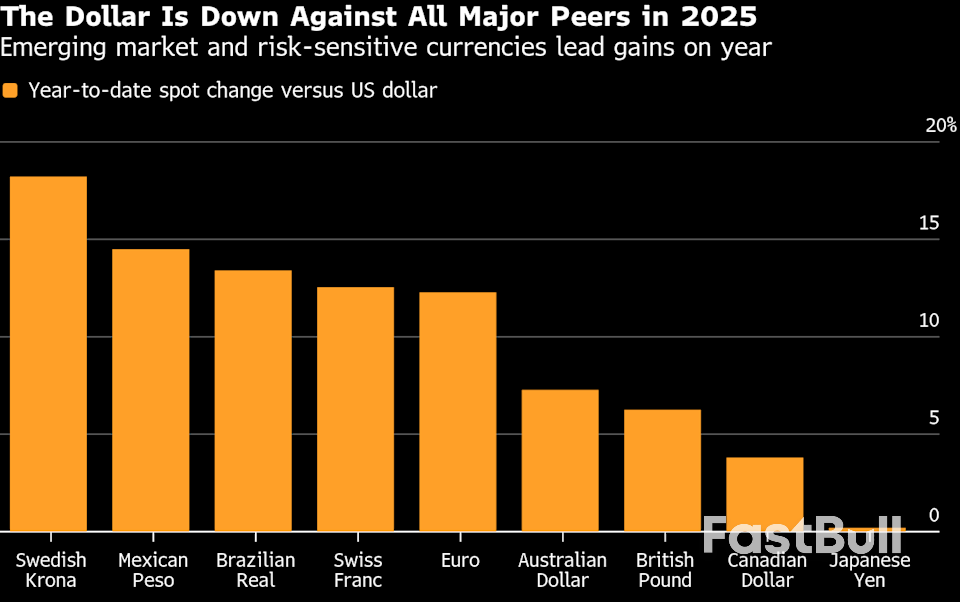
          The dollar’s decline is expected to be more muted and not as broad as it was this year, when it lost ground against all of the major currencies, leaving the the Bloomberg Dollar Spot Index down nearly 8% in its deepest annual drop since 2017. And the outlook hinges on anticipation that the US job market will continue to weaken — which remains uncertain, given the surprising resilience of the post-pandemic economy.
          Currency forecasting is also particularly vexing. When the dollar was surging late last year as investors piled into the so-called Trump trade, betting his policies would spur growth, strategists expected the the rally would reverse by mid-2025, only to get caught off guard by the scale of the drop during the first half of the year.
          But strategists see the broad contours heading into the new year as a recipe for a weaker dollar. Traders are pricing in two more quarter-point Fed rate cuts next year, and it’s possible that whoever Trump picks to replace Chair Jerome Powell may give in to White House pressure to lower rates even more. Meanwhile, the European Central Bank is expected to hold rates steady while the Bank of Japan nudges them upward.
          “We see risks stacked more against the dollar than in favor of the dollar,” Luis Oganes, London-based head of global macro research at JPMorgan, said at a news conference on Tuesday.
          A weaker dollar would have ripple effects in the broader economy by pushing up the cost of imports, increasing the value of corporate profits from overseas, and boosting exports — which would likely be welcomed by a Trump administration that’s complained about the US trade deficit. It could also extend rallies in emerging markets as investors shift cash there to seize on higher interest rates.
          That movement propelled emerging-market carry trades — which entail borrowing in low-rate countries and investing where yields are higher — to the biggest returns since 2009. JPMorgan and Bank of America Corp. both see potential for additional gains, flagging the Brazilian real and a handful Asian currencies — like the South Korean won and Chinese yuan — respectively.
          At Goldman Sachs, analysts led by Kamakshya Trivedi this month also noted that the market is starting to price a more optimistic economic outlook into other G-10 currencies — like Canada’s and Australia’s — following stronger-than-expected data. They noted the dollar’s “tendency to depreciate when the rest of the world is doing well.”
          Deutsche Bank, Goldman See Fed Cuts Rekindling Dollar’s Slide_2
          The contrarians who expect the dollar to gain against some other major currencies point primarily to the robust US economy. That growth, powered by the artificial-intelligence boom, will lure investment flows into the country that drive up the value of the dollar, analysts at Citigroup Inc. and Standard Chartered said.
          “We see strong potential for a dollar cycle recovery in 2026,” the Citigroup team led by Daniel Tobon wrote in their annual outlook.
          The prospect of stronger-than-expected growth was underscored Wednesday, when Fed policymakers marked up their projections for 2026. Yet they still cut interest rates by a quarter point and continued to pencil in one more such move next year. Powell also allayed any concern that the Fed could pivot to raising rates, saying the debate now is whether to continue cutting — or wait — as it’s tugged between a weakening job market and still above-target inflation.
          His comments were met with relief in the markets, where some traders had worried that the Fed would deliver a more hawkish message. As Treasury yields dropped, the Bloomberg dollar index slid 0.7% on Wednesday and Thursday, its biggest two-day drop since mid-September, when traders were positioning for the Fed to resume its rate-cutting cycle.
          In an annual outlook note to clients late last month, Deutsche Bank’s George Saravelos, the global head of foreign exchange research in London, and Tim Baker, his New York colleague, said the dollar has benefited from a “remarkably resilient” economy and the run-up in US stock prices. Yet they said the dollar is overvalued and predicted it will fall against its major counterparts next year as growth — and equity returns — pick up elsewhere.
          “If these forecasts materialize, they will confirm that this decade’s unusually long dollar bull cycle is over,” they wrote.

          Source: Bloomberg

          Risk Warnings and Disclaimers
          You understand and acknowledge that there is a high degree of risk involved in trading. Following any strategies or investment methods may lead to potential losses. The content on the site is provided by our contributors and analysts for information purposes only. You are solely responsible for determining whether any trading assets, securities, strategy, or any other product is suitable for investing based on your own investment objectives and financial situation.
          Add to Favorites
          Share

          Analysts flag risks for Strategy at Nasdaq 100 index reshuffle

          Adam

          Economic

          Bitcoin hoarding giant Strategy (MSTR.O) may be at risk of being removed from the Nasdaq 100 index (.NDX) at its annual reshuffle on Friday, amid questions over its business model that have weighed on its share price, some analysts flagged this week.
          After a sizzling rally that pushed its market capitalization to a peak of $128 billion earlier this year, Strategy - which started out as software company MicroStrategy but pivoted to bitcoin investing in 2020 - was included last December under the index's technology sub-category.
          That decision was questioned by some market-watchers who argued that the pioneering business model, which has spawned dozens of copycats, more closely resembles an investment fund.
          Strategy reported a net profit of $2.78 billion for the three months ended September 30, compared with a loss of $340.2 million a year earlier, mostly driven by an accounting change that allowed it to book gains on its bitcoin holdings. The Virginia-based company's revenue from the legacy software business, meanwhile, stood at just $128.7 million.
          "If MSTR is deemed to be a holding company or a cryptocurrency company rather than its legacy business as a software company, then it is susceptible to removal," said Steve Sosnick, chief market analyst at Interactive Brokers.
          The exchange operator, whose Nasdaq 100 index tracks the largest non-financial companies by market capitalization, declined to comment ahead of the announcement on Friday.
          The Information reported , opens new tab in September that Nasdaq has been tightening requirements for digital asset treasury companies it lists. It has not generally commented on the inclusion of those firms in its indices.
          Strategy did not respond to a request for comment.
          Analysts flag risks for Strategy at Nasdaq 100 index reshuffle_1

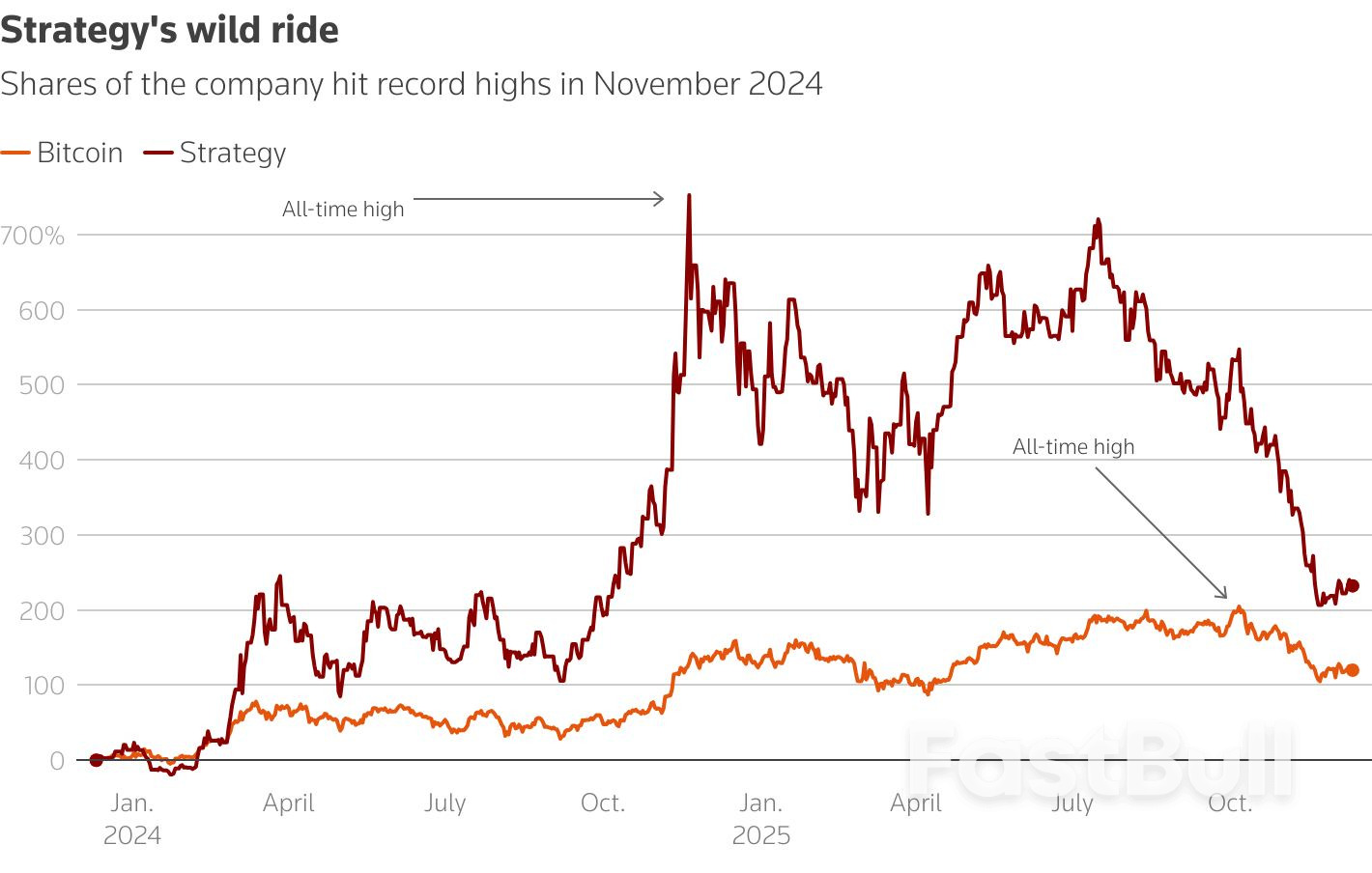
          A line chart showing Strategy and bitcoin's performance over the last two years

          Index reshuffles are closely watched, since they dictate which companies benefit from billions of passive investor flows. Saylor, though, has generally dismissed worries over potential index exclusion, and some other analysts said they did not expect Nasdaq to delete Strategy on Friday.
          DIGITAL ASSET TREASURY QUESTIONS
          Concerns have grown over the sustainability of crypto treasury companies, whose shares have proved extremely sensitive to bitcoin's gyrations. Strategy shares are down 65% from their 2024 peak and 36% year-to-date, compared with a 3.6% drop in bitcoin this year.
          Strategy's market value has fallen to $52.7 billion as of Thursday, while its bitcoin holdings are worth more than $61 billion, according to Reuters calculations.
          While that isn't enough to exclude Strategy on market capitalization grounds, Mike O'Rourke, chief market strategist at JonesTrading, argued in a note this week that Strategy had been included on a technicality and that Friday was a "perfect opportunity for Nasdaq to correct last year's mistake."
          If Nasdaq removes Strategy, the company could experience passive fund outflows of about $1.6 billion, according to estimates by Kaasha Saini, head of index strategy at Jefferies.
          Global index provider MSCI (MSCI.N) has raised concerns about the presence of digital asset treasury companies in its benchmarks. MSCI is due to decide in January on whether to exclude Strategy and similar companies.
          Saylor told Reuters this month that Strategy was engaging with MSCI, but that if it was excluded it wouldn't matter.
          Some analysts believe that Strategy is safe because its market value is still relatively high. H.C. Wainwright analyst Mike Colonnese doubted Strategy would be removed, since it is "larger than about 30 other companies in the Nasdaq 100."
          Beyond Strategy, Jefferies estimates drugmaker Biogen (BIIB.O) , IT solutions provider CDW (CDW.O) and four other stocks could depart from the Nasdaq 100. The six companies currently have the lowest market cap among the 100 members, according to data compiled by LSEG.
          Jefferies expects that retail giant Walmart , which has a market capitalization of $932.7 billion, is not eligible to be included this time, because its effective first day of trading (December 8) on the Nasdaq was after the exchange's November 28 reference date for the rebalancing.
          Nasdaq's announcement is expected after the market close on Friday, with changes effective December 22.

          Source: reuters

          To stay updated on all economic events of today, please check out our Economic calendar
          Risk Warnings and Disclaimers
          You understand and acknowledge that there is a high degree of risk involved in trading. Following any strategies or investment methods may lead to potential losses. The content on the site is provided by our contributors and analysts for information purposes only. You are solely responsible for determining whether any trading assets, securities, strategy, or any other product is suitable for investing based on your own investment objectives and financial situation.
          Add to Favorites
          Share
          FastBull
          Copyright © 2025 FastBull Ltd

          728 RM B 7/F GEE LOK IND BLDG NO 34 HUNG TO RD KWUN TONG KLN HONG KONG

          TelegramInstagramTwitterfacebooklinkedin
          App Store Google Play Google Play
          Products
          Charts

          Chats

          Q&A with Experts
          Screeners
          Economic Calendar
          Data
          Tools
          Membership
          Features
          Function
          Markets
          Copy Trading
          Latest Signals
          Contests
          News
          Analysis
          24/7
          Columns
          Education
          Company
          Careers
          About Us
          Contact Us
          Advertising
          Help Center
          Feedback
          User Agreement
          Privacy Policy
          Business

          White Label

          Data API

          Web Plug-ins

          Poster Maker

          Affiliate Program

          Risk Disclosure

          The risk of loss in trading financial instruments such as stocks, FX, commodities, futures, bonds, ETFs and crypto can be substantial. You may sustain a total loss of the funds that you deposit with your broker. Therefore, you should carefully consider whether such trading is suitable for you in light of your circumstances and financial resources.

          No decision to invest should be made without thoroughly conducting due diligence by yourself or consulting with your financial advisors. Our web content might not suit you since we don't know your financial conditions and investment needs. Our financial information might have latency or contain inaccuracy, so you should be fully responsible for any of your trading and investment decisions. The company will not be responsible for your capital loss.

          Without getting permission from the website, you are not allowed to copy the website's graphics, texts, or trademarks. Intellectual property rights in the content or data incorporated into this website belong to its providers and exchange merchants.

          Not Logged In

          Log in to access more features

          FastBull Membership

          Not yet

          Purchase

          Become a signal provider
          Help Center
          Customer Service
          Dark Mode
          Price Up/Down Colors

          Log In

          Sign Up

          Position
          Layout
          Fullscreen
          Default to Chart
          The chart page opens by default when you visit fastbull.com