• Trade
  • Markets
  • Copy
  • Contests
  • News
  • 24/7
  • Calendar
  • Q&A
  • Chats
Trending
Screeners
SYMBOL
LAST
BID
ASK
HIGH
LOW
NET CHG.
%CHG.
SPREAD
SPX
S&P 500 Index
6870.39
6870.39
6870.39
6895.79
6858.28
+13.27
+ 0.19%
--
DJI
Dow Jones Industrial Average
47954.98
47954.98
47954.98
48133.54
47871.51
+104.05
+ 0.22%
--
IXIC
NASDAQ Composite Index
23578.12
23578.12
23578.12
23680.03
23506.00
+72.99
+ 0.31%
--
USDX
US Dollar Index
98.820
98.900
98.820
98.960
98.810
-0.130
-0.13%
--
EURUSD
Euro / US Dollar
1.16534
1.16541
1.16534
1.16539
1.16341
+0.00108
+ 0.09%
--
GBPUSD
Pound Sterling / US Dollar
1.33384
1.33393
1.33384
1.33399
1.33151
+0.00072
+ 0.05%
--
XAUUSD
Gold / US Dollar
4199.69
4200.14
4199.69
4211.68
4190.61
+1.78
+ 0.04%
--
WTI
Light Sweet Crude Oil
59.824
59.861
59.824
60.063
59.752
+0.015
+ 0.03%
--

Community Accounts

Signal Accounts
--
Profit Accounts
--
Loss Accounts
--
View More

Become a signal provider

Sell trading signals to earn additional income

View More

Guide to Copy Trading

Get started with ease and confidence

View More

Signal Accounts for Members

All Signal Accounts

Best Return
  • Best Return
  • Best P/L
  • Best MDD
Past 1W
  • Past 1W
  • Past 1M
  • Past 1Y

All Contests

  • All
  • Trump Updates
  • Recommend
  • Stocks
  • Cryptocurrencies
  • Central Banks
  • Featured News
Top News Only
Share

China's CSI Ai Index Up More Than 3%

Share

Australia Treasurer Chalmers: Mid-Year Teview Will Not Be A Mini-Budget, Will Include Savings

Share

Australia Treasurer Chalmers: Will Not Extend Electrictiy Rebates

Share

Most Active China Coke Contract Falls 6.1% To 1532 Yuan/Metric Ton

Share

Most Active China Coking Coal Contract Falls As Much As 6.6% To 1088.5 Yuan/Metric Ton

Share

China's Yuan Opens Trade At 7.0683 Per Dollar Versus Last Close At 7.0720

Share

Most Active China Coke Contract Falls 4.8%

Share

Most Active China Coking Coal Contract Falls More Than 5%

Share

China's Central Bank Sets Yuan Mid-Point At 7.0764 / Dlr Versus Last Close 7.0720

Share

Japan Chief Cabinet Secretary Kihara: Have Seen No Change In China's Export Of Rare Earths To Japan

Share

[Market Update] Spot Silver Fell Below $58/ounce, Down 0.47% On The Day

Share

Japan Chief Cabinet Secretary Kihara: Will Continue To Work Closely With USA With Heightening Regional Tension In Mind

Share

Japan Chief Cabinet Secretary Kihara: Japan Will Decide On Its Own What Is Appropriate For Its Defence Spending

Share

Japan Chief Cabinet Secretary Kihara: Ratio Of Defence Spending Versus GDP Is Not The Important Issue

Share

Taiwan Overnight Interbank Rate Opens At 0.805 Percent (Versus 0.805 Percent At Previous Session Open)

Share

USGS - Magnitude 5.8 Earthquake Strikes Yakutat, Alaska Region

Share

Japan Chief Cabinet Secretary Kihara: Very Important To Get Understanding Of Other Countries, Including USA, Over Japan's Stance

Share

[JPMorgan CEO Jamie Dimon Says Europe Has Big Problems And Internal Divisions Will Be A Major Challenge] JPMorgan Chase CEO Jamie Dimon Stated That European Bureaucracy Is Inefficient And Warned That A Weak European Continent Poses A Significant Economic Risk To The United States. Europe Has Big Problems. They've Done A Very Good Job With Social Security. But They've Also Driven Away Businesses, Investment, And Innovation. This Situation Is Gradually Improving. He Praised Some European Leaders, Saying They Are Aware Of These Problems, But He Also Cautioned That Politics Is "really Difficult."

Share

Thai Army Spokesman Says Military Launched Air Strikes In Disputed Border Area With Cambodia

Share

Bank Of Japan - Japan Nov Outstanding Bank Loans +4.2% Year-On-Year

TIME
ACT
FCST
PREV
Canada Labor Force Participation Rate (SA) (Nov)

A:--

F: --

P: --

U.S. Personal Income MoM (Sept)

A:--

F: --

P: --

U.S. PCE Price Index YoY (SA) (Sept)

A:--

F: --

P: --

U.S. PCE Price Index MoM (Sept)

A:--

F: --

P: --

U.S. Personal Outlays MoM (SA) (Sept)

A:--

F: --

P: --

U.S. Core PCE Price Index MoM (Sept)

A:--

F: --

P: --

U.S. Core PCE Price Index YoY (Sept)

A:--

F: --

P: --

U.S. UMich 5-Year-Ahead Inflation Expectations Prelim YoY (Dec)

A:--

F: --

P: --

U.S. Real Personal Consumption Expenditures MoM (Sept)

A:--

F: --

P: --

U.S. 5-10 Year-Ahead Inflation Expectations (Dec)

A:--

F: --

P: --

U.S. UMich Current Economic Conditions Index Prelim (Dec)

A:--

F: --

P: --

U.S. UMich Consumer Sentiment Index Prelim (Dec)

A:--

F: --

P: --

U.S. UMich 1-Year-Ahead Inflation Expectations Prelim (Dec)

A:--

F: --

P: --

U.S. UMich Consumer Expectations Index Prelim (Dec)

A:--

F: --

P: --

U.S. Weekly Total Rig Count

A:--

F: --

P: --

U.S. Weekly Total Oil Rig Count

A:--

F: --

P: --

U.S. Unit Labor Cost Prelim (SA) (Q3)

--

F: --

P: --

U.S. Consumer Credit (SA) (Oct)

A:--

F: --

P: --

China, Mainland Foreign Exchange Reserves (Nov)

A:--

F: --

P: --

China, Mainland Exports YoY (USD) (Nov)

--

F: --

P: --

China, Mainland Imports YoY (CNH) (Nov)

--

F: --

P: --

China, Mainland Imports YoY (USD) (Nov)

--

F: --

P: --

China, Mainland Imports (CNH) (Nov)

--

F: --

P: --

China, Mainland Trade Balance (CNH) (Nov)

--

F: --

P: --

China, Mainland Exports (Nov)

--

F: --

P: --

Japan Wages MoM (Oct)

A:--

F: --

P: --

Japan Trade Balance (Oct)

A:--

F: --

P: --

Japan Nominal GDP Revised QoQ (Q3)

A:--

F: --

P: --

Japan Trade Balance (Customs Data) (SA) (Oct)

A:--

F: --

P: --

Japan GDP Annualized QoQ Revised (Q3)

A:--

F: --

P: --
China, Mainland Exports YoY (CNH) (Nov)

--

F: --

P: --

China, Mainland Trade Balance (USD) (Nov)

--

F: --

P: --

Germany Industrial Output MoM (SA) (Oct)

--

F: --

P: --

Euro Zone Sentix Investor Confidence Index (Dec)

--

F: --

P: --

Canada Leading Index MoM (Nov)

--

F: --

P: --

Canada National Economic Confidence Index

--

F: --

P: --

U.S. Dallas Fed PCE Price Index YoY (Sept)

--

F: --

P: --

China, Mainland Trade Balance (USD) (Nov)

--

F: --

P: --

U.S. 3-Year Note Auction Yield

--

F: --

P: --

U.K. BRC Overall Retail Sales YoY (Nov)

--

F: --

P: --

U.K. BRC Like-For-Like Retail Sales YoY (Nov)

--

F: --

P: --

Australia Overnight (Borrowing) Key Rate

--

F: --

P: --

RBA Rate Statement
RBA Press Conference
Germany Exports MoM (SA) (Oct)

--

F: --

P: --

U.S. NFIB Small Business Optimism Index (SA) (Nov)

--

F: --

P: --

Mexico Core CPI YoY (Nov)

--

F: --

P: --

Mexico 12-Month Inflation (CPI) (Nov)

--

F: --

P: --

Mexico PPI YoY (Nov)

--

F: --

P: --

Mexico CPI YoY (Nov)

--

F: --

P: --

U.S. Weekly Redbook Index YoY

--

F: --

P: --

U.S. JOLTS Job Openings (SA) (Oct)

--

F: --

P: --

China, Mainland M2 Money Supply YoY (Nov)

--

F: --

P: --

China, Mainland M0 Money Supply YoY (Nov)

--

F: --

P: --

China, Mainland M1 Money Supply YoY (Nov)

--

F: --

P: --

U.S. EIA Short-Term Crude Production Forecast For The Next Year (Dec)

--

F: --

P: --

U.S. EIA Short-Term Crude Production Forecast For The Year (Dec)

--

F: --

P: --

U.S. EIA Natural Gas Production Forecast For The Next Year (Dec)

--

F: --

P: --

EIA Monthly Short-Term Energy Outlook
U.S. 10-Year Note Auction Avg. Yield

--

F: --

P: --

U.S. API Weekly Cushing Crude Oil Stocks

--

F: --

P: --

Q&A with Experts
    • All
    • Chatrooms
    • Groups
    • Friends
    Connecting
    .
    .
    .
    Type here...
    Add Symbol or Code

      No matching data

      All
      Trump Updates
      Recommend
      Stocks
      Cryptocurrencies
      Central Banks
      Featured News
      • All
      • Russia-Ukraine Conflict
      • Middle East Flashpoint
      • All
      • Russia-Ukraine Conflict
      • Middle East Flashpoint
      Search
      Products

      Charts Free Forever

      Chats Q&A with Experts
      Screeners Economic Calendar Data Tools
      Membership Features
      Data Warehouse Market Trends Institutional Data Policy Rates Macro

      Market Trends

      Market Sentiment Order Book Forex Correlations

      Top Indicators

      Charts Free Forever
      Markets

      News

      News Analysis 24/7 Columns Education
      From Institutions From Analysts
      Topics Columnists

      Latest Views

      Latest Views

      Trending Topics

      Top Columnists

      Latest Update

      Signals

      Copy Rankings Latest Signals Become a signal provider AI Rating
      Contests
      Brokers

      Overview Brokers Assessment Rankings Regulators News Claims
      Broker listing Forex Brokers Comparison Tool Live Spread Comparison Scam
      Q&A Complaint Scam Alert Videos Tips to Detect Scam
      More

      Business
      Events
      Careers About Us Advertising Help Center

      White Label

      Data API

      Web Plug-ins

      Affiliate Program

      Awards Institution Evaluation IB Seminar Salon Event Exhibition
      Vietnam Thailand Singapore Dubai
      Fans Party Investment Sharing Session
      FastBull Summit BrokersView Expo
      Recent Searches
        Top Searches
          Markets
          News
          Analysis
          User
          24/7
          Economic Calendar
          Education
          Data
          • Names
          • Latest
          • Prev

          View All

          No data

          Scan to Download

          Faster Charts, Chat Faster!

          Download App
          English
          • English
          • Español
          • العربية
          • Bahasa Indonesia
          • Bahasa Melayu
          • Tiếng Việt
          • ภาษาไทย
          • Français
          • Italiano
          • Türkçe
          • Русский язык
          • 简中
          • 繁中
          Open Account
          Search
          Products
          Charts Free Forever
          Markets
          News
          Signals

          Copy Rankings Latest Signals Become a signal provider AI Rating
          Contests
          Brokers

          Overview Brokers Assessment Rankings Regulators News Claims
          Broker listing Forex Brokers Comparison Tool Live Spread Comparison Scam
          Q&A Complaint Scam Alert Videos Tips to Detect Scam
          More

          Business
          Events
          Careers About Us Advertising Help Center

          White Label

          Data API

          Web Plug-ins

          Affiliate Program

          Awards Institution Evaluation IB Seminar Salon Event Exhibition
          Vietnam Thailand Singapore Dubai
          Fans Party Investment Sharing Session
          FastBull Summit BrokersView Expo

          The problem with the circular AI ecosystem

          Adam

          Economic

          Summary:

          OpenAI’s AMD deal creates a circular AI ecosystem—mixing supply, equity, and investment. It boosts innovation and alignment but increases dependency and systemic risks across the AI industry.

          A deal that closes the loop

          AMD has committed to providing up to 6 gigawatts of GPU capacity to OpenAI over several years, starting with an initial gigawatt in 2026. But more notably, AMD has granted OpenAI a warrant (a call option) for 160 million shares, representing approximately 10% of the capital, if various milestones are reached (delivery, performance, share price up to $600). In other words, OpenAI pays AMD for chips, but also obtains the right to become an AMD shareholder. This type of transaction creates a financial loop (or "circularity") in which revenue streams, investments, and technical transactions intertwine.

          Why is this circularity strategic (and risky)?

          Alignment of interests... but increased dependence
          This mechanism incentivizes AMD to deliver and succeed so that its stock price rises, which benefits OpenAI - both as a customer and as a shareholder. But it also creates mutual dependency: AMD's performance becomes critical to OpenAI, and vice versa.
          Strengthening the grip of tech giants
          Such a structure signals a form of implicit vertical integration in AI: those who consume "compute" become co-owners of the "compute provider." It's another way of locking down the ecosystem. Nvidia, already known for building a "moat" around its architecture (hardware, software, interconnections), follows a similar logic to make its customers captive to its technological environment.
          Pressure on margins and cash flow
          For AMD, giving up shares or warrants in exchange for a contract may reduce immediate profitability, but it is betting on future valuation. For OpenAI, paying for chips while receiving shares is tantamount to partially subsidizing its purchase, but this bet is only profitable if AMD's share price reaches the set milestones.
          Risk of excessive circularity
          By feeding off itself, this type of arrangement can create loops of financial dependency. If AMD's share price stagnates or declines, certain milestones will not be reached, undermining the profitability of the deal for OpenAI. This creates a "circular dance" in which companies are simultaneously customers, suppliers, and investors, making their financial stability more sensitive to external shocks.

          Impacts for Nvidia, AMD, and the AI ecosystem

          AMD is gaining legitimacy in the field of GPUs for AI: its stock jumped over 20% after the announcement. Nvidia, meanwhile, is reconfiguring its role: it recently signed a massive agreement with OpenAI to supply its own GPU systems, while also investing in the company. OpenAI is thus seeking to diversify its suppliers (Nvidia, AMD, Broadcom) in order to reduce its dependence on a single player and obtain better supply conditions. Finally, the AI ecosystem as a whole seems to be moving towards greater interdependence, through cross-alliances, reciprocal equity investments, and multi-year contracts that combine financing, technology, and capital.
          The partnership between OpenAI and AMD is not just a simple sale of hardware. It illustrates a structural transformation of the artificial intelligence economy: financial, industrial, and technological flows are becoming circular, boundaries are blurring, and the giants of the sector are building closed ecosystems where everything (from silicon to revenue) circulates in a loop. This circularity can accelerate innovation, but it also makes the entire system more vulnerable: if one part falls, the whole chain falters.

          Source: marketscreener

          To stay updated on all economic events of today, please check out our Economic calendar
          Risk Warnings and Disclaimers
          You understand and acknowledge that there is a high degree of risk involved in trading. Following any strategies or investment methods may lead to potential losses. The content on the site is provided by our contributors and analysts for information purposes only. You are solely responsible for determining whether any trading assets, securities, strategy, or any other product is suitable for investing based on your own investment objectives and financial situation.
          Add to Favorites
          Share

          EU Boosts Steel Protections With 50% Levy To Sustain Industry

          Thomas

          Economic

          Commodity

          The European Union unveiled fresh tariffs on Tuesday meant to shield its ailing steel sector, taking a page from Donald Trump’s protectionist playbook.

          The European Commission, the EU’s executive arm, proposed 50% tariffs — twice the current rate — on all steel imports above a quota that will be cut by roughly 45%, confirming Bloomberg’s previous reporting.

          “It is a very restrictive clause that does not have precedent in Europe,” EU industry commissioner Stephane Sejourne told Bloomberg News in an interview. He said that, once in place, only around 10% of the steel used in the EU market will be tariff-free.

          The move is a response to mounting fears that traditional European industries like steel are fading, choked by a glut of subsidized Chinese competition, high energy prices and dwindling local demand.

          The measures would align EU tariffs with a 50% US levy on most foreign steel and aluminum. The EU is trying to convince the US to lower its rate for EU steel and jointly target China instead.

          Thus far, those talks have failed to make progress since the two sides struck a trade deal in July that limited US tariffs to 15% on most EU exports, including cars.

          “We hope we can have talks as quickly as possible [with the US] that will get a result,” Sejourne said. “But we share the same industrial agenda as the US — we want more local production, more economic growth and protection for our industry.”

          The EU currently places a 25% tariff on most steel imports once quotas are exhausted. But that mechanism is temporary and expires next year, prompting the commission to develop more permanent protections.

          The new measures would cut the total quota for all steel categories to 18.35 million tons a year, about 45% lower than the current quota level. The plan sets quotas for specific product types based on historical averages.

          EU member states and the European Parliament must still approve the proposal.

          The EU executive argued that its plan is compatible with World Trade Organization rules. The commission will also discuss country-specific allocations with those affected, according to a press release.

          The tariffs will hit the struggling British steel industry particularly hard, since the EU buys about two-thirds of the country’s iron and steel exports, according to Office for National Statistics data. The Labour government was forced to seize control of the UK’s last maker of virgin steel earlier this year after the plant’s Chinese owner moved to halt production.

          The UK government last month shelved efforts to get the US to roll back a 25% levy on British-made steel, concluding it was better than the 50% tariff that the Trump administration had applied to other countries’ exports.

          Source: Bloomberg Europe

          To stay updated on all economic events of today, please check out our Economic calendar
          Risk Warnings and Disclaimers
          You understand and acknowledge that there is a high degree of risk involved in trading. Following any strategies or investment methods may lead to potential losses. The content on the site is provided by our contributors and analysts for information purposes only. You are solely responsible for determining whether any trading assets, securities, strategy, or any other product is suitable for investing based on your own investment objectives and financial situation.
          Add to Favorites
          Share

          Clarifying Putin's Comments About Poland's Pre-World War II Policy

          Samantha Luan

          Economic

          Forex

          Political

          Putin commented on Poland’s pre-World War II policy during the Q&A session that followed his speech at the Valdai Club’s latest annual meeting. Before clarifying what he said, readers should review this piece here about why Putin spent so much time talking about Poland in last year’s interview with Tucker, this one here about whether he really justified the Nazis’ invasion of Poland, and this one here about the Molotov-Ribbentrop Pact.

          With this context in mind, here are Putin’s latest words on this subject:

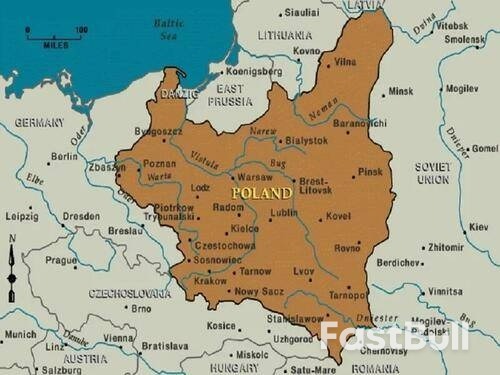
          “Poland made many mistakes before World War II. After all, Germany offered them a peaceful resolution to the Danzig and Danzig Corridor issue, but the Polish leadership of the time categorically refused and ultimately fell first victim to Nazi aggression.

          And Poland completely rejected something else—but historians probably know this—at that time, Poland refused the Soviet Union’s aid to Czechoslovakia. The Soviet Union was prepared to do so; we have documents in our archives, I’ve read them all myself. When the notes were written to Poland, Poland said it would under no circumstances allow Russian troops to aid Czechoslovakia, and if Soviet planes flew, Poland would shoot them down—and ultimately, it fell first victim to Nazi aggression.

          If today’s top political family in Poland also remembers, understanding all the complexities and twists and turns of historical eras of various kinds, and it keeps these mistakes in mind when consulting with Pilsudski, then this would actually be a good thing.”

          His reference to “consulting with Pilsudski” was due to him being asked about new Polish President Karol Nawrocki humorously going along with an interviewer playfully wondering whether he does this in the Belweder Palace where Poland’s famous independence hero and interwar leader resided. Russian media misunderstood the “infotainment” purpose of him participating in this gag, however, and unironically reported on it in full seriousness. With that out of the way, it’s now time to clarify Putin’s comments.

          He’s arguably making two historical points that he then hopes his new Polish counterpart will generalize and consequently apply in the present. They’re that World War II might have been avoided had Poland allowed the Soviets to come to Czechoslovakia’s aid against Nazi Germany or then later peacefully resolved their own dispute without resisting and officially embroiling its formal British and French mutual defense allies in what ultimately became a continental tragedy. This is the Russian position.

          As for the Polish one, they feared that the first scenario would lead to the Red Army seizing the Polish-controlled parts of Western Belarus and Ukraine that they partitioned after the Polish-Bolshevik War, thus coercing Poland into becoming a Soviet client state after the Nazis’ defeat. Regarding the second scenario, they feared that ceding Danzig would lead to more cessions of formerly Prussian-partitioned Poland, thus coercing Poland into becoming a Nazi client state. It’s unimportant whether one agrees.

          Both schools of thought on this were only shared so that readers can make up their own minds. Moving along, the two historical points that Putin made from the Russian position can be generalized as Poland having made major mistakes by not letting Moscow preemptively deal with a latent security threat to Europe and then rejecting a political deal for preventing a larger war afterwards, despite how flawed it was. Again, one doesn’t have to agree, but this is arguably the essence of what Putin was conveying.

          The first generalized point relates to contemporary times in the sense of Poland having made a major mistake by backing February 2014’s coup in Ukraine instead of letting the deal that it agreed to with France, Germany, and Ukraine with Russia’s blessing unfold for de-escalating growing East-West tensions. Regarding the second, it’s relevant with respect to Poland colluding with the UK to sabotage spring 2022’s peace talks, after which what could have otherwise been a minor war exploded into a larger one.

          These complementary mistakes in contemporary times contributed to bringing Europe to the brink of another tragedy. Putin thus hopes that Nawrocki will understand the generalized points that he sought to convey via his critiques of Poland’s pre-World War II policy given the latter’s prior role as his country’s top historian. If he does, then he might apply them to the present by encouraging a political solution to the Ukrainian Conflict instead of helping the West escalate tensions at the risk of sparking World War III.

          Nawrocki importantly didn’t rule out talking with Putin if Poland’s security depended on it when asked about this in an interview several days before his Russian counterpart’s comments. His predecessor Andrzej Duda, previous Prime Minister Mateusz Morawiecki, and his successor Donald Tusk had and have no interest whatsoever in talking to Putin about anything no matter the circumstances. For this reason, Nawrocki’s approach is pragmatic and even brave given the domestic Polish political context.

          This doesn’t mean that he’ll soon call Putin, just that Putin was likely aware of what Nawrocki said and tried to convey – however wonkishly and indirectly – that he’d be receptive to any outreach from him. That’s what Putin’s comments on Poland’s pre-World War II policy aimed to achieve. They weren’t meant to blame Poland for World War II like some might imagine, but to prevent World War III given Poland’s central role in that prior tragedy and the one that might still happen if tensions spiral out of control.

          Source: Zero Hedge

          To stay updated on all economic events of today, please check out our Economic calendar
          Risk Warnings and Disclaimers
          You understand and acknowledge that there is a high degree of risk involved in trading. Following any strategies or investment methods may lead to potential losses. The content on the site is provided by our contributors and analysts for information purposes only. You are solely responsible for determining whether any trading assets, securities, strategy, or any other product is suitable for investing based on your own investment objectives and financial situation.
          Add to Favorites
          Share

          Euro’s Bullish Momentum Shows Cracks as French Risks Resurface

          Adam

          Forex

          The euro is showing early signs of strain, with investors paring upside exposure as political uncertainty spikes in France.
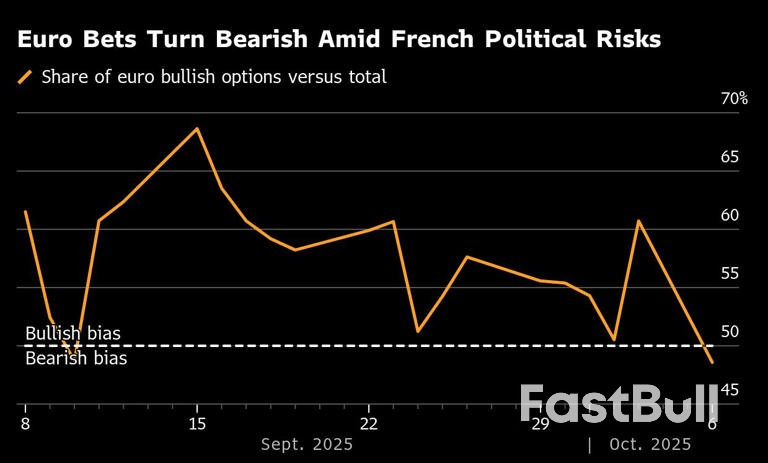
          The currency is trading below $1.17 and heading for a second consecutive daily drop. It fell to its lowest in more than a week on Monday after French Prime Minister Sébastien Lecornu unexpectedly resigned, deepening a national political crisis. A commonly watched options gauge of directional bias has turned bearish after a bullish run, suggesting traders are positioning for further losses.
          Flows point the same way. Depository Trust & Clearing Corporation data now indicate the largest tilt toward bearish exposure in a month.
          Euro’s Bullish Momentum Shows Cracks as French Risks Resurface_1

          Euro Bets Turn Bearish Amid French Political Risks

          That contrasts with the last major flare—up of political risk in France. On Sept. 8, after then–Prime Minister François Bayrou lost a confidence vote, euro sentiment held up: the currency rose about 0.4% on the day and options positioning leaned bullish, with roughly a 60–40 split in notional favoring upside exposure, DTCC figures show.
          Euro’s Bullish Momentum Shows Cracks as French Risks Resurface_2

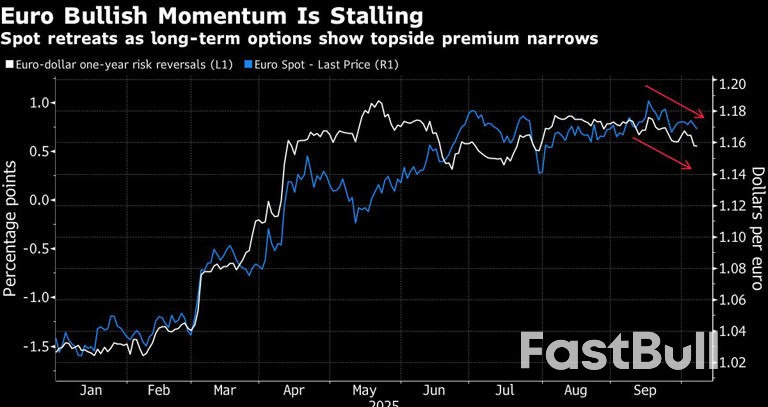
          Euro Bullish Momentum Is Stalling | Spot retreats as long-term options show topside premium narrows

          One factor in the shift is a thinner set of US catalysts during the government shutdown, which gives euro-centric headlines greater sway. It may also be the case that a bigger change is brewing as the share of bullish notional slipped for four straight weeks from about 60% to below 55%, signaling a gradual loss of momentum.
          Longer-dated options sentiment still leans to the topside, but at the narrowest premium since early August, while the euro has stalled near a long-term resistance area, and short-term signals now tilt to the downside.
          What Bloomberg Strategists say....
          “The euro’s resilience in the face of weaker data suggests the market is still clinging to the narrative that the end of US growth exceptionalism will mean a prospering Europe. But the reality is that when the US slows, it tends to take the rest of the world with it. So it’s more likely that the euro will have to catch up to its own weaker growth prospects.”

          Source: Bloomberg

          Risk Warnings and Disclaimers
          You understand and acknowledge that there is a high degree of risk involved in trading. Following any strategies or investment methods may lead to potential losses. The content on the site is provided by our contributors and analysts for information purposes only. You are solely responsible for determining whether any trading assets, securities, strategy, or any other product is suitable for investing based on your own investment objectives and financial situation.
          Add to Favorites
          Share

          Trump's Threat To Invoke Insurrection Act Escalates Showdown With Democratic Cities

          James Whitman

          Political

          Key points:

          ● Democratic leaders oppose Trump's military deployment in cities
          ● Legal battles ensue over National Guard deployment in Chicago, Portland
          ● National Guard deployment raises concerns over militarization of cities
          ● Illinois Governor Pritzker accuses Trump of using troops as political tool
          ● Federal judge temporarily blocks Guard deployment to Portland

          Donald Trump's threat to invoke a federal anti-insurrection law to expand his deployment of military personnel to U.S. cities has intensified the legal battle between the president and Democratic-led cities, as hundreds of National Guard troops from Texas on Tuesday prepared to patrol the streets of Chicago.

          Trump told reporters on Monday that he would consider utilizing the Insurrection Act, a law enacted more than two centuries ago, to sidestep any court rulings restricting his orders to send Guard troops into cities over the objections of local and state officials.

          "We have an Insurrection Act for a reason," Trump said. "If people were being killed and courts were holding us up, or governors or mayors were holding us up, sure, I'd do that."

          The law, which gives the president authority to deploy the military to quell unrest in an emergency, has typically been used only in extreme cases, and almost always at the invitation of state governors. The act was last invoked by President George H.W. Bush during the Los Angeles riots of 1992.

          Using the act would represent a significant escalation of Trump's campaign to deploy the military to the streets of Democratic cities in an extraordinary assertion of presidential power. Last week, in a speech to top military commanders, Trump suggested using U.S. cities as "training grounds" for the armed forces.

          Trump has ordered Guard troops sent to Chicago, the third-largest U.S. city, and Portland, Oregon, following his earlier deployments to Los Angeles and Washington, D.C. In each case, he has done so despite staunch opposition from Democratic mayors and governors, who say Trump's claims of lawlessness and violence do not reflect reality.

          In Chicago and Portland, protests over Trump's immigration policies had been largely peaceful, while both cities have seen sharp declines in violent crime so far this year, according to local officials. Clashes between protesters and federal agents, who have fired tear gas and other crowd deterrents, increased over the weekend as tensions grew over Trump's determination to send in Guard troops.

          Illinois Governor J.B. Pritzker, a Democrat, accused Trump of intentionally trying to foment violence in Chicago by sending in immigration agents and Guard troops, which the president could then use to justify further militarization.

          "Donald Trump is using our service members as political props and as pawns in his illegal effort to militarize our nation's cities," Pritzker told reporters on Monday.

          Illinois and Chicago sued the Trump administration on Monday, seeking to block orders to federalize 300 Illinois Guard troops and send 400 Texas Guard troops to Chicago. During a court hearing, Justice Department lawyers told a federal judge that hundreds of Texas Guard troops were already in transit to Illinois.

          The judge, April Perry, permitted the deployment to proceed for now but ordered the U.S. government to file a response by Wednesday.

          Separately, a federal judge in Oregon on Sunday temporarily blocked the administration from sending any National Guard troops to police Portland, the state's largest city.

          National Guard troops are state-based militia who normally answer to the governors of their states and are often deployed in response to natural disasters. A federal law, the Posse Comitus Act, generally bars the military from domestic law enforcement, but the Insurrection Act operates as an exception to that law.

          Source: Reuters

          Risk Warnings and Disclaimers
          You understand and acknowledge that there is a high degree of risk involved in trading. Following any strategies or investment methods may lead to potential losses. The content on the site is provided by our contributors and analysts for information purposes only. You are solely responsible for determining whether any trading assets, securities, strategy, or any other product is suitable for investing based on your own investment objectives and financial situation.
          Add to Favorites
          Share

          The stakes of OpenAI's dealmaking

          Adam

          Economic

          OpenAI is on a dealmaking tear.
          First it was Oracle and Nvidia. Then, on Monday, AMD joined the OpenAI partnership party, in a multibillion-dollar collaboration with the maker of ChatGPT.
          Chipmaker and Nvidia rival AMD will provide upward of 6 gigawatts of GPUs to OpenAI over several years. And OpenAI will take a roughly 10% stake in the company.
          AMD shares soared more than 30%, underscoring how highly the market values OpenAI's ambitions and the fortune-making potential of the AI buildout. But OpenIA's burst of partnerships also underscores the stakes for a company going all in on superintelligence.
          However investors and analysts see OpenAI's leadership in AI — whether that's at the top of the pedestal or near it — one thing Sam Altman doesn't have is a profitable business that predates the recent LLM mania.
          As DataTrek co-founder Nicholas Colas wrote in a note to clients Friday, "If all the enthusiasm over Generative Artificial investment is going to hit a pothole soon, it will almost certainly not be because of financial results at US Big Tech firms." The massive investments tech giants are doling out on AI are still operating within their limits of operating cash flows and commitments to shareholders, he noted.
          OpenAI, in other words, is vulnerable in ways its tech giant rivals are not.
          Yes, OpenAI claims the top two apps in the App Store rankings right now. That standing reflects user excitement for its new video generation tool Sora and the sustained interest in its flagship product ChatGPT. The flurry of agreements also showcases Altman's strategic approach and a circular, incestuous style of dealmaking that shrewdly places chipmaking rivals in the business of advancing his business. Both offensive and defensive at once, OpenAI's intertwining makes it, if not "too big to fail," about as close as it could be.
          But for all the shrewdness and ambition, there is no fallback plan or alternative revenue stream.
          OpenAI doesn't have a sprawling social media network or a global advertising machine; it doesn't (yet) have a world-class hardware lineup with an ecosystem of users that exceeds a billion. There is no e-commerce platform. No cloud storage empire. Name your tech giant business unit and OpenAI doesn't have it.
          That's not to say that startups shouldn't bother to trailblaze a new market. But the ability of the tech giants to spend vast fortunes on their future, while maintaining profitability, is something no amount of dealmaking can manufacture.
          On the other hand, if AI truly succeeds as the companies and investors anticipate, we may all forget what Microsoft used to sell. After all, only a few years ago, Nvidia was a graphics card company.

          Source: finance.yahoo

          To stay updated on all economic events of today, please check out our Economic calendar
          Risk Warnings and Disclaimers
          You understand and acknowledge that there is a high degree of risk involved in trading. Following any strategies or investment methods may lead to potential losses. The content on the site is provided by our contributors and analysts for information purposes only. You are solely responsible for determining whether any trading assets, securities, strategy, or any other product is suitable for investing based on your own investment objectives and financial situation.
          Add to Favorites
          Share

          Citi’s Montagu Warns US Tech Rally at Risk From Profit Taking

          Adam

          Economic

          US technology stocks face growing risks as investors seek to cash in on this year’s record-breaking rally, according to Citigroup Inc. strategists.
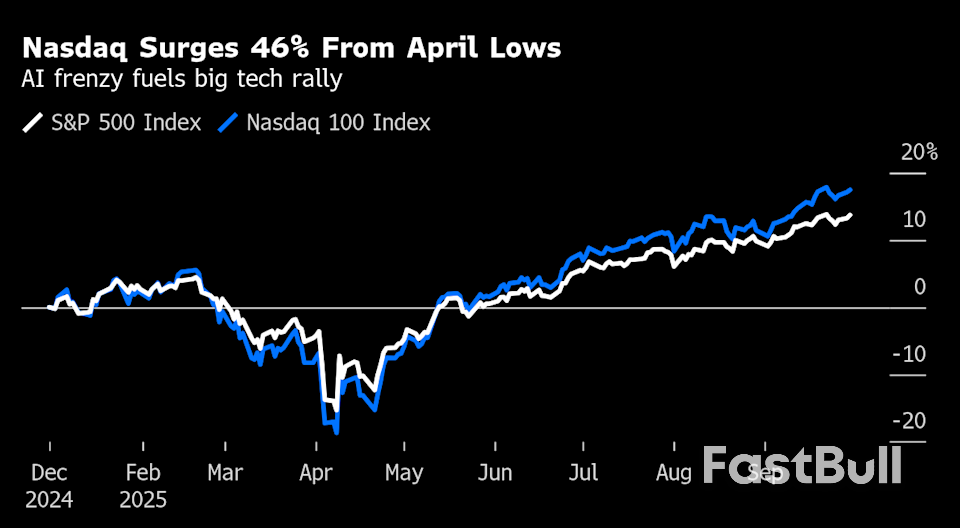
          The Nasdaq 100 (^NDX) is most vulnerable to the threat, after soaring 46% from its April lows thanks to resurgent enthusiasm around advances in artificial intelligence. The tech-heavy benchmark set its latest record on Monday after Advanced Micro Devices Inc.’s (AMD) blockbuster deal with OpenAI (OPAI.PVT).
          “Profit-taking risks have rapidly risen across markets, and are particularly elevated for Nasdaq, potentially hampering further upside,” the Citi team led by Chris Montagu wrote in a note.
          Citi’s Montagu Warns US Tech Rally at Risk From Profit Taking_1
          Optimism over AI keeps propelling the stock market to new highs, eclipsing concerns such as the US government shutdown or the lingering threat to the economy from trade tariffs. The Nasdaq 100 has already closed at a record 30 times this year through Monday, according to data compiled by Bloomberg. Last year, the benchmark set 45 closing peaks.
          For the moment, investors continue to add to wagers on stock market gains.
          Goldman Sachs Group Inc.’s (GS) trading desk reported last week that bullish sentiment among the firm’s clients is the highest since December, with 40% of those surveyed expecting the S&P 500 (^GSPC) to outperform this month. A sentiment tracker compiled by Barclays Plc (BCS) has been sitting near a level that indicates exuberance. A similar Bloomberg Intelligence measure is back to a “manic” zone that’s preceded lukewarm returns in the past.
          Citi’s latest weekly snapshot showed risk flows resumed for US equities, with new long positioning taking the upper hand, the bank’s strategists wrote. “Bullish positioning on both large and small caps is on the rise,” they said.

          Source: Bloomberg

          To stay updated on all economic events of today, please check out our Economic calendar
          Risk Warnings and Disclaimers
          You understand and acknowledge that there is a high degree of risk involved in trading. Following any strategies or investment methods may lead to potential losses. The content on the site is provided by our contributors and analysts for information purposes only. You are solely responsible for determining whether any trading assets, securities, strategy, or any other product is suitable for investing based on your own investment objectives and financial situation.
          Add to Favorites
          Share
          FastBull
          Copyright © 2025 FastBull Ltd

          728 RM B 7/F GEE LOK IND BLDG NO 34 HUNG TO RD KWUN TONG KLN HONG KONG

          TelegramInstagramTwitterfacebooklinkedin
          App Store Google Play Google Play
          Products
          Charts

          Chats

          Q&A with Experts
          Screeners
          Economic Calendar
          Data
          Tools
          Membership
          Features
          Function
          Markets
          Copy Trading
          Latest Signals
          Contests
          News
          Analysis
          24/7
          Columns
          Education
          Company
          Careers
          About Us
          Contact Us
          Advertising
          Help Center
          Feedback
          User Agreement
          Privacy Policy
          Business

          White Label

          Data API

          Web Plug-ins

          Poster Maker

          Affiliate Program

          Risk Disclosure

          The risk of loss in trading financial instruments such as stocks, FX, commodities, futures, bonds, ETFs and crypto can be substantial. You may sustain a total loss of the funds that you deposit with your broker. Therefore, you should carefully consider whether such trading is suitable for you in light of your circumstances and financial resources.

          No decision to invest should be made without thoroughly conducting due diligence by yourself or consulting with your financial advisors. Our web content might not suit you since we don't know your financial conditions and investment needs. Our financial information might have latency or contain inaccuracy, so you should be fully responsible for any of your trading and investment decisions. The company will not be responsible for your capital loss.

          Without getting permission from the website, you are not allowed to copy the website's graphics, texts, or trademarks. Intellectual property rights in the content or data incorporated into this website belong to its providers and exchange merchants.

          Not Logged In

          Log in to access more features

          FastBull Membership

          Not yet

          Purchase

          Become a signal provider
          Help Center
          Customer Service
          Dark Mode
          Price Up/Down Colors

          Log In

          Sign Up
          Position
          Layout
          Fullscreen
          Default to Chart
          The chart page opens by default when you visit fastbull.com