Markets
News
Analysis
User
24/7
Economic Calendar
Education
Data
- Names
- Latest
- Prev


Signal Accounts for Members
All Signal Accounts
All Contests


France Industrial Output MoM (SA) (Oct)A:--
F: --
France Trade Balance (SA) (Oct)A:--
F: --
Euro Zone Employment YoY (SA) (Q3)A:--
F: --
Canada Part-Time Employment (SA) (Nov)A:--
F: --
P: --
Canada Unemployment Rate (SA) (Nov)A:--
F: --
P: --
Canada Full-time Employment (SA) (Nov)A:--
F: --
P: --
Canada Labor Force Participation Rate (SA) (Nov)A:--
F: --
P: --
Canada Employment (SA) (Nov)A:--
F: --
P: --
U.S. PCE Price Index MoM (Sept)A:--
F: --
P: --
U.S. Personal Income MoM (Sept)A:--
F: --
P: --
U.S. Core PCE Price Index MoM (Sept)A:--
F: --
P: --
U.S. PCE Price Index YoY (SA) (Sept)A:--
F: --
P: --
U.S. Core PCE Price Index YoY (Sept)A:--
F: --
P: --
U.S. Personal Outlays MoM (SA) (Sept)A:--
F: --
U.S. 5-10 Year-Ahead Inflation Expectations (Dec)A:--
F: --
P: --
U.S. Real Personal Consumption Expenditures MoM (Sept)A:--
F: --
U.S. Weekly Total Rig CountA:--
F: --
P: --
U.S. Weekly Total Oil Rig CountA:--
F: --
P: --
U.S. Consumer Credit (SA) (Oct)A:--
F: --
China, Mainland Foreign Exchange Reserves (Nov)A:--
F: --
P: --
Japan Trade Balance (Oct)A:--
F: --
P: --
Japan Nominal GDP Revised QoQ (Q3)A:--
F: --
P: --
China, Mainland Imports YoY (CNH) (Nov)A:--
F: --
P: --
China, Mainland Exports (Nov)A:--
F: --
P: --
China, Mainland Imports (CNH) (Nov)A:--
F: --
P: --
China, Mainland Trade Balance (CNH) (Nov)A:--
F: --
P: --
China, Mainland Exports YoY (USD) (Nov)A:--
F: --
P: --
China, Mainland Imports YoY (USD) (Nov)A:--
F: --
P: --
Germany Industrial Output MoM (SA) (Oct)A:--
F: --
Euro Zone Sentix Investor Confidence Index (Dec)A:--
F: --
P: --
Canada National Economic Confidence Index--
F: --
P: --
U.K. BRC Like-For-Like Retail Sales YoY (Nov)--
F: --
P: --
U.K. BRC Overall Retail Sales YoY (Nov)--
F: --
P: --
Australia Overnight (Borrowing) Key Rate--
F: --
P: --
RBA Rate Statement
RBA Press Conference
Germany Exports MoM (SA) (Oct)--
F: --
P: --
U.S. NFIB Small Business Optimism Index (SA) (Nov)--
F: --
P: --
Mexico 12-Month Inflation (CPI) (Nov)--
F: --
P: --
Mexico Core CPI YoY (Nov)--
F: --
P: --
Mexico PPI YoY (Nov)--
F: --
P: --
U.S. Weekly Redbook Index YoY--
F: --
P: --
U.S. JOLTS Job Openings (SA) (Oct)--
F: --
P: --
China, Mainland M1 Money Supply YoY (Nov)--
F: --
P: --
China, Mainland M0 Money Supply YoY (Nov)--
F: --
P: --
China, Mainland M2 Money Supply YoY (Nov)--
F: --
P: --
U.S. EIA Short-Term Crude Production Forecast For The Year (Dec)--
F: --
P: --
U.S. EIA Natural Gas Production Forecast For The Next Year (Dec)--
F: --
P: --
U.S. EIA Short-Term Crude Production Forecast For The Next Year (Dec)--
F: --
P: --
EIA Monthly Short-Term Energy Outlook
U.S. API Weekly Gasoline Stocks--
F: --
P: --
U.S. API Weekly Cushing Crude Oil Stocks--
F: --
P: --
U.S. API Weekly Crude Oil Stocks--
F: --
P: --
U.S. API Weekly Refined Oil Stocks--
F: --
P: --
South Korea Unemployment Rate (SA) (Nov)--
F: --
P: --
Japan Reuters Tankan Non-Manufacturers Index (Dec)--
F: --
P: --
Japan Reuters Tankan Manufacturers Index (Dec)--
F: --
P: --
Japan Domestic Enterprise Commodity Price Index MoM (Nov)--
F: --
P: --
Japan Domestic Enterprise Commodity Price Index YoY (Nov)--
F: --
P: --
China, Mainland PPI YoY (Nov)--
F: --
P: --
China, Mainland CPI MoM (Nov)--
F: --
P: --


No matching data
Latest Views
Latest Views
Trending Topics
Top Columnists
Latest Update
White Label
Data API
Web Plug-ins
Affiliate Program
View All

No data
Investors are confident that the Federal Reserve will lower its policy interest rate on Wednesday for the first time this year.
Investors are confident that the Federal Reserve will lower its policy interest rate on Wednesday for the first time this year. Recent data support a modest cut, but the Fed would be wise to avoid signaling more reductions to come or pivoting decisively toward easing. For now, the data is too muddled for any such shift, and the central bank needs to keep an open mind.
The labor market is weaker than the Fed believed when its policymakers last met. Recent data revisions give much lower estimates of employment for the year to March, while the latest weekly jobless claims showed an increase to 263,000, the highest in four years. Those numbers are notoriously noisy, but the jobs market is plainly weakening.
That might seem to call for strong monetary stimulus. The problem is that inflation isn’t yet credibly on track toward the Fed’s 2% target. In August, the consumer price index excluding food and energy — so-called core CPI — rose 0.3%, for a year-over-year increase of 3.1%. This was roughly as expected, and it gave investors no reason to doubt that the policy rate would be trimmed this week. The fact remains: Higher-than-target inflation is stubbornly refusing to subside.
The Fed continues to assume that, at 4.25% to 4.5%, the current policy rate is gently tamping demand, enough to bring inflation back to target in due course. Maybe so. But again, caution is warranted. The neutral rate of interest — the level that neither adds to nor subtracts from demand — is unknown, one of many uncertainties clouding the outlook.
In particular, new tariffs don’t yet seem to be driving inflation higher: Importers are mostly absorbing the higher costs. That’s unlikely to last. Uncertainty over future tariffs, moreover, may itself prove to be inflationary, if it dents confidence enough to suppress supply more than demand. The administration’s crackdown on illegal immigration is yet another supply-side shock — and one that makes measures of labor-market tightness especially hard to read. Sluggish employment might reflect a shrinking supply of labor as much as a shortfall in demand.
A persistent combination of faltering supply and above-target inflation, otherwise known as stagflation, is a real possibility under these conditions. It’s a scenario that the Fed is ill-equipped to manage. The central bank’s dual mandate calls for maximum employment and stable prices — and stagflation means it cannot achieve both. Striking the right balance is especially difficult if its operational independence is in question, as it now is. The stage is set for rising inflation expectations, higher long-term borrowing costs and, eventually, an abrupt tightening of policy to get prices back under control.
For the moment, expectations seem reasonably well-anchored, a tribute to the Fed’s credibility, given the turbulence it’s being asked to navigate. In the meantime, the balance between labor-market cooling and persistent inflation has shifted — enough to warrant a quarter-point cut in the policy rate. A bigger cut, let alone promises of more to come, would be a mistake.
Investor confidence in Germany’s economic prospects unexpectedly improved in September, supporting hopes that Europe’s largest economy is leaving behind a prolonged downturn.
An expectations index by the ZEW institute rose to 37.3 from 34.7 the previous month. Analysts in a Bloomberg survey had expected another decline to 25 following a sharp drop in August. A measure of current conditions deteriorated as expected.
“Financial market experts are cautiously optimistic and the ZEW indicator has stabilized, but the economic situation has worsened,” ZEW President Achim Wambach said in a statement. “There are still considerable risks, as uncertainty about the US tariff policy and Germany’s ‘autumn of reforms’ continues.”
ZEW highlighted that the outlook improved in particular for export-oriented industries, in particular the automotive sector, the chemical and pharmaceutical industry and the metal sector.
After a strong start to the year, Germany’s economy has run into trouble, recording a 0.3% contraction in the second quarter in a blow to Chancellor Friedrich Merz. Output shrank in 2024 and 2023, weighed down by weak global demand and long-standing issues like aging workers and too much red tape.
Analysts expect it to gain momentum in the coming quarters thanks to higher government spending and lower European Central Bank interest rates. But some still worry that Germany is yet to feel the full force of higher US tariffs.
Business confidence improved in August, with an expectations index by the Ifo institute even hitting the highest since 2022. Recent hard data has been mixed: Industrial production increased more than expected in July, while factory orders slumped.
Key Points:
Bitcoin's rare technical signal, historically linked to price surges, emerges as institutional funds reach $100 billion in assets under management after ETF approval in January 2025.
This rare signal's emergence suggests a potential 40% price increase, significantly impacting Bitcoin's market position and fostering bullish sentiment amidst strong institutional participation.
Bitcoin has shown a rare technical signal historically linked to price surges. Past similar setups resulted in significant value increases, with key previous levels marked at $76K, $49K, and $16K, according to historical Bitcoin data. Institutional involvement reinforces market confidence.
Major institutional actors are accumulating Bitcoin following the ETF debut in 2025. These institutions now hold substantial Bitcoin amounts, showing growing confidence. BlackRock emphasizes Bitcoin's role in diversified portfolios, highlighting its acceptance as a store-of-value asset.
This signal is affecting the cryptocurrency market, particularly Bitcoin. Institutional acquisition of 120,000 BTC since ETF approval marks a notable shift. ETF assets have reached $100B, demonstrating Bitcoin's increasing legitimacy in global finance. https://x.com/magacoinfinance
The financial landscape shifts as institutional flows elevate Bitcoin's position. Ethereum and altcoins might exhibit correlated movements but are not currently driven by Bitcoin’s technical signal. Blockchain exchanges observe reduced balances, noting strong institutional holding.
Expert analysis aligns with historical trends, where past signals like the golden cross led to substantial price increases. The current signal might result in a potential 40% surge, supported by strong institutional backing and .
Bitcoin's surge potential from this signal underlines the importance of institutional influence in the cryptocurrency market. On-chain data, including exchange balances and HODL waves, strongly suggest a bullish price scenario, marking a pivotal moment for investors.
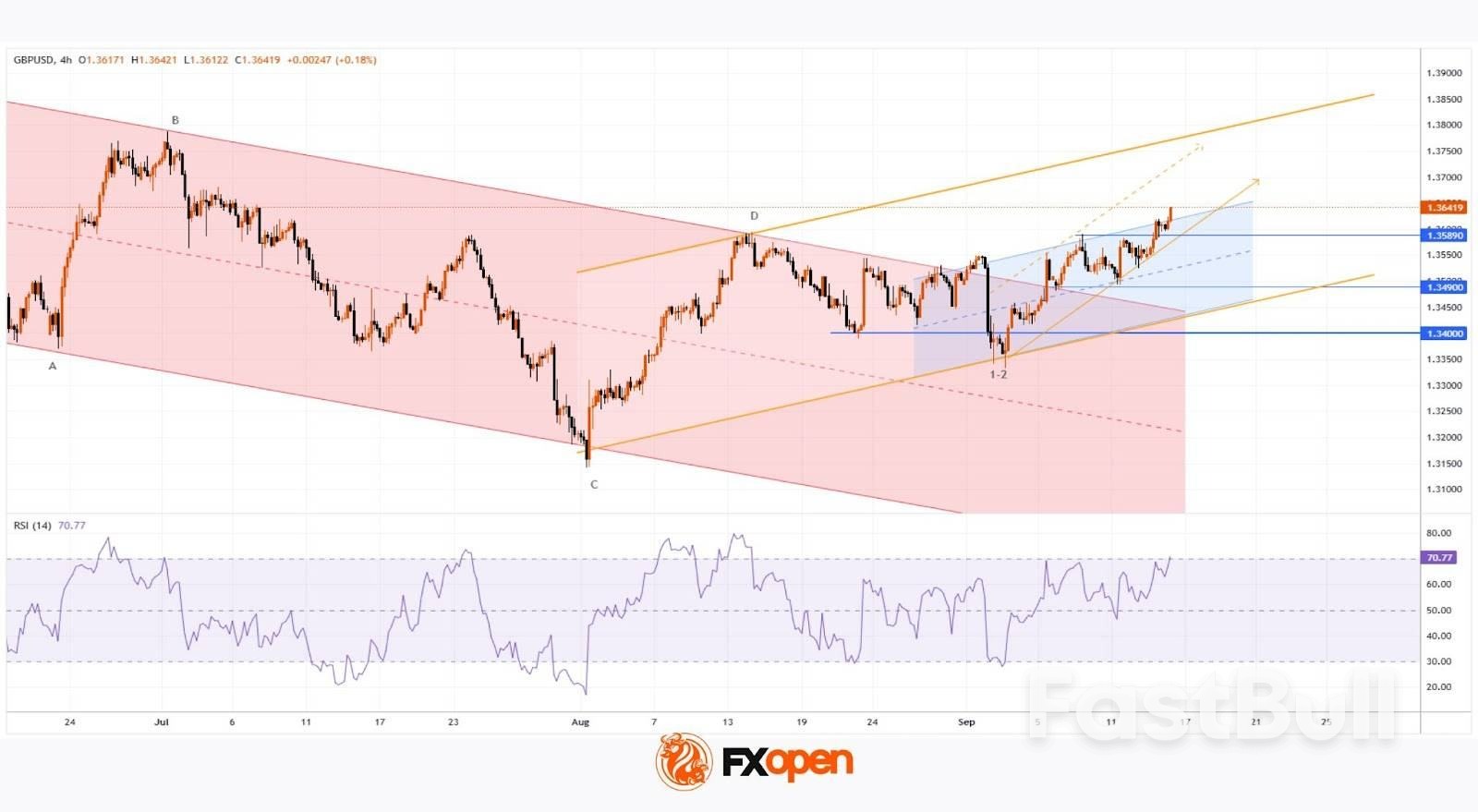
As the GBP/USD chart shows, the pair is trading this morning above 1.3620 – its highest level since the beginning of July.
The bullish sentiment is driven by the divergence in central bank policies:
→ United States: Traders are betting on an interest rate cut, supported by President Trump. The Federal Reserve will announce its decision tomorrow at 21:00 GMT+3, and the market expects a reduction of at least 0.25%, from 4.25%–4.50% to 4.00%–4.25%.
→ United Kingdom: Traders anticipate the rate will remain at 4.00%. The Bank of England will announce its decision on Thursday at 14:00 GMT+3.
Although the rates of the two central banks are comparable, the situation differs: in the UK, inflation is more persistent and rate cuts are seen as risky, while in the US, President Trump is exerting pressure on the Fed’s leadership.An additional boost for the pound comes from a wave of investment optimism linked to US President Donald Trump’s state visit to the UK. According to media reports, agreements worth around $10 billion are expected to be announced during the visit.

Looking at the price movements earlier this month, we noted lower highs and lower lows forming a bearish A→B→C→D structure. We also assumed that:
→ bulls could rely on support at the psychological level of 1.3400;
→ but if bearish pressure intensified, GBP/USD could fall towards the median of the descending channel.
Since then, the situation has changed considerably: bears failed to consolidate below 1.3400, and after a bullish double bottom pattern (1–2) formed, the price surged upwards.
At the same time, the GBP/USD chart highlights key signs of strong demand:
→ the descending (red) channel has been broken, and the bearish A→B→C→D structure is no longer relevant;
→ higher highs and higher lows confirm buyer dominance – providing grounds to outline a rising (blue) channel.
On the other hand, the RSI indicator is close to overbought territory, which suggests a possible pullback.
Potential support levels:
→ 1.34900: the breakout point where bulls started their advance;
→ 1.35890: a level that lost its resistance role this week;
→ the upper boundary and median of the blue ascending channel.
Taking all this into account, we could assume that in the near term, bulls may aim to lift GBP/USD towards the upper boundary of the yellow channel. It is also possible that news from the Fed and the Bank of England will aid them on this path.
White Label
Data API
Web Plug-ins
Poster Maker
Affiliate Program
The risk of loss in trading financial instruments such as stocks, FX, commodities, futures, bonds, ETFs and crypto can be substantial. You may sustain a total loss of the funds that you deposit with your broker. Therefore, you should carefully consider whether such trading is suitable for you in light of your circumstances and financial resources.
No decision to invest should be made without thoroughly conducting due diligence by yourself or consulting with your financial advisors. Our web content might not suit you since we don't know your financial conditions and investment needs. Our financial information might have latency or contain inaccuracy, so you should be fully responsible for any of your trading and investment decisions. The company will not be responsible for your capital loss.
Without getting permission from the website, you are not allowed to copy the website's graphics, texts, or trademarks. Intellectual property rights in the content or data incorporated into this website belong to its providers and exchange merchants.
Not Logged In
Log in to access more features

FastBull Membership
Not yet
Purchase
Log In
Sign Up